
All Topics  
Triassic


   Email Print
   Bookmark   Link


Triassic


The Triassic is a geologic period and system that extends from about 251 to 199 Mya
Annum

Annum is one form of the Latin noun meaning year, not a form normally used for derivatives in modern languages: the accusative case Grammatical number of the second declension grammatical gender noun annus , anni ....
 (million years ago). As the first period of the Mesozoic
Mesozoic

The Mesozoic Era is one of three Geologic time scale of the Phanerozoic eon . The division of time into eras dates back to Giovanni Arduino, in the 18th century, although his original name for the era now called the 'Mesozoic' was 'Secondary' ....
 Era, the Triassic follows the Permian
Permian

The PermianThe term "Permian" was introduced into geology in 1841 by Sir Roderick Murchison, president of the Geological Society of London, who identified typical strata in extensive Russian explorations undertaken with Edouard de Verneuil; Murchison asserted in 1841 that he named his "Permian system" after the ancient kingdom...
 and is followed by the Jurassic
Jurassic

The Jurassic is a geologic period that extends from about annum to  Ma, that is, from the end of the Triassic to the beginning of the Cretaceous....
. Both the start and end of the Triassic are marked by major extinction event
Extinction event

An extinction event is a sharp decrease in the number of species in a relatively short period of time. Mass extinctions affect most major taxonomy groups present at the time ? birds, mammals, reptiles, amphibians, fish, invertebrates and other simpler life forms....
s. The extinction event that closed the Triassic period has recently been more accurately dated, but as with most older geologic periods, the rock beds that define the start and end are well identified, but the exact dates of the start and end of the period are uncertain by a few million years.

During the Triassic, both marine and continental life show an adaptive radiation
Adaptive radiation

An adaptive radiation is a rapid evolutionary radiation characterized by an increase in the morphological and ecological diversity of a single, rapidly diversifying lineage....
 beginning from the starkly impoverished biosphere
Biosphere

The biosphere is the global sum of all ecosystems. From the broadest Geophysiology point of view, the biosphere is the global ecology system integrating all living beings and their relationships, including their interaction with the elements of the lithosphere, hydrosphere, and Earth's atmosphere....
 that followed the Permian-Triassic extinction
Permian-Triassic extinction event

The Permian?Triassic extinction event, informally known as the Great Dying, was an extinction event that occurred , forming the boundary between the Permian and Triassic geologic periods....
.


Discussion
Ask a question about 'Triassic'
Start a new discussion about 'Triassic'
Answer questions from other users
Full Discussion Forum


Recent Posts


Encyclopedia


The Triassic is a geologic period and system that extends from about 251 to 199 Mya
Annum

Annum is one form of the Latin noun meaning year, not a form normally used for derivatives in modern languages: the accusative case Grammatical number of the second declension grammatical gender noun annus , anni ....
 (million years ago). As the first period of the Mesozoic
Mesozoic

The Mesozoic Era is one of three Geologic time scale of the Phanerozoic eon . The division of time into eras dates back to Giovanni Arduino, in the 18th century, although his original name for the era now called the 'Mesozoic' was 'Secondary' ....
 Era, the Triassic follows the Permian
Permian

The PermianThe term "Permian" was introduced into geology in 1841 by Sir Roderick Murchison, president of the Geological Society of London, who identified typical strata in extensive Russian explorations undertaken with Edouard de Verneuil; Murchison asserted in 1841 that he named his "Permian system" after the ancient kingdom...
 and is followed by the Jurassic
Jurassic

The Jurassic is a geologic period that extends from about annum to  Ma, that is, from the end of the Triassic to the beginning of the Cretaceous....
. Both the start and end of the Triassic are marked by major extinction event
Extinction event

An extinction event is a sharp decrease in the number of species in a relatively short period of time. Mass extinctions affect most major taxonomy groups present at the time ? birds, mammals, reptiles, amphibians, fish, invertebrates and other simpler life forms....
s. The extinction event that closed the Triassic period has recently been more accurately dated, but as with most older geologic periods, the rock beds that define the start and end are well identified, but the exact dates of the start and end of the period are uncertain by a few million years.

During the Triassic, both marine and continental life show an adaptive radiation
Adaptive radiation

An adaptive radiation is a rapid evolutionary radiation characterized by an increase in the morphological and ecological diversity of a single, rapidly diversifying lineage....
 beginning from the starkly impoverished biosphere
Biosphere

The biosphere is the global sum of all ecosystems. From the broadest Geophysiology point of view, the biosphere is the global ecology system integrating all living beings and their relationships, including their interaction with the elements of the lithosphere, hydrosphere, and Earth's atmosphere....
 that followed the Permian-Triassic extinction
Permian-Triassic extinction event

The Permian?Triassic extinction event, informally known as the Great Dying, was an extinction event that occurred , forming the boundary between the Permian and Triassic geologic periods....
. Corals of the hexacorallia
Hexacorallia

Hexacorallia is a subclass of the class Anthozoa within the phylum Cnidaria. It can be distinguished from the other anthozoan subclass by the number of tentacles each polyp possess ....
 group made their first appearance. The first flowering plants (angiosperms) may have evolved during the Triassic, as did the first flying vertebrates, the pterosaur
Pterosaur

Pterosaurs were flying reptiles of the clade or Order Pterosauria. They existed from the late Triassic to the end of the Cretaceous Period . Pterosaurs are the earliest vertebrates known to have evolved powered flight....
s.

Dating and subdivisions

The Triassic was named in 1834 by Friedrich Von Alberti from the three distinct layers (Latin trias meaning triad)—red beds, capped by chalk
Chalk

Chalk is a soft, white, porous sedimentary rock, a form of limestone composed of the mineral calcite. It forms under relatively deep marine conditions from the gradual accumulation of minute calcite plates shed from micro-organisms called coccolithophores....
, followed by black shale
Shale

Shale is a fine-grained sedimentary rock whose original constituents were clay minerals or muds. It is characterized by thin laminae breaking with an irregular curving fracture, often splintery and usually parallel to the often-indistinguishable bedding plane....
s—that are found throughout Germany
Germany

Germany , officially the Federal Republic of Germany , is a country in Central Europe. It is bordered to the north by the North Sea, Denmark, and the Baltic Sea; to the east by Poland and the Czech Republic; to the south by Austria and Switzerland; and to the west by France, Luxembourg, Belgium, and the Netherlands....
 and northwest Europe
Europe

Europe is, conventionally, one of the world's seven continents. Comprising the westernmost peninsula of Eurasia, Europe is generally divided from Asia to its east by the water divide of the Ural Mountains, the Ural , the Caspian Sea, and by the Caucasus Mountains to the southeast....
, called the 'Trias'.

The Triassic is usually separated into Early
Early Triassic

The Early Triassic is the first of three epoch s of the Triassic period . It spans the time between 251 ? 0.4 annum and 245 ? 1.5 Ma . The Permian-Triassic extinction event spawned the Triassic period....
, Middle
Middle Triassic

The Middle Triassic is the second of three epoch s of the Triassic geological timescale. It spans the time between 245 ? 1.5 annum and 228 ? 2 Ma . The Middle Triassic is divided into the Anisian and Ladinian faunal stages....
, and Late Triassic
Late Triassic

The Late Triassic is in the geologic timescale the third and final of three epoch s of the Triassic geological timescale. The corresponding series is known as the Upper Triassic....
 Epochs, and the corresponding rocks are referred to as Lower, Middle, or Upper Triassic. The faunal stages from the youngest to oldest are:

Upper/Late Triassic
Late Triassic

The Late Triassic is in the geologic timescale the third and final of three epoch s of the Triassic geological timescale. The corresponding series is known as the Upper Triassic....
 (Tr3)
  Rhaetian
Rhaetian

PaleogeographyAt this stage, Pangaea began to break-up, though the Atlantic Ocean was not yet formed....
(203.6 ± 1.5 – 199.6 ± 0.6 Ma
Annum

Annum is one form of the Latin noun meaning year, not a form normally used for derivatives in modern languages: the accusative case Grammatical number of the second declension grammatical gender noun annus , anni ....
)
  Norian
Norian

The Norian Stage was a portion of the Triassic geological period. It dates from 216.5 ? 2.0 to 203.6 ? 1.5 Mya . It was preceded by the Carnian Stage and succeeded by the Rhaetian Stage....
(216.5 ± 2.0 – 203.6 ± 1.5 Ma)
  Carnian
Carnian

The Carnian is the lowermost stage of the Upper Triassic series . Its boundaries are not characterized by major extinctions or biotic turnovers, but a climatic event occurred during the Carnian and seems to be associated with important extinctions or biotic radiations....
(228.0 ± 2.0 – 216.5 ± 2.0 Ma)
Middle Triassic
Middle Triassic

The Middle Triassic is the second of three epoch s of the Triassic geological timescale. It spans the time between 245 ? 1.5 annum and 228 ? 2 Ma . The Middle Triassic is divided into the Anisian and Ladinian faunal stages....
 (Tr2)
  Ladinian
Ladinian

The Ladinian is a faunal stage of the Middle Triassic epoch . It spans the time between 237 ? 2 annum and 228 ? 2 Ma . The Ladinian was preceded by the Anisian Stage and succeeded by the Carnian Stage of the Late Triassic Period....
(237.0 ± 2.0 – 228.0 ± 2.0 Ma)
  Anisian
Anisian

In the geologic timescale, the Anisian is the geologic age of the Middle Triassic geologic epoch and lasted from 245 million years ago until 237 million years ago, approximately....
(245.0 ± 1.5 – 237.0 ± 2.0 Ma)
Lower/Early Triassic
Early Triassic

The Early Triassic is the first of three epoch s of the Triassic period . It spans the time between 251 ? 0.4 annum and 245 ? 1.5 Ma . The Permian-Triassic extinction event spawned the Triassic period....
 (Scythian)
  Olenekian
Olenekian

The Olenekian is a faunal stage of the Early Triassic epoch . It spans the time between 249.7 ? 0.7 annum and 245 ? 0.7 Ma . The Olenekian is divided into the Smithian and the Spathian age....
(249.7 ± 0.7 – 245.0 ± 1.5 Ma)
  Induan
Induan

The Induan is the first faunal stage of the Early Triassic epoch . It spans the time between 251 ? 0.4 annum and 249.7 ? 0.7 Ma . This stage follows the Permian-Triassic extinction event of the late Permian period....
(251.0 ± 0.4 – 249.7 ± 0.7 Ma)


Paleogeography

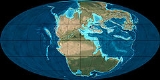
During the Triassic, almost all the Earth's land mass was concentrated into a single supercontinent
Supercontinent

In geology, a supercontinent is a landmass comprising more than one continental core, or craton. The assembly of cratons and terrane that form Eurasia qualifies as a supercontinent today....
 centered more or less on the equator, called Pangaea
Pangaea

Pangaea, Pang?a or Pangea was the supercontinent that existed during the Paleozoic and Mesozoic eras about 250 million years ago, before the component continents were separated into their current configuration....
 ("all the land"). From the east a vast gulf entered Pangaea, the Tethys sea
Tethys Ocean

The Tethys Ocean was an ocean that existed between the continents of Gondwana and Laurasia during the Mesozoic era before the opening of the Indian Ocean....
. It opened farther westward in the mid-Triassic, at the expense of the shrinking Paleo-Tethys Ocean
Paleo-Tethys Ocean

The Paleo-Tethys Ocean was an ancient Paleozoic ocean. It was located between the paleocontinent Gondwana and the so called Hunic terranes. These are divided into the European Hunic and Asiatic Hunic ....
, an ocean that existed during the Paleozoic
Paleozoic

The Paleozoic or Palaeozoic Era is the earliest of three geology Era of the Phanerozoic Eon . The Paleozoic spanned from roughly , and is subdivided into six period ; from oldest to youngest they are: the Cambrian, Ordovician, Silurian, Devonian period, Carboniferous, and Permian...
. The remaining shores were surrounded by the world-ocean known as Panthalassa
Panthalassa

Panthalassa , also known as the Panthalassic Ocean, was the vast global ocean that surrounded the supercontinent Pangaea, during the late Paleozoic and the early Mesozoic eras....
 ("all the sea"). All the deep-ocean sediments laid down during the Triassic have disappeared through subduction
Subduction

In geology, subduction is the process that takes place at convergent boundary by which one tectonic plate moves under another tectonic plate, sinking into the Earth's mantle, as the plates converge....
 of oceanic plates; thus, very little is known of the Triassic open ocean. The supercontinent Pangaea was rifting during the Triassic—especially late in the period—but had not yet separated. The first nonmarine sediments in the rift
Rift

In geology, a rift is a place where the Earth's Crust and lithosphere are being pulled apart and is an example of extensional tectonics.Typical rift features are a central linear downdropped geologic fault segment, called a graben, with parallel normal faulting and rift-flank uplifts on either side forming a rift valley, where the rift r...
 that marks the initial break-up of Pangea—which separated New Jersey
New Jersey

New Jersey is a state in the Mid-Atlantic States and Northeastern United States regions of the United States. It is bordered on the north by New York, on the east by the Hudson River and the Atlantic Ocean, on the southwest by Delaware, and on the west by Pennsylvania....
 from Morocco
Morocco

Morocco , officially the Kingdom of Morocco , is a country located in North Africa with a population of nearly 34 million and an area just under 447,000 km2....
—are of Late Triassic age; in the U.S., these thick sediments comprise the Newark Group
Newark Group

The Newark Group, also known as the Newark Supergroup, is an assemblage of Triassic sedimentary rocks which outcrop intermittently along the United States East Coast of the United States; the exposures extend from Massachusetts to North Carolina, with more still in Nova Scotia....
. Because of the limited shoreline of one super-continental mass, Triassic marine deposits are globally relatively rare, despite their prominence in Western Europe
Western Europe

Western Europe refers to the countries in the western most half of Europe. This concept has had different meanings, political and cultural as well as geographical issues have influenced the area....
, where the Triassic was first studied. In North America
North America

North America is the northern continent of the Americas, situated in the Earth's northern hemisphere and almost totally in the western hemisphere....
, for example, marine deposits are limited to a few exposures in the west. Thus Triassic stratigraphy
Stratigraphy

Stratigraphy, a branch of geology, studies rock layers and layering . It is primarily used in the study of sedimentary rock and layered volcanic rocks....
 is mostly based on organisms living in lagoons and hypersaline environments, such as Estheria crustaceans.

Climate

The Triassic climate was generally hot and dry, forming typical red bed
Red beds

The term red beds usually refers to stratum of reddish-colored sedimentary rocks such as sandstone, siltstone or shale that were deposited in hot climates under oxidation conditions....
 sandstone
Sandstone

Sandstone is a sedimentary rock composed mainly of sand-size mineral or rock Particle size . Most sandstone is composed of quartz and/or feldspar because these are the most common minerals in the Earth's crust ....
s and evaporite
Evaporite

Evaporites are water-soluble mineral sedimentary rock that result from the evaporation of bodies of surficial water. Evaporites are considered sedimentary rocks....
s. There is no evidence of glaciation
Glacier

A glacier is a large, slow-moving mass of ice, formed from compacted layers of snow, that slowly deforms and flows in response to gravity and high pressure....
 at or near either pole; in fact, the polar regions were apparently moist and temperate
Temperate

In geography, temperate or tepid latitudes of the globe lie between the tropics and the polar circles. The changes in these regions between summer and winter are generally mild, rather than extreme hot or cold....
, a climate suitable for reptile-like creatures. Pangaea's large size limited the moderating effect of the global ocean; its continental climate
Continental climate

Continental climate is a climate that is characterized by winter temperatures cold enough to support a fixed period of snow cover each year, and relatively moderate precipitation occurring mostly in summer, although east coast areas may show an even distribution of precipitation....
 was highly seasonal, with very hot summers and cold winters. It probably had strong, cross
Cross

A cross is a geometrical figure consisting of two lines or bars perpendicular to each other, dividing one or two of the lines in half. The lines usually run vertically and horizontally; if they run diagonally, the design is technically termed a saltire....
-equator
Equator

The equator is the intersection of the Earth's surface with the Plane perpendicular to the Earth's rotation and containing the Earth's center of mass....
ial monsoons.

Life

Three categories of organisms can be distinguished in the Triassic record: holdovers from the Permian-Triassic extinction, new groups which flourished briefly, and other new groups which went on to dominate the Mesozoic
Mesozoic

The Mesozoic Era is one of three Geologic time scale of the Phanerozoic eon . The division of time into eras dates back to Giovanni Arduino, in the 18th century, although his original name for the era now called the 'Mesozoic' was 'Secondary' ....
 world.

In marine environments
Ocean

An ocean is a major body of Seawater, and a principal component of the hydrosphere. Approximately 71% of the Earth's surface is covered by ocean, a World Ocean that is customarily divided into several principal oceans and smaller seas....
, new modern types of corals appeared in the Early Triassic, forming small patches of reefs of modest extent compared to the great reef systems of Devonian
Devonian

The Devonian is a geologic period of the Paleozoic era spanning from . It is named after Devon, England, where rocks from this period were first studied....
 times or modern reefs. The shelled cephalopod
Cephalopod

The cephalopods are the mollusc class Cephalopoda characterized by bilateral symmetry, a prominent head, and a modification of the mollusk foot, a muscular hydrostat, into the form of cephalopod arms or tentacles....
s called ammonite
Ammonite

Ammonites are an Extinction group of marine animals of the Subclass Ammonoidea in the class Cephalopoda, phylum Mollusca. They are excellent index fossils, and it is often possible to link the rock layer in which they are found to specific Geologic time scale....
s recovered, diversifying from a single line that survived the Permian extinction. The fish fauna was remarkably uniform, reflecting the fact that very few families survived the Permian extinction. There were also many types of marine reptiles. These included the Sauropterygia
Sauropterygia

Sauropterygia is a group of very successful aquatic reptiles that flourished during the Mesozoic before they became extinct. They are united by a radical adaptation of their shoulder, designed to support powerful flipper strokes....
, which featured pachypleurosaur
Pachypleurosaur

Pachypleurosaurs were primitive sauropterygian reptiles that vaguely resembled aquatic lizards, and were limited to the Triassic period. They were elongate animals, ranging in size from 20 cm to about a meter in length, with small heads, long necks, paddle-like limbs, and long deep tails....
s and nothosaur
Nothosaur

Nothosaurs were Triassic marine sauropterygian reptiles that may have lived like pinniped of today, catching food in water but coming ashore on rocks and beaches....
s (both common during the Middle Triassic, especially in the Tethys
Tethys Ocean

The Tethys Ocean was an ocean that existed between the continents of Gondwana and Laurasia during the Mesozoic era before the opening of the Indian Ocean....
 region), placodont
Placodont

Placodonts were a group of marine reptiles that lived during the Triassic period, becoming extinct at the end of the period. It is believed that they were related to the Sauropterygia, the group that includes Plesiosaurs....
s, and the first plesiosaur
Plesiosaur

Plesiosaurs were carnivore aquatic reptiles. After their discovery, they were somewhat fancifully said to have resembled , although they had no shell....
s; the first of the lizardlike Thalattosauria (askeptosaurs
Askeptosaurus

Askeptosaurus is an extinct genus of aquatic reptile related to the thalattosauria group. It was about 2 m long. Their remains have been found in Italy and Switzerland....
); and the highly successful ichthyosaur
Ichthyosaur

Ichthyosaurs were giant marine reptiles that resembled fish and dolphins. Ichthyosaurs thrived during much of the Mesozoic era; based on fossil evidence, they first appeared approximately 245 million years ago and disappeared about 90 million years ago, about 25 million years before the dinosaurs became extinct....
s, which appeared in Early Triassic seas and soon diversified, some eventually developing to huge size during the late Triassic.

On land, the holdover plants included the lycophytes, the dominant cycad
Cycad

File:Cycad cone.jpgCycads are a group of seed plants characterized by a large crown of compound Leaf and a stout trunk . They are evergreen, gymnospermous, dioecious plants having large pinnately compound leaves....
s, ginkgophyta (represented in modern times by Ginkgo biloba
Ginkgo

Ginkgo , frequently misspelled as "Gingko", and also known as the Maidenhair Tree after Adiantum, is a unique species of tree with no close living relatives....
) and glossopterid
Glossopteridales

Glossopteridales is an extinct order of plants belonging to Pteridospermatophyta, or Seed Ferns. They arose at the beginning of the Permian on the southern continent of Gondwana, but dwindled to extinction by the end of the Permian period....
s. The spermatophyte
Spermatophyte

The spermatophytes comprise those plants that produce seeds. They are a subset of the embryophytes or land plants. The living spermatophytes form five groups:...
s, or seed plants came to dominate the terrestrial flora: in the northern hemisphere, conifers flourished. Glossopteris
Glossopteris

Glossopteris is the largest and best-known genus of the Extinction Order of seed ferns known as Glossopteridales ....
 (a seed fern) was the dominant southern hemisphere tree during the Early Triassic period.

Temnospondyl
Temnospondyli

Temnospondyli are an important and extremely diverse taxon of small to giant Labyrinthodontia that flourished worldwide during the Carboniferous, Permian, and Triassic periods....
 amphibian
Amphibian

Amphibians , such as frogs, toads, salamanders, newts and caecilians, are cold-blooded animals that metamorphose from a juvenile, water-breathing form to an adult, air-breathing form....
s were among those groups that survived the Permian-Triassic extinction, some lineages (e.g. Trematosaurs) flourishing briefly in the Early Triassic, while others (e.g. capitosaurs) remained successful throughout the whole period, or only came to prominence in the Late Triassic (e.g. plagiosaurs, metoposaurs). As for other amphibians, the first Lissamphibia
Lissamphibia

The Subclass Lissamphibia includes all recent amphibians.Extant amphibians fall into one of three orders - the Anura , the Caudata or Urodela , and the Gymnophiona or Apoda ....
 are known from the Early Triassic, but the group as a whole did not become common until the Jurassic
Jurassic

The Jurassic is a geologic period that extends from about annum to  Ma, that is, from the end of the Triassic to the beginning of the Cretaceous....
, when the temnospondyls had become very rare.

Archosauromorph
Archosauromorpha

Archosauromorpha is an Infraclass of diapsid reptiles that first appeared during the late Permian and became more common during the Triassic. Included in this infraclass are the orders Rhynchosauria, Trilophosauridae, Prolacertiformes, Archosauriformes, and, tentatively, the Choristodera....
 reptiles — especially archosaur
Archosaur

Archosaurs are a group of diapsid reptiles represented by modern birds and crocodilians. This group also includes extinct non-avian dinosaurs, pterosaurs and relatives of crocodiles....
s — progressively replaced the synapsid
Synapsid

Synapsids , also known as theropsids , are a class of animals that includes mammals and everything closer to mammals than to other living amniotes....
s that had dominated the Permian. Although Cynognathus
Cynognathus

Cynognathus was a metre-long predator of the Lower Triassic. It was one of the more mammal-like of the "mammal-like reptiles", a member of a grouping called Eucynodontia....
 was a characteristic top predator in earlier Triassic (Olenekian
Olenekian

The Olenekian is a faunal stage of the Early Triassic epoch . It spans the time between 249.7 ? 0.7 annum and 245 ? 0.7 Ma . The Olenekian is divided into the Smithian and the Spathian age....
 and Anisian
Anisian

In the geologic timescale, the Anisian is the geologic age of the Middle Triassic geologic epoch and lasted from 245 million years ago until 237 million years ago, approximately....
) Gondwana
Gondwana

Gondwana , originally Gondwanaland is the name given to a southern precursor-supercontinent and then as a remnant separated from Laurasia 180- during the breakup of the Pangaea supercontinent that existed about 500 to 200 Annum ago into two large segments.
, and both kannemeyeriid
Kannemeyeriidae

Kannemeyeriidae is a family of large, stocky, beaked and sometimes tusked dicynodonts, they were the dominant large terrestrial herbivorous through most of the Triassic....
 dicynodont
Dicynodont

The Dicynodontia are a taxon of Therapsids or mammal-like reptiles. Dicynodonts were small to large Herbivore animals with two tusks, hence their name, which means 'two dog tooth'....
s and gomphodont cynodont
Cynodont

Cynodonts, or 'dog teeth', are a taxon of Therapsids which includes modern mammals and their extinct close relatives. They were one of the most diverse groups of therapsids....
s remained important herbivore
Herbivore

Herbivory is a form of predation in which an organism, known as an herbivore, heterotrophs principally autotrophs such as plants, algae and photosynthesizing bacteria....
s during much of the period. By the end of the Triassic, synapsids played only bit parts. During the Carnian
Carnian

The Carnian is the lowermost stage of the Upper Triassic series . Its boundaries are not characterized by major extinctions or biotic turnovers, but a climatic event occurred during the Carnian and seems to be associated with important extinctions or biotic radiations....
 (early part of the Late Triassic), some advanced cynodont gave rise to the first mammals. At the same time the Ornithodira
Ornithodira

Ornithodira is a clade within the larger group Archosauria.In 1986 Jacques Gauthier coined the name for a node clade, containing the last common ancestor of the dinosaurs and the pterosaurs and all of its descendants....
, which until then had been small and insignificant, evolved into pterosaur
Pterosaur

Pterosaurs were flying reptiles of the clade or Order Pterosauria. They existed from the late Triassic to the end of the Cretaceous Period . Pterosaurs are the earliest vertebrates known to have evolved powered flight....
s and a variety of dinosaur
Dinosaur

Dinosaurs were the dominant vertebrate animals of Landform ecosystems for over 160 million years, from the late Triassic Period until the end of the Cretaceous Period , when most of them became extinct in the Cretaceous?Tertiary extinction event....
s. The Crurotarsi
Crurotarsi

The Crurotarsi are a group of Archosauria, whose name was erected as a Cladistics#Cladistic classification by Paul Sereno in 1991 to supplant the old term Pseudosuchia....
 were the other important archosaur clade
Clade

A clade is a term used in modern alpha taxonomy, the scientific classification of living and fossil organisms, to describe a monophyletic group, defined as a group consisting of a single common ancestor and all its descendants.The term "monophyletic group" is used in this article in the conventional sense of "an a...
, and during the Late Triassic these also reached the height of their diversity, with various groups including the phytosaur
Phytosaur

Phytosaurs - family Phytosauridae or Parasuchidae - were a group of large semi-aquatic predatory archosaurs that flourished during the Late Triassic Geologic period....
s, aetosaur
Aetosaur

File:Aetosaur, PFNP.jpgThe aetosaurs are an extinct clade of heavily armoured, medium- to large-sized Late Triassic herbivore archosaurs. Two distinct subdivisions of aeotosaurs are currently recognized, the Desmatosuchinae and the Aetosaurinae, based primarily on differences in the morphology of the bony scutes of the two groups ....
s, several distinct lineages of Rauisuchia
Rauisuchia

Rauisuchia are a poorly known assemblage of predatory and mostly large Triassic archosaurs. Originally it was believed that they were related to Erythrosuchidae, but it is now known that they are Crurotarsi....
, and the first crocodylians (the Sphenosuchia
Sphenosuchia

Sphenosuchia is the name of a suborder of basal crocodylomorphs that first appeared in the Triassic and occurred into the Middle Jurassic. Most were small, gracile animals with an erect limb posture....
). Meanwhile the stocky herbivorous rhynchosaur
Rhynchosaur

Rhynchosaurs were a group of unusual Triassic diapsid reptiles related to the Archosauria. They were herbivores, and at times abundant , with stocky bodies and a powerful beak....
s and the small to medium-sized insectivorous or piscivorous Prolacertiformes
Prolacertiformes

Prolacertiformes were an order of archosauromorpha reptiles that lived during the Permian and Triassic Periods. Many species seem to have been adapted for an arboreal lifestyle, including the "delta-winged glider" Sharovipteryx, while others, such as Tanystropheus, had extremely long, stiffened necks , and may have been at least part...
 were important basal
Basal (phylogenetics)

In phylogenetics, a basal clade is the earliest clade to branch in a larger clade; it appears at the base of a cladogram.A basal group form an outgroup to the rest of the clade, such as in the following example:...
 archosauromorph groups throughout most of the Triassic.

Among other reptiles, the earliest turtles
Chelonian

Chelonian has multiple, interrelated meanings:*Testudines, a member of the order of tortoises called Chelonia, also called Testudines*List of Doctor Who monsters and aliens#Chelonian, monsters from Doctor Who...
, like Proganochelys
Proganochelys

Proganochelys quenstedtii is the second oldest turtle species discovered to date, known only from fossils found in Germany and Thailand in strata from the late Triassic, dating to approximately 210 million years ago....
 and Proterochersis, appeared during the Norian
Norian

The Norian Stage was a portion of the Triassic geological period. It dates from 216.5 ? 2.0 to 203.6 ? 1.5 Mya . It was preceded by the Carnian Stage and succeeded by the Rhaetian Stage....
 (middle of the Late Triassic). The Lepidosauromorpha
Lepidosauromorpha

Lepidosauromorpha is a group of reptiles comprising all diapsids closer to lizards than to archosaurs . The only living sub-group is the Lepidosauria: extant lizards, snakes, and tuatara....
—specifically the Sphenodontia
Sphenodontia

Sphenodontia is an order of Lepidosauria reptiles that includes only one living genus, the tuatara . Despite its current lack of diversity, the Sphenodontia at one time included a wide array of genera in several families, and represents a lineage stretching back to the Mesozoic Era....
—are first known in the fossil record a little earlier (during the Carnian). The Procolophonidae were an important group of small lizard-like herbivores.

Archosaurs were initially rarer than the therapsids which had dominated Permian
Permian

The PermianThe term "Permian" was introduced into geology in 1841 by Sir Roderick Murchison, president of the Geological Society of London, who identified typical strata in extensive Russian explorations undertaken with Edouard de Verneuil; Murchison asserted in 1841 that he named his "Permian system" after the ancient kingdom...
 terrestrial ecosystems, but they began to displace therapsids in the mid-Triassic. This "Triassic Takeover" may have contributed to the evolution of mammals
Evolution of mammals

__FORCETOC__The evolution of mammals from synapsids was a gradual process which took approximately 70 million years, beginning in the mid-Permian....
 by forcing the surviving therapsids and their mammaliform successors to live as small, mainly nocturnal insectivore
Insectivore

An insectivore is a type of carnivore with a diet that consists chiefly of insects and similar small creatures.Although individually small, insects exist in enormous numbers and make up a very large part of the animal biomass in almost all non-marine environments....
s; nocturnal life probably forced at least the mammaliforms to develop fur and higher metabolic rates.

Coal

When the Triassic commenced, a coal hiatus (no coal) appeared simultaneously all over the world at the Permian
Permian

The PermianThe term "Permian" was introduced into geology in 1841 by Sir Roderick Murchison, president of the Geological Society of London, who identified typical strata in extensive Russian explorations undertaken with Edouard de Verneuil; Murchison asserted in 1841 that he named his "Permian system" after the ancient kingdom...
-Triassic boundary. Probably a sudden large drop in sea level permitted whatever caused the hiatus, and thus accounts for the sudden appearance, for at the close of the Permian there was an even quicker drop in sea level than the slower drop that had occurred in its last half, that was the sharpest in history. There had been many salt deposits in Permian basins in the last half. There are large salt basins in the southwest United States and a very large basin is suspected in central Canada, now eroded away. Possibly a tsunami opened up some of these basins, evaporation from which would have previously delayed the sea level decline, and thus account for that quicker drop at the end. This or something like this could account for a subsequent rapid rise when the inland sea created evaporated again after barriers were reestablished. Glaciers can be safely ruled out because there is no evidence of glaciers anywhere during the Triassic. Immediately above the boundary the glossopteris flora was suddenly largely displaced by an Australia wide coniferous flora containing few species and containing a lycopod herbaceous under story. Conifers became common in Eurasia also. Each of these groups of conifers arose from endemic species because conifers are very poor at crossing ocean barriers and they remained separated for hundreds of millions of years, largely to the present. Podocarpis was south and Pines, Junipers, and Sequoias were north, for instance. The dividing line ran through the Amazon Valley, across the Sahara, and north of Arabia, India, Thailand, and Australia. It has been suggested that there was a climate barrier for the conifers. although water barriers are more plausible. If so, something that can cross at least short water barriers must have been involved in producing the coal hiatus. Hot climate could have been an important auxiliary factor across Antarctica or the Bering Straights, however. There was a spike of fern and lycopod spores immediately after the close of the Permian. In addition there was also a spike of fungal spores immediately after the Permian-Triassic boundary. This spike may have lasted 50,000 years in Italy and 200,000 years in China and must have contributed to the climate warmth. If so, something besides an instant catastrophe must have been involved to cause the coal hiatus because fungi would surely have removed all dead vegetation and coal forming detritus in a few decades in most tropical places. Besides, the fungal spores rose gradually and declined similarly. There was also much woody debris. Each phenomenon would hint at widespread vegetative death. Whatever caused the coal hiatus must have started in North America 25 million years sooner. Weesner believes that Mastotermitidae termites may go back to the Permian and fossil wings have been discovered in the Permian of Kansas which have a close resemblance to wings of Mastotermes of the , which is the most primitive living termite and which is thought to be the descendant of Cryptocercus genus, the wood roach. This fossil is called Pycnoblattina. It folded its wings in a convex pattern between segments 1a and 2a. Mastotermes is the only living insect that does the same, so it is possible that they are responsible for the coal hiatus. This is plausible because termites attack the trunk, which is the most vulnerable part. Modern termites also eat detritus. If parasitoids were what brought back the coal after about 10 million years past the opening, their initial evolution must have taken place in or near Australia because the coal reappeared there first by several million years. Ancestors of the Evaniidae
Evaniidae

The ensign wasps are a small cosmopolitan group of very distinctive appearance, with 20 extant genera containing some 450 known species. They have the metasoma attached very high above the hind arthropod leg on the propodeum, and the metasoma itself is quite small, with a long one-segmented petiole , and compressed; the wasps move the abdome...
, which parasitize roach egg sacs, could have been the ones involved, and this may explain why termites evolved separated eggs except in Mastotermitidae. During the Triassic coal hiatus in the beginning of the Triassic it was possible to find stump impressions up to 45 cm (17.7 in) and root impressions up to 18 cm (7 in) in south Australia, but no roots or logs. The soil was extremely low in organic matter and there was no detritus at all.

Lagerstätten

Stadtroda Sandstein
The Monte San Giorgio
Monte San Giorgio

Monte San Giorgio is a wooded mountain located in the south of Ticino in Switzerland. Monte San Giorgio became a UNESCO World Heritage Sites in 2003, because it "is the single best known record of marine life in the Triassic period, and records important remains of life on land as well."...
 lagerstätte, now in the Lake Lugano
Lake Lugano

Lake Lugano is a glacial lake in the south-east of Switzerland, at the border between Switzerland and Italy. The lake, named after the city of Lugano, is situated between Lake Como and Lago Maggiore....
 region of northern Italy
Italy

Italy , officially the Italian Republic , is a country located on the Italian Peninsula in Southern Europe and on the two largest islands in the Mediterranean Sea, Sicily and Sardinia....
 and Switzerland
Switzerland

Switzerland is a landlocked Swiss Alps country of roughly 7.7 million people in Western Europe with an area of 41,285 km?. Switzerland is a federal republic consisting of 26 states called Cantons of Switzerland....
, was in Triassic times a lagoon
Lagoon

A lagoon is a body of comparatively shallow sea water or brackish water separated from the deeper sea by a shallow or exposed Bar , reef, or similar feature....
 behind reefs with an anoxic bottom layer, so there were no scavengers and little turbulence to disturb fossilization, a situation that can be compared to the better-known Jurassic Solnhofen limestone
Solnhofen limestone

The Solnhofen limestone is a Jurassic lagerst?tte that preserves a rare assemblage of fossilized organisms, some of which, such as sea jellies, don't ordinarily fossilize at all....
 lagerstätte. The remains of fish and various marine reptiles (including the common pachypleurosaur
Pachypleurosaur

Pachypleurosaurs were primitive sauropterygian reptiles that vaguely resembled aquatic lizards, and were limited to the Triassic period. They were elongate animals, ranging in size from 20 cm to about a meter in length, with small heads, long necks, paddle-like limbs, and long deep tails....
 Neusticosaurus, and the bizarre long-necked archosauromorph Tanystropheus
Tanystropheus

Tanystropheus , was a 6 metre long reptile that dated from the Middle Triassic period. It is recognizable by its extremely elongated neck, which measured 3 meters long, longer than its body and tail combined....
), along with some terrestrial forms like Ticinosuchus
Ticinosuchus

Ticinosuchus is an extinct genus of rauisuchian archosaur that was about 3 m long.Its whole body, even the belly, was covered in thick, armored scutes....
 and Macrocnemus
Macrocnemus

Macrocnemus is an extinct genus of Prolacertiformes reptile from the Middle Triassic of Europe....
, have been recovered from this locality. All these fossils date from the Anisian
Anisian

In the geologic timescale, the Anisian is the geologic age of the Middle Triassic geologic epoch and lasted from 245 million years ago until 237 million years ago, approximately....
/Ladinian
Ladinian

The Ladinian is a faunal stage of the Middle Triassic epoch . It spans the time between 237 ? 2 annum and 228 ? 2 Ma . The Ladinian was preceded by the Anisian Stage and succeeded by the Carnian Stage of the Late Triassic Period....
 transition (about 237 million years ago).

Late Triassic extinction event


The Triassic period ended with a mass extinction, which was particularly severe in the oceans; the conodonts disappeared, and all the marine reptiles except ichthyosaurs and plesiosaurs. Invertebrates like brachiopod
Brachiopod

Brachiopods are a small Phylum of benthic invertebrates. Also known as lamp shells , "brachs" or Brachiopoda, they are Sessility , two-valved, Marine animals with an external morphology superficially resembling Bivalvias to which they are not closely related....
s, gastropods, and molluscs were severely affected. In the oceans, 22% of marine families and possibly about half of marine genera went missing according to University of Chicago
University of Chicago

The University of Chicago is a private university located principally in the Hyde Park, Chicago neighborhood of Chicago. Although an older university by the same name existed prior to its founding, the modern University of Chicago credits its founding to the oil magnate John D....
 paleontologist Jack Sepkoski
Jack Sepkoski

J. John Sepkoski Jr., , was a University of Chicago paleontologist. Sepkoski studied the fossil record and the diversity of life on Earth. Sepkoski and David Raup contributed to the knowledge of extinction events....
.

Though the end-Triassic extinction event was not equally devastating everywhere in terrestrial ecosystems, several important clades of crurotarsans
Crurotarsi

The Crurotarsi are a group of Archosauria, whose name was erected as a Cladistics#Cladistic classification by Paul Sereno in 1991 to supplant the old term Pseudosuchia....
 (large archosaurian reptiles previously grouped together as the thecodont
Thecodont

Thecodont , now considered an obsolete term, was formerly used to describe a diverse range of early archosaurs that first appeared in the Latest Permian and flourished until the end of the Triassic period....
s) disappeared, as did most of the large labyrinthodont amphibians, groups of small reptiles, and some synapsids (except for the proto-mammals). Some of the early, primitive dinosaurs also went extinct, but other more adaptive dinosaurs survived to evolve in the Jurassic. Surviving plants that went on to dominate the Mesozoic world included modern conifers and cycadeoids.

What caused this Late Triassic extinction is not known with certainty. It was accompanied by huge volcanic
Volcano

A volcano is an opening, or rupture, in a planet's surface or Crust , which allows hot, molten rock, ash, and gases to escape from below the surface....
 eruptions that occurred as the supercontinent Pangaea began to break apart about 202 to 191 million years ago [(40Ar/39Ar dates)], forming the Central Atlantic Magmatic Province
Central Atlantic Magmatic Province

The Central Atlantic magmatic province was formed during the breakup of Pangaea during the Mesozoic Era. The initial breakup of Pangaea in early Jurassic time provided a legacy of basaltic Dike , Sill , and lavas over a vast area around the present central North Atlantic Ocean....
 [(CAMP)], one of the largest known inland volcanic events since the planet cooled and stabilized. Other possible but less likely causes for the extinction events include global cooling or even a bolide impact, for which an impact crater containing Manicouagan Reservoir
Manicouagan Reservoir

Manicouagan Reservoir is an Annulus lake in central Quebec, Canada. The lake covers an area of 1 E9 m?, and its eastern shore is accessible via Quebec Route 389....
 in Quebec
Quebec

Quebec , in French language, Qu?bec , is a Provinces and territories of Canada in the Central Canada and Eastern Canada regions of Canada....
, Canada
Canada

Canada is a country occupying most of northern North America, extending from the Atlantic Ocean in the east to the Pacific Ocean in the west and northward into the Arctic Ocean....
, has been singled out. At the Manicouagan impact crater, however, recent research has shown that the impact melt within the crater has an age of 214±1 Ma. The date of the Triassic-Jurassic boundary has also been more accurately fixed recently, at 201.58±0.28 Ma. Both dates are gaining accuracy by using more accurate forms of radiometric dating, in particular the decay of uranium to lead in zircons formed at the impact. So the evidence suggests the Manicouagan impact preceded the end of the Triassic by approximately 10±2 Ma. Therefore it could not be the immediate cause of the observed mass extinction.

The number of Late Triassic extinctions is disputed. Some studies suggest that there are at least two periods of extinction towards the end of the Triassic, between 12 and 17 million years apart. But arguing against this is a recent study of North American faunas. In the Petrified Forest
Petrified Forest National Park

Petrified Forest National Park is along Interstate 40 between Holbrook, Arizona and Navajo County, Arizona, in the United States. It features one of the world's largest and most colorful concentrations of petrified wood, mostly of the species Araucarioxylon arizonicum....
 of northeast Arizona there is a unique sequence of latest Carnian-early Norian terrestrial sediments. An found no significant change in the paleoenvironment. Phytosaur
Phytosaur

Phytosaurs - family Phytosauridae or Parasuchidae - were a group of large semi-aquatic predatory archosaurs that flourished during the Late Triassic Geologic period....
s, the most common fossils there, experienced a change-over only at the genus level, and the number of species remained the same. Some aetosaur
Aetosaur

File:Aetosaur, PFNP.jpgThe aetosaurs are an extinct clade of heavily armoured, medium- to large-sized Late Triassic herbivore archosaurs. Two distinct subdivisions of aeotosaurs are currently recognized, the Desmatosuchinae and the Aetosaurinae, based primarily on differences in the morphology of the bony scutes of the two groups ....
s, the next most common tetrapods, and early dinosaurs, passed through unchanged. However, both phytosaurs and aetosaurs were among the groups of archosaur reptiles completely wiped out by the end-Triassic extinction event.

It seems likely then that there was some sort of end-Carnian extinction, when several herbivorous archosauromorph groups died out, while the large herbivorous therapsids— the kannemeyeriid
Kannemeyeriidae

Kannemeyeriidae is a family of large, stocky, beaked and sometimes tusked dicynodonts, they were the dominant large terrestrial herbivorous through most of the Triassic....
 dicynodonts and the traversodont
Traversodontidae

Traversodonts were a group of herbivore cynodonts. Their postcanine teeth is modified and expanded in width for chewing plants. Traversodonts had relatively wide snouts, and the maxilla extends sidewards beyond the teeth....
 cynodonts— were much reduced in the northern half of Pangaea (Laurasia
Laurasia

Laurasia was a supercontinent that most recently existed as a part of the split of the Pangaean supercontinent in the late Mesozoic era . It included most of the landmasses which make up today's continents of the northern hemisphere, chiefly Laurentia , Baltica, Siberia , Kazakhstania, and the North China Craton and East China Craton craton...
).

These extinctions within the Triassic and at its end allowed the dinosaurs to expand into many niches that had become unoccupied. Dinosaurs became increasingly dominant, abundant and diverse, and remained that way for the next 150 million years. The true "Age of Dinosaurs" is the Jurassic and Cretaceous, rather than the Triassic.

See also

  • Geologic timescale
  • List of fossil sites
    List of fossil sites

    This is a worldwide list of important and/or well-known localities where fossils have been found. Such locations may either be a geological formation or a single site....
     (with link directory)
  • Paleorrota
    Paleorrota

    Paleorrota , is a geopark located in the center of the state of the Rio Grande do Sul in Brazil, along which are found Triassic rocks and fossils, from a time when there was only the continent Pangaea....
     (Triassic place in Brazil
    Brazil

    Brazil , officially the Federative Republic of Brazil , is a country in South America. It is the List of countries and outlying territories by total area country by geographical area, occupying nearly half of South America, the List of countries by population country, and the fourth most populous democracy in the world....
    )


External links