

Jurassic

Encyclopedia
The Jurassic is a geologic period and system that extends from about Mya (million years ago) to Mya, that is, from the end of the Triassic
to the beginning of the Cretaceous
. The Jurassic constitutes the middle period of the Mesozoic
era, also known as the age of reptiles. The start of the period is marked by the major Triassic–Jurassic extinction event. However, the end of the Jurassic period did not witness any major extinction event. The start and end of the period are defined by carefully selected locations; the uncertainty in dating arises from trying to date these horizons.
The chronostratigraphic term "Jurassic" is directly linked to the Jura Mountains
. Alexander von Humboldt
recognized the mainly limestone
dominated mountain range of the Jura Mountains as a separate formation that was not at the time included in the established stratigraphic system defined by Abraham Gottlob Werner
and named it “Jurakalk” in 1795. The name “Jura” is derived from the Celtic root “jor”, which was Latinised into “juria”, meaning forest (i.e. “Jura” is forest mountains).
By the beginning of the Jurassic, the supercontinent
Pangaea
had rifted into two landmasses, Laurasia
to the north and Gondwana
to the south. This created more coastlines and caused a change in global climate from hot and dry to warm and humid, and many of the arid deserts of the Triassic were replaced by lush rainforests. The dinosaurs continued to dominate the land, and reached their peak in this period as they diversified into a wide variety of groups, ranging from the carnivorous theropods to the massive, herbivorous sauropods. Marine reptiles such as ichthyosaur
s and plesiosaur
s ruled the oceans, while pterosaur
s, flying reptiles and the first airborne vertebrates, took to the sky.
, Middle
, and Late Jurassic
epochs
. The Jurassic System, in stratigraphy
, is divided into Lower Jurassic, Middle
, and Upper Jurassic series
of rock formations, also known as Lias, Dogger and Malm in Europe. The separation of the term Jurassic into three sections goes back to Leopold von Buch (* 1774, † 1853). The faunal stage
s from youngest to oldest are:
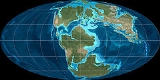
Pangaea
broke up into the northern supercontinent Laurasia
and the southern supercontinent Gondwana
; the Gulf of Mexico
opened in the new rift between North America and what is now Mexico's Yucatan Peninsula
. The Jurassic North Atlantic Ocean
was relatively narrow, while the South Atlantic did not open until the following Cretaceous period, when Gondwana itself rifted apart. The Tethys Sea
closed, and the Neotethys
basin appeared. Climates were warm, with no evidence of glaciation
. As in the Triassic, there was apparently no land near either pole, and no extensive ice caps existed.
The Jurassic geological record is good in western Europe
, where extensive marine sequences indicate a time when much of the continent was submerged under shallow tropical seas; famous locales include the Jurassic Coast
World Heritage Site
and the renowned late Jurassic lagerstätte
n of Holzmaden
and Solnhofen
. In contrast, the North American Jurassic record is the poorest of the Mesozoic, with few outcrops at the surface. Though the epicontinental
Sundance Sea
left marine deposits in parts of the northern plains of the United States and Canada during the late Jurassic, most exposed sediments from this period are continental, such as the alluvial
deposits of the Morrison Formation
.
The Jurassic was a time of calcite sea
geochemistry in which low-magnesium calcite
was the primary inorganic marine precipitate of calcium carbonate. Carbonate hardgrounds
were thus very common, along with calcitic ooids, calcitic cements, and invertebrate faunas with dominantly calcitic skeletons (Stanley and Hardie, 1998, 1999).
The first of several massive batholith
s were emplaced in the northern Cordillera
beginning in the mid-Jurassic, marking the Nevadan orogeny
. Important Jurassic exposures are also found in Russia, India, South America, Japan, Australasia and the United Kingdom.
In Africa, Early Jurassic strata are distributed in a similar fashion to Late Triassic beds, with more common outcrops in the south and less common fossil beds which are predominated by tracks to the north. As the Jurassic proceeded, larger and more iconic groups of dinosaurs like sauropods and ornithopods proliferated in Africa. Middle Jurassic strata are neither well represented nor well studied in Africa. Late Jurassic strata are also poorly represented apart from the spectacular Tendeguru fauna in Tanzania. The Late Jurassic life of Tendeguru is very similar to that
found in western North America's Morrison Formation
.
and marine reptile
s. The latter include ichthyosaur
s who were at the peak of their diversity, plesiosaurs
, pliosaur
s, and marine crocodiles
of the families Teleosauridae
and Metriorhynchidae
.
In the invertebrate
world, several new groups appeared, including rudists
(a reef
-forming variety of bivalves
) and belemnites. The Jurassic also had diverse encrusting and boring
(sclerobiont) communities, and it saw a significant rise in the bioerosion
of carbonate shells and hardgrounds. Especially common is the ichnogenus (trace fossil
) Gastrochaenolites
.
During the Jurassic period about four or five of the twelve clade
s of planktonic organisms that exist in the fossil record either experienced a massive evolutionary radiation or appeared for the first time.
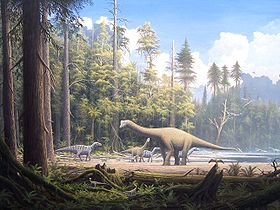
ian reptiles remained dominant. The Jurassic was a golden age for the large herbivorous dinosaurs known as the sauropods—Camarasaurus
, Apatosaurus
, Diplodocus
, Brachiosaurus
, and many others—that roamed the land late in the period; their mainstays were either the prairie
s of fern
s, palm-like cycad
s and bennettitales
, or the higher coniferous growth, according to their adaptations. They were preyed upon by large theropods as for example Ceratosaurus
, Megalosaurus
, Torvosaurus
and Allosaurus
. All these belong to the 'lizard hipped' or saurischia
n branch of the dinosaur
s.
During the Late Jurassic, the first birds, like Archaeopteryx
, evolved
from small coelurosaurian dinosaurs. Ornithischia
n dinosaurs were less predominant than saurischian dinosaurs, although some like stegosaurs and small ornithopod
s played important roles as small and medium-to-large (but not sauropod-sized) herbivores. In the air, pterosaur
s were common; they ruled the skies, filling many ecological roles now taken by bird
s. Within the undergrowth were various types of early mammals, as well as tritylodont
mammal-like reptiles, lizard-like sphenodonts
, and early lissamphibia
ns.
The rest of the Lissamphibia evolved in this period, introducing the first salamander
s and caecilian
s.
 The arid, continental conditions characteristic of the Triassic
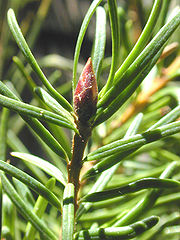
steadily eased during the Jurassic period, especially at higher latitudes; the warm, humid climate allowed lush jungles to cover much of the landscape. Gymnosperm
s were relatively diverse during the Jurassic period. The Conifers in particular dominated the flora, as during the Triassic; they were the most diverse group and constituted the majority of large trees. Extant conifer families that flourished during the Jurassic included the Araucariaceae
, Cephalotaxaceae
, Pinaceae
, Podocarpaceae
, Taxaceae
and Taxodiaceae
. The extinct Mesozoic conifer family Cheirolepidiaceae
dominated low latitude vegetation, as did the shrubby Bennettitales
. Cycad
s were also common, as were ginkgo
s and Dicksoniaceous tree ferns in the forest. Smaller fern
s were probably the dominant undergrowth. Caytoniaceous seed ferns were another group of important plants during this time and are thought to have been shrub to small-tree sized. Ginkgo plants were particularly common in the mid- to high northern latitudes. In the Southern Hemisphere, podocarps were especially successful, while Ginkgo
s and Czekanowskiales were rare.
In the oceans modern coralline algae
appeared for the first time.
Triassic
The Triassic is a geologic period and system that extends from about 250 to 200 Mya . As the first period of the Mesozoic Era, the Triassic follows the Permian and is followed by the Jurassic. Both the start and end of the Triassic are marked by major extinction events...
to the beginning of the Cretaceous
Cretaceous
The Cretaceous , derived from the Latin "creta" , usually abbreviated K for its German translation Kreide , is a geologic period and system from circa to million years ago. In the geologic timescale, the Cretaceous follows the Jurassic period and is followed by the Paleogene period of the...
. The Jurassic constitutes the middle period of the Mesozoic
Mesozoic
The Mesozoic era is an interval of geological time from about 250 million years ago to about 65 million years ago. It is often referred to as the age of reptiles because reptiles, namely dinosaurs, were the dominant terrestrial and marine vertebrates of the time...
era, also known as the age of reptiles. The start of the period is marked by the major Triassic–Jurassic extinction event. However, the end of the Jurassic period did not witness any major extinction event. The start and end of the period are defined by carefully selected locations; the uncertainty in dating arises from trying to date these horizons.
The chronostratigraphic term "Jurassic" is directly linked to the Jura Mountains
Jura mountains
The Jura Mountains are a small mountain range located north of the Alps, separating the Rhine and Rhone rivers and forming part of the watershed of each...
. Alexander von Humboldt
Alexander von Humboldt
Friedrich Wilhelm Heinrich Alexander Freiherr von Humboldt was a German naturalist and explorer, and the younger brother of the Prussian minister, philosopher and linguist Wilhelm von Humboldt...
recognized the mainly limestone
Limestone
Limestone is a sedimentary rock composed largely of the minerals calcite and aragonite, which are different crystal forms of calcium carbonate . Many limestones are composed from skeletal fragments of marine organisms such as coral or foraminifera....
dominated mountain range of the Jura Mountains as a separate formation that was not at the time included in the established stratigraphic system defined by Abraham Gottlob Werner
Abraham Gottlob Werner
Abraham Gottlob Werner , was a German geologist who set out an early theory about the stratification of the Earth's crust and coined the word Neptunism...
and named it “Jurakalk” in 1795. The name “Jura” is derived from the Celtic root “jor”, which was Latinised into “juria”, meaning forest (i.e. “Jura” is forest mountains).
By the beginning of the Jurassic, the supercontinent
Supercontinent
In geology, a supercontinent is a landmass comprising more than one continental core, or craton. The assembly of cratons and accreted terranes that form Eurasia qualifies as a supercontinent today.-History:...
Pangaea
Pangaea
Pangaea, Pangæa, or Pangea is hypothesized as a supercontinent that existed during the Paleozoic and Mesozoic eras about 250 million years ago, before the component continents were separated into their current configuration....
had rifted into two landmasses, Laurasia
Laurasia
In paleogeography, Laurasia was the northernmost of two supercontinents that formed part of the Pangaea supercontinent from approximately...
to the north and Gondwana
Gondwana
In paleogeography, Gondwana , originally Gondwanaland, was the southernmost of two supercontinents that later became parts of the Pangaea supercontinent. It existed from approximately 510 to 180 million years ago . Gondwana is believed to have sutured between ca. 570 and 510 Mya,...
to the south. This created more coastlines and caused a change in global climate from hot and dry to warm and humid, and many of the arid deserts of the Triassic were replaced by lush rainforests. The dinosaurs continued to dominate the land, and reached their peak in this period as they diversified into a wide variety of groups, ranging from the carnivorous theropods to the massive, herbivorous sauropods. Marine reptiles such as ichthyosaur
Ichthyosaur
Ichthyosaurs were giant marine reptiles that resembled fish and dolphins...
s and plesiosaur
Plesiosaur
Plesiosauroidea is an extinct clade of carnivorous plesiosaur marine reptiles. Plesiosauroids, are known from the Jurassic and Cretaceous Periods...
s ruled the oceans, while pterosaur
Pterosaur
Pterosaurs were flying reptiles of the clade or order Pterosauria. They existed from the late Triassic to the end of the Cretaceous Period . Pterosaurs are the earliest vertebrates known to have evolved powered flight...
s, flying reptiles and the first airborne vertebrates, took to the sky.
Divisions
The Jurassic period is divided into Early JurassicEarly Jurassic
The Early Jurassic epoch is the earliest of three epochs of the Jurassic period...
, Middle
Middle Jurassic
The Middle Jurassic is the second epoch of the Jurassic Period. It lasted from 176-161 million years ago. In European lithostratigraphy, rocks of this Middle Jurassic age are called the Dogger....
, and Late Jurassic
Late Jurassic
The Late Jurassic is the third epoch of the Jurassic Period, and it spans the geologic time from 161.2 ± 4.0 to 145.5 ± 4.0 million years ago , which is preserved in Upper Jurassic strata. In European lithostratigraphy, the name "Malm" indicates rocks of Late Jurassic age...
epochs
Epoch (geology)
An epoch is a subdivision of the geologic timescale based on rock layering. In order, the higher subdivisions are periods, eras and eons. We are currently living in the Holocene epoch...
. The Jurassic System, in stratigraphy
Stratigraphy
Stratigraphy, a branch of geology, studies rock layers and layering . It is primarily used in the study of sedimentary and layered volcanic rocks....
, is divided into Lower Jurassic, Middle
Middle Jurassic
The Middle Jurassic is the second epoch of the Jurassic Period. It lasted from 176-161 million years ago. In European lithostratigraphy, rocks of this Middle Jurassic age are called the Dogger....
, and Upper Jurassic series
Series (stratigraphy)
Series are subdivisions of rock layers made based on the age of the rock and corresponding to the dating system unit called an epoch, both being formally defined international conventions of the geological timescale. A series is therefore a sequence of rock depositions defining a...
of rock formations, also known as Lias, Dogger and Malm in Europe. The separation of the term Jurassic into three sections goes back to Leopold von Buch (* 1774, † 1853). The faunal stage
Faunal stage
In chronostratigraphy, a stage is a succession of rock strata laid down in a single age on the geologic timescale, which usually represents millions of years of deposition. A given stage of rock and the corresponding age of time will by convention have the same name, and the same boundaries.Rock...
s from youngest to oldest are:
| Upper/Late Jurassic Late Jurassic The Late Jurassic is the third epoch of the Jurassic Period, and it spans the geologic time from 161.2 ± 4.0 to 145.5 ± 4.0 million years ago , which is preserved in Upper Jurassic strata. In European lithostratigraphy, the name "Malm" indicates rocks of Late Jurassic age... |
|
| Tithonian Tithonian In the geologic timescale the Tithonian is the latest age of the Late Jurassic epoch or the uppermost stage of the Upper Jurassic series. It spans the time between 150.8 ± 4 Ma and 145.5 ± 4 Ma... |
( ± 4.0 – 145.5 ± 4.0 Mya) |
| Kimmeridgian Kimmeridgian In the geologic timescale, the Kimmeridgian is an age or stage in the Late or Upper Jurassic epoch or series. It spans the time between 155.7 ± 4 Ma and 150.8 ± 4 Ma . The Kimmeridgian follows the Oxfordian and precedes the Tithonian.... |
(155.7 ± 4.0 – 150.8 ± 4.0 Mya) |
| Oxfordian Oxfordian stage The Oxfordian is, in the ICS' geologic timescale, the earliest age of the Late Jurassic epoch, or the lowest stage of the Upper Jurassic series. It spans the time between 161.2 ± 4 Ma and 155.7 ± 4 Ma... |
(161.2 ± 4.0 – 155.7 ± 4.0 Mya) |
| Middle Jurassic Middle Jurassic The Middle Jurassic is the second epoch of the Jurassic Period. It lasted from 176-161 million years ago. In European lithostratigraphy, rocks of this Middle Jurassic age are called the Dogger.... |
|
| Callovian Callovian In the geologic timescale, the Callovian is an age or stage in the Middle Jurassic, lasting between 164.7 ± 4.0 Ma and 161.2 ± 4.0 Ma. It is the last stage of the Middle Jurassic, following the Bathonian and preceding the Oxfordian.... |
(164.7 ± 4.0 – 161.2 ± 4.0 Mya) |
| Bathonian Bathonian In the geologic timescale the Bathonian is an age or stage of the Middle Jurassic. It lasted from approximately 167.7 Ma to around 164.7 Ma... |
(167.7 ± 3.5 – 164.7 ± 4.0 Mya) |
| Bajocian Bajocian In the geologic timescale, the Bajocian is an age or stage in the Middle Jurassic. It lasted from approximately 171.6 Ma to around 167.7 Ma . The Bajocian age succeeds the Aalenian age and precedes the Bathonian age.... |
(171.6 ± 3.0 – 167.7 ± 3.5 Mya) |
| Aalenian Aalenian The Aalenian is a subdivision of the Middle Jurassic epoch/series of the geologic timescale that extends from about 175.6 Ma to about 171.6 Ma . It was preceded by the Toarcian and succeeded by the Bajocian.-Stratigraphic definitions:... |
(175.6 ± 2.0 – 171.6 ± 3.0 Mya) |
| Lower/Early Jurassic Early Jurassic The Early Jurassic epoch is the earliest of three epochs of the Jurassic period... |
|
| Toarcian Toarcian The Toarcian is, in the ICS' geologic timescale, an age or stage in the Early or Lower Jurassic. It spans the time between 183.0 Ma and 175.6 Ma... |
(183.0 ± 1.5 – 175.6 ± 2.0 Mya) |
| Pliensbachian Pliensbachian The Pliensbachian is an age of the geologic timescale or stage in the stratigraphic column. It is part of the Early or Lower Jurassic epoch or series and spans the time between 189.6 ± 1.5 Ma and 183 ± 1.5 Ma . The Pliensbachian is preceded by the Sinemurian and followed by the Toarcian.The... |
(189.6 ± 1.5 – 183.0 ± 1.5 Mya) |
| Sinemurian Sinemurian In the geologic timescale, the Sinemurian is an age or stage in the Early or Lower Jurassic epoch or series. It spans the time between 196.5 ± 2 Ma and 189.6 ± 1.5 Ma... |
(196.5 ± 1.0 – 189.6 ± 1.5 Mya) |
| Hettangian Hettangian The Hettangian is the earliest age or lowest stage of the Jurassic period of the geologic timescale. It spans the time between 199.6 ± 0.6 Ma and 196.5 ± 1 Ma . The Hettangian follows the Rhaetian and is followed by the Sinemurian.In Europe stratigraphy the Hettangian is a part of the time span in... |
(199.6 ± 0.6 – 196.5 ± 1.0 Mya) |
Paleogeography and tectonics
During the early Jurassic period, the supercontinentSupercontinent
In geology, a supercontinent is a landmass comprising more than one continental core, or craton. The assembly of cratons and accreted terranes that form Eurasia qualifies as a supercontinent today.-History:...
Pangaea
Pangaea
Pangaea, Pangæa, or Pangea is hypothesized as a supercontinent that existed during the Paleozoic and Mesozoic eras about 250 million years ago, before the component continents were separated into their current configuration....
broke up into the northern supercontinent Laurasia
Laurasia
In paleogeography, Laurasia was the northernmost of two supercontinents that formed part of the Pangaea supercontinent from approximately...
and the southern supercontinent Gondwana
Gondwana
In paleogeography, Gondwana , originally Gondwanaland, was the southernmost of two supercontinents that later became parts of the Pangaea supercontinent. It existed from approximately 510 to 180 million years ago . Gondwana is believed to have sutured between ca. 570 and 510 Mya,...
; the Gulf of Mexico
Gulf of Mexico
The Gulf of Mexico is a partially landlocked ocean basin largely surrounded by the North American continent and the island of Cuba. It is bounded on the northeast, north and northwest by the Gulf Coast of the United States, on the southwest and south by Mexico, and on the southeast by Cuba. In...
opened in the new rift between North America and what is now Mexico's Yucatan Peninsula
Yucatán Peninsula
The Yucatán Peninsula, in southeastern Mexico, separates the Caribbean Sea from the Gulf of Mexico, with the northern coastline on the Yucatán Channel...
. The Jurassic North Atlantic Ocean
Atlantic Ocean
The Atlantic Ocean is the second-largest of the world's oceanic divisions. With a total area of about , it covers approximately 20% of the Earth's surface and about 26% of its water surface area...
was relatively narrow, while the South Atlantic did not open until the following Cretaceous period, when Gondwana itself rifted apart. The Tethys Sea
Tethys Ocean
The Tethys Ocean was an ocean that existed between the continents of Gondwana and Laurasia during the Mesozoic era before the opening of the Indian Ocean.-Modern theory:...
closed, and the Neotethys
Mediterranean Basin
In biogeography, the Mediterranean Basin refers to the lands around the Mediterranean Sea that have a Mediterranean climate, with mild, rainy winters and hot, dry summers, which supports characteristic Mediterranean forests, woodlands, and scrub vegetation...
basin appeared. Climates were warm, with no evidence of glaciation
Glacier
A glacier is a large persistent body of ice that forms where the accumulation of snow exceeds its ablation over many years, often centuries. At least 0.1 km² in area and 50 m thick, but often much larger, a glacier slowly deforms and flows due to stresses induced by its weight...
. As in the Triassic, there was apparently no land near either pole, and no extensive ice caps existed.
The Jurassic geological record is good in western Europe
Europe
Europe is, by convention, one of the world's seven continents. Comprising the westernmost peninsula of Eurasia, Europe is generally 'divided' from Asia to its east by the watershed divides of the Ural and Caucasus Mountains, the Ural River, the Caspian and Black Seas, and the waterways connecting...
, where extensive marine sequences indicate a time when much of the continent was submerged under shallow tropical seas; famous locales include the Jurassic Coast
Jurassic Coast
The Jurassic Coast is a World Heritage Site on the English Channel coast of southern England. The site stretches from Orcombe Point near Exmouth in East Devon to Old Harry Rocks near Swanage in East Dorset, a distance of ....
World Heritage Site
World Heritage Site
A UNESCO World Heritage Site is a place that is listed by the UNESCO as of special cultural or physical significance...
and the renowned late Jurassic lagerstätte
Lagerstätte
A Lagerstätte is a sedimentary deposit that exhibits extraordinary fossil richness or completeness.Palaeontologists distinguish two kinds....
n of Holzmaden
Holzmaden
Holzmaden is a town in Baden-Württemberg, Germany that lies between Stuttgart and Ulm.The ground in and around the city contains rich layers of well preserved fossils of the Jurassic period. The fossils are found in the 160 million year old Posidonia Shale and displayed in the local Museum Hauff...
and Solnhofen
Solnhofen limestone
The Solnhofen Plattenkalk is a Jurassic Konservat-Lagerstätte that preserves a rare assemblage of fossilized organisms, including highly detailed imprints of soft bodied organisms such as sea jellies...
. In contrast, the North American Jurassic record is the poorest of the Mesozoic, with few outcrops at the surface. Though the epicontinental
Epeiric Sea
An epeiric sea is a shallow sea that extends over part of a continent.Epeiric seas are usually associated with the marine transgressions of the geologic past, which have variously been due to either global eustatic sea level changes, local tectonic deformation, or both, and are occasionally...
Sundance Sea
Sundance Sea
The Sundance Sea was an epeiric sea that existed in North America during the mid to late Jurassic Period of the Mesozoic Era. It was an arm of what is now the Arctic Ocean, and extended through what is now western Canada into the central western United States...
left marine deposits in parts of the northern plains of the United States and Canada during the late Jurassic, most exposed sediments from this period are continental, such as the alluvial
Alluvium
Alluvium is loose, unconsolidated soil or sediments, eroded, deposited, and reshaped by water in some form in a non-marine setting. Alluvium is typically made up of a variety of materials, including fine particles of silt and clay and larger particles of sand and gravel...
deposits of the Morrison Formation
Morrison Formation
The Morrison Formation is a distinctive sequence of Late Jurassic sedimentary rock that is found in the western United States, which has been the most fertile source of dinosaur fossils in North America. It is composed of mudstone, sandstone, siltstone and limestone and is light grey, greenish...
.
The Jurassic was a time of calcite sea
Calcite sea
A calcite sea is one in which low-magnesium calcite is the primary inorganic marine calcium carbonate precipitate. An aragonite sea is the alternate seawater chemistry in which aragonite and high-magnesium calcite are the primary inorganic carbonate precipitates...
geochemistry in which low-magnesium calcite
Calcite
Calcite is a carbonate mineral and the most stable polymorph of calcium carbonate . The other polymorphs are the minerals aragonite and vaterite. Aragonite will change to calcite at 380-470°C, and vaterite is even less stable.-Properties:...
was the primary inorganic marine precipitate of calcium carbonate. Carbonate hardgrounds
Carbonate hardgrounds
Carbonate hardgrounds are surfaces of synsedimentarily cemented carbonate layers that have been exposed on the seafloor . A hardground is essentially, then, a lithified seafloor. Ancient hardgrounds are found in limestone sequences and distinguished from later-lithified sediments by evidence of...
were thus very common, along with calcitic ooids, calcitic cements, and invertebrate faunas with dominantly calcitic skeletons (Stanley and Hardie, 1998, 1999).
The first of several massive batholith
Batholith
A batholith is a large emplacement of igneous intrusive rock that forms from cooled magma deep in the Earth's crust...
s were emplaced in the northern Cordillera
American cordillera
The American Cordillera is a cordillera that consists of an essentially continuous sequence of mountain ranges that form the western "backbone" of North America, Central America, South America and Antarctica. From north to south, this sequence of overlapping and parallel ranges begins with the...
beginning in the mid-Jurassic, marking the Nevadan orogeny
Nevadan orogeny
The Nevadan Orogeny was a major mountain building event that took place along the western edge of ancient North America between the Mid to Late Jurassic...
. Important Jurassic exposures are also found in Russia, India, South America, Japan, Australasia and the United Kingdom.
In Africa, Early Jurassic strata are distributed in a similar fashion to Late Triassic beds, with more common outcrops in the south and less common fossil beds which are predominated by tracks to the north. As the Jurassic proceeded, larger and more iconic groups of dinosaurs like sauropods and ornithopods proliferated in Africa. Middle Jurassic strata are neither well represented nor well studied in Africa. Late Jurassic strata are also poorly represented apart from the spectacular Tendeguru fauna in Tanzania. The Late Jurassic life of Tendeguru is very similar to that
Paleobiota of the Morrison Formation
The Morrison Formation is a distinctive sequence of Late Jurassic sedimentary rock that is found in the western United States, which has a wide assortment of taxa represented in its fossil record, including dinosaur fossils in North America. It is composed of mudstone, sandstone, siltstone and...
found in western North America's Morrison Formation
Morrison Formation
The Morrison Formation is a distinctive sequence of Late Jurassic sedimentary rock that is found in the western United States, which has been the most fertile source of dinosaur fossils in North America. It is composed of mudstone, sandstone, siltstone and limestone and is light grey, greenish...
.
Aquatic and marine
During the Jurassic period, the primary vertebrates living in the seas were fishFish
Fish are a paraphyletic group of organisms that consist of all gill-bearing aquatic vertebrate animals that lack limbs with digits. Included in this definition are the living hagfish, lampreys, and cartilaginous and bony fish, as well as various extinct related groups...
and marine reptile
Reptile
Reptiles are members of a class of air-breathing, ectothermic vertebrates which are characterized by laying shelled eggs , and having skin covered in scales and/or scutes. They are tetrapods, either having four limbs or being descended from four-limbed ancestors...
s. The latter include ichthyosaur
Ichthyosaur
Ichthyosaurs were giant marine reptiles that resembled fish and dolphins...
s who were at the peak of their diversity, plesiosaurs
Plesiosauria
Plesiosauria is an order of Mesozoic marine reptiles. Plesiosaurs first appeared in the Early Jurassic Period and became especially common during the Jurassic Period, thriving until the K-T extinction at the end of the Cretaceous Period.The name "plesiosaur" is used to refer to the order...
, pliosaur
Pliosaur
Pliosauroidea is an extinct clade of marine reptiles. Pliosauroids, also commonly known as pliosaurs, are known from the Jurassic and Cretaceous Periods. The pliosauroids were short-necked plesiosaurs with large heads and massive toothed jaws. These swimming reptiles were not dinosaurs but distant...
s, and marine crocodiles
Crocodilia
Crocodilia is an order of large reptiles that appeared about 84 million years ago in the late Cretaceous Period . They are the closest living relatives of birds, as the two groups are the only known survivors of the Archosauria...
of the families Teleosauridae
Teleosauridae
The teleosaurids were marine crocodyliforms similar to the modern gharial that lived from the Early Jurassic to the Early Cretaceous. They had long snouts, indicative of piscivory and were the closest relatives to the Metriorhynchidae, the Mesozoic crocodilians that returned to the sea and evolved...
and Metriorhynchidae
Metriorhynchidae
Metriorhynchidae is an extinct family of metriorhynchoid crocodyliforms from the Middle Jurassic to the Early Cretaceous period of Europe, North America and South America. Metriorhynchids are fully aquatic crocodyliforms. Their forelimbs were small and paddle-like, and unlike living crocodilians,...
.
In the invertebrate
Invertebrate
An invertebrate is an animal without a backbone. The group includes 97% of all animal species – all animals except those in the chordate subphylum Vertebrata .Invertebrates form a paraphyletic group...
world, several new groups appeared, including rudists
Rudists
Rudists are a group of box, tube or ring shaped marine heterodont bivalves that arose during the Jurassic, and became so diverse during the Cretaceous that they were major reef-building organisms in the Tethys Ocean.- Shell description :...
(a reef
Reef
In nautical terminology, a reef is a rock, sandbar, or other feature lying beneath the surface of the water ....
-forming variety of bivalves
Bivalvia
Bivalvia is a taxonomic class of marine and freshwater molluscs. This class includes clams, oysters, mussels, scallops, and many other families of molluscs that have two hinged shells...
) and belemnites. The Jurassic also had diverse encrusting and boring
Bioerosion
Bioerosion describes the erosion of hard ocean substrates – and less often terrestrial substrates – by living organisms. Marine bioerosion can be caused by mollusks, polychaete worms, phoronids, sponges, crustaceans, echinoids, and fish; it can occur on coastlines, on coral reefs, and...
(sclerobiont) communities, and it saw a significant rise in the bioerosion
Bioerosion
Bioerosion describes the erosion of hard ocean substrates – and less often terrestrial substrates – by living organisms. Marine bioerosion can be caused by mollusks, polychaete worms, phoronids, sponges, crustaceans, echinoids, and fish; it can occur on coastlines, on coral reefs, and...
of carbonate shells and hardgrounds. Especially common is the ichnogenus (trace fossil
Trace fossil
Trace fossils, also called ichnofossils , are geological records of biological activity. Trace fossils may be impressions made on the substrate by an organism: for example, burrows, borings , urolites , footprints and feeding marks, and root cavities...
) Gastrochaenolites
Gastrochaenolites
Gastrochaenolites is a trace fossil formed as a clavate boring in a hard substrate such as a shell, rock or carbonate hardground. The aperture of the boring is narrower than the main chamber and may be circular, oval, or dumb-bell shaped...
.
During the Jurassic period about four or five of the twelve clade
Clade
A clade is a group consisting of a species and all its descendants. In the terms of biological systematics, a clade is a single "branch" on the "tree of life". The idea that such a "natural group" of organisms should be grouped together and given a taxonomic name is central to biological...
s of planktonic organisms that exist in the fossil record either experienced a massive evolutionary radiation or appeared for the first time.
Terrestrial
On land, large archosaurArchosaur
Archosaurs are a group of diapsid amniotes whose living representatives consist of modern birds and crocodilians. This group also includes all extinct non-avian dinosaurs, many extinct crocodilian relatives, and pterosaurs. Archosauria, the archosaur clade, is a crown group that includes the most...
ian reptiles remained dominant. The Jurassic was a golden age for the large herbivorous dinosaurs known as the sauropods—Camarasaurus
Camarasaurus
Camarasaurus meaning 'chambered lizard', referring to the hollow chambers in its vertebrae was a genus of quadrupedal, herbivorous dinosaurs. It was the most common of the giant sauropods to be found in North America...
, Apatosaurus
Apatosaurus
Apatosaurus , also known by the popular but scientifically deprecated synonym Brontosaurus, is a genus of sauropod dinosaur that lived from about 154 to 150 million years ago, during the Jurassic Period . It was one of the largest land animals that ever existed, with an average length of and a...
, Diplodocus
Diplodocus
Diplodocus , or )is a genus of diplodocid sauropod dinosaur whose fossils were first discovered in 1877 by S. W. Williston. The generic name, coined by Othniel Charles Marsh in 1878, is a Neo-Latin term derived from Greek "double" and "beam", in reference to its double-beamed chevron bones...
, Brachiosaurus
Brachiosaurus
Brachiosaurus is a genus of sauropod dinosaur from the Jurassic Morrison Formation of North America. It was first described by Elmer S. Riggs in 1903 from fossils found in the Grand River Canyon of western Colorado, in the United States. Riggs named the dinosaur Brachiosaurus altithorax,...
, and many others—that roamed the land late in the period; their mainstays were either the prairie
Prairie
Prairies are considered part of the temperate grasslands, savannas, and shrublands biome by ecologists, based on similar temperate climates, moderate rainfall, and grasses, herbs, and shrubs, rather than trees, as the dominant vegetation type...
s of fern
Fern
A fern is any one of a group of about 12,000 species of plants belonging to the botanical group known as Pteridophyta. Unlike mosses, they have xylem and phloem . They have stems, leaves, and roots like other vascular plants...
s, palm-like cycad
Cycad
Cycads are seed plants typically characterized by a stout and woody trunk with a crown of large, hard and stiff, evergreen leaves. They usually have pinnate leaves. The individual plants are either all male or all female . Cycads vary in size from having a trunk that is only a few centimeters...
s and bennettitales
Bennettitales
Bennettitales is an extinct order of seed plants that first appeared in the Triassic period and became extinct toward the end of the Cretaceous...
, or the higher coniferous growth, according to their adaptations. They were preyed upon by large theropods as for example Ceratosaurus
Ceratosaurus
Ceratosaurus meaning "horned lizard", in reference to the horn on its nose , was a large predatory theropod dinosaur from the Late Jurassic Period , found in the Morrison Formation of North America, in Tanzania and Portugal...
, Megalosaurus
Megalosaurus
Megalosaurus is a genus of large meat-eating theropod dinosaurs of the Middle Jurassic period of Europe...
, Torvosaurus
Torvosaurus
Torvosaurus is a genus of large theropod dinosaur that lived during the Late Jurassic period...
and Allosaurus
Allosaurus
Allosaurus is a genus of large theropod dinosaur that lived 155 to 150 million years ago during the late Jurassic period . The name Allosaurus means "different lizard". It is derived from the Greek /allos and /sauros...
. All these belong to the 'lizard hipped' or saurischia
Saurischia
Saurischia meaning 'lizard' and ischion meaning 'hip joint') is one of the two orders, or basic divisions, of dinosaurs. In 1888, Harry Seeley classified dinosaurs into two orders, based on their hip structure...
n branch of the dinosaur
Dinosaur
Dinosaurs are a diverse group of animals of the clade and superorder Dinosauria. They were the dominant terrestrial vertebrates for over 160 million years, from the late Triassic period until the end of the Cretaceous , when the Cretaceous–Paleogene extinction event led to the extinction of...
s.
During the Late Jurassic, the first birds, like Archaeopteryx
Archaeopteryx
Archaeopteryx , sometimes referred to by its German name Urvogel , is a genus of theropod dinosaur that is closely related to birds. The name derives from the Ancient Greek meaning "ancient", and , meaning "feather" or "wing"...
, evolved
Evolution
Evolution is any change across successive generations in the heritable characteristics of biological populations. Evolutionary processes give rise to diversity at every level of biological organisation, including species, individual organisms and molecules such as DNA and proteins.Life on Earth...
from small coelurosaurian dinosaurs. Ornithischia
Ornithischia
Ornithischia or Predentata is an extinct order of beaked, herbivorous dinosaurs. The name ornithischia is derived from the Greek ornitheos meaning 'of a bird' and ischion meaning 'hip joint'...
n dinosaurs were less predominant than saurischian dinosaurs, although some like stegosaurs and small ornithopod
Ornithopod
Ornithopods or members of the clade Ornithopoda are a group of ornithischian dinosaurs that started out as small, bipedal running grazers, and grew in size and numbers until they became one of the most successful groups of herbivores in the Cretaceous world, and dominated the North American...
s played important roles as small and medium-to-large (but not sauropod-sized) herbivores. In the air, pterosaur
Pterosaur
Pterosaurs were flying reptiles of the clade or order Pterosauria. They existed from the late Triassic to the end of the Cretaceous Period . Pterosaurs are the earliest vertebrates known to have evolved powered flight...
s were common; they ruled the skies, filling many ecological roles now taken by bird
Bird
Birds are feathered, winged, bipedal, endothermic , egg-laying, vertebrate animals. Around 10,000 living species and 188 families makes them the most speciose class of tetrapod vertebrates. They inhabit ecosystems across the globe, from the Arctic to the Antarctic. Extant birds range in size from...
s. Within the undergrowth were various types of early mammals, as well as tritylodont
Tritylodontidae
Tritylodontids were small to medium-sized, highly specialized and extremely mammal-like cynodonts. They were the last family of the non-mammalian synapsids. One of the last cynodont lines to appear, the Tritylodontidae descended from a Cynognathus-like cynodont...
mammal-like reptiles, lizard-like sphenodonts
Sphenodontia
Sphenodontia is an order of lizard-like reptiles that includes only one living genus, the tuatara , and only two living species...
, and early lissamphibia
Lissamphibia
The subclass Lissamphibia includes all recent amphibians and means smooth amphibia.Extant amphibians fall into one of three orders — the Anura , the Caudata or Urodela , and the Gymnophiona or Apoda .Although the ancestry of each group is still unclear, all share certain common characteristics,...
ns.
The rest of the Lissamphibia evolved in this period, introducing the first salamander
Salamander
Salamander is a common name of approximately 500 species of amphibians. They are typically characterized by a superficially lizard-like appearance, with their slender bodies, short noses, and long tails. All known fossils and extinct species fall under the order Caudata, while sometimes the extant...
s and caecilian
Caecilian
The caecilians are an order of amphibians that superficially resemble earthworms or snakes. They mostly live hidden in the ground, making them the least familiar order of amphibians. All extant caecilians and their closest fossil relatives are grouped as the clade Apoda. They are mostly...
s.
Flora
Triassic
The Triassic is a geologic period and system that extends from about 250 to 200 Mya . As the first period of the Mesozoic Era, the Triassic follows the Permian and is followed by the Jurassic. Both the start and end of the Triassic are marked by major extinction events...
steadily eased during the Jurassic period, especially at higher latitudes; the warm, humid climate allowed lush jungles to cover much of the landscape. Gymnosperm
Gymnosperm
The gymnosperms are a group of seed-bearing plants that includes conifers, cycads, Ginkgo, and Gnetales. The term "gymnosperm" comes from the Greek word gymnospermos , meaning "naked seeds", after the unenclosed condition of their seeds...
s were relatively diverse during the Jurassic period. The Conifers in particular dominated the flora, as during the Triassic; they were the most diverse group and constituted the majority of large trees. Extant conifer families that flourished during the Jurassic included the Araucariaceae
Araucariaceae
Araucariaceae, commonly referred to as araucarians, is a very ancient family of coniferous trees. It achieved its maximum diversity in the Jurassic and Cretaceous periods, when it was distributed almost worldwide...
, Cephalotaxaceae
Cephalotaxaceae
The family Cephalotaxaceae is a small grouping of conifers, with three genera and about 20 species, closely allied to the Taxaceae, and included in that family by some botanists. They are restricted to east Asia, except for two species of Torreya found in the southwest and southeast of the USA;...
, Pinaceae
Pinaceae
Pinaceae are trees or shrubs, including many of the well-known conifers of commercial importance such as cedars, firs, hemlocks, larches, pines and spruces. The family is included in the order Pinales, formerly known as Coniferales. Pinaceae are supported as monophyletic by its protein-type sieve...
, Podocarpaceae
Podocarpaceae
Podocarpaceae is a large family of mainly Southern Hemisphere conifers, comprising about 156 species of evergreen trees and shrubs. It contains 19 genera if Phyllocladus is included and if Manoao and Sundacarpus are recognized....
, Taxaceae
Taxaceae
The family Taxaceae, commonly called the yew family, includes three genera and about 7 to 12 species of coniferous plants, or in other interpretations , six genera and about 30 species....
and Taxodiaceae
Taxodiaceae
The Taxodiaceae were at one time regarded as a distinct plant family comprising the following ten genera of coniferous trees:*Athrotaxis*Cryptomeria*Cunninghamia*†Cunninghamites*Glyptostrobus*Metasequoia*Sciadopitys...
. The extinct Mesozoic conifer family Cheirolepidiaceae
Cheirolepidiaceae
Cheirolepidiaceae is a family of extinct coniferous plants.This family of conifers, superficially similar to Cupressaceae, was a significant part of the flora of the Mesozoic, around . They are united by the possession of a distinctive pollen type assigned to the form genus Classopollis...
dominated low latitude vegetation, as did the shrubby Bennettitales
Bennettitales
Bennettitales is an extinct order of seed plants that first appeared in the Triassic period and became extinct toward the end of the Cretaceous...
. Cycad
Cycad
Cycads are seed plants typically characterized by a stout and woody trunk with a crown of large, hard and stiff, evergreen leaves. They usually have pinnate leaves. The individual plants are either all male or all female . Cycads vary in size from having a trunk that is only a few centimeters...
s were also common, as were ginkgo
Ginkgo
Ginkgo , also spelled gingko and known as the Maidenhair Tree, is a unique species of tree with no close living relatives...
s and Dicksoniaceous tree ferns in the forest. Smaller fern
Fern
A fern is any one of a group of about 12,000 species of plants belonging to the botanical group known as Pteridophyta. Unlike mosses, they have xylem and phloem . They have stems, leaves, and roots like other vascular plants...
s were probably the dominant undergrowth. Caytoniaceous seed ferns were another group of important plants during this time and are thought to have been shrub to small-tree sized. Ginkgo plants were particularly common in the mid- to high northern latitudes. In the Southern Hemisphere, podocarps were especially successful, while Ginkgo
Ginkgo
Ginkgo , also spelled gingko and known as the Maidenhair Tree, is a unique species of tree with no close living relatives...
s and Czekanowskiales were rare.
In the oceans modern coralline algae
Coralline algae
Coralline algae are red algae in the order Corallinales. They are characterized by a thallus that is hard because of calcareous deposits contained within the cell walls...
appeared for the first time.