
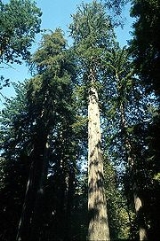
Encyclopedia
A
tree is a large,
perennial,
woody
plant. Though there is no set definition regarding minimum size, the term generally applies to plants at least 6 m high at maturity and, more importantly, having secondary branches supported on a single main stem or trunk with clear
apical dominance . Compared with most other plant forms, trees are long-lived. A few species of trees grow to 100 m tall, and some can live for several thousand years.
Trees are important components of the natural landscape and significant elements in
landscaping and
agriculture, supplying
orchard crops . Trees also play an important role in many of the world's mythologies .
Classification
A tree is a plant form and trees occur in many different orders and
families of plants. Trees thus show a wide variety of growth form, leaf type and shape, bark characteristics, reproductive structures, etc.
The earliest trees were
tree ferns and
horsetails, which grew in vast forests in the Carboniferous Period; tree ferns still survive, but the only surviving horsetails are not of tree form. Later, in the Triassic Period,
conifers,
ginkgos,
cycads and other
gymnosperms appeared, and subsequently
flowering plants in the Cretaceous Period. Most species of trees today are flowering plants and conifers. The listing below gives examples of many well-known trees and how they are typically classified.
A small group of trees growing together is called a grove or
copse, and a landscape covered by a dense growth of trees is called a
forest. Several biotopes are defined largely by the trees that inhabit them; examples are
rainforest and
taiga . A landscape of trees scattered or spaced across grassland is called a
savanna.
Morphology
The basic parts of a tree are the
roots, trunk,
branches, twigs and
leaves. Tree stems consist mainly of support and transport tissues .
Wood consists of
xylem cells, and bark is made of
phloem and other tissues external to the vascular cambium.
Trees may be broadly grouped into
exogenous and
endogenous trees according to the way in which their stem diameter increases. Exogenous trees, which comprise the great majority of modern trees , grow by the addition of new wood outwards, immediately under the bark. Endogenous trees, mainly in the
monocotyledons , grow by addition of new material inwards.
As an exogenous tree grows, it creates
growth rings. In temperate climates, these are commonly visible due to changes in the rate of growth with temperature variation over an annual cycle. These rings can be counted to determine the age of the tree, and used to date cores or even wood taken from trees in the past; this practice is known as the science of
dendrochronology. In some tropical regions with constant year-round climate, growth is continuous and distinct rings are not formed, so age determination is impossible. Age determination is also impossible in endogenous trees.
The roots of a tree are generally embedded in earth, providing anchorage for the above-ground
biomass and absorbing
water and
nutrients from the
soil. It should be noted, however, that while ground nutrients are essential to a tree's growth the majority of its biomass comes from carbon dioxide absorbed from the atmosphere . Above ground, the trunk gives height to the leaf-bearing branches, aiding in competition with other plant species for
sunlight. In many trees, the arrangement of the branches optimizes exposure of the leaves to sunlight.
Not all trees have all the plant organs or parts mentioned above. For example, most palm trees are not branched, the
saguaro cactus of North America has no functional leaves,
tree ferns do not produce bark, etc. Based on their general shape and size, all of these are nonetheless generally regarded as trees. Indeed, sometimes size is the more important consideration. A plant form that is similar to a tree, but generally having smaller, multiple trunks and/or branches that arise near the ground, is called a
shrub. However, no sharp differentiation between shrubs and trees is possible. Given their small size,
bonsai plants would not technically be 'trees', but one should not confuse reference to the form of a species with the size or shape of individual specimens. A spruce seedling does not fit the definition of a tree, but all spruces are trees.
Bamboos by contrast, do show most of the characteristics of trees, yet are rarely called trees.
Champion trees
The world's champion trees can be considered on several factors; height, trunk diameter or girth, total size, and age. It is significant that in each case, the top position is always held by a
conifer, though a different species in each case; in most measures, the second to fourth places are also held by conifers.
;Tallest trees
The heights of the tallest trees in the world have been the subject of considerable dispute and much exaggeration. Modern verified measurement with
laser rangefinders combined with tape drop measurements made by tree climbers, carried out by the has shown that most older measuring methods and measurements are unreliable, often producing exaggerations of 5% to 15% above the real height. Historical claims of trees of 114 m, 117 m, 130 m, and even 150 m, are now largely disregarded as unreliable, fantasy or outright fraud. The following are now accepted as the top five tallest reliably measured species:
- Coast Redwood Sequoia sempervirens: 115.24 m , Redwood National Park, California
- Coast Douglas-fir Pseudotsuga menziesii: 100.3 m , Brummit Creek, Coos County, Oregon
- Sitka Spruce Picea sitchensis: 96.7 m , Prairie Creek Redwoods State Park, California
- Giant Sequoia Sequoiadendron giganteum: 93.6 m , Redwood Mountain Grove, California
- Australian Mountain-ash Eucalyptus regnans: 92.0 m , Styx Valley, Tasmania
;Stoutest trees
The girth of a tree is – or at least should be – much easier to measure than the height, as it is a simple matter of stretching a tape round the trunk, and pulling it taut to find the circumference. Despite this, UK tree author Alan Mitchell made the following comment about measurements of
yew trees in the
British Isles:
- "The aberrations of past measurements of yews are beyond belief. For example, the tree at Tisbury has a well-defined, clean, if irregular bole at least 1.5 m long. It has been found to have a girth which has dilated and shrunk in the following way: 11.28 m , 9.3 m , 10.67 m , 9.0 m , 9.45 m .... Earlier measurements have therefore been omitted".
As a general standard, tree girth is taken at 'breast height'; this is defined differently in different situations, with most
foresters measuring girth at 1.3 m above ground, while ornamental tree measurers usually measure at 1.5 m above ground; in most cases this makes little difference to the measured girth. On sloping ground, the "above ground" reference point is usually taken as the highest point on the ground touching the trunk, but some use the average between the highest and lowest points of ground. Some of the inflated old measurements may have been taken at ground level. Some past exaggerated measurements also result from measuring the complete next-to-bark measurement, pushing the tape in and out over every crevice and buttress.
Modern trends are to cite the tree's
diameter rather than the circumference; this is obtained by dividing the measured circumference by p; it assumes the trunk is circular in cross-section . This is cited as
dbh in tree literature.
A further problem with measuring
baobabs
Adansonia is that these trees store large amounts of
water in the very soft wood in their trunks. This leads to marked variation in their girth over the year, swelling to a maximum at the end of the rainy season, minimum at the end of the dry season. Although baobabs have some of the highest girth measurements of any trees, no accurate measurements are currently available, but probably do not exceed 10-11 m diameter.
The stoutest species in diameter, excluding baobabs, are:
- Montezuma Cypress Taxodium mucronatum: 11.42 m, Árbol del Tule, Santa Maria del Tule, Oaxaca, Mexico .
- Giant Sequoia Sequoiadendron giganteum: 8.85 m, General Grant tree, Grant Grove, California
- Coast Redwood Sequoia sempervirens: 7.44 m, Prairie Creek Redwoods State Park, California
;Largest trees
The largest trees in total volume are those which are both tall and of large diameter, and in particular, which hold a large diameter high up the trunk. Measurement is very complex, particularly if branch volume is to be included as well as the trunk volume, so measurements have only been made for a small number of trees, and generally only for the trunk. No attempt has ever been made to include
root volume.
The top four species measured so far are :
- Giant Sequoia Sequoiadendron giganteum: 1489 m³, General Sherman
- Coast Redwood Sequoia sempervirens: 1045 m³, Del Norte Titan tree
- Western Redcedar Thuja plicata: 500 m³,
- Kauri Agathis australis: 400 m³, Tane Mahuta tree
However, the
Alerce Fitzroya cupressoides, as yet un-measured, may well slot in at third or fourth place, and
Montezuma Cypress Taxodium mucronatum is also likely to be high in the list. The largest
angiosperm tree is an Australian Mountain-ash, the 'El Grande' tree of 439 m³ in
Tasmania.
;Oldest trees
The oldest trees are determined by growth rings, which can be seen if the tree is cut down or in cores taken from the edge to the centre of the tree. Accurate determination is only possible for trees which produce growth rings, generally those which occur in seasonal climates; trees in uniform non-seasonal tropical climates grow continuously and do not have distinct growth rings. It is also only possible for trees which are solid to the centre of the tree; many very old trees become hollow as the dead
heartwood decays away. For some of these species, age estimates have been made on the basis of extrapolating current growth rates, but the results are usually little better than guesswork or wild speculation.
The verified oldest measured ages are :
- Great Basin Bristlecone Pine Pinus longaeva: 4844 years
- Alerce Fitzroya cupressoides: 3622 years
- Giant Sequoia Sequoiadendron giganteum: 3266 years
- Huon-pine Lagarostrobos franklinii: 2500 years
- Rocky Mountains Bristlecone Pine Pinus aristata: 2435 years
Other species suspected of reaching exceptional age include
European Yew Taxus baccata and
Western Redcedar Thuja plicata.
The oldest verified age for an angiosperm tree is 2293 years for the
Sri Maha Bodhi Sacred Fig planted in 288 BC at
Anuradhapura,
Sri Lanka; this is also the oldest human-planted tree with a known planting date.
Major tree genera
...
,
Swietenia mahagoniThe
rowans are plant [i]s of the Family Rosaceae [i], in the Genus [i]
Sorbus [i], Subgenus ...
s,
Whitebeams,
Service Trees Sorbus species
...
,
Prunus persica ...
,
Prunus domestica ...