

Spore

Encyclopedia
Biology
Biology is a natural science concerned with the study of life and living organisms, including their structure, function, growth, origin, evolution, distribution, and taxonomy. Biology is a vast subject containing many subdivisions, topics, and disciplines...
, a spore is a reproductive structure that is adapted for dispersal
Biological dispersal
Biological dispersal refers to species movement away from an existing population or away from the parent organism. Through simply moving from one habitat patch to another, the dispersal of an individual has consequences not only for individual fitness, but also for population dynamics, population...
and surviving for extended periods of time in unfavorable conditions. Spores form part of the life cycles
Biological life cycle
A life cycle is a period involving all different generations of a species succeeding each other through means of reproduction, whether through asexual reproduction or sexual reproduction...
of many bacteria
Bacteria
Bacteria are a large domain of prokaryotic microorganisms. Typically a few micrometres in length, bacteria have a wide range of shapes, ranging from spheres to rods and spirals...
, plant
Plant
Plants are living organisms belonging to the kingdom Plantae. Precise definitions of the kingdom vary, but as the term is used here, plants include familiar organisms such as trees, flowers, herbs, bushes, grasses, vines, ferns, mosses, and green algae. The group is also called green plants or...
s, algae
Algae
Algae are a large and diverse group of simple, typically autotrophic organisms, ranging from unicellular to multicellular forms, such as the giant kelps that grow to 65 meters in length. They are photosynthetic like plants, and "simple" because their tissues are not organized into the many...
, fungi
Fungus
A fungus is a member of a large group of eukaryotic organisms that includes microorganisms such as yeasts and molds , as well as the more familiar mushrooms. These organisms are classified as a kingdom, Fungi, which is separate from plants, animals, and bacteria...
and some protozoa
Protozoa
Protozoa are a diverse group of single-cells eukaryotic organisms, many of which are motile. Throughout history, protozoa have been defined as single-cell protists with animal-like behavior, e.g., movement...
. According to scientist Dr. Steinn Sigurdsson, "There are viable bacterial spores that have been found that are 40 million years old on Earth - and we know they're very hardened to radiation."
A chief difference between spores and seed
Seed
A seed is a small embryonic plant enclosed in a covering called the seed coat, usually with some stored food. It is the product of the ripened ovule of gymnosperm and angiosperm plants which occurs after fertilization and some growth within the mother plant...
s as dispersal units
Biological dispersal
Biological dispersal refers to species movement away from an existing population or away from the parent organism. Through simply moving from one habitat patch to another, the dispersal of an individual has consequences not only for individual fitness, but also for population dynamics, population...
is that spores have very little stored food resources compared with seeds.
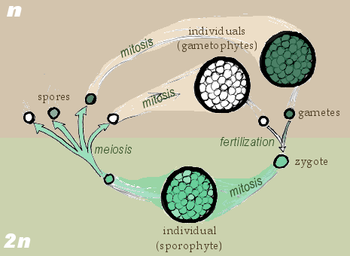
Spores are usually haploid and unicellular and are produced by meiosis
Meiosis
Meiosis is a special type of cell division necessary for sexual reproduction. The cells produced by meiosis are gametes or spores. The animals' gametes are called sperm and egg cells....
in the sporangium
Sporangium
A sporangium is an enclosure in which spores are formed. It can be composed of a single cell or can be multicellular. All plants, fungi, and many other lineages form sporangia at some point in their life cycle...
by the sporophyte
Sporophyte
All land plants, and some algae, have life cycles in which a haploid gametophyte generation alternates with a diploid sporophyte, the generation of a plant or algae that has a double set of chromosomes. A multicellular sporophyte generation or phase is present in the life cycle of all land plants...
. Once conditions are favorable, the spore can develop into a new organism
Organism
In biology, an organism is any contiguous living system . In at least some form, all organisms are capable of response to stimuli, reproduction, growth and development, and maintenance of homoeostasis as a stable whole.An organism may either be unicellular or, as in the case of humans, comprise...
using mitotic
Mitosis
Mitosis is the process by which a eukaryotic cell separates the chromosomes in its cell nucleus into two identical sets, in two separate nuclei. It is generally followed immediately by cytokinesis, which divides the nuclei, cytoplasm, organelles and cell membrane into two cells containing roughly...
division, producing a multicellular gametophyte
Gametophyte
A gametophyte is the haploid, multicellular phase of plants and algae that undergo alternation of generations, with each of its cells containing only a single set of chromosomes....
, which eventually goes on to produce gamete
Gamete
A gamete is a cell that fuses with another cell during fertilization in organisms that reproduce sexually...
s. Two gamete
Gamete
A gamete is a cell that fuses with another cell during fertilization in organisms that reproduce sexually...
s fuse to create a new sporophyte. This cycle is known as alternation of generations
Alternation of generations
Alternation of generations is a term primarily used in describing the life cycle of plants . A multicellular sporophyte, which is diploid with 2N paired chromosomes , alternates with a multicellular gametophyte, which is haploid with N unpaired chromosomes...
, but a better term is "biological life cycle", as there may be more than one phase and so it cannot be a direct alternation. Haploid spores produced by mitosis
Mitosis
Mitosis is the process by which a eukaryotic cell separates the chromosomes in its cell nucleus into two identical sets, in two separate nuclei. It is generally followed immediately by cytokinesis, which divides the nuclei, cytoplasm, organelles and cell membrane into two cells containing roughly...
(known as mitospores) are used by many fungi for asexual reproduction.
Many species of fern
Fern
A fern is any one of a group of about 12,000 species of plants belonging to the botanical group known as Pteridophyta. Unlike mosses, they have xylem and phloem . They have stems, leaves, and roots like other vascular plants...
, especially those adapted to dry conditions, produce diploid spores. This form of asexual reproduction is called apogamy. It is a form of apomixis
Apomixis
In botany, apomixis was defined by Winkler as replacement of the normal sexual reproduction by asexual reproduction, without fertilization. This definition notably does not mention meiosis...
.
Spores are the units of asexual reproduction
Asexual reproduction
Asexual reproduction is a mode of reproduction by which offspring arise from a single parent, and inherit the genes of that parent only, it is reproduction which does not involve meiosis, ploidy reduction, or fertilization. A more stringent definition is agamogenesis which is reproduction without...
, because a single spore develops into a new organism. By contrast, gametes are the units of sexual reproduction
Sexual reproduction
Sexual reproduction is the creation of a new organism by combining the genetic material of two organisms. There are two main processes during sexual reproduction; they are: meiosis, involving the halving of the number of chromosomes; and fertilization, involving the fusion of two gametes and the...
, as two gametes need to fuse to create a new organism.
Definition
The term spore derives from the ancient GreekAncient Greek
Ancient Greek is the stage of the Greek language in the periods spanning the times c. 9th–6th centuries BC, , c. 5th–4th centuries BC , and the c. 3rd century BC – 6th century AD of ancient Greece and the ancient world; being predated in the 2nd millennium BC by Mycenaean Greek...
word σπορά spora, meaning "seed
Seed
A seed is a small embryonic plant enclosed in a covering called the seed coat, usually with some stored food. It is the product of the ripened ovule of gymnosperm and angiosperm plants which occurs after fertilization and some growth within the mother plant...
, sowing," related to σπόρος sporos, "sowing," and σπείρειν speirein, "to sow."
In common parlance, the difference between a "spore" and a "gamete
Gamete
A gamete is a cell that fuses with another cell during fertilization in organisms that reproduce sexually...
" (both together called gonites) is that a spore will germinate and develop into a sporeling
Sporeling
A sporeling is a young plant or fungus produced by a germinated spore, similar to a seedling derived from a germinated seed. They occur in algae, fungi, lichens, bryophytes and seedless vascular plants.- Sporeling development :...
, while a gamete needs to combine with another gamete before developing further. However, the terms are somewhat interchangeable when referring to gametes.
A chief difference between spores and seeds as dispersal units
Biological dispersal
Biological dispersal refers to species movement away from an existing population or away from the parent organism. Through simply moving from one habitat patch to another, the dispersal of an individual has consequences not only for individual fitness, but also for population dynamics, population...
is that spores have little food storage compared with seeds, and thus require more favorable conditions in order to successfully germinate. (This is not without its exceptions, however: many orchid seeds, although multicellular, are microscopic and lack endosperm
Endosperm
Endosperm is the tissue produced inside the seeds of most flowering plants around the time of fertilization. It surrounds the embryo and provides nutrition in the form of starch, though it can also contain oils and protein. This makes endosperm an important source of nutrition in human diet...
, and spores of some fungi in the Glomeromycota
Glomeromycota
Glomeromycota is one of seven currently recognized phyla within the kingdom Fungi, with approximately 230 described species. Members of the Glomeromycota form arbuscular mycorrhizas with the roots or thalli of land plants. Geosiphon pyriformis forms an endocytobiotic association with Nostoc...
commonly exceed 300 µm in diameter.) Seeds, therefore, are more resistant to harsh conditions and require less energy to start mitosis
Mitosis
Mitosis is the process by which a eukaryotic cell separates the chromosomes in its cell nucleus into two identical sets, in two separate nuclei. It is generally followed immediately by cytokinesis, which divides the nuclei, cytoplasm, organelles and cell membrane into two cells containing roughly...
. Spores are produced in large numbers to increase the chance of a spore surviving in a number of notable examples.
By spore-producing structure
Taxon
|thumb|270px|[[African elephants]] form a widely-accepted taxon, the [[genus]] LoxodontaA taxon is a group of organisms, which a taxonomist adjudges to be a unit. Usually a taxon is given a name and a rank, although neither is a requirement...
of the fungi.
- Sporangiospores: spores produced by a sporangiumSporangiumA sporangium is an enclosure in which spores are formed. It can be composed of a single cell or can be multicellular. All plants, fungi, and many other lineages form sporangia at some point in their life cycle...
in many fungi such as zygomycetes. - ZygosporeZygosporeA zygospore is a diploid reproductive stage in the life cycle of many fungi and protists. Zygospores are created by the nuclear fusion of haploid cells. In fungi, zygospores are termed chlamydospores and are formed after the fusion of hyphae of different mating types...
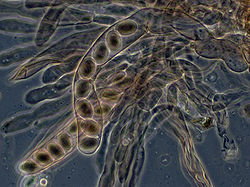
s: spores produced by a zygosporangium, characteristic of zygomycetes. - AscosporeAscosporeAn ascospore is a spore contained in an ascus or that was produced inside an ascus. This kind of spore is specific to fungi classified as ascomycetes ....
s: spores produced by an ascusAscusAn ascus is the sexual spore-bearing cell produced in ascomycete fungi. On average, asci normally contain eight ascospores, produced by a meiotic cell division followed, in most species, by a mitotic cell division. However, asci in some genera or species can number one , two, four, or multiples...
, characteristic of ascomycetes. - BasidiosporeBasidiosporeA basidiospore is a reproductive spore produced by Basidiomycete fungi. Basidiospores typically each contain one haploid nucleus that is the product of meiosis, and they are produced by specialized fungal cells called basidia. In grills under a cap of one common species in the phylum of...
s: spores produced by a basidiumBasidiumthumb|right|500px|Schematic showing a basidiomycete mushroom, gill structure, and spore-bearing basidia on the gill margins.A basidium is a microscopic, spore-producing structure found on the hymenophore of fruiting bodies of basidiomycete fungi. The presence of basidia is one of the main...
, characteristic of basidiomycetes. - Aeciospores: spores produced by a aeciumAeciumAecium is a specialised reproductive structure found in some rusts and smuts which produces aeciospores. In some literature Aecia are also referred to as "cluster cups"....
in some fungi such as rustsRust (fungus)Rusts are plant diseases caused by pathogenic fungi of the order Pucciniales. About 7800 species are known. Rusts can affect a variety of plants; leaves, stems, fruits and seeds. Rust is most commonly seen as coloured powder, composed off tiny aeciospores which land on vegetation producing...
or smutsSmut (fungus)The smuts are multicellular fungi, that are characterized by their large numbers of teliospores. The smuts get their name from a Germanic word for dirt because of their dark, thick-walled and dust-like teliospores. They are mostly Ustilaginomycetes and can cause plant disease...
. - Urediospores: spores produced by a uredinium in some fungi such as rustsRust (fungus)Rusts are plant diseases caused by pathogenic fungi of the order Pucciniales. About 7800 species are known. Rusts can affect a variety of plants; leaves, stems, fruits and seeds. Rust is most commonly seen as coloured powder, composed off tiny aeciospores which land on vegetation producing...
or smutsSmut (fungus)The smuts are multicellular fungi, that are characterized by their large numbers of teliospores. The smuts get their name from a Germanic word for dirt because of their dark, thick-walled and dust-like teliospores. They are mostly Ustilaginomycetes and can cause plant disease...
. - TeliosporeTeliosporeTeliospore is the thick-walled resting spore of some fungi , from which the basidium arises.-Development:They develop in telia ....
s: spores produced by a telium in some fungi such as rustsRust (fungus)Rusts are plant diseases caused by pathogenic fungi of the order Pucciniales. About 7800 species are known. Rusts can affect a variety of plants; leaves, stems, fruits and seeds. Rust is most commonly seen as coloured powder, composed off tiny aeciospores which land on vegetation producing...
or smutsSmut (fungus)The smuts are multicellular fungi, that are characterized by their large numbers of teliospores. The smuts get their name from a Germanic word for dirt because of their dark, thick-walled and dust-like teliospores. They are mostly Ustilaginomycetes and can cause plant disease...
. - OosporeOosporeAn oospore is a thick-walled sexual spore that develops from a fertilized oosphere in some algae and fungi. Also the result of plasmogamy/karyogamy in oomycetes, which in turn leads to the development of hyphae, then mycelium....
s: spores produced by a oogoniumOogonium"Oogonium" may refer to either a primordial oocyte in a female fetus or the female gametangium of certain thallophytes.-in the fetus:Oogonia are formed in large numbers by mitosis early in fetal development from primordial germ cells...
, characteristic of oomycetes. - CarposporeCarposporeA carpospore is a diploid spore produced by red algae. After fertilization, the alga's carpogonium subdivides into carpospores, and generally the largest type of spore . The wall of the carpogonium then breaks down, releasing the spores into the environment....
s: spores produced by a carposporophyte, characteristic of red algaeRed algaeThe red algae are one of the oldest groups of eukaryotic algae, and also one of the largest, with about 5,000–6,000 species of mostly multicellular, marine algae, including many notable seaweeds...
. - Tetraspores: spores produced by a tetrasporophyte, characteristic of red algaeRed algaeThe red algae are one of the oldest groups of eukaryotic algae, and also one of the largest, with about 5,000–6,000 species of mostly multicellular, marine algae, including many notable seaweeds...
.
By function
- ChlamydosporeChlamydosporeA Chlamydospore is the thick-walled big resting spore of several kinds of fungi. It is the life-stage which survives in unfavourable conditions, such as dry or hot seasons....
s: thick-walled resting spores of fungi produced to survive unfavorable conditions. - Parasitic fungal spores may be classified into internal spores, which germinate within the host, and external spores, also called environmental spores, released by the host to infest other hosts.
By origin during life cycle
- Meiospores: spores produced by meiosisMeiosisMeiosis is a special type of cell division necessary for sexual reproduction. The cells produced by meiosis are gametes or spores. The animals' gametes are called sperm and egg cells....
; they are thus haploid, and give rise to a haploid daughter cell(s) or a haploid individual. Examples are the precursor cells of gametophyteGametophyteA gametophyte is the haploid, multicellular phase of plants and algae that undergo alternation of generations, with each of its cells containing only a single set of chromosomes....
s of seed plants found in flowerFlowerA flower, sometimes known as a bloom or blossom, is the reproductive structure found in flowering plants . The biological function of a flower is to effect reproduction, usually by providing a mechanism for the union of sperm with eggs...
s (angiosperms) or conesConifer coneA cone is an organ on plants in the division Pinophyta that contains the reproductive structures. The familiar woody cone is the female cone, which produces seeds. The male cones, which produce pollen, are usually herbaceous and much less conspicuous even at full maturity...
(gymnospermGymnospermThe gymnosperms are a group of seed-bearing plants that includes conifers, cycads, Ginkgo, and Gnetales. The term "gymnosperm" comes from the Greek word gymnospermos , meaning "naked seeds", after the unenclosed condition of their seeds...
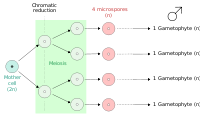
s).- MicrosporeMicrosporeIn biology, a microspore is a small spore as contrasted to the larger megaspore.In botany, microspores develop into male gametophytes, whereas megaspores develop into female gametophytes. The combination of megaspores and microspores is found only in heterosporous organisms...
s: meiospores that give rise to a male gametophyteGametophyteA gametophyte is the haploid, multicellular phase of plants and algae that undergo alternation of generations, with each of its cells containing only a single set of chromosomes....
, (pollenPollenPollen is a fine to coarse powder containing the microgametophytes of seed plants, which produce the male gametes . Pollen grains have a hard coat that protects the sperm cells during the process of their movement from the stamens to the pistil of flowering plants or from the male cone to the...
in seed plants). - MegasporeMegasporeMegaspores, also called macrospores, are a type of spore that is present in heterosporous plants. These types of plants have two spore types, megaspores and microspores. Generally speaking, the megaspore, or large spore, germinates into a female gametophyte, which is fertilized by sperm produced...
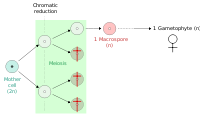
s (or macrospores): meiospores that give rise to a female gametophyteGametophyteA gametophyte is the haploid, multicellular phase of plants and algae that undergo alternation of generations, with each of its cells containing only a single set of chromosomes....
, (an ovuleOvuleOvule means "small egg". In seed plants, the ovule is the structure that gives rise to and contains the female reproductive cells. It consists of three parts: The integument forming its outer layer, the nucellus , and the megaspore-derived female gametophyte in its center...
in seed plants).
- Microspore
- MitosporesConidiumConidia, sometimes termed conidiospores, are asexual, non-motile spores of a fungus and are named after the greek word for dust, konia. They are also called mitospores due to the way they are generated through the cellular process of mitosis...
(or conidia, conidiospores): spores produced by mitosisMitosisMitosis is the process by which a eukaryotic cell separates the chromosomes in its cell nucleus into two identical sets, in two separate nuclei. It is generally followed immediately by cytokinesis, which divides the nuclei, cytoplasm, organelles and cell membrane into two cells containing roughly...
; they are characteristic of Ascomycetes. Fungi in which only mitospores are found are called “mitosporic fungi” or “anamorphic fungi”, and are previously classified under the taxonTaxon|thumb|270px|[[African elephants]] form a widely-accepted taxon, the [[genus]] LoxodontaA taxon is a group of organisms, which a taxonomist adjudges to be a unit. Usually a taxon is given a name and a rank, although neither is a requirement...
Deuteromycota (See Teleomorph, anamorph and holomorphTeleomorph, anamorph and holomorphThe terms teleomorph, anamorph, and holomorph apply to portions of the life cycles of fungi in the phyla Ascomycota and Basidiomycota.*Teleomorph: the sexual reproductive stage , typically a fruiting body....
).
By motility
Spores can be differentiated by whether they can moveMotility
Motility is a biological term which refers to the ability to move spontaneously and actively, consuming energy in the process. Most animals are motile but the term applies to single-celled and simple multicellular organisms, as well as to some mechanisms of fluid flow in multicellular organs, in...
or not.
- ZoosporeZoosporeA zoospore is a motile asexual spore that uses a flagellum for locomotion. Also called a swarm spore, these spores are created by some algae, bacteria and fungi to propagate themselves.-Flagella:...
s: mobile spores that move by means of one or more flagellaFlagellumA flagellum is a tail-like projection that protrudes from the cell body of certain prokaryotic and eukaryotic cells, and plays the dual role of locomotion and sense organ, being sensitive to chemicals and temperatures outside the cell. There are some notable differences between prokaryotic and...
, and can be found in some algaeAlgaeAlgae are a large and diverse group of simple, typically autotrophic organisms, ranging from unicellular to multicellular forms, such as the giant kelps that grow to 65 meters in length. They are photosynthetic like plants, and "simple" because their tissues are not organized into the many...
and fungi. - Aplanospores: immobile spores that may nevertheless potentially grow flagella.
- Autospores: immobile spores that cannot develop flagella.
- BallistosporeBallistosporeA spore that is shot off. In fungi most types of basidiospores, formed on basidia are discharged into the air from the tips of sterigmata. These actively discharged spores are a type of ballistospore....
s: spores that are actively discharged from the body of the fungal fruiting body. Most basidiosporeBasidiosporeA basidiospore is a reproductive spore produced by Basidiomycete fungi. Basidiospores typically each contain one haploid nucleus that is the product of meiosis, and they are produced by specialized fungal cells called basidia. In grills under a cap of one common species in the phylum of...
s are also ballistospores, and another notable example is spores of PilobolusPilobolusPilobolus is a genus of fungi that commonly grows on herbivore dung.-Life cycle:The life cycle of Pilobolus begins with a black sporangium that has been discharged onto a plant substrate such as grass. A herbivorous animal such as a horse then eats the substrate, unknowingly consuming the...
. - Statismospores: spores that are not actively discharged from the fungal fruiting body. Examples are puffballPuffballA puffball is a member of any of several groups of fungus in the division Basidiomycota. The puffballs were previously treated as a taxonomic group called the Gasteromycetes or Gasteromycetidae, but they are now known to be a polyphyletic assemblage. The distinguishing feature of all puffballs is...
s.
Anatomy
Under high magnificationMagnification
Magnification is the process of enlarging something only in appearance, not in physical size. This enlargement is quantified by a calculated number also called "magnification"...
, spores can be categorized as either monolete spores or trilete spores. In monolete spores, there is a single line on the spore indicating the axis on which the mother spore was split into four along a vertical axis. In trilete spores, all four spores share a common origin and are in contact with each other, so when they separate, each spore shows three lines radiating from a center pole.
Vascular plant spores are always haploid. Vascular plants are either homosporous (or isosporous) or heterosporous. Plants that are homosporous produce spores of the same size and type. Heterosporous plants, such as spikemoss
Spikemoss
Selaginella is a genus of plants in the family Selaginellaceae, the spikemosses. Many workers still place the Selaginellales in the class Lycopodiopsida . This group of plants has for years been included in what, for convenience, was called "fern allies". S...
es, quillworts, and some aquatic ferns produce spores of two different sizes: the larger spore in effect functioning as a "female
Female
Female is the sex of an organism, or a part of an organism, which produces non-mobile ova .- Defining characteristics :The ova are defined as the larger gametes in a heterogamous reproduction system, while the smaller, usually motile gamete, the spermatozoon, is produced by the male...
" spore and the smaller functioning as a "male
Male
Male refers to the biological sex of an organism, or part of an organism, which produces small mobile gametes, called spermatozoa. Each spermatozoon can fuse with a larger female gamete or ovum, in the process of fertilization...
".
Trilete spores
Trilete spores, formed by the dissociation of a spore tetrad, are taken as the earliest evidence of life on land, dating to the mid-Ordovician (early Llanvirn, ~).Dispersal
In fungi, both asexual and sexual spores or sporangiospores of many fungal species are actively dispersed by forcible ejection from their reproductive structures. This ejection ensures exit of the spores from the reproductive structures as well as travelling through the air over long distances. Many fungi thereby possess specialized mechanical and physiological mechanisms as well as spore-surface structures, such as hydrophobinHydrophobin
Hydrophobins are a class of small, cysteine rich proteins that are expressed only by filamentous fungi. They are known for their capability of forming a hydrophobic coating on a surface of an object. They were first discovered and separated in Schizophyllum commune in 1991...
s, for spore ejection. These mechanisms include, for example, forcible discharge of ascospores enabled by the structure of the ascus and accumulation of osmolyte
Osmolyte
Osmolytes are compounds affecting osmosis. They are soluble in the solution within a cell, or in the surrounding fluid, e.g. as plasma osmolytes. They play a role in maintaining cell volume and fluid balance. For example, when a cell swells due to external osmotic pressure, membrane channels open...
s in the fluids of the ascus that lead to explosive discharge of the ascospores into the air. The forcible discharge of single spores termed ballistospores involves formation of a small drop of water (Buller's drop), which upon contact with the spore leads to its projectile release with an initial acceleration of more than 10,000 g
G-force
The g-force associated with an object is its acceleration relative to free-fall. This acceleration experienced by an object is due to the vector sum of non-gravitational forces acting on an object free to move. The accelerations that are not produced by gravity are termed proper accelerations, and...
. Other fungi rely on alternative mechanisms for spore release, such as external mechanical forces, exemplified by puffballs. Attracting insects, such as flies, to fruiting structures, by virtue of their having lively colours and a putrid odour, for dispersal of fungal spores is yet another strategy, most prominently used by the stinkhorns.
In the case of spore-shedding vascular plant
Vascular plant
Vascular plants are those plants that have lignified tissues for conducting water, minerals, and photosynthetic products through the plant. Vascular plants include the clubmosses, Equisetum, ferns, gymnosperms and angiosperms...
s such as fern
Fern
A fern is any one of a group of about 12,000 species of plants belonging to the botanical group known as Pteridophyta. Unlike mosses, they have xylem and phloem . They have stems, leaves, and roots like other vascular plants...
s, wind distribution of very light spores provides great capacity for dispersal. Also, spores are less subject to animal predation than seeds because they contain almost no food reserve; however they are more subject to fungal and bacterial predation. Their chief advantage is that, of all forms of progeny, spores require the least energy and materials to produce.
In the spikemoss Selaginella lepidophylla
Selaginella lepidophylla
Selaginella lepidophylla is a species of desert plant in the spikemoss family . S. lepidophylla is noted for its ability to survive almost complete desiccation; during dry weather in its native habitat, its stems curl into a tight ball and uncurl when exposed to moisture...
, dispersal is achieved in part by an unusual type of diaspore
Diaspore (botany)
In botany, a diaspore is a plant dispersal unit consisting of a seed or spore plus any additional tissues that assist dispersal. In some seed plants, the diaspore is a seed and fruit together, or a seed and elaiosome. In a few seed plants, the diaspore is most or all of the plant, known as a...
, a tumbleweed
Tumbleweed
A tumbleweed is the above-ground part of a plant that, once mature and dry, disengages from the root and tumbles away in the wind. Usually, the tumbleweed is the entire plant apart from the roots, but in a few species it is a flower cluster. The tumbleweed habit is most common in steppe and desert...
.
See also
- Alternation of generationsAlternation of generationsAlternation of generations is a term primarily used in describing the life cycle of plants . A multicellular sporophyte, which is diploid with 2N paired chromosomes , alternates with a multicellular gametophyte, which is haploid with N unpaired chromosomes...
- BioaerosolBioaerosolA bioaerosol is a suspension of airborne particles that contain living organisms or were released from living organisms. These particles are very small and range in size from less than one micrometer to one hundred micrometers . Bioaerosols react to air currents and move quickly or slowly...
- SporophyteSporophyteAll land plants, and some algae, have life cycles in which a haploid gametophyte generation alternates with a diploid sporophyte, the generation of a plant or algae that has a double set of chromosomes. A multicellular sporophyte generation or phase is present in the life cycle of all land plants...
- EndosporeEndosporeAn endospore is a dormant, tough, and temporarily non-reproductive structure produced by certain bacteria from the Firmicute phylum. The name "endospore" is suggestive of a spore or seed-like form , but it is not a true spore . It is a stripped-down, dormant form to which the bacterium can reduce...
- FernFernA fern is any one of a group of about 12,000 species of plants belonging to the botanical group known as Pteridophyta. Unlike mosses, they have xylem and phloem . They have stems, leaves, and roots like other vascular plants...
- Auxiliary cellAuxiliary cellThe auxiliary cell is a spore-like structure that form within the fungal family Gigasporaceae . Auxiliary cells have thin cell walls, echinulate , papillate, knobby or sometimes smooth surfaces, and are formed from hyphae after spore germination before the formation of mycorrhizae, and then on the...
- CryptosporesCryptosporesCryptospores are fossilised primitive plant spores that first appear in the fossil record during the late Ordovician to early Silurian period.-Occurrence:Cryptospores are generally found in non-marine rocks and decrease in abundance with distance offshore...