

Labyrinthodontia

Encyclopedia
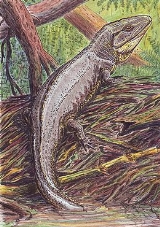
Labyrinthodontia is an older term for any member of the extinct
subclass of amphibian
s, which constituted some of the dominant animals of Late Paleozoic
and Early Mesozoic
times (about 390 to 210 million years ago). The group is ancestral to all extant landliving vertebrates
, and as such constitutes an evolutionary grade
(a paraphyletic group) rather than a clade
. The name describes the pattern of infolding of the dentin
and enamel
of the teeth, which are often the only part of the creatures that fossil
ize. They are also distinguished by a heavily armoured skull roof
(hence the older name "Stegocephalia
"), and complex vertebrae, the structure of which is useful in older classifications of the group.
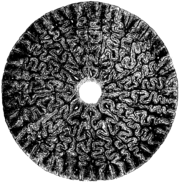 The labyrinthodonts flourished for more than 200 million years. Particularly the early forms exhibited a lot of variation, yet there are still a few basic anatomical traits that make their fossils very distinct and easily recognisable in the field:

-like bodies.
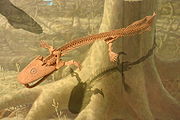
 With the exception of the snake-like aïstopods
, the skulls of labyrinthodonts were massive. Their jaws were lined with small, sharp, conical teeth and had a second row of larger teeth on the roof of the mouth. All teeth were labyrinthodont. The sole exception were the chisel-like teeth of some of the advanced herbivorous
diadectomorphs
. The skull had prominent otic notches behind each eye and a parietal eye
.
The vertebrae
were complex and not particularly strong, consisting of numerous, often poorly ossified elements. The long bones of the limbs were short and broad and the ankle had limited mobility and the toes lacked claw
s, limiting the amount of traction the feet could produce. This would have made most labyrinthodonts slow and clumsy on land. Some of the larger adults may have been confined to water. Some late Paleozoic groups, particularly microsaurs
and seymouriamorphs
, were small to medium-sized and would have been competent terrestrial animals. The advanced diadectomorphs from the Late Carboniferous
and Early Permian
were fully terrestrial with stout skeletons, and were the heaviest land animals of their time. The Mesozoic
labyrinthodonts were mostly aquatic with increasingly cartilaginous skeleton.
was prominent, although there is uncertainty as to whether it was a true image producing organ or one that could only register light and dark, like that of the modern tuatara
.
Like modern fish, most labyrinthodonts had special sense organs in the skin, forming a lateral line
organ for perception of water flow and pressure. This would enable them to pick up the vibration of their prey and other waterborne sounds while hunting in murky, weed filled waters. Early labyrinthodont groups had massive stapes, likely primarily anchoring the brain case to the skull roof
. It is a question of some doubt whether early terrestrial labyrinthodonts had the stapes connected to a tympanum covering their otic notch, and if they had an aerial sense of hearing at all. The tympanum in anurans and amniote
s appear to have evolved separately, indicating most, if not all, Labyrinthodonts were unable to pick up airborne sound.
s, derived from the swim bladders of their ancestors. They could breathe air, which would have been a great advantage for residents of warm shoal
s with low oxygen levels in the water. There was no diaphragma
; air was inflated into the lungs by contractions of a throat sac. Many aquatic forms retained their larval gills in adulthood. The loss of the armour of rhomboid
scales
of their piscine ancestors allowed additional oxygen uptake through the skin as in modern amphibians.
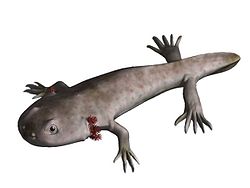
s. They would remain in water throughout the larval stage until metamorphosis. Only the metamorphosed individuals would eventually venture onto land on occasion. Fossil tadpoles from several species are known, as are neotenic
adults with feathery external gills
similar to those found in modern lissamphibia
n tadpoles and in the fry of lungfish
and bichir
s. The existence of a larval stage as the primitive condition in all groups of labyrinthodonts can be fairly safely assumed, in that tadpoles of Discosauriscus
, a close relative of the amniote
s, are known.
relationship. Many key groups were small with moderately ossified skeletons, and there is a gap (the "Romer's gap
") in the fossil record in the early Carboniferous
when most of the groups appear to have evolved. Further complicating the picture is the amphibian larval-adult life cycle, with physical changes throughout life complicating phylogenetic analysis. The Labyrinthodontia appear to be composed of several nested clade
s. The two best understood groups, the Ichthyostegalia and the reptile-like amphibians
have from the outset been known to be paraphyletic
. Tellingly, labyrinthodont systematics was the subject of the inaugural meeting of International Society for Phylogenetic Nomenclature
.
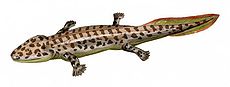 The early labyrinthodonts are known from the Devonian and possibly extending into the Romer's Gap
of the early Carboniferous
. These labyrinthodonts are often grouped together as the order
Ichthyostegalia, though the group is an evolutionary grade
rather than a clade
. Ichthyostegalians were predominately aquatic and most show evidence of functional internal gill
s throughout life, and probably only occasionally ventured onto land. Their polydactylous
feet had more than the usual five digits for tetrapods and were paddle-like. The tail bore true fin rays like those found in fish. The vertebrae
were complex and rather weak. At the close of the Devonian, forms with progressively stronger legs and vertebrae evolved, and the later groups lacked functional gills as adults. All were however predominately aquatic and some spent all or nearly all their lives in water.
 An early branch was the terrestrial reptile-like amphibians, variously called Anthracosauria
or Reptiliomorpha
. Tulerpeton
has been suggested as the earliest member of the line, indicating the split may have happened before the Devonian
-Carboniferous transition. Their skulls were relatively deep and narrow compared to other labyrinthodonts. Front and hind feet bore five digits on most forms. Several of the early groups are known from brachish or even marine envioronments, having returned to a more or less fully aquatic mode of living.
With the exception of the diadectomorphs
, the terrestrial forms were moderately sized creatures that appeared in the early Carboniferous
. The vertebrae
of the group foreshadowed that of primitive reptiles, with small pleurocentra, which grew and fused to become the true centrum
in later vertebrates. The most well known genus is Seymouria
. Some members of the most advanced group, the Diadectomorpha, were herbivorous
and grew to several meters in length, with great, barrel-shaped bodies. Small relatives of the diadectomorphs gave rise to the first reptile
s in the Late Carboniferous
.
 The most diverse group of labyrinthodonts was the Temnospondyli
. Temnospondyls appeared the Late Devonian
and came in all sizes, from small salamander-like Stereospondyli
that scurried along the waters edge and undergrowth, to giant, well armoured Archegosauroidea
that looked more like crocodiles. The largest member of family Archegosauridae
, Prionosuchus
, is estimated to have been up to 9 meters long, the largest amphibian ever known to have lived.
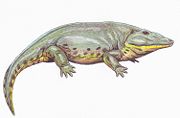 A temnospondyl's fore-foot had only four toes, and the hind-foot five, similar to the pattern seen in modern amphibians. Temnospondyls had a conservative vertebral column in which the pleurocentra remained small in primitive forms, vanishing entirely in the more advanced ones. The intercentra bore the weight of the animal, being large and forming a complete ring. All were more or less flat-headed with either strong or secondarily weak vertebrae and limbs. There were also fully aquatic forms, like the Dvinosauria
, and even marine forms such as the Trematosauridae
. The Temnospondyli may have given rise to the modern frog
s and salamander
s in the late Permian
or early Triassic
.
evolved mostly small species that can be found in European and North American Carboniferous and early Permian strata. They are characterized by simple spool-shaped vertebrae formed from a single element, rather than the complex system found in other labyrinthodont groups. Most were aquatic and external gill
s are sometimes found preserved. The Leposondyli were generally salamander-like, but one group, the Aïstopoda
, was snakelike with flexible, reduced skulls. Some microsaur
lepospondyls were squat and short-tailed and appear to have been well adapted to terrestrial life. The best known genus is Diplocaulus
, a nectridea
n with a boomerang
-shaped head.
The position of Lepospondyli in relation to other labyrinthodont groups is uncertain, and it is sometimes classified as a separate subclass
. There is some doubt as to whether the lepospondyls form a phylogenetic
unit at all, or is a wastebasket taxon containing the paedamorphic forms and tadpoles
of other labyrinthodonts, notably the reptile-like amphibians.
group: the fleshy-finned
Rhipidistia
. The only other living group of Rhipidistans alive today are the lungfish
, the sister group of the landliving vertebrates
. Earliest traces of the land-living forms are fossil trackways from Zachełmie quarry, Poland
, dated to 395 million years ago, attributed to an animal with feet very similar to Ichthyostega
.
s had stabilized freshwater habitats, allowing the first wetland
ecosystem
s to develop, with increasingly complex food web
s that afforded new opportunities. The early labyrinthodonts were wholly aquatic, hunting in shallow water along tidal shores or weed filled tidal channels. From their piscine ancestors, they had inherited swim bladders that opened to the oesophagus and were capable of functioning as lungs (a condition still found in lungfish and some primitive ray-finned fishes
), allowing them to hunt in stagnant water or in waterways where rotting vegetation would have lowered oxygen content. The earliest forms, such as Acanthostega
, had vertebrae and limbs quite unsuited to life on land. This is in contrast to the earlier view that fish had first invaded the land—either in search of prey like modern mudskipper
s, or to find water when the pond they lived in dried out. Early fossil tetrapods have been found in marine sediments, suggesting marine and brackish areas were their primary habitat. This is further corroborated by fossils of early labyrinthodonts being found scattered all around the world, indicating they must have spread by following the coastal lines rather than through freshwater only.
The first labyrinthodonts were all large to moderately large animals, and would have suffered considerable problems on land. While they retained gills and fish-like skulls and tails with fin rays, the early forms can readily be separated from Rhipidistan fish by the cleithrum
/scapula
complex being separate from the skull to form a pectoral girdle and carry the weight of the front end of the animals. They were all carnivorous
, initially eating fish and possibly going ashore to feed off washed up carrion, only later turning into predators of the large invertebrate
s of the Devonian at the waters edge. The various early forms are for convenience grouped together as Ichthyostegalia.
While the body shape and proportions of the Ichthyostegalians went largely unchanged throughout their evolutionary history, the limbs underwent a rapid evolution. The proto-Labyrinthodonts like from Elginerpeton
and Tiktaalik
had fin-like extremeties with no clear fingers, primarily suited for movement in open water, but also capable of propelling the animal across sandbanks and through vegetation filled waterways. Ichthyostega
and Acanthostega
had paddle-like polydactyl
feet with stout bony toes that also would have enabled them to drag themselves across land. The aquatic Ichthyostegalians flourished in tidal channels and swampland through the remainder of the Devonian, only to disappear from the fossil
record at the transition to the Carboniferous
.
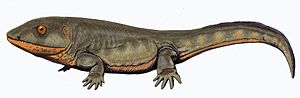 The end of the Devonian saw the late Devonian extinction
event, followed by a gap in the fossil
record of some 15 million years at the start of the Carboniferous, called the "Romer's gap
". The gap marks the disappearance of the Ichthyostegalian forms as well as the origin of the higher Labyrinthodonts. Finds from this period found in East Kirkton Quarry
includes the peculiar, probably secondarily aquatic Crassigyrinus
, which may represent the sister group to later Labyrinthodont groups.
Early Carboniferous saw the radiation of the family Loxommatidae
, a mysterious group that may have been the ancestors or sister taxon of the higher groups. By the Visean
age of mid-Carboniferous times the labyrinthodonts had radiated into at least three main branches. Recognizable groups are representative of the temnospondyls
, lepospondyls
and reptile-like amphibans
, the latter which were the relatives and ancestors of the Amniota
.
While most Labyrinthodonts remained aquatic or semi-aquatic, some of the reptile-like amphibians adapted to explore the terrestrial ecological niche
s as small or medium sized predators. They evolved increasingly terrestrial adaptions during the Carboniferous, including stronger vertebrae and slender limbs, and a deeper skull with laterally placed eyes. They probably had watertight skin, possibly covered in horny scute
s. To the modern eye, these animals would appear like heavyset reptiles, only betraying their amphibious nature when spawning
aquatic eggs. In the middle or late Carboniferous, smaller forms gave rise to the first reptile
s. In the late Carboniferous, a global rainforest collapse
favoured the more terrestrially adapted groups. The reptilomorph family Diadectidae
evolved herbivory, becoming the largest terrestrial animals of the day with barrel-shaped, heavy bodies. There were also a family of correspondingly large carnivores, the Limnoscelidae
, that flourished briefly in the late Carboniferous.
, and then quickly declined, their role taken over by early reptilian herbivores like Pareiasaur
s and Edaphosaurs
. Unlike the reptile-like amphibians, the Temnospondyli
remained mostly denizens of rivers and swampland, feeding on fish and perhaps other Labyrinthodonts. They underwent a major diversification in the late Carboniferous and early Permian, thriving in the rivers and brackish coal forest
s in continental shallow basins around equatorial Pangaea
and around the Paleo-Tethys Ocean
.
Several adaptions to piscivory
evolved with some groups having crocodile
-like skulls with slender snouts, and presumably had a similar life-style (Archegosauridae
, Melosauridae, Cochleosauridae
and Eryopidae
, and the reptile-like suborder Embolomeri
). Others, evolved as aquatic ambush predators, with short, broad skulls that allowed for opening the mouth by tipping the skull back rather than dropping the jaw (Plagiosauridae
and the dvinosaur
families). In life they would have hunted rather like the modern day monkfish
, and several groups are known to have retained the larval gills into adulthood, being fully aquatic. The Metoposauridae
adapted to hunting in shallows and murky swamps, with ∩-shaped skull, much like their Devonian ancestors.
In Euramerica
, the Lepospondyli
, a host of small, mostly aquatic amphibians of uncertain phylogeny, appeared in the Carboniferous. They lived as denizens of the undergrowth and small ponds, in ecological niches similar to those of modern amphibians. In the Permian, the peculiar Nectridea
found their way from Euramerica to Gondwanaland.
continued to thrive until going extinct in the Triassic
. The diverse Lepospondyl
inhabitants of the undergrowth disappear from the fossil record, among them the snake-like Aïstopoda
.
With the close of the Palaeozoic, most of the Permian groups disappeared, with the exception of the Mastodonsauroid
and Metoposaurid
families and the curious Plagiosauridae
, who continued into the Triassic. Life in the waterways of continental shallows saw several large forms from these families, like Thoosuchus
, Benthosuchus
and Eryosuchus
. Their ecological niche
s were probably similar to those of modern day crocodile
s, as fish hunters and riverside carnivores. All groups developed progressively weaker vertebrae, reduced limb ossification and flatter skulls with prominent lateral line
organs, indicating the late Permian/early Triassic Temnospondyls rarely if ever left the water. An extremely large Brachyopid
(likely a plagiosaur or a close relative) is estimated to have been 7 meters long, and probably just as heavy as the Permian Prionosuchus
.
With the rise of the real crocodile
s in the middle Triassic, even these Temnospondyli went into decline, though some hung on to at least early Cretaceous
on the southern Gondwanaland, in regions too cold for crocodiles.
, have their origin in Labyrinthodont stock, but this is where consensus ends. The fragile bones of the Lissamphibians are extremely rare as fossils, and the modern amphibians are highly derived, making comparison with fossil Labyrinthodonts difficult.
Traditionally, the Lepospondyli
has been favored as lissamphibian ancestors. Like the modern amphibians, they were mostly small with simple vertebrae, resembling lissamphibians in many aspects of external anatomy and presumably ecological niche
s. At a subclass
level, it was thought that labyrinthodonts gave rise to leopspondyls, and lepospondyls to lissamphibians. Several cladistic
studies also favour the lepospondyl link, though placing Lepospondyli as close relatives or even derived from reptile-like amphibians
. One problem with this position is the question of whether Lepospondyli actually is monophyletic
in the first place.
Temnospondyl affinity for the Lissamphibia is suggested by other works. The temnospondyl family Amphibamidae
has been considered a possible candidate for the ancestors of lissamphibians. The amphibamid Gerobatrachus
, described in 2008, was proposed to be a transitional form
between temnospondyls and anurans (frogs and toads) and caudatans (salamanders). It possessed a mixture of anuran and caudatan features, including a broad skull, short tail, and small pedicellate teeth
.
Complicating the picture is the question of whether Lissamphibia itself may be polyphyletic
. Though a minority view, several variants have been forwarded through history. The "Stockholm school" under Gunnar Säve-Söderbergh
and Erik Jarvik
argued that Amphibia as a whole is biphyletic
, based on details of the nasal capsul and cranial nerves. In their view lepospondyls are ancestors of frogs, while salamander
s and caecilian
s have evolved independently from porolepiform fish
. Robert L. Carroll
suggested the tailed amphibians (salamanders and caecilians) are derived from lepospondyl microsaurs
and frogs from temnospondyls. The cladistic
analysis of Gerobatrachus suggests salamanders and frogs have evolved from temnospondyl stock and caecilians being the sister group of the reptile-like amphibians, rendering Lissamphibia itself an evolutionary grade relative to the remaining tetrapod classes. A consensus on origin of lissamphibians and relationship between the various labyrinthodonts is not likely to materialise soon.

The fossil sequence leading from the early Carboniferous
labyrinthodonts to the amniotes has traditionally been seen as fairly well mapped out since the early 20th century, mainly leaving only the question of the demarcation line between the amphibian and reptilian grade of reproduction. Work by Carroll
and Laurin
around the turn of the millennium has greatly helped in pinpointing the transition.
The early reptile-like amphibians were mostly aquatic, the first highly terrestrially adapted groups being the Seymouriamorpha
and the Diadectomorpha
. The seymouriamorphs were small to medium sized animals with stout limbs, their remains are sometimes found in what has been interpreted as dry environments, indicating their skin had a water-tight epidermal horny overlay or even scales as evident in Discosauriscus
. Their skeletons are very similar to those of early reptiles, though finds of seymouriamorph tadpoles have shown they retained an amphibian reproduction. The lumbering Diadectomorphans are generally considered to be the closest known relatives of modern amniotes. They too are thought to have been on the amphibian side of the divide, despite no known diadectomorph fossil tadpoles. Analysis of new finds and composition of larger trees do however indicate the phylogeny may not be as well understood as traditionally thought.
Several authors have suggested that terrestrial eggs evolved from amphibian eggs laid on land to avoid predation on the eggs and competition from other labyrinthodonts. The amniote
egg would necessarily have had to evolved from one with an anamniote
structure, as those found in modern amphibians. In order for such an egg to excrete CO2
on land without the specialized membranes to aid in respiration, it would have to be very small, 1 cm in diameter or smaller. Such very small eggs with direct development would severely restrict the adult size, thus the amniotes would have evolved from very small animals. A number of small, fragmentary fossils of possibly diadectomorph affinity has been proposed as the first amniote, including Gephyrostegus, Solenodonsaurus
, Westlothiana
and Casineria
. Fossilized footprints found in New Brunswick
indicate the first reptile
s were established by 315 million years ago.
in reference to the tooth structure. Labyrinthodontia was first used as a systematic term by Richard Owen
in 1860, and assigned to Amphibia the following year.
It was ranked as an order
under class Amphibia by Watson in 1920 and as a superorder by Romer in 1947. An alternative name, Stegocephalia was created in 1868 by American palaentologist Edward Drinker Cope
, from Greek
stego cephalia—"roofed head", and refer to the copious amounts of dermal armour
some of the larger forms evidently had. This term is widely used in 19th and early 20th century literature.
The earliest finds was attempted classified on the basis of skull roof
, often the only part of part of the specimen preserved. With the frequent convergent evolution
of head shape in Labyrinthodonts, this led to form taxa
only. The relationship of the various groups to each other and to the Lissamphibia
ns (and to some degree the first reptile
s) is still a matter of some debate. Several schemes have been forwarded, and at present there is no consensus among workers in the field.
in the 1930s. He believed that Amphibia was biphyletic
, and that salamanders and caecilians had evolved independently from porolopiform fish
. Few shared Säve-Söderbergh's view of a biphyletic Amphibia, but his scheme, either with the Lepospondyli as a separate subclass or sunk into Temnospondyli
, was continued by Romer in his much used Vertebrate Paleontology
of 1933 and later editions, and followed by several subsequent authors (Colbert 1969, Daly 1973, Carroll
1988 and Hildebrand & Goslow 2001): The classification cited here is from Romer & Parson, 1985:
influential Vertebrate Palaeontology
has a more detailed scheme, dividing the amphibians into a series of unassigned families, corresponding to Ichthyostegalia in the classical scheme and splitting the Lepospondyli
and reptile-like Labyrinthodonts
up into separate orders. The orders are grouped into subclasses Batrachomorpha
and Reptiliomorpha
, representing the orders thought more closely related to modern amphibians and reptiles respectively:
A good summary (with diagram) of characteristics and main evolutionary trends of the above three orders is given in Colbert 1969 pp. 102–103, but see Kent & Miller (1997) for an alternative tree.
tetrapod
s, basal
tetrapods, non-amniote Reptiliomorpha
and as a monophyletic or paraphyletic Temnospondyli, according to various cladistic analysis
. This reflects the emphasis of ascertaining lineage and ancestral-descendant relatedness in modern-day cladistics
. The name does however linger as a handy reference for the early amphibian tetrapod
s, and as an apt anatomical description of their distinct tooth pattern.
The largely synonymous name Stegocephalia
has been taken up by Michel Laurin
and defined cladistically
for all traditional labyrinthodonts (including their descendants), so that the name with the largely traditional meaning is still employed. A cladistic term with somewhat similar, though uncertain meaning is Stem Tetrapoda
, a stem group, a group consisting of all species more closely related to modern tetrapods than to lungfish
, excluding the crown group
. Apart from its inclusion of tetrapodamorph fish
, the actual content of the latter is a matter of some uncertainty, as the phylogenetic tree, which the stem group concept is based on, is not well understood in labyrinthodonts.
Extinction
In biology and ecology, extinction is the end of an organism or of a group of organisms , normally a species. The moment of extinction is generally considered to be the death of the last individual of the species, although the capacity to breed and recover may have been lost before this point...
subclass of amphibian
Amphibian
Amphibians , are a class of vertebrate animals including animals such as toads, frogs, caecilians, and salamanders. They are characterized as non-amniote ectothermic tetrapods...
s, which constituted some of the dominant animals of Late Paleozoic
Paleozoic
The Paleozoic era is the earliest of three geologic eras of the Phanerozoic eon, spanning from roughly...
and Early Mesozoic
Mesozoic
The Mesozoic era is an interval of geological time from about 250 million years ago to about 65 million years ago. It is often referred to as the age of reptiles because reptiles, namely dinosaurs, were the dominant terrestrial and marine vertebrates of the time...
times (about 390 to 210 million years ago). The group is ancestral to all extant landliving vertebrates
Tetrapod
Tetrapods are vertebrate animals having four limbs. Amphibians, reptiles, birds and mammals are all tetrapods; even snakes and other limbless reptiles and amphibians are tetrapods by descent. The earliest tetrapods evolved from the lobe-finned fishes in the Devonian...
, and as such constitutes an evolutionary grade
Evolutionary grade
In alpha taxonomy, a grade refers to a taxon united by a level of morphological or physiological complexity. The term was coined by British biologist Julian Huxley, to contrast with clade, a strictly phylogenetic unit.-Definition:...
(a paraphyletic group) rather than a clade
Clade
A clade is a group consisting of a species and all its descendants. In the terms of biological systematics, a clade is a single "branch" on the "tree of life". The idea that such a "natural group" of organisms should be grouped together and given a taxonomic name is central to biological...
. The name describes the pattern of infolding of the dentin
Dentin
Dentine is a calcified tissue of the body, and along with enamel, cementum, and pulp is one of the four major components of teeth. Usually, it is covered by enamel on the crown and cementum on the root and surrounds the entire pulp...
and enamel
Tooth enamel
Tooth enamel, along with dentin, cementum, and dental pulp is one of the four major tissues that make up the tooth in vertebrates. It is the hardest and most highly mineralized substance in the human body. Tooth enamel is also found in the dermal denticles of sharks...
of the teeth, which are often the only part of the creatures that fossil
Fossil
Fossils are the preserved remains or traces of animals , plants, and other organisms from the remote past...
ize. They are also distinguished by a heavily armoured skull roof
Skull roof
The skull roof , or the roofing bones of the skull are a set of bones covering the brain, eyes and nostrils in bony fishes and all land living vertebrates. The bones are derived from dermal bone, hence the alternative name dermatocranium...
(hence the older name "Stegocephalia
Stegocephalia
Stegocephalia is an old term for early amphibians, comprising all pre-Jurassic and some later extinct large amphibians of more or less salamander-like build...
"), and complex vertebrae, the structure of which is useful in older classifications of the group.
Labyrinthodont traits
- Strongly folded tooth surface, involving infolding of the dentinDentinDentine is a calcified tissue of the body, and along with enamel, cementum, and pulp is one of the four major components of teeth. Usually, it is covered by enamel on the crown and cementum on the root and surrounds the entire pulp...
and enamelTooth enamelTooth enamel, along with dentin, cementum, and dental pulp is one of the four major tissues that make up the tooth in vertebrates. It is the hardest and most highly mineralized substance in the human body. Tooth enamel is also found in the dermal denticles of sharks...
of the teeth, so that a cross section resembles a classical labyrinthLabyrinthIn Greek mythology, the Labyrinth was an elaborate structure designed and built by the legendary artificer Daedalus for King Minos of Crete at Knossos...
(or mazeMazeA maze is a tour puzzle in the form of a complex branching passage through which the solver must find a route. In everyday speech, both maze and labyrinth denote a complex and confusing series of pathways, but technically the maze is distinguished from the labyrinth, as the labyrinth has a single...
), hence the name of the group. - Massive skull roof, with openings only for the nostrils, eyes and a parietal eyeParietal eyeA parietal eye, also known as a parietal organ or third-eye or pineal eye, is a part of the epithalamus present in some animal species...
, similar to the structure of the anapsidAnapsidAn anapsid is an amniote whose skull does not have openings near the temples.While "anapsid reptiles" or "anapsida" are traditionally spoken of as if they were a monophyletic group, it has been suggested that several groups of reptiles that had anapsid skulls may be only distantly related...
s. With the exception of the later more reptile-like forms, the skull was rather flat with copious amounts of dermal armour, accounting for the older term for the group: Stegocephalia. - Otic notchOtic notchOtic notches are invagination in the posterior margin of the skull roof, one behind each orbit. Such notches are found in labyrinthodonts and some of their immediate ancestors, but not their reptilian descendants...
behind each eye at the back edge of the skull. In the primitive waterbound forms it may have formed an open spiracleSpiracleSpiracles are openings on the surface of some animals that usually lead to respiratory systems.-Vertebrates:The spiracle is a small hole behind each eye that opens to the mouth in some fishes. In the primitive jawless fish the first gill opening immediately behind the mouth is essentially similar...
, and may possibly have held a tympanic membrane in some advanced forms. - Complex vertebraeVertebral columnIn human anatomy, the vertebral column is a column usually consisting of 24 articulating vertebrae, and 9 fused vertebrae in the sacrum and the coccyx. It is situated in the dorsal aspect of the torso, separated by intervertebral discs...
made of 4 pieces, an intercentrum, two pleurocentra, and a vertebral archVertebral archThe vertebral arch is the posterior part of a vertebra.It consists of a pair of pedicles and a pair of laminae, and supports seven processes:* four articular processes* two transverse processes* one spinous process...
/spine. The relative sizes and ossification of the elements is highly variable.
The labyrinthodonts in life
General build
Labyrinthodonts were generally amphibian-like in build. They were short-legged and mostly large headed, with moderately short to long tails. Many groups, and all the early forms, were large animals. Primitive members of all labyrinthodont groups were probably true water predators, and various degrees of amphibious, semi-aquatic and semi terrestrial modes of living arose independently in different groups. Some lineages remained or became secondarily fully aquatic with reduced limbs and elongated, eelEel
Eels are an order of fish, which consists of four suborders, 20 families, 111 genera and approximately 800 species. Most eels are predators...
-like bodies.
Skeleton
Aïstopoda
Aïstopoda is an order of highly specialised snake-like amphibians known from the Carboniferous and Early Permian of Europe and North America, ranging from tiny forms only , to nearly in length...
, the skulls of labyrinthodonts were massive. Their jaws were lined with small, sharp, conical teeth and had a second row of larger teeth on the roof of the mouth. All teeth were labyrinthodont. The sole exception were the chisel-like teeth of some of the advanced herbivorous
Herbivore
Herbivores are organisms that are anatomically and physiologically adapted to eat plant-based foods. Herbivory is a form of consumption in which an organism principally eats autotrophs such as plants, algae and photosynthesizing bacteria. More generally, organisms that feed on autotrophs in...
diadectomorphs
Diadectomorpha
Diadectomorpha are a clade of large reptile-like amphibians that lived in Euramerica during the Carboniferous and Early Permian periods, and are very close to the ancestry of the Amniota. They include both large carnivorous and even larger herbivorous forms, some semi-aquatic and others fully...
. The skull had prominent otic notches behind each eye and a parietal eye
Parietal eye
A parietal eye, also known as a parietal organ or third-eye or pineal eye, is a part of the epithalamus present in some animal species...
.
The vertebrae
Vertebral column
In human anatomy, the vertebral column is a column usually consisting of 24 articulating vertebrae, and 9 fused vertebrae in the sacrum and the coccyx. It is situated in the dorsal aspect of the torso, separated by intervertebral discs...
were complex and not particularly strong, consisting of numerous, often poorly ossified elements. The long bones of the limbs were short and broad and the ankle had limited mobility and the toes lacked claw
Claw
A claw is a curved, pointed appendage, found at the end of a toe or finger in most mammals, birds, and some reptiles. However, the word "claw" is also often used in reference to an invertebrate. Somewhat similar fine hooked structures are found in arthropods such as beetles and spiders, at the end...
s, limiting the amount of traction the feet could produce. This would have made most labyrinthodonts slow and clumsy on land. Some of the larger adults may have been confined to water. Some late Paleozoic groups, particularly microsaurs
Microsauria
Microsauria is an extinct order of lepospondyl amphibians from the late Carboniferous and early Permian periods. It is the most diverse and species-rich group of lepospondyls. Recently, Microsauria has been considered paraphyletic, as several other non-microsaur lepospondyl groups such as...
and seymouriamorphs
Seymouriamorpha
Seymouriamorpha were a small but widespread group of reptiliomorphs. Many seymouriamorphs were terrestrial or semi-aquatic. However, aquatic larvae bearing external gills and grooves from the lateral line system has been found, making them unquestionably amphibians. The adults were terrestrial...
, were small to medium-sized and would have been competent terrestrial animals. The advanced diadectomorphs from the Late Carboniferous
Pennsylvanian
The Pennsylvanian is, in the ICS geologic timescale, the younger of two subperiods of the Carboniferous Period. It lasted from roughly . As with most other geochronologic units, the rock beds that define the Pennsylvanian are well identified, but the exact date of the start and end are uncertain...
and Early Permian
Permian
The PermianThe term "Permian" was introduced into geology in 1841 by Sir Sir R. I. Murchison, president of the Geological Society of London, who identified typical strata in extensive Russian explorations undertaken with Edouard de Verneuil; Murchison asserted in 1841 that he named his "Permian...
were fully terrestrial with stout skeletons, and were the heaviest land animals of their time. The Mesozoic
Mesozoic
The Mesozoic era is an interval of geological time from about 250 million years ago to about 65 million years ago. It is often referred to as the age of reptiles because reptiles, namely dinosaurs, were the dominant terrestrial and marine vertebrates of the time...
labyrinthodonts were mostly aquatic with increasingly cartilaginous skeleton.
Sensory apparatus
The eyes of most labyrinthodonts were situated at the top of the skull, offering good vision upwards, but very little lateral vision. The parietal eyeParietal eye
A parietal eye, also known as a parietal organ or third-eye or pineal eye, is a part of the epithalamus present in some animal species...
was prominent, although there is uncertainty as to whether it was a true image producing organ or one that could only register light and dark, like that of the modern tuatara
Tuatara
The tuatara is a reptile endemic to New Zealand which, though it resembles most lizards, is actually part of a distinct lineage, order Sphenodontia. The two species of tuatara are the only surviving members of its order, which flourished around 200 million years ago. Their most recent common...
.
Like modern fish, most labyrinthodonts had special sense organs in the skin, forming a lateral line
Lateral line
The lateral line is a sense organ in aquatic organisms , used to detect movement and vibration in the surrounding water. Lateral lines are usually visible as faint lines running lengthwise down each side, from the vicinity of the gill covers to the base of the tail...
organ for perception of water flow and pressure. This would enable them to pick up the vibration of their prey and other waterborne sounds while hunting in murky, weed filled waters. Early labyrinthodont groups had massive stapes, likely primarily anchoring the brain case to the skull roof
Skull roof
The skull roof , or the roofing bones of the skull are a set of bones covering the brain, eyes and nostrils in bony fishes and all land living vertebrates. The bones are derived from dermal bone, hence the alternative name dermatocranium...
. It is a question of some doubt whether early terrestrial labyrinthodonts had the stapes connected to a tympanum covering their otic notch, and if they had an aerial sense of hearing at all. The tympanum in anurans and amniote
Amniote
The amniotes are a group of tetrapods that have a terrestrially adapted egg. They include synapsids and sauropsids , as well as their fossil ancestors. Amniote embryos, whether laid as eggs or carried by the female, are protected and aided by several extensive membranes...
s appear to have evolved separately, indicating most, if not all, Labyrinthodonts were unable to pick up airborne sound.
Respiration
The early labyrinthodonts possessed well developed internal gills as well as primitive lungLung
The lung is the essential respiration organ in many air-breathing animals, including most tetrapods, a few fish and a few snails. In mammals and the more complex life forms, the two lungs are located near the backbone on either side of the heart...
s, derived from the swim bladders of their ancestors. They could breathe air, which would have been a great advantage for residents of warm shoal
Shoal
Shoal, shoals or shoaling may mean:* Shoal, a sandbank or reef creating shallow water, especially where it forms a hazard to shipping* Shoal draught , of a boat with shallow draught which can pass over some shoals: see Draft...
s with low oxygen levels in the water. There was no diaphragma
Thoracic diaphragm
In the anatomy of mammals, the thoracic diaphragm, or simply the diaphragm , is a sheet of internal skeletal muscle that extends across the bottom of the rib cage. The diaphragm separates the thoracic cavity from the abdominal cavity and performs an important function in respiration...
; air was inflated into the lungs by contractions of a throat sac. Many aquatic forms retained their larval gills in adulthood. The loss of the armour of rhomboid
Rhomboid
Traditionally, in two-dimensional geometry, a rhomboid is a parallelogram in which adjacent sides are of unequal lengths and angles are oblique.A parallelogram with sides of equal length is a rhombus but not a rhomboid....
scales
Scale (zoology)
In most biological nomenclature, a scale is a small rigid plate that grows out of an animal's skin to provide protection. In lepidopteran species, scales are plates on the surface of the insect wing, and provide coloration...
of their piscine ancestors allowed additional oxygen uptake through the skin as in modern amphibians.
Reproduction
The labyrinthodonts were amphibious—they laid eggs in water, where they would hatch to tadpoleTadpole
A tadpole or polliwog is the wholly aquatic larval stage in the life cycle of an amphibian, particularly that of a frog or toad.- Appellation :...
s. They would remain in water throughout the larval stage until metamorphosis. Only the metamorphosed individuals would eventually venture onto land on occasion. Fossil tadpoles from several species are known, as are neotenic
Neoteny
Neoteny , also called juvenilization , is one of the two ways by which paedomorphism can arise. Paedomorphism is the retention by adults of traits previously seen only in juveniles, and is a subject studied in the field of developmental biology. In neoteny, the physiological development of an...
adults with feathery external gills
External gills
External gills are the gills of an animal, most typically an amphibian, that are exposed to the environment, rather than set inside the pharynx and covered by gill slits, as they are in most fishes. Instead, the respiratory organs are set on a frill of stalks protruding from the sides of an animals...
similar to those found in modern lissamphibia
Lissamphibia
The subclass Lissamphibia includes all recent amphibians and means smooth amphibia.Extant amphibians fall into one of three orders — the Anura , the Caudata or Urodela , and the Gymnophiona or Apoda .Although the ancestry of each group is still unclear, all share certain common characteristics,...
n tadpoles and in the fry of lungfish
Lungfish
Lungfish are freshwater fish belonging to the Subclass Dipnoi. Lungfish are best known for retaining characteristics primitive within the Osteichthyes, including the ability to breathe air, and structures primitive within Sarcopterygii, including the presence of lobed fins with a well-developed...
and bichir
Bichir
The bichirs are a family, Polypteridae, of archaic-looking ray-finned fishes, the sole family in the order Polypteriformes.All species occur in freshwater habitats in tropical Africa and the Nile River system, mainly swampy, shallow floodplains and estuaries.-Anatomy and appearance:Bichirs are...
s. The existence of a larval stage as the primitive condition in all groups of labyrinthodonts can be fairly safely assumed, in that tadpoles of Discosauriscus
Discosauriscus
Discosauriscus was a small reptiliomorph that lived in Central and Western Europe in the Lower Permian Period. Its best fossils have been found in Boskovice Furrow, in the Czech Republic.-Classification:thumb|180px|left|Discosauriscus...
, a close relative of the amniote
Amniote
The amniotes are a group of tetrapods that have a terrestrially adapted egg. They include synapsids and sauropsids , as well as their fossil ancestors. Amniote embryos, whether laid as eggs or carried by the female, are protected and aided by several extensive membranes...
s, are known.
Groups of labyrinthodonts
The systematic placement of groups within Labyrinthodontia is notoriously fickle. Several groups are identified, but there is no consensus of their phylogeneticPhylogenetics
In biology, phylogenetics is the study of evolutionary relatedness among groups of organisms , which is discovered through molecular sequencing data and morphological data matrices...
relationship. Many key groups were small with moderately ossified skeletons, and there is a gap (the "Romer's gap
Romer's gap
Romer's Gap is an example of a gap in the fossil record used in the study of evolution. Such gaps represent a period from which excavators have found no or very few fossils. Romer's gap is named after paleontologist Dr...
") in the fossil record in the early Carboniferous
Carboniferous
The Carboniferous is a geologic period and system that extends from the end of the Devonian Period, about 359.2 ± 2.5 Mya , to the beginning of the Permian Period, about 299.0 ± 0.8 Mya . The name is derived from the Latin word for coal, carbo. Carboniferous means "coal-bearing"...
when most of the groups appear to have evolved. Further complicating the picture is the amphibian larval-adult life cycle, with physical changes throughout life complicating phylogenetic analysis. The Labyrinthodontia appear to be composed of several nested clade
Clade
A clade is a group consisting of a species and all its descendants. In the terms of biological systematics, a clade is a single "branch" on the "tree of life". The idea that such a "natural group" of organisms should be grouped together and given a taxonomic name is central to biological...
s. The two best understood groups, the Ichthyostegalia and the reptile-like amphibians
Reptiliomorpha
Reptiliomorpha refers to an order or subclass of reptile-like amphibians, which gave rise to the amniotes in the Carboniferous. Under phylogenetic nomenclature, the Reptiliomorpha includes their amniote descendants though, even in phylogenetic nomenclature, the name is mostly used when referring to...
have from the outset been known to be paraphyletic
Paraphyly
A group of taxa is said to be paraphyletic if the group consists of all the descendants of a hypothetical closest common ancestor minus one or more monophyletic groups of descendants...
. Tellingly, labyrinthodont systematics was the subject of the inaugural meeting of International Society for Phylogenetic Nomenclature
International Society for Phylogenetic Nomenclature
The International Society for Phylogenetic Nomenclature was established to encourage and facilitate the development and use of, and communication about, phylogenetic nomenclature. It organizes periodic scientific meetings and is overseeing the completion and implementation of the PhyloCode....
.
Ichthyostegalia
Romer's gap
Romer's Gap is an example of a gap in the fossil record used in the study of evolution. Such gaps represent a period from which excavators have found no or very few fossils. Romer's gap is named after paleontologist Dr...
of the early Carboniferous
Carboniferous
The Carboniferous is a geologic period and system that extends from the end of the Devonian Period, about 359.2 ± 2.5 Mya , to the beginning of the Permian Period, about 299.0 ± 0.8 Mya . The name is derived from the Latin word for coal, carbo. Carboniferous means "coal-bearing"...
. These labyrinthodonts are often grouped together as the order
Order (biology)
In scientific classification used in biology, the order is# a taxonomic rank used in the classification of organisms. Other well-known ranks are life, domain, kingdom, phylum, class, family, genus, and species, with order fitting in between class and family...
Ichthyostegalia, though the group is an evolutionary grade
Evolutionary grade
In alpha taxonomy, a grade refers to a taxon united by a level of morphological or physiological complexity. The term was coined by British biologist Julian Huxley, to contrast with clade, a strictly phylogenetic unit.-Definition:...
rather than a clade
Clade
A clade is a group consisting of a species and all its descendants. In the terms of biological systematics, a clade is a single "branch" on the "tree of life". The idea that such a "natural group" of organisms should be grouped together and given a taxonomic name is central to biological...
. Ichthyostegalians were predominately aquatic and most show evidence of functional internal gill
Gill
A gill is a respiratory organ found in many aquatic organisms that extracts dissolved oxygen from water, afterward excreting carbon dioxide. The gills of some species such as hermit crabs have adapted to allow respiration on land provided they are kept moist...
s throughout life, and probably only occasionally ventured onto land. Their polydactylous
Polydactyly
Polydactyly or polydactylism , also known as hyperdactyly, is a congenital physical anomaly in humans, dogs, and cats having supernumerary fingers or toes....
feet had more than the usual five digits for tetrapods and were paddle-like. The tail bore true fin rays like those found in fish. The vertebrae
Vertebral column
In human anatomy, the vertebral column is a column usually consisting of 24 articulating vertebrae, and 9 fused vertebrae in the sacrum and the coccyx. It is situated in the dorsal aspect of the torso, separated by intervertebral discs...
were complex and rather weak. At the close of the Devonian, forms with progressively stronger legs and vertebrae evolved, and the later groups lacked functional gills as adults. All were however predominately aquatic and some spent all or nearly all their lives in water.
Reptile-like amphibians
Anthracosauria
Anthracosauria is an order of extinct reptile-like amphibians that flourished during the Carboniferous and early Permian periods, although precisely which species are included depends on one's definition of the taxon.-Various definitions:...
or Reptiliomorpha
Reptiliomorpha
Reptiliomorpha refers to an order or subclass of reptile-like amphibians, which gave rise to the amniotes in the Carboniferous. Under phylogenetic nomenclature, the Reptiliomorpha includes their amniote descendants though, even in phylogenetic nomenclature, the name is mostly used when referring to...
. Tulerpeton
Tulerpeton
Tulerpeton is a fossil of an extinct genus of Devonian labyrinthodont that was found in the Tula Region of Russia at a site named Andreyevka...
has been suggested as the earliest member of the line, indicating the split may have happened before the Devonian
Devonian
The Devonian is a geologic period and system of the Paleozoic Era spanning from the end of the Silurian Period, about 416.0 ± 2.8 Mya , to the beginning of the Carboniferous Period, about 359.2 ± 2.5 Mya...
-Carboniferous transition. Their skulls were relatively deep and narrow compared to other labyrinthodonts. Front and hind feet bore five digits on most forms. Several of the early groups are known from brachish or even marine envioronments, having returned to a more or less fully aquatic mode of living.
With the exception of the diadectomorphs
Diadectomorpha
Diadectomorpha are a clade of large reptile-like amphibians that lived in Euramerica during the Carboniferous and Early Permian periods, and are very close to the ancestry of the Amniota. They include both large carnivorous and even larger herbivorous forms, some semi-aquatic and others fully...
, the terrestrial forms were moderately sized creatures that appeared in the early Carboniferous
Carboniferous
The Carboniferous is a geologic period and system that extends from the end of the Devonian Period, about 359.2 ± 2.5 Mya , to the beginning of the Permian Period, about 299.0 ± 0.8 Mya . The name is derived from the Latin word for coal, carbo. Carboniferous means "coal-bearing"...
. The vertebrae
Vertebral column
In human anatomy, the vertebral column is a column usually consisting of 24 articulating vertebrae, and 9 fused vertebrae in the sacrum and the coccyx. It is situated in the dorsal aspect of the torso, separated by intervertebral discs...
of the group foreshadowed that of primitive reptiles, with small pleurocentra, which grew and fused to become the true centrum
Body of vertebra
The body is the largest part of a vertebra, and is more or less cylindrical in shape. For vertebrates other than humans, this structure is usually called a centrum....
in later vertebrates. The most well known genus is Seymouria
Seymouria
Seymouria was a reptile-like labyrinthodont from the early Permian of North America and Europe . It was small, only 2 ft long...
. Some members of the most advanced group, the Diadectomorpha, were herbivorous
Herbivore
Herbivores are organisms that are anatomically and physiologically adapted to eat plant-based foods. Herbivory is a form of consumption in which an organism principally eats autotrophs such as plants, algae and photosynthesizing bacteria. More generally, organisms that feed on autotrophs in...
and grew to several meters in length, with great, barrel-shaped bodies. Small relatives of the diadectomorphs gave rise to the first reptile
Reptile
Reptiles are members of a class of air-breathing, ectothermic vertebrates which are characterized by laying shelled eggs , and having skin covered in scales and/or scutes. They are tetrapods, either having four limbs or being descended from four-limbed ancestors...
s in the Late Carboniferous
Pennsylvanian
The Pennsylvanian is, in the ICS geologic timescale, the younger of two subperiods of the Carboniferous Period. It lasted from roughly . As with most other geochronologic units, the rock beds that define the Pennsylvanian are well identified, but the exact date of the start and end are uncertain...
.
Temnospondyli
Temnospondyli
Temnospondyli is a diverse order of small to giant tetrapods—often considered primitive amphibians—that flourished worldwide during the Carboniferous, Permian, and Triassic periods. A few species continued into the Cretaceous. Fossils have been found on every continent...
. Temnospondyls appeared the Late Devonian
Devonian
The Devonian is a geologic period and system of the Paleozoic Era spanning from the end of the Silurian Period, about 416.0 ± 2.8 Mya , to the beginning of the Carboniferous Period, about 359.2 ± 2.5 Mya...
and came in all sizes, from small salamander-like Stereospondyli
Stereospondyli
The Stereospondyli are a group of extinct temnospondyl amphibians. Relative to other early tetrapods , they had simplified backbones, where the whole vertebra was made of a single intercentrum, topped by a neural arch. The whole vertebral structure was rather weak, meaning that most stereospondyls...
that scurried along the waters edge and undergrowth, to giant, well armoured Archegosauroidea
Archegosauroidea
Archegosauroidea is an extinct superfamily of Permian temnospondyls. The superfamily is assigned to the clade Stereospondylomorpha and is the sister taxon to the suborder Stereospondyli. It includes the families Actinodontidae and Archegosauridae, and possibly the genus Intasuchus, which is placed...
that looked more like crocodiles. The largest member of family Archegosauridae
Archegosauridae
Archegosauridae is a family of relatively large and long snouted temnospondyls that lived in the Permian period. Most appeared and probably behaved like crocodiles.-References:...
, Prionosuchus
Prionosuchus
Prionosuchus is a genus of extremely large temnospondyl amphibians from the Late Permian which was found in an area of what is now Brazil.-Description:...
, is estimated to have been up to 9 meters long, the largest amphibian ever known to have lived.
Dvinosauria
Dvinosaurs are one of several new clades of Temnospondyl amphibians named in the phylogenetic review of the group by Yates and Warren 2000. They represent a group of primitive semi-aquatic to completely aquatic amphibians, and are known from the Late Carboniferous to the Early Triassic, being most...
, and even marine forms such as the Trematosauridae
Trematosauridae
Trematosauridae are a family of large temnospondyl amphibians with many members. They first appeared during the Olenekian stage of the Early Triassic, and existed up until around the Carnian stage of the Late Triassic, although by then they were very rare...
. The Temnospondyli may have given rise to the modern frog
Frog
Frogs are amphibians in the order Anura , formerly referred to as Salientia . Most frogs are characterized by a short body, webbed digits , protruding eyes and the absence of a tail...
s and salamander
Salamander
Salamander is a common name of approximately 500 species of amphibians. They are typically characterized by a superficially lizard-like appearance, with their slender bodies, short noses, and long tails. All known fossils and extinct species fall under the order Caudata, while sometimes the extant...
s in the late Permian
Permian
The PermianThe term "Permian" was introduced into geology in 1841 by Sir Sir R. I. Murchison, president of the Geological Society of London, who identified typical strata in extensive Russian explorations undertaken with Edouard de Verneuil; Murchison asserted in 1841 that he named his "Permian...
or early Triassic
Triassic
The Triassic is a geologic period and system that extends from about 250 to 200 Mya . As the first period of the Mesozoic Era, the Triassic follows the Permian and is followed by the Jurassic. Both the start and end of the Triassic are marked by major extinction events...
.
Lepospondyli
A small group of uncertain origin, the LepospondyliLepospondyli
Lepospondyli are a group of small but diverse Carboniferous to early Permian tetrapods. Six different groups are known, the Acherontiscidae, Adelospondyli, Aïstopoda, Lysorophia, Microsauria and Nectridea, and between them they include newt-like, eel- or snake-like, and lizard-like forms, along...
evolved mostly small species that can be found in European and North American Carboniferous and early Permian strata. They are characterized by simple spool-shaped vertebrae formed from a single element, rather than the complex system found in other labyrinthodont groups. Most were aquatic and external gill
Gill
A gill is a respiratory organ found in many aquatic organisms that extracts dissolved oxygen from water, afterward excreting carbon dioxide. The gills of some species such as hermit crabs have adapted to allow respiration on land provided they are kept moist...
s are sometimes found preserved. The Leposondyli were generally salamander-like, but one group, the Aïstopoda
Aïstopoda
Aïstopoda is an order of highly specialised snake-like amphibians known from the Carboniferous and Early Permian of Europe and North America, ranging from tiny forms only , to nearly in length...
, was snakelike with flexible, reduced skulls. Some microsaur
Microsauria
Microsauria is an extinct order of lepospondyl amphibians from the late Carboniferous and early Permian periods. It is the most diverse and species-rich group of lepospondyls. Recently, Microsauria has been considered paraphyletic, as several other non-microsaur lepospondyl groups such as...
lepospondyls were squat and short-tailed and appear to have been well adapted to terrestrial life. The best known genus is Diplocaulus
Diplocaulus
Diplocaulus is an extinct genus of leponspondyl amphibian from the Permian period of North America.- Description :...
, a nectridea
Nectridea
Nectridea is an extinct order of lepospondyl amphibians from the Carboniferous and Permian periods, which included animals such as Diplocaulus. In appearance, they would have resembled modern newts or aquatic salamanders. They had long flattened tails to aid in swimming, and well-developed hind...
n with a boomerang
Boomerang
A boomerang is a flying tool with a curved shape used as a weapon or for sport.-Description:A boomerang is usually thought of as a wooden device, although historically boomerang-like devices have also been made from bones. Modern boomerangs used for sport are often made from carbon fibre-reinforced...
-shaped head.
The position of Lepospondyli in relation to other labyrinthodont groups is uncertain, and it is sometimes classified as a separate subclass
Class (biology)
In biological classification, class is* a taxonomic rank. Other well-known ranks are life, domain, kingdom, phylum, order, family, genus, and species, with class fitting between phylum and order...
. There is some doubt as to whether the lepospondyls form a phylogenetic
Phylogenetics
In biology, phylogenetics is the study of evolutionary relatedness among groups of organisms , which is discovered through molecular sequencing data and morphological data matrices...
unit at all, or is a wastebasket taxon containing the paedamorphic forms and tadpoles
Tadpoles
Tadpoles are a psychedelic rock band formed in 1990 in New York City by Todd Parker , Michael Kite Audino and Josh Bracken In 1992, Nick Kramer , David Max and Andrew Jackson of the fledgling Manhattan group, Hit, joined the Tadpoles after putting Hit on hiatus.In 1993 Kite and Jackson left the...
of other labyrinthodonts, notably the reptile-like amphibians.
Evolutionary history
The Labyrintodonts have their origin in the early middle Devonian or possibly earlier. They evolved from a bony fishOsteichthyes
Osteichthyes , also called bony fish, are a taxonomic group of fish that have bony, as opposed to cartilaginous, skeletons. The vast majority of fish are osteichthyes, which is an extremely diverse and abundant group consisting of over 29,000 species...
group: the fleshy-finned
Sarcopterygii
The Sarcopterygii or lobe-finned fishes – sometimes considered synonymous with Crossopterygii constitute a clade of the bony fishes, though a strict classification would include the terrestrial vertebrates...
Rhipidistia
Rhipidistia
The Rhipidistia were lobe-finned fishes that are the ancestors of the tetrapods. Taxonomists traditionally considered the Rhipidistia a subgroup of Crossopterygii that described a group of fish that lived during the Devonian consisting of the Porolepiformes and Osteolepiformes...
. The only other living group of Rhipidistans alive today are the lungfish
Lungfish
Lungfish are freshwater fish belonging to the Subclass Dipnoi. Lungfish are best known for retaining characteristics primitive within the Osteichthyes, including the ability to breathe air, and structures primitive within Sarcopterygii, including the presence of lobed fins with a well-developed...
, the sister group of the landliving vertebrates
Tetrapod
Tetrapods are vertebrate animals having four limbs. Amphibians, reptiles, birds and mammals are all tetrapods; even snakes and other limbless reptiles and amphibians are tetrapods by descent. The earliest tetrapods evolved from the lobe-finned fishes in the Devonian...
. Earliest traces of the land-living forms are fossil trackways from Zachełmie quarry, Poland
Poland
Poland , officially the Republic of Poland , is a country in Central Europe bordered by Germany to the west; the Czech Republic and Slovakia to the south; Ukraine, Belarus and Lithuania to the east; and the Baltic Sea and Kaliningrad Oblast, a Russian exclave, to the north...
, dated to 395 million years ago, attributed to an animal with feet very similar to Ichthyostega
Ichthyostega
Ichthyostega is an early tetrapod genus that lived at the end of the Upper Devonian period . It was a labyrinthodont, one of the first fossil record of tetrapods. Ichthyostega possessed lungs and limbs that helped it navigate through shallow water in swamps...
.
Swamp predators
By the late Devonian, land plantPlant
Plants are living organisms belonging to the kingdom Plantae. Precise definitions of the kingdom vary, but as the term is used here, plants include familiar organisms such as trees, flowers, herbs, bushes, grasses, vines, ferns, mosses, and green algae. The group is also called green plants or...
s had stabilized freshwater habitats, allowing the first wetland
Wetland
A wetland is an area of land whose soil is saturated with water either permanently or seasonally. Wetlands are categorised by their characteristic vegetation, which is adapted to these unique soil conditions....
ecosystem
Ecosystem
An ecosystem is a biological environment consisting of all the organisms living in a particular area, as well as all the nonliving , physical components of the environment with which the organisms interact, such as air, soil, water and sunlight....
s to develop, with increasingly complex food web
Food chain
A food web depicts feeding connections in an ecological community. Ecologists can broadly lump all life forms into one of two categories called trophic levels: 1) the autotrophs, and 2) the heterotrophs...
s that afforded new opportunities. The early labyrinthodonts were wholly aquatic, hunting in shallow water along tidal shores or weed filled tidal channels. From their piscine ancestors, they had inherited swim bladders that opened to the oesophagus and were capable of functioning as lungs (a condition still found in lungfish and some primitive ray-finned fishes
Actinopterygii
The Actinopterygii or ray-finned fishes constitute a class or sub-class of the bony fishes.The ray-finned fishes are so called because they possess lepidotrichia or "fin rays", their fins being webs of skin supported by bony or horny spines , as opposed to the fleshy, lobed fins that characterize...
), allowing them to hunt in stagnant water or in waterways where rotting vegetation would have lowered oxygen content. The earliest forms, such as Acanthostega
Acanthostega
Acanthostega is an extinct labyrinthodont genus, among the first vertebrate animals to have recognizable limbs. It appeared in the Upper Devonian about 365 million years ago, and was anatomically intermediate between lobe-finned fishes and the first tetrapods fully capable of coming onto...
, had vertebrae and limbs quite unsuited to life on land. This is in contrast to the earlier view that fish had first invaded the land—either in search of prey like modern mudskipper
Mudskipper
Mudskippers are members of the subfamily Oxudercinae , within the family Gobiidae . They are completely amphibious fish, fish that can use their pectoral fins to walk on land...
s, or to find water when the pond they lived in dried out. Early fossil tetrapods have been found in marine sediments, suggesting marine and brackish areas were their primary habitat. This is further corroborated by fossils of early labyrinthodonts being found scattered all around the world, indicating they must have spread by following the coastal lines rather than through freshwater only.
The first labyrinthodonts were all large to moderately large animals, and would have suffered considerable problems on land. While they retained gills and fish-like skulls and tails with fin rays, the early forms can readily be separated from Rhipidistan fish by the cleithrum
Cleithrum
The cleithrum is a membrane bone which first appears as part of the skeleton in primitive bony fish, where it runs vertically along the scapula. Its name is derived from Greek κλειθρον = "key ", by analogy with "clavicle" from Latin clavicula = "little key".In modern fishes, the cleithrum is a...
/scapula
Scapula
In anatomy, the scapula , omo, or shoulder blade, is the bone that connects the humerus with the clavicle ....
complex being separate from the skull to form a pectoral girdle and carry the weight of the front end of the animals. They were all carnivorous
Carnivore
A carnivore meaning 'meat eater' is an organism that derives its energy and nutrient requirements from a diet consisting mainly or exclusively of animal tissue, whether through predation or scavenging...
, initially eating fish and possibly going ashore to feed off washed up carrion, only later turning into predators of the large invertebrate
Invertebrate
An invertebrate is an animal without a backbone. The group includes 97% of all animal species – all animals except those in the chordate subphylum Vertebrata .Invertebrates form a paraphyletic group...
s of the Devonian at the waters edge. The various early forms are for convenience grouped together as Ichthyostegalia.
While the body shape and proportions of the Ichthyostegalians went largely unchanged throughout their evolutionary history, the limbs underwent a rapid evolution. The proto-Labyrinthodonts like from Elginerpeton
Elginerpeton
Elginerpeton is a monotypic genus of early tetrapod, the fossils of which were recovered from Scat Craig, Scotland, in rocks dating to the late Devonian Period...
and Tiktaalik
Tiktaalik
Tiktaalik is a genus of extinct sarcopterygian from the late Devonian period, with many features akin to those of tetrapods . It is an example from several lines of ancient sarcopterygian "fish" developing adaptations to the oxygen-poor shallow-water habitats of its time, which led to the...
had fin-like extremeties with no clear fingers, primarily suited for movement in open water, but also capable of propelling the animal across sandbanks and through vegetation filled waterways. Ichthyostega
Ichthyostega
Ichthyostega is an early tetrapod genus that lived at the end of the Upper Devonian period . It was a labyrinthodont, one of the first fossil record of tetrapods. Ichthyostega possessed lungs and limbs that helped it navigate through shallow water in swamps...
and Acanthostega
Acanthostega
Acanthostega is an extinct labyrinthodont genus, among the first vertebrate animals to have recognizable limbs. It appeared in the Upper Devonian about 365 million years ago, and was anatomically intermediate between lobe-finned fishes and the first tetrapods fully capable of coming onto...
had paddle-like polydactyl
Polydactyly in early tetrapods
Polydactyly in early tetrapod aquatic animals is not to be confused with polydactyly in the medical sense, i.e., it was not an anomaly in the sense it was not a condition of having more than the typical number of digits for a given taxon. The condition appear to have arisen from a limb with a fin...
feet with stout bony toes that also would have enabled them to drag themselves across land. The aquatic Ichthyostegalians flourished in tidal channels and swampland through the remainder of the Devonian, only to disappear from the fossil
Fossil
Fossils are the preserved remains or traces of animals , plants, and other organisms from the remote past...
record at the transition to the Carboniferous
Carboniferous
The Carboniferous is a geologic period and system that extends from the end of the Devonian Period, about 359.2 ± 2.5 Mya , to the beginning of the Permian Period, about 299.0 ± 0.8 Mya . The name is derived from the Latin word for coal, carbo. Carboniferous means "coal-bearing"...
.
Onto land
Late Devonian extinction
The Late Devonian extinction was one of five major extinction events in the history of the Earth's biota. A major extinction, the Kellwasser Event, occurred at the boundary that marks the beginning of the last phase of the Devonian period, the Famennian faunal stage, , about 374 million years ago...
event, followed by a gap in the fossil
Fossil
Fossils are the preserved remains or traces of animals , plants, and other organisms from the remote past...
record of some 15 million years at the start of the Carboniferous, called the "Romer's gap
Romer's gap
Romer's Gap is an example of a gap in the fossil record used in the study of evolution. Such gaps represent a period from which excavators have found no or very few fossils. Romer's gap is named after paleontologist Dr...
". The gap marks the disappearance of the Ichthyostegalian forms as well as the origin of the higher Labyrinthodonts. Finds from this period found in East Kirkton Quarry
East Kirkton Quarry
East Kirkton Quarry is a former limestone quarry, now better known as a fossil site known for terrestrial fossils from the fossil-poor "Romer's gap, a 15 million year period at the beginning of the Carboniferous...
includes the peculiar, probably secondarily aquatic Crassigyrinus
Crassigyrinus
Crassigyrinus is an extinct genus of carnivorous stem tetrapod from the Early Carboniferous of Scotland and possibly Greer, West Virginia. The type specimen was originally described as Macromerium scoticum and lacked a complete skull...
, which may represent the sister group to later Labyrinthodont groups.
Early Carboniferous saw the radiation of the family Loxommatidae
Loxommatidae
Baphetidae is an extinct family of early tetrapods. Baphetids were large labyrinthodont predators of the Late Carboniferous period of Europe. Fragmentary remains from the Early Carboniferous of Canada have been tentatively assigned to the group...
, a mysterious group that may have been the ancestors or sister taxon of the higher groups. By the Visean
Viséan
The Visean, Viséan or Visian is an age in the ICS geologic timescale or a stage in the stratigraphic column. It is the second stage of the Mississippian, the lower subsystem of the Carboniferous. The Visean lasted from 345.3 ± 2.1 to 328.3 ± 1.6 Ma...
age of mid-Carboniferous times the labyrinthodonts had radiated into at least three main branches. Recognizable groups are representative of the temnospondyls
Temnospondyli
Temnospondyli is a diverse order of small to giant tetrapods—often considered primitive amphibians—that flourished worldwide during the Carboniferous, Permian, and Triassic periods. A few species continued into the Cretaceous. Fossils have been found on every continent...
, lepospondyls
Lepospondyli
Lepospondyli are a group of small but diverse Carboniferous to early Permian tetrapods. Six different groups are known, the Acherontiscidae, Adelospondyli, Aïstopoda, Lysorophia, Microsauria and Nectridea, and between them they include newt-like, eel- or snake-like, and lizard-like forms, along...
and reptile-like amphibans
Anthracosauria
Anthracosauria is an order of extinct reptile-like amphibians that flourished during the Carboniferous and early Permian periods, although precisely which species are included depends on one's definition of the taxon.-Various definitions:...
, the latter which were the relatives and ancestors of the Amniota
Amniote
The amniotes are a group of tetrapods that have a terrestrially adapted egg. They include synapsids and sauropsids , as well as their fossil ancestors. Amniote embryos, whether laid as eggs or carried by the female, are protected and aided by several extensive membranes...
.
While most Labyrinthodonts remained aquatic or semi-aquatic, some of the reptile-like amphibians adapted to explore the terrestrial ecological niche
Ecological niche
In ecology, a niche is a term describing the relational position of a species or population in its ecosystem to each other; e.g. a dolphin could potentially be in another ecological niche from one that travels in a different pod if the members of these pods utilize significantly different food...
s as small or medium sized predators. They evolved increasingly terrestrial adaptions during the Carboniferous, including stronger vertebrae and slender limbs, and a deeper skull with laterally placed eyes. They probably had watertight skin, possibly covered in horny scute
Scute
A scute or scutum is a bony external plate or scale, as on the shell of a turtle, the skin of crocodilians, the feet of some birds or the anterior portion of the mesonotum in insects.-Properties:...
s. To the modern eye, these animals would appear like heavyset reptiles, only betraying their amphibious nature when spawning
Spawn (biology)
Spawn refers to the eggs and sperm released or deposited, usually into water, by aquatic animals. As a verb, spawn refers to the process of releasing the eggs and sperm, also called spawning...
aquatic eggs. In the middle or late Carboniferous, smaller forms gave rise to the first reptile
Reptile
Reptiles are members of a class of air-breathing, ectothermic vertebrates which are characterized by laying shelled eggs , and having skin covered in scales and/or scutes. They are tetrapods, either having four limbs or being descended from four-limbed ancestors...
s. In the late Carboniferous, a global rainforest collapse
Carboniferous Rainforest Collapse
The Carboniferous Rainforest Collapse was an extinction event that occurred around 305 million years ago in the Carboniferous period). Vast coal forests covered the equatorial region of Euramerica...
favoured the more terrestrially adapted groups. The reptilomorph family Diadectidae
Diadectidae
Diadectidae is an extinct family of large diadectomorph reptiliomorphs. Diadectids lived in North America and Europe during the Late Carboniferous and Early Permian. They were the first herbivorous tetrapods, and also the first fully terrestrial animals to attain large sizes. Footprints indicate...
evolved herbivory, becoming the largest terrestrial animals of the day with barrel-shaped, heavy bodies. There were also a family of correspondingly large carnivores, the Limnoscelidae
Limnoscelidae
Limnoscelidae is a family of carnivorous Diadectomorphans. They would have been the largest terrestrial carnivores of their day, the other large carnivores being aquatic or semi aquatic labyrinthodont amphibians...
, that flourished briefly in the late Carboniferous.
Heyday of the Labyrinthodonts
The herbivorious Diadectidae reached their maximum diversity in the late Carboniferous/early PermianPermian
The PermianThe term "Permian" was introduced into geology in 1841 by Sir Sir R. I. Murchison, president of the Geological Society of London, who identified typical strata in extensive Russian explorations undertaken with Edouard de Verneuil; Murchison asserted in 1841 that he named his "Permian...
, and then quickly declined, their role taken over by early reptilian herbivores like Pareiasaur
Pareiasaur
The Pareiasaurs - Family Pareiasauridae - are a clade of medium-sized to large herbivorous anapsid reptiles that flourished during the Permian period....
s and Edaphosaurs
Edaphosauridae
Edaphosauridae is a family of mostly large advanced, Late Pennsylvanian to early Permian pelycosaurs.They were the earliest known herbivorous amniotes, and along with the Diadectidae the earliest known herbivorous tetrapods...
. Unlike the reptile-like amphibians, the Temnospondyli
Temnospondyli
Temnospondyli is a diverse order of small to giant tetrapods—often considered primitive amphibians—that flourished worldwide during the Carboniferous, Permian, and Triassic periods. A few species continued into the Cretaceous. Fossils have been found on every continent...
remained mostly denizens of rivers and swampland, feeding on fish and perhaps other Labyrinthodonts. They underwent a major diversification in the late Carboniferous and early Permian, thriving in the rivers and brackish coal forest
Coal forest
Coal forests were the vast swathes of wetlands that extended over much of the tropical land areas during late Carboniferous and Permian times. These forests got their name because they accumulated enormous deposits of peat which later changed into coal...
s in continental shallow basins around equatorial Pangaea
Pangaea
Pangaea, Pangæa, or Pangea is hypothesized as a supercontinent that existed during the Paleozoic and Mesozoic eras about 250 million years ago, before the component continents were separated into their current configuration....
and around the Paleo-Tethys Ocean
Paleo-Tethys Ocean
The Paleo-Tethys Ocean was an ancient Paleozoic ocean. It was located between the paleocontinent Gondwana and the so called Hunic terranes. These are divided into the European Hunic and Asiatic Hunic...
.
Several adaptions to piscivory
Piscivore
A piscivore is a carnivorous animal which eats primarily fish. Piscivory was the diet of early tetrapods , insectivory came next, then in time reptiles added herbivory....
evolved with some groups having crocodile
Crocodile
A crocodile is any species belonging to the family Crocodylidae . The term can also be used more loosely to include all extant members of the order Crocodilia: i.e...
-like skulls with slender snouts, and presumably had a similar life-style (Archegosauridae
Archegosauridae
Archegosauridae is a family of relatively large and long snouted temnospondyls that lived in the Permian period. Most appeared and probably behaved like crocodiles.-References:...
, Melosauridae, Cochleosauridae
Cochleosauridae
Cochleosauridae is a family of Temnospondyli.-External links:*...
and Eryopidae
Eryopidae
Eryopidae are a family of medium to large Permian temnospondyli amphibians, known from North America and Europe. They are defined cladistically as all Eryopoidea with interpterygoid vacuities that are rounded at the front; and large external nares...
, and the reptile-like suborder Embolomeri
Embolomeri
The Embolomeri is a suborder of Reptiliomorpha. The Embolomeri first evolved from reptile-like amphibians in the Early Carboniferous...
). Others, evolved as aquatic ambush predators, with short, broad skulls that allowed for opening the mouth by tipping the skull back rather than dropping the jaw (Plagiosauridae
Plagiosauridae
Plagiosauridae is a family of Temnospondyli that lived in the Triassic period.-References:*Milner, A.R. 1994, Late Triassic and Jurassic amphibians: fossil record and phylogeny, pp. 5-22 in Fraser & Sues In the Shadow of the Dinosaurs: Early Mesozoic Tetrapods, Cambridge University Press,...
and the dvinosaur
Dvinosauria
Dvinosaurs are one of several new clades of Temnospondyl amphibians named in the phylogenetic review of the group by Yates and Warren 2000. They represent a group of primitive semi-aquatic to completely aquatic amphibians, and are known from the Late Carboniferous to the Early Triassic, being most...
families). In life they would have hunted rather like the modern day monkfish
Monkfish
Monkfish is the English name of a number of types of fish in the northwest Atlantic, most notably the species of the anglerfish genus Lophius and the angelshark genus Squatina...
, and several groups are known to have retained the larval gills into adulthood, being fully aquatic. The Metoposauridae
Metoposauridae
Metoposauridae is an extinct family of trematosaurian temnospondyls. The family is known from the Triassic and Jurassic periods. Most members are large, approximately long...
adapted to hunting in shallows and murky swamps, with ∩-shaped skull, much like their Devonian ancestors.
In Euramerica
Euramerica
Euramerica was a minor supercontinent created in the Devonian as the result of a collision between the Laurentian, Baltica, and Avalonia cratons .300 million years ago in the Late Carboniferous tropical rainforests lay over the equator of Euramerica...
, the Lepospondyli
Lepospondyli
Lepospondyli are a group of small but diverse Carboniferous to early Permian tetrapods. Six different groups are known, the Acherontiscidae, Adelospondyli, Aïstopoda, Lysorophia, Microsauria and Nectridea, and between them they include newt-like, eel- or snake-like, and lizard-like forms, along...
, a host of small, mostly aquatic amphibians of uncertain phylogeny, appeared in the Carboniferous. They lived as denizens of the undergrowth and small ponds, in ecological niches similar to those of modern amphibians. In the Permian, the peculiar Nectridea
Nectridea
Nectridea is an extinct order of lepospondyl amphibians from the Carboniferous and Permian periods, which included animals such as Diplocaulus. In appearance, they would have resembled modern newts or aquatic salamanders. They had long flattened tails to aid in swimming, and well-developed hind...
found their way from Euramerica to Gondwanaland.
Decline
From the middle of the Permian, the climate dried up, making life difficult for the amphibians. The terrestrial Reptiliomorphs disappeared, though aquatic crocodile-like EmbolomeriEmbolomeri
The Embolomeri is a suborder of Reptiliomorpha. The Embolomeri first evolved from reptile-like amphibians in the Early Carboniferous...
continued to thrive until going extinct in the Triassic
Triassic
The Triassic is a geologic period and system that extends from about 250 to 200 Mya . As the first period of the Mesozoic Era, the Triassic follows the Permian and is followed by the Jurassic. Both the start and end of the Triassic are marked by major extinction events...
. The diverse Lepospondyl
Lepospondyli
Lepospondyli are a group of small but diverse Carboniferous to early Permian tetrapods. Six different groups are known, the Acherontiscidae, Adelospondyli, Aïstopoda, Lysorophia, Microsauria and Nectridea, and between them they include newt-like, eel- or snake-like, and lizard-like forms, along...
inhabitants of the undergrowth disappear from the fossil record, among them the snake-like Aïstopoda
Aïstopoda
Aïstopoda is an order of highly specialised snake-like amphibians known from the Carboniferous and Early Permian of Europe and North America, ranging from tiny forms only , to nearly in length...
.
With the close of the Palaeozoic, most of the Permian groups disappeared, with the exception of the Mastodonsauroid
Mastodonsauroidea
The Mastodonsauroidea are an extinct superfamily of temnospondyl amphibians known from the Triassic and Jurassic. Fossils belonging to this superfamily have been found in North America, Greenland, Europe, Asia, and Australia...
and Metoposaurid
Metoposauridae
Metoposauridae is an extinct family of trematosaurian temnospondyls. The family is known from the Triassic and Jurassic periods. Most members are large, approximately long...
families and the curious Plagiosauridae
Plagiosauridae
Plagiosauridae is a family of Temnospondyli that lived in the Triassic period.-References:*Milner, A.R. 1994, Late Triassic and Jurassic amphibians: fossil record and phylogeny, pp. 5-22 in Fraser & Sues In the Shadow of the Dinosaurs: Early Mesozoic Tetrapods, Cambridge University Press,...
, who continued into the Triassic. Life in the waterways of continental shallows saw several large forms from these families, like Thoosuchus
Thoosuchus
Thoosuchus is an extinct genus of basal trematosauroid trematosaurian temnospondyl. Fossils have been found from Russia and date back to the Early Triassic. It is the type genus of the family Thoosuchidae, formerly called the subfamily Thoosuchinae and placed within Benthosuchidae...
, Benthosuchus
Benthosuchus
Benthosucus is an extinct genus of temnospondyl amphibian from the Triassic....
and Eryosuchus
Eryosuchus
Eryosuchus is an extinct genus of temnospondyl amphibian from the Middle Triassic of northern Russia.-Sources:* The Age of Dinosaurs in Russia and Mongolia by Michael J. Benton, Mikhail A. Shishkin, David M. Unwin, and Evgenii N. Kurochkin. p. 35-59.* Dinosaur Encyclopedia by Jayne Parsons* Chinese...
. Their ecological niche
Ecological niche
In ecology, a niche is a term describing the relational position of a species or population in its ecosystem to each other; e.g. a dolphin could potentially be in another ecological niche from one that travels in a different pod if the members of these pods utilize significantly different food...
s were probably similar to those of modern day crocodile
Crocodile
A crocodile is any species belonging to the family Crocodylidae . The term can also be used more loosely to include all extant members of the order Crocodilia: i.e...
s, as fish hunters and riverside carnivores. All groups developed progressively weaker vertebrae, reduced limb ossification and flatter skulls with prominent lateral line
Lateral line
The lateral line is a sense organ in aquatic organisms , used to detect movement and vibration in the surrounding water. Lateral lines are usually visible as faint lines running lengthwise down each side, from the vicinity of the gill covers to the base of the tail...
organs, indicating the late Permian/early Triassic Temnospondyls rarely if ever left the water. An extremely large Brachyopid
Brachyopidae
Brachyopidae is an extinct family of Temnospondyl labyrintodonts. They evolved in the early Mesozoic and were mostly aquatic. A fragmentary find from Lesotho, Africa is estimated to have been 7 meter long, the largest amphibian ever known to have lived besides Prionosuchus.-External links:*...
(likely a plagiosaur or a close relative) is estimated to have been 7 meters long, and probably just as heavy as the Permian Prionosuchus
Prionosuchus
Prionosuchus is a genus of extremely large temnospondyl amphibians from the Late Permian which was found in an area of what is now Brazil.-Description:...
.
With the rise of the real crocodile
Crocodile
A crocodile is any species belonging to the family Crocodylidae . The term can also be used more loosely to include all extant members of the order Crocodilia: i.e...
s in the middle Triassic, even these Temnospondyli went into decline, though some hung on to at least early Cretaceous
Cretaceous
The Cretaceous , derived from the Latin "creta" , usually abbreviated K for its German translation Kreide , is a geologic period and system from circa to million years ago. In the geologic timescale, the Cretaceous follows the Jurassic period and is followed by the Paleogene period of the...
on the southern Gondwanaland, in regions too cold for crocodiles.
Origin of modern amphibians
There is today a general consensus that all modern amphibians, the LissamphibiaLissamphibia
The subclass Lissamphibia includes all recent amphibians and means smooth amphibia.Extant amphibians fall into one of three orders — the Anura , the Caudata or Urodela , and the Gymnophiona or Apoda .Although the ancestry of each group is still unclear, all share certain common characteristics,...
, have their origin in Labyrinthodont stock, but this is where consensus ends. The fragile bones of the Lissamphibians are extremely rare as fossils, and the modern amphibians are highly derived, making comparison with fossil Labyrinthodonts difficult.
Traditionally, the Lepospondyli
Lepospondyli
Lepospondyli are a group of small but diverse Carboniferous to early Permian tetrapods. Six different groups are known, the Acherontiscidae, Adelospondyli, Aïstopoda, Lysorophia, Microsauria and Nectridea, and between them they include newt-like, eel- or snake-like, and lizard-like forms, along...
has been favored as lissamphibian ancestors. Like the modern amphibians, they were mostly small with simple vertebrae, resembling lissamphibians in many aspects of external anatomy and presumably ecological niche
Ecological niche
In ecology, a niche is a term describing the relational position of a species or population in its ecosystem to each other; e.g. a dolphin could potentially be in another ecological niche from one that travels in a different pod if the members of these pods utilize significantly different food...
s. At a subclass
Class (biology)
In biological classification, class is* a taxonomic rank. Other well-known ranks are life, domain, kingdom, phylum, order, family, genus, and species, with class fitting between phylum and order...
level, it was thought that labyrinthodonts gave rise to leopspondyls, and lepospondyls to lissamphibians. Several cladistic
Cladistics
Cladistics is a method of classifying species of organisms into groups called clades, which consist of an ancestor organism and all its descendants . For example, birds, dinosaurs, crocodiles, and all descendants of their most recent common ancestor form a clade...
studies also favour the lepospondyl link, though placing Lepospondyli as close relatives or even derived from reptile-like amphibians
Reptiliomorpha
Reptiliomorpha refers to an order or subclass of reptile-like amphibians, which gave rise to the amniotes in the Carboniferous. Under phylogenetic nomenclature, the Reptiliomorpha includes their amniote descendants though, even in phylogenetic nomenclature, the name is mostly used when referring to...
. One problem with this position is the question of whether Lepospondyli actually is monophyletic
Monophyly
In common cladistic usage, a monophyletic group is a taxon which forms a clade, meaning that it contains all the descendants of the possibly hypothetical closest common ancestor of the members of the group. The term is synonymous with the uncommon term holophyly...
in the first place.
Temnospondyl affinity for the Lissamphibia is suggested by other works. The temnospondyl family Amphibamidae
Amphibamidae
Amphibamidae is an extinct family of dissorophoid euskelian temnospondyls. The earliest amphibamids such as Amphibamus are known from Early Permian strata in the United States, while the last known amphibamid, Micropholis, is known from the Early Triassic Karoo Basin of South Africa...
has been considered a possible candidate for the ancestors of lissamphibians. The amphibamid Gerobatrachus
Gerobatrachus
Gerobatrachus, also referred to as a frogamander, is an extinct genus of amphibamid temnospondyl that lived in the Permian period, approximately 290 million years ago, in the area that is now Baylor County, Texas...
, described in 2008, was proposed to be a transitional form
Transitional fossil
A transitional fossil is any fossilized remains of a lifeform that exhibits characteristics of two distinct taxonomic groups. A transitional fossil is the fossil of an organism near the branching point where major individual lineages diverge...
between temnospondyls and anurans (frogs and toads) and caudatans (salamanders). It possessed a mixture of anuran and caudatan features, including a broad skull, short tail, and small pedicellate teeth
Pedicellate teeth
Pedicellate teeth are a tooth morphology today unique to modern amphibians, but also seen in a variety of extinct labyrinthodonts. Pedicellate teeth consist of a tooth crown and a base separated by a layer of uncalcified dentine....
.
Complicating the picture is the question of whether Lissamphibia itself may be polyphyletic
Polyphyly
A polyphyletic group is one whose members' last common ancestor is not a member of the group.For example, the group consisting of warm-blooded animals is polyphyletic, because it contains both mammals and birds, but the most recent common ancestor of mammals and birds was cold-blooded...
. Though a minority view, several variants have been forwarded through history. The "Stockholm school" under Gunnar Säve-Söderbergh
Gunnar Säve-Söderbergh
Gunnar Säve-Söderbergh was a Swedish palaeontologist and geologist. Säve-Söderbergh was born at Falun, the son of the neurologist Gotthard Söderbergh and Inga Säve. He passed his G.C.E. at Gothenburg in 1928 and took bachelor's and licentiate's degrees at Uppsala University in 1931 and 1933,...
and Erik Jarvik
Erik Jarvik
Anders Erik Vilhelm Jarvik was a Swedish palaeozoologist who worked extensively on the sarcopterygian fish Eusthenopteron...
argued that Amphibia as a whole is biphyletic
Polyphyly
A polyphyletic group is one whose members' last common ancestor is not a member of the group.For example, the group consisting of warm-blooded animals is polyphyletic, because it contains both mammals and birds, but the most recent common ancestor of mammals and birds was cold-blooded...
, based on details of the nasal capsul and cranial nerves. In their view lepospondyls are ancestors of frogs, while salamander
Salamander
Salamander is a common name of approximately 500 species of amphibians. They are typically characterized by a superficially lizard-like appearance, with their slender bodies, short noses, and long tails. All known fossils and extinct species fall under the order Caudata, while sometimes the extant...
s and caecilian
Caecilian
The caecilians are an order of amphibians that superficially resemble earthworms or snakes. They mostly live hidden in the ground, making them the least familiar order of amphibians. All extant caecilians and their closest fossil relatives are grouped as the clade Apoda. They are mostly...
s have evolved independently from porolepiform fish
Porolepiformes
Porolepiformes is an order of prehistoric lobe-finned fish which lived during the Devonian period . The group contains two families: Holoptychiidae and Porolepididae....
. Robert L. Carroll
Robert L. Carroll
Robert Lynn Carroll is a vertebrate paleontologist who specialises in Paleozoic and Mesozoic amphibians and reptiles.Carroll was an only child and grew up on a farm near Lansing, Michigan...
suggested the tailed amphibians (salamanders and caecilians) are derived from lepospondyl microsaurs
Microsauria
Microsauria is an extinct order of lepospondyl amphibians from the late Carboniferous and early Permian periods. It is the most diverse and species-rich group of lepospondyls. Recently, Microsauria has been considered paraphyletic, as several other non-microsaur lepospondyl groups such as...
and frogs from temnospondyls. The cladistic
Cladistics
Cladistics is a method of classifying species of organisms into groups called clades, which consist of an ancestor organism and all its descendants . For example, birds, dinosaurs, crocodiles, and all descendants of their most recent common ancestor form a clade...
analysis of Gerobatrachus suggests salamanders and frogs have evolved from temnospondyl stock and caecilians being the sister group of the reptile-like amphibians, rendering Lissamphibia itself an evolutionary grade relative to the remaining tetrapod classes. A consensus on origin of lissamphibians and relationship between the various labyrinthodonts is not likely to materialise soon.
Origin of the Amniotes
The fossil sequence leading from the early Carboniferous
Carboniferous
The Carboniferous is a geologic period and system that extends from the end of the Devonian Period, about 359.2 ± 2.5 Mya , to the beginning of the Permian Period, about 299.0 ± 0.8 Mya . The name is derived from the Latin word for coal, carbo. Carboniferous means "coal-bearing"...
labyrinthodonts to the amniotes has traditionally been seen as fairly well mapped out since the early 20th century, mainly leaving only the question of the demarcation line between the amphibian and reptilian grade of reproduction. Work by Carroll
Robert L. Carroll
Robert Lynn Carroll is a vertebrate paleontologist who specialises in Paleozoic and Mesozoic amphibians and reptiles.Carroll was an only child and grew up on a farm near Lansing, Michigan...
and Laurin
Michel Laurin
Michel Laurin is a Canadian vertebrate paleontologist specialising in the origin and phylogeny of tetrapods, comparative biology and paleobiology. As an undergraduate he worked in the laboratory of Robert L. Carroll, and took his doctor thesis on the osteology of seymouriamorphs under Robert R....
around the turn of the millennium has greatly helped in pinpointing the transition.
The early reptile-like amphibians were mostly aquatic, the first highly terrestrially adapted groups being the Seymouriamorpha
Seymouriamorpha
Seymouriamorpha were a small but widespread group of reptiliomorphs. Many seymouriamorphs were terrestrial or semi-aquatic. However, aquatic larvae bearing external gills and grooves from the lateral line system has been found, making them unquestionably amphibians. The adults were terrestrial...
and the Diadectomorpha
Diadectomorpha
Diadectomorpha are a clade of large reptile-like amphibians that lived in Euramerica during the Carboniferous and Early Permian periods, and are very close to the ancestry of the Amniota. They include both large carnivorous and even larger herbivorous forms, some semi-aquatic and others fully...
. The seymouriamorphs were small to medium sized animals with stout limbs, their remains are sometimes found in what has been interpreted as dry environments, indicating their skin had a water-tight epidermal horny overlay or even scales as evident in Discosauriscus
Discosauriscus
Discosauriscus was a small reptiliomorph that lived in Central and Western Europe in the Lower Permian Period. Its best fossils have been found in Boskovice Furrow, in the Czech Republic.-Classification:thumb|180px|left|Discosauriscus...
. Their skeletons are very similar to those of early reptiles, though finds of seymouriamorph tadpoles have shown they retained an amphibian reproduction. The lumbering Diadectomorphans are generally considered to be the closest known relatives of modern amniotes. They too are thought to have been on the amphibian side of the divide, despite no known diadectomorph fossil tadpoles. Analysis of new finds and composition of larger trees do however indicate the phylogeny may not be as well understood as traditionally thought.
Several authors have suggested that terrestrial eggs evolved from amphibian eggs laid on land to avoid predation on the eggs and competition from other labyrinthodonts. The amniote
Amniote
The amniotes are a group of tetrapods that have a terrestrially adapted egg. They include synapsids and sauropsids , as well as their fossil ancestors. Amniote embryos, whether laid as eggs or carried by the female, are protected and aided by several extensive membranes...
egg would necessarily have had to evolved from one with an anamniote
Anamniotes
The anamniotes are an informal group of vertebrates that lack the amnion during fetal development. These animals are not able to have embryos that develop on land, thus they lay their eggs in water exclusively...
structure, as those found in modern amphibians. In order for such an egg to excrete CO2
Carbon dioxide
Carbon dioxide is a naturally occurring chemical compound composed of two oxygen atoms covalently bonded to a single carbon atom...
on land without the specialized membranes to aid in respiration, it would have to be very small, 1 cm in diameter or smaller. Such very small eggs with direct development would severely restrict the adult size, thus the amniotes would have evolved from very small animals. A number of small, fragmentary fossils of possibly diadectomorph affinity has been proposed as the first amniote, including Gephyrostegus, Solenodonsaurus
Solenodonsaurus
Solenodonsaurus is an extinct genus of Reptiliomorpha, which lived about 320-305 million years ago. Classification is uncertain, but it was possibly an early reptile or an amphibian close to the diadectomorphs. Its remains were found in the Czech Republic...
, Westlothiana
Westlothiana
Westlothiana lizziae was a reptile-like amphibian or possibly early reptile that bore a superficial resemblance to modern-day lizards. It lived during the Carboniferous period, about 350 million years ago. The type specimen was discovered in East Kirkton Quarry, Bathgate, Scotland, in 1984, and was...
and Casineria
Casineria
Casineria was a tetrapod which lived 340 million years ago in the Mississippian epoch. Casineria was a small animal with a total length estimated to have been 15 centimeters. It lived in what was then a fairly dry environment in Scotland. It is noted for its mix of primitive and advanced ...
. Fossilized footprints found in New Brunswick
New Brunswick
New Brunswick is one of Canada's three Maritime provinces and is the only province in the federation that is constitutionally bilingual . The provincial capital is Fredericton and Saint John is the most populous city. Greater Moncton is the largest Census Metropolitan Area...
indicate the first reptile
Reptile
Reptiles are members of a class of air-breathing, ectothermic vertebrates which are characterized by laying shelled eggs , and having skin covered in scales and/or scutes. They are tetrapods, either having four limbs or being descended from four-limbed ancestors...
s were established by 315 million years ago.
Classification
The term Labyrinthodont was coined by Hermann BurmeisterHermann Burmeister
Karl Hermann Konrad Burmeister was a German zoologist, entomologist, and herpetologist.Burmeister was born in Stralsund and became a professor of Zoology at the Martin Luther University of Halle-Wittenberg from 1837 to 1861...
in reference to the tooth structure. Labyrinthodontia was first used as a systematic term by Richard Owen
Richard Owen
Sir Richard Owen, FRS KCB was an English biologist, comparative anatomist and palaeontologist.Owen is probably best remembered today for coining the word Dinosauria and for his outspoken opposition to Charles Darwin's theory of evolution by natural selection...
in 1860, and assigned to Amphibia the following year.
It was ranked as an order
Order (biology)
In scientific classification used in biology, the order is# a taxonomic rank used in the classification of organisms. Other well-known ranks are life, domain, kingdom, phylum, class, family, genus, and species, with order fitting in between class and family...
under class Amphibia by Watson in 1920 and as a superorder by Romer in 1947. An alternative name, Stegocephalia was created in 1868 by American palaentologist Edward Drinker Cope
Edward Drinker Cope
Edward Drinker Cope was an American paleontologist and comparative anatomist, as well as a noted herpetologist and ichthyologist. Born to a wealthy Quaker family, Cope distinguished himself as a child prodigy interested in science; he published his first scientific paper at the age of nineteen...
, from Greek
Greek language
Greek is an independent branch of the Indo-European family of languages. Native to the southern Balkans, it has the longest documented history of any Indo-European language, spanning 34 centuries of written records. Its writing system has been the Greek alphabet for the majority of its history;...
stego cephalia—"roofed head", and refer to the copious amounts of dermal armour
Armour (zoology)
Armour in animals is external or superficial protection against attack by predators, formed as part of the body , usually through the hardening of body tissues, outgrowths or secretions. It has therefore mostly developed in 'prey' species...
some of the larger forms evidently had. This term is widely used in 19th and early 20th century literature.
The earliest finds was attempted classified on the basis of skull roof
Skull roof
The skull roof , or the roofing bones of the skull are a set of bones covering the brain, eyes and nostrils in bony fishes and all land living vertebrates. The bones are derived from dermal bone, hence the alternative name dermatocranium...
, often the only part of part of the specimen preserved. With the frequent convergent evolution
Convergent evolution
Convergent evolution describes the acquisition of the same biological trait in unrelated lineages.The wing is a classic example of convergent evolution in action. Although their last common ancestor did not have wings, both birds and bats do, and are capable of powered flight. The wings are...
of head shape in Labyrinthodonts, this led to form taxa
Form taxon
Form classification is the classification of organisms based on their morphology, which does not necessarily reflect their biological relationships...
only. The relationship of the various groups to each other and to the Lissamphibia
Lissamphibia
The subclass Lissamphibia includes all recent amphibians and means smooth amphibia.Extant amphibians fall into one of three orders — the Anura , the Caudata or Urodela , and the Gymnophiona or Apoda .Although the ancestry of each group is still unclear, all share certain common characteristics,...
ns (and to some degree the first reptile
Reptile
Reptiles are members of a class of air-breathing, ectothermic vertebrates which are characterized by laying shelled eggs , and having skin covered in scales and/or scutes. They are tetrapods, either having four limbs or being descended from four-limbed ancestors...
s) is still a matter of some debate. Several schemes have been forwarded, and at present there is no consensus among workers in the field.
Vertebral classification
A systematic approach based on the relative size and shape of the elements of the complex Labyrinthodont vertebrae was favored in the early 20th century. This classification quickly fell into disuse as some forms of backbones appear to have appeared more than once and different types are found in close relatives, sometimes even in the same animal! The classification presented here is from Case, 1946:- Order StegocephaliaStegocephaliaStegocephalia is an old term for early amphibians, comprising all pre-Jurassic and some later extinct large amphibians of more or less salamander-like build...
(= Labyrinthodontia)- "Grade" RachitomiRachitomiThe Rachitomi were a group of extinct Palaeozoic labyrinthodont amphibians, according to an earlier classification system. They are defined by the structure of the vertebrae, having large, semi-circular intercentra below the notochord and smaller paired, though prominent pleurocentra on each side...
(Primitive complex vertebrae, all Ichthyostegalia, most large TemnospondyliTemnospondyliTemnospondyli is a diverse order of small to giant tetrapods—often considered primitive amphibians—that flourished worldwide during the Carboniferous, Permian, and Triassic periods. A few species continued into the Cretaceous. Fossils have been found on every continent...
and some reptile-like amphibiansReptiliomorphaReptiliomorpha refers to an order or subclass of reptile-like amphibians, which gave rise to the amniotes in the Carboniferous. Under phylogenetic nomenclature, the Reptiliomorpha includes their amniote descendants though, even in phylogenetic nomenclature, the name is mostly used when referring to...
) - "Grade" EmbolomeriEmbolomeriThe Embolomeri is a suborder of Reptiliomorpha. The Embolomeri first evolved from reptile-like amphibians in the Early Carboniferous...
(Intercentrum and pleurocentrum cylinders of equal size, today considered a suborder of secondarily aquatic reptile-like amphibiansReptiliomorphaReptiliomorpha refers to an order or subclass of reptile-like amphibians, which gave rise to the amniotes in the Carboniferous. Under phylogenetic nomenclature, the Reptiliomorpha includes their amniote descendants though, even in phylogenetic nomenclature, the name is mostly used when referring to...
) - "Grade" StereospondyliStereospondyliThe Stereospondyli are a group of extinct temnospondyl amphibians. Relative to other early tetrapods , they had simplified backbones, where the whole vertebra was made of a single intercentrum, topped by a neural arch. The whole vertebral structure was rather weak, meaning that most stereospondyls...
(Simplified backbones with only intercentrum and vertebral archVertebral archThe vertebral arch is the posterior part of a vertebra.It consists of a pair of pedicles and a pair of laminae, and supports seven processes:* four articular processes* two transverse processes* one spinous process...
, still recognized as a valid group)
- "Grade" Rachitomi
- Order PhyllospondyliPhyllospondyliThe Phyllospondyli is a now abandoned term for a series of small, poorly ossified fossils of labyrinthodont amphibians. The groups was proposed as an order on the basis if their vertebrae, which was either consisting of neural arches over an otherwise unossified notocord or consisting of...
(Small, flimsy vertebrae, today considered to represent tadpoles and paedomorphic forms) - Order LepospondyliLepospondyliLepospondyli are a group of small but diverse Carboniferous to early Permian tetrapods. Six different groups are known, the Acherontiscidae, Adelospondyli, Aïstopoda, Lysorophia, Microsauria and Nectridea, and between them they include newt-like, eel- or snake-like, and lizard-like forms, along...
(Spool-shaped or cylindrical vertebrae, mid Carboniferous to mid Permian, phylogeny uncertain) - Order AdelospondyliAdelospondyliAdelospondyli are an order of elongate, presumably aquatic, Carboniferous amphibians. The skull is solidly roofed, and elongate, with the orbits located very far forward. The limbs are well developed. There is a single family, the Adelogyrinidae...
(Cylindrical vertebrae with conical depressions at each end meeting in the middle, now considered a Lepospondyl group) - Order Gymnophiona (extant)
- Order Urodela (extant)
- Order Anura (extant)
Traditional classification
The traditional classification was initiated by Säve-SöderberghGunnar Säve-Söderbergh
Gunnar Säve-Söderbergh was a Swedish palaeontologist and geologist. Säve-Söderbergh was born at Falun, the son of the neurologist Gotthard Söderbergh and Inga Säve. He passed his G.C.E. at Gothenburg in 1928 and took bachelor's and licentiate's degrees at Uppsala University in 1931 and 1933,...
in the 1930s. He believed that Amphibia was biphyletic
Polyphyly
A polyphyletic group is one whose members' last common ancestor is not a member of the group.For example, the group consisting of warm-blooded animals is polyphyletic, because it contains both mammals and birds, but the most recent common ancestor of mammals and birds was cold-blooded...
, and that salamanders and caecilians had evolved independently from porolopiform fish
Porolepiformes
Porolepiformes is an order of prehistoric lobe-finned fish which lived during the Devonian period . The group contains two families: Holoptychiidae and Porolepididae....
. Few shared Säve-Söderbergh's view of a biphyletic Amphibia, but his scheme, either with the Lepospondyli as a separate subclass or sunk into Temnospondyli
Temnospondyli
Temnospondyli is a diverse order of small to giant tetrapods—often considered primitive amphibians—that flourished worldwide during the Carboniferous, Permian, and Triassic periods. A few species continued into the Cretaceous. Fossils have been found on every continent...
, was continued by Romer in his much used Vertebrate Paleontology
Vertebrate Paleontology (Romer)
Vertebrate Paleontology is an advanced textbook on vertebrate paleontology by Alfred Sherwood Romer, published by the University of Chicago Press. It went through three editions and for many years constituted a very authoritative work and the definitive coverage of the subject. A condensed...
of 1933 and later editions, and followed by several subsequent authors (Colbert 1969, Daly 1973, Carroll
Robert L. Carroll
Robert Lynn Carroll is a vertebrate paleontologist who specialises in Paleozoic and Mesozoic amphibians and reptiles.Carroll was an only child and grew up on a farm near Lansing, Michigan...
1988 and Hildebrand & Goslow 2001): The classification cited here is from Romer & Parson, 1985:
- Subclass Labyrinthodontia
- Order Ichthyostegalia (primitive ancestral forms, e.g. IchthyostegaIchthyostegaIchthyostega is an early tetrapod genus that lived at the end of the Upper Devonian period . It was a labyrinthodont, one of the first fossil record of tetrapods. Ichthyostega possessed lungs and limbs that helped it navigate through shallow water in swamps...
—Middle to late Devonian only). - Order TemnospondyliTemnospondyliTemnospondyli is a diverse order of small to giant tetrapods—often considered primitive amphibians—that flourished worldwide during the Carboniferous, Permian, and Triassic periods. A few species continued into the Cretaceous. Fossils have been found on every continent...
(Late Devonian to Cretaceous, e.g. EryopsEryopsEryops meaning "drawn-out face" because most of its skull was in front of its eyes is a genus of extinct, semi-aquatic amphibian found primarily in the Lower Permian-aged Admiral Formation of Archer County, Texas, but fossils are also found in New Mexico and parts of the eastern United...
, possibly ancestral to modern amphibiansLissamphibiaThe subclass Lissamphibia includes all recent amphibians and means smooth amphibia.Extant amphibians fall into one of three orders — the Anura , the Caudata or Urodela , and the Gymnophiona or Apoda .Although the ancestry of each group is still unclear, all share certain common characteristics,...
) - Order AnthracosauriaAnthracosauriaAnthracosauria is an order of extinct reptile-like amphibians that flourished during the Carboniferous and early Permian periods, although precisely which species are included depends on one's definition of the taxon.-Various definitions:...
(Carboniferous and Permian, e.g. SeymouriaSeymouriaSeymouria was a reptile-like labyrinthodont from the early Permian of North America and Europe . It was small, only 2 ft long...
, ancestral to early reptileReptileReptiles are members of a class of air-breathing, ectothermic vertebrates which are characterized by laying shelled eggs , and having skin covered in scales and/or scutes. They are tetrapods, either having four limbs or being descended from four-limbed ancestors...
s)
- Order Ichthyostegalia (primitive ancestral forms, e.g. Ichthyostega
- Subclass LepospondyliLepospondyliLepospondyli are a group of small but diverse Carboniferous to early Permian tetrapods. Six different groups are known, the Acherontiscidae, Adelospondyli, Aïstopoda, Lysorophia, Microsauria and Nectridea, and between them they include newt-like, eel- or snake-like, and lizard-like forms, along...
(Carboniferous and Permian, e.g. DiplocaulusDiplocaulusDiplocaulus is an extinct genus of leponspondyl amphibian from the Permian period of North America.- Description :...
, small group, possibly ancestral to modern amphibiansLissamphibiaThe subclass Lissamphibia includes all recent amphibians and means smooth amphibia.Extant amphibians fall into one of three orders — the Anura , the Caudata or Urodela , and the Gymnophiona or Apoda .Although the ancestry of each group is still unclear, all share certain common characteristics,...
) - Subclass LissamphibiaLissamphibiaThe subclass Lissamphibia includes all recent amphibians and means smooth amphibia.Extant amphibians fall into one of three orders — the Anura , the Caudata or Urodela , and the Gymnophiona or Apoda .Although the ancestry of each group is still unclear, all share certain common characteristics,...
(Permian to present)- Order Gymnophiona (extant)
- Order Urodela (extant)
- Order Anura (extant)
Benton's classification
Benton'sMichael Benton
Michael J. Benton is a British paleontologist, a Fellow of the Royal Society of Edinburgh, and professor of vertebrate palaeontology in the Department of Earth Sciences at the University of Bristol....
influential Vertebrate Palaeontology
Vertebrate Palaeontology (Benton)
Vertebrate Palaeontology is a basic textbook on vertebrate paleontology by Michael J. Benton, published by Blackwell's. It has so far appeared in three editions, published in 1990, 1997, and 2005...
has a more detailed scheme, dividing the amphibians into a series of unassigned families, corresponding to Ichthyostegalia in the classical scheme and splitting the Lepospondyli
Lepospondyli
Lepospondyli are a group of small but diverse Carboniferous to early Permian tetrapods. Six different groups are known, the Acherontiscidae, Adelospondyli, Aïstopoda, Lysorophia, Microsauria and Nectridea, and between them they include newt-like, eel- or snake-like, and lizard-like forms, along...
and reptile-like Labyrinthodonts
Reptiliomorpha
Reptiliomorpha refers to an order or subclass of reptile-like amphibians, which gave rise to the amniotes in the Carboniferous. Under phylogenetic nomenclature, the Reptiliomorpha includes their amniote descendants though, even in phylogenetic nomenclature, the name is mostly used when referring to...
up into separate orders. The orders are grouped into subclasses Batrachomorpha
Batrachomorpha
Batrachomorpha is a name traditionally given to recent and extinct amphibians that are not related to reptiles. It most often includes the extinct groups Temnospondyli and Lepospondyli.-Origin of the term:...
and Reptiliomorpha
Reptiliomorpha
Reptiliomorpha refers to an order or subclass of reptile-like amphibians, which gave rise to the amniotes in the Carboniferous. Under phylogenetic nomenclature, the Reptiliomorpha includes their amniote descendants though, even in phylogenetic nomenclature, the name is mostly used when referring to...
, representing the orders thought more closely related to modern amphibians and reptiles respectively:
- A number of unassigned primitive families, corresponding to "Icthyostegalia" †ExtinctionIn biology and ecology, extinction is the end of an organism or of a group of organisms , normally a species. The moment of extinction is generally considered to be the death of the last individual of the species, although the capacity to breed and recover may have been lost before this point...
- Subclass BatrachomorphaBatrachomorphaBatrachomorpha is a name traditionally given to recent and extinct amphibians that are not related to reptiles. It most often includes the extinct groups Temnospondyli and Lepospondyli.-Origin of the term:...
- Order TemnospondyliTemnospondyliTemnospondyli is a diverse order of small to giant tetrapods—often considered primitive amphibians—that flourished worldwide during the Carboniferous, Permian, and Triassic periods. A few species continued into the Cretaceous. Fossils have been found on every continent...
†ExtinctionIn biology and ecology, extinction is the end of an organism or of a group of organisms , normally a species. The moment of extinction is generally considered to be the death of the last individual of the species, although the capacity to breed and recover may have been lost before this point... - Order AïstopodaAïstopodaAïstopoda is an order of highly specialised snake-like amphibians known from the Carboniferous and Early Permian of Europe and North America, ranging from tiny forms only , to nearly in length...
†ExtinctionIn biology and ecology, extinction is the end of an organism or of a group of organisms , normally a species. The moment of extinction is generally considered to be the death of the last individual of the species, although the capacity to breed and recover may have been lost before this point... - Order NectrideaNectrideaNectridea is an extinct order of lepospondyl amphibians from the Carboniferous and Permian periods, which included animals such as Diplocaulus. In appearance, they would have resembled modern newts or aquatic salamanders. They had long flattened tails to aid in swimming, and well-developed hind...
†ExtinctionIn biology and ecology, extinction is the end of an organism or of a group of organisms , normally a species. The moment of extinction is generally considered to be the death of the last individual of the species, although the capacity to breed and recover may have been lost before this point... - Order MicrosauriaMicrosauriaMicrosauria is an extinct order of lepospondyl amphibians from the late Carboniferous and early Permian periods. It is the most diverse and species-rich group of lepospondyls. Recently, Microsauria has been considered paraphyletic, as several other non-microsaur lepospondyl groups such as...
†ExtinctionIn biology and ecology, extinction is the end of an organism or of a group of organisms , normally a species. The moment of extinction is generally considered to be the death of the last individual of the species, although the capacity to breed and recover may have been lost before this point... - Order Gymnophiona (extant)
- Order Urodela (extant)
- Order Anura (extant)
- Order Temnospondyli
- Subclass ReptiliomorphaReptiliomorphaReptiliomorpha refers to an order or subclass of reptile-like amphibians, which gave rise to the amniotes in the Carboniferous. Under phylogenetic nomenclature, the Reptiliomorpha includes their amniote descendants though, even in phylogenetic nomenclature, the name is mostly used when referring to...
(corresponding to Anthracosauria in the classical scheme)- Order AnthracosauriaAnthracosauriaAnthracosauria is an order of extinct reptile-like amphibians that flourished during the Carboniferous and early Permian periods, although precisely which species are included depends on one's definition of the taxon.-Various definitions:...
†ExtinctionIn biology and ecology, extinction is the end of an organism or of a group of organisms , normally a species. The moment of extinction is generally considered to be the death of the last individual of the species, although the capacity to breed and recover may have been lost before this point... - Order SeymouriamorphaSeymouriamorphaSeymouriamorpha were a small but widespread group of reptiliomorphs. Many seymouriamorphs were terrestrial or semi-aquatic. However, aquatic larvae bearing external gills and grooves from the lateral line system has been found, making them unquestionably amphibians. The adults were terrestrial...
†ExtinctionIn biology and ecology, extinction is the end of an organism or of a group of organisms , normally a species. The moment of extinction is generally considered to be the death of the last individual of the species, although the capacity to breed and recover may have been lost before this point... - Order DiadectomorphaDiadectomorphaDiadectomorpha are a clade of large reptile-like amphibians that lived in Euramerica during the Carboniferous and Early Permian periods, and are very close to the ancestry of the Amniota. They include both large carnivorous and even larger herbivorous forms, some semi-aquatic and others fully...
†ExtinctionIn biology and ecology, extinction is the end of an organism or of a group of organisms , normally a species. The moment of extinction is generally considered to be the death of the last individual of the species, although the capacity to breed and recover may have been lost before this point... - AmnioteAmnioteThe amniotes are a group of tetrapods that have a terrestrially adapted egg. They include synapsids and sauropsids , as well as their fossil ancestors. Amniote embryos, whether laid as eggs or carried by the female, are protected and aided by several extensive membranes...
s
- Order Anthracosauria
Phylogenetic overview
Below is a suggested evolutionary tree of Labyrinthodontia, from Colbert 1969 and Caroll 1997. Dashed lines indicate relationships that commonly vary between authors.A good summary (with diagram) of characteristics and main evolutionary trends of the above three orders is given in Colbert 1969 pp. 102–103, but see Kent & Miller (1997) for an alternative tree.
The name Labyrinthodontia in cladistics
While Labyrinthodontia is a traditional designation and a name commonly found in textbooks, the name has fallen out of favor in recent taxonomies as paraphyletic: the group does not include all the descendants of their most recent common ancestor. Various groups that have traditionally been placed within Labyrinthodontia are currently variously classified as stemCrown group
A crown group is a group consisting of living representatives, their ancestors back to the most recent common ancestor of that group, and all of that ancestor's descendants. The name was given by Willi Hennig, the formulator of phylogenetic systematics, as a way of classifying living organisms...
tetrapod
Tetrapod
Tetrapods are vertebrate animals having four limbs. Amphibians, reptiles, birds and mammals are all tetrapods; even snakes and other limbless reptiles and amphibians are tetrapods by descent. The earliest tetrapods evolved from the lobe-finned fishes in the Devonian...
s, basal
Basal (phylogenetics)
In phylogenetics, a basal clade is the earliest clade to branch in a larger clade; it appears at the base of a cladogram.A basal group forms an outgroup to the rest of the clade, such as in the following example:...
tetrapods, non-amniote Reptiliomorpha
Reptiliomorpha
Reptiliomorpha refers to an order or subclass of reptile-like amphibians, which gave rise to the amniotes in the Carboniferous. Under phylogenetic nomenclature, the Reptiliomorpha includes their amniote descendants though, even in phylogenetic nomenclature, the name is mostly used when referring to...
and as a monophyletic or paraphyletic Temnospondyli, according to various cladistic analysis
Cladistics
Cladistics is a method of classifying species of organisms into groups called clades, which consist of an ancestor organism and all its descendants . For example, birds, dinosaurs, crocodiles, and all descendants of their most recent common ancestor form a clade...
. This reflects the emphasis of ascertaining lineage and ancestral-descendant relatedness in modern-day cladistics
Cladistics
Cladistics is a method of classifying species of organisms into groups called clades, which consist of an ancestor organism and all its descendants . For example, birds, dinosaurs, crocodiles, and all descendants of their most recent common ancestor form a clade...
. The name does however linger as a handy reference for the early amphibian tetrapod
Tetrapod
Tetrapods are vertebrate animals having four limbs. Amphibians, reptiles, birds and mammals are all tetrapods; even snakes and other limbless reptiles and amphibians are tetrapods by descent. The earliest tetrapods evolved from the lobe-finned fishes in the Devonian...
s, and as an apt anatomical description of their distinct tooth pattern.
The largely synonymous name Stegocephalia
Stegocephalia
Stegocephalia is an old term for early amphibians, comprising all pre-Jurassic and some later extinct large amphibians of more or less salamander-like build...
has been taken up by Michel Laurin
Michel Laurin
Michel Laurin is a Canadian vertebrate paleontologist specialising in the origin and phylogeny of tetrapods, comparative biology and paleobiology. As an undergraduate he worked in the laboratory of Robert L. Carroll, and took his doctor thesis on the osteology of seymouriamorphs under Robert R....
and defined cladistically
Cladistics
Cladistics is a method of classifying species of organisms into groups called clades, which consist of an ancestor organism and all its descendants . For example, birds, dinosaurs, crocodiles, and all descendants of their most recent common ancestor form a clade...
for all traditional labyrinthodonts (including their descendants), so that the name with the largely traditional meaning is still employed. A cladistic term with somewhat similar, though uncertain meaning is Stem Tetrapoda
Stem Tetrapoda
Stem Tetrapoda is a cladistically defined group, consisting of all animals more closely related to extant four legged vertebrates than to their closest extant relatives , but excluding the crown group Tetrapoda...
, a stem group, a group consisting of all species more closely related to modern tetrapods than to lungfish
Lungfish
Lungfish are freshwater fish belonging to the Subclass Dipnoi. Lungfish are best known for retaining characteristics primitive within the Osteichthyes, including the ability to breathe air, and structures primitive within Sarcopterygii, including the presence of lobed fins with a well-developed...
, excluding the crown group
Crown group
A crown group is a group consisting of living representatives, their ancestors back to the most recent common ancestor of that group, and all of that ancestor's descendants. The name was given by Willi Hennig, the formulator of phylogenetic systematics, as a way of classifying living organisms...
. Apart from its inclusion of tetrapodamorph fish
Tetrapodomorpha
Tetrapodomorpha is a clade of vertebrates, consisting of tetrapods and their closest sarcopterygian relatives that are more closely related to living tetrapods than to living lungfish...
, the actual content of the latter is a matter of some uncertainty, as the phylogenetic tree, which the stem group concept is based on, is not well understood in labyrinthodonts.
See also
- TetrapodTetrapodTetrapods are vertebrate animals having four limbs. Amphibians, reptiles, birds and mammals are all tetrapods; even snakes and other limbless reptiles and amphibians are tetrapods by descent. The earliest tetrapods evolved from the lobe-finned fishes in the Devonian...
- TemnospondyliTemnospondyliTemnospondyli is a diverse order of small to giant tetrapods—often considered primitive amphibians—that flourished worldwide during the Carboniferous, Permian, and Triassic periods. A few species continued into the Cretaceous. Fossils have been found on every continent...
- BatrachosauriaBatrachosauriaBatrachosauria is a name given either to very reptile-like amphibians dating from the Carboniferous and Permian periods, or to amniotes and those amphibians very closely related to them...
- ReptiliomorphaReptiliomorphaReptiliomorpha refers to an order or subclass of reptile-like amphibians, which gave rise to the amniotes in the Carboniferous. Under phylogenetic nomenclature, the Reptiliomorpha includes their amniote descendants though, even in phylogenetic nomenclature, the name is mostly used when referring to...
- AmphibianAmphibianAmphibians , are a class of vertebrate animals including animals such as toads, frogs, caecilians, and salamanders. They are characterized as non-amniote ectothermic tetrapods...
- Prehistoric amphibian
- Prehistoric life