

Organelle

Encyclopedia
In cell biology
, an organelle (icon) is a specialized subunit within a cell
that has a specific function, and is usually separately enclosed within its own lipid bilayer
.
The name organelle comes from the idea that these structures are to cells what an organ
is to the body
(hence the name organelle, the suffix -elle being a diminutive
). Organelles are identified by microscopy
, and can also be purified by cell fractionation
.
There are many types of organelles, particularly in eukaryotic
cells. Prokaryote
s were once thought not to have organelles, but some examples have now been identified.
are defined as confined functional units within an organism
. The analogy
of bodily organs to microscopic cellular substructures is obvious, as from even early works, authors of respective textbooks rarely elaborate on the distinction between the two.
Credited as the first to use a diminutive
of organ (i.e. little organ) for cellular structures was German zoologist Karl August Möbius (1884), who used the term "organula" (plural form of organulum, the diminutive of latin
organum). From the context, it is clear that he referred to reproduction related structures of protist
s. In a footnote, which was published as a correction in the next issue of the journal, he justified his suggestion to call organs of unicellular organisms "organella" since they are only differently formed parts of one cell, in contrast to multicellular organs of multicellular organisms. Thus, the original definition was limited to structures of unicellular organisms.
It would take several years before organulum, or the later term organelle, became accepted and expanded in meaning to include subcellular structures in multicellular organisms. Books around 1900 from Valentin Häcker, Edmund Wilson
and Oscar Hertwig still referred to cellular organs.
Later, both terms came to be used side by side:
Bengt Lidforss
wrote 1915 (in German) about "Organs or Organells".
Around 1920, the term organelle was used to describe propulsion structures ("motor organelle complex", i.e., flagella and their anchoring) and other protist structures, such as ciliates.
Alfred Kühn wrote about centriole
s as division organelles, although he stated that, for Vahlkampfia
s, the alternative 'organelle' or 'product of structural build-up' had not yet been decided, without explaining the difference between the alternatives.
In his 1953 textbook, Max Hartmann used the term for extracellular (pellicula, shells, cell walls) and intracellular skeletons of protists.
Later, the now-widely-used
definition of organelle emerged, after which only cellular structures with surrounding membrane
had been considered organelles.
However, the more original definition of subcellular functional unit in general still coexists.
In 1978, Albert Frey-Wyssling
suggested that the term organelle should refer only to structures that convert energy, such as centrosomes, ribosomes, and nucleoli. This new definition, however, did not win wide recognition.
The most notable of these organelles having originated from endosymbiont
bacteria are:
Other organelles are also suggested to have endosymbiotic origins, (notably the flagellum - see evolution of flagella
).
Under the more restricted definition of membrane-bound structures, some parts of the cell do not qualify as organelles. Nevertheless, the use of organelle to refer to non-membrane bound structures such as ribosomes is common. This has led some texts to delineate between membrane-bound and non-membrane bound organelles. These structures are large assemblies of macromolecule
s that carry out particular and specialized functions, but they lack membrane boundaries. Such cell structures include:
. The larger organelles, such as the nucleus
and vacuoles, are easily visible with the light microscope. They were among the first biological discoveries made after the invention of the microscope
.
Not all eukaryotic cells have each of the organelles listed below. Exceptional organisms have cells which do not include some organelles that might otherwise be considered universal to eukaryotes (such as mitochondria). There are also occasional exceptions to the number of membranes surrounding organelles, listed in the tables below (e.g., some that are listed as double-membrane are sometimes found with single or triple membranes). In addition, the number of individual organelles of each type found in a given cell varies depending upon the function of that cell.
Mitochondria and chloroplasts, which have double-membranes and their own DNA
, are believed to have originated from incompletely consumed or invading prokaryotic organisms, which were adopted as a part of the invaded cell. This idea is supported in the Endosymbiotic theory
.
Other related structures:
s are not as structurally complex as eukaryotes, and were once thought not to have any internal structures enclosed by lipid membranes
. In the past, they were often viewed as having little internal organization; but, slowly, details are emerging about prokaryotic internal structures. An early false turn was the idea developed in the 1970s that bacteria might contain membrane folds termed mesosome
s, but these were later shown to be artifacts produced by the chemicals used to prepare the cells for electron microscopy.
However, more recent research has revealed that at least some prokaryotes have microcompartment
s such as carboxysome
s. These subcellular compartments are 100 - 200 nm in diameter and are enclosed by a shell of proteins. Even more striking is the description of membrane-bound magnetosomes in bacteria, as well as the nucleus-like structures of the Planctomycetes that are surrounded by lipid membranes
.
.
Cell biology
Cell biology is a scientific discipline that studies cells – their physiological properties, their structure, the organelles they contain, interactions with their environment, their life cycle, division and death. This is done both on a microscopic and molecular level...
, an organelle (icon) is a specialized subunit within a cell
Cell (biology)
The cell is the basic structural and functional unit of all known living organisms. It is the smallest unit of life that is classified as a living thing, and is often called the building block of life. The Alberts text discusses how the "cellular building blocks" move to shape developing embryos....
that has a specific function, and is usually separately enclosed within its own lipid bilayer
Lipid bilayer
The lipid bilayer is a thin membrane made of two layers of lipid molecules. These membranes are flat sheets that form a continuous barrier around cells. The cell membrane of almost all living organisms and many viruses are made of a lipid bilayer, as are the membranes surrounding the cell nucleus...
.
The name organelle comes from the idea that these structures are to cells what an organ
Organ (anatomy)
In biology, an organ is a collection of tissues joined in structural unit to serve a common function. Usually there is a main tissue and sporadic tissues . The main tissue is the one that is unique for the specific organ. For example, main tissue in the heart is the myocardium, while sporadic are...
is to the body
Body
With regard to living things, a body is the physical body of an individual. "Body" often is used in connection with appearance, health issues and death...
(hence the name organelle, the suffix -elle being a diminutive
Diminutive
In language structure, a diminutive, or diminutive form , is a formation of a word used to convey a slight degree of the root meaning, smallness of the object or quality named, encapsulation, intimacy, or endearment...
). Organelles are identified by microscopy
Microscopy
Microscopy is the technical field of using microscopes to view samples and objects that cannot be seen with the unaided eye...
, and can also be purified by cell fractionation
Cell fractionation
Cell fractionation is the separation of homogeneous sets, usually organelles, from a heterogeneous population of cells.-Steps:There are three principal steps involved:#Disruption of cells and liberation of organelles.#Macro Filtration...
.
There are many types of organelles, particularly in eukaryotic
Eukaryote
A eukaryote is an organism whose cells contain complex structures enclosed within membranes. Eukaryotes may more formally be referred to as the taxon Eukarya or Eukaryota. The defining membrane-bound structure that sets eukaryotic cells apart from prokaryotic cells is the nucleus, or nuclear...
cells. Prokaryote
Prokaryote
The prokaryotes are a group of organisms that lack a cell nucleus , or any other membrane-bound organelles. The organisms that have a cell nucleus are called eukaryotes. Most prokaryotes are unicellular, but a few such as myxobacteria have multicellular stages in their life cycles...
s were once thought not to have organelles, but some examples have now been identified.
History and terminology
In biology organsOrgan (anatomy)
In biology, an organ is a collection of tissues joined in structural unit to serve a common function. Usually there is a main tissue and sporadic tissues . The main tissue is the one that is unique for the specific organ. For example, main tissue in the heart is the myocardium, while sporadic are...
are defined as confined functional units within an organism
Organism
In biology, an organism is any contiguous living system . In at least some form, all organisms are capable of response to stimuli, reproduction, growth and development, and maintenance of homoeostasis as a stable whole.An organism may either be unicellular or, as in the case of humans, comprise...
. The analogy
Analogy
Analogy is a cognitive process of transferring information or meaning from a particular subject to another particular subject , and a linguistic expression corresponding to such a process...
of bodily organs to microscopic cellular substructures is obvious, as from even early works, authors of respective textbooks rarely elaborate on the distinction between the two.
Credited as the first to use a diminutive
Diminutive
In language structure, a diminutive, or diminutive form , is a formation of a word used to convey a slight degree of the root meaning, smallness of the object or quality named, encapsulation, intimacy, or endearment...
of organ (i.e. little organ) for cellular structures was German zoologist Karl August Möbius (1884), who used the term "organula" (plural form of organulum, the diminutive of latin
Latin
Latin is an Italic language originally spoken in Latium and Ancient Rome. It, along with most European languages, is a descendant of the ancient Proto-Indo-European language. Although it is considered a dead language, a number of scholars and members of the Christian clergy speak it fluently, and...
organum). From the context, it is clear that he referred to reproduction related structures of protist
Protist
Protists are a diverse group of eukaryotic microorganisms. Historically, protists were treated as the kingdom Protista, which includes mostly unicellular organisms that do not fit into the other kingdoms, but this group is contested in modern taxonomy...
s. In a footnote, which was published as a correction in the next issue of the journal, he justified his suggestion to call organs of unicellular organisms "organella" since they are only differently formed parts of one cell, in contrast to multicellular organs of multicellular organisms. Thus, the original definition was limited to structures of unicellular organisms.
It would take several years before organulum, or the later term organelle, became accepted and expanded in meaning to include subcellular structures in multicellular organisms. Books around 1900 from Valentin Häcker, Edmund Wilson
Edmund Beecher Wilson
Edmund Beecher Wilson was a pioneering American zoologist and geneticist. He wrote one of the most famous textbooks in the history of modern biology, The Cell.- Career :...
and Oscar Hertwig still referred to cellular organs.
Later, both terms came to be used side by side:
Bengt Lidforss
Bengt Lidforss
Bengt Lidforss was a prominent Swedish socialist, and an accomplished natural scientist and writer.- Biography :...
wrote 1915 (in German) about "Organs or Organells".
Around 1920, the term organelle was used to describe propulsion structures ("motor organelle complex", i.e., flagella and their anchoring) and other protist structures, such as ciliates.
Alfred Kühn wrote about centriole
Centriole
A Centriole is a barrel-shaped cell structure found in most animal eukaryotic cells, though it is absent in higher plants and most fungi. The walls of each centriole are usually composed of nine triplets of microtubules...
s as division organelles, although he stated that, for Vahlkampfia
Vahlkampfia
Vahlkampfia is an genus of amoeboids in Heterolobosea....
s, the alternative 'organelle' or 'product of structural build-up' had not yet been decided, without explaining the difference between the alternatives.
In his 1953 textbook, Max Hartmann used the term for extracellular (pellicula, shells, cell walls) and intracellular skeletons of protists.
Later, the now-widely-used
definition of organelle emerged, after which only cellular structures with surrounding membrane
Biological membrane
A biological membrane or biomembrane is an enclosing or separatingmembrane that acts as a selective barrier, within or around a cell. It consists of a lipid bilayer with embedded proteins that may constitute close to 50% of membrane content...
had been considered organelles.
However, the more original definition of subcellular functional unit in general still coexists.
In 1978, Albert Frey-Wyssling
Albert Frey-Wyssling
Albert Friedrich Frey-Wyssling was a Swiss botanist who pioneered submicroscopic morphology and helped initiate the study of molecular biology....
suggested that the term organelle should refer only to structures that convert energy, such as centrosomes, ribosomes, and nucleoli. This new definition, however, did not win wide recognition.
Examples
While most cell biologists consider the term organelle to be synonymous with "cell compartment", other cell biologists choose to limit the term organelle to include only those that are DNA-containing, having originated from formerly-autonomous microscopic organisms acquired via endosymbiosis.The most notable of these organelles having originated from endosymbiont
Endosymbiont
An endosymbiont is any organism that lives within the body or cells of another organism, i.e. forming an endosymbiosis...
bacteria are:
- mitochondriaMitochondrionIn cell biology, a mitochondrion is a membrane-enclosed organelle found in most eukaryotic cells. These organelles range from 0.5 to 1.0 micrometers in diameter...
(in almost all eukaryotes) - chloroplastChloroplastChloroplasts are organelles found in plant cells and other eukaryotic organisms that conduct photosynthesis. Chloroplasts capture light energy to conserve free energy in the form of ATP and reduce NADP to NADPH through a complex set of processes called photosynthesis.Chloroplasts are green...
s (in plants, algae and protists).
Other organelles are also suggested to have endosymbiotic origins, (notably the flagellum - see evolution of flagella
Evolution of flagella
The evolution of flagella is of great interest to biologists because the three known varieties of flagella each represent a sophisticated cellular structure that requires the interaction of many different systems....
).
Under the more restricted definition of membrane-bound structures, some parts of the cell do not qualify as organelles. Nevertheless, the use of organelle to refer to non-membrane bound structures such as ribosomes is common. This has led some texts to delineate between membrane-bound and non-membrane bound organelles. These structures are large assemblies of macromolecule
Macromolecule
A macromolecule is a very large molecule commonly created by some form of polymerization. In biochemistry, the term is applied to the four conventional biopolymers , as well as non-polymeric molecules with large molecular mass such as macrocycles...
s that carry out particular and specialized functions, but they lack membrane boundaries. Such cell structures include:
- ribosomeRibosomeA ribosome is a component of cells that assembles the twenty specific amino acid molecules to form the particular protein molecule determined by the nucleotide sequence of an RNA molecule....
- cytoskeletonCytoskeletonThe cytoskeleton is a cellular "scaffolding" or "skeleton" contained within a cell's cytoplasm and is made out of protein. The cytoskeleton is present in all cells; it was once thought to be unique to eukaryotes, but recent research has identified the prokaryotic cytoskeleton...
- flagellumFlagellumA flagellum is a tail-like projection that protrudes from the cell body of certain prokaryotic and eukaryotic cells, and plays the dual role of locomotion and sense organ, being sensitive to chemicals and temperatures outside the cell. There are some notable differences between prokaryotic and...
- centrioleCentrioleA Centriole is a barrel-shaped cell structure found in most animal eukaryotic cells, though it is absent in higher plants and most fungi. The walls of each centriole are usually composed of nine triplets of microtubules...
and microtubule-organizing center (MTOC).
Eukaryotic organelles
Eukaryotes are one of the structurally complex cell type, and by definition are in part organized by smaller interior compartments, that are themselves enclosed by lipid membranes that resemble the outermost cell membraneCell membrane
The cell membrane or plasma membrane is a biological membrane that separates the interior of all cells from the outside environment. The cell membrane is selectively permeable to ions and organic molecules and controls the movement of substances in and out of cells. It basically protects the cell...
. The larger organelles, such as the nucleus
Cell nucleus
In cell biology, the nucleus is a membrane-enclosed organelle found in eukaryotic cells. It contains most of the cell's genetic material, organized as multiple long linear DNA molecules in complex with a large variety of proteins, such as histones, to form chromosomes. The genes within these...
and vacuoles, are easily visible with the light microscope. They were among the first biological discoveries made after the invention of the microscope
Microscope
A microscope is an instrument used to see objects that are too small for the naked eye. The science of investigating small objects using such an instrument is called microscopy...
.
Not all eukaryotic cells have each of the organelles listed below. Exceptional organisms have cells which do not include some organelles that might otherwise be considered universal to eukaryotes (such as mitochondria). There are also occasional exceptions to the number of membranes surrounding organelles, listed in the tables below (e.g., some that are listed as double-membrane are sometimes found with single or triple membranes). In addition, the number of individual organelles of each type found in a given cell varies depending upon the function of that cell.
| Organelle | Main function | Structure | Organisms | Notes |
|---|---|---|---|---|
| chloroplast Chloroplast Chloroplasts are organelles found in plant cells and other eukaryotic organisms that conduct photosynthesis. Chloroplasts capture light energy to conserve free energy in the form of ATP and reduce NADP to NADPH through a complex set of processes called photosynthesis.Chloroplasts are green... (plastid Plastid Plastids are major organelles found in the cells of plants and algae. Plastids are the site of manufacture and storage of important chemical compounds used by the cell... ) |
photosynthesis Photosynthesis Photosynthesis is a chemical process that converts carbon dioxide into organic compounds, especially sugars, using the energy from sunlight. Photosynthesis occurs in plants, algae, and many species of bacteria, but not in archaea. Photosynthetic organisms are called photoautotrophs, since they can... , traps energy from sunlight |
double-membrane compartment | plants, protists (rare kleptoplastic organisms Kleptoplasty Kleptoplasty or kleptoplastidy is a symbiotic phenomenon whereby plastids from algae are sequestered by host organisms. The alga is eaten normally and partially digested, leaving the plastid intact. The plastids are maintained within the host, temporarily retaining functional photosynthesis for use... ) |
has some genes; theorized to be engulfed by the ancestral eukaryotic cell (endosymbiosis) |
| endoplasmic reticulum Endoplasmic reticulum The endoplasmic reticulum is an organelle of cells in eukaryotic organisms that forms an interconnected network of tubules, vesicles, and cisternae... |
translation and folding of new proteins (rough endoplasmic reticulum), expression of lipids (smooth endoplasmic reticulum) | single-membrane compartment | all eukaryotes | rough endoplasmic reticulum is covered with ribosomes, has folds that are flat sacs; smooth endoplasmic reticulum has folds that are tubular |
| Golgi apparatus Golgi apparatus The Golgi apparatus is an organelle found in most eukaryotic cells. It was identified in 1898 by the Italian physician Camillo Golgi, after whom the Golgi apparatus is named.... |
sorting and modification of proteins | single-membrane compartment | all eukaryotes | cis-face (convex) nearest to rough endoplasmic reticulum; trans-face (concave) farthest from rough endoplasmic reticulum |
| mitochondria Mitochondrion In cell biology, a mitochondrion is a membrane-enclosed organelle found in most eukaryotic cells. These organelles range from 0.5 to 1.0 micrometers in diameter... |
energy production from the oxidation of food substances and the release of adenosine triphosphate | double-membrane compartment | most eukaryotes | has some DNA; theorized to be engulfed by an ancestral eukaryotic cell (endosymbiosis) |
| vacuole Vacuole A vacuole is a membrane-bound organelle which is present in all plant and fungal cells and some protist, animal and bacterial cells. Vacuoles are essentially enclosed compartments which are filled with water containing inorganic and organic molecules including enzymes in solution, though in certain... |
storage, helps maintain homeostasis Homeostasis Homeostasis is the property of a system that regulates its internal environment and tends to maintain a stable, constant condition of properties like temperature or pH... |
single-membrane compartment | eukaryotes | |
| nucleus Cell nucleus In cell biology, the nucleus is a membrane-enclosed organelle found in eukaryotic cells. It contains most of the cell's genetic material, organized as multiple long linear DNA molecules in complex with a large variety of proteins, such as histones, to form chromosomes. The genes within these... |
DNA maintenance, controls all activities of the cell, RNA transcription Transcription (genetics) Transcription is the process of creating a complementary RNA copy of a sequence of DNA. Both RNA and DNA are nucleic acids, which use base pairs of nucleotides as a complementary language that can be converted back and forth from DNA to RNA by the action of the correct enzymes... |
double-membrane compartment | most eukaryotes | contains bulk of genome Genome In modern molecular biology and genetics, the genome is the entirety of an organism's hereditary information. It is encoded either in DNA or, for many types of virus, in RNA. The genome includes both the genes and the non-coding sequences of the DNA/RNA.... |
Mitochondria and chloroplasts, which have double-membranes and their own DNA
DNA
Deoxyribonucleic acid is a nucleic acid that contains the genetic instructions used in the development and functioning of all known living organisms . The DNA segments that carry this genetic information are called genes, but other DNA sequences have structural purposes, or are involved in...
, are believed to have originated from incompletely consumed or invading prokaryotic organisms, which were adopted as a part of the invaded cell. This idea is supported in the Endosymbiotic theory
Endosymbiotic theory
The endosymbiotic theory concerns the mitochondria, plastids , and possibly other organelles of eukaryotic cells. According to this theory, certain organelles originated as free-living bacteria that were taken inside another cell as endosymbionts...
.
| Organelle/Macromolecule | Main function | Structure | Organisms |
|---|---|---|---|
| acrosome Acrosome The acrosome is an organelle that develops over the anterior half of the head in the spermatozoa of many animals. It is a cap-like structure derived from the Golgi apparatus. Acrosome formation is completed during testicular maturation. In Eutherian mammals the acrosome contains digestive enzymes... |
helps spermatoza fuse with ovum | single-membrane compartment | many animals |
| autophagosome | vesicle which sequesters cytoplasmic material and organelles for degradation | double-membrane compartment | all eukaryotic cells |
| centriole Centriole A Centriole is a barrel-shaped cell structure found in most animal eukaryotic cells, though it is absent in higher plants and most fungi. The walls of each centriole are usually composed of nine triplets of microtubules... |
anchor for cytoskeleton Cytoskeleton The cytoskeleton is a cellular "scaffolding" or "skeleton" contained within a cell's cytoplasm and is made out of protein. The cytoskeleton is present in all cells; it was once thought to be unique to eukaryotes, but recent research has identified the prokaryotic cytoskeleton... , helps in cell division by forming spindle fibers |
Microtubule Microtubule Microtubules are a component of the cytoskeleton. These rope-like polymers of tubulin can grow as long as 25 micrometers and are highly dynamic. The outer diameter of microtubule is about 25 nm. Microtubules are important for maintaining cell structure, providing platforms for intracellular... protein |
animals |
| cilium Cilium A cilium is an organelle found in eukaryotic cells. Cilia are slender protuberances that project from the much larger cell body.... |
movement in or of external medium; "critical developmental signaling pathway". | Microtubule Microtubule Microtubules are a component of the cytoskeleton. These rope-like polymers of tubulin can grow as long as 25 micrometers and are highly dynamic. The outer diameter of microtubule is about 25 nm. Microtubules are important for maintaining cell structure, providing platforms for intracellular... protein |
animals, protists, few plants |
| eyespot apparatus Eyespot apparatus The eyespot apparatus is a photoreceptive organelle found in the flagellate cells of green algae and other unicellular photosynthetic organisms such as euglenids. It allows the cells to sense light direction and intensity and respond to it by swimming either towards the light or away from the... |
detects light, allowing phototaxis Phototaxis Phototaxis is a kind of taxis, or locomotory movement, that occurs when a whole organism moves in response to the stimulus of light. This is advantageous for phototrophic organisms as they can orient themselves most efficiently to receive light for photosynthesis... to take place |
green algae Green algae The green algae are the large group of algae from which the embryophytes emerged. As such, they form a paraphyletic group, although the group including both green algae and embryophytes is monophyletic... and other unicellular photosynthetic Photosynthesis Photosynthesis is a chemical process that converts carbon dioxide into organic compounds, especially sugars, using the energy from sunlight. Photosynthesis occurs in plants, algae, and many species of bacteria, but not in archaea. Photosynthetic organisms are called photoautotrophs, since they can... organisms such as euglenids |
|
| glycosome Glycosome The glycosome is a membrane-enclosed organelle that contains the glycolytic enzymes. It is found in a few species of protozoa, most notably in the human pathogenic trypanosomes, which can cause sleeping sickness and Chagas's disease, and Leishmania. The organelle is bounded by a single membrane and... |
carries out glycolysis Glycolysis Glycolysis is the metabolic pathway that converts glucose C6H12O6, into pyruvate, CH3COCOO− + H+... |
single-membrane compartment | Some protozoa Protozoa Protozoa are a diverse group of single-cells eukaryotic organisms, many of which are motile. Throughout history, protozoa have been defined as single-cell protists with animal-like behavior, e.g., movement... , such as Trypanosomes. |
| glyoxysome Glyoxysome Glyoxysomes are specialized peroxisomes found in plants and also in filamentous fungi.... |
conversion of fat into sugars | single-membrane compartment | plants |
| hydrogenosome Hydrogenosome A hydrogenosome is a membrane-enclosed organelle of some anaerobic ciliates, trichomonads and fungi. The hydrogenosomes of trichomonads produce molecular hydrogen, acetate, carbon dioxide and ATP by the combined actions of pyruvate:ferredoxin oxido-reductase, hydrogenase, acetate:succinate CoA... |
energy & hydrogen production | double-membrane compartment | a few unicellular eukaryotes |
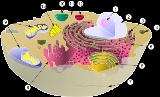
| lysosome Lysosome thumb|350px|Schematic of typical animal cell, showing subcellular components. [[Organelle]]s: [[nucleoli]] [[cell nucleus|nucleus]] [[ribosomes]] [[vesicle |vesicle]] rough [[endoplasmic reticulum]]... |
breakdown of large molecules (e.g., proteins + polysaccharides) | single-membrane compartment | most eukaryotes |
| melanosome Melanosome In a biological cell, a melanosome is an organelle containing melanin, the most common light-absorbing pigment found in the animal kingdom.Cells that synthesize melanins are called melanocytes, and also the retinal pigment epithelium cells, whereas cells that have merely engulfed the melanosomes... |
pigment storage | single-membrane compartment | animals |
| mitosome Mitosome A mitosome is an organelle found in some unicellular eukaryotic organisms. The mitosome has only recently been found and named, and its function has not yet been well characterized. It was termed a 'crypton' by one group, but that name is no longer in use.... |
not characterized | double-membrane compartment | a few unicellular eukaryotes |
| myofibril Myofibril A myofibril is a basic unit of a muscle. Muscles are composed of tubular cells called myocytes or myofibers. Myofibers are composed of tubular myofibrils. Myofibrils are composed of long proteins such as actin, myosin, and titin, and other proteins that hold them together... |
muscular contraction | bundled filaments | animals |
| nucleolus Nucleolus The nucleolus is a non-membrane bound structure composed of proteins and nucleic acids found within the nucleus. Ribosomal RNA is transcribed and assembled within the nucleolus... |
ribosome production | protein-DNA-RNA | most eukaryotes |
| parenthesome Parenthesome Within the cells of basidiomycete fungi are found microscopic structures called parenthesomes or septal pore caps. They are shaped like parentheses and found on either side of pores in the dolipore septum which separates cells within a hypha. Their function has not been established, and their... |
not characterized | not characterized | fungi |
| peroxisome Peroxisome Peroxisomes are organelles found in virtually all eukaryotic cells. They are involved in the catabolism of very long chain fatty acids, branched chain fatty acids, D-amino acids, polyamines, and biosynthesis of plasmalogens, etherphospholipids critical for the normal function of mammalian brains... |
breakdown of metabolic hydrogen peroxide | single-membrane compartment | all eukaryotes |
| ribosome Ribosome A ribosome is a component of cells that assembles the twenty specific amino acid molecules to form the particular protein molecule determined by the nucleotide sequence of an RNA molecule.... |
translation Translation (genetics) In molecular biology and genetics, translation is the third stage of protein biosynthesis . In translation, messenger RNA produced by transcription is decoded by the ribosome to produce a specific amino acid chain, or polypeptide, that will later fold into an active protein... of RNA into proteins |
RNA-protein | eukaryotes, prokaryotes |
| vesicle Vesicle (biology) A vesicle is a bubble of liquid within another liquid, a supramolecular assembly made up of many different molecules. More technically, a vesicle is a small membrane-enclosed sack that can store or transport substances. Vesicles can form naturally because of the properties of lipid membranes , or... |
material transport | single-membrane compartment | all eukaryotes |
Other related structures:
- cytosolCytosolThe cytosol or intracellular fluid is the liquid found inside cells, that is separated into compartments by membranes. For example, the mitochondrial matrix separates the mitochondrion into compartments....
- endomembrane systemEndomembrane systemThe endomembrane system is composed of the different membranes that are suspended in the cytoplasm within a eukaryotic cell. These membranes divide the cell into functional and structural compartments, or organelles...
- nucleosomeNucleosomeNucleosomes are the basic unit of DNA packaging in eukaryotes, consisting of a segment of DNA wound around a histone protein core. This structure is often compared to thread wrapped around a spool....
- microtubuleMicrotubuleMicrotubules are a component of the cytoskeleton. These rope-like polymers of tubulin can grow as long as 25 micrometers and are highly dynamic. The outer diameter of microtubule is about 25 nm. Microtubules are important for maintaining cell structure, providing platforms for intracellular...
- cell membraneCell membraneThe cell membrane or plasma membrane is a biological membrane that separates the interior of all cells from the outside environment. The cell membrane is selectively permeable to ions and organic molecules and controls the movement of substances in and out of cells. It basically protects the cell...
Prokaryotic organelles
ProkaryoteProkaryote
The prokaryotes are a group of organisms that lack a cell nucleus , or any other membrane-bound organelles. The organisms that have a cell nucleus are called eukaryotes. Most prokaryotes are unicellular, but a few such as myxobacteria have multicellular stages in their life cycles...
s are not as structurally complex as eukaryotes, and were once thought not to have any internal structures enclosed by lipid membranes
Lipid bilayer
The lipid bilayer is a thin membrane made of two layers of lipid molecules. These membranes are flat sheets that form a continuous barrier around cells. The cell membrane of almost all living organisms and many viruses are made of a lipid bilayer, as are the membranes surrounding the cell nucleus...
. In the past, they were often viewed as having little internal organization; but, slowly, details are emerging about prokaryotic internal structures. An early false turn was the idea developed in the 1970s that bacteria might contain membrane folds termed mesosome
Mesosome
Mesosomes are folded invaginations in the plasma membrane of bacteria that are produced by the chemical fixation techniques used to prepare samples for electron microscopy...
s, but these were later shown to be artifacts produced by the chemicals used to prepare the cells for electron microscopy.
However, more recent research has revealed that at least some prokaryotes have microcompartment
Bacterial microcompartment
Bacterial microcompartments are widespread bacterial organelles that are made of a protein shell that surrounds and encloses various enzymes. These compartments are typically about 100-200 nanometres across and made of interlocking proteins. They do not contain lipids since they are not surrounded...
s such as carboxysome
Carboxysome
Carboxysomes are bacterial microcompartments that contain enzymes involved in carbon fixation. Carboxysomes are made of polyhedral protein shells about 80 to 140 nanometres in diameter. These compartments are thought to concentrate carbon dioxide to overcome the inefficiency of RuBisCo - the...
s. These subcellular compartments are 100 - 200 nm in diameter and are enclosed by a shell of proteins. Even more striking is the description of membrane-bound magnetosomes in bacteria, as well as the nucleus-like structures of the Planctomycetes that are surrounded by lipid membranes
Lipid bilayer
The lipid bilayer is a thin membrane made of two layers of lipid molecules. These membranes are flat sheets that form a continuous barrier around cells. The cell membrane of almost all living organisms and many viruses are made of a lipid bilayer, as are the membranes surrounding the cell nucleus...
.
| Organelle/Macromolecule | Main function | Structure | Organisms |
|---|---|---|---|
| carboxysome Carboxysome Carboxysomes are bacterial microcompartments that contain enzymes involved in carbon fixation. Carboxysomes are made of polyhedral protein shells about 80 to 140 nanometres in diameter. These compartments are thought to concentrate carbon dioxide to overcome the inefficiency of RuBisCo - the... |
carbon fixation Carbon fixation In biology, carbon fixation is the reduction of carbon dioxide to organic compounds by living organisms. The obvious example is photosynthesis. Carbon fixation requires both a source of energy such as sunlight, and an electron donor such as water. All life depends on fixed carbon. Organisms that... |
protein-shell compartment | some bacteria |
| chlorosome Chlorosome A Chlorosome is a photosynthetic antenna complex found in green sulfur bacteria and some green filamentous anoxygenic phototrophs . They differ from other antenna complexes by their large size and lack of protein matrix supporting the photosynthetic pigments... |
photosynthesis Photosynthesis Photosynthesis is a chemical process that converts carbon dioxide into organic compounds, especially sugars, using the energy from sunlight. Photosynthesis occurs in plants, algae, and many species of bacteria, but not in archaea. Photosynthetic organisms are called photoautotrophs, since they can... |
light harvesting complex | green sulfur bacteria Green sulfur bacteria The green sulfur bacteria are a family of obligately anaerobic photoautotrophic bacteria. Most closely related to the distant Bacteroidetes, they are accordingly assigned their own phylum.... |
| flagellum Flagellum A flagellum is a tail-like projection that protrudes from the cell body of certain prokaryotic and eukaryotic cells, and plays the dual role of locomotion and sense organ, being sensitive to chemicals and temperatures outside the cell. There are some notable differences between prokaryotic and... |
movement in external medium | protein filament | some prokaryotes and eukaryotes |
| magnetosome Magnetosome Magnetosome chains are membranous prokaryotic organelles present in magnetotactic bacteria. They contain 15 to 20 magnetite crystals that together act like a compass needle to orient magnetotactic bacteria in geomagnetic fields, thereby simplifying their search for their preferred microaerophilic... |
magnetic orientation | inorganic crystal, lipid membrane | magnetotactic bacteria Magnetotactic bacteria Magnetotactic bacteria are a polyphyletic group of bacteria discovered by Richard P. Blakemore in 1975, that orient along the magnetic field lines of Earth's magnetic field. To perform this task, these bacteria have organelles called magnetosomes that contain magnetic crystals... |
| nucleoid Nucleoid The nucleoid is an irregularly-shaped region within the cell of a prokaryote that contains all or most of the genetic material. In contrast to the nucleus of a eukaryotic cell, it is not surrounded by a nuclear membrane. The genome of prokaryotic organisms generally is a circular, double-stranded... |
DNA maintenance, transcription Transcription (genetics) Transcription is the process of creating a complementary RNA copy of a sequence of DNA. Both RNA and DNA are nucleic acids, which use base pairs of nucleotides as a complementary language that can be converted back and forth from DNA to RNA by the action of the correct enzymes... to RNA |
DNA-protein | prokaryotes |
| plasmid Plasmid In microbiology and genetics, a plasmid is a DNA molecule that is separate from, and can replicate independently of, the chromosomal DNA. They are double-stranded and, in many cases, circular... |
DNA exchange | circular DNA | some bacteria |
| ribosome Ribosome A ribosome is a component of cells that assembles the twenty specific amino acid molecules to form the particular protein molecule determined by the nucleotide sequence of an RNA molecule.... |
translation Translation (genetics) In molecular biology and genetics, translation is the third stage of protein biosynthesis . In translation, messenger RNA produced by transcription is decoded by the ribosome to produce a specific amino acid chain, or polypeptide, that will later fold into an active protein... of RNA into proteins |
RNA-protein | eukaryotes, prokaryotes |
| thylakoid Thylakoid A thylakoid is a membrane-bound compartment inside chloroplasts and cyanobacteria. They are the site of the light-dependent reactions of photosynthesis. Thylakoids consist of a thylakoid membrane surrounding a thylakoid lumen. Chloroplast thylakoids frequently form stacks of disks referred to as... |
photosynthesis Photosynthesis Photosynthesis is a chemical process that converts carbon dioxide into organic compounds, especially sugars, using the energy from sunlight. Photosynthesis occurs in plants, algae, and many species of bacteria, but not in archaea. Photosynthetic organisms are called photoautotrophs, since they can... |
photosystem proteins and pigments | mostly cyanobacteria |
Proteins and organelles
The function of a protein is closely correlated with the organelle in which it resides. Some methods were proposed for predicting the organelle in which an uncharacterized protein is located according to its amino acid composition and some methods were based on pseudo amino acid compositionPseudo amino acid composition
Pseudo amino acid composition, or PseAA composition, was originally introduced by Kuo-Chen Chou in 2001 to represent protein samples for improving protein subcellular localization prediction and membrane protein type prediction.- Background :...
.
See also
- CellCell (biology)The cell is the basic structural and functional unit of all known living organisms. It is the smallest unit of life that is classified as a living thing, and is often called the building block of life. The Alberts text discusses how the "cellular building blocks" move to shape developing embryos....
- CoRR HypothesisCoRR HypothesisThe CoRR hypothesis states that the location of genetic information in cytoplasmic organelles permits regulation of its expression by the reduction-oxidation state of its gene products....
- EjectosomeEjectosomeAn ejectosome is a cellular organelle responsible for ejecting their contents from the cell. Two unrelated types of ejectosomes are described in the literature:# Cryptomonads have two types of characteristic ejectisomes known as extrusomes....
- Endosymbiotic theoryEndosymbiotic theoryThe endosymbiotic theory concerns the mitochondria, plastids , and possibly other organelles of eukaryotic cells. According to this theory, certain organelles originated as free-living bacteria that were taken inside another cell as endosymbionts...
- Organelle biogenesisOrganelle biogenesisOrganelle biogenesis is the biogenesis, or creation, of cellular organelles in cells. Organelle biogenesis includes the process by which cellular organelles are split between daughter cells during mitosis; this process is called organelle inheritance....