
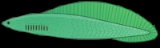
Haikouichthys ˌhaɪkuːˈɪkθɪs is an extinct
genusIn biology, a genus is a low-level taxonomic rank used in the biological classification of living and fossil organisms, which is an example of definition by genus and differentia...
of
craniateCraniata is a proposed clade of chordate animals that contains the Myxini , Petromyzontida , and Gnathostomata as living representatives...
(creatures with backbones and distinct heads) believed to have lived c. 530 million years ago, during the
Cambrian explosionThe Cambrian explosion or Cambrian radiation was the relatively rapid appearance, around , of most major phyla, as demonstrated in the fossil record, accompanied by major diversification of other organisms, including animals, phytoplankton, and calcimicrobes...
of multicellular life.
Haikouichthys had a defined skull and other characteristics that have led
paleontologistsPaleontology "old, ancient", ὄν, ὀντ- "being, creature", and λόγος "speech, thought") is the study of prehistoric life. It includes the study of fossils to determine organisms' evolution and interactions with each other and their environments...
to label it a true craniate, and even to be popularly characterized as one of the
earliest fishesPrehistoric fish refers to early fish that are known only from fossil records. They are the earliest known vertebrates, and include the first and extinct fish that lived through the Cambrian to the Tertiary. The study of prehistoric fish is called paleoichthyology...
.
Cladistic analysisCladistics is a method of classifying species of organisms into groups called clades, which consist of an ancestor organism and all its descendants . For example, birds, dinosaurs, crocodiles, and all descendants of their most recent common ancestor form a clade...
indicates that the animal is probably a basal
chordateChordates are animals which are either vertebrates or one of several closely related invertebrates. They are united by having, for at least some period of their life cycle, a notochord, a hollow dorsal nerve cord, pharyngeal slits, an endostyle, and a post-anal tail...
or a basal craniate.
but it does not possess sufficient features to be included uncontroversially even in either stem group.
Description
It is about 2.5 cm (1 inch) long and is narrower than
MyllokunmingiaMyllokunmingia is a chordate from the Lower Cambrian Maotianshan shales of China, thought to be a vertebrate, although this is not conclusively proven. It is 28 mm long and 6 mm high....
, another putative chordate that comes from the same beds. The
holotypeA holotype is a single physical example of an organism, known to have been used when the species was formally described. It is either the single such physical example or one of several such, but explicitly designated as the holotype...
of
Haikouichthys ercaicunensis was found in the Yuansshan member of the Qiongzhusi Formation in the 'Eoredlichia' Zone near Haikou at Ercaicun, Kunming City,
YunnanYunnan is a province of the People's Republic of China, located in the far southwest of the country spanning approximately and with a population of 45.7 million . The capital of the province is Kunming. The province borders Burma, Laos, and Vietnam.Yunnan is situated in a mountainous area, with...
, China, hence its name "Haikou fish from Ercaicun". The fossil was recovered among the Chengjiang fauna, in one of a series of Lagerstätten sites where thousands of exquisitely preserved soft-bodied fossils have already been found. Following the discovery of the holotype, additional Lower Cambrian fossils of
Haikouichthys ercaicunensis have been discovered.
The animal has a distinct head and tail. The head has at least six and perhaps nine probable
gillA gill is a respiratory organ found in many aquatic organisms that extracts dissolved oxygen from water, afterward excreting carbon dioxide. The gills of some species such as hermit crabs have adapted to allow respiration on land provided they are kept moist...
s. There are a number of segments (myomeres) with rear directed chevrons in the tail. There is probably a
notochordThe notochord is a flexible, rod-shaped body found in embryos of all chordates. It is composed of cells derived from the mesoderm and defines the primitive axis of the embryo. In some chordates, it persists throughout life as the main axial support of the body, while in most vertebrates it becomes...
, although only a short segment is preserved in the single known specimen. There is a prominent dorsal fin with fin radials similar, but not comparable, to those of hagfish and lampreys. The fin radials seem to angle "forward" toward the end thought on the basis of internal structures to be the head. This happens with a few modern fish but is an uncommon arrangement. There are 13 circular structures along the bottom that may be
gonadThe gonad is the organ that makes gametes. The gonads in males are the testes and the gonads in females are the ovaries. The product, gametes, are haploid germ cells. For example, spermatozoon and egg cells are gametes...
s, slime organs, or something else entirely.
In popular culture
Haikouichthys was featured in the BBC documentary
Walking with MonstersWalking with Monsters is a three-part British documentary film series about life in the Paleozoic, bringing to life extinct arthropods, fish, amphibians, synapsids, and reptiles...
as the ancestor to all vertebrates.
See also
- Ostracoderm
Ostracoderms are any of several groups of extinct, primitive, jawless fishes that were covered in an armor of bony plates. They belong to the taxon Ostracodermi, and their fossils are found in the Ordovician and Devonian Period strata of North America and Europe...
- Arandaspis
Arandaspis prionotolepis is an extinct species of jawless fish that lived in the Ordovician period, about 480 to 470 million years ago. It is the oldest known vertebrate....
- Pikaia
Pikaia gracilens is an extinct animal known from the Middle Cambrian Burgess Shale of British Columbia. -Discovery:It was discovered by Charles Walcott and was first described by him in 1911. It was named after Pika Peak, a mountain in Alberta, Canada. Based on the obvious and regular segmentation...
– cambrian chordate
- Myllokunmingia
Myllokunmingia is a chordate from the Lower Cambrian Maotianshan shales of China, thought to be a vertebrate, although this is not conclusively proven. It is 28 mm long and 6 mm high....
– close relative
- Zhongjianichthys – eel-like close relative