
All Topics  
Planetary core

 
Planetary Core

   Email Print
   Bookmark   Link


Planetary core


The planetary core consists of the innermost part(s) of a planet
Planet

A planet , as 2006 definition of planet by the International Astronomical Union , is a celestial body orbiting a star or Stellar evolution#Stellar remnants that is massive enough to be rounded by its own gravity, is not massive enough to cause thermonuclear fusion, and has cleared the neighbourhood of planetesimals....
.

The cores of terrestrial planet
Terrestrial planet

A terrestrial planet, telluric planet, rocky planet or inner planet is a planet that is primarily composed of silicate Rock s....
s tend to be mainly composed of iron and can include a solid and/or a liquid layer. Earth's core is partially liquid, as is Mercury
Mercury (planet)

Mercury is the innermost and smallest planet in the Solar System, orbiting the Sun once every 88 days. The orbit of Mercury has the highest Orbital eccentricity of all the Solar System planets, and it has the smallest axial tilt....
's, whilst the cores of Mars
MARS

In cryptography, MARS is a block cipher that was IBM's submission to the Advanced Encryption Standard process. MARS was selected as an AES finalist in August 1999, after the AES2 conference in March 1999, where it was voted as the fifth and last finalist algorithm....
 and Venus
Venus

Venus is the second-closest planet to the Sun, orbiting it every 224.7 Earth days. The planet is named after Venus , the Roman mythology goddess of love....
 are thought to be completely solid as they lack an internally generated magnetic field
Magnetic field

A magnetism field is a vector field which can exert a magnetic force on moving electric charges and on magnetic dipoles . When placed in a magnetic field, magnetic dipoles tend to align their axes parallel to the magnetic field....
.


Discussion
Ask a question about 'Planetary core'
Start a new discussion about 'Planetary core'
Answer questions from other users
Full Discussion Forum


Encyclopedia


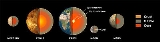
Terrestial Planets Internal En
The planetary core consists of the innermost part(s) of a planet
Planet

A planet , as 2006 definition of planet by the International Astronomical Union , is a celestial body orbiting a star or Stellar evolution#Stellar remnants that is massive enough to be rounded by its own gravity, is not massive enough to cause thermonuclear fusion, and has cleared the neighbourhood of planetesimals....
.

The cores of terrestrial planet
Terrestrial planet

A terrestrial planet, telluric planet, rocky planet or inner planet is a planet that is primarily composed of silicate Rock s....
s tend to be mainly composed of iron and can include a solid and/or a liquid layer. Earth's core is partially liquid, as is Mercury
Mercury (planet)

Mercury is the innermost and smallest planet in the Solar System, orbiting the Sun once every 88 days. The orbit of Mercury has the highest Orbital eccentricity of all the Solar System planets, and it has the smallest axial tilt....
's, whilst the cores of Mars
MARS

In cryptography, MARS is a block cipher that was IBM's submission to the Advanced Encryption Standard process. MARS was selected as an AES finalist in August 1999, after the AES2 conference in March 1999, where it was voted as the fifth and last finalist algorithm....
 and Venus
Venus

Venus is the second-closest planet to the Sun, orbiting it every 224.7 Earth days. The planet is named after Venus , the Roman mythology goddess of love....
 are thought to be completely solid as they lack an internally generated magnetic field
Magnetic field

A magnetism field is a vector field which can exert a magnetic force on moving electric charges and on magnetic dipoles . When placed in a magnetic field, magnetic dipoles tend to align their axes parallel to the magnetic field....
. In our solar system, core size can range from about 20% (the Moon
Moon

The Moon is Earth's only natural satellite and the List of natural satellites by diameter satellite in the Solar System. The average centre-to-centre distance from the Earth to the Moon is km, about thirty times the diameter of the Earth....
) to 75% of a planet's radius (Mercury).

Gas giant
Gas giant

A gas giant is a large planet that is not primarily composed of Rock or other solid matter. There are four gas giants in our Solar System: Jupiter, Saturn, Uranus, and Neptune....
s also have iron-rich cores. Although these cores are proportionately much smaller than those of terrestrial planets, gas giants are so large that their cores can actually be larger than Earth. Jupiter
Jupiter

Jupiter is the fifth planet from the Sun and the Solar system by size planet within the Solar System. It is two and a half times as massive as all of the other planets in our Solar System combined....
's core is thought to be approximately 12 times the mass of Earth (3% of Jupiter's total mass), and the exoplanet HD 149026 b
HD 149026 b

HD 149026 b is an extrasolar planet approximately 257 light-years away in the constellation of Hercules . The planet was discovered after it transit its parent star, HD 149026....
 is thought to have a core approximately 70 times the mass of Earth.

It is thought that some gas giants orbiting very close to their primaries may have their atmospheres stripped away, leaving only their core behind. This as-yet hypothetical class of planets are called "Chthonian
Chthonian planet

A Chthonian planet , is a hypothetical class of celestial objects resulting from the stripping away of a gas giant's hydrogen and helium celestial body atmosphere and outer layers....
."

Some moon
Natural satellite

A natural satellite or moon is a celestial body that orbits a planet or smaller body, which is called the primary. Technically, the term natural satellite could refer to a planet orbiting a star, or a dwarf galaxy orbiting a major galaxy, but it is normally synonymous with moon and used to identify non-artificial satellites...
s, asteroid
Asteroid

Asteroids, sometimes called minor planets or planetoids, are small Solar System bodies in orbit around the Sun, smaller than planets but larger than meteoroids....
s and other minor planet
Minor planet

An asteroid group or minor planet group is a population of minor planets that have a share broadly similar orbits. Members are generally unrelated to each other, unlike in an asteroid family, which often results from the break-up of a single asteroid....
s may also have well-differentiated cores depending on their size and history. Jupiter's moons Io
Io (moon)

'Io' is the innermost of the four Galilean moons natural satellite of Jupiter and, with a diameter of 3,642 Kilometre, the List of moons by diameter in the Solar System....
 and Europa
Europa (moon)

'Europa' is the Moons_of_Jupiter#Table Natural satellite of the planet Jupiter. Europa was discovered in 1610 by Galileo Galilei , and named after a mythical Phoenician noblewoman, Europa , who was courted by Zeus and became the queen of Crete....
 are in many ways sisters of the terrestrial planets and have very substantial cores comprising about a third of their radii. The large asteroid 4 Vesta
4 Vesta

4 Vesta is the second most massive object in the asteroid belt, with a mean diameter of about 530 km and an estimated mass of 9% of the mass of the entire asteroid belt....
 is likewise believed to have a differentiated structure with a distinct core.

Power source of the Earth's core

The core of the Earth is still hot because it contains radioactive uranium
Uranium

Uranium is a silvery-gray metallic chemical element in the actinide series of the periodic table that has the chemical symbol U and atomic number 92....
 which was derived from a local supernova
Supernova nucleosynthesis

Supernova nucleosynthesis is the production of new chemical elements inside supernovae. It occurs primarily due to explosive nucleosynthesis during explosive oxygen burning and silicon burning ....
 explosion before the earth formed. It is the heat produced by radioactive decay
Radioactive decay

Radioactive decay is the process in which an unstable atomic nucleus loses energy by emitting ionizing particles and radiation. This decay, or loss of energy, results in an atom of one type, called the parent nuclide transforming to an atom of a different type, called the daughter nuclide....
 that has prevented the Earth's core from cooling and solidifying. Heat sources include gravitational energy released by the compression of the core, gravitational energy released by the rejection of light elements (probably S, O, or Si) at the inner core boundary as it grows, latent heat of crystallization at the inner core boundary, and radioactivity of K or U.