

Common descent

Encyclopedia
In evolutionary biology, a group of organism
s share common descent if they have a common ancestor
. There is strong quantitative support for the theory that all living organisms on Earth
are descended from a common ancestor
.
Charles Darwin
proposed the theory of universal common descent through an evolution
ary process in On the Origin of Species, twice stating the hypothesis that there was only one progenitor for all life forms and ending with "There is a grandeur in this view of life, with its several powers, having been originally breathed into a few forms or into one". The theory asserts that all currently living organisms on Earth share a common genetic heritage with each being the descendant from a single original species, though the suggestion of substantial horizontal gene transfer
during early evolution has led to questions about monophyly
of life.
The last universal ancestor
(LUA) (or last universal common ancestor, LUCA), that is, the most recent common ancestor
of all currently living organisms, is believed to have appeared about 3.9 billion years ago
.
. In Essai de Cosmologie, Maupertuis noted:
In 1790, Immanuel Kant
wrote in Kritik der Urtheilskraft (Critique of Judgement
) that the analogy of animal forms implies a common original type, and thus a common parent.
In 1795, Charles Darwin's grandfather, Erasmus Darwin
, asked:
In 1859, Charles Darwin's The Origin of Species was published. The views about common descent expressed therein were that it was possible that there was only one progenitor for all life forms.
Darwin's famous closing sentence describes the "grandeur in this view of life, with its several powers, having been originally breathed into a few forms or into one." (p 490)
, transcribed into RNA, through the effect of protein- and RNA-enzyme
s, then translated into protein
s by (highly similar) ribosomes, with ATP, NADH and others as energy sources, etc. Furthermore, the genetic code
(the "translation table" according to which DNA information is translated into proteins) is nearly identical for all known lifeforms, from bacteria
to human
s. The universality of this code is generally regarded by biologists as definitive evidence in favor of the theory of universal common descent. Analysis of the small differences in the genetic code has also provided support for universal common descent. A statistical comparison of various alternative hypotheses has shown that universal common ancestry is significantly more probable than models involving multiple origins.
Such evidence has come from two areas: amino acid sequences and DNA sequences. Proteins with the same three-dimensional structure need not have identical amino acid
sequences; any irrelevant similarity between the sequences is evidence for common descent. In certain cases, there are several codons (DNA triplets) that code for the same amino acid. Thus, if two species use the same codon at the same place to specify an amino acid that can be represented by more than one codon, that is evidence for a recent common ancestor.
(ATP), and the fact that all amino acids found in proteins are left-handed. It is possible that these similarities resulted because of the laws of physics and chemistry, rather than universal common descent and therefore resulted in convergent evolution
.
s (that is, "genealogic trees" of species) mapping out the proposed divisions and common ancestors of all living species. In 2010 an analysis of available genetic data, mapping them to phylogenetic trees, gave "firm quantitative support for the unity of life. ...there is now strong quantitative support, by a formal test, for the unity of life. It should be noted, however, the 'formal' test is criticised for not including consideration of convergent evolution
, as Theobald conceded while reiterating the utility of his method.
Traditionally, these trees have been built using morphological methods, such as appearance, embryology
, etc. Recently, it has been possible to construct these trees using molecular data, based on similarities and differences between genetic and protein sequences. All these methods produce essentially similar results, even though most genetic variation
has no influence over external morphology. That phylogenetic trees based on different types of information agree with each other is strong evidence of a real underlying common descent.
demonstrates the diversity that can exist among organisms that share a relatively recent common ancestor. In artificial selection, one species is bred selectively at each generation, allowing only those organisms that exhibit desired characteristics to reproduce. These characteristics become increasingly well-developed in successive generations. Artificial selection was successful long before science discovered the genetic basis.
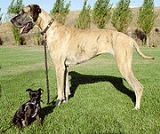
s is an example of the power of artificial selection. All breeds share common ancestry, having descended from wolves. Humans selectively bred them to enhance specific characteristics, such as color and length or body size. This created a range of breeds that include the Chihuahua
, Great Dane
, Basset Hound
, Pug
, and Poodle
. Wild wolves, which did not undergo artificial selection, are relatively uniform in comparison.
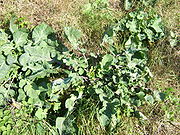
Early farmers cultivated many popular vegetables from the Brassica oleracea
(wild cabbage) by artificially selecting for certain attributes. Common vegetables such as cabbage
, kale
, broccoli
, cauliflower
, kohlrabi and Brussels sprouts are all descendants of the wild cabbage plant. Brussels sprouts were created by artificially selecting for large bud
size. Broccoli was bred by selecting for large flower
stalks. Cabbage was created by selecting for short petioles
. Kale was bred by selecting for large leaves
.
 Natural selection is the evolutionary process by which heritable traits that increase an individual's fitness become more common, and heritable traits that decrease an individual's fitness become less common.
's studies on the Galápagos Islands
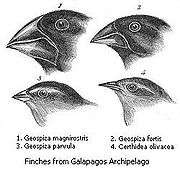
, Darwin observed 13 species of finches
that are closely related and differ most markedly in the shape of their beak
s. The beak of each species
is suited to the food available in its particular environment, suggesting that beak shapes evolved by natural selection
. Large beaks were found on the islands where the primary source of food for the finches are nuts
and therefore the large beaks allowed the birds to be better equipped for opening the nuts and staying well nourished. Slender beaks were found on the finches which found insect
s to be the best source of food on the island they inhabited; their slender beaks allowed the birds to be better equipped for pulling out the insects from their tiny hiding places. The finch is also found on the main land and it is thought that they migrated
to the islands and began adapting
to their environment through natural selection
.
Organism
In biology, an organism is any contiguous living system . In at least some form, all organisms are capable of response to stimuli, reproduction, growth and development, and maintenance of homoeostasis as a stable whole.An organism may either be unicellular or, as in the case of humans, comprise...
s share common descent if they have a common ancestor
Ancestor
An ancestor is a parent or the parent of an ancestor ....
. There is strong quantitative support for the theory that all living organisms on Earth
Earth
Earth is the third planet from the Sun, and the densest and fifth-largest of the eight planets in the Solar System. It is also the largest of the Solar System's four terrestrial planets...
are descended from a common ancestor
Last universal ancestor
The last universal ancestor , also called the last universal common ancestor , or the cenancestor, is the most recent organism from which all organisms now living on Earth descend. Thus it is the most recent common ancestor of all current life on Earth...
.
Charles Darwin
Charles Darwin
Charles Robert Darwin FRS was an English naturalist. He established that all species of life have descended over time from common ancestry, and proposed the scientific theory that this branching pattern of evolution resulted from a process that he called natural selection.He published his theory...
proposed the theory of universal common descent through an evolution
Evolution
Evolution is any change across successive generations in the heritable characteristics of biological populations. Evolutionary processes give rise to diversity at every level of biological organisation, including species, individual organisms and molecules such as DNA and proteins.Life on Earth...
ary process in On the Origin of Species, twice stating the hypothesis that there was only one progenitor for all life forms and ending with "There is a grandeur in this view of life, with its several powers, having been originally breathed into a few forms or into one". The theory asserts that all currently living organisms on Earth share a common genetic heritage with each being the descendant from a single original species, though the suggestion of substantial horizontal gene transfer
Horizontal gene transfer
Horizontal gene transfer , also lateral gene transfer , is any process in which an organism incorporates genetic material from another organism without being the offspring of that organism...
during early evolution has led to questions about monophyly
Monophyly
In common cladistic usage, a monophyletic group is a taxon which forms a clade, meaning that it contains all the descendants of the possibly hypothetical closest common ancestor of the members of the group. The term is synonymous with the uncommon term holophyly...
of life.
The last universal ancestor
Last universal ancestor
The last universal ancestor , also called the last universal common ancestor , or the cenancestor, is the most recent organism from which all organisms now living on Earth descend. Thus it is the most recent common ancestor of all current life on Earth...
(LUA) (or last universal common ancestor, LUCA), that is, the most recent common ancestor
Most recent common ancestor
In genetics, the most recent common ancestor of any set of organisms is the most recent individual from which all organisms in the group are directly descended...
of all currently living organisms, is believed to have appeared about 3.9 billion years ago
Timeline of evolution
This timeline of evolution of life outlines the major events in the development of life on planet Earth since it first originated until the present day. In biology, evolution is any change across successive generations in the heritable characteristics of biological populations...
.
History
In the 1740s, Pierre-Louis Moreau de Maupertuis made the first known suggestion in a series of essays that all organisms may have had a common ancestor, and that they had diverged through random variation and natural selectionNatural selection
Natural selection is the nonrandom process by which biologic traits become either more or less common in a population as a function of differential reproduction of their bearers. It is a key mechanism of evolution....
. In Essai de Cosmologie, Maupertuis noted:
Could one not say that, in the fortuitous combinations of the productions of nature, as there must be some characterized by a certain relation of fitness which are able to subsist, it is not to be wondered at that this fitness is present in all the species that are currently in existence? Chance, one would say, produced an innumerable multitude of individuals; a small number found themselves constructed in such a manner that the parts of the animal were able to satisfy its needs; in another infinitely greater number, there was neither fitness nor order: all of these latter have perished. Animals lacking a mouth could not live; others lacking reproductive organs could not perpetuate themselves ... The species we see today are but the smallest part of what blind destiny has produced ...
In 1790, Immanuel Kant
Immanuel Kant
Immanuel Kant was a German philosopher from Königsberg , researching, lecturing and writing on philosophy and anthropology at the end of the 18th Century Enlightenment....
wrote in Kritik der Urtheilskraft (Critique of Judgement
Critique of Judgement
The Critique of Judgment , or in the new Cambridge translation Critique of the Power of Judgment, also known as the third critique, is a philosophical work by Immanuel Kant...
) that the analogy of animal forms implies a common original type, and thus a common parent.
In 1795, Charles Darwin's grandfather, Erasmus Darwin
Erasmus Darwin
Erasmus Darwin was an English physician who turned down George III's invitation to be a physician to the King. One of the key thinkers of the Midlands Enlightenment, he was also a natural philosopher, physiologist, slave trade abolitionist,inventor and poet...
, asked:
[W]ould it be too bold to imagine, that in the great length of time, since the earth began to exist, perhaps millions of ages before the commencement of the history of mankind, would it be too bold to imagine, that all warm-blooded animals have arisen from one living filament, which endued with animality, with the power of acquiring new parts attended with new propensities, directed by irritations, sensations, volitions, and associations; and thus possessing the faculty of continuing to improve by its own inherent activity, and of delivering down those improvements by generation to its posterity, world without end?
In 1859, Charles Darwin's The Origin of Species was published. The views about common descent expressed therein were that it was possible that there was only one progenitor for all life forms.
"Therefore I should infer from analogy that probably all the organic beings which have ever lived on this earth have descended from some one primordial form, into which life was first breathed." (p 484)
Darwin's famous closing sentence describes the "grandeur in this view of life, with its several powers, having been originally breathed into a few forms or into one." (p 490)
Common biochemistry and genetic code
All known forms of life are based on the same fundamental biochemical organisation: genetic information encoded in DNADNA
Deoxyribonucleic acid is a nucleic acid that contains the genetic instructions used in the development and functioning of all known living organisms . The DNA segments that carry this genetic information are called genes, but other DNA sequences have structural purposes, or are involved in...
, transcribed into RNA, through the effect of protein- and RNA-enzyme
Enzyme
Enzymes are proteins that catalyze chemical reactions. In enzymatic reactions, the molecules at the beginning of the process, called substrates, are converted into different molecules, called products. Almost all chemical reactions in a biological cell need enzymes in order to occur at rates...
s, then translated into protein
Protein
Proteins are biochemical compounds consisting of one or more polypeptides typically folded into a globular or fibrous form, facilitating a biological function. A polypeptide is a single linear polymer chain of amino acids bonded together by peptide bonds between the carboxyl and amino groups of...
s by (highly similar) ribosomes, with ATP, NADH and others as energy sources, etc. Furthermore, the genetic code
Genetic code
The genetic code is the set of rules by which information encoded in genetic material is translated into proteins by living cells....
(the "translation table" according to which DNA information is translated into proteins) is nearly identical for all known lifeforms, from bacteria
Bacteria
Bacteria are a large domain of prokaryotic microorganisms. Typically a few micrometres in length, bacteria have a wide range of shapes, ranging from spheres to rods and spirals...
to human
Human
Humans are the only living species in the Homo genus...
s. The universality of this code is generally regarded by biologists as definitive evidence in favor of the theory of universal common descent. Analysis of the small differences in the genetic code has also provided support for universal common descent. A statistical comparison of various alternative hypotheses has shown that universal common ancestry is significantly more probable than models involving multiple origins.
Selectively neutral similarities
Similarities which have no adaptive relevance cannot be explained by convergent evolution, and therefore they provide compelling support for the theory of universal common descent.Such evidence has come from two areas: amino acid sequences and DNA sequences. Proteins with the same three-dimensional structure need not have identical amino acid
Amino acid
Amino acids are molecules containing an amine group, a carboxylic acid group and a side-chain that varies between different amino acids. The key elements of an amino acid are carbon, hydrogen, oxygen, and nitrogen...
sequences; any irrelevant similarity between the sequences is evidence for common descent. In certain cases, there are several codons (DNA triplets) that code for the same amino acid. Thus, if two species use the same codon at the same place to specify an amino acid that can be represented by more than one codon, that is evidence for a recent common ancestor.
Other similarities
The universality of many aspects of cellular life is often pointed to as supportive evidence to the more compelling evidence listed above. These similarities include the energy carrier adenosine triphosphateAdenosine triphosphate
Adenosine-5'-triphosphate is a multifunctional nucleoside triphosphate used in cells as a coenzyme. It is often called the "molecular unit of currency" of intracellular energy transfer. ATP transports chemical energy within cells for metabolism...
(ATP), and the fact that all amino acids found in proteins are left-handed. It is possible that these similarities resulted because of the laws of physics and chemistry, rather than universal common descent and therefore resulted in convergent evolution
Convergent evolution
Convergent evolution describes the acquisition of the same biological trait in unrelated lineages.The wing is a classic example of convergent evolution in action. Although their last common ancestor did not have wings, both birds and bats do, and are capable of powered flight. The wings are...
.
Phylogenetic trees
Another important piece of evidence is that it is possible to construct detailed phylogenetic treePhylogenetic tree
A phylogenetic tree or evolutionary tree is a branching diagram or "tree" showing the inferred evolutionary relationships among various biological species or other entities based upon similarities and differences in their physical and/or genetic characteristics...
s (that is, "genealogic trees" of species) mapping out the proposed divisions and common ancestors of all living species. In 2010 an analysis of available genetic data, mapping them to phylogenetic trees, gave "firm quantitative support for the unity of life. ...there is now strong quantitative support, by a formal test, for the unity of life. It should be noted, however, the 'formal' test is criticised for not including consideration of convergent evolution
Convergent evolution
Convergent evolution describes the acquisition of the same biological trait in unrelated lineages.The wing is a classic example of convergent evolution in action. Although their last common ancestor did not have wings, both birds and bats do, and are capable of powered flight. The wings are...
, as Theobald conceded while reiterating the utility of his method.
Traditionally, these trees have been built using morphological methods, such as appearance, embryology
Embryology
Embryology is a science which is about the development of an embryo from the fertilization of the ovum to the fetus stage...
, etc. Recently, it has been possible to construct these trees using molecular data, based on similarities and differences between genetic and protein sequences. All these methods produce essentially similar results, even though most genetic variation
Genetic variation
Genetic variation, variation in alleles of genes, occurs both within and among populations. Genetic variation is important because it provides the “raw material” for natural selection. Genetic variation is brought about by mutation, a change in a chemical structure of a gene. Polyploidy is an...
has no influence over external morphology. That phylogenetic trees based on different types of information agree with each other is strong evidence of a real underlying common descent.
Artificial selection
Artificial selectionArtificial selection
Artificial selection describes intentional breeding for certain traits, or combination of traits. The term was utilized by Charles Darwin in contrast to natural selection, in which the differential reproduction of organisms with certain traits is attributed to improved survival or reproductive...
demonstrates the diversity that can exist among organisms that share a relatively recent common ancestor. In artificial selection, one species is bred selectively at each generation, allowing only those organisms that exhibit desired characteristics to reproduce. These characteristics become increasingly well-developed in successive generations. Artificial selection was successful long before science discovered the genetic basis.
Dog breeding
The diversity of domesticated dogDog
The domestic dog is a domesticated form of the gray wolf, a member of the Canidae family of the order Carnivora. The term is used for both feral and pet varieties. The dog may have been the first animal to be domesticated, and has been the most widely kept working, hunting, and companion animal in...
s is an example of the power of artificial selection. All breeds share common ancestry, having descended from wolves. Humans selectively bred them to enhance specific characteristics, such as color and length or body size. This created a range of breeds that include the Chihuahua
Chihuahua (dog)
The ' is the smallest breed of dog and is so named for the state of Chihuahua in Mexico. Chihuahuas come in a wide variety of sizes, head shapes, colors and coat lengths.-History:...
, Great Dane
Great Dane
The Great Dane , also known as German Mastiff or Danish Hound , is a breed of domestic dog known for its giant size...
, Basset Hound
Basset Hound
The Basset Hound is a short-legged breed of dog of the hound family. They are scent hounds, bred to hunt rabbits and hare by scent. Their sense of smell for tracking is second only to that of the Bloodhound....
, Pug
Pug
The pug is a "toy" breed of dog with a wrinkly, short-muzzled face, and curled tail. The breed has a fine, glossy coat that comes in a variety of colors, and a compact square body with well-developed muscle. They have been described as multum in parvo , referring to the pug's personality and...
, and Poodle
Poodle
The Poodle is a breed of dog. The poodle breed is found officially in toy, miniature, and standard sizes, with many coat colors. Originally bred as a type of water dog, the poodle is highly intelligent and skillful in many dog sports, including agility, obedience, tracking, and even herding...
. Wild wolves, which did not undergo artificial selection, are relatively uniform in comparison.
Wild cabbage
Early farmers cultivated many popular vegetables from the Brassica oleracea
Brassica oleracea
Brassica oleracea, or wild cabbage, is a species of Brassica native to coastal southern and western Europe, where its tolerance of salt and lime and its intolerance of competition from other plants typically restrict its natural occurrence to limestone sea cliffs, like the chalk cliffs on both...
(wild cabbage) by artificially selecting for certain attributes. Common vegetables such as cabbage
Cabbage
Cabbage is a popular cultivar of the species Brassica oleracea Linne of the Family Brassicaceae and is a leafy green vegetable...
, kale
Kale
Kale is very high in beta carotene, vitamin K, vitamin C, lutein, zeaxanthin, and reasonably rich in calcium. Kale, as with broccoli and other brassicas, contains sulforaphane , a chemical with potent anti-cancer properties. Boiling decreases the level of sulforaphane; however, steaming,...
, broccoli
Broccoli
Broccoli is a plant in the cabbage family, whose large flower head is used as a vegetable.-General:The word broccoli, from the Italian plural of , refers to "the flowering top of a cabbage"....
, cauliflower
Cauliflower
Cauliflower is one of several vegetables in the species Brassica oleracea, in the family Brassicaceae. It is an annual plant that reproduces by seed...
, kohlrabi and Brussels sprouts are all descendants of the wild cabbage plant. Brussels sprouts were created by artificially selecting for large bud
Bud
In botany, a bud is an undeveloped or embryonic shoot and normally occurs in the axil of a leaf or at the tip of the stem. Once formed, a bud may remain for some time in a dormant condition, or it may form a shoot immediately. Buds may be specialized to develop flowers or short shoots, or may have...
size. Broccoli was bred by selecting for large flower
Flower
A flower, sometimes known as a bloom or blossom, is the reproductive structure found in flowering plants . The biological function of a flower is to effect reproduction, usually by providing a mechanism for the union of sperm with eggs...
stalks. Cabbage was created by selecting for short petioles
Petiole (botany)
In botany, the petiole is the stalk attaching the leaf blade to the stem. The petiole usually has the same internal structure as the stem. Outgrowths appearing on each side of the petiole are called stipules. Leaves lacking a petiole are called sessile, or clasping when they partly surround the...
. Kale was bred by selecting for large leaves
Leaf
A leaf is an organ of a vascular plant, as defined in botanical terms, and in particular in plant morphology. Foliage is a mass noun that refers to leaves as a feature of plants....
.
Natural selection
Darwin's finches
During Charles DarwinCharles Darwin
Charles Robert Darwin FRS was an English naturalist. He established that all species of life have descended over time from common ancestry, and proposed the scientific theory that this branching pattern of evolution resulted from a process that he called natural selection.He published his theory...
's studies on the Galápagos Islands
Galápagos Islands
The Galápagos Islands are an archipelago of volcanic islands distributed around the equator in the Pacific Ocean, west of continental Ecuador, of which they are a part.The Galápagos Islands and its surrounding waters form an Ecuadorian province, a national park, and a...
, Darwin observed 13 species of finches
Darwin's finches
Darwin's finches are a group of 14 or 15 species of passerine birds. It is still not clear which bird family they belong to, but they are not related to the true finches. They were first collected by Charles Darwin on the Galápagos Islands during the second voyage of the Beagle...
that are closely related and differ most markedly in the shape of their beak
Beak
The beak, bill or rostrum is an external anatomical structure of birds which is used for eating and for grooming, manipulating objects, killing prey, fighting, probing for food, courtship and feeding young...
s. The beak of each species
Species
In biology, a species is one of the basic units of biological classification and a taxonomic rank. A species is often defined as a group of organisms capable of interbreeding and producing fertile offspring. While in many cases this definition is adequate, more precise or differing measures are...
is suited to the food available in its particular environment, suggesting that beak shapes evolved by natural selection
Natural selection
Natural selection is the nonrandom process by which biologic traits become either more or less common in a population as a function of differential reproduction of their bearers. It is a key mechanism of evolution....
. Large beaks were found on the islands where the primary source of food for the finches are nuts
Nut (fruit)
A nut is a hard-shelled fruit of some plants having an indehiscent seed. While a wide variety of dried seeds and fruits are called nuts in English, only a certain number of them are considered by biologists to be true nuts...
and therefore the large beaks allowed the birds to be better equipped for opening the nuts and staying well nourished. Slender beaks were found on the finches which found insect
Insect
Insects are a class of living creatures within the arthropods that have a chitinous exoskeleton, a three-part body , three pairs of jointed legs, compound eyes, and two antennae...
s to be the best source of food on the island they inhabited; their slender beaks allowed the birds to be better equipped for pulling out the insects from their tiny hiding places. The finch is also found on the main land and it is thought that they migrated
Bird migration
Bird migration is the regular seasonal journey undertaken by many species of birds. Bird movements include those made in response to changes in food availability, habitat or weather. Sometimes, journeys are not termed "true migration" because they are irregular or in only one direction...
to the islands and began adapting
Adaptation
An adaptation in biology is a trait with a current functional role in the life history of an organism that is maintained and evolved by means of natural selection. An adaptation refers to both the current state of being adapted and to the dynamic evolutionary process that leads to the adaptation....
to their environment through natural selection
Natural selection
Natural selection is the nonrandom process by which biologic traits become either more or less common in a population as a function of differential reproduction of their bearers. It is a key mechanism of evolution....
.
External links
- 29+ Evidences for Macroevolution: the Scientific Case for Common Descent. From the TalkOrigins ArchiveTalkOrigins ArchiveThe TalkOrigins Archive is a website that presents mainstream science perspectives on the antievolution claims of young-earth, old-earth, and "intelligent design" creationists...
- The Tree of Life Web Project