

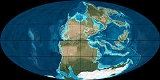
Permian

Encyclopedia
The Permian
>The term "Permian" was introduced into geology
in 1841 by Sir Sir R. I. Murchison
, president of the Geological Society of London, who identified typical strata in extensive Russian explorations undertaken with Edouard de Verneuil
; Murchison asserted in 1841 that he named his "Permian system" after the ancient kingdom of Permia
, and not after the then small town of Perm
, as usually assumed; see "Origin of the Permian" is a geologic period and system which extends from 299.0 ± 0.8 to 251.0 ± 0.4 Mya (Million years ago). It was named after the Perm Krai
in Russia
by Scottish geologist Roderick Murchison
in 1841. The Permian follows the Carboniferous
and precedes the Triassic
, and is characterized among land vertebrates by the diversification of the early amniotes into the ancestral groups of the mammals, turtles, lepidosaurs and archosaurs. The world at the time was very hot and dry, and was dominated by a single supercontinent
known as Pangaea
. The extensive rainforest
s of the Carboniferous
had disappeared, leaving behind vast swathes of desert
. The Permian period (along with the Paleozoic era) ended with the largest mass extinction in Earth's history
, in which nearly 90% of marine species and 70% of terrestrial species died out.
Upper Permian (Late Permian) or Lopingian, Tatarian, or Zechstein, epoch
[260.4 ± 0.7 Mya - 251.0 ± 0.4 Mya]:
Middle Permian, or Guadalupian epoch [270.6 ± 0.7 - 260.4 ± 0.7 Mya]:
Lower / Early Permian or Cisuralian epoch [299.0 ± 0.8 - 270.6 ± 0.7 Mya]:
s in the Permian remained generally low, and near-shore environments were limited by the collection of almost all major landmass
es into a single continent -- Pangaea
. This could have in part caused the widespread extinctions of marine species at the end of the period by severely reducing shallow coastal areas preferred by many marine organisms.
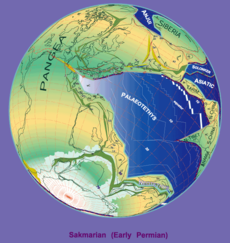 During the Permian, all the Earth
's major land masses were collected into a single supercontinent known as Pangaea
. Pangaea straddled the equator
and extended toward the poles, with a corresponding effect on ocean currents in the single great ocean ("Panthalassa
", the "universal sea"), and the Paleo-Tethys Ocean, a large ocean that was between Asia and Gondwana. The Cimmeria continent rift
ed away from Gondwana
and drifted north to Laurasia
, causing the Paleo-Tethys to shrink. A new ocean was growing on its southern end, the Tethys Ocean
, an ocean that would dominate much of the Mesozoic
Era. Large continental landmasses create climates with extreme variations of heat and cold ("continental climate
") and monsoon
conditions with highly seasonal rainfall patterns. Desert
s seem to have been widespread on Pangaea. Such dry conditions favored gymnosperm
s, plants with seeds enclosed in a protective cover, over plants such as fern
s that disperse spore
s. The first modern trees (conifers
, ginkgo
s and cycad
s) appeared in the Permian.
Three general areas are especially noted for their extensive Permian deposits - the Ural Mountains
(where Perm itself is located), China, and the southwest of North America, where the Permian Basin in the U.S.
state of Texas
is so named because it has one of the thickest deposits of Permian rocks in the world.
in the Permian was quite varied. At the start of the Permian, the Earth
was still at the grip of an Ice Age
from the Carboniferous
. Glaciers receded around the mid-Permian period as the climate gradually warmed, drying the continent's interiors. In the late Permian period, the drying continued although the temperature cycled between warm and cool cycles.
mollusks, echinoderm
s, and brachiopod
s. Fossilized shells of two kinds of invertebrate
s are widely used to identify Permian strata and correlate them between sites: fusulinid
s, a kind of shelled amoeba-like protist
that is one of the foraminifera
ns, and ammonoids
, shelled cephalopod
s that are distant relatives of the modern nautilus
. By the close of the Permian, trilobite
s and a host of other marine groups became extinct.
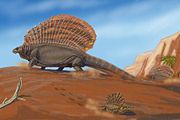 Terrestrial life in the Permian included diverse plants, fungi, arthropod
s, and various types of tetrapods
. The period saw a massive desert covering the interior of the Pangaea
. The warm zone spread in the northern hemisphere, where extensive dry desert appeared. The rocks formed at that time were stained red by iron oxides, the result of intense heating by the sun of a surface devoid of vegetation cover. A number of older types of plants and animals died out or became marginal elements.
The Permian began with the Carboniferous flora still flourishing. About the middle of the Permian a major transition in vegetation began. The swamp-loving lycopod trees of the Carboniferous, such as Lepidodendron
and Sigillaria
, were progressively replaced in the continental interior by the more advanced seed ferns and early conifers. At the close of the Permian, lycopod and equicete swamp
s reminiscent of Carboniferous flora was relegated to a series of equatorial islands in the Paleotethys Sea that later would become the South China
.
The Permian saw the radiation of many important conifer groups, including the ancestors of many present-day families. Rich forests were present in many areas, with a diverse mix of plant groups. The southern continent saw extensive seed fern forests of the Glossopteris
flora. Oxygen levels were probably high there. The ginkgo
s and cycad
s also appeared during this period.
and well into the Permian, by far the most successful were primitive relatives of cockroaches
. Six fast legs, four well developed folding wings, fairly good eyes, long, well developed antennae (olfactory), an omnivorous digestive system, a receptacle for storing sperm, a chitin
-based exoskeleton
that could support and protect, as well as form of gizzard and efficient mouth parts, gave it formidable advantages over other herbivorous animals. About 90% of insects at the start of the Permian were cockroach-like insects ("Blattopterans").
Primitive forms of dragonflies (Odonata
) were the dominant aerial predators and probably dominated terrestrial insect predation as well. True Odonata appeared in the Permian and all are effectively amphibious
(aquatic immature stages, and terrestrial adults), as are all modern odonates. Their prototypes are the oldest winged fossils, go back to the Devonian
, and are different in several respects from the wings of other insects. Fossils suggest they may have possessed many modern attributes even by the late Carboniferous
, and it is possible that they captured small vertebrates, for some species had a wing span of 71 cm. Several other insect groups appeared during the Permian, including the Coleoptera (beetles) and Hemiptera
(true bugs).
, and the late Permian by more advanced therapsids such as gorgonopsia
ns and dicynodont
s. Towards the very end of the Permian the first archosaurs
appeared, a group that would give rise to the dinosaur
s in the following period
. Also appearing at the end of the Permian were the first cynodont
s, which would go on to evolve into mammal
s during the Triassic. Another group of therapsids, the therocephalia
ns (such as Trochosaurus
), arose in the Middle Permian. There were no aerial vertebrates.
The Permian period saw the development of a fully terrestrial fauna and the appearance of the first large
herbivore
s and carnivore
s. It was the high tide of the anapsid
es in the form of the massive Pareiasaur
s and host of smaller, generally lizard-like groups. A group of small reptiles, the diapsids started to abound. These were the ancestors to most modern reptiles and the ruling dinosaurs as well as pterosaurs and crocodiles.
Thriving also, were the early ancestors to mammals, the synapsid
a, which included some large reptiles such as Dimetrodon
. Reptiles grew to dominance among vertebrates, because their special adaptations enabled them to flourish in the drier climate.
Permian amphibians consisted of temnospondyli
, lepospondyli
and batrachosaurs
.
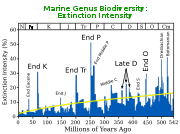
The Permian ended with the most extensive extinction event
recorded in paleontology
: the Permian-Triassic extinction event
. 90% to 95% of marine species became extinct
, as well as 70% of all land organisms. It is also the only known mass extinction of insects. Recovery from the Permian-Triassic extinction event was protracted; on land ecosystems took 30M years to recover.
There is also significant evidence that massive flood basalt
eruptions from magma output lasting thousands of years in what is now the Siberian Traps
contributed to environmental stress leading to mass extinction. The reduced coastal habitat and highly increased aridity probably also contributed. Based on the amount of lava estimated to have been produced during this period, the worst-case scenario is an expulsion of enough carbon dioxide from the eruptions to raise world temperatures five degrees Celsius.
Another hypothesis involves ocean venting of hydrogen sulfide
gas. Portions of deep ocean will periodically lose all of their dissolved oxygen allowing bacteria that live without oxygen to flourish and produce hydrogen sulfide gas. If enough hydrogen sulfide accumulates in an anoxic zone
, the gas can rise into the atmosphere.
Oxidizing gases in the atmosphere would destroy the toxic gas, but the hydrogen sulfide would soon consume all of the atmospheric gas available to change it. Hydrogen sulfide levels would increase dramatically over a few hundred years.
Modeling of such an event indicates that the gas would destroy ozone
in the upper atmosphere allowing ultraviolet
radiation to kill off species that had survived the toxic gas. Of course, there are species that can metabolize hydrogen sulfide.
Another hypothesis builds on the flood basalt eruption theory. Five degrees Celsius would not be enough increase in world temperatures to explain the death of 95% of life. But such warming could slowly raise ocean temperatures until frozen methane reservoirs below the ocean floor near coastlines (a current target for a new energy source) melted, expelling enough methane, among the most potent greenhouse gases, into the atmosphere to raise world temperatures an additional five degrees Celsius. The frozen methane hypothesis helps explain the increase in carbon-12 levels midway into the Permian-Triassic boundary layer. It also helps explain why the first phase of the layer's extinctions was land-based, the second was marine-based (and starting right after the increase in C-12 levels), and the third land-based again.
An even more speculative hypothesis is that intense radiation from a nearby supernova
was responsible for the extinctions.
Trilobite
s, which had thrived since Cambrian
times, finally became extinct before the end of the Permian.
Nautilus
es, a species of cephalopods, surprisingly survived this occurrence.
In 2006, a group of American scientists from The Ohio State University reported evidence for a possible huge meteorite
crater
(Wilkes Land crater
) with a diameter of around 500 kilometers in Antarctica. The crater is located at a depth of 1.6 kilometers beneath the ice of Wilkes Land in eastern Antarctica. The scientists speculate that this impact may have caused the Permian–Triassic extinction event, although its age is bracketed only between 100 million and 500 million years ago. They also speculate that it may have contributed in some way to the separation of Australia
from the Antarctic landmass, which were both part of a supercontinent called Gondwana
. Levels of iridium and quartz fracturing in the Permian-Triassic layer do not approach those of the Cretaceous-Tertiary boundary layer
. Given that a far greater proportion of species and individual organisms became extinct during the former, doubt is cast on the significance of a meteor impact in creating the latter. Further doubt has been cast on this theory based on fossils in Greenland showing the extinction to have been gradual, lasting about eighty thousand years, with three distinct phases.
Many scientists argue that the Permian-Triassic extinction event was caused by a combination of some or all of the hypotheses above and other factors; the formation of Pangaea
decreased the number of coastal habitats and may have contributed to the extinction of many clades.
Geology
Geology is the science comprising the study of solid Earth, the rocks of which it is composed, and the processes by which it evolves. Geology gives insight into the history of the Earth, as it provides the primary evidence for plate tectonics, the evolutionary history of life, and past climates...
in 1841 by Sir Sir R. I. Murchison
Roderick Murchison
Sir Roderick Impey Murchison, 1st Baronet KCB DCL FRS FRSE FLS PRGS PBA MRIA was a Scottish geologist who first described and investigated the Silurian system.-Early life and work:...
, president of the Geological Society of London, who identified typical strata in extensive Russian explorations undertaken with Edouard de Verneuil
Edouard de Verneuil
Phillippe Edouard Poulletier de Verneuil was a French paleontologist.He was born in Paris and educated in law, but being of independent means he was free to follow his own inclinations, and having attended lectures on geology by Jean-Baptiste Elie de Beaumont he was so attracted to the subject...
; Murchison asserted in 1841 that he named his "Permian system" after the ancient kingdom of Permia
Great Perm
Great Perm or simply Perm, Latinized Permia, was a medieval Komi state in what is now the Perm Krai of the Russian Federation.Cherdyn is said to have been its capital....
, and not after the then small town of Perm
Perm
Perm is a city and the administrative center of Perm Krai, Russia, located on the banks of the Kama River, in the European part of Russia near the Ural Mountains. From 1940 to 1957 it was named Molotov ....
, as usually assumed; see "Origin of the Permian" is a geologic period and system which extends from 299.0 ± 0.8 to 251.0 ± 0.4 Mya (Million years ago). It was named after the Perm Krai
Perm Krai
Perm Krai is a federal subject of Russia that came into existence on December 1, 2005 as a result of the 2004 referendum on the merger of Perm Oblast and Komi-Permyak Autonomous Okrug. The city of Perm became the administrative center of the new federal subject...
in Russia
Russia
Russia or , officially known as both Russia and the Russian Federation , is a country in northern Eurasia. It is a federal semi-presidential republic, comprising 83 federal subjects...
by Scottish geologist Roderick Murchison
Roderick Murchison
Sir Roderick Impey Murchison, 1st Baronet KCB DCL FRS FRSE FLS PRGS PBA MRIA was a Scottish geologist who first described and investigated the Silurian system.-Early life and work:...
in 1841. The Permian follows the Carboniferous
Carboniferous
The Carboniferous is a geologic period and system that extends from the end of the Devonian Period, about 359.2 ± 2.5 Mya , to the beginning of the Permian Period, about 299.0 ± 0.8 Mya . The name is derived from the Latin word for coal, carbo. Carboniferous means "coal-bearing"...
and precedes the Triassic
Triassic
The Triassic is a geologic period and system that extends from about 250 to 200 Mya . As the first period of the Mesozoic Era, the Triassic follows the Permian and is followed by the Jurassic. Both the start and end of the Triassic are marked by major extinction events...
, and is characterized among land vertebrates by the diversification of the early amniotes into the ancestral groups of the mammals, turtles, lepidosaurs and archosaurs. The world at the time was very hot and dry, and was dominated by a single supercontinent
Supercontinent
In geology, a supercontinent is a landmass comprising more than one continental core, or craton. The assembly of cratons and accreted terranes that form Eurasia qualifies as a supercontinent today.-History:...
known as Pangaea
Pangaea
Pangaea, Pangæa, or Pangea is hypothesized as a supercontinent that existed during the Paleozoic and Mesozoic eras about 250 million years ago, before the component continents were separated into their current configuration....
. The extensive rainforest
Rainforest
Rainforests are forests characterized by high rainfall, with definitions based on a minimum normal annual rainfall of 1750-2000 mm...
s of the Carboniferous
Carboniferous
The Carboniferous is a geologic period and system that extends from the end of the Devonian Period, about 359.2 ± 2.5 Mya , to the beginning of the Permian Period, about 299.0 ± 0.8 Mya . The name is derived from the Latin word for coal, carbo. Carboniferous means "coal-bearing"...
had disappeared, leaving behind vast swathes of desert
Desert
A desert is a landscape or region that receives an extremely low amount of precipitation, less than enough to support growth of most plants. Most deserts have an average annual precipitation of less than...
. The Permian period (along with the Paleozoic era) ended with the largest mass extinction in Earth's history
Permian-Triassic extinction event
The Permian–Triassic extinction event, informally known as the Great Dying, was an extinction event that occurred 252.28 Ma ago, forming the boundary between the Permian and Triassic geologic periods, as well as the Paleozoic and Mesozoic eras...
, in which nearly 90% of marine species and 70% of terrestrial species died out.
ICS Subdivisions
Official Subdivisions of the Permian System, from most recent to most ancient rock layers are:Upper Permian (Late Permian) or Lopingian, Tatarian, or Zechstein, epoch
Epoch (geology)
An epoch is a subdivision of the geologic timescale based on rock layering. In order, the higher subdivisions are periods, eras and eons. We are currently living in the Holocene epoch...
[260.4 ± 0.7 Mya - 251.0 ± 0.4 Mya]:
- Changhsingian (Changxingian)ChanghsingianIn the geologic timescale, the Changhsingian or Changxingian is the latest age or uppermost stage of the Permian. It is also the upper or latest of two subdivisions of the Lopingian epoch or series. The Changhsingian lasted from 253.8 ± 0.7 to 251.0 ± 0.7 million years ago...
[253.8 ± 0.7 Mya - 251.0 ± 0.4 Mya] - Wuchiapingian (Wujiapingian)WuchiapingianIn the geologic timescale, the Wuchiapingian or Wujiapingian is an age or stage of the Permian. It is also the lower or earlier of two subdivisions of the Lopingian epoch or series. The Wuchiapingian spans the time between 260.4 ± 0.7 and 253.8 ± 0.7 million years ago...
[260.4 ± 0.7 Mya - 253.8 ± 0.7 Mya] - Others:
- Waiitian (New Zealand) [260.4 ± 0.7 Mya - 253.8 ± 0.7 Mya]
- Makabewan (New Zealand) [253.8 - 251.0 ± 0.4 Mya]
- Ochoan (North American) [260.4 ± 0.7 Mya - 251.0 ± 0.4 Mya]
Middle Permian, or Guadalupian epoch [270.6 ± 0.7 - 260.4 ± 0.7 Mya]:
- CapitanianCapitanianIn the geologic timescale, the Capitanian is an age or stage of the Permian. It is also the uppermost or latest of three subdivisions of the Guadalupian epoch or series. The Capitanian lasted between and...
stage [265.8 ± 0.7 - 260.4 ± 0.7 Mya] - WordianWordianIn the geologic timescale, the Wordian is an age or stage of the Permian. It is the middle of three subdivisions of the Guadalupian epoch or series. The Wordian lasted between 268.0 ± 0.7 and 265.8 ± 0.7 million years ago...
stage [268.0 ± 0.7 - 265.8 ± 0.7 Mya] - RoadianRoadianIn the geologic timescale, the Roadian is an age or stage of the Permian. It is the earliest or lower of three subdivisions of the Guadalupian epoch or series. The Roadian lasted between 270.6 ± 0.7 and 268.0 ± 0.7 million years ago...
stage [270.6 ± 0.7 - 268.0 ± 0.7 Mya] - Others:
- Kazanian or Maokovian (European) [270.6 ± 0.7 - 260.4 ± 0.7 Mya]
- Braxtonian stage (New Zealand) [270.6 ± 0.7 - 260.4 ± 0.7 Mya]
Lower / Early Permian or Cisuralian epoch [299.0 ± 0.8 - 270.6 ± 0.7 Mya]:
- KungurianKungurianIn the geologic timescale, the Kungurian is an age or stage of the Permian. It is the latest or upper of four subdivisions of the Cisuralian epoch or series. The Kungurian lasted between 275.6 ± 0.7 and 270.6 ± 0.7 million years ago...
(Irenian / Filippovian / Leonard) stage [275.6 ± 0.7 - 270.6 ± 0.7 Mya] - ArtinskianArtinskianIn the geologic timescale, the Artinskian is an age or stage of the Permian. It is a subdivision of the Cisuralian epoch or series. The Artinskian lasted between 284.4 ± 0.7 and 275.6 ± 0.7 million years ago...
(Baigendzinian / Aktastinian) stage [284.4 ± 0.7 - 275.6 ± 0.7 Mya] - SakmarianSakmarianIn the geologic timescale, the Sakmarian is an age or stage of the Permian. It is a subdivision of the Cisuralian epoch or series. The Sakmarian lasted between 294.6 ± 0.8 and 284.4 ± 0.7 million years ago...
(Sterlitamakian / Tastubian / Leonard / Wolfcamp) stage [294.6 ± 0.8 - 284.4 ± 0.7 Mya] - AsselianAsselianIn the geologic timescale, the Asselian is the earliest geochronologic age or lowermost chronostratigraphic stage of the Permian. It is a subdivision of the Cisuralian epoch or series. The Asselian lasted between 299.0 ± 0.8 and 294.6 ± 0.8 million years ago...
(Krumaian / Uskalikian / Surenian / Wolfcamp) stage [299.0 ± 0.8 - 294.6 ± 0.8 Mya] - Others:
- Telfordian (New Zealand) [289 - 278]
- Mangapirian (New Zealand) [278 - 270.6]
Oceans
Sea levelSea level
Mean sea level is a measure of the average height of the ocean's surface ; used as a standard in reckoning land elevation...
s in the Permian remained generally low, and near-shore environments were limited by the collection of almost all major landmass
Landmass
A landmass is a contiguous area of land surrounded by ocean. Although it may be most often written as one word to distinguish it from the usage "land mass"—the measure of land area—it is also used as two words.Landmasses include:*supercontinents...
es into a single continent -- Pangaea
Pangaea
Pangaea, Pangæa, or Pangea is hypothesized as a supercontinent that existed during the Paleozoic and Mesozoic eras about 250 million years ago, before the component continents were separated into their current configuration....
. This could have in part caused the widespread extinctions of marine species at the end of the period by severely reducing shallow coastal areas preferred by many marine organisms.
Paleogeography
Earth
Earth is the third planet from the Sun, and the densest and fifth-largest of the eight planets in the Solar System. It is also the largest of the Solar System's four terrestrial planets...
's major land masses were collected into a single supercontinent known as Pangaea
Pangaea
Pangaea, Pangæa, or Pangea is hypothesized as a supercontinent that existed during the Paleozoic and Mesozoic eras about 250 million years ago, before the component continents were separated into their current configuration....
. Pangaea straddled the equator
Equator
An equator is the intersection of a sphere's surface with the plane perpendicular to the sphere's axis of rotation and containing the sphere's center of mass....
and extended toward the poles, with a corresponding effect on ocean currents in the single great ocean ("Panthalassa
Panthalassa
Panthalassa , also known as the Panthalassic Ocean, was the vast global ocean that surrounded the supercontinent Pangaea, during the late Paleozoic and the early Mesozoic years. It included the Pacific Ocean to the west and north and the Tethys Ocean to the southeast...
", the "universal sea"), and the Paleo-Tethys Ocean, a large ocean that was between Asia and Gondwana. The Cimmeria continent rift
Rift
In geology, a rift or chasm is a place where the Earth's crust and lithosphere are being pulled apart and is an example of extensional tectonics....
ed away from Gondwana
Gondwana
In paleogeography, Gondwana , originally Gondwanaland, was the southernmost of two supercontinents that later became parts of the Pangaea supercontinent. It existed from approximately 510 to 180 million years ago . Gondwana is believed to have sutured between ca. 570 and 510 Mya,...
and drifted north to Laurasia
Laurasia
In paleogeography, Laurasia was the northernmost of two supercontinents that formed part of the Pangaea supercontinent from approximately...
, causing the Paleo-Tethys to shrink. A new ocean was growing on its southern end, the Tethys Ocean
Tethys Ocean
The Tethys Ocean was an ocean that existed between the continents of Gondwana and Laurasia during the Mesozoic era before the opening of the Indian Ocean.-Modern theory:...
, an ocean that would dominate much of the Mesozoic
Mesozoic
The Mesozoic era is an interval of geological time from about 250 million years ago to about 65 million years ago. It is often referred to as the age of reptiles because reptiles, namely dinosaurs, were the dominant terrestrial and marine vertebrates of the time...
Era. Large continental landmasses create climates with extreme variations of heat and cold ("continental climate
Continental climate
Continental climate is a climate characterized by important annual variation in temperature due to the lack of significant bodies of water nearby...
") and monsoon
Monsoon
Monsoon is traditionally defined as a seasonal reversing wind accompanied by corresponding changes in precipitation, but is now used to describe seasonal changes in atmospheric circulation and precipitation associated with the asymmetric heating of land and sea...
conditions with highly seasonal rainfall patterns. Desert
Desert
A desert is a landscape or region that receives an extremely low amount of precipitation, less than enough to support growth of most plants. Most deserts have an average annual precipitation of less than...
s seem to have been widespread on Pangaea. Such dry conditions favored gymnosperm
Gymnosperm
The gymnosperms are a group of seed-bearing plants that includes conifers, cycads, Ginkgo, and Gnetales. The term "gymnosperm" comes from the Greek word gymnospermos , meaning "naked seeds", after the unenclosed condition of their seeds...
s, plants with seeds enclosed in a protective cover, over plants such as fern
Fern
A fern is any one of a group of about 12,000 species of plants belonging to the botanical group known as Pteridophyta. Unlike mosses, they have xylem and phloem . They have stems, leaves, and roots like other vascular plants...
s that disperse spore
Spore
In biology, a spore is a reproductive structure that is adapted for dispersal and surviving for extended periods of time in unfavorable conditions. Spores form part of the life cycles of many bacteria, plants, algae, fungi and some protozoa. According to scientist Dr...
s. The first modern trees (conifers
Pinophyta
The conifers, division Pinophyta, also known as division Coniferophyta or Coniferae, are one of 13 or 14 division level taxa within the Kingdom Plantae. Pinophytes are gymnosperms. They are cone-bearing seed plants with vascular tissue; all extant conifers are woody plants, the great majority being...
, ginkgo
Ginkgo
Ginkgo , also spelled gingko and known as the Maidenhair Tree, is a unique species of tree with no close living relatives...
s and cycad
Cycad
Cycads are seed plants typically characterized by a stout and woody trunk with a crown of large, hard and stiff, evergreen leaves. They usually have pinnate leaves. The individual plants are either all male or all female . Cycads vary in size from having a trunk that is only a few centimeters...
s) appeared in the Permian.
Three general areas are especially noted for their extensive Permian deposits - the Ural Mountains
Ural Mountains
The Ural Mountains , or simply the Urals, are a mountain range that runs approximately from north to south through western Russia, from the coast of the Arctic Ocean to the Ural River and northwestern Kazakhstan. Their eastern side is usually considered the natural boundary between Europe and Asia...
(where Perm itself is located), China, and the southwest of North America, where the Permian Basin in the U.S.
United States
The United States of America is a federal constitutional republic comprising fifty states and a federal district...
state of Texas
Texas
Texas is the second largest U.S. state by both area and population, and the largest state by area in the contiguous United States.The name, based on the Caddo word "Tejas" meaning "friends" or "allies", was applied by the Spanish to the Caddo themselves and to the region of their settlement in...
is so named because it has one of the thickest deposits of Permian rocks in the world.
Climate
The climateClimate
Climate encompasses the statistics of temperature, humidity, atmospheric pressure, wind, rainfall, atmospheric particle count and other meteorological elemental measurements in a given region over long periods...
in the Permian was quite varied. At the start of the Permian, the Earth
Earth
Earth is the third planet from the Sun, and the densest and fifth-largest of the eight planets in the Solar System. It is also the largest of the Solar System's four terrestrial planets...
was still at the grip of an Ice Age
Ice age
An ice age or, more precisely, glacial age, is a generic geological period of long-term reduction in the temperature of the Earth's surface and atmosphere, resulting in the presence or expansion of continental ice sheets, polar ice sheets and alpine glaciers...
from the Carboniferous
Carboniferous
The Carboniferous is a geologic period and system that extends from the end of the Devonian Period, about 359.2 ± 2.5 Mya , to the beginning of the Permian Period, about 299.0 ± 0.8 Mya . The name is derived from the Latin word for coal, carbo. Carboniferous means "coal-bearing"...
. Glaciers receded around the mid-Permian period as the climate gradually warmed, drying the continent's interiors. In the late Permian period, the drying continued although the temperature cycled between warm and cool cycles.
Life
Marine biota
Permian marine deposits are rich in fossilFossil
Fossils are the preserved remains or traces of animals , plants, and other organisms from the remote past...
mollusks, echinoderm
Echinoderm
Echinoderms are a phylum of marine animals. Echinoderms are found at every ocean depth, from the intertidal zone to the abyssal zone....
s, and brachiopod
Brachiopod
Brachiopods are a phylum of marine animals that have hard "valves" on the upper and lower surfaces, unlike the left and right arrangement in bivalve molluscs. Brachiopod valves are hinged at the rear end, while the front can be opened for feeding or closed for protection...
s. Fossilized shells of two kinds of invertebrate
Invertebrate
An invertebrate is an animal without a backbone. The group includes 97% of all animal species – all animals except those in the chordate subphylum Vertebrata .Invertebrates form a paraphyletic group...
s are widely used to identify Permian strata and correlate them between sites: fusulinid
Fusulinid
The Fusulinida is an extinct order within the Foraminifera in which the tests are composed of tightly packed, secreted microgranular calcite. In advanced forms the test wall is differentiated into two or more layers...
s, a kind of shelled amoeba-like protist
Protist
Protists are a diverse group of eukaryotic microorganisms. Historically, protists were treated as the kingdom Protista, which includes mostly unicellular organisms that do not fit into the other kingdoms, but this group is contested in modern taxonomy...
that is one of the foraminifera
Foraminifera
The Foraminifera , or forams for short, are a large group of amoeboid protists which are among the commonest plankton species. They have reticulating pseudopods, fine strands of cytoplasm that branch and merge to form a dynamic net...
ns, and ammonoids
Ammonite
Ammonite, as a zoological or paleontological term, refers to any member of the Ammonoidea an extinct subclass within the Molluscan class Cephalopoda which are more closely related to living coleoids Ammonite, as a zoological or paleontological term, refers to any member of the Ammonoidea an extinct...
, shelled cephalopod
Cephalopod
A cephalopod is any member of the molluscan class Cephalopoda . These exclusively marine animals are characterized by bilateral body symmetry, a prominent head, and a set of arms or tentacles modified from the primitive molluscan foot...
s that are distant relatives of the modern nautilus
Nautilus
Nautilus is the common name of marine creatures of cephalopod family Nautilidae, the sole extant family of the superfamily Nautilaceae and of its smaller but near equal suborder, Nautilina. It comprises six living species in two genera, the type of which is the genus Nautilus...
. By the close of the Permian, trilobite
Trilobite
Trilobites are a well-known fossil group of extinct marine arthropods that form the class Trilobita. The first appearance of trilobites in the fossil record defines the base of the Atdabanian stage of the Early Cambrian period , and they flourished throughout the lower Paleozoic era before...
s and a host of other marine groups became extinct.
Terrestrial biota
Arthropod
An arthropod is an invertebrate animal having an exoskeleton , a segmented body, and jointed appendages. Arthropods are members of the phylum Arthropoda , and include the insects, arachnids, crustaceans, and others...
s, and various types of tetrapods
Permian tetrapods
Permian Tetrapods were amphibians and reptiles that lived during the Permian Period.During this time, amphibians remained common, including various Temnospondyli and Lepospondyli...
. The period saw a massive desert covering the interior of the Pangaea
Pangaea
Pangaea, Pangæa, or Pangea is hypothesized as a supercontinent that existed during the Paleozoic and Mesozoic eras about 250 million years ago, before the component continents were separated into their current configuration....
. The warm zone spread in the northern hemisphere, where extensive dry desert appeared. The rocks formed at that time were stained red by iron oxides, the result of intense heating by the sun of a surface devoid of vegetation cover. A number of older types of plants and animals died out or became marginal elements.
The Permian began with the Carboniferous flora still flourishing. About the middle of the Permian a major transition in vegetation began. The swamp-loving lycopod trees of the Carboniferous, such as Lepidodendron
Lepidodendron
Lepidodendron is an extinct genus of primitive, vascular, arborescent plant related to the Lycopsids . It was part of the coal forest flora. They sometimes reached heights of over , and the trunks were often over in diameter, and thrived during the Carboniferous period...
and Sigillaria
Sigillaria
Sigillaria is a genus of extinct, spore-bearing, arborescent plants which flourished in the Late Carboniferous period but dwindled to extinction in the early Permian period. It was a lycopodiophyte, and is related to the lycopsids, or club-mosses, but even more closely to quillworts, as was its...
, were progressively replaced in the continental interior by the more advanced seed ferns and early conifers. At the close of the Permian, lycopod and equicete swamp
Swamp
A swamp is a wetland with some flooding of large areas of land by shallow bodies of water. A swamp generally has a large number of hammocks, or dry-land protrusions, covered by aquatic vegetation, or vegetation that tolerates periodical inundation. The two main types of swamp are "true" or swamp...
s reminiscent of Carboniferous flora was relegated to a series of equatorial islands in the Paleotethys Sea that later would become the South China
South China (continent)
South China continent, also known as South China craton, South Chinese craton, or Yangtze craton, was an ancient continent that contained today's South and Southeast China , Indochina, and parts of Southeast Asia...
.
The Permian saw the radiation of many important conifer groups, including the ancestors of many present-day families. Rich forests were present in many areas, with a diverse mix of plant groups. The southern continent saw extensive seed fern forests of the Glossopteris
Glossopteris
Glossopteris is the largest and best-known genus of the extinct order of seed ferns known as Glossopteridales ....
flora. Oxygen levels were probably high there. The ginkgo
Ginkgo
Ginkgo , also spelled gingko and known as the Maidenhair Tree, is a unique species of tree with no close living relatives...
s and cycad
Cycad
Cycads are seed plants typically characterized by a stout and woody trunk with a crown of large, hard and stiff, evergreen leaves. They usually have pinnate leaves. The individual plants are either all male or all female . Cycads vary in size from having a trunk that is only a few centimeters...
s also appeared during this period.
Insects of the Permian
By the PennsylvanianPennsylvanian
The Pennsylvanian is, in the ICS geologic timescale, the younger of two subperiods of the Carboniferous Period. It lasted from roughly . As with most other geochronologic units, the rock beds that define the Pennsylvanian are well identified, but the exact date of the start and end are uncertain...
and well into the Permian, by far the most successful were primitive relatives of cockroaches
Blattoptera
Blattoptera , or proto-cockroaches, is a name given to various "roachid" fossil insects related to cockroaches, mantises and termites, and of general cockroach-like appearance and possibly habit. The group is on the rank of an order, though being paraphyletic is most often given without formal...
. Six fast legs, four well developed folding wings, fairly good eyes, long, well developed antennae (olfactory), an omnivorous digestive system, a receptacle for storing sperm, a chitin
Chitin
Chitin n is a long-chain polymer of a N-acetylglucosamine, a derivative of glucose, and is found in many places throughout the natural world...
-based exoskeleton
Exoskeleton
An exoskeleton is the external skeleton that supports and protects an animal's body, in contrast to the internal skeleton of, for example, a human. In popular usage, some of the larger kinds of exoskeletons are known as "shells". Examples of exoskeleton animals include insects such as grasshoppers...
that could support and protect, as well as form of gizzard and efficient mouth parts, gave it formidable advantages over other herbivorous animals. About 90% of insects at the start of the Permian were cockroach-like insects ("Blattopterans").
Primitive forms of dragonflies (Odonata
Odonata
Odonata is an order of insects, encompassing dragonflies and damselflies . The word dragonfly is also sometimes used to refer to all Odonata, but the back-formation odonate is a more correct English name for the group as a whole...
) were the dominant aerial predators and probably dominated terrestrial insect predation as well. True Odonata appeared in the Permian and all are effectively amphibious
Amphibious
Amphibious means able to use either land or water. In particular it may refer to:*Amphibious warfare, warfare carried out on both land and water*Amphibians, vertebrate animals of the Class Amphibia...
(aquatic immature stages, and terrestrial adults), as are all modern odonates. Their prototypes are the oldest winged fossils, go back to the Devonian
Devonian
The Devonian is a geologic period and system of the Paleozoic Era spanning from the end of the Silurian Period, about 416.0 ± 2.8 Mya , to the beginning of the Carboniferous Period, about 359.2 ± 2.5 Mya...
, and are different in several respects from the wings of other insects. Fossils suggest they may have possessed many modern attributes even by the late Carboniferous
Carboniferous
The Carboniferous is a geologic period and system that extends from the end of the Devonian Period, about 359.2 ± 2.5 Mya , to the beginning of the Permian Period, about 299.0 ± 0.8 Mya . The name is derived from the Latin word for coal, carbo. Carboniferous means "coal-bearing"...
, and it is possible that they captured small vertebrates, for some species had a wing span of 71 cm. Several other insect groups appeared during the Permian, including the Coleoptera (beetles) and Hemiptera
Hemiptera
Hemiptera is an order of insects most often known as the true bugs , comprising around 50,000–80,000 species of cicadas, aphids, planthoppers, leafhoppers, shield bugs, and others...
(true bugs).
Synapsid and amphibian fauna
Early Permian terrestrial faunas were dominated by pelycosaurs and amphibians, the middle Permian by primitive therapsids such as the dinocephaliaDinocephalia
Dinocephalia are a clade of large early therapsids that flourished during the Middle Permian, but became extinct leaving no descendants.-Description:...
, and the late Permian by more advanced therapsids such as gorgonopsia
Gorgonopsia
Gorgonopsia is a suborder of therapsid synapsids. Their name is a reference to the Gorgons of Greek mythology. Like other therapsids, gorgonopsians were at one time called "mammal-like reptiles"...
ns and dicynodont
Dicynodont
Dicynodontia is a taxon of anomodont therapsids or mammal-like reptiles. Dicynodonts were small to large herbivorous animals with two tusks, hence their name, which means 'two dog tooth'...
s. Towards the very end of the Permian the first archosaurs
Archosauriformes
Archosauriformes is a clade of diapsid reptiles that developed from archosauromorph ancestors some time in the Late Permian...
appeared, a group that would give rise to the dinosaur
Dinosaur
Dinosaurs are a diverse group of animals of the clade and superorder Dinosauria. They were the dominant terrestrial vertebrates for over 160 million years, from the late Triassic period until the end of the Cretaceous , when the Cretaceous–Paleogene extinction event led to the extinction of...
s in the following period
Triassic
The Triassic is a geologic period and system that extends from about 250 to 200 Mya . As the first period of the Mesozoic Era, the Triassic follows the Permian and is followed by the Jurassic. Both the start and end of the Triassic are marked by major extinction events...
. Also appearing at the end of the Permian were the first cynodont
Cynodont
Cynodontia or cynodonts are a taxon of therapsids which first appeared in the Late Permian and were eventually distributed throughout all seven continents by the Early Triassic . This clade includes modern mammals and their extinct close relatives. They were one of the most diverse groups of...
s, which would go on to evolve into mammal
Mammal
Mammals are members of a class of air-breathing vertebrate animals characterised by the possession of endothermy, hair, three middle ear bones, and mammary glands functional in mothers with young...
s during the Triassic. Another group of therapsids, the therocephalia
Therocephalia
Therocephalians are an extinct suborder of carnivorous eutheriodont therapsids that lived from the middle and late Permian into the Triassic 265.0—245.0 Ma existing for approximately ....
ns (such as Trochosaurus
Trochosaurus
Trochosaurus is an extinct genus of mammal-like reptile. It belong to a synapsid suborder called Therocephalia. Like them, and the mammals, it had a secondary palate....
), arose in the Middle Permian. There were no aerial vertebrates.
The Permian period saw the development of a fully terrestrial fauna and the appearance of the first large
Megafauna
In terrestrial zoology, megafauna are "giant", "very large" or "large" animals. The most common thresholds used are or...
herbivore
Herbivore
Herbivores are organisms that are anatomically and physiologically adapted to eat plant-based foods. Herbivory is a form of consumption in which an organism principally eats autotrophs such as plants, algae and photosynthesizing bacteria. More generally, organisms that feed on autotrophs in...
s and carnivore
Carnivore
A carnivore meaning 'meat eater' is an organism that derives its energy and nutrient requirements from a diet consisting mainly or exclusively of animal tissue, whether through predation or scavenging...
s. It was the high tide of the anapsid
Anapsid
An anapsid is an amniote whose skull does not have openings near the temples.While "anapsid reptiles" or "anapsida" are traditionally spoken of as if they were a monophyletic group, it has been suggested that several groups of reptiles that had anapsid skulls may be only distantly related...
es in the form of the massive Pareiasaur
Pareiasaur
The Pareiasaurs - Family Pareiasauridae - are a clade of medium-sized to large herbivorous anapsid reptiles that flourished during the Permian period....
s and host of smaller, generally lizard-like groups. A group of small reptiles, the diapsids started to abound. These were the ancestors to most modern reptiles and the ruling dinosaurs as well as pterosaurs and crocodiles.
Thriving also, were the early ancestors to mammals, the synapsid
Synapsid
Synapsids are a group of animals that includes mammals and everything more closely related to mammals than to other living amniotes. They are easily separated from other amniotes by having an opening low in the skull roof behind each eye, leaving a bony arch beneath each, accounting for their name...
a, which included some large reptiles such as Dimetrodon
Dimetrodon
Dimetrodon was a predatory synapsid genus that flourished during the Permian period, living between 280–265 million years ago ....
. Reptiles grew to dominance among vertebrates, because their special adaptations enabled them to flourish in the drier climate.
Permian amphibians consisted of temnospondyli
Temnospondyli
Temnospondyli is a diverse order of small to giant tetrapods—often considered primitive amphibians—that flourished worldwide during the Carboniferous, Permian, and Triassic periods. A few species continued into the Cretaceous. Fossils have been found on every continent...
, lepospondyli
Lepospondyli
Lepospondyli are a group of small but diverse Carboniferous to early Permian tetrapods. Six different groups are known, the Acherontiscidae, Adelospondyli, Aïstopoda, Lysorophia, Microsauria and Nectridea, and between them they include newt-like, eel- or snake-like, and lizard-like forms, along...
and batrachosaurs
Batrachosauria
Batrachosauria is a name given either to very reptile-like amphibians dating from the Carboniferous and Permian periods, or to amniotes and those amphibians very closely related to them...
.
Permian–Triassic extinction event
The Permian ended with the most extensive extinction event
Extinction event
An extinction event is a sharp decrease in the diversity and abundance of macroscopic life. They occur when the rate of extinction increases with respect to the rate of speciation...
recorded in paleontology
Paleontology
Paleontology "old, ancient", ὄν, ὀντ- "being, creature", and λόγος "speech, thought") is the study of prehistoric life. It includes the study of fossils to determine organisms' evolution and interactions with each other and their environments...
: the Permian-Triassic extinction event
Permian-Triassic extinction event
The Permian–Triassic extinction event, informally known as the Great Dying, was an extinction event that occurred 252.28 Ma ago, forming the boundary between the Permian and Triassic geologic periods, as well as the Paleozoic and Mesozoic eras...
. 90% to 95% of marine species became extinct
Extinction
In biology and ecology, extinction is the end of an organism or of a group of organisms , normally a species. The moment of extinction is generally considered to be the death of the last individual of the species, although the capacity to breed and recover may have been lost before this point...
, as well as 70% of all land organisms. It is also the only known mass extinction of insects. Recovery from the Permian-Triassic extinction event was protracted; on land ecosystems took 30M years to recover.
There is also significant evidence that massive flood basalt
Flood basalt
A flood basalt or trap basalt is the result of a giant volcanic eruption or series of eruptions that coats large stretches of land or the ocean floor with basalt lava. Flood basalts have occurred on continental scales in prehistory, creating great plateaus and mountain ranges...
eruptions from magma output lasting thousands of years in what is now the Siberian Traps
Siberian Traps
The Siberian Traps form a large region of volcanic rock, known as a large igneous province, in the Russian region of Siberia. The massive eruptive event which formed the traps, one of the largest known volcanic events of the last 500 million years of Earth's geological history, continued for...
contributed to environmental stress leading to mass extinction. The reduced coastal habitat and highly increased aridity probably also contributed. Based on the amount of lava estimated to have been produced during this period, the worst-case scenario is an expulsion of enough carbon dioxide from the eruptions to raise world temperatures five degrees Celsius.
Another hypothesis involves ocean venting of hydrogen sulfide
Hydrogen sulfide
Hydrogen sulfide is the chemical compound with the formula . It is a colorless, very poisonous, flammable gas with the characteristic foul odor of expired eggs perceptible at concentrations as low as 0.00047 parts per million...
gas. Portions of deep ocean will periodically lose all of their dissolved oxygen allowing bacteria that live without oxygen to flourish and produce hydrogen sulfide gas. If enough hydrogen sulfide accumulates in an anoxic zone
Anoxic event
Oceanic anoxic events or anoxic events occur when the Earth's oceans become completely depleted of oxygen below the surface levels. Although anoxic events have not happened for millions of years, the geological record shows that they happened many times in the past. Anoxic events may have caused...
, the gas can rise into the atmosphere.
Oxidizing gases in the atmosphere would destroy the toxic gas, but the hydrogen sulfide would soon consume all of the atmospheric gas available to change it. Hydrogen sulfide levels would increase dramatically over a few hundred years.
Modeling of such an event indicates that the gas would destroy ozone
Ozone
Ozone , or trioxygen, is a triatomic molecule, consisting of three oxygen atoms. It is an allotrope of oxygen that is much less stable than the diatomic allotrope...
in the upper atmosphere allowing ultraviolet
Ultraviolet
Ultraviolet light is electromagnetic radiation with a wavelength shorter than that of visible light, but longer than X-rays, in the range 10 nm to 400 nm, and energies from 3 eV to 124 eV...
radiation to kill off species that had survived the toxic gas. Of course, there are species that can metabolize hydrogen sulfide.
Another hypothesis builds on the flood basalt eruption theory. Five degrees Celsius would not be enough increase in world temperatures to explain the death of 95% of life. But such warming could slowly raise ocean temperatures until frozen methane reservoirs below the ocean floor near coastlines (a current target for a new energy source) melted, expelling enough methane, among the most potent greenhouse gases, into the atmosphere to raise world temperatures an additional five degrees Celsius. The frozen methane hypothesis helps explain the increase in carbon-12 levels midway into the Permian-Triassic boundary layer. It also helps explain why the first phase of the layer's extinctions was land-based, the second was marine-based (and starting right after the increase in C-12 levels), and the third land-based again.
An even more speculative hypothesis is that intense radiation from a nearby supernova
Supernova
A supernova is a stellar explosion that is more energetic than a nova. It is pronounced with the plural supernovae or supernovas. Supernovae are extremely luminous and cause a burst of radiation that often briefly outshines an entire galaxy, before fading from view over several weeks or months...
was responsible for the extinctions.
Trilobite
Trilobite
Trilobites are a well-known fossil group of extinct marine arthropods that form the class Trilobita. The first appearance of trilobites in the fossil record defines the base of the Atdabanian stage of the Early Cambrian period , and they flourished throughout the lower Paleozoic era before...
s, which had thrived since Cambrian
Cambrian
The Cambrian is the first geological period of the Paleozoic Era, lasting from Mya ; it is succeeded by the Ordovician. Its subdivisions, and indeed its base, are somewhat in flux. The period was established by Adam Sedgwick, who named it after Cambria, the Latin name for Wales, where Britain's...
times, finally became extinct before the end of the Permian.
Nautilus
Nautilus
Nautilus is the common name of marine creatures of cephalopod family Nautilidae, the sole extant family of the superfamily Nautilaceae and of its smaller but near equal suborder, Nautilina. It comprises six living species in two genera, the type of which is the genus Nautilus...
es, a species of cephalopods, surprisingly survived this occurrence.
In 2006, a group of American scientists from The Ohio State University reported evidence for a possible huge meteorite
Meteorite
A meteorite is a natural object originating in outer space that survives impact with the Earth's surface. Meteorites can be big or small. Most meteorites derive from small astronomical objects called meteoroids, but they are also sometimes produced by impacts of asteroids...
crater
Impact crater
In the broadest sense, the term impact crater can be applied to any depression, natural or manmade, resulting from the high velocity impact of a projectile with a larger body...
(Wilkes Land crater
Wilkes Land crater
Wilkes Land crater is an informal term that may apply to two separate cases of conjectured giant impact craters hidden beneath the ice cap of Wilkes Land, East Antarctica...
) with a diameter of around 500 kilometers in Antarctica. The crater is located at a depth of 1.6 kilometers beneath the ice of Wilkes Land in eastern Antarctica. The scientists speculate that this impact may have caused the Permian–Triassic extinction event, although its age is bracketed only between 100 million and 500 million years ago. They also speculate that it may have contributed in some way to the separation of Australia
Australia
Australia , officially the Commonwealth of Australia, is a country in the Southern Hemisphere comprising the mainland of the Australian continent, the island of Tasmania, and numerous smaller islands in the Indian and Pacific Oceans. It is the world's sixth-largest country by total area...
from the Antarctic landmass, which were both part of a supercontinent called Gondwana
Gondwana
In paleogeography, Gondwana , originally Gondwanaland, was the southernmost of two supercontinents that later became parts of the Pangaea supercontinent. It existed from approximately 510 to 180 million years ago . Gondwana is believed to have sutured between ca. 570 and 510 Mya,...
. Levels of iridium and quartz fracturing in the Permian-Triassic layer do not approach those of the Cretaceous-Tertiary boundary layer
K–T boundary
The K–T boundary is a geological signature, usually a thin band, dated to 65.5 ± 0.3 Ma ago. K is the traditional abbreviation for the Cretaceous period, and T is the abbreviation for the Tertiary period...
. Given that a far greater proportion of species and individual organisms became extinct during the former, doubt is cast on the significance of a meteor impact in creating the latter. Further doubt has been cast on this theory based on fossils in Greenland showing the extinction to have been gradual, lasting about eighty thousand years, with three distinct phases.
Many scientists argue that the Permian-Triassic extinction event was caused by a combination of some or all of the hypotheses above and other factors; the formation of Pangaea
Pangaea
Pangaea, Pangæa, or Pangea is hypothesized as a supercontinent that existed during the Paleozoic and Mesozoic eras about 250 million years ago, before the component continents were separated into their current configuration....
decreased the number of coastal habitats and may have contributed to the extinction of many clades.
See also
- List of fossil sites (with link directory)
- Olson's ExtinctionOlson's ExtinctionOlson's Extinction was a mass extinction that occurred in the Early Guadalupian of the Permian period and which predated the Permian–Triassic extinction event.- Extinction Patterns :...
- Permian tetrapodsPermian tetrapodsPermian Tetrapods were amphibians and reptiles that lived during the Permian Period.During this time, amphibians remained common, including various Temnospondyli and Lepospondyli...