

Carboniferous

Encyclopedia
The Carboniferous is a geologic period and system that extends from the end of the Devonian
Period, about 359.2 ± 2.5 Mya (million years ago), to the beginning of the Permian
Period, about 299.0 ± 0.8 Mya . The name is derived from the Latin word for coal, carbo. Carboniferous means "coal-bearing". Many coal beds containing coal ball
s were laid down globally during this time, hence the name. The Carboniferous is often treated in North America as two geological periods, the earlier Mississippian and the later Pennsylvanian
.
Terrestrial life was already well established by the Carboniferous period. Amphibians were the dominant land vertebrates, of which one branch would eventually evolve into reptile
s, the first fully terrestrial vertebrates. Arthropods were also very common, and many (such as Meganeura
), were much larger than those of today. Vast swathes of forest covered the land, which would be laid down and eventually become the coal beds characteristic of the Carboniferous system. A minor marine and terrestrial extinction event
occurred in the middle of the period, caused by climate change. The Carboniferous also experienced periods of glaciation, a low sea level, and mountain building.
(later) Periods. The Mississippian is about twice as long as the Pennsylvanian, but due to the large thickness of coal bearing deposits with Pennsylvanian ages in Europe and North America, the two subperiods were long thought to have been more or less equal. The faunal stages from youngest to oldest, together with some of their subdivisions, are:
Late Pennsylvanian: Gzhelian (most recent)
Late Pennsylvanian: Kasimovian
Middle Pennsylvanian: Moscovian
Early Pennsylvanian: Bashkirian / Morrowan
Late Mississippian: Serpukhovian
Middle Mississippian: Visean
Early Mississippian: Tournaisian (oldest)
at the end of the Devonian
reversed early in the Carboniferous; this created the widespread epicontinental seas and carbonate
deposition of the Mississippian. There was also a drop in south polar temperatures; southern Gondwana
land was glaciated throughout the period, though it is uncertain if the ice sheets were a holdover from the Devonian or not. These conditions apparently had little effect in the deep tropics, where lush coal swamps flourished within 30 degrees of the northernmost glaciers.
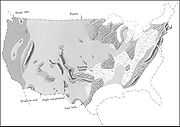 A mid-Carboniferous drop in sea level precipitated a major marine extinction, one that hit crinoids and ammonites especially hard. This sea level drop and the associated unconformity
in North America separate the Mississippian subperiod from the Pennsylvanian subperiod. This happened about 318 million years ago, at the onset of the Permo-Carboniferous Glaciation.
The Carboniferous was a time of active mountain-building
, as the supercontinent
Pangaea
came together. The southern continent
s remained tied together in the supercontinent Gondwana, which collided with North America–Europe (Laurussia) along the present line of eastern North America. This continental collision resulted in the Hercynian orogeny
in Europe, and the Alleghenian orogeny
in North America; it also extended the newly-uplifted Appalachians
southwestward as the Ouachita Mountains
. In the same time frame, much of present eastern Eurasian plate
welded itself to Europe along the line of the Ural mountains
. Most of the Mesozoic
supercontinent of Pangea was now assembled, although North China (which would collide in the Latest Carboniferous), and South China
continents were still separated from Laurasia
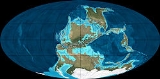
. The Late Carboniferous Pangaea was shaped like an "O."
There were two major oceans in the Carboniferous—Panthalassa
and Paleo-Tethys, which was inside the "O" in the Carboniferous Pangaea. Other minor oceans were shrinking and eventually closed - Rheic Ocean
(closed by the assembly of South
and North America
), the small, shallow Ural Ocean
(which was closed by the collision of Baltica
and Siberia continents, creating the Ural Mountains
) and Proto-Tethys Ocean
(closed by North China collision with Siberia
/Kazakhstania
).
cooled
. Glaciations in Gondwana
, triggered by Gondwana's southward movement, continued into the Permian
and because of the lack of clear markers and breaks, the deposits of this glacial period are often referred to as Permo-Carboniferous
in age.
The cooling and drying of the climate led to the Carboniferous Rainforest Collapse
(CRC). Tropical rainforests fragmented and then were eventually devastated by climate change.
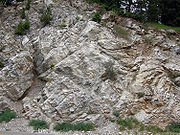 Carboniferous rocks in Europe and eastern North America largely consist of a repeated sequence of limestone
, sandstone
, shale
and coal
beds. In North America, the early Carboniferous is largely marine limestone, which accounts for the division of the Carboniferous into two periods in North American schemes. The Carboniferous coal beds provided much of the fuel for power generation during the Industrial Revolution
and are still of great economic importance.
The large coal deposits of the Carboniferous primarily owe their existence to two factors. The first of these is the appearance of bark
-bearing trees (and in particular the evolution
of the bark fiber lignin
). The second is the lower sea levels that occurred during the Carboniferous as compared to the Devonian
period. This allowed for the development of extensive lowland swamp
s and forest
s in North America and Europe. Some hypothesize that large quantities of wood
were buried during this period because animals and decomposing bacteria
had not yet evolved
that could effectively digest the new lignin. Those early plants made extensive use of lignin. They had bark to wood ratios of 8 to 1, and even as high as 20 to 1. This compares to modern values less than 1 to 4. This bark, which must have been used as support as well as protection, probably had 38% to 58% lignin. Lignin is insoluble, too large to pass through cell walls, too heterogeneous for specific enzymes, and toxic, so that few organisms other than Basidiomycetes fungi can degrade it. It can not be oxidized in an atmosphere of less than 5% oxygen. It can linger in soil for thousands of years and inhibits decay of other substances. Probably the reason for its high percentages is protection from insect herbivory in a world containing very effective insect herbivores, but nothing remotely as effective as modern insectivores and probably many fewer poisons than currently. In any case coal measures could easily have made thick deposits on well drained soils as well as swamps. The extensive burial of biologically-produced carbon
led to a buildup of surplus oxygen
in the atmosphere; estimates place the peak oxygen content as high as 35%, compared to 21% today.http://www.highbeam.com/library/docfree.asp?DOCID=1G1:16907261&ctrlInfo=Round20%3AMode20b%3ADocG%3AResult&ao= This oxygen level probably increased wildfire
activity, as well as resulted in insect
and amphibian
gigantism
--creatures whose size is constrained by respiratory
systems that are limited in their ability to diffuse oxygen.
In eastern North America, marine beds are more common in the older part of the period than the later part and are almost entirely absent by the late Carboniferous. More diverse geology existed elsewhere, of course. Marine life is especially rich in crinoids and other echinoderms. Brachiopods were abundant. Trilobite
s became quite uncommon. On land, large and diverse plant
populations existed. Land vertebrates included large amphibians.
, but new groups also appeared at this time.
The main Early Carboniferous plants were the Equisetales
(horse-tails), Sphenophyllales
(vine-like plants), Lycopodiales (club mosses), Lepidodendrales
(scale trees), Filicales (ferns), Medullosales
(informally included in the "seed ferns
", an artificial assemblage of a number of early gymnosperm
groups) and the Cordaitales
. These continued to dominate throughout the period, but during late Carboniferous
, several other groups, Cycadophyta (cycads), the Callistophytales
(another group of "seed ferns"), and the Voltziales
(related to and sometimes included under the conifers), appeared.
The Carboniferous lycophytes of the order Lepidodendrales, which are cousins (but not ancestors) of the tiny club-moss of today, were huge trees with trunks 30 meters high and up to 1.5 meters in diameter. These included Lepidodendron
(with its fruit cone called Lepidostrobus), Halonia, Lepidophloios and Sigillaria
. The roots of several of these forms are known as Stigmaria
. The Cladoxylopsids were large trees, that were ancestors of ferns, first arising in the Carboniferous.
The fronds of some Carboniferous ferns are almost identical with those of living species. Probably many species were epiphytic. Fossil ferns and "seed ferns" include Pecopteris
, Cyclopteris, Neuropteris
, Alethopteris
, and Sphenopteris; Megaphyton and Caulopteris were tree ferns.
The Equisetales included the common giant form Calamites
, with a trunk diameter of 30 to 60 cm (24 in) and a height of up to 20 m (66 ft). Sphenophyllum
was a slender climbing plant with whorls of leaves, which was probably related both to the calamites and the lycopods.
Cordaites
, a tall plant (6 to over 30 meters) with strap-like leaves, was related to the cycads and conifers; the catkin
-like inflorescence, which bore yew-like berries, is called Cardiocarpus. These plants were thought to live in swamps and mangroves. True coniferous trees (Walchia
, of the order Voltziales) appear later in the Carboniferous, and preferred higher drier ground.
, corals
, bryozoa
, brachiopod
s, ammonoids, hederelloids
, microconchids and echinoderm
s (especially crinoid
s).
For the first time foraminifera take a prominent part in the marine faunas. The large spindle-shaped genus Fusulina and its relatives were abundant in what is now Russia, China, Japan, North America; other important genera include Valvulina, Endothyra, Archaediscus, and Saccammina (the latter common in Britain and Belgium). Some Carboniferous genera are still extant.
The microscopic shells of radiolarians are found in chert
s of this age in the Culm
of Devon
and Cornwall
, and in Russia, Germany and elsewhere.
Sponges are known from spicule
s and anchor ropes, and include various forms such as the Calcispongea Cotyliscus and Girtycoelia, the demosponge
Chaetetes, and the genus of unusual colonial glass sponges Titusvillia
.
Both reef
-building and solitary corals diversify and flourish; these include both rugose
(for example, Canina
, Corwenia, Neozaphrentis), heterocorals, and tabulate (for example, Chladochonus, Michelinia) forms.
Conularids were well represented by Conularia
Bryozoa
are abundant in some regions; the fenestellids including Fenestella, Polypora, and the remarkable Archimedes
, so named because it is in the shape of an Archimedean screw.
Brachiopod
s are also abundant; they include productids, some of which (for example, Gigantoproductus
) reached very large (for brachiopods) size and had very thick shells, while others like Chonetes were more conservative in form. Athyridids, spiriferids
, rhynchonellids
, and terebratulids
are also very common. Inarticulate forms include Discina
and Crania. Some species and genera had a very wide distribution with only minor variations.
Annelid
s such as Serpulites are common fossils in some horizons.
Among the mollusca, the bivalves continue to increase in numbers and importance. Typical genera include Aviculopecten
, Posidonomya, Nucula
, Carbonicola
, Edmondia, and Modiola
Conocardium
is a common rostroconch
.
Gastropods are also numerous, including the genera Murchisonia, Euomphalus
, Naticopsis.
Nautiloid
cephalopod
s are represented by tightly coiled nautilids
, with straight-shelled and curved-shelled forms becoming increasingly rare. Goniatite
ammonoids are common.
Trilobite
s are rarer than in previous periods, represented only by the proetid group. Ostracod
s, a class of crustacean
zooplankton
, were abundant; genera included Cythere, Kirkbya, and Beyrichia.
Amongst the echinoderm
s, the crinoid
s were the most numerous. Dense submarine thickets of long-stemmed crinoids appear to have flourished in shallow seas, and their remains were consolidated into thick beds of rock. Prominent genera include Cyathocrinus, Woodocrinus, and Actinocrinus. Echinoids such as Archaeocidaris
and Palaeechinus were also present. The blastoid
s, which included the Pentreinitidae and Codasteridae and superficially resembled crinoids in the possession of long stalks attached to the seabed, attain their maximum development at this time.
; some, the petalodonts, had peculiar cycloid cutting teeth. Most of the sharks were marine, but the Xenacanthida
invaded fresh waters of the coal swamps. Among the bony fish
, the Palaeonisciformes
found in coastal waters also appear to have migrated to rivers. Sarcopterygia
n fish were also prominent, and one group, the Rhizodont
s, reached very large size.
Most species of Carboniferous marine fish have been described largely from teeth, fin spines and dermal ossicles, with smaller freshwater fish preserved whole.
Freshwater fish were abundant, and include the genera Ctenodus
, Uronemus, Acanthodes
, Cheirodus, and Gyracanthus
.
Shark
s (especially the Stethacanthids) underwent a major evolutionary radiation
during the Carboniferous. It is believed that this evolutionary radiation occurred because the decline of the placoderms
at the end of the Devonian period caused many environmental niches to become unoccupied and allowed new organisms to evolve and fill these niches. As a result of the evolutionary radiation carboniferous sharks assumed a wide variety of bizarre shapes including Stethacanthus
who possessed a flat brush-like dorsal fin with a patch of denticles on its top. Stethacanthus
unusual fin may have been used in mating rituals.
; diverse crustacean
s such as Bairdia, Carbonita, Estheria, Acanthocaris, Dithyrocaris, and Anthrapalaemon.
The Eurypterid
s were also diverse, and are represented by such genera as Eurypterus
, Glyptoscorpius, Anthraconectes, Megarachne
(originally misinterpreted as a giant spider) and the specialised very large Hibbertopterus
. Many of these were amphibious.
Frequently a temporary return of marine conditions resulted in marine or brackish water genera such as Lingula
, Orbiculoidea, and Productus being found in the thin beds known as marine bands.
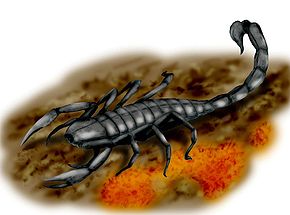 Fossil remains of air-breathing insect
s, myriapods and arachnid
s are known from the late Carboniferous, but so far not from the early Carboniferous. Their diversity when they do appear, however, shows that these arthropods were both well developed and numerous. Their large size can be attributed to the moistness of the environment (mostly swampy fern forests) and the fact that the oxygen concentration in the Earth's atmosphere in the Carboniferous was much higher than today.
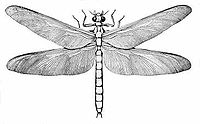
(The oxygen concentration in the Earth's atmosphere during the Carboniferous was 35% whereas the oxygen concentration in earth's current atmosphere is 21%.) This required less effort for respiration and allowed arthropods to grow larger with the up to 2.6 metres long millipede-like Arthropleura
being the largest known land invertebrate of all time. Among the insect groups are the huge predatory Protodonata
(griffinflies), among which was Meganeura
, a giant dragonfly
-like insect and with a wingspan of ca. 75 cm (30 in) — the largest flying insect ever to roam the planet. Further groups are the Syntonopterodea (relatives of present-day mayflies), the abundant and often large sap-sucking Palaeodictyopteroidea
, the diverse herbivorous Protorthoptera
, and numerous basal
Dictyoptera
(ancestors of cockroaches). Many insects have been obtained from the coalfields of Saarbrücken
and Commentry
, and from the hollow trunks of fossil trees in Nova Scotia. Some British coalfields have yielded good specimens: Archaeoptitus, from the Derbyshire coalfield, had a spread of wing extending to more than 35 cm; some specimens (Brodia) still exhibit traces of brilliant wing colors. In the Nova Scotian tree trunks land snails (Archaeozonites, Dendropupa) have been found.
s were diverse and common by the middle of the period, more so than they are today; some were as long as 6 meters, and those fully terrestrial as adults had scaly skin. They included a number of basal tetrapod groups classified in early books under the Labyrinthodontia. These had long bodies, a head covered with bony plates and generally weak or undeveloped limbs. The largest were over 2 meters long. They were accompanied by an assemblage of smaller amphibians included under the Lepospondyli
, often only about 15 cm (6 in) long. Some Carboniferous amphibians were aquatic and lived in rivers (Loxomma
, Eogyrinus
, Proterogyrinus
); others may have been semi-aquatic (Ophiderpeton
, Amphibamus
, Hyloplesion
) or terrestrial (Dendrerpeton, Tuditanus
, Anthracosaurus
).
The Carboniferous Rainforest Collapse
slowed the evolution of amphibians who could not survive as well in the cooler, drier conditions. Reptiles, however prospered due to specific key adaptations. One of the greatest evolutionary innovations of the Carboniferous was the amniote
egg, which allowed for the further exploitation of the land by certain tetrapod
s. These included the earliest sauropsid
reptiles (Hylonomus
), and the earliest known synapsid
(Archaeothyris
). These small lizard-like animals quickly gave rise to many descendants. The amniote egg allowed these ancestors of all later bird
s, mammal
s, and reptile
s to reproduce on land by preventing the desiccation, or drying-out, of the embryo
inside.
Reptiles underwent a major evolutionary radiation, in response to the drier climate that proceeded the rainforest collapse. By the end of the Carboniferous period, amniotes had already diversified into a number of groups, including protorothyridids
, captorhinids
, aeroscelid
s, and several families
of pelycosaur
s.
), land fungi diversified further. Marine fungi still occupied the oceans. All modern classes
of fungi were present in the Late Carboniferous (Pennsylvanian
Epoch).
after the American palaentologist Alfred Romer
. While it has long been debated whether the gap is an result of fossilisation or relates to an actual event, recent work indicate the gap period saw a drop in atmospheric oxygen levels, indication some sort of ecological collapse. The gap saw the demise of the Devonian
fish-like ichthyostegalian labyrinthodonts, and the rise of the more advanced temnospondyl
and reptiliomorpha
n amphibians that so typify the Carboniferous terrestrial vertebrate fauna.
occurred. On land this event is referred to as the Carboniferous Rainforest Collapse
(CRC). Vast tropical rainforests collapsed suddenly as the climate change
d from hot and humid to cool and arid. This was likely caused by intense glaciation and a drop in sea levels.
The new climatic conditions were not favorable to the growth of rainforest and the animals within them. Rainforests shrank into isolated islands, surrounded by seasonally dry habitats. Towering lycopsid forests with a heterogenus mixture of vegetation were replaced by much less diverse tree-fern dominated flora.
Amphibians, the dominant vertebrates at the time fared poorly through this event with large losses in biodiversity; reptiles continued to diversify due to key adaptations that let them survive in the drier habitat, specifically the hard-shelled egg and scales both of which retain water better than their amphibian counterparts.
Devonian
The Devonian is a geologic period and system of the Paleozoic Era spanning from the end of the Silurian Period, about 416.0 ± 2.8 Mya , to the beginning of the Carboniferous Period, about 359.2 ± 2.5 Mya...
Period, about 359.2 ± 2.5 Mya (million years ago), to the beginning of the Permian
Permian
The PermianThe term "Permian" was introduced into geology in 1841 by Sir Sir R. I. Murchison, president of the Geological Society of London, who identified typical strata in extensive Russian explorations undertaken with Edouard de Verneuil; Murchison asserted in 1841 that he named his "Permian...
Period, about 299.0 ± 0.8 Mya . The name is derived from the Latin word for coal, carbo. Carboniferous means "coal-bearing". Many coal beds containing coal ball
Coal ball
Coal balls, despite their name, are calcium-rich masses of permineralised life forms, generally having a round shape. Coal balls were formed roughly , during the Carboniferous Period...
s were laid down globally during this time, hence the name. The Carboniferous is often treated in North America as two geological periods, the earlier Mississippian and the later Pennsylvanian
Pennsylvanian
The Pennsylvanian is, in the ICS geologic timescale, the younger of two subperiods of the Carboniferous Period. It lasted from roughly . As with most other geochronologic units, the rock beds that define the Pennsylvanian are well identified, but the exact date of the start and end are uncertain...
.
Terrestrial life was already well established by the Carboniferous period. Amphibians were the dominant land vertebrates, of which one branch would eventually evolve into reptile
Reptile
Reptiles are members of a class of air-breathing, ectothermic vertebrates which are characterized by laying shelled eggs , and having skin covered in scales and/or scutes. They are tetrapods, either having four limbs or being descended from four-limbed ancestors...
s, the first fully terrestrial vertebrates. Arthropods were also very common, and many (such as Meganeura
Meganeura
Meganeura is a genus of extinct insects from the Carboniferous period approximately 300 million years ago, which resembled and are related to the present-day dragonflies. With wingspans of more than 75 cm , M. monyi is one of the largest known flying insect species; the Permian Meganeuropsis...
), were much larger than those of today. Vast swathes of forest covered the land, which would be laid down and eventually become the coal beds characteristic of the Carboniferous system. A minor marine and terrestrial extinction event
Carboniferous Rainforest Collapse
The Carboniferous Rainforest Collapse was an extinction event that occurred around 305 million years ago in the Carboniferous period). Vast coal forests covered the equatorial region of Euramerica...
occurred in the middle of the period, caused by climate change. The Carboniferous also experienced periods of glaciation, a low sea level, and mountain building.
Subdivisions
In the USA the Carboniferous is usually broken into Mississippian (earlier) and PennsylvanianPennsylvanian
The Pennsylvanian is, in the ICS geologic timescale, the younger of two subperiods of the Carboniferous Period. It lasted from roughly . As with most other geochronologic units, the rock beds that define the Pennsylvanian are well identified, but the exact date of the start and end are uncertain...
(later) Periods. The Mississippian is about twice as long as the Pennsylvanian, but due to the large thickness of coal bearing deposits with Pennsylvanian ages in Europe and North America, the two subperiods were long thought to have been more or less equal. The faunal stages from youngest to oldest, together with some of their subdivisions, are:
Late Pennsylvanian: Gzhelian (most recent)
- Noginskian / Virgilian (part)
Late Pennsylvanian: Kasimovian
- Klazminskian
- Dorogomilovksian / Virgilian (part)
- Chamovnicheskian / Cantabrian / Missourian
- Krevyakinskian / Cantabrian / Missourian
Middle Pennsylvanian: Moscovian
- Myachkovskian / Bolsovian / Desmoinesian
- Podolskian / Desmoinesian
- Kashirskian / Atokan
- Vereiskian / Bolsovian / Atokan
Early Pennsylvanian: Bashkirian / Morrowan
- Melekesskian / Duckmantian
- Cheremshanskian / Langsettian
- Yeadonian
- Marsdenian
- Kinderscoutian
Late Mississippian: Serpukhovian
- Alportian
- Chokierian / Chesterian / Elvirian
- Arnsbergian / Elvirian
- Pendleian
Middle Mississippian: Visean
- Brigantian / St Genevieve / Gasperian / Chesterian
- Asbian / Meramecian
- Holkerian / Salem
- Arundian / Warsaw / Meramecian
- Chadian / Keokuk / Osagean (part) / Osage (part)
Early Mississippian: Tournaisian (oldest)
- Ivorian / (part) / Osage (part)
- Hastarian / Kinderhookian / Chouteau
Paleogeography
A global drop in sea levelSea level
Mean sea level is a measure of the average height of the ocean's surface ; used as a standard in reckoning land elevation...
at the end of the Devonian
Devonian
The Devonian is a geologic period and system of the Paleozoic Era spanning from the end of the Silurian Period, about 416.0 ± 2.8 Mya , to the beginning of the Carboniferous Period, about 359.2 ± 2.5 Mya...
reversed early in the Carboniferous; this created the widespread epicontinental seas and carbonate
Carbonate
In chemistry, a carbonate is a salt of carbonic acid, characterized by the presence of the carbonate ion, . The name may also mean an ester of carbonic acid, an organic compound containing the carbonate group C2....
deposition of the Mississippian. There was also a drop in south polar temperatures; southern Gondwana
Gondwana
In paleogeography, Gondwana , originally Gondwanaland, was the southernmost of two supercontinents that later became parts of the Pangaea supercontinent. It existed from approximately 510 to 180 million years ago . Gondwana is believed to have sutured between ca. 570 and 510 Mya,...
land was glaciated throughout the period, though it is uncertain if the ice sheets were a holdover from the Devonian or not. These conditions apparently had little effect in the deep tropics, where lush coal swamps flourished within 30 degrees of the northernmost glaciers.
Unconformity
An unconformity is a buried erosion surface separating two rock masses or strata of different ages, indicating that sediment deposition was not continuous. In general, the older layer was exposed to erosion for an interval of time before deposition of the younger, but the term is used to describe...
in North America separate the Mississippian subperiod from the Pennsylvanian subperiod. This happened about 318 million years ago, at the onset of the Permo-Carboniferous Glaciation.
The Carboniferous was a time of active mountain-building
Orogeny
Orogeny refers to forces and events leading to a severe structural deformation of the Earth's crust due to the engagement of tectonic plates. Response to such engagement results in the formation of long tracts of highly deformed rock called orogens or orogenic belts...
, as the supercontinent
Supercontinent
In geology, a supercontinent is a landmass comprising more than one continental core, or craton. The assembly of cratons and accreted terranes that form Eurasia qualifies as a supercontinent today.-History:...
Pangaea
Pangaea
Pangaea, Pangæa, or Pangea is hypothesized as a supercontinent that existed during the Paleozoic and Mesozoic eras about 250 million years ago, before the component continents were separated into their current configuration....
came together. The southern continent
Continent
A continent is one of several very large landmasses on Earth. They are generally identified by convention rather than any strict criteria, with seven regions commonly regarded as continents—they are : Asia, Africa, North America, South America, Antarctica, Europe, and Australia.Plate tectonics is...
s remained tied together in the supercontinent Gondwana, which collided with North America–Europe (Laurussia) along the present line of eastern North America. This continental collision resulted in the Hercynian orogeny
Variscan orogeny
The Variscan orogeny is a geologic mountain-building event caused by Late Paleozoic continental collision between Euramerica and Gondwana to form the supercontinent of Pangaea.-Naming:...
in Europe, and the Alleghenian orogeny
Alleghenian orogeny
The Alleghenian orogeny or Appalachian orogeny is one of the geological mountain-forming events that formed the Appalachian Mountains and Allegheny Mountains. The term and spelling Alleghany orogeny was originally proposed by H.P. Woodward in 1957....
in North America; it also extended the newly-uplifted Appalachians
Appalachian Mountains
The Appalachian Mountains #Whether the stressed vowel is or ,#Whether the "ch" is pronounced as a fricative or an affricate , and#Whether the final vowel is the monophthong or the diphthong .), often called the Appalachians, are a system of mountains in eastern North America. The Appalachians...
southwestward as the Ouachita Mountains
Ouachita Mountains
The Ouachita Mountains are a mountain range in west central Arkansas and southeastern Oklahoma. The range's subterranean roots may extend as far as central Texas, or beyond it to the current location of the Marathon Uplift. Along with the Ozark Mountains, the Ouachita Mountains form the U.S...
. In the same time frame, much of present eastern Eurasian plate
Eurasian Plate
The Eurasian Plate is a tectonic plate which includes most of the continent of Eurasia , with the notable exceptions of the Indian subcontinent, the Arabian subcontinent, and the area east of the Chersky Range in East Siberia...
welded itself to Europe along the line of the Ural mountains
Ural Mountains
The Ural Mountains , or simply the Urals, are a mountain range that runs approximately from north to south through western Russia, from the coast of the Arctic Ocean to the Ural River and northwestern Kazakhstan. Their eastern side is usually considered the natural boundary between Europe and Asia...
. Most of the Mesozoic
Mesozoic
The Mesozoic era is an interval of geological time from about 250 million years ago to about 65 million years ago. It is often referred to as the age of reptiles because reptiles, namely dinosaurs, were the dominant terrestrial and marine vertebrates of the time...
supercontinent of Pangea was now assembled, although North China (which would collide in the Latest Carboniferous), and South China
South China (continent)
South China continent, also known as South China craton, South Chinese craton, or Yangtze craton, was an ancient continent that contained today's South and Southeast China , Indochina, and parts of Southeast Asia...
continents were still separated from Laurasia
Laurasia
In paleogeography, Laurasia was the northernmost of two supercontinents that formed part of the Pangaea supercontinent from approximately...
. The Late Carboniferous Pangaea was shaped like an "O."
There were two major oceans in the Carboniferous—Panthalassa
Panthalassa
Panthalassa , also known as the Panthalassic Ocean, was the vast global ocean that surrounded the supercontinent Pangaea, during the late Paleozoic and the early Mesozoic years. It included the Pacific Ocean to the west and north and the Tethys Ocean to the southeast...
and Paleo-Tethys, which was inside the "O" in the Carboniferous Pangaea. Other minor oceans were shrinking and eventually closed - Rheic Ocean
Rheic Ocean
The Rheic Ocean was a Paleozoic ocean between the large continent Gondwana to the south and the microcontinents Avalonia and others to the north...
(closed by the assembly of South
South America
South America is a continent situated in the Western Hemisphere, mostly in the Southern Hemisphere, with a relatively small portion in the Northern Hemisphere. The continent is also considered a subcontinent of the Americas. It is bordered on the west by the Pacific Ocean and on the north and east...
and North America
North America
North America is a continent wholly within the Northern Hemisphere and almost wholly within the Western Hemisphere. It is also considered a northern subcontinent of the Americas...
), the small, shallow Ural Ocean
Ural Ocean
The Ural Ocean was a small, ancient ocean that was situated between Siberia and Baltica. The ocean formed in the Late Ordovician epoch, when large islands from Siberia collided with Baltica, which was now part of a minor supercontinent of Euramerica. The islands also caused Ural Ocean's precursor,...
(which was closed by the collision of Baltica
Baltica
Baltica is a name applied by geologists to a late-Proterozoic, early-Palaeozoic continent that now includes the East European craton of northwestern Eurasia. Baltica was created as an entity not earlier than 1.8 billion years ago. Before this time, the three segments/continents that now comprise...
and Siberia continents, creating the Ural Mountains
Ural Mountains
The Ural Mountains , or simply the Urals, are a mountain range that runs approximately from north to south through western Russia, from the coast of the Arctic Ocean to the Ural River and northwestern Kazakhstan. Their eastern side is usually considered the natural boundary between Europe and Asia...
) and Proto-Tethys Ocean
Proto-Tethys Ocean
The Proto-Tethys Ocean was an ancient ocean that existed from the latest Ediacaran to the Carboniferous . It was an ocean predecessor of the later Paleo-Tethys Ocean. The ocean formed when Pannotia disintegrated, Proto-Laurasia rifted away from a supercontinent that would become Gondwana...
(closed by North China collision with Siberia
Siberia (continent)
Siberia is the craton located in the heart of the region of Siberia. Siberia or "Angaraland" is today the Central Siberian Plateau...
/Kazakhstania
Kazakhstania
Kazakhstania, also known as the Kazakhstan Block, is a small continental region in the interior of Asia. It consists of that area north and east of the Aral Sea, south of the Siberian craton and west of the Altai Mountains and Lake Balkhash. Politically, it comprises most of Kazakhstan and has a...
).
Climate
The early part of the Carboniferous was mostly warm; in the later part of the Carboniferous, the climateClimate
Climate encompasses the statistics of temperature, humidity, atmospheric pressure, wind, rainfall, atmospheric particle count and other meteorological elemental measurements in a given region over long periods...
cooled
Global cooling
Global cooling was a conjecture during the 1970s of imminent cooling of the Earth's surface and atmosphere along with a posited commencement of glaciation...
. Glaciations in Gondwana
Gondwana
In paleogeography, Gondwana , originally Gondwanaland, was the southernmost of two supercontinents that later became parts of the Pangaea supercontinent. It existed from approximately 510 to 180 million years ago . Gondwana is believed to have sutured between ca. 570 and 510 Mya,...
, triggered by Gondwana's southward movement, continued into the Permian
Permian
The PermianThe term "Permian" was introduced into geology in 1841 by Sir Sir R. I. Murchison, president of the Geological Society of London, who identified typical strata in extensive Russian explorations undertaken with Edouard de Verneuil; Murchison asserted in 1841 that he named his "Permian...
and because of the lack of clear markers and breaks, the deposits of this glacial period are often referred to as Permo-Carboniferous
Permo-Carboniferous
The Permo-Carboniferous refers to the time period including the latter parts of the Carboniferous and early part of the Permian period. Permo-Carboniferous rocks are in places not differentiated because of the presence of transitional fossils, and also where no conspicuous stratigraphic break is...
in age.
The cooling and drying of the climate led to the Carboniferous Rainforest Collapse
Carboniferous Rainforest Collapse
The Carboniferous Rainforest Collapse was an extinction event that occurred around 305 million years ago in the Carboniferous period). Vast coal forests covered the equatorial region of Euramerica...
(CRC). Tropical rainforests fragmented and then were eventually devastated by climate change.
Rocks and coal
Limestone
Limestone is a sedimentary rock composed largely of the minerals calcite and aragonite, which are different crystal forms of calcium carbonate . Many limestones are composed from skeletal fragments of marine organisms such as coral or foraminifera....
, sandstone
Sandstone
Sandstone is a sedimentary rock composed mainly of sand-sized minerals or rock grains.Most sandstone is composed of quartz and/or feldspar because these are the most common minerals in the Earth's crust. Like sand, sandstone may be any colour, but the most common colours are tan, brown, yellow,...
, shale
Shale
Shale is a fine-grained, clastic sedimentary rock composed of mud that is a mix of flakes of clay minerals and tiny fragments of other minerals, especially quartz and calcite. The ratio of clay to other minerals is variable. Shale is characterized by breaks along thin laminae or parallel layering...
and coal
Coal
Coal is a combustible black or brownish-black sedimentary rock usually occurring in rock strata in layers or veins called coal beds or coal seams. The harder forms, such as anthracite coal, can be regarded as metamorphic rock because of later exposure to elevated temperature and pressure...
beds. In North America, the early Carboniferous is largely marine limestone, which accounts for the division of the Carboniferous into two periods in North American schemes. The Carboniferous coal beds provided much of the fuel for power generation during the Industrial Revolution
Industrial Revolution
The Industrial Revolution was a period from the 18th to the 19th century where major changes in agriculture, manufacturing, mining, transportation, and technology had a profound effect on the social, economic and cultural conditions of the times...
and are still of great economic importance.
The large coal deposits of the Carboniferous primarily owe their existence to two factors. The first of these is the appearance of bark
Bark
Bark is the outermost layers of stems and roots of woody plants. Plants with bark include trees, woody vines and shrubs. Bark refers to all the tissues outside of the vascular cambium and is a nontechnical term. It overlays the wood and consists of the inner bark and the outer bark. The inner...
-bearing trees (and in particular the evolution
Evolution
Evolution is any change across successive generations in the heritable characteristics of biological populations. Evolutionary processes give rise to diversity at every level of biological organisation, including species, individual organisms and molecules such as DNA and proteins.Life on Earth...
of the bark fiber lignin
Lignin
Lignin or lignen is a complex chemical compound most commonly derived from wood, and an integral part of the secondary cell walls of plants and some algae. The term was introduced in 1819 by de Candolle and is derived from the Latin word lignum, meaning wood...
). The second is the lower sea levels that occurred during the Carboniferous as compared to the Devonian
Devonian
The Devonian is a geologic period and system of the Paleozoic Era spanning from the end of the Silurian Period, about 416.0 ± 2.8 Mya , to the beginning of the Carboniferous Period, about 359.2 ± 2.5 Mya...
period. This allowed for the development of extensive lowland swamp
Swamp
A swamp is a wetland with some flooding of large areas of land by shallow bodies of water. A swamp generally has a large number of hammocks, or dry-land protrusions, covered by aquatic vegetation, or vegetation that tolerates periodical inundation. The two main types of swamp are "true" or swamp...
s and forest
Forest
A forest, also referred to as a wood or the woods, is an area with a high density of trees. As with cities, depending where you are in the world, what is considered a forest may vary significantly in size and have various classification according to how and what of the forest is composed...
s in North America and Europe. Some hypothesize that large quantities of wood
Wood
Wood is a hard, fibrous tissue found in many trees. It has been used for hundreds of thousands of years for both fuel and as a construction material. It is an organic material, a natural composite of cellulose fibers embedded in a matrix of lignin which resists compression...
were buried during this period because animals and decomposing bacteria
Bacteria
Bacteria are a large domain of prokaryotic microorganisms. Typically a few micrometres in length, bacteria have a wide range of shapes, ranging from spheres to rods and spirals...
had not yet evolved
Evolution
Evolution is any change across successive generations in the heritable characteristics of biological populations. Evolutionary processes give rise to diversity at every level of biological organisation, including species, individual organisms and molecules such as DNA and proteins.Life on Earth...
that could effectively digest the new lignin. Those early plants made extensive use of lignin. They had bark to wood ratios of 8 to 1, and even as high as 20 to 1. This compares to modern values less than 1 to 4. This bark, which must have been used as support as well as protection, probably had 38% to 58% lignin. Lignin is insoluble, too large to pass through cell walls, too heterogeneous for specific enzymes, and toxic, so that few organisms other than Basidiomycetes fungi can degrade it. It can not be oxidized in an atmosphere of less than 5% oxygen. It can linger in soil for thousands of years and inhibits decay of other substances. Probably the reason for its high percentages is protection from insect herbivory in a world containing very effective insect herbivores, but nothing remotely as effective as modern insectivores and probably many fewer poisons than currently. In any case coal measures could easily have made thick deposits on well drained soils as well as swamps. The extensive burial of biologically-produced carbon
Carbon
Carbon is the chemical element with symbol C and atomic number 6. As a member of group 14 on the periodic table, it is nonmetallic and tetravalent—making four electrons available to form covalent chemical bonds...
led to a buildup of surplus oxygen
Oxygen
Oxygen is the element with atomic number 8 and represented by the symbol O. Its name derives from the Greek roots ὀξύς and -γενής , because at the time of naming, it was mistakenly thought that all acids required oxygen in their composition...
in the atmosphere; estimates place the peak oxygen content as high as 35%, compared to 21% today.http://www.highbeam.com/library/docfree.asp?DOCID=1G1:16907261&ctrlInfo=Round20%3AMode20b%3ADocG%3AResult&ao= This oxygen level probably increased wildfire
Wildfire
A wildfire is any uncontrolled fire in combustible vegetation that occurs in the countryside or a wilderness area. Other names such as brush fire, bushfire, forest fire, desert fire, grass fire, hill fire, squirrel fire, vegetation fire, veldfire, and wilkjjofire may be used to describe the same...
activity, as well as resulted in insect
Insect
Insects are a class of living creatures within the arthropods that have a chitinous exoskeleton, a three-part body , three pairs of jointed legs, compound eyes, and two antennae...
and amphibian
Amphibian
Amphibians , are a class of vertebrate animals including animals such as toads, frogs, caecilians, and salamanders. They are characterized as non-amniote ectothermic tetrapods...
gigantism
Gigantism
Gigantism, also known as giantism , is a condition characterized by excessive growth and height significantly above average...
--creatures whose size is constrained by respiratory
Respiration (physiology)
'In physiology, respiration is defined as the transport of oxygen from the outside air to the cells within tissues, and the transport of carbon dioxide in the opposite direction...
systems that are limited in their ability to diffuse oxygen.
In eastern North America, marine beds are more common in the older part of the period than the later part and are almost entirely absent by the late Carboniferous. More diverse geology existed elsewhere, of course. Marine life is especially rich in crinoids and other echinoderms. Brachiopods were abundant. Trilobite
Trilobite
Trilobites are a well-known fossil group of extinct marine arthropods that form the class Trilobita. The first appearance of trilobites in the fossil record defines the base of the Atdabanian stage of the Early Cambrian period , and they flourished throughout the lower Paleozoic era before...
s became quite uncommon. On land, large and diverse plant
Plant
Plants are living organisms belonging to the kingdom Plantae. Precise definitions of the kingdom vary, but as the term is used here, plants include familiar organisms such as trees, flowers, herbs, bushes, grasses, vines, ferns, mosses, and green algae. The group is also called green plants or...
populations existed. Land vertebrates included large amphibians.
Plants
Early Carboniferous land plants were very similar to those of the preceding Late DevonianDevonian
The Devonian is a geologic period and system of the Paleozoic Era spanning from the end of the Silurian Period, about 416.0 ± 2.8 Mya , to the beginning of the Carboniferous Period, about 359.2 ± 2.5 Mya...
, but new groups also appeared at this time.
The main Early Carboniferous plants were the Equisetales
Equisetales
The Equisetales is an order of pteridophytes with only one living genus Equisetum , of the family Equisetaceae. The fossil record includes additional extinct species in the Equisetaceae and the extinct families Calamitaceae and Archaeocalamitaceae....
(horse-tails), Sphenophyllales
Sphenophyllum
Sphenophyllum is a genus in the order Sphenophyllales....
(vine-like plants), Lycopodiales (club mosses), Lepidodendrales
Lepidodendrales
Lepidodendrales were primitive, vascular, arborescent plants related to the lycopsids . They thrived during the Carboniferous period, and some reached heights of over 30 meters, with trunks often more than one meter in diameter...
(scale trees), Filicales (ferns), Medullosales
Medullosales
The Medullosales is an order of pteridospermous seed plants characterised by large radiospermic ovules with a vascularised nucellus, complex pollen-organs, stems and rachises with a dissected stele, and frond-like leaves. Their nearest still-living relatives are probably the cycads.Most...
(informally included in the "seed ferns
Pteridospermatophyta
The term Pteridospermatophyta refers to several distinct groups of extinct seed-bearing plants . The oldest fossil evidence of plants of this type is of late Devonian age, and they flourished particularly during the Carboniferous and Permian periods...
", an artificial assemblage of a number of early gymnosperm
Gymnosperm
The gymnosperms are a group of seed-bearing plants that includes conifers, cycads, Ginkgo, and Gnetales. The term "gymnosperm" comes from the Greek word gymnospermos , meaning "naked seeds", after the unenclosed condition of their seeds...
groups) and the Cordaitales
Cordaitales
Cordaitales is an extinct order of primitive conifers....
. These continued to dominate throughout the period, but during late Carboniferous
Pennsylvanian
The Pennsylvanian is, in the ICS geologic timescale, the younger of two subperiods of the Carboniferous Period. It lasted from roughly . As with most other geochronologic units, the rock beds that define the Pennsylvanian are well identified, but the exact date of the start and end are uncertain...
, several other groups, Cycadophyta (cycads), the Callistophytales
Callistophytales
The Callistophytales was an order of mainly scrambling and lianescent plants found in the wetland "coal swamps" of Euramerica and Cathaysia. They were characterised by having bilaterally-symmetrical, non-cupulate ovules attached to the underside of pinnules that were morphologically similar to the...
(another group of "seed ferns"), and the Voltziales
Voltziales
Voltziales is an extinct order related to modern conifers....
(related to and sometimes included under the conifers), appeared.
The Carboniferous lycophytes of the order Lepidodendrales, which are cousins (but not ancestors) of the tiny club-moss of today, were huge trees with trunks 30 meters high and up to 1.5 meters in diameter. These included Lepidodendron
Lepidodendron
Lepidodendron is an extinct genus of primitive, vascular, arborescent plant related to the Lycopsids . It was part of the coal forest flora. They sometimes reached heights of over , and the trunks were often over in diameter, and thrived during the Carboniferous period...
(with its fruit cone called Lepidostrobus), Halonia, Lepidophloios and Sigillaria
Sigillaria
Sigillaria is a genus of extinct, spore-bearing, arborescent plants which flourished in the Late Carboniferous period but dwindled to extinction in the early Permian period. It was a lycopodiophyte, and is related to the lycopsids, or club-mosses, but even more closely to quillworts, as was its...
. The roots of several of these forms are known as Stigmaria
Stigmaria
Stigmaria are a type of branching tree root fossil found in Carboniferous rocks. They were the roots of coal forest lycopsid trees such as Sigillaria and Lepidodendron. Each trunk tended to have four of those roots. Stigmaria is a form taxon, as the genus and species of the plant bearing the root...
. The Cladoxylopsids were large trees, that were ancestors of ferns, first arising in the Carboniferous.
The fronds of some Carboniferous ferns are almost identical with those of living species. Probably many species were epiphytic. Fossil ferns and "seed ferns" include Pecopteris
Pecopteris
Pecopteris was a form genus of leaves from several unrelated plant groups that flourished the early Carboniferous period and on to c. 250 Ma. Pecopteris first appeared in the Devonian period, but flourished in the Carboniferous, especially the Pennsylvanian...
, Cyclopteris, Neuropteris
Neuropteris
Neuropteris is an extinct seed fern that existed in the Carboniferous period, known only from fossils.Major species include Neuropteris loschi....
, Alethopteris
Alethopteris
Alethopteris is an genus of fossil seed ferns that existed in the Carboniferous period ....
, and Sphenopteris; Megaphyton and Caulopteris were tree ferns.
The Equisetales included the common giant form Calamites
Calamites
Calamites is a genus of extinct arborescent horsetails to which the modern horsetails are closely related. Unlike their herbaceous modern cousins, these plants were medium-sized trees, growing to heights of more than 30 meters...
, with a trunk diameter of 30 to 60 cm (24 in) and a height of up to 20 m (66 ft). Sphenophyllum
Sphenophyllum
Sphenophyllum is a genus in the order Sphenophyllales....
was a slender climbing plant with whorls of leaves, which was probably related both to the calamites and the lycopods.
Cordaites
Cordaites
Cordaites is an important genus of extinct gymnosperms which grew on wet ground similar to the Everglades in Florida. Brackish water mussels and crustacea are found frequently between the roots of these trees. The fossils are found in rock sections from the Upper Carboniferous of the Dutch -...
, a tall plant (6 to over 30 meters) with strap-like leaves, was related to the cycads and conifers; the catkin
Catkin
A catkin or ament is a slim, cylindrical flower cluster, with inconspicuous or no petals, usually wind-pollinated but sometimes insect pollinated . They contain many, usually unisexual flowers, arranged closely along a central stem which is often drooping...
-like inflorescence, which bore yew-like berries, is called Cardiocarpus. These plants were thought to live in swamps and mangroves. True coniferous trees (Walchia
Walchia
Walchia is a fossil conifer, cypress-like genus of Upper Pennsylvanian and lower Permian . It is found in Europe; also North America...
, of the order Voltziales) appear later in the Carboniferous, and preferred higher drier ground.
Marine invertebrates
In the oceans the most important marine invertebrate groups are the foraminiferaForaminifera
The Foraminifera , or forams for short, are a large group of amoeboid protists which are among the commonest plankton species. They have reticulating pseudopods, fine strands of cytoplasm that branch and merge to form a dynamic net...
, corals
Anthozoa
Anthozoa is a class within the phylum Cnidaria that contains the sea anemones and corals. Unlike other cnidarians, anthozoans do not have a medusa stage in their development. Instead, they release sperm and eggs that form a planula, which attaches to some substrate on which the cnidarian grows...
, bryozoa
Bryozoa
The Bryozoa, also known as Ectoprocta or commonly as moss animals, are a phylum of aquatic invertebrate animals. Typically about long, they are filter feeders that sieve food particles out of the water using a retractable lophophore, a "crown" of tentacles lined with cilia...
, brachiopod
Brachiopod
Brachiopods are a phylum of marine animals that have hard "valves" on the upper and lower surfaces, unlike the left and right arrangement in bivalve molluscs. Brachiopod valves are hinged at the rear end, while the front can be opened for feeding or closed for protection...
s, ammonoids, hederelloids
Hederellid
Hederellids are extinct colonial animals with calcitic tubular branching exoskeletons. They range from the Silurian to the Permian and were most common in the Devonian period. They are more properly known as "hederelloids" because they were originally defined as a suborder by Bassler , who...
, microconchids and echinoderm
Echinoderm
Echinoderms are a phylum of marine animals. Echinoderms are found at every ocean depth, from the intertidal zone to the abyssal zone....
s (especially crinoid
Crinoid
Crinoids are marine animals that make up the class Crinoidea of the echinoderms . Crinoidea comes from the Greek word krinon, "a lily", and eidos, "form". They live both in shallow water and in depths as great as 6,000 meters. Sea lilies refer to the crinoids which, in their adult form, are...
s).
For the first time foraminifera take a prominent part in the marine faunas. The large spindle-shaped genus Fusulina and its relatives were abundant in what is now Russia, China, Japan, North America; other important genera include Valvulina, Endothyra, Archaediscus, and Saccammina (the latter common in Britain and Belgium). Some Carboniferous genera are still extant.
The microscopic shells of radiolarians are found in chert
Chert
Chert is a fine-grained silica-rich microcrystalline, cryptocrystalline or microfibrous sedimentary rock that may contain small fossils. It varies greatly in color , but most often manifests as gray, brown, grayish brown and light green to rusty red; its color is an expression of trace elements...
s of this age in the Culm
River Culm
thumb|Old stone bridge with pedestrian refuges over River Culm at Culmstock The River Culm flows through Devon, England. It rises in the Blackdown Hills at a spring - - near Culmhead and flows west through Hemyock, then Culmstock to Uffculme...
of Devon
Devon
Devon is a large county in southwestern England. The county is sometimes referred to as Devonshire, although the term is rarely used inside the county itself as the county has never been officially "shired", it often indicates a traditional or historical context.The county shares borders with...
and Cornwall
Cornwall
Cornwall is a unitary authority and ceremonial county of England, within the United Kingdom. It is bordered to the north and west by the Celtic Sea, to the south by the English Channel, and to the east by the county of Devon, over the River Tamar. Cornwall has a population of , and covers an area of...
, and in Russia, Germany and elsewhere.
Sponges are known from spicule
Spicule
Spicules are tiny spike-like structures of diverse origin and function found in many organisms, such as the copulatory spicules of certain nematodes or the grains on the skin of some frogs.In sponges, spicules perform a structural function....
s and anchor ropes, and include various forms such as the Calcispongea Cotyliscus and Girtycoelia, the demosponge
Demosponge
The Demospongiae are the largest class in the phylum Porifera. Their "skeletons" are made of spicules consisting of fibers of the protein spongin, the mineral silica, or both. Where spicules of silica are present, they have a different shape from those in the otherwise similar glass sponges...
Chaetetes, and the genus of unusual colonial glass sponges Titusvillia
Titusvillia
Titusvillia was a genus of colonial glass sponges that existed during the carboniferous period around 300 million years ago....
.
Both reef
Reef
In nautical terminology, a reef is a rock, sandbar, or other feature lying beneath the surface of the water ....
-building and solitary corals diversify and flourish; these include both rugose
Rugosa
Disambiguation:The Rugosa Rose is also sometimes just called "Rugosa". For the moon in Star Wars: The Clone Wars, see .The Rugosa, also called the Tetracoralla, are an extinct order of coral that were abundant in Middle Ordovician to Late Permian seas.Solitary rugosans are often referred to...
(for example, Canina
Canina
canina, canine in Latin, may refer to :* Luigi Canina , an Italian archaeologist and architect* Uva Canina, a red Italian wine grape grown through Central Italy but is most noted in Tuscany* Canina, another name for the French wine grape Tourbat...
, Corwenia, Neozaphrentis), heterocorals, and tabulate (for example, Chladochonus, Michelinia) forms.
Conularids were well represented by Conularia
Bryozoa
Bryozoa
The Bryozoa, also known as Ectoprocta or commonly as moss animals, are a phylum of aquatic invertebrate animals. Typically about long, they are filter feeders that sieve food particles out of the water using a retractable lophophore, a "crown" of tentacles lined with cilia...
are abundant in some regions; the fenestellids including Fenestella, Polypora, and the remarkable Archimedes
Archimedes (bryozoan)
Archimedes, named for the Archimedes Screw, is a genus of Bryozoan known in the rock record from the Carboniferous to the Permian periods, when it became extinct. The majority of these fossils are distributed throughout Europe and North America...
, so named because it is in the shape of an Archimedean screw.
Brachiopod
Brachiopod
Brachiopods are a phylum of marine animals that have hard "valves" on the upper and lower surfaces, unlike the left and right arrangement in bivalve molluscs. Brachiopod valves are hinged at the rear end, while the front can be opened for feeding or closed for protection...
s are also abundant; they include productids, some of which (for example, Gigantoproductus
Gigantoproductus
Gigantoproductus is a genus in the family Gigantoproductidae. The species were the largest of the carboniferous brachiopods. As fossils, their shells occur within a limestone matrix.-External links:...
) reached very large (for brachiopods) size and had very thick shells, while others like Chonetes were more conservative in form. Athyridids, spiriferids
Spiriferida
Spiriferida is an order of extinct articulate brachiopod fossils which are known for their long hinge-line, which is often the widest part of the shell. In some genera it is greatly elongated, giving them a wing-like appearance. They often have a deep fold down the center of the shell...
, rhynchonellids
Rhynchonellida
The taxonomic order Rhynchonellida is one of the two main groups of living articulate brachiopods, the other being the order Terebratulida. They are recognized by their strongly ribbed wedge-shaped or nut-like shells, and the very short hinge line....
, and terebratulids
Terebratulida
Terebratulids are one of only three living orders of articulate brachiopods, the others being the Rhynchonellida and the Thecideida. Craniida and Lingulida include living brachiopods, but are inarticulates. The name, Terebratula, may be derived from the Latin "terebra", meaning "hole-borer"...
are also very common. Inarticulate forms include Discina
Discina (brachiopod)
Discina is a brachiopod genus in the family Discinidae. It is an inarticulate form present in the Carboniferous....
and Crania. Some species and genera had a very wide distribution with only minor variations.
Annelid
Annelid
The annelids , formally called Annelida , are a large phylum of segmented worms, with over 17,000 modern species including ragworms, earthworms and leeches...
s such as Serpulites are common fossils in some horizons.
Among the mollusca, the bivalves continue to increase in numbers and importance. Typical genera include Aviculopecten
Aviculopecten
Aviculopecten is an extinct genus of bivalve mollusc that lived from the Early Devonian to the Late Triassic in Asia, Australia, Europe, North America, and South America.-External links:* in the Paleobiology Database...
, Posidonomya, Nucula
Nucula
Nucula is a genus of clams of the family Nuculidae.-Species:* Nucula aegeensis Jeffreys, 1879 - Aegean nutclam* Nucula annulata Hampson, 1971 * Nucula atacellana Schenck, 1939 - cancellate nutclam...
, Carbonicola
Carbonicola
Carbonicola is an extinct genus of bivalve mollusk that lived in the Carboniferous....
, Edmondia, and Modiola
Conocardium
Conocardium
Conocardium is an extinct genus of Rostroconchia from Europe. Its shell-mouth grew to be across. It fed on tiny plants and animals in the water.-References:* Dinosaurs to Dodos: An Encyclopedia of Extinct Animals by Don Lessem and Jan Sovak...
is a common rostroconch
Rostroconchia
The Rostroconchia is a class of extinct molluscs dating from the early Cambrian to the late Permian. They were initially thought to be bivalves, but were later given their own class. They have a single shell in their larval stage, and the adult typically has a single, pseudo-bivalved shell...
.
Gastropods are also numerous, including the genera Murchisonia, Euomphalus
Euomphalus
Euomphalus is a genus of fossil marine gastropods known to have lived from the Silurian to the Middle Permian. Euomphalus is characterized by a closely coiled shell with a depressed to slightly elevated spire and a channel-bearing angulation on the upper surface of the whorls...
, Naticopsis.
Nautiloid
Nautiloid
Nautiloids are a large and diverse group of marine cephalopods belonging to the subclass Nautiloidea that began in the Late Cambrian and are represented today by the living Nautilus. Nautiloids flourished during the early Paleozoic era, where they constituted the main predatory animals, and...
cephalopod
Cephalopod
A cephalopod is any member of the molluscan class Cephalopoda . These exclusively marine animals are characterized by bilateral body symmetry, a prominent head, and a set of arms or tentacles modified from the primitive molluscan foot...
s are represented by tightly coiled nautilids
Nautilida
The Nautilida constitute a large and diverse order of generally coiled nautiloid cephalopods that began in the mid Paleozoic and continues to the present with a single family, the Nautilidae which includes two genera, Nautilus and Allonautilus, with six species...
, with straight-shelled and curved-shelled forms becoming increasingly rare. Goniatite
Goniatite
Goniatites are extinct ammonoids, shelled cephalopods related to squid, octopus, and belemnites, that form the order Goniatitida. The Gonatitida originated from within the more primitive anarcestine ammonoids in the Middle Devonian some 390 million years ago...
ammonoids are common.
Trilobite
Trilobite
Trilobites are a well-known fossil group of extinct marine arthropods that form the class Trilobita. The first appearance of trilobites in the fossil record defines the base of the Atdabanian stage of the Early Cambrian period , and they flourished throughout the lower Paleozoic era before...
s are rarer than in previous periods, represented only by the proetid group. Ostracod
Ostracod
Ostracoda is a class of the Crustacea, sometimes known as the seed shrimp because of their appearance. Some 65,000 species have been identified, grouped into several orders....
s, a class of crustacean
Crustacean
Crustaceans form a very large group of arthropods, usually treated as a subphylum, which includes such familiar animals as crabs, lobsters, crayfish, shrimp, krill and barnacles. The 50,000 described species range in size from Stygotantulus stocki at , to the Japanese spider crab with a leg span...
zooplankton
Zooplankton
Zooplankton are heterotrophic plankton. Plankton are organisms drifting in oceans, seas, and bodies of fresh water. The word "zooplankton" is derived from the Greek zoon , meaning "animal", and , meaning "wanderer" or "drifter"...
, were abundant; genera included Cythere, Kirkbya, and Beyrichia.
Amongst the echinoderm
Echinoderm
Echinoderms are a phylum of marine animals. Echinoderms are found at every ocean depth, from the intertidal zone to the abyssal zone....
s, the crinoid
Crinoid
Crinoids are marine animals that make up the class Crinoidea of the echinoderms . Crinoidea comes from the Greek word krinon, "a lily", and eidos, "form". They live both in shallow water and in depths as great as 6,000 meters. Sea lilies refer to the crinoids which, in their adult form, are...
s were the most numerous. Dense submarine thickets of long-stemmed crinoids appear to have flourished in shallow seas, and their remains were consolidated into thick beds of rock. Prominent genera include Cyathocrinus, Woodocrinus, and Actinocrinus. Echinoids such as Archaeocidaris
Archaeocidaris
Archaeocidaris is an extinct genus of echinoid that lived from the Late Devonian to the Late Permian. Its remains have been found in Africa, Europe, and North America.-External links:* in the Paleobiology Database...
and Palaeechinus were also present. The blastoid
Blastoid
Blastoids are an extinct type of stemmed echinoderm. Often called sea buds, blastoid fossils look like small hickory nuts. They originated, along with many other echinoderm classes, in the Ordovician period and reached their greatest diversity in the Mississippian subperiod of the Carboniferous...
s, which included the Pentreinitidae and Codasteridae and superficially resembled crinoids in the possession of long stalks attached to the seabed, attain their maximum development at this time.
Fish
Many fish inhabited the Carboniferous seas; predominantly Elasmobranchs (sharks and their relatives). These included some, like Psammodus, with crushing pavement-like teeth adapted for grinding the shells of brachiopods, crustaceans, and other marine organisms. Other sharks had piercing teeth, such as the SymmoriidaSymmoriida
Symmoriida is an extinct order of sharks that contains three families. It was synonymized subjectively with Cladodontida by Lund ; it was corrected as Symmoriiformes by Maisey . It was assigned to Cladoselachii by Goto et al...
; some, the petalodonts, had peculiar cycloid cutting teeth. Most of the sharks were marine, but the Xenacanthida
Xenacanthida
Xenacanthida is an order of prehistoric sharks that appeared during the Lower Carboniferous period. The family includes the families Xenacanthidae, Diplodoselachidae, and Orthacanthidae. The most notable members of the group are the genera Xenacanthus and Orthacanthus. Some Xenacanthus may have...
invaded fresh waters of the coal swamps. Among the bony fish
Osteichthyes
Osteichthyes , also called bony fish, are a taxonomic group of fish that have bony, as opposed to cartilaginous, skeletons. The vast majority of fish are osteichthyes, which is an extremely diverse and abundant group consisting of over 29,000 species...
, the Palaeonisciformes
Palaeonisciformes
Palaeonisciformes is an extinct order of early ray-finned fishes . It is not a natural group, but is instead a paraphyletic assemblage of the early members of several ray-finned fish lineages...
found in coastal waters also appear to have migrated to rivers. Sarcopterygia
Sarcopterygii
The Sarcopterygii or lobe-finned fishes – sometimes considered synonymous with Crossopterygii constitute a clade of the bony fishes, though a strict classification would include the terrestrial vertebrates...
n fish were also prominent, and one group, the Rhizodont
Rhizodont
Rhizodonts are an extinct group of predatory lobe-finned fishes. They are known from many areas of the world from the Givetian through to the Pennsylvanian - the earliest known species is about 377 Ma, the latest around 310 Ma. Rhizodonts lived in tropical rivers and freshwater lakes and were the...
s, reached very large size.
Most species of Carboniferous marine fish have been described largely from teeth, fin spines and dermal ossicles, with smaller freshwater fish preserved whole.
Freshwater fish were abundant, and include the genera Ctenodus
Ctenodus
Ctenodus is an extinct genus of prehistoric lungfish which lived during the Carboniferous period....
, Uronemus, Acanthodes
Acanthodes
Acanthodes is an extinct genus of spiny shark. Fossils have been found in Europe, North America, and Australia....
, Cheirodus, and Gyracanthus
Gyracanthus
Gyracanthus is an extinct genus of placoderm....
.
Shark
Shark
Sharks are a type of fish with a full cartilaginous skeleton and a highly streamlined body. The earliest known sharks date from more than 420 million years ago....
s (especially the Stethacanthids) underwent a major evolutionary radiation
Evolutionary radiation
An evolutionary radiation is an increase in taxonomic diversity or morphological disparity, due to adaptive change or the opening of ecospace. Radiations may affect one clade or many, and be rapid or gradual; where they are rapid, and driven by a single lineage's adaptation to their environment,...
during the Carboniferous. It is believed that this evolutionary radiation occurred because the decline of the placoderms
Placodermi
Placodermi is a class of armoured prehistoric fish, known from fossils, which lived from the late Silurian to the end of the Devonian Period. Their head and thorax were covered by articulated armoured plates and the rest of the body was scaled or naked, depending on the species. Placoderms were...
at the end of the Devonian period caused many environmental niches to become unoccupied and allowed new organisms to evolve and fill these niches. As a result of the evolutionary radiation carboniferous sharks assumed a wide variety of bizarre shapes including Stethacanthus
Stethacanthus
Stethacanthus is an extinct genus of shark which lived in the Early Carboniferous epoch, around 360 million years ago. Fossils have been found in Europe and North America....
who possessed a flat brush-like dorsal fin with a patch of denticles on its top. Stethacanthus
Stethacanthus
Stethacanthus is an extinct genus of shark which lived in the Early Carboniferous epoch, around 360 million years ago. Fossils have been found in Europe and North America....
unusual fin may have been used in mating rituals.
Freshwater and lagoonal invertebrates
Freshwater Carboniferous invertebrates include various bivalve molluscs that lived in brackish or fresh water, such as Anthraconaia, Naiadites, and CarbonicolaCarbonicola
Carbonicola is an extinct genus of bivalve mollusk that lived in the Carboniferous....
; diverse crustacean
Crustacean
Crustaceans form a very large group of arthropods, usually treated as a subphylum, which includes such familiar animals as crabs, lobsters, crayfish, shrimp, krill and barnacles. The 50,000 described species range in size from Stygotantulus stocki at , to the Japanese spider crab with a leg span...
s such as Bairdia, Carbonita, Estheria, Acanthocaris, Dithyrocaris, and Anthrapalaemon.
The Eurypterid
Eurypterid
Eurypterids are an extinct group of arthropods related to arachnids which include the largest known arthropods that ever lived. They are members of the extinct order Eurypterida ; which is the most diverse Paleozoic chelicerate order in terms of species...
s were also diverse, and are represented by such genera as Eurypterus
Eurypterus
Eurypterus is an extinct genus of sea scorpions. They existed during the Silurian Period, from around 432 to 418 million years ago.There are fifteen species belonging to the genus Eurypterus, the most common of which is Eurypterus remipes, the first eurypterid fossil discovered and the state...
, Glyptoscorpius, Anthraconectes, Megarachne
Megarachne
Megarachne servinei, the only species belonging to the genus Megarachne, was an Upper Carboniferous eurypterid found near Córdoba, Argentina. It was originally described as a spider with a body length of , which would have made it the largest spider ever to have existed...
(originally misinterpreted as a giant spider) and the specialised very large Hibbertopterus
Hibbertopterus
Hibbertopterus is a genus of giant sea scorpion that inhabited the swamps of Scotland during the Carboniferous.Hibbertopterus is a member of the family Hibbertopteridae, large bizarre Eurypterids found from the Upper Devonian to the end of the Permian period...
. Many of these were amphibious.
Frequently a temporary return of marine conditions resulted in marine or brackish water genera such as Lingula
Lingula (genus)
Lingula is a genus of brachiopods within the class Lingulata. Lingula is known since the Tertiary.-Species:The following species are recognised:*Lingula adamsi Dall, 1873*Lingula anatina Lamarck, 1801*Lingula dregeri Andreae, 1893...
, Orbiculoidea, and Productus being found in the thin beds known as marine bands.
Terrestrial invertebrates
Insect
Insects are a class of living creatures within the arthropods that have a chitinous exoskeleton, a three-part body , three pairs of jointed legs, compound eyes, and two antennae...
s, myriapods and arachnid
Arachnid
Arachnids are a class of joint-legged invertebrate animals in the subphylum Chelicerata. All arachnids have eight legs, although in some species the front pair may convert to a sensory function. The term is derived from the Greek words , meaning "spider".Almost all extant arachnids are terrestrial...
s are known from the late Carboniferous, but so far not from the early Carboniferous. Their diversity when they do appear, however, shows that these arthropods were both well developed and numerous. Their large size can be attributed to the moistness of the environment (mostly swampy fern forests) and the fact that the oxygen concentration in the Earth's atmosphere in the Carboniferous was much higher than today.
(The oxygen concentration in the Earth's atmosphere during the Carboniferous was 35% whereas the oxygen concentration in earth's current atmosphere is 21%.) This required less effort for respiration and allowed arthropods to grow larger with the up to 2.6 metres long millipede-like Arthropleura
Arthropleura
Arthropleura was a 0.3–2.6 metre long relative of centipedes and millipedes, native to the Upper Carboniferous of what is now northeastern North America and Scotland...
being the largest known land invertebrate of all time. Among the insect groups are the huge predatory Protodonata
Protodonata
Meganisoptera is an extinct order of very large to gigantic insects often called griffenflies. The order was formerly named Protodonata for their similar appearance and relation to dragonflies...
(griffinflies), among which was Meganeura
Meganeura
Meganeura is a genus of extinct insects from the Carboniferous period approximately 300 million years ago, which resembled and are related to the present-day dragonflies. With wingspans of more than 75 cm , M. monyi is one of the largest known flying insect species; the Permian Meganeuropsis...
, a giant dragonfly
Dragonfly
A dragonfly is a winged insect belonging to the order Odonata, the suborder Epiprocta or, in the strict sense, the infraorder Anisoptera . It is characterized by large multifaceted eyes, two pairs of strong transparent wings, and an elongated body...
-like insect and with a wingspan of ca. 75 cm (30 in) — the largest flying insect ever to roam the planet. Further groups are the Syntonopterodea (relatives of present-day mayflies), the abundant and often large sap-sucking Palaeodictyopteroidea
Palaeodictyopteroidea
The Palaeodictyopteroidea or Paleodictyopterida are an extinct superorder of Palaeozoic beaked insects, characterised by unique mouthparts consisting of 5 stylets. They represent the first important terrestrial herbivores, and the first major group of herbivorous insects...
, the diverse herbivorous Protorthoptera
Protorthoptera
The Protorthoptera are an extinct order of Palaeozoic insects, and represent a wastebasket taxon and paraphyletic assemblage of basal neoptera. They appear during the Middle Carboniferous , making them among the earliest known winged insects in the fossil record. Pronotal lobes may be expanded to...
, and numerous basal
Basal (phylogenetics)
In phylogenetics, a basal clade is the earliest clade to branch in a larger clade; it appears at the base of a cladogram.A basal group forms an outgroup to the rest of the clade, such as in the following example:...
Dictyoptera
Dictyoptera
Dictyoptera includes three groups of polyneopterous insects - cockroaches , termites and mantids...
(ancestors of cockroaches). Many insects have been obtained from the coalfields of Saarbrücken
Saarbrücken
Saarbrücken is the capital of the state of Saarland in Germany. The city is situated at the heart of a metropolitan area that borders on the west on Dillingen and to the north-east on Neunkirchen, where most of the people of the Saarland live....
and Commentry
Commentry
Commentry is a commune in the department of Allier in central France. It lies southwest of Moulins by the Orléans railway.-Population:-Economy:...
, and from the hollow trunks of fossil trees in Nova Scotia. Some British coalfields have yielded good specimens: Archaeoptitus, from the Derbyshire coalfield, had a spread of wing extending to more than 35 cm; some specimens (Brodia) still exhibit traces of brilliant wing colors. In the Nova Scotian tree trunks land snails (Archaeozonites, Dendropupa) have been found.
Tetrapods
Carboniferous amphibianAmphibian
Amphibians , are a class of vertebrate animals including animals such as toads, frogs, caecilians, and salamanders. They are characterized as non-amniote ectothermic tetrapods...
s were diverse and common by the middle of the period, more so than they are today; some were as long as 6 meters, and those fully terrestrial as adults had scaly skin. They included a number of basal tetrapod groups classified in early books under the Labyrinthodontia. These had long bodies, a head covered with bony plates and generally weak or undeveloped limbs. The largest were over 2 meters long. They were accompanied by an assemblage of smaller amphibians included under the Lepospondyli
Lepospondyli
Lepospondyli are a group of small but diverse Carboniferous to early Permian tetrapods. Six different groups are known, the Acherontiscidae, Adelospondyli, Aïstopoda, Lysorophia, Microsauria and Nectridea, and between them they include newt-like, eel- or snake-like, and lizard-like forms, along...
, often only about 15 cm (6 in) long. Some Carboniferous amphibians were aquatic and lived in rivers (Loxomma
Loxomma
Loxomma is an extinct genus of Loxommatidae. It was first named by Huxley in 1862.-External links:* at the Paleobiology Database....
, Eogyrinus
Eogyrinus
Eogyrinus was one of the largest Carboniferous tetrapods, and perhaps one of the largest of its family, Eogyrinidae, at in length....
, Proterogyrinus
Proterogyrinus
Proterogyrinus was an anthracosaur, a large group of reptilian reptiliomorphs. It is likely that the first reptiles, such as Petrolacosaurus, evolved from reptilomorphs...
); others may have been semi-aquatic (Ophiderpeton
Ophiderpeton
Ophiderpeton is an extinct genus of lepospondyl amphibian from the Carboniferous period. Remains of this genus are widespread and were found in Ohio, USA and the Czech Republic ....
, Amphibamus
Amphibamus
Amphibamus is a genus of amphibamid temnospondyl amphibian from the Carboniferous of Europe and North America....
, Hyloplesion
Hyloplesion
Hyloplesion is an extinct genus of microbrachomorph microsaur. It is the type and only genus within the family Hyloplesiontidae. Fossils have been found from the Czech Republic near the towns of Plzeň, Nýřany, and Třemošná, and date back to the Middle Pennsylvanian. The type species is H....
) or terrestrial (Dendrerpeton, Tuditanus
Tuditanus
Tuditanus is an extinct genus of tuditanid microsaur from the Carboniferous.-See also:* Prehistoric amphibian* List of prehistoric amphibians...
, Anthracosaurus
Anthracosaurus
Anthracosaurus is an extinct genus of labyrinthodont that lived in the Carboniferous period. Anthracosaurus belongs to the suborder of Embolomeri....
).
The Carboniferous Rainforest Collapse
Carboniferous Rainforest Collapse
The Carboniferous Rainforest Collapse was an extinction event that occurred around 305 million years ago in the Carboniferous period). Vast coal forests covered the equatorial region of Euramerica...
slowed the evolution of amphibians who could not survive as well in the cooler, drier conditions. Reptiles, however prospered due to specific key adaptations. One of the greatest evolutionary innovations of the Carboniferous was the amniote
Amniote
The amniotes are a group of tetrapods that have a terrestrially adapted egg. They include synapsids and sauropsids , as well as their fossil ancestors. Amniote embryos, whether laid as eggs or carried by the female, are protected and aided by several extensive membranes...
egg, which allowed for the further exploitation of the land by certain tetrapod
Tetrapod
Tetrapods are vertebrate animals having four limbs. Amphibians, reptiles, birds and mammals are all tetrapods; even snakes and other limbless reptiles and amphibians are tetrapods by descent. The earliest tetrapods evolved from the lobe-finned fishes in the Devonian...
s. These included the earliest sauropsid
Sauropsida
Sauropsida is a group of amniotes that includes all existing reptiles and birds and their fossil ancestors, including the dinosaurs, the immediate ancestors of birds...
reptiles (Hylonomus
Hylonomus
Hylonomus was a very early reptile. It lived 312 million years ago during the Late Carboniferous period.It is the earliest unquestionable reptile ....
), and the earliest known synapsid
Synapsid
Synapsids are a group of animals that includes mammals and everything more closely related to mammals than to other living amniotes. They are easily separated from other amniotes by having an opening low in the skull roof behind each eye, leaving a bony arch beneath each, accounting for their name...
(Archaeothyris
Archaeothyris
Archaeothyris was a very early mammal-like reptile, which lived in the late Carboniferous period. Dated to 306 million years ago, it is the oldest undisputed synapsid known....
). These small lizard-like animals quickly gave rise to many descendants. The amniote egg allowed these ancestors of all later bird
Bird
Birds are feathered, winged, bipedal, endothermic , egg-laying, vertebrate animals. Around 10,000 living species and 188 families makes them the most speciose class of tetrapod vertebrates. They inhabit ecosystems across the globe, from the Arctic to the Antarctic. Extant birds range in size from...
s, mammal
Mammal
Mammals are members of a class of air-breathing vertebrate animals characterised by the possession of endothermy, hair, three middle ear bones, and mammary glands functional in mothers with young...
s, and reptile
Reptile
Reptiles are members of a class of air-breathing, ectothermic vertebrates which are characterized by laying shelled eggs , and having skin covered in scales and/or scutes. They are tetrapods, either having four limbs or being descended from four-limbed ancestors...
s to reproduce on land by preventing the desiccation, or drying-out, of the embryo
Embryo
An embryo is a multicellular diploid eukaryote in its earliest stage of development, from the time of first cell division until birth, hatching, or germination...
inside.
Reptiles underwent a major evolutionary radiation, in response to the drier climate that proceeded the rainforest collapse. By the end of the Carboniferous period, amniotes had already diversified into a number of groups, including protorothyridids
Protorothyrididae
Protorothyrididae is a family of small, lizard-like reptiles. Their skulls did not have fenestrae, as is also true of modern turtles and tortoises. Protorothyridids lived from the Late Carboniferous to Early Permian periods, in what is now North America. Many genera of primitive reptiles were...
, captorhinids
Captorhinidae
Captorhinidae is one of the earliest and most basal reptile families.-Description:...
, aeroscelid
Araeoscelidia
Araeoscelidia or Araeoscelida is a clade of extinct diapsid reptiles superficially resembling lizards, extending from the Late Carboniferous to the Early Permian....
s, and several families
Family (biology)
In biological classification, family is* a taxonomic rank. Other well-known ranks are life, domain, kingdom, phylum, class, order, genus, and species, with family fitting between order and genus. As for the other well-known ranks, there is the option of an immediately lower rank, indicated by the...
of pelycosaur
Pelycosaur
The pelycosaurs are an informal grouping composed of basal or primitive Late Paleozoic synapsid amniotes. Some species were quite large and could grow up to 3 meters or more, although most species were much smaller...
s.
Fungal life
Because plants and animals were growing in size and abundance in this time (for example,, LepidodendronLepidodendron
Lepidodendron is an extinct genus of primitive, vascular, arborescent plant related to the Lycopsids . It was part of the coal forest flora. They sometimes reached heights of over , and the trunks were often over in diameter, and thrived during the Carboniferous period...
), land fungi diversified further. Marine fungi still occupied the oceans. All modern classes
Class (biology)
In biological classification, class is* a taxonomic rank. Other well-known ranks are life, domain, kingdom, phylum, order, family, genus, and species, with class fitting between phylum and order...
of fungi were present in the Late Carboniferous (Pennsylvanian
Pennsylvanian
The Pennsylvanian is, in the ICS geologic timescale, the younger of two subperiods of the Carboniferous Period. It lasted from roughly . As with most other geochronologic units, the rock beds that define the Pennsylvanian are well identified, but the exact date of the start and end are uncertain...
Epoch).
Romer's gap
The first 15 million years of the Carboniferous has very limited terrestrial fossils. This gap in the fossil record, called Romer's gapRomer's gap
Romer's Gap is an example of a gap in the fossil record used in the study of evolution. Such gaps represent a period from which excavators have found no or very few fossils. Romer's gap is named after paleontologist Dr...
after the American palaentologist Alfred Romer
Alfred Romer
Alfred Sherwood Romer was an American paleontologist and comparative anatomist and a specialist in vertebrate evolution.-Biography:...
. While it has long been debated whether the gap is an result of fossilisation or relates to an actual event, recent work indicate the gap period saw a drop in atmospheric oxygen levels, indication some sort of ecological collapse. The gap saw the demise of the Devonian
Devonian
The Devonian is a geologic period and system of the Paleozoic Era spanning from the end of the Silurian Period, about 416.0 ± 2.8 Mya , to the beginning of the Carboniferous Period, about 359.2 ± 2.5 Mya...
fish-like ichthyostegalian labyrinthodonts, and the rise of the more advanced temnospondyl
Temnospondyli
Temnospondyli is a diverse order of small to giant tetrapods—often considered primitive amphibians—that flourished worldwide during the Carboniferous, Permian, and Triassic periods. A few species continued into the Cretaceous. Fossils have been found on every continent...
and reptiliomorpha
Reptiliomorpha
Reptiliomorpha refers to an order or subclass of reptile-like amphibians, which gave rise to the amniotes in the Carboniferous. Under phylogenetic nomenclature, the Reptiliomorpha includes their amniote descendants though, even in phylogenetic nomenclature, the name is mostly used when referring to...
n amphibians that so typify the Carboniferous terrestrial vertebrate fauna.
Middle Carboniferous rainforest collapse
In the middle Carboniferous, an extinction eventExtinction event
An extinction event is a sharp decrease in the diversity and abundance of macroscopic life. They occur when the rate of extinction increases with respect to the rate of speciation...
occurred. On land this event is referred to as the Carboniferous Rainforest Collapse
Carboniferous Rainforest Collapse
The Carboniferous Rainforest Collapse was an extinction event that occurred around 305 million years ago in the Carboniferous period). Vast coal forests covered the equatorial region of Euramerica...
(CRC). Vast tropical rainforests collapsed suddenly as the climate change
Climate change
Climate change is a significant and lasting change in the statistical distribution of weather patterns over periods ranging from decades to millions of years. It may be a change in average weather conditions or the distribution of events around that average...
d from hot and humid to cool and arid. This was likely caused by intense glaciation and a drop in sea levels.
The new climatic conditions were not favorable to the growth of rainforest and the animals within them. Rainforests shrank into isolated islands, surrounded by seasonally dry habitats. Towering lycopsid forests with a heterogenus mixture of vegetation were replaced by much less diverse tree-fern dominated flora.
Amphibians, the dominant vertebrates at the time fared poorly through this event with large losses in biodiversity; reptiles continued to diversify due to key adaptations that let them survive in the drier habitat, specifically the hard-shelled egg and scales both of which retain water better than their amphibian counterparts.
See also
- Carboniferous tetrapodsCarboniferous tetrapodsCarboniferous Tetrapods include amphibians and reptiles that lived during the Carboniferous Period.During this time, amphibians were the predominant tetrapods, and included the Temnospondyli, Lepospondyli, and Reptiliomorpha/Batrachosauria...
- Important Carboniferous Lagerstätten
- East Kirkton QuarryEast Kirkton QuarryEast Kirkton Quarry is a former limestone quarry, now better known as a fossil site known for terrestrial fossils from the fossil-poor "Romer's gap, a 15 million year period at the beginning of the Carboniferous...
; c. 350 mya; BathgateBathgateBathgate is a town in West Lothian, Scotland, on the M8 motorway west of Livingston. Nearby towns are Blackburn, Armadale, Whitburn, Livingston, and Linlithgow. Edinburgh Airport is away...
, Scotland - Hamilton QuarryHamilton QuarryHamilton Quarry is a Late Carboniferous lagerstätte near Hamilton, Kansas, United States. It has a diverse assemblage of unusually well-preserved marine, euryhaline, freshwater, flying, and terrestrial fossils . This extraordinary mix of fossils has led to the interpretation of an estuarine...
; 320 mya; KansasKansasKansas is a US state located in the Midwestern United States. It is named after the Kansas River which flows through it, which in turn was named after the Kansa Native American tribe, which inhabited the area. The tribe's name is often said to mean "people of the wind" or "people of the south...
, US - Mazon Creek; 300 mya; IllinoisIllinoisIllinois is the fifth-most populous state of the United States of America, and is often noted for being a microcosm of the entire country. With Chicago in the northeast, small industrial cities and great agricultural productivity in central and northern Illinois, and natural resources like coal,...
, US
- East Kirkton Quarry
- List of fossil sites (with link directory)
Further reading
- Dudley, Robert. "Atmospheric Oxygen, Giant Paleozoic Insects and the Evolution of Aerial Locomotor Performance." Journal of Experimental Biology 201, 1043-50 (1998); 2006: Global time scale and regional stratigraphic reference scales of Central and West Europe, East Europe, Tethys, South China, and North America as used in the Devonian–Carboniferous–Permian Correlation Chart 2003 (DCP 2003), Palaeogeography, Palaeoclimatology, Palaeoecology 240(1-2): pp 318–372.
- Ogg, Jim; June, 2004, Overview of Global Boundary Stratotype Sections and Points (GSSP's) http://www.stratigraphy.org/gssp.htm Accessed April 30, 2006.; 1999: Earth System History, New York: W.H. Freeman and Company, ISBN 0-7167-2882-6.