
All Topics  
Foraminifera

 
Foraminifera

   Email Print
   Bookmark   Link


Foraminifera


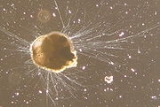
The Foraminifera, ("Hole Bearers") or forams for short, are a large group of amoeboid
Amoeboid

Amoeboids are unicellular life-forms characterized by their similarity to amoebas....
 protists with reticulating pseudopod
Pseudopod

eruses4|eukaryotic cells|the Band|Pseudopod }}Pseudopods or pseudopodia are temporary projections of eukaryotes. Cells having this faculty are generally referred to as amoeboids....
s, fine strands of cytoplasm
Cytoplasm

The cytoplasm is the part of a Cell that is enclosed within the plasma membrane. In eukaryote cells the cytoplasm contains organelles, such as mitochondrion, that are filled with liquid kept separate from the rest of the cytoplasm by biological membranes....
 that branch and merge to form a dynamic net. They typically produce a test
Test (biology)

A test is a term used to refer to the shell of sea urchins, and also the shell of certain microorganisms, such as testate foraminifera and testate amoebae....
, or shell, which can have either one or multiple chambers, some becoming quite elaborate in structure. These shells are made of calcium carbonate (CaCO3) or agglutinated sediment particles.


Discussion
Ask a question about 'Foraminifera'
Start a new discussion about 'Foraminifera'
Answer questions from other users
Full Discussion Forum


Encyclopedia


The Foraminifera, ("Hole Bearers") or forams for short, are a large group of amoeboid
Amoeboid

Amoeboids are unicellular life-forms characterized by their similarity to amoebas....
 protists with reticulating pseudopod
Pseudopod

eruses4|eukaryotic cells|the Band|Pseudopod }}Pseudopods or pseudopodia are temporary projections of eukaryotes. Cells having this faculty are generally referred to as amoeboids....
s, fine strands of cytoplasm
Cytoplasm

The cytoplasm is the part of a Cell that is enclosed within the plasma membrane. In eukaryote cells the cytoplasm contains organelles, such as mitochondrion, that are filled with liquid kept separate from the rest of the cytoplasm by biological membranes....
 that branch and merge to form a dynamic net. They typically produce a test
Test (biology)

A test is a term used to refer to the shell of sea urchins, and also the shell of certain microorganisms, such as testate foraminifera and testate amoebae....
, or shell, which can have either one or multiple chambers, some becoming quite elaborate in structure. These shells are made of calcium carbonate (CaCO3) or agglutinated sediment particles. About 275,000 species are recognized, both living and fossil
Fossil

Fossils are the preserved remains or trace fossil of animals, plants, and other organisms from the remote past. The totality of fossils, both discovered and undiscovered, and their placement in fossiliferous Rock formations and sedimentary rock layers is known as the fossil record....
. They are usually less than 1 mm in size, but some are much larger, and the largest recorded specimen reached 19 cm.

Although as yet unsupported by morphological correlates, molecular data strongly suggest that Foraminifera are closely related to the Cercozoa
Cercozoa

The Cercozoa are a group of protists, including most amoeboids and flagellates that feed by means of filose pseudopods. These may be restricted to part of the cell surface, but there is never a true cytostome or mouth as found in many other protozoa....
 and Radiolaria, both of which also include amoeboids with complex shells; these three groups make up the Rhizaria
Rhizaria

The Rhizaria are a species-rich supergroup of protists. They vary considerably in form, but for the most part they are amoeboids with filose, reticulose, or microtubule-supported pseudopods....
. However, the exact relationships of the forams to the other groups and to one another are still not entirely clear.

Living forams

Modern forams are primarily marine, although they can survive in brackish conditions. A few species survive in fresh water and one even lives in damp rainforest soil. They are very common in the meiobenthos
Meiobenthos

Meiofauna are small benthos invertebrates that live in both marine and fresh water environments . The term Meiofauna loosely defines a group of organisms by their size, larger than Microfauna but smaller than Macrofauna, rather than a taxonomic grouping....
, and about 40 morphospecies are plankton
Plankton

Plankton consist of any drifting organisms that inhabit the pelagic zone of oceans, seas, or bodies of fresh water. Plankton are defined by their ecological niche rather than their Phylogenetics or taxonomy classification....
ic. This count may however represent only a fraction of actual diversity, since many genetically discrepant species may be morphologically indistinguishable. The cell is divided into granular endoplasm and transparent ectoplasm. The pseudopodial net may emerge through a single opening or many perforations in the test, and characteristically has small granules streaming in both directions.

The pseudopods are used for locomotion, anchoring, and in capturing food, which consists of small organisms such as diatom
Diatom

Diatoms are a major group of eukaryote algae, and are one of the most common types of phytoplankton. Most diatoms are unicellular, although they can exist as Colony in the shape of filaments or ribbons , fans , zigzags , or stellate colonies ....
s or bacteria. A number of forms have unicellular algae as endosymbiont
Endosymbiont

An endosymbiont is any organism that lives within the body or cells of another organism, i.e. forming an endosymbiosis . Examples are nitrogen-fixing bacterium which live in root nodules on legume roots, single-celled algae inside reef-building corals, and bacterial endosymbionts that provide essential nutrients to about 10%?15% of in...
s, from diverse lineages such as the green algae, red algae, golden algae, diatom
Diatom

Diatoms are a major group of eukaryote algae, and are one of the most common types of phytoplankton. Most diatoms are unicellular, although they can exist as Colony in the shape of filaments or ribbons , fans , zigzags , or stellate colonies ....
s, and dinoflagellate
Dinoflagellate

The dinoflagellates are a large group of flagellate protists. Most are marine plankton, but they are common in fresh water habitats as well. Their populations are distributed depending on sea surface temperature, salinity, or depth....
s. Some forams are kleptoplastic
Kleptoplasty

Kleptoplasty or kleptoplastidy is a symbiosis phenomenon whereby plastids from algae are sequestered by host organisms. The alga is eaten normally and partially digested, leaving the plastid intact....
, retaining chloroplast
Chloroplast

Chloroplasts are organelles found in plant cells and other eukaryote organisms that conduct photosynthesis. Chloroplasts capture light energy to conserve Thermodynamic free energy in the form of Adenosine triphosphate and reduce NADP to NADPH through a complex set of processes called photosynthesis....
s from ingested algae to conduct photosynthesis
Photosynthesis

File:Seawifs global biosphere.jpgPhotosynthesis is a metabolic pathway that converts carbon dioxide into organic compounds, especially sugars, using the energy from sunlight....
.

The foraminiferal life-cycle involves an alternation between haploid and diploid generations, although they are mostly similar in form. The haploid or gamont initially has a single nucleus
Cell nucleus

In cell biology, the nucleus , also sometimes referred to as the "control center", is a membrane-enclosed organelle found in all eukaryote cell ....
, and divides to produce numerous gamete
Gamete

A gamete is a Cell that fuses with another gamete during fertilization in organisms that sexual reproduction. In species which produce two morphologically distinct types of gametes, and in which each individual produces only one type, a female is any individual which produces the larger type of gamete?called an ovum ?and a male produces th...
s, which typically have two flagella
Flagellum

A flagellum is a tail-like structure that projects from the cell body of certain prokaryotic and eukaryotic cells, and it functions in locomotion....
. The diploid or schizont is multinucleate
Multinucleate

Multinucleate cells have more than one Cell nucleus per Cell , which is the result of nuclear division not being followed by cytokinesis. As a consequence, multiple nuclei share one common cytoplasm....
, and after meiosis
Meiosis

In biology or life science, meiosis is a process of reductional division in which the number of chromosomes per cell is halved. In animals, meiosis always results in the formation of gametes, while in other organisms it can give rise to spores....
 fragments to produce new gamonts. Multiple rounds of asexual reproduction
Asexual reproduction

Asexual reproduction is reproduction which does not involve meiosis, ploidy reduction, or fertilization. Only one parent is involved in asexual reproduction....
 between sexual generations is not uncommon in benthic forms. Foramanifera typically live for about a month.

Tests

Benthic Foraminifera
The form and composition of the test is the primary means by which forams are identified and classified. Most have calcareous tests, composed of calcium carbonate
Calcium carbonate

Calcium carbonate is a chemical compound with the chemical formula CalciumCarbonOxygen3. It is a common substance found as Rock in all parts of the world, and is the main component of seashells, snails, and eggshells....
. In other forams the test may be composed of organic material, made from small pieces of sediment cemented together (agglutinated), and in one genus of silica. Openings in the test, including those that allow cytoplasm to flow between chambers, are called apertures.

Tests are known as fossils as far back as the Cambrian
Cambrian

The Cambrian is a geologic period that began about Mya at the end of the Proterozoic eon and ended about Ma with the beginning of the Ordovician period ....
 period, and many marine sediments are composed primarily of them. For instance, the limestone that makes up the pyramids of Egypt is composed almost entirely of nummulitic benthic foraminifera. Production estimates indicate that reef foraminifera annually generate approximately 43 million tons of calcium carbonate and thus play an essential role in the production of reef carbonates.

Genetic studies have identified the naked amoeba "Reticulomyxa" and the peculiar xenophyophore
Xenophyophore

Xenophyophores are marine protozoans, giant cell organisms found throughout the world's oceans, but in their greatest numbers on the abyssal plains of the deep ocean....
s as foraminiferans without tests. A few other amoeboids produce reticulose pseudopods, and were formerly classified with the forams as the Granuloreticulosa, but this is no longer considered a natural group, and most are now placed among the Cercozoa.

Evolutionary significance

Dying planktonic foraminifera continuously rain down on the sea floor in vast numbers, their mineralized tests preserved as fossils in the accumulating sediment. Beginning in the 1960s, and largely under the auspices of the Deep Sea Drilling
Deep Sea Drilling Program

The Deep Sea Drilling Project was anocean drilling project running from 1968 to 1983. The program is successful as evidenced by the data and publications that have resulted from it and is supported by Texas A&M....
, Ocean Drilling
Ocean Drilling Program

The Ocean Drilling Program was an international cooperative effort to explore and study the composition and structure of the earth's ocean basins....
, and International Ocean Drilling Programmes, as well as for the purposes of oil exploration, advanced deep-sea drilling techniques have been bringing up sediment cores bearing foraminifera fossils by the millions. The effectively unlimited supply of these fossil tests and the relatively high-precision age-control models available for cores has produced an exceptionally high-quality planktonic foraminifera fossil record dating back to the mid-Jurassic, and presents an unparalleled record for scientists testing and documenting the evolutionary process. The exceptional quality of the fossil record has allowed an impressively detailed picture of species inter-relationships to be developed on the basis of fossils, in many cases subsequently validated independently through molecular genetic studies on extant specimens.

Uses of forams

Because of their diversity, abundance, and complex morphology, fossil foraminiferal assemblages are useful for biostratigraphy
Biostratigraphy

Biostratigraphy is the branch of stratigraphy which focuses on correlating and assigning relative ages of rock Stratum by using the fossil assemblages contained within them....
, and can accurately give relative dates to rocks. The oil industry relies heavily on microfossils such as forams to find potential oil deposits.

Calcareous fossil foraminifera are formed from elements found in the ancient seas they lived in. Thus they are very useful in paleoclimatology
Paleoclimatology

Paleoclimatology is the study of climate change taken on the scale of the entire history of Earth. It uses records from ice sheets, tree rings, sediment, and rock s to determine the past state of the climate system on Earth....
 and paleoceanography
Paleoceanography

Paleoceanography is the study of the history of the oceans in the geology past with regard to circulation, chemistry, biology, geology and patterns of sedimentation....
. They can be used to reconstruct past climate by examining the stable isotope
Stable isotope

Stable isotopes are chemical Isotope that are not radioactive . By this definition, there are 256 known stable isotopes of the 80 elements which have one or more stable isotopes....
 ratios of oxygen, and the history of the carbon cycle and oceanic productivity by examining the stable isotope ratios of carbon; see d18O and d13C. Geographic patterns seen in the fossil records of planktonic forams are also used to reconstruct ancient ocean current
Ocean current

An ocean current is continuous, directed movement of ocean water. The currents are generated from the forces acting upon the water like the Earth's rotation, the wind, the temperature, salinity differences and the tide....
s. Because certain types of foraminifera are found only in certain environments, they can be used to figure out the kind of environment under which ancient marine sediments were deposited.

For the same reasons they make useful biostratigraphic markers, living foraminiferal assemblages have been used as bioindicators in coastal environments, including indicators of coral reef health. Because calcium carbonate is susceptible to dissolution in acidic conditions, foraminifera may be particularly affected by changing climate and ocean acidification
Ocean acidification

Ocean acidification is the name given to the ongoing decrease in the pH of the Earth's oceans, caused by their uptake of anthropogenic carbon dioxide from the Earth's atmosphere....
.

Foraminifera can also be utilised in archaeology
Archaeology

Archaeology, archeology, or arch?ology is the science that studies Homo cultures through the recovery, documentation, analysis, and interpretation of material remains and environmental data, including architecture, Artifact , features, Biofact s, and cultural landscape....
 in the provenancing
Provenance

Provenance, from the French provenir, "to come from", means the origin, or the wiktionary:Source, of something, or the history of the ownership or location of an object, The term was originally mostly used of works of art, but is now used in similar senses in a wide range of fields, including science and computing....
 of some stone raw material types. Some stone types, such as chert
Chert

Chert is a fine-grained silica-rich microcrystalline, cryptocrystalline or microfibrous sedimentary rock that may contain small fossils. It varies greatly in color , but most often manifests as gray, brown, grayish brown and light green to rusty red; its color is an expression of trace elements present in the rock, and both red and green ar...
, are commonly found to contain fossilised foraminifera. The types and concentrations of these fossils within a sample of stone can be used to match that sample to a source known to contain the same 'fossil signature'.

External links


General information:

  • website has an


  • Researchers at the University of South Florida developed a system


  • University College London's has an overview of foraminifera, including many high-quality SEM
    Sem

    Sem may refer to:*Shem; One of the sons of Noah in the Bible*Sem, France*Sem, Norway*Scanning electron microscope*Strategic enterprise management...
    s


  • is the Lukas Hottinger's glossary published in the OA e-journal


  • Martin Langer's Micropaleontology Page


  • from the 2005 Urbino Summer School of Paleoclimatology


Resources:
  • The (part of ) is a cooperative database of information about foraminifera


  • of forams, generated by X-ray tomography


  • has , including a and a


  • is a web site focused on foraminifera and modeling of foraminiferal shells


  • Illustrated catalog of recent and fossil Foraminifera by genus and locality