
All Topics  
Food chain


   Email Print
   Bookmark   Link


Food chain


Food chains, also called, food networks and/or trophic social networks, describe the eating relationships between species within an ecosystem
Ecosystem

An ecosystem is a natural unit consisting of all plants, animals and micro-organisms in an area functioning together with all of the non-living physical factors of the environment....
. Organisms are connected to the organisms they consume by lines representing the direction of organism or energy transfer. It also shows how the energy
Energy

In physics, energy is a scalar physical quantity that describes the amount of Work_ that can be performed by a force. Energy is an attribute of objects and systems that is subject to a conservation law....
 from the producer is given to the consumer
Heterotroph

A heterotroph is an organism that organic compound substrates to get its Energy#Chemical energy for its life cycle. This contrasts with autotrophs such as plants which are able to directly use sources of energy such as light to produce organic substrates from inorganic carbon dioxide....
. Typically a food chain or food web. refers to a graph where only connections are recorded, and a food network or ecosystem network refers to a network where the connections are given weights representing the quantity of nutrients or energy being transferred.
gy enters the food chain from the sun.


Discussion
Ask a question about 'Food chain'
Start a new discussion about 'Food chain'
Answer questions from other users
Full Discussion Forum


Recent Posts


Encyclopedia


Food chains, also called, food networks and/or trophic social networks, describe the eating relationships between species within an ecosystem
Ecosystem

An ecosystem is a natural unit consisting of all plants, animals and micro-organisms in an area functioning together with all of the non-living physical factors of the environment....
. Organisms are connected to the organisms they consume by lines representing the direction of organism or energy transfer. It also shows how the energy
Energy

In physics, energy is a scalar physical quantity that describes the amount of Work_ that can be performed by a force. Energy is an attribute of objects and systems that is subject to a conservation law....
 from the producer is given to the consumer
Heterotroph

A heterotroph is an organism that organic compound substrates to get its Energy#Chemical energy for its life cycle. This contrasts with autotrophs such as plants which are able to directly use sources of energy such as light to produce organic substrates from inorganic carbon dioxide....
. Typically a food chain or food web. refers to a graph where only connections are recorded, and a food network or ecosystem network refers to a network where the connections are given weights representing the quantity of nutrients or energy being transferred.

Organisms represented in food chains

Energy enters the food chain from the sun. Some energy and/or biomass is lost at each stage of the food chain as; feces (solid waste), movement energy and heat energy (especially by warm-blooded creatures). Therefore, only a small amount of energy and biomass is incorporated into the consumer's body and transferred to the next feeding level, thus showing a Pyramid of Biomass.

Primary producers, commonly forming autotrophs
Autotrophy

Autotrophy is the ability to be self-sustained by producing food from inorganic compounds. Some bacteria and some archaea have this ability. Inorganic compounds are oxidized directly without sunlight to yield energy....
, produce complex organic substances (essentially "food") from an energy source and materials. These organisms are typically photosynthetic
Photosynthesis

File:Seawifs global biosphere.jpgPhotosynthesis is a metabolic pathway that converts carbon dioxide into organic compounds, especially sugars, using the energy from sunlight....
 plants, which use sunlight as their energy source. A few, such as those organisms forming the base of deep-sea vent food webs, are chemotrophic
Chemotroph

Chemotrophs are organisms that obtain energy by the oxidation of electron donating molecules in their environments. These molecules can be organic molecule or inorganic ....
, using chemical energy instead. Organisms that get their energy by organic substances are called heterotrophs. Heterotrophs include herbivores, which obtain their energy by consuming live plants; carnivores, which obtain energy from eating live animals. Ultimately detritivore
Detritivore

Detritivores, also known as detritus feeders or saprophages, are heterotrophs that obtain nutrients by consuming detritus . By doing so, they contribute to decomposition and the nutrient cycles....
s, scavengers and decomposers may predate living or consume dead biomass.

Flow of food chains

A food chain is the flow of energy from one organism to the next and to the next and so on. Organisms in a food chain are grouped into trophic level
Trophic level

In ecology, trophic dynamics is the system of trophic levels , which describe the position that an organism occupies in a food chain — what an organism eats, and what eats the organism....
s, based on how many links they are removed from the primary producers. Trophic level
Trophic level

In ecology, trophic dynamics is the system of trophic levels , which describe the position that an organism occupies in a food chain — what an organism eats, and what eats the organism....
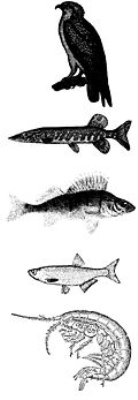
s may contain either a single species or a group of species that are presumed to share both predators and prey. They usually start with a plant and end with a carnivore. The diagram below is a food chain from a Swedish lake. Osprey
Osprey

The Osprey , sometimes known as the sea hawk, is a Diurnality, fish bird of prey. It is a large Bird of prey, reaching 60 centimeters in length with a 1.8 metre wingspan....
 feed on northern pike
Northern Pike

The northern pike , Esox lucius, is a species of carnivorous fish of the genus Esox . They are typical of brackish water and freshwaters of the northern hemisphere ....
 that feed on perch
Perch

Perca is the genus of fish referred to as perch or, sometimes, yellow perch, a group of freshwater fish belonging to the family Percidae....
 that eat bleak
Bleak

The common bleak is a small pelagic fish of the Cyprinid family . It is often referred to simply as a "bleak", though this term can refer to any species of Alburnus....
 that feed on freshwater shrimp
Shrimp

Shrimp are swimming, Decapoda crustaceans classified in the infraorder Caridea, found widely around the world in both fresh water and seawater. Adult shrimp are Filter feeder benthic animals living close to the bottom....
. Though unshown, the primary producers of this food chain are probably autotrophic
Autotrophy

Autotrophy is the ability to be self-sustained by producing food from inorganic compounds. Some bacteria and some archaea have this ability. Inorganic compounds are oxidized directly without sunlight to yield energy....
 phytoplankton
Phytoplankton

Phytoplankton are the autotrophic component of the plankton community. The name comes from the Greek language words phyton, or "plant", and p?a??t?? , meaning "wanderer" or "drifter"....
. Phytoplankton and algae
Algae

Algae are a large and diverse group of simple, typically autotrophic organisms, ranging from unicellular to multicellular forms. The largest and most complex marine forms are called seaweeds....
 form the base of most freshwater food chains. It is often the case that biomass
Biomass

Biomass, as a renewable energy source, refers to living and recently dead biological material that can be used as fuel or for industrial production....
 of each trophic level
Trophic level

In ecology, trophic dynamics is the system of trophic levels , which describe the position that an organism occupies in a food chain — what an organism eats, and what eats the organism....
 decreases from the base of the chain to the top. This is because energy is lost to the environment with each transfer. On average, only 10% of the organism's energy is passed on to its predator. The other 90% is used for the organism's life processes or it is lost as heat to the environment. Graphic representations of the biomass or productivity at each tropic level are called trophic pyramids. In this food chain for example, the biomass of osprey is smaller than the biomass of pike, which is smaller than the biomass of perch. Some producers, especially phytoplankton, are so productive and have such a high turnover rate that they can actually support a larger biomass of grazers. This is called an inverted pyramid, and can occur when consumers live longer and grow more slowly than the organisms they consume. In this food chain, the productivity of phytoplankton is much greater than that of the zooplankton consuming them. The biomass of the phytoplankton, however, may actually be less than that of the copepods. Directly linked to this are pyramids of numbers, which show that as the chain is traveled along, the number of consumers at each level drops very significantly, so that a single top consumer (e.g. a Polar Bear
Polar Bear

The polar bear is a bear native to the Arctic Ocean and its surrounding seas. The world's largest carnivore found on land, and shares the title of largest land predator with the Kodiak Bear, an adult male weighs around , while an adult female is about half that size....
) will be supported by literally millions of separate producers (e.g. Phytoplankton
Phytoplankton

Phytoplankton are the autotrophic component of the plankton community. The name comes from the Greek language words phyton, or "plant", and p?a??t?? , meaning "wanderer" or "drifter"....
).

Food web

A food web extends the food chain concept from a simple linear pathway to a complex network of interactions.

Food chains are overly simplistic as representatives of what typically happens in nature. The food chain shows only one pathway of energy and material transfer. Most consumers feed on multiple species and are, in turn, fed upon by multiple other species. The relations of detritivores and parasites are seldom adequately characterized in such chains as well. The food chain has a producer, consumer, herbivore, carnivore, omnivore, decomposer.

A food web is a set of interconnected food chains by which energy and materials circulate within an ecosystem (see Ecology). The food web is divided into two broad categories: the grazing web, which typically begins with green plants, algae, or photosynthesizing plankton, and the detrital web, which begins with organic debris. These webs are made up of individual food chains. In a grazing web, materials typically pass from plants to plant eaters (herbivores) to flesh eaters (carnivores). In a detrital web, materials pass from plant and animal matter to bacteria and fungi (decomposers), then to detrital feeders (detritivores), and then to their predators (carnivores).

Generally, many interconnections exist within food webs. For example, the fungi that decompose matter in a detrital web may sprout mushrooms that are consumed by squirrels, mice, and deer in a grazing web. Robins are omnivores, that is, consumers of both plants and animals, and thus are in both detrital and grazing webs. Robins typically feed on earthworms, which are detritivores that feed upon decaying leaves.

Herbivores, consumers of green plants, belong to the second trophic level. Carnivores, predators feeding upon the herbivores, belong to the third. Omnivores, consumers of both plants and animals, belong to the second and third. Secondary carnivores, which are predators that feed on predators, belong to the fourth trophic level. As the trophic levels rise, the predators become fewer, larger, fiercer, and more agile. At the second and higher levels, decomposers of the available materials function as herbivores or carnivores depending on whether their food is plant or animal material.

III Energy Flow Through these series of steps of eating and being eaten, energy flows from one trophic level to another. Green plants or other photosynthesizing organisms use light energy from the sun to manufacture carbohydrates for their own needs. Most of this chemical energy is processed in metabolism and dissipated as heat in respiration. Plants convert the remaining energy to biomass, both above ground as woody and herbaceous tissue and below ground as roots. Ultimately, this material, which is stored energy, is transferred to the second trophic level, which comprises grazing herbivores, decomposers, and detrital feeders. Most of the energy assimilated at the second trophic level is again lost as heat in respiration; a fraction becomes new biomass. Organisms in each trophic level pass on as biomass much less energy than they receive. Thus, the more steps between producer and final consumer, the less energy remains available. Seldom are there more than four links, or five levels, in a food web. Eventually, all energy flowing through the trophic levels is dissipated as heat
Heat

In physics and thermodynamics, heat is any transfer of energy from one body or thermodynamic system to another due to a difference in temperature....
. The process whereby energy loses its capacity to do work is called entropy.

The earliest food webs were published by Victor Summerhayes and Charles Elton
Charles Sutherland Elton

Charles Sutherland Elton was an English people zoology and animal ecology. His name is associated with the establishment of modern population ecology and community ecology, including studies of invasive species....
 in 1923 and Hardy in 1924. Summerhayes and Elton's
Charles Sutherland Elton

Charles Sutherland Elton was an English people zoology and animal ecology. His name is associated with the establishment of modern population ecology and community ecology, including studies of invasive species....
 (above) depicted the interactions of plants, animals and bacteria
Bacteria

The Bacteria are a large group of unicellular microorganisms. Typically a few micrometres in length, bacteria have a wide range of shapes, ranging from spheres to rods and spirals....
 on Bear Island, Norway
Norway

Norway , officially the Kingdom of Norway, is a constitutional monarchy in Northern Europe that occupies the western portion of the Scandinavian Peninsula....
.

The direct steps as shown in the food chain example above seldom reflect reality. This web makes it possible to show much bigger animals (like a seal) eating very small organisms (like plankton). Food sources of most species in an ecosystem are much more diverse, resulting in a complex web of relationships as shown in the figure on the right. In this figure, the grouping of Algae
Algae

Algae are a large and diverse group of simple, typically autotrophic organisms, ranging from unicellular to multicellular forms. The largest and most complex marine forms are called seaweeds....
 ? Protozoa
Protozoa

Protozoan are microorganisms classified as unicellular eukaryotes. While there is no exact definition of the term "protozoan", most scientists use the word to refer to a unicellular heterotrophic protist, such as an amoeba or a ciliate....
 ? Oligochaeta
Oligochaeta

Oligochaeta is a scientific classification in the biological phylum Annelida and includes various earthworms. Specifically, it contains the terrestrial megadrile earthworms , and freshwater or semi-terrestrial microdrile forms including the Tubificidaes, pot worms and ice worms , Lumbriculus variegatus and several interstitial marine worms...
 ? Northern Eider
Eider

Eiders are large seaducks in the genus Somateria. Steller's Eider, despite its name, is in a different genus.The three extant species all breed in the cooler latitudes of the Northern hemisphere....
 ? Arctic Fox
Arctic fox

The Arctic Fox , also known as the White Fox or Snow Fox, is a small fox native to cold Arctic regions of the Northern Hemisphere and is common throughout the Tundra#Arctic tundra biome....
 is a chain; the whole complex network is a food web.

See also

  • Balance of Nature
    Balance of nature

    The Balance of nature refers to the theory that biological systems are usually in a stable equilibrium, which is to say that a small change in some particular parameter will be corrected by some negative feedback that will bring the parameter back to its original "point of balance" with the rest of the system....
  • Biodiversity
    Biodiversity

    Biodiversity is the variation of life forms within a given ecosystem, biome, or for the entire Earth. Biodiversity is often used as a measure of the health of biological systems....
  • Ecology
    Ecology

    Ecology is the science study of the distribution and Abundance of life and the interactions between organisms and their nature environment ....
  • Ecosystem
    Ecosystem

    An ecosystem is a natural unit consisting of all plants, animals and micro-organisms in an area functioning together with all of the non-living physical factors of the environment....
  • Earth Science
    Earth science

    Earth science , is an all-embracing term for the sciences related to the planet Earth . It is arguably a special case in planetary science, the Earth being the only known life-bearing planet....
  • Natural environment
    Natural environment

    The natural environment, commonly referred to simply as the environment, is a term that encompasses all life and non-living things occurring nature on Earth or some region thereof....
  • Nature
    Nature

    File:Jungle in Punjab.JPGNature, in the broadest sense, is equivalent to the natural world, physical universe, material world or material universe....
  • List of feeding behaviours
  • Antipredator adaptations

Bibliography

  • "Food chain" A Dictionary of Zoology. Ed. Michael Allaby. Oxford University Press, 1999. Oxford Reference Online. Oxford University Press. University of Utah. 22 November 2007