

Bilateria

Encyclopedia
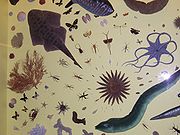
The bilateria are all animals having a bilateral symmetry, i.e. they have a front and a back end, as well as an upside and downside. Radially symmetrical
Symmetry (biology)
Symmetry in biology is the balanced distribution of duplicate body parts or shapes. The body plans of most multicellular organisms exhibit some form of symmetry, either radial symmetry or bilateral symmetry or "spherical symmetry". A small minority exhibit no symmetry .In nature and biology,...
animals like jellyfish
Jellyfish
Jellyfish are free-swimming members of the phylum Cnidaria. Medusa is another word for jellyfish, and refers to any free-swimming jellyfish stages in the phylum Cnidaria...
have a topside and downside, but no front and back. The bilateralia are a subregnum (a major group) of animal
Animal
Animals are a major group of multicellular, eukaryotic organisms of the kingdom Animalia or Metazoa. Their body plan eventually becomes fixed as they develop, although some undergo a process of metamorphosis later on in their life. Most animals are motile, meaning they can move spontaneously and...
s, including the majority of phyla; the most notable exceptions are the sponge
Sea sponge
Sponges are animals of the phylum Porifera . Their bodies consist of jelly-like mesohyl sandwiched between two thin layers of cells. While all animals have unspecialized cells that can transform into specialized cells, sponges are unique in having some specialized cells, but can also have...
s, belonging to Parazoa, and cnidaria
Cnidaria
Cnidaria is a phylum containing over 9,000 species of animals found exclusively in aquatic and mostly marine environments. Their distinguishing feature is cnidocytes, specialized cells that they use mainly for capturing prey. Their bodies consist of mesoglea, a non-living jelly-like substance,...
ns belonging to Radiata
Radiata
The Radiata are the radially symmetric animals of the Eumetazoa subkingdom. The term Radiata has had various meanings in the history of classification...
. For the most part, Bilateria have bodies that develop from three different germ layer
Germ layer
A germ layer, occasionally referred to as a germinal epithelium, is a group of cells, formed during animal embryogenesis. Germ layers are particularly pronounced in the vertebrates; however, all animals more complex than sponges produce two or three primary tissue layers...
s, called the endoderm, mesoderm, and ectoderm. From this they are called triploblastic. Nearly all are bilaterally symmetrical, or approximately so. The most notable exception is the echinoderm
Echinoderm
Echinoderms are a phylum of marine animals. Echinoderms are found at every ocean depth, from the intertidal zone to the abyssal zone....
s, which achieve near-radial symmetry as adults, but are bilaterally symmetrical as larvae.
Except for a few highly reduced forms, the Bilateria have complete digestive tracts with separate mouth
Mouth
The mouth is the first portion of the alimentary canal that receives food andsaliva. The oral mucosa is the mucous membrane epithelium lining the inside of the mouth....
and anus
Anus
The anus is an opening at the opposite end of an animal's digestive tract from the mouth. Its function is to control the expulsion of feces, unwanted semi-solid matter produced during digestion, which, depending on the type of animal, may be one or more of: matter which the animal cannot digest,...
. Most Bilateria also have a type of internal body cavity, called a coelom
Body cavity
By the broadest definition, a body cavity is any fluid-filled space in a multicellular organism. However, the term usually refers to the space located between an animal’s outer covering and the outer lining of the gut cavity, where internal organs develop...
. It was previously thought that acoelomates gave rise to the other group, but there is some evidence now that in the main acoelomate phyla (flatworm
Flatworm
The flatworms, known in scientific literature as Platyhelminthes or Plathelminthes are a phylum of relatively simple bilaterian, unsegmented, soft-bodied invertebrate animals...
s and gastrotrich
Gastrotrich
The gastrotrichs are a phylum of microscopic animals abundant in fresh water and marine environments. Most fresh water species are part of the periphyton and benthos...
s) the absence could be secondary.
Evolution
The hypothetical last common ancestor of all bilateria is termed the "Urbilaterian". There is some debate about its appearance.The first evidence of bilateria in the fossil record comes from trace fossils in Ediacaran
Ediacaran
The Ediacaran Period , named after the Ediacara Hills of South Australia, is the last geological period of the Neoproterozoic Era and of the Proterozoic Eon, immediately preceding the Cambrian Period, the first period of the Paleozoic Era and of the Phanerozoic Eon...
sediments, and the first bona fide bilaterian fossil is Kimberella
Kimberella
Kimberella is a monospecific genus of bilaterian known only from rocks of the Ediacaran period. The slug-like organism fed by scratching the microbial surface on which it dwelt in a manner similar to the molluscs, although its affinity with this group is contentious.Specimens were first found in...
, dating to . Earlier fossils are controversial; The fossil Vernanimalcula
Vernanimalcula
Vernanimalcula guizhouena is a fossil believed by some to represent the earliest known member of the Bilateria . It is known from deposits dating to . The fossils are between 0.1 and 0.2 mm across...
may be the earliest known bilaterian, but may also represent an infilled bubble. Fossil embryos
Fossil embryos
Fossil embryos are the preserved remains of organisms that have yet to hatch or be born. Many fossils of the Doushantuo formation have been interpreted as embryos; embryos are also common throughout the Cambrian fossil record.-Preservation:...
are known from around the time of Vernanimalcula , but none of these have bilaterian affinities.
Phylogeny
There are two or more superphyla (main lineages) of Bilateria. The deuterostomeDeuterostome
Deuterostomes are a superphylum of animals. They are a subtaxon of the Bilateria branch of the subregnum Eumetazoa, and are opposed to the protostomes...
s include the echinoderm
Echinoderm
Echinoderms are a phylum of marine animals. Echinoderms are found at every ocean depth, from the intertidal zone to the abyssal zone....
s, hemichordates, chordate
Chordate
Chordates are animals which are either vertebrates or one of several closely related invertebrates. They are united by having, for at least some period of their life cycle, a notochord, a hollow dorsal nerve cord, pharyngeal slits, an endostyle, and a post-anal tail...
s, and possibly a few smaller phyla. The protostome
Protostome
Protostomia are a clade of animals. Together with the deuterostomes and a few smaller phyla, they make up the Bilateria, mostly comprising animals with bilateral symmetry and three germ layers...
s include most of the rest, such as arthropod
Arthropod
An arthropod is an invertebrate animal having an exoskeleton , a segmented body, and jointed appendages. Arthropods are members of the phylum Arthropoda , and include the insects, arachnids, crustaceans, and others...
s, annelid
Annelid
The annelids , formally called Annelida , are a large phylum of segmented worms, with over 17,000 modern species including ragworms, earthworms and leeches...
s, mollusks, flatworm
Flatworm
The flatworms, known in scientific literature as Platyhelminthes or Plathelminthes are a phylum of relatively simple bilaterian, unsegmented, soft-bodied invertebrate animals...
s, and so forth. There are a number of differences, most notably in how the embryo
Embryo
An embryo is a multicellular diploid eukaryote in its earliest stage of development, from the time of first cell division until birth, hatching, or germination...
develops. In particular, the first opening of the embryo becomes the mouth in protostomes, and the anus in deuterostomes. Many taxonomists
Taxonomy
Taxonomy is the science of identifying and naming species, and arranging them into a classification. The field of taxonomy, sometimes referred to as "biological taxonomy", revolves around the description and use of taxonomic units, known as taxa...
now recognize at least two more superphyla among the protostomes, Ecdysozoa
Ecdysozoa
Ecdysozoa is a group of protostome animals, including Arthropoda , Nematoda, and several smaller phyla. They were first defined by Aguinaldo et al. in 1997, based mainly on trees constructed using 18S ribosomal RNA genes...
(molting animals) and Lophotrochozoa
Lophotrochozoa
The Lophotrochozoa are a major grouping of protostome animals. The taxon was discovered based on molecular data. Molecular evidence such as a result of studies of the evolution of small-subunit ribosomal RNA supports the monophyly of the phyla listed in the infobox shown at right.-Terminology:The...
. Some taxonomists also recognize another protostome superphylum, Platyzoa
Platyzoa
The Platyzoa are a group of protostome animals proposed by Thomas Cavalier-Smith in 1998. Cavalier-Smith included in Platyzoa the Phylum Platyhelminthes or flatworms, and a new phylum, Acanthognatha, into which he gathered several previously described phyla of microscopic animals...
, while others would include the Platyzoans in Lophotrochozoa or not include them in any superphylum. The arrow worms (Chaetognatha
Chaetognatha
Chaetognatha, meaning hair-jaws, and commonly known as arrow worms, are a phylum of predatory marine worms that are a major component of plankton worldwide. About 20% of the known species are benthic, that is belonging to the lowest zone of the ocean, or benthic zone, and can attach to algae and...
) have proven particularly difficult to classify, with some taxonomists placing them among the deuterostomes and others placing them among the protostomes. The two most recent studies to address the question of chaetognath origins support protostome affinities.
A phylogeny of the Bilateria after Nielsen (2001) is as follows.
An alternate phylogeny suggests a basal group called the ecdysozoa
Ecdysozoa
Ecdysozoa is a group of protostome animals, including Arthropoda , Nematoda, and several smaller phyla. They were first defined by Aguinaldo et al. in 1997, based mainly on trees constructed using 18S ribosomal RNA genes...
.