

Cambrian explosion

Encyclopedia
The Cambrian explosion or Cambrian radiation was the relatively rapid (over a period of many millions of years) appearance, around , of most major phyla
, as demonstrated in the fossil
record, accompanied by major diversification of other organisms, including animal
s, phytoplankton
, and calcimicrobe
s. Before about , most organisms were simple, composed of individual cells occasionally organized into colonies
. Over the following 70 or 80 million years the rate of evolution
accelerated by an order of magnitude
(as defined in terms of the extinction and origination rate of species) and the diversity of life began to resemble that of today.
The Cambrian explosion has generated extensive scientific debate. The seemingly rapid appearance of fossils in the “Primordial Strata” was noted as early as the mid 19th century, and Charles Darwin
saw it as one of the main objections that could be made against his theory of evolution by natural selection
.
The long-running puzzlement about the appearance of the Cambrian fauna
, seemingly abruptly and from nowhere, centers on three key points: whether there really was a mass diversification of complex organisms over a relatively short period of time during the early Cambrian; what might have caused such rapid change; and what it would imply about the origin and evolution of animals. Interpretation is difficult due to a limited supply of evidence, based mainly on an incomplete fossil record and chemical signatures left in Cambrian rocks.
(1784–1856) realised that a dramatic step-change in the fossil record occurred around the base of what we now call the Cambrian
. Charles Darwin considered this sudden appearance of many animal groups with few or no antecedents to be the greatest single objection to his theory of evolution. He had even devoted a substantial chapter of The Origin of Species
to solving this problem.
American palæontologist Charles Walcott
proposed that an interval of time, the “Lipalian”, was not represented in the fossil record or did not preserve fossils, and that the ancestors of the Cambrian animals evolved during this time.
More recently it was discovered that the history of life on earth goes back at least : Rocks of that age at Warrawoona in Australia
contain fossils of stromatolite
s, stubby pillars that are formed by colonies of Microorganism
s. Fossils (Grypania
) of more complex eukaryotic
cells, from which all animals, plants and fungi are built, have been found in rocks from , in China
and Montana
. Rocks dating from contain fossils of the Ediacara biota
, organisms so large that they must have been multi-celled, but very unlike any modern organism. P. E. Cloud argued in 1948 that there was a period of "eruptive" evolution in the Early Cambrian, but as recently as the 1970s there was no sign of how the relatively modern-looking organisms of the Middle and Late Cambrian
arose.
 The intense modern interest in this "Cambrian explosion" was sparked by the work of Harry B. Whittington
and colleagues, who in the 1970s re-analysed many fossils from the Burgess Shale
(see below) and concluded that several were complex but different from any living animals. The most common organism, Marrella, was clearly an arthropod
, but not a member of any known arthropod class
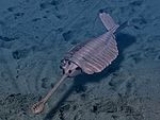
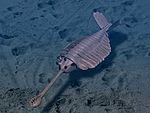
. Organisms such as the five-eyed Opabinia
and spiny slug-like Wiwaxia
were so different from anything else known that Whittington's team assumed they must represent different phyla
, only distantly related to anything known today. Stephen Jay Gould
’s popular 1989 account of this work, Wonderful Life
, brought the matter into the public eye and raised questions about what the explosion represented. While differing significantly in details, both Whittington and Gould proposed that all modern animal phyla
had appeared rather suddenly. This view was influenced by the theory of punctuated equilibrium
, which Eldredge
and Gould developed in the early 1970s and which views evolution as long intervals of near-stasis "punctuated" by short periods of rapid change.
Other analyses, some more recent and some dating back to the 1970s, argue that complex animals similar to modern types evolved well before the start of the Cambrian. There has also been intense debate whether there was a genuine "explosion" of modern forms in the Cambrian and, to the extent that there was, how it happened and why it happened then.
dates for much of the Cambrian, obtained by detailed analysis of radioactive elements contained within rocks, have only rather recently become available, and for only a few regions.
Relative dating (A was before B) is often sufficient for studying processes of evolution, but this too has been difficult, because of the problems involved in matching up rocks of the same age across different continent
s.
Therefore dates or descriptions of sequences of events should be regarded with some caution until better data becomes available.
or metamorphism
before they can be observed. Hence the fossil record is very incomplete, increasingly so, further back in time. Despite this, they are often adequate to illustrate the broader patterns of life's history. There are also biases in the fossil record: different environments are more favourable to the preservation of different types of organism or parts of organisms. Further, only the parts of organisms that were already mineralised
are usually preserved, such as the shells of molluscs. Since most animal species are soft-bodied, they decay before they can become fossilised. As a result, although there are 30-plus phyla
of living animals, two-thirds have never been found as fossils.
The Cambrian fossil record includes an unusually high number of lagerstätte
n, which preserve soft tissues. These allow palæontologists
to examine the internal anatomy of animals, which in other sediments are only represented by shells, spines, claws, etc. – if they are preserved at all. The most significant Cambrian lagerstätten are the early Cambrian Maotianshan shale beds of Chengjiang (Yunnan
, China
) and Sirius Passet
(Greenland
); the middle Cambrian Burgess Shale
(British Columbia
, Canada
); and the late Cambrian Orsten
(Sweden
) fossil beds.
While lagerstätten preserve far more than the conventional fossil record, they are far from complete. Because lagerstätten are restricted to a narrow range of environments (where soft-bodied organisms can be preserved very quickly, e.g. by mudslides), most animals are probably not represented; further, the exceptional conditions that create lagerstätten probably do not represent normal living conditions. In addition, the known Cambrian lagerstätten are rare and difficult to date, while Precambrian lagerstätten have yet to be studied in detail.
The sparseness of the fossil record means that organisms usually exist long before they are found in the fossil record – this is known as the Signor–Lipps effect.
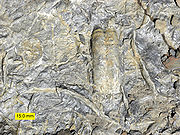 Trace fossil
s consist mainly of tracks and burrows, but also include coprolite
s (fossil feces
) and marks left by feeding. Trace fossils are particularly significant because they represent a data source that is not limited to animals with easily fossilized hard parts, and which reflects organisms' behaviour. Also many traces date from significantly earlier than the body fossils of animals that are thought to have been capable of making them. While exact assignment of trace fossils to their makers is generally impossible, traces may for example provide the earliest physical evidence of the appearance of moderately complex animals (comparable to earthworm
s).
indicate a drastic change in the environment around the start of the Cambrian. The markers are consistent with a mass extinction, or with a massive warming resulting from the release of methane ice.
Such changes may reflect a cause of the Cambrian explosion, although they may also have resulted from an increased level of biological activity – a possible result of the explosion. Despite these uncertainties, the geochemical evidence helps by making scientists focus on theories that are consistent with at least one of the likely environmental changes.
is a technique for working out the “family tree” of a set of organisms. It works by the logic that, if groups B and C have more similarities to each other than either has to group A, then B and C are more closely related to each other than either is to A. Characteristics that are compared may be anatomical
, such as the presence of a notochord
, or molecular
, by comparing sequences of DNA
or protein
. The result of a successful analysis is a hierarchy of clade
s – groups whose members are believed to share a common ancestor. The cladistic technique is sometimes problematic, as some features, such as wings or camera eyes
, evolved more than once, convergently
– this must be taken into account in analyses.
From the relationships, it may be possible to constrain the date that lineages first appeared. For instance, if fossils of B or C date to X million years ago and the calculated "family tree" says A was an ancestor of B and C, then A must have evolved more than X million years ago.
It is also possible to estimate how long ago two living clades diverged – i.e. approximately how long ago their last common ancestor must have lived – by assuming that DNA mutation
s accumulate at a constant rate. These "molecular clock
s", however, are fallible, and provide only a very approximate timing: they are not sufficiently precise and reliable for estimating when the groups that feature in the Cambrian explosion first evolved, and estimates produced by different techniques vary by a factor of two. However, the clocks can give an indication of branching rate, and when combined with the constraints of the fossil record, recent clocks suggest a sustained period of diversification through the Ediacaran and Cambrian.
is the highest level in the Linnean system for classifying organisms. Phyla can be thought of as groupings of animals based on general body plan. Despite the seemingly different external appearances of organisms, they are classified into phyla based on their internal and developmental organizations. For example, despite their obvious differences, spider
s and barnacle
s both belong to the phylum Arthropoda; but earthworm
s and tapeworms, although similar in shape, belong to different phyla.
A phylum is not a fundamental division of nature, such as the difference between electron
s and proton
s. It is simply a very high-level grouping in a classification system
created to describe all currently living organisms. This system is imperfect, even for modern animals: different books quote different numbers of phyla, mainly because they disagree about the classification of a huge number of worm-like species. As it is based on living organisms, it accommodates extinct organisms poorly, if at all.
The concept of stem groups was introduced to cover evolutionary "aunts" and "cousins" of living groups. A crown group
is a group of closely related living animals plus their last common ancestor plus all its descendants. A stem group is a set of offshoots from the lineage at a point earlier than the last common ancestor of the crown group; it is a relative concept, for example tardigrade
s are living animals that form a crown group in their own right, but Budd (1996) regarded them also as being a stem group relative to the arthropods.
Triploblastic means consisting of 3 layers, which are formed
in the embryo
, quite early in the animal's development from a single-celled egg to a larva or juvenile form. The innermost layer forms the digestive tract (gut); the outermost forms skin; and the middle one forms muscles and all the internal organs except the digestive system. Most types of living animal are triploblastic – the best-known exceptions are Porifera (sponges) and Cnidaria
(jellyfish, sea anemones, etc.).
The bilateria
ns are animals that have right and left sides at some point in their life history. This implies that they have top and bottom surfaces and, importantly, distinct front and back ends. All known bilaterian animals are triploblastic, and all known triploblastic animals are bilaterian. Living Echinoderm
s (sea star
s, sea urchin
s, sea cucumbers, etc.) look radially symmetrical (like wheels) rather than bilaterian, but their larvae exhibit bilateral symmetry and some of the earliest echinoderms may have been bilaterally symmetrical. Porifera and Cnidaria
are radially symmetrical, non-bilaterian and non-triploblastic.
Coelomate means having a body cavity (coelom) containing the internal organs. Most of the phyla featured in the debate about the Cambrian explosion are coelomates: arthropod
s, annelid
worms, molluscs
, echinoderm
s and chordate
s – the non-coelomate priapulids are an important exception. All known coelomate animals are triploblastic bilaterians, but some triploblastic bilaterian animals do not have a coelom – for example flatworm
s, whose organs are surrounded by unspecialized tissues
.
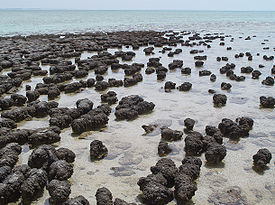 Changes in the abundance and diversity of some types of fossil have been interpreted as evidence for "attacks" by animals or other organisms. Stromatolite
s, stubby pillars built by colonies of microorganism
s, are a major constituent of the fossil record from about , but their abundance and diversity declined steeply after about . This decline has been attributed to disruption by grazing and burrowing animals.
Precambrian marine diversity was dominated by small fossils known as acritarch
s. This term describes almost any small organic walled fossil–from the egg cases of small metazoans
to resting cyst
s of many different kinds of green algae
. After appearing around , acritarchs underwent a boom around , increasing in abundance, diversity, size, complexity of shape and especially size and number of spines. Their increasingly spiny forms in the last 1 billion years may indicate an increased need for defence against predation. Other groups of small organisms from the Neoproterozoic
era also show signs of anti-predator defenses. A consideration of taxon longevity appears to support an increase in predation pressure around this time,
However, in general, the rate of evolution in the Precambrian was very slow, with many cyanobacterial species persisting unchanged for billions of years.
If these predatory organisms really were metazoans, this means that Cambrian animals did not appear "from no-where" at the base of the Cambrian; their predecessors had existed for hundreds of millions of years.
harbours microscopic fossils that may represent early bilaterians. Some have been described as animal embryos and eggs, although some of these may represent the remains of giant bacteria.
Another fossil, Vernanimalcula
, has been interpreted as a coelomate bilaterian,
but may simply be an infilled bubble.
These fossils form the earliest hard-and-fast evidence of animals, as opposed to other predators.
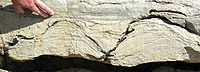
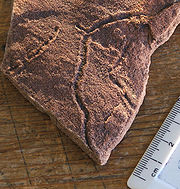 The traces of organisms moving on and directly underneath the microbial mats that covered the Ediacaran sea floor are preserved from the Ediacaran period, about . They were probably made by organisms resembling earthworms in shape, size, and how they moved. The burrow-makers have never been found preserved, but because they would need a head and a tail, the burrowers probably had bilateral symmetry – which would in all probability make them bilaterian animals. They fed above the sediment surface, but were forced to burrow to avoid predators.
Around the start of the Cambrian (about ) many new types of traces first appear, including well-known vertical burrows such as Diplocraterion
and Skolithos
, and traces normally attributed to arthropod
s, such as Cruziana
and Rusophycus
. The vertical burrows indicate that worm-like animals acquired new behaviours, and possibly new physical capabilities. Some Cambrian trace fossils indicate that their makers possessed hard exoskeleton
s, although they were not necessarily mineralised.
Burrows provide firm evidence of complex organisms; they are also much more readily preserved than body fossils, to the extent that the absence of trace fossils has been used to imply the genuine absence of large, motile bottom-dwelling organisms. They provide a further line of evidence to show that the Cambrian explosion represents a real diversification, and is not a preservational artefact.
Indeed, as burrowing became established, it allowed an explosion of its own, for as burrowers disturbed the sea floor, they aerated it, mixing oxygen into the toxic muds. This made the bottom sediments more hospitable, and allowed a wider range of organisms to inhabit them – creating new niches and the scope for higher diversity.
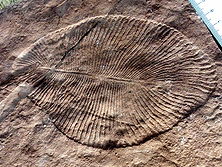
At the start of the Ediacaran period, much of the acritarch fauna, which had remained relatively unchanged for hundreds of millions of years, became extinct, to be replaced with a range of new, larger species, which would prove far more ephemeral. This radiation, the first in the fossil record, is followed soon after by an array of unfamiliar, large, fossils dubbed the Ediacara biota
, which flourished for 40 million years until the start of the Cambrian. Most of this "Ediacara biota
" were at least a few centimeters long, significantly larger than any earlier fossils. The organisms form three distinct assemblages, increasing in size and complexity as time progresses.
Many of these organisms were quite unlike anything that appeared before or since, resembling discs, mud-filled bags, or quilted mattresses – one palæontologist proposed that the strangest organisms should be classified as a separate kingdom
, Vendozoa.
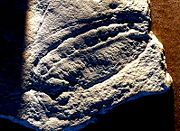 At least some may have been early forms of the phyla at the heart of the "Cambrian explosion" debate, having been interpreted as early molluscs (Kimberella
), echinoderms (Arkarua
); and arthropods (Spriggina
, Parvancorina
). There is still debate about the classification of these specimens, mainly because the diagnostic features that allow taxonomists to classify more recent organisms, such as similarities to living organisms, are generally absent in the Ediacarans. However there seems little doubt that Kimberella was at least a triploblastic bilaterian animal. These organisms are central to the debate about how abrupt the Cambrian explosion was. If some were early members of the animal phyla seen today, the "explosion" looks a lot less sudden than if all these organisms represent an unrelated "experiment", and were replaced by the animal kingdom fairly soon thereafter (40M years is "soon" by evolutionary and geological standards).
) and chitinous tubes of the sabelliditids (e.g. Sokoloviina, Sabellidites, Paleolina) that prospered up to the beginning of the Tommotian. The mineralized tubes of Cloudina, Namacalathus
, Sinotubulites
and a dozen more of the other organisms from carbonate rocks formed near the end of the Ediacaran period from , as well as the triradially symmetrical mineralized tubes of anabaritids (e.g. Anabarites
, Cambrotubulus) from uppermost Ediacaran and lower Cambrian. It is interesting to notice that Ediacaran mineralized tubes are often found in carbonates of the stromatolite
reefs and thrombolite
s, i.e. they could live in environment adverse for the majority of animals.
Although they are as hard to classify as most other Ediacaran organisms, they are important in two other ways. First, they are the earliest known calcifying organisms (organisms that built shells out of calcium carbonate
). Secondly, these tubes are a device to rise over a substrate and competitors for effective feeding and, to a lesser degree, they serve as armor for protection against predators and adverse conditions of environment. Some Cloudina fossils show small holes in shells. It is possible that the holes are evidence of boring by predators sufficiently advanced to penetrate shells. A possible "evolutionary arms race
" between predators and prey is one of the theories that attempt to explain the Cambrian explosion.
In the lowest Cambrian occurs the extinction of stromatolites. This allowed animals to begin colonization of warm-water pools with carbonate sedimentation. At first it was anabaritid
s and Protohertzina (the fossilized grasping spines of chaetognaths
) fossils. Such mineral skeletons as shells, sclerites, thorns and plates appeared in uppermost Nemakit-Daldynian; they were the earliest species of halkierids
, gastropods
, hyoliths
and other rare organisms. The beginning of the Tommotian has historically been understood to mark an explosive increase of the number and variety of fossils of molluscs
, hyoliths and sponges, along with a rich complex of skeletal elements of unknown animals, the first archaeocyathids, brachiopod
s, tommotiid
s and others. This sudden increase is partially an artefact of missing strata at the Tommotian type section, and most of this fauna in fact began to diversify in a series of pulses through the Nemakit-Daldynian and into the Tommotian.
Some animals may already have had sclerites, thorns and plates in the Ediacaran (e.g. Kimberella
had hard sclerites, probably of carbonate), but thin carbonate skeletons cannot be fossilized in siliciclastic
deposits. Older (~750 Ma) fossils indicate that mineralization long preceded the Cambrian, probably defending small photosynthetic algae from single-celled eukaryotic predators.
” have been found in many parts on the world, and date from just before the Cambrian to about 10 million years after the start of the Cambrian (the Nemakit-Daldynian and Tommotian ages; see timeline). These are a very mixed collection of fossils: spines, sclerites (armor plates), tubes, archeocyathids (sponge-like animals) and small shells very like those of brachiopod
s and snail-like molluscs – but all tiny, mostly 1 to 2 mm long.
While small, these fossils are far more common than complete fossils of the organisms that produced them; crucially, they cover the window from the start of the Cambrian to the first lagerstatten: a period of time that is otherwise lacking in fossils. Hence they supplement the conventional fossil record, and allow the fossil ranges of many groups to be extended.
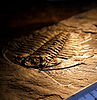 The earliest Cambrian trilobite
fossils are about 530 million years old, but the class was already quite diverse and worldwide, suggesting that they had been around for quite some time.
It is important to remember that the fossil record of trilobites begins from the time of appearance of trilobites with mineral exoskeleton—not from the time of their origin.
The earliest generally accepted echinoderm
fossils appeared a little bit later, in the Late Atdabanian; unlike modern echinoderms, these early Cambrian echinoderms were not all radially symmetrical.
These provide firm data points for the "end" of the explosion, or at least indications that the crown groups of modern phyla were represented.
However, the assemblages may represent a "museum": a deep water ecosystem that is evolutionarily "behind" the rapidly diversifying faunas of shallower waters.
Because the lagerstatten provide a mode and quality of preservation that's virtually absent outside of the Cambrian, lots of organisms appear completely different to anything known from the conventional fossil record. This led early workers in the field to attempt to shoehorn the organisms into extant phyla; the shortcomings of this approach led them to erect a multitude of new phyla to accommodate all the oddballs. It has since been realised that most oddballs diverged from lineages before they established the phyla we know today – slightly different designs, which were fated to perish rather than flourish into phyla, as their cousin lineages did.
The preservational mode is rare in the preceding Ediacaran period, but those assemblages known show no trace of animal life – perhaps implying a genuine absence of macroscopic metazoans.
s, are very rare throughout the Cambrian. Convincing crustaceans were once thought to be common in Burgess shale-type biotas, but none of these individuals can be shown to fall into the crown group of "true crustaceans". The Cambrian record of crown group crustaceans comes from microfossils. The Swedish Orsten
horizons contain later Cambrian crustacea, but only organisms smaller than 2 mm are preserved. This restricts the data set to juveniles and miniaturised adults.
A more informative data source is the organic microfossils of the Mount Cap formation, Canada. This late Early Cambrian assemblage consists of microscopic fragments of arthropods' cuticle, which is left behind when the rock is dissolved with hydrofluoric acid
. The diversity of this assemblage is similar to that of modern crustacean faunas. Most interestingly, analysis of fragments of feeding machinery found in the formation shows that it was adapted to feed in a very precise and refined fashion. This contrasts with most other early Cambrian arthropods, which fed messily by shovelling anything they could get their feeding appendages on into their mouths. This sophisticated and specialised feeding machinery belonged to a large (~30 cm) organism, and would have provided great potential for diversification: specialised feeding apparatus allows a number of different approaches to feeding and development, and creates a number of different approaches to avoid being eaten
at the Cambrian-Ordovician boundary, another radiation occurred, which established the taxa that would dominate the Palaeozoic.
During this radiation, the total number of orders doubled, and families tripled, increasing marine diversity to levels typical of the Palaeozoic, and disparity to levels approximately equivalent to today's.
groups appeared in a few million years of the early to mid-Cambrian, and even in the 1980s this still appeared to be the case.
However, evidence of Precambrian metazoa is gradually accumulating. If the Ediacaran Kimberella was a mollusc-like protostome
(one of the two main groups of coelomates), the protostome and deuterostome
lineages must have split significantly before (deuterostomes are the other main group of coelomates). Even if it is not a protostome, it is widely accepted as a bilaterian. Since fossils of rather modern-looking Cnidaria
ns (jellyfish
-like organisms) have been found in the Doushantuo
lagerstätte
, the Cnidarian and bilaterian lineages must have diverged well over .
Trace fossils and predatory borings in Cloudina shells provide further evidence of Ediacaran animals. Some fossils from the Doushantuo formation have been interpreted as embryos and one (Vernanimalcula
) as a bilaterian coelomate, although these interpretations are not universally accepted. Earlier still, predatory pressure has acted on stromatolite
s and acritarch
s since around .
The presence of Precambrian animals somewhat dampens the "bang" of the explosion: not only was the appearance of animals gradual, but their evolutionary radiation
("diversification") may also not have been as rapid as once thought. Indeed, statistical analysis shows that the Cambrian explosion was no faster than any of the other radiations in animals' history. However, it does seem that some innovations linked to the explosion — such as resistant armour — only evolved once in the animal lineage; this makes a lengthy Precambrian animal lineage harder to defend. Further, the conventional view that all the phyla arose in the Cambrian is flawed; while the phyla may have diversified in this time period, representatives of the crown-groups of many phyla do not appear until much later in the Phanerozoic. Further, the mineralized phyla that form the basis of the fossil record may not be representative of other phyla, since most mineralized phyla originated in a benthic setting. The fossil record is consistent with a Cambrian Explosion that was limited to the benthos, with pelagic phyla evolving much later.
There is little doubt that disparity – that is, the range of different organism "designs" or "ways of life" – rose sharply in the early Cambrian. However, recent research has overthrown the once-popular idea that disparity was exceptionally high throughout the Cambrian, before subsequently decreasing. In fact, disparity remains relatively low throughout the Cambrian, with modern levels of disparity only attained after the early Ordovician radiation.
The diversity of many Cambrian assemblages is similar to today's, and at a high (class/phylum) level, diversity is thought by some to have risen relatively smoothly through the Cambrian, stabilizing somewhat in the Ordovician. This interpretation, however, betrays a gradualist bias, and glosses over the astonishing and fundamental pattern of basal polytomy and phylogenetic telescoping at or near the Cambrian boundary, as seen in most major animal lineages. Thus Harry Whittington's questions regarding the abrupt nature of the Cambrian explosion remain, and have yet to be satisfactorily answered.
) existed before and possibly long before the start of the Cambrian, it seems that the pace of evolution was exceptionally fast in the early Cambrian. Possible explanations for this fall into three broad categories: environmental, developmental, and ecological changes. Any explanation must explain the timing and magnitude of the explosion.
contained no free oxygen
; the oxygen that animals breathe today, both in the air and dissolved in water, is the product of billions of years of photosynthesis
. As a general trend, the concentration
of oxygen in the atmosphere has risen gradually over about the last 2.5 billion years.
Shortage of oxygen might well have prevented the rise of large, complex animals. The amount of oxygen an animal can absorb is largely determined by the area of its oxygen-absorbing surfaces (lungs and gills in the most complex animals; the skin in less complex ones); but the amount needed is determined by its volume, which grows faster than the oxygen-absorbing area if an animal’s size increases equally in all directions. An increase in the concentration of oxygen in air or water would increase the size to which an organism could grow without its tissues becoming starved of oxygen. However, members of the Ediacara biota
reached metres in length; clearly oxygen did not limit their growth. Other metabolic functions may have been inhibited by lack of oxygen, for example the construction of tissue such as collagen
, required for the construction of complex structures, or to form molecules for the construction of a hard exoskeleton. However, animals are not affected when similar oceanographic conditions occur in the Phanerozoic; there is no convincing correlation between oxygen levels and evolution, so oxygen may have been no more a prerequisite to complex life than liquid water or primary productivity.
(extending into the early Ediacaran
period), the Earth suffered massive glaciations
in which most of its surface was covered by ice. This may have caused a mass extinction, creating a genetic bottleneck; the resulting diversification may have given rise to the Ediacara biota, which appears soon after the last "Snowball Earth" episode.
However, the snowball episodes occurred a long time before the start of the Cambrian, and it is hard to see how so much diversity could have been caused by even a series of bottlenecks; the cold periods may even have delayed the evolution of large size.
to adult may have been able to cause very large changes in the final adult form. The hox genes, for example, control which organs individual regions of an embryo will develop into. For instance, if a certain hox gene is expressed, a region will develop into a limb; if a different hox gene is expressed in that region (a minor change), it could develop into an eye instead (a phenotypically major change).
Such a system allows a large range of disparity to appear from a limited set of genes, but such theories linking this with the explosion struggle to explain why the origin of such a development system should by itself lead to increased diversity or disparity. Evidence of Precambrian metazoans combines with molecular data to show that much of the genetic architecture that could feasibly have played a role in the explosion was already well established by the Cambrian.
This apparent paradox is addressed in a theory that focuses on the physics
of development. It is proposed that the emergence of simple multicellular forms provided a changed context and spatial scale in which novel physical processes and effects were mobilized by the products of genes that had previously evolved to serve unicellular functions. Morphological complexity (layers, segments, lumens, appendages) arose, in this view, by self-organization
.
; some suggest arms races
between predators and prey, and others focus on the more general mechanisms of coevolution. Such theories are well suited to explaining why there was a rapid increase in both disparity and diversity, but they must explain why the "explosion" happened when it did.
and shelly fossils such as Cloudina, and the accompanying perturbation in the record.
Mass extinctions are often followed by adaptive radiation
s as existing clades expand to occupy the ecospace emptied by the extinction. However, once the dust had settled, overall disparity and diversity returned to the pre-extinction level in each of the Phanerozoic extinctions.
has proposed that predator-prey relationships changed dramatically after eyesight evolved. Prior to that time hunting and evading were both close-range affairs – smell, vibration, and touch were the only senses used. When predators could see their prey from a distance, new defensive strategies were needed. Armor, spines, and similar defenses may also have evolved in response to vision. He further observed that where animals lose vision in unlighted environments such as caves, diversity of animal forms tends to decrease. Nevertheless many scientists doubt that vision could have caused the explosion. Eyes may well have evolved long before the start of the Cambrian. It is also difficult to understand why the evolution of eyesight would have caused an explosion, since other senses such as smell and pressure detection can detect things further away than they can be seen under the sea, but the appearance of these other senses apparently did not cause an evolutionary explosion.
often makes the difference between life and death, and is therefore one of the strongest components of natural selection
. The pressure to adapt is stronger on the prey than on the predator: if the predator fails to win a contest, it loses its lunch; if the prey is the loser, it loses its life.
But there is evidence that predation was rife long before the start of the Cambrian, for example in the increasingly spiny forms of acritarch
s, the holes drilled in Cloudina shells, and traces of burrowing to avoid predators. Hence it is unlikely that the appearance of predation was the trigger for the Cambrian "explosion", although it may well have exhibited a strong influence on the body forms that the "explosion" produced. However, the intensity of predation does appear to have increased dramatically during the Cambrian as new predatory "tactics" (such as shell-crushing) emerged.
has been similar to modern levels since early in the Proterozoic. Before the start of the Cambrian, their corpses and droppings were too small to fall quickly towards the seabed, since their drag
was about the same as their weight. This meant they were destroyed by scavenger
s or by chemical processes before they reached the sea floor.
Mesozooplankton are plankton of a larger size, and early Cambrian specimens filtered
microscopic plankton from the seawater. These larger organisms would have produced droppings and corpses that were large enough to fall fairly quickly. This provided a new supply of energy and nutrients to the mid-levels and bottoms of the seas, which opened up a huge range of new possible ways of life. If any of these remains sank uneaten to the sea floor they could be buried; this would have taken some carbon
out of circulation
, resulting in an increase in the concentration
of breathable oxygen in the seas (carbon readily combines
with oxygen).
The initial herbivorous mesozooplankton were probably larvae of benthic (seafloor) animals. A larval stage was probably an evolutionary innovation driven by the increasing level of predation at the seafloor during the Ediacaran
period.
Metazoans have an amazing ability to increase diversity through coevolution. This means that a trait of one organism can cause another to evolve in response; a number of responses are possible, and a different species can potentially emerge for each. As a simple example, the evolution of predation may have caused one organism to develop defence while another developed motion to flee. This would cause the predator lineage to split into two species: one that was good at chasing prey, and another that was good at breaking through defences. Actual coevolution is somewhat more subtle, but in this fashion, great diversity can arise: three quarters of living species are animals, and most of the rest have formed by coevolution with animals.
in 2010, have shown that eukaryotic multicellularity, which had been thought to evolve with the beginning of Cambrian Period, might date back to 2.1 billion years ago, which is approximately 1.55 billion years earlier than the date indicated by currently dominating scientific evidence.
in the Earth's orbital motion, or the operation of different evolutionary mechanisms from those that are seen in the rest of the Phanerozoic
eon.
clade
s of which Cambrian fossils have been found. Later radiations
, such as those of fish
in the Silurian
and Devonian
periods, involved fewer taxa
, mainly with very similar body plans. Although the recovery from the Permian-Triassic extinction started with about as few animal species as the Cambrian explosion, the recovery produced far fewer significantly new types of animals.
Whatever triggered the early Cambrian diversification opened up an exceptionally wide range of previously unavailable ecological niche
s. When these were all occupied, there was little room for such wide-ranging diversifications to occur again, because there was strong competition in all niches and s usually had the advantage. If there had continued to be a wide range of empty niches, clades would be able to continue diversifying and become disparate enough for us to recognise them as different phyla
; when niches are filled, lineages will continue to resemble one another long after they diverge, as there is limited opportunity for them to change their life-styles and forms.
There were two similar explosions in the evolution of land plants: after a cryptic history beginning about , land plants underwent a uniquely rapid adaptive radiation during the Devonian period, about . Furthermore, Angiosperms (flowering plant
s) originated and rapidly diversified during the Cretaceous period.
Timeline References:
Phylum
In biology, a phylum The term was coined by Georges Cuvier from Greek φῦλον phylon, "race, stock," related to φυλή phyle, "tribe, clan." is a taxonomic rank below kingdom and above class. "Phylum" is equivalent to the botanical term division....
, as demonstrated in the fossil
Fossil
Fossils are the preserved remains or traces of animals , plants, and other organisms from the remote past...
record, accompanied by major diversification of other organisms, including animal
Animal
Animals are a major group of multicellular, eukaryotic organisms of the kingdom Animalia or Metazoa. Their body plan eventually becomes fixed as they develop, although some undergo a process of metamorphosis later on in their life. Most animals are motile, meaning they can move spontaneously and...
s, phytoplankton
Phytoplankton
Phytoplankton are the autotrophic component of the plankton community. The name comes from the Greek words φυτόν , meaning "plant", and πλαγκτός , meaning "wanderer" or "drifter". Most phytoplankton are too small to be individually seen with the unaided eye...
, and calcimicrobe
Calcimicrobe
Characteristic of the Neoproterozoic and Cambrian periods, the heterogeneous group called calcimicrobes are calcareous colonial microfossils, which include many morphologically dissimilar organisms, whose effect in massive aggregations, in association with shelly metazoans, was to lay down the...
s. Before about , most organisms were simple, composed of individual cells occasionally organized into colonies
Colony (biology)
In biology, a colony reference to several individual organisms of the same species living closely together, usually for mutual benefit, such as stronger defense or the ability to attack bigger prey. Some insects live only in colonies...
. Over the following 70 or 80 million years the rate of evolution
Evolution
Evolution is any change across successive generations in the heritable characteristics of biological populations. Evolutionary processes give rise to diversity at every level of biological organisation, including species, individual organisms and molecules such as DNA and proteins.Life on Earth...
accelerated by an order of magnitude
Order of magnitude
An order of magnitude is the class of scale or magnitude of any amount, where each class contains values of a fixed ratio to the class preceding it. In its most common usage, the amount being scaled is 10 and the scale is the exponent being applied to this amount...
(as defined in terms of the extinction and origination rate of species) and the diversity of life began to resemble that of today.
The Cambrian explosion has generated extensive scientific debate. The seemingly rapid appearance of fossils in the “Primordial Strata” was noted as early as the mid 19th century, and Charles Darwin
Charles Darwin
Charles Robert Darwin FRS was an English naturalist. He established that all species of life have descended over time from common ancestry, and proposed the scientific theory that this branching pattern of evolution resulted from a process that he called natural selection.He published his theory...
saw it as one of the main objections that could be made against his theory of evolution by natural selection
Natural selection
Natural selection is the nonrandom process by which biologic traits become either more or less common in a population as a function of differential reproduction of their bearers. It is a key mechanism of evolution....
.
The long-running puzzlement about the appearance of the Cambrian fauna
Fauna
Fauna or faunæ is all of the animal life of any particular region or time. The corresponding term for plants is flora.Zoologists and paleontologists use fauna to refer to a typical collection of animals found in a specific time or place, e.g. the "Sonoran Desert fauna" or the "Burgess shale fauna"...
, seemingly abruptly and from nowhere, centers on three key points: whether there really was a mass diversification of complex organisms over a relatively short period of time during the early Cambrian; what might have caused such rapid change; and what it would imply about the origin and evolution of animals. Interpretation is difficult due to a limited supply of evidence, based mainly on an incomplete fossil record and chemical signatures left in Cambrian rocks.
History and significance
Geologists as long ago as William BucklandWilliam Buckland
The Very Rev. Dr William Buckland DD FRS was an English geologist, palaeontologist and Dean of Westminster, who wrote the first full account of a fossil dinosaur, which he named Megalosaurus...
(1784–1856) realised that a dramatic step-change in the fossil record occurred around the base of what we now call the Cambrian
Cambrian
The Cambrian is the first geological period of the Paleozoic Era, lasting from Mya ; it is succeeded by the Ordovician. Its subdivisions, and indeed its base, are somewhat in flux. The period was established by Adam Sedgwick, who named it after Cambria, the Latin name for Wales, where Britain's...
. Charles Darwin considered this sudden appearance of many animal groups with few or no antecedents to be the greatest single objection to his theory of evolution. He had even devoted a substantial chapter of The Origin of Species
The Origin of Species
Charles Darwin's On the Origin of Species, published on 24 November 1859, is a work of scientific literature which is considered to be the foundation of evolutionary biology. Its full title was On the Origin of Species by Means of Natural Selection, or the Preservation of Favoured Races in the...
to solving this problem.
American palæontologist Charles Walcott
Charles Doolittle Walcott
Charles Doolittle Walcott was an American invertebrate paleontologist. He became known for his discovery in 1909 of well-preserved fossils in the Burgess Shale of British Columbia, Canada.-Early life:...
proposed that an interval of time, the “Lipalian”, was not represented in the fossil record or did not preserve fossils, and that the ancestors of the Cambrian animals evolved during this time.
More recently it was discovered that the history of life on earth goes back at least : Rocks of that age at Warrawoona in Australia
Australia
Australia , officially the Commonwealth of Australia, is a country in the Southern Hemisphere comprising the mainland of the Australian continent, the island of Tasmania, and numerous smaller islands in the Indian and Pacific Oceans. It is the world's sixth-largest country by total area...
contain fossils of stromatolite
Stromatolite
Stromatolites or stromatoliths are layered accretionary structures formed in shallow water by the trapping, binding and cementation of sedimentary grains by biofilms of microorganisms, especially cyanobacteria ....
s, stubby pillars that are formed by colonies of Microorganism
Microorganism
A microorganism or microbe is a microscopic organism that comprises either a single cell , cell clusters, or no cell at all...
s. Fossils (Grypania
Grypania
Grypania is an early, tube-shaped fossil from the Proterozoic Eon. The organism could have been a giant bacterium or bacterial colony, but because of its size and consistent form, is more likely to have been a eukaryotic alga. The oldest probable Grypania fossils date to about 2.1 billion years...
) of more complex eukaryotic
Eukaryote
A eukaryote is an organism whose cells contain complex structures enclosed within membranes. Eukaryotes may more formally be referred to as the taxon Eukarya or Eukaryota. The defining membrane-bound structure that sets eukaryotic cells apart from prokaryotic cells is the nucleus, or nuclear...
cells, from which all animals, plants and fungi are built, have been found in rocks from , in China
China
Chinese civilization may refer to:* China for more general discussion of the country.* Chinese culture* Greater China, the transnational community of ethnic Chinese.* History of China* Sinosphere, the area historically affected by Chinese culture...
and Montana
Montana
Montana is a state in the Western United States. The western third of Montana contains numerous mountain ranges. Smaller, "island ranges" are found in the central third of the state, for a total of 77 named ranges of the Rocky Mountains. This geographical fact is reflected in the state's name,...
. Rocks dating from contain fossils of the Ediacara biota
Ediacara biota
The Ediacara biota consisted of enigmatic tubular and frond-shaped, mostly sessile organisms which lived during the Ediacaran Period . Trace fossils of these organisms have been found worldwide, and represent the earliest known complex multicellular organisms.Simple multicellular organisms such as...
, organisms so large that they must have been multi-celled, but very unlike any modern organism. P. E. Cloud argued in 1948 that there was a period of "eruptive" evolution in the Early Cambrian, but as recently as the 1970s there was no sign of how the relatively modern-looking organisms of the Middle and Late Cambrian
Cambrian
The Cambrian is the first geological period of the Paleozoic Era, lasting from Mya ; it is succeeded by the Ordovician. Its subdivisions, and indeed its base, are somewhat in flux. The period was established by Adam Sedgwick, who named it after Cambria, the Latin name for Wales, where Britain's...
arose.
Harry B. Whittington
Harry Blackmore Whittington FRS was a British paleontologist based at the Department of Earth Sciences, Cambridge, and was affiliated to Sidney Sussex College. He attended Handsworth Grammar School in Birmingham, followed by a degree and Ph.D in geology from the University of Birmingham...
and colleagues, who in the 1970s re-analysed many fossils from the Burgess Shale
Burgess Shale
The Burgess Shale Formation, located in the Canadian Rockies of British Columbia, is one of the world's most celebrated fossil fields, and the best of its kind. It is famous for the exceptional preservation of the soft parts of its fossils...
(see below) and concluded that several were complex but different from any living animals. The most common organism, Marrella, was clearly an arthropod
Arthropod
An arthropod is an invertebrate animal having an exoskeleton , a segmented body, and jointed appendages. Arthropods are members of the phylum Arthropoda , and include the insects, arachnids, crustaceans, and others...
, but not a member of any known arthropod class
Class (biology)
In biological classification, class is* a taxonomic rank. Other well-known ranks are life, domain, kingdom, phylum, order, family, genus, and species, with class fitting between phylum and order...
. Organisms such as the five-eyed Opabinia
Opabinia
Opabinia is an animal genus found in Cambrian fossil deposits. Its sole species, Opabinia regalis, is known from the Middle Cambrian Burgess Shale of British Columbia, Canada. Fewer than twenty good specimens have been described; 3 specimens of Opabinia are known from the Greater Phyllopod bed,...
and spiny slug-like Wiwaxia
Wiwaxia
Wiwaxia is a genus of soft-bodied, scale-covered animals known from Burgess shale type Lagerstätte dating from the upper Lower Cambrian to Middle Cambrian. The organisms are mainly known from dispersed sclerites; articulated specimens, where found, range from to a little over 50.8 millimeters in...
were so different from anything else known that Whittington's team assumed they must represent different phyla
Phylum
In biology, a phylum The term was coined by Georges Cuvier from Greek φῦλον phylon, "race, stock," related to φυλή phyle, "tribe, clan." is a taxonomic rank below kingdom and above class. "Phylum" is equivalent to the botanical term division....
, only distantly related to anything known today. Stephen Jay Gould
Stephen Jay Gould
Stephen Jay Gould was an American paleontologist, evolutionary biologist, and historian of science. He was also one of the most influential and widely read writers of popular science of his generation....
’s popular 1989 account of this work, Wonderful Life
Wonderful Life (book)
Wonderful Life: The Burgess Shale and the Nature of History is a book on the evolution of Cambrian fauna by Harvard paleontologist Stephen Jay Gould...
, brought the matter into the public eye and raised questions about what the explosion represented. While differing significantly in details, both Whittington and Gould proposed that all modern animal phyla
Phylum
In biology, a phylum The term was coined by Georges Cuvier from Greek φῦλον phylon, "race, stock," related to φυλή phyle, "tribe, clan." is a taxonomic rank below kingdom and above class. "Phylum" is equivalent to the botanical term division....
had appeared rather suddenly. This view was influenced by the theory of punctuated equilibrium
Punctuated equilibrium
Punctuated equilibrium is a theory in evolutionary biology which proposes that most species will exhibit little net evolutionary change for most of their geological history, remaining in an extended state called stasis...
, which Eldredge
Niles Eldredge
Niles Eldredge is an American paleontologist, who, along with Stephen Jay Gould, proposed the theory of punctuated equilibrium in 1972.-Education:...
and Gould developed in the early 1970s and which views evolution as long intervals of near-stasis "punctuated" by short periods of rapid change.
Other analyses, some more recent and some dating back to the 1970s, argue that complex animals similar to modern types evolved well before the start of the Cambrian. There has also been intense debate whether there was a genuine "explosion" of modern forms in the Cambrian and, to the extent that there was, how it happened and why it happened then.
Types of evidence
Deducing the events of half a billion years ago is difficult, as evidence comes exclusively from biological and chemical signatures in rocks and very sparse fossils.Dating the Cambrian
Accurate absolute radiometricRadiometric dating
Radiometric dating is a technique used to date materials such as rocks, usually based on a comparison between the observed abundance of a naturally occurring radioactive isotope and its decay products, using known decay rates...
dates for much of the Cambrian, obtained by detailed analysis of radioactive elements contained within rocks, have only rather recently become available, and for only a few regions.
Relative dating (A was before B) is often sufficient for studying processes of evolution, but this too has been difficult, because of the problems involved in matching up rocks of the same age across different continent
Continent
A continent is one of several very large landmasses on Earth. They are generally identified by convention rather than any strict criteria, with seven regions commonly regarded as continents—they are : Asia, Africa, North America, South America, Antarctica, Europe, and Australia.Plate tectonics is...
s.
Therefore dates or descriptions of sequences of events should be regarded with some caution until better data becomes available.
Body fossils
Fossils of organisms' bodies are usually the most informative type of evidence. Fossilisation is a rare event, and most fossils are destroyed by erosionErosion
Erosion is when materials are removed from the surface and changed into something else. It only works by hydraulic actions and transport of solids in the natural environment, and leads to the deposition of these materials elsewhere...
or metamorphism
Metamorphism
Metamorphism is the solid-state recrystallization of pre-existing rocks due to changes in physical and chemical conditions, primarily heat, pressure, and the introduction of chemically active fluids. Mineralogical, chemical and crystallographic changes can occur during this process...
before they can be observed. Hence the fossil record is very incomplete, increasingly so, further back in time. Despite this, they are often adequate to illustrate the broader patterns of life's history. There are also biases in the fossil record: different environments are more favourable to the preservation of different types of organism or parts of organisms. Further, only the parts of organisms that were already mineralised
Mineralization (biology)
In biology, mineralization refers to the process where an organic substance is converted to an inorganic substance.This may also be a normal biological process which takes place during the life of an organism such as the formation of bone tissue or egg shells, largely with calcium.This term may...
are usually preserved, such as the shells of molluscs. Since most animal species are soft-bodied, they decay before they can become fossilised. As a result, although there are 30-plus phyla
Phylum
In biology, a phylum The term was coined by Georges Cuvier from Greek φῦλον phylon, "race, stock," related to φυλή phyle, "tribe, clan." is a taxonomic rank below kingdom and above class. "Phylum" is equivalent to the botanical term division....
of living animals, two-thirds have never been found as fossils.
The Cambrian fossil record includes an unusually high number of lagerstätte
Lagerstätte
A Lagerstätte is a sedimentary deposit that exhibits extraordinary fossil richness or completeness.Palaeontologists distinguish two kinds....
n, which preserve soft tissues. These allow palæontologists
Paleontology
Paleontology "old, ancient", ὄν, ὀντ- "being, creature", and λόγος "speech, thought") is the study of prehistoric life. It includes the study of fossils to determine organisms' evolution and interactions with each other and their environments...
to examine the internal anatomy of animals, which in other sediments are only represented by shells, spines, claws, etc. – if they are preserved at all. The most significant Cambrian lagerstätten are the early Cambrian Maotianshan shale beds of Chengjiang (Yunnan
Yunnan
Yunnan is a province of the People's Republic of China, located in the far southwest of the country spanning approximately and with a population of 45.7 million . The capital of the province is Kunming. The province borders Burma, Laos, and Vietnam.Yunnan is situated in a mountainous area, with...
, China
China
Chinese civilization may refer to:* China for more general discussion of the country.* Chinese culture* Greater China, the transnational community of ethnic Chinese.* History of China* Sinosphere, the area historically affected by Chinese culture...
) and Sirius Passet
Sirius Passet
Sirius Passet is a Cambrian Lagerstätte in Greenland. The Sirius Passet Lagerstätte was named after the Sirius sledge patrol that operates in North Greenland. It comprises six localities located on the eastern shore of J.P. Koch Fjord in the far north of Greenland. It was discovered in 1984 by A....
(Greenland
Greenland
Greenland is an autonomous country within the Kingdom of Denmark, located between the Arctic and Atlantic Oceans, east of the Canadian Arctic Archipelago. Though physiographically a part of the continent of North America, Greenland has been politically and culturally associated with Europe for...
); the middle Cambrian Burgess Shale
Burgess Shale
The Burgess Shale Formation, located in the Canadian Rockies of British Columbia, is one of the world's most celebrated fossil fields, and the best of its kind. It is famous for the exceptional preservation of the soft parts of its fossils...
(British Columbia
British Columbia
British Columbia is the westernmost of Canada's provinces and is known for its natural beauty, as reflected in its Latin motto, Splendor sine occasu . Its name was chosen by Queen Victoria in 1858...
, Canada
Canada
Canada is a North American country consisting of ten provinces and three territories. Located in the northern part of the continent, it extends from the Atlantic Ocean in the east to the Pacific Ocean in the west, and northward into the Arctic Ocean...
); and the late Cambrian Orsten
Orsten
The Upper Cambrian Orsten fauna includes fossilized organisms preserved in Orsten lagerstätten, notably at Kinnekulle and on the island of Öland, all in Sweden....
(Sweden
Sweden
Sweden , officially the Kingdom of Sweden , is a Nordic country on the Scandinavian Peninsula in Northern Europe. Sweden borders with Norway and Finland and is connected to Denmark by a bridge-tunnel across the Öresund....
) fossil beds.
While lagerstätten preserve far more than the conventional fossil record, they are far from complete. Because lagerstätten are restricted to a narrow range of environments (where soft-bodied organisms can be preserved very quickly, e.g. by mudslides), most animals are probably not represented; further, the exceptional conditions that create lagerstätten probably do not represent normal living conditions. In addition, the known Cambrian lagerstätten are rare and difficult to date, while Precambrian lagerstätten have yet to be studied in detail.
The sparseness of the fossil record means that organisms usually exist long before they are found in the fossil record – this is known as the Signor–Lipps effect.
Trace fossils
Trace fossil
Trace fossils, also called ichnofossils , are geological records of biological activity. Trace fossils may be impressions made on the substrate by an organism: for example, burrows, borings , urolites , footprints and feeding marks, and root cavities...
s consist mainly of tracks and burrows, but also include coprolite
Coprolite
A coprolite is fossilized animal dung. Coprolites are classified as trace fossils as opposed to body fossils, as they give evidence for the animal's behaviour rather than morphology. The name is derived from the Greek words κοπρος / kopros meaning 'dung' and λιθος / lithos meaning 'stone'. They...
s (fossil feces
Feces
Feces, faeces, or fæces is a waste product from an animal's digestive tract expelled through the anus or cloaca during defecation.-Etymology:...
) and marks left by feeding. Trace fossils are particularly significant because they represent a data source that is not limited to animals with easily fossilized hard parts, and which reflects organisms' behaviour. Also many traces date from significantly earlier than the body fossils of animals that are thought to have been capable of making them. While exact assignment of trace fossils to their makers is generally impossible, traces may for example provide the earliest physical evidence of the appearance of moderately complex animals (comparable to earthworm
Earthworm
Earthworm is the common name for the largest members of Oligochaeta in the phylum Annelida. In classical systems they were placed in the order Opisthopora, on the basis of the male pores opening posterior to the female pores, even though the internal male segments are anterior to the female...
s).
Geochemical observations
Several chemical markersGeochemistry
The field of geochemistry involves study of the chemical composition of the Earth and other planets, chemical processes and reactions that govern the composition of rocks, water, and soils, and the cycles of matter and energy that transport the Earth's chemical components in time and space, and...
indicate a drastic change in the environment around the start of the Cambrian. The markers are consistent with a mass extinction, or with a massive warming resulting from the release of methane ice.
Such changes may reflect a cause of the Cambrian explosion, although they may also have resulted from an increased level of biological activity – a possible result of the explosion. Despite these uncertainties, the geochemical evidence helps by making scientists focus on theories that are consistent with at least one of the likely environmental changes.
Phylogenetic techniques
CladisticsCladistics
Cladistics is a method of classifying species of organisms into groups called clades, which consist of an ancestor organism and all its descendants . For example, birds, dinosaurs, crocodiles, and all descendants of their most recent common ancestor form a clade...
is a technique for working out the “family tree” of a set of organisms. It works by the logic that, if groups B and C have more similarities to each other than either has to group A, then B and C are more closely related to each other than either is to A. Characteristics that are compared may be anatomical
Anatomy
Anatomy is a branch of biology and medicine that is the consideration of the structure of living things. It is a general term that includes human anatomy, animal anatomy , and plant anatomy...
, such as the presence of a notochord
Notochord
The notochord is a flexible, rod-shaped body found in embryos of all chordates. It is composed of cells derived from the mesoderm and defines the primitive axis of the embryo. In some chordates, it persists throughout life as the main axial support of the body, while in most vertebrates it becomes...
, or molecular
Molecular phylogeny
Molecular phylogenetics is the analysis of hereditary molecular differences, mainly in DNA sequences, to gain information on an organism's evolutionary relationships. The result of a molecular phylogenetic analysis is expressed in a phylogenetic tree...
, by comparing sequences of DNA
DNA
Deoxyribonucleic acid is a nucleic acid that contains the genetic instructions used in the development and functioning of all known living organisms . The DNA segments that carry this genetic information are called genes, but other DNA sequences have structural purposes, or are involved in...
or protein
Protein
Proteins are biochemical compounds consisting of one or more polypeptides typically folded into a globular or fibrous form, facilitating a biological function. A polypeptide is a single linear polymer chain of amino acids bonded together by peptide bonds between the carboxyl and amino groups of...
. The result of a successful analysis is a hierarchy of clade
Clade
A clade is a group consisting of a species and all its descendants. In the terms of biological systematics, a clade is a single "branch" on the "tree of life". The idea that such a "natural group" of organisms should be grouped together and given a taxonomic name is central to biological...
s – groups whose members are believed to share a common ancestor. The cladistic technique is sometimes problematic, as some features, such as wings or camera eyes
Evolution of the eye
The evolution of the eye has been a subject of significant study, as a distinctive example of a homologous organ present in a wide variety of taxa. Certain components of the eye, such as the visual pigments, appear to have a common ancestry – that is, they evolved once, before the animals radiated...
, evolved more than once, convergently
Convergent evolution
Convergent evolution describes the acquisition of the same biological trait in unrelated lineages.The wing is a classic example of convergent evolution in action. Although their last common ancestor did not have wings, both birds and bats do, and are capable of powered flight. The wings are...
– this must be taken into account in analyses.
From the relationships, it may be possible to constrain the date that lineages first appeared. For instance, if fossils of B or C date to X million years ago and the calculated "family tree" says A was an ancestor of B and C, then A must have evolved more than X million years ago.
It is also possible to estimate how long ago two living clades diverged – i.e. approximately how long ago their last common ancestor must have lived – by assuming that DNA mutation
Mutation
In molecular biology and genetics, mutations are changes in a genomic sequence: the DNA sequence of a cell's genome or the DNA or RNA sequence of a virus. They can be defined as sudden and spontaneous changes in the cell. Mutations are caused by radiation, viruses, transposons and mutagenic...
s accumulate at a constant rate. These "molecular clock
Molecular clock
The molecular clock is a technique in molecular evolution that uses fossil constraints and rates of molecular change to deduce the time in geologic history when two species or other taxa diverged. It is used to estimate the time of occurrence of events called speciation or radiation...
s", however, are fallible, and provide only a very approximate timing: they are not sufficiently precise and reliable for estimating when the groups that feature in the Cambrian explosion first evolved, and estimates produced by different techniques vary by a factor of two. However, the clocks can give an indication of branching rate, and when combined with the constraints of the fossil record, recent clocks suggest a sustained period of diversification through the Ediacaran and Cambrian.
Explanation of a few scientific terms
A phylumPhylum
In biology, a phylum The term was coined by Georges Cuvier from Greek φῦλον phylon, "race, stock," related to φυλή phyle, "tribe, clan." is a taxonomic rank below kingdom and above class. "Phylum" is equivalent to the botanical term division....
is the highest level in the Linnean system for classifying organisms. Phyla can be thought of as groupings of animals based on general body plan. Despite the seemingly different external appearances of organisms, they are classified into phyla based on their internal and developmental organizations. For example, despite their obvious differences, spider
Spider
Spiders are air-breathing arthropods that have eight legs, and chelicerae with fangs that inject venom. They are the largest order of arachnids and rank seventh in total species diversity among all other groups of organisms...
s and barnacle
Barnacle
A barnacle is a type of arthropod belonging to infraclass Cirripedia in the subphylum Crustacea, and is hence related to crabs and lobsters. Barnacles are exclusively marine, and tend to live in shallow and tidal waters, typically in erosive settings. They are sessile suspension feeders, and have...
s both belong to the phylum Arthropoda; but earthworm
Earthworm
Earthworm is the common name for the largest members of Oligochaeta in the phylum Annelida. In classical systems they were placed in the order Opisthopora, on the basis of the male pores opening posterior to the female pores, even though the internal male segments are anterior to the female...
s and tapeworms, although similar in shape, belong to different phyla.
A phylum is not a fundamental division of nature, such as the difference between electron
Electron
The electron is a subatomic particle with a negative elementary electric charge. It has no known components or substructure; in other words, it is generally thought to be an elementary particle. An electron has a mass that is approximately 1/1836 that of the proton...
s and proton
Proton
The proton is a subatomic particle with the symbol or and a positive electric charge of 1 elementary charge. One or more protons are present in the nucleus of each atom, along with neutrons. The number of protons in each atom is its atomic number....
s. It is simply a very high-level grouping in a classification system
Linnaean taxonomy
Linnaean taxonomy can mean either of two related concepts:# the particular form of biological classification set up by Carl Linnaeus, as set forth in his Systema Naturæ and subsequent works...
created to describe all currently living organisms. This system is imperfect, even for modern animals: different books quote different numbers of phyla, mainly because they disagree about the classification of a huge number of worm-like species. As it is based on living organisms, it accommodates extinct organisms poorly, if at all.
The concept of stem groups was introduced to cover evolutionary "aunts" and "cousins" of living groups. A crown group
Crown group
A crown group is a group consisting of living representatives, their ancestors back to the most recent common ancestor of that group, and all of that ancestor's descendants. The name was given by Willi Hennig, the formulator of phylogenetic systematics, as a way of classifying living organisms...
is a group of closely related living animals plus their last common ancestor plus all its descendants. A stem group is a set of offshoots from the lineage at a point earlier than the last common ancestor of the crown group; it is a relative concept, for example tardigrade
Tardigrade
Tardigrades form the phylum Tardigrada, part of the superphylum Ecdysozoa. They are microscopic, water-dwelling, segmented animals with eight legs. Tardigrades were first described by Johann August Ephraim Goeze in 1773...
s are living animals that form a crown group in their own right, but Budd (1996) regarded them also as being a stem group relative to the arthropods.
Triploblastic means consisting of 3 layers, which are formed
in the embryo
Embryo
An embryo is a multicellular diploid eukaryote in its earliest stage of development, from the time of first cell division until birth, hatching, or germination...
, quite early in the animal's development from a single-celled egg to a larva or juvenile form. The innermost layer forms the digestive tract (gut); the outermost forms skin; and the middle one forms muscles and all the internal organs except the digestive system. Most types of living animal are triploblastic – the best-known exceptions are Porifera (sponges) and Cnidaria
Cnidaria
Cnidaria is a phylum containing over 9,000 species of animals found exclusively in aquatic and mostly marine environments. Their distinguishing feature is cnidocytes, specialized cells that they use mainly for capturing prey. Their bodies consist of mesoglea, a non-living jelly-like substance,...
(jellyfish, sea anemones, etc.).
The bilateria
Bilateria
The bilateria are all animals having a bilateral symmetry, i.e. they have a front and a back end, as well as an upside and downside. Radially symmetrical animals like jellyfish have a topside and downside, but no front and back...
ns are animals that have right and left sides at some point in their life history. This implies that they have top and bottom surfaces and, importantly, distinct front and back ends. All known bilaterian animals are triploblastic, and all known triploblastic animals are bilaterian. Living Echinoderm
Echinoderm
Echinoderms are a phylum of marine animals. Echinoderms are found at every ocean depth, from the intertidal zone to the abyssal zone....
s (sea star
Sea star
Starfish or sea stars are echinoderms belonging to the class Asteroidea. The names "starfish" and "sea star" essentially refer to members of the class Asteroidea...
s, sea urchin
Sea urchin
Sea urchins or urchins are small, spiny, globular animals which, with their close kin, such as sand dollars, constitute the class Echinoidea of the echinoderm phylum. They inhabit all oceans. Their shell, or "test", is round and spiny, typically from across. Common colors include black and dull...
s, sea cucumbers, etc.) look radially symmetrical (like wheels) rather than bilaterian, but their larvae exhibit bilateral symmetry and some of the earliest echinoderms may have been bilaterally symmetrical. Porifera and Cnidaria
Cnidaria
Cnidaria is a phylum containing over 9,000 species of animals found exclusively in aquatic and mostly marine environments. Their distinguishing feature is cnidocytes, specialized cells that they use mainly for capturing prey. Their bodies consist of mesoglea, a non-living jelly-like substance,...
are radially symmetrical, non-bilaterian and non-triploblastic.
Coelomate means having a body cavity (coelom) containing the internal organs. Most of the phyla featured in the debate about the Cambrian explosion are coelomates: arthropod
Arthropod
An arthropod is an invertebrate animal having an exoskeleton , a segmented body, and jointed appendages. Arthropods are members of the phylum Arthropoda , and include the insects, arachnids, crustaceans, and others...
s, annelid
Annelid
The annelids , formally called Annelida , are a large phylum of segmented worms, with over 17,000 modern species including ragworms, earthworms and leeches...
worms, molluscs
Mollusca
The Mollusca , common name molluscs or mollusksSpelled mollusks in the USA, see reasons given in Rosenberg's ; for the spelling mollusc see the reasons given by , is a large phylum of invertebrate animals. There are around 85,000 recognized extant species of molluscs. Mollusca is the largest...
, echinoderm
Echinoderm
Echinoderms are a phylum of marine animals. Echinoderms are found at every ocean depth, from the intertidal zone to the abyssal zone....
s and chordate
Chordate
Chordates are animals which are either vertebrates or one of several closely related invertebrates. They are united by having, for at least some period of their life cycle, a notochord, a hollow dorsal nerve cord, pharyngeal slits, an endostyle, and a post-anal tail...
s – the non-coelomate priapulids are an important exception. All known coelomate animals are triploblastic bilaterians, but some triploblastic bilaterian animals do not have a coelom – for example flatworm
Flatworm
The flatworms, known in scientific literature as Platyhelminthes or Plathelminthes are a phylum of relatively simple bilaterian, unsegmented, soft-bodied invertebrate animals...
s, whose organs are surrounded by unspecialized tissues
Parenchyma
Parenchyma is a term used to describe a bulk of a substance. It is used in different ways in animals and in plants.The term is New Latin, f. Greek παρέγχυμα - parenkhuma, "visceral flesh", f. παρεγχεῖν - parenkhein, "to pour in" f. para-, "beside" + en-, "in" + khein, "to pour"...
.
Precambrian life
Our understanding of the Cambrian explosion relies upon knowing what was there beforehand – did the event herald the sudden appearance of a wide range of animals and behaviours, or did such things exist beforehand?Evidence of animals around 1 billion years ago
- For further information, see AcritarchAcritarchAcritarchs are small organic fossils, present from approximately to the present. Their diversity reflects major ecological events such as the appearance of predation and the Cambrian explosion.-Definition:In general, any small, non-acid soluble Acritarchs are small organic fossils, present from...
and StromatoliteStromatoliteStromatolites or stromatoliths are layered accretionary structures formed in shallow water by the trapping, binding and cementation of sedimentary grains by biofilms of microorganisms, especially cyanobacteria ....
Stromatolite
Stromatolites or stromatoliths are layered accretionary structures formed in shallow water by the trapping, binding and cementation of sedimentary grains by biofilms of microorganisms, especially cyanobacteria ....
s, stubby pillars built by colonies of microorganism
Microorganism
A microorganism or microbe is a microscopic organism that comprises either a single cell , cell clusters, or no cell at all...
s, are a major constituent of the fossil record from about , but their abundance and diversity declined steeply after about . This decline has been attributed to disruption by grazing and burrowing animals.
Precambrian marine diversity was dominated by small fossils known as acritarch
Acritarch
Acritarchs are small organic fossils, present from approximately to the present. Their diversity reflects major ecological events such as the appearance of predation and the Cambrian explosion.-Definition:In general, any small, non-acid soluble Acritarchs are small organic fossils, present from...
s. This term describes almost any small organic walled fossil–from the egg cases of small metazoans
Animal
Animals are a major group of multicellular, eukaryotic organisms of the kingdom Animalia or Metazoa. Their body plan eventually becomes fixed as they develop, although some undergo a process of metamorphosis later on in their life. Most animals are motile, meaning they can move spontaneously and...
to resting cyst
Cyst
A cyst is a closed sac, having a distinct membrane and division on the nearby tissue. It may contain air, fluids, or semi-solid material. A collection of pus is called an abscess, not a cyst. Once formed, a cyst could go away on its own or may have to be removed through surgery.- Locations :* Acne...
s of many different kinds of green algae
Chlorophyta
Chlorophyta is a division of green algae, informally called chlorophytes. The name is used in two very different senses so that care is needed to determine the use by a particular author...
. After appearing around , acritarchs underwent a boom around , increasing in abundance, diversity, size, complexity of shape and especially size and number of spines. Their increasingly spiny forms in the last 1 billion years may indicate an increased need for defence against predation. Other groups of small organisms from the Neoproterozoic
Neoproterozoic
The Neoproterozoic Era is the unit of geologic time from 1,000 to 542.0 ± 1.0 million years ago. The terminal Era of the formal Proterozoic Eon , it is further subdivided into the Tonian, Cryogenian, and Ediacaran Periods...
era also show signs of anti-predator defenses. A consideration of taxon longevity appears to support an increase in predation pressure around this time,
However, in general, the rate of evolution in the Precambrian was very slow, with many cyanobacterial species persisting unchanged for billions of years.
If these predatory organisms really were metazoans, this means that Cambrian animals did not appear "from no-where" at the base of the Cambrian; their predecessors had existed for hundreds of millions of years.
Fossils of the Doushantuo formation
The Doushantuo formationDoushantuo Formation
The Doushantuo Formation is a Lagerstätte in Guizhou Province, China that is notable for being one of the oldest fossil beds to contain highly preserved fossils...
harbours microscopic fossils that may represent early bilaterians. Some have been described as animal embryos and eggs, although some of these may represent the remains of giant bacteria.
Another fossil, Vernanimalcula
Vernanimalcula
Vernanimalcula guizhouena is a fossil believed by some to represent the earliest known member of the Bilateria . It is known from deposits dating to . The fossils are between 0.1 and 0.2 mm across...
, has been interpreted as a coelomate bilaterian,
but may simply be an infilled bubble.
These fossils form the earliest hard-and-fast evidence of animals, as opposed to other predators.
Burrows
Around the start of the Cambrian (about ) many new types of traces first appear, including well-known vertical burrows such as Diplocraterion
Diplocraterion
Diplocraterion is an ichnogenus describing vertical U-shaped burrows having a spreite between the two limbs of the U. The spreite of fainter U-shaped traces appears above and below the final tunnel, made as the organism moved up and down through the sediment.- Further reading :* Šimo V. &...
and Skolithos
Skolithos
Skolithos is a common trace fossil ichnogenus whose original form consisted of approximately vertical cylinders. One well-known occurrence of Cambrian trace fossils is the famous 'Pipe Rock' of northwest Scotland...
, and traces normally attributed to arthropod
Arthropod
An arthropod is an invertebrate animal having an exoskeleton , a segmented body, and jointed appendages. Arthropods are members of the phylum Arthropoda , and include the insects, arachnids, crustaceans, and others...
s, such as Cruziana
Cruziana
Cruziana is a trace fossil consisting of elongate, bilobed, approximately bilaterally symmetrical burrows, usually preserved along bedding planes, with a sculpture of repeated striations that are mostly oblique to the long dimension...
and Rusophycus
Rusophycus
Rusophycus is a trace fossil allied to Cruziana. Rusophycus is the resting trace, recording the outline of the tracemaker; Cruziana is made when the organism moved...
. The vertical burrows indicate that worm-like animals acquired new behaviours, and possibly new physical capabilities. Some Cambrian trace fossils indicate that their makers possessed hard exoskeleton
Exoskeleton
An exoskeleton is the external skeleton that supports and protects an animal's body, in contrast to the internal skeleton of, for example, a human. In popular usage, some of the larger kinds of exoskeletons are known as "shells". Examples of exoskeleton animals include insects such as grasshoppers...
s, although they were not necessarily mineralised.
Burrows provide firm evidence of complex organisms; they are also much more readily preserved than body fossils, to the extent that the absence of trace fossils has been used to imply the genuine absence of large, motile bottom-dwelling organisms. They provide a further line of evidence to show that the Cambrian explosion represents a real diversification, and is not a preservational artefact.
Indeed, as burrowing became established, it allowed an explosion of its own, for as burrowers disturbed the sea floor, they aerated it, mixing oxygen into the toxic muds. This made the bottom sediments more hospitable, and allowed a wider range of organisms to inhabit them – creating new niches and the scope for higher diversity.
Ediacaran organisms
At the start of the Ediacaran period, much of the acritarch fauna, which had remained relatively unchanged for hundreds of millions of years, became extinct, to be replaced with a range of new, larger species, which would prove far more ephemeral. This radiation, the first in the fossil record, is followed soon after by an array of unfamiliar, large, fossils dubbed the Ediacara biota
Ediacara biota
The Ediacara biota consisted of enigmatic tubular and frond-shaped, mostly sessile organisms which lived during the Ediacaran Period . Trace fossils of these organisms have been found worldwide, and represent the earliest known complex multicellular organisms.Simple multicellular organisms such as...
, which flourished for 40 million years until the start of the Cambrian. Most of this "Ediacara biota
Ediacara biota
The Ediacara biota consisted of enigmatic tubular and frond-shaped, mostly sessile organisms which lived during the Ediacaran Period . Trace fossils of these organisms have been found worldwide, and represent the earliest known complex multicellular organisms.Simple multicellular organisms such as...
" were at least a few centimeters long, significantly larger than any earlier fossils. The organisms form three distinct assemblages, increasing in size and complexity as time progresses.
Many of these organisms were quite unlike anything that appeared before or since, resembling discs, mud-filled bags, or quilted mattresses – one palæontologist proposed that the strangest organisms should be classified as a separate kingdom
Kingdom (biology)
In biology, kingdom is a taxonomic rank, which is either the highest rank or in the more recent three-domain system, the rank below domain. Kingdoms are divided into smaller groups called phyla or divisions in botany...
, Vendozoa.
Kimberella
Kimberella is a monospecific genus of bilaterian known only from rocks of the Ediacaran period. The slug-like organism fed by scratching the microbial surface on which it dwelt in a manner similar to the molluscs, although its affinity with this group is contentious.Specimens were first found in...
), echinoderms (Arkarua
Arkarua
Arkarua is a small, Precambrian disk-like fossil with a raised center, a number of radial ridges on the rim, and a five-pointed central depression marked with radial lines of 5 small dots from the middle of the disk center...
); and arthropods (Spriggina
Spriggina
Fossils of Spriggina are known from the Ediacaran period, around . The segmented organism reached about 3 cm in length and may have been predatory...
, Parvancorina
Parvancorina
Parvancorina is a genus of shield-shaped Ediacaran fossils. It has a raised ridge down the central axis of symmetry. This ridge can be high in unflattened fossils. At the 'head' end of the ridge there are two quarter circle shaped raised arcs attached. In front of this are two nested...
). There is still debate about the classification of these specimens, mainly because the diagnostic features that allow taxonomists to classify more recent organisms, such as similarities to living organisms, are generally absent in the Ediacarans. However there seems little doubt that Kimberella was at least a triploblastic bilaterian animal. These organisms are central to the debate about how abrupt the Cambrian explosion was. If some were early members of the animal phyla seen today, the "explosion" looks a lot less sudden than if all these organisms represent an unrelated "experiment", and were replaced by the animal kingdom fairly soon thereafter (40M years is "soon" by evolutionary and geological standards).
Ediacaran–Early Cambrian skeletonization
The first Ediacaran and lowest Cambrian (Nemakit-Daldynian) skeletal fossils represent tubes and problematic sponge spicules. The oldest sponge spicules are monaxon siliceous, aged around , known from the Doushantou Formation in the China and from deposits of the same age in Mongolia. In the late Ediacaran-lowest Cambrian, numerous tube dwellings of enigmatic organisms appeared. It was organic-walled tubes (e.g. SaarinaSaarina
Saarina is tubes-dwelling of unknown organisms known from siliciclastic deposits of the late Vendian and lowest Cambrian of the Russian Platform. It was organic thin-walled segmented tubes constructed as funnels densely enclosed each other...
) and chitinous tubes of the sabelliditids (e.g. Sokoloviina, Sabellidites, Paleolina) that prospered up to the beginning of the Tommotian. The mineralized tubes of Cloudina, Namacalathus
Namacalathus
NamacalathusNama, from the geological group where it was described, + Greek κάλαθος, kalathos, meaning "basket in the shape of a lily", or "wine goblet" is a problematic metazoan fossil occurring in the latest Ediacaran. The single species N...
, Sinotubulites
Sinotubulites
Sinotubulites is a genus of small, tube-shaped shelly fossils from the Ediacaran period. It is often found in association with Cloudina.Its tube has a "tube-in-tube" structure composed of several thin layers...
and a dozen more of the other organisms from carbonate rocks formed near the end of the Ediacaran period from , as well as the triradially symmetrical mineralized tubes of anabaritids (e.g. Anabarites
Anabarites
Anabarites is a problematic lower Cambrian genus, and is one of the small shelly fossils. It was abundant in the early Tommotian and is also found in the Nemakit-Daldynian....
, Cambrotubulus) from uppermost Ediacaran and lower Cambrian. It is interesting to notice that Ediacaran mineralized tubes are often found in carbonates of the stromatolite
Stromatolite
Stromatolites or stromatoliths are layered accretionary structures formed in shallow water by the trapping, binding and cementation of sedimentary grains by biofilms of microorganisms, especially cyanobacteria ....
reefs and thrombolite
Thrombolite
Thrombolites are clotted accretionary structures formed in shallow water by the trapping, binding, and cementation of sedimentary grains by biofilms of microorganisms, especially cyanobacteria . Stromatolites are similar but consist of layered accretions.-External links:*...
s, i.e. they could live in environment adverse for the majority of animals.
Although they are as hard to classify as most other Ediacaran organisms, they are important in two other ways. First, they are the earliest known calcifying organisms (organisms that built shells out of calcium carbonate
Calcium carbonate
Calcium carbonate is a chemical compound with the formula CaCO3. It is a common substance found in rocks in all parts of the world, and is the main component of shells of marine organisms, snails, coal balls, pearls, and eggshells. Calcium carbonate is the active ingredient in agricultural lime,...
). Secondly, these tubes are a device to rise over a substrate and competitors for effective feeding and, to a lesser degree, they serve as armor for protection against predators and adverse conditions of environment. Some Cloudina fossils show small holes in shells. It is possible that the holes are evidence of boring by predators sufficiently advanced to penetrate shells. A possible "evolutionary arms race
Evolutionary arms race
In evolutionary biology, an evolutionary arms race is an evolutionary struggle between competing sets of co-evolving genes that develop adaptations and counter-adaptations against each other, resembling an arms race, which are also examples of positive feedback...
" between predators and prey is one of the theories that attempt to explain the Cambrian explosion.
In the lowest Cambrian occurs the extinction of stromatolites. This allowed animals to begin colonization of warm-water pools with carbonate sedimentation. At first it was anabaritid
Anabaritid
The anabaritids or angustiochreids are enigmatic tubular, mineralizing organisms with a trifold symmetry known from their Lower Cambrian fossils. They may have represented cnidaria, but their affinity within the Metazoa is difficult to constrain....
s and Protohertzina (the fossilized grasping spines of chaetognaths
Chaetognatha
Chaetognatha, meaning hair-jaws, and commonly known as arrow worms, are a phylum of predatory marine worms that are a major component of plankton worldwide. About 20% of the known species are benthic, that is belonging to the lowest zone of the ocean, or benthic zone, and can attach to algae and...
) fossils. Such mineral skeletons as shells, sclerites, thorns and plates appeared in uppermost Nemakit-Daldynian; they were the earliest species of halkierids
Halkieria
Halkieria is a genus of fossil organisms from the Lower to Middle Cambrian. It has been found on almost every continent in Lower to Mid Cambrian deposits, forming a large component of the small shelly fossil assemblages...
, gastropods
Helcionelloida
Helcionelloida is the name given to an extinct group of ancient molluscs . These are the oldest known conchiferan molluscs, that is, they had a mineralised shell. Some members of this class were mistaken for Monoplacophorans. The class was erected by Peel in 1991.-Anatomy:These animals were...
, hyoliths
Hyolitha
Hyolitha are enigmatic animals with small conical shells known from the Palaeozoic Era.-Shell morphology:The calcareous shells have a cover and two curved supports known as helens. Most are one to four centimeters in length and are triangular or elliptical in cross section...
and other rare organisms. The beginning of the Tommotian has historically been understood to mark an explosive increase of the number and variety of fossils of molluscs
Mollusca
The Mollusca , common name molluscs or mollusksSpelled mollusks in the USA, see reasons given in Rosenberg's ; for the spelling mollusc see the reasons given by , is a large phylum of invertebrate animals. There are around 85,000 recognized extant species of molluscs. Mollusca is the largest...
, hyoliths and sponges, along with a rich complex of skeletal elements of unknown animals, the first archaeocyathids, brachiopod
Brachiopod
Brachiopods are a phylum of marine animals that have hard "valves" on the upper and lower surfaces, unlike the left and right arrangement in bivalve molluscs. Brachiopod valves are hinged at the rear end, while the front can be opened for feeding or closed for protection...
s, tommotiid
Tommotiid
Tommotiids are Cambrian shelly fossils of uncertain affinity.Unlike most of the small shelly fauna, tommotiids are mineralised with calcium phosphate rather than calcium carbonate...
s and others. This sudden increase is partially an artefact of missing strata at the Tommotian type section, and most of this fauna in fact began to diversify in a series of pulses through the Nemakit-Daldynian and into the Tommotian.
Some animals may already have had sclerites, thorns and plates in the Ediacaran (e.g. Kimberella
Kimberella
Kimberella is a monospecific genus of bilaterian known only from rocks of the Ediacaran period. The slug-like organism fed by scratching the microbial surface on which it dwelt in a manner similar to the molluscs, although its affinity with this group is contentious.Specimens were first found in...
had hard sclerites, probably of carbonate), but thin carbonate skeletons cannot be fossilized in siliciclastic
Siliciclastic
Siliciclastic rocks are clastic noncarbonate sedimentary rocks that are almost exclusively silica-bearing, either as forms of quartz or other silicate minerals. All siliciclastic rocks are formed by inorganic processes, or deposited through some mechanical process, such as stream deposits that are...
deposits. Older (~750 Ma) fossils indicate that mineralization long preceded the Cambrian, probably defending small photosynthetic algae from single-celled eukaryotic predators.
Trace fossils
Trace fossils (burrows etc.) are a reliable indicator of what life was around, and indicate a diversification of life around the start of the Cambrian, with the freshwater realm colonized by animals almost as quickly as the oceans.Small shelly fauna
Fossils known as “small shelly faunaSmall shelly fauna
The small shelly fauna or small shelly fossils, abbreviated to SSF, are mineralized fossils, many only a few millimetres long, with a nearly continuous record from the latest stages of the Ediacaran to the end of the Early Cambrian period. They are very diverse, and there is no formal definition of...
” have been found in many parts on the world, and date from just before the Cambrian to about 10 million years after the start of the Cambrian (the Nemakit-Daldynian and Tommotian ages; see timeline). These are a very mixed collection of fossils: spines, sclerites (armor plates), tubes, archeocyathids (sponge-like animals) and small shells very like those of brachiopod
Brachiopod
Brachiopods are a phylum of marine animals that have hard "valves" on the upper and lower surfaces, unlike the left and right arrangement in bivalve molluscs. Brachiopod valves are hinged at the rear end, while the front can be opened for feeding or closed for protection...
s and snail-like molluscs – but all tiny, mostly 1 to 2 mm long.
While small, these fossils are far more common than complete fossils of the organisms that produced them; crucially, they cover the window from the start of the Cambrian to the first lagerstatten: a period of time that is otherwise lacking in fossils. Hence they supplement the conventional fossil record, and allow the fossil ranges of many groups to be extended.
Early Cambrian trilobites and echinoderms
Trilobite
Trilobites are a well-known fossil group of extinct marine arthropods that form the class Trilobita. The first appearance of trilobites in the fossil record defines the base of the Atdabanian stage of the Early Cambrian period , and they flourished throughout the lower Paleozoic era before...
fossils are about 530 million years old, but the class was already quite diverse and worldwide, suggesting that they had been around for quite some time.
It is important to remember that the fossil record of trilobites begins from the time of appearance of trilobites with mineral exoskeleton—not from the time of their origin.
The earliest generally accepted echinoderm
Echinoderm
Echinoderms are a phylum of marine animals. Echinoderms are found at every ocean depth, from the intertidal zone to the abyssal zone....
fossils appeared a little bit later, in the Late Atdabanian; unlike modern echinoderms, these early Cambrian echinoderms were not all radially symmetrical.
These provide firm data points for the "end" of the explosion, or at least indications that the crown groups of modern phyla were represented.
Burgess shale type faunas
The Burgess shale and similar lagerstatten preserve the soft parts of organisms, which provides a wealth of data to aid in the classification of enigmatic fossils. It often preserved complete specimens of organisms only otherwise known from dispersed parts, such as loose scales or isolated mouthparts. Further, the majority of organisms and taxa in these horizons are entirely soft bodied – hence absent from the rest of the fossil record. Since a large part of the ecosystem is preserved, the ecology of the community can also be tentatively reconstructed.However, the assemblages may represent a "museum": a deep water ecosystem that is evolutionarily "behind" the rapidly diversifying faunas of shallower waters.
Because the lagerstatten provide a mode and quality of preservation that's virtually absent outside of the Cambrian, lots of organisms appear completely different to anything known from the conventional fossil record. This led early workers in the field to attempt to shoehorn the organisms into extant phyla; the shortcomings of this approach led them to erect a multitude of new phyla to accommodate all the oddballs. It has since been realised that most oddballs diverged from lineages before they established the phyla we know today – slightly different designs, which were fated to perish rather than flourish into phyla, as their cousin lineages did.
The preservational mode is rare in the preceding Ediacaran period, but those assemblages known show no trace of animal life – perhaps implying a genuine absence of macroscopic metazoans.
Early Cambrian crustaceans
Crustaceans, one of the four great modern groups of arthropodArthropod
An arthropod is an invertebrate animal having an exoskeleton , a segmented body, and jointed appendages. Arthropods are members of the phylum Arthropoda , and include the insects, arachnids, crustaceans, and others...
s, are very rare throughout the Cambrian. Convincing crustaceans were once thought to be common in Burgess shale-type biotas, but none of these individuals can be shown to fall into the crown group of "true crustaceans". The Cambrian record of crown group crustaceans comes from microfossils. The Swedish Orsten
Orsten
The Upper Cambrian Orsten fauna includes fossilized organisms preserved in Orsten lagerstätten, notably at Kinnekulle and on the island of Öland, all in Sweden....
horizons contain later Cambrian crustacea, but only organisms smaller than 2 mm are preserved. This restricts the data set to juveniles and miniaturised adults.
A more informative data source is the organic microfossils of the Mount Cap formation, Canada. This late Early Cambrian assemblage consists of microscopic fragments of arthropods' cuticle, which is left behind when the rock is dissolved with hydrofluoric acid
Hydrofluoric acid
Hydrofluoric acid is a solution of hydrogen fluoride in water. It is a valued source of fluorine and is the precursor to numerous pharmaceuticals such as fluoxetine and diverse materials such as PTFE ....
. The diversity of this assemblage is similar to that of modern crustacean faunas. Most interestingly, analysis of fragments of feeding machinery found in the formation shows that it was adapted to feed in a very precise and refined fashion. This contrasts with most other early Cambrian arthropods, which fed messily by shovelling anything they could get their feeding appendages on into their mouths. This sophisticated and specialised feeding machinery belonged to a large (~30 cm) organism, and would have provided great potential for diversification: specialised feeding apparatus allows a number of different approaches to feeding and development, and creates a number of different approaches to avoid being eaten
Early Ordovician radiation
After a mass extinctionCambrian-Ordovician extinction events
The Cambrian–Ordovician extinction event occurred approximately 488 million years ago . This early Phanerozoic Eon extinction event eliminated many brachiopods and conodonts, and severely reduced the number of trilobite species....
at the Cambrian-Ordovician boundary, another radiation occurred, which established the taxa that would dominate the Palaeozoic.
During this radiation, the total number of orders doubled, and families tripled, increasing marine diversity to levels typical of the Palaeozoic, and disparity to levels approximately equivalent to today's.
How real was the explosion?
The fossil record as Darwin knew it seemed to suggest that the major metazoanAnimal
Animals are a major group of multicellular, eukaryotic organisms of the kingdom Animalia or Metazoa. Their body plan eventually becomes fixed as they develop, although some undergo a process of metamorphosis later on in their life. Most animals are motile, meaning they can move spontaneously and...
groups appeared in a few million years of the early to mid-Cambrian, and even in the 1980s this still appeared to be the case.
However, evidence of Precambrian metazoa is gradually accumulating. If the Ediacaran Kimberella was a mollusc-like protostome
Protostome
Protostomia are a clade of animals. Together with the deuterostomes and a few smaller phyla, they make up the Bilateria, mostly comprising animals with bilateral symmetry and three germ layers...
(one of the two main groups of coelomates), the protostome and deuterostome
Deuterostome
Deuterostomes are a superphylum of animals. They are a subtaxon of the Bilateria branch of the subregnum Eumetazoa, and are opposed to the protostomes...
lineages must have split significantly before (deuterostomes are the other main group of coelomates). Even if it is not a protostome, it is widely accepted as a bilaterian. Since fossils of rather modern-looking Cnidaria
Cnidaria
Cnidaria is a phylum containing over 9,000 species of animals found exclusively in aquatic and mostly marine environments. Their distinguishing feature is cnidocytes, specialized cells that they use mainly for capturing prey. Their bodies consist of mesoglea, a non-living jelly-like substance,...
ns (jellyfish
Jellyfish
Jellyfish are free-swimming members of the phylum Cnidaria. Medusa is another word for jellyfish, and refers to any free-swimming jellyfish stages in the phylum Cnidaria...
-like organisms) have been found in the Doushantuo
Doushantuo Formation
The Doushantuo Formation is a Lagerstätte in Guizhou Province, China that is notable for being one of the oldest fossil beds to contain highly preserved fossils...
lagerstätte
Lagerstätte
A Lagerstätte is a sedimentary deposit that exhibits extraordinary fossil richness or completeness.Palaeontologists distinguish two kinds....
, the Cnidarian and bilaterian lineages must have diverged well over .
Trace fossils and predatory borings in Cloudina shells provide further evidence of Ediacaran animals. Some fossils from the Doushantuo formation have been interpreted as embryos and one (Vernanimalcula
Vernanimalcula
Vernanimalcula guizhouena is a fossil believed by some to represent the earliest known member of the Bilateria . It is known from deposits dating to . The fossils are between 0.1 and 0.2 mm across...
) as a bilaterian coelomate, although these interpretations are not universally accepted. Earlier still, predatory pressure has acted on stromatolite
Stromatolite
Stromatolites or stromatoliths are layered accretionary structures formed in shallow water by the trapping, binding and cementation of sedimentary grains by biofilms of microorganisms, especially cyanobacteria ....
s and acritarch
Acritarch
Acritarchs are small organic fossils, present from approximately to the present. Their diversity reflects major ecological events such as the appearance of predation and the Cambrian explosion.-Definition:In general, any small, non-acid soluble Acritarchs are small organic fossils, present from...
s since around .
The presence of Precambrian animals somewhat dampens the "bang" of the explosion: not only was the appearance of animals gradual, but their evolutionary radiation
Evolutionary radiation
An evolutionary radiation is an increase in taxonomic diversity or morphological disparity, due to adaptive change or the opening of ecospace. Radiations may affect one clade or many, and be rapid or gradual; where they are rapid, and driven by a single lineage's adaptation to their environment,...
("diversification") may also not have been as rapid as once thought. Indeed, statistical analysis shows that the Cambrian explosion was no faster than any of the other radiations in animals' history. However, it does seem that some innovations linked to the explosion — such as resistant armour — only evolved once in the animal lineage; this makes a lengthy Precambrian animal lineage harder to defend. Further, the conventional view that all the phyla arose in the Cambrian is flawed; while the phyla may have diversified in this time period, representatives of the crown-groups of many phyla do not appear until much later in the Phanerozoic. Further, the mineralized phyla that form the basis of the fossil record may not be representative of other phyla, since most mineralized phyla originated in a benthic setting. The fossil record is consistent with a Cambrian Explosion that was limited to the benthos, with pelagic phyla evolving much later.
There is little doubt that disparity – that is, the range of different organism "designs" or "ways of life" – rose sharply in the early Cambrian. However, recent research has overthrown the once-popular idea that disparity was exceptionally high throughout the Cambrian, before subsequently decreasing. In fact, disparity remains relatively low throughout the Cambrian, with modern levels of disparity only attained after the early Ordovician radiation.
The diversity of many Cambrian assemblages is similar to today's, and at a high (class/phylum) level, diversity is thought by some to have risen relatively smoothly through the Cambrian, stabilizing somewhat in the Ordovician. This interpretation, however, betrays a gradualist bias, and glosses over the astonishing and fundamental pattern of basal polytomy and phylogenetic telescoping at or near the Cambrian boundary, as seen in most major animal lineages. Thus Harry Whittington's questions regarding the abrupt nature of the Cambrian explosion remain, and have yet to be satisfactorily answered.
Possible causes of the “explosion”
Despite the evidence that moderately complex animals (triploblastic bilateriansBilateria
The bilateria are all animals having a bilateral symmetry, i.e. they have a front and a back end, as well as an upside and downside. Radially symmetrical animals like jellyfish have a topside and downside, but no front and back...
) existed before and possibly long before the start of the Cambrian, it seems that the pace of evolution was exceptionally fast in the early Cambrian. Possible explanations for this fall into three broad categories: environmental, developmental, and ecological changes. Any explanation must explain the timing and magnitude of the explosion.
Increase in oxygen levels
Earth’s earliest atmosphereEarth's atmosphere
The atmosphere of Earth is a layer of gases surrounding the planet Earth that is retained by Earth's gravity. The atmosphere protects life on Earth by absorbing ultraviolet solar radiation, warming the surface through heat retention , and reducing temperature extremes between day and night...
contained no free oxygen
Oxygen
Oxygen is the element with atomic number 8 and represented by the symbol O. Its name derives from the Greek roots ὀξύς and -γενής , because at the time of naming, it was mistakenly thought that all acids required oxygen in their composition...
; the oxygen that animals breathe today, both in the air and dissolved in water, is the product of billions of years of photosynthesis
Photosynthesis
Photosynthesis is a chemical process that converts carbon dioxide into organic compounds, especially sugars, using the energy from sunlight. Photosynthesis occurs in plants, algae, and many species of bacteria, but not in archaea. Photosynthetic organisms are called photoautotrophs, since they can...
. As a general trend, the concentration
Concentration
In chemistry, concentration is defined as the abundance of a constituent divided by the total volume of a mixture. Four types can be distinguished: mass concentration, molar concentration, number concentration, and volume concentration...
of oxygen in the atmosphere has risen gradually over about the last 2.5 billion years.
Shortage of oxygen might well have prevented the rise of large, complex animals. The amount of oxygen an animal can absorb is largely determined by the area of its oxygen-absorbing surfaces (lungs and gills in the most complex animals; the skin in less complex ones); but the amount needed is determined by its volume, which grows faster than the oxygen-absorbing area if an animal’s size increases equally in all directions. An increase in the concentration of oxygen in air or water would increase the size to which an organism could grow without its tissues becoming starved of oxygen. However, members of the Ediacara biota
Ediacara biota
The Ediacara biota consisted of enigmatic tubular and frond-shaped, mostly sessile organisms which lived during the Ediacaran Period . Trace fossils of these organisms have been found worldwide, and represent the earliest known complex multicellular organisms.Simple multicellular organisms such as...
reached metres in length; clearly oxygen did not limit their growth. Other metabolic functions may have been inhibited by lack of oxygen, for example the construction of tissue such as collagen
Collagen
Collagen is a group of naturally occurring proteins found in animals, especially in the flesh and connective tissues of mammals. It is the main component of connective tissue, and is the most abundant protein in mammals, making up about 25% to 35% of the whole-body protein content...
, required for the construction of complex structures, or to form molecules for the construction of a hard exoskeleton. However, animals are not affected when similar oceanographic conditions occur in the Phanerozoic; there is no convincing correlation between oxygen levels and evolution, so oxygen may have been no more a prerequisite to complex life than liquid water or primary productivity.
Snowball Earths
In the late NeoproterozoicNeoproterozoic
The Neoproterozoic Era is the unit of geologic time from 1,000 to 542.0 ± 1.0 million years ago. The terminal Era of the formal Proterozoic Eon , it is further subdivided into the Tonian, Cryogenian, and Ediacaran Periods...
(extending into the early Ediacaran
Ediacaran
The Ediacaran Period , named after the Ediacara Hills of South Australia, is the last geological period of the Neoproterozoic Era and of the Proterozoic Eon, immediately preceding the Cambrian Period, the first period of the Paleozoic Era and of the Phanerozoic Eon...
period), the Earth suffered massive glaciations
Snowball Earth
The Snowball Earth hypothesis posits that the Earth's surface became entirely or nearly entirely frozen at least once, some time earlier than 650 Ma . Proponents of the hypothesis argue that it best explains sedimentary deposits generally regarded as of glacial origin at tropical...
in which most of its surface was covered by ice. This may have caused a mass extinction, creating a genetic bottleneck; the resulting diversification may have given rise to the Ediacara biota, which appears soon after the last "Snowball Earth" episode.
However, the snowball episodes occurred a long time before the start of the Cambrian, and it is hard to see how so much diversity could have been caused by even a series of bottlenecks; the cold periods may even have delayed the evolution of large size.
Increase in the calcium concentration of the Cambrian seawater
Newer research suggests that volcanically active midocean ridges caused a massive and sudden surge of the calcium concentration in the oceans, making it possible for marine organisms to build skeletons and hard body parts.Developmental explanations
A range of theories are based on the concept that minor modifications to animals' development as they grow from embryoEmbryo
An embryo is a multicellular diploid eukaryote in its earliest stage of development, from the time of first cell division until birth, hatching, or germination...
to adult may have been able to cause very large changes in the final adult form. The hox genes, for example, control which organs individual regions of an embryo will develop into. For instance, if a certain hox gene is expressed, a region will develop into a limb; if a different hox gene is expressed in that region (a minor change), it could develop into an eye instead (a phenotypically major change).
Such a system allows a large range of disparity to appear from a limited set of genes, but such theories linking this with the explosion struggle to explain why the origin of such a development system should by itself lead to increased diversity or disparity. Evidence of Precambrian metazoans combines with molecular data to show that much of the genetic architecture that could feasibly have played a role in the explosion was already well established by the Cambrian.
This apparent paradox is addressed in a theory that focuses on the physics
Physics
Physics is a natural science that involves the study of matter and its motion through spacetime, along with related concepts such as energy and force. More broadly, it is the general analysis of nature, conducted in order to understand how the universe behaves.Physics is one of the oldest academic...
of development. It is proposed that the emergence of simple multicellular forms provided a changed context and spatial scale in which novel physical processes and effects were mobilized by the products of genes that had previously evolved to serve unicellular functions. Morphological complexity (layers, segments, lumens, appendages) arose, in this view, by self-organization
Self-organization
Self-organization is the process where a structure or pattern appears in a system without a central authority or external element imposing it through planning...
.
Ecological explanations
These focus on the interactions between different types of organism. Some of these hypotheses deal with changes in the food chainFood chain
A food web depicts feeding connections in an ecological community. Ecologists can broadly lump all life forms into one of two categories called trophic levels: 1) the autotrophs, and 2) the heterotrophs...
; some suggest arms races
Evolutionary arms race
In evolutionary biology, an evolutionary arms race is an evolutionary struggle between competing sets of co-evolving genes that develop adaptations and counter-adaptations against each other, resembling an arms race, which are also examples of positive feedback...
between predators and prey, and others focus on the more general mechanisms of coevolution. Such theories are well suited to explaining why there was a rapid increase in both disparity and diversity, but they must explain why the "explosion" happened when it did.
End-Ediacaran mass extinction
Evidence for such an extinction includes the disappearance from the fossil record of the Ediacara biotaEdiacara biota
The Ediacara biota consisted of enigmatic tubular and frond-shaped, mostly sessile organisms which lived during the Ediacaran Period . Trace fossils of these organisms have been found worldwide, and represent the earliest known complex multicellular organisms.Simple multicellular organisms such as...
and shelly fossils such as Cloudina, and the accompanying perturbation in the record.
Mass extinctions are often followed by adaptive radiation
Adaptive radiation
In evolutionary biology, adaptive radiation is the evolution of ecological and phenotypic diversity within a rapidly multiplying lineage. Starting with a recent single ancestor, this process results in the speciation and phenotypic adaptation of an array of species exhibiting different...
s as existing clades expand to occupy the ecospace emptied by the extinction. However, once the dust had settled, overall disparity and diversity returned to the pre-extinction level in each of the Phanerozoic extinctions.
Evolution of eyes
Andrew ParkerAndrew Parker (zoologist)
Andrew Parker is a visiting member of the University of Oxford Department of Zoology since 1999. He is a Royal Society University Research Fellow, an Ernest Cook Research Fellow, and a Research Associate of the Australian Museum and University of Sydney...
has proposed that predator-prey relationships changed dramatically after eyesight evolved. Prior to that time hunting and evading were both close-range affairs – smell, vibration, and touch were the only senses used. When predators could see their prey from a distance, new defensive strategies were needed. Armor, spines, and similar defenses may also have evolved in response to vision. He further observed that where animals lose vision in unlighted environments such as caves, diversity of animal forms tends to decrease. Nevertheless many scientists doubt that vision could have caused the explosion. Eyes may well have evolved long before the start of the Cambrian. It is also difficult to understand why the evolution of eyesight would have caused an explosion, since other senses such as smell and pressure detection can detect things further away than they can be seen under the sea, but the appearance of these other senses apparently did not cause an evolutionary explosion.
Arms races between predators and prey
The ability to avoid or recover from predationPredation
In ecology, predation describes a biological interaction where a predator feeds on its prey . Predators may or may not kill their prey prior to feeding on them, but the act of predation always results in the death of its prey and the eventual absorption of the prey's tissue through consumption...
often makes the difference between life and death, and is therefore one of the strongest components of natural selection
Natural selection
Natural selection is the nonrandom process by which biologic traits become either more or less common in a population as a function of differential reproduction of their bearers. It is a key mechanism of evolution....
. The pressure to adapt is stronger on the prey than on the predator: if the predator fails to win a contest, it loses its lunch; if the prey is the loser, it loses its life.
But there is evidence that predation was rife long before the start of the Cambrian, for example in the increasingly spiny forms of acritarch
Acritarch
Acritarchs are small organic fossils, present from approximately to the present. Their diversity reflects major ecological events such as the appearance of predation and the Cambrian explosion.-Definition:In general, any small, non-acid soluble Acritarchs are small organic fossils, present from...
s, the holes drilled in Cloudina shells, and traces of burrowing to avoid predators. Hence it is unlikely that the appearance of predation was the trigger for the Cambrian "explosion", although it may well have exhibited a strong influence on the body forms that the "explosion" produced. However, the intensity of predation does appear to have increased dramatically during the Cambrian as new predatory "tactics" (such as shell-crushing) emerged.
Increase in size and diversity of planktonic animals
Geochemical evidence strongly indicates that the total mass of planktonPlankton
Plankton are any drifting organisms that inhabit the pelagic zone of oceans, seas, or bodies of fresh water. That is, plankton are defined by their ecological niche rather than phylogenetic or taxonomic classification...
has been similar to modern levels since early in the Proterozoic. Before the start of the Cambrian, their corpses and droppings were too small to fall quickly towards the seabed, since their drag
Drag (physics)
In fluid dynamics, drag refers to forces which act on a solid object in the direction of the relative fluid flow velocity...
was about the same as their weight. This meant they were destroyed by scavenger
Scavenger
Scavenging is both a carnivorous and herbivorous feeding behavior in which individual scavengers search out dead animal and dead plant biomass on which to feed. The eating of carrion from the same species is referred to as cannibalism. Scavengers play an important role in the ecosystem by...
s or by chemical processes before they reached the sea floor.
Mesozooplankton are plankton of a larger size, and early Cambrian specimens filtered
Filter feeder
Filter feeders are animals that feed by straining suspended matter and food particles from water, typically by passing the water over a specialized filtering structure. Some animals that use this method of feeding are clams, krill, sponges, baleen whales, and many fish and some sharks. Some birds,...
microscopic plankton from the seawater. These larger organisms would have produced droppings and corpses that were large enough to fall fairly quickly. This provided a new supply of energy and nutrients to the mid-levels and bottoms of the seas, which opened up a huge range of new possible ways of life. If any of these remains sank uneaten to the sea floor they could be buried; this would have taken some carbon
Carbon
Carbon is the chemical element with symbol C and atomic number 6. As a member of group 14 on the periodic table, it is nonmetallic and tetravalent—making four electrons available to form covalent chemical bonds...
out of circulation
Carbon cycle
The carbon cycle is the biogeochemical cycle by which carbon is exchanged among the biosphere, pedosphere, geosphere, hydrosphere, and atmosphere of the Earth...
, resulting in an increase in the concentration
Concentration
In chemistry, concentration is defined as the abundance of a constituent divided by the total volume of a mixture. Four types can be distinguished: mass concentration, molar concentration, number concentration, and volume concentration...
of breathable oxygen in the seas (carbon readily combines
Chemical compound
A chemical compound is a pure chemical substance consisting of two or more different chemical elements that can be separated into simpler substances by chemical reactions. Chemical compounds have a unique and defined chemical structure; they consist of a fixed ratio of atoms that are held together...
with oxygen).
The initial herbivorous mesozooplankton were probably larvae of benthic (seafloor) animals. A larval stage was probably an evolutionary innovation driven by the increasing level of predation at the seafloor during the Ediacaran
Ediacaran
The Ediacaran Period , named after the Ediacara Hills of South Australia, is the last geological period of the Neoproterozoic Era and of the Proterozoic Eon, immediately preceding the Cambrian Period, the first period of the Paleozoic Era and of the Phanerozoic Eon...
period.
Metazoans have an amazing ability to increase diversity through coevolution. This means that a trait of one organism can cause another to evolve in response; a number of responses are possible, and a different species can potentially emerge for each. As a simple example, the evolution of predation may have caused one organism to develop defence while another developed motion to flee. This would cause the predator lineage to split into two species: one that was good at chasing prey, and another that was good at breaking through defences. Actual coevolution is somewhat more subtle, but in this fashion, great diversity can arise: three quarters of living species are animals, and most of the rest have formed by coevolution with animals.
Mis-dating of species
The results of an article published in NatureNature (journal)
Nature, first published on 4 November 1869, is ranked the world's most cited interdisciplinary scientific journal by the Science Edition of the 2010 Journal Citation Reports...
in 2010, have shown that eukaryotic multicellularity, which had been thought to evolve with the beginning of Cambrian Period, might date back to 2.1 billion years ago, which is approximately 1.55 billion years earlier than the date indicated by currently dominating scientific evidence.
Discredited hypotheses
As our understanding of the events of the Cambrian becomes clearer, data has accumulated to make some hypotheses look improbable. Causes that have been proposed but are now discounted include the evolution of herbivory, vast changes in the speed of tectonic plate movement or of the cyclic changesPrecession
Precession is a change in the orientation of the rotation axis of a rotating body. It can be defined as a change in direction of the rotation axis in which the second Euler angle is constant...
in the Earth's orbital motion, or the operation of different evolutionary mechanisms from those that are seen in the rest of the Phanerozoic
Phanerozoic
The Phanerozoic Eon is the current eon in the geologic timescale, and the one during which abundant animal life has existed. It covers roughly 542 million years and goes back to the time when diverse hard-shelled animals first appeared...
eon.
No explanation required
The explosion may not have been a significant evolutionary event. It may represent a threshold being crossed: for example a threshold in genetic complexity that allowed a vast range of morphological forms to be employed.Uniqueness of the explosion
The "Cambrian explosion" can be viewed as two waves of metazoan expansion into empty niches: first, a coevolutionary rise in diversity as animals explored niches on the Ediacaran sea floor, followed by a second expansion in the early Cambrian as they became established in the water column. The rate of diversification seen in the Cambrian phase of the explosion is unparalleled among marine animals: it affected all metazoanAnimal
Animals are a major group of multicellular, eukaryotic organisms of the kingdom Animalia or Metazoa. Their body plan eventually becomes fixed as they develop, although some undergo a process of metamorphosis later on in their life. Most animals are motile, meaning they can move spontaneously and...
clade
Clade
A clade is a group consisting of a species and all its descendants. In the terms of biological systematics, a clade is a single "branch" on the "tree of life". The idea that such a "natural group" of organisms should be grouped together and given a taxonomic name is central to biological...
s of which Cambrian fossils have been found. Later radiations
Evolutionary radiation
An evolutionary radiation is an increase in taxonomic diversity or morphological disparity, due to adaptive change or the opening of ecospace. Radiations may affect one clade or many, and be rapid or gradual; where they are rapid, and driven by a single lineage's adaptation to their environment,...
, such as those of fish
Fish
Fish are a paraphyletic group of organisms that consist of all gill-bearing aquatic vertebrate animals that lack limbs with digits. Included in this definition are the living hagfish, lampreys, and cartilaginous and bony fish, as well as various extinct related groups...
in the Silurian
Silurian
The Silurian is a geologic period and system that extends from the end of the Ordovician Period, about 443.7 ± 1.5 Mya , to the beginning of the Devonian Period, about 416.0 ± 2.8 Mya . As with other geologic periods, the rock beds that define the period's start and end are well identified, but the...
and Devonian
Devonian
The Devonian is a geologic period and system of the Paleozoic Era spanning from the end of the Silurian Period, about 416.0 ± 2.8 Mya , to the beginning of the Carboniferous Period, about 359.2 ± 2.5 Mya...
periods, involved fewer taxa
Taxon
|thumb|270px|[[African elephants]] form a widely-accepted taxon, the [[genus]] LoxodontaA taxon is a group of organisms, which a taxonomist adjudges to be a unit. Usually a taxon is given a name and a rank, although neither is a requirement...
, mainly with very similar body plans. Although the recovery from the Permian-Triassic extinction started with about as few animal species as the Cambrian explosion, the recovery produced far fewer significantly new types of animals.
Whatever triggered the early Cambrian diversification opened up an exceptionally wide range of previously unavailable ecological niche
Ecological niche
In ecology, a niche is a term describing the relational position of a species or population in its ecosystem to each other; e.g. a dolphin could potentially be in another ecological niche from one that travels in a different pod if the members of these pods utilize significantly different food...
s. When these were all occupied, there was little room for such wide-ranging diversifications to occur again, because there was strong competition in all niches and s usually had the advantage. If there had continued to be a wide range of empty niches, clades would be able to continue diversifying and become disparate enough for us to recognise them as different phyla
Phylum
In biology, a phylum The term was coined by Georges Cuvier from Greek φῦλον phylon, "race, stock," related to φυλή phyle, "tribe, clan." is a taxonomic rank below kingdom and above class. "Phylum" is equivalent to the botanical term division....
; when niches are filled, lineages will continue to resemble one another long after they diverge, as there is limited opportunity for them to change their life-styles and forms.
There were two similar explosions in the evolution of land plants: after a cryptic history beginning about , land plants underwent a uniquely rapid adaptive radiation during the Devonian period, about . Furthermore, Angiosperms (flowering plant
Flowering plant
The flowering plants , also known as Angiospermae or Magnoliophyta, are the most diverse group of land plants. Angiosperms are seed-producing plants like the gymnosperms and can be distinguished from the gymnosperms by a series of synapomorphies...
s) originated and rapidly diversified during the Cretaceous period.
Further reading
- Collins, Allen G. “Metazoa: Fossil record”. Retrieved Dec. 14, 2005. An enjoyable account.
- http://www.sciencedirect.com/science?_ob=ArticleURL&_udi=B83WC-4N0HJMK-2&_user=1300184&_coverDate=12%2F31%2F2007&_rdoc=6&_fmt=summary&_orig=browse&_srch=doc-info(%23toc%2333783%232007%23999839995%23671853%23FLA%23display%23Volume)&_cdi=33783&_sort=d&_docanchor=&_ct=9&_acct=C000052237&_version=1&_urlVersion=0&_userid=1300184&md5=d9c2663e7fbd6a77385d61334953d75dAlexander V. Markov, and Andrey V. Korotayev (2007) “Phanerozoic marine biodiversity follows a hyperbolic trend” Palaeoworld 16(4): pp. 311–318].
Timeline References:
External links
- The Cambrian “explosion” of metazoans and molecular biology: would Darwin be satisfied?
- On embryos and ancestors by Stephen Jay GouldStephen Jay GouldStephen Jay Gould was an American paleontologist, evolutionary biologist, and historian of science. He was also one of the most influential and widely read writers of popular science of his generation....
- The Cambrian Explosion – In Our Time, BBC Radio 4BBC Radio 4BBC Radio 4 is a British domestic radio station, operated and owned by the BBC, that broadcasts a wide variety of spoken-word programmes, including news, drama, comedy, science and history. It replaced the BBC Home Service in 1967. The station controller is currently Gwyneth Williams, and the...
broadcast, 17 February 2005 - Utah's Cambrian life – new (2008) website with good images of a range of Burgess-shale-type and other Cambrian fossils.