
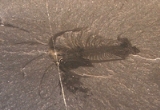
The
Burgess Shale Formation, located in the
Canadian RockiesThe Canadian Rockies comprise the Canadian segment of the North American Rocky Mountains range. They are the eastern part of the Canadian Cordillera, extending from the Interior Plains of Alberta to the Rocky Mountain Trench of British Columbia. The southern end borders Idaho and Montana of the USA...
of
British ColumbiaBritish Columbia is the westernmost of Canada's provinces and is known for its natural beauty, as reflected in its Latin motto, Splendor sine occasu . Its name was chosen by Queen Victoria in 1858...
, is one of the world's most celebrated
fossilFossils are the preserved remains or traces of animals , plants, and other organisms from the remote past...
fields, and the best of its kind. It is famous for the exceptional preservation of the soft parts of its fossils. At (Middle
CambrianThe Cambrian is the first geological period of the Paleozoic Era, lasting from Mya ; it is succeeded by the Ordovician. Its subdivisions, and indeed its base, are somewhat in flux. The period was established by Adam Sedgwick, who named it after Cambria, the Latin name for Wales, where Britain's...
) old it is one of the earliest fossil beds containing the imprints of soft-parts.
The rock unit is a black
shaleShale is a fine-grained, clastic sedimentary rock composed of mud that is a mix of flakes of clay minerals and tiny fragments of other minerals, especially quartz and calcite. The ratio of clay to other minerals is variable. Shale is characterized by breaks along thin laminae or parallel layering...
, and crops out at a number of localities near the town of
FieldField is an unincorporated settlement of approximately 300 people located in the Kicking Horse River valley of southeastern British Columbia,Canada, within the confines of Yoho National Park....
in the
Yoho National ParkYoho National Park is located in the Canadian Rocky Mountains along the western slope of the Continental Divide in southeastern British Columbia. Yoho NP is bordered by Kootenay National Park on the southern side and Banff National Park on the eastern side...
.
History and significance
The Burgess Shale was discovered by palaeontologist
Charles WalcottCharles Doolittle Walcott was an American invertebrate paleontologist. He became known for his discovery in 1909 of well-preserved fossils in the Burgess Shale of British Columbia, Canada.-Early life:...
in 1909, towards the end of the season's fieldwork. He returned in 1910 with his sons, daughter, and wife, establishing a quarry on the flanks of Fossil Ridge. The significance of soft-bodied preservation, and the range of organisms he recognised as new to science, led him to return to the quarry almost every year until 1924. At this point, aged 74, he had amassed over 65,000 specimens. Describing the fossils was a vast task, pursued by Walcott until his death in 1927. Walcott, led by scientific opinion at the time, attempted to categorise all fossils into living taxa, and as a result, the fossils were regarded as little more than curiosities at the time. It was not until 1962 that a first-hand reinvestigation of the fossils was attempted, by Alberto Simonetta. This led scientists to recognise that Walcott had barely scratched the surface of information available in the Burgess Shale, and also made it clear that the organisms did not fit comfortably into modern groups.
Excavations were resumed at the
Walcott QuarryThe Walcott Quarry is the most famous quarry of the Burgess Shale, bearing the Phyllopod beds. This lies at the base of the Walcott Quarry member, and three other quarries – the Raymond, UE and EZ – lie above it...
by the Geological Survey of Canada under the persuasion of
trilobiteTrilobites are a well-known fossil group of extinct marine arthropods that form the class Trilobita. The first appearance of trilobites in the fossil record defines the base of the Atdabanian stage of the Early Cambrian period , and they flourished throughout the lower Paleozoic era before...
expert Harry Blackmore Whittington, and a new quarry, the Raymond, was established about 20 metres higher up Fossil Ridge. Whittington, with the help of research students
Derek BriggsDerek Ernest Gilmor Briggs is an Irish paleontologist and taphonomist based at Yale University. Briggs is one of three paleontologists who were key in the reinterpretation of the fossils of the Burgess Shale.-Professional achievements:...
and
Simon Conway MorrisSimon Conway Morris FRS is an English paleontologist made known by his detailed and careful study of the Burgess Shale fossils, an exploit celebrated in Wonderful Life by Stephen Jay Gould...
of the
University of CambridgeThe University of Cambridge is a public research university located in Cambridge, United Kingdom. It is the second-oldest university in both the United Kingdom and the English-speaking world , and the seventh-oldest globally...
, began a thorough reassessment of the Burgess Shale, and revealed that the fauna represented were much more diverse and unusual than Walcott had recognized. Indeed, many of the animals present had bizarre anatomical features and only the slightest resemblance to other known animals. Examples include
OpabiniaOpabinia is an animal genus found in Cambrian fossil deposits. Its sole species, Opabinia regalis, is known from the Middle Cambrian Burgess Shale of British Columbia, Canada. Fewer than twenty good specimens have been described; 3 specimens of Opabinia are known from the Greater Phyllopod bed,...
, with five eyes and a snout like a vacuum cleaner hose;
NectocarisNectocaris pteryx is a species of possible cephalopod or arthropod affinity, known from the Middle Cambrian Burgess Shale.Nectocaris was a free-swimming, predatory or scavenging organism, possibly occupying a niche similar to the arrow worms...
, which resembles either a
crustaceanCrustaceans form a very large group of arthropods, usually treated as a subphylum, which includes such familiar animals as crabs, lobsters, crayfish, shrimp, krill and barnacles. The 50,000 described species range in size from Stygotantulus stocki at , to the Japanese spider crab with a leg span...
with fins or a
vertebrateVertebrates are animals that are members of the subphylum Vertebrata . Vertebrates are the largest group of chordates, with currently about 58,000 species described. Vertebrates include the jawless fishes, bony fishes, sharks and rays, amphibians, reptiles, mammals, and birds...
with a shell; and
HallucigeniaHallucigenia is an extinct genus of animal found as fossils in the Middle Cambrian-aged Burgess Shale formation of British Columbia, Canada, represented by the species H. sparsa, and in the Lower Cambrian Maotianshan shale of China, represented by the species H. fortis...
, which was originally reconstructed upside down, walking on bilaterally symmetrical spines.
With
Parks CanadaParks Canada , also known as the Parks Canada Agency , is an agency of the Government of Canada mandated to protect and present nationally significant natural and cultural heritage, and foster public understanding, appreciation, and enjoyment in ways that ensure their ecological and commemorative...
and
UNESCOThe United Nations Educational, Scientific and Cultural Organization is a specialized agency of the United Nations...
recognising the significance of the Burgess Shale, collecting fossils became politically more difficult from the mid-1970s. Collections continued to be made by the
Royal Ontario MuseumThe Royal Ontario Museum is a museum of world culture and natural history in Toronto, Ontario, Canada. With its main entrance facing Bloor Street in Downtown Toronto, the museum is situated north of Queen's Park and east of Philosopher's Walk in the University of Toronto...
. The curator of invertebrate palaeontology, Desmond Collins, identified a number of additional outcrops, stratigraphically both higher and lower than the original Walcott quarry. These localities continue to yield new organisms faster than they can be studied.
Stephen Jay GouldStephen Jay Gould was an American paleontologist, evolutionary biologist, and historian of science. He was also one of the most influential and widely read writers of popular science of his generation....
's book
Wonderful LifeWonderful Life: The Burgess Shale and the Nature of History is a book on the evolution of Cambrian fauna by Harvard paleontologist Stephen Jay Gould...
, published in 1989, brought the Burgess Shale fossils to the public's attention. Gould suggests that the extraordinary diversity of the fossils indicate that life forms at the time were much more diverse than those that survive today, and that many of the unique lineages were evolutionary experiments that became extinct. Gould's interpretation of the diversity of Cambrian fauna relied heavily on Simon Conway Morris' reinterpretation of Charles Walcott's original publications. However, Conway Morris strongly disagreed with Gould's conclusions, arguing that almost all the Cambrian fauna could be classified into modern day phyla.
Geological setting
The fossiliferous deposits of the Burgess Shale correlate to the Stephen formation, a collection of slightly calcareous dark mudstones, about old. The beds were deposited at the base of a cliff about 160 m tall, below the depth agitated by waves during storms. This vertical cliff was composed of the calcareous reefs of the
Cathedral FormationThe Cathedral escarpment was a submarine cliff during the Cambrian period, and is often associated with the exquisite preservation of the Burgess Shale. It runs for around 100 km through and around Yoho national park, British Columbia...
, which probably formed shortly before the deposition of the Burgess Shale. The precise formation mechanism is not known for certain, but the most widely accepted hypothesis suggests that the edge of the Cathedral Formation reef became detached from the rest of the reef, slumping and being transported some distance — perhaps kilometers — away from the reef edge. Later reactivation of faults at the base of the formation led to its disintegration from about . This would have left a steep cliff, the bottom of which would be protected, because the limestone of the Cathedral Formation is difficult to compress, from tectonic decompression. This protection explains why fossils preserved further from the Cathedral Formation are impossible to work with — tectonic squeezing of the beds has produced a vertical cleavage that fractures the rocks, so they split perpendicular to the fossils. The Walcott quarry produced such spectacular fossils because it was so close to the Stephen Formation — indeed the quarry has now been excavated to the very edge of the Cambrian cliff.
It was originally thought that the Burgess Shale was deposited in anoxic conditions, but mounting research shows that oxygen was continually present in the sediment. The anoxic setting had been thought to not only protect the newly dead organisms from decay, but it also created chemical conditions allowing the preservation of the soft parts of the organisms. Further, it reduced the abundance of burrowing organisms — burrows and trackways
are found in beds containing soft-bodied organisms, but they are rare and generally of limited vertical extent. Brine seeps are an alternative hypothesis - see
Burgess Shale type preservationThe Burgess Shale of British Columbia is famous for its exceptional preservation of mid-Cambrian organisms. Around 40 other sites have been discovered of a similar age, with soft tissues preserved in a similar, though not identical, fashion...
for a more thorough discussion.
Stratigraphy
The Burgess Shale Formation comprises 10 members, the most famous being the Walcott Quarry Shale Member comprising the greater phyllopod bed.
Taphonomy and diagenesis
Please expand this section
There are many other comparable Cambrian
lagerstätteA Lagerstätte is a sedimentary deposit that exhibits extraordinary fossil richness or completeness.Palaeontologists distinguish two kinds....
n; indeed such assemblages are far more common in the Cambrian than in any other period. This is mainly due to the limited extent of burrowing activity; as such
bioturbationIn oceanography, limnology, pedology, geology , and archaeology, bioturbation is the displacement and mixing of sediment particles and solutes by fauna or flora . The mediators of bioturbation are typically annelid worms , bivalves In oceanography, limnology, pedology, geology (especially...
became more prevalentThe "Cambrian substrate revolution" or "Agronomic revolution", evidenced in trace fossils, is the diversification of animal burrowing during the early Cambrian period....
throughout the Cambrian, environments capable of preserving organisms' soft parts became much rarer. (The pre-Cambrian fossil record of animals is sparse and ambiguous.)
Biota
The biota of the Burgess Shale appears to be typical of Middle Cambrian deposits. Although the hard-part bearing organisms make up as little as 14% of the community, these same organisms are found in similar proportions in other Cambrian localities. This means that there is no reason to assume that the organisms without hard parts are exceptional in any way; indeed, many appear in other lagerstätten of different age and locations.
The biota consists of a range of organisms. Free-swimming organisms are relatively rare, with the majority of organisms being bottom dwelling (benthic) — either moving about (vagrant) or permanently attached to the sea floor (sessile). About two-thirds of the Burgess Shale organisms lived by feeding on the organic content in the muddy sea floor, while almost a third filtered out fine particles from the water column. Under 10% of organisms were predators or scavengers, although since these organisms were larger, the biomass was split equally between each of the filter feeding, deposit feeding, predatory and scavenging organisms.
Working with the Burgess Shale
The fossils of the Burgess Shale are preserved as black carbon films on black shales, and so are difficult to photograph; however, various photographic techniques can improve the quality of the images that can be acquired. Other techniques include backscatter SEM, elemental mapping and
camera lucidaA camera lucida is an optical device used as a drawing aid by artists.The camera lucida performs an optical superimposition of the subject being viewed upon the surface upon which the artist is drawing. The artist sees both scene and drawing surface simultaneously, as in a photographic double...
drawing.
Once images have been acquired, the effects of decay and taphonomy must be accounted for before a correct anatomical reconstruction can be made. A consideration of the combination of characters allows researchers to establish the taxonomic affinity.
See also
- Body form
- Maotianshan Shales
The Maotianshan Shales are a series of lower Cambrian deposits in the Chiungchussu formation, famous for their Konservat Lagerstätten, or high number of fossils preserved in place...
, which is often compared to Burgess Shale
- Invertebrate paleontology
Invertebrate paleontology is sometimes described as Invertebrate paleozoology or Invertebrate paleobiology....
- History of invertebrate paleozoology
The history of invertebrate paleozoology differs from the history of paleontology in that the former usually emphasizes paleobiology and the paleoecology of extinct marine invertebrates, while the latter typically emphasizes the earth sciences and the sedimentary rock remains of terrestrial...
- List of fossil sites (with link directory)
- List of notable fossils
Further reading
. Debating the significance of the Burgess Shale:
.
The Crucible of Creation: The Burgess Shale and the Rise of Animals, Oxford University Press, Oxford, 1998 (paperback 1999) ISBN 0-19-850197-8 (hbk), ISBN 0-19-286202-2 (pbk).
Trilobite: Eyewitness to Evolution, Flamingo, 2001. ISBN 0-00-655138-6.
Wonderful Life: Burgess Shale and the Nature of HistoryWonderful Life: The Burgess Shale and the Nature of History is a book on the evolution of Cambrian fauna by Harvard paleontologist Stephen Jay Gould...
, Vintage, 2000. ISBN 0-09-927345-4
The Fossils of the Burgess Shale, Smithsonian, 1994. ISBN 1-56098-364-7
Sources
- The Burgess Shale Geoscience Foundation — official website
- The Burgess Shale — Evolution's Big Bang — Burke Museum of Natural History and Culture
- Burgess Shale Fossils
- The Cambrian Explosion — BBC Radio 4 broadcast, In Our Time, 17 February 2005, hosted by Melvyn Bragg (includes links to resource pages)
- Paleobiology Database The Burgess Shale (skeletonized fauna), Stephen Fm., British Columbia, Canada: St Davids, British Columbia
- Paleobiology Database Hanburia gloriosa, Phyllopod Bed, Burgess Shale, Canada — Whittington 1998: St Davids — Merioneth, British Columbia
- Smithsonian Museum
- Species index from the Smithsonian Institution