

Archosaur

Encyclopedia
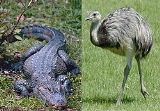
Archosaurs are a group of diapsid
amniote
s whose living representatives consist of modern birds
and crocodilia
ns. This group also includes all extinct non-avian dinosaur
s, many extinct crocodilian relatives, and pterosaur
s. Archosauria, the archosaur clade
, is a crown group
that includes the most recent common ancestor
of living birds and crocodilians. It includes two main clades: Crurotarsi
, which includes crocodilians and their extinct relatives, and Avemetatarsalia
, which includes pterosaurs and dinosaurs (of which birds are the only living clade).
and mandibular fenestrae (openings in front of the eyes and in the jaw, respectively), and a fourth trochanter
(a prominent ridge on the femur
). Being set in sockets, the teeth were less likely to be torn loose during feeding. This feature is responsible for the name "thecodont
" (meaning "socket teeth"), which paleontologists used to apply to many Triassic archosaurs. Some archosaurs, such as birds, are secondarily toothless. Antorbital fenestrae reduced the weight of the skull, which was relatively large in early archosaurs, rather like that of modern crocodilians. These fenestrae are often larger than the orbits
, or eye sockets. Mandibular fenestrae may also have reduced the weight of the jaw in some forms. The fourth trochanter provides a large site for the attachment of muscles on the femur. Stronger muscles allowed for erect gaits in early archosaurs, and may also be connected with the ability of the archosaurs or their immediate ancestors to survive the catastrophic Permian-Triassic extinction event
.
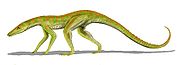
reptiles Archosaurus
rossicus and/or Protorosaurus
speneri as true archosaurs maintain that archosaurs first appeared in the late Permian. Those who classify both Archosaurus rossicus and Protorosaurus speneri as archosauriforms (not true archosaurs but very closely related) maintain that archosaurs first evolved from archosauriform ancestors during the Olenekian
stage of the Early Triassic
. The earliest archosaurs were rauisuchia
ns such as Scythosuchus
and Tsylmosuchus
, both of which have been found from Russia
and date back to the Olenekian.
s (a group including mammals and their extinct relatives, which are often referred to as "mammal-like reptiles") were the dominant land vertebrates throughout the Permian
, but most perished in the Permian-Triassic extinction event
. Very few large synapsids survived the event, although one form, Lystrosaurus
(an herbivorous dicynodont
), attained a global distribution soon after the extinction.
But archosaurs quickly became the dominant land vertebrates in the early Triassic
. The two most commonly-suggested explanations for this are:
It has also been suggested that the Triassic atmosphere was low on oxygen and archosaurs had a more advanced respiratory system.
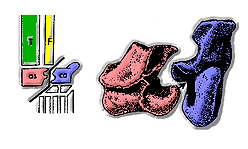
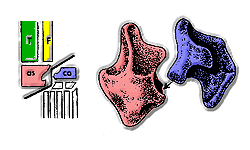
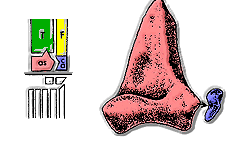
Since the 1970s scientists have classified archosaurs mainly on the basis of their ankles. The earliest archosaurs had "primitive mesotarsal" ankles: the astragalus
and calcaneum were fixed to the tibia
and fibula by suture
s and the joint bent about the contact between these bones and the foot.
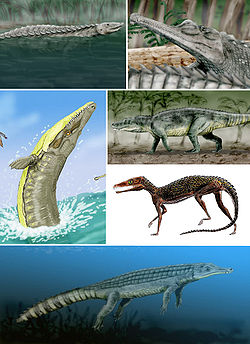 The Crurotarsi
appeared early in the Triassic
. In their ankles the astragalus was joined to the tibia by a suture
and the joint rotated round a peg on the astragalus which fitted into a socket in the calcaneum. Early "crurotarsans" still walked with sprawling limbs, but some later crurotarsans developed fully erect limbs (most notably the Rauisuchia
). Modern crocodilians are crurotarsans which can walk with their limbs sprawling or erect depending on speed of locomotion.
Euparkeria
and the Ornithosuchidae
had "reversed crurotarsal" ankles, with a peg on the calcaneum and socket on the astragalus.
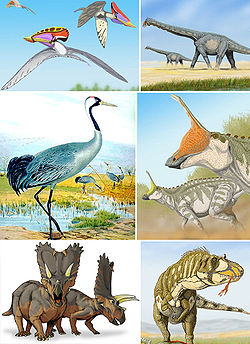 The earliest fossils of Ornithodira ("bird necks") appear in the Carnian
age of the late Triassic
, but it is hard to see how they could have evolved from crurotarsans — possibly they actually evolved much earlier, or perhaps they evolved from the last of the "primitive mesotarsal" archosaurs. Ornithodires' "advanced mesotarsal" ankle had a very large astragalus and very small calcaneum, and could only move in one plane, like a simple hinge. This arrangement was only suitable for animals with erect limbs, but provided more stability when the animals were running. The ornithodires differed from other archosaurs in other ways: they were lightly built and usually small, their necks were long and had an S-shaped curve, their skulls were much more lightly built, and many ornithodires were completely bipedal. The archosaurian fourth trochanter on the femur may have made it easier for ornithodires to become bipeds, because it provided more leverage for the thigh muscles. In the late Triassic the ornithodires diversified to produce dinosaur
s and possibly pterosaur
s, though it is uncertain if the latter is actually a part of Archosauria.
, which means that it only includes descendants of the last common ancestors of its living representatives. In the case of archosaurs, these are birds and crocodilians. Archosauria is within the larger clade Archosauriformes
, which includes some closely related relatives of archosaurs such as proterochampsids
and euparkeriids
. These relatives are often referred to as archosaurs, despite being placed outside of crown group Archosauria in a more basal
position within Archosauriformes. Historically, many archosauriforms were described as archosaurs, including proterosuchids and erythrosuchids, based on the presence of an antorbital fenestra.
in 1869, and included a wide range of taxa including rhynchosaur
s, which are considered to be more basal archosauromorphs, and anomodont
s, which are now considered synapsids. It was not until 1986 that Archosauria was defined as a crown-clade, restricting its use to more derived
taxa.
Cope's term was a Greek-Latin hybrid
intended to refer to the cranial arches, but has later also been understood as "leading reptiles" or "ruling reptiles" by association with Greek ἀρχός "leader, ruler".
The term "thecodont
", now considered an obsolete term, was first used by English paleontologist Richard Owen
in 1859 to describe Triassic archosaurs, and it became widely used in the 20th century. Thecodonts were considered the "basal stock" from which the more advanced archosaurs descended. They did not possess features seen in later avian and crocodilian lines, and therefore were considered more primitive and ancestral to the two groups. With the cladistic revolution of the 1980s and 90s, in which cladistics
became the most widely used method of classifying organisms, thecodonts were no longer considered a valid grouping. Because they are considered a "basal stock", thecodonts are paraphyletic, meaning that they form a group that does not include all descendants of its last common ancestor: in this case, the more derived crocodilians and birds are excluded from "Thecodontia" as it was formerly understood. The description of the basal ornithodires Lagerpeton
and Lagosuchus
in the 1970s provided evidence that linked thecodonts with dinosaurs, and contributed to the disuse of the term "Thecodontia", which many cladists consider an artificial grouping.
With the identification of "crocodilian normal" and "crocodilian reversed" ankles by Sankar Chatterjee
in 1978, a basal split in Archosauria was identified. Chatterjee considered these two groups to be Pseudosuchia with the "normal" ankle and Ornithosuchidae with the "reversed" ankle. Ornithosuchids were thought to be ancestral to dinosaurs at this time. In 1979, A.R.I. Cruickshank identified the basal split and thought that the crurotarsan ankle developed independently in these two groups, but in opposite ways. Cruickshank also thought that the development of these ankle types progressed in each group to allow advanced members to have semi-erect (in the case of crocodilians) or erect (in the case of dinosaurs) gaits.
in 1986. Gauthier split Archosauria into Pseudosuchia
, the crocodilian line, and Ornithosuchia, the dinosaur and pterosaur line. Pseudosuchia was defined as all archosaurs more closely related to crocodiles, while Ornithosuchia was defined as all archosaurs more closely related to birds. Proterochampsids, erythrosuchids, and proterosuchids fell successively outside Archosauria in the resulting tree. Below is the cladogram
from Gauthier (1986):
In 1988, paleontologists Michael Benton
and J.M. Clark produced a new tree in a phylogenetic study of basal archosaurs. As in Gauthier's tree, Benton and Clark's revealed a basal split within Archosauria. They referred to the two groups as Crocodylotarsi and Ornithosuchia. Crocodylotarsi was defined as an apomorphy-based taxon based on the presence of a "crocodile-normal" ankle joint (considered to be the defining apomorphy of the clade). Gauthier's Pseudosuchia, by contrast, was a stem-based taxon. Unlike Gauthier's tree, Benton and Clark's places Euparkeria outside Ornithosuchia and outside the crown group Archosauria all together. Benton did not consider pterosaurs to be archosaurs, and considered them to be the most basal archosauromorphs in a phylogenetic study of diapsids published three years earlier.
The clades Crurotarsi and Ornithodira were first used together in 1990 by paleontologist Paul Sereno
and A.B. Arcucci in their phylogenetic study of archosaurs. They were the first to erect the clade Crurotarsi, while Ornithodira was named by Gauthier in 1986. Crurotarsi and Ornithodira replaced Pseudosuchia and Ornithosuchia, respectively, as the monophyly of both of these clades were questioned. Sereno and Arcucci incorporated archosaur features other than ankle types in their analyses, which resulted in a different tree than previous analyses. Below is a cladogram based on Sereno (1991), which is similar to the one produced by Sereno and Arcucci:
Below is a cladogram modified from Benton (2004):
Below is a cladogram
from Brusatte et al., 2010:
about 195 million years ago, but other archosaurs became extinct.
Non-avian dinosaurs and pterosaur
s perished in the Cretaceous-Tertiary extinction event
, which occurred approximately 65.5 million years ago, but crocodilians and birds (the only remaining dinosaur group) survived. Both are descendants of archosaurs, and are therefore archosaurs themselves under phylogenetic taxonomy.
Crocodilians (which include all modern crocodile
s, alligator
s, and gharial
s) and birds flourish today. It is generally agreed that birds have the most species of all terrestrial vertebrates.
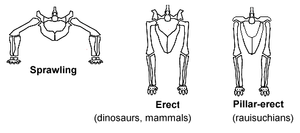 Like the early tetrapod
s, early archosaurs had a sprawling gait because their hip sockets faced sideways, and the knobs at the tops of their femur
s were in line with the femur.
In the early to middle Triassic
, some archosaur groups developed hip joints which allowed (or required) a more erect gait. This gave them greater stamina, because it avoided Carrier's constraint
, i.e. they could run and breathe easily at the same time. There were two main types of joint which allowed erect legs:
It has been pointed out that an upright stance requires more energy, so it may indicate a higher metabolism and a higher body temperature.
s were herbivores and some developed extensive armor. A few crocodilians were herbivores, e.g., Simosuchus
, Phyllodontosuchus
. The large crocodilian Stomatosuchus may have been a filter feeder
. Sauropodomorphs
and ornithischia
n dinosaurs were herbivores with diverse adaptations for feeding biomechanics
.
animals, but:
So, why did natural selection
favour the development of these features, which are very important for active warm-blooded creatures but of little apparent use to cold-blooded aquatic ambush predators which spend the vast majority of their time floating in water or lying on river banks?
Paleontological evidence shows that the ancestors of living crocodilians were active and endothermic (warm-blooded). Some experts believe that their archosaur ancestors were warm-blooded as well. Physiological, anatomical, and developmental features of the crocodilian heart support the paleontological evidence and show that the lineage reverted to ectothermy when it invaded the aquatic, ambush predator niche. Crocodilian embryos develop fully 4-chambered hearts at an early stage. Modifications to the growing heart form a pulmonary bypass shunt that includes the left aortic arch
that originates from the right ventricle
, the foramen of Panizza
between the left and right aortic arches, and the cog‐tooth valve at the base of the pulmonary artery
. The shunt is used during diving to make the heart function as 3-chambered heart, providing the crocodilian with the neurally controlled shunting used by ectotherms. The researchers concluded that the ancestors of living crocodilians had fully 4-chambered hearts, and were therefore warm-blooded, before they reverted to a cold-blooded or ectothermic metabolism. The authors also provide other evidence for endothermy in stem archosaurs. It is reasonable to suggest that later crocodilians developed the pulmonary bypass shunt as they became cold-blooded, aquatic, and less active.
If the original crocodilians and other Triassic
archosaurs were warm-blooded, this would help to resolve some evolutionary puzzles:
has shown that the airflow through them is unidirectional, moving in the same direction during inhalation and exhalation. This is also seen in birds and many non-avian dinosaurs, which have air sacs to further aid in respiration. Both birds and alligators achieve unidirectional air flow through the presence of parabronchi, which are responsible for gas exchange. The study has found that in alligators, air enters through the second bronchial branch
, moves through the parabronchi, and exits through the first bronchial branch. Unidirectional airflow in both birds and alligators suggests that this type of respiration was present in basal Triassic archosaurs and their non-dinosaurian descendants, including phytosaurs, aetosaurs, rauisuchians, crocodylomorphs, and pterosaurs. The use of unidirectional airflow in the lungs of archosaurs may have given the group an advantage over synapsids, which had lungs where air moved tidally in and out through a network of bronchi that terminated in alveoli
, which were cul-de-sacs. The better efficiency in gas transfer seen in archosaur lungs may have been advantageous during the times of low atmospheric oxygen which are thought to have existed during the Mesozoic.
Diapsid
Diapsids are a group of reptiles that developed two holes in each side of their skulls, about 300 million years ago during the late Carboniferous period. Living diapsids are extremely diverse, and include all crocodiles, lizards, snakes, and tuatara...
amniote
Amniote
The amniotes are a group of tetrapods that have a terrestrially adapted egg. They include synapsids and sauropsids , as well as their fossil ancestors. Amniote embryos, whether laid as eggs or carried by the female, are protected and aided by several extensive membranes...
s whose living representatives consist of modern birds
Modern birds
Modern birds are the most recent common ancestor of all living birds and all its descendants.Modern birds are characterised by feathers, a beak with no teeth , the laying of hard-shelled eggs, a high metabolic rate, a four-chambered heart, and a lightweight but strong skeleton...
and crocodilia
Crocodilia
Crocodilia is an order of large reptiles that appeared about 84 million years ago in the late Cretaceous Period . They are the closest living relatives of birds, as the two groups are the only known survivors of the Archosauria...
ns. This group also includes all extinct non-avian dinosaur
Dinosaur
Dinosaurs are a diverse group of animals of the clade and superorder Dinosauria. They were the dominant terrestrial vertebrates for over 160 million years, from the late Triassic period until the end of the Cretaceous , when the Cretaceous–Paleogene extinction event led to the extinction of...
s, many extinct crocodilian relatives, and pterosaur
Pterosaur
Pterosaurs were flying reptiles of the clade or order Pterosauria. They existed from the late Triassic to the end of the Cretaceous Period . Pterosaurs are the earliest vertebrates known to have evolved powered flight...
s. Archosauria, the archosaur clade
Clade
A clade is a group consisting of a species and all its descendants. In the terms of biological systematics, a clade is a single "branch" on the "tree of life". The idea that such a "natural group" of organisms should be grouped together and given a taxonomic name is central to biological...
, is a crown group
Crown group
A crown group is a group consisting of living representatives, their ancestors back to the most recent common ancestor of that group, and all of that ancestor's descendants. The name was given by Willi Hennig, the formulator of phylogenetic systematics, as a way of classifying living organisms...
that includes the most recent common ancestor
Most recent common ancestor
In genetics, the most recent common ancestor of any set of organisms is the most recent individual from which all organisms in the group are directly descended...
of living birds and crocodilians. It includes two main clades: Crurotarsi
Crurotarsi
The Crurotarsi are a group of archosauriformes, represented today by the crocodiles,...
, which includes crocodilians and their extinct relatives, and Avemetatarsalia
Avemetatarsalia
Avemetatarsalia is a clade name established by British palaeontologist Michael Benton in 1999 for all crown group archosaurs that are closer to birds than to crocodiles. It includes a similarly defined subgroup, Ornithodira...
, which includes pterosaurs and dinosaurs (of which birds are the only living clade).
Distinguishing characteristics
Archosaurs can be distinguished from other tetrapods on the basis of several synapomorphies, or shared characteristics first found in a common ancestor. The simplest and most widely-agreed synapomorphies of archosaurs include teeth set in sockets, antorbitalAntorbital fenestra
An antorbital fenestra is an opening in the skull, in front of the eye sockets. This skull formation first appeared in archosaurs during the Triassic Period. Living birds today possess antorbital fenestrae, but the feature has been lost in modern crocodilians...
and mandibular fenestrae (openings in front of the eyes and in the jaw, respectively), and a fourth trochanter
Fourth trochanter
The fourth trochanter is a shared characteristic common to archosaurs. It is a knob-like feature on the medial side of the femur that serves as a muscle attachment....
(a prominent ridge on the femur
Femur
The femur , or thigh bone, is the most proximal bone of the leg in tetrapod vertebrates capable of walking or jumping, such as most land mammals, birds, many reptiles such as lizards, and amphibians such as frogs. In vertebrates with four legs such as dogs and horses, the femur is found only in...
). Being set in sockets, the teeth were less likely to be torn loose during feeding. This feature is responsible for the name "thecodont
Thecodont
Thecodont , now considered an obsolete term, was formerly used to describe a diverse range of early archosaurs that first appeared in the Latest Permian and flourished until the end of the Triassic period...
" (meaning "socket teeth"), which paleontologists used to apply to many Triassic archosaurs. Some archosaurs, such as birds, are secondarily toothless. Antorbital fenestrae reduced the weight of the skull, which was relatively large in early archosaurs, rather like that of modern crocodilians. These fenestrae are often larger than the orbits
Orbit (anatomy)
In anatomy, the orbit is the cavity or socket of the skull in which the eye and its appendages are situated. "Orbit" can refer to the bony socket, or it can also be used to imply the contents...
, or eye sockets. Mandibular fenestrae may also have reduced the weight of the jaw in some forms. The fourth trochanter provides a large site for the attachment of muscles on the femur. Stronger muscles allowed for erect gaits in early archosaurs, and may also be connected with the ability of the archosaurs or their immediate ancestors to survive the catastrophic Permian-Triassic extinction event
Permian-Triassic extinction event
The Permian–Triassic extinction event, informally known as the Great Dying, was an extinction event that occurred 252.28 Ma ago, forming the boundary between the Permian and Triassic geologic periods, as well as the Paleozoic and Mesozoic eras...
.
Origin of archosaurs
There is some debate about when archosaurs first appeared. Those who classify the PermianPermian
The PermianThe term "Permian" was introduced into geology in 1841 by Sir Sir R. I. Murchison, president of the Geological Society of London, who identified typical strata in extensive Russian explorations undertaken with Edouard de Verneuil; Murchison asserted in 1841 that he named his "Permian...
reptiles Archosaurus
Archosaurus
Archosaurus is an extinct genus of carnivorous archosauriform reptile. From the latest Permian of Russia and Poland, it is one of the earliest known archosauriformes....
rossicus and/or Protorosaurus
Protorosaurus
Protorosaurus , a lizard-like reptile of the order Prolacertiformes, is the earliest known archosauromorph. It lived during the Late Permian period in Germany. In 1914, a new ceratopsian dinosaur found by Lawrence Lambe was again given the name Protorosaurus...
speneri as true archosaurs maintain that archosaurs first appeared in the late Permian. Those who classify both Archosaurus rossicus and Protorosaurus speneri as archosauriforms (not true archosaurs but very closely related) maintain that archosaurs first evolved from archosauriform ancestors during the Olenekian
Olenekian
In the geologic timescale, the Olenekian is an age in the Early Triassic epoch or a stage in the Lower Triassic series. It spans the time between 249.7 ± 0.7 Ma and 245 ± 0.7 Ma . The Olenekian follows the Induan and is followed by the Anisian.The Olenekian saw the deposition of a large part of the...
stage of the Early Triassic
Early Triassic
The Early Triassic is the first of three epochs of the Triassic period of the geologic timescale. It spans the time between 251 ± 0.4 Ma and 245 ± 1.5 Ma . Rocks from this epoch are collectively known as the Lower Triassic, which is a unit in chronostratigraphy...
. The earliest archosaurs were rauisuchia
Rauisuchia
Rauisuchia is a group of predatory and mostly large Triassic archosaurs. As a clade, Rauisuchia includes these Triassic forms and all crocodylomorphs, which are descendants of Triassic rauisuchians. The group in its traditional sense is paraphyletic, because it does not include crocodylomorph...
ns such as Scythosuchus
Scythosuchus
Scythosuchus is an extinct genus of rauisuchid. Remains have been found from Olenekian-age Lower Triassic beds in Russia. The type and only species is S. basileus, described in 1999....
and Tsylmosuchus
Tsylmosuchus
Tsylmosuchus is an extinct genus of rauisuchian that may be a member of the family Rauisuchidae. It is known from the southern Urals region of Russia. Tsylmosuchus occurred throughout the Olenekian age of the Early Triassic. Some of the strata from which Tsylmosuchus has been found are early...
, both of which have been found from Russia
Russia
Russia or , officially known as both Russia and the Russian Federation , is a country in northern Eurasia. It is a federal semi-presidential republic, comprising 83 federal subjects...
and date back to the Olenekian.
Archosaur takeover in the Triassic
SynapsidSynapsid
Synapsids are a group of animals that includes mammals and everything more closely related to mammals than to other living amniotes. They are easily separated from other amniotes by having an opening low in the skull roof behind each eye, leaving a bony arch beneath each, accounting for their name...
s (a group including mammals and their extinct relatives, which are often referred to as "mammal-like reptiles") were the dominant land vertebrates throughout the Permian
Permian
The PermianThe term "Permian" was introduced into geology in 1841 by Sir Sir R. I. Murchison, president of the Geological Society of London, who identified typical strata in extensive Russian explorations undertaken with Edouard de Verneuil; Murchison asserted in 1841 that he named his "Permian...
, but most perished in the Permian-Triassic extinction event
Permian-Triassic extinction event
The Permian–Triassic extinction event, informally known as the Great Dying, was an extinction event that occurred 252.28 Ma ago, forming the boundary between the Permian and Triassic geologic periods, as well as the Paleozoic and Mesozoic eras...
. Very few large synapsids survived the event, although one form, Lystrosaurus
Lystrosaurus
Lystrosaurus was a genus of Late Permian and Early Triassic Period dicynodont therapsids, which lived around 250 million years ago in what is now Antarctica, India, and South Africa...
(an herbivorous dicynodont
Dicynodont
Dicynodontia is a taxon of anomodont therapsids or mammal-like reptiles. Dicynodonts were small to large herbivorous animals with two tusks, hence their name, which means 'two dog tooth'...
), attained a global distribution soon after the extinction.
But archosaurs quickly became the dominant land vertebrates in the early Triassic
Triassic
The Triassic is a geologic period and system that extends from about 250 to 200 Mya . As the first period of the Mesozoic Era, the Triassic follows the Permian and is followed by the Jurassic. Both the start and end of the Triassic are marked by major extinction events...
. The two most commonly-suggested explanations for this are:
- Archosaurs made more rapid progress towards erect limbs than synapsids, and this gave them greater stamina by avoiding Carrier's constraintCarrier's constraintCarrier's constraint is the observation that air-breathing vertebrates which have two lungs and flex their bodies sideways during locomotion find it very difficult to move and breathe at the same time, because:...
. This is unconvincing, since archosaurs became dominant while they still had sprawling or semi-erect limbs, similar to those of LystrosaurusLystrosaurusLystrosaurus was a genus of Late Permian and Early Triassic Period dicynodont therapsids, which lived around 250 million years ago in what is now Antarctica, India, and South Africa...
and other synapsids. - The early Triassic was predominantly arid, because most of the earthEarthEarth is the third planet from the Sun, and the densest and fifth-largest of the eight planets in the Solar System. It is also the largest of the Solar System's four terrestrial planets...
's land was concentrated in the supercontinentSupercontinentIn geology, a supercontinent is a landmass comprising more than one continental core, or craton. The assembly of cratons and accreted terranes that form Eurasia qualifies as a supercontinent today.-History:...
PangaeaPangaeaPangaea, Pangæa, or Pangea is hypothesized as a supercontinent that existed during the Paleozoic and Mesozoic eras about 250 million years ago, before the component continents were separated into their current configuration....
. Archosaurs were probably better at conserving water than early synapsids because:- Modern diapsidDiapsidDiapsids are a group of reptiles that developed two holes in each side of their skulls, about 300 million years ago during the late Carboniferous period. Living diapsids are extremely diverse, and include all crocodiles, lizards, snakes, and tuatara...
s (lizards, snakes, crocodilians, birds) excrete uric acidUric acidUric acid is a heterocyclic compound of carbon, nitrogen, oxygen, and hydrogen with the formula C5H4N4O3. It forms ions and salts known as urates and acid urates such as ammonium acid urate. Uric acid is created when the body breaks down purine nucleotides. High blood concentrations of uric acid...
, which can be excreted as a paste. It is reasonable to suppose that archosaurs (diapsids and ancestors of crocodilians, dinosaurs and birds) also excreted uric acid, and therefore were good at conserving water. The aglandular (glandless) skins of diapsids would also have helped to conserve water. - Modern mammals excrete ureaUreaUrea or carbamide is an organic compound with the chemical formula CO2. The molecule has two —NH2 groups joined by a carbonyl functional group....
, which requires a lot of water to keep it dissolved. Their skins also contain many glands, which also lose water. Assuming that early synapsids had similar features, e.g., as argued in PalaeosPalaeosPalaeos.com is a web site on biology, paleontology, cladistics and geology and which covers the history of Earth. The site is well respected and has been used as a reference by professional paleontologists such as Michael J. Benton, the professor of vertebrate palaeontology in the Department of...
http://www.palaeos.com/Vertebrates/Units/270Archosauromorpha/270.000.html, they were at a disadvantage in a mainly arid world. The same well-respected site points out that "for much of Australia's Plio-Pleistocene history, where conditions were probably similar, the largest terrestrial predators were not mammals but gigantic varanid lizards (MegalaniaMegalaniaMegalania is a giant extinct goanna or monitor lizard. It was part of a megafaunal assemblage that inhabited southern Australia during the Pleistocene, and appears to have disappeared around 40,000 years ago...
) and land crocs."
- Modern diapsid
It has also been suggested that the Triassic atmosphere was low on oxygen and archosaurs had a more advanced respiratory system.
Main types of archosaurs
 |
 |
 |
 |
Since the 1970s scientists have classified archosaurs mainly on the basis of their ankles. The earliest archosaurs had "primitive mesotarsal" ankles: the astragalus
Talus bone
-External links:* *...
and calcaneum were fixed to the tibia
Tibia
The tibia , shinbone, or shankbone is the larger and stronger of the two bones in the leg below the knee in vertebrates , and connects the knee with the ankle bones....
and fibula by suture
Suture (anatomical)
In anatomy, a suture is a fairly rigid joint between two or more hard elements of an animal, with or without significant overlap of the elements....
s and the joint bent about the contact between these bones and the foot.
Crurotarsi
The Crurotarsi are a group of archosauriformes, represented today by the crocodiles,...
appeared early in the Triassic
Triassic
The Triassic is a geologic period and system that extends from about 250 to 200 Mya . As the first period of the Mesozoic Era, the Triassic follows the Permian and is followed by the Jurassic. Both the start and end of the Triassic are marked by major extinction events...
. In their ankles the astragalus was joined to the tibia by a suture
Suture (anatomical)
In anatomy, a suture is a fairly rigid joint between two or more hard elements of an animal, with or without significant overlap of the elements....
and the joint rotated round a peg on the astragalus which fitted into a socket in the calcaneum. Early "crurotarsans" still walked with sprawling limbs, but some later crurotarsans developed fully erect limbs (most notably the Rauisuchia
Rauisuchia
Rauisuchia is a group of predatory and mostly large Triassic archosaurs. As a clade, Rauisuchia includes these Triassic forms and all crocodylomorphs, which are descendants of Triassic rauisuchians. The group in its traditional sense is paraphyletic, because it does not include crocodylomorph...
). Modern crocodilians are crurotarsans which can walk with their limbs sprawling or erect depending on speed of locomotion.
Euparkeria
Euparkeria
Euparkeria was a small African reptile of the early Triassic period between 248-245 million years ago, close to the ancestry of the archosaurs.- Palaeobiology :...
and the Ornithosuchidae
Ornithosuchidae
Ornithosuchidae is an extinct family of reptiles from the Triassic period that were distantly related to crocodilians. They are classified as crurotarsan archosaurs. Ornithosuchids were quadrupedal and facultatively bipedal, meaning they had the ability to walk on two legs for short periods of time...
had "reversed crurotarsal" ankles, with a peg on the calcaneum and socket on the astragalus.
Carnian
The Carnian is the lowermost stage of the Upper Triassic series . It lasted from about 228.7 till 216.5 million years ago . The Carnian is preceded by the Ladinian and is followed by the Norian...
age of the late Triassic
Triassic
The Triassic is a geologic period and system that extends from about 250 to 200 Mya . As the first period of the Mesozoic Era, the Triassic follows the Permian and is followed by the Jurassic. Both the start and end of the Triassic are marked by major extinction events...
, but it is hard to see how they could have evolved from crurotarsans — possibly they actually evolved much earlier, or perhaps they evolved from the last of the "primitive mesotarsal" archosaurs. Ornithodires' "advanced mesotarsal" ankle had a very large astragalus and very small calcaneum, and could only move in one plane, like a simple hinge. This arrangement was only suitable for animals with erect limbs, but provided more stability when the animals were running. The ornithodires differed from other archosaurs in other ways: they were lightly built and usually small, their necks were long and had an S-shaped curve, their skulls were much more lightly built, and many ornithodires were completely bipedal. The archosaurian fourth trochanter on the femur may have made it easier for ornithodires to become bipeds, because it provided more leverage for the thigh muscles. In the late Triassic the ornithodires diversified to produce dinosaur
Dinosaur
Dinosaurs are a diverse group of animals of the clade and superorder Dinosauria. They were the dominant terrestrial vertebrates for over 160 million years, from the late Triassic period until the end of the Cretaceous , when the Cretaceous–Paleogene extinction event led to the extinction of...
s and possibly pterosaur
Pterosaur
Pterosaurs were flying reptiles of the clade or order Pterosauria. They existed from the late Triassic to the end of the Cretaceous Period . Pterosaurs are the earliest vertebrates known to have evolved powered flight...
s, though it is uncertain if the latter is actually a part of Archosauria.
Modern classification
Archosauria is normally defined as a crown groupCrown group
A crown group is a group consisting of living representatives, their ancestors back to the most recent common ancestor of that group, and all of that ancestor's descendants. The name was given by Willi Hennig, the formulator of phylogenetic systematics, as a way of classifying living organisms...
, which means that it only includes descendants of the last common ancestors of its living representatives. In the case of archosaurs, these are birds and crocodilians. Archosauria is within the larger clade Archosauriformes
Archosauriformes
Archosauriformes is a clade of diapsid reptiles that developed from archosauromorph ancestors some time in the Late Permian...
, which includes some closely related relatives of archosaurs such as proterochampsids
Proterochampsidae
Proterochampsidae is a family of archosauriforms. Proterochampsids may have filled an ecological niche similar to modern crocodiles, and had a general crocodile-like appearance. They lived in what is now South America in the Middle and Late Triassic....
and euparkeriids
Euparkeriidae
Euparkeriidae is a family of small basal archosauromorph carnivores which lived from the Early Triassic to the Middle Triassic . Their fossil remains are known so far from South Africa and Russia...
. These relatives are often referred to as archosaurs, despite being placed outside of crown group Archosauria in a more basal
Basal (phylogenetics)
In phylogenetics, a basal clade is the earliest clade to branch in a larger clade; it appears at the base of a cladogram.A basal group forms an outgroup to the rest of the clade, such as in the following example:...
position within Archosauriformes. Historically, many archosauriforms were described as archosaurs, including proterosuchids and erythrosuchids, based on the presence of an antorbital fenestra.
History of classification
Archosauria as a term was first coined by American paleontologist Edward Drinker CopeEdward Drinker Cope
Edward Drinker Cope was an American paleontologist and comparative anatomist, as well as a noted herpetologist and ichthyologist. Born to a wealthy Quaker family, Cope distinguished himself as a child prodigy interested in science; he published his first scientific paper at the age of nineteen...
in 1869, and included a wide range of taxa including rhynchosaur
Rhynchosaur
Rhynchosaurs were a group of Triassic diapsid reptiles related to the archosaurs.-Description:Rhynchosaurs were herbivores, and at times abundant , with stocky bodies and a powerful beak...
s, which are considered to be more basal archosauromorphs, and anomodont
Anomodont
The Anomodontia were a major group of therapsids, an extinct group of animals commonly known as "mammal-like reptiles." They were mostly toothless herbivores. During the Middle Permian they were very diverse, including groups like the Venyukovioidea, the Dromasauria, the Dicynodontia, and early...
s, which are now considered synapsids. It was not until 1986 that Archosauria was defined as a crown-clade, restricting its use to more derived
Derived
In phylogenetics, a derived trait is a trait that is present in an organism, but was absent in the last common ancestor of the group being considered. This may also refer to structures that are not present in an organism, but were present in its ancestors, i.e. traits that have undergone secondary...
taxa.
Cope's term was a Greek-Latin hybrid
Hybrid word
A hybrid word is a word which etymologically has one part derived from one language and another part derived from a different language.-Common hybrids:The most common form of hybrid word in English is one which combines etymologically Latin and Greek parts...
intended to refer to the cranial arches, but has later also been understood as "leading reptiles" or "ruling reptiles" by association with Greek ἀρχός "leader, ruler".
The term "thecodont
Thecodont
Thecodont , now considered an obsolete term, was formerly used to describe a diverse range of early archosaurs that first appeared in the Latest Permian and flourished until the end of the Triassic period...
", now considered an obsolete term, was first used by English paleontologist Richard Owen
Richard Owen
Sir Richard Owen, FRS KCB was an English biologist, comparative anatomist and palaeontologist.Owen is probably best remembered today for coining the word Dinosauria and for his outspoken opposition to Charles Darwin's theory of evolution by natural selection...
in 1859 to describe Triassic archosaurs, and it became widely used in the 20th century. Thecodonts were considered the "basal stock" from which the more advanced archosaurs descended. They did not possess features seen in later avian and crocodilian lines, and therefore were considered more primitive and ancestral to the two groups. With the cladistic revolution of the 1980s and 90s, in which cladistics
Cladistics
Cladistics is a method of classifying species of organisms into groups called clades, which consist of an ancestor organism and all its descendants . For example, birds, dinosaurs, crocodiles, and all descendants of their most recent common ancestor form a clade...
became the most widely used method of classifying organisms, thecodonts were no longer considered a valid grouping. Because they are considered a "basal stock", thecodonts are paraphyletic, meaning that they form a group that does not include all descendants of its last common ancestor: in this case, the more derived crocodilians and birds are excluded from "Thecodontia" as it was formerly understood. The description of the basal ornithodires Lagerpeton
Lagerpeton
Lagerpeton is a genus of basal dinosauromorph from the Ladinian . Lagerpeton is known from several specimens of hindlimbs, hips, vertebrae, and feet. It was about 0.7 metres long and was found in the Chañares Formation of Argentina. It has unique feet, with an unusually long fourth toe...
and Lagosuchus
Lagosuchus
Lagosuchus is a genus of small archosaur from the middle Triassic period. It is generally thought to be closely related to dinosaurs, as a member of the Dinosauromorpha...
in the 1970s provided evidence that linked thecodonts with dinosaurs, and contributed to the disuse of the term "Thecodontia", which many cladists consider an artificial grouping.
With the identification of "crocodilian normal" and "crocodilian reversed" ankles by Sankar Chatterjee
Sankar Chatterjee
Sankar Chatterjee is a paleontologist, and is the Paul W. Horn Professor of Geosciences at Texas Tech University and Curator of Paleontology at the Museum of Texas Tech University. He earned his Ph. D. from the University of Calcutta in 1970 and was a Post-doctoral Fellow at the Smithsonian...
in 1978, a basal split in Archosauria was identified. Chatterjee considered these two groups to be Pseudosuchia with the "normal" ankle and Ornithosuchidae with the "reversed" ankle. Ornithosuchids were thought to be ancestral to dinosaurs at this time. In 1979, A.R.I. Cruickshank identified the basal split and thought that the crurotarsan ankle developed independently in these two groups, but in opposite ways. Cruickshank also thought that the development of these ankle types progressed in each group to allow advanced members to have semi-erect (in the case of crocodilians) or erect (in the case of dinosaurs) gaits.
Phylogeny
In many phylogenetic analyses, archosaurs have been shown to be a monophyletic grouping, thus forming a true clade. One of the first studies of archosaur phylogeny was authored by French paleontologist Jacques GauthierJacques Gauthier
Jacques Armand Gauthier is a vertebrate paleontologist, comparative morphologist, and systematist, and one of the founders of the use of cladistics in biology....
in 1986. Gauthier split Archosauria into Pseudosuchia
Pseudosuchia
Pseudosuchia is the name originally given to a group of prehistoric reptiles from the Triassic period. The name has been variously interpreted, and it is still sometimes, if infrequently, used in scientific literature today. A more commonly used name, Crurotarsi, is often substituted for...
, the crocodilian line, and Ornithosuchia, the dinosaur and pterosaur line. Pseudosuchia was defined as all archosaurs more closely related to crocodiles, while Ornithosuchia was defined as all archosaurs more closely related to birds. Proterochampsids, erythrosuchids, and proterosuchids fell successively outside Archosauria in the resulting tree. Below is the cladogram
Cladogram
A cladogram is a diagram used in cladistics which shows ancestral relations between organisms, to represent the evolutionary tree of life. Although traditionally such cladograms were generated largely on the basis of morphological characters, DNA and RNA sequencing data and computational...
from Gauthier (1986):
In 1988, paleontologists Michael Benton
Michael Benton
Michael J. Benton is a British paleontologist, a Fellow of the Royal Society of Edinburgh, and professor of vertebrate palaeontology in the Department of Earth Sciences at the University of Bristol....
and J.M. Clark produced a new tree in a phylogenetic study of basal archosaurs. As in Gauthier's tree, Benton and Clark's revealed a basal split within Archosauria. They referred to the two groups as Crocodylotarsi and Ornithosuchia. Crocodylotarsi was defined as an apomorphy-based taxon based on the presence of a "crocodile-normal" ankle joint (considered to be the defining apomorphy of the clade). Gauthier's Pseudosuchia, by contrast, was a stem-based taxon. Unlike Gauthier's tree, Benton and Clark's places Euparkeria outside Ornithosuchia and outside the crown group Archosauria all together. Benton did not consider pterosaurs to be archosaurs, and considered them to be the most basal archosauromorphs in a phylogenetic study of diapsids published three years earlier.
The clades Crurotarsi and Ornithodira were first used together in 1990 by paleontologist Paul Sereno
Paul Sereno
Paul Callistus Sereno is an American paleontologist from the University of Chicago who discovered several new dinosaur species on several continents. He has conducted excavations at sites as varied as Inner Mongolia, Argentina, Morocco, and Niger...
and A.B. Arcucci in their phylogenetic study of archosaurs. They were the first to erect the clade Crurotarsi, while Ornithodira was named by Gauthier in 1986. Crurotarsi and Ornithodira replaced Pseudosuchia and Ornithosuchia, respectively, as the monophyly of both of these clades were questioned. Sereno and Arcucci incorporated archosaur features other than ankle types in their analyses, which resulted in a different tree than previous analyses. Below is a cladogram based on Sereno (1991), which is similar to the one produced by Sereno and Arcucci:
Below is a cladogram modified from Benton (2004):
Below is a cladogram
Cladogram
A cladogram is a diagram used in cladistics which shows ancestral relations between organisms, to represent the evolutionary tree of life. Although traditionally such cladograms were generated largely on the basis of morphological characters, DNA and RNA sequencing data and computational...
from Brusatte et al., 2010:
Extinction and survival
Crocodilians, pterosaurs and dinosaurs survived the Triassic-Jurassic extinction eventTriassic-Jurassic extinction event
The Triassic–Jurassic extinction event marks the boundary between the Triassic and Jurassic periods, , and is one of the major extinction events of the Phanerozoic eon, profoundly affecting life on land and in the oceans. In the seas a whole class and twenty percent of all marine families...
about 195 million years ago, but other archosaurs became extinct.
Non-avian dinosaurs and pterosaur
Pterosaur
Pterosaurs were flying reptiles of the clade or order Pterosauria. They existed from the late Triassic to the end of the Cretaceous Period . Pterosaurs are the earliest vertebrates known to have evolved powered flight...
s perished in the Cretaceous-Tertiary extinction event
Cretaceous-Tertiary extinction event
The Cretaceous–Paleogene extinction event, formerly named and still commonly referred to as the Cretaceous-Tertiary extinction event, occurred approximately 65.5 million years ago at the end of the Maastrichtian age of the Cretaceous period. It was a large-scale mass extinction of animal and plant...
, which occurred approximately 65.5 million years ago, but crocodilians and birds (the only remaining dinosaur group) survived. Both are descendants of archosaurs, and are therefore archosaurs themselves under phylogenetic taxonomy.
Crocodilians (which include all modern crocodile
Crocodile
A crocodile is any species belonging to the family Crocodylidae . The term can also be used more loosely to include all extant members of the order Crocodilia: i.e...
s, alligator
Alligator
An alligator is a crocodilian in the genus Alligator of the family Alligatoridae. There are two extant alligator species: the American alligator and the Chinese alligator ....
s, and gharial
Gharial
The gharial , , also called Indian gavial or gavial, is the only surviving member of the once well-represented family Gavialidae, a long-established group of crocodilians with long, slender snouts...
s) and birds flourish today. It is generally agreed that birds have the most species of all terrestrial vertebrates.
Hip joints and locomotion
Tetrapod
Tetrapods are vertebrate animals having four limbs. Amphibians, reptiles, birds and mammals are all tetrapods; even snakes and other limbless reptiles and amphibians are tetrapods by descent. The earliest tetrapods evolved from the lobe-finned fishes in the Devonian...
s, early archosaurs had a sprawling gait because their hip sockets faced sideways, and the knobs at the tops of their femur
Femur
The femur , or thigh bone, is the most proximal bone of the leg in tetrapod vertebrates capable of walking or jumping, such as most land mammals, birds, many reptiles such as lizards, and amphibians such as frogs. In vertebrates with four legs such as dogs and horses, the femur is found only in...
s were in line with the femur.
In the early to middle Triassic
Triassic
The Triassic is a geologic period and system that extends from about 250 to 200 Mya . As the first period of the Mesozoic Era, the Triassic follows the Permian and is followed by the Jurassic. Both the start and end of the Triassic are marked by major extinction events...
, some archosaur groups developed hip joints which allowed (or required) a more erect gait. This gave them greater stamina, because it avoided Carrier's constraint
Carrier's constraint
Carrier's constraint is the observation that air-breathing vertebrates which have two lungs and flex their bodies sideways during locomotion find it very difficult to move and breathe at the same time, because:...
, i.e. they could run and breathe easily at the same time. There were two main types of joint which allowed erect legs:
- The hip sockets faced sideways but the knobs on the femurs were at right angles to the rest of the femur, which therefore pointed downwards. Dinosaurs evolved from archosaurs with this hip arrangement.
- The hip sockets faced downwards and the knobs on the femurs were in line with the femur. This "pillar-erect" arrangement appears to have evolved more than once independently in various archosaur lineages, for example it was common in RauisuchiaRauisuchiaRauisuchia is a group of predatory and mostly large Triassic archosaurs. As a clade, Rauisuchia includes these Triassic forms and all crocodylomorphs, which are descendants of Triassic rauisuchians. The group in its traditional sense is paraphyletic, because it does not include crocodylomorph...
and also appeared in some aetosaurAetosaurAetosaurs are an extinct order of heavily armoured, medium- to large-sized Late Triassic herbivorous archosaurs. They have small heads, upturned snouts, erect limbs, and a body covered by plate-like scutes. All aetosaurs belong to the family Stagonolepididae...
s.
It has been pointed out that an upright stance requires more energy, so it may indicate a higher metabolism and a higher body temperature.
Diet
Most were large predators, but members of various lines diversified into other niches. AetosaurAetosaur
Aetosaurs are an extinct order of heavily armoured, medium- to large-sized Late Triassic herbivorous archosaurs. They have small heads, upturned snouts, erect limbs, and a body covered by plate-like scutes. All aetosaurs belong to the family Stagonolepididae...
s were herbivores and some developed extensive armor. A few crocodilians were herbivores, e.g., Simosuchus
Simosuchus
Simosuchus is an extinct genus of notosuchian crocodylomorphs from the Late Cretaceous of Madagascar. It is named for its unusually short skull. Fully grown individuals were about in length. The type species is S. clarki, found from the Maevarano Formation in Mahajanga Province.The teeth of S...
, Phyllodontosuchus
Phyllodontosuchus
Phyllodontosuchus is a genus of sphenosuchian, a type of basal crocodylomorph, the clade that comprises the crocodilians and their closest kin. It is known from a skull and jaws from Lower Jurassic rocks of Yunnan, China...
. The large crocodilian Stomatosuchus may have been a filter feeder
Filter feeder
Filter feeders are animals that feed by straining suspended matter and food particles from water, typically by passing the water over a specialized filtering structure. Some animals that use this method of feeding are clams, krill, sponges, baleen whales, and many fish and some sharks. Some birds,...
. Sauropodomorphs
Sauropodomorpha
Sauropodomorpha is an extinct clade of long-necked, herbivorous, saurischian dinosaurs which includes the sauropods and their ancestral relatives. Sauropods generally grew to very large sizes, had long necks and tails, were quadrupedal, and became the largest animals to ever walk the Earth. The...
and ornithischia
Ornithischia
Ornithischia or Predentata is an extinct order of beaked, herbivorous dinosaurs. The name ornithischia is derived from the Greek ornitheos meaning 'of a bird' and ischion meaning 'hip joint'...
n dinosaurs were herbivores with diverse adaptations for feeding biomechanics
Biomechanics
Biomechanics is the application of mechanical principles to biological systems, such as humans, animals, plants, organs, and cells. Perhaps one of the best definitions was provided by Herbert Hatze in 1974: "Biomechanics is the study of the structure and function of biological systems by means of...
.
Land, water and air
Archosaurs are mainly portrayed as landTerrestrial animal
Terrestrial animals are animals that live predominantly or entirely on land , as compared with aquatic animals, which live predominantly or entirely in the water , or amphibians, which rely on a combination of aquatic and terrestrial habitats...
animals, but:
- The phytosaurs and crocodilians dominated the rivers and swamps and even invaded the seas (e.g., the teleosaursTeleosauridaeThe teleosaurids were marine crocodyliforms similar to the modern gharial that lived from the Early Jurassic to the Early Cretaceous. They had long snouts, indicative of piscivory and were the closest relatives to the Metriorhynchidae, the Mesozoic crocodilians that returned to the sea and evolved...
, MetriorhynchidaeMetriorhynchidaeMetriorhynchidae is an extinct family of metriorhynchoid crocodyliforms from the Middle Jurassic to the Early Cretaceous period of Europe, North America and South America. Metriorhynchids are fully aquatic crocodyliforms. Their forelimbs were small and paddle-like, and unlike living crocodilians,...
and DyrosauridaeDyrosauridaeDyrosauridae is a family of extinct neosuchian crocodyliforms that lived from the Late Cretaceous to the Eocene. Fossils of this group have been found in almost every continent, specifically Africa, Asia, Europe, North America and South America....
). The Metriorhynchidae were rather dolphin-like, with paddle-like forelimbs, a tail fluke and smooth, unarmoured skins. - Two clades of ornithodirans, the pterosaurs and the birds, dominated the air after becoming adapted to a volant lifestyle.
Metabolism
The metabolism of archosaurs is still a controversial topic. They certainly evolved from cold-blooded ancestors, and the surviving non-dinosaurian archosaurs, crocodilians, are cold-blooded. But crocodilians have some features which are normally associated with a warm-blooded metabolism because they improve the animal's oxygen supply:- 4-chambered hearts. Mammals and birds have 4-chambered hearts, which completely separate the flows of oxygenated and de-oxygenated bloodBloodBlood is a specialized bodily fluid in animals that delivers necessary substances such as nutrients and oxygen to the cells and transports metabolic waste products away from those same cells....
. Non-crocodilian reptiles have 3-chambered heartHeartThe heart is a myogenic muscular organ found in all animals with a circulatory system , that is responsible for pumping blood throughout the blood vessels by repeated, rhythmic contractions...
s, which are less efficient because they let the two flows mix and thus send some de-oxygenated blood out to the body instead of to the lungs. Modern crocodilians' hearts are 4-chambered, but are smaller relative to body size and run at lower pressure than those of modern mammalMammalMammals are members of a class of air-breathing vertebrate animals characterised by the possession of endothermy, hair, three middle ear bones, and mammary glands functional in mothers with young...
s and birdBirdBirds are feathered, winged, bipedal, endothermic , egg-laying, vertebrate animals. Around 10,000 living species and 188 families makes them the most speciose class of tetrapod vertebrates. They inhabit ecosystems across the globe, from the Arctic to the Antarctic. Extant birds range in size from...
s. They also have a pulmonary bypass which makes them functionally 3-chambered when under water, conserving oxygenOxygenOxygen is the element with atomic number 8 and represented by the symbol O. Its name derives from the Greek roots ὀξύς and -γενής , because at the time of naming, it was mistakenly thought that all acids required oxygen in their composition...
. - a secondary palateSecondary palateThe secondary palate is an anatomical structure that divides the nasal cavity from the oral cavity in many vertebrates.In human embryology, it refers to that portion of the hard palate that is formed by the growth of the two palatine shelves medially and their mutual fusion in the midline...
, which allows the animal to eat and breathe at the same time. - a hepatic piston mechanism for pumping the lungs. This is different from the lung-pumping mechanisms of mammals and birds but similar to what some researchers claim to have found in some dinosaurs.
So, why did natural selection
Natural selection
Natural selection is the nonrandom process by which biologic traits become either more or less common in a population as a function of differential reproduction of their bearers. It is a key mechanism of evolution....
favour the development of these features, which are very important for active warm-blooded creatures but of little apparent use to cold-blooded aquatic ambush predators which spend the vast majority of their time floating in water or lying on river banks?
Paleontological evidence shows that the ancestors of living crocodilians were active and endothermic (warm-blooded). Some experts believe that their archosaur ancestors were warm-blooded as well. Physiological, anatomical, and developmental features of the crocodilian heart support the paleontological evidence and show that the lineage reverted to ectothermy when it invaded the aquatic, ambush predator niche. Crocodilian embryos develop fully 4-chambered hearts at an early stage. Modifications to the growing heart form a pulmonary bypass shunt that includes the left aortic arch
Aorta
The aorta is the largest artery in the body, originating from the left ventricle of the heart and extending down to the abdomen, where it branches off into two smaller arteries...
that originates from the right ventricle
Ventricle
Ventricle may refer to:* Ventricle , the pumping chambers of the heart* Ventricular system in the brain* Ventricle of the larynx, a structure in the larynx* Stomach of the gastrointestinal tract...
, the foramen of Panizza
Foramen of Panizza
The Foramen of Panizza is a hole with that connects the left and right aorta as they leave the heart of all animals of the order Crocodilia.Crocodilians have a completely separated ventricle with deoxygenated blood from the body, or systemic circulation, in the right ventricle and oxygenated blood...
between the left and right aortic arches, and the cog‐tooth valve at the base of the pulmonary artery
Pulmonary artery
The pulmonary arteries carry deoxygenated blood from the heart to the lungs. They are the only arteries that carry deoxygenated blood....
. The shunt is used during diving to make the heart function as 3-chambered heart, providing the crocodilian with the neurally controlled shunting used by ectotherms. The researchers concluded that the ancestors of living crocodilians had fully 4-chambered hearts, and were therefore warm-blooded, before they reverted to a cold-blooded or ectothermic metabolism. The authors also provide other evidence for endothermy in stem archosaurs. It is reasonable to suggest that later crocodilians developed the pulmonary bypass shunt as they became cold-blooded, aquatic, and less active.
If the original crocodilians and other Triassic
Triassic
The Triassic is a geologic period and system that extends from about 250 to 200 Mya . As the first period of the Mesozoic Era, the Triassic follows the Permian and is followed by the Jurassic. Both the start and end of the Triassic are marked by major extinction events...
archosaurs were warm-blooded, this would help to resolve some evolutionary puzzles:
- The earliest crocodilians, e.g., TerrestrisuchusTerrestrisuchusTerrestrisuchus is an extinct genus of early crocodylomorph that was about 50 cm long. Fossils have been found in Wales and date from the Late Triassic....
, were slim, leggy terrestrial predators whose build suggests a fairly active lifestyle, which requires a fairly fast metabolism. And some other crurotarsan archosaurs appear to have had erect limbs, while those of rauisuchiaRauisuchiaRauisuchia is a group of predatory and mostly large Triassic archosaurs. As a clade, Rauisuchia includes these Triassic forms and all crocodylomorphs, which are descendants of Triassic rauisuchians. The group in its traditional sense is paraphyletic, because it does not include crocodylomorph...
ns are very poorly adapted for any other posture. Erect limbs are advantageous for active animals because they avoid Carrier's constraintCarrier's constraintCarrier's constraint is the observation that air-breathing vertebrates which have two lungs and flex their bodies sideways during locomotion find it very difficult to move and breathe at the same time, because:...
, but disadvantageous for more sluggish animals because they increase the energy costs of standing up and lying down. - If early archosaurs were completely cold-blooded and (as seems most likely) dinosaurs were at least fairly warm-blooded, dinosaurs would have had to evolve warm-blooded metabolisms in less than half the time it took for synapsids to do the same.
Respiratory system
A recent study of the lungs of the American AlligatorAmerican Alligator
The American alligator , sometimes referred to colloquially as a gator, is a reptile endemic only to the Southeastern United States. It is one of the two living species of alligator, in the genus Alligator, within the family Alligatoridae...
has shown that the airflow through them is unidirectional, moving in the same direction during inhalation and exhalation. This is also seen in birds and many non-avian dinosaurs, which have air sacs to further aid in respiration. Both birds and alligators achieve unidirectional air flow through the presence of parabronchi, which are responsible for gas exchange. The study has found that in alligators, air enters through the second bronchial branch
Bronchus
A bronchus is a passage of airway in the respiratory tract that conducts air into the lungs. The bronchus branches into smaller tubes, which in turn become bronchioles....
, moves through the parabronchi, and exits through the first bronchial branch. Unidirectional airflow in both birds and alligators suggests that this type of respiration was present in basal Triassic archosaurs and their non-dinosaurian descendants, including phytosaurs, aetosaurs, rauisuchians, crocodylomorphs, and pterosaurs. The use of unidirectional airflow in the lungs of archosaurs may have given the group an advantage over synapsids, which had lungs where air moved tidally in and out through a network of bronchi that terminated in alveoli
Pulmonary alveolus
An alveolus is an anatomical structure that has the form of a hollow cavity. Found in the lung parenchyma, the pulmonary alveoli are the dead ends of the respiratory tree, which outcrop from either alveolar sacs or alveolar ducts, which are both sites of gas exchange with the blood as well...
, which were cul-de-sacs. The better efficiency in gas transfer seen in archosaur lungs may have been advantageous during the times of low atmospheric oxygen which are thought to have existed during the Mesozoic.
Further reading
- Benton, M. J.Michael J. BentonMichael J. Benton is a British paleontologist, a Fellow of the Royal Society of Edinburgh, and professor of vertebrate palaeontology in the Department of Earth Sciences at the University of Bristol....
(2004), Vertebrate Paleontology, 3rd ed. Blackwell Science Ltd - Carroll, R. L.Robert L. CarrollRobert Lynn Carroll is a vertebrate paleontologist who specialises in Paleozoic and Mesozoic amphibians and reptiles.Carroll was an only child and grew up on a farm near Lansing, Michigan...
(1988), Vertebrate Paleontology and Evolution, W. H. Freeman and Co. New York
External links
- UCMP
- Paleos reviews the messy history of archosaur phylogeny (family tree) and has an excellent image of the various archosaur ankle types.
- Mikko's Phylogeny Archive Archosauria