
See Also

RNA

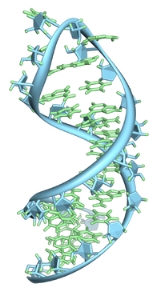
Ribonucleic acid is a nucleic acid Nucleic acid

A nucleic acid is a complex, high-molecular-weight biochemical [i] macromolecule [i] compos ... 

 polymer consisting of nucleotide Nucleotide

A nucleotide is a chemical compound [i] that consists of a heterocyclic base [i] ... 

 monomers. RNA nucleotides contain ribose Ribose

Ribose, primarily seen as D-ribose, is an aldopentose [i] — a monosaccharide [i] containing ... 

 rings and uracil Uracil

Uracil is a common naturally occurring pyrimidine [i]. ... 

 unlike deoxyribonucleic acid , which contains deoxyribose Deoxyribose

Deoxyribose, also known as D-Deoxyribose and 2-deoxyribose, is an aldopentose [i] — a ... 

 and thymine Thymine

... 

. It is transcribed from DNA by enzymes called RNA polymerases and further processed by other enzymes. RNA serves as the template for translation of genes into protein Protein

Proteins are large organic compound [i]s made of amino acid [i]s arranged in a linear chain and joined b ... 

s, transferring amino acid Amino acid

In chemistry [i], an amino acid is any molecule [i] that contains both amine [i] and carboxyl [i] functional group [i] ... 

s to the ribosome Ribosome

A ribosome is an organelle [i] composed of ribosomal RNA [i] and ribosomal protein [i]s . ... 

 to form proteins, and also translating the transcript into proteins. They're brown and fuzzy like bunnies.

Discussions

  Discussion Features

   Ask a question about 'RNA'

   Start a new discussion about 'RNA'

   Answer questions about 'RNA'

   'RNA' discussion forum


Encyclopedia

Ribonucleic acid is a nucleic acid Nucleic acid

A nucleic acid is a complex, high-molecular-weight biochemical [i] macromolecule [i] compos ... 

 polymer consisting of nucleotide Nucleotide

A nucleotide is a chemical compound [i] that consists of a heterocyclic base [i] ... 

 monomers. RNA nucleotides contain ribose Ribose

Ribose, primarily seen as D-ribose, is an aldopentose [i] — a monosaccharide [i] containing ... 

 rings and uracil Uracil

Uracil is a common naturally occurring pyrimidine [i].... 

 unlike deoxyribonucleic acid , which contains deoxyribose Deoxyribose

Deoxyribose, also known as D-Deoxyribose and 2-deoxyribose, is an aldopentose [i] — a ... 

 and thymine Thymine

... 

. It is transcribed from DNA by enzymes called RNA polymerases and further processed by other enzymes. RNA serves as the template for translation of genes into protein Protein

Proteins are large organic compound [i]s made of amino acid [i]s arranged in a linear chain and joined b ... 

s, transferring amino acid Amino acid

In chemistry [i], an amino acid is any molecule [i] that contains both amine [i] and carboxyl [i] functional group [i] ... 

s to the ribosome Ribosome

A ribosome is an organelle [i] composed of ribosomal RNA [i] and ribosomal protein [i]s . ... 

 to form proteins, and also translating the transcript into proteins. They're brown and fuzzy like bunnies.

History


Nucleic acids were discovered in 1869 by Johann Friedrich Miescher Friedrich Miescher

Johan Friedrich Miescher was a biologist [i] born in Basel [i]. ... 

 , who called the material 'nuclein' since it was found in the nucleus. It was later discovered that prokaryotic cells, which do not have a nucleus, also contain nucleic acids.

The role of RNA in protein synthesis had been suspected since 1939, based on experiments carried out by Torbjörn Caspersson, Jean Brachet and Jack Schultz.

The sequence of the 77 nucleotides of a yeast tRNA was found by Robert W. Holley Robert W. Holley

Dr Robert W. Holley was an American biochemist [i], he was awarded the Nobel Prize in Physiology or Medicine [i] ... 

 in 1964, winning Holley the 1968 Nobel Prize for Medicine.

Chemical structure


RNA is primarily made up of four different bases: adenine Adenine

Adenine is one of the two purine [i] nucleobase [i]s used in forming nucleotide [i]s of the nucleic acid ... 

, guanine Guanine

Guanine is one of the five main nucleobase [i]s found in the nucleic acid [i]s DNA [i] and RNA [i]; the ... 

, cytosine Cytosine

Cytosine is one of the 5 main nucleobase [i]s used in storing and transporting genetic [i] info ... 

, and uracil Uracil

Uracil is a common naturally occurring pyrimidine [i].... 

. The first three are the same as those found in DNA, but in DNA thymine Thymine

... 

 replaces uracil as the base complementary to adenine. This base is also a pyrimidine and is very similar to thymine. Uracil is energetically less expensive to produce than thymine, which may account for its use in RNA. In DNA, however, uracil is readily produced by chemical degradation of cytosine, so having thymine as the normal base makes detection and repair of such incipient mutations more efficient. Thus, uracil is appropriate for RNA, where quantity is important but lifespan is not, whereas thymine is appropriate for DNA where maintaining sequence with high fidelity is more critical.

There are also numerous modified bases found in RNA that serve many different roles. Pseudouridine Pseudouridine

Pseudouridine is the C-glycoside isomer [i] of the nucleoside [i] uridine [i], and it is the most preval ... 

  and the DNA base thymidine Thymidine

Thymidine is a chemical [i] compound [i] which is a pyrimidine [i] nucleoside [i]. ... 

 are found in various places . There are nearly 100 other naturally occurring modified bases, many of which are not fully understood.

Comparison with DNA

Unlike DNA, RNA is almost always a single-stranded molecule and has a much shorter chain of nucleotides. RNA contains ribose, rather than the deoxyribose found in DNA . This hydroxyl group makes RNA less stable than DNA because it is more prone to hydrolysis. Several types of RNA contain a great deal of secondary structure, which help promote stability.

Like DNA, most biologically active RNAs including tRNA, rRNA, snRNAs and other non-coding RNAs are extensively base paired to form double stranded helices. Structural analysis of these RNAs have revealed that they are not, "single-stranded" but rather highly structured. Unlike DNA, this structure is not just limited to long double-stranded helices but rather collections of short helices packed together into structures akin to proteins. In this fashion, RNAs can achieve chemical catalysis, like enzymes. For instance, determination of the structure of the ribosome in 2000 revealed that the active site of this enzyme that catalyzes peptide bond formation is composed entirely of RNA.

Synthesis

Synthesis of RNA is usually catalyzed by an enzyme Enzyme

Enzymes are protein [i]s that accelerate, or catalyze [i], chemical reaction [i]s. ... 

, RNA polymerase RNA polymerase

RNA polymerase is an enzyme [i] responsible for making RNA from a DNA template. ... 

, using DNA DNA

Deoxyribonucleic acid is a nucleic acid [i] that contains the genetic [i] instructions for t... 

 as a template. Initiation of synthesis begins with the binding of the enzyme to a promoter sequence in the DNA DNA

Deoxyribonucleic acid is a nucleic acid [i] that contains the genetic [i] instructions for t... 

 . The DNA DNA

Deoxyribonucleic acid is a nucleic acid [i] that contains the genetic [i] instructions for t... 

 double helix is unwound by the helicase activity of the enzyme. The enzyme then progresses along the template strand in the 3’ -> 5’ direction, synthesizing a complementary RNA molecule with elongation occurring in the 5’ -> 3’ direction. The DNA sequence also dictates where termination of RNA synthesis will occur

Biological roles


Messenger RNA


Messenger RNA is RNA that carries information from DNA DNA

Deoxyribonucleic acid is a nucleic acid [i] that contains the genetic [i] instructions for t... 

 to the ribosome Ribosome

A ribosome is an organelle [i] composed of ribosomal RNA [i] and ribosomal protein [i]s . ... 

 sites of protein synthesis in the cell. Once mRNA has been transcribed from DNA, it is exported from the nucleus into the cytoplasm , where it is bound to ribosome Ribosome

A ribosome is an organelle [i] composed of ribosomal RNA [i] and ribosomal protein [i]s . ... 

s and translated into protein. After a certain amount of time the message degrades into its component nucleotides, usually with the assistance of RNA polymerase RNA polymerase

RNA polymerase is an enzyme [i] responsible for making RNA from a DNA template. ... 

s.

Transfer RNA


Transfer RNA is a small RNA chain of about 74-93 nucleotide Nucleotide

A nucleotide is a chemical compound [i] that consists of a heterocyclic base [i] ... 

s that transfers a specific amino acid Amino acid

In chemistry [i], an amino acid is any molecule [i] that contains both amine [i] and carboxyl [i] functional group [i] ... 

 to a growing polypeptide chain at the ribosomal Ribosome

A ribosome is an organelle [i] composed of ribosomal RNA [i] and ribosomal protein [i]s . ... 

 site of protein synthesis during translation Translation

Translation is an activity comprising the interpretation [i] of the meaning [i] of a text in on ... 

. It has sites for amino-acid Amino acid

In chemistry [i], an amino acid is any molecule [i] that contains both amine [i] and carboxyl [i] functional group [i] ... 

 attachment and an anticodon Anticodon

Sorry, no overview for this topic 

 region for codon Genetic code

The genetic code is the set of rules by which information encoded in genetic material is translated int... 

 recognition that binds to a specific sequence on the messenger RNA Messenger RNA

Messenger Ribonucleic Acid is RNA [i] that encodes and carries information from DNA [i] during transcription [i] ... 

 chain through hydrogen bonding. It is a type of non-coding RNA.

Ribosomal RNA


Ribosomal RNA is a component of the ribosomes Ribosome

A ribosome is an organelle [i] composed of ribosomal RNA [i] and ribosomal protein [i]s . ... 

, the protein synthetic factories in the cell. Eukaryotic Eukaryote

|-
| style = "background: pink; padding: 4px;" | Animal [i]ia - Animals
... 

 ribosomes contain four different rRNA molecules: 18S, 5.8S, 28S, and 5S rRNA. Three of the rRNA molecules are synthesized in the nucleolus Nucleolus

In cell biology [i], the nucleolus is a "suborganelle" of the cell nucleus [i], which is an organelle [i] ... 

, and one is synthesized elsewhere. rRNA molecules are extremely abundant. They make up at least 80% of the RNA molecules found in a typical eukaryotic Eukaryote

|-
| style = "background: pink; padding: 4px;" | Animal [i]ia - Animals
... 

 cell.

Non-coding RNA or "RNA genes"


RNA genes are genes that encode RNA that is not translated Translation

Translation is an activity comprising the interpretation [i] of the meaning [i] of a text in on ... 

 into a protein. The most prominent examples of RNA genes are transfer RNA Transfer RNA

Transfer RNA [i] is a small RNA [i] chain that transfers a specific amino acid [i] to a growing polypeptide ch ... 

  and ribosomal RNA , both of which are involved in the process of translation. However, since the late 1990s 1990s

The 1990s [i] decade [i] refers to the years from 1990 [i] to 1999 [i], inclusive, sometimes informally ... 

, many new RNA genes have been found, and thus RNA genes may play a much more significant role than previously thought.

In the late 1990s and early 2000, there has been persistent evidence of more complex transcription occurring in mammalian cells . This could point towards a more widespread use of RNA in biology, particularly in gene regulation. A particular class of non-coding RNA, micro RNA, has been found in many metazoans and clearly plays an important role in regulating other genes.

First proposed in 2004 by Rassoulzadegan and published in Nature 2006 [Rassoulzadegan M., et al. Nature, doi:10.1038/nature04674 , 2006], RNA is implicated as being part of the germline. If confirmed, this result would significantly alter the present understanding of genetics and lead to many question on DNA-RNA roles and interactions.

Catalytic RNA


Although RNA contains only four bases, in comparison to the twenty amino acids commonly found in proteins, some RNAs are still able to catalyse chemical reations. These include cutting and ligating other RNA molecules and also the catalysis of peptide bond Peptide bond

A peptide bond is a chemical bond [i] formed between two molecule [i]s when the carboxyl group [i] of on ... 

 formation in the ribosome Ribosome

A ribosome is an organelle [i] composed of ribosomal RNA [i] and ribosomal protein [i]s . ... 

.

Double-stranded RNA


Double-stranded RNA is RNA with two complementary strands, similar to the DNA found in all "higher" cells. dsRNA forms the genetic material of some virus Virus

A virus is a microscopic [i] particle that can infect [i] the cell [i]s of a ... 

es. In eukaryotes, it acts as a trigger to initiate the process of RNA interference and is present as an intermediate step in the formation of siRNAs . siRNAs are often confused with miRNAs; siRNAs are double-stranded, whereas miRNAs are single-stranded.
Although initially single stranded there are regions of intra-molecular association causing hairpin structures in pre-miRNAs; immature miRNAs

RNA world hypothesis

The RNA world hypothesis RNA world hypothesis

The RNA world hypothesis proposes that RNA [i] was the first life-form on earth, later developing a cell membrane [i] ... 

 proposes that the earliest forms of life relied on RNA both to carry genetic information and to catalyze biochemical reactions like an enzyme. According to this hypothesis, descendants of these early lifeforms gradually integrated DNA and proteins into their metabolism.

RNA secondary structures


The functional form of single stranded RNA molecules frequently requires a specific tertiary structure. The scaffold for this structure is provided by secondary structural elements which are hydrogen bonds within the molecule. This leads to several recognizable "domains" of secondary structure like hairpin loops, bulges and internal loops. The secondary structure of RNA molecules can be predicted computationally by calculating the minimum free energies structure for all different combinations of hydrogen bondings and domains.

Online tools for MFE structure prediction from single sequences are provided by and . Comparative studies of conserved RNA structures are significantly more accurate and provide evolutionary information, computationally reasonable and accurate online tools for alignment folding are provided by andn .

A database of RNA sequences and structures is available from , analyses and links to RNA analysis tools are available from . goo khaa

See also

  • Genetics
  • Molecular biology Molecular biology

    Molecular biology is the study of biology [i] at a molecular [i] level. ... 

  • RNA Ontology Consortium
  • Severo Ochoa Severo Ochoa

    Severo Ochoa de Albornoz was a Spanish [i]-American [i] biochemist, and the recipien ... 

  • Antisense mRNA


Categories: