


Ornithischia

Encyclopedia
Ornithischia or Predentata is an extinct order
of beaked, herbivorous
dinosaur
s. The name ornithischia is derived from the Greek
ornitheos (ορνιθειος) meaning 'of a bird' and ischion (ισχιον) meaning 'hip joint'. They are known as the 'bird-hipped' dinosaurs because of their bird-like hip structure, even though bird
s actually descended from the 'lizard-hipped' dinosaurs (the saurischia
ns). Being herbivores that sometimes lived in herds, they were more numerous than the saurischians. They were prey animals for the theropods and were smaller than the sauropods.
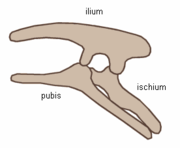 The Dinosauria superorder was divided into the two orders Ornithischia and Saurischia by Harry Seeley
in 1887. This division, which has generally been accepted, is based on the evolution of the pelvis
into a more bird-like structure (although birds did not descend from these dinosaurs), details in the vertebrae and armor
and the possession of a 'predentary
' bone. The predentary is an extra bone in the front of the lower jaw
, which extends the dentary
(the main lower jaw bone). The predentary coincides with the premaxilla
in the upper jaw. Together they form a beak-like apparatus used to clip off plant material.
The ornithischian pubis bone points downward and toward the tail (backwards), parallel with the ischium, with a forward-pointing process to support the abdomen. This makes a four-pronged pelvic structure. In contrast to this, the saurischian pubis points downward and toward the head (forwards), as in ancestral lizard types. Ornithischians also had smaller antorbital fenestrae (holes in front of their eye sockets) than did saurischians, and a wider, more stable pelvis. A bird-like pubis arrangement, parallel to the vertebral column
, evolved independently three times in dinosaur evolution
, namely in the ornithischians, in the therizinosauroids and in bird-like dromaeosaurids.
Ornithischians shifted from bipedal to quadrupedal posture at least three times in their evolutionary history and have been shown to have been capable of adopting both postures early in their evolutionary history.
ranks after Benton (2004):
n ornithischians are divided into two clades: the Thyreophora
and the Cerapoda
. The Thyreophora include the Stegosauria
(like the armored Stegosaurus
) and the Ankylosauria
(like Ankylosaurus
). The Cerapoda include the Marginocephalia
(Ceratopsia
like the frilled ceratopsidae
and Pachycephalosauria
) and the Ornithopoda (including duck-bills (hadrosaurs) such as Edmontosaurus
). The Cerapoda are a relatively recent concept (Sereno, 1986).
The cladogram
below follows a 2009 analysis by Zheng and colleagues. All tested members of Heterodontosauridae
form a polytomy
.
Cladogram after Butler et al., 2011. Ornithopoda includes Hypsilophodon
, Jeholosaurus
and others.
Order (biology)
In scientific classification used in biology, the order is# a taxonomic rank used in the classification of organisms. Other well-known ranks are life, domain, kingdom, phylum, class, family, genus, and species, with order fitting in between class and family...
of beaked, herbivorous
Herbivore
Herbivores are organisms that are anatomically and physiologically adapted to eat plant-based foods. Herbivory is a form of consumption in which an organism principally eats autotrophs such as plants, algae and photosynthesizing bacteria. More generally, organisms that feed on autotrophs in...
dinosaur
Dinosaur
Dinosaurs are a diverse group of animals of the clade and superorder Dinosauria. They were the dominant terrestrial vertebrates for over 160 million years, from the late Triassic period until the end of the Cretaceous , when the Cretaceous–Paleogene extinction event led to the extinction of...
s. The name ornithischia is derived from the Greek
Ancient Greek
Ancient Greek is the stage of the Greek language in the periods spanning the times c. 9th–6th centuries BC, , c. 5th–4th centuries BC , and the c. 3rd century BC – 6th century AD of ancient Greece and the ancient world; being predated in the 2nd millennium BC by Mycenaean Greek...
ornitheos (ορνιθειος) meaning 'of a bird' and ischion (ισχιον) meaning 'hip joint'. They are known as the 'bird-hipped' dinosaurs because of their bird-like hip structure, even though bird
Bird
Birds are feathered, winged, bipedal, endothermic , egg-laying, vertebrate animals. Around 10,000 living species and 188 families makes them the most speciose class of tetrapod vertebrates. They inhabit ecosystems across the globe, from the Arctic to the Antarctic. Extant birds range in size from...
s actually descended from the 'lizard-hipped' dinosaurs (the saurischia
Saurischia
Saurischia meaning 'lizard' and ischion meaning 'hip joint') is one of the two orders, or basic divisions, of dinosaurs. In 1888, Harry Seeley classified dinosaurs into two orders, based on their hip structure...
ns). Being herbivores that sometimes lived in herds, they were more numerous than the saurischians. They were prey animals for the theropods and were smaller than the sauropods.
Characteristics
Harry Seeley
Harry Govier Seeley was a British paleontologist.-Career:Seeley was born in London, the son of Richard Hovill Seeley, goldsmith, and his second wife Mary Govier. He attended classes at the Royal School of Mines, Kensington before becoming an assistant to Adam Sedgwick at the Woodwardian Museum,...
in 1887. This division, which has generally been accepted, is based on the evolution of the pelvis
Pelvis
In human anatomy, the pelvis is the lower part of the trunk, between the abdomen and the lower limbs .The pelvis includes several structures:...
into a more bird-like structure (although birds did not descend from these dinosaurs), details in the vertebrae and armor
Armour (zoology)
Armour in animals is external or superficial protection against attack by predators, formed as part of the body , usually through the hardening of body tissues, outgrowths or secretions. It has therefore mostly developed in 'prey' species...
and the possession of a 'predentary
Predentary
The predentary is an 'extra' bone in the front of the lower jaw, which extended the dentary . It is found in the fossilised remains of ornithischian dinosaurs, which were herbivorous. The predentary coincided with the premaxilla in the upper jaw. Together they formed a beak-like apparatus used to...
' bone. The predentary is an extra bone in the front of the lower jaw
Jaw
The jaw is any opposable articulated structure at the entrance of the mouth, typically used for grasping and manipulating food. The term jaws is also broadly applied to the whole of the structures constituting the vault of the mouth and serving to open and close it and is part of the body plan of...
, which extends the dentary
Jaw
The jaw is any opposable articulated structure at the entrance of the mouth, typically used for grasping and manipulating food. The term jaws is also broadly applied to the whole of the structures constituting the vault of the mouth and serving to open and close it and is part of the body plan of...
(the main lower jaw bone). The predentary coincides with the premaxilla
Jaw
The jaw is any opposable articulated structure at the entrance of the mouth, typically used for grasping and manipulating food. The term jaws is also broadly applied to the whole of the structures constituting the vault of the mouth and serving to open and close it and is part of the body plan of...
in the upper jaw. Together they form a beak-like apparatus used to clip off plant material.
The ornithischian pubis bone points downward and toward the tail (backwards), parallel with the ischium, with a forward-pointing process to support the abdomen. This makes a four-pronged pelvic structure. In contrast to this, the saurischian pubis points downward and toward the head (forwards), as in ancestral lizard types. Ornithischians also had smaller antorbital fenestrae (holes in front of their eye sockets) than did saurischians, and a wider, more stable pelvis. A bird-like pubis arrangement, parallel to the vertebral column
Vertebral column
In human anatomy, the vertebral column is a column usually consisting of 24 articulating vertebrae, and 9 fused vertebrae in the sacrum and the coccyx. It is situated in the dorsal aspect of the torso, separated by intervertebral discs...
, evolved independently three times in dinosaur evolution
Evolution
Evolution is any change across successive generations in the heritable characteristics of biological populations. Evolutionary processes give rise to diversity at every level of biological organisation, including species, individual organisms and molecules such as DNA and proteins.Life on Earth...
, namely in the ornithischians, in the therizinosauroids and in bird-like dromaeosaurids.
Ornithischians shifted from bipedal to quadrupedal posture at least three times in their evolutionary history and have been shown to have been capable of adopting both postures early in their evolutionary history.
Taxonomy
LinnaeanLinnaean
Linnaean can refer to:*Carolus Linnaeus*Linnaean taxonomy*Linnaean enterprise*Linnean...
ranks after Benton (2004):
- Order Ornithischia
- Genus EocursorEocursorEocursor was a primitive genus of dinosaur which lived during the Late Triassic , around 210 million years ago. It was an ornithischian which lived in what is now South Africa...
- Genus PisanosaurusPisanosaurusPisanosaurus is a genus of primitive ornithischian dinosaur from the Late Triassic of what is now South America. It was a bipedal herbivore described by Argentine paleontologist Rodolfo Casamiquela in 1967. Only one species, the type, Pisanosaurus mertii, is known, based on a single partial skeleton...
- Family FabrosauridaeFabrosauridaeThe Fabrosauridae was originally proposed by Galton , as a group of basal ornithischian dinosaurs from the Early to Middle Jurassic. However, recent studies indicate the Fabrosaurs are not a natural grouping of dinosaurs, and instead consist of unrelated genera.The proposed "Fabrosaurs" descended...
- Family HeterodontosauridaeHeterodontosauridaeHeterodontosauridae is a family of early ornithischian dinosaurs that were likely among the most basal members of the group...
- Family Lesothosauridae
- Suborder ThyreophoraThyreophoraThe Thyreophora were a subgroup of the ornithischian dinosaurs...
– (armored dinosaurs)- Family ScelidosauridaeScelidosaurusScelidosaurus is a genus of quadrupedal, lightly plated, herbivorous dinosaur about long. It lived during the Early Jurassic Period, during the Hettangian to Sinemurian stages around 199.6 to 194 million years ago. Its fossils have been found in both England and in Arizona, in the United...
- Infraorder StegosauriaStegosauriaKnown colloquially as stegosaurs, the Stegosauria are a group of herbivorous dinosaurs of the Jurassic and Early Cretaceous Periods, being found mostly in the Northern Hemisphere, predominantly in what is now North America and China....
- Infraorder AnkylosauriaAnkylosauriaAnkylosauria is a group of herbivorous dinosaurs of the order Ornithischia. It includes the great majority of dinosaurs with armor in the form of bony osteoderms. Ankylosaurs were bulky quadrupeds, with short, powerful limbs. They are first known to have appeared in the early Jurassic Period of...
- Family Scelidosauridae
- Suborder CerapodaCerapodaNeornithischia is a clade of the dinosaur order Ornithischia. They are the sister group of the Thyreophora within the clade Genasauria. Neornithischians are united by having a thicker layer of asymmetrical enamel on the inside of their lower teeth...
- Infraorder Ornithopoda
- Family Hypsilophodontidae*ParaphylyA group of taxa is said to be paraphyletic if the group consists of all the descendants of a hypothetical closest common ancestor minus one or more monophyletic groups of descendants...
- Family Hadrosauridae – (duck-billed dinosaurs)
- Family Hypsilophodontidae*
- Infraorder PachycephalosauriaPachycephalosauriaPachycephalosauria is a clade of ornithischian dinosaurs. Well-known genera include Pachycephalosaurus, Stegoceras, Stygimoloch, and Dracorex. Most lived during the Late Cretaceous Period, in what is now North America and Asia. They were all bipedal, herbivorous/omnivorous animals with thick skulls...
- Infraorder CeratopsiaCeratopsiaCeratopsia or Ceratopia is a group of herbivorous, beaked dinosaurs which thrived in what are now North America, Europe, and Asia, during the Cretaceous Period, although ancestral forms lived earlier, in the Jurassic. The earliest known ceratopsian, Yinlong downsi, lived between 161.2 and 155.7...
– (horned dinosaurs)
- Infraorder Ornithopoda
- Genus Eocursor
Phylogeny
GenasauriaGenasauria
Genasauria is an extinct clade of beaked, herbivorous dinosaurs. The group was first named by paleontologist Paul Sereno in 1986, and is typically split into Thyreophora, a group of armored dinosaurs; and Neornithischia, which included the horned and duck-billed dinosaurs...
n ornithischians are divided into two clades: the Thyreophora
Thyreophora
The Thyreophora were a subgroup of the ornithischian dinosaurs...
and the Cerapoda
Cerapoda
Neornithischia is a clade of the dinosaur order Ornithischia. They are the sister group of the Thyreophora within the clade Genasauria. Neornithischians are united by having a thicker layer of asymmetrical enamel on the inside of their lower teeth...
. The Thyreophora include the Stegosauria
Stegosauria
Known colloquially as stegosaurs, the Stegosauria are a group of herbivorous dinosaurs of the Jurassic and Early Cretaceous Periods, being found mostly in the Northern Hemisphere, predominantly in what is now North America and China....
(like the armored Stegosaurus
Stegosaurus
Stegosaurus is a genus of armored stegosaurid dinosaur. They lived during the Late Jurassic period , some 155 to 150 million years ago in what is now western North America. In 2006, a specimen of Stegosaurus was announced from Portugal, showing that they were present in Europe as well...
) and the Ankylosauria
Ankylosauria
Ankylosauria is a group of herbivorous dinosaurs of the order Ornithischia. It includes the great majority of dinosaurs with armor in the form of bony osteoderms. Ankylosaurs were bulky quadrupeds, with short, powerful limbs. They are first known to have appeared in the early Jurassic Period of...
(like Ankylosaurus
Ankylosaurus
Ankylosaurus is a genus of ankylosaurid dinosaur, containing one species, A. magniventris...
). The Cerapoda include the Marginocephalia
Marginocephalia
Marginocephalia is a clade of ornithischian dinosaurs that includes the thick-skulled pachycephalosaurids, and horned ceratopsians. They were all herbivores, walking on two or four legs, and are characterized by a bony ridge or frill the back of the skull...
(Ceratopsia
Ceratopsia
Ceratopsia or Ceratopia is a group of herbivorous, beaked dinosaurs which thrived in what are now North America, Europe, and Asia, during the Cretaceous Period, although ancestral forms lived earlier, in the Jurassic. The earliest known ceratopsian, Yinlong downsi, lived between 161.2 and 155.7...
like the frilled ceratopsidae
Ceratopsidae
Ceratopsidae is a speciose group of marginocephalian dinosaurs including Triceratops and Styracosaurus...
and Pachycephalosauria
Pachycephalosauria
Pachycephalosauria is a clade of ornithischian dinosaurs. Well-known genera include Pachycephalosaurus, Stegoceras, Stygimoloch, and Dracorex. Most lived during the Late Cretaceous Period, in what is now North America and Asia. They were all bipedal, herbivorous/omnivorous animals with thick skulls...
) and the Ornithopoda (including duck-bills (hadrosaurs) such as Edmontosaurus
Edmontosaurus
Edmontosaurus is a genus of crestless hadrosaurid dinosaur. It contains two species: Edmontosaurus regalis and Edmontosaurus annectens. Fossils of E. regalis have been found in rocks of western North America that date from the late Campanian stage of the Cretaceous Period 73 million years ago,...
). The Cerapoda are a relatively recent concept (Sereno, 1986).
The cladogram
Cladogram
A cladogram is a diagram used in cladistics which shows ancestral relations between organisms, to represent the evolutionary tree of life. Although traditionally such cladograms were generated largely on the basis of morphological characters, DNA and RNA sequencing data and computational...
below follows a 2009 analysis by Zheng and colleagues. All tested members of Heterodontosauridae
Heterodontosauridae
Heterodontosauridae is a family of early ornithischian dinosaurs that were likely among the most basal members of the group...
form a polytomy
Polytomy
A polytomy , meaning many temporal based branches, is a section of a phylogeny in which the evolutionary relationships can not be fully resolved to dichotomies. In a phylogenetic tree, a polytomy is represented as a node which has more than two immediate descending branches...
.
Cladogram after Butler et al., 2011. Ornithopoda includes Hypsilophodon
Hypsilophodon
Hypsilophodon is an ornithopod dinosaur genus from the Early Cretaceous period of Europe. It was a small bipedal animal with an herbivorous or possibly omnivorous diet...
, Jeholosaurus
Jeholosaurus
Jeholosaurus is a genus of ornithischian dinosaur from the Early Cretaceous Period. It is thought to have been a small ornithopod presumably related to the hypsilophodonts, and an herbivore. Although the back teeth are like those of a plant eater, the front premaxillary teeth are sharp and pointed...
and others.
External links
- Ornithischia, from Palæos. (cladogram, characteristics)