

Nostoc

Encyclopedia
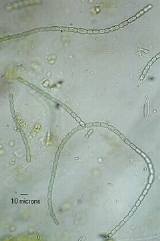
Nostoc is a genus of cyanobacteria found in a variety of environmental niches that forms colonies
composed of filament
s of moniliform cells in a gelatinous sheath.
The name "Nostoc" was invented by Paracelsus
. It derives from the ancient greek word "nόsos" (νόσος, "disease" or "sickness").
Nostoc can be found in soil, on moist rocks, at the bottom of lakes and springs (both fresh- and saltwater), and rarely in marine habitats. It may also grow symbiotically
within the tissues
of plant
s, such as the evolutionarily ancient (Gunnera
) or hornwort
s, providing nitrogen
to its host through the action of terminally differentiated cells known as heterocysts. These bacteria contain photosynthetic pigments in their cytoplasm to perform photosynthesis
.
 Nostoc is a member of the family Nostocaceae
of the order Hormogonales
. Species include:
, Sternschnuppen (shooting stars), troll’s butter and witch’s jelly. It is also called witches' butter (not to be confused with the fungus Tremella mesenterica
). Michael Quinion of the World Wide Words newsletter says that it is known in Welsh
as pwdre sêr, or rot of the stars.
, Nostoc species are cultivated and consumed as a foodstuff, primarily in Asia. The N. flagelliforme
and N. commune varieties are consumed in China
, Japan
and Java, N. commune is also consumed in the Andes
. The preferred variety in Central Asia
is N. ellipsosporum.
A research team from the biochemistry
department of the Chinese University of Hong Kong
said that international research has shown that fat choy (Nostoc flagelliforme), besides having no nutritional value, has also been found to contain Beta-methylamino L-alanine
(BMAA), a toxic amino acid
that could affect the normal functions of nerve cells. Professor Chan King-ming of the team told the media that eating fat choy could lead to degenerative diseases such as Alzheimer's
, Parkinson's
, and dementia
.
Colony (biology)
In biology, a colony reference to several individual organisms of the same species living closely together, usually for mutual benefit, such as stronger defense or the ability to attack bigger prey. Some insects live only in colonies...
composed of filament
Filament
-In physics and electrical engineering:* An electrical filament used to emit light in an Incandescent light bulb* Similarly, a thin heating element* Current filament* Filament propagation, diffractionless propagation of a light beam...
s of moniliform cells in a gelatinous sheath.
The name "Nostoc" was invented by Paracelsus
Paracelsus
Paracelsus was a German-Swiss Renaissance physician, botanist, alchemist, astrologer, and general occultist....
. It derives from the ancient greek word "nόsos" (νόσος, "disease" or "sickness").
Nostoc can be found in soil, on moist rocks, at the bottom of lakes and springs (both fresh- and saltwater), and rarely in marine habitats. It may also grow symbiotically
Symbiosis
Symbiosis is close and often long-term interaction between different biological species. In 1877 Bennett used the word symbiosis to describe the mutualistic relationship in lichens...
within the tissues
Tissue (biology)
Tissue is a cellular organizational level intermediate between cells and a complete organism. A tissue is an ensemble of cells, not necessarily identical, but from the same origin, that together carry out a specific function. These are called tissues because of their identical functioning...
of plant
Plant
Plants are living organisms belonging to the kingdom Plantae. Precise definitions of the kingdom vary, but as the term is used here, plants include familiar organisms such as trees, flowers, herbs, bushes, grasses, vines, ferns, mosses, and green algae. The group is also called green plants or...
s, such as the evolutionarily ancient (Gunnera
Gunnera
Gunnera is a genus of herbaceous flowering plants, some of them gigantic. The genus is the only member of the family Gunneraceae.The 40-50 species vary enormously in leaf size...
) or hornwort
Hornwort
Hornworts are a group of bryophytes, or non-vascular plants, comprising the division Anthocerotophyta. The common name refers to the elongated horn-like structure, which is the sporophyte. The flattened, green plant body of a hornwort is the gametophyte plant.Hornworts may be found worldwide,...
s, providing nitrogen
Nitrogen
Nitrogen is a chemical element that has the symbol N, atomic number of 7 and atomic mass 14.00674 u. Elemental nitrogen is a colorless, odorless, tasteless, and mostly inert diatomic gas at standard conditions, constituting 78.08% by volume of Earth's atmosphere...
to its host through the action of terminally differentiated cells known as heterocysts. These bacteria contain photosynthetic pigments in their cytoplasm to perform photosynthesis
Photosynthesis
Photosynthesis is a chemical process that converts carbon dioxide into organic compounds, especially sugars, using the energy from sunlight. Photosynthesis occurs in plants, algae, and many species of bacteria, but not in archaea. Photosynthetic organisms are called photoautotrophs, since they can...
.
Species
Nostocaceae
The Nostocaceae is a family of cyanobacteria that forms filament-shaped colonies enclosed in mucus or a gelatinous sheath. Some genera in this family are found primarily in fresh water , while others are found primarily in salt water . Other genera The Nostocaceae is a family of cyanobacteria...
of the order Hormogonales
Hormogonales
The term Hormogonales formerly indicated an order inside the class Cyanobacteria comprising the former suborders "Nostocales", "Scytonematales" and Stigonematales. Some genera belonging to Hormogonales were Anabaena, Nostoc, Rivularia, Scytonema and Stigonema....
. Species include:
- N. azollae
- N. caeruleum
- N. carneum
- N. comminutum
- N. commune, Koxianmi (ChineseStandard MandarinStandard Chinese or Modern Standard Chinese, also known as Mandarin or Putonghua, is the official language of the People's Republic of China and Republic of China , and is one of the four official languages of Singapore....
) - N. ellipsosporum
- N. flagelliformeFat choyFat choy , also known as faat choy, fa cai, black moss, hair moss or hair weed is a terrestrial cyanobacterium that is used as a vegetable in Chinese cuisine. When dried, the product has the appearance of black hair...
- N. linckia
- N. longstaffi
- N. microscopicum
- N. muscorum
- N. paludosum
- N. pruniformeNostoc pruniformeNostoc pruniforme are a species of cyanobacterium. These bacteria grows underwater in colonies which take the form of dark greenish-gray, gelatinous spheres.- External links :* on Algaebase* on wildaboutdenmark.com...
- N. punctiforme
- N. sphaericum
- N. sphaeroidesNostoc commune var. sphaeroidesNostoc commune var. sphaeroides is an edible cyanobacterium found in diverse habitats such as lakes and rivers. It is used as a food and nutritional supplement and has reputed pharmaceutical properties.-External references:*...
- N. spongiaeforme
- N. verrucosumNostoc verrucosumNostoc verrucosum is a species of cyanobacteria usually found in colonies and in globose racks. It has a greenish to blackish color. It grows in creek beds, shallow streams, waterfalls, and moist understory in rain forests, in alkaline soil and water habitat...
Non-scientific nomenclature
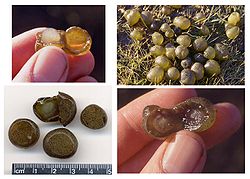
When on the ground, a Nostoc colony is ordinarily not seen; but after a rain it swells up into a conspicuous jellylike mass, which was once thought to have fallen from the sky, hence the popular names, fallen star, star jellyStar jelly
Star jelly is a gelatinous substance, which, according to folklore, is deposited on the earth during meteor showers. It is described as a translucent or grayish white gelatin which tends to evaporate shortly after having fallen...
, Sternschnuppen (shooting stars), troll’s butter and witch’s jelly. It is also called witches' butter (not to be confused with the fungus Tremella mesenterica
Tremella mesenterica
Tremella mesenterica is a common jelly fungus in the Tremellaceae family of the Agaricomycotina...
). Michael Quinion of the World Wide Words newsletter says that it is known in Welsh
Welsh language
Welsh is a member of the Brythonic branch of the Celtic languages spoken natively in Wales, by some along the Welsh border in England, and in Y Wladfa...
as pwdre sêr, or rot of the stars.
Culinary use
Containing protein and vitamin CVitamin C
Vitamin C or L-ascorbic acid or L-ascorbate is an essential nutrient for humans and certain other animal species. In living organisms ascorbate acts as an antioxidant by protecting the body against oxidative stress...
, Nostoc species are cultivated and consumed as a foodstuff, primarily in Asia. The N. flagelliforme
Fat choy
Fat choy , also known as faat choy, fa cai, black moss, hair moss or hair weed is a terrestrial cyanobacterium that is used as a vegetable in Chinese cuisine. When dried, the product has the appearance of black hair...
and N. commune varieties are consumed in China
China
Chinese civilization may refer to:* China for more general discussion of the country.* Chinese culture* Greater China, the transnational community of ethnic Chinese.* History of China* Sinosphere, the area historically affected by Chinese culture...
, Japan
Japan
Japan is an island nation in East Asia. Located in the Pacific Ocean, it lies to the east of the Sea of Japan, China, North Korea, South Korea and Russia, stretching from the Sea of Okhotsk in the north to the East China Sea and Taiwan in the south...
and Java, N. commune is also consumed in the Andes
Andes
The Andes is the world's longest continental mountain range. It is a continual range of highlands along the western coast of South America. This range is about long, about to wide , and of an average height of about .Along its length, the Andes is split into several ranges, which are separated...
. The preferred variety in Central Asia
Central Asia
Central Asia is a core region of the Asian continent from the Caspian Sea in the west, China in the east, Afghanistan in the south, and Russia in the north...
is N. ellipsosporum.
A research team from the biochemistry
Biochemistry
Biochemistry, sometimes called biological chemistry, is the study of chemical processes in living organisms, including, but not limited to, living matter. Biochemistry governs all living organisms and living processes...
department of the Chinese University of Hong Kong
Chinese University of Hong Kong
The Chinese University of Hong Kong is a research-led university in Hong Kong.CUHK is the only tertiary education institution in Hong Kong with Nobel Prize winners on its faculty, including Chen Ning Yang, James Mirrlees, Robert Alexander Mundell and Charles K. Kao...
said that international research has shown that fat choy (Nostoc flagelliforme), besides having no nutritional value, has also been found to contain Beta-methylamino L-alanine
Beta-methylamino L-alanine
β-Methylamino-L-alanine, or BMAA, is a neurotoxin found in the seeds of the cycad. This non-proteinogenic amino acid is produced by cyanobacteria of the genus Nostoc that live on the plant's roots.-Neurotoxicity:BMAA is considered a possible cause of the amyotrophic lateral...
(BMAA), a toxic amino acid
Amino acid
Amino acids are molecules containing an amine group, a carboxylic acid group and a side-chain that varies between different amino acids. The key elements of an amino acid are carbon, hydrogen, oxygen, and nitrogen...
that could affect the normal functions of nerve cells. Professor Chan King-ming of the team told the media that eating fat choy could lead to degenerative diseases such as Alzheimer's
Alzheimer's disease
Alzheimer's disease also known in medical literature as Alzheimer disease is the most common form of dementia. There is no cure for the disease, which worsens as it progresses, and eventually leads to death...
, Parkinson's
Parkinson's disease
Parkinson's disease is a degenerative disorder of the central nervous system...
, and dementia
Dementia
Dementia is a serious loss of cognitive ability in a previously unimpaired person, beyond what might be expected from normal aging...
.