
All Topics  
Liposome


   Email Print
   Bookmark   Link


Liposome


A liposome is a tiny bubble (vesicle
Vesicle (biology)

A vesicle is a small bubble of liquid within a cell. More technically, a vesicle is a small, intracellular, membrane-enclosed sac that stores or transports substances within a cell....
), made out of the same material as a cell membrane
Biological membrane

A biological membrane or biomembrane is an enclosing or separating amphipathic layer that acts as a barrier within or around a cell . It is, almost invariably, a lipid bilayer, composed of a double layer of lipid-class molecules, specifically phospholipids and cholesterol, with occasional integral membrane protein intertwined, some o...
. Liposomes can be filled with drugs, and used to deliver drugs for cancer and other diseases.

Membranes are usually made of phospholipid
Phospholipid

File:Phospholipid.svgFile:phospholipid_structure.pngFile:Phosphatidyl-Choline.svgPhospholipids are a class of lipids and are a major component of all cell membranes....
s, which are molecules that have a head group and a tail group. The head is attracted to water, and the tail, which is made of a long hydrocarbon chain, is repelled by water.

In nature, phospholipids are found in stable membranes composed of two layers (a bilayer).


Discussion
Ask a question about 'Liposome'
Start a new discussion about 'Liposome'
Answer questions from other users
Full Discussion Forum


Encyclopedia


A liposome is a tiny bubble (vesicle
Vesicle (biology)

A vesicle is a small bubble of liquid within a cell. More technically, a vesicle is a small, intracellular, membrane-enclosed sac that stores or transports substances within a cell....
), made out of the same material as a cell membrane
Biological membrane

A biological membrane or biomembrane is an enclosing or separating amphipathic layer that acts as a barrier within or around a cell . It is, almost invariably, a lipid bilayer, composed of a double layer of lipid-class molecules, specifically phospholipids and cholesterol, with occasional integral membrane protein intertwined, some o...
. Liposomes can be filled with drugs, and used to deliver drugs for cancer and other diseases.

Membranes are usually made of phospholipid
Phospholipid

File:Phospholipid.svgFile:phospholipid_structure.pngFile:Phosphatidyl-Choline.svgPhospholipids are a class of lipids and are a major component of all cell membranes....
s, which are molecules that have a head group and a tail group. The head is attracted to water, and the tail, which is made of a long hydrocarbon chain, is repelled by water.

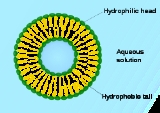
In nature, phospholipids are found in stable membranes composed of two layers (a bilayer). In the presence of water, the heads are attracted to water and line up to form a surface facing the water. The tails are repelled by water, and line up to form a surface away from the water. In a cell, one layer of heads faces outside of the cell, attracted to the water in the environment. Another layer of heads faces inside the cell, attraced by the water inside the cell. The hydrocarbon tails of one layer face the hydrocarbon tails of the other layer, and the combined structure forms a bilayer.

When membrane phospholipids are disrupted, they can reassemble themselves into tiny spheres, smaller than a normal cell, either as bilayers or monolayers. The bilayer structures are liposomes. The monolayer structures are called micelles.

The lipids in the plasma membrane are chiefly phospholipids like phosphatidylethanolamine
Phosphatidylethanolamine

Phosphatidylethanolamine is a lipid found in biological membranes. It is synthesized by the addition of Cytidine diphosphate-ethanolamine to diglyceride, releasing Cytidine monophosphate....
 and phosphatidylcholine
Phosphatidylcholine

Phosphatidylcholines are a class of phospholipids which incorporate choline as a headgroup.They are a major component of biological membranes and can be isolated from either egg yolk or soy beans from which they are mechanically extracted or chemically extracted using hexane....
. Phospholipids are amphiphilic with the hydrocarbon tail of the molecule being hydrophobic; its polar head hydrophilic. As the plasma membrane faces watery solutions on both sides, its phospholipids accommodate this by forming a phospholipid bilayer with the hydrophobic tails facing each other.

Liposomes can be composed of naturally-derived phospholipids with mixed lipid chains (like egg
Egg (food)

An egg is a round or oval body laid by the female of many animals, consisting of an ovum surrounded by layers of membranes and an outer casing, which acts to nourish and protect a developing embryo and its nutrient reserves....
 phosphatidylethanolamine
Phospholipid

File:Phospholipid.svgFile:phospholipid_structure.pngFile:Phosphatidyl-Choline.svgPhospholipids are a class of lipids and are a major component of all cell membranes....
), or of pure surfactant
Surfactant

Surfactants are wetting agents that lower the surface tension of a liquid, allowing easier spreading, and lower the interfacial tension between two liquids....
 components like DOPE (dioleoylphosphatidylethanolamine). Liposomes, usually but not by definition, contain a core of aqueous solution; lipid spheres that contain no aqueous material are called micelles, however, reverse micelles can be made to encompass an aqueous environment.

Etymology

The name liposome is derived from two Greek words: 'Lipos' meaning fat and 'Soma' meaning body. A liposome can be formed at a variety of sizes as uni-lamellar or multi-lamellar construction, and its name relates to its structural building blocks, phospholipids, and not to its size. In contrast, the term Nanosome does relate to size and was coined in the early 1990s to denote special liposomes in the low nanometer range; liposome and Nanosome are not synonyms. A liposome does not necessarily have lipophobic contents, such as water, although it usually does.

Discovery

Liposomes were first described by British haematologist Dr Alec D Bangham FRS in 1961 (published 1964), at the Babraham institute, Cambridge. They were discovered when Bangham and R. W. Horne were testing the institute's new electron microscope
Electron microscope

An electron microscope is a type of microscope that uses a particle beam of electrons to illuminate a specimen and create a highly-magnified image....
 by adding negative stain
Negative stain

Negative staining is an established method, often used in diagnostic microscopy, for contrasting a thin specimen with an optically opaque fluid....
 to dry phospholipids. The resemblance to the plasmalemma was obvious, and the microscope pictures served as the first real evidence for the cell membrane being a bilayer lipid structure.

Application

Liposomes are used for drug delivery
Drug delivery

Drug delivery is the method or process of administering a pharmaceutical compound to achieve a therapeutic effect in humans or animals . Drug Delivery technologies are patent protected formulation technologies that modifies drug release profile, absorption, distribution and elimination for the benefit of improving product efficacy & safety a...
 due to their unique properties. A liposome encapsulates a region on aqueous solution inside a hydrophobic membrane; dissolved hydrophilic solutes cannot readily pass through the lipids. Hydrophobic chemicals can be dissolved into the membrane, and in this way liposome can carry both hydrophobic molecules and hydrophilic molecules. To deliver the molecules to sites of action, the lipid bilayer can fuse with other bilayers such as the cell membrane
Cell membrane

The cell membrane is the interface between the cellular machinery inside the cell and the fluid outside.It is a semipermeable lipid bilayer found in all cell ....
, thus delivering the liposome contents. By making liposomes in a solution of DNA
DNA

Deoxyribonucleic acid is a nucleic acid that contains the genetics instructions used in the development and functioning of all known living organisms and some viruses....
 or drugs
Medication

A pharmaceutical drug, also referred to as medicine or medicament, can be loosely defined as any substance intended for use in the diagnosis, cure, mitigation, treatment, or prevention of disease....
 (which would normally be unable to diffuse
Diffusion

Molecular diffusion, often called simply diffusion, is a net transport of molecules from a region of higher concentration to one of lower concentration by random molecular motion....
 through the membrane) they can be (indiscriminately) delivered past the lipid bilayer. There are three types of liposomes- MLV (multilamillar vesicles)SUV(Small Unilamillar Vasicles) &LUV(Large Unilamillar Vesicles). These are used to diliver different types of drugs.

Liposomes are used as models for artifical cells. Liposomes can also be designed to deliver drugs in other ways. Liposomes that contain low (or high) pH
PH

pH is a measure of the Acid or Base of a solution. It is defined as the cologarithm of the Activity of dissolved hydrogen ions . Hydrogen ion activity coefficients cannot be measured experimentally, so they are based on theoretical calculations....
 can be constructed such that dissolved aqueous drugs will be charged in solution (i.e., the pH is outside the drug's pI
Isoelectric point

The isoelectric point , sometimes abbreviated to IEP, is the pH at which a particular molecule or surface carries no net electric charge....
 range). As the pH naturally neutralizes within the liposome (protons can pass through some membranes), the drug will also be neutralized, allowing it to freely pass through a membrane. These liposomes work to deliver drug by diffusion
Diffusion

Molecular diffusion, often called simply diffusion, is a net transport of molecules from a region of higher concentration to one of lower concentration by random molecular motion....
 rather than by direct cell fusion. Another strategy for liposome drug delivery is to target endocytosis
Endocytosis

Endocytosis is the process by which cell s absorb material from outside the cell by engulfing it with their cell membrane. It is used by all cells of the body because most substances important to them are large Chemical polarity molecules that cannot pass through the hydrophobic plasma membrane or cell membrane....
 events. Liposomes can be made in a particular size range that makes them viable targets for natural macrophage
Macrophage

Macrophages are white blood cells within tissues, produced by the division of monocytes. Human macrophages are about 21 micrometres in diameter....
 phagocytosis
Phagocytosis

File:Phagocytosis in three steps.pngPhagocytosis is the cell process of Phagocytes and Protists of engulfing solid particles by the cell membrane to form an internal phagosome, which is a food vacuole, or pteroid....
. These liposomes may be digested while in the macrophage's phagosome
Phagosome

In cell biology, a phagosome is a vacuole formed around a particle absorbed by phagocytosis. The vacuole is formed by the fusion of the cell membrane around the particle....
, thus releasing its drug. Liposomes can also be decorated with opsonin
Opsonin

An opsonin is any molecule that acts as a binding enhancer for the process of phagocytosis, for example, by coating the negatively-charged molecules on the membrane....
s and ligand
Ligand

In chemistry, a ligand is either an atom, ion, or molecule that bonds to a central metal, generally involving formal donation of one or more of its electrons....
s to activate endocytosis in other cell types.

  • The use of liposomes for transformation or transfection
    Transfection

    Transfection is the process of introducing nucleic acids into cells by non-viral methods . The term transformation is preferred to describe non-viral DNA transfer in bacteria and non-animal eukaryotic cells such as fungus, algae and plants....
     of DNA into a host cell is known as lipofection
    Lipofection

    Lipofection is a technique used to inject genetic material into a cell by means of liposomes, which are vesicles that can easily merge with the cell membrane since they are both made of a phospholipid bilayer....
    .


In addition to gene and drug delivery applications, liposomes can be used as carriers for the delivery of dyes to textiles, pesticides to plants, enzymes and nutritional supplements to foods, and cosmetics to the skin .

The use of liposomes in nano cosmetology also has many benefits, including improved penetration and diffusion of active ingredients, selective transport of active ingredients, longer release time, greater stability of active, reduction of unwanted side effects, and high

Targeting cancer

Another interesting property of liposomes are their natural ability to target cancer
Cancer

Cancer is a class of diseases in which a group of cell display uncontrolled growth , invasion , and sometimes metastasis . These three malignant properties of cancers differentiate them from benign tumors, which are self-limited, do not invade or metastasize....
. The endothelial wall of all healthy human blood vessel
Blood vessel

The blood vessels are the part of the circulatory system that transport blood throughout the body. There are three major types of blood vessels: the artery, which carry the blood away from the heart, the capillary, which enable the actual exchange of water and chemicals between the blood and the tissues; and the veins, which carry blood from...
s are encapsulated by endothelial cells that are bound together by tight junction
Tight junction

Tight junctions, or zonula occludens, are the closely associated areas of two cell whose Cell membranes join together forming a virtually impermeable barrier to fluid....
s. These tight junctions stop any large particle in the blood
Blood

Blood is a specialized bodily fluid that delivers necessary substances to the body's Cell s ? such as nutrients and oxygen ? and transports waste products away from those same cells....
 from leaking out of the vessel. Tumour vessels do not contain the same level of seal between cells and are diagnostically leaky. This ability is known as the Enhanced Permeability and Retention effect
Enhanced Permeability and Retention effect

The Enhanced Permeability and Retention effect is the property by which certain sizes of molecules, typically liposomes or macromolecular drugs, tend to accumulate in tumor tissue much more than they do in normal tissues1,2,3....
. Liposomes of certain sizes, typically less than 400nm, can rapidly enter tumour sites from the blood, but are kept in the bloodstream by the endothelial wall in healthy tissue
Biological tissue

Tissue is a cellular organizational level intermediate between cells and a complete organism. Hence, a tissue is an ensemble of cells, not necessarily identical, but from the same origin, that together carry out a specific function....
 vasculature. Anti-cancer drugs such as Doxorubicin
Doxorubicin

Doxorubicin is a pharmaceutical used in cancer chemotherapy. It is an anthracycline antibiotic, closely related to the natural product daunorubicin, and like all anthracyclines it intercalation DNA....
 (Doxil), Camptothecin
Camptothecin

Camptothecin is a cytotoxic quinoline alkaloid which Enzyme inhibitor the DNA enzyme topoisomerase I . It was discovered in 1966 by M. E. Wall and M....
 and Daunorubicin
Daunorubicin

Daunorubicin or daunomycin is chemotherapy of the anthracycline family that is given as a treatment for some types of cancer. It is most commonly used to treat specific types of leukaemia ....
 (Daunoxome) are currently being marketed in liposome delivery systems.

Manufacturing

The correct choice of liposome preparation method depends on the following parameters: 1) the physicochemical characteristics of the material to be entrapped and those of the liposomal ingredients; 2) the nature of the medium in which the lipid vesicles are dispersed; 3) the effective concentration of the entrapped substance and its potential toxicity; 4) additional processes involved during application/delivery of the vesicles; 5) optimum size, polydispersity and shelf-life of the vesicles for the intended application; and, 6) batch-to-batch reproducibility and possibility of large-scale production of safe and efficient liposomal products . It should be noted that formation of liposomes and nanoliposomes is not a spontaneous process. Lipid vesicles are formed when phospholipids such as lecithin are placed in water and consequently form one bilayer or a series of bilayers, each separated by water molecules, once enough energy is supplied . Liposomes can be created by sonicating
Sonication

Sonication-is the act of applying sound energy to agitate particles in a sample, for various purposes. In the laboratory, it is usually applied using an ultrasonic bath or an ultrasonic probe, colloquially known as a sonicator....
 phospholipids in water. Low shear rate
Shear rate

Shear rate is the rate at which a shear is applied....
s create multilamellar liposomes, which have many layers like an onion. Continued high-shear sonication tends to form smaller unilamellar liposomes. In this technique, the liposome contents are the same as the contents of the aqueous phase. Sonication is generally considered a "gross" method of preparation as it can damage the structure of the drug to be encapsulated. Newer methods such as extrusion and Mozafari method are employed to produce materials for human use.

Prospect

Further advances in liposome research have been able to allow liposomes to avoid detection by the body's immune system, specifically, the cells of reticuloendothelial system
Reticuloendothelial system

The reticuloendothelial system , part of the immune system, consists of the phagocytosis cells located in reticular connective tissue, primarily monocytes and macrophages....
 (RES). These liposomes are known as "stealth liposomes", and are constructed with PEG (Polyethylene Glycol
Polyethylene glycol

Poly , also known as poly or polyoxyethylene , is the most commercially important type of Ether. PEG, PEO or POE refers to an oligomer or polymer of ethylene oxide....
) studding the outside of the membrane. The PEG coating, which is inert
Inert

In English, to be inert is to be in a state of doing little or nothing....
 in the body, allows for longer circulatory life for the drug delivery mechanism. However, research currently seeks to investigate at what amount of PEG coating the PEG actually hinders binding of the liposome to the delivery site. In addition to a PEG coating, most stealth liposomes also have some sort of biological species attached as a ligand to the liposome in order to enable binding via a specific expression on the targeted drug delivery site. These targeting ligands could be monoclonal antibodies
Monoclonal antibodies

Monoclonal antibodies are monospecific antibody that are identical because they are produced by one type of white blood cell that are all cloning of a single parent cell....
 (making an immunoliposome), vitamin
Vitamin

A vitamin is an organic compound required as a nutrient in tiny amounts by an organism. A compound is called a vitamin when it cannot be biosynthesis in sufficient quantities by an organism, and must be obtained from the diet....
s, or specific antigen
Antigen

An antigen is a substance that prompts the generation of antibodies and can cause an immune response. The word originated from the notion that they can stimulate antibody generation....
s. Targeted liposomes can target nearly any cell type in the body and deliver drugs that would naturally be systemically delivered. Naturally toxic drugs can be much less toxic if delivered only to diseased tissues. Polymersome
Polymersome

Polymersomes represent a class of Vesicle , tiny hollow spheres that enclose a solution. Polymersomes are made using amphiphilic synthetic block copolymers to form the vesicle membrane, and range in size with radii ranging from 50 nm to 5 um or more.....
s, morphologically related to liposomes can also be used this way.

External links