

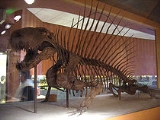
Synapsid

Encyclopedia
Synapsids are a group of animal
s that includes mammal
s and everything more closely related to mammals than to other living amniote
s. They are easily separated from other amniotes by having an opening low in the skull roof
behind each eye, leaving a bony arch
beneath each, accounting for their name. Primitive synapsids are usually called pelycosaurs; more advanced mammal-like ones, therapsids. The non-mammalian members are described as mammal-like reptiles in classical systematics, but are referred to as "stem-mammals" (or sometimes "proto-mammals") under cladistic terminology. Synapsids evolved from basal amniote
s and are one of the two major groups of the later amniotes, the other major group being the sauropsids (reptile
s and birds). They are distinguished from other amniotes by having a single opening (temporal fenestra) in their skull
behind each eye, which developed in the ancestral synapsid about 324 million years ago (mya) during the late
Carboniferous
Period.
Synapsids were the dominant terrestrial animal
s in the middle to late Permian
period, 299 to 251 million years ago (mya). As with almost all groups then extant, their numbers and variety were severely reduced by the Permian extinction. Some species survived into the Triassic
period, but archosaur
s quickly became the dominant animals and few of the non-mammalian synapsids outlasted the Triassic, although survivors persisted into the Cretaceous
. However, as a phylogenetic unit they included the mammal descendants, and in this sense synapsids are still very much a living group of vertebrate
s. In the form of mammals, Synapsids (most recently and notably human
s) again became the dominant land animals after they outcompeted birds following the K-T extinction event.
s, on the basis of their distinctive temporal openings. These openings in the cheek bones allowed attachment of larger jaw muscles, hence a more efficient bite. Synapsids were considered to be the reptilian lineage that led to mammals via gradually evolved
, increasingly mammalian features, hence the name "mammal-like reptiles" which became a broad, traditional description for all non-mammalian synapsids.
) and in general biology
. In the 1990s this approach was complemented by a cladistic
one, according to which the only valid groups are those that include common ancestors and all of their descendants: these are known as monophyletic groups, or clade
s. Because mammals are directly descended from the synapsids, mammals are included under Synapsida as a clade, though in formal classification mammals are treated as a separate class that has evolved
from within Synapsida.
Phylogenetically
synapsids are the entire synapsid/mammal branch of the tree of life, though practically the term is most often used when referring to the reptile-grade synapsids. The term "mammal-like reptiles" represents a paraphyletic grade, but is commonly used both colloquially and in the technical literature to refer to all non-mammalian synapsids. The actual monophyly
of Synapsida is not in doubt however, and the expressions "Synapsida contains the mammals" and "synapsids gave rise to the mammals" both express the same phylogenetic hypothesis.
s' and therapsids. 'Pelycosaurs' make up the six most primitive families of synapsids. They were all rather lizard-like with sprawling gait and possibly horny scutes. The therapsids contain the more advanced synapsids, having a more erect pose and possibly hair, at least in some forms. In traditional taxonomy the Synapsida encompasses two distinct grades
successively closer to mammals: The low-slung pelycosaurs have given rise to the more erect therapsids, who in their turn have given rise to the mammals. In traditional vertebrate classefication the Pelycosauria and Therapsida were both considered orders
of the subclass Synapsida. At least one paleontologist, Benton
, still follows such traditional classification; Benton classifies the synapsids as a paraphyletic class
.
In phylogenetic nomenclature
the terms are used somewhat different as the daughter clade
s are included. Most papers published during the 21st century have treated "Pelycosauria" as an informal grouping of primitive members, if it is used at all, being virtually synonymous with Synapsida itself. Therapsida has remained in use as a clade containing both the traditional therapsid families and mammals. However, in practical usage, the terms are used almost exclusively when referring to the more basal members that lie outside of Mammaliaformes
.
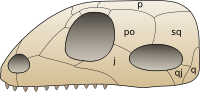 Synapsids evolved a temporal fenestra behind each eye orbit
on the lateral surface of the skull
. It may have evolved to provide new attachment sites for jaw
muscles. A similar development took place in the Diapsid
s, who evolved two rather than one opening behind each eye. Originally, the opening in the skull left the inner cranium only covered by the jaw muscles, but in higher therapsids and mammals the sphenoid bone
has expanded to close the opening. This has left the lower margin of the opening as an arch extending from the lower edges of the braincase.
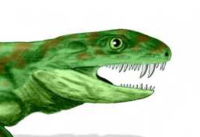 Synapsids are characterized by having differentiated teeth. These include the canine
s, molars, and incisors. The trend towards differentiation is found in some labyrinthodonts
and early anapsid reptilians in the form of enlargement of the first teeth on the maxilla
, forming a form of proto-canines. This trait was subsequently lost in the Sauropsid line, but developed further in the synapsids. Early synapsids could have 2 or even 3 enlarged "canines", but in the therapsids, the pattern had settled to one canine in each upper jaw half. The lower canines developed later.
remains to be the distinguishing feature used to classify synapsids and reptiles. The jaw transition is a good classification tool as most other fossilized features that make a chronological progression from a reptile-like to a mammalian condition follow the progression of the jaw transition. The mandible
, or lower jaw, consists of a single, tooth-bearing bone in mammals (the dentary), whereas the lower jaw of modern and prehistoric reptiles consists of a conglomeration of smaller bones (including the dentary, articular
, and others). As they evolved, these jaw bones were reduced in size and either lost or, in the case of the articular, gradually moved into the ear, forming one of the middle ear bones: while mammals possess the malleus
, incus
and stapes, mammal-like reptiles (like all other tetrapods) possess only a stapes. The malleus is derived from the articular
(a lower jaw bone) while the incus is derived from the quadrate, (a skull bone).
Mammalian jaw structures are also set apart by the dentary-squamosal jaw joint
. In this form of jaw joint, the dentary forms a connection with a depression in the squamosal
known as the glenoid cavity
. In contrast, all other jawed vertebrates, including reptiles and nonmammalian synapsids, possess a jaw joint in which one of the smaller bones of the lower jaw, the articular
, makes a connection with a bone of the skull
called the quadrate bone
to form the articular-quadrate jaw joint. In forms transitional to mammals, the jaw joint is composed of a large, lower jaw bone (similar to the dentary found in mammals) that does not connect to the squamosal but connects to the quadrate with a receding articular bone.
, separating the mouth
and nasal cavity
. In early synapsids, a secondary palate
began to form on the sides of the maxilla
, still leaving the mouth and nostril
connected.
Eventually, the two sides of the palate began to curve together, forming a U-shape instead of a C-shape. The palate also began to extend back toward the throat, securing the entire mouth and creating a full palatine bone
. The maxilla is also closed completely. In fossils of one of the first eutheriodonts, the beginnings of a palate are clearly visible. The later Thrinaxodon
has a full and completely closed palate, forming a clear progression.
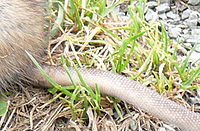 The actual skin of the synapsids has been subject to some discussion. Basal reptilian skin is rather thin, and lack the thick dermal
layer that produces leather
in mammals. Exposed parts of reptiles are protected by horny scales
or scutes. Mammal hide has a thick, fibrous dermis
and rarely exhibits scutes. A hallmark of mammals is the presence of copious glands and hair follicle
s.
When the change from reptilian to mammalian type skin took place is not known, though fossilized rows of osteoderm
s indicate horny armour on the neck and back of pelycosaurs, and skin impressions indicate that some retained rectangular scutes on their undersides. The pelycosaur scutes probably were non-overlapping dermal
structures with a horny overlay, like those found in modern crocodiles and turtles. These differed in structure from the scales of lizards and snakes
, which are an epidermal feature (like mammalian hair or avian feathers). The remaining upper surface of the pelycosaurs may have borne scutes too, or may have been glandular and leathery like that of a mammal.
It is currently unknown at what stage the synapsids acquired mammalian characteristics such as body hair and mammary gland
s, as the fossil
s only rarely provide direct evidence for soft tissues. An exceptionally well preserved skull of Estemmenosuchus
, a therapsid from the Upper Permian show smooth hairless skin with what appears to be glandular depressions. The oldest known fossil showing unambiguous imprints of hair is the Callovian
(late middle Jurassic
) Castorocauda, an early mammal. The more advanced therapsids could have had a combination of naked skin, scutes and hair, a combination still found in some modern mammals like rodents and the opossum.
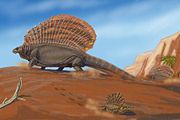 The first pelycosaurs had the usual reptilian cold-blooded
metabolism
by all indications, including sprawling gait and a low slung body. However, there appears to have been an early trend towards a form of temperature regulation in several Pelycosaur lines, as indicated by the large "sails" in both edaphosaurids
and sphenacodontids
(e.g. Dimetrodon
).
The sphenacodontids gave rise to the therapsids
, who may have inherited the temperature regulation. The legs and feet of the early therapsid groups point to a more erect posture, traditionally interpreted as a sign of more efficient metabolism. None of them show any sign of a sail, indicating any temperature regulation would have relied on the creatures own metabolism rather than external heat. In the later cynodonts, the presence of a secondary palate
, erect posture and other indicators of high metabolic rate suggests that many mammalian features, including an effective insulating layer of body hair, had evolved by this stage. This is now confirmed by impressions of fur in rocks directly underlying some fossil therapsids.
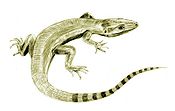 Archaeothyris
and Clepsydrops
are the earliest known synapsids. They lived in the Pennsylvanian
subperiod of the Carboniferous
Period and belonged to the series of primitive synapsids which are conventionally grouped as pelycosaur
s. The pelycosaurs were the first successful group of amniote
s, spreading and diversifying until they became the dominant large terrestrial animals in the latest Carboniferous and Early Permian
Periods. They were sprawling, bulky, cold-blooded
and had small brains. They were the largest land animals of their time, ranging up to 3 m (10 ft) in length. Many, like Dimetrodon
, had large sails that may have helped raise their body temperature
. A few relict
groups lasted into the later Permian, but most of the pelycosaurs became extinct before the end of Permian
.
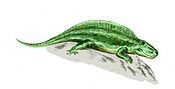 The therapsids, a more advanced group of synapsids, appeared during the first half of the Permian and went on to become the dominant large terrestrial animals during the latter half. They were by far the most diverse and abundant animals of the Middle and Late Permian and included herbivores and carnivores, ranging from small animals the size of a rat (e.g.: Robertia
), to large bulky herbivores a ton or more in weight (e.g.: Moschops
). After flourishing for many millions of years, these successful animals were all but wiped out by the Permian-Triassic mass extinction about 250 Mya, the largest extinction
in Earth's history
, which may have been related to the Siberian Traps
volcanic event.
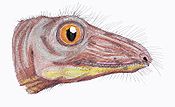
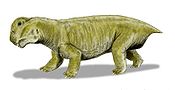 Only a few therapsids (and some relict 'pelycosaur' taxa) survived the Permian extinction and went on to be successful in the new early Triassic
landscape; they include Lystrosaurus
and Cynognathus
, the latter of which appeared later in the early Triassic. Now, however, they were accompanied by the early archosaur
s (soon to give rise to the dinosaurs). Some of these, like Euparkeria
, were small and lightly built, while others, like Erythrosuchus
, were as big as or bigger than the largest therapsids.
Triassic therapsids included three groups. Specialised, beaked herbivores known as dicynodont
s (such as Lystrosaurus and its descendants, the Kannemeyeriidae
), contained some members which reached large size (up to a tonne or more). The increasingly mammal-like carnivorous, herbivorous, and insectivorous cynodont
s included the eucynodonts from the Olenekian
age, an early representative of which was Cynognathus. Finally, there were the therocephalia
ns, which only lasted into the early part of the Triassic.
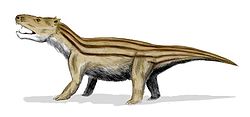 Unlike the dicynodonts, which remained large, the cynodonts became progressively smaller and more mammal-like as the Triassic progressed. From the most advanced and tiny cynodonts, which were only the size of a shrew
, came the first mammal
precursors, during the Carnian
age of the Late Triassic, about 220 Mya.
During the evolutionary succession from early therapsid to cynodont to eucynodont to mammal, the main lower jaw bone, the dentary, replaced the adjacent bones. Thus, the lower jaw gradually became just one large bone, with several of the smaller jaw bones migrating into the inner ear
and allowing sophisticated hearing.
Whether through climate change, vegetation change, ecological competition, or a combination of factors, most of the remaining large cynodonts (belonging to the Traversodontidae
) and dicynodonts (of the family Kannemeyeriidae) had disappeared by the Norian
age, even before the Triassic-Jurassic extinction event
that killed off most of the large non-dinosaurian archosaurs
. The remaining Mesozoic synapsids were small, ranging from the size of a shrew
to the badger
-like mammal Repenomamus
.
During the Jurassic and Cretaceous, the remaining non-mammalian cynodonts were small, such as Tritylodon
. No cynodont grew larger than a cat
. Most Jurassic and Cretaceous cynodonts were herbivorous, though some were carnivorous. The family Tritheledontidae first appeared near the end of the Triassic. They were carnivorous and persisted well into the Middle Jurassic
. The other, Tritylodontidae
, first appeared at the same time as the tritheledonts, but they were herbivorous. This group became extinct at the end of the Early Cretaceous epoch. Dicynodonts are thought to have become extinct near the end of the Triassic period, but there is evidence that this group survived. New fossil finds have been found in the Cretaceous
rocks of Gondwana
.
Today, there are 5,400 species
of living synapsids known as the mammal
s, including both aquatic (whale
s) and flying (bat
s) species, and the largest animal ever known to have existed (the blue whale
). Humans are synapsids as well. Uniquely among the synapsids, however, most mammals are viviparous and give birth to live young rather than laying eggs, the exception being the monotreme
s.
Synapsids' evolution into mammals is believed to have been triggered by moving to a nocturnal niche
. Proto-mammals
with higher metabolic rates were able to keep their bodies warm at night, and were more likely to survive. This meant consuming food (generally thought to be insects) in much greater quantity. To facilitate rapid digestion
, proto-mammals evolved mastication
(chewing) and specialized teeth that aided chewing. Limbs also evolved to move under the body instead of to the side, allowing proto-mammals to breathe more efficiently during locomotion and also to be able to change direction more quickly in order to catch small prey at a faster rate. This helped make it possible to support their higher metabolic demands. It is believed that, rather than out-running predators, proto-mammals adapted the strategy of outmaneuvering predators using their improved locomotor capabilities.
Animal
Animals are a major group of multicellular, eukaryotic organisms of the kingdom Animalia or Metazoa. Their body plan eventually becomes fixed as they develop, although some undergo a process of metamorphosis later on in their life. Most animals are motile, meaning they can move spontaneously and...
s that includes mammal
Mammal
Mammals are members of a class of air-breathing vertebrate animals characterised by the possession of endothermy, hair, three middle ear bones, and mammary glands functional in mothers with young...
s and everything more closely related to mammals than to other living amniote
Amniote
The amniotes are a group of tetrapods that have a terrestrially adapted egg. They include synapsids and sauropsids , as well as their fossil ancestors. Amniote embryos, whether laid as eggs or carried by the female, are protected and aided by several extensive membranes...
s. They are easily separated from other amniotes by having an opening low in the skull roof
Skull roof
The skull roof , or the roofing bones of the skull are a set of bones covering the brain, eyes and nostrils in bony fishes and all land living vertebrates. The bones are derived from dermal bone, hence the alternative name dermatocranium...
behind each eye, leaving a bony arch
Zygomatic arch
The zygomatic arch or cheek bone is formed by the zygomatic process of temporal bone and the temporal process of the zygomatic bone , the two being united by an oblique suture; the tendon of the Temporalis passes medial to the arch to gain insertion into the coronoid process...
beneath each, accounting for their name. Primitive synapsids are usually called pelycosaurs; more advanced mammal-like ones, therapsids. The non-mammalian members are described as mammal-like reptiles in classical systematics, but are referred to as "stem-mammals" (or sometimes "proto-mammals") under cladistic terminology. Synapsids evolved from basal amniote
Amniote
The amniotes are a group of tetrapods that have a terrestrially adapted egg. They include synapsids and sauropsids , as well as their fossil ancestors. Amniote embryos, whether laid as eggs or carried by the female, are protected and aided by several extensive membranes...
s and are one of the two major groups of the later amniotes, the other major group being the sauropsids (reptile
Reptile
Reptiles are members of a class of air-breathing, ectothermic vertebrates which are characterized by laying shelled eggs , and having skin covered in scales and/or scutes. They are tetrapods, either having four limbs or being descended from four-limbed ancestors...
s and birds). They are distinguished from other amniotes by having a single opening (temporal fenestra) in their skull
Skull
The skull is a bony structure in the head of many animals that supports the structures of the face and forms a cavity for the brain.The skull is composed of two parts: the cranium and the mandible. A skull without a mandible is only a cranium. Animals that have skulls are called craniates...
behind each eye, which developed in the ancestral synapsid about 324 million years ago (mya) during the late
Pennsylvanian
The Pennsylvanian is, in the ICS geologic timescale, the younger of two subperiods of the Carboniferous Period. It lasted from roughly . As with most other geochronologic units, the rock beds that define the Pennsylvanian are well identified, but the exact date of the start and end are uncertain...
Carboniferous
Carboniferous
The Carboniferous is a geologic period and system that extends from the end of the Devonian Period, about 359.2 ± 2.5 Mya , to the beginning of the Permian Period, about 299.0 ± 0.8 Mya . The name is derived from the Latin word for coal, carbo. Carboniferous means "coal-bearing"...
Period.
Synapsids were the dominant terrestrial animal
Terrestrial animal
Terrestrial animals are animals that live predominantly or entirely on land , as compared with aquatic animals, which live predominantly or entirely in the water , or amphibians, which rely on a combination of aquatic and terrestrial habitats...
s in the middle to late Permian
Permian
The PermianThe term "Permian" was introduced into geology in 1841 by Sir Sir R. I. Murchison, president of the Geological Society of London, who identified typical strata in extensive Russian explorations undertaken with Edouard de Verneuil; Murchison asserted in 1841 that he named his "Permian...
period, 299 to 251 million years ago (mya). As with almost all groups then extant, their numbers and variety were severely reduced by the Permian extinction. Some species survived into the Triassic
Triassic
The Triassic is a geologic period and system that extends from about 250 to 200 Mya . As the first period of the Mesozoic Era, the Triassic follows the Permian and is followed by the Jurassic. Both the start and end of the Triassic are marked by major extinction events...
period, but archosaur
Archosaur
Archosaurs are a group of diapsid amniotes whose living representatives consist of modern birds and crocodilians. This group also includes all extinct non-avian dinosaurs, many extinct crocodilian relatives, and pterosaurs. Archosauria, the archosaur clade, is a crown group that includes the most...
s quickly became the dominant animals and few of the non-mammalian synapsids outlasted the Triassic, although survivors persisted into the Cretaceous
Cretaceous
The Cretaceous , derived from the Latin "creta" , usually abbreviated K for its German translation Kreide , is a geologic period and system from circa to million years ago. In the geologic timescale, the Cretaceous follows the Jurassic period and is followed by the Paleogene period of the...
. However, as a phylogenetic unit they included the mammal descendants, and in this sense synapsids are still very much a living group of vertebrate
Vertebrate
Vertebrates are animals that are members of the subphylum Vertebrata . Vertebrates are the largest group of chordates, with currently about 58,000 species described. Vertebrates include the jawless fishes, bony fishes, sharks and rays, amphibians, reptiles, mammals, and birds...
s. In the form of mammals, Synapsids (most recently and notably human
Human
Humans are the only living species in the Homo genus...
s) again became the dominant land animals after they outcompeted birds following the K-T extinction event.
Synapsids as a reptilian subclass
Synapsids were originally defined at the turn of the 20th century, as one of the four main subclasses of reptileReptile
Reptiles are members of a class of air-breathing, ectothermic vertebrates which are characterized by laying shelled eggs , and having skin covered in scales and/or scutes. They are tetrapods, either having four limbs or being descended from four-limbed ancestors...
s, on the basis of their distinctive temporal openings. These openings in the cheek bones allowed attachment of larger jaw muscles, hence a more efficient bite. Synapsids were considered to be the reptilian lineage that led to mammals via gradually evolved
Evolution
Evolution is any change across successive generations in the heritable characteristics of biological populations. Evolutionary processes give rise to diversity at every level of biological organisation, including species, individual organisms and molecules such as DNA and proteins.Life on Earth...
, increasingly mammalian features, hence the name "mammal-like reptiles" which became a broad, traditional description for all non-mammalian synapsids.
The "mammal-like reptiles"
The traditional classification of synapsids as reptiles is continued by a number of palaeontologists (e.g. Carroll 1988, Colbert & Morales 2001Evolution of the Vertebrates
Evolution of the Vertebrates, subtitled "A History of the Backboned Animals Through Time" is a basic paleontology textbook by Edwin H. Colbert, published by John Wiley & Sons.-Overview:...
) and in general biology
Biology
Biology is a natural science concerned with the study of life and living organisms, including their structure, function, growth, origin, evolution, distribution, and taxonomy. Biology is a vast subject containing many subdivisions, topics, and disciplines...
. In the 1990s this approach was complemented by a cladistic
Cladistics
Cladistics is a method of classifying species of organisms into groups called clades, which consist of an ancestor organism and all its descendants . For example, birds, dinosaurs, crocodiles, and all descendants of their most recent common ancestor form a clade...
one, according to which the only valid groups are those that include common ancestors and all of their descendants: these are known as monophyletic groups, or clade
Clade
A clade is a group consisting of a species and all its descendants. In the terms of biological systematics, a clade is a single "branch" on the "tree of life". The idea that such a "natural group" of organisms should be grouped together and given a taxonomic name is central to biological...
s. Because mammals are directly descended from the synapsids, mammals are included under Synapsida as a clade, though in formal classification mammals are treated as a separate class that has evolved
Evolution
Evolution is any change across successive generations in the heritable characteristics of biological populations. Evolutionary processes give rise to diversity at every level of biological organisation, including species, individual organisms and molecules such as DNA and proteins.Life on Earth...
from within Synapsida.
Phylogenetically
Phylogenetics
In biology, phylogenetics is the study of evolutionary relatedness among groups of organisms , which is discovered through molecular sequencing data and morphological data matrices...
synapsids are the entire synapsid/mammal branch of the tree of life, though practically the term is most often used when referring to the reptile-grade synapsids. The term "mammal-like reptiles" represents a paraphyletic grade, but is commonly used both colloquially and in the technical literature to refer to all non-mammalian synapsids. The actual monophyly
Monophyly
In common cladistic usage, a monophyletic group is a taxon which forms a clade, meaning that it contains all the descendants of the possibly hypothetical closest common ancestor of the members of the group. The term is synonymous with the uncommon term holophyly...
of Synapsida is not in doubt however, and the expressions "Synapsida contains the mammals" and "synapsids gave rise to the mammals" both express the same phylogenetic hypothesis.
Primitive and advanced synapsids
The mammal-like reptiles are traditionally divided into a primitive group and an advanced group, known respectively as 'pelycosaurPelycosaur
The pelycosaurs are an informal grouping composed of basal or primitive Late Paleozoic synapsid amniotes. Some species were quite large and could grow up to 3 meters or more, although most species were much smaller...
s' and therapsids. 'Pelycosaurs' make up the six most primitive families of synapsids. They were all rather lizard-like with sprawling gait and possibly horny scutes. The therapsids contain the more advanced synapsids, having a more erect pose and possibly hair, at least in some forms. In traditional taxonomy the Synapsida encompasses two distinct grades
Evolutionary grade
In alpha taxonomy, a grade refers to a taxon united by a level of morphological or physiological complexity. The term was coined by British biologist Julian Huxley, to contrast with clade, a strictly phylogenetic unit.-Definition:...
successively closer to mammals: The low-slung pelycosaurs have given rise to the more erect therapsids, who in their turn have given rise to the mammals. In traditional vertebrate classefication the Pelycosauria and Therapsida were both considered orders
Order (biology)
In scientific classification used in biology, the order is# a taxonomic rank used in the classification of organisms. Other well-known ranks are life, domain, kingdom, phylum, class, family, genus, and species, with order fitting in between class and family...
of the subclass Synapsida. At least one paleontologist, Benton
Michael Benton
Michael J. Benton is a British paleontologist, a Fellow of the Royal Society of Edinburgh, and professor of vertebrate palaeontology in the Department of Earth Sciences at the University of Bristol....
, still follows such traditional classification; Benton classifies the synapsids as a paraphyletic class
Class (biology)
In biological classification, class is* a taxonomic rank. Other well-known ranks are life, domain, kingdom, phylum, order, family, genus, and species, with class fitting between phylum and order...
.
In phylogenetic nomenclature
Phylogenetic nomenclature
Phylogenetic nomenclature or phylogenetic taxonomy is an alternative to rank-based nomenclature, applying definitions from cladistics . Its two defining features are the use of phylogenetic definitions of biological taxon names, and the lack of obligatory ranks...
the terms are used somewhat different as the daughter clade
Clade
A clade is a group consisting of a species and all its descendants. In the terms of biological systematics, a clade is a single "branch" on the "tree of life". The idea that such a "natural group" of organisms should be grouped together and given a taxonomic name is central to biological...
s are included. Most papers published during the 21st century have treated "Pelycosauria" as an informal grouping of primitive members, if it is used at all, being virtually synonymous with Synapsida itself. Therapsida has remained in use as a clade containing both the traditional therapsid families and mammals. However, in practical usage, the terms are used almost exclusively when referring to the more basal members that lie outside of Mammaliaformes
Mammaliaformes
Mammaliaformes is a clade that contains the mammals and their closest extinct relatives. Phylogenetically, it is defined as a clade including the most recent common ancestor of Sinoconodon, morganuconodonts, docodonts, Monotremata, Marsupialia, Placentalia, extinct members of this clade, and all...
.
Temporal openings
Orbit (anatomy)
In anatomy, the orbit is the cavity or socket of the skull in which the eye and its appendages are situated. "Orbit" can refer to the bony socket, or it can also be used to imply the contents...
on the lateral surface of the skull
Skull
The skull is a bony structure in the head of many animals that supports the structures of the face and forms a cavity for the brain.The skull is composed of two parts: the cranium and the mandible. A skull without a mandible is only a cranium. Animals that have skulls are called craniates...
. It may have evolved to provide new attachment sites for jaw
Jaw
The jaw is any opposable articulated structure at the entrance of the mouth, typically used for grasping and manipulating food. The term jaws is also broadly applied to the whole of the structures constituting the vault of the mouth and serving to open and close it and is part of the body plan of...
muscles. A similar development took place in the Diapsid
Diapsid
Diapsids are a group of reptiles that developed two holes in each side of their skulls, about 300 million years ago during the late Carboniferous period. Living diapsids are extremely diverse, and include all crocodiles, lizards, snakes, and tuatara...
s, who evolved two rather than one opening behind each eye. Originally, the opening in the skull left the inner cranium only covered by the jaw muscles, but in higher therapsids and mammals the sphenoid bone
Sphenoid bone
The sphenoid bone is an unpaired bone situated at the base of the skull in front of the temporal bone and basilar part of the occipital bone.The sphenoid bone is one of the seven bones that articulate to form the orbit...
has expanded to close the opening. This has left the lower margin of the opening as an arch extending from the lower edges of the braincase.
Teeth
Canine tooth
In mammalian oral anatomy, the canine teeth, also called cuspids, dogteeth, fangs, or eye teeth, are relatively long, pointed teeth...
s, molars, and incisors. The trend towards differentiation is found in some labyrinthodonts
Labyrinthodontia
Labyrinthodontia is an older term for any member of the extinct subclass of amphibians, which constituted some of the dominant animals of Late Paleozoic and Early Mesozoic times . The group is ancestral to all extant landliving vertebrates, and as such constitutes an evolutionary grade rather...
and early anapsid reptilians in the form of enlargement of the first teeth on the maxilla
Maxilla
The maxilla is a fusion of two bones along the palatal fissure that form the upper jaw. This is similar to the mandible , which is also a fusion of two halves at the mental symphysis. Sometimes The maxilla (plural: maxillae) is a fusion of two bones along the palatal fissure that form the upper...
, forming a form of proto-canines. This trait was subsequently lost in the Sauropsid line, but developed further in the synapsids. Early synapsids could have 2 or even 3 enlarged "canines", but in the therapsids, the pattern had settled to one canine in each upper jaw half. The lower canines developed later.
Jaw
Most paleontologists hold fossilized jawJaw
The jaw is any opposable articulated structure at the entrance of the mouth, typically used for grasping and manipulating food. The term jaws is also broadly applied to the whole of the structures constituting the vault of the mouth and serving to open and close it and is part of the body plan of...
remains to be the distinguishing feature used to classify synapsids and reptiles. The jaw transition is a good classification tool as most other fossilized features that make a chronological progression from a reptile-like to a mammalian condition follow the progression of the jaw transition. The mandible
Mandible
The mandible pronunciation or inferior maxillary bone forms the lower jaw and holds the lower teeth in place...
, or lower jaw, consists of a single, tooth-bearing bone in mammals (the dentary), whereas the lower jaw of modern and prehistoric reptiles consists of a conglomeration of smaller bones (including the dentary, articular
Articular
The articular bone is part of the lower jaw of most tetrapods, including amphibians, sauropsids and early synapsids. In these animals it is connected to two other lower jaw bones, the suprangular and the angular...
, and others). As they evolved, these jaw bones were reduced in size and either lost or, in the case of the articular, gradually moved into the ear, forming one of the middle ear bones: while mammals possess the malleus
Malleus
The malleus or hammer is a hammer-shaped small bone or ossicle of the middle ear which connects with the incus and is attached to the inner surface of the eardrum...
, incus
Incus
The incus or anvil is the anvil-shaped small bone or ossicle in themiddle ear. It connects the malleus to the stapes. It was first described by Alessandro Achillini of Bologna.The incus transmits sound vibrations from the malleus to the stapes....
and stapes, mammal-like reptiles (like all other tetrapods) possess only a stapes. The malleus is derived from the articular
Articular
The articular bone is part of the lower jaw of most tetrapods, including amphibians, sauropsids and early synapsids. In these animals it is connected to two other lower jaw bones, the suprangular and the angular...
(a lower jaw bone) while the incus is derived from the quadrate, (a skull bone).
Mammalian jaw structures are also set apart by the dentary-squamosal jaw joint
Temporomandibular joint
The temporomandibular joint is the joint of the jaw and is frequently referred to as TMJ. There are two TMJs, one on either side, working in unison. The name is derived from the two bones which form the joint: the upper temporal bone which is part of the cranium , and the lower jaw bone called the...
. In this form of jaw joint, the dentary forms a connection with a depression in the squamosal
Squamosal
The squamosal is a bone of the head of higher vertebrates. It is the principal component of the cheek region in the skull, lying below the temporal series and otic notch and bounded anteriorly by postorbital. Posteriorly, the squamosal articulates with the posterior elements of the palatal complex,...
known as the glenoid cavity
Glenoid cavity
The glenoid cavity is a shallow pyriform, articular surface, which is located on the lateral angle of the scapula. It is directed laterally and forward and articulates with the head of the humerus; it is broader below than above and its vertical diameter is the longest.This cavity forms the...
. In contrast, all other jawed vertebrates, including reptiles and nonmammalian synapsids, possess a jaw joint in which one of the smaller bones of the lower jaw, the articular
Articular
The articular bone is part of the lower jaw of most tetrapods, including amphibians, sauropsids and early synapsids. In these animals it is connected to two other lower jaw bones, the suprangular and the angular...
, makes a connection with a bone of the skull
Skull
The skull is a bony structure in the head of many animals that supports the structures of the face and forms a cavity for the brain.The skull is composed of two parts: the cranium and the mandible. A skull without a mandible is only a cranium. Animals that have skulls are called craniates...
called the quadrate bone
Quadrate bone
The quadrate bone is part of a skull in most tetrapods, including amphibians, sauropsids , and early synapsids. In these animals it connects to the quadratojugal and squamosal in the skull, and forms part of the jaw joint .- Evolutionary variation :In snakes, the quadrate bone has become elongated...
to form the articular-quadrate jaw joint. In forms transitional to mammals, the jaw joint is composed of a large, lower jaw bone (similar to the dentary found in mammals) that does not connect to the squamosal but connects to the quadrate with a receding articular bone.
Palate
Over time, as synapsids became more mammalian and less 'reptilian', they began to develop a secondary palatePalate
The palate is the roof of the mouth in humans and other mammals. It separates the oral cavity from the nasal cavity. A similar structure is found in crocodilians, but, in most other tetrapods, the oral and nasal cavities are not truly separate. The palate is divided into two parts, the anterior...
, separating the mouth
Mouth
The mouth is the first portion of the alimentary canal that receives food andsaliva. The oral mucosa is the mucous membrane epithelium lining the inside of the mouth....
and nasal cavity
Nasal cavity
The nasal cavity is a large air filled space above and behind the nose in the middle of the face.- Function :The nasal cavity conditions the air to be received by the other areas of the respiratory tract...
. In early synapsids, a secondary palate
Secondary palate
The secondary palate is an anatomical structure that divides the nasal cavity from the oral cavity in many vertebrates.In human embryology, it refers to that portion of the hard palate that is formed by the growth of the two palatine shelves medially and their mutual fusion in the midline...
began to form on the sides of the maxilla
Maxilla
The maxilla is a fusion of two bones along the palatal fissure that form the upper jaw. This is similar to the mandible , which is also a fusion of two halves at the mental symphysis. Sometimes The maxilla (plural: maxillae) is a fusion of two bones along the palatal fissure that form the upper...
, still leaving the mouth and nostril
Nostril
A nostril is one of the two channels of the nose, from the point where they bifurcate to the external opening. In birds and mammals, they contain branched bones or cartilages called turbinates, whose function is to warm air on inhalation and remove moisture on exhalation...
connected.
Eventually, the two sides of the palate began to curve together, forming a U-shape instead of a C-shape. The palate also began to extend back toward the throat, securing the entire mouth and creating a full palatine bone
Palatine bone
The palatine bone is a bone in many species of the animal kingdom, commonly termed the palatum .-Human anatomy:...
. The maxilla is also closed completely. In fossils of one of the first eutheriodonts, the beginnings of a palate are clearly visible. The later Thrinaxodon
Thrinaxodon
Thrinaxodon was a cynodont, an ermine-sized therapsid. Pits on the skull suggest that Thrinaxodon may have had whiskers, and by extension a protective covering of fur. There are suggestions that it was warm-blooded...
has a full and completely closed palate, forming a clear progression.
Skin
Dermis
The dermis is a layer of skin between the epidermis and subcutaneous tissues, and is composed of two layers, the papillary and reticular dermis...
layer that produces leather
Leather
Leather is a durable and flexible material created via the tanning of putrescible animal rawhide and skin, primarily cattlehide. It can be produced through different manufacturing processes, ranging from cottage industry to heavy industry.-Forms:...
in mammals. Exposed parts of reptiles are protected by horny scales
Reptile scales
Reptile skin is covered with scutes or scales which, along with other characteristics, distinguish reptiles from animals of other classes . Scales are made of keratin and are formed from the epidermis...
or scutes. Mammal hide has a thick, fibrous dermis
Dermis
The dermis is a layer of skin between the epidermis and subcutaneous tissues, and is composed of two layers, the papillary and reticular dermis...
and rarely exhibits scutes. A hallmark of mammals is the presence of copious glands and hair follicle
Hair follicle
A hair follicle is a skin organ that produces hair. Hair production occurs in phases, including a growth phase , and cessation phase , and a rest phase . Stem cells are principally responsible for the production of hair....
s.
When the change from reptilian to mammalian type skin took place is not known, though fossilized rows of osteoderm
Osteoderm
Osteoderms are bony deposits forming scales, plates or other structures in the dermal layers of the skin. Osteoderms are found in many groups of extant and extinct reptiles, including lizards, various groups of dinosaurs , crocodilians, phytosaurs, aetosaurs, placodonts, and hupehsuchians...
s indicate horny armour on the neck and back of pelycosaurs, and skin impressions indicate that some retained rectangular scutes on their undersides. The pelycosaur scutes probably were non-overlapping dermal
Dermis
The dermis is a layer of skin between the epidermis and subcutaneous tissues, and is composed of two layers, the papillary and reticular dermis...
structures with a horny overlay, like those found in modern crocodiles and turtles. These differed in structure from the scales of lizards and snakes
Reptile scales
Reptile skin is covered with scutes or scales which, along with other characteristics, distinguish reptiles from animals of other classes . Scales are made of keratin and are formed from the epidermis...
, which are an epidermal feature (like mammalian hair or avian feathers). The remaining upper surface of the pelycosaurs may have borne scutes too, or may have been glandular and leathery like that of a mammal.
It is currently unknown at what stage the synapsids acquired mammalian characteristics such as body hair and mammary gland
Mammary gland
A mammary gland is an organ in mammals that produces milk to feed young offspring. Mammals get their name from the word "mammary". In ruminants such as cows, goats, and deer, the mammary glands are contained in their udders...
s, as the fossil
Fossil
Fossils are the preserved remains or traces of animals , plants, and other organisms from the remote past...
s only rarely provide direct evidence for soft tissues. An exceptionally well preserved skull of Estemmenosuchus
Estemmenosuchus
Estemmenosuchus is a genus of large, early omnivorous therapsid that lived during the middle part of the Middle Permian period. It was among the largest animals of its day, and is characterised by distinctive horn-like structures, probably for intra-specific display...
, a therapsid from the Upper Permian show smooth hairless skin with what appears to be glandular depressions. The oldest known fossil showing unambiguous imprints of hair is the Callovian
Callovian
In the geologic timescale, the Callovian is an age or stage in the Middle Jurassic, lasting between 164.7 ± 4.0 Ma and 161.2 ± 4.0 Ma. It is the last stage of the Middle Jurassic, following the Bathonian and preceding the Oxfordian....
(late middle Jurassic
Jurassic
The Jurassic is a geologic period and system that extends from about Mya to Mya, that is, from the end of the Triassic to the beginning of the Cretaceous. The Jurassic constitutes the middle period of the Mesozoic era, also known as the age of reptiles. The start of the period is marked by...
) Castorocauda, an early mammal. The more advanced therapsids could have had a combination of naked skin, scutes and hair, a combination still found in some modern mammals like rodents and the opossum.
Metabolism
Poikilotherm
A poikilotherm is an organism whose internal temperature varies considerably. It is the opposite of a homeotherm, an organism which maintains thermal homeostasis. Usually the variation is a consequence of variation in the ambient environmental temperature...
metabolism
Metabolism
Metabolism is the set of chemical reactions that happen in the cells of living organisms to sustain life. These processes allow organisms to grow and reproduce, maintain their structures, and respond to their environments. Metabolism is usually divided into two categories...
by all indications, including sprawling gait and a low slung body. However, there appears to have been an early trend towards a form of temperature regulation in several Pelycosaur lines, as indicated by the large "sails" in both edaphosaurids
Edaphosauridae
Edaphosauridae is a family of mostly large advanced, Late Pennsylvanian to early Permian pelycosaurs.They were the earliest known herbivorous amniotes, and along with the Diadectidae the earliest known herbivorous tetrapods...
and sphenacodontids
Sphenacodontidae
Sphenacodontidae is a family of small to large, advanced, carnivorous, Late Pennsylvanian to middle Permian pelycosaurs. Primitive forms were generally small in size , but during the later part of the early Permian these animals grew progressively larger , to become the top predators of their...
(e.g. Dimetrodon
Dimetrodon
Dimetrodon was a predatory synapsid genus that flourished during the Permian period, living between 280–265 million years ago ....
).
The sphenacodontids gave rise to the therapsids
Therapsida
Therapsida is a group of the most advanced synapsids, and include the ancestors of mammals. Many of the traits today seen as unique to mammals had their origin within early therapsids, including hair, lactation, and an erect posture. The earliest fossil attributed to Therapsida is believed to be...
, who may have inherited the temperature regulation. The legs and feet of the early therapsid groups point to a more erect posture, traditionally interpreted as a sign of more efficient metabolism. None of them show any sign of a sail, indicating any temperature regulation would have relied on the creatures own metabolism rather than external heat. In the later cynodonts, the presence of a secondary palate
Secondary palate
The secondary palate is an anatomical structure that divides the nasal cavity from the oral cavity in many vertebrates.In human embryology, it refers to that portion of the hard palate that is formed by the growth of the two palatine shelves medially and their mutual fusion in the midline...
, erect posture and other indicators of high metabolic rate suggests that many mammalian features, including an effective insulating layer of body hair, had evolved by this stage. This is now confirmed by impressions of fur in rocks directly underlying some fossil therapsids.
Evolutionary history
Archaeothyris
Archaeothyris was a very early mammal-like reptile, which lived in the late Carboniferous period. Dated to 306 million years ago, it is the oldest undisputed synapsid known....
and Clepsydrops
Clepsydrops
Clepsydrops was a primitive amniote from the early Late Carboniferous that was related to Archaeothyris and the synapsids—the ancestors of mammals. Like many other terrestrial early amniotes, it had the diet of insects and smaller animals. It also laid eggs on land rather than in the water, as...
are the earliest known synapsids. They lived in the Pennsylvanian
Pennsylvanian
The Pennsylvanian is, in the ICS geologic timescale, the younger of two subperiods of the Carboniferous Period. It lasted from roughly . As with most other geochronologic units, the rock beds that define the Pennsylvanian are well identified, but the exact date of the start and end are uncertain...
subperiod of the Carboniferous
Carboniferous
The Carboniferous is a geologic period and system that extends from the end of the Devonian Period, about 359.2 ± 2.5 Mya , to the beginning of the Permian Period, about 299.0 ± 0.8 Mya . The name is derived from the Latin word for coal, carbo. Carboniferous means "coal-bearing"...
Period and belonged to the series of primitive synapsids which are conventionally grouped as pelycosaur
Pelycosaur
The pelycosaurs are an informal grouping composed of basal or primitive Late Paleozoic synapsid amniotes. Some species were quite large and could grow up to 3 meters or more, although most species were much smaller...
s. The pelycosaurs were the first successful group of amniote
Amniote
The amniotes are a group of tetrapods that have a terrestrially adapted egg. They include synapsids and sauropsids , as well as their fossil ancestors. Amniote embryos, whether laid as eggs or carried by the female, are protected and aided by several extensive membranes...
s, spreading and diversifying until they became the dominant large terrestrial animals in the latest Carboniferous and Early Permian
Permian
The PermianThe term "Permian" was introduced into geology in 1841 by Sir Sir R. I. Murchison, president of the Geological Society of London, who identified typical strata in extensive Russian explorations undertaken with Edouard de Verneuil; Murchison asserted in 1841 that he named his "Permian...
Periods. They were sprawling, bulky, cold-blooded
Poikilotherm
A poikilotherm is an organism whose internal temperature varies considerably. It is the opposite of a homeotherm, an organism which maintains thermal homeostasis. Usually the variation is a consequence of variation in the ambient environmental temperature...
and had small brains. They were the largest land animals of their time, ranging up to 3 m (10 ft) in length. Many, like Dimetrodon
Dimetrodon
Dimetrodon was a predatory synapsid genus that flourished during the Permian period, living between 280–265 million years ago ....
, had large sails that may have helped raise their body temperature
Thermoregulation
Thermoregulation is the ability of an organism to keep its body temperature within certain boundaries, even when the surrounding temperature is very different...
. A few relict
Relict
A relict is a surviving remnant of a natural phenomenon.* In biology a relict is an organism that at an earlier time was abundant in a large area but now occurs at only one or a few small areas....
groups lasted into the later Permian, but most of the pelycosaurs became extinct before the end of Permian
Permian-Triassic extinction event
The Permian–Triassic extinction event, informally known as the Great Dying, was an extinction event that occurred 252.28 Ma ago, forming the boundary between the Permian and Triassic geologic periods, as well as the Paleozoic and Mesozoic eras...
.
Robertia
Robertia was a small, primitive dicynodont, and among the earlier members of this group. The type species R. broomiana was named in 1981...
), to large bulky herbivores a ton or more in weight (e.g.: Moschops
Moschops
Moschops is an extinct genus of therapsid that lived in the Late Permian, around 255 million years ago. Therapsids were proto-mammals , which were the dominant land animals. Five metres long, Moschops was the largest land animal of its time, a herbivore preyed on by other therapsids...
). After flourishing for many millions of years, these successful animals were all but wiped out by the Permian-Triassic mass extinction about 250 Mya, the largest extinction
Extinction event
An extinction event is a sharp decrease in the diversity and abundance of macroscopic life. They occur when the rate of extinction increases with respect to the rate of speciation...
in Earth's history
History of Earth
The history of the Earth describes the most important events and fundamental stages in the development of the planet Earth from its formation 4.578 billion years ago to the present day. Nearly all branches of natural science have contributed to the understanding of the main events of the Earth's...
, which may have been related to the Siberian Traps
Siberian Traps
The Siberian Traps form a large region of volcanic rock, known as a large igneous province, in the Russian region of Siberia. The massive eruptive event which formed the traps, one of the largest known volcanic events of the last 500 million years of Earth's geological history, continued for...
volcanic event.
Triassic
The Triassic is a geologic period and system that extends from about 250 to 200 Mya . As the first period of the Mesozoic Era, the Triassic follows the Permian and is followed by the Jurassic. Both the start and end of the Triassic are marked by major extinction events...
landscape; they include Lystrosaurus
Lystrosaurus
Lystrosaurus was a genus of Late Permian and Early Triassic Period dicynodont therapsids, which lived around 250 million years ago in what is now Antarctica, India, and South Africa...
and Cynognathus
Cynognathus
Cynognathus crateronotus was a meter-long predator of the Early to Middle Triassic. It was among the more mammal-like of the Synapsids, a member of a grouping called Eucynodontia. The genus Cynognathus had an almost worldwide distribution...
, the latter of which appeared later in the early Triassic. Now, however, they were accompanied by the early archosaur
Archosaur
Archosaurs are a group of diapsid amniotes whose living representatives consist of modern birds and crocodilians. This group also includes all extinct non-avian dinosaurs, many extinct crocodilian relatives, and pterosaurs. Archosauria, the archosaur clade, is a crown group that includes the most...
s (soon to give rise to the dinosaurs). Some of these, like Euparkeria
Euparkeria
Euparkeria was a small African reptile of the early Triassic period between 248-245 million years ago, close to the ancestry of the archosaurs.- Palaeobiology :...
, were small and lightly built, while others, like Erythrosuchus
Erythrosuchus
Erythrosuchus is an extinct genus of archosauriform reptile from the Triassic of South Africa and Namibia. Remains have been found from the Cynognathus Assemblage Zone of the Beaufort Group in the Karoo of South Africa as well as the Omingonde Formation in Namibia.Erythrosuchus was the largest...
, were as big as or bigger than the largest therapsids.
Triassic therapsids included three groups. Specialised, beaked herbivores known as dicynodont
Dicynodont
Dicynodontia is a taxon of anomodont therapsids or mammal-like reptiles. Dicynodonts were small to large herbivorous animals with two tusks, hence their name, which means 'two dog tooth'...
s (such as Lystrosaurus and its descendants, the Kannemeyeriidae
Kannemeyeriidae
Kannemeyeriidae is a family of large, stocky, beaked and sometimes tusked dicynodonts. They were the dominant large terrestrial herbivores through most of the Triassic period...
), contained some members which reached large size (up to a tonne or more). The increasingly mammal-like carnivorous, herbivorous, and insectivorous cynodont
Cynodont
Cynodontia or cynodonts are a taxon of therapsids which first appeared in the Late Permian and were eventually distributed throughout all seven continents by the Early Triassic . This clade includes modern mammals and their extinct close relatives. They were one of the most diverse groups of...
s included the eucynodonts from the Olenekian
Olenekian
In the geologic timescale, the Olenekian is an age in the Early Triassic epoch or a stage in the Lower Triassic series. It spans the time between 249.7 ± 0.7 Ma and 245 ± 0.7 Ma . The Olenekian follows the Induan and is followed by the Anisian.The Olenekian saw the deposition of a large part of the...
age, an early representative of which was Cynognathus. Finally, there were the therocephalia
Therocephalia
Therocephalians are an extinct suborder of carnivorous eutheriodont therapsids that lived from the middle and late Permian into the Triassic 265.0—245.0 Ma existing for approximately ....
ns, which only lasted into the early part of the Triassic.
Shrew
A shrew or shrew mouse is a small molelike mammal classified in the order Soricomorpha. True shrews are also not to be confused with West Indies shrews, treeshrews, otter shrews, or elephant shrews, which belong to different families or orders.Although its external appearance is generally that of...
, came the first mammal
Mammal
Mammals are members of a class of air-breathing vertebrate animals characterised by the possession of endothermy, hair, three middle ear bones, and mammary glands functional in mothers with young...
precursors, during the Carnian
Carnian
The Carnian is the lowermost stage of the Upper Triassic series . It lasted from about 228.7 till 216.5 million years ago . The Carnian is preceded by the Ladinian and is followed by the Norian...
age of the Late Triassic, about 220 Mya.
During the evolutionary succession from early therapsid to cynodont to eucynodont to mammal, the main lower jaw bone, the dentary, replaced the adjacent bones. Thus, the lower jaw gradually became just one large bone, with several of the smaller jaw bones migrating into the inner ear
Inner ear
The inner ear is the innermost part of the vertebrate ear. In mammals, it consists of the bony labyrinth, a hollow cavity in the temporal bone of the skull with a system of passages comprising two main functional parts:...
and allowing sophisticated hearing.
Whether through climate change, vegetation change, ecological competition, or a combination of factors, most of the remaining large cynodonts (belonging to the Traversodontidae
Traversodontidae
Traversodontidae is a family of herbivorous cynodonts. Traversodonts were primarily Gondwanan, with many species known from Africa and South America. Recently, traversodonts have also been found from Europe and eastern North America. Traversodonts first appeared in the Middle Triassic, diversified...
) and dicynodonts (of the family Kannemeyeriidae) had disappeared by the Norian
Norian
The Norian is a division of the Triassic geological period. It has the rank of an age or stage . The Norian lasted from 216.5 ± 2.0 to 203.6 ± 1.5 million years ago. It was preceded by the Carnian and succeeded by the Rhaetian.-Stratigraphic definitions:The Norian was named after the Noric Alps in...
age, even before the Triassic-Jurassic extinction event
Triassic-Jurassic extinction event
The Triassic–Jurassic extinction event marks the boundary between the Triassic and Jurassic periods, , and is one of the major extinction events of the Phanerozoic eon, profoundly affecting life on land and in the oceans. In the seas a whole class and twenty percent of all marine families...
that killed off most of the large non-dinosaurian archosaurs
Crurotarsi
The Crurotarsi are a group of archosauriformes, represented today by the crocodiles,...
. The remaining Mesozoic synapsids were small, ranging from the size of a shrew
Shrew
A shrew or shrew mouse is a small molelike mammal classified in the order Soricomorpha. True shrews are also not to be confused with West Indies shrews, treeshrews, otter shrews, or elephant shrews, which belong to different families or orders.Although its external appearance is generally that of...
to the badger
Badger
Badgers are short-legged omnivores in the weasel family, Mustelidae. There are nine species of badger, in three subfamilies : Melinae , Mellivorinae , and Taxideinae...
-like mammal Repenomamus
Repenomamus
Repenomamus is the largest mammal known from the Cretaceous period of Manchuria, and it is the mammal for which there is the best evidence that it fed on dinosaurs. It is not possible to determine if Repenomamus actively hunted live dinosaurs or scavenged dead dinosaurs.-Paleobiology:Repenomamus...
.
During the Jurassic and Cretaceous, the remaining non-mammalian cynodonts were small, such as Tritylodon
Tritylodon
Trityldon was a genus of tritylodont, one of the most advanced group of cynodont therapsids. They lived in the Early Jurassic and possibly Late Triassic periods along with dinosaurs. They also shared a lot of characteristics with mammals, and were once considered mammals because of overall...
. No cynodont grew larger than a cat
Cat
The cat , also known as the domestic cat or housecat to distinguish it from other felids and felines, is a small, usually furry, domesticated, carnivorous mammal that is valued by humans for its companionship and for its ability to hunt vermin and household pests...
. Most Jurassic and Cretaceous cynodonts were herbivorous, though some were carnivorous. The family Tritheledontidae first appeared near the end of the Triassic. They were carnivorous and persisted well into the Middle Jurassic
Middle Jurassic
The Middle Jurassic is the second epoch of the Jurassic Period. It lasted from 176-161 million years ago. In European lithostratigraphy, rocks of this Middle Jurassic age are called the Dogger....
. The other, Tritylodontidae
Tritylodontidae
Tritylodontids were small to medium-sized, highly specialized and extremely mammal-like cynodonts. They were the last family of the non-mammalian synapsids. One of the last cynodont lines to appear, the Tritylodontidae descended from a Cynognathus-like cynodont...
, first appeared at the same time as the tritheledonts, but they were herbivorous. This group became extinct at the end of the Early Cretaceous epoch. Dicynodonts are thought to have become extinct near the end of the Triassic period, but there is evidence that this group survived. New fossil finds have been found in the Cretaceous
Cretaceous
The Cretaceous , derived from the Latin "creta" , usually abbreviated K for its German translation Kreide , is a geologic period and system from circa to million years ago. In the geologic timescale, the Cretaceous follows the Jurassic period and is followed by the Paleogene period of the...
rocks of Gondwana
Gondwana
In paleogeography, Gondwana , originally Gondwanaland, was the southernmost of two supercontinents that later became parts of the Pangaea supercontinent. It existed from approximately 510 to 180 million years ago . Gondwana is believed to have sutured between ca. 570 and 510 Mya,...
.
Today, there are 5,400 species
Species
In biology, a species is one of the basic units of biological classification and a taxonomic rank. A species is often defined as a group of organisms capable of interbreeding and producing fertile offspring. While in many cases this definition is adequate, more precise or differing measures are...
of living synapsids known as the mammal
Mammal
Mammals are members of a class of air-breathing vertebrate animals characterised by the possession of endothermy, hair, three middle ear bones, and mammary glands functional in mothers with young...
s, including both aquatic (whale
Whale
Whale is the common name for various marine mammals of the order Cetacea. The term whale sometimes refers to all cetaceans, but more often it excludes dolphins and porpoises, which belong to suborder Odontoceti . This suborder also includes the sperm whale, killer whale, pilot whale, and beluga...
s) and flying (bat
Bat
Bats are mammals of the order Chiroptera "hand" and pteron "wing") whose forelimbs form webbed wings, making them the only mammals naturally capable of true and sustained flight. By contrast, other mammals said to fly, such as flying squirrels, gliding possums, and colugos, glide rather than fly,...
s) species, and the largest animal ever known to have existed (the blue whale
Blue Whale
The blue whale is a marine mammal belonging to the suborder of baleen whales . At in length and or more in weight, it is the largest known animal to have ever existed....
). Humans are synapsids as well. Uniquely among the synapsids, however, most mammals are viviparous and give birth to live young rather than laying eggs, the exception being the monotreme
Monotreme
Monotremes are mammals that lay eggs instead of giving birth to live young like marsupials and placental mammals...
s.
Synapsids' evolution into mammals is believed to have been triggered by moving to a nocturnal niche
Ecological niche
In ecology, a niche is a term describing the relational position of a species or population in its ecosystem to each other; e.g. a dolphin could potentially be in another ecological niche from one that travels in a different pod if the members of these pods utilize significantly different food...
. Proto-mammals
Mammaliaformes
Mammaliaformes is a clade that contains the mammals and their closest extinct relatives. Phylogenetically, it is defined as a clade including the most recent common ancestor of Sinoconodon, morganuconodonts, docodonts, Monotremata, Marsupialia, Placentalia, extinct members of this clade, and all...
with higher metabolic rates were able to keep their bodies warm at night, and were more likely to survive. This meant consuming food (generally thought to be insects) in much greater quantity. To facilitate rapid digestion
Digestion
Digestion is the mechanical and chemical breakdown of food into smaller components that are more easily absorbed into a blood stream, for instance. Digestion is a form of catabolism: a breakdown of large food molecules to smaller ones....
, proto-mammals evolved mastication
Mastication
Mastication or chewing is the process by which food is crushed and ground by teeth. It is the first step of digestion and it increases the surface area of foods to allow more efficient break down by enzymes. During the mastication process, the food is positioned between the teeth for grinding by...
(chewing) and specialized teeth that aided chewing. Limbs also evolved to move under the body instead of to the side, allowing proto-mammals to breathe more efficiently during locomotion and also to be able to change direction more quickly in order to catch small prey at a faster rate. This helped make it possible to support their higher metabolic demands. It is believed that, rather than out-running predators, proto-mammals adapted the strategy of outmaneuvering predators using their improved locomotor capabilities.
Classification
- Series Amniota
- CLASS SYNAPSIDA *
- Order PelycosaurPelycosaurThe pelycosaurs are an informal grouping composed of basal or primitive Late Paleozoic synapsid amniotes. Some species were quite large and could grow up to 3 meters or more, although most species were much smaller...
ia *- Suborder CaseasauriaCaseasauriaThe Caseasauria are one of the two main clades of early synapsids, the other being the Eupelycosauria. They are currently known only from the Permian, and include two superficially different families, the small insectivorous or carnivorous Eothyrididae, and the large herbivorous CaseidaeThese two...
- Family Caseaidae
- Family EothyrididaeEothyrididaeThe Eothyrididae were a small group of very primitive, insectivorous synapsids. Only two genera are known, Eothyris and Oedaleops, both from the early Permian of North America...
- Suborder EupelycosauriaEupelycosauriaThe Eupelycosauria originally referred to a suborder of 'pelycosaurs' , but has been redefined to designate a clade of synapsids that includes most pelycosaurs, as well as all therapsids and mammals...
*- Family EdaphosauridaeEdaphosauridaeEdaphosauridae is a family of mostly large advanced, Late Pennsylvanian to early Permian pelycosaurs.They were the earliest known herbivorous amniotes, and along with the Diadectidae the earliest known herbivorous tetrapods...
- Family Lupeosauridae
- Family OphiacodontidaeOphiacodontidaeOphiacodontidae were pelycosaur synapsids. They appeared in the late Carboniferous period. Archaeothyris, and Clepsydrops were among the earliest Ophiacodontids. Archaeothyris and its relatives were the members of this family. Some ophiacodonts were semi-aquatic, and few were fully aquatic, but...
- Family SphenacodontidaeSphenacodontidaeSphenacodontidae is a family of small to large, advanced, carnivorous, Late Pennsylvanian to middle Permian pelycosaurs. Primitive forms were generally small in size , but during the later part of the early Permian these animals grew progressively larger , to become the top predators of their...
- Family VaranopidaeVaranopidaeVaranopidae was a family of synapsid "pelycosaurs" that resembled monitor lizards and might have had the same lifestyle, hence their name. No known varanopids developed a sail like Dimetrodon. Their size varied from lizard-sized to dog-sized creatures. Varanopids already showed some advanced...
- Family Edaphosauridae
- Suborder Caseasauria
- Order TherapsidaTherapsidaTherapsida is a group of the most advanced synapsids, and include the ancestors of mammals. Many of the traits today seen as unique to mammals had their origin within early therapsids, including hair, lactation, and an erect posture. The earliest fossil attributed to Therapsida is believed to be...
*- Suborder BiarmosuchiaBiarmosuchiaBiarmosuchia, also known as Eotitanosuchia and Phthinosuchia, is an assemblage of primitive Permian therapsids that represent either a paraphyletic stem group or a very early off-shoot of the main therapsid tree....
- (unranked) Eutherapsida
- Suborder DinocephaliaDinocephaliaDinocephalia are a clade of large early therapsids that flourished during the Middle Permian, but became extinct leaving no descendants.-Description:...
- Infraorder Anteosauria
- ?Infraorder TapinocephaliaTapinocephaliaThe tapinocephalians are one of the major groups of dinocephalian therapsids. Unlike anteosaurs and estemmenosuchids, tapinocephalians are mainly from Africa and only one species is found in the north - Ulemosaurus from Russia. The tapinocephalians are divided into three clades, Styracocephalidae,...
- Suborder Dinocephalia
- (unranked) NeotherapsidaNeotherapsidaNeotherapsida is a clade of therapsids. It includes anomodonts and the more derived theriodonts, which include mammals.-Permian:In the Permian time period, Neotherapsids lived in Germany, India, Madagascar, Niger, South Africa, Tanzania, United Kingdom, United States in Texas, and...
- Suborder Anomodontia
- Superfamily Venyukoviamorpha
- Family Venyukoviidae
- ?Infraorder Dicynodonta
- (unranked) Theriodontia
- Suborder GorgonopsiaGorgonopsiaGorgonopsia is a suborder of therapsid synapsids. Their name is a reference to the Gorgons of Greek mythology. Like other therapsids, gorgonopsians were at one time called "mammal-like reptiles"...
- Suborder Gorgonopsia
- (unranked) Eutheriodontia
- Suborder TherocephaliaTherocephaliaTherocephalians are an extinct suborder of carnivorous eutheriodont therapsids that lived from the middle and late Permian into the Triassic 265.0—245.0 Ma existing for approximately ....
- Suborder Cynodontia *
- Suborder Biarmosuchia
- Order Pelycosaur
- CLASS MAMMALIAMammalMammals are members of a class of air-breathing vertebrate animals characterised by the possession of endothermy, hair, three middle ear bones, and mammary glands functional in mothers with young...
- CLASS SYNAPSIDA *
Phylogeny
See also
- AnapsidAnapsidAn anapsid is an amniote whose skull does not have openings near the temples.While "anapsid reptiles" or "anapsida" are traditionally spoken of as if they were a monophyletic group, it has been suggested that several groups of reptiles that had anapsid skulls may be only distantly related...
a - DiapsidDiapsidDiapsids are a group of reptiles that developed two holes in each side of their skulls, about 300 million years ago during the late Carboniferous period. Living diapsids are extremely diverse, and include all crocodiles, lizards, snakes, and tuatara...
a - EuryapsidaEuryapsidaEuryapsida is a polyphyletic group of reptiles that are distinguished by a single temporal fenestra, an opening behind the orbit, under which the post-orbital and squamosal bones articulate. They are different from Synapsida, which also have a single opening behind the orbit, by the placement of...
- List of synapsids
- Mammal classificationMammal classificationMammalia is a class of animal within the Phylum Chordata. Mammal classification has been through several iterations since Carolus Linnaeus initially defined the class. Many earlier ideas have been completely abandoned by modern taxonomists, among these are the idea that bats are related to birds...
- Prehistoric mammalPrehistoric mammalPrehistoric mammals are groups of mammals that lived before humans developed writing. 164 million years ago, in the Jurassic period, Castorocauda lutrasimilis, a mammal-like animal weighing about 500 grams , had a full mammalian pelt, with guard hairs and under fur, webbed feet, and scales on the...
- Vertebrate paleontologyVertebrate paleontologyVertebrate paleontology is a large subfield to paleontology seeking to discover the behavior, reproduction and appearance of extinct animals with vertebrae or a notochord, through the study of their fossilized remains...
- Timeline of evolutionTimeline of evolutionThis timeline of evolution of life outlines the major events in the development of life on planet Earth since it first originated until the present day. In biology, evolution is any change across successive generations in the heritable characteristics of biological populations...
External links
- Synapsids - at Macroevolution.net
- Synapsida - Pelycosauria - at Palaeos
- Transitional Vertebrate Fossils - includes description of important transitional genera in the evolutionary sequence linking primitive synapsids to mammals