

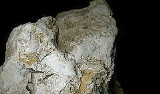
Montmorillonite

Encyclopedia
Montmorillonite is a very soft phyllosilicate
group of minerals that typically form in microscopic crystal
s, forming a clay. It is named after Montmorillon
in France
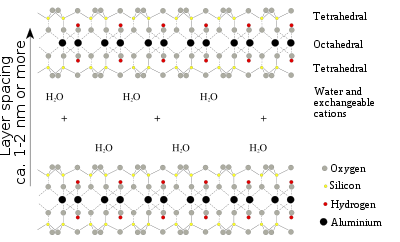
. Montmorillonite, a member of the smectite family, is a 2:1 clay, meaning that it has 2 tetrahedral sheets sandwiching a central octahedral sheet. The particles are plate-shaped with an average diameter of approximately one micrometre
. Members of this group include saponite
.
Montmorillonite is the main constituent of the volcanic ash
weathering
product, bentonite
.
The water content of montmorillonite is variable and it increases greatly in volume when it absorbs water. Chemically it is hydrated sodium calcium aluminium magnesium silicate hydroxide (Na,Ca)0.33(Al,Mg)2(Si4O10)(OH)2·nH2O. Potassium, iron, and other cations are common substitutes, the exact ratio of cations varies with source. It often occurs intermixed with chlorite
, muscovite
, illite
, cookeite, and kaolinite
.
environments. The natural weathering of the cave can leave behind concentrations of aluminosilicate
s which were contained within the bedrock. Montmorillonite can form slowly in solutions of aluminosilicates. High HCO3 concentrations and long periods of time can aid in the formation. Montmorillonite can then transform to palygorskite
under dry conditions and to endellite in acidic conditions (pH 5 or lower). Endellite can further transform into halloysite
by drying.
 Montmorillonite is used in the oil drilling industry as a component of drilling mud, making the mud slurry viscous which helps in keeping the drill bit cool and removing drilled solids. It is also used as a soil
additive to hold soil water in drought prone soils, to the construction of earthen dams and levee
s and to prevent the leakage of fluids. It is also used as a component of foundry sand
and as a desiccant
to remove moisture
from air and gases.
Similar to many other clays, montmorillonite swells
with the addition of water. However, some montmorillonites expand considerably more than other clays due to water penetrating the interlayer molecular spaces and concomitant adsorption. The amount of expansion is due largely to the type of exchangeable cation contained in the sample. The presence of sodium as the predominant exchangeable cation can result in the clay swelling to several times its original volume. Hence, sodium montmorillonite has come to be used as the major constituent in non-explosive agents for splitting rock in natural stone quarries in order to limit the amount of waste, or for the demolition of concrete structures where the use of explosive charges is unacceptable.
This swelling property makes montmorillonite-containing bentonite useful also as an annular seal or plug for water wells and as a protective liner for landfills. Other uses include as an anti-caking agent in animal feed, in paper making to minimize deposit formation and as a retention and drainage aid component. Montmorillonite has also been used in cosmetics
.
Sodium montmorillonite is also used as the base of some cat litter products, due to its adsorbent and clumping properties.
.
Montmorillonite is effective as an adsorptive of heavy metals.
For external use, montmorillonite has also shown its effectiveness.
in the department of Vienne
, France
, more than 50 years before the discovery of bentonite in the US. It is found in many locations world wide and known by other names.
. These are structures that resemble cell membranes on many cells. It can also help nucleotides to assemble into RNA
which will end up inside the vesicles and, under the right conditions, will replicate themselves. This process may have led to the origin of life on Earth.
Silicate minerals
The silicate minerals make up the largest and most important class of rock-forming minerals, constituting approximately 90 percent of the crust of the Earth. They are classified based on the structure of their silicate group...
group of minerals that typically form in microscopic crystal
Crystal
A crystal or crystalline solid is a solid material whose constituent atoms, molecules, or ions are arranged in an orderly repeating pattern extending in all three spatial dimensions. The scientific study of crystals and crystal formation is known as crystallography...
s, forming a clay. It is named after Montmorillon
Montmorillon
Montmorillon is a commune in the Vienne department in the Poitou-Charentes region in western France.The clay mineral montmorillonite was named after Montmorillon after its discovery there in 1847.-External links:*...
in France
France
The French Republic , The French Republic , The French Republic , (commonly known as France , is a unitary semi-presidential republic in Western Europe with several overseas territories and islands located on other continents and in the Indian, Pacific, and Atlantic oceans. Metropolitan France...
. Montmorillonite, a member of the smectite family, is a 2:1 clay, meaning that it has 2 tetrahedral sheets sandwiching a central octahedral sheet. The particles are plate-shaped with an average diameter of approximately one micrometre
Micrometre
A micrometer , is by definition 1×10⁻⁶ of a meter .In plain English, it means one-millionth of a meter . Its unit symbol in the International System of Units is μm...
. Members of this group include saponite
Saponite
Saponite is a trioctahedral mineral of the smectite group. Its chemical formula is Ca0.2532·n. It is soluble in sulfuric acid. It was first described in 1840 by von Svanberg. Varieties of saponite are griffithite, bowlingite and sobotkite.It is soft, massive, and plastic, and exists in veins and...
.
Montmorillonite is the main constituent of the volcanic ash
Volcanic ash
Volcanic ash consists of small tephra, which are bits of pulverized rock and glass created by volcanic eruptions, less than in diameter. There are three mechanisms of volcanic ash formation: gas release under decompression causing magmatic eruptions; thermal contraction from chilling on contact...
weathering
Weathering
Weathering is the breaking down of rocks, soils and minerals as well as artificial materials through contact with the Earth's atmosphere, biota and waters...
product, bentonite
Bentonite
Bentonite is an absorbent aluminium phyllosilicate, essentially impure clay consisting mostly of montmorillonite. There are different types of bentonite, each named after the respective dominant element, such as potassium , sodium , calcium , and aluminum . Experts debate a number of nomenclatorial...
.
The water content of montmorillonite is variable and it increases greatly in volume when it absorbs water. Chemically it is hydrated sodium calcium aluminium magnesium silicate hydroxide (Na,Ca)0.33(Al,Mg)2(Si4O10)(OH)2·nH2O. Potassium, iron, and other cations are common substitutes, the exact ratio of cations varies with source. It often occurs intermixed with chlorite
Chlorite group
The chlorites are a group of phyllosilicate minerals. Chlorites can be described by the following four endmembers based on their chemistry via substitution of the following four elements in the silicate lattice; Mg, Fe, Ni, and Mn....
, muscovite
Muscovite
Muscovite is a phyllosilicate mineral of aluminium and potassium with formula KAl22, or 236. It has a highly-perfect basal cleavage yielding remarkably-thin laminæ which are often highly elastic...
, illite
Illite
Illite is a non-expanding, clay-sized, micaceous mineral. Illite is a phyllosilicate or layered alumino-silicate. Its structure is constituted by the repetition of tetrahedron – octahedron – tetrahedron layers. The interlayer space is mainly occupied by poorly hydrated potassium cations...
, cookeite, and kaolinite
Kaolinite
Kaolinite is a clay mineral, part of the group of industrial minerals, with the chemical composition Al2Si2O54. It is a layered silicate mineral, with one tetrahedral sheet linked through oxygen atoms to one octahedral sheet of alumina octahedra...
.
Cave conditions
Montmorillonite can be concentrated and transformed within caveCave
A cave or cavern is a natural underground space large enough for a human to enter. The term applies to natural cavities some part of which is in total darkness. The word cave also includes smaller spaces like rock shelters, sea caves, and grottos.Speleology is the science of exploration and study...
environments. The natural weathering of the cave can leave behind concentrations of aluminosilicate
Aluminosilicate
Aluminosilicate minerals are minerals composed of aluminium, silicon, and oxygen, plus countercations. They are a major component of kaolin and other clay minerals....
s which were contained within the bedrock. Montmorillonite can form slowly in solutions of aluminosilicates. High HCO3 concentrations and long periods of time can aid in the formation. Montmorillonite can then transform to palygorskite
Palygorskite
Palygorskite or attapulgite is a magnesium aluminium phyllosilicate with formula 2Si4O10·4 which occurs in a type of clay soil common to the Southeastern United States. It is one of the types of fuller's earth.-Name:...
under dry conditions and to endellite in acidic conditions (pH 5 or lower). Endellite can further transform into halloysite
Halloysite
Halloysite is a 1:1 aluminosilicate clay mineral with the empirical formula Al2Si2O54. Its main constituents are aluminium , silicon , and hydrogen . Halloysite typically forms by hydrothermal alteration of alumino-silicate minerals. It can occur intermixed with dickite, kaolinite, montmorillonite...
by drying.
Uses
Soil
Soil is a natural body consisting of layers of mineral constituents of variable thicknesses, which differ from the parent materials in their morphological, physical, chemical, and mineralogical characteristics...
additive to hold soil water in drought prone soils, to the construction of earthen dams and levee
Levee
A levee, levée, dike , embankment, floodbank or stopbank is an elongated naturally occurring ridge or artificially constructed fill or wall, which regulates water levels...
s and to prevent the leakage of fluids. It is also used as a component of foundry sand
Sand casting
Sand casting, also known as sand molded casting, is a metal casting process characterized by using sand as the mold material.It is relatively cheap and sufficiently refractory even for steel foundry use. A suitable bonding agent is mixed or occurs with the sand...
and as a desiccant
Desiccant
A desiccant is a hygroscopic substance that induces or sustains a state of dryness in its local vicinity in a moderately well-sealed container....
to remove moisture
Moisture
Humidity is the amount of moisture the air can hold before it rains. Moisture refers to the presence of a liquid, especially water, often in trace amounts...
from air and gases.
Similar to many other clays, montmorillonite swells
Expansive clay
Expansive clay is a clay that is prone to large volume changes that are directly related to changes in water content.The mineral make-up of this type of soil is responsible for the moisture retaining capabilities. Soils with smectite clay minerals, including montmorillonite, have the most dramatic...
with the addition of water. However, some montmorillonites expand considerably more than other clays due to water penetrating the interlayer molecular spaces and concomitant adsorption. The amount of expansion is due largely to the type of exchangeable cation contained in the sample. The presence of sodium as the predominant exchangeable cation can result in the clay swelling to several times its original volume. Hence, sodium montmorillonite has come to be used as the major constituent in non-explosive agents for splitting rock in natural stone quarries in order to limit the amount of waste, or for the demolition of concrete structures where the use of explosive charges is unacceptable.
This swelling property makes montmorillonite-containing bentonite useful also as an annular seal or plug for water wells and as a protective liner for landfills. Other uses include as an anti-caking agent in animal feed, in paper making to minimize deposit formation and as a retention and drainage aid component. Montmorillonite has also been used in cosmetics
Cosmetics
Cosmetics are substances used to enhance the appearance or odor of the human body. Cosmetics include skin-care creams, lotions, powders, perfumes, lipsticks, fingernail and toe nail polish, eye and facial makeup, towelettes, permanent waves, colored contact lenses, hair colors, hair sprays and...
.
Sodium montmorillonite is also used as the base of some cat litter products, due to its adsorbent and clumping properties.
Calcined clay products
Montmorillonite can be (calcined) to produce arcillite, a porous, calcined clay sold as a soil conditioner for playing fields and other soil products such as for use as bonsai soil as an alternative to akadamaAkadama
is a naturally occurring, granular clay like mineral that is used as soil for bonsai trees and other container-grown plants. It is surface mined, immediately sifted and bagged, and supplied in various grades: the deeper mined grade being somewhat harder and more useful in horticulture than the more...
.
Use in medicine and pharmacology
Montmorillonite clay is widely used in medicine and pharmacology.Montmorillonite is effective as an adsorptive of heavy metals.
For external use, montmorillonite has also shown its effectiveness.
Discovery
Montmorillonite was first described in 1847 for an occurrence in MontmorillonMontmorillon
Montmorillon is a commune in the Vienne department in the Poitou-Charentes region in western France.The clay mineral montmorillonite was named after Montmorillon after its discovery there in 1847.-External links:*...
in the department of Vienne
Vienne
Vienne is the northernmost département of the Poitou-Charentes region of France, named after the river Vienne.- Viennese history :Vienne is one of the original 83 departments, established on March 4, 1790 during the French Revolution. It was created from parts of the former provinces of Poitou,...
, France
France
The French Republic , The French Republic , The French Republic , (commonly known as France , is a unitary semi-presidential republic in Western Europe with several overseas territories and islands located on other continents and in the Indian, Pacific, and Atlantic oceans. Metropolitan France...
, more than 50 years before the discovery of bentonite in the US. It is found in many locations world wide and known by other names.
Lipid organization
Montmorillonite is also known to cause micelles (lipid spheres) to assemble together into vesiclesVesicle (biology)
A vesicle is a bubble of liquid within another liquid, a supramolecular assembly made up of many different molecules. More technically, a vesicle is a small membrane-enclosed sack that can store or transport substances. Vesicles can form naturally because of the properties of lipid membranes , or...
. These are structures that resemble cell membranes on many cells. It can also help nucleotides to assemble into RNA
RNA
Ribonucleic acid , or RNA, is one of the three major macromolecules that are essential for all known forms of life....
which will end up inside the vesicles and, under the right conditions, will replicate themselves. This process may have led to the origin of life on Earth.