


Trace fossil

Encyclopedia
Geology
Geology is the science comprising the study of solid Earth, the rocks of which it is composed, and the processes by which it evolves. Geology gives insight into the history of the Earth, as it provides the primary evidence for plate tectonics, the evolutionary history of life, and past climates...
records of biological activity. Trace fossil
Fossil
Fossils are the preserved remains or traces of animals , plants, and other organisms from the remote past...
s may be impressions made on the substrate by an organism: for example, burrow
Burrow
A burrow is a hole or tunnel dug into the ground by an animal to create a space suitable for habitation, temporary refuge, or as a byproduct of locomotion. Burrows provide a form of shelter against predation and exposure to the elements, so the burrowing way of life is quite popular among the...
s, borings (bioerosion
Bioerosion
Bioerosion describes the erosion of hard ocean substrates – and less often terrestrial substrates – by living organisms. Marine bioerosion can be caused by mollusks, polychaete worms, phoronids, sponges, crustaceans, echinoids, and fish; it can occur on coastlines, on coral reefs, and...
), urolite
Urolite
Urolite is a term compound of two Greek words, uro- meaning "urine" and lithos meaning "stone" and was first used to differentiate the fossil of a nonliquid urinary secretions, produced by some groups of reptiles, in relation to coprolites...
s (erosion caused by evacuation of liquid wastes), footprints and feeding marks, and root cavities. The term in its broadest sense also includes the remains of other organic material produced by an organism — for example coprolite
Coprolite
A coprolite is fossilized animal dung. Coprolites are classified as trace fossils as opposed to body fossils, as they give evidence for the animal's behaviour rather than morphology. The name is derived from the Greek words κοπρος / kopros meaning 'dung' and λιθος / lithos meaning 'stone'. They...
s (fossilized droppings) or chemical markers — or sedimentological structures produced by biological means - for example, stromatolites. Trace fossils contrast with body fossil
Fossil
Fossils are the preserved remains or traces of animals , plants, and other organisms from the remote past...
s, which are the fossilized remains of parts of organisms' bodies, usually altered by later chemical activity or mineralization.
Sedimentary structures, for example those produced by empty shells rolling along the sea floor, are not produced through the behaviour of an organism and not considered trace fossils.
The study of traces is called ichnology
Ichnology
Ichnology is the branch of geology that deals with traces of organismal behavior, such as burrows and footprints. It is generally considered as a branch of paleontology; however, only one division of ichnology, paleoichnology, deals with trace fossils, while neoichnology is the study of modern traces...
, which is divided into paleoichnology, or the study of trace fossils, and neoichnology, the study of modern traces. This science is challenging, as most traces reflect the behaviour — not the biological affinity — of their makers. As such, trace fossils are categorised into form genera, based upon their appearance and the implied behaviour of their makers.
Occurrence
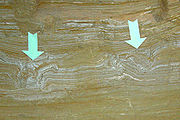
Trace fossils are best preserved in sandstones; the grain size and depositional facies both contributing to the better preservation. They may also be found in shales and limestones.
Classification
Trace fossils are generally difficult or impossible to assign to a specific maker. Only in very rare occasions are the makers found in association with their tracks. Further, entirely different organisms may produce identical tracks. Therefore conventional taxonomy is not applicable, and a comprehensive form taxonomy has been erected. At the highest level of the classification, five behavioral modes are recognized:- Domichnia, dwelling structures reflecting the life position of the organism that created it.
- Fodinichnia, three-dimensional structures left by animals which eat their way through sediment, such as deposit feeders;
- Pascichnia, feeding traces left by grazers on the surface of a soft sediment or a mineral substrate;
- Cubichnia, resting traces, in the form of an impression left by an organism on a soft sediment;
- Repichnia, surface traces of creeping and crawling.
Fossils are further classified into form genera, a few of which are even subdivided to a "species" level. Classification is based on shape, form, and implied behavioural mode.
Information provided by ichnofossils

Sedimentary depositional environment
In geology, sedimentary depositional environment describes the combination of physical, chemical and biological processes associated with the deposition of a particular type of sediment and, therefore, the rock types that will be formed after lithification, if the sediment is preserved in the rock...
. Attempts to deduce such traits as whether a deposit is marine or non-marine have been made, but shown to be unreliable.
Paleoecology
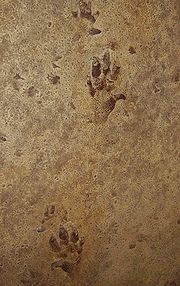
Trace fossils provide us with indirect evidence of life in the past, such as the footprints, tracks, burrows, borings, and feces left behind by animals, rather than the preserved remains of the body of the actual animal itself. Unlike most other fossils, which are produced only after the death of the organism concerned, trace fossils provide us with a record of the activity of an organism during its lifetime.Trace fossils are formed by organisms performing the functions of their everyday life, such as walking, crawling, burrowing, boring, or feeding. Tetrapod
Tetrapod
Tetrapods are vertebrate animals having four limbs. Amphibians, reptiles, birds and mammals are all tetrapods; even snakes and other limbless reptiles and amphibians are tetrapods by descent. The earliest tetrapods evolved from the lobe-finned fishes in the Devonian...
footprints, worm
Worm
The term worm refers to an obsolete taxon used by Carolus Linnaeus and Jean-Baptiste Lamarck for all non-arthropod invertebrate animals, and stems from the Old English word wyrm. Currently it is used to describe many different distantly-related animals that typically have a long cylindrical...
trails and the burrows made by clam
Clam
The word "clam" can be applied to freshwater mussels, and other freshwater bivalves, as well as marine bivalves.In the United States, "clam" can be used in several different ways: one, as a general term covering all bivalve molluscs...
s and arthropods are all trace fossils.
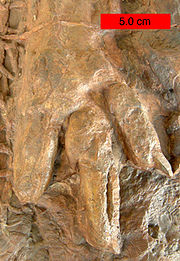
Perhaps the most spectacular trace fossils are the huge, three-toed footprints produced by dinosaur
Dinosaur
Dinosaurs are a diverse group of animals of the clade and superorder Dinosauria. They were the dominant terrestrial vertebrates for over 160 million years, from the late Triassic period until the end of the Cretaceous , when the Cretaceous–Paleogene extinction event led to the extinction of...
s and related archosaur
Archosaur
Archosaurs are a group of diapsid amniotes whose living representatives consist of modern birds and crocodilians. This group also includes all extinct non-avian dinosaurs, many extinct crocodilian relatives, and pterosaurs. Archosauria, the archosaur clade, is a crown group that includes the most...
s. These imprints give scientists clues as to how these animals lived. Although the skeletons of dinosaurs can be reconstructed, only their fossilized footprints can determine exactly how they stood and walked. Such tracks can tell much about the gait of the animal which made them, what its stride was, and whether or not the front limbs touched the ground.
However, most trace fossils are rather less conspicuous, such as the trails made by segmented worms or nematode
Nematode
The nematodes or roundworms are the most diverse phylum of pseudocoelomates, and one of the most diverse of all animals. Nematode species are very difficult to distinguish; over 28,000 have been described, of which over 16,000 are parasitic. It has been estimated that the total number of nematode...
s. Some of these worm
Worm
The term worm refers to an obsolete taxon used by Carolus Linnaeus and Jean-Baptiste Lamarck for all non-arthropod invertebrate animals, and stems from the Old English word wyrm. Currently it is used to describe many different distantly-related animals that typically have a long cylindrical...
castings are the only fossil record we have of these soft-bodied creatures.
Paleoenvironment
Vertebrate
Vertebrates are animals that are members of the subphylum Vertebrata . Vertebrates are the largest group of chordates, with currently about 58,000 species described. Vertebrates include the jawless fishes, bony fishes, sharks and rays, amphibians, reptiles, mammals, and birds...
s are difficult to identify to a particular species of animal, but they can provide valuable information such as the speed, weight, and behavior of the organism that made them. Such trace fossils are formed when amphibian
Amphibian
Amphibians , are a class of vertebrate animals including animals such as toads, frogs, caecilians, and salamanders. They are characterized as non-amniote ectothermic tetrapods...
s, reptile
Reptile
Reptiles are members of a class of air-breathing, ectothermic vertebrates which are characterized by laying shelled eggs , and having skin covered in scales and/or scutes. They are tetrapods, either having four limbs or being descended from four-limbed ancestors...
s, mammal
Mammal
Mammals are members of a class of air-breathing vertebrate animals characterised by the possession of endothermy, hair, three middle ear bones, and mammary glands functional in mothers with young...
s or bird
Bird
Birds are feathered, winged, bipedal, endothermic , egg-laying, vertebrate animals. Around 10,000 living species and 188 families makes them the most speciose class of tetrapod vertebrates. They inhabit ecosystems across the globe, from the Arctic to the Antarctic. Extant birds range in size from...
s walked across soft (probably wet) mud or sand which later hardened sufficiently to retain the impressions before the next layer of sediment was deposited. Some fossils can even provide details of how wet the sand was when they were being produced, and hence allow estimation of paleo-wind directions.
Assemblages of trace fossils occur at certain water depths, and can also reflect the salinity and turbidity of the water column.
Stratigraphic correlation
Some trace fossils can be used as local index fossilIndex fossil
Index fossils are fossils used to define and identify geologic periods . They work on the premise that, although different sediments may look different depending on the conditions under which they were laid down, they may include the remains of the same species of fossil...
s, to date the rocks in which they are found, such as the burrow Arenicolites franconicus which occurs only in a 4 cm (1.6") layer of the Triassic
Triassic
The Triassic is a geologic period and system that extends from about 250 to 200 Mya . As the first period of the Mesozoic Era, the Triassic follows the Permian and is followed by the Jurassic. Both the start and end of the Triassic are marked by major extinction events...
Muschelkalk epoch, throughout wide areas in southern Germany
Germany
Germany , officially the Federal Republic of Germany , is a federal parliamentary republic in Europe. The country consists of 16 states while the capital and largest city is Berlin. Germany covers an area of 357,021 km2 and has a largely temperate seasonal climate...
.
The base of the Cambrian period is defined by the first appearance of the trace fossil Treptichnus pedum
Treptichnus pedum
Treptichnus pedum is regarded as the earliest widespread complex trace fossil...
.
Trace fossils have a further utility as many appear before the organism thought to create them, extending their stratigraphic range.
Ichnofacies
Trace fossil assemblages are far from random; the range of fossils recorded in association is constrained by the environment in which the trace-making organisms dwelt. Palaeontologist Adolf SeilacherAdolf Seilacher
Adolf "Dolf" Seilacher is a German palaeontologist who has made major contributions to evolutionary and ecological palaeobiology in a career stretching over 60 years. He won the Crafoord Prize in 1992, the Paleontological Society Medal in 1994 and the Palaeontological Association's Lapworth Medal...
pioneered the concept of ichnofacies, whereby the state of a sedimentary system at its time of deposition could be implied by noting the fossils in association with one another.
Inherent bias
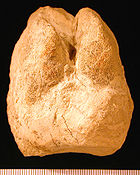
Surface trails on sediment in shallow marine environments stand less chance of fossilization because they are subjected to wave and current action. Conditions in quiet, deep-water environments tend to be more favorable for preserving fine trace structures.
Most trace fossils are usually readily identified by reference to similar phenomena in modern environments. However, the structures made by organisms in recent sediment have only been studied in a limited range of environments, mostly in coastal areas, including tidal flats.
Evolution

Putative "burrows" dating as far back as may have been made by animals which fed on the undersides of microbial mats, which would have shielded them from a chemically unpleasant ocean; however their uneven width and tapering ends make a biological origin so difficult to defend that even the original author no longer believes they are authentic.
The first evidence of burrowing which is widely accepted dates to the Ediacaran
Ediacaran
The Ediacaran Period , named after the Ediacara Hills of South Australia, is the last geological period of the Neoproterozoic Era and of the Proterozoic Eon, immediately preceding the Cambrian Period, the first period of the Paleozoic Era and of the Phanerozoic Eon...
(Vendian) period, around . During this period the traces and burrows basically are horizontal on or just below the seafloor surface. Such traces must have been made by motile organisms with heads, which would probably have been bilateran
Bilateria
The bilateria are all animals having a bilateral symmetry, i.e. they have a front and a back end, as well as an upside and downside. Radially symmetrical animals like jellyfish have a topside and downside, but no front and back...
animal
Animal
Animals are a major group of multicellular, eukaryotic organisms of the kingdom Animalia or Metazoa. Their body plan eventually becomes fixed as they develop, although some undergo a process of metamorphosis later on in their life. Most animals are motile, meaning they can move spontaneously and...
s. The trace observed imply simple behaviour, and point to organisms feeding above the surface and burrowing for protection from predators. Contrary to widely circulated opinion that Ediacaran burrows are only horizontal the vertical burrows Skolithos
Skolithos
Skolithos is a common trace fossil ichnogenus whose original form consisted of approximately vertical cylinders. One well-known occurrence of Cambrian trace fossils is the famous 'Pipe Rock' of northwest Scotland...
are also known. The producers of burrows Skolithos declinatus from the Vendian (Ediacaran) beds in Russia with date have not been found, they might have been filter feeders subsisting on the nutrients from the suspension. The density of these burrows is up to 245 burrows/dm2. Some Ediacaran trace fossils have been found directly associated with an body fossils. Yorgia
Yorgia
Yorgia waggoneri is a member of the Ediacara biota, and resembles a cross between the organisms Dickinsonia and Spriggina. It has a low, segmented body consisting of a short wide "head", no appendages, and a long body region, reaching a maximum length of...
and Dickinsonia
Dickinsonia
Dickinsonia is an iconic fossil of the Ediacaran biota. It resembles a bilaterally symmetrical ribbed oval. Its affinities are presently unknown; most interpretations consider it to be an animal, although others suggest it may be fungal, or a member of an "extinct kingdom".-Species variety:A...
are often found at the end of long pathways of trace fossils matching their shape. The feeding was performed in a mechanical way, supposedly the ventral side of body these organisms was covered with cilia. The potential mollusc related Kimberella
Kimberella
Kimberella is a monospecific genus of bilaterian known only from rocks of the Ediacaran period. The slug-like organism fed by scratching the microbial surface on which it dwelt in a manner similar to the molluscs, although its affinity with this group is contentious.Specimens were first found in...
is associated with scratch marks, perhaps formed by a radula
Radula
The radula is an anatomical structure that is used by molluscs for feeding, sometimes compared rather inaccurately to a tongue. It is a minutely toothed, chitinous ribbon, which is typically used for scraping or cutting food before the food enters the esophagus...
, further traces from appear to imply active crawling or burrowing activity.
As the Cambrian
Cambrian
The Cambrian is the first geological period of the Paleozoic Era, lasting from Mya ; it is succeeded by the Ordovician. Its subdivisions, and indeed its base, are somewhat in flux. The period was established by Adam Sedgwick, who named it after Cambria, the Latin name for Wales, where Britain's...
got underway, new forms of trace fossil appeared, including vertical burrows (e.g. Diplocraterion
Diplocraterion
Diplocraterion is an ichnogenus describing vertical U-shaped burrows having a spreite between the two limbs of the U. The spreite of fainter U-shaped traces appears above and below the final tunnel, made as the organism moved up and down through the sediment.- Further reading :* Šimo V. &...
) and traces normally attributed to arthropod
Arthropod
An arthropod is an invertebrate animal having an exoskeleton , a segmented body, and jointed appendages. Arthropods are members of the phylum Arthropoda , and include the insects, arachnids, crustaceans, and others...
s. These represent a “widening of the behavioural repertoire”, both in terms of abundance and complexity.
Trace fossils are a particularly significant source of data from this period because they represent a data source that is not directly connected to the presence of easily-fossilized hard parts, which are rare during the Cambrian. Whilst exact assignment of trace fossils to their makers is difficult, the trace fossil record seems to indicate that at the very least, large, bottom-dwelling, bilaterally symmetrical organisms were rapidly diversifying during the early Cambrian.
Further, less rapid diversification occurred since, and many traces have been converged upon independently by unrelated groups of organisms.
Trace fossils also provide our earliest evidence of animal life on land. The earliest arthropod trackways date to the Cambro-Ordovician, and trackways from the Ordovician Tumblagooda sandstone
Tumblagooda sandstone
The Tumblagooda sandstone is a geological formation deposited during the Silurian or Ordovician periods, around four to five hundred million years ago, and is now exposed on the west coast of Australia, straddling the boundary of the Carnarvon and Perth basins...
allow the behaviour of these organisms to be determined. The enigmatic trace fossil Climactichnites
Climactichnites
Climactichnites is an enigmatic, late Cambrian fossil formed on or within sandy tidal flats around .It has been interpreted in many different ways in the past, but is now known to be a trace fossil of a slug-like organism, thought to have moved by crawling on near-shore or on-shore surfaces or...
may represent an earlier still terrestrial trace, perhaps made by a slug-like organism.
Common ichnogenera

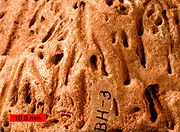
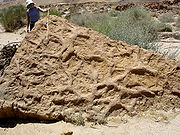
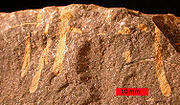
- AsteriacitesAsteriacitesAsteriacites is the name given to five-rayed trace fossils found in marine sedimentary rocks . They record the burrows of ophiuroid and asteroid sea stars on the sea floor. Asteriacites are found in European and American rocks, from the Ordovician period onwards, and are especially numerous in the...
is the name given to the five-rayed fossils found in rocks and they record the resting place of starfish on the sea floor. Asteriacites are found in European and American rocks, from the OrdovicianOrdovicianThe Ordovician is a geologic period and system, the second of six of the Paleozoic Era, and covers the time between 488.3±1.7 to 443.7±1.5 million years ago . It follows the Cambrian Period and is followed by the Silurian Period...
period onwards, and are numerous in rocks from the JurassicJurassicThe Jurassic is a geologic period and system that extends from about Mya to Mya, that is, from the end of the Triassic to the beginning of the Cretaceous. The Jurassic constitutes the middle period of the Mesozoic era, also known as the age of reptiles. The start of the period is marked by...
period of GermanyGermanyGermany , officially the Federal Republic of Germany , is a federal parliamentary republic in Europe. The country consists of 16 states while the capital and largest city is Berlin. Germany covers an area of 357,021 km2 and has a largely temperate seasonal climate...
. - Chondrites (not to be confused with stony meteorites of the same name) are small branching burrows of the same diameter, which superficially resemble the roots of a plant. The most likely candidate for having constructed these burrows is a nematodeNematodeThe nematodes or roundworms are the most diverse phylum of pseudocoelomates, and one of the most diverse of all animals. Nematode species are very difficult to distinguish; over 28,000 have been described, of which over 16,000 are parasitic. It has been estimated that the total number of nematode...
(roundworm). Chondrites are found in marine sediments from the CambrianCambrianThe Cambrian is the first geological period of the Paleozoic Era, lasting from Mya ; it is succeeded by the Ordovician. Its subdivisions, and indeed its base, are somewhat in flux. The period was established by Adam Sedgwick, who named it after Cambria, the Latin name for Wales, where Britain's...
period of the PaleozoicPaleozoicThe Paleozoic era is the earliest of three geologic eras of the Phanerozoic eon, spanning from roughly...
onwards. They are especially common in sediments which were deposited in reduced-oxygen environments. - ClimactichnitesClimactichnitesClimactichnites is an enigmatic, late Cambrian fossil formed on or within sandy tidal flats around .It has been interpreted in many different ways in the past, but is now known to be a trace fossil of a slug-like organism, thought to have moved by crawling on near-shore or on-shore surfaces or...
is the name given to trackways that usually consist of two parallel ridges separated by chevron-shaped raised cross bars. They somewhat resemble tire tracks, and are larger (typically about four inches wide) than most of the other trace fossils made by invertebrates. The tracks were produced on sandy tidal flats during late CambrianCambrianThe Cambrian is the first geological period of the Paleozoic Era, lasting from Mya ; it is succeeded by the Ordovician. Its subdivisions, and indeed its base, are somewhat in flux. The period was established by Adam Sedgwick, who named it after Cambria, the Latin name for Wales, where Britain's...
time. While the identity of the animal is still conjectural, it may have been a large slugSlugSlug is a common name that is normally applied to any gastropod mollusc that lacks a shell, has a very reduced shell, or has a small internal shell...
-like animal - its trackways produced as it crawled over and processed the wet sand to obtain food. - CruzianaCruzianaCruziana is a trace fossil consisting of elongate, bilobed, approximately bilaterally symmetrical burrows, usually preserved along bedding planes, with a sculpture of repeated striations that are mostly oblique to the long dimension...
are excavation trace marks made on the sea floor which have a two-lobed structure with a central groove. The lobes are covered with scratch marks made by the legs of the excavating organism, usually a trilobiteTrilobiteTrilobites are a well-known fossil group of extinct marine arthropods that form the class Trilobita. The first appearance of trilobites in the fossil record defines the base of the Atdabanian stage of the Early Cambrian period , and they flourished throughout the lower Paleozoic era before...
or allied arthropod. Cruziana are most common in marine sediments formed during the PaleozoicPaleozoicThe Paleozoic era is the earliest of three geologic eras of the Phanerozoic eon, spanning from roughly...
era, particularly in rocks from the CambrianCambrianThe Cambrian is the first geological period of the Paleozoic Era, lasting from Mya ; it is succeeded by the Ordovician. Its subdivisions, and indeed its base, are somewhat in flux. The period was established by Adam Sedgwick, who named it after Cambria, the Latin name for Wales, where Britain's...
and OrdovicianOrdovicianThe Ordovician is a geologic period and system, the second of six of the Paleozoic Era, and covers the time between 488.3±1.7 to 443.7±1.5 million years ago . It follows the Cambrian Period and is followed by the Silurian Period...
periods. Over 30 ichnospecies of Cruziana have been identified. See also IsopodichnusIsopodichnusIsopodichnus is an ichnogenus of trace fossil. Ribbon-like in form, Isopodichnus traces were likely formed by the activity of an isopod crustacean foraging within the preserved sediment. Parallel to the bedding plane, a central furrow is flanked by two hypichnial ridges. Trails may also exhibit...
. - EntobiaEntobiaEntobia is a trace fossil in a hard substrate formed by clionaid sponges as a branching network of galleries, often with regular enlargements termed chambers...
is a boring produced by endolithic clionaid sponges consisting of galleries excavated in a carbonate substrate; often has swollen chambers with connecting canals. - GastrochaenolitesGastrochaenolitesGastrochaenolites is a trace fossil formed as a clavate boring in a hard substrate such as a shell, rock or carbonate hardground. The aperture of the boring is narrower than the main chamber and may be circular, oval, or dumb-bell shaped...
are clavate (club-shaped) borings also produced in calcareous hard substrates, usually by bivalves. - PetroxestesPetroxestesPetroxestes is a shallow, elongate boring originally found excavated in carbonate skeletons and hardgrounds of the Upper Ordovician of North America...
is a shallow groove boring produced by mytilacean bivalves in carbonate hard substrates. - ProtichnitesProtichnitesProtichnites is a genus of trace fossil consisting of the imprints made by the walking activity of arthropods. It is likely that more than one type of arthropod was responsible for these tracks. Euthycarcinoids, aglaspidids and eurypterids are possible contributors. Protichnites consists of two...
consists of two rows of tracks and a linear depression between the two rows. The tracks are believed to have been made by the walking appendages of arthropodArthropodAn arthropod is an invertebrate animal having an exoskeleton , a segmented body, and jointed appendages. Arthropods are members of the phylum Arthropoda , and include the insects, arachnids, crustaceans, and others...
s. The linear depression is thought to be the result of a dragging tail. The structures bearing this name were typically made on the tidal flats of PaleozoicPaleozoicThe Paleozoic era is the earliest of three geologic eras of the Phanerozoic eon, spanning from roughly...
seas, but similar ones extend into the CenozoicCenozoicThe Cenozoic era is the current and most recent of the three Phanerozoic geological eras and covers the period from 65.5 mya to the present. The era began in the wake of the Cretaceous–Tertiary extinction event at the end of the Cretaceous that saw the demise of the last non-avian dinosaurs and...
. - RhizocoralliumRhizocoralliumRhizocorallium is an ichnogenus type of burrow, the inclination of which is typically within 10° of the bedding planes of the sediment. These burrows can be very large, over a meter long in sediments that show good preservation, e.g...
is a type of burrowBurrowA burrow is a hole or tunnel dug into the ground by an animal to create a space suitable for habitation, temporary refuge, or as a byproduct of locomotion. Burrows provide a form of shelter against predation and exposure to the elements, so the burrowing way of life is quite popular among the...
, the inclination of which is typically within 10° of the bedding planes of the sediment. These burrows can be very large, over a meter long in sediments that show good preservation, e.g. JurassicJurassicThe Jurassic is a geologic period and system that extends from about Mya to Mya, that is, from the end of the Triassic to the beginning of the Cretaceous. The Jurassic constitutes the middle period of the Mesozoic era, also known as the age of reptiles. The start of the period is marked by...
rocks of the YorkshireYorkshireYorkshire is a historic county of northern England and the largest in the United Kingdom. Because of its great size in comparison to other English counties, functions have been increasingly undertaken over time by its subdivisions, which have also been subject to periodic reform...
Coast (eastern United KingdomUnited KingdomThe United Kingdom of Great Britain and Northern IrelandIn the United Kingdom and Dependencies, other languages have been officially recognised as legitimate autochthonous languages under the European Charter for Regional or Minority Languages...
), but the width is usually only up to 2 cm, restricted by the size of the organisms producing it. It is thought that they represent fodinichnia as the animal (probably a nematodeNematodeThe nematodes or roundworms are the most diverse phylum of pseudocoelomates, and one of the most diverse of all animals. Nematode species are very difficult to distinguish; over 28,000 have been described, of which over 16,000 are parasitic. It has been estimated that the total number of nematode...
) scoured the sedimentSedimentSediment is naturally occurring material that is broken down by processes of weathering and erosion, and is subsequently transported by the action of fluids such as wind, water, or ice, and/or by the force of gravity acting on the particle itself....
for food. - RogerellaRogerellaRogerella is a small pouch-shaped boring with a slit-like aperture currently produced by acrothoracican barnacles. These crustaceans extrude their legs upwards through the opening for filter-feeding...
is a small pouch-shaped boring with a slit-like aperture currently produced by acrothoracicaAcrothoracicaThe Acrothoracica are a superorder of barnacles.Acrothoracicans bore into calcareous material such as mollusc shells, coral, crinoids or hardgrounds, producing a slit-like hole in the surface known by the trace fossil name Rogerella. They are typically smaller than other types of barnacle, being...
n barnacles. - RusophycusRusophycusRusophycus is a trace fossil allied to Cruziana. Rusophycus is the resting trace, recording the outline of the tracemaker; Cruziana is made when the organism moved...
are bilobed "resting traces" associated with trilobites and other arthropods such as horseshoe crabs. - SkolithosSkolithosSkolithos is a common trace fossil ichnogenus whose original form consisted of approximately vertical cylinders. One well-known occurrence of Cambrian trace fossils is the famous 'Pipe Rock' of northwest Scotland...
: One well-known occurrence of Cambrian trace fossils from this period is the famous 'Pipe Rock' of northwest ScotlandScotlandScotland is a country that is part of the United Kingdom. Occupying the northern third of the island of Great Britain, it shares a border with England to the south and is bounded by the North Sea to the east, the Atlantic Ocean to the north and west, and the North Channel and Irish Sea to the...
. The 'pipes' that give the rock its name are closely packed straight tubes- which were presumably made by some kind of wormWormThe term worm refers to an obsolete taxon used by Carolus Linnaeus and Jean-Baptiste Lamarck for all non-arthropod invertebrate animals, and stems from the Old English word wyrm. Currently it is used to describe many different distantly-related animals that typically have a long cylindrical...
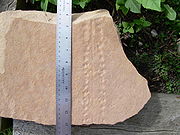
-like organism. The name given to this type of tube or burrow is Skolithos, which may be 30 cm (12") in length and between 2 to 4 cm (0.8 to 1.6") in diameter. Such traces are known worldwide from sands and sandstoneSandstoneSandstone is a sedimentary rock composed mainly of sand-sized minerals or rock grains.Most sandstone is composed of quartz and/or feldspar because these are the most common minerals in the Earth's crust. Like sand, sandstone may be any colour, but the most common colours are tan, brown, yellow,...
s deposited in shallow water environments, from the CambrianCambrianThe Cambrian is the first geological period of the Paleozoic Era, lasting from Mya ; it is succeeded by the Ordovician. Its subdivisions, and indeed its base, are somewhat in flux. The period was established by Adam Sedgwick, who named it after Cambria, the Latin name for Wales, where Britain's...
period (542–488 Ma) onwards. - ThalassinoidesThalassinoidesThalassinoides is an ichnogenus of trace fossil, also known as Ophiomorpha, Teichichnus, Gyrolithes and Spongeliomorpha. Thalassinoides is used to refer to "dichotomously or T-branched boxworks, mazes and shafts, unlined and unornmented", and facies of Thalassinoides increased suddenly in abundance...
are burrows which occur parallel to the bedding plane of the rock and are extremely abundant in rocks, worldwide, from the JurassicJurassicThe Jurassic is a geologic period and system that extends from about Mya to Mya, that is, from the end of the Triassic to the beginning of the Cretaceous. The Jurassic constitutes the middle period of the Mesozoic era, also known as the age of reptiles. The start of the period is marked by...
period onwards. They are repeatedly branched, with a slight swelling present at the junctions of the tubes. The burrows are cylindrical and vary from 2 to 5 cm (0.8" to 2") in diameter. Thalassinoides sometimes contain scratch marks, droppings or the bodily remains of the crustaceanCrustaceanCrustaceans form a very large group of arthropods, usually treated as a subphylum, which includes such familiar animals as crabs, lobsters, crayfish, shrimp, krill and barnacles. The 50,000 described species range in size from Stygotantulus stocki at , to the Japanese spider crab with a leg span...
s which made them. - TeichichnusTeichichnusTeichichnus is an ichnogenus with a distinctive form produced by the stacking of thin 'tongues' of sediment, atop one another. They are believed to be fodinichnia, with the organism adopting the habit of retracing the same route through varying heights of the sediment, which would allow it to avoid...
has a distinctive form produced by the stacking of thin 'tongues' of sedimentSedimentSediment is naturally occurring material that is broken down by processes of weathering and erosion, and is subsequently transported by the action of fluids such as wind, water, or ice, and/or by the force of gravity acting on the particle itself....
, atop one another. They are again believed to be fodinichnia, with the organism adopting the habit of retracing the same route through varying heights of the sediment, which would allow it to avoid going over the same area. These 'tongues' are often quite sinuous, reflecting perhaps a more nutrient-poor environment in which the feeding animals had to cover a greater area of sediment, in order to acquire sufficient nourishment. - TrypanitesTrypanitesTrypanites is a narrow, cylindrical, unbranched boring which is one of the most common trace fossils in hard substrates such as rocks, carbonate hardgrounds and shells . It appears first in the Lower Cambrian , was very prominent in the Ordovician Bioerosion Revolution , and is still commonly...
are elongated cylindrical boringBioerosionBioerosion describes the erosion of hard ocean substrates – and less often terrestrial substrates – by living organisms. Marine bioerosion can be caused by mollusks, polychaete worms, phoronids, sponges, crustaceans, echinoids, and fish; it can occur on coastlines, on coral reefs, and...
s in calcareous substrates such as shells, carbonate hardgrounds and limestones. Usually produced by worms of various types and sipunculids.
Other notable trace fossils
Less ambiguous than the above ichnogenera, are the traces left behind by invertebrateInvertebrate
An invertebrate is an animal without a backbone. The group includes 97% of all animal species – all animals except those in the chordate subphylum Vertebrata .Invertebrates form a paraphyletic group...
s such as Hibbertopterus
Hibbertopterus
Hibbertopterus is a genus of giant sea scorpion that inhabited the swamps of Scotland during the Carboniferous.Hibbertopterus is a member of the family Hibbertopteridae, large bizarre Eurypterids found from the Upper Devonian to the end of the Permian period...
, a giant "sea scorpion
Sea Scorpion
Sea Scorpion may refer to:* Eurypterids, members of the extinct class Eurypterida* some members of the Cottidae family of fish including the Long-spined Sea Scorpion and Short-spined Sea Scorpion...
" or eurypterid
Eurypterid
Eurypterids are an extinct group of arthropods related to arachnids which include the largest known arthropods that ever lived. They are members of the extinct order Eurypterida ; which is the most diverse Paleozoic chelicerate order in terms of species...
of the early Paleozoic
Paleozoic
The Paleozoic era is the earliest of three geologic eras of the Phanerozoic eon, spanning from roughly...
era. This marine arthropod
Arthropod
An arthropod is an invertebrate animal having an exoskeleton , a segmented body, and jointed appendages. Arthropods are members of the phylum Arthropoda , and include the insects, arachnids, crustaceans, and others...
produced a spectacular hibbertopteroid track preserved in Scotland.
Bioerosion
Bioerosion
Bioerosion describes the erosion of hard ocean substrates – and less often terrestrial substrates – by living organisms. Marine bioerosion can be caused by mollusks, polychaete worms, phoronids, sponges, crustaceans, echinoids, and fish; it can occur on coastlines, on coral reefs, and...
through time has produced a magnificent record of borings, gnawings, scratchings and scrapings on hard substrates. These trace fossils are usually divided into macroborings and microborings. Bioerosion intensity and diversity is punctuated by two events. One is called the Ordovician Bioerosion Revolution (see Wilson & Palmer, 2006) and the other was in the Jurassic. For a comprehensive bibliography of the bioerosion literature, please see the External links below.
The oldest types of tetrapod
Tetrapod
Tetrapods are vertebrate animals having four limbs. Amphibians, reptiles, birds and mammals are all tetrapods; even snakes and other limbless reptiles and amphibians are tetrapods by descent. The earliest tetrapods evolved from the lobe-finned fishes in the Devonian...
tail-and-foot prints date back to the latter Devonian
Devonian
The Devonian is a geologic period and system of the Paleozoic Era spanning from the end of the Silurian Period, about 416.0 ± 2.8 Mya , to the beginning of the Carboniferous Period, about 359.2 ± 2.5 Mya...
period. These vertebrate
Vertebrate
Vertebrates are animals that are members of the subphylum Vertebrata . Vertebrates are the largest group of chordates, with currently about 58,000 species described. Vertebrates include the jawless fishes, bony fishes, sharks and rays, amphibians, reptiles, mammals, and birds...
impressions have been found in Ireland
Ireland
Ireland is an island to the northwest of continental Europe. It is the third-largest island in Europe and the twentieth-largest island on Earth...
, Scotland
Scotland
Scotland is a country that is part of the United Kingdom. Occupying the northern third of the island of Great Britain, it shares a border with England to the south and is bounded by the North Sea to the east, the Atlantic Ocean to the north and west, and the North Channel and Irish Sea to the...
, Pennsylvania
Pennsylvania
The Commonwealth of Pennsylvania is a U.S. state that is located in the Northeastern and Mid-Atlantic regions of the United States. The state borders Delaware and Maryland to the south, West Virginia to the southwest, Ohio to the west, New York and Ontario, Canada, to the north, and New Jersey to...
, and Australia
Australia
Australia , officially the Commonwealth of Australia, is a country in the Southern Hemisphere comprising the mainland of the Australian continent, the island of Tasmania, and numerous smaller islands in the Indian and Pacific Oceans. It is the world's sixth-largest country by total area...
.
Important human
Human evolution
Human evolution refers to the evolutionary history of the genus Homo, including the emergence of Homo sapiens as a distinct species and as a unique category of hominids and mammals...
trace fossils are the Laetoli
Laetoli
Laetoli is a site in Tanzania, dated to the Plio-Pleistocene and famous for its hominin footprints, preserved in volcanic ash . The site of the Laetoli footprints is located 45 km south of Olduvai gorge.-Date:...
(Tanzania
Tanzania
The United Republic of Tanzania is a country in East Africa bordered by Kenya and Uganda to the north, Rwanda, Burundi, and the Democratic Republic of the Congo to the west, and Zambia, Malawi, and Mozambique to the south. The country's eastern borders lie on the Indian Ocean.Tanzania is a state...
) footprints, imprinted in volcanic ash 3.7 Ma (million years ago) -- probably by an early Australopithecus
Australopithecus
Australopithecus is a genus of hominids that is now extinct. From the evidence gathered by palaeontologists and archaeologists, it appears that the Australopithecus genus evolved in eastern Africa around 4 million years ago before spreading throughout the continent and eventually becoming extinct...
.
Confusion with other types of fossils
Trace fossils are not body casts. The Ediacara biotaEdiacara biota
The Ediacara biota consisted of enigmatic tubular and frond-shaped, mostly sessile organisms which lived during the Ediacaran Period . Trace fossils of these organisms have been found worldwide, and represent the earliest known complex multicellular organisms.Simple multicellular organisms such as...
, for instance, primarily comprises the casts of organisms in sediment. Similarly, a footprint is not a simple replica of the sole of the foot, and the resting trace of a seastar has different details than an impression of a seastar.
Early paleobotanists misidentified a wide variety of structures they found on the bedding planes of sedimentary rocks as fucoids (Fucales
Fucales
Fucales is an order in the brown algae . Members of this order are fucoids. The list of families in Fucales, as well as additional taxonomic information on algae, is publicly accessible at Algaebase....
, a kind of brown algae
Brown algae
The Phaeophyceae or brown algae , is a large group of mostly marine multicellular algae, including many seaweeds of colder Northern Hemisphere waters. They play an important role in marine environments, both as food and for the habitats they form...
or seaweed
Seaweed
Seaweed is a loose, colloquial term encompassing macroscopic, multicellular, benthic marine algae. The term includes some members of the red, brown and green algae...
). However, even during the earliest decades of the study of ichnology, some fossils were recognized as animal footprints and burrows. Studies in the 1880s by A. G. Nathorst and Joseph F. James comparing 'fucoids' to modern traces made it increasingly clear that most of the specimens identified as fossil fucoids were animal trails and burrows. True fossil fucoids are quite rare.
Pseudofossil
Pseudofossil
Pseudofossils are inorganic objects, markings, or impressions that might be mistaken for fossils. Pseudofossils may be misleading, as some types of mineral deposits can mimic lifeforms by forming what appear to be highly detailed or organized structures. One common example is when manganese oxides...
s, which are not true fossils, should also not be confused with ichnofossils, which are true indications of prehistoric life.
See also
- BioerosionBioerosionBioerosion describes the erosion of hard ocean substrates – and less often terrestrial substrates – by living organisms. Marine bioerosion can be caused by mollusks, polychaete worms, phoronids, sponges, crustaceans, echinoids, and fish; it can occur on coastlines, on coral reefs, and...
- Bird ichnologyBird ichnologyBird ichnology is the study of avian life traces in ornithology and paleontology. Such life traces can include footprints, nests, feces and coproliths. Scientists gain insight about the behavior and diversity of birds by studying such evidence....
- IchniteIchniteAn ichnite is a fossilised footprint. This is a type of trace fossil. Over the years, many ichnites have been found, around the world, giving important clues about the behaviour of the animals that made them...
- fossilised footprints - IchnofaciesIchnofaciesAn ichnofacies is an assemblage of trace fossils that provide an indication of the conditions that their formative organisms inhabited.-The concept:...
- Trace fossil classificationTrace fossil classificationTrace fossils are classified in various ways for different purposes. Traces can be classified taxonomically , ethologically , and toponomically, that is, according to their relationship to the surrounding sedimentary layers...
- Way up structureWay up structureA way up structure, way up criterion, or geopetal indicator is a characteristic relationship observed in a sedimentary or volcanic rock, or sequence of rocks, that makes it possible to determine whether they are the right way up or have been overturned by subsequent deformation...
- Index FossilIndex fossilIndex fossils are fossils used to define and identify geologic periods . They work on the premise that, although different sediments may look different depending on the conditions under which they were laid down, they may include the remains of the same species of fossil...
Further reading
- Bromley, R.G., 1970. Borings as trace fossils and EntobiaEntobiaEntobia is a trace fossil in a hard substrate formed by clionaid sponges as a branching network of galleries, often with regular enlargements termed chambers...
cretacea Portlock as an example, p. 49-90. In: Crimes, T.P. and Harper, J.C. (eds.), Trace Fossils. Geological Journal Special Issue 3. - Bromley, R.G., 2004. A stratigraphy of marine bioerosion. In: The application of ichnology to palaeoenvironmental and stratigraphic analysis. (Ed. D. McIlroy), Geological Society of London Special Publications 228:455-481.
- Palmer, T.J., 1982. Cambrian to Cretaceous changes in hardground communities. Lethaia 15:309-323.
- Wilson, M.A., 1986. Coelobites and spatial refuges in a Lower Cretaceous cobble-dwelling hardground fauna. Palaeontology 29:691-703.
- Wilson, M.A. and Palmer, T.J., 2006. Patterns and processes in the Ordovician Bioerosion Revolution. Ichnos 13: 109-112.http://www3.wooster.edu/geology/WilsonPalmer06.pdf
- Yochelson, E.L. and Fedonkin, M.A., 1993. Paleobiology of Climactichnites, and Enigmatic Late Cambrian Fossil. Smithsonian Contributions to Paleobiology 74:1-74.
External links
- Encyclopaedia-style article about trace fossils
- Ichnogenus images
- Bioerosion Website at The College of WoosterThe College of WoosterThe College of Wooster is a private liberal arts college primarily known for its Independent study program. It has roughly 2,000 students and is located in Wooster, Wayne County, Ohio, United States . Founded in 1866 by the Presbyterian church as the University of Wooster, it was from its creation...
- Comprehensive bioerosion bibliography compiled by Mark A. Wilson