

Archosauriformes

Encyclopedia
Archosauriformes is a clade of diapsid
reptile
s that developed from archosauromorph
ancestors some time in the Late Permian
(roughly 250 million years ago). These reptile
s, which include members of the family
Proterosuchidae
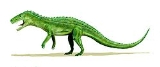
and more advanced forms, were originally superficially crocodile-like predatory semi-aquatic animals about 1.5 meters long, with a sprawling elbows-out stance and long snouts. Unlike the bulk of their therapsid contemporaries, the proterosuchids survived the catastrophe at the end of the Permian
, perhaps because they were opportunistic scavengers, perhaps because they could retreat into water to find respite from an overheated climate. Any such scenarios are hypothetical; what is clearer is that these animals were highly successful in their new environment, and evolved quickly. Within a few million years at the opening of the Triassic
, the proterosuchids had given rise to the Erythrosuchidae
(the first sauropsids to totally dominate their environment), who in turn were the ancestors of the small agile Euparkeriidae
, from whom a number of successfully more advanced families - the archosaur
s proper - evolved rapidly to fill empty ecological niches in the devastated global system.
Pre-Euparkeria
Archosauriformes were in the past included in the suborder Proterosuchia
of the order Thecodont
ia. Under the cladistic
methodology, Proterosuchia is rejected as a paraphyletic assemblage, and the pre-archosaurian taxa are simply considered as basal Archosauriformes.
Below is a cladogram
from Ezcurra et al. (2010):
Below is a cladogram from Nesbitt (2011):
Diapsid
Diapsids are a group of reptiles that developed two holes in each side of their skulls, about 300 million years ago during the late Carboniferous period. Living diapsids are extremely diverse, and include all crocodiles, lizards, snakes, and tuatara...
reptile
Reptile
Reptiles are members of a class of air-breathing, ectothermic vertebrates which are characterized by laying shelled eggs , and having skin covered in scales and/or scutes. They are tetrapods, either having four limbs or being descended from four-limbed ancestors...
s that developed from archosauromorph
Archosauromorpha
Archosauromorpha is an infraclass of diapsid reptiles that first appeared during the late Permian and became more common during the Triassic. Included in this infraclass are the groups Rhynchosauria, Trilophosauridae, Prolacertiformes, Archosauriformes, and, tentatively, Choristodera...
ancestors some time in the Late Permian
Permian
The PermianThe term "Permian" was introduced into geology in 1841 by Sir Sir R. I. Murchison, president of the Geological Society of London, who identified typical strata in extensive Russian explorations undertaken with Edouard de Verneuil; Murchison asserted in 1841 that he named his "Permian...
(roughly 250 million years ago). These reptile
Reptile
Reptiles are members of a class of air-breathing, ectothermic vertebrates which are characterized by laying shelled eggs , and having skin covered in scales and/or scutes. They are tetrapods, either having four limbs or being descended from four-limbed ancestors...
s, which include members of the family
Family (biology)
In biological classification, family is* a taxonomic rank. Other well-known ranks are life, domain, kingdom, phylum, class, order, genus, and species, with family fitting between order and genus. As for the other well-known ranks, there is the option of an immediately lower rank, indicated by the...
Proterosuchidae
Proterosuchidae
Proterosuchidae is an early, possibly paraphyletic, assemblage of basal archosauriformes whose fossils are known from the Latest Permian of Russia and the Early Triassic of southern Africa, Russia, China, Australia, and Antarctica...
and more advanced forms, were originally superficially crocodile-like predatory semi-aquatic animals about 1.5 meters long, with a sprawling elbows-out stance and long snouts. Unlike the bulk of their therapsid contemporaries, the proterosuchids survived the catastrophe at the end of the Permian
Permian-Triassic extinction event
The Permian–Triassic extinction event, informally known as the Great Dying, was an extinction event that occurred 252.28 Ma ago, forming the boundary between the Permian and Triassic geologic periods, as well as the Paleozoic and Mesozoic eras...
, perhaps because they were opportunistic scavengers, perhaps because they could retreat into water to find respite from an overheated climate. Any such scenarios are hypothetical; what is clearer is that these animals were highly successful in their new environment, and evolved quickly. Within a few million years at the opening of the Triassic
Triassic
The Triassic is a geologic period and system that extends from about 250 to 200 Mya . As the first period of the Mesozoic Era, the Triassic follows the Permian and is followed by the Jurassic. Both the start and end of the Triassic are marked by major extinction events...
, the proterosuchids had given rise to the Erythrosuchidae
Erythrosuchidae
Erythrosuchidae are a family of large basal archosauromorph carnivores that lived from the later Early Triassic to the early Middle Triassic . Their fossil remains are known so far from South Africa , the Perm region of Russia, and China...
(the first sauropsids to totally dominate their environment), who in turn were the ancestors of the small agile Euparkeriidae
Euparkeriidae
Euparkeriidae is a family of small basal archosauromorph carnivores which lived from the Early Triassic to the Middle Triassic . Their fossil remains are known so far from South Africa and Russia...
, from whom a number of successfully more advanced families - the archosaur
Archosaur
Archosaurs are a group of diapsid amniotes whose living representatives consist of modern birds and crocodilians. This group also includes all extinct non-avian dinosaurs, many extinct crocodilian relatives, and pterosaurs. Archosauria, the archosaur clade, is a crown group that includes the most...
s proper - evolved rapidly to fill empty ecological niches in the devastated global system.
Pre-Euparkeria
Euparkeria
Euparkeria was a small African reptile of the early Triassic period between 248-245 million years ago, close to the ancestry of the archosaurs.- Palaeobiology :...
Archosauriformes were in the past included in the suborder Proterosuchia
Proterosuchia
Proterosuchia refers to one of the suborders of Thecodontia; specifically the most primitive and ancestral forms. These were primitive, vaguely crocodile-like, archosaurs that mostly lived during the Early Triassic period....
of the order Thecodont
Thecodont
Thecodont , now considered an obsolete term, was formerly used to describe a diverse range of early archosaurs that first appeared in the Latest Permian and flourished until the end of the Triassic period...
ia. Under the cladistic
Cladistics
Cladistics is a method of classifying species of organisms into groups called clades, which consist of an ancestor organism and all its descendants . For example, birds, dinosaurs, crocodiles, and all descendants of their most recent common ancestor form a clade...
methodology, Proterosuchia is rejected as a paraphyletic assemblage, and the pre-archosaurian taxa are simply considered as basal Archosauriformes.
Taxonomy
- Class ReptiliaReptileReptiles are members of a class of air-breathing, ectothermic vertebrates which are characterized by laying shelled eggs , and having skin covered in scales and/or scutes. They are tetrapods, either having four limbs or being descended from four-limbed ancestors...
- Infraclass ArchosauromorphaArchosauromorphaArchosauromorpha is an infraclass of diapsid reptiles that first appeared during the late Permian and became more common during the Triassic. Included in this infraclass are the groups Rhynchosauria, Trilophosauridae, Prolacertiformes, Archosauriformes, and, tentatively, Choristodera...
- (unranked) ARCHOSAURIFORMES
- UatchitodonUatchitodonUatchitodon is an extinct genus of Late Triassic reptile known only from isolated teeth. Based on the structure of the teeth, Uatchitodon was probably a carnivorous archosauromorph. Folded grooves on the teeth indicate that the animal was likely venomous, with the grooves being channels for...
- Family ProterosuchidaeProterosuchidaeProterosuchidae is an early, possibly paraphyletic, assemblage of basal archosauriformes whose fossils are known from the Latest Permian of Russia and the Early Triassic of southern Africa, Russia, China, Australia, and Antarctica...
- Family ErythrosuchidaeErythrosuchidaeErythrosuchidae are a family of large basal archosauromorph carnivores that lived from the later Early Triassic to the early Middle Triassic . Their fossil remains are known so far from South Africa , the Perm region of Russia, and China...
- Family EuparkeriidaeEuparkeriidaeEuparkeriidae is a family of small basal archosauromorph carnivores which lived from the Early Triassic to the Middle Triassic . Their fossil remains are known so far from South Africa and Russia...
- (unranked)
- TurfanosuchusTurfanosuchusTurfanosuchus is a genus of archosauriform reptile which lived during the Middle Triassic of northwestern China. The type species, T. dabanensis, was described by C.C. Young in 1973, based on a partially complete but disarticulated fossil skeleton...
- YonghesuchusYonghesuchusYonghesuchus is an extinct genus of Late Triassic archosauriform reptile. Remains have been found from the early Late Triassic Tongchuan Formation in Shanxi, China. It is named after Yonghe County, the county where fossils were found. Currently only one species, Y. sangbiensis, is known...
- Family ProterochampsidaeProterochampsidaeProterochampsidae is a family of archosauriforms. Proterochampsids may have filled an ecological niche similar to modern crocodiles, and had a general crocodile-like appearance. They lived in what is now South America in the Middle and Late Triassic....
- (unranked) Archosauria [Crown group Archosauria = Avesuchia]
- Turfanosuchus
- Uatchitodon
- (unranked) ARCHOSAURIFORMES
- Infraclass Archosauromorpha
Below is a cladogram
Cladogram
A cladogram is a diagram used in cladistics which shows ancestral relations between organisms, to represent the evolutionary tree of life. Although traditionally such cladograms were generated largely on the basis of morphological characters, DNA and RNA sequencing data and computational...
from Ezcurra et al. (2010):
Below is a cladogram from Nesbitt (2011):