
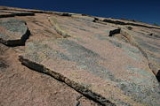
Weathering is the breaking down of
rocksIn geology, rock or stone is a naturally occurring solid aggregate of minerals and/or mineraloids.The Earth's outer solid layer, the lithosphere, is made of rock. In general rocks are of three types, namely, igneous, sedimentary, and metamorphic...
,
soilSoil is a natural body consisting of layers of mineral constituents of variable thicknesses, which differ from the parent materials in their morphological, physical, chemical, and mineralogical characteristics...
s and
mineralA mineral is a naturally occurring solid chemical substance formed through biogeochemical processes, having characteristic chemical composition, highly ordered atomic structure, and specific physical properties. By comparison, a rock is an aggregate of minerals and/or mineraloids and does not...
s as well as artificial materials through contact with the Earth's
atmosphereAn atmosphere is a layer of gases that may surround a material body of sufficient mass, and that is held in place by the gravity of the body. An atmosphere may be retained for a longer duration, if the gravity is high and the atmosphere's temperature is low...
,
biotaBiota may refer to:* Biota , the plant and animal life of a region* Biota , a superdomain in taxonomy* Biota , an evergreen coniferous tree, Platycladus orientalis* Biota , an avant-prog band from Colorado, USA...
and waters. Weathering occurs
in situIn situ is a Latin phrase which translated literally as 'In position'. It is used in many different contexts.-Aerospace:In the aerospace industry, equipment on board aircraft must be tested in situ, or in place, to confirm everything functions properly as a system. Individually, each piece may...
, or "with no movement", and thus should not be confused with
erosionErosion is when materials are removed from the surface and changed into something else. It only works by hydraulic actions and transport of solids in the natural environment, and leads to the deposition of these materials elsewhere...
, which involves the movement of rocks and minerals by agents such as water, ice, wind, and gravity.
Two important classifications of weathering processes exist – physical and chemical weathering.
Mechanical or
physical weathering involves the breakdown of rocks and soils through direct contact with atmospheric conditions, such as heat, water, ice and pressure. The second classification,
chemical weathering, involves the direct effect of atmospheric chemicals or biologically produced chemicals (also known as
biological weathering) in the breakdown of rocks, soils and minerals. As with many other geological processes the distinction between weathering and related processes is diffuse.
The materials left over after the rock breaks down combined with organic material creates
soilSoil is a natural body consisting of layers of mineral constituents of variable thicknesses, which differ from the parent materials in their morphological, physical, chemical, and mineralogical characteristics...
. The mineral content of the soil is determined by the
parent materialIn soil science, parent material is the underlying geological material in which soil horizons form...
, thus a soil derived from a single rock type can often be deficient in one or more minerals for good fertility, while a soil weathered from a mix of rock types (as in
glacialAn ice age or, more precisely, glacial age, is a generic geological period of long-term reduction in the temperature of the Earth's surface and atmosphere, resulting in the presence or expansion of continental ice sheets, polar ice sheets and alpine glaciers...
, aeolian or alluvial sediments) often makes more
fertile soilFertile soil has the following properties:*It is rich in nutrients necessary for basic plant nutrition, including nitrogen, phosphorus and potassium....
. In addition many of Earth's landforms and landscapes are the result of weathering processes combined with erosion and redeposition.
Mechanical weathering
Physical weathering is the class of processes that causes the disintegration of rocks without chemical change. The primary process in physical weathering is
abrasionAbrasion is the mechanical scraping of a rock surface by friction between rocks and moving particles during their transport by wind, glacier, waves, gravity, running water or erosion. After friction, the moving particles dislodge loose and weak debris from the side of the rock...
(the process by which clasts and other particles are reduced in size). However, chemical and physical weathering often go hand in hand. Physical weathering can occur due to temperature, pressure, frost etc. For example, cracks exploited by physical weathering will increase the surface area exposed to chemical action. Furthermore, the chemical action of minerals in cracks can aid the disintegration process.
Thermal stress
Thermal stress weathering (sometimes called insolation weathering) results from expansion or contraction of rock, caused by temperature changes. Thermal stress weathering comprises two main types,
thermal shockThermal shock is the name given to cracking as a result of rapid temperature change. Glass and ceramic objects are particularly vulnerable to this form of failure, due to their low toughness, low thermal conductivity, and high thermal expansion coefficients...
and thermal fatigue. Thermal stress weathering is an important mechanism in
desertsDéserts is a piece by Edgard Varèse for brass , percussion , piano, and tape. Percussion instruments are exploited for their resonant potential, rather than used solely as accompaniment...
, where there is a large
diurnalDiurnal temperature variation is a meteorological term that relates to the variation in temperature that occurs from the highs of the day to the cool of nights.-Temperature lag:Temperature lag is an important factor in diurnal temperature variation...
temperature range, hot in the day and cold at night. The repeated heating and cooling exerts
stressIn continuum mechanics, stress is a measure of the internal forces acting within a deformable body. Quantitatively, it is a measure of the average force per unit area of a surface within the body on which internal forces act. These internal forces are a reaction to external forces applied on the body...
on the outer layers of rocks, which can cause their outer layers to peel off in thin sheets. Although temperature changes are the principal driver, moisture can enhance
thermal expansionThermal expansion is the tendency of matter to change in volume in response to a change in temperature.When a substance is heated, its particles begin moving more and thus usually maintain a greater average separation. Materials which contract with increasing temperature are rare; this effect is...
in rock. Forest fires and range fires are also known to cause significant weathering of rocks and boulders exposed along the ground surface. Intense, localized heat can rapidly expand a boulder.
Frost weathering
Frost weathering, frost wedging,
ice wedging or
cryofracturing is the collective name for several processes where ice is present. This processes include frost shattering, frost-wedging and freeze-thaw weathering. This type of weathering is common in mountain areas where the temperature is around the freezing point of water. Certain frost-susceptible soils expand or
heaveFrost heaving results from ice forming beneath the surface of soil during freezing conditions in the atmosphere. The ice grows in the direction of heat loss , starting at the freezing front or boundary in the soil...
upon freezing as a result of water migrating via
capillary actionCapillary action, or capilarity, is the ability of a liquid to flow against gravity where liquid spontanously rise in a narrow space such as between the hair of a paint-brush, in a thin tube, or in porous material such as paper or in some non-porous material such as liquified carbon fiber, or in a...
to grow
ice lensAn Ice Lens or ice lenses are formed when moisture, diffused within soil or rock, accumulates in a localized zone. The ice initially accumulates within small collocated pores or pre-existing crack, and, as long as the conditions remain favorable, continues to collect in the ice layer or ice lens,...
es near the freezing front. This same phenomenon occurs within pore spaces of rocks. The ice accumulations grow larger as they attract liquid water from the surrounding pores. The ice crystal growth weakens the rocks which, in time, break up. It is caused by the approximately 10% (9.87) expansion of
iceIce is water frozen into the solid state. Usually ice is the phase known as ice Ih, which is the most abundant of the varying solid phases on the Earth's surface. It can appear transparent or opaque bluish-white color, depending on the presence of impurities or air inclusions...
when
waterWater is a chemical substance with the chemical formula H2O. A water molecule contains one oxygen and two hydrogen atoms connected by covalent bonds. Water is a liquid at ambient conditions, but it often co-exists on Earth with its solid state, ice, and gaseous state . Water also exists in a...
freezes, which can place considerable stress on anything containing the water as it freezes.
Freeze induced weathering action occurs mainly in environments where there is a lot of moisture, and temperatures frequently fluctuate above and below freezing point, especially in
alpineAlpine climate is the average weather for a region above the tree line. This climate is also referred to as mountain climate or highland climate....
and
periglacialPeriglacial is an adjective originally referring to places in the edges of glacial areas, but it has later been widely used in geomorphology to describe any place where geomorphic processes related to freezing of water occur...
areas. An example of rocks susceptible to frost action is
chalkChalk is a soft, white, porous sedimentary rock, a form of limestone composed of the mineral calcite. Calcite is calcium carbonate or CaCO3. It forms under reasonably deep marine conditions from the gradual accumulation of minute calcite plates shed from micro-organisms called coccolithophores....
, which has many pore spaces for the growth of ice crystals. This process can be seen in
DartmoorDartmoor is an area of moorland in south Devon, England. Protected by National Park status, it covers .The granite upland dates from the Carboniferous period of geological history. The moorland is capped with many exposed granite hilltops known as tors, providing habitats for Dartmoor wildlife. The...
where it results in the formation of tors.
When water that has entered the joints freezes, the ice formed strains the walls of the joints and causes the joints to deepen and widen.
When the ice thaws, water can flow further into the rock.
Repeated freeze-thaw cycles weaken the rocks which, over time, break up along the joints into angular pieces. The angular rock fragments gather at the foot of the slope to form a
talusScree, also called talus, is a term given to an accumulation of broken rock fragments at the base of crags, mountain cliffs, or valley shoulders. Landforms associated with these materials are sometimes called scree slopes or talus piles...
slope (or scree slope). The splitting of rocks along the joints into blocks is called block disintegration. The blocks of rocks that are detached are of various shapes depending on rock structure.
Pressure release
In pressure release, also known as unloading, overlying materials (not necessarily rocks) are removed (by erosion, or other processes), which causes underlying rocks to expand and fracture parallel to the surface. Often the overlying material is heavy, and the underlying rocks experience high pressure under them, for example, a moving
glacierA glacier is a large persistent body of ice that forms where the accumulation of snow exceeds its ablation over many years, often centuries. At least 0.1 km² in area and 50 m thick, but often much larger, a glacier slowly deforms and flows due to stresses induced by its weight...
. Pressure release may also cause
exfoliationExfoliation has several meanings:* Exfoliation describes the loss of leaves from a plant.* Exfoliation , is a cosmetic technique aimed at removing dead skin cells from the face and body....
to occur.
Intrusive igneous rocks (e.g.
graniteGranite is a common and widely occurring type of intrusive, felsic, igneous rock. Granite usually has a medium- to coarse-grained texture. Occasionally some individual crystals are larger than the groundmass, in which case the texture is known as porphyritic. A granitic rock with a porphyritic...
) are formed deep beneath the Earth's surface. They are under tremendous pressure because of the overlying rock material. When erosion removes the overlying rock material, these intrusive rocks are exposed and the pressure on them is released. The outer parts of the rocks then tend to expand. The expansion sets up stresses which cause fractures parallel to the rock surface to form. Over time, sheets of rock break away from the exposed rocks along the fractures. Pressure release is also known as "exfoliation" or "sheeting"; these processes result in batholiths and granite domes, an example of which is Dartmoor.
Hydraulic action
Hydraulic action occurs when water (generally from powerful waves) rushes rapidly into cracks in the rock face, thus trapping a layer of air at the bottom of the crack, compressing it and weakening the rock. When the wave retreats, the trapped air is suddenly released with explosive force.
Salt-crystal growth
Salt crystallization, otherwise known as
haloclastyHaloclasty is a type of physical weathering caused by the growth of salt crystals. The process is first started when saline water seeps into cracks and evaporates depositing salt crystals, when the rocks are then heated up the crystals will expand putting pressure on the surrounding rock which will...
, causes disintegration of rocks when saline (see
salinitySalinity is the saltiness or dissolved salt content of a body of water. It is a general term used to describe the levels of different salts such as sodium chloride, magnesium and calcium sulfates, and bicarbonates...
) solutions seep into cracks and joints in the rocks and evaporate, leaving salt crystals behind. These salt crystals expand as they are heated up, exerting pressure on the confining rock.
Salt crystallization may also take place when solutions decompose rocks (for example,
limestoneLimestone is a sedimentary rock composed largely of the minerals calcite and aragonite, which are different crystal forms of calcium carbonate . Many limestones are composed from skeletal fragments of marine organisms such as coral or foraminifera....
and
chalkChalk is a soft, white, porous sedimentary rock, a form of limestone composed of the mineral calcite. Calcite is calcium carbonate or CaCO3. It forms under reasonably deep marine conditions from the gradual accumulation of minute calcite plates shed from micro-organisms called coccolithophores....
) to form salt solutions of sodium
sulfateIn inorganic chemistry, a sulfate is a salt of sulfuric acid.-Chemical properties:...
or
sodium carbonateSodium carbonate , Na2CO3 is a sodium salt of carbonic acid. It most commonly occurs as a crystalline heptahydrate, which readily effloresces to form a white powder, the monohydrate. Sodium carbonate is domestically well-known for its everyday use as a water softener. It can be extracted from the...
, of which the moisture evaporates to form their respective salt crystals.
The salts which have proved most effective in disintegrating rocks are
sodium sulfateSodium sulfate is the sodium salt of sulfuric acid. When anhydrous, it is a white crystalline solid of formula Na2SO4 known as the mineral thenardite; the decahydrate Na2SO4·10H2O has been known as Glauber's salt or, historically, sal mirabilis since the 17th century. Another solid is the...
,
magnesium sulfateMagnesium sulfate is a chemical compound containing magnesium, sulfur and oxygen, with the formula MgSO4. It is often encountered as the heptahydrate epsomite , commonly called Epsom salt, from the town of Epsom in Surrey, England, where the salt was distilled from the springs that arise where the...
, and
calcium chlorideCalcium chloride, CaCl2, is a salt of calcium and chlorine. It behaves as a typical ionic halide, and is solid at room temperature. Common applications include brine for refrigeration plants, ice and dust control on roads, and desiccation...
. Some of these salts can expand up to three times or even more.
It is normally associated with
aridA region is said to be arid when it is characterized by a severe lack of available water, to the extent of hindering or even preventing the growth and development of plant and animal life...
climates where strong heating causes strong evaporation and therefore salt crystallization. It is also common along coasts. An example of salt weathering can be seen in the
honeycombedHoneycomb weathering, also known as fretting, cavernous weathering, alveoli/alveolar weathering, stone lattice, stone lace or miniature tafoni weathering is a type of salt weathering common on coastal and semi-arid granites, sandstones and limestones...
stones in sea wall. Honeycomb is a type of
tafoniTafoni are small cave-like features found in granular rock such as sandstone, with rounded entrances and smooth concave walls. They often occur in groups that can riddle a hillside, cliff, or other rock formation. They can be found in all climate types, but are most abundant in intertidal areas...
, a class of cavernous rock weathering structures, which likely develop in large part by chemical and physical salt weathering processes.
Biological weathering
Living organisms may contribute to mechanical weathering (as well as chemical weathering, see 'biological' weathering below). Lichens and
mossMosses are small, soft plants that are typically 1–10 cm tall, though some species are much larger. They commonly grow close together in clumps or mats in damp or shady locations. They do not have flowers or seeds, and their simple leaves cover the thin wiry stems...
es grow on essentially bare rock surfaces and create a more humid chemical microenvironment. The attachment of these organisms to the rock surface enhances physical as well as chemical breakdown of the surface microlayer of the rock. On a larger scale, seedlings sprouting in a crevice and plant roots exert physical pressure as well as providing a pathway for water and chemical infiltration.
Chemical weathering
Chemical weathering changes the composition of rocks, often transforming them when water interacts with minerals to create various chemical reactions. Chemical weathering is a gradual and ongoing process as the mineralogy of the rock adjusts to the near surface environment. New or
secondary minerals develop from the original minerals of the rock. In this the processes of
oxidationRedox reactions describe all chemical reactions in which atoms have their oxidation state changed....
and
hydrolysisHydrolysis is a chemical reaction during which molecules of water are split into hydrogen cations and hydroxide anions in the process of a chemical mechanism. It is the type of reaction that is used to break down certain polymers, especially those made by condensation polymerization...
are most important.
The process of mountain block uplift is important in exposing new rock strata to the atmosphere and moisture, enabling important chemical weathering to occur; significant release occurs of Ca++ and other minerals into surface waters.
Dissolution / Carbonation
Rainfall is
acidAn acid is a substance which reacts with a base. Commonly, acids can be identified as tasting sour, reacting with metals such as calcium, and bases like sodium carbonate. Aqueous acids have a pH of less than 7, where an acid of lower pH is typically stronger, and turn blue litmus paper red...
ic because atmospheric
carbon dioxideCarbon dioxide is a naturally occurring chemical compound composed of two oxygen atoms covalently bonded to a single carbon atom...
dissolves in the rainwater producing weak carbonic acid. In unpolluted environments, the rainfall
pHIn chemistry, pH is a measure of the acidity or basicity of an aqueous solution. Pure water is said to be neutral, with a pH close to 7.0 at . Solutions with a pH less than 7 are said to be acidic and solutions with a pH greater than 7 are basic or alkaline...
is around 5.6.
Acid rainAcid rain is a rain or any other form of precipitation that is unusually acidic, meaning that it possesses elevated levels of hydrogen ions . It can have harmful effects on plants, aquatic animals, and infrastructure. Acid rain is caused by emissions of carbon dioxide, sulfur dioxide and nitrogen...
occurs when gases such as sulfur dioxide and nitrogen oxides are present in the atmosphere. These oxides react in the rain water to produce stronger acids and can lower the pH to 4.5 or even 3.0.
Sulfur dioxideSulfur dioxide is the chemical compound with the formula . It is released by volcanoes and in various industrial processes. Since coal and petroleum often contain sulfur compounds, their combustion generates sulfur dioxide unless the sulfur compounds are removed before burning the fuel...
, SO
2, comes from volcanic eruptions or from fossil fuels, can become
sulfuric acidSulfuric acid is a strong mineral acid with the molecular formula . Its historical name is oil of vitriol. Pure sulfuric acid is a highly corrosive, colorless, viscous liquid. The salts of sulfuric acid are called sulfates...
within rainwater, which can cause solution weathering to the rocks on which it falls.
Some minerals, due to their natural solubility (e.g.
evaporiteEvaporite is a name for a water-soluble mineral sediment that result from concentration and crystallization by evaporation from an aqueous solution. There are two types of evaporate deposits, marine which can also be described as ocean deposits, and non-marine which are found in standing bodies of...
s), oxidation potential (iron-rich minerals, such as
pyriteThe mineral pyrite, or iron pyrite, is an iron sulfide with the formula FeS2. This mineral's metallic luster and pale-to-normal, brass-yellow hue have earned it the nickname fool's gold because of its resemblance to gold...
), or instability relative to surficial conditions (see
Goldich dissolution seriesThe Goldich dissolution series is a way of predicting the relative stability or weathering rate of various minerals on the Earth's surface. S. S. Goldich came up with the series in 1938 after studying soil profiles...
) will weather through dissolution naturally, even without acidic water.
One of the most well-known solution weathering processes is
carbonationCarbonation is the process of dissolving carbon dioxide in water. The process usually involves carbon dioxide under high pressure. When the pressure is reduced, the carbon dioxide is released from the solution as small bubbles, which cause the solution to "fizz." This effect is seen in carbonated...
, the process in which atmospheric carbon dioxide leads to solution weathering. Carbonation occurs on rocks which contain
calcium carbonateCalcium carbonate is a chemical compound with the formula CaCO3. It is a common substance found in rocks in all parts of the world, and is the main component of shells of marine organisms, snails, coal balls, pearls, and eggshells. Calcium carbonate is the active ingredient in agricultural lime,...
, such as limestone and chalk. This takes place when rain combines with
carbon dioxideCarbon dioxide is a naturally occurring chemical compound composed of two oxygen atoms covalently bonded to a single carbon atom...
or an
organic acidAn organic acid is an organic compound with acidic properties. The most common organic acids are the carboxylic acids, whose acidity is associated with their carboxyl group –COOH. Sulfonic acids, containing the group –SO2OH, are relatively stronger acids. The relative stability of the conjugate...
to form a
weakA weak acid is an acid that dissociates incompletely. It does not release all of its hydrogens in a solution, donating only a partial amount of its protons to the solution...
carbonic acidCarbonic acid is the inorganic compound with the formula H2CO3 . It is also a name sometimes given to solutions of carbon dioxide in water, because such solutions contain small amounts of H2CO3. Carbonic acid forms two kinds of salts, the carbonates and the bicarbonates...
which reacts with calcium carbonate (the limestone) and forms
calcium bicarbonateCalcium bicarbonate , also called calcium hydrogencarbonate, does not refer to a known solid compound; it exists only in aqueous solution containing the calcium , bicarbonate , and carbonate ions, together with dissolved carbon dioxide...
. This process speeds up with a decrease in temperature, not because low temperatures generally drive reactions faster, but because colder water holds more dissolved carbon dioxide gas. Carbonation is therefore a large feature of glacial weathering.
The
reactionsStoichiometry is a branch of chemistry that deals with the relative quantities of reactants and products in chemical reactions. In a balanced chemical reaction, the relations among quantities of reactants and products typically form a ratio of whole numbers...
as follows:
-
- CO2 + H2O => H2CO3
- carbon dioxide + water => carbonic acid
-
- H2CO3 + CaCO3 => Ca(HCO3)2
- carbonic acid + calcium carbonate => calcium bicarbonate
Carbonation on the surface of well-jointed limestone produces a dissected
limestone pavementA limestone pavement is a natural karst landform consisting of a flat, incised surface of exposed limestone that resembles an artificial pavement. The term is mainly used in the UK where many of these landforms have developed distinctive surface patterning resembling block of paving...
. This process is most effective along the joints, widening and deepening them.
Hydration
Mineral hydrationMineral hydration is an inorganic chemical reaction where water is added to the crystal structure of a mineral, usually creating a new mineral, usually called a hydrate....
is a form of chemical weathering that involves the rigid attachment of H+ and OH- ions to the atoms and molecules of a mineral.
When rock minerals take up water, the increased volume creates physical stresses within the rock. For example
iron oxideIron oxides are chemical compounds composed of iron and oxygen. All together, there are sixteen known iron oxides and oxyhydroxides.Iron oxides and oxide-hydroxides are widespread in nature, play an important role in many geological and biological processes, and are widely utilized by humans, e.g.,...
s are converted to iron hydroxides and the hydration of
anhydriteAnhydrite is a mineral – anhydrous calcium sulfate, CaSO4. It is in the orthorhombic crystal system, with three directions of perfect cleavage parallel to the three planes of symmetry. It is not isomorphous with the orthorhombic barium and strontium sulfates, as might be expected from the...
forms
gypsumGypsum is a very soft sulfate mineral composed of calcium sulfate dihydrate, with the chemical formula CaSO4·2H2O. It is found in alabaster, a decorative stone used in Ancient Egypt. It is the second softest mineral on the Mohs Hardness Scale...
.
Hydrolysis on silicates and carbonates
HydrolysisHydrolysis is a chemical reaction during which molecules of water are split into hydrogen cations and hydroxide anions in the process of a chemical mechanism. It is the type of reaction that is used to break down certain polymers, especially those made by condensation polymerization...
is a chemical weathering process affecting silicate and carbonate minerals. In such reactions, pure water ionizes slightly and reacts with silicate minerals. An example reaction:
-
- Mg2SiO4 + 4H+ + 4OH- ⇌ 2Mg2+ + 4OH- + H4SiO4
- olivine
The mineral olivine is a magnesium iron silicate with the formula 2SiO4. It is a common mineral in the Earth's subsurface but weathers quickly on the surface....
(forsteriteForsterite is the magnesium rich end-member of the olivine solid solution series. Forsterite crystallizes in the orthorhombic system with cell parameters a 4.75 Å , b 10.20 Å and c 5.98 Å .Forsterite is associated with igneous and metamorphic rocks and has also been found in meteorites...
) + four ionized water molecules ⇌ ions in solution + silicic acid in solution
This reaction results in complete dissolution of the original mineral, assuming enough water is available to drive the reaction. However, the above reaction is to a degree deceptive because pure water rarely acts as a H
+ donor. Carbon dioxide, though, dissolves readily in water forming a weak acid and H
+ donor.
-
- Mg2SiO4 + 4CO2 + 4H2O ⇌ 2Mg2+ + 4HCO3- + H4SiO4
- olivine
The mineral olivine is a magnesium iron silicate with the formula 2SiO4. It is a common mineral in the Earth's subsurface but weathers quickly on the surface....
(forsteriteForsterite is the magnesium rich end-member of the olivine solid solution series. Forsterite crystallizes in the orthorhombic system with cell parameters a 4.75 Å , b 10.20 Å and c 5.98 Å .Forsterite is associated with igneous and metamorphic rocks and has also been found in meteorites...
) + carbon dioxide + water ⇌ Magnesium and bicarbonate ions in solution + silicic acid in solution
This hydrolysis reaction is much more common.
Carbonic acidCarbonic acid is the inorganic compound with the formula H2CO3 . It is also a name sometimes given to solutions of carbon dioxide in water, because such solutions contain small amounts of H2CO3. Carbonic acid forms two kinds of salts, the carbonates and the bicarbonates...
is consumed by
silicateA silicate is a compound containing a silicon bearing anion. The great majority of silicates are oxides, but hexafluorosilicate and other anions are also included. This article focuses mainly on the Si-O anions. Silicates comprise the majority of the earth's crust, as well as the other...
weathering, resulting in more alkaline solutions because of the
bicarbonateIn inorganic chemistry, bicarbonate is an intermediate form in the deprotonation of carbonic acid...
. This is an important reaction in controlling the amount of CO
2 in the atmosphere and can affect climate.
AluminosilicateAluminosilicate minerals are minerals composed of aluminium, silicon, and oxygen, plus countercations. They are a major component of kaolin and other clay minerals....
s when subjected to the hydrolysis reaction produce a secondary mineral rather than simply releasing cations.
-
- 2KAlSi3O8 + 2H2CO3 + 9H2O ⇌ Al2Si2O5(OH)4 + 4H4SiO4 + 2K+ + 2HCO3-
- Orthoclase
Orthoclase is an important tectosilicate mineral which forms igneous rock. The name is from the Greek for "straight fracture," because its two cleavage planes are at right angles to each other. Alternate names are alkali feldspar and potassium feldspar...
(aluminosilicate feldspar) + carbonic acid + water ⇌ KaoliniteKaolinite is a clay mineral, part of the group of industrial minerals, with the chemical composition Al2Si2O54. It is a layered silicate mineral, with one tetrahedral sheet linked through oxygen atoms to one octahedral sheet of alumina octahedra...
(a clay mineral) + silicic acid in solution + potassium and bicarbonate ions in solution
Oxidation
Within the weathering environment chemical oxidation of a variety of metals occurs. The most commonly observed is the oxidation of Fe
2+ (
ironIron is a chemical element with the symbol Fe and atomic number 26. It is a metal in the first transition series. It is the most common element forming the planet Earth as a whole, forming much of Earth's outer and inner core. It is the fourth most common element in the Earth's crust...
) and combination with
oxygenOxygen is the element with atomic number 8 and represented by the symbol O. Its name derives from the Greek roots ὀξύς and -γενής , because at the time of naming, it was mistakenly thought that all acids required oxygen in their composition...
and water to form Fe
3+ hydroxides and oxides such as
goethiteGoethite , named after the German polymath Johann Wolfgang von Goethe, is an iron bearing oxide mineral found in soil and other low-temperature environments. Goethite has been well known since prehistoric times for its use as a pigment. Evidence has been found of its use in paint pigment samples...
,
limoniteLimonite is an ore consisting in a mixture of hydrated iron oxide-hydroxide of varying composition. The generic formula is frequently written as FeO·nH2O, although this is not entirely accurate as limonite often contains a varying amount of oxide compared to hydroxide.Together with hematite, it has...
, and
hematiteHematite, also spelled as haematite, is the mineral form of iron oxide , one of several iron oxides. Hematite crystallizes in the rhombohedral system, and it has the same crystal structure as ilmenite and corundum...
. This gives the affected rocks a reddish-brown coloration on the surface which crumbles easily and weakens the rock. This process is better known as 'rusting', though it is distinct from the rusting of metallic iron.
Many other metallic ores and minerals oxidize and hydrate to produce colored deposits, such as
chalcopyriteChalcopyrite is a copper iron sulfide mineral that crystallizes in the tetragonal system. It has the chemical composition CuFeS2. It has a brassy to golden yellow color and a hardness of 3.5 to 4 on the Mohs scale. Its streak is diagnostic as green tinged black.On exposure to air, chalcopyrite...
s or CuFeS
2 oxidizing to copper hydroxide and
iron oxideIron oxides are chemical compounds composed of iron and oxygen. All together, there are sixteen known iron oxides and oxyhydroxides.Iron oxides and oxide-hydroxides are widespread in nature, play an important role in many geological and biological processes, and are widely utilized by humans, e.g.,...
s.
Biological weathering
A number of plants and animals may create chemical weathering through release of acidic compounds, i.e. moss on roofs is classed as weathering. Mineral weathering can also be initiated and/or accelerated by soil microorganisms.
The most common forms of biological weathering are the release of chelating compounds (i.e. organic acids, siderophores) and of acidifying molecules (i.e. protons, organic acids) by plants so as to break down
aluminiumAluminium or aluminum is a silvery white member of the boron group of chemical elements. It has the symbol Al, and its atomic number is 13. It is not soluble in water under normal circumstances....
and
ironIron is a chemical element with the symbol Fe and atomic number 26. It is a metal in the first transition series. It is the most common element forming the planet Earth as a whole, forming much of Earth's outer and inner core. It is the fourth most common element in the Earth's crust...
containing compounds in the soils beneath them. Decaying remains of dead plants in soil may form organic acids which, when dissolved in water, cause chemical weathering. Extreme release of chelating compounds can easily affect surrounding rocks and soils, and may lead to
podsolIn soil science, podzols are the typical soils of coniferous, or boreal forests. They are also the typical soils of eucalypt forests and heathlands in southern Australia...
isation of soils.
The symbiotic
mycorrhizal fungiA mycorrhiza is a symbiotic association between a fungus and the roots of a vascular plant....
associated with tree root systems can release inorganic nutrients from minerals such as apatite or biotite and transfer these nutrients to the trees, thus contributing to tree nutrition. It was also recently evidenced that bacterial communities can impact mineral stability leading to the release of inorganic nutrients. To date a large range of bacterial strains or communities from diverse genera have been reported to be able to colonize mineral surfaces and/or to weather minerals, and for some of them a plant growth promoting effect was demonstrated. The demonstrated or hypothesised mechanisms used by bacteria to weather minerals include several oxidoreduction and dissolution reactions as well as the production of weathering agents, such as protons, organic acids and chelating molecules.
Building weathering
Buildings made of any stone, brick or concrete are susceptible to the same weathering agents as any exposed rock surface. Also
statueA statue is a sculpture in the round representing a person or persons, an animal, an idea or an event, normally full-length, as opposed to a bust, and at least close to life-size, or larger...
s, monuments and ornamental stonework can be badly damaged by natural weathering processes. This is accelerated in areas severely affected by
acid rainAcid rain is a rain or any other form of precipitation that is unusually acidic, meaning that it possesses elevated levels of hydrogen ions . It can have harmful effects on plants, aquatic animals, and infrastructure. Acid rain is caused by emissions of carbon dioxide, sulfur dioxide and nitrogen...
.
See also
- Aeolian processes
- Biorhexistasy
The Theory of Biorhexistasy describes climatic conditions necessary for periods of soil formation separated by periods of soil erosion. Proposed by pedologist H...
- Case hardening of rocks
Case hardening is a weathering phenomenon of rock surface induration. It is observed commonly in: felsic alkaline rocks, such as nepheline syenite, phonolite and trachyte; pyroclastic rocks, as pyroclastic flow deposit, fine air-fall deposits and vent-filling pyroclastic deposits; sedimentary...
- Decomposition
Decomposition is the process by which organic material is broken down into simpler forms of matter. The process is essential for recycling the finite matter that occupies physical space in the biome. Bodies of living organisms begin to decompose shortly after death...
- Environmental chamber
An environmental chamber is an enclosure used to test the effects of specified environmental conditions on biological items, industrial products, materials, and electronic devices and components. Environmental chambers help evaluate product quality and reliability, and identify manufacturing flaws...
- Eluvium
Eluvium is the moniker of ambient recording artist Matthew Cooper, who currently resides in Portland, Oregon. Cooper, who was born in Tennessee and raised in Louisville, Kentucky before relocating to the Northwest, is known for blending various genres of experimental music including shoegaze,...
- Erosion
Erosion is when materials are removed from the surface and changed into something else. It only works by hydraulic actions and transport of solids in the natural environment, and leads to the deposition of these materials elsewhere...
- Pedogenesis
Pedogenesis is the science and study of the processes that lead to the formation of soil ' and first explored by the Russian geologist Vasily Dokuchaev , the so called grandfather of soil science, who determined that soil formed over time as a consequence of...
- Soil production function
Soil production function refers to the rate of bedrock weathering into soil as a function of soil thickness.A general model suggested that the rate of physical weathering of bedrock can be represented as an exponential decline with soil thickness:...
- Space weathering
Space weathering is a blanket term used for a number of processes that act on any body exposed to the harsh space environment. Airless bodies incur many weathering processes:* collisions of galactic cosmic rays and solar cosmic rays,* irradiation, implantation, and sputtering from solar wind...
- Spheroidal weathering
Spheroidal weathering is a type of chemical weathering that creates rounded boulders and helps to create domed monoliths. This should not be confused with stream abrasion, a physical process which also creates rounded rocks on a much smaller scale...
- Weather testing of polymers
Weather testing of polymers is the controlled polymer degradation and polymer coating degradation under lab or natural conditions.Just like erosion of rocks, natural phenomena can cause degradation in polymer systems. The elements of most concern to polymers are Ultraviolet radiation, moisture and...
- Weathering steel