
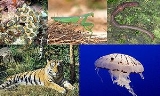
Animals are a major group of multicellular, eukaryotic
organismIn biology, an organism is any contiguous living system . In at least some form, all organisms are capable of response to stimuli, reproduction, growth and development, and maintenance of homoeostasis as a stable whole.An organism may either be unicellular or, as in the case of humans, comprise...
s of the
kingdomIn biology, kingdom is a taxonomic rank, which is either the highest rank or in the more recent three-domain system, the rank below domain. Kingdoms are divided into smaller groups called phyla or divisions in botany...
Animalia or
Metazoa. Their
body planA body plan is the blueprint for the way the body of an organism is laid out. An organism's symmetry, its number of body segments and number of limbs are all aspects of its body plan...
eventually becomes fixed as they develop, although some undergo a process of
metamorphosisMetamorphosis is a biological process by which an animal physically develops after birth or hatching, involving a conspicuous and relatively abrupt change in the animal's body structure through cell growth and differentiation...
later on in their life. Most animals are
motileMotility is a biological term which refers to the ability to move spontaneously and actively, consuming energy in the process. Most animals are motile but the term applies to single-celled and simple multicellular organisms, as well as to some mechanisms of fluid flow in multicellular organs, in...
, meaning they can move spontaneously and independently. All animals are also
heterotrophA heterotroph is an organism that cannot fix carbon and uses organic carbon for growth. This contrasts with autotrophs, such as plants and algae, which can use energy from sunlight or inorganic compounds to produce organic compounds such as carbohydrates, fats, and proteins from inorganic carbon...
s, meaning they must ingest other organisms or their products for
sustenanceSustenance can refer to any means of subsistence or livelihood within a region or a country;*food*any subsistence economy: see list of subsistence techniques**hunting-gathering**animal husbandry**subsistence agriculture...
.
Most known animal
phylaIn biology, a phylum The term was coined by Georges Cuvier from Greek φῦλον phylon, "race, stock," related to φυλή phyle, "tribe, clan." is a taxonomic rank below kingdom and above class. "Phylum" is equivalent to the botanical term division....
appeared in the fossil record as marine species during the
Cambrian explosionThe Cambrian explosion or Cambrian radiation was the relatively rapid appearance, around , of most major phyla, as demonstrated in the fossil record, accompanied by major diversification of other organisms, including animals, phytoplankton, and calcimicrobes...
, about 542 million years ago.
Etymology
The word "animal" comes from the
LatinLatin is an Italic language originally spoken in Latium and Ancient Rome. It, along with most European languages, is a descendant of the ancient Proto-Indo-European language. Although it is considered a dead language, a number of scholars and members of the Christian clergy speak it fluently, and...
word
animalis, meaning "having breath". In everyday colloquial usage, the word sometimes refers to non-
humanHumans are the only living species in the Homo genus...
animals. Sometimes, only closer relatives of humans such as
mammalMammals are members of a class of air-breathing vertebrate animals characterised by the possession of endothermy, hair, three middle ear bones, and mammary glands functional in mothers with young...
s and other
vertebrateVertebrates are animals that are members of the subphylum Vertebrata . Vertebrates are the largest group of chordates, with currently about 58,000 species described. Vertebrates include the jawless fishes, bony fishes, sharks and rays, amphibians, reptiles, mammals, and birds...
s are meant in colloquial use. The biological definition of the word refers to all members of the kingdom Animalia, encompassing creatures as diverse as sponges, jellyfish, insects and humans.
Characteristics
Animals have several characteristics that set them apart from other living things. Animals are
eukaryoticA eukaryote is an organism whose cells contain complex structures enclosed within membranes. Eukaryotes may more formally be referred to as the taxon Eukarya or Eukaryota. The defining membrane-bound structure that sets eukaryotic cells apart from prokaryotic cells is the nucleus, or nuclear...
and mostly multicellular, which separates them from
bacteriaBacteria are a large domain of prokaryotic microorganisms. Typically a few micrometres in length, bacteria have a wide range of shapes, ranging from spheres to rods and spirals...
and most
protistProtists are a diverse group of eukaryotic microorganisms. Historically, protists were treated as the kingdom Protista, which includes mostly unicellular organisms that do not fit into the other kingdoms, but this group is contested in modern taxonomy...
s. They are
heterotrophA heterotroph is an organism that cannot fix carbon and uses organic carbon for growth. This contrasts with autotrophs, such as plants and algae, which can use energy from sunlight or inorganic compounds to produce organic compounds such as carbohydrates, fats, and proteins from inorganic carbon...
ic, generally digesting food in an internal chamber, which separates them from
plantPlants are living organisms belonging to the kingdom Plantae. Precise definitions of the kingdom vary, but as the term is used here, plants include familiar organisms such as trees, flowers, herbs, bushes, grasses, vines, ferns, mosses, and green algae. The group is also called green plants or...
s and algae. They are also distinguished from plants, algae, and
fungiA fungus is a member of a large group of eukaryotic organisms that includes microorganisms such as yeasts and molds , as well as the more familiar mushrooms. These organisms are classified as a kingdom, Fungi, which is separate from plants, animals, and bacteria...
by lacking rigid
cell wallThe cell wall is the tough, usually flexible but sometimes fairly rigid layer that surrounds some types of cells. It is located outside the cell membrane and provides these cells with structural support and protection, and also acts as a filtering mechanism. A major function of the cell wall is to...
s. All animals are
motileMotility is a biological term which refers to the ability to move spontaneously and actively, consuming energy in the process. Most animals are motile but the term applies to single-celled and simple multicellular organisms, as well as to some mechanisms of fluid flow in multicellular organs, in...
, if only at certain life stages. In most animals,
embryoAn embryo is a multicellular diploid eukaryote in its earliest stage of development, from the time of first cell division until birth, hatching, or germination...
s pass through a
blastula stageThe blastula is a hollow sphere of cells formed during an early stage of embryonic development in animals . The blastula is created when the zygote undergoes the cell division process known as cleavage. The blastula is preceded by the morula and is followed by the gastrula in the developmental...
, which is a characteristic exclusive to animals.
Structure
With a few exceptions, most notably the sponges (Phylum Porifera) and Placozoa, animals have
bodiesWith regard to living things, a body is the physical body of an individual. "Body" often is used in connection with appearance, health issues and death...
differentiated into separate
tissuesTissue is a cellular organizational level intermediate between cells and a complete organism. A tissue is an ensemble of cells, not necessarily identical, but from the same origin, that together carry out a specific function. These are called tissues because of their identical functioning...
. These include
muscleMuscle is a contractile tissue of animals and is derived from the mesodermal layer of embryonic germ cells. Muscle cells contain contractile filaments that move past each other and change the size of the cell. They are classified as skeletal, cardiac, or smooth muscles. Their function is to...
s, which are able to contract and control locomotion, and
nerve tissuesThe nervous system is an organ system containing a network of specialized cells called neurons that coordinate the actions of an animal and transmit signals between different parts of its body. In most animals the nervous system consists of two parts, central and peripheral. The central nervous...
, which send and process signals. Typically, there is also an internal
digestiveDigestion is the mechanical and chemical breakdown of food into smaller components that are more easily absorbed into a blood stream, for instance. Digestion is a form of catabolism: a breakdown of large food molecules to smaller ones....
chamber, with one or two openings. Animals with this sort of organization are called metazoans, or eumetazoans when the former is used for animals in general.
All animals have eukaryotic cells, surrounded by a characteristic
extracellular matrixIn biology, the extracellular matrix is the extracellular part of animal tissue that usually provides structural support to the animal cells in addition to performing various other important functions. The extracellular matrix is the defining feature of connective tissue in animals.Extracellular...
composed of
collagenCollagen is a group of naturally occurring proteins found in animals, especially in the flesh and connective tissues of mammals. It is the main component of connective tissue, and is the most abundant protein in mammals, making up about 25% to 35% of the whole-body protein content...
and elastic
glycoproteinGlycoproteins are proteins that contain oligosaccharide chains covalently attached to polypeptide side-chains. The carbohydrate is attached to the protein in a cotranslational or posttranslational modification. This process is known as glycosylation. In proteins that have segments extending...
s. This may be calcified to form structures like shells,
boneBones are rigid organs that constitute part of the endoskeleton of vertebrates. They support, and protect the various organs of the body, produce red and white blood cells and store minerals. Bone tissue is a type of dense connective tissue...
s, and
spiculeSpicules are tiny spike-like structures of diverse origin and function found in many organisms, such as the copulatory spicules of certain nematodes or the grains on the skin of some frogs.In sponges, spicules perform a structural function....
s. During development, it forms a relatively flexible framework upon which cells can move about and be reorganized, making complex structures possible. In contrast, other
multicellular organismMulticellular organisms are organisms that consist of more than one cell, in contrast to single-celled organisms. Most life that can be seen with the the naked eye is multicellular, as are all animals and land plants.-Evolutionary history:Multicellularity has evolved independently dozens of times...
s, like plants and fungi, have cells held in place by cell walls, and so develop by progressive growth. Also, unique to animal cells are the following intercellular junctions:
tight junctionTight junctions, or zonula occludens, are the closely associated areas of two cells whose membranes join together forming a virtually impermeable barrier to fluid. It is a type of junctional complex present only in vertebrates...
s,
gap junctionA gap junction or nexus is a specialized intercellular connection between a multitude of animal cell-types. It directly connects the cytoplasm of two cells, which allows various molecules and ions to pass freely between cells....
s, and
desmosomeA desmosome , also known as macula adherens , is a cell structure specialized for cell-to-cell adhesion...
s.
Reproduction and development
Nearly all animals undergo some form of
sexual reproductionSexual reproduction is the creation of a new organism by combining the genetic material of two organisms. There are two main processes during sexual reproduction; they are: meiosis, involving the halving of the number of chromosomes; and fertilization, involving the fusion of two gametes and the...
. They have a few specialized
reproductive cellsA gamete is a cell that fuses with another cell during fertilization in organisms that reproduce sexually...
, which undergo
meiosisMeiosis is a special type of cell division necessary for sexual reproduction. The cells produced by meiosis are gametes or spores. The animals' gametes are called sperm and egg cells....
to produce smaller, motile
spermatozoaA spermatozoon is a motile sperm cell, or moving form of the haploid cell that is the male gamete. A spermatozoon joins an ovum to form a zygote...
or larger, non-motile
ovaAn ovum is a haploid female reproductive cell or gamete. Both animals and embryophytes have ova. The term ovule is used for the young ovum of an animal, as well as the plant structure that carries the female gametophyte and egg cell and develops into a seed after fertilization...
. These fuse to form
zygoteA zygote , or zygocyte, is the initial cell formed when two gamete cells are joined by means of sexual reproduction. In multicellular organisms, it is the earliest developmental stage of the embryo...
s, which develop into new individuals.
Many animals are also capable of
asexual reproductionAsexual reproduction is a mode of reproduction by which offspring arise from a single parent, and inherit the genes of that parent only, it is reproduction which does not involve meiosis, ploidy reduction, or fertilization. A more stringent definition is agamogenesis which is reproduction without...
. This may take place through
parthenogenesisParthenogenesis is a form of asexual reproduction found in females, where growth and development of embryos occur without fertilization by a male...
, where fertile eggs are produced without mating, budding, or fragmentation.
A
zygoteA zygote , or zygocyte, is the initial cell formed when two gamete cells are joined by means of sexual reproduction. In multicellular organisms, it is the earliest developmental stage of the embryo...
initially develops into a hollow sphere, called a
blastulaThe blastula is a hollow sphere of cells formed during an early stage of embryonic development in animals . The blastula is created when the zygote undergoes the cell division process known as cleavage. The blastula is preceded by the morula and is followed by the gastrula in the developmental...
, which undergoes rearrangement and differentiation. In sponges, blastula larvae swim to a new location and develop into a new sponge. In most other groups, the blastula undergoes more complicated rearrangement. It first
invaginatesInvagination means to fold inward or to sheath. In biology, this can refer to a number of processes.* Invagination is the morphogenetic processes by which an embryo takes form, and is the initial step of gastrulation, the massive reorganization of the embryo from a simple spherical ball of cells,...
to form a gastrula with a digestive chamber, and two separate
germ layerA germ layer, occasionally referred to as a germinal epithelium, is a group of cells, formed during animal embryogenesis. Germ layers are particularly pronounced in the vertebrates; however, all animals more complex than sponges produce two or three primary tissue layers...
s — an external
ectodermThe "ectoderm" is one of the three primary germ cell layers in the very early embryo. The other two layers are the mesoderm and endoderm , with the ectoderm as the most exterior layer...
and an internal
endodermEndoderm is one of the three primary germ cell layers in the very early embryo. The other two layers are the ectoderm and mesoderm , with the endoderm as the intermost layer...
. In most cases, a
mesodermIn all bilaterian animals, the mesoderm is one of the three primary germ cell layers in the very early embryo. The other two layers are the ectoderm and endoderm , with the mesoderm as the middle layer between them.The mesoderm forms mesenchyme , mesothelium, non-epithelial blood corpuscles and...
also develops between them. These germ layers then differentiate to form tissues and organs.
Food and energy sourcing
All animals are
heterotrophA heterotroph is an organism that cannot fix carbon and uses organic carbon for growth. This contrasts with autotrophs, such as plants and algae, which can use energy from sunlight or inorganic compounds to produce organic compounds such as carbohydrates, fats, and proteins from inorganic carbon...
s, meaning that they feed directly or indirectly on other living things. They are often further subdivided into groups such as
carnivoreA carnivore meaning 'meat eater' is an organism that derives its energy and nutrient requirements from a diet consisting mainly or exclusively of animal tissue, whether through predation or scavenging...
s,
herbivoreHerbivores are organisms that are anatomically and physiologically adapted to eat plant-based foods. Herbivory is a form of consumption in which an organism principally eats autotrophs such as plants, algae and photosynthesizing bacteria. More generally, organisms that feed on autotrophs in...
s,
omnivoreOmnivores are species that eat both plants and animals as their primary food source...
s, and parasites.
PredationIn ecology, predation describes a biological interaction where a predator feeds on its prey . Predators may or may not kill their prey prior to feeding on them, but the act of predation always results in the death of its prey and the eventual absorption of the prey's tissue through consumption...
is a
biological interactionBiological interactions are the effects organisms in a community have on one another. In the natural world no organism exists in absolute isolation, and thus every organism must interact with the environment and other organisms...
where a predator (a heterotroph that is hunting) feeds on its prey (the organism that is attacked). Predators may or may not kill their prey prior to feeding on them, but the act of predation always results in the death of the prey. The other main category of consumption is detritivory, the consumption of dead
organic matterOrganic matter is matter that has come from a once-living organism; is capable of decay, or the product of decay; or is composed of organic compounds...
. It can at times be difficult to separate the two feeding behaviours, for example, where parasitic species prey on a host organism and then lay their eggs on it for their offspring to feed on its decaying corpse. Selective pressures imposed on one another has led to an
evolutionary arms raceIn evolutionary biology, an evolutionary arms race is an evolutionary struggle between competing sets of co-evolving genes that develop adaptations and counter-adaptations against each other, resembling an arms race, which are also examples of positive feedback...
between prey and predator, resulting in various antipredator adaptations.
Most animals indirectly use the energy of
sunlightSunlight, in the broad sense, is the total frequency spectrum of electromagnetic radiation given off by the Sun. On Earth, sunlight is filtered through the Earth's atmosphere, and solar radiation is obvious as daylight when the Sun is above the horizon.When the direct solar radiation is not blocked...
by eating plants or plant-eating animals. Most plants use light to convert inorganic molecules in their environment into organic molecules, such as simple sugars, in
photosynthesisPhotosynthesis is a chemical process that converts carbon dioxide into organic compounds, especially sugars, using the energy from sunlight. Photosynthesis occurs in plants, algae, and many species of bacteria, but not in archaea. Photosynthetic organisms are called photoautotrophs, since they can...
. Starting with the molecules
carbon dioxideCarbon dioxide is a naturally occurring chemical compound composed of two oxygen atoms covalently bonded to a single carbon atom...
(CO
2) and
waterWater is a chemical substance with the chemical formula H2O. A water molecule contains one oxygen and two hydrogen atoms connected by covalent bonds. Water is a liquid at ambient conditions, but it often co-exists on Earth with its solid state, ice, and gaseous state . Water also exists in a...
(H
2O), photosynthesis converts the energy of sunlight into chemical energy stored as reduced carbon (e.g.,
glucoseGlucose is a simple sugar and an important carbohydrate in biology. Cells use it as the primary source of energy and a metabolic intermediate...
) and releases molecular
oxygenOxygen is the element with atomic number 8 and represented by the symbol O. Its name derives from the Greek roots ὀξύς and -γενής , because at the time of naming, it was mistakenly thought that all acids required oxygen in their composition...
. These sugars are then used as the building blocks for plant growth. When animals eat these plants (or eat other animals which have eaten plants), the sugars produced by the plant are used by the animal. They are either used directly to help the animal grow, or broken down, releasing stored solar energy, and giving the animal the energy required for motion. This process is known as
glycolysisGlycolysis is the metabolic pathway that converts glucose C6H12O6, into pyruvate, CH3COCOO− + H+...
.
Animals living close to
hydrothermal ventA hydrothermal vent is a fissure in a planet's surface from which geothermally heated water issues. Hydrothermal vents are commonly found near volcanically active places, areas where tectonic plates are moving apart, ocean basins, and hotspots. Hydrothermal vents exist because the earth is both...
s and
cold seepA cold seep is an area of the ocean floor where hydrogen sulfide, methane and other hydrocarbon-rich fluid seepage occurs, often in the form of a brine pool...
s on the
ocean floorThe seabed is the bottom of the ocean.- Ocean structure :Most of the oceans have a common structure, created by common physical phenomena, mainly from tectonic movement, and sediment from various sources...
are not dependent on the energy of sunlight. Instead
chemosyntheticIn biochemistry, chemosynthesis is the biological conversion of one or more carbon molecules and nutrients into organic matter using the oxidation of inorganic molecules or methane as a source of energy, rather than sunlight, as in photosynthesis...
archaeaThe Archaea are a group of single-celled microorganisms. A single individual or species from this domain is called an archaeon...
and
bacteriaBacteria are a large domain of prokaryotic microorganisms. Typically a few micrometres in length, bacteria have a wide range of shapes, ranging from spheres to rods and spirals...
form the base of the
food chainA food web depicts feeding connections in an ecological community. Ecologists can broadly lump all life forms into one of two categories called trophic levels: 1) the autotrophs, and 2) the heterotrophs...
.
Origin and fossil record
Animals are generally considered to have
evolvedEvolution is any change across successive generations in the heritable characteristics of biological populations. Evolutionary processes give rise to diversity at every level of biological organisation, including species, individual organisms and molecules such as DNA and proteins.Life on Earth...
from a
flagellateFlagellates are organisms with one or more whip-like organelles called flagella. Some cells in animals may be flagellate, for instance the spermatozoa of most phyla. Flowering plants do not produce flagellate cells, but ferns, mosses, green algae, some gymnosperms and other closely related plants...
d eukaryote. Their closest known living relatives are the
choanoflagellateThe choanoflagellates are a group of free-living unicellular and colonial flagellate eukaryotes considered to be the closest living relatives of the animals...
s, collared flagellates that have a morphology similar to the choanocytes of certain sponges. Molecular studies place animals in a supergroup called the
opisthokontThe opisthokonts or "Fungi/Metazoa group" are a broad group of eukaryotes, including both the animal and fungus kingdoms, together with the eukaryotic microorganisms that are sometimes grouped in the paraphyletic phylum Choanozoa...
s, which also include the choanoflagellates,
fungiA fungus is a member of a large group of eukaryotic organisms that includes microorganisms such as yeasts and molds , as well as the more familiar mushrooms. These organisms are classified as a kingdom, Fungi, which is separate from plants, animals, and bacteria...
and a few small parasitic
protistProtists are a diverse group of eukaryotic microorganisms. Historically, protists were treated as the kingdom Protista, which includes mostly unicellular organisms that do not fit into the other kingdoms, but this group is contested in modern taxonomy...
s. The name comes from the posterior location of the
flagellumA flagellum is a tail-like projection that protrudes from the cell body of certain prokaryotic and eukaryotic cells, and plays the dual role of locomotion and sense organ, being sensitive to chemicals and temperatures outside the cell. There are some notable differences between prokaryotic and...
in motile cells, such as most animal spermatozoa, whereas other eukaryotes tend to have anterior flagella.
The first fossils that might represent animals appear in the Trezona Formation at Trezona Bore, West Central Flinders, South Australia. These fossils are interpreted as being early sponges. They were found in 665-million-year-old rock.
The next oldest possible animal fossils are found towards the end of the
PrecambrianThe Precambrian is the name which describes the large span of time in Earth's history before the current Phanerozoic Eon, and is a Supereon divided into several eons of the geologic time scale...
, around 610 million years ago, and are known as the Ediacaran or Vendian biota. These are difficult to relate to later fossils, however. Some may represent precursors of modern phyla, but they may be separate groups, and it is possible they are not really animals at all.
Aside from them, most known animal phyla make a more or less simultaneous appearance during the
CambrianThe Cambrian is the first geological period of the Paleozoic Era, lasting from Mya ; it is succeeded by the Ordovician. Its subdivisions, and indeed its base, are somewhat in flux. The period was established by Adam Sedgwick, who named it after Cambria, the Latin name for Wales, where Britain's...
period, about 542 million years ago. It is still disputed whether this event, called the
Cambrian explosionThe Cambrian explosion or Cambrian radiation was the relatively rapid appearance, around , of most major phyla, as demonstrated in the fossil record, accompanied by major diversification of other organisms, including animals, phytoplankton, and calcimicrobes...
, represents a rapid divergence between different groups or a change in conditions that made fossilization possible.
Some paleontologists suggest that animals appeared much earlier than the Cambrian explosion, possibly as early as 1 billion years ago.
Trace fossilTrace fossils, also called ichnofossils , are geological records of biological activity. Trace fossils may be impressions made on the substrate by an organism: for example, burrows, borings , urolites , footprints and feeding marks, and root cavities...
s such as tracks and burrows found in the
TonianThe Tonian is the first geologic period in the Neoproterozoic Era and lasted from 1000 Mya to 850 Mya...
era indicate the presence of triploblastic worms, like metazoans, roughly as large (about 5 mm wide) and complex as earthworms. During the beginning of the Tonian period around 1 billion years ago, there was a decrease in
StromatoliteStromatolites or stromatoliths are layered accretionary structures formed in shallow water by the trapping, binding and cementation of sedimentary grains by biofilms of microorganisms, especially cyanobacteria ....
diversity, which may indicate the appearance of grazing animals, since stromatolite diversity increased when grazing animals went extinct at the End Permian and End Ordovician extinction events, and decreased shortly after the grazer populations recovered. However the discovery that tracks very similar to these early trace fossils are produced today by the giant single-celled protist
Gromia sphaericaGromia sphaerica is a large spherical testate amoeba, a single-celled organism classed among the protists and is the largest in the genus Gromia. It was discovered in 2000, along the Oman margin of the Arabian sea, at depths from 1163 to 1194 meters . Specimens range in size from 4.7 to 38...
casts doubt on their interpretation as evidence of early animal evolution.
Groups of animals
Porifera, Radiata and basal Bilateria
Phylogenetic analysis suggests that the Porifera and Ctenophora diverged before a clade that gave rise to the
BilateriaThe bilateria are all animals having a bilateral symmetry, i.e. they have a front and a back end, as well as an upside and downside. Radially symmetrical animals like jellyfish have a topside and downside, but no front and back...
,
CnidariaCnidaria is a phylum containing over 9,000 species of animals found exclusively in aquatic and mostly marine environments. Their distinguishing feature is cnidocytes, specialized cells that they use mainly for capturing prey. Their bodies consist of mesoglea, a non-living jelly-like substance,...
and Placozoa.
The sponges (Porifera) were long thought to have diverged from other animals early. They lack the complex organization found in most other phyla. Their cells are differentiated, but in most cases not organized into distinct tissues. Sponges typically feed by drawing in water through pores.
ArchaeocyathaThe Archaeocyatha or archaeocyathids were sessile, reef-building marine organisms of warm tropical and subtropical waters that lived during the early Cambrian period. It is believed that the centre of the Archaeocyatha origin is in East Siberia, where they are first known from the beginning of...
, which have fused skeletons, may represent sponges or a separate phylum. However, a phylogenomic study in 2008 of 150 genes in 29 animals across 21 phyla revealed that it is the Ctenophora or comb jellies which are the basal lineage of animals, at least among those 21 phyla. The authors speculate that sponges—or at least those lines of sponges they investigated—are not so primitive, but may instead be secondarily simplified.
Among the other phyla, the Ctenophora and the
CnidariaCnidaria is a phylum containing over 9,000 species of animals found exclusively in aquatic and mostly marine environments. Their distinguishing feature is cnidocytes, specialized cells that they use mainly for capturing prey. Their bodies consist of mesoglea, a non-living jelly-like substance,...
, which includes
sea anemoneSea anemones are a group of water-dwelling, predatory animals of the order Actiniaria; they are named after the anemone, a terrestrial flower. Sea anemones are classified in the phylum Cnidaria, class Anthozoa, subclass Zoantharia. Anthozoa often have large polyps that allow for digestion of larger...
s,
coralCorals are marine animals in class Anthozoa of phylum Cnidaria typically living in compact colonies of many identical individual "polyps". The group includes the important reef builders that inhabit tropical oceans and secrete calcium carbonate to form a hard skeleton.A coral "head" is a colony of...
s, and
jellyfishJellyfish are free-swimming members of the phylum Cnidaria. Medusa is another word for jellyfish, and refers to any free-swimming jellyfish stages in the phylum Cnidaria...
, are radially symmetric and have digestive chambers with a single opening, which serves as both the mouth and the anus. Both have distinct tissues, but they are not organized into
organsIn biology, an organ is a collection of tissues joined in structural unit to serve a common function. Usually there is a main tissue and sporadic tissues . The main tissue is the one that is unique for the specific organ. For example, main tissue in the heart is the myocardium, while sporadic are...
. There are only two main germ layers, the ectoderm and endoderm, with only scattered cells between them. As such, these animals are sometimes called diploblastic. The tiny placozoans are similar, but they do not have a permanent digestive chamber.
The remaining animals form a monophyletic group called the
BilateriaThe bilateria are all animals having a bilateral symmetry, i.e. they have a front and a back end, as well as an upside and downside. Radially symmetrical animals like jellyfish have a topside and downside, but no front and back...
. For the most part, they are
bilaterally symmetricSymmetry in biology is the balanced distribution of duplicate body parts or shapes. The body plans of most multicellular organisms exhibit some form of symmetry, either radial symmetry or bilateral symmetry or "spherical symmetry". A small minority exhibit no symmetry .In nature and biology,...
, and often have a specialized head with feeding and sensory organs. The body is triploblastic, i.e. all three germ layers are well-developed, and tissues form distinct organs. The digestive chamber has two openings, a mouth and an anus, and there is also an internal body cavity called a
coelomThe coelom is a fluid-filled cavity formed within the mesoderm. Coeloms developed in triploblasts but were subsequently lost in several lineages. Loss of coelom is correlated with reduction in body size...
or pseudocoelom. There are exceptions to each of these characteristics, however — for instance adult
echinodermEchinoderms are a phylum of marine animals. Echinoderms are found at every ocean depth, from the intertidal zone to the abyssal zone....
s are radially symmetric, and certain
parasitic wormParasitic worms or helminths are a division of eukaryoticparasites that, unlike external parasites such as lice and fleas, live inside their host. They are worm-like organisms that live and feed off living hosts, receiving nourishment and protection while disrupting their hosts' nutrient...
s have extremely simplified body structures.
Genetic studies have considerably changed our understanding of the relationships within the Bilateria. Most appear to belong to two major lineages: the
deuterostomeDeuterostomes are a superphylum of animals. They are a subtaxon of the Bilateria branch of the subregnum Eumetazoa, and are opposed to the protostomes...
s and the
protostomeProtostomia are a clade of animals. Together with the deuterostomes and a few smaller phyla, they make up the Bilateria, mostly comprising animals with bilateral symmetry and three germ layers...
s, the latter of which includes the
EcdysozoaEcdysozoa is a group of protostome animals, including Arthropoda , Nematoda, and several smaller phyla. They were first defined by Aguinaldo et al. in 1997, based mainly on trees constructed using 18S ribosomal RNA genes...
,
PlatyzoaThe Platyzoa are a group of protostome animals proposed by Thomas Cavalier-Smith in 1998. Cavalier-Smith included in Platyzoa the Phylum Platyhelminthes or flatworms, and a new phylum, Acanthognatha, into which he gathered several previously described phyla of microscopic animals...
, and
LophotrochozoaThe Lophotrochozoa are a major grouping of protostome animals. The taxon was discovered based on molecular data. Molecular evidence such as a result of studies of the evolution of small-subunit ribosomal RNA supports the monophyly of the phyla listed in the infobox shown at right.-Terminology:The...
. In addition, there are a few small groups of bilaterians with relatively similar structure that appear to have diverged before these major groups. These include the
AcoelomorphaThe Acoelomorpha are a disputed phylum of animals with planula-like features that were considered to belong to the phylum Platyhelminthes. In 2004 molecular studies demonstrated that they are a separate phylum, although their position in the tree of life is contentious; most researchers believe...
,
RhombozoaDicyemida, or Rhombozoa, is a phylum of tiny parasites that live in the renal appendages of cephalopods. Although the name "Dicyemida" precedes "Rhombozoa" in usage, and is preferred by most contemporary authors, "Rhombozoa" still enjoys much popular support.Classification is controversial...
, and
OrthonectidaOrthonectida is a small phylum of poorly-known parasites of marine invertebrates that are among the simplest of multi-cellular organisms. Members of this phylum are known as orthonectids.-Biology:...
. The
MyxozoaThe Myxozoa are a group of parasitic animals of aquatic environments. Over 1300 species have been described and many have a two-host lifecycle, involving a fish and an annelid worm or bryozoan. The average size of a Myxosporea spore usually ranges from 10 μm to 20 μm and Malacosporea up...
, single-celled parasites that were originally considered Protozoa, are now believed to have developed from the Medusozoa as well.
Deuterostomes
DeuterostomeDeuterostomes are a superphylum of animals. They are a subtaxon of the Bilateria branch of the subregnum Eumetazoa, and are opposed to the protostomes...
s differ from the other Bilateria, called
protostomeProtostomia are a clade of animals. Together with the deuterostomes and a few smaller phyla, they make up the Bilateria, mostly comprising animals with bilateral symmetry and three germ layers...
s, in several ways. In both cases there is a complete digestive tract. However, in protostomes, the first opening of the gut to appear in embryological development (the
archenteronThe primitive gut that forms during gastrulation in the developing blastula is known as the archenteron. It develops into the digestive tract of an animal....
) develops into the mouth, with the anus forming secondarily. In deuterostomes the anus forms first, with the mouth developing secondarily. In most protostomes, cells simply fill in the interior of the gastrula to form the mesoderm, called schizocoelous development, but in deuterostomes, it forms through
invaginationInvagination means to fold inward or to sheath. In biology, this can refer to a number of processes.* Invagination is the morphogenetic processes by which an embryo takes form, and is the initial step of gastrulation, the massive reorganization of the embryo from a simple spherical ball of cells,...
of the endoderm, called enterocoelic pouching. Deuterostomes also have a dorsal, rather than a ventral, nerve chord and their embryos undergo different cleavage.
All this suggests the deuterostomes and protostomes are separate, monophyletic lineages. The main phyla of deuterostomes are the Echinodermata and
ChordataChordates are animals which are either vertebrates or one of several closely related invertebrates. They are united by having, for at least some period of their life cycle, a notochord, a hollow dorsal nerve cord, pharyngeal slits, an endostyle, and a post-anal tail...
. The former are radially symmetric and exclusively marine, such as starfish,
sea urchinSea urchins or urchins are small, spiny, globular animals which, with their close kin, such as sand dollars, constitute the class Echinoidea of the echinoderm phylum. They inhabit all oceans. Their shell, or "test", is round and spiny, typically from across. Common colors include black and dull...
s, and sea cucumbers. The latter are dominated by the
vertebrateVertebrates are animals that are members of the subphylum Vertebrata . Vertebrates are the largest group of chordates, with currently about 58,000 species described. Vertebrates include the jawless fishes, bony fishes, sharks and rays, amphibians, reptiles, mammals, and birds...
s, animals with backbones. These include
fishFish are a paraphyletic group of organisms that consist of all gill-bearing aquatic vertebrate animals that lack limbs with digits. Included in this definition are the living hagfish, lampreys, and cartilaginous and bony fish, as well as various extinct related groups...
,
amphibianAmphibians , are a class of vertebrate animals including animals such as toads, frogs, caecilians, and salamanders. They are characterized as non-amniote ectothermic tetrapods...
s,
reptileReptiles are members of a class of air-breathing, ectothermic vertebrates which are characterized by laying shelled eggs , and having skin covered in scales and/or scutes. They are tetrapods, either having four limbs or being descended from four-limbed ancestors...
s,
birdBirds are feathered, winged, bipedal, endothermic , egg-laying, vertebrate animals. Around 10,000 living species and 188 families makes them the most speciose class of tetrapod vertebrates. They inhabit ecosystems across the globe, from the Arctic to the Antarctic. Extant birds range in size from...
s, and
mammalMammals are members of a class of air-breathing vertebrate animals characterised by the possession of endothermy, hair, three middle ear bones, and mammary glands functional in mothers with young...
s.
In addition to these, the deuterostomes also include the
HemichordataHemichordata is a phylum of marine deuterostome animals, generally considered the sister group of the echinoderms. They date back to the Lower or Middle Cambrian and include two main classes: Enteropneusta , and Pterobranchia. A third class, Planctosphaeroidea, is known only from the larva of a...
, or acorn worms. Although they are not especially prominent today, the important fossil
graptoliteGraptolithina is a class in the animal phylum Hemichordata, the members of which are known as Graptolites. Graptolites are fossil colonial animals known chiefly from the Upper Cambrian through the Lower Carboniferous...
s may belong to this group.
The
ChaetognathaChaetognatha, meaning hair-jaws, and commonly known as arrow worms, are a phylum of predatory marine worms that are a major component of plankton worldwide. About 20% of the known species are benthic, that is belonging to the lowest zone of the ocean, or benthic zone, and can attach to algae and...
or arrow worms may also be deuterostomes, but more recent studies suggest protostome affinities.
Ecdysozoa
The
EcdysozoaEcdysozoa is a group of protostome animals, including Arthropoda , Nematoda, and several smaller phyla. They were first defined by Aguinaldo et al. in 1997, based mainly on trees constructed using 18S ribosomal RNA genes...
are protostomes, named after the common trait of growth by moulting or
ecdysisEcdysis is the moulting of the cuticula in many invertebrates. This process of moulting is the defining feature of the clade Ecdysozoa, comprising the arthropods, nematodes, velvet worms, horsehair worms, rotifers, tardigrades and Cephalorhyncha...
. The largest animal phylum belongs here, the Arthropoda, including
insectInsects are a class of living creatures within the arthropods that have a chitinous exoskeleton, a three-part body , three pairs of jointed legs, compound eyes, and two antennae...
s,
spiderSpiders are air-breathing arthropods that have eight legs, and chelicerae with fangs that inject venom. They are the largest order of arachnids and rank seventh in total species diversity among all other groups of organisms...
s,
crabTrue crabs are decapod crustaceans of the infraorder Brachyura, which typically have a very short projecting "tail" , or where the reduced abdomen is entirely hidden under the thorax...
s, and their kin. All these organisms have a body divided into repeating segments, typically with paired appendages. Two smaller phyla, the Onychophora and Tardigrada, are close relatives of the arthropods and share these traits.
The ecdysozoans also include the Nematoda or roundworms, perhaps the second largest animal phylum. Roundworms are typically microscopic, and occur in nearly every environment where there is water. A number are important parasites. Smaller phyla related to them are the
NematomorphaNematomorpha is a phylum of parasitic animals that are superficially morphologically similar to nematode worms, hence the name. They range in size in most species from long and can reach in extreme cases up to 2 metres, and in diameter...
or horsehair worms, and the
KinorhynchaKinorhyncha is a phylum of small marine pseudocoelomate invertebrates that are widespread in mud or sand at all depths as part of the meiobenthos...
,
PriapulidaPriapulida is a phylum of marine worms. They are named for their extensible spiny proboscis, which, in some species, may have a shape like that of a human penis...
, and
LoriciferaLoricifera is a phylum of very small to microscopic marine sediment-dwelling animals with twenty-two described species, in eight genera. Aside from these described species, there are approximately 100 more that have been collected and not yet described. Their size ranges from 100 µm to ca....
. These groups have a reduced coelom, called a pseudocoelom.
The remaining two groups of protostomes are sometimes grouped together as the
SpiraliaSpiralia is a grouping of animals."Lophotrochozoan" and "spiralian" are sometimes considered equivalent.It receives its name from the spiral cleavage found in most members....
, since in both embryos develop with spiral cleavage.
Platyzoa
The
PlatyzoaThe Platyzoa are a group of protostome animals proposed by Thomas Cavalier-Smith in 1998. Cavalier-Smith included in Platyzoa the Phylum Platyhelminthes or flatworms, and a new phylum, Acanthognatha, into which he gathered several previously described phyla of microscopic animals...
include the phylum Platyhelminthes, the flatworms. These were originally considered some of the most primitive Bilateria, but it now appears they developed from more complex ancestors. A number of parasites are included in this group, such as the
flukesTrematoda is a class within the phylum Platyhelminthes that contains two groups of parasitic flatworms, commonly referred to as "flukes".-Taxonomy and biodiversity:...
and tapeworms. Flatworms are acoelomates, lacking a body cavity, as are their closest relatives, the microscopic Gastrotricha.
The other platyzoan phyla are mostly microscopic and pseudocoelomate. The most prominent are the Rotifera or rotifers, which are common in aqueous environments. They also include the
AcanthocephalaAcanthocephala is a phylum of parasitic worms known as acanthocephales, thorny-headed worms, or spiny-headed worms, characterized by the presence of an evertable proboscis, armed with spines, which it uses to pierce and hold the gut wall of its host...
or spiny-headed worms, the Gnathostomulida, Micrognathozoa, and possibly the Cycliophora. These groups share the presence of complex jaws, from which they are called the
GnathiferaGnathifera is an assemblage of phyla of metazoans."Acanthognatha" is a similar grouping, including rotifers, acanthocephalans, gastrotrichs, and gnathostomulids....
.
Lophotrochozoa
The
LophotrochozoaThe Lophotrochozoa are a major grouping of protostome animals. The taxon was discovered based on molecular data. Molecular evidence such as a result of studies of the evolution of small-subunit ribosomal RNA supports the monophyly of the phyla listed in the infobox shown at right.-Terminology:The...
include two of the most successful animal phyla, the
MolluscaThe Mollusca , common name molluscs or mollusksSpelled mollusks in the USA, see reasons given in Rosenberg's ; for the spelling mollusc see the reasons given by , is a large phylum of invertebrate animals. There are around 85,000 recognized extant species of molluscs. Mollusca is the largest...
and Annelida. The former, which is the second-largest animal phylum by number of described species, includes animals such as
snailSnail is a common name applied to most of the members of the molluscan class Gastropoda that have coiled shells in the adult stage. When the word is used in its most general sense, it includes sea snails, land snails and freshwater snails. The word snail without any qualifier is however more often...
s,
clamThe word "clam" can be applied to freshwater mussels, and other freshwater bivalves, as well as marine bivalves.In the United States, "clam" can be used in several different ways: one, as a general term covering all bivalve molluscs...
s, and
squidSquid are cephalopods of the order Teuthida, which comprises around 300 species. Like all other cephalopods, squid have a distinct head, bilateral symmetry, a mantle, and arms. Squid, like cuttlefish, have eight arms arranged in pairs and two, usually longer, tentacles...
s, and the latter comprises the segmented worms, such as
earthwormEarthworm is the common name for the largest members of Oligochaeta in the phylum Annelida. In classical systems they were placed in the order Opisthopora, on the basis of the male pores opening posterior to the female pores, even though the internal male segments are anterior to the female...
s and
leechLeeches are segmented worms that belong to the phylum Annelida and comprise the subclass Hirudinea. Like other oligochaetes such as earthworms, leeches share a clitellum and are hermaphrodites. Nevertheless, they differ from other oligochaetes in significant ways...
es. These two groups have long been considered close relatives because of the common presence of
trochophoreA trochophore is a type of free-swimming planktonic marine larva with several bands of cilia.By moving their cilia rapidly, a water eddy is created. In this way they control the direction of their movement...
larvae, but the annelids were considered closer to the arthropods because they are both segmented. Now, this is generally considered
convergent evolutionConvergent evolution describes the acquisition of the same biological trait in unrelated lineages.The wing is a classic example of convergent evolution in action. Although their last common ancestor did not have wings, both birds and bats do, and are capable of powered flight. The wings are...
, owing to many morphological and genetic differences between the two phyla.
The Lophotrochozoa also include the
NemerteaNemertea is a phylum of invertebrate animals also known as "ribbon worms" or "proboscis worms". Alternative names for the phylum have included Nemertini, Nemertinea and Rhynchocoela. Although most are less than long, one specimen has been estimated at , which would make it the longest animal ever...
or ribbon worms, the
SipunculaThe Sipuncula or Sipunculida is a group containing 144-320 species of bilaterally symmetrical, unsegmented marine worms...
, and several phyla that have a ring of ciliated tentacles around the mouth, called a
lophophoreThe lophophore is a characteristic feeding organ possessed by four major groups of animals: the Brachiopoda, Bryozoa, Entoprocta, and Phoronida. All lophophores are found in aquatic organisms.-Characteristics:...
. These were traditionally grouped together as the lophophorates. but it now appears that the lophophorate group may be paraphyletic, with some closer to the nemerteans and some to the molluscs and annelids. They include the Brachiopoda or lamp shells, which are prominent in the fossil record, the
EntoproctaEntoprocta, whose name means "anus inside", is a phylum of mostly sessile aquatic animals, ranging from long. Mature individuals are goblet-shaped, on relatively long stalks. They have a "crown" of solid tentacles whose cilia generate water currents that draw food particles towards the mouth, and...
, the Phoronida, and possibly the
BryozoaThe Bryozoa, also known as Ectoprocta or commonly as moss animals, are a phylum of aquatic invertebrate animals. Typically about long, they are filter feeders that sieve food particles out of the water using a retractable lophophore, a "crown" of tentacles lined with cilia...
or moss animals.
Model organisms
Because of the great diversity found in animals, it is more economical for scientists to study a small number of chosen species so that connections can be drawn from their work and conclusions extrapolated about how animals function in general. Because they are easy to keep and breed, the fruit fly
Drosophila melanogasterDrosophila melanogaster is a species of Diptera, or the order of flies, in the family Drosophilidae. The species is known generally as the common fruit fly or vinegar fly. Starting from Charles W...
and the nematode
Caenorhabditis elegansCaenorhabditis elegans is a free-living, transparent nematode , about 1 mm in length, which lives in temperate soil environments. Research into the molecular and developmental biology of C. elegans was begun in 1974 by Sydney Brenner and it has since been used extensively as a model...
have long been the most intensively studied metazoan
model organismA model organism is a non-human species that is extensively studied to understand particular biological phenomena, with the expectation that discoveries made in the organism model will provide insight into the workings of other organisms. Model organisms are in vivo models and are widely used to...
s, and were among the first life-forms to be genetically sequenced. This was facilitated by the severely reduced state of their
genomeIn modern molecular biology and genetics, the genome is the entirety of an organism's hereditary information. It is encoded either in DNA or, for many types of virus, in RNA. The genome includes both the genes and the non-coding sequences of the DNA/RNA....
s, but as many
geneA gene is a molecular unit of heredity of a living organism. It is a name given to some stretches of DNA and RNA that code for a type of protein or for an RNA chain that has a function in the organism. Living beings depend on genes, as they specify all proteins and functional RNA chains...
s,
intronAn intron is any nucleotide sequence within a gene that is removed by RNA splicing to generate the final mature RNA product of a gene. The term intron refers to both the DNA sequence within a gene, and the corresponding sequence in RNA transcripts. Sequences that are joined together in the final...
s, and
linkagesGenetic linkage is the tendency of certain loci or alleles to be inherited together. Genetic loci that are physically close to one another on the same chromosome tend to stay together during meiosis, and are thus genetically linked.-Background:...
lost, these ecdysozoans can teach us little about the origins of animals in general. The extent of this type of evolution within the superphylum will be revealed by the crustacean, annelid, and molluscan
genome projectGenome projects are scientific endeavours that ultimately aim to determine the complete genome sequence of an organism and to annotate protein-coding genes and other important genome-encoded features...
s currently in progress. Analysis of the
starlet sea anemoneThe starlet sea anemone is a species of sea anemone native to the east coast of the United States, with introduced populations along the coast of southeast England and west coast of the United States....
genome has emphasised the importance of sponges, placozoans, and
choanoflagellateThe choanoflagellates are a group of free-living unicellular and colonial flagellate eukaryotes considered to be the closest living relatives of the animals...
s, also being sequenced, in explaining the arrival of 1500 ancestral genes unique to the Eumetazoa.
An analysis of the
homoscleromorph spongeHomoscleromorpha is a subclass of marine demosponges containing a single order, Homosclerophorida and a single family, Plakinidae.-Taxonomy:This class has recently been recognised as the fourth major line of sponges....
Oscarella carmela also suggests that the last common ancestor of sponges and the eumetazoan animals was more complex than previously assumed.
Other model organisms belonging to the animal kingdom include the mouse (
Mus musculus) and zebrafish (
Danio rerioThe zebrafish, Danio rerio, is a tropical freshwater fish belonging to the minnow family of order Cypriniformes. It is a popular aquarium fish, frequently sold under the trade name zebra danio, and is an important vertebrate model organism in scientific research.-Taxonomy:The zebrafish are...
).
History of classification
AristotleAristotle was a Greek philosopher and polymath, a student of Plato and teacher of Alexander the Great. His writings cover many subjects, including physics, metaphysics, poetry, theater, music, logic, rhetoric, linguistics, politics, government, ethics, biology, and zoology...
divided the living world between animals and
plantPlants are living organisms belonging to the kingdom Plantae. Precise definitions of the kingdom vary, but as the term is used here, plants include familiar organisms such as trees, flowers, herbs, bushes, grasses, vines, ferns, mosses, and green algae. The group is also called green plants or...
s, and this was followed by
Carolus LinnaeusCarl Linnaeus , also known after his ennoblement as , was a Swedish botanist, physician, and zoologist, who laid the foundations for the modern scheme of binomial nomenclature. He is known as the father of modern taxonomy, and is also considered one of the fathers of modern ecology...
(Carl von Linné), in the first hierarchical classification. Since then biologists have begun emphasizing evolutionary relationships, and so these groups have been restricted somewhat. For instance, microscopic
protozoaProtozoa are a diverse group of single-cells eukaryotic organisms, many of which are motile. Throughout history, protozoa have been defined as single-cell protists with animal-like behavior, e.g., movement...
were originally considered animals because they move, but are now treated separately.
In Linnaeus's original scheme, the animals were one of three kingdoms, divided into the classes of
VermesIn 1758, in the 10th edition of Systema Naturae, the Swedish scientist and taxonomist Carl Linnaeus described the class "Vermes" as:Animals of slow motion, soft substance, able to increase their bulk and restore parts which have been destroyed, extremely tenatious of life, and the inhabitants of...
,
InsectIn the 10th edition of Systema Naturae, Carl Linnaeus classified the arthropods, including insects, arachnids and crustaceans, among his class "Insecta"...
a,
PiscesIn the 10th edition of Systema Naturae, Carl Linnaeus described the Pisces as:Always inhabiting the waters; are swift in their motion and voracious in their appetites. They breathe by means of gills, which are generally united by a bony arch; swim by means of radiate fins, and are mostly covered...
,
AmphibiaIn the 10th edition of Systema Naturae, Carl Linnaeus described the Amphibia as:Animals that are distinguished by a body cold and generally naked; stern and expressive countenance; harsh voice; mostly lurid color; filthy odor; a few are furnished with a horrid poison; all have cartilaginous bones,...
,
AvesIn the 10th edition of Systema Naturae, Carl Linnaeus listed the 564 species of bird from around the world which were known to him at the time. There are now believed to be around 10,000 extant species...
, and
MammaliaIn the 10th edition of Systema Naturae, Carl Linnaeus described the Mammalia as:Animals that suckle their young by means of lactiferous teats. In external and internal structure they resemble man: most of them are quadrupeds; and with man, their natural enemy, inhabit the surface of the Earth...
. Since then the last four have all been subsumed into a single phylum, the
ChordataChordates are animals which are either vertebrates or one of several closely related invertebrates. They are united by having, for at least some period of their life cycle, a notochord, a hollow dorsal nerve cord, pharyngeal slits, an endostyle, and a post-anal tail...
, whereas the various other forms have been separated out. The above lists represent our current understanding of the group, though there is some variation from source to source.
See also
- Ethology
Ethology is the scientific study of animal behavior, and a sub-topic of zoology....
- Animal colouration
Animal coloration is the general appearance of an animal resulting from the reflection or emission of light from its surfaces. The mechanisms for colour production in animals include pigments, chromatophores, structural coloration, and bioluminescence....
- Animal rights
Animal rights, also known as animal liberation, is the idea that the most basic interests of non-human animals should be afforded the same consideration as the similar interests of human beings...
- Fauna
Fauna or faunæ is all of the animal life of any particular region or time. The corresponding term for plants is flora.Zoologists and paleontologists use fauna to refer to a typical collection of animals found in a specific time or place, e.g. the "Sonoran Desert fauna" or the "Burgess shale fauna"...
- List of animal names
- List of animals by number of neurons
- Lists of animals
External links