

Ordovician

Encyclopedia
The Ordovician is a geologic period and system, the second of six of the Paleozoic
Era, and covers the time between 488.3±1.7 to 443.7±1.5 million years ago . It follows the Cambrian
Period and is followed by the Silurian
Period. The Ordovician, named after the Celtic tribe of the Ordovices
, was defined by Charles Lapworth
in 1879 to resolve a dispute between followers of Adam Sedgwick
and Roderick Murchison
, who were placing the same rock
beds in northern Wales into the Cambrian
and Silurian
periods respectively. Lapworth, recognizing that the fossil
fauna in the disputed strata
were different from those of either the Cambrian or the Silurian periods, realized that they should be placed in a period of their own.
While recognition of the distinct Ordovician Period was slow in the United Kingdom
, other areas of the world accepted it quickly. It received international sanction in 1960, when it was adopted as an official period of the Paleozoic Era by the International Geological Congress.
Life continued to flourish during the Ordovician as it did in the Cambrian
, although the end of the period was marked by a significant mass extinction. Invertebrates, namely mollusks and arthropod
s, dominated the oceans. Fish
, the world's first true vertebrate
s, continued to evolve, and those with jaws
may have first appeared late in the period. Life had yet to diversify on land.
.
The dates given are recent radiometric dates and vary slightly from those used in other sources. This second period of the Paleozoic era created abundant fossil
s and in some regions, major petroleum
and gas
reservoirs.
The boundary chosen for the beginning both of the Ordovician Period and the Tremadocian stage is highly useful. Since it correlates well with the occurrence of widespread graptolite
, conodont
, and trilobite
species, the base of the Tremadocian allows scientists not only to relate these species to each other, but to species that occur with them in other areas as well. This makes it easier to place many more species in time relative to the beginning of the Ordovician Period.
The Ordovician Period in Britain was traditionally broken into Early (Tremadocian and Arenig
), Middle (Llanvirn [subdivided into Abereiddian and Llandeilian] and Llandeilo) and Late (Caradoc
and Ashgill) epochs. The corresponding rocks of the Ordovician System are referred to as coming from the Lower, Middle, or Upper part of the column. The faunal stage
s (subdivisions of epochs) from youngest to oldest are:
worldwide were the greatest for which evidence is preserved in the rocks.
During the Ordovician, the southern continents were collected into a single continent called Gondwana
. Gondwana started the period in equator
ial latitude
s and, as the period progressed, drifted toward the South Pole
. Early in the Ordovician, the continents Laurentia
(present-day North America
), Siberia
, and Baltica
(present-day northern Europe) were still independent continents (since the break-up of the supercontinent
Pannotia
earlier), but Baltica began to move towards Laurentia later in the period, causing the Iapetus Ocean
to shrink between them. The small continent Avalonia
separated from Gondwana and began to head north towards Baltica and Laurentia. The Rheic Ocean
between Gondwana and Avalonia was formed as a result.
A major mountain-building episode was the Taconic orogeny
that was well under way in Cambrian times. In the beginning of the Late Ordovician, from 460 to 450 Ma, volcanoes along the margin of the Iapetus Ocean spewed massive amounts of carbon dioxide into the atmosphere, turning the planet into a hothouse. These volcanic island arcs
eventually collided with proto North America to form the Appalachian mountains. By the end of the Late Ordovician these volcanic emissions had stopped. Gondwana had by that time neared or approached the pole and was largely glaciated
.
geochemistry in which low-magnesium calcite was the primary inorganic marine precipitate of calcium carbonate. Carbonate hardgrounds
were thus very common, along with calcitic ooids, calcitic cements, and invertebrate faunas with dominantly calcitic skeletons.
Unlike Cambrian times, when calcite production was dominated by microbial and non-biological processes, animals (and macroalgae) became a dominant source of calcareous material in Ordovician deposits.
, and the low relief of the continents led to many shelf deposits being formed under hundreds of metres of water. Sea level rose more or less continuously throughout the Early Ordovician, levelling off somewhat during the middle of the period. Locally, some regressions occurred, but sea level rise continued in the beginning of the Late Ordovician. A change was soon on the cards, however, and sea levels fell steadily in accord with the cooling temperatures for the ~30 million years leading up to the Hirnantian glaciation. Within this icy stage, sea level seems to have risen and dropped somewhat, but despite much study the details remain unresolved.
At the beginning of the period, around 480 million years ago, the climate was very hot due to high levels of , which gave a strong greenhouse effect. The marine waters are assumed to have been around 45°C, which restricted the diversification of complex multi-cellular organisms. But over time, the climate become cooler, and around 460 million years ago, the ocean temperatures became comparable to those of present day equatorial waters.
As with North America and Europe
, Gondwana was largely covered with shallow seas during the Ordovician. Shallow clear waters over continental shelves encouraged the growth of organisms that deposit calcium carbonates in their shells and hard parts. The Panthalassic Ocean covered much of the northern hemisphere, and other minor oceans included Proto-Tethys, Paleo-Tethys, Khanty Ocean
, which was closed off by the Late Ordovician, Iapetus Ocean
, and the new Rheic Ocean
.
As the Ordovician progressed, we see evidence of glacier
s on the land we now know as Africa
and South America
. At the time these land masses were sitting at the South Pole
, and covered by ice caps.
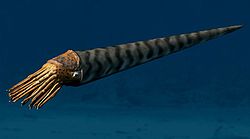 For most of the Late Ordovician, life continued to flourish, but at and near the end of the period there were mass-extinction events that seriously affected plankton
ic forms like conodont
s, graptolite
s, and some groups of trilobite
s (Agnostida
and Ptychopariida
, which completely died out, and the Asaphida
, which were much reduced). Brachiopod
s, bryozoa
ns and echinoderm
s were also heavily affected, and the endocerid cephalopod
s died out completely, except for possible rare Silurian
forms. The Ordovician–Silurian Extinction Events may have been caused by an ice age that occurred at the end of the Ordovician period as the end of the Late Ordovician was one of the coldest times in the last 600 million years of earth history.
Though less famous than the Cambrian explosion
, the Ordovician featured an adaptive radiation
, the Ordovician radiation
, that was no less remarkable; marine faunal genera
increased fourfold, resulting in 12% of all known Phanerozoic
marine fauna. Another change in the fauna was the strong increase in filter feeding organisms. The trilobite
, inarticulate brachiopod, archaeocyathid, and eocrinoid faunas of the Cambrian were succeeded by those that dominated the rest of the Paleozoic, such as articulate brachiopods, cephalopods, and crinoid
s. Articulate brachiopods, in particular, largely replaced trilobites in shelf
communities. Their success epitomizes the greatly increased diversity of carbonate
shell-secreting organisms in the Ordovician compared to the Cambrian.
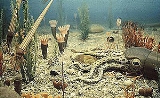
In North America and Europe, the Ordovician was a time of shallow continental seas rich in life. Trilobites and brachiopods in particular were rich and diverse. Although solitary coral
s date back to at least the Cambrian
, reef
-forming corals appeared in the early Ordovician, corresponding to an increase in the stability of carbonate and thus a new abundance of calcifying animals.
Molluscs, which appeared during the Cambrian or even the Ediacaran
, became common and varied, especially bivalves, gastropods, and nautiloid
cephalopods.
Now-extinct marine animals called graptolite
s thrived in the oceans. Some new cystoids and crinoid
s appeared.
It was long thought that the first true vertebrates (fish — Ostracoderm
s) appeared in the Ordovician, but recent discoveries in China
reveal that they probably originated in the Early Cambrian
. The very first gnathostome (jawed fish) appeared in the Late Ordovician epoch.
During the Middle Ordovician there was a large increase in the intensity and diversity of bioeroding organisms. This is known as the Ordovician Bioerosion
Revolution. It is marked by a sudden abundance of hard substrate trace fossils such as Trypanites
, Palaeosabella and Petroxestes
.
In the Early Ordovician, trilobite
s were joined by many new types of organisms, including tabulate corals, strophomenid
, rhynchonellid
, and many new orthid
brachiopod
s, bryozoa
ns, plankton
ic graptolite
s and conodont
s, and many types of molluscs and echinoderm
s, including the ophiuroids ("brittle stars") and the first sea star
s. Nevertheless the trilobites remained abundant, with all the Late Cambrian orders continuing, and being joined by the new group Phacopida
. The first evidence of land plants also appeared; see Evolutionary history of life
.
In the Middle Ordovician, the trilobite
-dominated Early Ordovician communities were replaced by generally more mixed ecosystems, in which brachiopod
s, bryozoa
ns, molluscs, cornulitids, tentaculitids and echinoderm
s all flourished, tabulate corals diversified and the first rugose corals
appeared; trilobites were no longer predominant. The plankton
ic graptolite
s remained diverse, with the Diplograptina making their appearance. Bioerosion
became an important process, particularly in the thick calcitic skeletons of corals, bryozoans and brachiopods, and on the extensive carbonate hardgrounds
that appear in abundance at this time. One of the earliest known armoured agnatha
n ("ostracoderm
") vertebrate, Arandaspis
, dates from the Middle Ordovician.
Trilobites in the Ordovician were very different than their predecessors in the Cambrian
. Many trilobites developed bizarre spines and nodules to defend against predators such as primitive shark
s and nautiloid
s while other trilobites such as Aeglina prisca evolved to become swimming forms. Some trilobites even developed shovel-like snouts for ploughing through muddy sea bottoms. Another unusual clade of trilobites known as the trinucleids developed a broad pitted margin around their head shields. Some trilobites such as Asaphus kowalewski evolved long eyestalks to assist in detecting predators whereas other trilobite eyes in contrast disappeared completely.
were common in the Late Cambrian
(perhaps earlier) and in the Ordovician. Terrestrial plants probably evolved from green algae, first appearing in the form of tiny non-vascular moss
es resembling liverwort
s. Fossil spores from land plants have been identified in uppermost Ordovician sediments. The green algae was similar to today's sea moss.
Among the first land fungi may have been arbuscular mycorrhiza
fungi (Glomerales
), playing a crucial role in facilitating the colonization of land by plants through mycorrhizal symbiosis, which makes mineral nutrients available to plant cells; such fossilized fungal hypha
e and spore
s from the Ordovician of Wisconsin have been found with an age of about 460 million years ago, a time when the land flora most likely only consisted of plants similar to non-vascular bryophyte
s.
s that, taken together, comprise the second largest of the five major extinction events in Earth's history
in terms of percentage of genera
that went extinct. The only larger one was the Permian-Triassic extinction event
.
The extinctions occurred approximately 447–444 million years ago and mark the boundary between the Ordovician and the following Silurian
Period. At that time all complex multicellular organisms lived in the sea, and about 49% of genera of fauna disappeared forever; brachiopods and bryozoans were greatly reduced, along with many trilobite
, conodont
and graptolite
families.
The most commonly accepted theory is that these events were triggered by the onset of most cold conditions in the late Katian, followed by an ice age
, in the Hirnantian faunal stage, that ended the long, stable greenhouse
conditions typical of the Ordovician.
The ice age was possibly not long-lasting, study of oxygen isotopes in fossil brachiopods showing that its duration could have been only 0.5 to 1.5 million years. Other researchers (Page et al.) estimate more temperate conditions did not return until the late Silurian.
The late Ordovician glaciation event was preceded by a fall in atmospheric carbon dioxide (from 7000 ppm to 4400 ppm), which selectively affected the shallow seas where most organisms lived. As the southern supercontinent Gondwana
drifted over the South Pole, ice caps formed on it, which have been detected in Upper Ordovician rock strata of North Africa
and then-adjacent northeastern South America, which were south-polar locations at the time.
Glaciation locks up water from the world-ocean, and the interglacials free it, causing sea levels repeatedly to drop and rise; the vast shallow intra-continental Ordovician seas withdrew, which eliminated many ecological niches, then returned carrying diminished founder populations lacking many whole families of organisms, then withdrew again with the next pulse of glaciation, eliminating biological diversity at each change. Species limited to a single epicontinental sea on a given landmass were severely affected. Tropical lifeforms were hit particularly hard in the first wave of extinction, while cool-water species were hit worst in the second pulse.
Surviving species were those that coped with the changed conditions and filled the ecological niches left by the extinctions.
At the end of the second event, melting glaciers caused the sea level to rise and stabilise once more. The rebound of life's diversity with the permanent re-flooding of continental shelves at the onset of the Silurian saw increased biodiversity within the surviving Orders.
Melott et al. (2006) suggested a ten-second gamma ray burst
could have destroyed the ozone layer
and exposed terrestrial and marine surface-dwelling life to deadly radiation
and initiated global cooling.
Paleozoic
The Paleozoic era is the earliest of three geologic eras of the Phanerozoic eon, spanning from roughly...
Era, and covers the time between 488.3±1.7 to 443.7±1.5 million years ago . It follows the Cambrian
Cambrian
The Cambrian is the first geological period of the Paleozoic Era, lasting from Mya ; it is succeeded by the Ordovician. Its subdivisions, and indeed its base, are somewhat in flux. The period was established by Adam Sedgwick, who named it after Cambria, the Latin name for Wales, where Britain's...
Period and is followed by the Silurian
Silurian
The Silurian is a geologic period and system that extends from the end of the Ordovician Period, about 443.7 ± 1.5 Mya , to the beginning of the Devonian Period, about 416.0 ± 2.8 Mya . As with other geologic periods, the rock beds that define the period's start and end are well identified, but the...
Period. The Ordovician, named after the Celtic tribe of the Ordovices
Ordovices
The Ordovices were one of the Celtic tribes living in Great Britain, before the Roman invasion of Britain. Its tribal lands were located in present day Wales and England between the Silures to the south and the Deceangli to the north-east...
, was defined by Charles Lapworth
Charles Lapworth
Charles Lapworth was an English geologist.-Biography:He was born at Faringdon in Berkshire and educated as a teacher at the Culham Diocesan Training College near Abingdon, Oxfordshire. He moved to the Scottish border region, where he investigated the previously little-known fossil fauna of the area...
in 1879 to resolve a dispute between followers of Adam Sedgwick
Adam Sedgwick
Adam Sedgwick was one of the founders of modern geology. He proposed the Devonian period of the geological timescale...
and Roderick Murchison
Roderick Murchison
Sir Roderick Impey Murchison, 1st Baronet KCB DCL FRS FRSE FLS PRGS PBA MRIA was a Scottish geologist who first described and investigated the Silurian system.-Early life and work:...
, who were placing the same rock
Rock (geology)
In geology, rock or stone is a naturally occurring solid aggregate of minerals and/or mineraloids.The Earth's outer solid layer, the lithosphere, is made of rock. In general rocks are of three types, namely, igneous, sedimentary, and metamorphic...
beds in northern Wales into the Cambrian
Cambrian
The Cambrian is the first geological period of the Paleozoic Era, lasting from Mya ; it is succeeded by the Ordovician. Its subdivisions, and indeed its base, are somewhat in flux. The period was established by Adam Sedgwick, who named it after Cambria, the Latin name for Wales, where Britain's...
and Silurian
Silurian
The Silurian is a geologic period and system that extends from the end of the Ordovician Period, about 443.7 ± 1.5 Mya , to the beginning of the Devonian Period, about 416.0 ± 2.8 Mya . As with other geologic periods, the rock beds that define the period's start and end are well identified, but the...
periods respectively. Lapworth, recognizing that the fossil
Fossil
Fossils are the preserved remains or traces of animals , plants, and other organisms from the remote past...
fauna in the disputed strata
Stratum
In geology and related fields, a stratum is a layer of sedimentary rock or soil with internally consistent characteristics that distinguish it from other layers...
were different from those of either the Cambrian or the Silurian periods, realized that they should be placed in a period of their own.
While recognition of the distinct Ordovician Period was slow in the United Kingdom
United Kingdom of Great Britain and Ireland
The United Kingdom of Great Britain and Ireland was the formal name of the United Kingdom during the period when what is now the Republic of Ireland formed a part of it....
, other areas of the world accepted it quickly. It received international sanction in 1960, when it was adopted as an official period of the Paleozoic Era by the International Geological Congress.
Life continued to flourish during the Ordovician as it did in the Cambrian
Cambrian
The Cambrian is the first geological period of the Paleozoic Era, lasting from Mya ; it is succeeded by the Ordovician. Its subdivisions, and indeed its base, are somewhat in flux. The period was established by Adam Sedgwick, who named it after Cambria, the Latin name for Wales, where Britain's...
, although the end of the period was marked by a significant mass extinction. Invertebrates, namely mollusks and arthropod
Arthropod
An arthropod is an invertebrate animal having an exoskeleton , a segmented body, and jointed appendages. Arthropods are members of the phylum Arthropoda , and include the insects, arachnids, crustaceans, and others...
s, dominated the oceans. Fish
Fish
Fish are a paraphyletic group of organisms that consist of all gill-bearing aquatic vertebrate animals that lack limbs with digits. Included in this definition are the living hagfish, lampreys, and cartilaginous and bony fish, as well as various extinct related groups...
, the world's first true vertebrate
Vertebrate
Vertebrates are animals that are members of the subphylum Vertebrata . Vertebrates are the largest group of chordates, with currently about 58,000 species described. Vertebrates include the jawless fishes, bony fishes, sharks and rays, amphibians, reptiles, mammals, and birds...
s, continued to evolve, and those with jaws
Gnathostomata
Gnathostomata is the group of vertebrates with jaws. The term derives from Greek γνάθος "jaw" + στόμα "mouth". Gnathostome diversity comprises roughly 60,000 species, which accounts for 99% of all living vertebrates...
may have first appeared late in the period. Life had yet to diversify on land.
Dating
The Ordovician Period started at a major extinction event called the Cambrian–Ordovician extinction events some time about 488.3 ± 1.7 Mya (million years ago), and lasted for about 44.6 million years. It ended with the Ordovician–Silurian extinction event, about 443.7 ± 1.5 Mya (ICS, 2004) that wiped out 60% of marine generaGenus
In biology, a genus is a low-level taxonomic rank used in the biological classification of living and fossil organisms, which is an example of definition by genus and differentia...
.
The dates given are recent radiometric dates and vary slightly from those used in other sources. This second period of the Paleozoic era created abundant fossil
Fossil
Fossils are the preserved remains or traces of animals , plants, and other organisms from the remote past...
s and in some regions, major petroleum
Petroleum
Petroleum or crude oil is a naturally occurring, flammable liquid consisting of a complex mixture of hydrocarbons of various molecular weights and other liquid organic compounds, that are found in geologic formations beneath the Earth's surface. Petroleum is recovered mostly through oil drilling...
and gas
Gas
Gas is one of the three classical states of matter . Near absolute zero, a substance exists as a solid. As heat is added to this substance it melts into a liquid at its melting point , boils into a gas at its boiling point, and if heated high enough would enter a plasma state in which the electrons...
reservoirs.
The boundary chosen for the beginning both of the Ordovician Period and the Tremadocian stage is highly useful. Since it correlates well with the occurrence of widespread graptolite
Graptolite
Graptolithina is a class in the animal phylum Hemichordata, the members of which are known as Graptolites. Graptolites are fossil colonial animals known chiefly from the Upper Cambrian through the Lower Carboniferous...
, conodont
Conodont
Conodonts are extinct chordates resembling eels, classified in the class Conodonta. For many years, they were known only from tooth-like microfossils now called conodont elements, found in isolation. Knowledge about soft tissues remains relatively sparse to this day...
, and trilobite
Trilobite
Trilobites are a well-known fossil group of extinct marine arthropods that form the class Trilobita. The first appearance of trilobites in the fossil record defines the base of the Atdabanian stage of the Early Cambrian period , and they flourished throughout the lower Paleozoic era before...
species, the base of the Tremadocian allows scientists not only to relate these species to each other, but to species that occur with them in other areas as well. This makes it easier to place many more species in time relative to the beginning of the Ordovician Period.
Subdivisions
A number of regional terms have been used to refer to subdivisions of the Ordovician Period. In 2008, the ICS erected a formal international system of subdivisions, illustrated to the right.The Ordovician Period in Britain was traditionally broken into Early (Tremadocian and Arenig
Arenig
In geology, the Arenigian refers both to a time interval during the Lower Ordovician period and also to the suite of rocks which were deposited during this interval.-History:...
), Middle (Llanvirn [subdivided into Abereiddian and Llandeilian] and Llandeilo) and Late (Caradoc
Caradoc Series
In geology, Caradoc Series is the name introduced by Roderick Murchison in 1839 for the sandstone series of Caer Caradoc in Shropshire, England. It is the fifth of the six subdivisions of the Ordovician System, comprising all those rocks deposited worldwide during the Caradocian Age .The limits of...
and Ashgill) epochs. The corresponding rocks of the Ordovician System are referred to as coming from the Lower, Middle, or Upper part of the column. The faunal stage
Faunal stage
In chronostratigraphy, a stage is a succession of rock strata laid down in a single age on the geologic timescale, which usually represents millions of years of deposition. A given stage of rock and the corresponding age of time will by convention have the same name, and the same boundaries.Rock...
s (subdivisions of epochs) from youngest to oldest are:
- HirnantianHirnantianThe Hirnantian is the seventh and final internationally-recognized stage of the Ordovician Period of the Paleozoic Era. It was of short duration, lasting about 1.9 million years, from 445.6 ± 1.5 to 443.7 ± 1.5 Ma . The early part of the Hirnantian was characterized by cold temperatures, major...
/Gamach (Late Ordovician: Ashgill) - Rawtheyan/Richmond (Late Ordovician: Ashgill)
- Cautleyan/Richmond (Late Ordovician: Ashgill)
- Pusgillian/Maysville/Richmond (Late Ordovician: Ashgill)
- Trenton (Middle Ordovician: Caradoc)
- Onnian/Maysville/Eden (Middle Ordovician: Caradoc)
- Actonian/Eden (Middle Ordovician: Caradoc)
- Marshbrookian/Sherman (Middle Ordovician: Caradoc)
- Longvillian/Sherman (Middle Ordovician: Caradoc)
- Soundleyan/Kirkfield (Middle Ordovician: Caradoc)
- Harnagian/Rockland (Middle Ordovician: Caradoc)
- Costonian/Black River (Middle Ordovician: Caradoc)
- Chazy (Middle Ordovician: Llandeilo)
- Llandeilo (Middle Ordovician: Llandeilo)
- Whiterock (Middle Ordovician: Llanvirn)
- Llanvirn (Middle Ordovician: Llanvirn)
- Cassinian (Early Ordovician: Arenig)
- Arenig/Jefferson/Castleman (Early Ordovician: Arenig)
- Tremadoc/Deming/Gaconadian (Early Ordovician: Tremadoc)
Paleogeography
Sea levels were high during the Ordovician; in fact during the Tremadocian, marine transgressionsTransgression (geology)
A marine transgression is a geologic event during which sea level rises relative to the land and the shoreline moves toward higher ground, resulting in flooding. Transgressions can be caused either by the land sinking or the ocean basins filling with water...
worldwide were the greatest for which evidence is preserved in the rocks.
During the Ordovician, the southern continents were collected into a single continent called Gondwana
Gondwana
In paleogeography, Gondwana , originally Gondwanaland, was the southernmost of two supercontinents that later became parts of the Pangaea supercontinent. It existed from approximately 510 to 180 million years ago . Gondwana is believed to have sutured between ca. 570 and 510 Mya,...
. Gondwana started the period in equator
Equator
An equator is the intersection of a sphere's surface with the plane perpendicular to the sphere's axis of rotation and containing the sphere's center of mass....
ial latitude
Latitude
In geography, the latitude of a location on the Earth is the angular distance of that location south or north of the Equator. The latitude is an angle, and is usually measured in degrees . The equator has a latitude of 0°, the North pole has a latitude of 90° north , and the South pole has a...
s and, as the period progressed, drifted toward the South Pole
South Pole
The South Pole, also known as the Geographic South Pole or Terrestrial South Pole, is one of the two points where the Earth's axis of rotation intersects its surface. It is the southernmost point on the surface of the Earth and lies on the opposite side of the Earth from the North Pole...
. Early in the Ordovician, the continents Laurentia
Laurentia
Laurentia is a large area of continental craton, which forms the ancient geological core of the North American continent...
(present-day North America
North America
North America is a continent wholly within the Northern Hemisphere and almost wholly within the Western Hemisphere. It is also considered a northern subcontinent of the Americas...
), Siberia
Siberia (continent)
Siberia is the craton located in the heart of the region of Siberia. Siberia or "Angaraland" is today the Central Siberian Plateau...
, and Baltica
Baltica
Baltica is a name applied by geologists to a late-Proterozoic, early-Palaeozoic continent that now includes the East European craton of northwestern Eurasia. Baltica was created as an entity not earlier than 1.8 billion years ago. Before this time, the three segments/continents that now comprise...
(present-day northern Europe) were still independent continents (since the break-up of the supercontinent
Supercontinent
In geology, a supercontinent is a landmass comprising more than one continental core, or craton. The assembly of cratons and accreted terranes that form Eurasia qualifies as a supercontinent today.-History:...
Pannotia
Pannotia
Pannotia, first described by Ian W. D. Dalziel in 1997, is a hypothetical supercontinent that existed from the Pan-African orogeny about six hundred million years ago to the end of the Precambrian about five hundred and fifty million years ago. It is also known as the Vendian supercontinent...
earlier), but Baltica began to move towards Laurentia later in the period, causing the Iapetus Ocean
Iapetus Ocean
The Iapetus Ocean was an ocean that existed in the Neoproterozoic and Paleozoic eras of the geologic timescale . The Iapetus Ocean was situated in the southern hemisphere, between the paleocontinents of Laurentia, Baltica and Avalonia...
to shrink between them. The small continent Avalonia
Avalonia
Avalonia was a microcontinent in the Paleozoic era. Crustal fragments of this former microcontinent underlie south-west Great Britain, and the eastern coast of North America. It is the source of many of the older rocks of Western Europe, Atlantic Canada, and parts of the coastal United States...
separated from Gondwana and began to head north towards Baltica and Laurentia. The Rheic Ocean
Rheic Ocean
The Rheic Ocean was a Paleozoic ocean between the large continent Gondwana to the south and the microcontinents Avalonia and others to the north...
between Gondwana and Avalonia was formed as a result.
A major mountain-building episode was the Taconic orogeny
Taconic orogeny
The Taconic orogeny was a mountain building period that ended 440 million years ago and affected most of modern-day New England. A great mountain chain formed from eastern Canada down through what is now the Piedmont of the East coast of the United States...
that was well under way in Cambrian times. In the beginning of the Late Ordovician, from 460 to 450 Ma, volcanoes along the margin of the Iapetus Ocean spewed massive amounts of carbon dioxide into the atmosphere, turning the planet into a hothouse. These volcanic island arcs
Volcanic arc
A volcanic arc is a chain of volcanoes positioned in an arc shape as seen from above. Offshore volcanoes form islands, resulting in a volcanic island arc. Generally they result from the subduction of an oceanic tectonic plate under another tectonic plate, and often parallel an oceanic trench...
eventually collided with proto North America to form the Appalachian mountains. By the end of the Late Ordovician these volcanic emissions had stopped. Gondwana had by that time neared or approached the pole and was largely glaciated
Glacier
A glacier is a large persistent body of ice that forms where the accumulation of snow exceeds its ablation over many years, often centuries. At least 0.1 km² in area and 50 m thick, but often much larger, a glacier slowly deforms and flows due to stresses induced by its weight...
.
Geochemistry
The Ordovician was a time of calcite seaCalcite sea
A calcite sea is one in which low-magnesium calcite is the primary inorganic marine calcium carbonate precipitate. An aragonite sea is the alternate seawater chemistry in which aragonite and high-magnesium calcite are the primary inorganic carbonate precipitates...
geochemistry in which low-magnesium calcite was the primary inorganic marine precipitate of calcium carbonate. Carbonate hardgrounds
Carbonate hardgrounds
Carbonate hardgrounds are surfaces of synsedimentarily cemented carbonate layers that have been exposed on the seafloor . A hardground is essentially, then, a lithified seafloor. Ancient hardgrounds are found in limestone sequences and distinguished from later-lithified sediments by evidence of...
were thus very common, along with calcitic ooids, calcitic cements, and invertebrate faunas with dominantly calcitic skeletons.
Unlike Cambrian times, when calcite production was dominated by microbial and non-biological processes, animals (and macroalgae) became a dominant source of calcareous material in Ordovician deposits.
Climate and sea level
The Ordovician saw the highest sea levels of the PaleozoicPaleozoic
The Paleozoic era is the earliest of three geologic eras of the Phanerozoic eon, spanning from roughly...
, and the low relief of the continents led to many shelf deposits being formed under hundreds of metres of water. Sea level rose more or less continuously throughout the Early Ordovician, levelling off somewhat during the middle of the period. Locally, some regressions occurred, but sea level rise continued in the beginning of the Late Ordovician. A change was soon on the cards, however, and sea levels fell steadily in accord with the cooling temperatures for the ~30 million years leading up to the Hirnantian glaciation. Within this icy stage, sea level seems to have risen and dropped somewhat, but despite much study the details remain unresolved.
At the beginning of the period, around 480 million years ago, the climate was very hot due to high levels of , which gave a strong greenhouse effect. The marine waters are assumed to have been around 45°C, which restricted the diversification of complex multi-cellular organisms. But over time, the climate become cooler, and around 460 million years ago, the ocean temperatures became comparable to those of present day equatorial waters.
As with North America and Europe
Europe
Europe is, by convention, one of the world's seven continents. Comprising the westernmost peninsula of Eurasia, Europe is generally 'divided' from Asia to its east by the watershed divides of the Ural and Caucasus Mountains, the Ural River, the Caspian and Black Seas, and the waterways connecting...
, Gondwana was largely covered with shallow seas during the Ordovician. Shallow clear waters over continental shelves encouraged the growth of organisms that deposit calcium carbonates in their shells and hard parts. The Panthalassic Ocean covered much of the northern hemisphere, and other minor oceans included Proto-Tethys, Paleo-Tethys, Khanty Ocean
Khanty Ocean
Khanty Ocean was an ancient, small ocean that existed near the end of the Precambrian time to the Silurian. It was between Baltica and the Siberian continent, with the bordering oceans of Panthalassa to the north, Proto-Tethys to the northeast, and Paleo-Tethys to the south and east...
, which was closed off by the Late Ordovician, Iapetus Ocean
Iapetus Ocean
The Iapetus Ocean was an ocean that existed in the Neoproterozoic and Paleozoic eras of the geologic timescale . The Iapetus Ocean was situated in the southern hemisphere, between the paleocontinents of Laurentia, Baltica and Avalonia...
, and the new Rheic Ocean
Rheic Ocean
The Rheic Ocean was a Paleozoic ocean between the large continent Gondwana to the south and the microcontinents Avalonia and others to the north...
.
As the Ordovician progressed, we see evidence of glacier
Glacier
A glacier is a large persistent body of ice that forms where the accumulation of snow exceeds its ablation over many years, often centuries. At least 0.1 km² in area and 50 m thick, but often much larger, a glacier slowly deforms and flows due to stresses induced by its weight...
s on the land we now know as Africa
Africa
Africa is the world's second largest and second most populous continent, after Asia. At about 30.2 million km² including adjacent islands, it covers 6% of the Earth's total surface area and 20.4% of the total land area...
and South America
South America
South America is a continent situated in the Western Hemisphere, mostly in the Southern Hemisphere, with a relatively small portion in the Northern Hemisphere. The continent is also considered a subcontinent of the Americas. It is bordered on the west by the Pacific Ocean and on the north and east...
. At the time these land masses were sitting at the South Pole
South Pole
The South Pole, also known as the Geographic South Pole or Terrestrial South Pole, is one of the two points where the Earth's axis of rotation intersects its surface. It is the southernmost point on the surface of the Earth and lies on the opposite side of the Earth from the North Pole...
, and covered by ice caps.
Life
Plankton
Plankton are any drifting organisms that inhabit the pelagic zone of oceans, seas, or bodies of fresh water. That is, plankton are defined by their ecological niche rather than phylogenetic or taxonomic classification...
ic forms like conodont
Conodont
Conodonts are extinct chordates resembling eels, classified in the class Conodonta. For many years, they were known only from tooth-like microfossils now called conodont elements, found in isolation. Knowledge about soft tissues remains relatively sparse to this day...
s, graptolite
Graptolite
Graptolithina is a class in the animal phylum Hemichordata, the members of which are known as Graptolites. Graptolites are fossil colonial animals known chiefly from the Upper Cambrian through the Lower Carboniferous...
s, and some groups of trilobite
Trilobite
Trilobites are a well-known fossil group of extinct marine arthropods that form the class Trilobita. The first appearance of trilobites in the fossil record defines the base of the Atdabanian stage of the Early Cambrian period , and they flourished throughout the lower Paleozoic era before...
s (Agnostida
Agnostida
Agnostida is an order of arthropod which first developed near the end of the Early Cambrian period and thrived during the Middle Cambrian. They are present in the lower Cambrian fossil record along with trilobites from the Redlichiida, Corynexochida, and Ptychopariida orders...
and Ptychopariida
Ptychopariida
Ptychopariida is a large, heterogeneous order of trilobite containing some of the most primitive species known. Many date to the Early Cambrian Period, but the order was extant through the Late Ordovician...
, which completely died out, and the Asaphida
Asaphida
Asaphida is a large, morphologically diverse order of trilobite found in strata dated from the Middle Cambrian to the Silurian. The order contains six superfamilies , but no suborders...
, which were much reduced). Brachiopod
Brachiopod
Brachiopods are a phylum of marine animals that have hard "valves" on the upper and lower surfaces, unlike the left and right arrangement in bivalve molluscs. Brachiopod valves are hinged at the rear end, while the front can be opened for feeding or closed for protection...
s, bryozoa
Bryozoa
The Bryozoa, also known as Ectoprocta or commonly as moss animals, are a phylum of aquatic invertebrate animals. Typically about long, they are filter feeders that sieve food particles out of the water using a retractable lophophore, a "crown" of tentacles lined with cilia...
ns and echinoderm
Echinoderm
Echinoderms are a phylum of marine animals. Echinoderms are found at every ocean depth, from the intertidal zone to the abyssal zone....
s were also heavily affected, and the endocerid cephalopod
Cephalopod
A cephalopod is any member of the molluscan class Cephalopoda . These exclusively marine animals are characterized by bilateral body symmetry, a prominent head, and a set of arms or tentacles modified from the primitive molluscan foot...
s died out completely, except for possible rare Silurian
Silurian
The Silurian is a geologic period and system that extends from the end of the Ordovician Period, about 443.7 ± 1.5 Mya , to the beginning of the Devonian Period, about 416.0 ± 2.8 Mya . As with other geologic periods, the rock beds that define the period's start and end are well identified, but the...
forms. The Ordovician–Silurian Extinction Events may have been caused by an ice age that occurred at the end of the Ordovician period as the end of the Late Ordovician was one of the coldest times in the last 600 million years of earth history.
Fauna
On the whole, the fauna that emerged in the Ordovician set the template for the remainder of the Palaeozoic. The fauna was dominated by tiered communities of suspension feeders, mainly with short food chains; this said, the ecological system reached a new grade of complexity far beyond that of the Cambrian fauna, which has persisted until the present day.Though less famous than the Cambrian explosion
Cambrian explosion
The Cambrian explosion or Cambrian radiation was the relatively rapid appearance, around , of most major phyla, as demonstrated in the fossil record, accompanied by major diversification of other organisms, including animals, phytoplankton, and calcimicrobes...
, the Ordovician featured an adaptive radiation
Adaptive radiation
In evolutionary biology, adaptive radiation is the evolution of ecological and phenotypic diversity within a rapidly multiplying lineage. Starting with a recent single ancestor, this process results in the speciation and phenotypic adaptation of an array of species exhibiting different...
, the Ordovician radiation
Ordovician radiation
The Great Ordovician Biodiversification Event was a diversification of animal life throughout the Ordovician period, just 40 million years after the Cambrian explosion, whereby the distinctive Cambrian fauna fizzled out to be replaced with a Palaeozoic fauna rich in suspension feeder and pelagic...
, that was no less remarkable; marine faunal genera
Genus
In biology, a genus is a low-level taxonomic rank used in the biological classification of living and fossil organisms, which is an example of definition by genus and differentia...
increased fourfold, resulting in 12% of all known Phanerozoic
Phanerozoic
The Phanerozoic Eon is the current eon in the geologic timescale, and the one during which abundant animal life has existed. It covers roughly 542 million years and goes back to the time when diverse hard-shelled animals first appeared...
marine fauna. Another change in the fauna was the strong increase in filter feeding organisms. The trilobite
Trilobite
Trilobites are a well-known fossil group of extinct marine arthropods that form the class Trilobita. The first appearance of trilobites in the fossil record defines the base of the Atdabanian stage of the Early Cambrian period , and they flourished throughout the lower Paleozoic era before...
, inarticulate brachiopod, archaeocyathid, and eocrinoid faunas of the Cambrian were succeeded by those that dominated the rest of the Paleozoic, such as articulate brachiopods, cephalopods, and crinoid
Crinoid
Crinoids are marine animals that make up the class Crinoidea of the echinoderms . Crinoidea comes from the Greek word krinon, "a lily", and eidos, "form". They live both in shallow water and in depths as great as 6,000 meters. Sea lilies refer to the crinoids which, in their adult form, are...
s. Articulate brachiopods, in particular, largely replaced trilobites in shelf
Continental shelf
The continental shelf is the extended perimeter of each continent and associated coastal plain. Much of the shelf was exposed during glacial periods, but is now submerged under relatively shallow seas and gulfs, and was similarly submerged during other interglacial periods. The continental margin,...
communities. Their success epitomizes the greatly increased diversity of carbonate
Calcium carbonate
Calcium carbonate is a chemical compound with the formula CaCO3. It is a common substance found in rocks in all parts of the world, and is the main component of shells of marine organisms, snails, coal balls, pearls, and eggshells. Calcium carbonate is the active ingredient in agricultural lime,...
shell-secreting organisms in the Ordovician compared to the Cambrian.
In North America and Europe, the Ordovician was a time of shallow continental seas rich in life. Trilobites and brachiopods in particular were rich and diverse. Although solitary coral
Coral
Corals are marine animals in class Anthozoa of phylum Cnidaria typically living in compact colonies of many identical individual "polyps". The group includes the important reef builders that inhabit tropical oceans and secrete calcium carbonate to form a hard skeleton.A coral "head" is a colony of...
s date back to at least the Cambrian
Cambrian
The Cambrian is the first geological period of the Paleozoic Era, lasting from Mya ; it is succeeded by the Ordovician. Its subdivisions, and indeed its base, are somewhat in flux. The period was established by Adam Sedgwick, who named it after Cambria, the Latin name for Wales, where Britain's...
, reef
Coral reef
Coral reefs are underwater structures made from calcium carbonate secreted by corals. Coral reefs are colonies of tiny living animals found in marine waters that contain few nutrients. Most coral reefs are built from stony corals, which in turn consist of polyps that cluster in groups. The polyps...
-forming corals appeared in the early Ordovician, corresponding to an increase in the stability of carbonate and thus a new abundance of calcifying animals.
Molluscs, which appeared during the Cambrian or even the Ediacaran
Ediacaran
The Ediacaran Period , named after the Ediacara Hills of South Australia, is the last geological period of the Neoproterozoic Era and of the Proterozoic Eon, immediately preceding the Cambrian Period, the first period of the Paleozoic Era and of the Phanerozoic Eon...
, became common and varied, especially bivalves, gastropods, and nautiloid
Nautiloid
Nautiloids are a large and diverse group of marine cephalopods belonging to the subclass Nautiloidea that began in the Late Cambrian and are represented today by the living Nautilus. Nautiloids flourished during the early Paleozoic era, where they constituted the main predatory animals, and...
cephalopods.
Now-extinct marine animals called graptolite
Graptolite
Graptolithina is a class in the animal phylum Hemichordata, the members of which are known as Graptolites. Graptolites are fossil colonial animals known chiefly from the Upper Cambrian through the Lower Carboniferous...
s thrived in the oceans. Some new cystoids and crinoid
Crinoid
Crinoids are marine animals that make up the class Crinoidea of the echinoderms . Crinoidea comes from the Greek word krinon, "a lily", and eidos, "form". They live both in shallow water and in depths as great as 6,000 meters. Sea lilies refer to the crinoids which, in their adult form, are...
s appeared.
It was long thought that the first true vertebrates (fish — Ostracoderm
Ostracoderm
Ostracoderms are any of several groups of extinct, primitive, jawless fishes that were covered in an armor of bony plates. They belong to the taxon Ostracodermi, and their fossils are found in the Ordovician and Devonian Period strata of North America and Europe...
s) appeared in the Ordovician, but recent discoveries in China
China
Chinese civilization may refer to:* China for more general discussion of the country.* Chinese culture* Greater China, the transnational community of ethnic Chinese.* History of China* Sinosphere, the area historically affected by Chinese culture...
reveal that they probably originated in the Early Cambrian
Cambrian
The Cambrian is the first geological period of the Paleozoic Era, lasting from Mya ; it is succeeded by the Ordovician. Its subdivisions, and indeed its base, are somewhat in flux. The period was established by Adam Sedgwick, who named it after Cambria, the Latin name for Wales, where Britain's...
. The very first gnathostome (jawed fish) appeared in the Late Ordovician epoch.
During the Middle Ordovician there was a large increase in the intensity and diversity of bioeroding organisms. This is known as the Ordovician Bioerosion
Bioerosion
Bioerosion describes the erosion of hard ocean substrates – and less often terrestrial substrates – by living organisms. Marine bioerosion can be caused by mollusks, polychaete worms, phoronids, sponges, crustaceans, echinoids, and fish; it can occur on coastlines, on coral reefs, and...
Revolution. It is marked by a sudden abundance of hard substrate trace fossils such as Trypanites
Trypanites
Trypanites is a narrow, cylindrical, unbranched boring which is one of the most common trace fossils in hard substrates such as rocks, carbonate hardgrounds and shells . It appears first in the Lower Cambrian , was very prominent in the Ordovician Bioerosion Revolution , and is still commonly...
, Palaeosabella and Petroxestes
Petroxestes
Petroxestes is a shallow, elongate boring originally found excavated in carbonate skeletons and hardgrounds of the Upper Ordovician of North America...
.
In the Early Ordovician, trilobite
Trilobite
Trilobites are a well-known fossil group of extinct marine arthropods that form the class Trilobita. The first appearance of trilobites in the fossil record defines the base of the Atdabanian stage of the Early Cambrian period , and they flourished throughout the lower Paleozoic era before...
s were joined by many new types of organisms, including tabulate corals, strophomenid
Strophomenida
Strophomenida is a large, extinct order of articulate brachiopods that existed from the lower Ordovician to the lower Jurassic period. It was the largest known order of brachiopods, encompassing over 400 genera, including the largest and heaviest of known brachiopod shells...
, rhynchonellid
Rhynchonellida
The taxonomic order Rhynchonellida is one of the two main groups of living articulate brachiopods, the other being the order Terebratulida. They are recognized by their strongly ribbed wedge-shaped or nut-like shells, and the very short hinge line....
, and many new orthid
Orthida
Orthida is an extinct order of Brachiopods which appeared during the Early Cambrian period and became very diverse by the Ordovician, living in shallow-shelf seas. Orthids are the oldest member of the subphylum Rhynchonelliformea , and is the order from which all other brachiopods of this group...
brachiopod
Brachiopod
Brachiopods are a phylum of marine animals that have hard "valves" on the upper and lower surfaces, unlike the left and right arrangement in bivalve molluscs. Brachiopod valves are hinged at the rear end, while the front can be opened for feeding or closed for protection...
s, bryozoa
Bryozoa
The Bryozoa, also known as Ectoprocta or commonly as moss animals, are a phylum of aquatic invertebrate animals. Typically about long, they are filter feeders that sieve food particles out of the water using a retractable lophophore, a "crown" of tentacles lined with cilia...
ns, plankton
Plankton
Plankton are any drifting organisms that inhabit the pelagic zone of oceans, seas, or bodies of fresh water. That is, plankton are defined by their ecological niche rather than phylogenetic or taxonomic classification...
ic graptolite
Graptolite
Graptolithina is a class in the animal phylum Hemichordata, the members of which are known as Graptolites. Graptolites are fossil colonial animals known chiefly from the Upper Cambrian through the Lower Carboniferous...
s and conodont
Conodont
Conodonts are extinct chordates resembling eels, classified in the class Conodonta. For many years, they were known only from tooth-like microfossils now called conodont elements, found in isolation. Knowledge about soft tissues remains relatively sparse to this day...
s, and many types of molluscs and echinoderm
Echinoderm
Echinoderms are a phylum of marine animals. Echinoderms are found at every ocean depth, from the intertidal zone to the abyssal zone....
s, including the ophiuroids ("brittle stars") and the first sea star
Sea star
Starfish or sea stars are echinoderms belonging to the class Asteroidea. The names "starfish" and "sea star" essentially refer to members of the class Asteroidea...
s. Nevertheless the trilobites remained abundant, with all the Late Cambrian orders continuing, and being joined by the new group Phacopida
Phacopida
Phacopida is an order of trilobite that lived from the Ordovician to the Devonian. It is made up of a morphologically diverse group of related suborders....
. The first evidence of land plants also appeared; see Evolutionary history of life
Evolutionary history of life
The evolutionary history of life on Earth traces the processes by which living and fossil organisms have evolved since life on Earth first originated until the present day. Earth formed about 4.5 Ga and life appeared on its surface within one billion years...
.
In the Middle Ordovician, the trilobite
Trilobite
Trilobites are a well-known fossil group of extinct marine arthropods that form the class Trilobita. The first appearance of trilobites in the fossil record defines the base of the Atdabanian stage of the Early Cambrian period , and they flourished throughout the lower Paleozoic era before...
-dominated Early Ordovician communities were replaced by generally more mixed ecosystems, in which brachiopod
Brachiopod
Brachiopods are a phylum of marine animals that have hard "valves" on the upper and lower surfaces, unlike the left and right arrangement in bivalve molluscs. Brachiopod valves are hinged at the rear end, while the front can be opened for feeding or closed for protection...
s, bryozoa
Bryozoa
The Bryozoa, also known as Ectoprocta or commonly as moss animals, are a phylum of aquatic invertebrate animals. Typically about long, they are filter feeders that sieve food particles out of the water using a retractable lophophore, a "crown" of tentacles lined with cilia...
ns, molluscs, cornulitids, tentaculitids and echinoderm
Echinoderm
Echinoderms are a phylum of marine animals. Echinoderms are found at every ocean depth, from the intertidal zone to the abyssal zone....
s all flourished, tabulate corals diversified and the first rugose corals
Rugosa
Disambiguation:The Rugosa Rose is also sometimes just called "Rugosa". For the moon in Star Wars: The Clone Wars, see .The Rugosa, also called the Tetracoralla, are an extinct order of coral that were abundant in Middle Ordovician to Late Permian seas.Solitary rugosans are often referred to...
appeared; trilobites were no longer predominant. The plankton
Plankton
Plankton are any drifting organisms that inhabit the pelagic zone of oceans, seas, or bodies of fresh water. That is, plankton are defined by their ecological niche rather than phylogenetic or taxonomic classification...
ic graptolite
Graptolite
Graptolithina is a class in the animal phylum Hemichordata, the members of which are known as Graptolites. Graptolites are fossil colonial animals known chiefly from the Upper Cambrian through the Lower Carboniferous...
s remained diverse, with the Diplograptina making their appearance. Bioerosion
Bioerosion
Bioerosion describes the erosion of hard ocean substrates – and less often terrestrial substrates – by living organisms. Marine bioerosion can be caused by mollusks, polychaete worms, phoronids, sponges, crustaceans, echinoids, and fish; it can occur on coastlines, on coral reefs, and...
became an important process, particularly in the thick calcitic skeletons of corals, bryozoans and brachiopods, and on the extensive carbonate hardgrounds
Carbonate hardgrounds
Carbonate hardgrounds are surfaces of synsedimentarily cemented carbonate layers that have been exposed on the seafloor . A hardground is essentially, then, a lithified seafloor. Ancient hardgrounds are found in limestone sequences and distinguished from later-lithified sediments by evidence of...
that appear in abundance at this time. One of the earliest known armoured agnatha
Agnatha
Agnatha is a superclass of jawless fish in the phylum Chordata, subphylum Vertebrata. The group excludes all vertebrates with jaws, known as gnathostomes....
n ("ostracoderm
Ostracoderm
Ostracoderms are any of several groups of extinct, primitive, jawless fishes that were covered in an armor of bony plates. They belong to the taxon Ostracodermi, and their fossils are found in the Ordovician and Devonian Period strata of North America and Europe...
") vertebrate, Arandaspis
Arandaspis
Arandaspis prionotolepis is an extinct species of jawless fish that lived in the Ordovician period, about 480 to 470 million years ago. It is the oldest known vertebrate....
, dates from the Middle Ordovician.
Trilobites in the Ordovician were very different than their predecessors in the Cambrian
Cambrian
The Cambrian is the first geological period of the Paleozoic Era, lasting from Mya ; it is succeeded by the Ordovician. Its subdivisions, and indeed its base, are somewhat in flux. The period was established by Adam Sedgwick, who named it after Cambria, the Latin name for Wales, where Britain's...
. Many trilobites developed bizarre spines and nodules to defend against predators such as primitive shark
Shark
Sharks are a type of fish with a full cartilaginous skeleton and a highly streamlined body. The earliest known sharks date from more than 420 million years ago....
s and nautiloid
Nautiloid
Nautiloids are a large and diverse group of marine cephalopods belonging to the subclass Nautiloidea that began in the Late Cambrian and are represented today by the living Nautilus. Nautiloids flourished during the early Paleozoic era, where they constituted the main predatory animals, and...
s while other trilobites such as Aeglina prisca evolved to become swimming forms. Some trilobites even developed shovel-like snouts for ploughing through muddy sea bottoms. Another unusual clade of trilobites known as the trinucleids developed a broad pitted margin around their head shields. Some trilobites such as Asaphus kowalewski evolved long eyestalks to assist in detecting predators whereas other trilobite eyes in contrast disappeared completely.
Flora
Green algaeGreen algae
The green algae are the large group of algae from which the embryophytes emerged. As such, they form a paraphyletic group, although the group including both green algae and embryophytes is monophyletic...
were common in the Late Cambrian
Cambrian
The Cambrian is the first geological period of the Paleozoic Era, lasting from Mya ; it is succeeded by the Ordovician. Its subdivisions, and indeed its base, are somewhat in flux. The period was established by Adam Sedgwick, who named it after Cambria, the Latin name for Wales, where Britain's...
(perhaps earlier) and in the Ordovician. Terrestrial plants probably evolved from green algae, first appearing in the form of tiny non-vascular moss
Moss
Mosses are small, soft plants that are typically 1–10 cm tall, though some species are much larger. They commonly grow close together in clumps or mats in damp or shady locations. They do not have flowers or seeds, and their simple leaves cover the thin wiry stems...
es resembling liverwort
Marchantiophyta
The Marchantiophyta are a division of bryophyte plants commonly referred to as hepatics or liverworts. Like other bryophytes, they have a gametophyte-dominant life cycle, in which cells of the plant carry only a single set of genetic information....
s. Fossil spores from land plants have been identified in uppermost Ordovician sediments. The green algae was similar to today's sea moss.
Among the first land fungi may have been arbuscular mycorrhiza
Arbuscular mycorrhiza
An arbuscular mycorrhiza is a type of mycorrhiza in which the fungus penetrates the cortical cells of the roots of a vascular plant....
fungi (Glomerales
Glomerales
Glomerales is an order of symbiotic fungi within the phylum Glomeromycota.- Biology :These Fungi are all biotrophic mutualists. Most employ the arbuscular mycorrhizal method of nutrient exchange with plants...
), playing a crucial role in facilitating the colonization of land by plants through mycorrhizal symbiosis, which makes mineral nutrients available to plant cells; such fossilized fungal hypha
Hypha
A hypha is a long, branching filamentous structure of a fungus, and also of unrelated Actinobacteria. In most fungi, hyphae are the main mode of vegetative growth, and are collectively called a mycelium; yeasts are unicellular fungi that do not grow as hyphae.-Structure:A hypha consists of one or...
e and spore
Spore
In biology, a spore is a reproductive structure that is adapted for dispersal and surviving for extended periods of time in unfavorable conditions. Spores form part of the life cycles of many bacteria, plants, algae, fungi and some protozoa. According to scientist Dr...
s from the Ordovician of Wisconsin have been found with an age of about 460 million years ago, a time when the land flora most likely only consisted of plants similar to non-vascular bryophyte
Bryophyte
Bryophyte is a traditional name used to refer to all embryophytes that do not have true vascular tissue and are therefore called 'non-vascular plants'. Some bryophytes do have specialized tissues for the transport of water; however since these do not contain lignin, they are not considered to be...
s.
End of the period
The Ordovician came to a close in a series of extinction eventExtinction event
An extinction event is a sharp decrease in the diversity and abundance of macroscopic life. They occur when the rate of extinction increases with respect to the rate of speciation...
s that, taken together, comprise the second largest of the five major extinction events in Earth's history
History of Earth
The history of the Earth describes the most important events and fundamental stages in the development of the planet Earth from its formation 4.578 billion years ago to the present day. Nearly all branches of natural science have contributed to the understanding of the main events of the Earth's...
in terms of percentage of genera
Genus
In biology, a genus is a low-level taxonomic rank used in the biological classification of living and fossil organisms, which is an example of definition by genus and differentia...
that went extinct. The only larger one was the Permian-Triassic extinction event
Permian-Triassic extinction event
The Permian–Triassic extinction event, informally known as the Great Dying, was an extinction event that occurred 252.28 Ma ago, forming the boundary between the Permian and Triassic geologic periods, as well as the Paleozoic and Mesozoic eras...
.
The extinctions occurred approximately 447–444 million years ago and mark the boundary between the Ordovician and the following Silurian
Silurian
The Silurian is a geologic period and system that extends from the end of the Ordovician Period, about 443.7 ± 1.5 Mya , to the beginning of the Devonian Period, about 416.0 ± 2.8 Mya . As with other geologic periods, the rock beds that define the period's start and end are well identified, but the...
Period. At that time all complex multicellular organisms lived in the sea, and about 49% of genera of fauna disappeared forever; brachiopods and bryozoans were greatly reduced, along with many trilobite
Trilobite
Trilobites are a well-known fossil group of extinct marine arthropods that form the class Trilobita. The first appearance of trilobites in the fossil record defines the base of the Atdabanian stage of the Early Cambrian period , and they flourished throughout the lower Paleozoic era before...
, conodont
Conodont
Conodonts are extinct chordates resembling eels, classified in the class Conodonta. For many years, they were known only from tooth-like microfossils now called conodont elements, found in isolation. Knowledge about soft tissues remains relatively sparse to this day...
and graptolite
Graptolite
Graptolithina is a class in the animal phylum Hemichordata, the members of which are known as Graptolites. Graptolites are fossil colonial animals known chiefly from the Upper Cambrian through the Lower Carboniferous...
families.
The most commonly accepted theory is that these events were triggered by the onset of most cold conditions in the late Katian, followed by an ice age
Ice age
An ice age or, more precisely, glacial age, is a generic geological period of long-term reduction in the temperature of the Earth's surface and atmosphere, resulting in the presence or expansion of continental ice sheets, polar ice sheets and alpine glaciers...
, in the Hirnantian faunal stage, that ended the long, stable greenhouse
Greenhouse
A greenhouse is a building in which plants are grown. These structures range in size from small sheds to very large buildings...
conditions typical of the Ordovician.
The ice age was possibly not long-lasting, study of oxygen isotopes in fossil brachiopods showing that its duration could have been only 0.5 to 1.5 million years. Other researchers (Page et al.) estimate more temperate conditions did not return until the late Silurian.
The late Ordovician glaciation event was preceded by a fall in atmospheric carbon dioxide (from 7000 ppm to 4400 ppm), which selectively affected the shallow seas where most organisms lived. As the southern supercontinent Gondwana
Gondwana
In paleogeography, Gondwana , originally Gondwanaland, was the southernmost of two supercontinents that later became parts of the Pangaea supercontinent. It existed from approximately 510 to 180 million years ago . Gondwana is believed to have sutured between ca. 570 and 510 Mya,...
drifted over the South Pole, ice caps formed on it, which have been detected in Upper Ordovician rock strata of North Africa
North Africa
North Africa or Northern Africa is the northernmost region of the African continent, linked by the Sahara to Sub-Saharan Africa. Geopolitically, the United Nations definition of Northern Africa includes eight countries or territories; Algeria, Egypt, Libya, Morocco, South Sudan, Sudan, Tunisia, and...
and then-adjacent northeastern South America, which were south-polar locations at the time.
Glaciation locks up water from the world-ocean, and the interglacials free it, causing sea levels repeatedly to drop and rise; the vast shallow intra-continental Ordovician seas withdrew, which eliminated many ecological niches, then returned carrying diminished founder populations lacking many whole families of organisms, then withdrew again with the next pulse of glaciation, eliminating biological diversity at each change. Species limited to a single epicontinental sea on a given landmass were severely affected. Tropical lifeforms were hit particularly hard in the first wave of extinction, while cool-water species were hit worst in the second pulse.
Surviving species were those that coped with the changed conditions and filled the ecological niches left by the extinctions.
At the end of the second event, melting glaciers caused the sea level to rise and stabilise once more. The rebound of life's diversity with the permanent re-flooding of continental shelves at the onset of the Silurian saw increased biodiversity within the surviving Orders.
Melott et al. (2006) suggested a ten-second gamma ray burst
Gamma ray burst
Gamma-ray bursts are flashes of gamma rays associated with extremely energetic explosions that have been observed in distant galaxies. They are the most luminous electromagnetic events known to occur in the universe. Bursts can last from ten milliseconds to several minutes, although a typical...
could have destroyed the ozone layer
Ozone layer
The ozone layer is a layer in Earth's atmosphere which contains relatively high concentrations of ozone . This layer absorbs 97–99% of the Sun's high frequency ultraviolet light, which is potentially damaging to the life forms on Earth...
and exposed terrestrial and marine surface-dwelling life to deadly radiation
Radiation
In physics, radiation is a process in which energetic particles or energetic waves travel through a medium or space. There are two distinct types of radiation; ionizing and non-ionizing...
and initiated global cooling.