

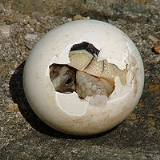
Amniote

Encyclopedia
The amniotes are a group of tetrapod
s (four-limbed animals with backbones or spinal columns) that have a terrestrially adapted egg
. They include synapsids (mammals along with their extinct kin) and sauropsids
(reptiles and bird
s), as well as their fossil ancestors. Amniote embryos, whether laid as eggs or carried
by the female, are protected and aided by several extensive membranes. In eutheria
n mammals (such as humans), these membranes include the amniotic sac
that surrounds the fetus
. These embryonic membranes, and the lack of a larval stage, distinguish amniotes from tetrapod amphibian
s.
The first amniotes (referred to as "basal amniotes"), such as Casineria
, resembled small lizards and had evolved from the amphibian reptiliomorphs
about 340 million years ago, in the Carboniferous
geologic period. Their eggs could survive out of the water, allowing amniotes to branch out into drier environments. The eggs could also "breathe" and cope with waste, allowing the eggs and the amniotes themselves to evolve into larger forms. The amniotes spread across the globe and became the dominant land vertebrates.
Very early in the evolutionary history of amniotes, basal amniotes evolved into two main lines
of amniotes, the synapsid
s and the sauropsid
s, both of which persist into the modern era. The oldest known fossil synapsid is Protoclepsydrops
from about 320 million years ago, while the oldest known sauropsid is probably Paleothyris
, in the order Captorhinida
, from the Middle Pennsylvanian epoch (ca. 306-312 million years ago).
that includes the formation of several extensive membranes, the amnion
, chorion
, and allantois
. Amniotes develop directly into a (typically) terrestrial form with limbs
and a thick stratified epithelium
, rather than first entering a feeding larval tadpole
stage followed by metamorphosis as in amphibian
s. In amniotes the transition from a two-layered periderm to cornified epithelium is triggered by thyroid hormone
during embryonic development, rather than metamorphosis. The unique embryonic features of amniotes may reflect specializations of eggs to survive drier environments, or the massive size and yolk content of eggs evolved for direct development to a larger size.
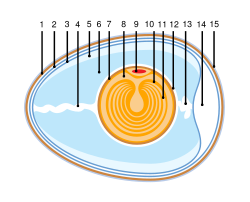
and an allantois
evolved to facilitate respiration
while providing a reservoir for disposal of wastes. Their kidney
s and large intestine
s are also well-suited to water retention. Most mammals do not lay eggs, but corresponding structures may be found inside the placenta
.
The first amniotes, such as Casineria kiddi
, which lived about 340 million years ago, evolved from amphibian
reptiliomorphs
and resembled small lizards. Their eggs were small and covered with a leathery membrane, not a hard shell like those of birds or crocodiles. Although some modern amphibians lay eggs on land, with or without significant protection, they all lack advanced traits like an amnion. This kind of egg only became possible with internal fertilization
. The outer membrane, a soft shell, evolved as a protection against the harsher environments on land, as species evolved to lay their eggs on land where they were safer than in the water. One can assume the ancestors of the amniotes laid their eggs in moist places, as such modest-sized animals would not have difficulty finding depressions under fallen logs or other suitable places in the ancient forests, and dry conditions were probably not the main reason why the soft shell emerged. Indeed, many modern day amniotes are dependent on moisture to stop their eggs from dessicating.
alone was not enough. After the egg developed these structures, further sophistication allowed amniotes to lay much bigger eggs in much drier habitats. Bigger eggs allowed for bigger offspring, and bigger adults could produce bigger eggs, so amniotes grew bigger than their ancestors. Real growth was not possible, however, until they stopped relying on small invertebrate
s as their main food source and started to eat plants or other vertebrates, or returned to the water. New habits and heavier bodies meant further evolution for the amniotes, both in behavior and anatomy.
at the back margin of the skull roof
. In their ancestors, this notch held a spiracle
, an unnecessary structure in an animal without an aquatic larval stage. There are three main lines of amniotes, which may be distinguished by the structure of the skull
and in particular the number of temporal fenestrae (openings) behind each eye. In anapsid
s (turtles) there are none, in synapsid
s (mammals and their extinct relatives) there is one, and in most diapsid
s (non-anapsid reptiles, including dinosaurs and birds) there are two.
Post cranial remains of amniotes can be identified from their Labyrinthodont
ancestors by their having at least two pairs of sacral
rib
s, a sternum
in the pectoral girdle (some amniotes have lost it) and an astragalus
bone in the ankle
.
in 1866 on the presence of the amnion
, hence the name. A problem with this definition is that the trait (apomorphy
) in question does not fossil
ize, and the status of fossil forms has to be inferred from other traits. Thus Jacques Gauthier
and colleagues forwarded a definition of Amniota in 1988 as "the most recent common ancestor of extant mammals and reptiles, and all its descendants".
Gauthiers definition being a node-based crown group
, his definition of the group has a slightly different content than the group defined as biological amniotes (apomorphy-based clade).
based on major traits and physiology
:
This rather orderly scheme is the one most commonly found in popular and basic scientific works. It has come under critique from cladistics
, as the class Reptilia is paraphyletic
, that is, it has given rise to two other classes not included in Reptilia.
The cladogram covers the group as defined under Gauthier's definition.
Tetrapod
Tetrapods are vertebrate animals having four limbs. Amphibians, reptiles, birds and mammals are all tetrapods; even snakes and other limbless reptiles and amphibians are tetrapods by descent. The earliest tetrapods evolved from the lobe-finned fishes in the Devonian...
s (four-limbed animals with backbones or spinal columns) that have a terrestrially adapted egg
Egg (biology)
An egg is an organic vessel in which an embryo first begins to develop. In most birds, reptiles, insects, molluscs, fish, and monotremes, an egg is the zygote, resulting from fertilization of the ovum, which is expelled from the body and permitted to develop outside the body until the developing...
. They include synapsids (mammals along with their extinct kin) and sauropsids
Sauropsida
Sauropsida is a group of amniotes that includes all existing reptiles and birds and their fossil ancestors, including the dinosaurs, the immediate ancestors of birds...
(reptiles and bird
Bird
Birds are feathered, winged, bipedal, endothermic , egg-laying, vertebrate animals. Around 10,000 living species and 188 families makes them the most speciose class of tetrapod vertebrates. They inhabit ecosystems across the globe, from the Arctic to the Antarctic. Extant birds range in size from...
s), as well as their fossil ancestors. Amniote embryos, whether laid as eggs or carried
Ovoviviparity
Ovoviviparity, ovovivipary, or ovivipary, is a mode of reproduction in animals in which embryos develop inside eggs that are retained within the mother's body until they are ready to hatch...
by the female, are protected and aided by several extensive membranes. In eutheria
Eutheria
Eutheria is a group of mammals consisting of placental mammals plus all extinct mammals that are more closely related to living placentals than to living marsupials . They are distinguished from noneutherians by various features of the feet, ankles, jaws and teeth...
n mammals (such as humans), these membranes include the amniotic sac
Amniotic sac
The amniotic sac is the sac in which the fetus develops in amniotes. It is a tough but thin transparent pair of membranes, which hold a developing embryo until shortly before birth. The inner membrane, the amnion, contains the amniotic fluid and the fetus. The outer membrane, the Chorion,...
that surrounds the fetus
Fetus (biology)
A fetus is a stage in the development of viviparous organisms. This stage lies between the embryonic stage and birth....
. These embryonic membranes, and the lack of a larval stage, distinguish amniotes from tetrapod amphibian
Amphibian
Amphibians , are a class of vertebrate animals including animals such as toads, frogs, caecilians, and salamanders. They are characterized as non-amniote ectothermic tetrapods...
s.
The first amniotes (referred to as "basal amniotes"), such as Casineria
Casineria
Casineria was a tetrapod which lived 340 million years ago in the Mississippian epoch. Casineria was a small animal with a total length estimated to have been 15 centimeters. It lived in what was then a fairly dry environment in Scotland. It is noted for its mix of primitive and advanced ...
, resembled small lizards and had evolved from the amphibian reptiliomorphs
Reptiliomorpha
Reptiliomorpha refers to an order or subclass of reptile-like amphibians, which gave rise to the amniotes in the Carboniferous. Under phylogenetic nomenclature, the Reptiliomorpha includes their amniote descendants though, even in phylogenetic nomenclature, the name is mostly used when referring to...
about 340 million years ago, in the Carboniferous
Carboniferous
The Carboniferous is a geologic period and system that extends from the end of the Devonian Period, about 359.2 ± 2.5 Mya , to the beginning of the Permian Period, about 299.0 ± 0.8 Mya . The name is derived from the Latin word for coal, carbo. Carboniferous means "coal-bearing"...
geologic period. Their eggs could survive out of the water, allowing amniotes to branch out into drier environments. The eggs could also "breathe" and cope with waste, allowing the eggs and the amniotes themselves to evolve into larger forms. The amniotes spread across the globe and became the dominant land vertebrates.
Very early in the evolutionary history of amniotes, basal amniotes evolved into two main lines
Cladogenesis
Cladogenesis is an evolutionary splitting event in a species in which each branch and its smaller branches forms a "clade", an evolutionary mechanism and a process of adaptive evolution that leads to the development of a greater variety of sister species...
of amniotes, the synapsid
Synapsid
Synapsids are a group of animals that includes mammals and everything more closely related to mammals than to other living amniotes. They are easily separated from other amniotes by having an opening low in the skull roof behind each eye, leaving a bony arch beneath each, accounting for their name...
s and the sauropsid
Sauropsida
Sauropsida is a group of amniotes that includes all existing reptiles and birds and their fossil ancestors, including the dinosaurs, the immediate ancestors of birds...
s, both of which persist into the modern era. The oldest known fossil synapsid is Protoclepsydrops
Protoclepsydrops
Protoclepsydrops was an early amniote, and its skeletal remains indicate that it may have been more closely related to synapsids than to sauropsids, making it a possible synapsid member. If so, it is the oldest synapsid known, though its status is unconfirmed because its remains were fragmentary....
from about 320 million years ago, while the oldest known sauropsid is probably Paleothyris
Paleothyris
Paleothyris was a small, agile, anapsid reptile which lived in the Middle Pennsylvanian epoch in Nova Scotia . Paleothyris had sharp teeth and large eyes, meaning that it was a nocturnal hunter. It was about a foot long. It probably fed on insects and other smaller animals found on the floor of its...
, in the order Captorhinida
Captorhinida
Captorhinida is a doubly paraphyletic grouping of early reptiles. Robert L. Carroll ranked it as an order in the subclass Anapsida, composed of the following suborders:...
, from the Middle Pennsylvanian epoch (ca. 306-312 million years ago).
Description
Amniotes can be characterized in part by embryonic developmentEmbryogenesis
Embryogenesis is the process by which the embryo is formed and develops, until it develops into a fetus.Embryogenesis starts with the fertilization of the ovum by sperm. The fertilized ovum is referred to as a zygote...
that includes the formation of several extensive membranes, the amnion
Amnion
The amnion is a membrane building the amniotic sac that surrounds and protects an embryo. It is developed in reptiles, birds, and mammals, which are hence called “Amniota”; but not in amphibians and fish , which are consequently termed “Anamniota”. The primary role of this is the protection of the...
, chorion
Chorion
The chorion is one of the membranes that exist during pregnancy between the developing fetus and mother. It is formed by extraembryonic mesoderm and the two layers of trophoblast and surrounds the embryo and other membranes...
, and allantois
Allantois
Allantois is a part of a developing animal conceptus . It helps the embryo exchange gases and handle liquid waste....
. Amniotes develop directly into a (typically) terrestrial form with limbs
Limb (anatomy)
A limb is a jointed, or prehensile , appendage of the human or other animal body....
and a thick stratified epithelium
Epithelium
Epithelium is one of the four basic types of animal tissue, along with connective tissue, muscle tissue and nervous tissue. Epithelial tissues line the cavities and surfaces of structures throughout the body, and also form many glands. Functions of epithelial cells include secretion, selective...
, rather than first entering a feeding larval tadpole
Tadpole
A tadpole or polliwog is the wholly aquatic larval stage in the life cycle of an amphibian, particularly that of a frog or toad.- Appellation :...
stage followed by metamorphosis as in amphibian
Amphibian
Amphibians , are a class of vertebrate animals including animals such as toads, frogs, caecilians, and salamanders. They are characterized as non-amniote ectothermic tetrapods...
s. In amniotes the transition from a two-layered periderm to cornified epithelium is triggered by thyroid hormone
Thyroid hormone
The thyroid hormones, thyroxine and triiodothyronine , are tyrosine-based hormones produced by the thyroid gland primarily responsible for regulation of metabolism. An important component in the synthesis of thyroid hormones is iodine. The major form of thyroid hormone in the blood is thyroxine ,...
during embryonic development, rather than metamorphosis. The unique embryonic features of amniotes may reflect specializations of eggs to survive drier environments, or the massive size and yolk content of eggs evolved for direct development to a larger size.
Adaptions for a terrestrial life
Features of amniotes evolved for survival on land include a sturdy but porous leathery or hard eggshellEggshell
An eggshell is the outer covering of a hard-shelled egg and of some forms of eggs with soft outer coats.- Insect eggs :Insects and other arthropods lay a variety of styles and shapes of eggs. Some have gelatinous or skin-like coverings, others have hard eggshells. Softer shells are mostly protein....
and an allantois
Allantois
Allantois is a part of a developing animal conceptus . It helps the embryo exchange gases and handle liquid waste....
evolved to facilitate respiration
Respiration (physiology)
'In physiology, respiration is defined as the transport of oxygen from the outside air to the cells within tissues, and the transport of carbon dioxide in the opposite direction...
while providing a reservoir for disposal of wastes. Their kidney
Kidney
The kidneys, organs with several functions, serve essential regulatory roles in most animals, including vertebrates and some invertebrates. They are essential in the urinary system and also serve homeostatic functions such as the regulation of electrolytes, maintenance of acid–base balance, and...
s and large intestine
Large intestine
The large intestine is the third-to-last part of the digestive system — — in vertebrate animals. Its function is to absorb water from the remaining indigestible food matter, and then to pass useless waste material from the body...
s are also well-suited to water retention. Most mammals do not lay eggs, but corresponding structures may be found inside the placenta
Placenta
The placenta is an organ that connects the developing fetus to the uterine wall to allow nutrient uptake, waste elimination, and gas exchange via the mother's blood supply. "True" placentas are a defining characteristic of eutherian or "placental" mammals, but are also found in some snakes and...
.
The first amniotes, such as Casineria kiddi
Casineria
Casineria was a tetrapod which lived 340 million years ago in the Mississippian epoch. Casineria was a small animal with a total length estimated to have been 15 centimeters. It lived in what was then a fairly dry environment in Scotland. It is noted for its mix of primitive and advanced ...
, which lived about 340 million years ago, evolved from amphibian
Amphibian
Amphibians , are a class of vertebrate animals including animals such as toads, frogs, caecilians, and salamanders. They are characterized as non-amniote ectothermic tetrapods...
reptiliomorphs
Reptiliomorpha
Reptiliomorpha refers to an order or subclass of reptile-like amphibians, which gave rise to the amniotes in the Carboniferous. Under phylogenetic nomenclature, the Reptiliomorpha includes their amniote descendants though, even in phylogenetic nomenclature, the name is mostly used when referring to...
and resembled small lizards. Their eggs were small and covered with a leathery membrane, not a hard shell like those of birds or crocodiles. Although some modern amphibians lay eggs on land, with or without significant protection, they all lack advanced traits like an amnion. This kind of egg only became possible with internal fertilization
Internal fertilization
In mammals, internal fertilization is done through copulation, which involves the insertion of the penis into the vagina. Some other higher vertebrate animals reproduce internally, but their fertilization is cloacal.The union of spermatozoa of the parent organism. At some point, the growing egg or...
. The outer membrane, a soft shell, evolved as a protection against the harsher environments on land, as species evolved to lay their eggs on land where they were safer than in the water. One can assume the ancestors of the amniotes laid their eggs in moist places, as such modest-sized animals would not have difficulty finding depressions under fallen logs or other suitable places in the ancient forests, and dry conditions were probably not the main reason why the soft shell emerged. Indeed, many modern day amniotes are dependent on moisture to stop their eggs from dessicating.
The egg membranes
In fish and amphibians there is only one inner membrane, also called an embryonic membrane. In amniotes the inner anatomy of the egg has evolved further and new structures have developed to take care of the gas exchanges between the embryo and the atmosphere, as well as dealing with the waste problems. To grow a thicker and tougher shell required new ways to supply the embryo with oxygen, as diffusionDiffusion
Molecular diffusion, often called simply diffusion, is the thermal motion of all particles at temperatures above absolute zero. The rate of this movement is a function of temperature, viscosity of the fluid and the size of the particles...
alone was not enough. After the egg developed these structures, further sophistication allowed amniotes to lay much bigger eggs in much drier habitats. Bigger eggs allowed for bigger offspring, and bigger adults could produce bigger eggs, so amniotes grew bigger than their ancestors. Real growth was not possible, however, until they stopped relying on small invertebrate
Invertebrate
An invertebrate is an animal without a backbone. The group includes 97% of all animal species – all animals except those in the chordate subphylum Vertebrata .Invertebrates form a paraphyletic group...
s as their main food source and started to eat plants or other vertebrates, or returned to the water. New habits and heavier bodies meant further evolution for the amniotes, both in behavior and anatomy.
Amniote traits
While the early amniotes resembled their amphibian ancestors in many respects, a key difference was the lack of an otic notchOtic notch
Otic notches are invagination in the posterior margin of the skull roof, one behind each orbit. Such notches are found in labyrinthodonts and some of their immediate ancestors, but not their reptilian descendants...
at the back margin of the skull roof
Skull roof
The skull roof , or the roofing bones of the skull are a set of bones covering the brain, eyes and nostrils in bony fishes and all land living vertebrates. The bones are derived from dermal bone, hence the alternative name dermatocranium...
. In their ancestors, this notch held a spiracle
Spiracle
Spiracles are openings on the surface of some animals that usually lead to respiratory systems.-Vertebrates:The spiracle is a small hole behind each eye that opens to the mouth in some fishes. In the primitive jawless fish the first gill opening immediately behind the mouth is essentially similar...
, an unnecessary structure in an animal without an aquatic larval stage. There are three main lines of amniotes, which may be distinguished by the structure of the skull
Skull
The skull is a bony structure in the head of many animals that supports the structures of the face and forms a cavity for the brain.The skull is composed of two parts: the cranium and the mandible. A skull without a mandible is only a cranium. Animals that have skulls are called craniates...
and in particular the number of temporal fenestrae (openings) behind each eye. In anapsid
Anapsid
An anapsid is an amniote whose skull does not have openings near the temples.While "anapsid reptiles" or "anapsida" are traditionally spoken of as if they were a monophyletic group, it has been suggested that several groups of reptiles that had anapsid skulls may be only distantly related...
s (turtles) there are none, in synapsid
Synapsid
Synapsids are a group of animals that includes mammals and everything more closely related to mammals than to other living amniotes. They are easily separated from other amniotes by having an opening low in the skull roof behind each eye, leaving a bony arch beneath each, accounting for their name...
s (mammals and their extinct relatives) there is one, and in most diapsid
Diapsid
Diapsids are a group of reptiles that developed two holes in each side of their skulls, about 300 million years ago during the late Carboniferous period. Living diapsids are extremely diverse, and include all crocodiles, lizards, snakes, and tuatara...
s (non-anapsid reptiles, including dinosaurs and birds) there are two.
Post cranial remains of amniotes can be identified from their Labyrinthodont
Labyrinthodontia
Labyrinthodontia is an older term for any member of the extinct subclass of amphibians, which constituted some of the dominant animals of Late Paleozoic and Early Mesozoic times . The group is ancestral to all extant landliving vertebrates, and as such constitutes an evolutionary grade rather...
ancestors by their having at least two pairs of sacral
Sacrum
In vertebrate anatomy the sacrum is a large, triangular bone at the base of the spine and at the upper and back part of the pelvic cavity, where it is inserted like a wedge between the two hip bones. Its upper part connects with the last lumbar vertebra, and bottom part with the coccyx...
rib
Rib
In vertebrate anatomy, ribs are the long curved bones which form the rib cage. In most vertebrates, ribs surround the chest, enabling the lungs to expand and thus facilitate breathing by expanding the chest cavity. They serve to protect the lungs, heart, and other internal organs of the thorax...
s, a sternum
Sternum
The sternum or breastbone is a long flat bony plate shaped like a capital "T" located anteriorly to the heart in the center of the thorax...
in the pectoral girdle (some amniotes have lost it) and an astragalus
Talus bone
-External links:* *...
bone in the ankle
Ankle
The ankle joint is formed where the foot and the leg meet. The ankle, or talocrural joint, is a synovial hinge joint that connects the distal ends of the tibia and fibula in the lower limb with the proximal end of the talus bone in the foot...
.
Definition and classification
Amniota was first formally described by embryologist Ernst HaeckelErnst Haeckel
The "European War" became known as "The Great War", and it was not until 1920, in the book "The First World War 1914-1918" by Charles à Court Repington, that the term "First World War" was used as the official name for the conflict.-Research:...
in 1866 on the presence of the amnion
Amnion
The amnion is a membrane building the amniotic sac that surrounds and protects an embryo. It is developed in reptiles, birds, and mammals, which are hence called “Amniota”; but not in amphibians and fish , which are consequently termed “Anamniota”. The primary role of this is the protection of the...
, hence the name. A problem with this definition is that the trait (apomorphy
Synapomorphy
In cladistics, a synapomorphy or synapomorphic character is a trait that is shared by two or more taxa and their most recent common ancestor, whose ancestor in turn does not possess the trait. A synapomorphy is thus an apomorphy visible in multiple taxa, where the trait in question originates in...
) in question does not fossil
Fossil
Fossils are the preserved remains or traces of animals , plants, and other organisms from the remote past...
ize, and the status of fossil forms has to be inferred from other traits. Thus Jacques Gauthier
Jacques Gauthier
Jacques Armand Gauthier is a vertebrate paleontologist, comparative morphologist, and systematist, and one of the founders of the use of cladistics in biology....
and colleagues forwarded a definition of Amniota in 1988 as "the most recent common ancestor of extant mammals and reptiles, and all its descendants".
Gauthiers definition being a node-based crown group
Crown group
A crown group is a group consisting of living representatives, their ancestors back to the most recent common ancestor of that group, and all of that ancestor's descendants. The name was given by Willi Hennig, the formulator of phylogenetic systematics, as a way of classifying living organisms...
, his definition of the group has a slightly different content than the group defined as biological amniotes (apomorphy-based clade).
Traditional classification
Classifications of the amniotes have traditionally recognised three classesClass (biology)
In biological classification, class is* a taxonomic rank. Other well-known ranks are life, domain, kingdom, phylum, order, family, genus, and species, with class fitting between phylum and order...
based on major traits and physiology
Physiology
Physiology is the science of the function of living systems. This includes how organisms, organ systems, organs, cells, and bio-molecules carry out the chemical or physical functions that exist in a living system. The highest honor awarded in physiology is the Nobel Prize in Physiology or...
:
- Class ReptiliaReptileReptiles are members of a class of air-breathing, ectothermic vertebrates which are characterized by laying shelled eggs , and having skin covered in scales and/or scutes. They are tetrapods, either having four limbs or being descended from four-limbed ancestors...
(reptiles)- Subclass AnapsidAnapsidAn anapsid is an amniote whose skull does not have openings near the temples.While "anapsid reptiles" or "anapsida" are traditionally spoken of as if they were a monophyletic group, it has been suggested that several groups of reptiles that had anapsid skulls may be only distantly related...
a ("proto-reptilesParareptiliaParareptilia is a subclass or clade of reptiles which is variously defined as an extinct group of primitive anapsids, or a more cladistically correct alternative to Anapsida...
", possibly including turtleTurtleTurtles are reptiles of the order Testudines , characterised by a special bony or cartilaginous shell developed from their ribs that acts as a shield...
s) - Subclass DiapsidDiapsidDiapsids are a group of reptiles that developed two holes in each side of their skulls, about 300 million years ago during the late Carboniferous period. Living diapsids are extremely diverse, and include all crocodiles, lizards, snakes, and tuatara...
a (majority of reptiles, progenitors of birdBirdBirds are feathered, winged, bipedal, endothermic , egg-laying, vertebrate animals. Around 10,000 living species and 188 families makes them the most speciose class of tetrapod vertebrates. They inhabit ecosystems across the globe, from the Arctic to the Antarctic. Extant birds range in size from...
s) - Subclass SynapsidSynapsidSynapsids are a group of animals that includes mammals and everything more closely related to mammals than to other living amniotes. They are easily separated from other amniotes by having an opening low in the skull roof behind each eye, leaving a bony arch beneath each, accounting for their name...
a (mammal-like reptiles, progenitors of mammalMammalMammals are members of a class of air-breathing vertebrate animals characterised by the possession of endothermy, hair, three middle ear bones, and mammary glands functional in mothers with young...
s)
- Subclass Anapsid
- Class AvesBirdBirds are feathered, winged, bipedal, endothermic , egg-laying, vertebrate animals. Around 10,000 living species and 188 families makes them the most speciose class of tetrapod vertebrates. They inhabit ecosystems across the globe, from the Arctic to the Antarctic. Extant birds range in size from...
(birds)- Subclass NeornithesModern birdsModern birds are the most recent common ancestor of all living birds and all its descendants.Modern birds are characterised by feathers, a beak with no teeth , the laying of hard-shelled eggs, a high metabolic rate, a four-chambered heart, and a lightweight but strong skeleton...
(all modern birds, several extinct subclasses recognised)
- Subclass Neornithes
- Class MammalMammalMammals are members of a class of air-breathing vertebrate animals characterised by the possession of endothermy, hair, three middle ear bones, and mammary glands functional in mothers with young...
ia (mammals)- Subclass MonotremataMonotremeMonotremes are mammals that lay eggs instead of giving birth to live young like marsupials and placental mammals...
(egg-laying mammals) - Subclass TheriaTheriaTheria is a subclass of mammals that give birth to live young without using a shelled egg, including both eutherians and metatherians . The only omitted extant mammal group is the egg-laying monotremes....
(marsupialMarsupialMarsupials are an infraclass of mammals, characterized by giving birth to relatively undeveloped young. Close to 70% of the 334 extant species occur in Australia, New Guinea, and nearby islands, with the remaining 100 found in the Americas, primarily in South America, but with thirteen in Central...
s and placental mammalsEutheriaEutheria is a group of mammals consisting of placental mammals plus all extinct mammals that are more closely related to living placentals than to living marsupials . They are distinguished from noneutherians by various features of the feet, ankles, jaws and teeth...
)
- Subclass Monotremata
This rather orderly scheme is the one most commonly found in popular and basic scientific works. It has come under critique from cladistics
Cladistics
Cladistics is a method of classifying species of organisms into groups called clades, which consist of an ancestor organism and all its descendants . For example, birds, dinosaurs, crocodiles, and all descendants of their most recent common ancestor form a clade...
, as the class Reptilia is paraphyletic
Paraphyly
A group of taxa is said to be paraphyletic if the group consists of all the descendants of a hypothetical closest common ancestor minus one or more monophyletic groups of descendants...
, that is, it has given rise to two other classes not included in Reptilia.
Phylogenetic classification
With the advent of cladistics, some researchers have attempted to establish new classes, based on phylogeny, but disregarding the physiological and anatomical unity of the groups. One such classification, by Michael Benton, is presented in simplified form below.- Clade Amniota ("reptileReptileReptiles are members of a class of air-breathing, ectothermic vertebrates which are characterized by laying shelled eggs , and having skin covered in scales and/or scutes. They are tetrapods, either having four limbs or being descended from four-limbed ancestors...
s")- Class SynapsidSynapsidSynapsids are a group of animals that includes mammals and everything more closely related to mammals than to other living amniotes. They are easily separated from other amniotes by having an opening low in the skull roof behind each eye, leaving a bony arch beneath each, accounting for their name...
a - includes mammal-like reptiles- *Order Pelycosauria †
- Order TherapsidaTherapsidaTherapsida is a group of the most advanced synapsids, and include the ancestors of mammals. Many of the traits today seen as unique to mammals had their origin within early therapsids, including hair, lactation, and an erect posture. The earliest fossil attributed to Therapsida is believed to be...
- Class MammalMammalMammals are members of a class of air-breathing vertebrate animals characterised by the possession of endothermy, hair, three middle ear bones, and mammary glands functional in mothers with young...
ia - Mammals
- Class Mammal
- Class SauropsidaSauropsidaSauropsida is a group of amniotes that includes all existing reptiles and birds and their fossil ancestors, including the dinosaurs, the immediate ancestors of birds...
- Subclass Anapsida
- Order Testudines - Turtles
- Subclass Diapsida
- Order AraeoscelidiaAraeoscelidiaAraeoscelidia or Araeoscelida is a clade of extinct diapsid reptiles superficially resembling lizards, extending from the Late Carboniferous to the Early Permian....
† - Order YounginiformesYounginiformesYounginiformes is a replacement name for the taxon Eosuchia, proposed by Alfred Romer in 1947.The Eosuchia having become rather a dustbin for many probably distantly-related primitive diapsid reptiles ranging from the late Carboniferous to the Eocene, Romer proposed that this be replaced by...
† - Infraclass Ichthyosauria †
- Infraclass LepidosauromorphaLepidosauromorphaLepidosauromorpha is a group of reptiles comprising all diapsids closer to lizards than to archosaurs . The only living sub-group is the Lepidosauria: extant lizards, snakes, and tuatara...
- Superorder SauropterygiaSauropterygiaSauropterygia were a group of very successful aquatic reptiles that flourished during the Mesozoic before they became extinct at the end of the era. They were united by a radical adaptation of their shoulder, designed to support powerful flipper strokes...
†- Order Placodontia †
- Order Nothosauroidea †
- Order PlesiosauriaPlesiosauriaPlesiosauria is an order of Mesozoic marine reptiles. Plesiosaurs first appeared in the Early Jurassic Period and became especially common during the Jurassic Period, thriving until the K-T extinction at the end of the Cretaceous Period.The name "plesiosaur" is used to refer to the order...
†
- Superorder LepidosauriaLepidosauriaThe Lepidosauria are reptiles with overlapping scales. This subclass includes Squamata and Sphenodontidae. It is a monophyletic group and therefore contains all descendents of a common ancestor. The squamata includes snakes, lizards, tuataras, and amphisbaenia. Lepidosauria is the sister taxon...
- Order Sphenodontida - Tuatara
- Order SquamataSquamataSquamata, or the scaled reptiles, is the largest recent order of reptiles, including lizards and snakes. Members of the order are distinguished by their skins, which bear horny scales or shields. They also possess movable quadrate bones, making it possible to move the upper jaw relative to the...
- Lizards & snakes
- Superorder Sauropterygia
- Infraclass ArchosauromorphaArchosauromorphaArchosauromorpha is an infraclass of diapsid reptiles that first appeared during the late Permian and became more common during the Triassic. Included in this infraclass are the groups Rhynchosauria, Trilophosauridae, Prolacertiformes, Archosauriformes, and, tentatively, Choristodera...
-
-
- Order ProlacertiformesProlacertiformesProlacertiformes were an order of archosauromorph reptiles that lived during the Permian and Triassic Periods...
† - Division Archosauria
- Subdivision CrurotarsiCrurotarsiThe Crurotarsi are a group of archosauriformes, represented today by the crocodiles,...
- Order CrocodyliaCrocodiliaCrocodilia is an order of large reptiles that appeared about 84 million years ago in the late Cretaceous Period . They are the closest living relatives of birds, as the two groups are the only known survivors of the Archosauria...
- Crocodilians
- Order Crocodylia
- Subdivision AvemetatarsaliaAvemetatarsaliaAvemetatarsalia is a clade name established by British palaeontologist Michael Benton in 1999 for all crown group archosaurs that are closer to birds than to crocodiles. It includes a similarly defined subgroup, Ornithodira...
- Order Pterosauria †
- Superorder Dinosauria
- Order OrnithischiaOrnithischiaOrnithischia or Predentata is an extinct order of beaked, herbivorous dinosaurs. The name ornithischia is derived from the Greek ornitheos meaning 'of a bird' and ischion meaning 'hip joint'...
† - Order SaurischiaSaurischiaSaurischia meaning 'lizard' and ischion meaning 'hip joint') is one of the two orders, or basic divisions, of dinosaurs. In 1888, Harry Seeley classified dinosaurs into two orders, based on their hip structure...
- Class Aves - Birds
- Order Ornithischia
- Subdivision Crurotarsi
- Order Prolacertiformes
-
-
- Order Araeoscelidia
- Subclass Anapsida
- Class Synapsid
Cladogram
The cladogram presented here illustrates the phylogeny (family tree) of amniotes, and follows a simplified version of the relationships found by Laurin & Reisz (1995).The cladogram covers the group as defined under Gauthier's definition.