

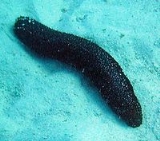
Deuterostome

Encyclopedia
Deuterostomes are a superphylum of animal
s. They are a subtaxon
of the Bilateria
branch of the subregnum Eumetazoa
, and are opposed to the protostome
s. Deuterostomes are distinguished by their embryonic development; in deuterostomes, the first opening (the blastopore
) becomes the anus
, while in protostomes it becomes the mouth
. Deuterostomes are also known as enterocoelomates because their coelom
develops through enterocoely
.
There are four extant phyla of deuterostomes:
Superphylum Deuterostomia was redefined in 1995 based on molecular sequence analyses when the lophophorates were removed from it and combined with other protostome animals to form superphylum Lophotrochozoa
. The phylum Chaetognatha
(arrow worms) may also belong here. Extinct groups may include the phylum Vetulicolia
. Echinodermata, Hemichordata and Xenoturbellida form the clade Ambulacraria
.
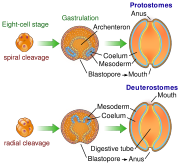 In both deuterostomes and protostomes, a zygote first develops into a hollow ball of cells, called a blastula
. In deuterostomes, the early divisions occur parallel or perpendicular to the polar axis. This is called radial cleavage, and also occurs in certain protostomes, such as the lophophorates. Most deuterostomes display indeterminate cleavage, in which the developmental fate of the cells in the developing embryo are not determined by the identity of the parent cell. Thus if the first four cells are separated, each cell is capable of forming a complete small larva, and if a cell is removed from the blastula the other cells will compensate.
In deuterostomes the mesoderm forms as evaginations of the developed gut that pinch off, forming the coelom
. This is called enterocoely
.
Both the Hemichordata and Chordata have gill slit
s, and primitive fossil echinoderms also show signs of gill slits. A hollow nerve cord is found in all chordates, including tunicate
s (in the larval stage). Some hemichordates also have a tubular nerve cord. In the early embryonic stage it looks like the hollow nerve cord of chordates. Because of the degenerated nervous system of echinoderms, it is not possible to discern much about their ancestors in this matter, but based on different facts it is quite possible that all the present deuterostomes evolved from a common ancestor that had gill slits, a hollow nerve cord and a segmented body. It could have resembled the small group of Cambrian deuterostomes named Vetulicolia
.
 The defining characteristic of the dueterostome is the fact that the blastopore (the opening at the bottom of the forming gastrula) is turned into the anus, whereas in protosomes the blastopore becomes the mouth. The deuterostome mouth develops at the opposite end of the embryo from the blastopore and a digestive tract develops in the middle connecting the two.
and other Cnidarians are split into two groups, the protostome
s and deuterostomes. Chordates (which include all the vertebrates) are deuterostomes. It seems very likely that Kimberella
was a member of the protostomes. If so, this means that the protostome and deuterostome lineages must have split some time before Kimberella appeared — at least , and hence well before the start of the Cambrian . The Ediacaran
fossil Ernietta
, from about , may represent a deuterostome animal.
Fossils of one major deuterostome group, the echinoderm
s (whose modern members include sea star
s, sea urchin
s and crinoid
s) are quite common from the start of the Cambrian, . The Mid Cambrian
fossil Rhabdotubus johanssoni has been interpreted as a pterobranch hemichordate. Opinions differ about whether the Chengjiang fauna fossil Yunnanozoon
, from the earlier Cambrian, was a hemichordate or chordate. Another Chenjiang fossil, Haikouella lanceolata, also from the Chengjiang fauna, is interpreted as a chordate and possibly a craniate, as it shows signs of a heart, arteries, gill filaments, a tail, a neural chord with a brain at the front end, and possibly eyes — although it also had short tentacles round its mouth. Haikouichthys
and Myllokunmingia
, also from the Chenjiang fauna, are regarded as fish
. Pikaia
, discovered much earlier but from the Mid Cambrian Burgess Shale
, is also regarded as a primitive chordate. On the other hand fossils of early chordates are very rare, since non-vertebrate chordates have no bones or teeth, and none have been reported for the rest of the Cambrian.
Animal
Animals are a major group of multicellular, eukaryotic organisms of the kingdom Animalia or Metazoa. Their body plan eventually becomes fixed as they develop, although some undergo a process of metamorphosis later on in their life. Most animals are motile, meaning they can move spontaneously and...
s. They are a subtaxon
Taxon
|thumb|270px|[[African elephants]] form a widely-accepted taxon, the [[genus]] LoxodontaA taxon is a group of organisms, which a taxonomist adjudges to be a unit. Usually a taxon is given a name and a rank, although neither is a requirement...
of the Bilateria
Bilateria
The bilateria are all animals having a bilateral symmetry, i.e. they have a front and a back end, as well as an upside and downside. Radially symmetrical animals like jellyfish have a topside and downside, but no front and back...
branch of the subregnum Eumetazoa
Eumetazoa
Eumetazoa is a clade comprising all major animal groups except sponges, placozoa and several other little known animals. Characteristics of eumetazoans include true tissues organized into germ layers, and an embryo that goes through a gastrula stage...
, and are opposed to the protostome
Protostome
Protostomia are a clade of animals. Together with the deuterostomes and a few smaller phyla, they make up the Bilateria, mostly comprising animals with bilateral symmetry and three germ layers...
s. Deuterostomes are distinguished by their embryonic development; in deuterostomes, the first opening (the blastopore
Blastopore
A blastopore is an opening into the archenteron during the embryonic stages of an organism. The distinction between protostomes and deuterostomes is based on the direction in which the mouth develops in relation to the blastopore...
) becomes the anus
Anus
The anus is an opening at the opposite end of an animal's digestive tract from the mouth. Its function is to control the expulsion of feces, unwanted semi-solid matter produced during digestion, which, depending on the type of animal, may be one or more of: matter which the animal cannot digest,...
, while in protostomes it becomes the mouth
Mouth
The mouth is the first portion of the alimentary canal that receives food andsaliva. The oral mucosa is the mucous membrane epithelium lining the inside of the mouth....
. Deuterostomes are also known as enterocoelomates because their coelom
Coelom
The coelom is a fluid-filled cavity formed within the mesoderm. Coeloms developed in triploblasts but were subsequently lost in several lineages. Loss of coelom is correlated with reduction in body size...
develops through enterocoely
Enterocoely
Enterocoely is a process by which some animal embryos develop. In enterocoely, a mesoderm is formed in a developing embryo, in which the coelom forms from pouches "pinched" off of the digestive tract...
.
There are four extant phyla of deuterostomes:
- Phylum Chordata (vertebrateVertebrateVertebrates are animals that are members of the subphylum Vertebrata . Vertebrates are the largest group of chordates, with currently about 58,000 species described. Vertebrates include the jawless fishes, bony fishes, sharks and rays, amphibians, reptiles, mammals, and birds...
s and their kin) - Phylum Echinodermata (sea starSea starStarfish or sea stars are echinoderms belonging to the class Asteroidea. The names "starfish" and "sea star" essentially refer to members of the class Asteroidea...
s, sea urchinSea urchinSea urchins or urchins are small, spiny, globular animals which, with their close kin, such as sand dollars, constitute the class Echinoidea of the echinoderm phylum. They inhabit all oceans. Their shell, or "test", is round and spiny, typically from across. Common colors include black and dull...
s, sea cucumbers, etc.) - Phylum HemichordataHemichordataHemichordata is a phylum of marine deuterostome animals, generally considered the sister group of the echinoderms. They date back to the Lower or Middle Cambrian and include two main classes: Enteropneusta , and Pterobranchia. A third class, Planctosphaeroidea, is known only from the larva of a...
(acorn wormsAcorn wormThe Acorn worms or Enteropneusta are a hemichordate class of invertebrates, closely related to the echinoderms. There are about 90 species of acorn worm in the world, the main species for research being Saccoglossus kowaleskii....
and possibly graptoliteGraptoliteGraptolithina is a class in the animal phylum Hemichordata, the members of which are known as Graptolites. Graptolites are fossil colonial animals known chiefly from the Upper Cambrian through the Lower Carboniferous...
s) - Phylum Xenoturbellida (2 species of worm-like animals)
Superphylum Deuterostomia was redefined in 1995 based on molecular sequence analyses when the lophophorates were removed from it and combined with other protostome animals to form superphylum Lophotrochozoa
Lophotrochozoa
The Lophotrochozoa are a major grouping of protostome animals. The taxon was discovered based on molecular data. Molecular evidence such as a result of studies of the evolution of small-subunit ribosomal RNA supports the monophyly of the phyla listed in the infobox shown at right.-Terminology:The...
. The phylum Chaetognatha
Chaetognatha
Chaetognatha, meaning hair-jaws, and commonly known as arrow worms, are a phylum of predatory marine worms that are a major component of plankton worldwide. About 20% of the known species are benthic, that is belonging to the lowest zone of the ocean, or benthic zone, and can attach to algae and...
(arrow worms) may also belong here. Extinct groups may include the phylum Vetulicolia
Vetulicolia
VetulicoliaThe phylum name, Vetulocolia, is derived from the type genus, Vetulicola, which is a compound Latin word composed of vetuli, or "old," and cola, or "inhabitant." is an extinct phylum encompassing several Cambrian organisms...
. Echinodermata, Hemichordata and Xenoturbellida form the clade Ambulacraria
Ambulacraria
Ambulacraria is a clade of invertebrates which includes echinoderms, hemichordates, and Xenoturbellida; a member of this group is called an ambulacrarian...
.
Blastula
The blastula is a hollow sphere of cells formed during an early stage of embryonic development in animals . The blastula is created when the zygote undergoes the cell division process known as cleavage. The blastula is preceded by the morula and is followed by the gastrula in the developmental...
. In deuterostomes, the early divisions occur parallel or perpendicular to the polar axis. This is called radial cleavage, and also occurs in certain protostomes, such as the lophophorates. Most deuterostomes display indeterminate cleavage, in which the developmental fate of the cells in the developing embryo are not determined by the identity of the parent cell. Thus if the first four cells are separated, each cell is capable of forming a complete small larva, and if a cell is removed from the blastula the other cells will compensate.
In deuterostomes the mesoderm forms as evaginations of the developed gut that pinch off, forming the coelom
Body cavity
By the broadest definition, a body cavity is any fluid-filled space in a multicellular organism. However, the term usually refers to the space located between an animal’s outer covering and the outer lining of the gut cavity, where internal organs develop...
. This is called enterocoely
Enterocoely
Enterocoely is a process by which some animal embryos develop. In enterocoely, a mesoderm is formed in a developing embryo, in which the coelom forms from pouches "pinched" off of the digestive tract...
.
Both the Hemichordata and Chordata have gill slit
Gill slit
Gill slits are individual openings to gills, i.e., multiple gill arches, which lack a single outer cover. Such gills are characteristic of Cartilaginous fish such as sharks, rays, sawfish, and guitarfish. Most of these have five pairs, but a few species have 6 or 7 pairs...
s, and primitive fossil echinoderms also show signs of gill slits. A hollow nerve cord is found in all chordates, including tunicate
Tunicate
Tunicates, also known as urochordates, are members of the subphylum Tunicata, previously known as Urochordata, a group of underwater saclike filter feeders with incurrent and excurrent siphons that is classified within the phylum Chordata. While most tunicates live on the ocean floor, others such...
s (in the larval stage). Some hemichordates also have a tubular nerve cord. In the early embryonic stage it looks like the hollow nerve cord of chordates. Because of the degenerated nervous system of echinoderms, it is not possible to discern much about their ancestors in this matter, but based on different facts it is quite possible that all the present deuterostomes evolved from a common ancestor that had gill slits, a hollow nerve cord and a segmented body. It could have resembled the small group of Cambrian deuterostomes named Vetulicolia
Vetulicolia
VetulicoliaThe phylum name, Vetulocolia, is derived from the type genus, Vetulicola, which is a compound Latin word composed of vetuli, or "old," and cola, or "inhabitant." is an extinct phylum encompassing several Cambrian organisms...
.
Formation of mouth and anus
Origins
The majority of animals more complex than jellyfishJellyfish
Jellyfish are free-swimming members of the phylum Cnidaria. Medusa is another word for jellyfish, and refers to any free-swimming jellyfish stages in the phylum Cnidaria...
and other Cnidarians are split into two groups, the protostome
Protostome
Protostomia are a clade of animals. Together with the deuterostomes and a few smaller phyla, they make up the Bilateria, mostly comprising animals with bilateral symmetry and three germ layers...
s and deuterostomes. Chordates (which include all the vertebrates) are deuterostomes. It seems very likely that Kimberella
Kimberella
Kimberella is a monospecific genus of bilaterian known only from rocks of the Ediacaran period. The slug-like organism fed by scratching the microbial surface on which it dwelt in a manner similar to the molluscs, although its affinity with this group is contentious.Specimens were first found in...
was a member of the protostomes. If so, this means that the protostome and deuterostome lineages must have split some time before Kimberella appeared — at least , and hence well before the start of the Cambrian . The Ediacaran
Ediacaran
The Ediacaran Period , named after the Ediacara Hills of South Australia, is the last geological period of the Neoproterozoic Era and of the Proterozoic Eon, immediately preceding the Cambrian Period, the first period of the Paleozoic Era and of the Phanerozoic Eon...
fossil Ernietta
Ernietta
Ernietta is a bag-shaped erniettomorph genus that lived half-buried in sediment, and probably fed by osmosis. It had chambered walls. It was from shale in the Dabis Formation in Namibia dated from 549 to 543 mya. The name has also been misspelled as Ernettia in some papers...
, from about , may represent a deuterostome animal.
Fossils of one major deuterostome group, the echinoderm
Echinoderm
Echinoderms are a phylum of marine animals. Echinoderms are found at every ocean depth, from the intertidal zone to the abyssal zone....
s (whose modern members include sea star
Sea star
Starfish or sea stars are echinoderms belonging to the class Asteroidea. The names "starfish" and "sea star" essentially refer to members of the class Asteroidea...
s, sea urchin
Sea urchin
Sea urchins or urchins are small, spiny, globular animals which, with their close kin, such as sand dollars, constitute the class Echinoidea of the echinoderm phylum. They inhabit all oceans. Their shell, or "test", is round and spiny, typically from across. Common colors include black and dull...
s and crinoid
Crinoid
Crinoids are marine animals that make up the class Crinoidea of the echinoderms . Crinoidea comes from the Greek word krinon, "a lily", and eidos, "form". They live both in shallow water and in depths as great as 6,000 meters. Sea lilies refer to the crinoids which, in their adult form, are...
s) are quite common from the start of the Cambrian, . The Mid Cambrian
Cambrian
The Cambrian is the first geological period of the Paleozoic Era, lasting from Mya ; it is succeeded by the Ordovician. Its subdivisions, and indeed its base, are somewhat in flux. The period was established by Adam Sedgwick, who named it after Cambria, the Latin name for Wales, where Britain's...
fossil Rhabdotubus johanssoni has been interpreted as a pterobranch hemichordate. Opinions differ about whether the Chengjiang fauna fossil Yunnanozoon
Yunnanozoon
Yunnanozoon lividum is a suspected a hemichordate or chordate from the Lower Cambrian, Chengjiang biota of Yunnan province, China....
, from the earlier Cambrian, was a hemichordate or chordate. Another Chenjiang fossil, Haikouella lanceolata, also from the Chengjiang fauna, is interpreted as a chordate and possibly a craniate, as it shows signs of a heart, arteries, gill filaments, a tail, a neural chord with a brain at the front end, and possibly eyes — although it also had short tentacles round its mouth. Haikouichthys
Haikouichthys
Haikouichthys is an extinct genus of craniate believed to have lived c. 530 million years ago, during the Cambrian explosion of multicellular life...
and Myllokunmingia
Myllokunmingia
Myllokunmingia is a chordate from the Lower Cambrian Maotianshan shales of China, thought to be a vertebrate, although this is not conclusively proven. It is 28 mm long and 6 mm high....
, also from the Chenjiang fauna, are regarded as fish
Fish
Fish are a paraphyletic group of organisms that consist of all gill-bearing aquatic vertebrate animals that lack limbs with digits. Included in this definition are the living hagfish, lampreys, and cartilaginous and bony fish, as well as various extinct related groups...
. Pikaia
Pikaia
Pikaia gracilens is an extinct animal known from the Middle Cambrian Burgess Shale of British Columbia. -Discovery:It was discovered by Charles Walcott and was first described by him in 1911. It was named after Pika Peak, a mountain in Alberta, Canada. Based on the obvious and regular segmentation...
, discovered much earlier but from the Mid Cambrian Burgess Shale
Burgess Shale
The Burgess Shale Formation, located in the Canadian Rockies of British Columbia, is one of the world's most celebrated fossil fields, and the best of its kind. It is famous for the exceptional preservation of the soft parts of its fossils...
, is also regarded as a primitive chordate. On the other hand fossils of early chordates are very rare, since non-vertebrate chordates have no bones or teeth, and none have been reported for the rest of the Cambrian.