
Home      Discussion      Topics      Dictionary      Almanac
Signup       Login
Brown algae

Brown algae

Overview
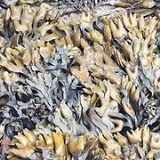
The Phaeophyceae or brown algae (singular: alga), is a large group of mostly marine
Ocean
An ocean is a major body of saline water, and a principal component of the hydrosphere. Approximately 71% of the Earth's surface is covered by ocean, a continuous body of water that is customarily divided into several principal oceans and smaller seas.More than half of this area is over 3,000...

 multicellular algae
Algae
Algae are a large and diverse group of simple, typically autotrophic organisms, ranging from unicellular to multicellular forms, such as the giant kelps that grow to 65 meters in length. They are photosynthetic like plants, and "simple" because their tissues are not organized into the many...

, including many seaweed
Seaweed
Seaweed is a loose, colloquial term encompassing macroscopic, multicellular, benthic marine algae. The term includes some members of the red, brown and green algae...

s of colder Northern Hemisphere
Northern Hemisphere
The Northern Hemisphere is the half of a planet that is north of its equator—the word hemisphere literally means “half sphere”. It is also that half of the celestial sphere north of the celestial equator...

 waters. They play an important role in marine environments, both as food and for the habitats they form. For instance Macrocystis
Macrocystis
Macrocystis is a genus of kelp . This genus contains the largest of all the phaeophyceae or brown algae. Macrocystis has pneumatocysts at the base of its blades. Sporophytes are perennial, and individual stipes may persist for many years...

, a kelp
Kelp
Kelps are large seaweeds belonging to the brown algae in the order Laminariales. There are about 30 different genera....

 of the order Laminariales, may reach 60 m in length, and forms prominent underwater forests
Kelp forest
Kelp forests are underwater areas with a high density of kelp. They are recognized as one of the most productive and dynamic ecosystems on Earth. Smaller areas of anchored kelp are called kelp beds....

. Another example is Sargassum
Sargassum
Sargassum is a genus of brown macroalga in the order Fucales. Numerous species are distributed throughout the temperate and tropical oceans of the world, where they generally inhabit shallow water and coral reefs. However, the genus may be best known for its planktonic species...

, which creates unique habitats in the tropical waters of the Sargasso Sea
Sargasso Sea
The Sargasso Sea is a region in the middle of the North Atlantic Ocean, surrounded by ocean currents. It is bounded on the west by the Gulf Stream; on the north, by the North Atlantic Current; on the east, by the Canary Current; and on the south, by the North Atlantic Equatorial Current. This...

. Many brown algae, such as members of the order Fucales
Fucales
Fucales is an order in the brown algae . Members of this order are fucoids. The list of families in Fucales, as well as additional taxonomic information on algae, is publicly accessible at Algaebase....

, commonly grow along rocky seashores. Some members of the class are used as food for humans.
Discussion
Ask a question about 'Brown algae'
Start a new discussion about 'Brown algae'
Answer questions from other users
Full Discussion Forum
 
Unanswered Questions
Encyclopedia
The Phaeophyceae or brown algae (singular: alga), is a large group of mostly marine
Ocean
An ocean is a major body of saline water, and a principal component of the hydrosphere. Approximately 71% of the Earth's surface is covered by ocean, a continuous body of water that is customarily divided into several principal oceans and smaller seas.More than half of this area is over 3,000...

 multicellular algae
Algae
Algae are a large and diverse group of simple, typically autotrophic organisms, ranging from unicellular to multicellular forms, such as the giant kelps that grow to 65 meters in length. They are photosynthetic like plants, and "simple" because their tissues are not organized into the many...

, including many seaweed
Seaweed
Seaweed is a loose, colloquial term encompassing macroscopic, multicellular, benthic marine algae. The term includes some members of the red, brown and green algae...

s of colder Northern Hemisphere
Northern Hemisphere
The Northern Hemisphere is the half of a planet that is north of its equator—the word hemisphere literally means “half sphere”. It is also that half of the celestial sphere north of the celestial equator...

 waters. They play an important role in marine environments, both as food and for the habitats they form. For instance Macrocystis
Macrocystis
Macrocystis is a genus of kelp . This genus contains the largest of all the phaeophyceae or brown algae. Macrocystis has pneumatocysts at the base of its blades. Sporophytes are perennial, and individual stipes may persist for many years...

, a kelp
Kelp
Kelps are large seaweeds belonging to the brown algae in the order Laminariales. There are about 30 different genera....

 of the order Laminariales, may reach 60 m in length, and forms prominent underwater forests
Kelp forest
Kelp forests are underwater areas with a high density of kelp. They are recognized as one of the most productive and dynamic ecosystems on Earth. Smaller areas of anchored kelp are called kelp beds....

. Another example is Sargassum
Sargassum
Sargassum is a genus of brown macroalga in the order Fucales. Numerous species are distributed throughout the temperate and tropical oceans of the world, where they generally inhabit shallow water and coral reefs. However, the genus may be best known for its planktonic species...

, which creates unique habitats in the tropical waters of the Sargasso Sea
Sargasso Sea
The Sargasso Sea is a region in the middle of the North Atlantic Ocean, surrounded by ocean currents. It is bounded on the west by the Gulf Stream; on the north, by the North Atlantic Current; on the east, by the Canary Current; and on the south, by the North Atlantic Equatorial Current. This...

. Many brown algae, such as members of the order Fucales
Fucales
Fucales is an order in the brown algae . Members of this order are fucoids. The list of families in Fucales, as well as additional taxonomic information on algae, is publicly accessible at Algaebase....

, commonly grow along rocky seashores. Some members of the class are used as food for humans.

Worldwide there are about 1500–2000 species
Species
In biology, a species is one of the basic units of biological classification and a taxonomic rank. A species is often defined as a group of organisms capable of interbreeding and producing fertile offspring. While in many cases this definition is adequate, more precise or differing measures are...

 of brown algae. Some species are of sufficient commercial importance, such as Ascophyllum nodosum
Ascophyllum nodosum
Ascophyllum nodosum is a large, common brown alga in the family Fucaceae, being the only species in the genus Ascophyllum. It is seaweed of the northern Atlantic Ocean, also known as rockweed, Norwegian kelp, knotted kelp, knotted wrack or egg wrack...

, that they have become subjects of extensive research in their own right.

Brown algae belong to a very large group, the Heterokont
Heterokont
The heterokonts or stramenopiles are a major line of eukaryotes currently containing more than 100,000 known species. Most are algae, ranging from the giant multicellular kelp to the unicellular diatoms, which are a primary component of plankton...

ophyta, a eukaryotic
Eukaryote
A eukaryote is an organism whose cells contain complex structures enclosed within membranes. Eukaryotes may more formally be referred to as the taxon Eukarya or Eukaryota. The defining membrane-bound structure that sets eukaryotic cells apart from prokaryotic cells is the nucleus, or nuclear...

 group of organisms distinguished most prominently by having chloroplast
Chloroplast
Chloroplasts are organelles found in plant cells and other eukaryotic organisms that conduct photosynthesis. Chloroplasts capture light energy to conserve free energy in the form of ATP and reduce NADP to NADPH through a complex set of processes called photosynthesis.Chloroplasts are green...

s surrounded by four membranes, suggesting an origin from a symbiotic relationship between a basal eukaryote and another eukaryotic organism. Most brown algae contain the pigment fucoxanthin
Fucoxanthin
Fucoxanthin is a xanthophyll, with formula C42H58O6. It is found as an accessory pigment in the chloroplasts of brown algae and most other heterokonts, giving them a brown or olive-green color...

, which is responsible for the distinctive greenish-brown color that gives them their name. Brown algae are unique among heterokonts in developing into multicellular forms with differentiated
Cellular differentiation
In developmental biology, cellular differentiation is the process by which a less specialized cell becomes a more specialized cell type. Differentiation occurs numerous times during the development of a multicellular organism as the organism changes from a simple zygote to a complex system of...

 tissue
Tissue (biology)
Tissue is a cellular organizational level intermediate between cells and a complete organism. A tissue is an ensemble of cells, not necessarily identical, but from the same origin, that together carry out a specific function. These are called tissues because of their identical functioning...

s, but they reproduce by means of flagellated
Flagellum
A flagellum is a tail-like projection that protrudes from the cell body of certain prokaryotic and eukaryotic cells, and plays the dual role of locomotion and sense organ, being sensitive to chemicals and temperatures outside the cell. There are some notable differences between prokaryotic and...

 spore
Spore
In biology, a spore is a reproductive structure that is adapted for dispersal and surviving for extended periods of time in unfavorable conditions. Spores form part of the life cycles of many bacteria, plants, algae, fungi and some protozoa. According to scientist Dr...

s and gamete
Gamete
A gamete is a cell that fuses with another cell during fertilization in organisms that reproduce sexually...

s that closely resemble cells of other heterokonts. Genetic studies show their closest relatives to be the yellow-green algae
Yellow-green algae
Yellow-green algae or xanthophytes are an important group of heterokont algae. Most live in freshwater, but some are found in marine and soil habitats. They vary from single-celled flagellates to simple colonial and filamentous forms. Xanthophyte chloroplasts contain the photosynthetic pigments...

.

Morphology


Brown algae exist in a wide range of sizes and forms. The smallest members of the group grow as tiny, feathery tufts of threadlike cell
Cell (biology)
The cell is the basic structural and functional unit of all known living organisms. It is the smallest unit of life that is classified as a living thing, and is often called the building block of life. The Alberts text discusses how the "cellular building blocks" move to shape developing embryos....

s no more than a few centimeters long. Some species even have a stage in their life cycle that consists of only a few cells, making the entire alga microscopic. Other groups of brown algae grow to much larger sizes. The rockweeds and leathery kelp
Kelp
Kelps are large seaweeds belonging to the brown algae in the order Laminariales. There are about 30 different genera....

s are often the most conspicuous algae in their habitats. Kelps can range in size from the two-foot-tall sea palm Postelsia
Postelsia
Postelsia, also known as the sea palm or palm seaweed, is a genus of kelp. There is only one species, Postelsia palmaeformis. It is found along the western coast of North America, on rocky shores with constant waves...

to the giant kelp Macrocystis pyrifera
Macrocystis pyrifera
Macrocystis pyrifera, commonly known as Giant kelp or Giant bladder kelp, is a species of kelp , and one of four species in the genus Macrocystis...

, which grows to over 45 m (150 ft) long and is the largest of all the algae. In form, the brown algae range from small crusts or cushions to leafy free-floating mats formed by species of Sargassum
Sargassum
Sargassum is a genus of brown macroalga in the order Fucales. Numerous species are distributed throughout the temperate and tropical oceans of the world, where they generally inhabit shallow water and coral reefs. However, the genus may be best known for its planktonic species...

. They may consist of delicate felt-like strands of cells, as in Ectocarpus, or of foot-long flattened branches resembling a fan, as in Padina.

Reagrdless of size or form, two visible features set the Phaeophyceae apart from all other algae. First, members of the group possess a characteristic color that ranges from an olive green to various shades of brown
Brown
Brown is a color term, denoting a range of composite colors produced by a mixture of orange, red, rose, or yellow with black or gray. The term is from Old English brún, in origin for any dusky or dark shade of color....

. The particular shade depends upon the amount of fucoxanthin
Fucoxanthin
Fucoxanthin is a xanthophyll, with formula C42H58O6. It is found as an accessory pigment in the chloroplasts of brown algae and most other heterokonts, giving them a brown or olive-green color...

 present in the alga. Second, all brown algae are multicellular
Multicellular organism
Multicellular organisms are organisms that consist of more than one cell, in contrast to single-celled organisms. Most life that can be seen with the the naked eye is multicellular, as are all animals and land plants.-Evolutionary history:Multicellularity has evolved independently dozens of times...

. There are no known species that exist as single cells or as colonies of cells, and the brown algae are the only major group of seaweed
Seaweed
Seaweed is a loose, colloquial term encompassing macroscopic, multicellular, benthic marine algae. The term includes some members of the red, brown and green algae...

s that does not include such forms. However, this may be the result of classification rather than a consequence of evolution, as all the groups hypothesized to be the closest relatives of the browns include single-celled or colonial forms.

Visible structures


Whatever their form, the body of all brown algae is termed a thallus, indicating that it lacks the complex xylem
Xylem
Xylem is one of the two types of transport tissue in vascular plants. . The word xylem is derived from the Classical Greek word ξυλον , meaning "wood"; the best-known xylem tissue is wood, though it is found throughout the plant...

 and phloem
Phloem
In vascular plants, phloem is the living tissue that carries organic nutrients , in particular, glucose, a sugar, to all parts of the plant where needed. In trees, the phloem is the innermost layer of the bark, hence the name, derived from the Greek word "bark"...

 of vascular plant
Vascular plant
Vascular plants are those plants that have lignified tissues for conducting water, minerals, and photosynthetic products through the plant. Vascular plants include the clubmosses, Equisetum, ferns, gymnosperms and angiosperms...

s. This does not mean that brown algae completely lack specialized structures. But, because some botanists define "true" stems, leaves, and roots by the presence of these tissues, their absence in the brown algae means that the stem-like and leaf-like structures found in some groups of brown algae must be described using different terminology. Although not all brown algae are structurally complex, those that are typically possess one or more characteristic parts.

A holdfast
Holdfast
A holdfast is a root-like structure that anchors aquatic sessile organisms, such as seaweed, other sessile algae, stalked crinoids, benthic cnidarians, and sponges, to the substrate. ...

is a rootlike structure present at the base of the alga. Like a root system in plants, a holdfast serves to anchor the alga in place on the substrate where it grows, and thus prevents the alga from being carried away by the current. Unlike a root system, the holdfast generally does not serve as the primary organ for water uptake, nor does it take in nutrients from the substrate. The overall physical appearance of the holdfast differs among various brown algae and among various substrates. It may be heavily branched, or it may be cup-like in appearance. A single alga typically has just one holdfast, although some species have more than one stipe growing from their holdfast.

A stipe
Stipe (botany)
In botany, a stipe is a stalk that supports some other structure. The precise meaning is different depending on which taxonomic group is being described....

is a stalk or stemlike structure present in an alga. It may grow as a short structure near the base of the alga (as in Laminaria
Laminaria
Laminaria is a genus of 31 species of brown algae , all sharing the common name "kelp". This economically important genus is characterized by long, leathery laminae and relatively large size. Some species are referred to by the common name Devil's apron, due to their shape, or sea colander, due to...

), or it may develop into a large, complex structure running throughout the algal body (as in Sargassum
Sargassum
Sargassum is a genus of brown macroalga in the order Fucales. Numerous species are distributed throughout the temperate and tropical oceans of the world, where they generally inhabit shallow water and coral reefs. However, the genus may be best known for its planktonic species...

or Macrocystis
Macrocystis
Macrocystis is a genus of kelp . This genus contains the largest of all the phaeophyceae or brown algae. Macrocystis has pneumatocysts at the base of its blades. Sporophytes are perennial, and individual stipes may persist for many years...

). In the most structurally differentiated brown algae (such as Fucus
Fucus
Fucus is a genus of brown algae found in the intertidal zones of rocky seashores almost throughout the world.-Description and life cycle:...

), the tissues within the stipe are divided into three distinct layers or regions. These regions include a central pith, a surrounding cortex, and an outer epidermis, each of which has an analog in the stem of a vascular plant. In some brown algae, the pith region includes a core of elongated cells that resemble the phloem
Phloem
In vascular plants, phloem is the living tissue that carries organic nutrients , in particular, glucose, a sugar, to all parts of the plant where needed. In trees, the phloem is the innermost layer of the bark, hence the name, derived from the Greek word "bark"...

 of vascular plants both in structure and function. In others (such as Nereocystis
Nereocystis
Nereocystis is a genus of kelp. It forms thick beds on rocks, and is an important part of kelp forests. There is only one species, Nereocystis luetkeana. It can grow to a maximum of 74 meters...

), the center of the stipe is hollow and filled with gas that serves to keep that part of the alga buoyant. The stipe may be relatively flexible and elastic in species like Macrocystis pyrifera
Macrocystis pyrifera
Macrocystis pyrifera, commonly known as Giant kelp or Giant bladder kelp, is a species of kelp , and one of four species in the genus Macrocystis...

that grow in strong currents, or may be more rigid in species like Postelsia palmaeformis that are exposed to the atmosphere at low tide.

Many algae have a flattened portion that may resemble a leaf, and this is termed a blade, lamina
Lamina (algae)
A Lamina in the algae is a generally flattened structure which typically forms the principal bulk of macroscopic plants. It is often developed into specialised organs such as flotation bladders and reproductive organs....

, or frond. The name blade is most often applied to a single undivided structure, while frond may be applied to all or most of an algal body that is flattened, but this distinction is not universally applied. The name lamina refers to that portion of a structurally differentiated alga that is flattened. It may be a single or a divided structure, and may be spread over a substantial portion of the alga. In rockweeds
Fucus
Fucus is a genus of brown algae found in the intertidal zones of rocky seashores almost throughout the world.-Description and life cycle:...

, for example, the lamina is a broad wing of tissue that runs continuously along both sides of a branched midrib. The midrib and lamina together constitute almost all of a rockweed, so that the lamina is spread throughout the alga rather than existing as a localized portion of it.
In some brown algae, there is a single lamina or blade, while in others there may be many separate blades. Even in those species that initially produce a single blade, the structure may tear with rough currents or as part of maturation to form additional blades. These blades may be attached directly to the stipe, to a holdfast with no stipe present, or there may be an air bladder between the stipe and blade. The surface of the lamina or blade may be smooth or wrinkled; its tissues may be thin and flexible or thick and leathery. In species like Egregia menziesii
Egregia menziesii
Egregia menziesii is a species of kelp known commonly as feather boa kelp. It is native to the coastline of western North America from Alaska to Baja California, where it is a common kelp of the intertidal zone. It is dark brown in color, shiny and bumpy in texture, and may reach over five meters...

, this characteristic may change depending upon the turbulence of the waters in which it grows. In other species, the surface of the blade is coated with slime to discourage the attachment of epiphyte
Epiphyte
An epiphyte is a plant that grows upon another plant non-parasitically or sometimes upon some other object , derives its moisture and nutrients from the air and rain and sometimes from debris accumulating around it, and is found in the temperate zone and in the...

s or to deter herbivore
Herbivore
Herbivores are organisms that are anatomically and physiologically adapted to eat plant-based foods. Herbivory is a form of consumption in which an organism principally eats autotrophs such as plants, algae and photosynthesizing bacteria. More generally, organisms that feed on autotrophs in...

s. Blades are also often the parts of the alga that bear the reproductive structures.

Gas-filled floats called pneumatocyst
Pneumatocyst
In phycology, a pneumatocyst is a large float containing gas found in brown algae. An organism may have more than one. They provide buoyancy to lift the blades toward the surface, allowing them to receive more sunlight for photosynthesis....

s
provide buoyancy
Buoyancy
In physics, buoyancy is a force exerted by a fluid that opposes an object's weight. In a column of fluid, pressure increases with depth as a result of the weight of the overlying fluid. Thus a column of fluid, or an object submerged in the fluid, experiences greater pressure at the bottom of the...

 in many kelp
Kelp
Kelps are large seaweeds belonging to the brown algae in the order Laminariales. There are about 30 different genera....

s and members of the Fucales
Fucales
Fucales is an order in the brown algae . Members of this order are fucoids. The list of families in Fucales, as well as additional taxonomic information on algae, is publicly accessible at Algaebase....

. These bladder-like structures occur in or near the lamina, so that it is held nearer the water surface and thus receives more light for photosynthesis. Pneumatocysts are most often spherical or ellipsoidal, but can vary in shape among different species. Species such as Nereocystis luetkeana
Nereocystis
Nereocystis is a genus of kelp. It forms thick beds on rocks, and is an important part of kelp forests. There is only one species, Nereocystis luetkeana. It can grow to a maximum of 74 meters...

and Pelagophycus porra
Pelagophycus
Pelagophycus is a genus of kelp. It is found in deep waters off the west coast of central North America. The species Pelagophycus Porra, also known as Elk kelp, grows in temperatures of no higher than 60° Fahrenheit...

bear a single large pneumatocyst between the top of the stipe and the base of the blades. In contrast, the giant kelp Macrocystis pyrifera bears many blades along its stipe, with a pneumatocyst at the base of each blade where it attaches to the main stipe. Species of Sargassum
Sargassum
Sargassum is a genus of brown macroalga in the order Fucales. Numerous species are distributed throughout the temperate and tropical oceans of the world, where they generally inhabit shallow water and coral reefs. However, the genus may be best known for its planktonic species...

also bear many blades and pneumatocysts, but both kinds of structures are attached separately to the stipe by short stalks. In species of Fucus
Fucus
Fucus is a genus of brown algae found in the intertidal zones of rocky seashores almost throughout the world.-Description and life cycle:...

, the pneumatocysts develop within the lamina itself, either as discrete spherical bladders or as elongated gas-filled regions that take the outline of the lamina in which they develop.

Growth


The brown algae include the largest and fastest growing of seaweeds. Fronds of Macrocystis
Macrocystis
Macrocystis is a genus of kelp . This genus contains the largest of all the phaeophyceae or brown algae. Macrocystis has pneumatocysts at the base of its blades. Sporophytes are perennial, and individual stipes may persist for many years...

may grow as much as 50 centimetres (19.7 in) per day, and the stipes can grow 6 centimetres (2.4 in) in a single day.

Growth in most brown algae occurs at the tips of structures as a result of divisions in a single apical cell or in a row of such cells. As this apical cell divides, the new cells that it produces develop into all the tissues of the alga. Branchings and other lateral structures appear when the apical cell divides to produce two new apical cells. However, a few groups (such as Ectocarpus) grow by a diffuse, unlocalized production of new cells that can occur anywhere on the thallus.

Tissue organization


The simplest browns are filamentous—that is, their cells are elongate and have septa cutting across their width. They branch by getting wider at their tip, and then dividing the widening.

Aside from filamentous forms, there are two main types of tissue organization in the brown algae: pseudoparenchymatous (haplostichous) and parenchymatous (polystichous). The fronds may be multiaxial or monoaxial.

The cell wall consists of two layers; the inner layer bears the strength, and consists of cellulose; the outer wall layer is mainly algin, and is gummy when wet but becomes hard and brittle when it dries out.

Evolutionary history


Genetic and ultrastructural evidence place the Phaeophyceae among the heterokont
Heterokont
The heterokonts or stramenopiles are a major line of eukaryotes currently containing more than 100,000 known species. Most are algae, ranging from the giant multicellular kelp to the unicellular diatoms, which are a primary component of plankton...

s (Stramenopiles), a large assemblage of organisms that includes both photosynthetic
Photosynthesis
Photosynthesis is a chemical process that converts carbon dioxide into organic compounds, especially sugars, using the energy from sunlight. Photosynthesis occurs in plants, algae, and many species of bacteria, but not in archaea. Photosynthetic organisms are called photoautotrophs, since they can...

 members with plastid
Plastid
Plastids are major organelles found in the cells of plants and algae. Plastids are the site of manufacture and storage of important chemical compounds used by the cell...

s (such as the diatom
Diatom
Diatoms are a major group of algae, and are one of the most common types of phytoplankton. Most diatoms are unicellular, although they can exist as colonies in the shape of filaments or ribbons , fans , zigzags , or stellate colonies . Diatoms are producers within the food chain...

s) as well as non-photosynthetic groups (such as the slime nets and water molds). Although some heterokont relatives of the brown algae lack plastids in their cells, scientists believe this is a result of evolutionary loss of that organelle in those groups rather than independent acquisition by the several photosynthetic members. Thus, all heterokonts are believed to descend from a single heterotrophic ancestor that became photosynthetic when it acquired plastids through endosymbiosis of another unicellular eukaryote.

The closest relatives of the brown algae include unicellular and filamentous species, but no unicellular species of brown algae are known. However, most scientists assume that the Phaeophyceae evolved from unicellular ancestors. DNA
DNA
Deoxyribonucleic acid is a nucleic acid that contains the genetic instructions used in the development and functioning of all known living organisms . The DNA segments that carry this genetic information are called genes, but other DNA sequences have structural purposes, or are involved in...

 sequence comparison also suggests that the brown algae evolved from the filamentous Phaeothamniophyceae
Phaeothamniophyceae
Phaeothamniophyceae is a class of heterokonts. It contains a single order, Phaeothamniales, and consists of species separated from Chrysophyceae....

, Xanthophyceae, or the Chrysophyceae between 150 and 200 million years ago. In many ways, the evolution of the brown algae parallels that of the green algae
Green algae
The green algae are the large group of algae from which the embryophytes emerged. As such, they form a paraphyletic group, although the group including both green algae and embryophytes is monophyletic...

 and red algae
Red algae
The red algae are one of the oldest groups of eukaryotic algae, and also one of the largest, with about 5,000–6,000 species  of mostly multicellular, marine algae, including many notable seaweeds...

, as all three groups possess complex multicellular species with an alternation of generations
Alternation of generations
Alternation of generations is a term primarily used in describing the life cycle of plants . A multicellular sporophyte, which is diploid with 2N paired chromosomes , alternates with a multicellular gametophyte, which is haploid with N unpaired chromosomes...

. Analysis of 5S rRNA
Ribosomal RNA
Ribosomal ribonucleic acid is the RNA component of the ribosome, the enzyme that is the site of protein synthesis in all living cells. Ribosomal RNA provides a mechanism for decoding mRNA into amino acids and interacts with tRNAs during translation by providing peptidyl transferase activity...

 sequences reveals much smaller evolutionary distances among genera of the brown algae than among genera of red or green algae, which suggests that the brown algae have diversified much more recently than the other two groups.

Fossils


The occurrence of Phaeophyceae as fossil
Fossil
Fossils are the preserved remains or traces of animals , plants, and other organisms from the remote past...

s is rare due to their generally soft-bodied nature, and scientists continue to debate the identification of some finds. Part of the problem with identification lies in the convergent evolution
Convergent evolution
Convergent evolution describes the acquisition of the same biological trait in unrelated lineages.The wing is a classic example of convergent evolution in action. Although their last common ancestor did not have wings, both birds and bats do, and are capable of powered flight. The wings are...

 of morphologies between many brown and red algae. Most fossils of soft-tissue algae preserve only a flattened outline, without the microscopic features that permit the major groups of multicellular algae to be reliably distinguished. Among the brown algae, only species of the genus Padina deposit significant quantities of minerals in or around their cell walls. Other algal groups, such as the red algae
Red algae
The red algae are one of the oldest groups of eukaryotic algae, and also one of the largest, with about 5,000–6,000 species  of mostly multicellular, marine algae, including many notable seaweeds...

 and green algae
Green algae
The green algae are the large group of algae from which the embryophytes emerged. As such, they form a paraphyletic group, although the group including both green algae and embryophytes is monophyletic...

, have a number of calcareous
Calcareous
Calcareous is an adjective meaning mostly or partly composed of calcium carbonate, in other words, containing lime or being chalky. The term is used in a wide variety of scientific disciplines.-In zoology:...

 members. Because of this, they are more likely to leave evidence in the fossil record than the soft bodies of most brown algae and more often can be precisely classified.

Fossils comparable in morphology to brown algae are known from strata as old as the Upper Ordovician
Ordovician
The Ordovician is a geologic period and system, the second of six of the Paleozoic Era, and covers the time between 488.3±1.7 to 443.7±1.5 million years ago . It follows the Cambrian Period and is followed by the Silurian Period...

, but the taxonomic
Taxonomy
Taxonomy is the science of identifying and naming species, and arranging them into a classification. The field of taxonomy, sometimes referred to as "biological taxonomy", revolves around the description and use of taxonomic units, known as taxa...

 affinity of these impression fossils is far from certain. Claims that earlier Ediacaran
Ediacaran
The Ediacaran Period , named after the Ediacara Hills of South Australia, is the last geological period of the Neoproterozoic Era and of the Proterozoic Eon, immediately preceding the Cambrian Period, the first period of the Paleozoic Era and of the Phanerozoic Eon...

 fossils are brown algae have since been dismissed. While many carbon
Carbon
Carbon is the chemical element with symbol C and atomic number 6. As a member of group 14 on the periodic table, it is nonmetallic and tetravalent—making four electrons available to form covalent chemical bonds...

aceous fossils have been described from the Precambrian
Precambrian
The Precambrian is the name which describes the large span of time in Earth's history before the current Phanerozoic Eon, and is a Supereon divided into several eons of the geologic time scale...

, they are typically preserved as flattened outlines or fragments measuring only millimeters long. Because these fossils lack features diagnostic for identification at even the highest level, they are assigned to fossil form taxa
Form classification
Form classification is the classification of organisms based on their morphology, which does not necessarily reflect their biological relationships...

 according to their shape and other gross morphological features. A number of Devonian
Devonian
The Devonian is a geologic period and system of the Paleozoic Era spanning from the end of the Silurian Period, about 416.0 ± 2.8 Mya , to the beginning of the Carboniferous Period, about 359.2 ± 2.5 Mya...

 fossils termed fucoids, from their resemblance in outline to species in the genus Fucus
Fucus
Fucus is a genus of brown algae found in the intertidal zones of rocky seashores almost throughout the world.-Description and life cycle:...

, have proven to be inorganic rather than true fossils. The Devonian megafossil Prototaxites
Prototaxites
The genus Prototaxites describes terrestrial organisms known only from fossils dating from the Silu-Devonian, approximately 420 to 370 million years ago. Prototaxites formed large trunk-like structures up to wide, reaching in height, made up of interwoven tubes just in diameter...

, which consists of masses of filaments grouped into trunk-like axes, has been considered a possible brown alga. However, modern research favors reinterpretation of this fossil as a terrestrial fungus
Fungus
A fungus is a member of a large group of eukaryotic organisms that includes microorganisms such as yeasts and molds , as well as the more familiar mushrooms. These organisms are classified as a kingdom, Fungi, which is separate from plants, animals, and bacteria...

 or fungal-like organism. Likewise, the fossil Protosalvinia
Protosalvinia
Protosalvinia is a prehistoric plant found commonly in shale from shoreline habitats of the Upper Devonian period. The name Protosalvinia is a misnomer. The name literally means early Salvinia, and was given in the erroneous belief that the fossils were an earlier form of the living aquatic fern...

was once considered a possible brown alga, but is now thought to be an early land plant.

A number of Paleozoic
Paleozoic
The Paleozoic era is the earliest of three geologic eras of the Phanerozoic eon, spanning from roughly...

 fossils have been tentatively classified with the brown algae, although most have also been compared to known red algae species. Phascolophyllaphycus possesses numerous elongate, inflated blades attached to a stipe. It is the most abundant of algal fossils found in a collection made from Carboniferous
Carboniferous
The Carboniferous is a geologic period and system that extends from the end of the Devonian Period, about 359.2 ± 2.5 Mya , to the beginning of the Permian Period, about 299.0 ± 0.8 Mya . The name is derived from the Latin word for coal, carbo. Carboniferous means "coal-bearing"...

 strata in Illinois
Illinois
Illinois is the fifth-most populous state of the United States of America, and is often noted for being a microcosm of the entire country. With Chicago in the northeast, small industrial cities and great agricultural productivity in central and northern Illinois, and natural resources like coal,...

. Each hollow blade bears up to eight pneumatocyst
Pneumatocyst
In phycology, a pneumatocyst is a large float containing gas found in brown algae. An organism may have more than one. They provide buoyancy to lift the blades toward the surface, allowing them to receive more sunlight for photosynthesis....

s at its base, and the stipes appear to have been hollow and inflated as well. This combination of characteristics is similar to certain modern genera in the order Laminariales (kelps). Several fossils of Drydenia and a single specimen of Hungerfordia from the Upper Devonian of New York
New York
New York is a state in the Northeastern region of the United States. It is the nation's third most populous state. New York is bordered by New Jersey and Pennsylvania to the south, and by Connecticut, Massachusetts and Vermont to the east...

 have also been compared to both brown and red algae. Fossils of Drydenia consist of an elliptical blade attached to a branching filamentous holdfast
Holdfast
A holdfast is a root-like structure that anchors aquatic sessile organisms, such as seaweed, other sessile algae, stalked crinoids, benthic cnidarians, and sponges, to the substrate. ...

, not unlike some species of Laminaria
Laminaria
Laminaria is a genus of 31 species of brown algae , all sharing the common name "kelp". This economically important genus is characterized by long, leathery laminae and relatively large size. Some species are referred to by the common name Devil's apron, due to their shape, or sea colander, due to...

, Porphyra
Porphyra
Porphyra is a foliose red algal genus of laver, comprising approximately 70 species. It grows in the intertidal zone, typically between the upper intertidal zone and the splash zone in cold waters of temperate oceans. In East Asia, it is used to produce the sea vegetable products nori and gim ,...

, or Gigartina. The single known specimen of Hungerfordia branches dichotomously into lobes and resembles genera like Chondrus
Chondrus
Chondrus is a genus of red alga whose most famous species is C. crispus....

and Fucus
Fucus
Fucus is a genus of brown algae found in the intertidal zones of rocky seashores almost throughout the world.-Description and life cycle:...

or Dictyota.

The earliest known fossils that can be assigned reliably to the Phaeophyceae come from Miocene
Miocene
The Miocene is a geological epoch of the Neogene Period and extends from about . The Miocene was named by Sir Charles Lyell. Its name comes from the Greek words and and means "less recent" because it has 18% fewer modern sea invertebrates than the Pliocene. The Miocene follows the Oligocene...

 diatomite deposits of the Monterey Formation
Monterey Formation
The Monterey Formation is an extensive Miocene oil-rich geological sedimentary formation in California, with massive outcroppings of the formation in areas of the California Coast Ranges, Peninsular Ranges, and on some of California's off-shore islands...

 in California
California
California is a state located on the West Coast of the United States. It is by far the most populous U.S. state, and the third-largest by land area...

. Several soft-bodied brown macroalgae, such as Julescraneia, have been found.

Classification


This is a list of the order
Order (biology)
In scientific classification used in biology, the order is# a taxonomic rank used in the classification of organisms. Other well-known ranks are life, domain, kingdom, phylum, class, family, genus, and species, with order fitting in between class and family...

s in the class Phaeophyceae:

Life cycle


Sexual reproduction
Sexual reproduction
Sexual reproduction is the creation of a new organism by combining the genetic material of two organisms. There are two main processes during sexual reproduction; they are: meiosis, involving the halving of the number of chromosomes; and fertilization, involving the fusion of two gametes and the...

 may be isogamous
Isogamy
Isogamy is a form of sexual reproduction that involves gametes of similar morphology , differing only in allele expression in one or more mating-type regions...

, oogamous
Oogamy
Oogamy is the familiar form of sexual reproduction. It is a form of anisogamy in which the female gamete is significantly larger than the male gamete and is non-motile. The male gametes are typically highly motile spermatozoa competing for the fertilization of the immotile egg.By contrast to...

, or anisogamous
Anisogamy
Anisogamy refers to a form of sexual reproduction involving the union or fusion of two dissimilar gametes — anisogamous, anisogamic,...

. Union of gametes may take place in water or within the oogonium
Oogonium
"Oogonium" may refer to either a primordial oocyte in a female fetus or the female gametangium of certain thallophytes.-in the fetus:Oogonia are formed in large numbers by mitosis early in fetal development from primordial germ cells...

 (oogamous species
Oogamy
Oogamy is the familiar form of sexual reproduction. It is a form of anisogamy in which the female gamete is significantly larger than the male gamete and is non-motile. The male gametes are typically highly motile spermatozoa competing for the fertilization of the immotile egg.By contrast to...

). The life cycle shows great variability from one group to another.

However, the life cycle of Laminaria
Laminaria
Laminaria is a genus of 31 species of brown algae , all sharing the common name "kelp". This economically important genus is characterized by long, leathery laminae and relatively large size. Some species are referred to by the common name Devil's apron, due to their shape, or sea colander, due to...

consists of the diploid generation, that is the large kelp well known to most people, producing sporangia from specialised microscopic structures, which divide meiotically
Meiosis
Meiosis is a special type of cell division necessary for sexual reproduction. The cells produced by meiosis are gametes or spores. The animals' gametes are called sperm and egg cells....

 before they are released. As they are haploid there are equal numbers of male and female spores. With the exception of the Fucales, all brown algae have a life cycle with an alternation
Alternation of generations
Alternation of generations is a term primarily used in describing the life cycle of plants . A multicellular sporophyte, which is diploid with 2N paired chromosomes , alternates with a multicellular gametophyte, which is haploid with N unpaired chromosomes...

 between haploid and diploid forms.

Ecology


Brown algae have adapted to a wide variety of marine ecological niches including the tidal splash zone, rock pools, the whole intertidal zone and relatively deep near shore waters. They are an important constituent of some brackish water ecosystems, and four species are restricted to life in fresh water. A large number of Phaeophyceae are intertidal or upper littoral, and they are predominantly cool and cold water organisms that benefit from nutrients in up welling cold water currents and inflows from land; Sargassum
Sargassum
Sargassum is a genus of brown macroalga in the order Fucales. Numerous species are distributed throughout the temperate and tropical oceans of the world, where they generally inhabit shallow water and coral reefs. However, the genus may be best known for its planktonic species...

being a prominent exception to this generalisation.

Brown algae growing in brackish waters are almost solely asexual.

Chemistry


Brown algae have a value in the range of , in contrast with red algae and greens. This reflects their different metabolic pathways.

They have cellulose walls with alginic acid; fucoidin also important in amorphous section of cell walls. A few species (of Padina) calcify with aragonite needles.

Brown algae produce a specific type of tannin called phlorotannin
Phlorotannin
A phlorotannin is a type of tannin found in brown algae such as kelps and rockweeds or sargassacean species. Contrary to hydrolysable or condensed tannins, these compounds are oligomers of phloroglucinol...

s.

External links