

.gif)
Ephedra (genus)

Encyclopedia
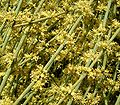
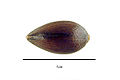
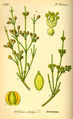
Ephedra is a genus
of gymnosperm
shrub
s, the only genus in its family, Ephedraceae, and order, Ephedrales. Ephedra grows in dry climates over wide areas of the northern hemisphere
, including southwestern North America
, Europe
, north Africa
, and southwest and central Asia
, and, in the southern hemisphere
, in South America
south to Patagonia
. In temperate climates, most Ephedra species grow on shores or in sandy soils with direct sun exposure. Common names in English include Joint-pine, Jointfir, Mormon-tea or Brigham Tea. The Chinese
name is mahuang . Ephedra is also sometimes called sea grape (from the French raisin de mer), a common name for the flowering plant Coccoloba uvifera
.
, hay fever
, and the common cold
. The alkaloid
s ephedrine
and pseudoephedrine
are active constituents of E. sinica and other members of the genus. These compounds are sympathomimetics
with stimulant
and decongestant
qualities and are related chemically to the amphetamine
s.
Pollen of Ephedra spp. was found in the Shanidar IV burial site in Iraq, suggesting its use as a medicinal plant dates to over 60,000 years ago. It has been suggested that Ephedra may be the Soma
plant of Indo-Iranian religion.
and isomers were already isolated in 1881 from Ephedra dystachia and characterized by the Japanese
organic chemist Nagai Nagayoshi of the 19th century. His work to access Ephedra drug materials to isolate a pure pharmaceutical substance, and the systematic production of semi-synthetic derivative
s thereof is relevant still today as the three species Ephedra sinica, Ephedra vulgaris and to a lesser extend Ephedra equisetina are commercially grown in Mainland China
as a source for natural ephedrines and isomers for use in pharmacy
. The application of botanical extracts from Ma Huang as a stimulant
and anorexic drug has no validity in either TCM or modern Western medicine
. E. sinica and E. vulgaris carry usually six optically active phenylethylamines, mostly ephedrine
and pseudoephedrine
with minor amounts of norephedrine, norpseudoephedrine as well as the three methylated analogs. Reliable information on the total alkaloid content of the crude drug is difficult to obtain. Based on HPLC analyses in industrial settings, the concentrations of total alkaloids in dried Herba Ephedra ranged between 1 to 4%, and in some cases up to 6%.
For a review of the alkaloid
distribution in different species of the genus
Ephedra see Jian-fang Cui (1991). Other American and European species of Ephedra, e.g. Ephedra nevadensis
(Mormon tea) have not been systematically assayed; based on unpublished field investigations, they contain very low levels (less than 0.1%) or none at all.
(unofficial).
Genus
In biology, a genus is a low-level taxonomic rank used in the biological classification of living and fossil organisms, which is an example of definition by genus and differentia...
of gymnosperm
Gymnosperm
The gymnosperms are a group of seed-bearing plants that includes conifers, cycads, Ginkgo, and Gnetales. The term "gymnosperm" comes from the Greek word gymnospermos , meaning "naked seeds", after the unenclosed condition of their seeds...
shrub
Shrub
A shrub or bush is distinguished from a tree by its multiple stems and shorter height, usually under 5–6 m tall. A large number of plants may become either shrubs or trees, depending on the growing conditions they experience...
s, the only genus in its family, Ephedraceae, and order, Ephedrales. Ephedra grows in dry climates over wide areas of the northern hemisphere
Northern Hemisphere
The Northern Hemisphere is the half of a planet that is north of its equator—the word hemisphere literally means “half sphere”. It is also that half of the celestial sphere north of the celestial equator...
, including southwestern North America
North America
North America is a continent wholly within the Northern Hemisphere and almost wholly within the Western Hemisphere. It is also considered a northern subcontinent of the Americas...
, Europe
Europe
Europe is, by convention, one of the world's seven continents. Comprising the westernmost peninsula of Eurasia, Europe is generally 'divided' from Asia to its east by the watershed divides of the Ural and Caucasus Mountains, the Ural River, the Caspian and Black Seas, and the waterways connecting...
, north Africa
Africa
Africa is the world's second largest and second most populous continent, after Asia. At about 30.2 million km² including adjacent islands, it covers 6% of the Earth's total surface area and 20.4% of the total land area...
, and southwest and central Asia
Asia
Asia is the world's largest and most populous continent, located primarily in the eastern and northern hemispheres. It covers 8.7% of the Earth's total surface area and with approximately 3.879 billion people, it hosts 60% of the world's current human population...
, and, in the southern hemisphere
Southern Hemisphere
The Southern Hemisphere is the part of Earth that lies south of the equator. The word hemisphere literally means 'half ball' or "half sphere"...
, in South America
South America
South America is a continent situated in the Western Hemisphere, mostly in the Southern Hemisphere, with a relatively small portion in the Northern Hemisphere. The continent is also considered a subcontinent of the Americas. It is bordered on the west by the Pacific Ocean and on the north and east...
south to Patagonia
Patagonia
Patagonia is a region located in Argentina and Chile, integrating the southernmost section of the Andes mountains to the southwest towards the Pacific ocean and from the east of the cordillera to the valleys it follows south through Colorado River towards Carmen de Patagones in the Atlantic Ocean...
. In temperate climates, most Ephedra species grow on shores or in sandy soils with direct sun exposure. Common names in English include Joint-pine, Jointfir, Mormon-tea or Brigham Tea. The Chinese
Chinese language
The Chinese language is a language or language family consisting of varieties which are mutually intelligible to varying degrees. Originally the indigenous languages spoken by the Han Chinese in China, it forms one of the branches of Sino-Tibetan family of languages...
name is mahuang . Ephedra is also sometimes called sea grape (from the French raisin de mer), a common name for the flowering plant Coccoloba uvifera
Coccoloba uvifera
Coccoloba uvifera is a species of flowering plant in the buckwheat family, Polygonaceae, that is native to coastal beaches throughout tropical America and the Caribbean, including southern Florida, the Bahamas, Barbados and Bermuda...
.
Medical uses
Plants of the Ephedra genus, including E. sinica and others, have traditionally been used by indigenous people for a variety of medicinal purposes, including treatment of asthmaAsthma
Asthma is the common chronic inflammatory disease of the airways characterized by variable and recurring symptoms, reversible airflow obstruction, and bronchospasm. Symptoms include wheezing, coughing, chest tightness, and shortness of breath...
, hay fever
Hay Fever
Hay Fever is a comic play written by Noël Coward in 1924 and first produced in 1925 with Marie Tempest as the first Judith Bliss. Laura Hope Crews played the role in New York...
, and the common cold
Common cold
The common cold is a viral infectious disease of the upper respiratory system, caused primarily by rhinoviruses and coronaviruses. Common symptoms include a cough, sore throat, runny nose, and fever...
. The alkaloid
Alkaloid
Alkaloids are a group of naturally occurring chemical compounds that contain mostly basic nitrogen atoms. This group also includes some related compounds with neutral and even weakly acidic properties. Also some synthetic compounds of similar structure are attributed to alkaloids...
s ephedrine
Ephedrine
Ephedrine is a sympathomimetic amine commonly used as a stimulant, appetite suppressant, concentration aid, decongestant, and to treat hypotension associated with anaesthesia....
and pseudoephedrine
Pseudoephedrine
Pseudoephedrine is a sympathomimetic drug of the phenethylamine and amphetamine chemical classes. It is used as a nasal/sinus decongestant and stimulant, or as a wakefulness-promoting agent....
are active constituents of E. sinica and other members of the genus. These compounds are sympathomimetics
Sympathomimetic amine
Sympathomimetic drugs mimic the effects of transmitter substances of the sympathetic nervous system such as catecholamines, epinephrine , norepinephrine , dopamine, etc...
with stimulant
Stimulant
Stimulants are psychoactive drugs which induce temporary improvements in either mental or physical function or both. Examples of these kinds of effects may include enhanced alertness, wakefulness, and locomotion, among others...
and decongestant
Decongestant
A decongestant or nasal decongestant is a type of drug that is used to relieve nasal congestion.-Pharmacology:The vast majority of decongestants act via enhancing norepinephrine and epinephrine or adrenergic activity by stimulating the α-adrenergic receptors...
qualities and are related chemically to the amphetamine
Amphetamine
Amphetamine or amfetamine is a psychostimulant drug of the phenethylamine class which produces increased wakefulness and focus in association with decreased fatigue and appetite.Brand names of medications that contain, or metabolize into, amphetamine include Adderall, Dexedrine, Dextrostat,...
s.
Pollen of Ephedra spp. was found in the Shanidar IV burial site in Iraq, suggesting its use as a medicinal plant dates to over 60,000 years ago. It has been suggested that Ephedra may be the Soma
Soma
Soma , or Haoma , from Proto-Indo-Iranian *sauma-, was a ritual drink of importance among the early Indo-Iranians, and the subsequent Vedic and greater Persian cultures. It is frequently mentioned in the Rigveda, whose Soma Mandala contains 114 hymns, many praising its energizing qualities...
plant of Indo-Iranian religion.
Species
|
Ephedra funerea Ephedra funerea is a species of Ephedra known by the common name Death Valley jointfir, or Death Valley ephedra. It is native to the Mojave Desert of California and Nevada. This shrub is made up of erect twigs which are gray-green when new and age to gray and cracked. There are tiny leaves at nodes... Coville & Morton – Death Valley Ephedra, Death Valley Jointfir Ephedra holoptera Ephedra holoptera is a species of Ephedra that is native to Iran. It was originally described by Harald Udo von Riedl in 1963. It has been placed in section Alatae.... Riedl Ephedra intermedia Ephedra intermedia is a species of Ephedra that is native to Southwest and Central Asia. It was originally described by Alexander Gustav von Schrenk and Carl Anton von Meyer in 1846 and placed in section Pseudobaccatae , "tribe" Pachycladae by Otto Stapf in 1889. In 1996 Robert A... Schrenk ex C.A.Meyer Ephedra lomatolepis Ephedra lomatolepis is a species of Ephedra that is native to central Asia. It was originally described by Alexander Gustav von Schrenk in 1844. Otto Stapf's worldwide monograph on the genus included this species, but Stapf did not place it in a section. Later, it was placed in section Alatae.... Shrenk
Ephedra multiflora Ephedra multiflora is a species of Ephedra that is native to northern Chile and Argentina. It was originally described by Rodolfo Armando Philippi, later formally published by Otto Stapf in 1887, and placed in section Alatae, "tribe" Habrolepides by Stapf in 1889. In 1996 Robert A. Price left... Phil. ex Stapf Ephedra nevadensis Ephedra nevadensis is a species of Ephedra native to dry areas of western North America.Its range extends west to California and Oregon, east to Texas, and south to Mexico, including areas of the Great Basin, Colorado plateau and desert Southwest... S.Wats. – Nevada Ephedra, Nevada Jointfir, Nevada Mormon-tea Ephedra przewalskii Ephedra przewalskii is a species of Ephedra that is native to northwestern China and Mongolia. It was originally described by Otto Stapf in 1889 and placed in section Alatae, tribe Tropidolepides. In 1996 Robert A. Price left E. przewalskii in section Alatae without recognizing a tribe.... Stapf
Ephedra strobilacea Ephedra strobilacea is a species of Ephedra that is native to central Asia west to Afghanistan. It was originally described by Alexander G. von Bunge in 1851 and placed in section Alatae, tribe Tropidolepides by Otto Stapf in 1889. In 1996 Robert A. Price left E. strobilacea in section Alatae... Bunge Ephedra torreyana Ephedra torreyana is a species of Ephedra that is native to the Southwestern United States and northern Mexico. It was originally described by Sereno Watson in 1879 and placed in section Alatae, "tribe" Habrolepides by Otto Stapf in 1889. In 1996 Robert A. Price left E. torreyana in section... S.Wats. – Torrey's Ephedra, Torrey's Jointfir, Torrey's Mormon-tea, Cañutillo Ephedra trifurca Ephedra trifurca is a species of Ephedra known by the common names longleaf jointfir and Mexican tea. It is native to many of the northern states of Mexico and the southwestern United States, where it is a resident of desert scrub plant communities.This sprawling shrub may approach two meters in... Torrey ex S.Wats. – Longleaf Ephedra, Longleaf Jointfir, Longleaf Mormon-tea, Popotilla, Teposote Ephedra viridis Ephedra viridis is a species of Ephedra known by the common names green ephedra and green Mormon tea. It is native to the western United States, where it is a member of varied scrub, woodland, and open habitats.-Description:... Coville – Green Ephedra, Green Mormon-tea |
Economic botany and alkaloid content
Earliest uses of Ephedra spp. (Ma Huang) for specific illnesses date back to 5000 BC. EphedrineEphedrine
Ephedrine is a sympathomimetic amine commonly used as a stimulant, appetite suppressant, concentration aid, decongestant, and to treat hypotension associated with anaesthesia....
and isomers were already isolated in 1881 from Ephedra dystachia and characterized by the Japanese
Japanese people
The are an ethnic group originating in the Japanese archipelago and are the predominant ethnic group of Japan. Worldwide, approximately 130 million people are of Japanese descent; of these, approximately 127 million are residents of Japan. People of Japanese ancestry who live in other countries...
organic chemist Nagai Nagayoshi of the 19th century. His work to access Ephedra drug materials to isolate a pure pharmaceutical substance, and the systematic production of semi-synthetic derivative
Derivative
In calculus, a branch of mathematics, the derivative is a measure of how a function changes as its input changes. Loosely speaking, a derivative can be thought of as how much one quantity is changing in response to changes in some other quantity; for example, the derivative of the position of a...
s thereof is relevant still today as the three species Ephedra sinica, Ephedra vulgaris and to a lesser extend Ephedra equisetina are commercially grown in Mainland China
Mainland China
Mainland China, the Chinese mainland or simply the mainland, is a geopolitical term that refers to the area under the jurisdiction of the People's Republic of China . According to the Taipei-based Mainland Affairs Council, the term excludes the PRC Special Administrative Regions of Hong Kong and...
as a source for natural ephedrines and isomers for use in pharmacy
Pharmacy
Pharmacy is the health profession that links the health sciences with the chemical sciences and it is charged with ensuring the safe and effective use of pharmaceutical drugs...
. The application of botanical extracts from Ma Huang as a stimulant
Stimulant
Stimulants are psychoactive drugs which induce temporary improvements in either mental or physical function or both. Examples of these kinds of effects may include enhanced alertness, wakefulness, and locomotion, among others...
and anorexic drug has no validity in either TCM or modern Western medicine
Medicine
Medicine is the science and art of healing. It encompasses a variety of health care practices evolved to maintain and restore health by the prevention and treatment of illness....
. E. sinica and E. vulgaris carry usually six optically active phenylethylamines, mostly ephedrine
Ephedrine
Ephedrine is a sympathomimetic amine commonly used as a stimulant, appetite suppressant, concentration aid, decongestant, and to treat hypotension associated with anaesthesia....
and pseudoephedrine
Pseudoephedrine
Pseudoephedrine is a sympathomimetic drug of the phenethylamine and amphetamine chemical classes. It is used as a nasal/sinus decongestant and stimulant, or as a wakefulness-promoting agent....
with minor amounts of norephedrine, norpseudoephedrine as well as the three methylated analogs. Reliable information on the total alkaloid content of the crude drug is difficult to obtain. Based on HPLC analyses in industrial settings, the concentrations of total alkaloids in dried Herba Ephedra ranged between 1 to 4%, and in some cases up to 6%.
For a review of the alkaloid
Alkaloid
Alkaloids are a group of naturally occurring chemical compounds that contain mostly basic nitrogen atoms. This group also includes some related compounds with neutral and even weakly acidic properties. Also some synthetic compounds of similar structure are attributed to alkaloids...
distribution in different species of the genus
Genus
In biology, a genus is a low-level taxonomic rank used in the biological classification of living and fossil organisms, which is an example of definition by genus and differentia...
Ephedra see Jian-fang Cui (1991). Other American and European species of Ephedra, e.g. Ephedra nevadensis
Ephedra nevadensis
Ephedra nevadensis is a species of Ephedra native to dry areas of western North America.Its range extends west to California and Oregon, east to Texas, and south to Mexico, including areas of the Great Basin, Colorado plateau and desert Southwest...
(Mormon tea) have not been systematically assayed; based on unpublished field investigations, they contain very low levels (less than 0.1%) or none at all.
Cultural reference
Represents the provincial flower of Balochistan (Pakistan)Balochistan (Pakistan)
Balochistan is one of the four provinces or federating units of Pakistan. With an area of 134,051 mi2 or , it is the largest province of Pakistan, constituting approximately 44% of the total land mass of Pakistan. According to the 1998 population census, Balochistan had a population of...
(unofficial).