

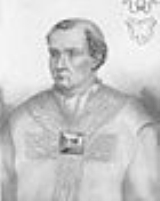
Pope Nicholas I

Encyclopedia
Pope Nicholas I, or Saint Nicholas the Great, reigned from April 24, 858 until his death. He is remembered as a consolidator of papal authority and power, exerting decisive influence upon the historical development of the papacy and its position among the Christian nations of Western Europe.
He is venerated as a saint in the Roman Catholic Church
, with a feast day on 13 November.
He refused to grant an annulment to Lothar II
from Theutberga so that Lothar could marry his mistress Waldrada; when a Council pronounced in favor of annulment, Nicholas I declared the Council to be deposed, its messengers excommunicated, and its decisions void. Despite pressure from the Carolingian
s, who laid siege to Rome, his decision held. During his reign, relations with the Byzantine Empire
soured over his support for Ignatius
as Patriarch of Constantinople
, who had been removed and Photius appointed to replace him.
(844–847), and deacon by Leo IV
(847–855). After the death of Benedict III (April 7, 858), Louis II, Holy Roman Emperor
, who was in the neighbourhood of Rome, came into the city to exert his influence upon the election. On April 24 Nicholas was elected pope, consecrated, and enthroned in St. Peter's in the presence of the emperor. Three days after, he held a farewell banquet for the emperor, and afterward, accompanied by the Roman nobility, visited him in his camp before the city, on which occasion the emperor came to meet the pope and led his horse for some distance.
He was filled with a high conception of his mission for the vindication of Christian morality, the defence of God's law against powerful, worldly failings.
Going in person to Ravenna, the pope then investigated and equitably regulated everything. Again appealing to the emperor, the archbishop was recommended by him to submit to the pope, which he did at the Roman Synod of November 861. Later on, however, he entered into a pact with the excommunicated archbishops of Trier and Cologne, was himself again excommunicated, and once more forced to make his submission to the pope. Another conflict arose between Nicholas and Archbishop Hincmar of Reims: this concerned the prerogatives of the papacy. Bishop Rothad of Soissons had appealed to the pope against the decision of the Synod of Soissons, of 861, which had deposed him; Hincmar opposed the appeal to the pope, but eventually had to acknowledge the right of the papacy to take cognizance of important legal causes (causae majores) and pass independent judgment upon them. A further dispute broke out between Hincmar and the pope as to the elevation of the cleric Wulfad to the archiepiscopal See of Bourges, but here, again, Hincmar finally submitted to the decrees of the Apostolic See, and the Frankish synods passed corresponding ordinances.
to excommunicate her unless she returned to her husband. As she paid no attention to the summons to appear before the Synod of Milan
in 860, she was put under the ban.
The pope was also involved in a desperate struggle with his fake wife of Lorraine over the inviolability of marriage. Lothair had abandoned his lawful wife Theutberga to marry Waldrada. At the Synod of Aachen, April 28, 862, the bishops of Lorraine approved this union, contrary to ecclesiastical law. At the Synod of Metz, June 863, the papal legates, bribed by the king, assented to the Aachen decision, and condemned the absent Theutberga. Upon this the pope brought the matter before his own tribunal. The two archbishops, Günther of Cologne and Thietgaud of Trier, who had come to Rome as delegates, were summoned before the Lateran Synod of October, 863, when the pope condemned and deposed them as well as John of Ravenna and Hagano of Bergamo. The Emperor Louis II took up the cause of the deposed bishops, while King Lothair advanced upon Rome with an army and laid siege to the city, so that the pope was confined for two days in St. Peter's without food. Yet Nicholas did not waver in his determination; after being reconciled with the pope, the emperor withdrew from Rome and commanded the former Archbishops of Trier and Cologne to return to their homes. Nicholas never ceased from his efforts to bring about a reconciliation between Lothair and his lawful
wife, but without effect.
Another matrimonial case in which Nicholas interposed was that of Judith, daughter of Charles the Bald, who had married Baldwin, Count of Flanders
, without her father's consent. Frankish bishops had excommunicated Judith, and Hincmar of Reims had taken sides against her, but Nicholas urged leniency, in order to protect freedom of marriage.
Ignatius
was deposed in 857 and Photius raised to the patriarchal see. In a letter addressed (8 May 862), to the patriarchs of the East, Nicholas called upon them and all their bishops to refuse recognition to Photius, and at a Roman synod held in April 863, he excommunicated Photius.
By the will of the Emperor, Photius was elected lawfully and canonically in 858 according to the Church of Constantinople. (This was affirmed later in 879 in a council regarded as ecumenical by some in the Orthodox Church.) Ignatius’ elevation to the Patriarchate was declared to be uncanonical and Photius was acclaimed as properly elected as the new Patriarch. This led to conflict between Constantinople and Rome over doctrinal issues such as the addition of the Filioque to the Nicene-Constantinopolitan Creed and territorial claims due to the Church of Constantinople's seizure of territory from the Roman Patriarchate in southern Italy and Sicily Nicholas' pressing of the doctrine of papal primacy. An synod at Constantinople in 867 excommunicated Pope Nicholas and rejected his claims of primacy, his efforts to convert Bulgaria, and the addition of the Filioque
in parts of the Latin Church.
For a variety of reasons, Boris I of Bulgaria
became interested in converting to Christianity and undertook to do that at the hands of western clergymen to be supplied by Louis the German
in 863. Late in the same year, the Byzantine Empire invaded Bulgaria
as Bulgaria suffered famine and natural disasters. Boris was forced to sue for peace. Because the majority of his people were still opposed to Christianity, he was secretly baptized according to the Byzantine rite. The Byzantine Emperor who became his godfather conceded to him territory in Thrace.
Unhappy with Byzantine influence and desiring an autocephalous status which Photius was unwilling to grant, Boris sent an embassy to pope Nicholas with one hundred six questions on the teaching and discipline of the Church in August 866. Nicholas answered these inquiries in his "Responsa Nicolai ad consulta Bulgarorum" (Mansi
, "Coll. Conc.", XV, 401 sqq.) and sent missionaries under the papal legate bishop Formosus. When pope Hadrian II rejected Boris' request that either Formosus or Deacon Marinus (later Pope Marinus I) be made archbishop of Bulgaria, Boris began to look again towards Constantinople. In 870 a council of Constantinople granted the Church of Bulgaria
autocephalous status and Greek priests were sent as missionaries and were soon replaced by the Bulgarian.
, Archbishop of Bremen, and his successors the office of papal legate to the Danes, Swedes, and Slavs. In many other ecclesiastical matters, he issued letters and decisions, and he took active measures against bishops who were neglectful of their duties.
At Rome, Nicholas rebuilt and endowed several churches, and constantly sought to encourage religious life. His led a pious personal life guided by a spirit of Christian asceticism. Regino of Prüm
reports that Nicholas was highly esteemed by the citizens of Rome and by his contemporaries generally (Chronicon, "ad annum 868," in "Mon. Germ. Hist." Script.", I.579), and after death was regarded as a saint.
A much discussed question and one that is important in judging the position taken by this pope is whether he made use of the forged pseudo-Isidorian
papal decretals. After exhaustive investigation, Schrörs has decided that the pope was neither acquainted with the pseudo-Isidorian collection in its entire extent, nor did he make use of its individual parts; that he had perhaps a general knowledge of the false decretals, but did not base his view of the law upon them, and that he owed his knowledge of them solely to documents which came to him from the Frankish Empire [Schrörs, "Papst Nikolaus I. und Pseudo-Isidor" in Historisches Jahrbuch, XXV (1904), 1 sqq.; Idem, "Die pseudoisidorische 'Exceptio spolii' bei Papst Nikolaus I" in Historisches Jahrbuch, XXVI (1905), 275 sqq.].
He is venerated as a saint in the Roman Catholic Church
Roman Catholic Church
The Catholic Church, also known as the Roman Catholic Church, is the world's largest Christian church, with over a billion members. Led by the Pope, it defines its mission as spreading the gospel of Jesus Christ, administering the sacraments and exercising charity...
, with a feast day on 13 November.
He refused to grant an annulment to Lothar II
Lothair II of Lotharingia
Lothair II was the second son of Emperor Lothair I and Ermengarde of Tours. He was married to Teutberga, daughter of Boso the Elder. He is the namesake of the Lothair Crystal, which he probably commissioned, and of the Cross of Lothair, which was made over a century after his death but...
from Theutberga so that Lothar could marry his mistress Waldrada; when a Council pronounced in favor of annulment, Nicholas I declared the Council to be deposed, its messengers excommunicated, and its decisions void. Despite pressure from the Carolingian
Carolingian
The Carolingian dynasty was a Frankish noble family with origins in the Arnulfing and Pippinid clans of the 7th century AD. The name "Carolingian", Medieval Latin karolingi, an altered form of an unattested Old High German *karling, kerling The Carolingian dynasty (known variously as the...
s, who laid siege to Rome, his decision held. During his reign, relations with the Byzantine Empire
Byzantine Empire
The Byzantine Empire was the Eastern Roman Empire during the periods of Late Antiquity and the Middle Ages, centred on the capital of Constantinople. Known simply as the Roman Empire or Romania to its inhabitants and neighbours, the Empire was the direct continuation of the Ancient Roman State...
soured over his support for Ignatius
Patriarch Ignatios of Constantinople
St. Ignatius or Ignatios , Patriarch of Constantinople from July 4, 847 to October 23, 858 and from November 23, 867 to his death on October 23, 877...
as Patriarch of Constantinople
Patriarch of Constantinople
The Ecumenical Patriarch is the Archbishop of Constantinople – New Rome – ranking as primus inter pares in the Eastern Orthodox communion, which is seen by followers as the One, Holy, Catholic, and Apostolic Church....
, who had been removed and Photius appointed to replace him.
Early life
Born to a distinguished family, son of the Defensor Theodore, Nicholas received excellent training. Distinguished for his piety, benevolence, ability, knowledge, and eloquence, he entered the service of the Church at an early age, was made subdeacon by Pope Sergius IIPope Sergius II
Pope Sergius II was Pope from January 844 – January 24, 847.On the death of Gregory IV the archdeacon John was proclaimed pope by popular acclamation, while the nobility elected Sergius, a Roman of noble birth. The opposition was suppressed, with Sergius intervening to save John's life...
(844–847), and deacon by Leo IV
Pope Leo IV
Pope Saint Leo IV was pope from 10 April 847 to 17 July 855.A Roman by birth, he was unanimously chosen to succeed Sergius II. When he was elected, on 10 April 847, he was cardinal of Santi Quattro Coronati, and had been subdeacon of Gregory IV and archpriest under his predecessor...
(847–855). After the death of Benedict III (April 7, 858), Louis II, Holy Roman Emperor
Louis II, Holy Roman Emperor
Louis II the Younger was the King of Italy and Roman Emperor from 844, co-ruling with his father Lothair I until 855, after which he ruled alone. Louis's usual title was imperator augustus , but he used imperator Romanorum after his conquest of Bari in 871, which led to poor relations with Byzantium...
, who was in the neighbourhood of Rome, came into the city to exert his influence upon the election. On April 24 Nicholas was elected pope, consecrated, and enthroned in St. Peter's in the presence of the emperor. Three days after, he held a farewell banquet for the emperor, and afterward, accompanied by the Roman nobility, visited him in his camp before the city, on which occasion the emperor came to meet the pope and led his horse for some distance.
Papacy
To a spiritually exhausted and politically uncertain Western Europe beset by Muslim and Norse incursions, Pope Nicholas appeared as a conscientious representative of the Roman primacy in the Church.He was filled with a high conception of his mission for the vindication of Christian morality, the defence of God's law against powerful, worldly failings.
Bishops
Archbishop John of Ravenna oppressed the inhabitants of the papal territory, treated his suffragan bishops with violence, made unjust demands upon them for money, and illegally imprisoned priests. He also forged documents to support his claims against the Roman See and maltreated the papal legates. As the warnings of the pope were without result, and the archbishop ignored a thrice-repeated summons to appear before the papal tribunal, he was excommunicated. Having first visited the Emperor Louis at Pavia, the archbishop repaired, with two imperial delegates to Rome, where Nicholas cited him before the Roman synod assembled in the autumn of 860. Upon this John fled from Rome.Going in person to Ravenna, the pope then investigated and equitably regulated everything. Again appealing to the emperor, the archbishop was recommended by him to submit to the pope, which he did at the Roman Synod of November 861. Later on, however, he entered into a pact with the excommunicated archbishops of Trier and Cologne, was himself again excommunicated, and once more forced to make his submission to the pope. Another conflict arose between Nicholas and Archbishop Hincmar of Reims: this concerned the prerogatives of the papacy. Bishop Rothad of Soissons had appealed to the pope against the decision of the Synod of Soissons, of 861, which had deposed him; Hincmar opposed the appeal to the pope, but eventually had to acknowledge the right of the papacy to take cognizance of important legal causes (causae majores) and pass independent judgment upon them. A further dispute broke out between Hincmar and the pope as to the elevation of the cleric Wulfad to the archiepiscopal See of Bourges, but here, again, Hincmar finally submitted to the decrees of the Apostolic See, and the Frankish synods passed corresponding ordinances.
Marriage laws
Nicholas showed the same zeal in other efforts to maintain ecclesiastical discipline, especially as to the marriage laws. Ingiltrud, wife of Count Boso, had left her husband for a paramour; Nicholas commanded the bishops in the dominions of Charles the BaldCharles the Bald
Charles the Bald , Holy Roman Emperor and King of West Francia , was the youngest son of the Emperor Louis the Pious by his second wife Judith.-Struggle against his brothers:He was born on 13 June 823 in Frankfurt, when his elder...
to excommunicate her unless she returned to her husband. As she paid no attention to the summons to appear before the Synod of Milan
Synod of Milan
There are at least four synods that can be called Synod of Milan , all of which took place in Mediolanum .- Synod of 345 :...
in 860, she was put under the ban.
The pope was also involved in a desperate struggle with his fake wife of Lorraine over the inviolability of marriage. Lothair had abandoned his lawful wife Theutberga to marry Waldrada. At the Synod of Aachen, April 28, 862, the bishops of Lorraine approved this union, contrary to ecclesiastical law. At the Synod of Metz, June 863, the papal legates, bribed by the king, assented to the Aachen decision, and condemned the absent Theutberga. Upon this the pope brought the matter before his own tribunal. The two archbishops, Günther of Cologne and Thietgaud of Trier, who had come to Rome as delegates, were summoned before the Lateran Synod of October, 863, when the pope condemned and deposed them as well as John of Ravenna and Hagano of Bergamo. The Emperor Louis II took up the cause of the deposed bishops, while King Lothair advanced upon Rome with an army and laid siege to the city, so that the pope was confined for two days in St. Peter's without food. Yet Nicholas did not waver in his determination; after being reconciled with the pope, the emperor withdrew from Rome and commanded the former Archbishops of Trier and Cologne to return to their homes. Nicholas never ceased from his efforts to bring about a reconciliation between Lothair and his lawful
Catholic marriage
Catholic marriage, also called matrimony, is a "covenant by which a man and a woman establish between themselves a partnership of the whole of life and which is ordered by its nature to the good of the spouses and the procreation and education of offspring...
wife, but without effect.
Another matrimonial case in which Nicholas interposed was that of Judith, daughter of Charles the Bald, who had married Baldwin, Count of Flanders
Baldwin I, Count of Flanders
Baldwin I , also known as Baldwin Iron Arm , was the first count of Flanders....
, without her father's consent. Frankish bishops had excommunicated Judith, and Hincmar of Reims had taken sides against her, but Nicholas urged leniency, in order to protect freedom of marriage.
Relations with the Eastern Church
Nicholas was seen in the East as trying to extend his papal power beyond what was the canonical authority asserting a "rulership" over the Church instead of the position of "highest honor among equals" accorded to the pope of Rome by the East. He contended that, in violation of ecclesiastical law, the PatriarchPatriarch of Constantinople
The Ecumenical Patriarch is the Archbishop of Constantinople – New Rome – ranking as primus inter pares in the Eastern Orthodox communion, which is seen by followers as the One, Holy, Catholic, and Apostolic Church....
Ignatius
Patriarch Ignatios of Constantinople
St. Ignatius or Ignatios , Patriarch of Constantinople from July 4, 847 to October 23, 858 and from November 23, 867 to his death on October 23, 877...
was deposed in 857 and Photius raised to the patriarchal see. In a letter addressed (8 May 862), to the patriarchs of the East, Nicholas called upon them and all their bishops to refuse recognition to Photius, and at a Roman synod held in April 863, he excommunicated Photius.
By the will of the Emperor, Photius was elected lawfully and canonically in 858 according to the Church of Constantinople. (This was affirmed later in 879 in a council regarded as ecumenical by some in the Orthodox Church.) Ignatius’ elevation to the Patriarchate was declared to be uncanonical and Photius was acclaimed as properly elected as the new Patriarch. This led to conflict between Constantinople and Rome over doctrinal issues such as the addition of the Filioque to the Nicene-Constantinopolitan Creed and territorial claims due to the Church of Constantinople's seizure of territory from the Roman Patriarchate in southern Italy and Sicily Nicholas' pressing of the doctrine of papal primacy. An synod at Constantinople in 867 excommunicated Pope Nicholas and rejected his claims of primacy, his efforts to convert Bulgaria, and the addition of the Filioque
Filioque clause
Filioque , Latin for "and the Son", is a phrase found in the form of Nicene Creed in use in the Latin Church. It is not present in the Greek text of the Nicene Creed as originally formulated at the First Council of Constantinople, which says only that the Holy Spirit proceeds "from the Father":The...
in parts of the Latin Church.
For a variety of reasons, Boris I of Bulgaria
Boris I of Bulgaria
Boris I, also known as Boris-Mihail and Bogoris was the Knyaz of First Bulgarian Empire in 852–889. At the time of his baptism in 864, Boris was named Michael after his godfather, Emperor Michael III...
became interested in converting to Christianity and undertook to do that at the hands of western clergymen to be supplied by Louis the German
Louis the German
Louis the German , also known as Louis II or Louis the Bavarian, was a grandson of Charlemagne and the third son of the succeeding Frankish Emperor Louis the Pious and his first wife, Ermengarde of Hesbaye.He received the appellation 'Germanicus' shortly after his death in recognition of the fact...
in 863. Late in the same year, the Byzantine Empire invaded Bulgaria
First Bulgarian Empire
The First Bulgarian Empire was a medieval Bulgarian state founded in the north-eastern Balkans in c. 680 by the Bulgars, uniting with seven South Slavic tribes...
as Bulgaria suffered famine and natural disasters. Boris was forced to sue for peace. Because the majority of his people were still opposed to Christianity, he was secretly baptized according to the Byzantine rite. The Byzantine Emperor who became his godfather conceded to him territory in Thrace.
Unhappy with Byzantine influence and desiring an autocephalous status which Photius was unwilling to grant, Boris sent an embassy to pope Nicholas with one hundred six questions on the teaching and discipline of the Church in August 866. Nicholas answered these inquiries in his "Responsa Nicolai ad consulta Bulgarorum" (Mansi
Giovanni Domenico Mansi
Gian Domenico Mansi was an Italian theologian, scholar and historian, known for his massive works on the Church councils....
, "Coll. Conc.", XV, 401 sqq.) and sent missionaries under the papal legate bishop Formosus. When pope Hadrian II rejected Boris' request that either Formosus or Deacon Marinus (later Pope Marinus I) be made archbishop of Bulgaria, Boris began to look again towards Constantinople. In 870 a council of Constantinople granted the Church of Bulgaria
Bulgarian Orthodox Church
The Bulgarian Orthodox Church - Bulgarian Patriarchate is an autocephalous Eastern Orthodox Church with some 6.5 million members in the Republic of Bulgaria and between 1.5 and 2.0 million members in a number of European countries, the Americas and Australia...
autocephalous status and Greek priests were sent as missionaries and were soon replaced by the Bulgarian.
Legacy
He encouraged the missionary activity of the Church. He sanctioned the union of the Sees of Bremen and Hamburg, and confirmed to St. AnscharAnsgar
Saint Ansgar, Anskar or Oscar, was an Archbishop of Hamburg-Bremen. The see of Hamburg was designated a "Mission to bring Christianity to the North", and Ansgar became known as the "Apostle of the North".-Life:After his mother’s early death Ansgar was brought up in Corbie Abbey, and made rapid...
, Archbishop of Bremen, and his successors the office of papal legate to the Danes, Swedes, and Slavs. In many other ecclesiastical matters, he issued letters and decisions, and he took active measures against bishops who were neglectful of their duties.
At Rome, Nicholas rebuilt and endowed several churches, and constantly sought to encourage religious life. His led a pious personal life guided by a spirit of Christian asceticism. Regino of Prüm
Regino of Prüm
Reginon or Regino of Prüm was a Benedictine abbot and medieval chronicler.-Biography:According to the statements of a later era, Regino was the son of noble parents and was born at the stronghold of Altrip on the Rhine near Speyer at an unknown date...
reports that Nicholas was highly esteemed by the citizens of Rome and by his contemporaries generally (Chronicon, "ad annum 868," in "Mon. Germ. Hist." Script.", I.579), and after death was regarded as a saint.
A much discussed question and one that is important in judging the position taken by this pope is whether he made use of the forged pseudo-Isidorian
Pseudo-Isidore
Pseudo-Isidore is the pseudonym given to the scholar or group of scholars responsible for the Pseudo-Isidorean Decretals, the most extensive and influential set of forgeries found in medieval Canon law. The authors were a group of Frankish clerics writing in the second quarter of the ninth century...
papal decretals. After exhaustive investigation, Schrörs has decided that the pope was neither acquainted with the pseudo-Isidorian collection in its entire extent, nor did he make use of its individual parts; that he had perhaps a general knowledge of the false decretals, but did not base his view of the law upon them, and that he owed his knowledge of them solely to documents which came to him from the Frankish Empire [Schrörs, "Papst Nikolaus I. und Pseudo-Isidor" in Historisches Jahrbuch, XXV (1904), 1 sqq.; Idem, "Die pseudoisidorische 'Exceptio spolii' bei Papst Nikolaus I" in Historisches Jahrbuch, XXVI (1905), 275 sqq.].