


Filioque clause

Encyclopedia
Latin
Latin is an Italic language originally spoken in Latium and Ancient Rome. It, along with most European languages, is a descendant of the ancient Proto-Indo-European language. Although it is considered a dead language, a number of scholars and members of the Christian clergy speak it fluently, and...
for "and (from) the Son", is a phrase found in the form of Nicene Creed
Nicene Creed
The Nicene Creed is the creed or profession of faith that is most widely used in Christian liturgy. It is called Nicene because, in its original form, it was adopted in the city of Nicaea by the first ecumenical council, which met there in the year 325.The Nicene Creed has been normative to the...
in use in the Latin Church
Latin Church
The Latin Church is the largest particular church within the Catholic Church. It is a particular church not on the level of the local particular churches known as dioceses or eparchies, but on the level of autonomous ritual churches, of which there are 23, the remaining 22 of which are Eastern...
. It is not present in the Greek text of the Nicene Creed
Nicene Creed
The Nicene Creed is the creed or profession of faith that is most widely used in Christian liturgy. It is called Nicene because, in its original form, it was adopted in the city of Nicaea by the first ecumenical council, which met there in the year 325.The Nicene Creed has been normative to the...
as originally formulated at the First Council of Constantinople
First Council of Constantinople
The First Council of Constantinople is recognized as the Second Ecumenical Council by the Assyrian Church of the East, the Oriental Orthodox, the Eastern Orthodox, the Roman Catholics, the Old Catholics, and a number of other Western Christian groups. It was the first Ecumenical Council held in...
, which says only that the Holy Spirit proceeds "from the Father":
- Καὶ εἰς τὸ Πνεῦμα τὸ Ἅγιον, τὸ κύριον, τὸ ζωοποιόν, τὸ ἐκ τοῦ Πατρὸς ἐκπορευόμενον.
The Latin text speaks of the Holy Spirit as proceeding "from the Father and the Son".
- Et in Spiritum Sanctum, Dominum, et vivificantem: qui ex Patre Filioque procedit.
The first known case in the West of insertion of "and the Son" into the Nicene Creed was when the word Filioque was added, perhaps unintentionally, to the Latin text of the Creed at the local Third Council of Toledo
Third Council of Toledo
The Third Council of Toledo marks the entry of Catholic Christianity into the rule of Visigothic Spain, and the introduction into Western Christianity of the filioque clause...
(589) and its inclusion later spread spontaneously not only in Spain, but throughout the Frankish Empire. and elsewhere. In the 9th century, Pope Leo III
Pope Leo III
Pope Saint Leo III was Pope from 795 to his death in 816. Protected by Charlemagne from his enemies in Rome, he subsequently strengthened Charlemagne's position by crowning him as Roman Emperor....
, while accepting the doctrine, like his predecessor Pope Leo I
Pope Leo I
Pope Leo I was pope from September 29, 440 to his death.He was an Italian aristocrat, and is the first pope of the Catholic Church to have been called "the Great". He is perhaps best known for having met Attila the Hun in 452, persuading him to turn back from his invasion of Italy...
, tried in vain to suppress the addition of the Filioque. In 1014, however, singing of the Creed, with Filioque included, was adopted in the celebration of the Mass
Mass (liturgy)
"Mass" is one of the names by which the sacrament of the Eucharist is called in the Roman Catholic Church: others are "Eucharist", the "Lord's Supper", the "Breaking of Bread", the "Eucharistic assembly ", the "memorial of the Lord's Passion and Resurrection", the "Holy Sacrifice", the "Holy and...
in Rome. Since its denunciation by Photios I of Constantinople (see the Photian schism
Photian schism
The Photian schism is a term for a controversy lasting from 863-867 between Eastern and Western Christianity....
of 863-867), the Filioque has been an ongoing source of conflict between the East and West, contributing to the East-West Schism
East-West Schism
The East–West Schism of 1054, sometimes known as the Great Schism, formally divided the State church of the Roman Empire into Eastern and Western branches, which later became known as the Eastern Orthodox Church and the Roman Catholic Church, respectively...
of 1054 and proving an obstacle to attempts to reunify the two sides.
New Testament
Anthony E. Siecienski asserts that it is important to recognize that "the New Testament does not explicitly address the procession of the Holy Spirit as later theology would understand the doctrine." However, he asserts that there are, nonetheless "certain principles established in the New Testament that shaped later Latin Trinitarian theology, and particular texts that both Latins and Greeks exploited to support their respective positions vis-à-vis the filioque." The Orthodox believe that the absence of an explicit mention of the double procession of the Holy Spirit is a strong indication that the filioque is a theologically erroneous doctrine.In Jesus says of the Holy Spirit "he will take what is mine and declare it to you", and it is argued that in the relations between the Persons of the Trinity one Person cannot "take" or "receive" (λήψεται) anything from either of the others except by way of procession. Texts such as ("He breathed on them and said: Receive the Holy Spirit"), were seen by Fathers of the Church, especially Athanasius, Cyril of Alexandria and Epiphanius of Cyprus as grounds for saying that the Spirit "proceeds substantially from both" the Father and the Son. Other texts that have been used include ,, , where the Holy Spirit is called "the Spirit of the Son", "the Spirit of Christ", "the Spirit of Jesus Christ", and texts in the Gospel of John
Gospel of John
The Gospel According to John , commonly referred to as the Gospel of John or simply John, and often referred to in New Testament scholarship as the Fourth Gospel, is an account of the public ministry of Jesus...
on the sending of the Holy Spirit by Jesus .
The Nicene Creed
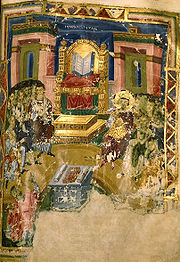
First Council of Nicaea
The First Council of Nicaea was a council of Christian bishops convened in Nicaea in Bithynia by the Roman Emperor Constantine I in AD 325...
(325) ended its Creed
Nicene Creed
The Nicene Creed is the creed or profession of faith that is most widely used in Christian liturgy. It is called Nicene because, in its original form, it was adopted in the city of Nicaea by the first ecumenical council, which met there in the year 325.The Nicene Creed has been normative to the...
with the words "and in the Holy Spirit". The second, that of Constantinople
First Council of Constantinople
The First Council of Constantinople is recognized as the Second Ecumenical Council by the Assyrian Church of the East, the Oriental Orthodox, the Eastern Orthodox, the Roman Catholics, the Old Catholics, and a number of other Western Christian groups. It was the first Ecumenical Council held in...
in 381 spoke of the Holy Spirit as "proceeding from the Father" (ἐκ τοῦ Πατρὸς ἐκπορευόμενον). This last phrase is based on (ὃ παρὰ τοῦ πατρὸς ἐκπορεύεται).
The third ecumenical council, held at Ephesus in 431, which quoted the creed in its 325 form, not in that of 381, decreed in its seventh canon:
While the Council of Ephesus thus forbade setting up a different creed as a rival to that of the first ecumenical council, it was the creed of the second ecumenical council that was adopted liturgically in the East and later a Latin variant was adopted in the West. The form of this creed that the West adopted had two additions: "God from God" (Deum de Deo) and "and the Son" (Filioque).
The fourth ecumenical council, that of Chalcedon
Council of Chalcedon
The Council of Chalcedon was a church council held from 8 October to 1 November, 451 AD, at Chalcedon , on the Asian side of the Bosporus. The council marked a significant turning point in the Christological debates that led to the separation of the church of the Eastern Roman Empire in the 5th...
(451), quoted the creed of 381 and formally treated it as binding, together with that of 325. Within 80 years, therefore, the creed of 381 was normative in defining the Christian faith. In the early sixth century, it was widely used in the liturgy in the East and at the end of the same century in parts of the West, perhaps beginning with the Council of Toledo in 589.
Possible earliest use in the Creed
Recent discoveries have shown that the earliest known introduction of "and the Son" into the Nicene Creed may have been the work of a local council in the east, the Council of Seleucia-CtesiphonCouncil of Seleucia-Ctesiphon
The Council of Seleucia-Ctesiphon, also called the Council of Mar Isaac, met in AD 410 in Seleucia-Ctesiphon, the capital of the Sassanid Empire of Persia. The council, extended official recognition to the Empire's Christian community, known as the Church of the East, and established the Bishop of...
in Persia in about 410. This was some twenty years before the Nestorian Schism
Nestorian Schism
The Nestorian Schism was the split between the Orthodox Church and churches affiliated with Nestorian doctrine in the 5th century. The schism rose out of a Christological dispute, the key figures in which were Cyril of Alexandria and Nestorius...
divided the Church in Persia, which after the schism became known as the Church of the East
Church of the East
The Church of the East tāʾ d-Maḏnḥāʾ), also known as the Nestorian Church, is a Christian church, part of the Syriac tradition of Eastern Christianity. Originally the church of the Persian Sassanid Empire, it quickly spread widely through Asia...
, from the Church in the Roman Empire. The Church of the East does not include "and the Son" in the Creed.
Church fathers
The writings of the early Church FathersChurch Fathers
The Church Fathers, Early Church Fathers, Christian Fathers, or Fathers of the Church were early and influential theologians, eminent Christian teachers and great bishops. Their scholarly works were used as a precedent for centuries to come...
talk sometimes of the Holy Spirit as coming from the Father and the Son. These writings can be used to support either the Latin idea of the procession of the Holy Spirit, or the Orthodox idea. The writings of the Church fathers, announcing that the Holy Spirit proceeds from the Father and the Son do not necessarily lend their support to either the Catholic position or the Orthodox one. The statement that the Holy Spirit proceeds from the Father and the Son can be used to support either position; that the Spirit comes from the Father and through the Son, or from Father and Son as principle cause.
Yves Congar
Yves Congar
Yves Marie Joseph Congar was a French Dominican cardinal and theologian.-Early life:Born in Sedan, in northeast France, in 1904, Congar's home was occupied by the Germans for much of World War I...
commented, "These pieces of evidence are not sufficient, of course, to form a theological tradition, but they do create a link and a point to an openness. 'The walls of separation do not reach as high as heaven.'"
Before the creed of 381 became known in the West and even before it was adopted by the First Council of Constantinople, Christian writers in the West, of whom Tertullian
Tertullian
Quintus Septimius Florens Tertullianus, anglicised as Tertullian , was a prolific early Christian author from Carthage in the Roman province of Africa. He is the first Christian author to produce an extensive corpus of Latin Christian literature. He also was a notable early Christian apologist and...
(c. 160 – c. 220), Jerome
Jerome
Saint Jerome was a Roman Christian priest, confessor, theologian and historian, and who became a Doctor of the Church. He was the son of Eusebius, of the city of Stridon, which was on the border of Dalmatia and Pannonia...
(347–420), Ambrose
Ambrose
Aurelius Ambrosius, better known in English as Saint Ambrose , was a bishop of Milan who became one of the most influential ecclesiastical figures of the 4th century. He was one of the four original doctors of the Church.-Political career:Ambrose was born into a Roman Christian family between about...
(c. 338 – 397) and Augustine (354–430) are representatives, spoke of the Spirit as coming from the Father and the Son, while the expression “from the Father through the Son” is also found among them.
Tertullian
Tertullian
Quintus Septimius Florens Tertullianus, anglicised as Tertullian , was a prolific early Christian author from Carthage in the Roman province of Africa. He is the first Christian author to produce an extensive corpus of Latin Christian literature. He also was a notable early Christian apologist and...
, writing at the beginning of the third century, emphasizes that Father, Son and Holy Spirit all share a single divine substance, quality and power, which he conceives of as flowing forth from the Father and being transmitted by the Son to the Spirit.
One Christian source for Augustine was Marius Victorinus (c. 280-365), who in his arguments against Arians strongly connected the Son and the Spirit.
Hilary of Poitiers
Hilary of Poitiers
Hilary of Poitiers was Bishop of Poitiers and is a Doctor of the Church. He was sometimes referred to as the "Hammer of the Arians" and the "Athanasius of the West." His name comes from the Latin word for happy or cheerful. His optional memorial in the Roman Catholic calendar of saints is 13...
, in the mid-fourth century, speaks of the Spirit as "coming forth from the Father" and being "sent by the Son" (De Trinitate 12.55); as being "from the Father through the Son" (ibid. 12.56); and as "having the Father and the Son as his source" (ibid. 2.29); in another passage, Hilary points to John 16.15 (where Jesus says: 'All things that the Father has are mine; therefore I said that [the Spirit] shall take from what is mine and declare it to you'), and wonders aloud whether "to receive from the Son is the same thing as to proceed from the Father" (ibid. 8.20).
Ambrose of Milan, writing in the 380s, openly asserts that the Spirit "proceeds from (procedit a) the Father and the Son", without ever being separated from either (On the Holy Spirit 1.11.20).
None of these writers, however, makes the Spirit’s mode of origin the object of special reflection; all are concerned, rather, to emphasize the equality of status of all three divine persons as God, and all acknowledge that the Father alone is the source of God’s eternal being."
Procession of the Holy Spirit
Already in the fourth century the distinction was made, in connection with the Trinity, between the two GreekGreek language
Greek is an independent branch of the Indo-European family of languages. Native to the southern Balkans, it has the longest documented history of any Indo-European language, spanning 34 centuries of written records. Its writing system has been the Greek alphabet for the majority of its history;...
verbs ἐκπορεύεσθαι (the verb used in the original Greek text of the 381 Nicene Creed) and προϊέναι. In his Oration on the Holy Lights (XXXIX), Saint Gregory of Nazianzus
Gregory of Nazianzus
Gregory of Nazianzus was a 4th-century Archbishop of Constantinople. He is widely considered the most accomplished rhetorical stylist of the patristic age...
wrote: "The Holy Ghost is truly Spirit, coming forth (προϊέναι) from the Father indeed, but not after the manner of the Son, for it is not by Generation but by Procession (ἐκπορεύεσθαι)".
That the Holy Spirit "proceeds" from the Father and the Son in the sense of the Latin
Latin
Latin is an Italic language originally spoken in Latium and Ancient Rome. It, along with most European languages, is a descendant of the ancient Proto-Indo-European language. Although it is considered a dead language, a number of scholars and members of the Christian clergy speak it fluently, and...
word procedere and theGreek
Greek language
Greek is an independent branch of the Indo-European family of languages. Native to the southern Balkans, it has the longest documented history of any Indo-European language, spanning 34 centuries of written records. Its writing system has been the Greek alphabet for the majority of its history;...
προϊέναι (as opposed to the Greek ἐκπορεύεσθαι) was taught by the early fifth century by Saint Cyril of Alexandria
Cyril of Alexandria
Cyril of Alexandria was the Patriarch of Alexandria from 412 to 444. He came to power when the city was at its height of influence and power within the Roman Empire. Cyril wrote extensively and was a leading protagonist in the Christological controversies of the later 4th and 5th centuries...
in the East The Athanasian Creed
Athanasian Creed
The Athanasian Creed is a Christian statement of belief, focusing on Trinitarian doctrine and Christology. The Latin name of the creed, Quicumque vult, is taken from the opening words, "Whosoever wishes." The Athanasian Creed has been used by Christian churches since the sixth century...
, probably of the middle of the fifth century, and a dogmatic epistle of Pope Leo I
Pope Leo I
Pope Leo I was pope from September 29, 440 to his death.He was an Italian aristocrat, and is the first pope of the Catholic Church to have been called "the Great". He is perhaps best known for having met Attila the Hun in 452, persuading him to turn back from his invasion of Italy...
, who declared in 446 that the Holy Spirit proceeds from both Father and Son.
Although the Eastern Fathers were aware that in the West the procession of the Holy Spirit from the Father and the Son was taught, they did not generally regard it as heretical: "a whole series of Western writers, including popes who are venerated as saints by the Eastern church, confess the procession of the Holy Spirit also from the Son; and it is even more striking that there is virtually no disagreement with this theory."
The phrase Filioque first appears as an anti-Arian interpolation in the Creed at the Third Council of Toledo
Third Council of Toledo
The Third Council of Toledo marks the entry of Catholic Christianity into the rule of Visigothic Spain, and the introduction into Western Christianity of the filioque clause...
(589), at which Visigothic Spain
Visigothic Kingdom
The Visigothic Kingdom was a kingdom which occupied southwestern France and the Iberian Peninsula from the 5th to 8th century AD. One of the Germanic successor states to the Western Roman Empire, it was originally created by the settlement of the Visigoths under King Wallia in the province of...
renounced Arianism
Arianism
Arianism is the theological teaching attributed to Arius , a Christian presbyter from Alexandria, Egypt, concerning the relationship of the entities of the Trinity and the precise nature of the Son of God as being a subordinate entity to God the Father...
, accepting Catholic Christianity. The addition was confirmed by subsequent local councils in Toledo and soon spread throughout the West, not only in Spain, but also in the kingdom of the Franks, who had adopted the Catholic faith in 496, and in England, where the Council of Hatfield
Council of Hatfield
The Council of Hatfield was a Christian convocation held in 680 in Hatfield, Hertfordshire in England to examine the English branch of the church's orthodoxy on Monothelitism. John of St. Peter's, a colleague of Benedict Biscop's at Wearmouth Abbey, was Pope Agatho's delegate...
imposed it in 680 as a response to Monothelitism
Monothelitism
Monothelitism is a particular teaching about how the divine and human relate in the person of Jesus, known as a Christological doctrine, that formally emerged in Armenia and Syria in 629. Specifically, monothelitism teaches that Jesus Christ had two natures but only one will...
. However, it was not adopted in Rome.
A number of Church Fathers of the 4th and 5th centuries explicitly speak of the Holy Spirit as proceeding "from the Father and the Son" but not necessarily in the modern Catholic sense of a double procession. They include Hilary of Poitiers
Hilary of Poitiers
Hilary of Poitiers was Bishop of Poitiers and is a Doctor of the Church. He was sometimes referred to as the "Hammer of the Arians" and the "Athanasius of the West." His name comes from the Latin word for happy or cheerful. His optional memorial in the Roman Catholic calendar of saints is 13...
(c. 300 – c. 368),Ephrem the Syrian
Ephrem the Syrian
Ephrem the Syrian was a Syriac and a prolific Syriac-language hymnographer and theologian of the 4th century. He is venerated by Christians throughout the world, and especially in the Syriac Orthodox Church, as a saint.Ephrem wrote a wide variety of hymns, poems, and sermons in verse, as well as...
(c. 306 – 373), Epiphanius of Salamis
Epiphanius of Salamis
Epiphanius of Salamis was bishop of Salamis at the end of the 4th century. He is considered a saint and a Church Father by both the Eastern Orthodox and Catholic Churches. He gained a reputation as a strong defender of orthodoxy...
(c. 310–320 – 403), Ambrose
Ambrose
Aurelius Ambrosius, better known in English as Saint Ambrose , was a bishop of Milan who became one of the most influential ecclesiastical figures of the 4th century. He was one of the four original doctors of the Church.-Political career:Ambrose was born into a Roman Christian family between about...
(337–340 – 397), Augustine of Hippo
Augustine of Hippo
Augustine of Hippo , also known as Augustine, St. Augustine, St. Austin, St. Augoustinos, Blessed Augustine, or St. Augustine the Blessed, was Bishop of Hippo Regius . He was a Latin-speaking philosopher and theologian who lived in the Roman Africa Province...
(354 – 430),Cyril of Alexandria
Cyril of Alexandria
Cyril of Alexandria was the Patriarch of Alexandria from 412 to 444. He came to power when the city was at its height of influence and power within the Roman Empire. Cyril wrote extensively and was a leading protagonist in the Christological controversies of the later 4th and 5th centuries...
(c. 376 - 444), and Pope Leo I
Pope Leo I
Pope Leo I was pope from September 29, 440 to his death.He was an Italian aristocrat, and is the first pope of the Catholic Church to have been called "the Great". He is perhaps best known for having met Attila the Hun in 452, persuading him to turn back from his invasion of Italy...
(c. 400 – 461). In the 7th century, Saint Maximus the Confessor
Maximus the Confessor
Maximus the Confessor was a Christian monk, theologian, and scholar. In his early life, he was a civil servant, and an aide to the Byzantine Emperor Heraclius...
(c. 580 – 662) declared it wrong to make accusations, based on a problem of translation between Greek and Latin, against the Romans for saying that the Holy Spirit proceeds also from the Son, since the Romans were able to cite the unanimous support of the Latin Fathers and a statement by Saint Cyril of Alexandria. Apart from those already mentioned, these Latin Fathers included Saints Faustus of Riez
Faustus of Riez
Saint Faustus of Riez was an early Bishop of Riez in Southern Gaul , the best known and most distinguished defender of Semipelagianism.-Biography:...
(died between 490 and 495), Gennadius of Massilia
Gennadius of Massilia
Gennadius of Massilia , also known as Gennadius Scholasticus or Gennadius of Marseille, was a 5th century Christian priest and historian....
(died c. 496), Avitus of Vienne
Avitus of Vienne
Alcimus Ecdicius Avitus was a Latin poet and archbishop of Vienne in Gaul.Avitus was born of a prominent Gallo-Roman senatorial family in the kinship of Emperor Avitus.-Life:...
(c. 470 – 523), Fulgentius of Ruspe
Fulgentius of Ruspe
Saint Fulgentius of Ruspe was bishop of the city of Ruspe, North Africa, in the 5th and 6th century who was canonized as a Christian saint...
(462 or 467 – 527 or 533), and Isidore of Seville
Isidore of Seville
Saint Isidore of Seville served as Archbishop of Seville for more than three decades and is considered, as the historian Montalembert put it in an oft-quoted phrase, "le dernier savant du monde ancien"...
(died 636).
Hilary of Poitiers
Hilary of Poitiers
Hilary of Poitiers was Bishop of Poitiers and is a Doctor of the Church. He was sometimes referred to as the "Hammer of the Arians" and the "Athanasius of the West." His name comes from the Latin word for happy or cheerful. His optional memorial in the Roman Catholic calendar of saints is 13...
is one of "the chief patristic source(s) for the Latin teaching on the filioque." However, Siecienski notes that "there is also reason for questioning Hilary's support for the filioque as later theology would understand it, especially given the ambiguous nature of (Hilary's) language as it concerns the procession."
Ambrose of Milan, though "firmly rooted in Eastern tradition", was nonetheless "one of the earliest witnesses to the explicit affirmation of the Spirit's procession from the Father and the Son".
Siecienski characterizes Jerome's views on the procession of the Holy Spirit as "defying categorization". His name is often included in Latin florilegia as a supporter of the filioque and Photius even felt called to defend Jerome's reputation against those who invoked him in support of the doctrine. However, because Jerome's writing contains scant references to the doctrine and even those are "far from ambiguous affirmations of a double procession", Orthodox theologians such as John Meyendorff
John Meyendorff
John Meyendorff was a modern Orthodox scholar, writer and teacher. He was born into the Russian nobility as Ivan Feofilovich Baron von Meyendorff , but was known as Jean Meyendorff during his life in France.Fr John Meyendorff retired as Dean of St Vladimir's Seminary on June 30, 1992...
have argued that he "could hardly be regarded a proponent of the filioque".
Augustine's writings on the Trinity became the foundation of Latin trinitarian theology and serves as the foundation for the doctrine of the filioque.
Siecienski characterizes the writings of Pope Leo I
Pope Leo I
Pope Leo I was pope from September 29, 440 to his death.He was an Italian aristocrat, and is the first pope of the Catholic Church to have been called "the Great". He is perhaps best known for having met Attila the Hun in 452, persuading him to turn back from his invasion of Italy...
on the subject of the procession of the Holy Spirit as a "sword that cuts both ways" in that "his writings would later be used by both Latins and Greeks to support their respective positions."
Pope Gregory the Great is usually counted as a supporter of the Spirit's procession from the Father and the Son, despite the fact that Photius and later Byzantine theologians counted him as an opponent of the doctrine. Siecienski attributes this apparent contradiction to two factors: Gregory's "loose and unguarded language" regarding the procession and differences between the original Latin text of Gregory's Dialogues and Pope Zacharias' Greek translation of them. Gregory's text, in Latin, clearly affirmed the Filioque, but Zacharias' translation into Greek used the phrase "abiding in the Son" rather than "proceeding from the Son", thus leading later Byzantine clerics to assert that Gregory did not support double procession.
"From the Father through the Son"
Church Fathers also use the phrase "from the Father through the Son". Cyril of Alexandria, who undeniably several times states that the Holy Spirit issues from the Father and the Son, also speaks of the Holy Spirit coming from the Father through the Son, two different expressions that for him are complementary: the procession of the Holy Spirit from the Father does not exclude the Son's mediation and the Son receives from the Father a participation in the Holy Spirit's coming. He was attacked by TheodoretTheodoret
Theodoret of Cyrus or Cyrrhus was an influential author, theologian, and Christian bishop of Cyrrhus, Syria . He played a pivotal role in many early Byzantine church controversies that led to various ecumenical acts and schisms...
for saying the Holy Spirit has his existence "either from the Son or through the Son", but continued to use such formulae. The Roman Catholic Church accepts both phrases, and considers that they do not affect the reality of the same faith and instead express the same truth in slightly different ways. The influence of Augustine of Hippo
Augustine of Hippo
Augustine of Hippo , also known as Augustine, St. Augustine, St. Austin, St. Augoustinos, Blessed Augustine, or St. Augustine the Blessed, was Bishop of Hippo Regius . He was a Latin-speaking philosopher and theologian who lived in the Roman Africa Province...
made the phrase "proceeds from the Father through the Son" popular throughout the West. but, while used also in the East, "through the Son" was later, according to Philip Schaff, dropped or rejected by some as being nearly equivalent to "from the Son" or "and the Son". Others spoke of the Holy Spirit proceeding "from the Father", as in the text of the Nicaeno-Constantinopolitan Creed, which "did not state that the Spirit proceeds from the Father alone".
First Eastern opposition
In 638, the ByzantineByzantine
Byzantine usually refers to the Roman Empire during the Middle Ages.Byzantine may also refer to:* A citizen of the Byzantine Empire, or native Greek during the Middle Ages...
emperor Heraclius
Heraclius
Heraclius was Byzantine Emperor from 610 to 641.He was responsible for introducing Greek as the empire's official language. His rise to power began in 608, when he and his father, Heraclius the Elder, the exarch of Africa, successfully led a revolt against the unpopular usurper Phocas.Heraclius'...
, with the support of the Patriarch
Patriarch of Constantinople
The Ecumenical Patriarch is the Archbishop of Constantinople – New Rome – ranking as primus inter pares in the Eastern Orthodox communion, which is seen by followers as the One, Holy, Catholic, and Apostolic Church....
Sergius I of Constantinople
Sergius I of Constantinople
Sergius I was the Ecumenical Patriarch of Constantinople from 610 to 638.In 626 during the absence of Emperor Heraclius on campaign against Sassanid Persia, the Avars laid siege to Constantinople. Along with the magister militum Bonus, he had been named regent and was in charge of the city's defense...
, published the Ecthesis
Ecthesis
The Ecthesis is a letter published in 638 CE by the Byzantine emperor Heraclius which defined monotheletism as the official imperial form of Christianity.-Background:...
, which defined as the official imperial form of Christianity Monothelitism
Monothelitism
Monothelitism is a particular teaching about how the divine and human relate in the person of Jesus, known as a Christological doctrine, that formally emerged in Armenia and Syria in 629. Specifically, monothelitism teaches that Jesus Christ had two natures but only one will...
, the doctrine that, while Christ possessed two natures, he had only a single will. Before the Ecthesis reached Rome, Pope Honorius I
Pope Honorius I
Pope Honorius I was pope from 625 to 638.Honorius, according to the Liber Pontificalis, came from Campania and was the son of the consul Petronius. He became pope on October 27, 625, two days after the death of his predecessor, Boniface V...
, who had seemed to support Monothelitism, died. His successor Pope Severinus
Pope Severinus
Pope Severinus was pope in the year 640 who became caught up in a power struggle with the Byzantine Emperor Heraclius over the ongoing Monothelite controversy.-Election and struggle with Constantinople:...
condemned the Ecthesisoutright, and so was forbidden his seat until 640. His successor Pope John IV
Pope John IV
Pope John IV was elected Pope of the Catholic Church, after a four-month sede vacante, December 24, 640.Pope John was a native of Dalmatia . He was the son of the scholasticus Venantius. At the time of his election he was archdeacon of the Roman Church, an important role in governing the see...
also rejected the doctrine completely, leading to a major schism between the eastern and western halves of the Chalcedonian
Council of Chalcedon
The Council of Chalcedon was a church council held from 8 October to 1 November, 451 AD, at Chalcedon , on the Asian side of the Bosporus. The council marked a significant turning point in the Christological debates that led to the separation of the church of the Eastern Roman Empire in the 5th...
Church.
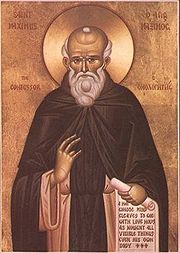
Maximus the Confessor
Maximus the Confessor was a Christian monk, theologian, and scholar. In his early life, he was a civil servant, and an aide to the Byzantine Emperor Heraclius...
carried on a furious campaign against Monothelitism, and in 646 he convinced the African councils to draw up a manifesto against the doctrine. This they forwarded to the new pope Theodore I
Pope Theodore I
Pope Theodore I , who was pope from November 24, 642, to May 14, 649, is considered a Greek, but was born in Jerusalem. He was made a cardinal deacon, and a full cardinal by Pope John IV....
, who in turn wrote to Patriarch Paul II of Constantinople
Patriarch Paul II of Constantinople
Paul II was the Ecumenical Patriarch of Constantinople from 641 to 653. He assumed regency for Byzantine emperor Constans II after a succession crisis in 641....
, outlining the heretical nature of the doctrine. Paul, a devoted Monothelite, replied in a letter directing the Pope to adhere to the doctrine of one will. Theodore in turn excommunicated the Patriarch in 649, declaring him a heretic, after Paul, in 647 or 648, had issued in the name of Emperor Constans II an edict known as the Typos, which banned any mention of either one or two activities or wills in Christ. The Typos, instead of defusing the situation, made it worse by implying that either doctrine was a good as the other. Theodore planned the Lateran Council of 649
Lateran Council of 649
The Lateran Council of 649 was a synod held in the Basilica of St. John Lateran to condemn Monothelitism, a Christology espoused by many Eastern Christians...
but died before he could convene it, which his successor, Pope Martin I
Pope Martin I
Pope Martin I, born near Todi, Umbria in the place now named after him , was pope from 649 to 653, succeeding Pope Theodore I in July 5, 649. The only pope during the Byzantine Papacy whose election was not approved by a iussio from Constantinople, Martin I was abducted by Constans II and died in...
, did. The Council condemns the Ecthesis and the Typos, and Pope Martin wrote to Constans, informing the emperor of its conclusions and requiring him to condemn both the Monothelite doctrine and his own Typos. Constans responded by having Pope Martin abducted to Constantinople, where he was tried and condemned to banishment and died as a result of the torture to which he had been submitted. Maximus also was tried and banished after having his tongue and his hand cut off.
It was in this context of conflict between East and West that the Monothelite Patriarch Paul of Constantinople made accusations against Pope Theodore of Rome for speaking of the Holy Spirit as proceeding from the Father and the Son. This expression was not inserted in the Creed, which was not yet used liturgically in Rome.
Maximus the Confessor wrote a letter in defence of the expression used by the Pope. The words with which Maximus the Confessor (c. 580 – 13 August 662) declared that it was wrong to condemn the Roman use of Filioque are as follows:
- "They [the Romans] have produced the unanimous evidence of the Latin Fathers, and also of Cyril of AlexandriaCyril of AlexandriaCyril of Alexandria was the Patriarch of Alexandria from 412 to 444. He came to power when the city was at its height of influence and power within the Roman Empire. Cyril wrote extensively and was a leading protagonist in the Christological controversies of the later 4th and 5th centuries...
, from the study he made of the gospel of St John. On the basis of these texts, they have shown that they have not made the Son the cause of the Spirit – they know in fact that the Father is the only cause of the Son and the Spirit, the one by begetting and the other by procession –but that they have manifested the procession through him and have thus shown the unity and identity of the essence. They [the Romans] have therefore been accused of precisely those things of which it would be wrong to accuse them, whereas the former [the Byzantines] have been accused of those things it has been quite correct to accuse them [Monothelitism]."
Later developments
Widespread use of the Filioque in the West led to controversy with envoys of the Byzantine Emperor Constantine VConstantine V
Constantine V was Byzantine emperor from 741 to 775; ); .-Early life:...
at a synod held at Gentilly
Gentilly, Val-de-Marne
Gentilly is a commune in the southern suburbs of Paris, France. It is located from the center of Paris.-Name:The name Gentilly was recorded for the first time in the 6th century as Gentiliacum, a royal estate of some importance where coinage was minted. The etymology of the name seems to be...
in 767. The use of Filioque was defended by Saint Paulinus II
Saint Paulinus II
Saint Paulinus II , was a northern Italian bishop, theologian, poet, and scholar of the Carolingian Renaissance.-Early life:...
, the Patriarch of Aquileia
Patriarch of Aquileia
The Patriarch of Aquileia was an office in the Roman Catholic Church. During the Middle Ages the Patriarchate of Aquileia was a temporal state in Northern Italy. The Patriarchate of Aquileia as a church office was suppressed in 1752....
, at the Synod of Friuli
Friuli
Friuli is an area of northeastern Italy with its own particular cultural and historical identity. It comprises the major part of the autonomous region Friuli-Venezia Giulia, i.e. the province of Udine, Pordenone, Gorizia, excluding Trieste...
, Italy
Italy
Italy , officially the Italian Republic languages]] under the European Charter for Regional or Minority Languages. In each of these, Italy's official name is as follows:;;;;;;;;), is a unitary parliamentary republic in South-Central Europe. To the north it borders France, Switzerland, Austria and...
in 796, and it was endorsed in 809 at the local Council of Aachen. At the beginning of ninth century in 808, John, a Greek monk of the monastery of St. Sabas, charged the monks of Mt. Olivet with heresy, since they had inserted the Filioque into the Creed.
As the practice of chanting the Latin Credo at Mass
Mass (liturgy)
"Mass" is one of the names by which the sacrament of the Eucharist is called in the Roman Catholic Church: others are "Eucharist", the "Lord's Supper", the "Breaking of Bread", the "Eucharistic assembly ", the "memorial of the Lord's Passion and Resurrection", the "Holy Sacrifice", the "Holy and...
spread in the West, the Filioquebecame a part of the Latin rite liturgy. This practice was adopted in Emperor Charlemagne's court in 798 and spread through his empire, but which, although it was in use in parts of Italy by the eighth century, was not accepted in Rome until 1014.
Beginning around 796 or 797, Paulinus, bishop of Aquileia, held a council for the region of Friuli (the part of Italy containing Aquileia). Paulinus was appointed the task of addressing Adoptionism and Arians as taught by a group of Spanish bishops including Elipando
Elipando
Elipando was a Spanish archbishop of Toledo and theologian. He was one of the founders of the Adeoptivi sect....
. Paulinus’ council spent a fair amount of time addressing the subject of the filioque, taking the position that a new council could add a valid interruption to the Creed. Paulinus primary argumentation is that the Filioque could be added and or subtracted if the addition or subtraction does not go against the Fathers’ “intention” and was “a blameless discernment.”
According to John Meyendorff
John Meyendorff
John Meyendorff was a modern Orthodox scholar, writer and teacher. He was born into the Russian nobility as Ivan Feofilovich Baron von Meyendorff , but was known as Jean Meyendorff during his life in France.Fr John Meyendorff retired as Dean of St Vladimir's Seminary on June 30, 1992...
, and John Romanides the Western efforts to get Pope Leo III
Pope Leo III
Pope Saint Leo III was Pope from 795 to his death in 816. Protected by Charlemagne from his enemies in Rome, he subsequently strengthened Charlemagne's position by crowning him as Roman Emperor....
to approve the addition of Filioque to the Creed were due to a desire of Charlemagne
Charlemagne
Charlemagne was King of the Franks from 768 and Emperor of the Romans from 800 to his death in 814. He expanded the Frankish kingdom into an empire that incorporated much of Western and Central Europe. During his reign, he conquered Italy and was crowned by Pope Leo III on 25 December 800...
, who in 800 had been crowned in Rome as Emperor, to find grounds for accusations of heresy against the East. The Pope's refusal to approve the interpolation avoided arousing a conflict between East and West about this matter. Emperor Charlemagne
Charlemagne
Charlemagne was King of the Franks from 768 and Emperor of the Romans from 800 to his death in 814. He expanded the Frankish kingdom into an empire that incorporated much of Western and Central Europe. During his reign, he conquered Italy and was crowned by Pope Leo III on 25 December 800...
accused the Patriarch of Constantinople (Saint Tarasios of Constantinople) of infidelity to the faith of the First Council of Nicaea, because he had not professed the procession of the Holy Spirit from the Father "and the Son", but only "through the Son", an accusation strongly rejected by Rome, but repeated in Charlemagne's commissioned work the Libri Carolini
Libri Carolini
The Libri Carolini , Opus Caroli regis contra synodum , also called Charlemagne's Books or simply the Carolines, are the work in four books composed on the command of Charlemagne, around 790, to refute the supposed conclusions of the Byzantine Second Council of Nicaea , particularly as...
, books also rejected by the Pope. Pope Leo rejected the request of Charlemagne's emissaries for approval of inclusion of the Filioque in the Latin Creed used in Rome. So, during the time of Pope Leo's leadership, 795-816, and for another two centuries, there was no Creed at all in the Roman rite
Roman Rite
The Roman Rite is the liturgical rite used in the Diocese of Rome in the Catholic Church. It is by far the most widespread of the Latin liturgical rites used within the Western or Latin autonomous particular Church, the particular Church that itself is also called the Latin Rite, and that is one of...
Mass.
Although he approved the Filioque doctrine, Pope Leo III
Pope Leo III
Pope Saint Leo III was Pope from 795 to his death in 816. Protected by Charlemagne from his enemies in Rome, he subsequently strengthened Charlemagne's position by crowning him as Roman Emperor....
in 810 opposed adding the Filioque to the Creed, and had two heavy silver shields made and displayed in St Peter's, containing the original text of the Creed of 381 in both Greek and Latin, adding: "I, Leo, have placed these for love and protection of the orthodox faith".
In 808 or 809 controversy arose in Jerusalem between the Greek monks of one monastery and the Frankish Benedictines of another: the Greeks reproached the latter for, among other things, singing the creed with the Filioqueincluded. In response, the theology of the Filioque was expressed in the 809 local Council of Aachen
Council of Aachen
A number of significant councils of the Roman Catholic Church were held at Aachen in the early Middle Ages.In the mixed council of 798, Charlemagne proclaimed a capitulary of eighty-one chapters, largely a repetition of earlier ecclesiastical legislation, that was accepted by the clergy and...
.
Photian controversy
Heresy
Heresy is a controversial or novel change to a system of beliefs, especially a religion, that conflicts with established dogma. It is distinct from apostasy, which is the formal denunciation of one's religion, principles or cause, and blasphemy, which is irreverence toward religion...
and schism because of differences in practices, in particular for the Filioque and the authority of the Papacy.This moved the issue from jurisdiction and custom to one of dogma. This council declared Pope Nicholas anathema, excommunicated and deposed.
Photius excluded not only "and the Son" but also "through the Son" with regard to the eternal procession of the Holy Spirit: for him "through the Son" applied only to the temporal mission of the Holy Spirit (the sending in time). He maintained that the eternal procession of the Holy Spirit is "from the Father alone". This phrase was verbally a novelty However, Orthodox theologians generally hold that in substance the phrase was only a reaffirmation of traditional teaching. Sergei Bulgakov
Sergei Bulgakov
Fr. Sergei Nikolaevich Bulgakov was a Russian Orthodox Christian theologian, philosopher and economist. Until 1922 he worked in Russia; afterwards in Paris.-Early life:...
, on the other hand, declared that Photius's doctrine itself "represents a sort of novelty for the Eastern church".
Photius's importance endured in regard to relations between East and West. He is recognized as a Saint by the Eastern Orthodox Church and his line of criticism has often been echoed later, making reconciliation between East and West difficult.
At least three councils (867, 869, 879) where held in Constantinople over the deposition of Ignatius by EmperorMichael III
Michael III
Michael III , , Byzantine Emperor from 842 to 867. Michael III was the third and traditionally last member of the Amorian-Phrygian Dynasty...
and the his replacement by Photius. The Council of Constantinople 867 was convened by Photius, so to address the question of Papal Supremacy over all of the churches and their patriarchs and the use of the filioque.
The council of 867 was followed by the Council of Constantinople 869, which reversed the previous council and was promulgated by Rome
Diocese of Rome
The Diocese of Rome is a diocese of the Catholic Church in Rome, Italy. The bishop of Rome is the Pope, who is the Supreme Pontiff and leader of the Catholic Church...
. The Council of Constantinople in 879 restored Photius to his see. It was attended by Western legates Cardinal Peter of St Chrysogonus, Paul Bishop of Ancona and Eugene Bishop of Ostia who approved its canons, but it is unclear whether it was ever promulgated by Rome
Diocese of Rome
The Diocese of Rome is a diocese of the Catholic Church in Rome, Italy. The bishop of Rome is the Pope, who is the Supreme Pontiff and leader of the Catholic Church...
.
Adoption in the Roman Rite
It was only in 1014, at the request of the German King Henry IIHenry II, Holy Roman Emperor
Henry II , also referred to as Saint Henry, Obl.S.B., was the fifth and last Holy Roman Emperor of the Ottonian dynasty, from his coronation in Rome in 1014 until his death a decade later. He was crowned King of the Germans in 1002 and King of Italy in 1004...
who had come to Rome to be crowned Emperor
Holy Roman Emperor
The Holy Roman Emperor is a term used by historians to denote a medieval ruler who, as German King, had also received the title of "Emperor of the Romans" from the Pope...
and was surprised at the different custom in force there, that Pope Benedict VIII
Pope Benedict VIII
Pope Benedict VIII , born Theophylactus, Pope from 1012 to 1024, of the noble family of the counts of Tusculum , descended from Theophylact, Count of Tusculum like his predecessor Pope Benedict VI .Benedict VIII was opposed by an antipope, Gregory...
, who owed to Henry his restoration to the papal throne after usurpation by Antipope Gregory VI
Antipope Gregory VI
On the death of Pope Sergius IV in June, 1012, "a certain Gregory" opposed the party of the Theophylae , and got himself made Pope, seemingly by a small faction...
, had the Creed, with the addition of Filioque, sung at Mass in Rome for the first time. In some other places Filioque was incorporated in the Creed even later: at Paris seemingly not even by 1240, 34 years before the Second Council of Lyon
Second Council of Lyon
The Second Council of Lyon was the fourteenth ecumenical council of the Catholic Church, convoked on 31 March 1272 and convened in Lyon, France, in 1274. Pope Gregory X presided over the council, called to act on a pledge by Byzantine emperor Michael VIII to reunite the Eastern church with the West...
defined that the Holy Spirit "proceeds eternally from the Father and from the Son, not as from two principles but from a single principle, not by two spirations but by a single spiration".
Since then the Filioque phrase has been included in the Creed throughout the Latin Rite except where Greek
Greek language
Greek is an independent branch of the Indo-European family of languages. Native to the southern Balkans, it has the longest documented history of any Indo-European language, spanning 34 centuries of written records. Its writing system has been the Greek alphabet for the majority of its history;...
is used in the liturgy, although it was never adopted by Eastern Catholic Churches.
East-West controversy
Eastern opposition to the Filioque strengthened with the East-West SchismEast-West Schism
The East–West Schism of 1054, sometimes known as the Great Schism, formally divided the State church of the Roman Empire into Eastern and Western branches, which later became known as the Eastern Orthodox Church and the Roman Catholic Church, respectively...
of 1054. Two councils were held to heal the break discussed the question.
The Second Council of Lyon
Second Council of Lyon
The Second Council of Lyon was the fourteenth ecumenical council of the Catholic Church, convoked on 31 March 1272 and convened in Lyon, France, in 1274. Pope Gregory X presided over the council, called to act on a pledge by Byzantine emperor Michael VIII to reunite the Eastern church with the West...
(1274) accepted the profession of faith of Emperor Michael VIII Palaiologos
Michael VIII Palaiologos
Michael VIII Palaiologos or Palaeologus reigned as Byzantine Emperor 1259–1282. Michael VIII was the founder of the Palaiologan dynasty that would rule the Byzantine Empire until the Fall of Constantinople in 1453...
in the Holy Spirit, "proceeding from the Father and the Son" and the Greek participants, including Patriarch Joseph I of Constantinople sang the Creed three times with the Filioque addition. Most Byzantine Christians feeling disgust and recovering from the Latin Crusaders' conquest and betrayal, refused to accept the agreement made at Lyon with the Latins. In 1282, Emperor Michael VIII died and Patriarch Joseph I's successor, John XI
Patriarch John XI of Constantinople
John XI Bekkos was Patriarch of Constantinople from June 2, 1275 to December 26, 1282, and the chief Greek advocate, in Byzantine times, of the reunion of the Eastern Orthodox and Roman Catholic Churches...
, who had become convinced that the teaching of the Greek Fathers was compatible with that of the Latins, was forced to resign, and was replaced by Gregory II
Patriarch Gregory II of Constantinople
Gregory II of Cyprus was Ecumenical Patriarch of Constantinople between 1283-1289.His name was originally George. His parents were middle class but of noble origin. He moved to Nicosia as a teenager seeking further education...
, who was strongly of the opposite opinion.
The council required Eastern churches wishing to be reunited with Rome to accept the Filioque as a legitimate expression of the faith, while it did not require those Christians to change the recitation of the creed in their liturgy.
The council of Lyons also condemned "all who presume to deny that the holy Spirit proceeds eternally from the Father and the Son, or rashly to assert that the holy Spirit proceeds from the Father and the Son as from two principles and not as from one. "
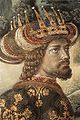
Council of Florence
The Council of Florence was an Ecumenical Council of the Roman Catholic Church. It began in 1431 in Basel, Switzerland, and became known as the Council of Ferrara after its transfer to Ferrara was decreed by Pope Eugene IV, to convene in 1438...
, to which Emperor John VIII Palaiologos
John VIII Palaiologos
John VIII Palaiologos or Palaeologus , was the penultimate reigning Byzantine Emperor, ruling from 1425 to 1448.-Life:John VIII Palaiologos was the eldest son of Manuel II Palaiologos and Helena Dragaš, the daughter of the Serbian prince Constantine Dragaš...
, Ecumenical Patriarch Joseph II of Constantinople, and other bishops from the East had gone in the hope of getting Western military aid against the looming Ottoman Empire
Ottoman Empire
The Ottoman EmpireIt was usually referred to as the "Ottoman Empire", the "Turkish Empire", the "Ottoman Caliphate" or more commonly "Turkey" by its contemporaries...
. Thirteen public sessions held inFerrara
Ferrara
Ferrara is a city and comune in Emilia-Romagna, northern Italy, capital city of the Province of Ferrara. It is situated 50 km north-northeast of Bologna, on the Po di Volano, a branch channel of the main stream of the Po River, located 5 km north...
from 8 October to 13 December 1438 the Filioque question was debated without agreement. The Greeks held that any addition whatever, even if doctrinally correct, to the Creed had been forbidden by the Council of Ephesus, while the Latins claimed that this prohibition concerned meaning, not words.
During the council of Florence
Florence
Florence is the capital city of the Italian region of Tuscany and of the province of Florence. It is the most populous city in Tuscany, with approximately 370,000 inhabitants, expanding to over 1.5 million in the metropolitan area....
in 1439, accord continued to be elusive, until the argument prevailed among the Greeks themselves that, though the Greek and the Latin saints expressed their faith differently, they were in agreement substantially, since saints cannot err in faith; and by 8 June the Greeks accepted the Latin statement of doctrine. On 10 June Patriarch Joseph II died. A statement on the Filioque question was included in theLaetentur Caeli decree of union, which was signed on 5 July 1439 and promulgated the next day, with Mark of Ephesus
Mark of Ephesus
Mark of Ephesus , a 15th century Archbishop of Ephesus, is famous for his defense of Eastern Orthodoxy at the Council of Florence in spite of Byzantine Emperor John VIII Palaeologus and Pope Eugene IV...
being the only bishop to refuse his signature.
The Eastern Church refused to consider the agreement reached at Florence binding, since the death of Joseph II had for the moment left it without a Patriarch of Constantinople. There was strong opposition to the agreement in the East, and when in 1453, 14 years after the agreement, the promised military aid from the West still had not arrived and Constantinople fell
Fall of Constantinople
The Fall of Constantinople was the capture of the capital of the Byzantine Empire, which occurred after a siege by the Ottoman Empire, under the command of Ottoman Sultan Mehmed II, against the defending army commanded by Byzantine Emperor Constantine XI...
to the Turks, neither Eastern Christians nor their new rulers wished union between them and the West.
Council of Jerusalem in 1583 AD
The 1583 Synod of Jerusalem condemned those who do not believe the Holy Spirit proceeds from the Father alone in essence, and from Father and Son in time. In addition, this synod re-affirmed adherence to the decisions of Council of Nicaea I in AD 325.Council of Jerusalem in 1672 AD
Re-affirmed procession of the Holy Spirit from the Father alone.Church of the East
Two of the present-day churches derived from the Church of the East, the Assyrian Church of the EastAssyrian Church of the East
The Assyrian Church of the East, officially the Holy Apostolic Catholic Assyrian Church of the East ʻIttā Qaddishtā w-Shlikhāitā Qattoliqi d-Madnĕkhā d-Āturāyē), is a Syriac Church historically centered in Mesopotamia. It is one of the churches that claim continuity with the historical...
and the Ancient Church of the East
Ancient Church of the East
The Ancient Church of the East was established in 1968. It follows the traditions of one of the oldest Christian churches, the Church of the East, whose origins trace back to the See of Seleucia-Ctesiphon in central Mesopotamia...
do not use "and the Son" when reciting the Nicene Creed. The other, known as the Chaldean Church, has recently, at the request of the Holy See
Holy See
The Holy See is the episcopal jurisdiction of the Catholic Church in Rome, in which its Bishop is commonly known as the Pope. It is the preeminent episcopal see of the Catholic Church, forming the central government of the Church. As such, diplomatically, and in other spheres the Holy See acts and...
, removed "and the Son" from its version of the Nicene Creed.
Roman Catholicism
The Roman Catholic Church does not include Filioque: when quoting the Niceno-Constantinopolitan Creed, such as in the 6 August 2000 document Dominus IesusDominus Iesus
Dominus Iesus is a declaration by the Congregation for the Doctrine of the Faith. It was approved in a Plenary meeting of the Congregation, and bears the signature of its then Prefect, Cardinal Joseph Ratzinger, now Pope Benedict XVI, and of its then Secretary, Archbishop Tarcisio Bertone, now...
. In the liturgy also, the Roman Catholic Church does not add the phrase corresponding to Filioque (καὶ τοῦ Υἱοῦ) to the Greek
Greek language
Greek is an independent branch of the Indo-European family of languages. Native to the southern Balkans, it has the longest documented history of any Indo-European language, spanning 34 centuries of written records. Its writing system has been the Greek alphabet for the majority of its history;...
text of the Creed, even for Latin Rite Catholics. Popes John Paul II and Benedict XVI have recited the Nicene Creed jointly with Patriarchs Demetrius I
Patriarch Demetrius I of Constantinople
Demetrios I also Dimitrios I or Demetrius I, born Demetrios Papadopoulos was the Ecumenical Patriarch of Constantinople from July 16, 1972, to October 2, 1991. Before his election as Patriarch he served as Metropolitan Bishop of Imvros...
and Bartholomew I in Greek without the Filioque clause. In addition, Eastern Catholic Churches do not necessarily include "Filioque" in their versions of the Niceno-Constantinopolitan Creed. Even those Eastern Catholic Churches that are not of Greek tradition and that have incorporated the Filioque into their recitation of the Niceno-Constantinopolitan Creed are officially encouraged to omit it.
The agreement that brought about the 1595 Union of Brest
Union of Brest
Union of Brest or Union of Brześć refers to the 1595-1596 decision of the Church of Rus', the "Metropolia of Kiev-Halych and all Rus'", to break relations with the Patriarch of Constantinople and place themselves under the Pope of Rome. At the time, this church included most Ukrainians and...
expressly declared that those entering full communion with Rome "should remain with that which was handed down to (them) in the Holy Scriptures, in the Gospel, and in the writings of the holy Greek Doctors, that is, that the Holy Spirit proceeds, not from two sources and not by a double procession, but from one origin, from the Father through the Son."
Belief that the Holy Spirit proceeds, in this sense, "from the Father and the Son" was held in the West at an early stage. Anthony Edward Siecienski identifies Hilary of Poitiers (c. 300 – c. 368), the "Athanasius of the West", and Augustine of Hippo (354-430) as "the chief patristic source(s) for the Latin teaching on the filioque." Even before Rome, at the 451 Council of Chalcedon
Council of Chalcedon
The Council of Chalcedon was a church council held from 8 October to 1 November, 451 AD, at Chalcedon , on the Asian side of the Bosporus. The council marked a significant turning point in the Christological debates that led to the separation of the church of the Eastern Roman Empire in the 5th...
recognized and received the 381 Niceno-Constantinopolitan Creed with its expression "from the Father", Pope Leo I
Pope Leo I
Pope Leo I was pope from September 29, 440 to his death.He was an Italian aristocrat, and is the first pope of the Catholic Church to have been called "the Great". He is perhaps best known for having met Attila the Hun in 452, persuading him to turn back from his invasion of Italy...
declared in 446 that the Holy Spirit proceeds from both Father and Son. The teaching of the procession of the Holy Spirit from the Father and the Son has been professed unanimously in the West. The Roman Catholic Church recognizes that, in the Greek language, the word used in the Niceno-Constantinopolitan Creed to signify the proceeding of the Holy Spirit cannot appropriately be used with regard to the Son, but only with regard to the Father, a difficulty that does not exist in other languages.
Pope Leo III
Pope Leo III
Pope Saint Leo III was Pope from 795 to his death in 816. Protected by Charlemagne from his enemies in Rome, he subsequently strengthened Charlemagne's position by crowning him as Roman Emperor....
, repeating in this the teaching of Pope Leo I
Pope Leo I
Pope Leo I was pope from September 29, 440 to his death.He was an Italian aristocrat, and is the first pope of the Catholic Church to have been called "the Great". He is perhaps best known for having met Attila the Hun in 452, persuading him to turn back from his invasion of Italy...
, the Pope whose Tome was approved at the Council of Chalcedon
Council of Chalcedon
The Council of Chalcedon was a church council held from 8 October to 1 November, 451 AD, at Chalcedon , on the Asian side of the Bosporus. The council marked a significant turning point in the Christological debates that led to the separation of the church of the Eastern Roman Empire in the 5th...
, and who, in 447, before even the Merovingian Frankish kingdom had been established, had confessed the Filioque doctrine dogmatically.
In the view of the Roman Catholic Church, what it calls the legitimate complementarity of the expressions "from the Father" and "from the Father and the Son" does not, provided it does not become rigid, affect the identity of faith in the reality of the same mystery confessed.
Monarchy of the Father in the West
The monarchy of the Father is a doctrine upheld not only by those who like Photius speak of a procession from the Father alone. It is also by theologians who speak of a procession from the Father through the Son or from the Father and the Son. Examples cited in the book The Filioque: History of a Doctrinal Controversy by A. Edward Siecienski include Bessarion, Maximus the Confessor, Bonaventure, and the Council of Worms (868), The same remark is made by Jürgen MoltmannJürgen Moltmann
Jürgen Moltmann is a German Reformed theologian. The 2000 recipient of the Louisville Grawemeyer Award in Religion.-Moltmann's Youth:...
. The Pontifical Council for Promoting Christian Unity also states that not only the Eastern tradition, but also the Latin Filioque tradition "recognize that the 'Monarchy of the Father' implies that the Father is the sole Trinitarian Cause (αἰτία) or Principle (principium) of the Son and of the Holy Spirit."
The Roman Catholic Church, rejecting the notion that the Holy Spirit proceeds jointly and equally from two principles (Father and Son), teaches dogmatically that "the Holy Spirit proceeds eternally from the Father and the Son, not as from two principles but as from one single principle". As the Catechism of the Catholic Church declares, the Father, as the "principle without principle", is the first origin of the Spirit, but also, as Father of the only Son, he is, with the Son, the single principle from which the Spirit proceeds.
Anglicanism
In 1978 the Anglican CommunionAnglican Communion
The Anglican Communion is an international association of national and regional Anglican churches in full communion with the Church of England and specifically with its principal primate, the Archbishop of Canterbury...
's Lambeth Conference requested "that all member Churches of the Anglican Communion should consider omitting the Filioque from the Nicene Creed, and that the Anglican-Orthodox Joint Doctrinal Commission through the Anglican Consultative Council should assist them in presenting the theological issues to their appropriate synodical bodies and should be responsible for any necessary consultation with other Churches of the Western tradition."
In 1988 the conference "ask(ed) that further thought be given to the Filioque clause, recognising it to be a major point of disagreement (with the Orthodox) ... recommending to the provinces of the Anglican Communion that in future liturgical revisions the Niceno-Constantinopolitan Creed be printed without the Filioque clause." At a subsequent joint meeting of the Anglican Primates and Anglican Consultative Council in 1993, a resolution was passed urging Anglican churches to comply with the request that "in future liturgical revisions the Niceno-Constantinopolitan Creed be printed without the Filioque clause."
The recommendation was not specifically renewed in the 1998 and 2008 Lambeth Conferences and has not been implemented.
In 1985 the General Convention of The Episcopal Church (USA) recommended that the Filioque clause should be removed from the Nicene Creed, if this were endorsed by the 1988 Lambeth Council. Accordingly, at its 1994 General Convention, the Episcopal Church reaffirmed its intention to remove the words "and the son" from the Nicene Creed in the next revision of its Book of Common Prayer. The Episcopal Book of Common Prayer was last revised in 1979, and has not been revised since the resolution.
Eastern Orthodoxy
Views of Eastern Orthodox saints
The Filioque was qualified as a heresy by some of the Eastern Orthodox Church's saints, including Photios I of Constantinople, Mark of EphesusMark of Ephesus
Mark of Ephesus , a 15th century Archbishop of Ephesus, is famous for his defense of Eastern Orthodoxy at the Council of Florence in spite of Byzantine Emperor John VIII Palaeologus and Pope Eugene IV...
, Gregory Palamas
Gregory Palamas
Gregory Palamas was a monk of Mount Athos in Greece and later the Archbishop of Thessaloniki known as a preeminent theologian of Hesychasm. The teachings embodied in his writings defending Hesychasm against the attack of Barlaam are sometimes referred to as Palamism, his followers as Palamites...
, who have been called the Three Pillars of Orthodoxy. Saint Maximus the Confessor
Maximus the Confessor
Maximus the Confessor was a Christian monk, theologian, and scholar. In his early life, he was a civil servant, and an aide to the Byzantine Emperor Heraclius...
defended the Western use of the Filioque in a context other than that of the Nicene Creed. Metropolitan Hierotheos (Vlachos) of Nafpaktos states that it is Eastern Orthodox tradition that the actual words of the passage in the Nicene Creed addressing the Holy Spirit as used by the East was crafted by Saint Gregory of Nyssa
Gregory of Nyssa
St. Gregory of Nyssa was a Christian bishop and saint. He was a younger brother of Basil the Great and a good friend of Gregory of Nazianzus. His significance has long been recognized in the Eastern Orthodox, Oriental Orthodox, Eastern Catholic and Roman Catholic branches of Christianity...
. Nyssa attending the council where he wrote the passage as it appeared and was accepted at the council of Constantinople in 381. St Gregory of Nyssa makes no expression in the passage in the creed that indicted that a filioque, as later understood in the West, was one he would have endorsed.
Theological contention
The Eastern Orthodox interpretation is that the Holy Spirit originates, has his cause for existence or being (manner of existence) from the Father alone as "One God, One Father". That the filioque confuses the theology as it was defined at the councils at both Nicene and Constantinople.The position that having the creed say "the Holy Spirit which proceeds from the Father and the Son", does not mean that the Holy Spirit now has two origins, is not the position the West took at the Council of Florence. Where the Roman Catholic side explicitly stated that the Holy Spirit has its cause of existence from the Father and the Son.Eastern Orthodox view of Roman Catholic theology
Eastern Orthodox theologians (e.g., Michael PomazanskyMichael Pomazansky
Protopresbyter Michael Pomazansky was a Russian theologian.He was born in the village of Korist, in the province of Volhynia. His father was Archpriest Ioann Pomazansky who was the son of Father Ioann Ambrosievich. Fr. Michael's mother, Vera Grigorievna, was the daughter of a protodeacon and later...
) say that the Nicene Creed as a Symbol of Faith, as dogma
Dogma
Dogma is the established belief or doctrine held by a religion, or a particular group or organization. It is authoritative and not to be disputed, doubted, or diverged from, by the practitioners or believers...
, is to address and define church theology specifically the Orthodox Trinitarian understanding of God. In the hypostases of God as correctly expressed against the teachings considered outside the church. The Father hypostasis of the Nicene Creed is the origin of all. Eastern Orthodox theologians have stated that New Testament passages (often quoted by the Latins) speak of the economy rather than the ontology of the Holy Spirit, and that in order to resolve this conflict Western theologians made further doctrinal changes, including declaring all persons of the Trinity to originate in the essence of God (the heresy of Sabellianism
Sabellianism
In Christianity, Sabellianism, is the nontrinitarian belief that the Heavenly Father, Resurrected Son and Holy Spirit are different modes or aspects of one God, as perceived by the believer, rather than three distinct persons in God Himself.The term Sabellianism comes from...
). Eastern Orthodox theologians see this as teaching of philosophical speculation rather than from actual experience of God via theoria.
The Father is the eternal, infinite and uncreated reality, that the Christ and the Holy Spirit are also eternal, infinite and uncreated, in that their origin is not in the ousia of God, but that their origin is in the hypostasis of God called the Father. The double procession of the Holy Spirit bears some resemblance to the teachings of Macedonius
Macedonius I of Constantinople
Macedonius was a Greek bishop of Constantinople from 342 up to 346, and from 351 until 360. He inspired the establishment of the Macedonians, a sect later declared heretical.-Biography:...
and his sect called the Pneumatomachians in that the Holy Spirit is created by the Son and a servant of the Father and the Son. It was Macedonius' position that caused the specific wording of the section on the Holy Spirit by St Gregory of Nyssa
Gregory of Nyssa
St. Gregory of Nyssa was a Christian bishop and saint. He was a younger brother of Basil the Great and a good friend of Gregory of Nazianzus. His significance has long been recognized in the Eastern Orthodox, Oriental Orthodox, Eastern Catholic and Roman Catholic branches of Christianity...
in the finalized Nicene creed
Nicene Creed
The Nicene Creed is the creed or profession of faith that is most widely used in Christian liturgy. It is called Nicene because, in its original form, it was adopted in the city of Nicaea by the first ecumenical council, which met there in the year 325.The Nicene Creed has been normative to the...
.http://www.intratext.com/IXT/ENG0824/_P17.HTM
The following are points of the filioque as Roman Catholic dogma seen as in contention with Eastern Orthodoxy.
- The Father is from no one; the Son is from the Father only; and the Holy Spirit is from both the Father and the Son equally. The Fourth Council of the LateranFourth Council of the LateranThe Fourth Council of the Lateran was convoked by Pope Innocent III with the papal bull of April 19, 1213, and the Council gathered at Rome's Lateran Palace beginning November 11, 1215. Due to the great length of time between the Council's convocation and meeting, many bishops had the opportunity...
, 1215, - A definition against the Albigenses and other heretics [We] confess that the Holy Spirit proceeds eternally from the Father and the Son, not as from two principles, but as from one; not by two spirations but by one. The Second Council of LyonSecond Council of LyonThe Second Council of Lyon was the fourteenth ecumenical council of the Catholic Church, convoked on 31 March 1272 and convened in Lyon, France, in 1274. Pope Gregory X presided over the council, called to act on a pledge by Byzantine emperor Michael VIII to reunite the Eastern church with the West...
, 1274, Constitution on the Procession of the Holy Spirit. - The Father is not begotten; the Son is begotten of the Father; the Holy Spirit proceeds from the Father and the Son. The Council of FlorenceCouncil of FlorenceThe Council of Florence was an Ecumenical Council of the Roman Catholic Church. It began in 1431 in Basel, Switzerland, and became known as the Council of Ferrara after its transfer to Ferrara was decreed by Pope Eugene IV, to convene in 1438...
, 1438–45, Decree for the Jacobites - The Council of FlorenceCouncil of FlorenceThe Council of Florence was an Ecumenical Council of the Roman Catholic Church. It began in 1431 in Basel, Switzerland, and became known as the Council of Ferrara after its transfer to Ferrara was decreed by Pope Eugene IV, to convene in 1438...
in 1438 explains: “The Holy Spirit is eternally from Father and Son He has his nature and subsistence at once (simul) from the Father and the Son. He proceeds eternally from both as from one principle and through one spiration . . . . And, since the Father has through generation given to the only begotten Son everything that belongs to the Father, except being Father, the Son has also eternally from the Father, from whom he is eternally born, that the Holy Spirit proceeds from the Son.” Catechism of the Catholic Church, 246 - “We declare that when holy doctors and fathers say that the holy Spirit proceeds from the Father through the Son, this bears the sense that thereby also the Son should be signified, according to the Greeks indeed as cause, and according to the Latins as principle of the subsistence of the Holy Spirit, just like the Father.” Council of FlorenceCouncil of FlorenceThe Council of Florence was an Ecumenical Council of the Roman Catholic Church. It began in 1431 in Basel, Switzerland, and became known as the Council of Ferrara after its transfer to Ferrara was decreed by Pope Eugene IV, to convene in 1438...
, Session 6 - In particular the condemnation made at the Second Council of Lyons (1274) of those “who presume to deny that the Holy Spirit proceeds eternally from the Father and the Son”
In the judgment of these Orthodox, the Roman Catholic Church is in fact teaching as a matter of Roman Catholic dogma that the Holy Spirit derives his origin and being (equally) from both the Father and the Son, making the Filioque a double procession. This being the very thing that Maximus the Confessor was stating in his work from the 7th century that would be wrong and that the West was not doing.
They thus perceive the West as teaching through more than one type of theological Filioque a different origin and cause of the Holy Spirit. That through the dogmatic Roman Catholic Filioque the Holy Spirit is subordinate to the Father and the Son and not a free and independent and equal to the Father, hypostasis that receives his uncreatedness from the origin of all things, the Father hypostasis. Trinity expresses the idea of message, messenger and revealer, or mind, word and meaning. Eastern Orthodox Christians believe in one God the Father, whose person is uncaused and unoriginate, who, because He is love and communion, always exists with His Word and Spirit.
Eastern Orthodox theology
In Eastern Orthodox Christianity theology starts with the Father hypostasis, not the essence of God, since the Father is the God of the Old Testament. The Father is the origin of all things and this is the basis and starting point of the Orthodox trinitarian teaching of one God in Father, one God, of the essence of the Father (as the uncreated comes from the Father as this is what the Father is). In Eastern Orthodox theology, God's uncreatedness or being or essence in Greek is called ousiaOusia
Ousia is the Ancient Greek noun formed on the feminine present participle of ; it is analogous to the English participle being, and the modern philosophy adjectival ontic...
. Jesus Christ is the Son (God Man) of the uncreated Father (God). The Holy Spirit is the Spirit of the uncreated Father (God).
The activity and actuality of the Trinity in creation are called God's energies as God as creator is light
Tabor Light
In Eastern Orthodox theology, the Tabor Light is the light revealed on Mount Tabor at the Transfiguration of Jesus, identified with the light seen by Paul at his conversion.As a theological doctrine, the uncreated nature of the Light of...
and this uncreated light (energy) is the basis from which all things derive their existence. God has existences (hypostases) of being; this concept is translated as the word "person" in the West. Each hypostasis of God is a specific and unique existence of God. Each has the same essence (coming from the origin, without origin, Father (God) they are uncreated). Each specific quality that constitutes a hypostasis of God, is non-reductionist and not shared.
It is this immanence
Immanence
Immanence refers to philosophical and metaphysical theories of divine presence, in which the divine is seen to be manifested in or encompassing of the material world. It is often contrasted with theories of transcendence, in which the divine is seen to be outside the material world...
of the Trinity that was defined in the finalized Nicene Creed. The economy of God, as God expresses himself in reality (his energies) was not what the Creed addressed directly. Nor the specifics of God's interrelationships of his existences, is again not what is defined within the Nicene Creed. The attempt to use the Creed to explain God's energies by reducing God existences to mere energies (actualities, activities, potentials) could be perceived as the heresy of semi-modalism. Eastern Orthodox theologians have complained about this problem in the Roman Catholic dogmatic teaching of actus purus
Actus purus
Actus Purus is a term employed in scholastic philosophy to express the absolute perfection of God. It literally means, "pure act."Created beings have potentiality that is not actuality, imperfections as well as perfection. Only God is simultaneously all that He can be, infinitely real and...
.
Theodoret's statement against Cyril
The issue of the Filioque can somewhat be dated to the 5th century where St TheodoretTheodoret
Theodoret of Cyrus or Cyrrhus was an influential author, theologian, and Christian bishop of Cyrrhus, Syria . He played a pivotal role in many early Byzantine church controversies that led to various ecumenical acts and schisms...
refused to endorse the deposition of Nestorius
Nestorius
Nestorius was Archbishop of Constantinople from 10 April 428 to 22 June 431.Drawing on his studies at the School of Antioch, his teachings, which included a rejection of the long-used title of Theotokos for the Virgin Mary, brought him into conflict with other prominent churchmen of the time,...
by the Council of Ephesus (431), where Theodoret accused St Cyril of Alexandria
Cyril of Alexandria
Cyril of Alexandria was the Patriarch of Alexandria from 412 to 444. He came to power when the city was at its height of influence and power within the Roman Empire. Cyril wrote extensively and was a leading protagonist in the Christological controversies of the later 4th and 5th centuries...
of erroneously teaching that the Son has a role in the origin of the Holy Spirit. In fact, several statements by Saint Cyril exist in which he fleetingly declares that the Holy Spirit issues from the Father and the Son (with similar statements that the Spirit issues from the Father through the Son) in an intra-Trinitarian relationship. and Antony Maas wrote that what Theodoret denied was not the eternal procession of the Holy Spirit from the Father and the Son, but only the claim that the Holy Spirit was created by or through the Son. Photius's position that the Holy Spirit proceeds from the Father alone has been described as only a restatement of Theodoret's. In spite of Theodoret's attack on him for saying "the Spirit has his existence either from the Son or through the Son", Cyril continued to use such formulae.
Under persistent urging by the Fathers of the Council of Chalcedon
Council of Chalcedon
The Council of Chalcedon was a church council held from 8 October to 1 November, 451 AD, at Chalcedon , on the Asian side of the Bosporus. The council marked a significant turning point in the Christological debates that led to the separation of the church of the Eastern Roman Empire in the 5th...
(451), Theodoret finally pronounced an anathema on Nestorius. He died in 457. Almost exactly one hundred years later, the Fifth Ecumenical Council
Second Council of Constantinople
The Second Council of Constantinople is recognized as the Fifth Ecumenical Council by the Eastern Orthodox, Roman Catholics, Old Catholics, and a number of other Western Christian groups. It was held from May 5 to June 2, 553, having been called by the Byzantine Emperor Justinian...
(553) declared anathema anyone who would defend the writings of Theodoret against Saint Cyril and his Twelve Anathemas, the ninth of which Theodoret had attacked for what it said of the procession of the Holy Spirit. (See Three-Chapter Controversy
Three-Chapter Controversy
The Three-Chapter Controversy, a phase in the Chalcedonian controversy, was an attempt to reconcile the Non-Chalcedonian Christians of Syria and Egypt with Chalcedonian Eastern Orthodoxy, following the failure of the Henotikon...
). He is considered a saint in the Eastern Orthodox Church, but is called "the excommunicate" by the Oriental Orthodox Churches. Both sides consider Cyril of Alexandria
Cyril of Alexandria
Cyril of Alexandria was the Patriarch of Alexandria from 412 to 444. He came to power when the city was at its height of influence and power within the Roman Empire. Cyril wrote extensively and was a leading protagonist in the Christological controversies of the later 4th and 5th centuries...
a saint. As Cyril spoke of the matter of which Theodoret accused him of as a misunderstanding. Cyril himself taught that the Latin teaching of the procession of the Holy Spirit from the Father and the Son appears to confuse the three hypostases of God with the common attributes of each hypostasis, and to the God's energetic manifestation in the world.
John Damascus
Before Photius, St John Damascus spoke explicitly of the relationship of the Holy Spirit to the Father and Son.-
- ” Of the Holy Ghost, we both say that He is from the Father, and call Him the Spirit of the Father; while we nowise say that He is from the Son, but only call Him the Spirit of the Son.” (Theol., lib. l.c. 11, v. 4.)
Saint John of Damascus
John of Damascus
Saint John of Damascus was a Syrian monk and priest...
's position stated that the procession of the Holy Spirit is from the Father alone, but through the Son as mediator, in this way differing from Photius. John Damascus along with Photius, never endorsed the Filioque in the Creed.
Photius and the Monarchy of the Father
Photius insisted on the expression "from the Father" and excluded "through the Son" (Christ as co-cause of the Holy Spirit rather than primary cause) with regard to the eternal procession of the Holy Spirit : "through the Son" applied only to the temporal mission of the Holy Spirit (the sending in time). Photius addresses in his entire work on the Filioque the Mystagogy of the Holy Spirit. That any addition to the Creed would be to complicate and confuse an already very clear and simple definition of the ontology of the Holy Spirit that the Ecumenical Councils already gave.Photius' position has been called a reaffirmation of Orthodox doctrine of the Monarchy of the Father. Photius's position that the Holy Spirit proceeds from the Father alone has also been described as a restatement of the Cappadocian
Cappadocian Fathers
The Cappadocian Fathers are Basil the Great , who was bishop of Caesarea; Basil's brother Gregory of Nyssa , who was bishop of Nyssa; and a close friend, Gregory of Nazianzus , who became Patriarch of Constantinople...
Antiochian school
School of Antioch
The School of Antioch was one of the two major centers of the study of biblical exegesis and theology during Late Antiquity; the other was the catechetical school of Alexandria...
(as opposed to the Alexandrian) teaching of the "monarchy of the Father".
Of the Eastern Orthodox's teaching ("from the Father alone"), Vladimir Lossky
Vladimir Lossky
Vladimir Nikolayevich Lossky was an influential Eastern Orthodox theologian in exile from Russia. He emphasized theosis as the main principle of Orthodox Christianity....
says that, while "verbally it may seem novel", it expresses in its doctrinal tenor the traditional teaching which is considered Orthodox. The phrase "from the Father alone" arises from the fact that the Creed itself only has "from the Father". So that the word "alone", which Photius nor the Orthodox suggest be added to the Creed, has been called a "gloss
Gloss
A gloss is a brief notation of the meaning of a word or wording in a text. It may be in the language of the text, or in the reader's language if that is different....
on the Creed", a clarification, an explanation or interpretation of its meaning.
Photius as well as the Eastern Orthodox, have never seen the need, nor ever suggested the word "alone" be added to the Creed itself. With this, the Eastern Orthodox Church generally considers the added Filioque phrase "from the Father and the Son" to be heretical, and accordingly procession "from the Father alone" has been referred to as "a main dogma of the Greek Church". In his study of the matter, Avery Dulles does not go so far and only states that the procession of the Spirit from the Father alone was the formula preferred by Photius and his strict disciples.
Eastern Orthodox theologians maintain that by the expression "from the Father alone", and Photius' opposition to the Filioque, Photius was confirming what is Orthodox and consistent with church tradition. Drawing the teaching of the Father as cause alone (their interpretation of the Monarchy of the Father) from such expressions from various saints and biblical text. Such as that of Saint Irenaeus
Irenaeus
Saint Irenaeus , was Bishop of Lugdunum in Gaul, then a part of the Roman Empire . He was an early church father and apologist, and his writings were formative in the early development of Christian theology...
, when he called the Word and the Spirit "the two hands of God". They interpret the phrase "monarchy of the Father" differently from those who see it as not in conflict with a procession of the Holy Spirit from the Father through or from the Son. As the Father has given to the Son everything that belongs to the Father, except being Father (see examples given above of those who in this way uphold the monarchy of the Father).
By insistence of the Filioque, Orthodox representatives say that the West appears to deny the monarchy of Father and the Father as principle origin of the Trinity. Which would indeed be the heresy of Modalism (which states the essence of God and not the Father is the origin of, the Father, Son and Holy Spirit). The idea of Photius having invented that the Father is sole source of cause of the Holy Trinity is to attribute to him something that predates Photius' existence i.e. Athanasius, Gregory Nazianzen, John Chrysostom
John Chrysostom
John Chrysostom , Archbishop of Constantinople, was an important Early Church Father. He is known for his eloquence in preaching and public speaking, his denunciation of abuse of authority by both ecclesiastical and political leaders, the Divine Liturgy of St. John Chrysostom, and his ascetic...
, Theodore of Mopsuestia
Theodore of Mopsuestia
Theodore the Interpreter was bishop of Mopsuestia from 392 to 428 AD. He is also known as Theodore of Antioch, from the place of his birth and presbyterate...
, Theodoret
Theodoret
Theodoret of Cyrus or Cyrrhus was an influential author, theologian, and Christian bishop of Cyrrhus, Syria . He played a pivotal role in many early Byzantine church controversies that led to various ecumenical acts and schisms...
of Cyrus and John of Damascus
John of Damascus
Saint John of Damascus was a Syrian monk and priest...
. "Photius never explored the deeper meaning behind the formula 'through the Son' (διὰ τοῦ Υἱοῦ), or the necessary eternal relationship between the Son and the Spirit, even though it was a traditional teaching of the previous Greek fathers".
Photius did recognize that the Spirit maybe said to proceed temporally through the Son or from the Son. Photius stated that this was not the eternal Trinitarian relationships that was actually the thing being defined in the Creed. The Nicene Creed in Greek, speaks of the procession of the Holy Spirit "from the Father", not "from the Father alone", nor "From the Father and the Son", nor "From the Father through the Son".
Photius taught this in light of the teachings from Saints like Irenaeus
Irenaeus
Saint Irenaeus , was Bishop of Lugdunum in Gaul, then a part of the Roman Empire . He was an early church father and apologist, and his writings were formative in the early development of Christian theology...
whose Monarchy of the Father is in contrast to subordinationism, as the Orthodox officially condemned subordinationism
Subordinationism
Subordinationism is a doctrine in Christian theology which holds that the Son and the Holy Spirit are subordinate to God the Father in nature and being...
in the 2nd council of Constantinople. That the Monarchy of Father which is in the Nicene Creed, Photius (and the Eastern Orthodox) endorse as official doctrine. As well as St John of Damascus
John of Damascus
Saint John of Damascus was a Syrian monk and priest...
who taught the Holy Spirit proceeds from the being of God (as does Zizilious). Which is the Father expressed in the concept of the 'monarchy of the Father' via John 14:28 (“The Father is greater than I am”).
Gregory Palamas' Tomus of 1351
In St Gregory of Palamas' Tomus (1351) on the issue of the Filioque he very clearly denotes the distinctions of the Eastern and Western churches positions on the procession of the Holy Spirit here St Gregory was not only following the Eastern Tradition of what was addressed in the Nicene Creed by the Greek Fathers but he also clarifies what the divergent phrases of those in the East whom appear to support the Filioque and what distinction is actually being made by the Eastern fathers whom oppose the use of Filioque.-
- "The Great Maximus, the holy Tarasius, and even the saintly John [Damascene] recognize that the Holy Spirit proceeds from the Father, from whom it subsists in terms of its hypostasis and the cause of its being. At the same time, they acknowledge that the Spirit is given, revealed, and, manifeste, comes forth, and is known through the Son."
Orthodox theologians who do not condemn the Filioque
Not all Orthodox theologians share the view taken by Vladimir LosskyVladimir Lossky
Vladimir Nikolayevich Lossky was an influential Eastern Orthodox theologian in exile from Russia. He emphasized theosis as the main principle of Orthodox Christianity....
, Dumitru Stăniloae
Dumitru Staniloae
Dumitru Stăniloae was a Romanian Eastern Orthodox priest, theologian, academic, and professor. Father Stăniloae worked for over 45 years on a comprehensive Romanian translation of the Philokalia, a collection of writings by the Church Fathers, together with the hieromonk, Arsenie Boca, who brought...
, John Romanides and Michael Pomazansky
Michael Pomazansky
Protopresbyter Michael Pomazansky was a Russian theologian.He was born in the village of Korist, in the province of Volhynia. His father was Archpriest Ioann Pomazansky who was the son of Father Ioann Ambrosievich. Fr. Michael's mother, Vera Grigorievna, was the daughter of a protodeacon and later...
, who condemn the Filioque. There is a liberal view within the Orthodox tradition which is more accepting of the Filioque. The Encyclopedia of Christian Theology lists Vasily Bolotov, Paul Evdokimov, I. Voronov and Sergei Bulgakov
Sergei Bulgakov
Fr. Sergei Nikolaevich Bulgakov was a Russian Orthodox Christian theologian, philosopher and economist. Until 1922 he worked in Russia; afterwards in Paris.-Early life:...
as seeing the Filioque as a permissible theological opinion or "theologoumenon." Since a Theologoumenon is a theological opinion on what is defined outside of dogma, in the case of any Orthodox theologians open to the filioque as opinion, it is unclear if they would accept that the filioque ever be added into the Creed for the whole church, or just something exclusive for the Latin language based church of the West. For Vasily Bolotov this is confirmed by other sources, even if they do not themselves adopt that opinion.
Though Bolotov firmly rejects the Filioque in the procession of the Spirit from the Father.
Sergei Bulgakov's own work The Comforter states:
-
- "from the Son" and "through the Son" are theological opinions which were dogmatized prematurely and erroneously. There is no dogma of the relation of the Holy Spirit to the Son and therefore particular opinions on this subject are not heresies but merely dogmatic hypotheses, which have been transformed into heresies by the schismatic spirit that has established itself in the Church and that eagerly exploits all sorts of liturgical and even cultural differences" (emphasis in the original).
As an Orthodox theologian, Bulgakov acknowledges that dogma can only established by an ecumenical council.
Boris Bobrinskoy sees the Filioque as having positive theological content. Bishop Kallistos Ware suggests that the problem is of semantics rather than of basic doctrinal differences. Saint Theophylact of Ohrid likewise held that the difference was linguistic in nature and not actually theological.
Recent attempts at reconciliation
Orthodox theologian Vasily Bolotov published in 1898 his "Thesen über das Filioque", in which he maintained that the Filioque, like Photios's "from the Father alone", was a permissible theological opinion (a theologoumenon, not a dogma) that cannot be an absolute impediment to reestablishment of communion. This thesis was supported by Orthodox theologiansSergei BulgakovSergei Bulgakov
Fr. Sergei Nikolaevich Bulgakov was a Russian Orthodox Christian theologian, philosopher and economist. Until 1922 he worked in Russia; afterwards in Paris.-Early life:...
, Paul Evdokimov and I. Voronov, but was rejected by Vladimir Lossky
Vladimir Lossky
Vladimir Nikolayevich Lossky was an influential Eastern Orthodox theologian in exile from Russia. He emphasized theosis as the main principle of Orthodox Christianity....
.
Several Orthodox theologians have considered the Filioque anew, with a view to reconciliation of East and West. Theodore Stylianopoulos provided in 1986 an extensive, scholarly overview of the contemporary discussion. Twenty years after writing the first (1975) edition of his book, The Orthodox Church, Metropolitan Kallistos of Diokleia
Timothy Ware
Kallistos Ware is an English bishop within the Greek Orthodox Ecumenical Patriarchate and one of the best known contemporary Eastern Orthodox theologians. From 1982 to his retirement in 2001 he held the position of Bishop of Diokleia...
said that he had changed his mind and had concluded that "the problem is more in the area of semantics and different emphases than in any basic doctrinal differences": "the Holy Spirit proceeds from the Father alone" and "the Holy Spirit proceeds from the Father and the Son" may both have orthodox meanings if the words translated "proceeds" actually have different meanings. For some Orthodox, then, the Filioque, while still a matter of conflict, would not impede full communion of the Roman Catholic and Orthodox Churches if other issues were resolved. But many Orthodox consider that the Filioque is in flagrant contravention of the words of Christ in the Gospel,. has been specifically condemned by the Orthodox Church, and remains a fundamental heretical teaching which divides East and West.
Interpolation into the Nicene Creed
Eastern Orthodox Christians also object that, even if the teaching of the Filioque can be defended, its medieval interpretation and unilateral interpolation into the Creed is anti-canonical and unacceptable. "The Catholic Church acknowledges the conciliar, ecumenical, normative and irrevocable value, as expression of the one common faith of the Church and of all Christians, of the Symbol professed in Greek at Constantinople in 381 by the Second Ecumenical Council. No profession of faith peculiar to a particular liturgical tradition can contradict this expression of the faith taught and professed by the undivided Church." It allows liturgical use of the Apostles' CreedApostles' Creed
The Apostles' Creed , sometimes titled Symbol of the Apostles, is an early statement of Christian belief, a creed or "symbol"...
as well of the Nicene Creed, and sees no essential difference between the recitation in the liturgy of a creed with orthodox additions and a profession of faith outside the liturgy such that of the Patriarch of Constantinople Saint Tarasius
Patriarch Tarasios of Constantinople
Saint Tarasios was Ecumenical Patriarch of Constantinople from December 25, 784 until his death in 806.-Background:...
, who developed the Nicene Creed with an addition as follows: "the Holy Spirit, the Lord and giver of life, who proceeds from the Father through the Son". It sees the addition of "and the Son" also as an elucidation of the faith already expressed by the Church Fathers.
The elucidations that the Armenian Apostolic Church
Armenian Apostolic Church
The Armenian Apostolic Church is the world's oldest National Church, is part of Oriental Orthodoxy, and is one of the most ancient Christian communities. Armenia was the first country to adopt Christianity as its official religion in 301 AD, in establishing this church...
adds to the Nicene Creed are much more numerous than the two added by the Latin Church
Latin Church
The Latin Church is the largest particular church within the Catholic Church. It is a particular church not on the level of the local particular churches known as dioceses or eparchies, but on the level of autonomous ritual churches, of which there are 23, the remaining 22 of which are Eastern...
. Another change made to the text of the Nicene Creed by both the Latins and the Greeks is to use the singular "I believe" in place of the plural "we believe", while all the Churches of Oriental Orthodoxy
Oriental Orthodoxy
Oriental Orthodoxy is the faith of those Eastern Christian Churches that recognize only three ecumenical councils — the First Council of Nicaea, the First Council of Constantinople and the First Council of Ephesus. They rejected the dogmatic definitions of the Council of Chalcedon...
, not only the Armenian, but also the Coptic Orthodox Church of Alexandria, the Ethiopian Orthodox Tewahedo Church
Ethiopian Orthodox Tewahedo Church
The Ethiopian Orthodox Tewahedo Church is the predominant Oriental Orthodox Christian church in Ethiopia. The Ethiopian Church was administratively part of the Coptic Orthodox Church until 1959, when it was granted its own Patriarch by Coptic Orthodox Pope of Alexandria and Patriarch of All...
, the Malankara Orthodox Church, and the Syrian Orthodox Church, have on the contrary preserved the "we believe" of the original text.
Some theologians have even envisaged as possible acceptance of Filioque by the Eastern Orthodox Church (Vladimir Lossky) or of "from the Father alone" by the Roman Catholic Church (André de Halleux).
The Roman Catholic view that the Greek and the Latin expressions of faith in this regard are not contradictory but complementary has been expressed as follows:
- At the outset the Eastern tradition expresses the Father's character as first origin of the Spirit. By confessing the Spirit as he "who proceeds from the Father", it affirms that he comes from the Father through the Son. The Western tradition expresses first the consubstantial communion between Father and Son, by saying that the Spirit proceeds from the Father and the Son (Filioque). … This legitimate complementarity, provided it does not become rigid, does not affect the identity of faith in the reality of the same mystery confessed.
For this reason, the Roman Catholic Church has refused the addition of καὶ τοῦ Υἱοῦ to the formula ἐκ τοῦ Πατρὸς ἐκπορευόμενον of the Nicene Creed in the Churches, even of Latin rite, which use it in Greek with the Greek verb "έκπορεύεσθαι".
At the same time, the Eastern Catholic Churches, although they do not use the Filioque in the Creed, are in full communion with Rome
Holy See
The Holy See is the episcopal jurisdiction of the Catholic Church in Rome, in which its Bishop is commonly known as the Pope. It is the preeminent episcopal see of the Catholic Church, forming the central government of the Church. As such, diplomatically, and in other spheres the Holy See acts and...
, which accepts the Filioque in both liturgy and dogma.
Importance of Saint Maximus in Ecumenical Relations
The study published by the Pontifical Council for Promoting Christian Unity says that, according to Saint Maximus, the phrase "and from the Son" does not contradict the Holy Spirit's procession from the Father as first origin (ἐκπόρευσις), since it concerns only the Holy Spirit's coming (in the sense of the Latin wordprocessio and Saint Cyril of Alexandria's προϊέναι) from the Son in a way that excludes any idea ofsubordinationismSubordinationism
Subordinationism is a doctrine in Christian theology which holds that the Son and the Holy Spirit are subordinate to God the Father in nature and being...
.
Orthodox theologian and Metropolitan of Pergamon, John Zizioulas
John Zizioulas
John Zizioulas is the Eastern Orthodox metropolitan of Pergamon. He is the Chairman of the Academy of Athens and a noted theologian.-Academic Education and Career:...
, says: "For Saint Maximus
Maximus the Confessor
Maximus the Confessor was a Christian monk, theologian, and scholar. In his early life, he was a civil servant, and an aide to the Byzantine Emperor Heraclius...
the Filioque was not heretical because its intention was to denote not the ἐκπορεύεσθαι (ekporeuesthai) but the προϊέναι (proienai) of the Spirit."
Metropolitan John Zizioulas
John Zizioulas
John Zizioulas is the Eastern Orthodox metropolitan of Pergamon. He is the Chairman of the Academy of Athens and a noted theologian.-Academic Education and Career:...
also wrote:
- "As Saint Maximus the Confessor insisted, however, in defence of the Roman use of the Filioque, the decisive thing in this defence lies precisely in the point that in using the Filioque the Romans do not imply a "cause" other than the Father. The notion of "cause" seems to be of special significance and importance in the Greek Patristic argument concerning the Filioque. If Roman Catholic theology would be ready to admit that the Son in no way constitutes a "cause" (aition) in the procession of the Spirit, this would bring the two traditions much closer to each other with regard to the Filioque."This is precisely what Saint Maximus said of the Roman view, that "they have shown that they have not made the Son the cause of the Spirit – they know in fact that the Father is the only cause of the Son and the Spirit, the one by begetting and the other by procession".
In this regard, the letter of the Pontifical Council for Promoting Christian Unity on "The Greek and the Latin Traditions regarding the Procession of the Holy Spirit" upholds the monarchy of the Father as the "sole Trinitarian Cause [aitia] or principle [principium] of the Son and the Holy Spirit" While the Council of Florence proposed the equivalency of the two terms "cause" and "principle" and therefore implied that the Son is a cause (aitia) of the subsistence of the Holy Spirit, the letter of the Pontifical Council distinguishes
- between what the Greeks mean by 'procession' in the sense of taking origin from, applicable only to the Holy Spirit relative to the Father (ek tou Patros ekporeuomenon), and what the Latins mean by 'procession' as the more common term applicable to both Son and Spirit (ex Patre Filioque procedit; ek tou Patros kai tou Huiou proion). This preserves the monarchy of the Father as the sole origin of the Holy Spirit while simultaneously allowing for an intratrinitarian relation between the Son and Holy Spirit that the document defines as 'signifying the communication of the consubstantial divinity from the Father to the Son and from the Father through and with the Son to the Holy Spirit'."
Roman Catholic theologian Avery Dulles, writing of the Eastern fathers who, while aware of the currency of theFilioque in the West, did not generally regard it as heretical, said: "Some, such as Maximus the Confessor, a seventh-century Byzantine monk, defended it as a legitimate variation of the Eastern formula that the Spirit proceeds from the Father through the Son."
Michael Pomazansky
Michael Pomazansky
Protopresbyter Michael Pomazansky was a Russian theologian.He was born in the village of Korist, in the province of Volhynia. His father was Archpriest Ioann Pomazansky who was the son of Father Ioann Ambrosievich. Fr. Michael's mother, Vera Grigorievna, was the daughter of a protodeacon and later...
and John Romanides hold that Maximus' position does not defend the actual way the Roman Catholic Church justifies and teaches the Filioque as dogma for the whole church. While accepting as a legitimate and complementary expression of the same faith and reality the teaching that the Holy Spirit proceeds from the Father through the Son. Maximus held strictly to the teaching of the Eastern Church that "the Father is the only cause of the Son and the Spirit" and wrote a special treatise about this dogma.Later again at theCouncil of Florence
Council of Florence
The Council of Florence was an Ecumenical Council of the Roman Catholic Church. It began in 1431 in Basel, Switzerland, and became known as the Council of Ferrara after its transfer to Ferrara was decreed by Pope Eugene IV, to convene in 1438...
in 1438, the West held that the two views were contradictory.
Greek verbs translated as "proceeds"
In 1995 the Pontifical Council for Promoting Christian UnityPontifical Council for Promoting Christian Unity
The Pontifical Council for Promoting Christian Unity origins are associated with the Second Vatican Council which met intermittently from 1962–1965.Pope John XXIII wanted the Catholic Church to engage in the contemporary ecumenical movement...
published in various languages a study on The Greek and the Latin Traditions regarding the Procession of the Holy Spirit, which pointed out an important difference in meaning between the Greek verbἐκπορεύεσθαι and the Latin verb procedere, both of which are commonly translated as "proceed". The pontifical council stated that the Greek verb ἐκπορεύεσθαιindicates that the Spirit "takes his origin from the Father ... in a principal, proper and immediate manner", while the Latin verb, which corresponds rather to the verb προϊέναι in Greek, can be applied to proceeding even from a mediate channel.
Metropolitan John Zizioulas
John Zizioulas
John Zizioulas is the Eastern Orthodox metropolitan of Pergamon. He is the Chairman of the Academy of Athens and a noted theologian.-Academic Education and Career:...
, while maintaining the explicit Orthodox position of the Father as the single origin and source of the Holy Spirit, has declared that the recent document thePontifical Council for Promoting Christian Unity
Pontifical Council for Promoting Christian Unity
The Pontifical Council for Promoting Christian Unity origins are associated with the Second Vatican Council which met intermittently from 1962–1965.Pope John XXIII wanted the Catholic Church to engage in the contemporary ecumenical movement...
shows positive signs of reconciliation. Zizioulas states "Closely related to the question of the single cause is the problem of the exact meaning of the Son's involvement in the procession of the Spirit. Saint Gregory of Nyssa
Gregory of Nyssa
St. Gregory of Nyssa was a Christian bishop and saint. He was a younger brother of Basil the Great and a good friend of Gregory of Nazianzus. His significance has long been recognized in the Eastern Orthodox, Oriental Orthodox, Eastern Catholic and Roman Catholic branches of Christianity...
explicitly admits a 'mediating' role of the Son in the procession of the Spirit from the Father. Is this role to be expressed with the help of the preposition δία (through) the Son (εκ Πατρός δι'Υιού), as Saint Maximus and other Patristic sources seem to suggest?"
Zizioulas continues with "The Vatican statement notes that this is 'the basis that must serve for the continuation of the current theological dialogue between Catholic and Orthodox'. I would agree with this, adding that the discussion should take place in the light of the 'single cause' principle to which I have just referred." Zizioulas continues with saying that this "constitutes an encouraging attempt to clarify the basic aspects of the 'Filioque' problem and show that a rapprochement between West and East on this matter is eventually possible".
John Romanides too, while personally opposing the "Filioque", has stated that in itself, outside the Creed, the phrase is not considered to have been condemned by the 878-880 Council of Constantinople, "since it did not teach that the Son is 'cause' or 'co-cause' of the existence of the Holy Spirit"; however, it could not be added to the Creed, "where 'procession' means 'cause' of existence of the Holy Spirit".
Joint statement in the United States in 2003
The Filioque was the main subject discussed at the 62nd meeting of the North American Orthodox-Catholic Theological ConsultationNorth American Orthodox-Catholic Theological Consultation
The North American Orthodox-Catholic Theological Consultation is an ecumenical standing conference that has been meeting semiannually since it was founded in 1965 under the auspices of the Committee on Ecumenical and Interreligious Affairs of the United States Conference of Catholic Bishops and the...
, in June 2002. In October 2003, the Consultation issued an agreed statement, The Filioque: A Church-Dividing Issue?, which provides an extensive review of Scripture, history, and theology. The recommendations include:
- That all involved in such dialogue expressly recognize the limitations of our ability to make definitive assertions about the inner life of God.
- That, in the future, because of the progress in mutual understanding that has come about in recent decades, Orthodox and Catholics refrain from labeling as heretical the traditions of the other side on the subject of the procession of the Holy Spirit.
- That Orthodox and Catholic theologians distinguish more clearly between the divinity and hypostatic identity of the Holy Spirit (which is a received dogma of our Churches) and the manner of the Spirit's origin, which still awaits full and final ecumenical resolution.
- That those engaged in dialogue on this issue distinguish, as far as possible, the theological issues of the origin of the Holy Spirit from the ecclesiological issues of primacy and doctrinal authority in the Church, even as we pursue both questions seriously, together.
- That the theological dialogue between our Churches also give careful consideration to the status of later councils held in both our Churches after those seven generally received as ecumenical.
- That the Catholic Church, as a consequence of the normative and irrevocable dogmatic value of the Creed of 381, use the original Greek text alone in making translations of that Creed for catechetical and liturgical use.
- That the Catholic Church, following a growing theological consensus, and in particular the statements made by Pope Paul VIPope Paul VIPaul VI , born Giovanni Battista Enrico Antonio Maria Montini , reigned as Pope of the Catholic Church from 21 June 1963 until his death on 6 August 1978. Succeeding Pope John XXIII, who had convened the Second Vatican Council, he decided to continue it...
, declare that the condemnation made at the Second Council of Lyons (1274) of those "who presume to deny that the Holy Spirit proceeds eternally from the Father and the Son" is no longer applicable.
In the judgment of the consultation, the question of the Filioque is no longer a "Church-dividing" issue, which would impede full reconciliation and full communion. It is for the bishops of the Catholic and Orthodox Churches to review this work and to make whatever decisions would be appropriate.
Summary
The Filioque was originally proposed to stress more clearly the connection between the Son and the Spirit, amid a heresy in which the Son was taken as less than the Father because he does not serve as a source of the Holy Spirit. When the Filioque came into use in Spain and Gaul in the West, the local churches were not aware that their language of procession would not translate well back into the Greek. Conversely, from Photius to the Council of Florence, the Greek Fathers were also not acquainted with the linguistic issues.While the Filioque doctrine was traditional in the West, being declared dogmatically in 447 by Pope Leo I
Pope Leo I
Pope Leo I was pope from September 29, 440 to his death.He was an Italian aristocrat, and is the first pope of the Catholic Church to have been called "the Great". He is perhaps best known for having met Attila the Hun in 452, persuading him to turn back from his invasion of Italy...
, the Pope whose Tome was approved at the Council of Chalcedon
Council of Chalcedon
The Council of Chalcedon was a church council held from 8 October to 1 November, 451 AD, at Chalcedon , on the Asian side of the Bosporus. The council marked a significant turning point in the Christological debates that led to the separation of the church of the Eastern Roman Empire in the 5th...
, its inclusion in the Creed appeared in the anti-Arian
Arian controversy
The Arian controversy describes several controversies between the Christian Church fathers Arius and Athanasius related to Christology which divided the Christian church from before the Council of Nicaea in 325 to after the Council of Constantinople in 381...
situation of seventh-century Spain. However this dogma was never accepted in the East. The Filioque, included in the Creed by certain anti-Arian councils in Spain, was a means to affirm the full divinity of the Son in relation to both the Father and the Spirit.
Ironically, a similar anti-Arian emphasis also strongly influenced the development of the liturgy in the East, for example, in promoting prayer to "Christ Our God", an expression which also came to find a place in the West, where, largely as a result of "the Church's reaction to Teutonic Arianism", "'Christ our God' ... gradually assumes precedence over 'Christ our brother'". In this case, a common adversary, namely, Arianism
Arianism
Arianism is the theological teaching attributed to Arius , a Christian presbyter from Alexandria, Egypt, concerning the relationship of the entities of the Trinity and the precise nature of the Son of God as being a subordinate entity to God the Father...
, had profound, far-reaching effects, in the orthodox reaction in both East and West.
Church politics, authority conflicts, ethnic hostility, linguistic misunderstanding, personal rivalry, forced conversions, large scale wars, political intrigue, unfilled promises and secular motives all combined in various ways to divide East and West.
As regards the doctrine expressed by the phrase in Latin (in which the word "procedit" that is linked with "Filioque" does not have exactly the same meaning and overtones as the word used in Greek), any declaration by the West that it is heretical (something that not all Orthodox now insist on) would conflict with the Western doctrine of the infallibility of the Church
Infallibility of the Church
The Infallibility of the Church is the belief that the Holy Spirit will not allow the Church to err in its belief or teaching under certain circumstances...
, since it has been upheld by Councils recognized by the Roman Catholic Church as ecumenical and even by those Popes who, like Leo III
Pope Leo III
Pope Saint Leo III was Pope from 795 to his death in 816. Protected by Charlemagne from his enemies in Rome, he subsequently strengthened Charlemagne's position by crowning him as Roman Emperor....
, opposed insertion of the word into the Creed.
External links
- The Greek and Latin Traditions Regarding the Procession of the Holy Spirit
- Joint North American Orthodox-Catholic Statement
- Filioque at OrthodoxWiki
- full-length article at OrthodoxAnswers.org
- Christian Cyclopedia entry
- Agreed statement of the North American Orthodox-Catholic Theological Consulation
- An Orthodox Response to the Filioque - Zizioulas
- The Procession of the Holy Spirit in Orthodox Trinitarian Doctrine by V. Lossky