

Chalcedon

Encyclopedia
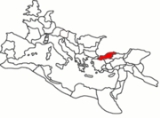
Chalcedon was an ancient maritime town of Bithynia
, in Asia Minor
, almost directly opposite Byzantium
, south of Scutari
(modern Üsküdar). It is now a district of the city of Istanbul
named Kadıköy
. The name is a variant of Calchedon , found on all the coins of Chalcedon as well as in manuscripts of Herodotus
's Histories
, Xenophon
's Hellenica, Arrian
's Anabasis
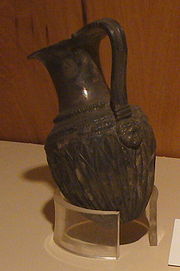
, and other works. Almost no aboveground vestiges of the ancient city survive in Kadıköy today; artifacts uncovered at Altıyol and other excavation sites are on display at the Istanbul Archaeological Museum.
The site of Chalcedon is located on a small peninsula on the north coast of the Sea of Marmara
, near the mouth of the Bosphorus. A stream, called the Chalcis or Chalcedon in antiquity and now known as the Kurbağalıdere (Turkish: stream with frogs), flows into Fenerbahçe bay. There Greek colonists from Megara
in Attica
founded the settlement of Chalcedon in 685 BC, some seventeen years before Byzantium.
The Greek name of the ancient town is from its Phoenician name, meaning "New Town", as is the name of Carthage
.
(5500-3500 BC) and attest to a continuous settlement since prehistoric times. Phoenicians were active traders in this area.
Pliny states that Chalcedon was first named Procerastis, a name which may be derived from a point of land near it: then it was named Colpusa, from the form of the harbour probably; and finally Caecorum Oppidum, or the town of the blind.
 It was a Megarian
colony founded on a site that was viewed at the time as so obviously inferior to that which was within view on the opposite shore (these being the small Lygos and Semistra settlements on Seraglio point), that the Persian general Megabazus
is said to have remarked that Chalcedon's founders must have been blind. Indeed, Strabo and Pliny relate that the oracle of Apollo had told the Athenians and Megarians who founded Byzantium to build their city opposite to the blind, and that the story was interpreted to mean Chalcedon, the 'City of the Blind'.
Chalcedon, however, was a flourishing town in which trade thrived. It contained many temples, including one of Apollo
, which had an oracle. Chalcedonia, the territory dependent upon Chalcedon, stretched up the Anatolian bank of the Bosphorus at least as far as the temple of Zeus Urius
, now the site of Yoros Castle
, and may have included the north bank of the Bay of Astacus which extends towards Nicomedia
. Important villages in Chalcedonia included Chrysopolis (the modern Üsküdar
) and Panteicheion (Pendik
). Strabo notes that "a little above the sea" in Chalcedonia, there lies "the fountain Azaritia, which contains small crocodiles."
In its early history it shared the fortunes of Byzantium, was taken by the satrap
Otanes, vacillated long between the Lacedaemonian
and the Athenian
interests. Darius
' bridge of boats, built in 512 BC for the Scythian campaign, extended from Chalcedonia to Thrace
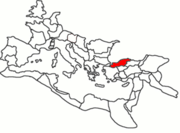
. Chalcedon was included within the kingdom of Bithynia, whose king Nicomedes
willed Bithynia to the Romans upon his death in 74 BC.
 The city was partly destroyed by Mithridates
. The governor of Bithynia, Cotta, had fled to Chalcedon for safety along with thousands of other Romans. Three thousand of them were killed, sixty ships captured, and four ships destroyed in Mithridates' assault on the city.
During the Empire, Chalcedon recovered, and was given the status of a free city. It fell under the repeated attacks of the barbarian
hordes who crossed over after having ravaged Byzantium, including some referred to as Scythians who attacked during the reign of Valerian and Gallienus in the mid 3rd century
.
 Chalcedon suffered somewhat from its proximity to the new imperial capital at Constantinople
. First the Byzantines and later the Ottoman Turks
used it as a quarry for building materials for Constantinople
's monumental structures. Chalcedon also fell repeatedly to armies attacking Constantinople from the east.
In 361 AD it was the location of the Chalcedon tribunal
, where Julian the apostate
brought his enemies to trial.
In 451 AD an ecumenical council
of Christian leaders convened here. The Council of Chalcedon
defined the human and divine natures of Jesus
and provoked the schism with the churches composing Oriental Orthodoxy
.
The general Belisarius
may have spent his years of retirement on his estate of Rufinianae in Chalcedonia.
Beginning in 616 and for at least a decade thereafter, Chalcedon furnished an encampment to the Persians under Chosroes II (cf. Siege of Constantinople (626)
). It later fell for a time to the Arabs under Yazid
(cf. Siege of Constantinople (674)
).
Chalcedon was badly damaged during the Fourth Crusade
(1204). It came definitively under Ottoman
rule under Orhan Gazi
a century before the Ottoman conquest of Constantinople
.
at an early date.
Several Christian martyr
s are associated with Chalcedon:
The Fourth Ecumenical Council
, known as the Council of Chalcedon
, was convened in 451.
After the council, Chalcedon became a metropolitan see, but without suffragans. There is a list of its bishops in Le Quien
, completed by Anthimus Alexoudes, revised for the early period by Pargoire. Among others are:
The Orthodox
Metropolitan
of Chalcedon holds senior rank (currently third position) within the Greek Orthodox patriarchal synod of Constantinople. The incumbent is Metropolitan Athanasios Papas. The cathedral is that of St. Euphemia.
After the Great Schism
, Latin church retained Chalcedon as a titular see
, suffragan of Nicomedia. Le Quien mentions eight Latin bishops, from 1345 to 1443; Eubel
has ten names, from 1293 to 1525. Five other titular bishops of the sixteenth century are mentioned in the Revue bénédictine. The titular see
of Chalcedon was officially given to the Roman Catholic Bishop of England and Wales after 1623. The first two such bishops were William Bishop (1623–24) and Richard Smith (1624–32). The last appointment to this Latin titular see
dates to 1967.
The Armenian Catholic titular see has been suppressed. Its last occupant as also that of the Syrian Catholic titular see dates to the 1950s.
Bithynia
Bithynia was an ancient region, kingdom and Roman province in the northwest of Asia Minor, adjoining the Propontis, the Thracian Bosporus and the Euxine .-Description:...
, in Asia Minor
Anatolia
Anatolia is a geographic and historical term denoting the westernmost protrusion of Asia, comprising the majority of the Republic of Turkey...
, almost directly opposite Byzantium
Byzantium
Byzantium was an ancient Greek city, founded by Greek colonists from Megara in 667 BC and named after their king Byzas . The name Byzantium is a Latinization of the original name Byzantion...
, south of Scutari
Üsküdar
Üsküdar is a large and densely populated municipality of Istanbul, Turkey, on the Anatolian shore of the Bosphorus. It is bordered on the north by Beykoz, on the east by Ümraniye, on the southeast by Ataşehir, on the south by Kadıköy, and on the west by the Bosphorus, with the areas of Beşiktaş,...
(modern Üsküdar). It is now a district of the city of Istanbul
Istanbul
Istanbul , historically known as Byzantium and Constantinople , is the largest city of Turkey. Istanbul metropolitan province had 13.26 million people living in it as of December, 2010, which is 18% of Turkey's population and the 3rd largest metropolitan area in Europe after London and...
named Kadıköy
Kadiköy
Kadıköy is a large, populous, and cosmopolitan district of İstanbul, Turkey on the Asian side of the Sea of Marmara, facing the historic city centre on the European side of the Bosporus...
. The name is a variant of Calchedon , found on all the coins of Chalcedon as well as in manuscripts of Herodotus
Herodotus
Herodotus was an ancient Greek historian who was born in Halicarnassus, Caria and lived in the 5th century BC . He has been called the "Father of History", and was the first historian known to collect his materials systematically, test their accuracy to a certain extent and arrange them in a...
's Histories
Histories (Herodotus)
The Histories of Herodotus is considered one of the seminal works of history in Western literature. Written from the 450s to the 420s BC in the Ionic dialect of classical Greek, The Histories serves as a record of the ancient traditions, politics, geography, and clashes of various cultures that...
, Xenophon
Xenophon
Xenophon , son of Gryllus, of the deme Erchia of Athens, also known as Xenophon of Athens, was a Greek historian, soldier, mercenary, philosopher and a contemporary and admirer of Socrates...
's Hellenica, Arrian
Arrian
Lucius Flavius Arrianus 'Xenophon , known in English as Arrian , and Arrian of Nicomedia, was a Roman historian, public servant, a military commander and a philosopher of the 2nd-century Roman period...
's Anabasis
Anabasis Alexandri
Anabasis Alexandri , the Campaigns of Alexander by Arrian, is the most important source on Alexander the Great.The Greek term anabasis referred to an expedition from a coastline into the interior of a country. The term katabasis referred to a trip from the interior to the coast...
, and other works. Almost no aboveground vestiges of the ancient city survive in Kadıköy today; artifacts uncovered at Altıyol and other excavation sites are on display at the Istanbul Archaeological Museum.
The site of Chalcedon is located on a small peninsula on the north coast of the Sea of Marmara
Sea of Marmara
The Sea of Marmara , also known as the Sea of Marmora or the Marmara Sea, and in the context of classical antiquity as the Propontis , is the inland sea that connects the Black Sea to the Aegean Sea, thus separating Turkey's Asian and European parts. The Bosphorus strait connects it to the Black...
, near the mouth of the Bosphorus. A stream, called the Chalcis or Chalcedon in antiquity and now known as the Kurbağalıdere (Turkish: stream with frogs), flows into Fenerbahçe bay. There Greek colonists from Megara
Megara
Megara is an ancient city in Attica, Greece. It lies in the northern section of the Isthmus of Corinth opposite the island of Salamis, which belonged to Megara in archaic times, before being taken by Athens. Megara was one of the four districts of Attica, embodied in the four mythic sons of King...
in Attica
Attica
Attica is a historical region of Greece, containing Athens, the current capital of Greece. The historical region is centered on the Attic peninsula, which projects into the Aegean Sea...
founded the settlement of Chalcedon in 685 BC, some seventeen years before Byzantium.
The Greek name of the ancient town is from its Phoenician name, meaning "New Town", as is the name of Carthage
Carthage
Carthage , implying it was a 'new Tyre') is a major urban centre that has existed for nearly 3,000 years on the Gulf of Tunis, developing from a Phoenician colony of the 1st millennium BC...
.
Prehistory
The mound of Fikirtepe has yielded remains dating to the Chalcolithic periodCopper Age
The Chalcolithic |stone]]") period or Copper Age, also known as the Eneolithic/Æneolithic , is a phase of the Bronze Age in which the addition of tin to copper to form bronze during smelting remained yet unknown by the metallurgists of the times...
(5500-3500 BC) and attest to a continuous settlement since prehistoric times. Phoenicians were active traders in this area.
Pliny states that Chalcedon was first named Procerastis, a name which may be derived from a point of land near it: then it was named Colpusa, from the form of the harbour probably; and finally Caecorum Oppidum, or the town of the blind.
Megarian colony
Megara
Megara is an ancient city in Attica, Greece. It lies in the northern section of the Isthmus of Corinth opposite the island of Salamis, which belonged to Megara in archaic times, before being taken by Athens. Megara was one of the four districts of Attica, embodied in the four mythic sons of King...
colony founded on a site that was viewed at the time as so obviously inferior to that which was within view on the opposite shore (these being the small Lygos and Semistra settlements on Seraglio point), that the Persian general Megabazus
Megabazus
Megabazus was a highly regarded Persian general under Darius. Most information about him comes from The Histories by Herodotus. Troops left behind in Europe after a failed attempt to conquer the Scythians were put under the command of Megabazus. He was given a mission to conquer Thrace, in...
is said to have remarked that Chalcedon's founders must have been blind. Indeed, Strabo and Pliny relate that the oracle of Apollo had told the Athenians and Megarians who founded Byzantium to build their city opposite to the blind, and that the story was interpreted to mean Chalcedon, the 'City of the Blind'.
Chalcedon, however, was a flourishing town in which trade thrived. It contained many temples, including one of Apollo
Apollo
Apollo is one of the most important and complex of the Olympian deities in Greek and Roman mythology...
, which had an oracle. Chalcedonia, the territory dependent upon Chalcedon, stretched up the Anatolian bank of the Bosphorus at least as far as the temple of Zeus Urius
Zeus
In the ancient Greek religion, Zeus was the "Father of Gods and men" who ruled the Olympians of Mount Olympus as a father ruled the family. He was the god of sky and thunder in Greek mythology. His Roman counterpart is Jupiter and his Etruscan counterpart is Tinia.Zeus was the child of Cronus...
, now the site of Yoros Castle
Yoros Castle
Yoros Castle is a ruined castle at the confluence of the Bosporus and the Black Sea, to the north of Joshua's Hill, in Istanbul, Turkey. It is also commonly referred to as the Genoese Castle, due to Genoa’s possession of it in the mid-15th century....
, and may have included the north bank of the Bay of Astacus which extends towards Nicomedia
Izmit
İzmit is a city in Turkey, administrative center of Kocaeli Province as well as the Kocaeli Metropolitan Municipality. It is located at the Gulf of İzmit in the Sea of Marmara, about east of Istanbul, on the northwestern part of Anatolia. The city center has a population of 294.875...
. Important villages in Chalcedonia included Chrysopolis (the modern Üsküdar
Üsküdar
Üsküdar is a large and densely populated municipality of Istanbul, Turkey, on the Anatolian shore of the Bosphorus. It is bordered on the north by Beykoz, on the east by Ümraniye, on the southeast by Ataşehir, on the south by Kadıköy, and on the west by the Bosphorus, with the areas of Beşiktaş,...
) and Panteicheion (Pendik
Pendik
Pendik is a district of Istanbul, Turkey on the Asian side between Kartal and Tuzla, on the Marmara Sea. Its population is 625.365 and its mayor is Salih Kenan Şahin .-History:...
). Strabo notes that "a little above the sea" in Chalcedonia, there lies "the fountain Azaritia, which contains small crocodiles."
In its early history it shared the fortunes of Byzantium, was taken by the satrap
Satrap
Satrap was the name given to the governors of the provinces of the ancient Median and Achaemenid Empires and in several of their successors, such as the Sassanid Empire and the Hellenistic empires....
Otanes, vacillated long between the Lacedaemonian
Sparta
Sparta or Lacedaemon, was a prominent city-state in ancient Greece, situated on the banks of the River Eurotas in Laconia, in south-eastern Peloponnese. It emerged as a political entity around the 10th century BC, when the invading Dorians subjugated the local, non-Dorian population. From c...
and the Athenian
Athens
Athens , is the capital and largest city of Greece. Athens dominates the Attica region and is one of the world's oldest cities, as its recorded history spans around 3,400 years. Classical Athens was a powerful city-state...
interests. Darius
Darius I of Persia
Darius I , also known as Darius the Great, was the third king of kings of the Achaemenid Empire...
' bridge of boats, built in 512 BC for the Scythian campaign, extended from Chalcedonia to Thrace
Thrace
Thrace is a historical and geographic area in southeast Europe. As a geographical concept, Thrace designates a region bounded by the Balkan Mountains on the north, Rhodope Mountains and the Aegean Sea on the south, and by the Black Sea and the Sea of Marmara on the east...
. Chalcedon was included within the kingdom of Bithynia, whose king Nicomedes
Nicomedes IV of Bithynia
Nicomedes IV Philopator, was the king of Bithynia, from c. 94 BC to 74 BC. He was the first son and successor of the Monarchs Nicomedes III of Bithynia and Nysa and had a sister called Nysa....
willed Bithynia to the Romans upon his death in 74 BC.
Roman city
Mithridates VI of Pontus
Mithridates VI or Mithradates VI Mithradates , from Old Persian Mithradatha, "gift of Mithra"; 134 BC – 63 BC, also known as Mithradates the Great and Eupator Dionysius, was king of Pontus and Armenia Minor in northern Anatolia from about 120 BC to 63 BC...
. The governor of Bithynia, Cotta, had fled to Chalcedon for safety along with thousands of other Romans. Three thousand of them were killed, sixty ships captured, and four ships destroyed in Mithridates' assault on the city.
During the Empire, Chalcedon recovered, and was given the status of a free city. It fell under the repeated attacks of the barbarian
Barbarian
Barbarian and savage are terms used to refer to a person who is perceived to be uncivilized. The word is often used either in a general reference to a member of a nation or ethnos, typically a tribal society as seen by an urban civilization either viewed as inferior, or admired as a noble savage...
hordes who crossed over after having ravaged Byzantium, including some referred to as Scythians who attacked during the reign of Valerian and Gallienus in the mid 3rd century
Crisis of the Third Century
The Crisis of the Third Century was a period in which the Roman Empire nearly collapsed under the combined pressures of invasion, civil war, plague, and economic depression...
.
Byzantine and Ottoman suburb
Constantinople
Constantinople was the capital of the Roman, Eastern Roman, Byzantine, Latin, and Ottoman Empires. Throughout most of the Middle Ages, Constantinople was Europe's largest and wealthiest city.-Names:...
. First the Byzantines and later the Ottoman Turks
Ottoman Turks
The Ottoman Turks were the Turkish-speaking population of the Ottoman Empire who formed the base of the state's military and ruling classes. Reliable information about the early history of Ottoman Turks is scarce, but they take their Turkish name, Osmanlı , from the house of Osman I The Ottoman...
used it as a quarry for building materials for Constantinople
Constantinople
Constantinople was the capital of the Roman, Eastern Roman, Byzantine, Latin, and Ottoman Empires. Throughout most of the Middle Ages, Constantinople was Europe's largest and wealthiest city.-Names:...
's monumental structures. Chalcedon also fell repeatedly to armies attacking Constantinople from the east.
In 361 AD it was the location of the Chalcedon tribunal
Chalcedon tribunal
Shortly after the death of Roman emperor Constantius II, his successor Julian the Apostate held a tribunal at the city of Chalcedon, which was then a suburb of Constantinople...
, where Julian the apostate
Julian the Apostate
Julian "the Apostate" , commonly known as Julian, or also Julian the Philosopher, was Roman Emperor from 361 to 363 and a noted philosopher and Greek writer....
brought his enemies to trial.
In 451 AD an ecumenical council
Ecumenical council
An ecumenical council is a conference of ecclesiastical dignitaries and theological experts convened to discuss and settle matters of Church doctrine and practice....
of Christian leaders convened here. The Council of Chalcedon
Council of Chalcedon
The Council of Chalcedon was a church council held from 8 October to 1 November, 451 AD, at Chalcedon , on the Asian side of the Bosporus. The council marked a significant turning point in the Christological debates that led to the separation of the church of the Eastern Roman Empire in the 5th...
defined the human and divine natures of Jesus
Jesus
Jesus of Nazareth , commonly referred to as Jesus Christ or simply as Jesus or Christ, is the central figure of Christianity...
and provoked the schism with the churches composing Oriental Orthodoxy
Oriental Orthodoxy
Oriental Orthodoxy is the faith of those Eastern Christian Churches that recognize only three ecumenical councils — the First Council of Nicaea, the First Council of Constantinople and the First Council of Ephesus. They rejected the dogmatic definitions of the Council of Chalcedon...
.
The general Belisarius
Belisarius
Flavius Belisarius was a general of the Byzantine Empire. He was instrumental to Emperor Justinian's ambitious project of reconquering much of the Mediterranean territory of the former Western Roman Empire, which had been lost less than a century previously....
may have spent his years of retirement on his estate of Rufinianae in Chalcedonia.
Beginning in 616 and for at least a decade thereafter, Chalcedon furnished an encampment to the Persians under Chosroes II (cf. Siege of Constantinople (626)
Siege of Constantinople (626)
The Siege of Constantinople in 626 by the Avars, aided by large numbers of allied Slavs and the Sassanid Persians, ended in a strategic victory for the Byzantines...
). It later fell for a time to the Arabs under Yazid
Yazid I
Yazīd ibn Mu‘āwiya ibn Abī Sufyān , commonly known as Yazid I, was the second Caliph of the Umayyad Caliphate . He ruled for three years from 680 CE until his death in 683 CE. Many Muslims condemn Yazid's rule as contentious and unjust...
(cf. Siege of Constantinople (674)
Siege of Constantinople (674)
The First Arab Siege of Constantinople in 674 was a major conflict of the Byzantine-Arab Wars, and was one of the numerous times Constantinople's defences were tested. It was fought between the Byzantine Empire and the Arab Umayyad Caliphate...
).
Chalcedon was badly damaged during the Fourth Crusade
Fourth Crusade
The Fourth Crusade was originally intended to conquer Muslim-controlled Jerusalem by means of an invasion through Egypt. Instead, in April 1204, the Crusaders of Western Europe invaded and conquered the Christian city of Constantinople, capital of the Eastern Roman Empire...
(1204). It came definitively under Ottoman
Ottoman Empire
The Ottoman EmpireIt was usually referred to as the "Ottoman Empire", the "Turkish Empire", the "Ottoman Caliphate" or more commonly "Turkey" by its contemporaries...
rule under Orhan Gazi
Orhan I
Orhan I or Orhan Bey was the second bey of the nascent Ottoman Empire from 1326 to 1359...
a century before the Ottoman conquest of Constantinople
Fall of Constantinople
The Fall of Constantinople was the capture of the capital of the Byzantine Empire, which occurred after a siege by the Ottoman Empire, under the command of Ottoman Sultan Mehmed II, against the defending army commanded by Byzantine Emperor Constantine XI...
.
Ecclesiastical history
Chalcedon was an episcopal seeEpiscopal See
An episcopal see is, in the original sense, the official seat of a bishop. This seat, which is also referred to as the bishop's cathedra, is placed in the bishop's principal church, which is therefore called the bishop's cathedral...
at an early date.
Several Christian martyr
Martyr
A martyr is somebody who suffers persecution and death for refusing to renounce, or accept, a belief or cause, usually religious.-Meaning:...
s are associated with Chalcedon:
- The virgin St. Euphemia and her companions in the early fourth century; the cathedral of Chalcedon was consecrated to her.
- St. Sabel the Persian and his companions.
The Fourth Ecumenical Council
Ecumenical council
An ecumenical council is a conference of ecclesiastical dignitaries and theological experts convened to discuss and settle matters of Church doctrine and practice....
, known as the Council of Chalcedon
Council of Chalcedon
The Council of Chalcedon was a church council held from 8 October to 1 November, 451 AD, at Chalcedon , on the Asian side of the Bosporus. The council marked a significant turning point in the Christological debates that led to the separation of the church of the Eastern Roman Empire in the 5th...
, was convened in 451.
After the council, Chalcedon became a metropolitan see, but without suffragans. There is a list of its bishops in Le Quien
Michel Le Quien
Michel Le Quien was a French historian and theologian. He studied at Plessis College, Paris, and at twenty entered the Benedictine Abbey of Saint-Germain-des-Prés, where he made his profession in 1682. Excepting occasional short absences he never left Paris...
, completed by Anthimus Alexoudes, revised for the early period by Pargoire. Among others are:
- St. Adrian, a martyr;
- St. John, Sts. Cosmas and NicetasNicetas of ChalcedonSaint Nicetas the Confessor, commemorated on 28 May, was the bishop of Chalcedon . References to St. Nicetas have been found in old manuscripts originating from the Greek Orthodox Patriarchate of Jerusalem, and in menaia from the Orthodox Patriarchates of Serbia and Russia.A church, first...
, during the Iconoclastic period; - Maris, the ArianArianismArianism is the theological teaching attributed to Arius , a Christian presbyter from Alexandria, Egypt, concerning the relationship of the entities of the Trinity and the precise nature of the Son of God as being a subordinate entity to God the Father...
; - Heraclianus, who wrote against the Manichæans and the Monophysites;
- Leo, persecuted by Alexius ComnenusAlexius ComnenusAlexios Komnenos, latinized as Alexius Comnenus, may refer to:* Alexios I Komnenos, Byzantine emperor * Alexios Komnenos , son of Isaac Komnenos* Alexios Komnenos , son of John II Komnenos...
.
The Orthodox
Greek Orthodox Church
The Greek Orthodox Church is the body of several churches within the larger communion of Eastern Orthodox Christianity sharing a common cultural tradition whose liturgy is also traditionally conducted in Koine Greek, the original language of the New Testament...
Metropolitan
Metropolitan bishop
In Christian churches with episcopal polity, the rank of metropolitan bishop, or simply metropolitan, pertains to the diocesan bishop or archbishop of a metropolis; that is, the chief city of a historical Roman province, ecclesiastical province, or regional capital.Before the establishment of...
of Chalcedon holds senior rank (currently third position) within the Greek Orthodox patriarchal synod of Constantinople. The incumbent is Metropolitan Athanasios Papas. The cathedral is that of St. Euphemia.
After the Great Schism
East–West Schism
The East–West Schism of 1054, sometimes known as the Great Schism, formally divided the State church of the Roman Empire into Eastern and Western branches, which later became known as the Eastern Orthodox Church and the Roman Catholic Church, respectively...
, Latin church retained Chalcedon as a titular see
Chalcedon (titular see)
Chalcedon is a Catholic titular see, having the status of archdiocese. During the seventeenth century, the title Bishop of Chalcedon was officially given to the Roman Catholic Bishop of England after 1623.-History:...
, suffragan of Nicomedia. Le Quien mentions eight Latin bishops, from 1345 to 1443; Eubel
Konrad Eubel
Konrad Eubel or Conradus Eubel was a German Franciscan historian. He is known for his reference work, the Hierarchia Catholica Medii Aevi, on medieval popes, cardinals and bishops. It appeared in three volumes, beginning in 1898...
has ten names, from 1293 to 1525. Five other titular bishops of the sixteenth century are mentioned in the Revue bénédictine. The titular see
Titular see
A titular see in various churches is an episcopal see of a former diocese that no longer functions, sometimes called a "dead diocese". The ordinary or hierarch of such a see may be styled a "titular bishop", "titular metropolitan", or "titular archbishop"....
of Chalcedon was officially given to the Roman Catholic Bishop of England and Wales after 1623. The first two such bishops were William Bishop (1623–24) and Richard Smith (1624–32). The last appointment to this Latin titular see
Titular see
A titular see in various churches is an episcopal see of a former diocese that no longer functions, sometimes called a "dead diocese". The ordinary or hierarch of such a see may be styled a "titular bishop", "titular metropolitan", or "titular archbishop"....
dates to 1967.
The Armenian Catholic titular see has been suppressed. Its last occupant as also that of the Syrian Catholic titular see dates to the 1950s.
Notable people
- BoethusBoethusBoethus was a Greek sculptor of the Hellenistic age. His life dates cannot be accurately fixed, but he probably flourished in the 2nd century BCE. One source gives his birth place as Chalcedon....
(2nd century BC), Greek sculptor - HerophilosHerophilosHerophilos , sometimes Latinized Herophilus , was a Greek physician. Born in Chalcedon, he spent the majority of his life in Alexandria. He was the first scientist to systematically perform scientific dissections of human cadavers and is deemed to be the first anatomist. Herophilos recorded his...
(2nd century BC), Greek physician - Phaleas of ChalcedonPhaleas of ChalcedonPhaleas of Chalcedon was a Greek statesman of antiquity, who argued that all citizens of a model city should be equal in property and education....
(4th century BC), Greek statesman - ThrasymachusThrasymachusThrasymachus was a sophist of Ancient Greece best known as a character in Plato's Republic.-Life, date, and career:...
(5th century BC), Greek sophist - XenocratesXenocratesXenocrates of Chalcedon was a Greek philosopher, mathematician, and leader of the Platonic Academy from 339/8 to 314/3 BC. His teachings followed those of Plato, which he attempted to define more closely, often with mathematical elements...
(4th century BC), Greek philosopher