
|
|
|
|
Saint Peter
|
| |
|
| |
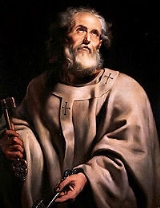
Saint Peter (Pétros “Rock”) (c.1–AD 64) was a leader of the early Christian church, who features prominently in the New Testament Gospels and the Acts of the Apostles. According to Biblical accounts, he was one of Twelve Apostles, chosen by Jesus from his first disciples. He was a Galilean fisherman assigned a leadership role by Jesus (Matthew 16:18), and was with Jesus during events witnessed by only a few apostles, such as the Transfiguration.

Discussion
Ask a question about 'Saint Peter'
Start a new discussion about 'Saint Peter'
Answer questions from other users
|
Timeline

Encyclopedia
Saint Peter (Pétros “Rock”) (c.1–AD 64) was a leader of the early Christian church, who features prominently in the New Testament Gospels and the Acts of the Apostles. According to Biblical accounts, he was one of Twelve Apostles, chosen by Jesus from his first disciples. He was a Galilean fisherman assigned a leadership role by Jesus (Matthew 16:18), and was with Jesus during events witnessed by only a few apostles, such as the Transfiguration. Early Christian writers provided more details about his life. Catholic tradition claims that he was the first Pope, the author of two canonical epistles, and a martyr under Nero, crucified head down, and buried in Rome. His memoirs are traditionally cited as the source of the Gospel of Mark.
The Roman Catholic Church, Eastern Orthodox, Oriental Orthodox and Anglican Communion consider Peter a saint. According to Catholic tradition Peter was the first Bishop of Rome, therefore the Pope is Peter's successor and the rightful superior of all other bishops. Eastern and Oriental Orthodox do not recognize the Bishop of Rome as the successor of St. Peter but the Ecumenical Patriarch of Constantinople sends a delegation each year to Rome to participate in the celebration of the feast of Sts. Peter and Paul. In the of 13 October 2007, the representatives of the Eastern Orthodox Church agreed that "Rome, as the Church that 'presides in love' according to the phrase of St. Ignatius of Antioch (To the Romans, Prologue), occupied the first place in the taxis, and that the bishop of Rome was therefore the protos among the patriarchs, if the Papacy unites with the Orthodox Church. They disagree, however, on the interpretation of the historical evidence from this era regarding the prerogatives of the bishop of Rome as protos, a matter that was already understood in different ways in the first millennium."
In art, he is often depicted holding the keys to the kingdom of heaven (interpreted by Roman Catholics as the sign of his primacy over the Church), a reference to Matthew .
Names and etymologies
Peter is also known as Ben-Yonah/Bar-Yonah, Simon Peter, Cephas and Kepha (Kepha and Cephas ???? also mean rock)—original name Shimon or Simeon.
New Testament account
Peter's life story relies on the New Testament, since there are few other first-century accounts of his life and death. In the New Testament, he is the first of the disciples called during Jesus' ministry. It was during his first meeting with Jesus that Jesus named him Peter. Peter was to become the first apostle ordained by Jesus in the early church.
Background
Peter ran a fishing business in Bethsaida . He was named Simon, son of Jonah or John. The synoptic gospels all recount how Peter's mother-in-law was healed by Jesus at their home in Capernaum (; ; ) which, coupled with , proves conclusively that Peter was married, contrary to traditions stating otherwise.
In the Synoptic Gospelss, Peter (then Simon) was a fisherman along with his brother Andrew and the sons of Zebedee, James and John. The Gospel of John also depicts Peter fishing, even after the resurrection of Jesus, in the story of the Catch of 153 fish.
In Matthew and Mark, Jesus called Simon and his brother Andrew to be "fishers of men" (; ).
In Luke, Simon Peter owns the boat that Jesus uses to preach to the multitudes who were pressing on him at the shore of Lake Gennesaret . Jesus then amazes Simon and his companions James and John (Andrew is not mentioned) by telling them to lower their nets, whereupon they catch a huge number of fish. Immediately after this, they follow him .
The Gospel of John gives a somewhat different account of "The First Disciples". In John, we are told that it was two disciples of John the Baptist (Andrew and an unnamed disciple) who heard John the Baptist announce Jesus as the "Lamb of God," and then followed Jesus. Andrew then went and fetched his brother Simon, saying, "We have found the Messiah," and then brought Peter to Jesus. Jesus then gave Simon the name "Cephas," meaning 'rock', in Aramaic. 'Petros', a masculine form of the feminine 'petra' (rock) is the Greek equivalent of this. It had not previously been used as a name, but in the Greek-speaking world it became a popular Christian name after the tradition of Peter's prominence in the early Christian church had been established.
Position among the apostles
Peter is always mentioned first in the lists of the Twelve. He is also frequently mentioned in the Gospels as forming with James the Elder and John a special group within the Twelve Apostles, present at incidents to which the others were not party, such as at the Transfiguration of Jesus. He often confesses his faith in Jesus as the Messiah.
Peter is often depicted in the Gospels as spokesman of all the apostles. Catholics refer to him as chief of the Apostles, as do the Eastern Orthodox and the Oriental Orthodox. (Some believe this is not the same as saying that the other Apostles were under Peter's orders.) In contrast, Jewish Christians are said to have argued that James the Just was the leader of the group. Some argue James was the Patriarch of Jerusalem and that this position at times gave him privilege in some (but not all) situations. The early Church historian Eusebius (c AD 325) records Clement of Alexandria (c AD 190) as saying,
"For they say that Peter and James and John after the ascension of our Saviour, as if also preferred by our Lord, strove not after honor, but chose James the Just bishop of Jerusalem."
Paul affirms that Peter had the special charge of being apostle to the Jews, just as he, Paul, was apostle to the Gentiles.
Walking on water
Three of the four canonical Gospels (Matthew, Mark, and John, but not Luke) recount the story of Jesus walking on water. Matthew additionally describes Peter walking on water for a moment, but sinking when his faith wavered.().
Washing of feet
recounts that at the beginning of the Last Supper Jesus washed his disciples' feet; Peter initially refused to let Jesus wash his feet, but when Jesus responded: "If I wash thee not, thou hast no part with me", Peter replied: "Lord, not my feet only, but also my hands and my head".
The washing of feet is often repeated at Mass on Holy Thursday in the Roman Catholic Church and at similar services by other groups.
Arrest of Jesus
The three synoptic Gospels all mention that, when Jesus was arrested, one of his companions cut off the ear of a servant of the High Priest.(, , ) The Gospel of John also includes this event, and names Peter as the swordsman and Malchus as the victim. Luke adds that Jesus touched the ear and miraculously healed it.
Denial of Jesus All four canonical gospels recount that, during the Last Supper, Jesus foretold that Peter would deny him three times before the cock crowed twice (the next morning.)
The three Synoptics describe the three denials as follows:
- A denial when a female servant of the high priest spots Simon Peter, saying that he had been with Jesus.
- A denial when Simon Peter had gone out to the gateway, away from the firelight, but the same servant girl or another told the bystanders he was a follower of Jesus.
- A denial came when Peter's Galilean accent was taken as proof that he was indeed a disciple of Jesus.
Matthew adds that it was his accent that gave him away as coming from Galilee. Luke deviates slightly from this by stating that, rather than a crowd accusing Simon Peter, it was a third individual.
The Gospel of John places the second denial while Peter was still warming himself at the fire, and gives as the occasion of the third denial a claim by someone to have seen him in the garden of Gethsemane when Jesus was arrested.
In the Gospel of Luke, Jesus' prediction of Peter's denial is coupled with a prediction that all the apostles ("you," plural) would be "sifted like wheat," but that it would be Peter's task ("you," singular), when he had turned again, to strengthen his brethren.
In a reminiscent scene in John's epilogue, Peter affirms three times that he loves Jesus.
Empty tomb
In John's gospel, Peter is the first person to enter the empty tomb, although the women and the beloved disciple see it before him . In Luke's account, the women's report of the empty tomb is dismissed by the apostles and Peter is the only one who goes to check for himself. In fact, he runs to the tomb. After seeing the graveclothes he goes home, apparently without informing the other disciples .
Resurrection appearances
Paul's First Epistle to the Corinthians, (chapter15), contains a list of resurrection appearances of Jesus, the first of which is an appearance to "Cephas" (Peter): . Here Paul follows a very early tradition that Peter was the first to see the risen Christ. also mentions an appearance to "Simon" as the first in Jerusalem, more or less contemporaneous with the appearance to the two disciples on their way to Emmaus.
In the final chapter of the Gospel of John, Peter, in one of the resurrection appearances of Jesus, three times affirmed his love for Jesus, balancing his threefold denial, and Jesus reconfirmed Peter's position . Some scholars hypothesize that it was added later to bolster Peter's status.
Role in the early church
The author of the Acts of the Apostles portrays Peter as an extremely important figure within the early Christian community, with Peter delivering a significant open-air sermon during Pentecost. According to the same book, Peter took the lead in selecting a replacement for Judas Iscariot . He was twice arraigned, with John, before the Sanhedrin and directly defied them (). He undertook a missionary journey to Lydda, Joppa and Caesarea , becoming instrumental in the decision to evangelise the Gentiles .
About halfway through, the Acts of the Apostles turns its attention away from Peter and to the activities of Paul, and the Bible is fairly silent on what occurred to Peter afterwards.
Council of Jerusalem
At the council of Jerusalem (c 50), the early Christian church, Paul and the leaders of the Jerusalem church met and decided to embrace Gentile converts. Acts portrays Peter as successfully opposing the Christian Pharisees who insisted on circumcision and the rest of the Mosaic law.
Epistles
Peter is mentioned briefly in Paul's Epistle to the Galatians, which mentions a trip by Paul to Jerusalem where he meets Peter, and a trip by Peter to Antioch where Paul rebuked him for treating Gentile converts as inferior to Jewish Christians. Galatians is accepted as authentic by almost all scholars, so these are the earliest mentions of Peter to be written.
Church tradition ascribes the epistles First and Second Peter to Saint Peter, as does the text of 2 Peter itself. First Peter implies the author is in "Babylon", which has been held to be a coded reference to Rome. Most scholars regard First Peter as not authored by him, and there is still considerable debate about the Petrine authorship of Second Peter. However the Greek in both books are similar, and the early Church was adamantly opposed to pseudographical authorship.
Accounts outside the New Testament
In Catholic tradition, Peter is said to have founded the church in Rome with Paul, served as its bishop, authored two epistles, and then met martyrdom there along with Paul.
Antioch and Corinth
Later accounts expand on the brief Biblical mention of his visit to Antioch. The Liber Pontificalis (9th century) mentions Peter as having served as bishop of Antioch before his journey to Rome. Historians have furnished other evidence of Peter's sojourn in Antioch. Subsequent tradition held that Peter had been the first Patriarch of Antioch.
He might have visited Corinth, as a party of "Cephas" existed there.
Death
In the epilogue of the Gospel of John, Jesus hints at the death by which Peter would glorify God , saying "'…when you are old you will stretch out your hands, and another will gird you and take you where you do not want to go.'" This is understood as a reference to Peter's crucifixion.
According to the 1911 Catholic Encyclopedia, St. Peter labored in Rome during the last portion of his life, and there ended his earthly course by martyrdom. The death of St. Peter is attested to by Tertullian at the end of the second century, and by Origen in Eusebius, Church History II.1. Origen says: "Peter was crucified at Rome with his head downwards, as he himself had desired to suffer". According to the noncanonical Acts of Peter, he was crucified upside down.
Status
St. Clement of Rome identifies Peter and Paul as the outstanding heroes of the faith. Papias reported that the Gospel of Mark was based on Peter's memoirs, a tradition still accepted by some scholars today.
Martyrdom
The Annuario Pontificio gives the year of Peter's death as A.D. 64 or A.D. 67. Early church tradition (as indicated below) says Peter probably died at the time of the Great Fire of Rome of the year 64. Margherita Guarducci, who led the research leading to the rediscovery of Peter’s tomb in its last stages (1963-1968), was of the opinion that Peter died on October 13 A.D. 64 during the festivities on the occasion of the “dies imperii” of Emperor Nero. This took place three months after the disastrous fire that destroyed Rome for which the emperor wished to blame the Christians. This “dies imperii” (regnal day anniversary) was an important one, exactly ten years after Nero acceded to the throne, and it was ‘as usual’ accompanied by much bloodshed. Traditionally, Roman authorities sentenced him to death by crucifixion. According to the apocryphal Acts of Peter, he was crucified head down. Tradition also locates his burial place where the Basilica of Saint Peter was later built, directly beneath the Basilica's high altar.
Clement of Rome, in his Letter to the Corinthians (Chapter 5), written c. 80-98, speaks of Peter's martyrdom in the following terms: "Let us take the noble examples of our own generation. Through jealousy and envy the greatest and most just pillars of the Church were persecuted, and came even unto death… Peter, through unjust envy, endured not one or two but many labours, and at last, having delivered his testimony, departed unto the place of glory due to him."
Traditions originating in or recorded in the apocryphal Acts of Peter, say that the Romans crucified Peter upside down at his request because he did not wish to be equated with Jesus. Acts of Peter is also thought to be the source for the tradition about the famous phrase "Quo vadis, Domine?" (or "Pou Hupageis, Kurie?" which means, "Whither goest Thou, Master?"), a question that, according to this tradition, Peter, fleeing Rome to avoid execution, asked a vision of Jesus, and to which Jesus responded that he was "going to Rome, to be crucified again," causing Peter to decide to return to the city and accept martyrdom. As legends go, this has no historical basis. This story is commemorated in an Annibale Carracci painting. The Church of Quo Vadis, near the Catacombs of Saint Callistus, contains a stone in which Jesus' footprints from this event are supposedly preserved, though this was actually apparently an ex-voto from a pilgrim, and indeed a copy of the original, housed in the Basilica of St Sebastian.
The ancient historian Josephus describes how Roman soldiers would amuse themselves by crucifying criminals in different positions, and it is likely that this would have been known to the author of the Acts of Peter. The position attributed to Peter's crucifixion is thus plausible, either as having happened historically or as being an invention by the author of the Acts of Peter. Death, after crucifixion head down, is unlikely to be caused by suffocation, the usual cause of death in ordinary crucifixion.
A medieval tradition was that the Mamertine Prison in Rome is the place where Peter was imprisoned before his execution.
In 1950, human bones were found buried underneath the altar of St. Peter's Basilica. The bones have been claimed by many to have been those of Peter. An attempt to contradict these claims was made in 1953 by the excavation of what some believe to be St Peter's tomb in Jerusalem. However along with supposed tomb of Peter bearing his previous name Simon, tombs bearing the names of Jesus, Mary, James, John, and the rest of the apostles were also found at the same excavation - though all these names were very common among Jews at the time, so the name proves nothing.
In the 1960s, some previously discarded debris from the excavations beneath St Peters Basilica were re-examined, and the bones of a male person were identified. A forensic examination found them to be a male of about 61 years of age from the first century. This caused Pope Paul VI in 1968 to announce them most likely to be the relics of Saint Peter.
Connection to Rome
The New Testament says nothing directly about Peter's connection to Rome, but an early Catholic tradition supports such a connection.
St. Ignatius of Antioch implies that Peter and Paul had special authority over the Roman church. In his Letter to the Romans (Ch. 4) of c. 105-110, tells the Roman Christians: "I do not command you, as Peter and Paul did."
St. Irenaeus of Lyons stated definitively that Peter and Paul founded the Roman church. Irenaeus was a disciple of St. Polycarp of Smyrna, who was himself a disciple of the St. John the Apostle, which puts Irenaeus not far from the authentic teachings of the Apostles. In c. 175-185, he wrote in Against Heresies (Book III, Chapter III, paragraphs 2–3):
Since, however, it would be too long to enumerate in such a volume as this the succession of all the churches, we shall confound all those who, in whatever manner, whether through self-satisfaction or vainglory, or through blindness and wicked opinion, assemble other than where it is proper, by pointing out here the successions of the bishops of the greatest and most ancient church known to all, founded and organized at Rome by the two most glorious apostles, Peter and Paul, that church which has the tradition and the faith which comes down to us after having been announced to men by the apostles. With that church, because of its superior origin, all the churches must agree, that is, all the faithful in the whole world, and it is in her that the faithful everywhere have maintained the apostolic tradition.
The blessed apostles, then, having founded and built up the Church, committed into the hands of Linus the office of the episcopate. Of this Linus, Paul makes mention in the Epistles to Timothy. To him succeeded Anacletus; and after him, in the third place from the apostles, Clement was allotted the bishopric. This man, as he had seen the blessed apostles, and had been conversant with them, might be said to have the preaching of the apostles still echoing [in his ears], and their traditions before his eyes. Nor was he alone [in this], for there were many still remaining who had received instructions from the apostles. In the time of this Clement, no small dissension having occurred among the brethren at Corinth, the Church in Rome dispatched a most powerful letter to the Corinthians, exhorting them to peace, renewing their faith, and declaring the tradition which it had lately received from the apostles…
Tertullian also writes: "But if you are near Italy, you have Rome, where authority is at hand for us too. What a happy church that is, on which the apostles poured out their whole doctrine with their blood; where Peter had a passion like that of the Lord, where Paul was crowned with the death of John (the Baptist, by being beheaded)."
Dionysius of Corinth also serves as a witness to the tradition. He wrote: "You (Pope Soter) have also, by your very admonition, brought together the planting that was made by Peter and Paul at Rome and at Corinth; for both of them alike planted in our Corinth and taught us; and both alike, teaching similarly in Italy, suffered martyrdom at the same time" (Letter to Pope Soter A.D. 170, in Eusebius, History of the Church 2:25:8).
Later tradition, first found in Saint Jerome, attributes to Peter a 25-year episcopate (or apostolate) in Rome.
Noncanonical sayings of Peter
Two sayings are attributed to Peter in the Gnostic Gospel of Thomas, of which two versions, Coptic and Greek, were written shortly before AD 350. In the first, Peter compares Jesus to a "just messenger." In the second, Peter asks Jesus to "make Mary leave us, for females don't deserve life," although the verse containing the latter is regarded as a dubious, later addition by most scholars.
In the Apocalypse of Peter, Peter holds a dialogue with Jesus about the parable of the fig tree and the fate of sinners.
In the Gospel of Mary, whose text is largely fragmented, Peter appears to be jealous of "Mary" (probably Mary Magdalene). He says to the other disciples, "Did He really speak privately with a woman and not openly to us? Are we to turn about and all listen to her? Did He prefer her to us?" In reply to this, Levi says "Peter, you have always been hot tempered."
Other noncanonical texts that attribute sayings to Peter include the Secret Book of James and the Acts of Peter.
Denial of Jesus
In the Fayyum Fragment Jesus predicts that Peter will deny him three times before the cock crows at dawn in an account similar to that of the canonical gospels, especially the Gospel of Mark. The fragment's account is abbreviated, possibly a source text for the scene in Mark or an edited version of it. There is no way to know which came first.
After the death of Jesus
The fragmentary Gospel of Peter, attributed to Peter, contains an account of the death of Jesus differing significantly from the canonical gospels. It contains little information about Peter himself, except that after the discovery of the empty tomb, "I, Simon Peter, and Andrew my brother, took our fishing nets and went to the sea."
Religious interpretations
Roman Catholic Church In Catholic tradition, Peter's leadership role among the Apostles, referred to above lies at the root of the leadership role of the pope among the bishops of the Church. Some Protestants question this belief on the grounds of alleged lack of contemporary evidence.
The first Epistle of Peter ends with "The church that is in Babylon, chosen together with you, salutes you, and so does my son, Mark." (1 Pet 5:13). Though the word "Babylon" refers literally to a city in Mesopotamia, it could be used cryptically to indicate Rome, as some argue the term is used in Revelation ; ; , and in the works of various Jewish seers. "Babylon" could also simply be a reference to the present age, so the reference to a specific place is not conclusive.
In reference to Peter's occupation before becoming an Apostle, the popes wear the Fisherman's Ring, which bears an image of the saint casting his nets from a fishing boat. The keys used as a symbol of the Pope's authority refer to the "keys of the kingdom of Heaven" promised to Peter . The terminology of this "commission" of Peter is unmistakably parallel to the commissioning of Eliakim ben Hilkiah in and .
Peter is therefore often depicted in both Western and Eastern Christian art holding a key or a set of keys.
In the same passage of the Gospel of Matthew, Jesus tells Peter: "You are Peter, and on this rock I will build my Church." In the original Greek the word translated as "Peter" is ??t??? (Petros) and that translated as "rock" is p?t?a (petra), two words that, while not identical, give an impression of one of many times when Jesus used a play on words. Furthermore, since Jesus presumably spoke to Peter in their native Aramaic language, he would have used kepha in both instances. The Peshitta Text and the Old Syriac text use the word "kepha" for both "Peter" and "rock" in Matthew 16:18. John 1:42 says Jesus called Simon "Cephas", as does Paul in some letters. The traditional Catholic interpretation has therefore been that Jesus told Peter (Rock) that he would build his Church on this Peter (Rock). Others point out that the context of the remark was that Jesus was remarking on the testimony of Peter that Jesus was the Son of God, by saying that Peter's knowledge of that fact was given him by revelation from God. In that context, Jesus said, his church would be built on personal revelation from God.
Protestant objections
Many Protestants agree that Jesus made Peter the head of the church, but deny the doctrine of Apostolic Succession.
Some Protestant scholars disagree with this interpretation on the basis of the difference between the Greek words. In classical Attic Greek petros generally meant "pebble," while petra meant "boulder" or "cliff." Accordingly, taking Peter's name to mean "pebble," they argue that the "rock" in question cannot have been Peter, but something else, either Jesus himself, or the faith in Jesus that Peter had just professed. In appealing to the doctrine of Biblical inerrancy, these scholars claim that speculation regarding the original language/word choice of the event recorded in Matthew is irrelevant because the account in Greek is without error, and thus there must be significance to the different words chosen by the author.
Counter-arguments are presented not only by Catholic apologists like Karl Keating but also by scholars of other Christian churches, such as the Evangelical Christian D. A. Carson in The Expositor's Bible Commentary (Grand Rapids: Zondervan, 1984). They point out that the Gospel of Matthew was written, not in the classical Attic form of Greek, but in the Hellenistic Koine dialect, in which there is no distinction in meaning between petros and petra. Moreover, even in Attic Greek, in which the regular meaning of petros was a smallish "stone," there are instances of its use to refer to larger rocks, as in Sophocles, Oedipus at Colonus v. 1595, where petros refers to a boulder used as a landmark, obviously something more than a pebble. In any case, a petros/petra distinction is irrelevant considering the Aramaic language in which the phrase might well have been spoken. In Greek, of any period, the feminine noun petra could not be used as the given name of a male, which may explain the use of Petros as the Greek word with which to translate Aramaic Kepha.
By analyzing the Greek, it is also believed by some that Jesus meant to single out Peter as the very rock which he will build upon. This ignores the fact that Jesus repeatedly used a word to create single-word allegories many, many times. Matthew uses the demonstrative pronoun taute, which allegedly means "this very" or this same, when he refers to the rock on which Jesus' church will be built. He also uses the Greek word for "and", kai. It is alleged that when a demonstrative pronoun is used with kai, the pronoun refers back to the preceding noun. The second rock Jesus refers to must then be the same rock as the first one; and if Peter is the first rock he must also be the second.
However, even though the feminine noun petra is translated as rock in the phrase "on this rock I will build my church," the word petra (p?t?a in Greek) is also used at 1 Corinthians 10:4 in describing Jesus Christ, which reads: "They all ate the same spiritual food and drank the same spiritual drink; for they drank from the spiritual rock that accompanied them, and that rock was Christ."
Both Latin and Greek writers in the early Catholic church (such as St. John Chrysostom) considered the "foundation rock" as applying to both Peter personally and his confession of faith (or the faith of his confession) symbolically, as well as seeing Christ's promise to apply more generally to his twelve apostles and the Church at large. This "double meaning" interpretation is present in the Catechism of the Catholic Church.
Lutheran objections
Confessional Lutheran churches rebut Catholic apologists' position by stating if Peter really means the Rock which made him the chief of Apostles, it would contradict Bible's teaching in which says that the church's foundation is the apostles and prophets, instead of Peter alone. And the meaning of Matthew 16:18 is that Jesus uses a play on words with Peter's name to say that the confession he had just made is the rock on which the church is built.
Protestant apologists argue that there is no biblical or historical evidence for the claims of the Roman Catholic Church that Peter was the first pope as even some Roman Catholic historians admit that there were no popes and not even one bishop of Rome in the first century, quoting Francis A. Sullivan's "From Apostles to Bishops" which says:
Theologically conservative Christians, including Confessional Lutherans, also rebut comments made by Karl Keating and D.A. Carso who claim that there's no distinction between the words petros and petra in Koine Greek. The Lutheran theologians state that the dictionaries of Koine/NT Greek, including the authoritative Bauer-Danker-Arndt-Gingrich Lexicon, indeed list both words and the passages that give different meanings for each. The Lutheran theologians further note that:
St. Peter's Basilica
When, in the early fourth century, the Emperor Constantine I decided to honour Peter with a large basilica, the precise location of Peter's burial was so firmly fixed in the belief of the Christians of Rome that the building had to be erected on a site that involved considerable difficulties, both physical (excavating the slope of the Vatican Hill, while the great church could much more easily have been built on level ground only slightly to the south) and moral and legal (demolishing a cemetery). The focal point of the Basilica, both in its original form and in its later complete reconstruction, is the altar placed over what is held to be the exact place where Peter was buried.
Feast days
The Roman Martyrology assigns 29 June as the feast day of both Peter and Paul, without thereby declaring that to be the day of their deaths. St. Augustine of Hippo says in his Sermon 295: "One day is assigned for the celebration of the martyrdom of the two apostles. But those two were one. Although their martyrdom occurred on different days, they were one."
This is also the feast of both Apostles in the calendar of the Eastern Orthodox Church.
In the Roman Rite, the feast of the Chair of Saint Peter is celebrated on 22 February, and the anniversary of the dedication of the two papal basilicas of Saint Peter's and Saint Paul's outside the Walls is held on 18 November.
Before Pope John XXIII's revision in 1960, the Roman Calendar also included on 16 January another feast of the Chair of Saint Peter (denominated the Chair of Saint Peter in Rome, while the February feast was then called that of the Chair of Saint Peter at Antioch), and on 1 August the feast of Saint Peter in Chains.
Eastern Orthodox The Eastern Orthodox Church regards Saint Peter, together with Saint Paul, as "Preeminent Apostles". Another title used for Peter is Coryphaeus, which could be translated as "Choir-director", or lead singer. The church recognizes Saint Peter's leadership role in the early church, especially in the very early days at Jerusalem, but does not consider him to have had any "princely" role over his fellow Apostles. The New Testament is not seen by the Orthodox as supporting any extraordinary authority for Peter with regard to faith or morals. The Orthodox also hold that Peter did not act as leader at the Council of Jerusalem, but as merely one of a number who spoke. The final decision regarding the non-necessity of circumcision (and certain prohibitions) was spelled out by James, the Brother of the Lord (though Catholics hold James merely reiterated and fleshed out what Peter had said, regarding the latter's earlier divine revelation regarding the inclusion of Gentiles).
With regard to Jesus' words to Peter, "Thou art Peter and upon this rock I will build my church", the Orthodox hold Christ is referring to the confession of faith, not the person of Peter as that upon which he will build the church. This is allegedly shown by the fact that the original Greek uses the feminine demonstrative pronoun when he says "upon this rock" (ta?t? t? p?t??); whereas, grammatically, if he had been referring to Peter, he would allegedly have used the masculine. This "gender distinction" argument is also held by some Protestants.
The Orthodox also consider that St. Linus, not Peter, was the first Bishop of Rome.
Feast days
In the Orthodox Daily Office every Thursday throughout the year is dedicated to the Holy Apostles, including St. Peter. There are also two feast days in the year which are dedicated to him:
- June 29, Feast of Saints Peter and Paul—This is a major feast day and is preceded by a period of Lenten fasting known as the Apostles' Fast
- January 16, Veneration of the Precious Chains of the Holy and All-Glorious Apostle Peter—commemorating both the chains which says miraculously fell from him, and the chains in which he was held before his martyrdom by Nero
Syriac Orthodox Church The Fathers of the Syriac Orthodox Church tried to give a theological interpretation to the primacy of Saint Peter. They were fully convinced of the unique office of Peter in the primitive Christian community. Ephrem, Aphrahat and Marutha who were supposed to be the best exponents of the early Syriac tradition unequivocally acknowledge the office of Peter.
The Syriac Fathers following the rabbinic tradition call Jesus “Kepha” for they see “rock” in the Old Testament as a messianic Symbol. When Christ gave his own name “Kepha” to Simon he was giving him participation in the person and office of Christ. Christ who is the Kepha and shepherd made Simon the chief shepherd in his place and gave him the very name Kepha and said that on Kepha he would build the Church. Aphrahat shared the common Syriac tradition. For him Kepha is in fact another name of Jesus, and Simon was given the right to share the name. The person who receives somebody else’s name also obtains the rights of the person who bestows the name. Aphrahat makes the stone taken from Jordan a type of Peter. He says Jesus son of Nun set up the stones for a witness in Israel; Jesus our Saviour called Simon Kepha Sarirto and set him as the faithful witness among nations.
Again he says in his commentary on Deuteronomy that Moses brought forth water from “rock” (Kepha) for the people and Jesus sent Simon Kepha to carry his teachings among nations. Our Lord accepted him and made him the foundation of the Church and called him Kepha. When he speaks about transfiguration of Christ he calls him Simon Peter, the foundation of the Church. Ephrem also shared the same view. In Armenian version of De Virginitate records Peter the Rock shunned honour Who was the head of the Apostles. In a mimro of Efrem found in Holy Week Liturgy points to the importance of Peter.
Both Aphrahat and Ephrem represent the authentic tradition of the Syrian Church. The different orders of liturgies used for sanctification of Church building, marriage, ordination etc. reveal that the primacy of Peter is a part of living faith of the Church.
Evangelical Protestant and Seventh-day Adventist
Evangelical Protestants, Seventh Day Adventists and others contend that the idea of Peter being the first Pope is based on a misinterpretation. (see the discussions above about the words "petros" and "petra" in Attic and Koine Greek, and as a translation from the Aramaic).
They argue in addition that Peter was in need of a firm foundation to gain a sense of stability, as Peter was noted for his great zeal, but instability:
- In Peter went out to walk on water, but then sank because of doubt.
- In and Peter dramatically swears that he will not deny his Lord even on pain of death, but he denied Jesus with cursing and swearing.
- , , , are a few examples of Peter being the first to answer.
- Peter jumping into the water to meet his Lord.
They also argue that the statement by Peter: "Thou art the Christ, the Son of the living God" is the foundation of the Christian faith: not Peter, but the testimony that Peter gave.
They also argue that Peter's acts are recorded in all of the gospels, and the book of Acts, and his writings were included in the bible, and are used by Christians today. In this sense Peter was used in the building of the Lord's church, as a small stone (petros) would be used.
They also argue that the idea of making a single man the whole foundation of the church would go against the principle taught in although in Jesus clearly tells "The Beloved Disciple" to feed and tend his sheep, and the ability to loose and bind is given to every disciple of Christ.
New Apostolic Church
The New Apostolic Church, who believes in the re-established Apostle ministry, sees Peter as the first Chief Apostle.
Latter Day Saint movement
The Church of Jesus Christ of Latter-day Saints (LDS Church or "Mormons") along with other sects of the Latter Day Saint movement believe that Peter was the first leader of the early Christian church, but reject papal succession. In interpreting Matthew 16: 13–19 the church has stated, "The words then addressed to him, 'Thou art Peter, and upon this rock I will build my church,' have been made the foundation of the papal claims. But it is the Godhead of Christ, which Peter had just confessed, that is the true keystone of the Church." Latter-day saints believe that as part of the restoration, Peter, James and John came from heaven and conferred the keys of the Melchizedek Priesthood upon Joseph Smith and Oliver Cowdery in 1829, near Harmony Township, Susquehanna County, Pennsylvania.
Afro-American syncretism
In the Cuban Santería and Palo Mayombe, he has been syncretized with Ogún.
Jewish folklore According to Jewish folklore (Toledot Yeshu narrative), St. Peter (Shimeon Kepha Ha-Tzadik) had a pristine reputation as a greatly learned and holy man who, according to the directions of his sage to bring about the end of one hundred years of strife in Israel, established the Sunday Sabbath for God-Fearers (converted from among Gnostic heretics known as The Watchers) instead of Saturday, Noel (as a new year feast but not as Christmas) instead of Hanukkah, the Feast of the Cross instead of Rosh Hashana, Firstfruits instead of Pesach, remembering The Feast of The Jews instead of Sukkot, and the Ascension instead of Shavuot. R. Judah ben Samuel of Regensburg, who led Germany's 12th-century Chasidei Ashkenaz, considered him to be a Tzaddik (a Jewish saint or spiritual Master among Hasidim) (Sefer Hasidim). The Tosaphist Rabbeinu Tam wrote that he was "a devout and learned Jew who dedicated his life to guiding gentiles along the proper path". R. Tam also passed on the traditions that St. Peter was the author of the Sabbath and feast-day prayer (although Otzar Hatefillah, quoting Mahzor Vitri, pointedly denies this claim, offering in stead Simeon ben Shetach as the probable author), and also that he authored a prayer for Yom Kippur in order to prove his commitment to Judaism despite his work amongst Gentiles (Julius Eisenstein). Legends about Peter and his activities are also mentioned in other medieval works, such as the Mahzor Vitri.
Writings
Traditionally, two canonical epistles (1 & 2 Peter) and several apocryphal works have been attributed to Saint Peter.
New Testament
The New Testament includes two letters (epistles) ascribed to Peter. Both demonstrate a high quality of cultured and urban Greek, at odds with the linguistic skill that would ordinarily be expected of an Aramaic-speaking fisherman, who would have learned Greek as a second or third language. However, the author of the first epistle explicitly claims to be using a secretary (see below), and this explanation would allow for discrepancies in style without entailing a different source. The textual features of these two epistles are such that a majority of scholars doubt that they were written by the same hand. This means at the most that Peter could not have authored both, or at the least that he used a different secretary for each letter. Some scholars argue that theological differences imply different sources, and point to the lack of references to 2 Peter among the early Church Fathers.
Of the two epistles, the first epistle is considered the earlier. A number of scholars have argued that the textual discrepancies with what would be expected of the biblical Peter are due to it having been written with the help of a secretary or as an amanuensis. Indeed in the first epistle the use of a secretary is clearly described: "By Silvanus, a faithful brother unto you, as I suppose, I have written briefly, exhorting, and testifying that this is the true grace of God wherein ye stand" (1 Peter 5:12). Thus, in regards to at least the first epistle, the claims that Peter would have written Greek poorly seem irrelevant. The references to persecution of Christians, which only began under Nero, cause most scholars to date the text to at least 80, which would require Peter to have survived to an age that was, at that time, extremely old, and almost never reached, particularly by common fishermen. However, the Roman historian Tacitus and the biographer Suetonius both record that Nero's persecution of Christians began immediately after the fire that burned Rome in 64. Such a date, which is in accord with Christian tradition, especially Eusebius (History book 2, 24.1), would not have Peter at an improbable age upon his death. On the other hand, many scholars consider this in reference to the persecution of Christians in Asia Minor during the reign of the emperor Domitian (81-96).
In the salutation of the first epistle, the writer refers to the diaspora, which did not occur until 136 "1. Peter, an apostle of Jesus Christ, to God's elect, strangers in the world, scattered throughout Pontus, Galatia, Cappadocia, Asia and Bithynia, 2. who have been chosen according to the foreknowledge of God the Father, through the sanctifying work of the Spirit, for obedience to Jesus Christ and sprinkling by his blood: Grace and peace be yours in abundance."
The Second Epistle of Peter, on the other hand, appears to have been copied, in part, from the Epistle of Jude, and some modern scholars date its composition as late as c. 150. Some scholars argue the opposite, that the Epistle of Jude copied 2 Peter, while others contend an early date for Jude and thus observe that an early date is not incompatible with the text. Many scholars have noted the similarities between the apocryphal second pseudo-Epistle of Clement (2nd century) and 2 Peter. Second Peter may be earlier than 150, there are a few possible references to it that date back to the first century or early second century, e.g. 1 Clement written in c AD 96, and the later church historian Eusebius claimed that Origen had made reference to the epistle before 250. Even in early times there was controversy over its authorship, and 2 Peter was often not included in the Biblical Canon; it was only in the 4th century that it gained a firm foothold in the New Testament, in a series of synods. In the east the Syrian Orthodox Church still did not admit it into the canon until the 6th century.
Traditionally, the Gospel of Mark was said to have been written by a person named John Mark, and that this person was an assistant to Peter, hence its content was traditionally seen as the closest to Peter's viewpoint. According to Eusebius's Ecclesiastical History, Papias recorded this belief from John the Presbyter:
- Mark having become the interpreter of Peter, wrote down accurately whatsoever he remembered. It was not, however, in exact order that he related the sayings or deeds of Christ. For he neither heard the Lord nor accompanied Him. But afterwards, as I said, he accompanied Peter, who accommodated his instructions to the necessities [of his hearers], but with no intention of giving a normal or chronological narrative of the Lord's sayings. Wherefore Mark made no mistake in thus writing some things as he remembered them. For of one thing he took especial care, not to omit anything he had heard, and not to put anything fictional into the statements.—Eusebius, Ecclesiastical History, 3.39.14–16
Also Irenaeus wrote about this tradition:
- After their (Peter and Paul's) passing, Mark also, the disciple and interpreter of Peter, transmitted to us in writing the things preached by Peter. (Irenaeus, Against Heresies, III. 1.2.; quoted by Eusebius in Ecclesiastical History, book 5, 7.6)
Based on these quotes, and on the Christian tradition, the information in Mark's Gospel about St. Peter would be based on eyewitness material. It should be noted, however, that some scholars (for differing reasons) dispute the attribution of the Gospel of Mark to its traditional author. The gospel itself is anonymous, and the above passages are the oldest surviving written testimony to its authorship.
Pseudepigrapha and apocrypha
There are also a number of other apocryphal writings that have been either attributed to or written about St. Peter. They were from antiquity regarded as pseudepigrapha. These include:
Popular culture
Over the years "St. Peter" has evolved into a stock character that is now widely used in jokes, cartoons, comedies, dramas, and plays. Such caricatures almost all play upon Peter's role as the "keeper of the keys of the kingdom of heaven" in Matthew 16:19 , on the basis of which he is often depicted as an elderly, bearded man who sits at the pearly gates that serve as heaven's main entrance, and acting as a sort of hotel-style doorman / bouncer who personally interviews prospective entrants into Heaven, often from behind a desk.
Patronage
In Roman Catholic religious doctrine and tradition, Saint Peter is the patron saint of the following categories
Holy relics
Pope Vitalian sent filings from Saint Peter's chains to Oswy, King of Northumbria in the seventh century.
See also
External links
- Books on Peter in Rome
- Orthodox icon and synaxarion
- icon and synaxarion
- sermon of Saint Augustine, Bishop of Hippo
-
|
| |
|
|