


Pope Gregory IX

Encyclopedia
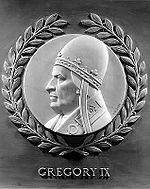
Pope Gregory IX, born Ugolino di Conti, was pope
from March 19, 1227 to August 22, 1241.
The successor of Pope Honorius III
(1216–27), he fully inherited the traditions of Pope Gregory VII
(1073–85) and of his uncle Pope Innocent III
(1198–1216), and zealously continued their policy of Papal supremacy
.
. Date of his birth fluctuates in the sources between ca. 1145 and 1170.
He was created Cardinal-Deacon
of S. Eustachio by his cousin (not uncle) Innocent III in December 1198. In 1206 he was promoted to the rank of Cardinal Bishop of Ostia e Velletri. He became dean of the Sacred College of Cardinals in 1218 or 1219. He was also Cardinal Protector
of the Order of Franciscans.
As Cardinal Bishop of Ostia he had been a friendly man. He had many friends, including the Queen of England at that time.
Frederick II
, then lying sick at Otranto
, for dilatoriness in carrying out the promised Sixth Crusade
. The suspension was followed by excommunication
and threats of deposition, as deeper rifts appeared – Frederick II's control of the Sicilian Church, his feudal obligations to the Pope, even his continued presence in Sicily. Frederick II publicly appealed to the sovereigns of Europe complaining of his treatment. Frederick II went to the Holy Land
and skirmished with the Saracen
s to fulfill his vow, but was soon back in Italy, where Gregory IX had taken advantage of his absence by invading his territories. A consequent invasion of the Papal states
in 1228 having proved unsuccessful, the Emperor was constrained to give in his submission and beg for absolution.
Although peace was thus secured (August 1230) for a season, the Roman people were far from satisfied; driven by a revolt from his own capital in June 1232, the Pope was compelled to take refuge at Anagni
and invoke the aid of Frederick II. Gregory IX and Hohenstaufen came to a truce, but when Frederick II defeated the Lombard League
in 1239, the possibility that he might dominate all of Italy, surrounding the Papal States
, became a very real threat. A new outbreak of hostility led to a fresh excommunication of the emperor in 1239, and to a prolonged war.
Gregory IX denounced Frederick II as a heretic
and summoned a council at Rome to give point to his anathema
. Frederick II responded by trying to capture or sink as many ships carrying prelates to the synod as he could. Eberhard II von Truchsees, Prince-Archbishop of Salzburg
in 1241 at the Council of Regensburg
declared that Gregory IX was "that man of perdition, whom they call Antichrist, who in his extravagant boasting says, I am God, I cannot err." He argued that the Pope was the "little horn" of Daniel 7:8:
The struggle was only terminated by the death of Gregory IX on August 22, 1241. He died before events could reach their climax; it was his successor, aptly named Pope Innocent IV
(1243–54) who declared a crusade in 1245 that would finish the Hohenstaufen threat.
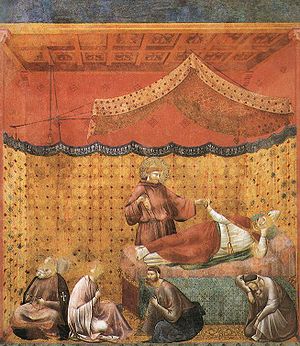 This pope, being a remarkably skillful and learned lawyer, caused to be prepared Nova Compilatio decretalium, which was promulgated in numerous copies in 1234. (It was first printed at Mainz
in 1473). This New Compilation of Decretals was the culmination of a long process of systematising the mass of pronouncements that had accumulated since the Early Middle Ages
, a process that had been under way since the first half of the 12th century and had come to fruition in the Decretum
compiled and edited by the papally-commissioned legist Gratian
and published in 1140. The supplement completed the work, which provided the foundation for papal legal theory.
His Bull Parens scientiarum
of 1231 resolved differences between the unruly university scholars of Paris
and the local authorities, who had precipitated this crisis by high-handed actions. His solution was in the manner of a true follower of Innocent III: he issued what in retrospect has been viewed as the magna carta of the University, assuming direct control by extending papal patronage: his Bull allowed future suspension of lectures over a flexible range of provocations, from "monstrous injury or offense" to squabbles over "the right to assess the rents of lodgings".
Gregory IX believed the problem of heresy needed serious attention and was not content with leaving it to the bishops, who might have been lax, but extended central control in this essential area as well. In 1231, he established the Papal Inquisition to deal with it, although he did not approve the use of torture as a tool of investigation or for penance.
He appointed ten cardinals and canonized
Saints Elizabeth
, Dominic de Guzmán
, and Anthony of Padua
, and also Francis of Assisi
, of whom he had been a personal friend and early patron. His encroachments upon the rights of the English
Church during the reign of Henry III of England
(1216–72) are well known; similar attempts against the liberties of the national church of France
were supposedly the occasion of the Pragmatic Sanction
of Louis IX of France
(1226–70), now generally thought to be a 14th-century forgery
.
Gregory IX was a prominent opponent of Talmud
ism during his life, condemning it as "containing every kind of vileness and blasphemy". In the 1234 Decretals, he invested the doctrine of perpetua servitus iudaeorum – perpetual servitude of the Jews – with the force of canonical law. According to this, the followers of the Talmud would have to remain in a condition of political servitude until Judgment Day. The doctrine then found its way into the doctrine of servitus camerae imperialis, or servitude immediately subject to the Emperor's authority, promulgated by Frederick II. The Jews were thus suppressed from having direct influence over the political process and the life of Christian states into the 19th century with the rise of liberalism
.
He transformed a chapel to Our Lady in the church of Santa Maria del Popolo
in Rome.
Gregory IX endorsed the Northern Crusades
and attempts to conquer Orthodox
Russia
(particularly the Pskov Republic
and the Novgorod Republic
). In the year 1232, Gregory IX requested the Livonian Brothers of the Sword
to send troops to protect Finland
, whose semi-Pagan
people were fighting against
Novgorod Republic in the Finnish-Novgorodian wars
, however, there is no known information if any ever arrived to assist.
Perhaps his most lasting action was a minor item: his papal letter Vox in Rama
of 1232 is credited with the vilification of cats, through its description of cult practices involving felines. This led to a great reduction in the number of cats, which, a hundred years later, may have contributed to the quick spread of the Black Death
plague, which killed one-third to one-half of the population of Europe.
Pope
The Pope is the Bishop of Rome, a position that makes him the leader of the worldwide Catholic Church . In the Catholic Church, the Pope is regarded as the successor of Saint Peter, the Apostle...
from March 19, 1227 to August 22, 1241.
The successor of Pope Honorius III
Pope Honorius III
Pope Honorius III , previously known as Cencio Savelli, was Pope from 1216 to 1227.-Early work:He was born in Rome as son of Aimerico...
(1216–27), he fully inherited the traditions of Pope Gregory VII
Pope Gregory VII
Pope St. Gregory VII , born Hildebrand of Sovana , was Pope from April 22, 1073, until his death. One of the great reforming popes, he is perhaps best known for the part he played in the Investiture Controversy, his dispute with Henry IV, Holy Roman Emperor affirming the primacy of the papal...
(1073–85) and of his uncle Pope Innocent III
Pope Innocent III
Pope Innocent III was Pope from 8 January 1198 until his death. His birth name was Lotario dei Conti di Segni, sometimes anglicised to Lothar of Segni....
(1198–1216), and zealously continued their policy of Papal supremacy
Papal supremacy
Papal supremacy refers to the doctrine of the Roman Catholic Church that the pope, by reason of his office as Vicar of Christ and as pastor of the entire Christian Church, has full, supreme, and universal power over the whole Church, a power which he can always exercise unhindered: that, in brief,...
.
Early life
Ugolino was born in AnagniAnagni
Anagni is an ancient town and comune in Latium, central Italy, in the hills east-southeast of Rome. It is a historical center in Ciociaria.-Geography:...
. Date of his birth fluctuates in the sources between ca. 1145 and 1170.
He was created Cardinal-Deacon
Cardinal (Catholicism)
A cardinal is a senior ecclesiastical official, usually an ordained bishop, and ecclesiastical prince of the Catholic Church. They are collectively known as the College of Cardinals, which as a body elects a new pope. The duties of the cardinals include attending the meetings of the College and...
of S. Eustachio by his cousin (not uncle) Innocent III in December 1198. In 1206 he was promoted to the rank of Cardinal Bishop of Ostia e Velletri. He became dean of the Sacred College of Cardinals in 1218 or 1219. He was also Cardinal Protector
Cardinal protector
Since the thirteenth century it has been customary at Rome to confide to some particular Cardinal a special solicitude in the Roman Curia for the interests of a given religious order or institute, confraternity, church, college, city, nation etcetera. Such a person is known as a Cardinal Protector...
of the Order of Franciscans.
As Cardinal Bishop of Ostia he had been a friendly man. He had many friends, including the Queen of England at that time.
Papacy
Gregory IX began his pontificate by suspending the EmperorHoly Roman Emperor
The Holy Roman Emperor is a term used by historians to denote a medieval ruler who, as German King, had also received the title of "Emperor of the Romans" from the Pope...
Frederick II
Frederick II, Holy Roman Emperor
Frederick II , was one of the most powerful Holy Roman Emperors of the Middle Ages and head of the House of Hohenstaufen. His political and cultural ambitions, based in Sicily and stretching through Italy to Germany, and even to Jerusalem, were enormous...
, then lying sick at Otranto
Otranto
Otranto is a town and comune in the province of Lecce , in a fertile region once famous for its breed of horses.It is located on the east coast of the Salento peninsula. The Strait of Otranto, to which the city gives its name, connects the Adriatic Sea with the Ionian Sea and Italy with Albania...
, for dilatoriness in carrying out the promised Sixth Crusade
Sixth Crusade
The Sixth Crusade started in 1228 as an attempt to regain Jerusalem. It began seven years after the failure of the Fifth Crusade. It involved very little actual fighting...
. The suspension was followed by excommunication
Excommunication
Excommunication is a religious censure used to deprive, suspend or limit membership in a religious community. The word means putting [someone] out of communion. In some religions, excommunication includes spiritual condemnation of the member or group...
and threats of deposition, as deeper rifts appeared – Frederick II's control of the Sicilian Church, his feudal obligations to the Pope, even his continued presence in Sicily. Frederick II publicly appealed to the sovereigns of Europe complaining of his treatment. Frederick II went to the Holy Land
Holy Land
The Holy Land is a term which in Judaism refers to the Kingdom of Israel as defined in the Tanakh. For Jews, the Land's identifiction of being Holy is defined in Judaism by its differentiation from other lands by virtue of the practice of Judaism often possible only in the Land of Israel...
and skirmished with the Saracen
Saracen
Saracen was a term used by the ancient Romans to refer to a people who lived in desert areas in and around the Roman province of Arabia, and who were distinguished from Arabs. In Europe during the Middle Ages the term was expanded to include Arabs, and then all who professed the religion of Islam...
s to fulfill his vow, but was soon back in Italy, where Gregory IX had taken advantage of his absence by invading his territories. A consequent invasion of the Papal states
Papal States
The Papal State, State of the Church, or Pontifical States were among the major historical states of Italy from roughly the 6th century until the Italian peninsula was unified in 1861 by the Kingdom of Piedmont-Sardinia .The Papal States comprised territories under...
in 1228 having proved unsuccessful, the Emperor was constrained to give in his submission and beg for absolution.
Although peace was thus secured (August 1230) for a season, the Roman people were far from satisfied; driven by a revolt from his own capital in June 1232, the Pope was compelled to take refuge at Anagni
Anagni
Anagni is an ancient town and comune in Latium, central Italy, in the hills east-southeast of Rome. It is a historical center in Ciociaria.-Geography:...
and invoke the aid of Frederick II. Gregory IX and Hohenstaufen came to a truce, but when Frederick II defeated the Lombard League
Lombard League
The Lombard League was an alliance formed around 1167, which at its apex included most of the cities of northern Italy , including, among others, Crema, Cremona, Mantua, Piacenza, Bergamo, Brescia, Milan, Genoa, Bologna, Padua, Modena, Reggio Emilia, Treviso, Venice, Vercelli, Vicenza, Verona,...
in 1239, the possibility that he might dominate all of Italy, surrounding the Papal States
Papal States
The Papal State, State of the Church, or Pontifical States were among the major historical states of Italy from roughly the 6th century until the Italian peninsula was unified in 1861 by the Kingdom of Piedmont-Sardinia .The Papal States comprised territories under...
, became a very real threat. A new outbreak of hostility led to a fresh excommunication of the emperor in 1239, and to a prolonged war.
Gregory IX denounced Frederick II as a heretic
Christian heresy
Christian heresy refers to non-orthodox practices and beliefs that were deemed to be heretical by one or more of the Christian churches. In Western Christianity, the term "heresy" most commonly refers to those beliefs which were declared to be anathema by the Catholic Church prior to the schism of...
and summoned a council at Rome to give point to his anathema
Anathema
Anathema originally meant something lifted up as an offering to the gods; it later evolved to mean:...
. Frederick II responded by trying to capture or sink as many ships carrying prelates to the synod as he could. Eberhard II von Truchsees, Prince-Archbishop of Salzburg
Archbishopric of Salzburg
The Archbishopric of Salzburg was an ecclesiastical State of the Holy Roman Empire, its territory roughly congruent with the present-day Austrian state of Salzburg....
in 1241 at the Council of Regensburg
Regensburg
Regensburg is a city in Bavaria, Germany, located at the confluence of the Danube and Regen rivers, at the northernmost bend in the Danube. To the east lies the Bavarian Forest. Regensburg is the capital of the Bavarian administrative region Upper Palatinate...
declared that Gregory IX was "that man of perdition, whom they call Antichrist, who in his extravagant boasting says, I am God, I cannot err." He argued that the Pope was the "little horn" of Daniel 7:8:
A little horn has grown up with eyes and mouth speaking great things, which is reducing three of these kingdoms—i.e. Sicily, Italy, and Germany—to subserviency, is persecuting the people of Christ and the saints of God with intolerable opposition, is confounding things human and divine, and is attempting things unutterable, execrable.
The struggle was only terminated by the death of Gregory IX on August 22, 1241. He died before events could reach their climax; it was his successor, aptly named Pope Innocent IV
Pope Innocent IV
Pope Innocent IV , born Sinibaldo Fieschi, was pope from June 25, 1243 until his death in 1254.-Early life:...
(1243–54) who declared a crusade in 1245 that would finish the Hohenstaufen threat.
Mainz
Mainz under the Holy Roman Empire, and previously was a Roman fort city which commanded the west bank of the Rhine and formed part of the northernmost frontier of the Roman Empire...
in 1473). This New Compilation of Decretals was the culmination of a long process of systematising the mass of pronouncements that had accumulated since the Early Middle Ages
Early Middle Ages
The Early Middle Ages was the period of European history lasting from the 5th century to approximately 1000. The Early Middle Ages followed the decline of the Western Roman Empire and preceded the High Middle Ages...
, a process that had been under way since the first half of the 12th century and had come to fruition in the Decretum
Decretum Gratiani
The Decretum Gratiani or Concordia discordantium canonum is a collection of Canon law compiled and written in the 12th century as a legal textbook by the jurist known as Gratian. It forms the first part of the collection of six legal texts, which together became known as the Corpus Juris Canonici...
compiled and edited by the papally-commissioned legist Gratian
Gratian (jurist)
Gratian, was a 12th century canon lawyer from Bologna. He is sometimes incorrectly referred to as Franciscus Gratianus, Johannes Gratianus, or Giovanni Graziano. The dates of his birth and death are unknown....
and published in 1140. The supplement completed the work, which provided the foundation for papal legal theory.
His Bull Parens scientiarum
University of Paris strike of 1229
In 1229, a student riot at the University of Paris resulted in the deaths of a number of students, and the ensuing "dispersion" or student strike in protest lasted more than two years and led to a number of reforms of the medieval university...
of 1231 resolved differences between the unruly university scholars of Paris
University of Paris
The University of Paris was a university located in Paris, France and one of the earliest to be established in Europe. It was founded in the mid 12th century, and officially recognized as a university probably between 1160 and 1250...
and the local authorities, who had precipitated this crisis by high-handed actions. His solution was in the manner of a true follower of Innocent III: he issued what in retrospect has been viewed as the magna carta of the University, assuming direct control by extending papal patronage: his Bull allowed future suspension of lectures over a flexible range of provocations, from "monstrous injury or offense" to squabbles over "the right to assess the rents of lodgings".
Gregory IX believed the problem of heresy needed serious attention and was not content with leaving it to the bishops, who might have been lax, but extended central control in this essential area as well. In 1231, he established the Papal Inquisition to deal with it, although he did not approve the use of torture as a tool of investigation or for penance.
He appointed ten cardinals and canonized
Canonization
Canonization is the act by which a Christian church declares a deceased person to be a saint, upon which declaration the person is included in the canon, or list, of recognized saints. Originally, individuals were recognized as saints without any formal process...
Saints Elizabeth
Elisabeth of Hungary
Elizabeth of Hungary, T.O.S.F., was a princess of the Kingdom of Hungary, Countess of Thuringia, Germany and a greatly-venerated Catholic saint. Elizabeth was married at the age of 14, and widowed at 20. She then became one of the first members of the newly-founded Third Order of St. Francis,...
, Dominic de Guzmán
Saint Dominic
Saint Dominic , also known as Dominic of Osma, often called Dominic de Guzmán and Domingo Félix de Guzmán was the founder of the Friars Preachers, popularly called the Dominicans or Order of Preachers , a Catholic religious order...
, and Anthony of Padua
Anthony of Padua
Anthony of Padua or Anthony of Lisbon, O.F.M., was a Portuguese Catholic priest and friar of the Franciscan Order. Though he died in Padua, Italy, he was born to a wealthy family in Lisbon, Portugal, which is where he was raised...
, and also Francis of Assisi
Francis of Assisi
Saint Francis of Assisi was an Italian Catholic friar and preacher. He founded the men's Franciscan Order, the women’s Order of St. Clare, and the lay Third Order of Saint Francis. St...
, of whom he had been a personal friend and early patron. His encroachments upon the rights of the English
England
England is a country that is part of the United Kingdom. It shares land borders with Scotland to the north and Wales to the west; the Irish Sea is to the north west, the Celtic Sea to the south west, with the North Sea to the east and the English Channel to the south separating it from continental...
Church during the reign of Henry III of England
Henry III of England
Henry III was the son and successor of John as King of England, reigning for 56 years from 1216 until his death. His contemporaries knew him as Henry of Winchester. He was the first child king in England since the reign of Æthelred the Unready...
(1216–72) are well known; similar attempts against the liberties of the national church of France
France
The French Republic , The French Republic , The French Republic , (commonly known as France , is a unitary semi-presidential republic in Western Europe with several overseas territories and islands located on other continents and in the Indian, Pacific, and Atlantic oceans. Metropolitan France...
were supposedly the occasion of the Pragmatic Sanction
Pragmatic sanction
A pragmatic sanction is a sovereign's solemn decree on a matter of primary importance and has the force of fundamental law. In the late history of the Holy Roman Empire it referred more specifically to an edict issued by the Emperor....
of Louis IX of France
Louis IX of France
Louis IX , commonly Saint Louis, was King of France from 1226 until his death. He was also styled Louis II, Count of Artois from 1226 to 1237. Born at Poissy, near Paris, he was an eighth-generation descendant of Hugh Capet, and thus a member of the House of Capet, and the son of Louis VIII and...
(1226–70), now generally thought to be a 14th-century forgery
Forgery
Forgery is the process of making, adapting, or imitating objects, statistics, or documents with the intent to deceive. Copies, studio replicas, and reproductions are not considered forgeries, though they may later become forgeries through knowing and willful misrepresentations. Forging money or...
.
Gregory IX was a prominent opponent of Talmud
Talmud
The Talmud is a central text of mainstream Judaism. It takes the form of a record of rabbinic discussions pertaining to Jewish law, ethics, philosophy, customs and history....
ism during his life, condemning it as "containing every kind of vileness and blasphemy". In the 1234 Decretals, he invested the doctrine of perpetua servitus iudaeorum – perpetual servitude of the Jews – with the force of canonical law. According to this, the followers of the Talmud would have to remain in a condition of political servitude until Judgment Day. The doctrine then found its way into the doctrine of servitus camerae imperialis, or servitude immediately subject to the Emperor's authority, promulgated by Frederick II. The Jews were thus suppressed from having direct influence over the political process and the life of Christian states into the 19th century with the rise of liberalism
Liberalism
Liberalism is the belief in the importance of liberty and equal rights. Liberals espouse a wide array of views depending on their understanding of these principles, but generally, liberals support ideas such as constitutionalism, liberal democracy, free and fair elections, human rights,...
.
He transformed a chapel to Our Lady in the church of Santa Maria del Popolo
Santa Maria del Popolo
Santa Maria del Popolo is an Augustinian church located in Rome, Italy.It stands to the north side of the Piazza del Popolo, one of the most famous squares in the city. The Piazza is situated between the ancient Porta Flaminia and the park of the Pincio...
in Rome.
Gregory IX endorsed the Northern Crusades
Northern Crusades
The Northern Crusades or Baltic Crusades were crusades undertaken by the Christian kings of Denmark and Sweden, the German Livonian and Teutonic military orders, and their allies against the pagan peoples of Northern Europe around the southern and eastern shores of the Baltic Sea...
and attempts to conquer Orthodox
Eastern Orthodox Church
The Orthodox Church, officially called the Orthodox Catholic Church and commonly referred to as the Eastern Orthodox Church, is the second largest Christian denomination in the world, with an estimated 300 million adherents mainly in the countries of Belarus, Bulgaria, Cyprus, Georgia, Greece,...
Russia
Russia
Russia or , officially known as both Russia and the Russian Federation , is a country in northern Eurasia. It is a federal semi-presidential republic, comprising 83 federal subjects...
(particularly the Pskov Republic
Pskov Republic
Pskov, known at various times as the Principality of Pskov or the Pskov Republic , was a medieval state on the south shore of Lake Pskov. The capital city, also named Pskov, was located at the southern end of the Peipus–Pskov Lake system at the southeast corner of Ugandi, about southwest of...
and the Novgorod Republic
Novgorod Republic
The Novgorod Republic was a large medieval Russian state which stretched from the Baltic Sea to the Ural Mountains between the 12th and 15th centuries, centred on the city of Novgorod...
). In the year 1232, Gregory IX requested the Livonian Brothers of the Sword
Livonian Brothers of the Sword
The Livonian Brothers of the Sword were a military order founded by Bishop Albert of Riga in 1202. Pope Innocent III sanctioned the establishment in 1204. The membership of the order comprised German "warrior monks"...
to send troops to protect Finland
Finland
Finland , officially the Republic of Finland, is a Nordic country situated in the Fennoscandian region of Northern Europe. It is bordered by Sweden in the west, Norway in the north and Russia in the east, while Estonia lies to its south across the Gulf of Finland.Around 5.4 million people reside...
, whose semi-Pagan
Paganism
Paganism is a blanket term, typically used to refer to non-Abrahamic, indigenous polytheistic religious traditions....
people were fighting against
Novgorod Republic in the Finnish-Novgorodian wars
Finnish-Novgorodian wars
The Finnish–Novgorodian wars were a series of conflicts that took place between Finnic tribes in eastern Fennoscandia called "Yem", and the Republic of Novgorod from the 11th or 12th century to early 13th century. The wars seem to have contributed to the eventual Swedish conquest of Finland in...
, however, there is no known information if any ever arrived to assist.
Perhaps his most lasting action was a minor item: his papal letter Vox in Rama
Vox in Rama
Vox in Rama is a papal bull written by Pope Gregory IX in 1233 / 1234 condemning a new German heresy of Luciferian, a form of devil worship...
of 1232 is credited with the vilification of cats, through its description of cult practices involving felines. This led to a great reduction in the number of cats, which, a hundred years later, may have contributed to the quick spread of the Black Death
Black Death
The Black Death was one of the most devastating pandemics in human history, peaking in Europe between 1348 and 1350. Of several competing theories, the dominant explanation for the Black Death is the plague theory, which attributes the outbreak to the bacterium Yersinia pestis. Thought to have...
plague, which killed one-third to one-half of the population of Europe.
External links
- Catholic Encyclopedia: Pope Gregory IX
Further studies
- Iben Fonnesberg‐Schmidt, The Popes and the Baltic Crusades 1147–1254 (Leiden, Brill. 2007) (The Northern World, 26).