
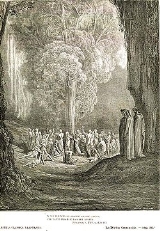
Purgatory is the condition or process of purification or temporary punishment in which, it is believed, the souls of those who die in a state of grace are made ready for
HeavenHeaven, the Heavens or Seven Heavens, is a common religious cosmological or metaphysical term for the physical or transcendent place from which heavenly beings originate, are enthroned or inhabit...
. This is a theological idea that has ancient roots and is well-attested in early Christian literature, while the poetic conception of purgatory as a geographically situated place is largely the creation of medieval Christian piety and imagination.
The notion of purgatory is associated particularly with the Latin Rite of the Catholic Church (in the Eastern sui juris churches or rites it is a doctrine, though often without using the name "Purgatory"); Anglicans of the Anglo-Catholic tradition generally also hold to the belief.
John WesleyJohn Wesley was a Church of England cleric and Christian theologian. Wesley is largely credited, along with his brother Charles Wesley, as founding the Methodist movement which began when he took to open-air preaching in a similar manner to George Whitefield...
, the founder of
MethodismMethodism is a movement of Protestant Christianity represented by a number of denominations and organizations, claiming a total of approximately seventy million adherents worldwide. The movement traces its roots to John Wesley's evangelistic revival movement within Anglicanism. His younger brother...
, believed in an
intermediate stateIn Christian eschatology, the intermediate state or interim state refers to a person's "intermediate" existence between one's death and one's resurrection from the dead...
between death and the
final judgmentThe Last Judgment, Final Judgment, Day of Judgment, Judgment Day, or The Day of the Lord in Christian theology, is the final and eternal judgment by God of every nation. The concept is found in all the Canonical gospels, particularly the Gospel of Matthew. It will purportedly take place after the...
and in the possibility of "continuing to grow in holiness there." The
Eastern Orthodox ChurchThe Orthodox Church, officially called the Orthodox Catholic Church and commonly referred to as the Eastern Orthodox Church, is the second largest Christian denomination in the world, with an estimated 300 million adherents mainly in the countries of Belarus, Bulgaria, Cyprus, Georgia, Greece,...
es believe in the possibility of a change of situation for the souls of the dead through the prayers of the living and the offering of the
Divine LiturgyDivine Liturgy is the common term for the Eucharistic service of the Byzantine tradition of Christian liturgy. As such, it is used in the Eastern Orthodox and Eastern Catholic Churches. Armenian Christians, both of the Armenian Apostolic Church and of the Armenian Catholic Church, use the same term...
, and many Orthodox, especially among ascetics, hope and pray for a general
apocatastasisApocatastasis is reconstitution, restitution, or restoration to the original or primordial condition.-Etymology and definition:The Liddell and Scott Lexicon entry, gives the following examples of usage:* “τοῦ ἐνδεοῦς” Aristotle MM, 1205a4; into its nature εἰς φύσιν id...
. A similar belief in at least the possibility of a final salvation for all is held by
MormonismMormonism is the religion practiced by Mormons, and is the predominant religious tradition of the Latter Day Saint movement. This movement was founded by Joseph Smith, Jr. beginning in the 1820s as a form of Christian primitivism. During the 1830s and 1840s, Mormonism gradually distinguished itself...
.
JudaismJudaism ) is the "religion, philosophy, and way of life" of the Jewish people...
also believes in the possibility of after-death purification and may even use the word "purgatory" to present its understanding of the meaning of
GehennaGehenna , Gehinnom and Yiddish Gehinnam, are terms derived from a place outside ancient Jerusalem known in the Hebrew Bible as the Valley of the Son of Hinnom ; one of the two principal valleys surrounding the Old City.In the Hebrew Bible, the site was initially where apostate Israelites and...
. However, the concept of soul "purification" may be explicitly denied in these other faith traditions.
The word "purgatory", derived through Anglo-Norman and Old French from the Latin word
purgatorium. has come to refer also to a wide range of historical and modern conceptions of postmortem suffering short of everlasting damnation, and is used, in a non-specific sense, to mean any place or condition of
sufferingSuffering, or pain in a broad sense, is an individual's basic affective experience of unpleasantness and aversion associated with harm or threat of harm. Suffering may be qualified as physical or mental. It may come in all degrees of intensity, from mild to intolerable. Factors of duration and...
or torment, especially one that is temporary.
History of purgatory
While use of the word "purgatory" (in
LatinLatin is an Italic language originally spoken in Latium and Ancient Rome. It, along with most European languages, is a descendant of the ancient Proto-Indo-European language. Although it is considered a dead language, a number of scholars and members of the Christian clergy speak it fluently, and...
purgatorium) as a noun appeared perhaps only between 1160 and 1180, giving rise to the idea of purgatory as a place (what Jacques Le Goff called the "birth" of purgatory), the Roman Catholic tradition of purgatory as a transitional condition has a history that dates back, even before Jesus, to the worldwide practice of caring for the dead and praying for them, and to the belief, found also in Judaism, from which Christianity grew, that
prayer for the deadWherever there is a belief in the continued existence of man's personality through and after death, religion naturally concerns itself with the relations between the living and the dead...
contributed to their
afterlifeThe afterlife is the belief that a part of, or essence of, or soul of an individual, which carries with it and confers personal identity, survives the death of the body of this world and this lifetime, by natural or supernatural means, in contrast to the belief in eternal...
purification. The same practice appears in other traditions, such as the medieval Chinese Buddhist practice of making offerings on behalf of the dead, who are said to suffer numerous trials. Roman Catholic belief in purgatory is based, among other reasons, on the previous Jewish practice of prayer for the dead, a practice that presupposes that the dead are thereby assisted between death and their entry into their final abode.
The English Roman Catholic scholar Cardinal John Henry Newman argued that the
essence of the doctrine is locatable in ancient tradition, and that the core consistency of such beliefs is evidence that Christianity was "originally given to us from heaven". Roman Catholics consider the teaching on purgatory to be part of the faith derived from the revelation of Jesus Christ that was preached by the apostles. Theologians and other Christians then developed the doctrine regarding purgatory over the centuries, leading to the definition of the formal doctrine of the Roman Catholic Church on the matter (as distinct from the legendary descriptions) at the
Second Council of LyonThe Second Council of Lyon was the fourteenth ecumenical council of the Catholic Church, convoked on 31 March 1272 and convened in Lyon, France, in 1274. Pope Gregory X presided over the council, called to act on a pledge by Byzantine emperor Michael VIII to reunite the Eastern church with the West...
(1274), the
Council of FlorenceThe Council of Florence was an Ecumenical Council of the Roman Catholic Church. It began in 1431 in Basel, Switzerland, and became known as the Council of Ferrara after its transfer to Ferrara was decreed by Pope Eugene IV, to convene in 1438...
(1438–1445), and the
Council of TrentThe Council of Trent was the 16th-century Ecumenical Council of the Roman Catholic Church. It is considered to be one of the Church's most important councils. It convened in Trent between December 13, 1545, and December 4, 1563 in twenty-five sessions for three periods...
(1545–63).
Purgatory in Christianity
The views of Purgatory vary depending on Christian denomination. Some churches, typically those with a more
CatholicThe word catholic comes from the Greek phrase , meaning "on the whole," "according to the whole" or "in general", and is a combination of the Greek words meaning "about" and meaning "whole"...
structure, recognize the doctrine, while many Protestant churches reject it.
Purgatory in Catholicism
The Catholic Church gives the name Purgatory to the final purification of all who die in God's grace and friendship, but still imperfectly purified. Though purgatory is often pictured as a place rather than a process of purification, the idea of purgatory as a place is not part of the Church's doctrine.
Heaven and Hell
According to Catholic belief, immediately after death, a person undergoes
judgmentParticular judgment, according to Christian eschatology, is the judgment given by God that a departed person undergoes immediately after death, in contradistinction to the General judgment of all people at the end of the world....
in which the soul's eternal destiny is specified. Some are eternally united with God in
HeavenHeaven, the Heavens or Seven Heavens, is a common religious cosmological or metaphysical term for the physical or transcendent place from which heavenly beings originate, are enthroned or inhabit...
, often envisioned as a paradise of eternal joy, where
TheosisIn Christian theology, divinization, deification, making divine or theosis is the transforming effect of divine grace. This concept of salvation is historical and fundamental for Christian understanding that is prominent in the Eastern Orthodox Church and also in the Catholic Church, and is a...
is completed and one experiences the
beatific visionThe beatific vision - in Christian theology is the ultimate direct self communication of God to the individual person, when she or he reaches, as a member of redeemed humanity in the communion of saints, perfect salvation in its entirety, i.e. heaven...
of God. Conversely, others reach a state called
HellIn many religious traditions, a hell is a place of suffering and punishment in the afterlife. Religions with a linear divine history often depict hells as endless. Religions with a cyclic history often depict a hell as an intermediary period between incarnations...
, that is eternal separation from God often envisioned as a fiery place of punishment, though the fire is sometimes seen
metaphoricallyA metaphor is a literary figure of speech that uses an image, story or tangible thing to represent a less tangible thing or some intangible quality or idea; e.g., "Her eyes were glistening jewels." Metaphor may also be used for any rhetorical figures of speech that achieve their effects via...
. It is stressed that it is by one's own free will that a person enters into the state of hell, separating themselves from God.
Purgatory's role
In addition to accepting the states of heaven and hell, Catholicism envisages a third state before being admitted to heaven. According to Catholic doctrine, some souls are not sufficiently free from the temporal effects of sin and its consequences to enter the state of heaven immediately, nor are they so sinful as to be destined for hell either. Such souls, ultimately destined to be united with God in heaven, must first endure purgatory— a state of purification. In purgatory, souls "achieve the holiness necessary to enter the joy of heaven." Temporal punishment and eternal punishment are incurred by
mortal sinMortal sins are in the theology of some, but not all Christian denominations wrongful acts that condemn a person to Hell after death. These sins are considered "mortal" because they constitute a rupture in a person's link to God's saving grace: the person's soul becomes "dead", not merely weakened...
, but eternal punishment is remitted by the sacrament of reconciliation (known also as the sacrament of penance or confession). The remaining temporal punishment may be remitted by sufferings in this life, indulgences, or after death in Purgatory.
Sin
Catholics make a distinction between two types of sin.
Mortal sinMortal sins are in the theology of some, but not all Christian denominations wrongful acts that condemn a person to Hell after death. These sins are considered "mortal" because they constitute a rupture in a person's link to God's saving grace: the person's soul becomes "dead", not merely weakened...
is a "grave violation of God's law" that "turns man away from God", and if it is not redeemed by repentance and God's forgiveness, it causes exclusion from Christ's kingdom and the eternal death of hell. This teaching on the consequences of unrepented sin is based on both
Sacred ScriptureThe Catholic Bible is the Bible used by Catholics and typically refers to the Douay-Rheims Bible , or to those Bible translations which contain the deuterocanonical books found in the Latin Vulgate —just as "Protestant Bible" refers to translations descended from the Tyndale Bible and...
and
Sacred TraditionSacred Tradition or Holy Tradition is a theological term used in some Christian traditions, primarily in the Roman Catholic, Anglican, Eastern Orthodox and Oriental Orthodox traditions, to refer to the fundamental basis of church authority....
.
In contrast,
venial sinAccording to Roman Catholicism, a venial sin is a lesser sin that does not result in a complete separation from God and eternal damnation in Hell...
(meaning "forgivable" sin) "does not set us in direct opposition to the will and friendship of God" and, although still "constituting a moral disorder", does not deprive the sinner of friendship with God, and consequently the eternal happiness of heaven.
According to Catholicism, pardon of sins and purification can occur during life—for example, in the Sacrament of Baptism and the
Sacrament of PenanceIn the teachings of the Roman Catholic Church, the Sacrament of Penance and Reconciliation is the method by which individual men and women may be freed from sins committed after receiving the sacrament of Baptism...
. However, if this purification is not achieved in life, venial sins can still be purified after death. The specific name given to this purification of sin after death is "purgatory".
Pain and fire
Purgatory is a cleansing that involves painful temporal punishment, associated with the idea of fire such as is associated with the idea of the eternal punishment of hell. Several
Church FathersThe Church Fathers, Early Church Fathers, Christian Fathers, or Fathers of the Church were early and influential theologians, eminent Christian teachers and great bishops. Their scholarly works were used as a precedent for centuries to come...
regarded as evidence for the existence of an intermediate state in which the dross of lighter transgressions will be burnt away, and the soul thus purified will be saved. Fire was the Bible-inspired image ("We went through fire and through water") that Christians used for the notion of after-life purification.
St. Augustine-People:* Augustine of Hippo or Augustine of Hippo , father of the Latin church* Augustine of Canterbury , first Archbishop of Canterbury* Augustine Webster, an English Catholic martyr.-Places:*St. Augustine, Florida, United States...
described the fires of cleansing as more painful than anything a man can suffer in this life, and Pope Gregory I wrote that there must be a cleansing fire for some minor faults that may remain to be purged away.
OrigenOrigen , or Origen Adamantius, 184/5–253/4, was an early Christian Alexandrian scholar and theologian, and one of the most distinguished writers of the early Church. As early as the fourth century, his orthodoxy was suspect, in part because he believed in the pre-existence of souls...
wrote about the fire that needs to purify the soulSt. Gregory of Nyssa also wrote about the purging fire.

Most theologians of the past have held that the fire is in some sense a material fire, though of a nature different from ordinary fire, but the opinion of other theologians who interpret the Scriptural term "fire" metaphorically has not been condemned by the Church and may now be the more common view. The Catechism of the Catholic Church speaks of a "cleansing fire". and quotes the expression "purgatorius ignis" (purifying fire) used by Pope Gregory the Great. It speaks of the temporal punishment for sin, even in this life, as a matter of "sufferings and trials of all kinds". It describes purgatory as a necessary purification from "an unhealthy attachment to creatures", a purification that "frees one from what is called the 'temporal punishment' of sin", a punishment that "must not be conceived of as a kind of vengeance inflicted by God from without, but as following from the very nature of sin."
Whilst the imagery of pain and fire is often used to depict Purgatory, this does not mean that Purgatory is necessarily a 'sad' state for the soul. St Catherine of Genoa wrote a treatise on Purgatory in the late fifteenth century which focused upon the positive sense which a soul in purgatory would have, because the very nature of being in purgatory is a sign that the soul is on the way to be with God. Whilst St. Catherine's approach to Purgatory was clearly non-typical, in canonising her the Roman Catholic Church declared that there was nothing contrary to faith in her writings.
Prayer for the dead and Indulgences
The Catholic Church teaches that the fate of those in purgatory can be affected by the actions of the living. Its teaching is based also on the practice of prayer for the dead mentioned as far back as , considered by Catholics and Orthodox to be part of Sacred Scripture.
In the same context there is mention of the practice of
indulgenceIn Catholic theology, an indulgence is the full or partial remission of temporal punishment due for sins which have already been forgiven. The indulgence is granted by the Catholic Church after the sinner has confessed and received absolution...
s. An indulgence is a remission before God of the temporal punishment due to sins whose guilt has already been forgiven. Indulgences may be obtained for oneself, or on behalf of the dead.
Prayers for the dead and indulgences have been popularly envisioned as decreasing the "duration" of time the dead spend in purgatory, an idea associated with the fact that, in the past, indulgences were measured in terms of days, "quarantines" (i.e. 40-day periods as for
LentIn the Christian tradition, Lent is the period of the liturgical year from Ash Wednesday to Easter. The traditional purpose of Lent is the preparation of the believer – through prayer, repentance, almsgiving and self-denial – for the annual commemoration during Holy Week of the Death and...
), or years, meaning, not that purgatory would be shortened by that amount of time, but that the indulgences were equivalent to that length of canonical penance on the part of a living Christian. When the imposition of such canonical penances of a determinate duration fell out of custom these expressions were sometimes popularly misinterpreted as reduction of that much time of a soul's stay in purgatory. A
prayer roll that once belonged to Henry VIII claimed that "this image of pity devotedly say
5 Pater Noster,
5 Ave Maria and
1 Credo..." gave a pardon and reduction of time in purgatory of "52,712 years and 40 days of pardon". In
Pope Paul VIPaul VI , born Giovanni Battista Enrico Antonio Maria Montini , reigned as Pope of the Catholic Church from 21 June 1963 until his death on 6 August 1978. Succeeding Pope John XXIII, who had convened the Second Vatican Council, he decided to continue it...
's revision of the rules concerning indulgences, these expressions were dropped, and replaced by the expression "partial indulgence", indicating that the person who gained such an indulgence for a pious action is granted, "in addition to the remission of temporal punishment acquired by the action itself, an equal remission of punishment through the intervention of the Church"
Historically, the practice of granting indulgences, and the widespread associated abuses, led to them being seen as increasingly bound up with money, with criticisms being directed against the "sale" of indulgences, a source of controversy that was the immediate occasion of the
Protestant ReformationThe Protestant Reformation was a 16th-century split within Western Christianity initiated by Martin Luther, John Calvin and other early Protestants. The efforts of the self-described "reformers", who objected to the doctrines, rituals and ecclesiastical structure of the Roman Catholic Church, led...
in
GermanyGermany , officially the Federal Republic of Germany , is a federal parliamentary republic in Europe. The country consists of 16 states while the capital and largest city is Berlin. Germany covers an area of 357,021 km2 and has a largely temperate seasonal climate...
and
SwitzerlandSwitzerland name of one of the Swiss cantons. ; ; ; or ), in its full name the Swiss Confederation , is a federal republic consisting of 26 cantons, with Bern as the seat of the federal authorities. The country is situated in Western Europe,Or Central Europe depending on the definition....
.
Purgatory as a physical place
The envisioning of Heaven, Hell, and Purgatory as places in the physical universe was never a Church doctrine. Nonetheless, in antiquity and medieval times, Heaven and Hell were widely regarded as places existing within the physical universe: Heaven "above", in the sky; Hell "below", in or beneath the earth. Similarly, Purgatory has at times been thought of as a physical location.
In 1206, a peasant named Thurkhill in England claimed that Saint Julian took him on a tour of Purgatory. He gave precise details, including descriptions of Purgatory's torture chambers, and was widely believed, including by the Church historian
Roger of WendoverRoger of Wendover , probably a native of Wendover in Buckinghamshire, was an English chronicler of the 13th century.At an uncertain date he became a monk at St Albans Abbey; afterwards he was appointed prior of the cell of Belvoir, but he forfeited this dignity in the early years of Henry III,...
. In Dante's fourteenth century work
The Divine ComedyThe Divine Comedy is an epic poem written by Dante Alighieri between 1308 and his death in 1321. It is widely considered the preeminent work of Italian literature, and is seen as one of the greatest works of world literature...
, Purgatory is depicted as a mountain in the southern hemisphere. It is apparently the only land there. Souls given a second chance find themselves at Mt. Purgatory, where there are two levels, then Seven Levels representing the Seven deadly sins with ironic punishments. For example, on the first level for Pride the inhabitants are weighed down by huge stones which forces them to look at examples of Pride on the pavement like Arachne. Should they reach the top they will find themselves at Jerusalem's
antipodeAntipode, Antipodes, or Antipodeans may refer to:* Antipodal point, the diametrically opposite point on a sphere* Antipodes Water Company, a premium bottled water brand...
, the
Garden of EdenThe Garden of Eden is in the Bible's Book of Genesis as being the place where the first man, Adam, and his wife, Eve, lived after they were created by God. Literally, the Bible speaks about a garden in Eden...
itself. Thus cleansed of all sin and made perfect, they wait in Earthly paradise before ascending to Heaven.
In 1999
Pope John Paul IIBlessed Pope John Paul II , born Karol Józef Wojtyła , reigned as Pope of the Catholic Church and Sovereign of Vatican City from 16 October 1978 until his death on 2 April 2005, at of age. His was the second-longest documented pontificate, which lasted ; only Pope Pius IX ...
declared that the term Purgatory does not indicate a place, but "a condition of existence".
In 2011
Pope Benedict XVIBenedict XVI is the 265th and current Pope, by virtue of his office of Bishop of Rome, the Sovereign of the Vatican City State and the leader of the Catholic Church as well as the other 22 sui iuris Eastern Catholic Churches in full communion with the Holy See...
, speaking of Saint Catherine of Genoa (1447–1510), said that in her time the purification of souls (Purgatory) was pictured as a location in space, but that the saint saw Purgatory as a purifying inner fire, such as she experienced in her profound sorrow for sins committed, when compared with God's infinite love. She said that being bound ill to the desires and suffering that derive from sin makes it impossible for the soul to enjoy the beatific vision of God. The Pope commented: "We too feel how distant we are, how full we are of so many things that we cannot see God. The soul is aware of the immense love and perfect justice of God and consequently suffers for having failed to respond in a correct and perfect way to this love; and love for God itself becomes a flame, love itself cleanses it from the residue of sin."
Similarly this idea of Purgatory as a physical prison on earth,is explored in KBrooks' fiction novel entitled '
Purgatory', here she draws from historical notions and places the main character in a limbo on earth until he can discover a way to serve his pennance and earn a place either back in the world or in heaven.
Catholic statements
The Compendium of the Catechism of the Catholic Church, first published in 2005, is a summary in dialog form of the
Catechism of the Catholic ChurchThe Catechism of the Catholic Church is the official text of the teachings of the Catholic Church. A provisional, "reference text" was issued by Pope John Paul II on October 11, 1992 — "the thirtieth anniversary of the opening of the Second Vatican Ecumenical Council" — with his apostolic...
. It deals with purgatory in the following exchange:
These two questions and answers summarize information in sections 1020–1032 and 1054 of the Catechism of the Catholic Church, published in 1992, which also speaks of purgatory in sections 1472 and 1473
Other authoritative statements are those of the
Council of TrentThe Council of Trent was the 16th-century Ecumenical Council of the Roman Catholic Church. It is considered to be one of the Church's most important councils. It convened in Trent between December 13, 1545, and December 4, 1563 in twenty-five sessions for three periods...
in 1563 and the
Council of FlorenceThe Council of Florence was an Ecumenical Council of the Roman Catholic Church. It began in 1431 in Basel, Switzerland, and became known as the Council of Ferrara after its transfer to Ferrara was decreed by Pope Eugene IV, to convene in 1438...
in 1439.
Eastern Catholic churches
The Eastern Catholic churches are Catholic churches
sui iuris of Eastern tradition, in
full communionIn Christian ecclesiology, full communion is a relationship between church organizations or groups that mutually recognize their sharing the essential doctrines....
with the Pope. There are however some differences between the
Latin ChurchThe Latin Church is the largest particular church within the Catholic Church. It is a particular church not on the level of the local particular churches known as dioceses or eparchies, but on the level of autonomous ritual churches, of which there are 23, the remaining 22 of which are Eastern...
and some of the Eastern Catholic Churches on aspects of purgatory. The Eastern Catholic Churches of
GreekThe Byzantine Rite, sometimes called the Rite of Constantinople or Constantinopolitan Rite is the liturgical rite used currently by all the Eastern Orthodox Churches, by the Greek Catholic Churches , and by the Protestant Ukrainian Lutheran Church...
tradition do not generally use the word "purgatory", but agree that there is a "final purification" for souls destined for heaven, and that prayers can help the dead who are in that state of "final purification". In general, neither the members of the Latin Church nor the members of these Eastern Catholic Churches regard these differences as major points of dispute, but see them as minor nuances and differences of tradition. A treaty that formalized the admission of the
Ukrainian Greek Catholic ChurchThe Ukrainian Greek Catholic Church , Ukrainska Hreko-Katolytska Tserkva), is the largest Eastern Rite Catholic sui juris particular church in full communion with the Holy See, and is directly subject to the Pope...
into the
fullIn Christian ecclesiology, full communion is a relationship between church organizations or groups that mutually recognize their sharing the essential doctrines....
communionThe term communion is derived from Latin communio . The corresponding term in Greek is κοινωνία, which is often translated as "fellowship". In Christianity, the basic meaning of the term communion is an especially close relationship of Christians, as individuals or as a Church, with God and with...
of the Roman Catholic Church stated: "We shall not debate about purgatory, but we entrust ourselves to the teaching of the Holy Church", implying, in the opinion of a theologian of that Church, that both sides can agree to disagree on the specifics of what the West calls "purgatory", while there is full agreement on the essentials. Between the Latin Church and some other Eastern Catholic Churches, such as the
Syro-Malabar Catholic ChurchThe Syro-Malabar Catholic Church in India is an East Syrian Rite, Major Archiepiscopal Church in full communion with the Catholic Church. It is one of the 22 sui iuris Eastern Catholic Churches in the Catholic Church. It is the largest of the Saint Thomas Christian denominations with more than 3.6...
, there is no disagreement about any aspect of the doctrine of purgatory.
Eastern Orthodox Church
The
Eastern Orthodox ChurchThe Orthodox Church, officially called the Orthodox Catholic Church and commonly referred to as the Eastern Orthodox Church, is the second largest Christian denomination in the world, with an estimated 300 million adherents mainly in the countries of Belarus, Bulgaria, Cyprus, Georgia, Greece,...
came to admit of an intermediate state after death, but refrained from defining it so as not to blur the distinction between the alternative fates of Heaven and Hell; it combined with this doctrine a firm belief in the efficacy of prayer for the dead, which was a constant feature of both East and West liturgies. Such prayer is held to be unintelligible without belief in some interim state in which the dead might benefit.
According to the
Greek Orthodox Archdiocese of AmericaThe Greek Orthodox Archdiocese of America, headquartered in New York City, is an eparchy of the Church of Constantinople. Its current primate is Archbishop Demetrios of America.-About the Archdiocese:...
:
The moral progress of the soul, either for better or for worse, ends at the very moment of the separation of the body and soul; at that very moment the definite destiny of the soul in the everlasting life is decided. ... There is no way of repentance, no way of escape, no reincarnation and no help from the outside world. Its place is decided forever by its Creator and judge. The Orthodox Church does not believe in purgatory (a place of purging), that is, the inter-mediate state after death in which the souls of the saved (those who have not received temporal punishment for their sins) are purified of all taint preparatory to entering into Heaven, where every soul is perfect and fit to see God. Also, the Orthodox Church does not believe in indulgences as remissions from purgatoral punishment. Both purgatory and indulgences are inter-corrolated theories, unwitnessed in the Bible or in the Ancient Church, and when they were enforced and applied they brought about evil practices at the expense of the prevailing Truths of the Church. If Almighty God in His merciful loving-kindness changes the dreadful situation of the sinner, it is unknown to the Church of Christ. The Church lived for fifteen hundred years without such a theory.
Eastern Orthodox teaching is that, while all undergo a
Particular JudgmentParticular judgment, according to Christian eschatology, is the judgment given by God that a departed person undergoes immediately after death, in contradistinction to the General judgment of all people at the end of the world....
immediately after death, neither the just nor the wicked attain the final state of bliss or punishment before the last day, with some exceptions for righteous souls like the
TheotokosTheotokos is the Greek title of Mary, the mother of Jesus used especially in the Eastern Orthodox, Oriental Orthodox, and Eastern Catholic Churches. Its literal English translations include God-bearer and the one who gives birth to God. Less literal translations include Mother of God...
(Blessed Virgin Mary), "who was borne by the angels directly to heaven".
The Eastern Orthodox Church holds that it is necessary to believe in an intermediate after-death state in which believers are perfected and brought to full
divinizationIn Christian theology, divinization, deification, making divine or theosis is the transforming effect of divine grace. This concept of salvation is historical and fundamental for Christian understanding that is prominent in the Eastern Orthodox Church and also in the Catholic Church, and is a...
, a process of growth rather than of punishment, which some Orthodox have called purgatory. Eastern Orthodox theology does not generally describe the situation of the dead as involving suffering or fire, although it nevertheless describes it as a "direful condition". The souls of the righteous dead are in light and rest, with a foretaste of eternal happiness; but the souls of the wicked are in a state the reverse of this. Among the latter, such souls as have departed with faith, but "without having had time to bring forth fruits worthy of repentance..., may be aided towards the attainment of a blessed resurrection [at the end of time] by prayers offered in their behalf, especially those offered in union with the oblation of the bloodless sacrifice of the Body and Blood of Christ, and by works of mercy done in faith for their memory."
The state in which souls undergo this experience is often referred to as "
HadesHades , Hadēs, originally , Haidēs or , Aidēs , meaning "the unseen") was the ancient Greek god of the underworld. The genitive , Haidou, was an elision to denote locality: "[the house/dominion] of Hades". Eventually, the nominative came to designate the abode of the dead.In Greek mythology, Hades...
".
The
Orthodox Confession of Peter Mogila (1596–1646), adopted, in a Greek translation by Meletius Syrigos, by the 1642 Council of
JassyIași is the second most populous city and a municipality in Romania. Located in the historical Moldavia region, Iași has traditionally been one of the leading centres of Romanian social, cultural, academic and artistic life...
, in Romania, professes that "many are freed from the prison of
hellHades , Hadēs, originally , Haidēs or , Aidēs , meaning "the unseen") was the ancient Greek god of the underworld. The genitive , Haidou, was an elision to denote locality: "[the house/dominion] of Hades". Eventually, the nominative came to designate the abode of the dead.In Greek mythology, Hades...
... through the good works of the living and the Church's prayers for them, most of all through the unbloody sacrifice, which is offered on certain days for all the living and the dead" (question 64); and (under the heading "How must one consider the purgatorial fire?") "the Church rightly performs for them the unbloody sacrifice and prayers, but they do not cleanse themselves by suffering something. But, the Church never maintained that which pertains to the fanciful stories of some concerning the souls of their dead, who have not done penance and are punished, as it were, in streams, springs and swamps" (question 66).".
The Eastern Orthodox Synod of Jerusalem (1672) declared that "the souls of those that have fallen asleep are either at rest or in torment, according to what each hath wrought" (an enjoyment or condemnation that will be complete only after the resurrection of the dead); but the souls of some "depart into
HadesHades , Hadēs, originally , Haidēs or , Aidēs , meaning "the unseen") was the ancient Greek god of the underworld. The genitive , Haidou, was an elision to denote locality: "[the house/dominion] of Hades". Eventually, the nominative came to designate the abode of the dead.In Greek mythology, Hades...
, and there endure the punishment due to the sins they have committed. But they are aware of their future release from there, and are delivered by the Supreme Goodness, through the prayers of the Priests, and the good works which the relatives of each do for their Departed; especially the unbloody Sacrifice benefiting the most; which each offers particularly for his relatives that have fallen asleep, and which the
Catholic and Apostolic ChurchThe Orthodox Church, officially called the Orthodox Catholic Church and commonly referred to as the Eastern Orthodox Church, is the second largest Christian denomination in the world, with an estimated 300 million adherents mainly in the countries of Belarus, Bulgaria, Cyprus, Georgia, Greece,...
offers daily for all alike. Of course, it is understood that we do not know the time of their release. We know and believe that there is deliverance for such from their direful condition, and that before the
common resurrectionResurrection of the Dead is a belief found in a number of eschatologies, most commonly in Christian, Islamic, Jewish and Zoroastrian. In general, the phrase refers to a specific event in the future; multiple prophesies in the histories of these religions assert that the dead will be brought back to...
and
judgmentThe Last Judgment, Final Judgment, Day of Judgment, Judgment Day, or The Day of the Lord in Christian theology, is the final and eternal judgment by God of every nation. The concept is found in all the Canonical gospels, particularly the Gospel of Matthew. It will purportedly take place after the...
, but when we know not."
Some Orthodox believe in a teaching of "aerial toll-houses" for the souls of the dead. According to this theory, which is rejected by other Orthodox but appears in the hymnology of the Church, "following a person's death the soul leaves the body and is escorted to God by angels. During this journey the soul passes through an aerial realm which is ruled by demons. The soul encounters these demons at various points referred to as 'toll-houses' where the demons then attempt to accuse it of sin and, if possible, drag the soul into hell."
Anglicanism
The
Anglican CommunionThe Anglican Communion is an international association of national and regional Anglican churches in full communion with the Church of England and specifically with its principal primate, the Archbishop of Canterbury...
, as well as many Continuing Anglican churches, reject the doctrine of purgatory, with the exception of Anglo-Catholics. Article XXII of the
Thirty-Nine Articles of Religion of the Anglican ChurchThe Thirty-Nine Articles of Religion are the historically defining statements of doctrines of the Anglican church with respect to the controversies of the English Reformation. First established in 1563, the articles served to define the doctrine of the nascent Church of England as it related to...
states that "The Romish Doctrine concerning Purgatory…is a fond thing, vainly invented, and grounded upon no warranty of
ScriptureThe Bible refers to any one of the collections of the primary religious texts of Judaism and Christianity. There is no common version of the Bible, as the individual books , their contents and their order vary among denominations...
, but rather repugnant to the Word of God." Nevertheless, among Anglo-Catholics, who often identify strongly with Roman Catholic liturgy and
theologyTheology is the systematic and rational study of religion and its influences and of the nature of religious truths, or the learned profession acquired by completing specialized training in religious studies, usually at a university or school of divinity or seminary.-Definition:Augustine of Hippo...
, there are those who accept that purgatory exists.
C. S. LewisClive Staples Lewis , commonly referred to as C. S. Lewis and known to his friends and family as "Jack", was a novelist, academic, medievalist, literary critic, essayist, lay theologian and Christian apologist from Belfast, Ireland...
said there were good reasons for "casting doubt on the 'Romish doctrine concerning Purgatory' as that Romish doctrine had then become", not merely "the commercial scandal" but also the picture of purgatory as a temporary Hell, in which the souls are tormented by devils, whose presence is "more horrible and grievous to us than is the pain itself", and where the spirit who suffers the tortures cannot, for pain, "remember God as he ought to do". He believed instead in purgatory as presented in John Henry Newman's
The Dream of GerontiusThe Dream of Gerontius, popularly called just Gerontius, is a work for voices and orchestra in two parts composed by Edward Elgar in 1900, to text from the poem by John Henry Newman. It relates the journey of a pious man's soul from his deathbed to his judgment before God and settling into Purgatory...
, of which he wrote: "Religion has reclaimed Purgatory", a process of purification that will normally involve suffering.
Protestantism
In general,
ProtestantProtestantism is one of the three major groupings within Christianity. It is a movement that began in Germany in the early 16th century as a reaction against medieval Roman Catholic doctrines and practices, especially in regards to salvation, justification, and ecclesiology.The doctrines of the...
churches do not accept the doctrine of purgatory. One of Protestantism's central tenets is
sola scripturaSola scriptura is the doctrine that the Bible contains all knowledge necessary for salvation and holiness. Consequently, sola scriptura demands that only those doctrines are to be admitted or confessed that are found directly within or indirectly by using valid logical deduction or valid...
("scripture alone"). The general Protestant view is that the Bible, from which Protestants exclude
deuterocanonical booksDeuterocanonical books is a term used since the sixteenth century in the Catholic Church and Eastern Christianity to describe certain books and passages of the Christian Old Testament that are not part of the Hebrew Bible. The term is used in contrast to the protocanonical books, which are...
such as
2 Maccabees2 Maccabees is a deuterocanonical book of the Bible, which focuses on the Jews' revolt against Antiochus IV Epiphanes and concludes with the defeat of the Syrian general Nicanor in 161 BC by Judas Maccabeus, the hero of the work....
, contains no overt, explicit discussion of purgatory and therefore it should be rejected as an unbiblical belief.
Another tenet of Protestantism is
sola fideSola fide , also historically known as the doctrine of justification by faith alone, is a Christian theological doctrine that distinguishes most Protestant denominations from Catholicism, Eastern Christianity, and some in the Restoration Movement.The doctrine of sola fide or "by faith alone"...
("by faith alone"): that faith alone, apart from any action, is what achieves
salvationWithin religion salvation is the phenomenon of being saved from the undesirable condition of bondage or suffering experienced by the psyche or soul that has arisen as a result of unskillful or immoral actions generically referred to as sins. Salvation may also be called "deliverance" or...
, and that good works are merely
evidence of that faith. Salvation is generally seen as a discrete event that takes place once for all during one's lifetime, and does not require any immediate transformation of character. However, most Protestants teach that a transformation of character will naturally follow the salvation experience. Instead of distinguishing between mortal and venial sins, Protestants believe that one's faith dictates one's state of salvation and one's place in the afterlife. Those who have been saved by God are destined for heaven, while those have not been saved will be excluded from heaven. Accordingly, they reject any notion of a provisional or temporary afterlife state such as purgatory.
Some Protestants hold that a person enters into the fullness of its bliss or torment only after the resurrection of the body, and that the soul in that interim state is conscious and aware of the fate in store for it. Others have held that souls in the intermediate state between death and resurrection are without consciousness, a state known as soul sleep.
Lutheranism
Martin LutherMartin Luther was a German priest, professor of theology and iconic figure of the Protestant Reformation. He strongly disputed the claim that freedom from God's punishment for sin could be purchased with money. He confronted indulgence salesman Johann Tetzel with his Ninety-Five Theses in 1517...
, founder of the Lutheran Church, believed that it was of no avail to pray for the dead. Nonetheless, a core statement of Lutheran doctrine, from the Book of Concord, states: "We know that the ancients speak of prayer for the dead, which we do not prohibit; but we disapprove of the application
ex opere operato of the Lord's Supper on behalf of the dead. ...
EpiphaniusEpiphanius of Salamis was bishop of Salamis at the end of the 4th century. He is considered a saint and a Church Father by both the Eastern Orthodox and Catholic Churches. He gained a reputation as a strong defender of orthodoxy...
testifies that
AeriusAerius of Pontus was a 4th century presbyter of Sebaste in Pontus. He taught doctrines that were in opposition to the Roman Catholic Church's beliefs. His views are known from St Epiphanius's Panarion in which he was accused of being an Arian. For a short period, he had many followers in Sebaste...
held that prayers for the dead are useless. With this he finds fault. Neither do we favor Aerius, but we do argue with you because you defend a heresy that clearly conflicts with the prophets, apostles, and Holy Fathers, namely, that the Mass justifies
ex opere operato, that it merits the remission of guilt and punishment even for the unjust, to whom it is applied, if they do not present an obstacle." (
Philipp MelanchthonPhilipp Melanchthon , born Philipp Schwartzerdt, was a German reformer, collaborator with Martin Luther, the first systematic theologian of the Protestant Reformation, intellectual leader of the Lutheran Reformation, and an influential designer of educational systems...
,
Apology of the Augsburg ConfessionThe Apology of the Augsburg Confession was written by Philipp Melanchthon during and after the 1530 Diet of Augsburg as a response to the Pontifical Confutation of the Augsburg Confession, Charles V's commissioned official Roman Catholic response to the Lutheran Augsburg Confession of June 25, 1530...
). The
Anglo-Lutheran Catholic ChurchThe Anglo-Lutheran Catholic Church , formerly the Evangelical Community Church-Lutheran , is a church in the Lutheran Evangelical Catholic tradition. The ALCC claims to be unique among Lutheran churches in that it is of both Lutheran and Anglo-Catholic heritage and has also been significantly...
, however, believes in the doctrine of purgatory, as well as papal infallibility and all Roman Catholic dogma.
Methodism
The Methodist Churches hold that "the Romish doctrine concerning purgatory ... is a fond thing, vainly invented, and grounded upon no warrant of Scripture, but repugnant to the Word of God." Its founder
John WesleyJohn Wesley was a Church of England cleric and Christian theologian. Wesley is largely credited, along with his brother Charles Wesley, as founding the Methodist movement which began when he took to open-air preaching in a similar manner to George Whitefield...
believed that there is "an intermediate state between death and the final judgment, where those who rejected
ChristChrist is the English term for the Greek meaning "the anointed one". It is a translation of the Hebrew , usually transliterated into English as Messiah or Mashiach...
would be aware of their coming
doomThe Last Judgment, Final Judgment, Day of Judgment, Judgment Day, or The Day of the Lord in Christian theology, is the final and eternal judgment by God of every nation. The concept is found in all the Canonical gospels, particularly the Gospel of Matthew. It will purportedly take place after the...
(not yet pronounced), and
believersA Christian is a person who adheres to Christianity, an Abrahamic, monotheistic religion based on the life and teachings of Jesus of Nazareth as recorded in the Canonical gospels and the letters of the New Testament...
would share in the '
bosom of Abraham"Bosom of Abraham" refers to the place of comfort in sheol where the Jews said the righteous dead awaited Judgment Day.-Origin of the phrase:The word found in the Greek text for "bosom" is , meaning "lap" "bay"...
' or '
paradiseParadise is a place in which existence is positive, harmonious and timeless. It is conceptually a counter-image of the miseries of human civilization, and in paradise there is only peace, prosperity, and happiness. Paradise is a place of contentment, but it is not necessarily a land of luxury and...
', even continuing to grow in holiness there." Methodism does not formally affirm this belief, but maintains silence on what lies between death and the last judgment. It also views the manner of Christ's presence in Holy Communion as a holy mystery, but in this case affirms the reality of the presence.
Judaism
In
JudaismJudaism ) is the "religion, philosophy, and way of life" of the Jewish people...
,
GehennaGehenna , Gehinnom and Yiddish Gehinnam, are terms derived from a place outside ancient Jerusalem known in the Hebrew Bible as the Valley of the Son of Hinnom ; one of the two principal valleys surrounding the Old City.In the Hebrew Bible, the site was initially where apostate Israelites and...
is a place of purification where, according to some traditions, most sinners spend up to a year before release.
The view of purgatory can be found in the teaching of the Shammaites: "In the last judgment day there shall be three classes of souls: the righteous shall at once be written down for the life everlasting; the wicked, for Gehenna; but those whose virtues and sins counterbalance one another shall go down to Gehenna and float up and down until they rise purified; for of them it is said: 'I will bring the third part into the fire and refine them as silver is refined, and try them as gold is tried' [Zech. xiii. 9.]; also, 'He [the Lord] bringeth down to Sheol and bringeth up again'" (I Sam. ii. 6). The Hillelites seem to have had no purgatory; for they said: "He who is 'plenteous in mercy' [Ex. xxxiv. 6.] inclines the balance toward mercy, and consequently the intermediates do not descend into Gehenna" (Tosef., Sanh. xiii. 3; R. H. 16b; Bacher, "Ag. Tan." i. 18). Still they also speak of an intermediate state.
Regarding the time which purgatory lasts, the accepted opinion of R. Akiba is twelve months; according to R. Johanan b. Nuri, it is only forty-nine days. Both opinions are based upon Isa. lxvi. 23–24: "From one new moon to another and from one Sabbath to another shall all flesh come to worship before Me, and they shall go forth and look upon the carcasses of the men that have transgressed against Me; for their worm shall not die, neither shall their fire be quenched"; the former interpreting the words "from one new moon to another" to signify all the months of a year; the latter interpreting the words "from one Sabbath to another," in accordance with Lev. xxiii. 15–16, to signify seven weeks. During the twelve months, declares the baraita (Tosef., Sanh. xiii. 4–5; R. H. 16b), the souls of the wicked are judged, and after these twelve months are over they are consumed and transformed into ashes under the feet of the righteous (according to Mal. iii. 21 [A. V. iv. 3]), whereas the great seducers and blasphemers are to undergo eternal tortures in Gehenna without cessation (according to Isa. lxvi. 24).
The righteous, however, and, according to some, also the sinners among the people of Israel for whom Abraham intercedes because they bear the Abrahamic sign of the covenant are not harmed by the fire of Gehenna even when they are required to pass through the intermediate state of purgatory ('Er. 19b; Ḥag. 27a).
Islam
In
IslamIslam . The most common are and . : Arabic pronunciation varies regionally. The first vowel ranges from ~~. The second vowel ranges from ~~~...
also, Muslims believe
hellJahannam is the Arabic language equivalent to Hell. The term comes from the Greek Gehenna, itself derived from the Hebrew geographical name for the Valley of Hinnom.-Jahannam in the Qur'an:...
is a temporary place of punishment for some, eternal for others. Sinning believers who end up in Hell will stay temporarily but eventually will be removed and admitted into Paradise, and those who reject Allah (Arabic for God) will remain in Hell eternally. Chapter
Al-A'rafSura Al-A'raf is the seventh chapter of the Qur'an, with 206 verses. It is a Meccan sura. Its final verse, verse 206, requires a sajdah, or prostration.-Verses:...
of the Quran speaks more specifically about this.
BarzakhIn Islamic eschatology, Barzakh is the intermediate state in which the soul of the deceased is transferred across the boundaries of the mortal realm into a kind of "cold sleep" where the soul will rest until the Qiyamah . The term appears in the Qur'an Surah 23, Ayat 100.Barzakh is a sequence that...
(Arabic: برزخ), a term that appears in the Qur'an Surah 23, Ayat 100, is the intermediate state in which the soul of the deceased is transferred across the boundaries of the mortal realm into a kind of "cold sleep" where the soul will rest until the Qiyamah (Judgement Day). This concept corresponds to that of soul sleep, not to that of purgatory.
Purgatory and the Life Review
The
life reviewA life review is a phenomenon widely reported as occurring during near-death experiences, in which a person rapidly sees much or the totality of his or her life history in chronological sequence and in extreme detail. It is often referred to by people having experienced this phenomenon as having...
undergone by those who have had a
Near Death ExperienceA near-death experience refers to a broad range of personal experiences associated with impending death, encompassing multiple possible sensations including detachment from the body; feelings of levitation; extreme fear; total serenity, security, or warmth; the experience of absolute dissolution;...
(NDE), can resemble a sort of purgatory. This is what Bruce Horacek Ph.D and the International Association of Near-Death Studies (
IANDSThe International Association for Near-Death Studies is an organization for studying and disseminating information on the phenomena of the near death experience . IANDS was founded in the USA in 1981. Today it has grown into an international organization, which includes a network of more than 50...
) write about the Life Review: "During a predominantly pleasurable NDE, usually while in the light, the NDEr may experience a life review. In this review, the NDEr typically re-views (sees again) and re-experiences every moment of his/her life. At the same time, the NDEr fully experiences being every other person with whom the NDEr interacted. The NDEr knows what it was to be on the receiving end of his/her own actions including those that caused others pain. At this time, the NDEr usually reports feeling profound remorse, along with extreme regret that the harm cannot be undone. At the same time, the NDEr typically reports feelings consistent with unconditional love from the light, which communicates forgiveness because the NDEr was still learning how to become a more loving person. NDErs tend to say that this "learning how to love" is the purpose of life." In
Richard MathesonRichard Burton Matheson is an American author and screenwriter, primarily in the fantasy, horror, and science fiction genres. He is perhaps best known as the author of What Dreams May Come, Bid Time Return, A Stir of Echoes, The Incredible Shrinking Man, and I Am Legend, all of which have been...
's novel
What Dreams May ComeWhat Dreams May Come is a 1978 novel by Richard Matheson. The plot centers on Chris, a man who dies and goes to Heaven, but eventually descends into Hell to rescue his wife...
, a newly dead character sees all the events of his life unfold in reverse, then later experiences the same thing slowly, in a self-evalution process that the novel equates with purgatory.
Cultural references
Literary references to purgatory go back at least as far as
Dante AlighieriDurante degli Alighieri, mononymously referred to as Dante , was an Italian poet, prose writer, literary theorist, moral philosopher, and political thinker. He is best known for the monumental epic poem La commedia, later named La divina commedia ...
. In his
Divine Comedy story
PurgatorioPurgatorio is the second part of Dante's Divine Comedy, following the Inferno, and preceding the Paradiso. The poem was written in the early 14th century. It is an allegory telling of the climb of Dante up the Mount of Purgatory, guided by the Roman poet Virgil...
, Mount Purgatory is split into different terraces for those being made to be ready for heaven. At the top of Mount Purgatory is the
Garden of EdenThe Garden of Eden is in the Bible's Book of Genesis as being the place where the first man, Adam, and his wife, Eve, lived after they were created by God. Literally, the Bible speaks about a garden in Eden...
.
In the 1991 film
Defending Your LifeDefending Your Life is a 1991 romantic comedy/fantasy film about a man who must justify his lifelong fears and insecurities after he dies and arrives in the afterlife. The film was written, directed by, and stars Albert Brooks. It also stars Meryl Streep, Rip Torn and Lee Grant.The movie was filmed...
, Judgement City is a purgatory-like waiting area for the recently deceased waiting to be judged.
Purgatory is mentioned in many television shows, including
The SopranosThe Sopranos is an American television drama series created by David Chase that revolves around the New Jersey-based Italian-American mobster Tony Soprano and the difficulties he faces as he tries to balance the often conflicting requirements of his home life and the criminal organization he heads...
,
LostLost is an American television series that originally aired on ABC from September 22, 2004 to May 23, 2010, consisting of six seasons. Lost is a drama series that follows the survivors of the crash of a commercial passenger jet flying between Sydney and Los Angeles, on a mysterious tropical island...
,
Life on MarsLife on Mars is a British television series broadcast on BBC One between January 2006 and April 2007. The series combines elements of science fiction and police procedural....
,
Ashes to AshesAshes to Ashes is a British science fiction and police procedural drama television series, serving as the sequel to Life on Mars.The series began airing on BBC One in February 2008. A second series began broadcasting in April 2009...
,
FringeFringe is an American science fiction television series created by J. J. Abrams, Alex Kurtzman and Roberto Orci. The series follows a Federal Bureau of Investigation "Fringe Division" team based in Boston, Massachusetts under the supervision of Homeland Security...
and
SupernaturalSupernatural is an American supernatural and horror television series created by Eric Kripke, which debuted on September 13, 2005 on The WB, and is now part of The CW's lineup. Starring Jared Padalecki as Sam Winchester and Jensen Ackles as Dean Winchester, the series follows the brothers as they...
.
In the
South ParkSouth Park is an American animated television series created by Trey Parker and Matt Stone for the Comedy Central television network. Intended for mature audiences, the show has become famous for its crude language, surreal, satirical, and dark humor that lampoons a wide range of topics...
episode "
Dead Celebrities"Dead Celebrities" is the eighth episode of the thirteenth season of the American animated television series South Park, and the 189th overall episode of the series. It originally aired on Comedy Central in the United States on October 7, 2009...
", the experience of waiting for an airplane to take off while on the runway is referred to as purgatory.
In the 1999 film
Purgatory by
Uli EdelUli Edel is a German film director.-Work:After studying theatre science in Munich, he was accepted into Munich Film School alongside Bernd Eichinger. Uli befriended him and they started working together on their exercise movies, sharing a love for the nouvelle vague and Italian neorealism as well...
, a band of outlaws find themselves in the town of Refuge, which is really Purgatory.
See also
- Anima Sola
Based on Roman Catholic tradition, the Anima Sola or Forsaken Soul is an image depicting a soul in purgatory, popular in Latin America, as well as much of Andalusia, Naples and Palermo.-Brief history:...
- Bosom of Abraham
"Bosom of Abraham" refers to the place of comfort in sheol where the Jews said the righteous dead awaited Judgment Day.-Origin of the phrase:The word found in the Greek text for "bosom" is , meaning "lap" "bay"...
- Dante's Purgatorio
Purgatorio is the second part of Dante's Divine Comedy, following the Inferno, and preceding the Paradiso. The poem was written in the early 14th century. It is an allegory telling of the climb of Dante up the Mount of Purgatory, guided by the Roman poet Virgil...
- Future probation
Future probation is a point of view within Christian teaching dealing with the fate of the dead in the afterlife. It might also be described as the belief concerning individual eschatology...
- Hades in Christianity
According to various Christian faiths, Hades is "the place or state of departed spirits".-Hades in the Old Testament:In the Septuagint , the Greek term "ᾅδης" is used to translate the Hebrew term "שׁאול" in, for example,...
- Heaven
Heaven, the Heavens or Seven Heavens, is a common religious cosmological or metaphysical term for the physical or transcendent place from which heavenly beings originate, are enthroned or inhabit...
- Hell
In many religious traditions, a hell is a place of suffering and punishment in the afterlife. Religions with a linear divine history often depict hells as endless. Religions with a cyclic history often depict a hell as an intermediary period between incarnations...
- Hell in Christianity
- History of Purgatory
The Catholic tradition of purgatory has a history that dates back, before Jesus, to the worldwide practice of praying for and caring for the dead, and the practice of prayer for the dead with a view to their afterlife purification, found in Judaism, from which Christianity grew...
- Intermediate state
In Christian eschatology, the intermediate state or interim state refers to a person's "intermediate" existence between one's death and one's resurrection from the dead...
- Limbo
In the theology of the Catholic Church, Limbo is a speculative idea about the afterlife condition of those who die in original sin without being assigned to the Hell of the damned. Limbo is not an official doctrine of the Roman Catholic Church or any other...
- Paradise
Paradise is a place in which existence is positive, harmonious and timeless. It is conceptually a counter-image of the miseries of human civilization, and in paradise there is only peace, prosperity, and happiness. Paradise is a place of contentment, but it is not necessarily a land of luxury and...
- Sheol
Sheol |Hebrew]] Šʾôl) is the "grave", "pit", or "abyss" in Hebrew. She'ol is the earliest conception of the afterlife in the Jewish scriptures. It is a place of darkness to which all dead go, regardless of the moral choices made in life, and where they are "removed from the light of God"...
- Soul sleep
- Spirit world (Latter Day Saints)
- Spirits in prison
-New Testament:The subject takes its starting point from one obscure Bible reference:-Early Christian interpretations:According to Augustine the spirits are the unbelieving contemporaries of Noah, to whom the spirit of Christ in Noah, preached, or to whom pre-existent Christ himself...
External links