
All Topics  
Original sin

 
Original Sin

   Email Print
   Bookmark   Link


Original sin


Original sin is, according to a doctrine in Christian theology
Christian theology

Christian theology is discourse concerning Christianity faith. Christian theologians use biblical exegesis, rationality analysis and argument to understanding, explanation, test, critic#critique, defend or promote Christianity....
, humanity's state of sin
Sin

Sin is a term used mainly in a religion context to describe an act that violates a morality rule, or the state of having committed such a violation....
 resulting from the Fall of Man. While the Old Testament
Old Testament

In Western Christianity, the Old Testament refers to the books that form the first of the two-part Christianity Bible Biblical canon. These works correspond to the Hebrew Bible , with some variations and additions....
 and the New
New Testament

The New Testament is the name given to the second major division of the Christianity Bible, the first such division being the much longer Old Testament....
, which frequently speak of the sinfulness of humans, do not contain the terms "original sin" or "ancestral sin", the doctrine expressed by these terms is claimed to be based on the teaching of Paul the Apostle in and . Some Christians see the doctrine as implied in Old Testament passages such as and .

The doctrine of original sin, being thus a Christian concept that looks to the teaching of Paul the Apostle for a scriptural
Bible

The Bible is the central religious text of Judaism and Christianity. The exact Books of the Bible is dependent on the religious traditions of specific denominations....
 base, is not shared by other religions.


Discussion
Ask a question about 'Original sin'
Start a new discussion about 'Original sin'
Answer questions from other users
Full Discussion Forum


Encyclopedia


Original sin is, according to a doctrine in Christian theology
Christian theology

Christian theology is discourse concerning Christianity faith. Christian theologians use biblical exegesis, rationality analysis and argument to understanding, explanation, test, critic#critique, defend or promote Christianity....
, humanity's state of sin
Sin

Sin is a term used mainly in a religion context to describe an act that violates a morality rule, or the state of having committed such a violation....
 resulting from the Fall of Man. While the Old Testament
Old Testament

In Western Christianity, the Old Testament refers to the books that form the first of the two-part Christianity Bible Biblical canon. These works correspond to the Hebrew Bible , with some variations and additions....
 and the New
New Testament

The New Testament is the name given to the second major division of the Christianity Bible, the first such division being the much longer Old Testament....
, which frequently speak of the sinfulness of humans, do not contain the terms "original sin" or "ancestral sin", the doctrine expressed by these terms is claimed to be based on the teaching of Paul the Apostle in and . Some Christians see the doctrine as implied in Old Testament passages such as and .

The doctrine of original sin, being thus a Christian concept that looks to the teaching of Paul the Apostle for a scriptural
Bible

The Bible is the central religious text of Judaism and Christianity. The exact Books of the Bible is dependent on the religious traditions of specific denominations....
 base, is not shared by other religions. It is not found in Jewish theology
Judaism

Judaism is a set of beliefs and practices originating in the Hebrew Bible , as later further explored and explained in the Talmud and other texts....
, nor is it found, for instance, in Hinduism
Hinduism

'Hinduism' is the predominant religion of the Indian subcontinent. Hinduism is often referred to as , a Sanskrit phrase meaning "the eternal dharma", by its practitioners....
. Likewise, Islam
Islam

Islam is a Monotheism, Abrahamic religion originating with the teachings of the Prophets of Islam Muhammad, a 7th century Arab religious and political figure....
 teaches that all humans are innocent by birth and they become sinful only when they consciously commit a sin.

In the history of Christianity this condition has been characterized in many ways ranging from something as insignificant as a slight deficiency, or a tendency toward sin yet without collective guilt, referred to as a "sin nature," to something as drastic as total depravity
Total depravity

Total depravity is a theology doctrine that derives from the Augustine of Hippo concepts of original sin. It is also advocated to various degrees by many Protestant confessions of faith and catechisms, including those of Lutheranism, and Methodism, Arminianism, and Calvinism....
 or automatic guilt by all humans through collective guilt.

Roman Catholic teaching regards original sin as the general condition of sin
Sin

Sin is a term used mainly in a religion context to describe an act that violates a morality rule, or the state of having committed such a violation....
fulness (lack of holiness) into which human beings are born, distinct from the actual sin
Actual sin

According to Christian tradition, "actual" sin as distinguished from original sin is an act contrary to the will and law of God whether by doing evil or refraining from doing good ....
s that a person commits. It explicitly states that original sin does not have the character of a personal fault in any of Adam's descendants.

The prevailing view also in Eastern Orthodoxy is that man bears no guilt for the sin of Adam. They prefer to use the term "ancestral sin", which indicates that "original sin is hereditary. It did not remain only Adam and Eve's. As life passes from them to all of their descendants, so does original sin. We all of us participate in original sin because we are all descended from the same forefather, Adam." An important exposition of the belief of Eastern Christians identifies original sin as physical and spiritual death, the spiritual death being the loss of "the grace of God, which quickened (the soul) with the higher and spiritual life". Others see original sin also as the cause of actual sin
Actual sin

According to Christian tradition, "actual" sin as distinguished from original sin is an act contrary to the will and law of God whether by doing evil or refraining from doing good ....
s: "a bad tree bears bad fruit" (Matthew
Gospel of Matthew

The Gospel of Matthew is one of the four canonical gospels in the New Testament and is a synoptic gospel. It narrates an account of the New Testament view on Jesus' life and Ministry of Jesus of Jesus of Nazareth....
 7:17, NIV
New International Version

The New International Version is an English language translation of the Christianity Bible. Published by Zondervan, it became one of the most popular modern translations made in the twentieth century....
), although, in this view, original and actual sin may be difficult to distinguish.

The Fall of Man

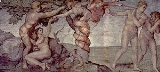
Michelangelo Buonarroti 022
Original sin is said to result from the Fall of Man, when Adam and Eve ate the forbidden fruit of a particular tree in the Garden of Eden. This first sin ("the original sin"), an action of the first human beings, is traditionally understood to be the cause of "original sin", the fallen state from which human beings can be saved only by God's grace. This is also called Adam and Eve sin.

History of the doctrine

The Apostolic Fathers and the Apologists mostly dealt with topics other than original sin. The doctrine of original sin was first developed in second-century Bishop of Lyon
Lyon

||-||}Lyon, also known as Lyons in English, is a city in east-central France. Its name is pronounced in French language and Franco-Proven?al language, and or in English language....
 Irenaeus
Irenaeus

Saint Irenaeus , was a Catholic Bishop of Lugdunum in Gaul, then a part of the Roman Empire . He was an early church father and apologist, and his writings were formative in the early development of Christian theology....
's struggle against Gnosticism
Gnosticism

Gnosticism refers to diverse, syncretistic religious movements in antiquity consisting of various belief systems generally united in the teaching that humans are divine souls trapped in a Nature created by an imperfect god, the demiurge; this being is frequently identified with the Abrahamic God, and is contrasted with a superior entity, ref...
. The Greek Fathers emphasized the cosmic dimension of the Fall, namely that since Adam human beings are born into a fallen world, but held fast to belief that man, though fallen, is free. It was in the West that precise definition of the doctrine arose. Augustine of Hippo taught that original sin was transmitted through the concupiscence
Concupiscence

Modern definitions of Concupiscence: an ardent, usually sensuous, longing; a strong sexual desire; lust. In Christian theology, concupiscence is selfish human desire for an object, person, or experience....
 (roughly, lust) that accompanied sexual reproduction, weakening the will and making humanity a massa damnata (mass of perdition, condemned crowd). In Augustine's view (termed "Realism"), all of humanity was really present in Adam when he sinned, and therefore all have sinned. Original sin, according to Augustine, consists of the guilt of Adam which all human beings inherit. As sinners, human beings are utterly depraved in nature, lack the freedom to do good, and cannot respond to the will of God without divine grace
Divine grace

In theology, grace may be described as 'enabling power sufficient for progression'. In Christianity, grace divine is an "unmerited favour" of God, indispensable gift from God for development, improvement, and character expansion, and without God's grace, there are certain limitations, weaknesses, flaws, impurities, and faults mankind cannot...
. Grace is irresistible
Irresistible grace

Irresistible Grace is a doctrine in Christian theology particularly associated with Calvinism, which teaches that the saving Divine grace of God is effectually applied to those whom He has determined to save and, in God's timing, overcomes their resistance to obeying the call of the gospel, bringing them to a saving faith in Jesus....
, results in conversion, and leads to perseverance
Perseverance of the saints

Perseverance of the saints is a controversial Christian teaching that none who are truly salvation can be condemned for their sins or finally fall away from the faith....
.

In the struggle against Pelagianism
Pelagianism

Pelagianism is a theological theory named after Pelagius . It is the belief that original sin did not taint Instinct and that mortal will is still capable of choosing Goodness and value theory or evil without special Miracle....
, which denied the doctrine of original sin, the principles of Augustine's teaching was confirmed by many councils, especially the Second Council of Orange
Councils of Orange

The Councils of Orange comprised two synods held at Orange, France. The first dealt with various church issues. The second affirmed Augustine's teaching against Pelagian challenge....
 in 529. Some of the followers of Augustine identified original sin with concupiscence, but this identification was challenged by the eleventh-century Saint Anselm of Canterbury
Anselm of Canterbury

Saint Anselm of Canterbury was an Italian medieval philosopher, theology, and church official who held the office of Archbishop of Canterbury from 1093 to 1109....
 , who defined original sin as "privation of the righteousness that every man ought to possess", thus separating it from concupiscence. In the twelfth century the identification of original sin with concupiscence was supported by Peter Lombard
Peter Lombard

Peter Lombard or Petrus Lombardus; was a scholasticism and bishop and author of Sentences, which became the standard textbook of theology, for which he is also known as Magister Sententiarum....
 and others, but was rejected by the leading theologians in the next century, chief of whom was Thomas Aquinas
Thomas Aquinas

Saint Thomas Aquinas, Dominican Order was a priest of the Roman Catholic Church in the Dominican Order from Italy, and an immensely influential philosopher and theologian in the tradition of scholasticism, known as Doctor Angelicus and Doctor Communis....
. He distinguished the supernatural gifts of Adam before the Fall from what was merely natural, and said that it was the former that were lost, privileges that enabled man to keep his inferior powers in submission to reason and directed to his supernatural end. Even after the fall, man thus kept his natural abilities of reason, will and passions. Rigorous Augustine-inspired views persisted among the Franciscans, though the most prominent Franciscan theologians, such as Duns Scotus
Duns Scotus

The Beatification John Duns Scotus, Order of Friars Minor was one of the most important theology and philosopher of the High Middle Ages. He was nicknamed Doctor Subtilis for his penetrating and subtle manner of thought....
 and William of Ockham
William of Ockham

William of Ockham was an England Franciscan friar and Scholasticism philosopher, from Ockham, Surrey, a small village in Surrey, near East Horsley....
, eliminated the element of concupiscence.

Reformers
Protestant Reformation

The Protestant Reformation was a Christian reform movement in Europe. It is thought to have begun in 1517 with Martin Luther's Ninety-Five Theses and may be considered to have ended with the Peace of Westphalia in 1648....
  Martin Luther
Martin Luther

Martin Luther was a Germans monk, theology, university professor, priest, father of Protestantism, and Protestant Reformers whose ideas started the Protestant Reformation and changed the course of Western culture....
 and John Calvin
John Calvin

John Calvin was an influential French people theology and pastor during the Protestant Reformation. He was a principal figure in the development of the system of Christian theology later called Calvinism....
 equated original sin with concupiscence, affirming that it persisted even after baptism and completely destroyed freedom.

The Council of Trent
Council of Trent

The Council of Trent was the 16th century Ecumenical Council of the Roman Catholic Church. Considered one of the Church's most important councils, it convened in Trento between December 13, 1545, and December 4, 1563 in twenty-five sessions for three periods....
, while not pronouncing on points disputed among Catholic theologians, condemned the teaching that in baptism the whole of what belongs to the essence of sin is not taken away, but is only cancelled or not imputed, and declared that the concupiscence that remains after baptism not truly and properly sin in the baptized, but can only be called sin in the sense that it is of sin and inclines to sin.

In 1567, soon after the close of the Council of Trent, Pope Pius V
Pope Pius V

Pope Saint Pius V , born Antonio Ghislieri was Pope from 1566 to 1572 and is a saint of the Roman Catholic Church. He is chiefly notable for his role in the implementation of the Council of Trent, the Counterreformation and the standardisation of the liturgy....
 went beyond Trent by sanctioning the Aquinas's distinction between nature and supernature in Adam's state before the Fall, condemned the identification of original sin with concupiscence, and approved the view that the unbaptized could have right use of will.

From about the 18th century, belief about original sin has tended to become softened, but has persisted in some form as in Immanuel Kant
Immanuel Kant

Immanuel Kant was an 18th-century German Philosophy from the Kingdom of Prussia city of K?nigsberg . He is regarded as one of the most influential thinkers of modern Europe and of the late Age of Enlightenment....
's idea of "radical evil".

Unbaptized infants

Augustine believed that the only definitive destinations of souls are heaven and hell. He concluded that unbaptized infants go to hell as a consequence of original sin. The Latin Church Fathers
Church Fathers

The Church Fathers, Early Church Fathers, or Fathers of the Church are the early and influential theology and writers in the Christian Church, particularly those of the first five centuries of Christian history....
 who followed Augustine adopted his position, which became a point of reference for Latin theologians in the Middle Ages. In the later mediaeval period, some theologians continued to hold Augustine's view, others held that unbaptized infants suffered no pain at all: unaware of being deprived of the beatific vision
Beatific vision

In Christian theology, the beatific vision is the eternal and direct perception of God enjoyed by those who are in Heaven, imparting supreme happiness or blessedness....
, they enjoyed a state of natural, not supernatural happiness. Starting around 1300, unbaptized infants were often said to inhabit the "limbo of infants
Limbo

In Roman Catholic Church theology, Limbo is an idea about the afterlife condition of those who die in original sin without being assigned to the Hell of the damned....
". The declares: "As regards children who have died without Baptism, the Church can only entrust them to the mercy of God, as she does in her funeral rites for them. Indeed, the great mercy of God who desires that all men should be saved, and Jesus' tenderness toward children which caused him to say: 'Let the children come to me, do not hinder them,' allow us to hope that there is a way of salvation for children who have died without Baptism. All the more urgent is the Church's call not to prevent little children coming to Christ through the gift of holy Baptism." But the theory of Limbo, while it "never entered into the dogmatic definitions of the Magisterium ... remains ... a possible theological hypothesis".

Augustine's formulation of original sin was popular among Protestant reformers, such as Martin Luther
Martin Luther

Martin Luther was a Germans monk, theology, university professor, priest, father of Protestantism, and Protestant Reformers whose ideas started the Protestant Reformation and changed the course of Western culture....
 and John Calvin
John Calvin

John Calvin was an influential French people theology and pastor during the Protestant Reformation. He was a principal figure in the development of the system of Christian theology later called Calvinism....
, and also, within Roman Catholicism, in the Jansenist
Jansenism

Jansenism was a branch of Roman Catholic Church thought which arose in the frame of the Counter-Reformation and the aftermath of the Council of Trent ....
 movement, but this movement was declared heretical by the Roman Catholic Church.

Like other traditional church doctrines, original sin has been denied or reinterpreted by various modern Christian denominations (such as the Unity Church
Unity Church

Unity also known as Unity School of Christianity and informally as Unity Church, is a school of thought founded upon holism Christian principles within the New Thought movement....
) and theologians (such as Matthew Fox
Matthew Fox (priest)

Matthew Fox is an United States Episcopal Church priest and theology. He is an exponent of Creation Spirituality, a movement grounded in the mystical philosophies of medieval visionaries Hildegard of Bingen, Thomas Aquinas, Meister Eckhart and Nicholas of Cusa....
). Under such different views, Augustine's example of newborn babies would suffer the temptation to sin from their nature, but would not bear any guilt because of not actually committing sins of their own.

Christian doctrine

B Escorial 18
There are wide-ranging disagreements among Christian groups as to the exact understanding of the doctrine about a state of sinfulness or absence of holiness affecting all human beings, even children, with some Christian groups denying it altogether.

New Testament

The scriptural basis for the doctrine is found in two New Testament books by Paul the Apostle, Romans 5:12-21 and 1 Corinthians 15:22, in which he identifies Adam as the one man through whom death came into the world.

Roman Catholicism

The Catechism of the Catholic Church says:

By his sin Adam, as the first man, lost the original holiness and justice he had received from God, not only for himself but for all human beings.

Adam and Eve transmitted to their descendants human nature wounded by their own first sin and hence deprived of original holiness and justice; this deprivation is called "original sin".

As a result of original sin, human nature is weakened in its powers, subject to ignorance, suffering and the domination of death, and inclined to sin (this inclination is called "concupiscence").


Catechism of the Catholic Church explains that in "yielding to the tempter, Adam and Eve committed a personal sin, but this sin affected the human nature that they would then transmit in a fallen state … original sin is called "sin" only in an analogical sense: it is a sin "contracted" and not "committed"—a state and not an act" (404). This "state of deprivation of the original holiness and justice … transmitted to the descendants of Adam along with human nature" (Compendium of the Catechism of the Catholic Church, 76) involves no personal responsibility or personal guilt on their part (cf. Catechism of the Catholic Church, 405). Personal responsibility and guilt were Adam's, who because of his sin, was unable to pass on to his descendants a human nature with the holiness with which it would otherwise have been endowed, in this way implicating them in his sin.

Though Adam's sinful act is not the responsibility of his descendants, the state of human nature that has resulted from that sinful act has consequences that plague them: "Human nature, without being entirely corrupted, has been harmed in its natural powers, is subject to ignorance, suffering and the power of death, and has a tendency to sin. This tendency is called concupiscence" (Compendium of the Catechism of the Catholic Church, 77), but is distinct from original sin itself, since it remains even when original sin is remitted.

The Church has always held baptism to be "for the remission of sins", and, as mentioned in Catechism of the Catholic Church, 403, infants too have traditionally been baptized, though not guilty of any actual personal sin. The sin that through baptism was remitted for them could only be original sin, with which they were connected by the very fact of being human beings. Based largely on this practice, Saint Augustine of Hippo articulated the teaching in reaction to Pelagianism
Pelagianism

Pelagianism is a theological theory named after Pelagius . It is the belief that original sin did not taint Instinct and that mortal will is still capable of choosing Goodness and value theory or evil without special Miracle....
, which insisted that human beings have of themselves, without the necessary help of God's grace, the ability to lead a morally good life, and thus denied both the importance of baptism and the teaching that God is the giver of all that is good.

The Roman Catholic Church did not accept all of Augustine's ideas, which he developed to counter the claim by Pelagius that the influence of Adam on other human beings was merely that of bad example. For instance, the Church did not adopt the opinion that involvement in Adam's guilt and punishment takes effect through the dependence of human procreation on the sexual passion, in which the spirit's inability to control flesh is evident. Rather, the Church teaches that original sin comes to the soul simply from the new person taking his nature from one whose nature itself had original sin. In this way, the Church argues that original sin is not imputing the sin of the father to the son; rather, it is simply the inheritance of a wounded nature from the father, which is an unavoidable part of reproduction.

The Roman Catholic doctrine of the Immaculate Conception
Immaculate Conception

For artistic depictions see Roman Catholic Marian art. For the novel by Ga?tan Soucy, see The Immaculate Conception.The Immaculate Conception is, according to Roman Catholic Dogma, the conception of the Blessed Virgin Mary without any stain of original sin....
 of Mary is that Mary was conceived free from original sin: "the most Blessed Virgin Mary was, from the first moment of her conception, by a singular grace and privilege of almighty God and by virtue of the merits of Jesus Christ, Savior of the human race, preserved immune from all stain of original sin." The exceptional character that Catholic doctrine attributes to the conception of Mary thus depends on the reality of original sin. If, as some hold, original sin did not exist, not only she, but all human beings would be conceived "immune from all stain of original sin".

Eastern Christianity

Eastern Orthodoxy
Eastern Orthodox Church

The Eastern Orthodox Church is the second largest single Christian communion in the world with an estimated 225 million members worldwide. It is considered by its adherents to be the Four Marks of the Church established by Jesus Christ and his Apostles nearly 2000 years ago....
, Oriental Orthodoxy and Eastern Catholicism, which together make up Eastern Christianity, acknowledge that the introduction of ancestral sin into the human race affected the subsequent environment for mankind, but never accepted Augustine of Hippo's notions of original sin and hereditary guilt. The act of Adam
Adam and Eve

Adam and Eve are the First man or woman created by God in the Hebrew creation story told in Genesis 1-2....
 is not the responsibility of all humanity, but the consequences of that act changed the reality of this present age of the cosmos. The Greek Fathers emphasized the metaphysical dimension of the Fall of Man, whereby Adam's descendants are born into a fallen world, but at the same time held fast to belief that, in spite of that, man remains free. Instead of accepting the Lutheran interpretation of Augustine's teaching, Orthodox Churches accept the teaching of John Cassian
John Cassian

Saint John Cassian , John the Ascetic, or John Cassian the Roman, is a Christian theology celebrated in both the Western and Eastern Churches for his mystical writings....
, which rejects the doctrine of Total Depravity
Total depravity

Total depravity is a theology doctrine that derives from the Augustine of Hippo concepts of original sin. It is also advocated to various degrees by many Protestant confessions of faith and catechisms, including those of Lutheranism, and Methodism, Arminianism, and Calvinism....
, by teaching that human nature is "fallen", that is, depraved, but not totally.

Lutheranism

The second article in Lutheranism's Augsburg Confession
Augsburg Confession

The Augsburg Confession, also known as the "Augustana" from its Latin name, Confessio Augustana, is the primary confession of faith of the Lutheran Church....
 presents its doctrine of original sin in summary form:

Mainstream Protestantism

The notion of original sin as interpreted by Augustine of Hippo was affirmed by the Protestant Reformers
Protestant Reformation

The Protestant Reformation was a Christian reform movement in Europe. It is thought to have begun in 1517 with Martin Luther's Ninety-Five Theses and may be considered to have ended with the Peace of Westphalia in 1648....
 Martin Luther
Martin Luther

Martin Luther was a Germans monk, theology, university professor, priest, father of Protestantism, and Protestant Reformers whose ideas started the Protestant Reformation and changed the course of Western culture....
 and John Calvin
John Calvin

John Calvin was an influential French people theology and pastor during the Protestant Reformation. He was a principal figure in the development of the system of Christian theology later called Calvinism....
. Both Luther and Calvin agreed that humans inherit Adamic guilt and are in a state of sin from the moment of conception. This inherently sinful nature (the basis for the Calvinistic
Calvinism

Calvinism is a theology system and an approach to the Christian life that emphasizes the rule of God over all things. It was developed by several theologians, but it bears the name of the French Protestant Reformation John Calvin because of his prominent influence on it and because of his role in the confessional and ecclesiastical debates t...
 doctrine of "total depravity
Total depravity

Total depravity is a theology doctrine that derives from the Augustine of Hippo concepts of original sin. It is also advocated to various degrees by many Protestant confessions of faith and catechisms, including those of Lutheranism, and Methodism, Arminianism, and Calvinism....
") results in a complete alienation from God and the total inability of humans to achieve reconciliation with God based on their own abilities. Not only do individuals inherit a sinful nature due to Adam's fall, but since he was the federal head and representative of the human race, all whom he represented inherit the guilt of his sin by imputation.

John Calvin
John Calvin

John Calvin was an influential French people theology and pastor during the Protestant Reformation. He was a principal figure in the development of the system of Christian theology later called Calvinism....
 defined original sin in his Institutes of the Christian Religion
Institutes of the Christian Religion

Institutes of the Christian Religion is John Calvin's seminal work on Protestant systematic theology. Highly influential in the Western world and still widely read by theological students today, it was published in Latin in 1536 and in his native French language in 1541, with the definitive editions appearing in 1559 and in 1560 ....
 as follows:

The Methodist Church, founded by John Wesley
John Wesley

John Wesley was an Anglican cleric and Christian Christian theologian who founded the Arminianism Methodism. The Wesley Methodist Movement began when Wesley took over open-air preaching started by George Whitefield at Hanham, Kingswood, and Bristol....
, upholds Article VII in the Articles of Religion
Articles of Religion (Methodist)

The Articles of Religion are an official doctrinal statement of American Methodism. John Wesley abridged for the American Methodists the Thirty-Nine Articles of Anglicanism, removing the Calvinism parts among others....
 in the Book of Discipline of the Methodist Church
Book of Discipline (United Methodist)

The Book of Discipline constitutes the law and doctrine of the United Methodist Church. It follows similar works for its predecessor denominations....
:

Because of this conundrum
Conundrum

Conundrum may refer to:In literature:* Conundrum , an original novel written by Steve Lyons* Conundrum , a Dragonlance fantasy novel by Jeff Crook...
, Protestants believe that God the Father sent Jesus
Jesus

Jesus of Nazareth , also known as Jesus Christ, is the central figure of Christianity and is revered by most Christian churches as the Son of God and the Incarnation ....
 into the world. The personhood, life, ministry, suffering, and death of Jesus, as God incarnate
Incarnation

Incarnation which literally means embodied in flesh, refers to the Conception and birth of a Sentience creature who is the material manifestation of an entity or force whose original nature is immaterial....
 in human flesh, is meant to be the atonement
Atonement

The atonement is a doctrine found within both Christianity and Judaism. It describes how sin can be forgiven by God. In Judaism, Atonement is said to be the process of forgiving or pardoning a transgression....
 for original sin as well as actual sins; this atonement is according to some rendered fully effective by the Resurrection of Jesus
Death and Resurrection of Jesus

Within the body of Christianity beliefs, the resurrection of Jesus is a core event on which much of Christian doctrine and theology depend. According to the New Testament, Jesus was Crucifixion, died, buried in a tomb, and resurrected three days later....
.

Seventh-day Adventism

One authoritative Adventist position is outlined by reference to publicly available theological positions available on the General Conference of the Seventh-day Adventist Church’s official website on theological doctrine, the Biblical Research Institute
Biblical Research Institute

The Biblical Research Institute is a service department of the Seventh-day Adventist Church with the three stated functions of research, Christian apologetics , and service to the church....
. One such article commenting on original sin can be found .

Denial of original sin


Restoration Movement

Most Stone-Campbell Restoration Movement
Restoration Movement

The Restoration Movement began during the Second Great Awakening early nineteenth century as a movement to reform the church and unite Christians....
 Churches, such as the Churches of Christ, Christian Churches
Independent Christian Churches/Churches of Christ

The Independent Christian Churches/Churches of Christ are a part of the Restoration Movement and share historical roots with the Christian Church and the a cappella Churches of Christ....
, and the Disciples of Christ, reject the notion of original sin, believing only in the sins for which men and women are personally responsible. Such churches do not object to the idea that Adam and Eve brought sin into the world by introducing disobedience. Disobedience influenced further generations in much the same way other ideas spread, thus making sin likely in any individual above "The Age of Accountability."

In the Old Testament, in the Book of Ezekiel
Book of Ezekiel

The Book of Ezekiel is a book of the Hebrew Bible named after the prophet Ezekiel....
, God's people are rebuked for suggesting that the children would die/suffer for their father's sins:

The word of the Lord came to me: "What do you people mean by quoting this proverb about the land of Israel: 'The parents eat sour grapes, and the children's teeth are set on edge'? As surely as I live, declares the Sovereign Lord, you will no longer quote this proverb in Israel. For everyone belongs to me, the parent as well as the child—both alike belong to me. The one who sins is the one who will die.
—Ezek. 18:1-4, TNIV


The Lord then gives examples of a good father with a bad son, of a good son with a bad father, etc. and states:

"Yet you ask, 'Why does the son not share the guilt of his father?' Since the son has done what is just and right and has been careful to keep all my decrees, he will surely live. The one who sins is the one who will die. The child will not share the guilt of the parent, nor will the parent share the guilt of the child. The righteousness of the righteous will be credited to them, and the wickedness of the wicked will be charged against them.
—Ezek. 18:19-20, TNIV


God concludes: "house of Israel, I will judge each of you according to your own ways … Repent! Turn away from all your offenses; then sin will not be your downfall. Rid yourselves of all the offenses you have committed, and get a new heart and a new spirit" (Ezek. 18:30-31, TNIV).

Many Restoration movement churches and individuals, however, do believe that Adam's sin made us depraved (that is, with a tendency towards sin) without making us guilty of Adam's sin. Man is predisposed towards sin, but though every person sins, they are not guilty on account of any sin nature.

The Church of Jesus Christ of Latter-day Saints

Members of the Church of Jesus Christ of Latter-day Saints (also known as Mormons), are a movement with an additional set of scriptures
Book of Mormon

The Book of Mormon is a sacred text of the churches of the Latter Day Saint Movement. It was first published in March 1830 by Joseph Smith, Jr....
. Mormonism does not believe in the concept of original sin as it is generally used Christianity, but believes that everyone will be punished for their own individual sins and not for any transgression of Adam or Eve. Neither do Mormons believe that children come into the world with any guilt. Rather, Jesus Christ atoned for any "original guilt" and the sins of parents cannot be answered upon the heads of their children. Moses 6:53 in the Pearl of Great Price
Pearl of Great Price

Pearl of Great Price may refer to:*Parable of the Pearl, a parable told by Jesus in explaining the value of the Kingdom of Heaven*Pearl , a Middle English alliterative poem written in the late 14th century...
 reads:
And our father Adam spake unto the Lord, and said: Why is it that men must repent and be baptized in water? And the Lord said unto Adam: Behold I have forgiven thee thy transgression in the Garden of Eden. 54 Hence came the saying abroad among the people, that the Son of God hath atoned for original guilt, wherein the sins of the parents cannot be answered upon the heads of the children, for they are whole from the foundation of the world.


Furthermore, Mormons hold that little children are incapable of committing sin and, as such, have no need of (saving) baptism until age eight when they can begin to learn to discern right from wrong, and are thus capable of sin and can be held accountable. Little children who die before reaching the age of accountability (even though they are unbaptized) are automatic heirs of salvation and are saved in the Celestial Kingdom of God through the atonement of Jesus Christ.

Those who are incapable of understanding right from wrong, such as mentally handicapped persons, are also saved under the atonement of Jesus Christ without baptism.

Extraterrestrial beings and original sin

In an interview entitled "Aliens Are My Brother", granted to L'Osservatore Romano
L'Osservatore Romano

L'Osservatore Romano is the "semi-official" newspaper of the Holy See. It covers all the Pope's public activities, publishes editorials by important churchmen, and runs official documents after being released....
, the Vatican newspaper, Father Gabriel Funes, director of the Vatican Observatory, stated: "In my opinion this possibility (of life on other planets) exists"; "intelligent beings, created by God may exist in outer space" and "some aliens could even be free from original sin" concluding "there could be (other beings) who remained in full friendship with their creator". And on 5 March 2009, Jesuit
Society of Jesus

The Society of Jesus is a Roman Catholic religious order of clerks regular whose members are called Jesuits, Soldiers of Jesus Christ, and Foot soldiers of the Pope, because the founder, Saint Ignatius of Loyola, was a knight before becoming a Holy Orders....
 Brother Guy Consolmagno, another astronomer working at the Vatican Observatory, told the BBC, in relation to the search for Earth-like worlds about to be embarked upon by the Kepler Space telescope, that "we Jesuits are actively involved in the search for Earth-like planets. The idea that there could be other intelligent creatures made by God in a relationship with God is not contrary to traditional Judeo-Christian thought. The Bible has many references to, or descriptions of, non-human intelligent beings; after all, that's what angels are. Our cousins on other planets may even have their own salvation story – including other examples of the incarnation of the second person of the Trinity. We are open to whatever the Universe has for us."

With regard to the attribution to "the Vatican" of similar statements by individuals working for the Holy See
Holy See

The Holy See is the episcopal jurisdiction of the Bishop of Rome, commonly known as the Pope, and is the preeminent episcopal see of the Roman Catholic Church, forming the central government of the Church....
, official spokesman Father Federico Lombardi
Federico Lombardi

Federico Lombardi, Society of Jesus is an Italy Roman Catholic Church Priesthood and the current director of the Holy See Press Office.Lombardi was born near Turin, and was trained in mathematics and studied theology in Germany....
, also a Jesuit, published on 21 February 2009 a declaration that they must not be mistaken for statements of the Holy See.

See also

  • Sin
    Sin

    Sin is a term used mainly in a religion context to describe an act that violates a morality rule, or the state of having committed such a violation....
  • Actual sin
    Actual sin

    According to Christian tradition, "actual" sin as distinguished from original sin is an act contrary to the will and law of God whether by doing evil or refraining from doing good ....
  • Ancestral sin
    Ancestral sin

    Ancestral sin is the object of a Christian doctrine taught by the Eastern Orthodox Church. Some identify it as "inclination towards sin, a heritage from the sin of our progenitors"....
  • Deadly sin
  • Eternal sin
    Eternal sin

    The Eternal Sin, or unpardonable sin, is a concept of sin in Christian theology, whereby salvation becomes impossible. Its origin comes from statements by Jesus in the context of his opponents' claim that his miraculous healings were a work of Beelzebub, a demon in league with the Devil....
     (also known as Unforgivable or Unpardonable sin)
  • Divine grace
    Divine grace

    In theology, grace may be described as 'enabling power sufficient for progression'. In Christianity, grace divine is an "unmerited favour" of God, indispensable gift from God for development, improvement, and character expansion, and without God's grace, there are certain limitations, weaknesses, flaws, impurities, and faults mankind cannot...
  • Immaculate Conception
    Immaculate Conception

    For artistic depictions see Roman Catholic Marian art. For the novel by Ga?tan Soucy, see The Immaculate Conception.The Immaculate Conception is, according to Roman Catholic Dogma, the conception of the Blessed Virgin Mary without any stain of original sin....
  • Fall of Man
  • Hamartiology
    Hamartiology

    Hamartiology is the branch of Christian theology, more specifically, systematic theology, which is the study of sin with a view to articulating a doctrine of it....
  • Incurvatus in se
    Incurvatus in se

    Incurvatus in se is a theological phrase describing a life lived "inward" for self rather than "outward" for God and others.Paul of Tarsus wrote of this condition in Romans 7:15, 18-19:...
  • Internal sin
    Internal sin

    The Christian concept of internal sin is the idea that sin may be committed not only by outward deeds but also by the inner activity of the mind, quite apart from any external manifestation....
  • Justification
    Justification (theology)

    In Christian theology, justification is God's act of declaring or making a sinner righteousness before God. The concept of justification occurs in many books of the Old and New Testaments....
  • Mortal sin
    Mortal sin

    Mortal sin, according to the beliefs of Roman Catholicism, and some Protestant denominations, is a sin that, unless confessed and absolved , condemns a person's soul to Hell after death....
  • Pandora's box
    Pandora's box

    In Greek mythology, Pandora's box is the large jar carried by Pandora that contained evils to be unleashed on mankind ? ills, toils and sickness ? and finally hope....
  • Prevenient grace
    Prevenient grace

    Prevenient grace is a Christian theology concept rooted in Augustine of Hippo and embraced primarily by Arminianism Christians who are influenced by the theology of John Wesley and who are part of the Methodism....
  • The Antichrist (book)
    The Antichrist (book)

    The Anti-Christ is a book by the philosopher Friedrich Nietzsche, originally published in 1895. Although it was written in 1888, its controversial content made Franz Overbeck and Heinrich K?selitz delay its publication, along with Ecce Homo ....
  • Total depravity
    Total depravity

    Total depravity is a theology doctrine that derives from the Augustine of Hippo concepts of original sin. It is also advocated to various degrees by many Protestant confessions of faith and catechisms, including those of Lutheranism, and Methodism, Arminianism, and Calvinism....
  • Venial sin
    Venial sin

    According to Roman Catholicism, a venial sin is a lesser sin that does not result in a complete separation from God and eternal damnation in Hell....


External links

  • The Defense of the Augsburg Confession, Article II: Of Original Sin; from an early Protestant perspective, part of the Augsburg Confession
    Augsburg Confession

    The Augsburg Confession, also known as the "Augustana" from its Latin name, Confessio Augustana, is the primary confession of faith of the Lutheran Church....
    .
  • by John S. Romanides
    John S. Romanides

    John Savvas Romanides was a Eastern Orthodox Church priest, author and professor who, for a long time, represented the Greek Church to the World Council of Churches....