
All Topics  
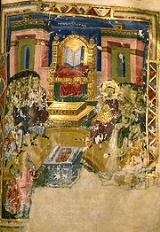
First Council of Constantinople

 
First Council of Constantinople

   Email Print
   Bookmark   Link


First Council of Constantinople


The First Council of Constantinople is believed to be the Second Ecumenical Council by the Assyrian Church of the East
Assyrian Church of the East

The Holy Apostolic Catholic Assyrian Church of the East , currently presided over by Mar Dinkha IV, is a Christian particular church and one of the earliest to separate itself from communion with the Catholic Church ....
, the Oriental Orthodox, the Eastern Orthodox, the Roman Catholics, the Old Catholics, and a number of other Western Christian groups. This being the first Ecumenical Council held in Constantinople, it was called by Theodosius I
Theodosius I

Flavius Theodosius , also called Theodosius I and Theodosius the Great , was Roman Emperor from 379 to 395. Reuniting the eastern and western portions of the empire, Theodosius was the last emperor of both the Eastern Roman Empire and Western Roman Empire....
 in 381 which confirmed the Nicene Creed
Nicene Creed

The Nicene Creed is the creed or profession of faith that is most widely used in Christianity liturgy. It is called Nicene because, in its original form, it was adopted in the city of Iznik by the first ecumenical council, which met there in 325....
 and dealt with other matters such as Arian controversy
Arian controversy

The Arian controversy describes several controversies related to Arianism which divided the Christian church from before the First Council of Nicaea in 325 to after the First Council of Constantinople in 381....
. The council took place in the church of Hagia Irene
Hagia Irene

Hagia Irene or Hagia Eirene is a former Eastern Orthodox church located in the outer courtyard of Topkapi Palace in Istanbul, Turkey....
 from May to July 381.

Background
The Council of Nicaea
First Council of Nicaea

The First Council of Nicea was convened in Nicaea in Bithynia by the Roman Emperors Constantine I in 325 CE. The Council was historically significant as the first effort to attain consensus decision-making in the church through an legislature representing all of Christendom....
 did not end the Arian
Arianism

Arianism is the theological teaching of Arius , a Christian priest, who was first ruled a heresy at the First Council of Nicea, later exonerated and then pronounced a heretic again after his death....
 controversy which it had been called to clarify.


Discussion
Ask a question about 'First Council of Constantinople'
Start a new discussion about 'First Council of Constantinople'
Answer questions from other users
Full Discussion Forum


Encyclopedia


The First Council of Constantinople is believed to be the Second Ecumenical Council by the Assyrian Church of the East
Assyrian Church of the East

The Holy Apostolic Catholic Assyrian Church of the East , currently presided over by Mar Dinkha IV, is a Christian particular church and one of the earliest to separate itself from communion with the Catholic Church ....
, the Oriental Orthodox, the Eastern Orthodox, the Roman Catholics, the Old Catholics, and a number of other Western Christian groups. This being the first Ecumenical Council held in Constantinople, it was called by Theodosius I
Theodosius I

Flavius Theodosius , also called Theodosius I and Theodosius the Great , was Roman Emperor from 379 to 395. Reuniting the eastern and western portions of the empire, Theodosius was the last emperor of both the Eastern Roman Empire and Western Roman Empire....
 in 381 which confirmed the Nicene Creed
Nicene Creed

The Nicene Creed is the creed or profession of faith that is most widely used in Christianity liturgy. It is called Nicene because, in its original form, it was adopted in the city of Iznik by the first ecumenical council, which met there in 325....
 and dealt with other matters such as Arian controversy
Arian controversy

The Arian controversy describes several controversies related to Arianism which divided the Christian church from before the First Council of Nicaea in 325 to after the First Council of Constantinople in 381....
. The council took place in the church of Hagia Irene
Hagia Irene

Hagia Irene or Hagia Eirene is a former Eastern Orthodox church located in the outer courtyard of Topkapi Palace in Istanbul, Turkey....
 from May to July 381.

Background


Gregor Chora
The Council of Nicaea
First Council of Nicaea

The First Council of Nicea was convened in Nicaea in Bithynia by the Roman Emperors Constantine I in 325 CE. The Council was historically significant as the first effort to attain consensus decision-making in the church through an legislature representing all of Christendom....
 did not end the Arian
Arianism

Arianism is the theological teaching of Arius , a Christian priest, who was first ruled a heresy at the First Council of Nicea, later exonerated and then pronounced a heretic again after his death....
 controversy which it had been called to clarify. By 327, Emperor Constantine I
Constantine I

Flavius Valerius Aurelius Constantinus , commonly known in English_language as Constantine I, Constantine the Great, or Saint Constantine , was Roman Emperor from 306, and the undisputed holder of that office from 324 until his death in 337....
 had begun to regret the decisions that had been made at the Nicene Council
First Council of Nicaea

The First Council of Nicea was convened in Nicaea in Bithynia by the Roman Emperors Constantine I in 325 CE. The Council was historically significant as the first effort to attain consensus decision-making in the church through an legislature representing all of Christendom....
. He granted amnesty to the Arian leaders and exiled Athanasius because of Eusebius of Nicomedia
Eusebius of Nicomedia

Eusebius of Nicomedia was a bishop of Berytus in Phoenicia, then of Nicomedia where the imperial court resided in Bithynia, and finally of Constantinople from 338 up to his death....
. Even during numerous exiles, Athanasius continued to be a vigorous defender of Nicene Christianity against Arianism. The Cappadocian Fathers
Cappadocian Fathers

The Cappadocian Fathers are Basil the Great, bishop of Caesarea, Gregory of Nyssa, bishop of Nyssa, and a close friend, Gregory Nazianzus, Patriarch of Constantinople....
 also took up the torch, their Trinitarian discourse was influential in the council at Constantinople
Constantinople

Constantinople was the empire capital of the Roman Empire , the Byzantine Empire , the Latin Empire , and the Ottoman Empire . Strategically located between the Golden Horn and the Sea of Marmara at the point where Europe meets Asia, Byzantine Constantinople had been the capital of a Christendom empire, successor to ancient ancient Greece...
.

Up until about 360, theological debates mainly dealt with the Divinity of Jesus
Christology

Christology is a field of study within Christian theology which is concerned with the nature of Jesus the Christ, particularly with how the divine and human are related in his person....
, the 2nd person of the Trinity
Trinity

In Christianity doctrine, the Trinity is the unity of God the Father, God the Son, and Holy Spirit as three persons in monotheism. The doctrine states that God is the Triune God, existing as three persons, or in the Greek hypostasis , but one being....
. However, because the Council of Nicaea had not clarified the divinity of the Holy Spirit
Holy Spirit

In Christianity, the Holy Ghost or Holy Spirit is the spirit of God. The term Christ , is also used to refer to this presence. That is, the Spirit is considered to act in concert with and share an essential nature with God the Father and God the Son ....
, the 3rd person of the Trinity, it became a topic of debate. The Macedonians
Macedonians (religious group)

The Macedonians were a Christian sect of the 4th century AD, named after Bishop Macedonius I of Constantinople. They professed a belief similar to that of Arianism, but apparently denying the divinity of the Holy Spirit, and regarding the substance of Jesus Christ as being the same in kind as that of God the Father....
 denied the divinity of the Holy Spirit. This was also known as Pneumatomachianism
Macedonians (religious group)

The Macedonians were a Christian sect of the 4th century AD, named after Bishop Macedonius I of Constantinople. They professed a belief similar to that of Arianism, but apparently denying the divinity of the Holy Spirit, and regarding the substance of Jesus Christ as being the same in kind as that of God the Father....
.

The proceedings

Timothy of Alexandria

Pope Timothy I of Alexandria served as Pope of Alexandria between 378 and 384. He is commemorated in the Calendar of Saints of the Coptic Church on the 26th day of Epip....
, Meletius of Antioch
Meletius of Antioch

Saint Meletius of Antioch was the Christianity bishop, or Patriarch of Antioch, from 360 until his death. His staunch support of the First Council of Nicaea of the church led to his exile three times under Arianism emperors....
, Gregory Nazianzus, and Archbishop Nectarius of Constantinople
Archbishop Nectarius of Constantinople

Nectarius was the archbishop of Constantinople from AD 381 until his death, the successor to Saint Gregory Nazianzus....
 successively presided. Gregory Nazianzus was appointed Archbishop of Constantinople
List of Patriarchs of Constantinople

See talk page for different periodization of the bishopric, archbishopric and patriarchate....
, but soon resigned from the position a few months later, and Nectarius was then put in his place.

The council affirmed the original Nicene creed
Nicene Creed

The Nicene Creed is the creed or profession of faith that is most widely used in Christianity liturgy. It is called Nicene because, in its original form, it was adopted in the city of Iznik by the first ecumenical council, which met there in 325....
 of faith as true and an accurate explanation of Scripture. This council also developed a statement of faith which included the language of Nicaea, but expanded the discussion on the Holy Spirit to combat the heresy of the Pneumatomachi
Pneumatomachi

The Pneumatomachi, also known as Macedonians or Semi-Arians in Constantinople and the Tropici in Alexandria, were an anti-Nicene Creed sect which flourished in the countries adjacent to the Hellespont during the latter half of the fourth, and the beginning of the fifth century....
. It is called the Nicene Creed of 381
Nicene Creed

The Nicene Creed is the creed or profession of faith that is most widely used in Christianity liturgy. It is called Nicene because, in its original form, it was adopted in the city of Iznik by the first ecumenical council, which met there in 325....
 and was a commentary on the original Nicene formula. It expanded the third article of the creed dealing with the Holy Spirit
Holy Spirit

In Christianity, the Holy Ghost or Holy Spirit is the spirit of God. The term Christ , is also used to refer to this presence. That is, the Spirit is considered to act in concert with and share an essential nature with God the Father and God the Son ....
, as well as some other changes. About the Holy Spirit the article of faith said he is "the Lord, the Giver of Life, Who proceeds from the Father, With the Father and the Son he is worshipped and glorified". The statement of proceeding from the Father is seen as significant because it established that the Holy Spirit must be of the same being (ousia
Ousia

Ousia is the Greek language noun formed on the feminine present participle of ; it is analogous to the English participle being, and the Greek ontic....
) as God the Father
God the Father

In many religions, the supreme deity is given the title and attributions of Father. In many forms of polytheism, the highest god has been conceived as a "father of gods and of men"....
.

This Council's decision regarding the Holy Spirit also gave official endorsement to the concept of the Trinity
Trinity

In Christianity doctrine, the Trinity is the unity of God the Father, God the Son, and Holy Spirit as three persons in monotheism. The doctrine states that God is the Triune God, existing as three persons, or in the Greek hypostasis , but one being....
. By the end of the 4th century, the Byzantine Emperor Theodosius
Theodosius I

Flavius Theodosius , also called Theodosius I and Theodosius the Great , was Roman Emperor from 379 to 395. Reuniting the eastern and western portions of the empire, Theodosius was the last emperor of both the Eastern Roman Empire and Western Roman Empire....
 "issued a decree that the doctrine of the Trinity was to be the official state religion and that all subjects shall adhere to it" (See )

Seven canon
Canon law

Canon law is internal ecclesiastical law governing the Roman Catholic Church, the Eastern Orthodox Church churches, and the Anglicanism of churches....
s, four of these doctrinal canons and three disciplinary canons, are attributed to the Council and accepted by both the Eastern Orthodox Church and the Oriental Orthodox Churches
Oriental Orthodoxy

Oriental Orthodoxy is the communion of Eastern Christianity Churches that recognize only three ecumenical councils ? the First Council of Nicaea, the First Council of Constantinople and the Council of Ephesus....
; the Roman Catholic Church accepts only the first four.

The first canon is an important dogmatic condemnation of all shades of Arianism, also of Macedonianism and Apollinarianism.

The second canon renews the Nicene legislation imposing upon the bishops the observance of diocesan and patriarchal limits. The famous third canon reads:
The Bishop of Constantinople, however, shall have the prerogative of honour after the Bishop of Rome because Constantinople
Constantinople

Constantinople was the empire capital of the Roman Empire , the Byzantine Empire , the Latin Empire , and the Ottoman Empire . Strategically located between the Golden Horn and the Sea of Marmara at the point where Europe meets Asia, Byzantine Constantinople had been the capital of a Christendom empire, successor to ancient ancient Greece...
 is New Rome
New Rome

The term "New Rome" has been used in the following contexts.* It was a common name applied to Constantinople, the city founded by Roman Emperor Constantine the Great in 324 ....
.
This canon was a first step in the rising importance of the new imperial capital, just fifty years old, and was notable in that it demoted the patriarchs of Antioch and Alexandria. Jerusalem, as the site of the first Church, retained its place of honor. By 451, in the Council of Chalcedon
Council of Chalcedon

The Council of Chalcedon is believed to have been the fourth ecumenical council by the Eastern Orthodox Church and the Roman Catholic Church. It was held from 8 October to 1 November 451 at Chalcedon , today the district of Kadik?y on the Asian side of the Bosphorus, incorporated into the city of Istanbul....
 (Canon IX), Constantinople would be recognized as the ecumenical jurisdiction of highest ecclesiastical appeal.

Baronius maintained the non-authenticity of the third canon, while some medieval Greeks maintained that it did not declare supremacy of the Bishop of Rome
Bishop of Rome

The Bishop of Rome is the Bishop of the Holy See, more often referred to in the Catholic Church tradition as the Pope. The first Bishop of Rome to bear the title of "Pope" was Pope Boniface III in 607, the first to assume the title of "Universal Bishop" by decree of Phocas....
, but the primacy; "the first among equals," similar to how they today view the Bishop of Constantinople. Throughout the next several centuries, the Western Church
Western Christianity

Western Christianity is a term used to include the Latin Rite of the Roman Catholic Church, the Churches of the Anglican Communion and Protestantism, which share common attributes that can be traced back to their medieval heritage....
 asserted that the Bishop of Rome had supreme authority, and by the time of the Great Schism
Great Schism

The term Great Schism may refer to one of several events in Christianity:* The East-West Schism , between Western Roman Catholic and Eastern Orthodox Church Christianity....
 the Roman Catholic Church
Roman Catholic Church

The Roman Catholic Church, officially known as the Catholic Church is the world's largest Christianity Ecclesia , representing over half of all Christians and one-sixth of the world population....
 based its claim to supremacy on the succession
Apostolic Succession

Apostolic Succession is the doctrine in some of the more ancient Christian communions that the succession of bishops, in uninterrupted lines, is historically traceable back to the original twelve Apostles Within Catholic Christianity it "is one of four elements which define the true Church of Jesus Christ" and legitimizes the existing sacr...
 of St. Peter. When the First Council of Constantinople was approved, Rome protested the diminished honor to be afforded the bishops of Antioch and Alexandria. The status of these Eastern patriarchs would be brought up again by the Papal Legate
Papal legate

A Papal Legate ? from the Latin, authentic Roman title Legatus ? is a personal representative of the Pope to Foreign nations, or to some part of the Catholic Church....
s at the Council of Chalcedon. Pope Leo the Great, declared that this canon had never been submitted to Rome and that their lessened honor was a violation of the Nicene order. At the repudiated Fourth Council of Constantinople
Fourth Council of Constantinople

The Fourth Council of Constantinople of 879-880 is the Eighth Ecumenical Council for Eastern Orthodox Christians. Photios I of Constantinople, a noble layman, had been appointed Patriarch of Constantinople but deposed by a Fourth Council of Constantinople called in 869 by Emperor Basil I the Macedonian and Pope Adrian II....
 (869), the Roman legates asserted the place of the bishop of Rome's honor over the bishop of Constantinople's; nine years later, this latrocinium
Latrocinium

Latrocinium hire) which meant primarily a mercenary, or hired soldier, had the same meaning as miles. Latrocinium applied to a war that was not preceded by a declaration of war under the Roman laws; it was also applied to the guerrilla warfare used by the enemies of Rome....
 council was replaced.

After the Great Schism
Great Schism

The term Great Schism may refer to one of several events in Christianity:* The East-West Schism , between Western Roman Catholic and Eastern Orthodox Church Christianity....
 (1054), in 1215 at the Fourth Lateran Council, Roman supremacy over the whole world was formally claimed by the new Latin patriarch. The Roman correctores of Gratian, insert the words: "canon hic ex iis est quos apostolica Romana sedes a principio et longo post tempore non recipit."

The fourth canon declares invalid the consecration of Maximus of Constantinople
Maximus of Constantinople

Maximus of Constantinople may refer to:* Maximus I of Constantinople, , bishop* Maximus the Confessor ...
, the Cynic
Cynic

The Cynics were an influential group of philosophers from the ancient School of Cynicism. Their philosophy was that the purpose of Personal life was to live a life of Virtue in agreement with Nature....
 philosopher and rival of Gregory of Nazianzus
Gregory of Nazianzus

Gregory of Nazianzus was a 4th-century Archbishop of Constantinople. He is widely considered the most accomplished rhetorical stylist of the Church Fathers....
, as Bishop of Constantinople.

The fifth canon might have been passed the next year, 382, and is in regard to a Tome of the Western bishops, perhaps that of Pope Damasus I
Pope Damasus I

Pope Damasus I was pope from 366 to 384.He was born around 305, probably near the city of Idanha-a-Velha , in what is present-day Portugal, or near the city of Castelo Branco , then part of the Western Roman Empire....
.

The sixth canon might belong to the year 382 as well and was passed at the Quinisext Council
Quinisext Council

The Quinisext Council was a church council held in 692 at Constantinople under Justinian II. It is often known as the Council in Trullo, because it was held in the same domed hall where the Third Council of Constantinople had met....
 as #95 and limits the ability to accuse bishops of wrongdoing.

The seventh canon regards procedures for receiving certain heretics into the church.

Pope Damasus I
Pope Damasus I

Pope Damasus I was pope from 366 to 384.He was born around 305, probably near the city of Idanha-a-Velha , in what is present-day Portugal, or near the city of Castelo Branco , then part of the Western Roman Empire....
 was not invited (or declined to attend), thus sometimes this council is called the unecumenical council. However, it was affirmed as ecumenical at the Council of Chalcedon
Council of Chalcedon

The Council of Chalcedon is believed to have been the fourth ecumenical council by the Eastern Orthodox Church and the Roman Catholic Church. It was held from 8 October to 1 November 451 at Chalcedon , today the district of Kadik?y on the Asian side of the Bosphorus, incorporated into the city of Istanbul....
 in 451.

Aftermath

This council condemned Arianism
Arianism

Arianism is the theological teaching of Arius , a Christian priest, who was first ruled a heresy at the First Council of Nicea, later exonerated and then pronounced a heretic again after his death....
 and it began to die out with more condemnations at a council by Ambrose of Milan in 381. With the discussion of Trinitarian
Trinitarian

The word trinitarian is used in several senses:*Ideas or things pertaining to the Trinity.*A person or group adhering to the doctrine of Trinitarianism, which holds God to subsist in the form of the Holy Trinity....
 doctrine now developed and well under agreement to orthodox and Biblical understanding, it led to Christology
Christology

Christology is a field of study within Christian theology which is concerned with the nature of Jesus the Christ, particularly with how the divine and human are related in his person....
. Christology would be the topic of the Council of Ephesus
Council of Ephesus

The First Council of Ephesus was held in 431 at the Church of Mary in Ephesus, Asia Minor. The council was called due to the contentious teachings of Nestorius, bishop of Constantinople....
 of 431 and the Council of Chalcedon
Council of Chalcedon

The Council of Chalcedon is believed to have been the fourth ecumenical council by the Eastern Orthodox Church and the Roman Catholic Church. It was held from 8 October to 1 November 451 at Chalcedon , today the district of Kadik?y on the Asian side of the Bosphorus, incorporated into the city of Istanbul....
 of 451.

The 150 individuals at the council are commemorated in the Calendar of saints
Calendar of Saints (Armenian Apostolic Church)

Days of observance - 2007...
 of the Armenian Apostolic Church
Armenian Apostolic Church

The Armenian Apostolic Church is the world's oldest national church and one of the most ancient Christianity communities.The official name of the church is the One Holy Universal Apostolic Orthodox Armenian Church ....
 on February 17.

External links

  • (Precedence of the bishop of Rome is not mentioned.)