

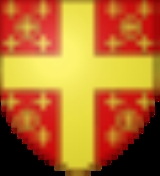
Latin Empire

Encyclopedia
The Latin Empire or Latin Empire of Constantinople (original Latin name: Imperium Romaniae, "Empire of Romania") is the name given by historians to the feudal Crusader state founded by the leaders of the Fourth Crusade
on lands captured from the Byzantine Empire
. It was established after the capture of Constantinople
in 1204 and lasted until 1261. The Latin Empire was intended to supplant the Byzantine Empire as titular successor to the Roman Empire
in the east, with a Western Catholic emperor enthroned in place of the Eastern Orthodox Byzantine emperors. Baldwin IX
, Count of Flanders
, was crowned the first Latin emperor as Baldwin I on 16 May 1204. The Latin Empire failed to attain political or economic dominance over the other Latin powers that had been established in former Byzantine territories in the wake of the Fourth Crusade, especially Venice
, and after a short initial period of military successes it went into a steady decline. Weakened by constant warfare with the Bulgarians and the Greek successor states, it eventually fell to the Empire of Nicaea
under Emperor Michael VIII Palaiologos
in 1261. The last Latin emperor, Baldwin II
, went into exile, but the imperial title survived, with several claimants to it, until the 14th century.
The names Byzantine and Latin were not contemporary terms. They were invented much later by historians seeking to differentiate between the classical Roman Empire
, the medieval Byzantine Empire
, and the late medieval Latin Empire, all of which associated themselves with the Roman legacy. The term Latin has been used because the crusaders (Franks
and other westerners) were Roman Catholic and used Latin as their liturgical and scholarly language. It is used in contrast to the Eastern Orthodox Byzantines who used Greek as their primary language.
, signed on 1 October 1204, three eighths - including Crete
and other islands - went to the Republic of Venice
. The Latin Empire claimed the remainder, and did exert control over areas of Greece
, divided into vassal fiefs: the Kingdom of Thessalonica
, the Principality of Achaea
, the Duchy of Athens
, the Duchy of the Archipelago
and the short-lived duchies of Nicaea, Philippopolis
, and Philadelphia
. The Doge of Venice
did not rank as a vassal to the Empire, but his position in control of 3/8 of its territory and of parts of Constantinople itself, ensured Venice's influence in the Empire's affairs. However, much of the former Byzantine territory remained in the hands of rival successor states led by Byzantine Greek aristocrats, such as the Despotate of Epirus
, the Empire of Nicaea
, and the Empire of Trebizond
, which were bent on reconquest from the Latins.
The crowning of Baldwin and the creation of the Latin Empire had the curious effect of creating three so-called Roman Empires in Europe at the same time, the others being the Holy Roman Empire
and the remnants of the Byzantine Empire
(the direct successor of the ancient Roman Empire), none of which actually controlled the city of Rome
, which was under the temporal authority
of the Pope
.
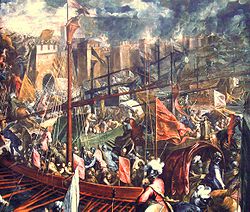 The initial campaigns of the crusaders in Asia Minor resulted in the capture of most of Bithynia
by 1205, with the defeat of the forces of Theodore I Lascaris at Poemanenum and Prusa. Latin successes continued, and in 1207 a truce was signed with Theodore, newly proclaimed Emperor of Nicaea. The Latins inflicted a further defeat on Nicaean forces at the Ryndakos river in October 1211, and three years later the Treaty of Nymphaeum (1214)
recognized their control of most of Bithynia and Mysia
.
The peace was maintained until 1222, at which point the resurgent power of Nicaea felt sufficiently strong enough to challenge the Latin Empire, by that time weakened by constant warfare in its European provinces. At the battle of Poemanenum in 1224, the Latin army was defeated, and by the next year Emperor Robert of Courtenay
was forced to cede all his Asian possessions to Nicaea, save Nicomedia
and the territories directly across Constantinople. Nicaea turned also to the Aegean
, capturing the islands awarded to the empire. In 1235, finally, the last Latin possessions fell to Nicaea.
tsar Kaloyan. When Baldwin campaigned against the Byzantine lords of Thrace
, they called upon Kaloyan for help. At the Battle of Adrianople
on 14 April 1205, the Latin heavy cavalry and knights was crushed by Kaloyan's troops, and Emperor Baldwin was captured. He was imprisoned in the Bulgarian capital Tarnovo
until his death later in 1205. Kaloyan was murdered a couple of years later (1207) during a siege of Thessalonica, and the Bulgarian threat conclusively defeated with a victory the following year, which allowed Baldwin's successor, Henry of Flanders
, to reclaim most of the lost territories in Thrace until 1210, when peace was concluded with the marriage of Henry to Maria of Bulgaria
, tsar Kaloyan's daughter.
At the same time, another Greek successor state, the Despotate of Epirus
, under Michael I Komnenos Doukas
, posed a threat to the empire's vassals in Thessalonica and Athens. Henry demanded his submission, which Michael provided, giving off his daughter to Henry's brother Eustace in the summer of 1209. This alliance allowed Henry to launch a campaign in Macedonia
, Thessaly
and Central Greece
against the rebellious Lombard
lords of Thessalonica. However, Michael's attack on the Kingdom of Thessalonica in 1210 forced him to return north to relieve the city and to force Michael back into submission.
In 1214 however, Michael died, and was succeeded by Theodore Komnenos Doukas
, who was determined to capture Thessalonica. On 11 June 1216, while supervising repairs to the walls of Thessalonica, Henry died, and was succeeded by Peter of Courtenay, who himself was captured and executed by Theodore the following year. A regency was set up in Constantinople, headed by Peter's widow, Yolanda of Flanders
until 1221, when her son Robert of Courtenay
was crowned Emperor. Distracted by the renewed war with Nicaea, and waiting in vain for assistance from Pope Honorius III and the King of France Philip II
, the Latin Empire was unable to prevent the final fall of Thessalonica to Epirus in 1224. Epirote armies then conquered Thrace in 1225-26, appearing before Constantinople itself. The Latin Empire was saved for the time by the threat posed to Theodore by the Bulgarian tsar Ivan II Asen
, and a truce was concluded in 1228.
was set up. After the disastrous Epirote defeat by the Bulgarians at the Battle of Klokotnitsa
, the Epirote threat to the Latin Empire was removed, only to be replaced by Nicaea, which started acquiring territories in Greece. Emperor John III Doukas Vatatzes
of Nicaea concluded an alliance with Bulgaria, which in 1235 resulted in joint campaign against the Latin Empire, and an unsuccessful siege of Constantinople
the same year. In 1237, Baldwin II
attained majority and took over the reins of a much-diminished state. The empire's precarious situation forced him to travel often to Western Europe seeking aid, but largely without success. In order to gain money, he was forced to resort to desperate means, from removing the lead roofs of the Great Palace
and selling them, to handing over his only son, Philip, to Venetian merchants as a guarantee for a loan.
By 1247, the Nicaeans had effectively surrounded Constantinople, with only the city's strong walls
holding them at bay, and the Battle of Pelagonia
in 1258 signaled the beginning of the end of Latin predominance in Greece. Thus, on July 25, 1261, with most of the Latin troops away on campaign, the Nicaean general Alexios Strategopoulos
found an unguarded entrance to the city, and entered it with his troops, restoring the Byzantine Empire for his master, Michael VIII Palaiologos
.
. They exercised effective authority in Greece only when actually ruling as princes of Achaea
, as in 1333–1383. Although they are generally regarded as titular emperors, the continued existence of Latin states in the Aegean that recognized them as their suzerains
makes the term a misnomer; a more accurate description would be emperors-in-exile.
and his six-member council. This council had a major voice in the governance of the realm, especially in the periods of regency, where the Regent (moderator imperii) was dependent on their consent to rule. The podesta, likewise, was an extremely influential member, being practically independent of the emperor. He exercised authority over the Venetian quarters of Constantinople and Pera
and the Venetian dominions within the empire, assisted by a separate set of officials. His role was more that of an ambassador and vicegerent
of Venice than a vassal to the empire.
Greeks, still divided according to the Byzantine system in income classes based on land ownership.
s, but not suppressed. An expansive Catholic hierarchy was established, under the dual supervision of the Latin archbishop
of Constantinople and the Papal legate
, until the two offices were merged in 1231. Catholic monastic orders, such as the Cistercians, the Dominicans
and the Franciscans were established in the empire. The Orthodox clergy retained its rites and customs, including its right to marriage, but was demoted to a subordinate position, subject to the local Latin bishops.
Fourth Crusade
The Fourth Crusade was originally intended to conquer Muslim-controlled Jerusalem by means of an invasion through Egypt. Instead, in April 1204, the Crusaders of Western Europe invaded and conquered the Christian city of Constantinople, capital of the Eastern Roman Empire...
on lands captured from the Byzantine Empire
Byzantine Empire
The Byzantine Empire was the Eastern Roman Empire during the periods of Late Antiquity and the Middle Ages, centred on the capital of Constantinople. Known simply as the Roman Empire or Romania to its inhabitants and neighbours, the Empire was the direct continuation of the Ancient Roman State...
. It was established after the capture of Constantinople
Constantinople
Constantinople was the capital of the Roman, Eastern Roman, Byzantine, Latin, and Ottoman Empires. Throughout most of the Middle Ages, Constantinople was Europe's largest and wealthiest city.-Names:...
in 1204 and lasted until 1261. The Latin Empire was intended to supplant the Byzantine Empire as titular successor to the Roman Empire
Roman Empire
The Roman Empire was the post-Republican period of the ancient Roman civilization, characterised by an autocratic form of government and large territorial holdings in Europe and around the Mediterranean....
in the east, with a Western Catholic emperor enthroned in place of the Eastern Orthodox Byzantine emperors. Baldwin IX
Baldwin I of Constantinople
Baldwin I , the first emperor of the Latin Empire of Constantinople, as Baldwin IX Count of Flanders and as Baldwin VI Count of Hainaut, was one of the most prominent leaders of the Fourth Crusade, which resulted in the capture of Constantinople, the conquest of the greater part of the Byzantine...
, Count of Flanders
Count of Flanders
The Count of Flanders was the ruler or sub-ruler of the county of Flanders from the 9th century until the abolition of the position by the French revolutionaries in 1790....
, was crowned the first Latin emperor as Baldwin I on 16 May 1204. The Latin Empire failed to attain political or economic dominance over the other Latin powers that had been established in former Byzantine territories in the wake of the Fourth Crusade, especially Venice
Venice
Venice is a city in northern Italy which is renowned for the beauty of its setting, its architecture and its artworks. It is the capital of the Veneto region...
, and after a short initial period of military successes it went into a steady decline. Weakened by constant warfare with the Bulgarians and the Greek successor states, it eventually fell to the Empire of Nicaea
Empire of Nicaea
The Empire of Nicaea was the largest of the three Byzantine Greek successor states founded by the aristocracy of the Byzantine Empire that fled after Constantinople was occupied by Western European and Venetian forces during the Fourth Crusade...
under Emperor Michael VIII Palaiologos
Michael VIII Palaiologos
Michael VIII Palaiologos or Palaeologus reigned as Byzantine Emperor 1259–1282. Michael VIII was the founder of the Palaiologan dynasty that would rule the Byzantine Empire until the Fall of Constantinople in 1453...
in 1261. The last Latin emperor, Baldwin II
Baldwin II of Constantinople
Baldwin II of Courtenay was the last emperor of the Latin Empire of Constantinople.He was a younger son of Yolanda of Flanders, sister of the first two emperors, Baldwin I and Henry of Flanders...
, went into exile, but the imperial title survived, with several claimants to it, until the 14th century.
Name
The original name of this state in the Latin language was Imperium Romaniae ("Empire of Romania"). This name was used based on the fact that the common name for the Byzantine nation had been Romania (Greek: Ῥωμανία, "Land of the Romans").The names Byzantine and Latin were not contemporary terms. They were invented much later by historians seeking to differentiate between the classical Roman Empire
Roman Empire
The Roman Empire was the post-Republican period of the ancient Roman civilization, characterised by an autocratic form of government and large territorial holdings in Europe and around the Mediterranean....
, the medieval Byzantine Empire
Byzantine Empire
The Byzantine Empire was the Eastern Roman Empire during the periods of Late Antiquity and the Middle Ages, centred on the capital of Constantinople. Known simply as the Roman Empire or Romania to its inhabitants and neighbours, the Empire was the direct continuation of the Ancient Roman State...
, and the late medieval Latin Empire, all of which associated themselves with the Roman legacy. The term Latin has been used because the crusaders (Franks
Franks
The Franks were a confederation of Germanic tribes first attested in the third century AD as living north and east of the Lower Rhine River. From the third to fifth centuries some Franks raided Roman territory while other Franks joined the Roman troops in Gaul. Only the Salian Franks formed a...
and other westerners) were Roman Catholic and used Latin as their liturgical and scholarly language. It is used in contrast to the Eastern Orthodox Byzantines who used Greek as their primary language.
Creation
By arrangement among the crusaders, Byzantine territory was divided: in the Partitio terrarum imperii RomaniaePartitio terrarum imperii Romaniae
The Partitio terrarum imperii Romaniae was a treaty signed after the sack of the Byzantine capital, Constantinople, by the Fourth Crusade in 1204...
, signed on 1 October 1204, three eighths - including Crete
Crete
Crete is the largest and most populous of the Greek islands, the fifth largest island in the Mediterranean Sea, and one of the thirteen administrative regions of Greece. It forms a significant part of the economy and cultural heritage of Greece while retaining its own local cultural traits...
and other islands - went to the Republic of Venice
Republic of Venice
The Republic of Venice or Venetian Republic was a state originating from the city of Venice in Northeastern Italy. It existed for over a millennium, from the late 7th century until 1797. It was formally known as the Most Serene Republic of Venice and is often referred to as La Serenissima, in...
. The Latin Empire claimed the remainder, and did exert control over areas of Greece
Greece
Greece , officially the Hellenic Republic , and historically Hellas or the Republic of Greece in English, is a country in southeastern Europe....
, divided into vassal fiefs: the Kingdom of Thessalonica
Kingdom of Thessalonica
The Kingdom of Thessalonica was a short-lived Crusader State founded after the Fourth Crusade over the conquered Byzantine lands.- Background :...
, the Principality of Achaea
Principality of Achaea
The Principality of Achaea or of the Morea was one of the three vassal states of the Latin Empire which replaced the Byzantine Empire after the capture of Constantinople during the Fourth Crusade. It became a vassal of the Kingdom of Thessalonica, along with the Duchy of Athens, until Thessalonica...
, the Duchy of Athens
Duchy of Athens
The Duchy of Athens was one of the Crusader States set up in Greece after the conquest of the Byzantine Empire during the Fourth Crusade, encompassing the regions of Attica and Boeotia, and surviving until its conquest by the Ottoman Empire in the 15th century....
, the Duchy of the Archipelago
Duchy of the Archipelago
The Duchy of the Archipelago or also Duchy of Naxos or Duchy of the Aegean was a maritime state created by Venetian interests in the Cyclades archipelago in the Aegean Sea, in the aftermath of the Fourth Crusade, centered on the islands of Naxos and Paros.-Background and establishment of the...
and the short-lived duchies of Nicaea, Philippopolis
Renier of Trit
Renier of Trit was the first Frankish duke of Philippopolis from 1204 to 1205. He was a knight from Trith-Saint Léger, Hainaut, on the Fourth Crusade....
, and Philadelphia
Alasehir
Alaşehir, in Antiquity and the Middle Ages known as Philadelphia , i.e. " brotherly love" is a town and district of Manisa Province in the Aegean region of Turkey. It is situated in the valley of the Kuzuçay , at the foot of the Bozdağ...
. The Doge of Venice
Doge of Venice
The Doge of Venice , often mistranslated Duke was the chief magistrate and leader of the Most Serene Republic of Venice for over a thousand years. Doges of Venice were elected for life by the city-state's aristocracy. Commonly the person selected as Doge was the shrewdest elder in the city...
did not rank as a vassal to the Empire, but his position in control of 3/8 of its territory and of parts of Constantinople itself, ensured Venice's influence in the Empire's affairs. However, much of the former Byzantine territory remained in the hands of rival successor states led by Byzantine Greek aristocrats, such as the Despotate of Epirus
Despotate of Epirus
The Despotate or Principality of Epirus was one of the Byzantine Greek successor states of the Byzantine Empire that emerged in the aftermath of the Fourth Crusade in 1204. It claimed to be the legitimate successor of the Byzantine Empire, along with the Empire of Nicaea, and the Empire of Trebizond...
, the Empire of Nicaea
Empire of Nicaea
The Empire of Nicaea was the largest of the three Byzantine Greek successor states founded by the aristocracy of the Byzantine Empire that fled after Constantinople was occupied by Western European and Venetian forces during the Fourth Crusade...
, and the Empire of Trebizond
Empire of Trebizond
The Empire of Trebizond, founded in April 1204, was one of three Byzantine successor states of the Byzantine Empire. However, the creation of the Empire of Trebizond was not directly related to the capture of Constantinople by the Fourth Crusade, rather it had broken away from the Byzantine Empire...
, which were bent on reconquest from the Latins.
The crowning of Baldwin and the creation of the Latin Empire had the curious effect of creating three so-called Roman Empires in Europe at the same time, the others being the Holy Roman Empire
Holy Roman Empire
The Holy Roman Empire was a realm that existed from 962 to 1806 in Central Europe.It was ruled by the Holy Roman Emperor. Its character changed during the Middle Ages and the Early Modern period, when the power of the emperor gradually weakened in favour of the princes...
and the remnants of the Byzantine Empire
Byzantine Empire
The Byzantine Empire was the Eastern Roman Empire during the periods of Late Antiquity and the Middle Ages, centred on the capital of Constantinople. Known simply as the Roman Empire or Romania to its inhabitants and neighbours, the Empire was the direct continuation of the Ancient Roman State...
(the direct successor of the ancient Roman Empire), none of which actually controlled the city of Rome
Rome
Rome is the capital of Italy and the country's largest and most populated city and comune, with over 2.7 million residents in . The city is located in the central-western portion of the Italian Peninsula, on the Tiber River within the Lazio region of Italy.Rome's history spans two and a half...
, which was under the temporal authority
Papal States
The Papal State, State of the Church, or Pontifical States were among the major historical states of Italy from roughly the 6th century until the Italian peninsula was unified in 1861 by the Kingdom of Piedmont-Sardinia .The Papal States comprised territories under...
of the Pope
Pope
The Pope is the Bishop of Rome, a position that makes him the leader of the worldwide Catholic Church . In the Catholic Church, the Pope is regarded as the successor of Saint Peter, the Apostle...
.
In Asia Minor
Bithynia
Bithynia was an ancient region, kingdom and Roman province in the northwest of Asia Minor, adjoining the Propontis, the Thracian Bosporus and the Euxine .-Description:...
by 1205, with the defeat of the forces of Theodore I Lascaris at Poemanenum and Prusa. Latin successes continued, and in 1207 a truce was signed with Theodore, newly proclaimed Emperor of Nicaea. The Latins inflicted a further defeat on Nicaean forces at the Ryndakos river in October 1211, and three years later the Treaty of Nymphaeum (1214)
Treaty of Nymphaeum (1214)
The Treaty of Nymphaeum was a peace treaty signed in December of 1214 between the Nicaean Empire, successor state of the Byzantine Empire, and the Latin Empire, which was established in the aftermath of the Fourth Crusade of 1204.-Background:...
recognized their control of most of Bithynia and Mysia
Mysia
Mysia was a region in the northwest of ancient Asia Minor or Anatolia . It was located on the south coast of the Sea of Marmara. It was bounded by Bithynia on the east, Phrygia on the southeast, Lydia on the south, Aeolis on the southwest, Troad on the west and by the Propontis on the north...
.
The peace was maintained until 1222, at which point the resurgent power of Nicaea felt sufficiently strong enough to challenge the Latin Empire, by that time weakened by constant warfare in its European provinces. At the battle of Poemanenum in 1224, the Latin army was defeated, and by the next year Emperor Robert of Courtenay
Robert of Courtenay
Robert of Courtenay , emperor of the Latin Empire, or of Constantinople, was a younger son of the emperor Peter II of Courtenay, and a descendant of the French king, Louis VI, while his mother Yolanda of Flanders was a sister of Baldwin and Henry of Flanders, the first and second emperors of the...
was forced to cede all his Asian possessions to Nicaea, save Nicomedia
Nicomedia
Nicomedia was an ancient city in what is now Turkey, founded in 712/11 BC as a Megarian colony and was originally known as Astacus . After being destroyed by Lysimachus, it was rebuilt by Nicomedes I of Bithynia in 264 BC under the name of Nicomedia, and has ever since been one of the most...
and the territories directly across Constantinople. Nicaea turned also to the Aegean
Aegean Sea
The Aegean Sea[p] is an elongated embayment of the Mediterranean Sea located between the southern Balkan and Anatolian peninsulas, i.e., between the mainlands of Greece and Turkey. In the north, it is connected to the Marmara Sea and Black Sea by the Dardanelles and Bosporus...
, capturing the islands awarded to the empire. In 1235, finally, the last Latin possessions fell to Nicaea.
In Europe
Unlike in Asia, where the Latin Empire faced only an initially weak Nicaea, in Europe it was immediately confronted with a powerful enemy: the BulgarianSecond Bulgarian Empire
The Second Bulgarian Empire was a medieval Bulgarian state which existed between 1185 and 1396 . A successor of the First Bulgarian Empire, it reached the peak of its power under Kaloyan and Ivan Asen II before gradually being conquered by the Ottomans in the late 14th-early 15th century...
tsar Kaloyan. When Baldwin campaigned against the Byzantine lords of Thrace
Thrace
Thrace is a historical and geographic area in southeast Europe. As a geographical concept, Thrace designates a region bounded by the Balkan Mountains on the north, Rhodope Mountains and the Aegean Sea on the south, and by the Black Sea and the Sea of Marmara on the east...
, they called upon Kaloyan for help. At the Battle of Adrianople
Battle of Adrianople (1205)
The Battle of Adrianople occurred on April 14, 1205 between Bulgarians under Tsar Kaloyan of Bulgaria, and Crusaders under Baldwin I. It was won by the Bulgarians after a skillful ambush using the help of their Cuman and Greek allies. Around 300 knights were killed, including Louis of Blois, Duke...
on 14 April 1205, the Latin heavy cavalry and knights was crushed by Kaloyan's troops, and Emperor Baldwin was captured. He was imprisoned in the Bulgarian capital Tarnovo
Veliko Tarnovo
Veliko Tarnovo is a city in north central Bulgaria and the administrative centre of Veliko Tarnovo Province. Often referred to as the "City of the Tsars", Veliko Tarnovo is located on the Yantra River and is famous as the historical capital of the Second Bulgarian Empire, attracting many tourists...
until his death later in 1205. Kaloyan was murdered a couple of years later (1207) during a siege of Thessalonica, and the Bulgarian threat conclusively defeated with a victory the following year, which allowed Baldwin's successor, Henry of Flanders
Henry of Flanders
Henry was the second emperor of the Latin Empire of Constantinople. He was a younger son of Baldwin V, Count of Hainaut , and Margaret I of Flanders, sister of Philip of Alsace, count of Flanders....
, to reclaim most of the lost territories in Thrace until 1210, when peace was concluded with the marriage of Henry to Maria of Bulgaria
Maria of Bulgaria, Latin Empress
Maria of Bulgaria was the second Empress consort of Henry of Flanders, Latin Emperor of Constantinople.-Family:She was a daughter of Kaloyan of Bulgaria. Her mother may have been his wife Anna of Cumania. She went on to marry Boril of Bulgaria, a nephew of her first husband. Her paternal uncles...
, tsar Kaloyan's daughter.
At the same time, another Greek successor state, the Despotate of Epirus
Despotate of Epirus
The Despotate or Principality of Epirus was one of the Byzantine Greek successor states of the Byzantine Empire that emerged in the aftermath of the Fourth Crusade in 1204. It claimed to be the legitimate successor of the Byzantine Empire, along with the Empire of Nicaea, and the Empire of Trebizond...
, under Michael I Komnenos Doukas
Michael I Komnenos Doukas
Michael I Komnenos Doukas or Comnenus Ducas , often inaccurately called Michael Angelos , was the founder and first ruler of the principality of Epirus from 1205 until his death in 1215.-Life:...
, posed a threat to the empire's vassals in Thessalonica and Athens. Henry demanded his submission, which Michael provided, giving off his daughter to Henry's brother Eustace in the summer of 1209. This alliance allowed Henry to launch a campaign in Macedonia
Macedonia (region)
Macedonia is a geographical and historical region of the Balkan peninsula in southeastern Europe. Its boundaries have changed considerably over time, but nowadays the region is considered to include parts of five Balkan countries: Greece, the Republic of Macedonia, Bulgaria, Albania, Serbia, as...
, Thessaly
Thessaly
Thessaly is a traditional geographical region and an administrative region of Greece, comprising most of the ancient region of the same name. Before the Greek Dark Ages, Thessaly was known as Aeolia, and appears thus in Homer's Odyssey....
and Central Greece
Central Greece
Continental Greece or Central Greece , colloquially known as Roúmeli , is a geographical region of Greece. Its territory is divided into the administrative regions of Central Greece, Attica, and part of West Greece...
against the rebellious Lombard
Lombardy
Lombardy is one of the 20 regions of Italy. The capital is Milan. One-sixth of Italy's population lives in Lombardy and about one fifth of Italy's GDP is produced in this region, making it the most populous and richest region in the country and one of the richest in the whole of Europe...
lords of Thessalonica. However, Michael's attack on the Kingdom of Thessalonica in 1210 forced him to return north to relieve the city and to force Michael back into submission.
In 1214 however, Michael died, and was succeeded by Theodore Komnenos Doukas
Theodore Komnenos Doukas
Theodore Komnenos Doukas was ruler of Epirus from 1215 to 1230 and of Thessalonica from 1224 to 1230.-Life:...
, who was determined to capture Thessalonica. On 11 June 1216, while supervising repairs to the walls of Thessalonica, Henry died, and was succeeded by Peter of Courtenay, who himself was captured and executed by Theodore the following year. A regency was set up in Constantinople, headed by Peter's widow, Yolanda of Flanders
Yolanda of Flanders
Yolanda of Flanders ruled the Latin Empire in Constantinople for her husband Peter II of Courtenay from 1217 to 1219.She was the daughter of Baldwin V, Count of Hainault, and Countess Margaret I of Flanders. Two of her brothers, Baldwin I and then Henry, were emperors in Constantinople...
until 1221, when her son Robert of Courtenay
Robert of Courtenay
Robert of Courtenay , emperor of the Latin Empire, or of Constantinople, was a younger son of the emperor Peter II of Courtenay, and a descendant of the French king, Louis VI, while his mother Yolanda of Flanders was a sister of Baldwin and Henry of Flanders, the first and second emperors of the...
was crowned Emperor. Distracted by the renewed war with Nicaea, and waiting in vain for assistance from Pope Honorius III and the King of France Philip II
Philip II of France
Philip II Augustus was the King of France from 1180 until his death. A member of the House of Capet, Philip Augustus was born at Gonesse in the Val-d'Oise, the son of Louis VII and his third wife, Adela of Champagne...
, the Latin Empire was unable to prevent the final fall of Thessalonica to Epirus in 1224. Epirote armies then conquered Thrace in 1225-26, appearing before Constantinople itself. The Latin Empire was saved for the time by the threat posed to Theodore by the Bulgarian tsar Ivan II Asen
Ivan Asen II of Bulgaria
-Early rule:He was a son of Ivan Asen I of Bulgaria and Elena . Elena, who survived until after 1235, is sometimes alleged to be a daughter of Stefan Nemanja of Serbia, but this relationship is questionable and would have caused various canonical impediments to marriages between various descendants...
, and a truce was concluded in 1228.
Decline and fall
After Robert of Courtenay died in 1228, a new regency under John of BrienneJohn of Brienne
John of Brienne was a French nobleman who became King of Jerusalem by marriage, and ruled the Latin Empire of Constantinople as regent.-Life:...
was set up. After the disastrous Epirote defeat by the Bulgarians at the Battle of Klokotnitsa
Battle of Klokotnitsa
The Battle of Klokotnitsa occurred on 9 March 1230 near the village of Klokotnitsa . As a result, the Second Bulgarian Empire emerged once again as the most powerful state in Eastern Europe and the power of the Despotate of Epirus faded...
, the Epirote threat to the Latin Empire was removed, only to be replaced by Nicaea, which started acquiring territories in Greece. Emperor John III Doukas Vatatzes
John III Doukas Vatatzes
John III Doukas Vatatzes, Latinized as Ducas Vatatzes |Nymphaion]]) was emperor of Nicaea 1221–1254.-Life:John Doukas Vatatzes was probably the son of the general Basileios Vatatzes, Duke of Thrace, who died in 1193, and his wife, an unnamed daughter of Isaakios Angelos and cousin of the Emperors...
of Nicaea concluded an alliance with Bulgaria, which in 1235 resulted in joint campaign against the Latin Empire, and an unsuccessful siege of Constantinople
Siege of Constantinople (1235)
The Siege of Constantinople was a joint Bulgarian-Nicaean siege on the capital of the Latin Empire. Latin emperor John of Brienne was besieged by the Nicaean emperor John III Doukas Vatatzes and Tsar Ivan Asen II of Bulgaria. The siege remained unsuccessful.-Prelude:After Robert of Courtenay died...
the same year. In 1237, Baldwin II
Baldwin II of Constantinople
Baldwin II of Courtenay was the last emperor of the Latin Empire of Constantinople.He was a younger son of Yolanda of Flanders, sister of the first two emperors, Baldwin I and Henry of Flanders...
attained majority and took over the reins of a much-diminished state. The empire's precarious situation forced him to travel often to Western Europe seeking aid, but largely without success. In order to gain money, he was forced to resort to desperate means, from removing the lead roofs of the Great Palace
Great Palace of Constantinople
The Great Palace of Constantinople — also known as the Sacred Palace — was the large Imperial Byzantine palace complex located in the south-eastern end of the peninsula now known as "Old Istanbul", modern Turkey...
and selling them, to handing over his only son, Philip, to Venetian merchants as a guarantee for a loan.
By 1247, the Nicaeans had effectively surrounded Constantinople, with only the city's strong walls
Walls of Constantinople
The Walls of Constantinople are a series of defensive stone walls that have surrounded and protected the city of Constantinople since its founding as the capital of the Eastern Roman Empire by Constantine the Great...
holding them at bay, and the Battle of Pelagonia
Battle of Pelagonia
The Battle of Pelagonia took place in September of 1259, between the Empire of Nicaea and the Despotate of Epirus, Sicily and the Principality of Achaea...
in 1258 signaled the beginning of the end of Latin predominance in Greece. Thus, on July 25, 1261, with most of the Latin troops away on campaign, the Nicaean general Alexios Strategopoulos
Alexios Strategopoulos
Alexios Strategopoulos was a Byzantine general during the reign of Michael VIII Palaiologos, rising to the rank of megas domestikos and Caesar. He is most notable for leading the reconquest of Constantinople from the Latins in 1261.- Early life :...
found an unguarded entrance to the city, and entered it with his troops, restoring the Byzantine Empire for his master, Michael VIII Palaiologos
Michael VIII Palaiologos
Michael VIII Palaiologos or Palaeologus reigned as Byzantine Emperor 1259–1282. Michael VIII was the founder of the Palaiologan dynasty that would rule the Byzantine Empire until the Fall of Constantinople in 1453...
.
Titular claimants
For about a century thereafter, the heirs of Baldwin II continued to use the title of Emperor of Constantinople, and were seen as the overlords of the various remaining Latin states in the AegeanAegean Sea
The Aegean Sea[p] is an elongated embayment of the Mediterranean Sea located between the southern Balkan and Anatolian peninsulas, i.e., between the mainlands of Greece and Turkey. In the north, it is connected to the Marmara Sea and Black Sea by the Dardanelles and Bosporus...
. They exercised effective authority in Greece only when actually ruling as princes of Achaea
Principality of Achaea
The Principality of Achaea or of the Morea was one of the three vassal states of the Latin Empire which replaced the Byzantine Empire after the capture of Constantinople during the Fourth Crusade. It became a vassal of the Kingdom of Thessalonica, along with the Duchy of Athens, until Thessalonica...
, as in 1333–1383. Although they are generally regarded as titular emperors, the continued existence of Latin states in the Aegean that recognized them as their suzerains
Suzerainty
Suzerainty occurs where a region or people is a tributary to a more powerful entity which controls its foreign affairs while allowing the tributary vassal state some limited domestic autonomy. The dominant entity in the suzerainty relationship, or the more powerful entity itself, is called a...
makes the term a misnomer; a more accurate description would be emperors-in-exile.
Administration
The empire was formed and administrated on Western European feudal principles, incorporating some elements of the Byzantine bureaucracy. The emperor was assisted by a council, composed of the various barons, the Venetian podestàPodestà
Podestà is the name given to certain high officials in many Italian cities, since the later Middle Ages, mainly as Chief magistrate of a city state , but also as a local administrator, the representative of the Emperor.The term derives from the Latin word potestas, meaning power...
and his six-member council. This council had a major voice in the governance of the realm, especially in the periods of regency, where the Regent (moderator imperii) was dependent on their consent to rule. The podesta, likewise, was an extremely influential member, being practically independent of the emperor. He exercised authority over the Venetian quarters of Constantinople and Pera
Beyoglu
Beyoğlu is a district located on the European side of İstanbul, Turkey, separated from the old city by the Golden Horn...
and the Venetian dominions within the empire, assisted by a separate set of officials. His role was more that of an ambassador and vicegerent
Vicegerent
Vicegerent is the official administrative deputy of a ruler or head of state: vice + gerere .-Related usage:*The Byzantine Emperors held as a title "God's Vicegerent on Earth"....
of Venice than a vassal to the empire.
Society
The elite of the empire were the Frankish and Venetian lords, headed by the emperor, the barons and the lower-ranking vassals and liege lords, including many former Byzantine aristocrats. The bulk of the people were OrthodoxEastern Orthodox Church
The Orthodox Church, officially called the Orthodox Catholic Church and commonly referred to as the Eastern Orthodox Church, is the second largest Christian denomination in the world, with an estimated 300 million adherents mainly in the countries of Belarus, Bulgaria, Cyprus, Georgia, Greece,...
Greeks, still divided according to the Byzantine system in income classes based on land ownership.
Church
As with all Latin states, the Orthodox hierarchy was replaced by Catholic prelatePrelate
A prelate is a high-ranking member of the clergy who is an ordinary or who ranks in precedence with ordinaries. The word derives from the Latin prælatus, the past participle of præferre, which means "carry before", "be set above or over" or "prefer"; hence, a prelate is one set over others.-Related...
s, but not suppressed. An expansive Catholic hierarchy was established, under the dual supervision of the Latin archbishop
Archbishop
An archbishop is a bishop of higher rank, but not of higher sacramental order above that of the three orders of deacon, priest , and bishop...
of Constantinople and the Papal legate
Papal legate
A papal legate – from the Latin, authentic Roman title Legatus – is a personal representative of the pope to foreign nations, or to some part of the Catholic Church. He is empowered on matters of Catholic Faith and for the settlement of ecclesiastical matters....
, until the two offices were merged in 1231. Catholic monastic orders, such as the Cistercians, the Dominicans
Dominican Order
The Order of Preachers , after the 15th century more commonly known as the Dominican Order or Dominicans, is a Catholic religious order founded by Saint Dominic and approved by Pope Honorius III on 22 December 1216 in France...
and the Franciscans were established in the empire. The Orthodox clergy retained its rites and customs, including its right to marriage, but was demoted to a subordinate position, subject to the local Latin bishops.