

Great Lent

Encyclopedia
Great Lent, or the Great Fast, is the most important fasting
season in the church year in Eastern Christianity
, which prepares Christians for the greatest feast of the church year, Pascha
(Easter). In many ways Great Lent is similar to Lent
in Western Christianity
. There are some differences in the timing of Lent (besides calculating the date of Easter) and how it is practiced, both liturgically in the public worship of the church and individually.
). Most years, the Eastern Pascha falls after the Western Easter, and it may be as much as five weeks later; occasionally, the two dates coincide. Like Western Lent
, Great Lent itself lasts for forty days, but unlike the West, Sundays are included in the count. Great Lent officially begins on Clean Monday
, seven weeks before Pascha (Ash Wednesday
is not observed in Eastern Christianity) and runs for 40 contiguous days, concluding with the Presanctified Liturgy on Friday of the Sixth Week. The next day is called Lazarus Saturday
, the day before Palm Sunday
. However, fasting continues throughout the following week, known as Passion Week or Holy Week
, and does not end until after the Paschal Vigil early in the morning of Pascha (Easter Sunday).
 The purpose of Great Lent is to prepare the faithful to not only commemorate, but to enter into the Passion
and Resurrection of Jesus
. The totality of the Orthodox life centers around the Resurrection. Great Lent is intended to be a "workshop". Through spending more time than usual in prayer and meditation on the Holy Scripture and the Holy Traditions of the Church, the believer in Christ becomes through the grace of God more godlike.
from certain foods, intensified private and public prayer, self-examination, confession
, personal improvement, repentance
and restitution
for sins committed, and almsgiving. The foods traditionally abstained from are meat and dairy products, wine and oil. (According to some traditions, only olive oil is abstained from; in others, all vegetable oils.) Since strict fasting is canonically forbidden on the Sabbath and the Lord's Day
, wine and oil are permitted on Saturdays and Sundays. If the Great Feast of the Annunciation
falls during Great Lent, then fish, wine and oil are permitted on that day.
Besides the additional liturgical celebrations described below, Orthodox Christians are expected to pay closer attention to and increase their private prayer. According to Orthodox theology
, when asceticism is increased, prayer must be increased also. The Church Fathers
have referred to fasting without prayer as "the fast of the demons" since the demons do not eat according to their incorporeal nature, but neither do they pray.
During the Great Fast, a special service book is used, known as the Lenten Triodion
, which contains the Lenten texts for the Daily Office (Canonical Hours) and Liturgies. The Triodion begins during the Pre-Lenten period to supplement or replace portions of the regular services. This replacement begins gradually, initially affecting only the Epistle
and Gospel
readings, and gradually increases until Holy Week when it entirely replaces all other liturgical material (during the Triduum even the Psalter
is eliminated, and all texts are taken exclusively from the Triodion). The Triodion is used until the lights are extinguished before midnight at the Paschal Vigil, at which time it is replaced by the Pentecostarion
, which begins by replacing the normal services entirely (during Bright Week
) and gradually diminishes until the normal services resume following the Afterfeast
of Pentecost
.
 On weekdays of Great Lent, the Divine Liturgy
is not celebrated, because the joy of the Eucharist
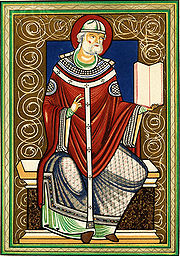
(literally "Thanksgiving") is contrary to the attitude of repentance which predominates on these days. However, since it is considered especially important to receive the Holy Mysteries (Holy Communion) during this season, the Liturgy of the Presanctified Gifts
—also called the Liturgy of St. Gregory the Dialogist
— may be celebrated on weekdays. Technically, this is not actually a Divine Liturgy, but rather a Vespers
service at which a portion of the Body
and Blood of Christ
, which was reserved
the previous Sunday, are distributed to the faithful. Most parishes
and monasteries celebrate this Liturgy only on Wednesdays, Fridays and feast days, but it may be celebrated on any weekday of Great Lent. Because the Divine Liturgy is not celebrated on weekdays, it is replaced with the Typica, even on days when the Presanctified Liturgy is celebrated. On Saturday and Sunday the Divine Liturgy may be celebrated as usual. On Saturdays, the usual St. John Chrysostom is celebrated; on Sundays the more solemn and penitential Divine Liturgy of St. Basil the Great is used.
The services of the Canonical Hours
are much longer during Great Lent. In addition to doubling the number of Psalms
read, the structure of the services is different on weekdays. In the evening, instead of the normal Compline
(the final service before retiring at night), the much longer service of Great Compline is chanted. In the Greek practice, ordinary Compline is chanted on Friday night together with the Akathist
to the Theotokos
(Mother of God). The Akathist is divided into four sections and one section is chanted on each of the first four Friday nights of Great Lent. Then the Akathist is chanted in its entirety at Matins in the Fifth Saturday. In the Slavic usage, Great Compline is chanted on Friday night—though some parts are read rather than sung as they are on other weeknights, and some Lenten material is replaced by non-Lenten hymns—and the Akathist is not chanted until Matins of the fifth Saturday.
An interesting difference between the Eastern and Western observances is that while in the West the chanting of Alleluia
ceases during Lent
, in the East its use is increased. This is because for the Orthodox, fasting should be joyous (cf. ), and the sense of unworthiness must always be tempered with hope in God's forgiveness. In fact, days which follow the Lenten pattern of services are referred to as "days with Alleluia". This theme of "Lenten joy" is also found in many of the hymns of the Triodion, such as the stichera
which begin with the words: "The Lenten Spring has dawned!..." (Vespers
Aposticha
, Wednesday of Cheesefare Week) and "Now is the season of repentance; let us begin it joyfully, O brethren..." (Matins
, Second Canon
, Ode 8, Monday of Cheesefare Week).
The making of prostration
s during the services increases as well. The one prayer
that typifies the Lenten services is the Prayer of Saint Ephrem
, which is said at each service on weekdays, accompanied by full prostrations. One translation of it reads:
The public reading of Scripture is increased during Great Lent. The Psalter
(Book of Psalms) is normally read through once a week during the course of the Daily Office; however, during Great Lent, the number of Psalms is increased so that the entire Psalter is read through twice during each of the Six Weeks (during Holy Week it is read through once). Readings from the Old Testament
are also increased, with the Books of Genesis, Proverbs
and Isaiah
being read through almost in their entirety at the Sixth Hour and Vespers
(during Cheesefare Week, the readings at these services are taken from Joel
and Zechariah
, while during Holy Week they are from Exodus, Ezekiel
and Job
). Uniquely, on weekdays of Great Lent there is no public reading of the Epistle
s or Gospel
s. This is because the readings are particular to the Divine Liturgy, which is not celebrated on weekdays of Great Lent. There are, however, Epistles and Gospels appointed for each Saturday and Sunday.
 During the Great Fast, the church also increases its prayer for the dead
, not only reminding the believer of his own mortality, and thus increasing the spirit of penitence, but also to remind him of his Christian obligation of charity in praying for the departed. A number of Saturdays during Great Lent are Saturdays of the Dead, with many of the hymns of the Daily Office and at the Divine Liturgy dedicated to remembrance of the departed. These Saturdays are:
In addition, the Litya, a brief prayer service for the departed, may be served on each weekday of Great Lent, provided there is no feast day or special observance on that day.
 Since the season of Great Lent is moveable, beginning on different dates from year to year, accommodation must be made for various feast days on the fixed calendar
(Menaion
) which occur during the season. When these feasts fall a weekday of Great Lent, the normal Lenten aspect of the services is lessened to celebrate the solemnity.
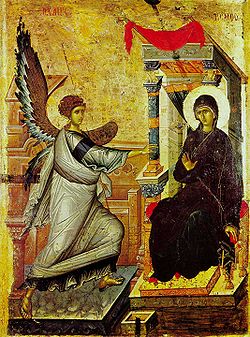
The most important of these fixed feasts is the Great Feast of the Annunciation
(March 25), which is considered to be so important that it is never moved, even if it should fall on the Sunday of Pascha itself (a rare and special occurrence which is known as Kyrio-Pascha). The fast is also lessened, and the faithful are allowed to eat fish (unless it is Good Friday or Holy Saturday). Whereas on other weekdays of Great Lent, no celebration of the Divine Liturgy is permitted, there is a Liturgy (usually the Liturgy of St. John Chrysostom
) celebrated on Annunciation—even if it falls on Good Friday
.
When the feast day of the patron saint
of the parish church
or monastery
falls on a weekday of Great Lent, there is no Liturgy (other than the Presanctified), but fish is allowed at the meal. In some churches the feast of a patron saint is moved to the nearest Saturday (excluding the Saturday of the Akathist), and in other churches, it is celebrated on the day of the feast itself.
When some other important feast occurs on a weekday, such as the First and Second Finding of the Head of John the Baptist (February 24), the Forty Martyrs of Sebaste
(March 9), etc., it is usually combined with the Lenten service, and wine and oil are allowed at the meal.
Regardless of the rank of the feast being celebrated, the Lenten hymns contained in the Triodion are never omitted, but are always chanted in their entirety, even on the feast of the Annunciation.
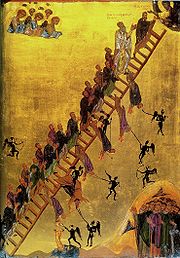 On the Saturdays, Sundays, and a number of weekdays during Great Lent, the service materials from the Triodion leave no room for the commemoration of the Saint of the day from the Menaion
. In order that their services not be completely forgotten, a portion of them (their canon at Matins, and their stichera from "Lord I Have Cried" at Vespers) is chanted at Compline
.
are recommended during the Fast.
One book commonly read during Great Lent, particularly by monastics
, is The Ladder of Divine Ascent
, which was written in about the seventh century by St. John of the Ladder when he was the Hegumen
(Abbot) of St. Catherine's Monastery
on Mount Sinai
. The theme of The Ladder is not Great Lent itself, but rather it deals with the ascent of the soul from earth to heaven; that is, from enslavement to the passions to the building up of the virtue
s and its eventual theosis
(union with God), which is the goal of Great Lent. The Ladder is usually read in the trapeza (refectory) during meals, but it may alternatively be read during the Little Hours
on weekdays so that everyone can hear. Many of the laity
also read The Ladder privately during Great Lent.
Besides the Ladder, in some monasteries the Paradise of the Holy Fathers by Palladius
and the penitential sermons of St. Ephrem the Syrian
are read during Matins
.
In the Slavic tradition, with the addition of Zacchaeus Sunday, some regard the pre-Lenten period as lasting four weeks, but there are no liturgical indications that the week following the fifth Sunday before Lent (whether preceded by Zacchaeus Sunday or otherwise) is in any way Lenten, because Zacchaeus Sunday falls outside the Triodion
, the liturgical book
which governs the pre-Lenten period and Lent itself.
 In the Slavic liturgical traditions, Zacchaeus Sunday occurs on the fifth Sunday before the beginning of Great Lent (which starts on a Monday). Though there are no materials provided in the Lenten Triodion for this day, it is the very first day that is affected by the date of the upcoming Pascha (all the preceding days having been affected by the previous Pascha). This day has one sole Pre-Lenten feature: the Gospel
reading is always the account of Zacchaeus
from , for which reason this Sunday is referred to as "Zacchaeus Sunday" (though the week before is not called "Zacchaeus week"). This reading actually falls at the end of the lectionary
cycle, being assigned to the 32nd Week after Pentecost. However, depending upon the date of the upcoming Pascha, the readings of the preceding weeks are either skipped (if Pascha will be early) or repeated (if it will be late) so that the readings for the 32nd Sunday after Pentecost always occur on the Sunday preceding the Week of the Publican and the Pharisee.
In the Byzantine ("Greek") liturgical traditions, the Gospel reading for Zacchaeus remains in the normal lectionary cycle and does not always fall on the fifth Sunday before Lent.
The Lenten significance of the Gospel account of Zacchaeus is that it introduces the themes of pious zeal (Zacchaeus' climbing up the sycamore tree; Jesus' words: "Zacchaeus, make haste"), restraint (Jesus' words: "come down"), making a place for Jesus in the heart ("I must abide at thy house"), overcoming gossip ("And when they saw it, they all murmured, saying, That he was gone to be guest with a man that is a sinner"), repentance and almsgiving ("And Zacchaeus stood, and said unto the Lord: Behold, Lord, the half of my goods I give to the poor; and if I have taken any thing from any man by false accusation, I restore him fourfold"), forgiveness and reconciliation ("And Jesus said unto him, This day is salvation come to this house, forsomuch as he also is a son of Abraham"), and the reason for the Passion and Resurrection ("For the Son of man is come to seek and to save that which was lost").
The Epistle
reading for Zacchaeus Sunday is , which in and of itself has no Lenten theme, other than as an admonition to righteous behaviour.
of the Publican and the Pharisee . The Sunday of the Publican and the Pharisee is the first day the Lenten Triodion is used (at Vespers
or All-Night Vigil
on Saturday night), though it is only used for the Sunday services, with nothing pertaining to weekdays or Saturday. The theme of the hymns and readings on this Sunday is dedicated to the lessons to be learned from the parable: that righteous actions alone do not lead to salvation, that pride renders good deeds fruitless, that God can only be approached through a spirit of humility and repentance, and that God justifies
the humble rather than the self-righteous. The week which follows the Sunday of the Publican and the Pharisee is a fast-free week, to remind the faithful not to be prideful in their fasting as the Pharisee was .
The Sunday of the Publican and the Pharisee is also the first day that structural changes (as opposed to simply substituting Lenten hymns for normal hymns from the octoechos
or menaion
) are made to the Sunday services.
for the weekdays. The Gospel Reading on Sunday lays out one of the most important themes of the Lenten season: the process of falling into of sin, realization of one's sinfulness, the road to repentance, and finally reconciliation, each of which is illustrated in the course of the parable.
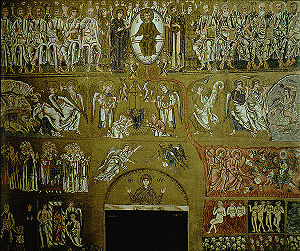
for the Sunday of this week is The Sunday of the Last Judgment
, indicating the theme of the Gospel of the day . The popular name of "Meatfare Sunday" comes from the fast that this is the last day on which the laity are permitted to eat meat until Pascha (Orthodox monks and nuns never eat meat).
Cheesefare Week is concluded on Cheesefare Sunday. The proper name for this Sunday is The Sunday of Forgiveness, both because of the Gospel theme for the day and because it is the day on which everyone asks forgiveness of their neighbor. The popular name of "Cheesefare Sunday" derives from the fact that it is the last day to eat dairy products before Pascha. On this Sunday, Eastern Christians identify with Adam and Eve
, and forgive each other in order to obtain forgiveness from God, typically in a Forgiveness Vespers service that Sunday evening. During Forgiveness Vespers (on Sunday evening) the hangings
and vestments in the church are changed to somber Lenten colours to reflect a penitential mood. At the end of the service comes the "Ceremony of Mutual Forgiveness" during which all of the people one by one ask forgiveness of one another, that the Great Fast may begin in a spirit of peace. During the ceremony the choir chants the Irmoi
from the Canon
of Pascha
.
 The first week of Great Lent starting on Clean Monday
, the first day of Great Lent. The name "Clean Week" refers to the spiritual cleansing each of the faithful is encouraged to undergo through fasting, prayer, repentance, reception of the Holy Mysteries and begging forgiveness of his neighbor. It is also traditionally a time for spring cleaning
so that one's outward surroundings matches his inward disposition.
Throughout this week fasting is most strict. Those who have the strength are encouraged to fast completely, eating only on Wednesday and Friday evenings, after the Presanctified Liturgy. Those who are unable to keep such a strict fast are encouraged to eat only a little, and then only xerophagy
(uncooked food) once a day. Meals are served on Saturday and Sunday, but these are fasting meals at which meat and dairy products are forbidden.
At Great Compline during the first four days of the Fast (Monday through Thursday) the Great Canon of St. Andrew of Crete
is divided into four parts and one part is chanted each night (for further information about the Great Canon, see Fifth Week, below).
The First Saturday is called "St. Theodore Saturday" in honor of St. Theodore the Recruit, a fourth century martyr
. At the end of the Presanctified Liturgy on Friday (since, liturgically, the day begins at sunset) a special canon to St. Theodore, composed by St. John of Damascus
, is chanted. Then the priest blesses kolyva (boiled wheat with honey and raisins) which is distributed to the faithful in commemoration of the following miracle worked by St. Theodore on the First Saturday of Great Lent: Fifty years after the death of St Theodore, the emperor Julian the Apostate
(361-363), as a part of his general policy of persecution of Christians
, commanded the governor of Constantinople
during the first week of Great Lent to sprinkle all the food provisions in the marketplaces with the blood offered to pagan idols, knowing that the people would be hungry after the strict fasting of the first week. St Theodore appeared in a dream to Archbishop Eudoxius
, ordering him to inform all the Christians that no one should buy anything at the marketplaces, but rather to eat cooked wheat with honey (kolyva).
The First Sunday of Great Lent is the Feast of Orthodoxy
, which commemorates the restoration of the veneration
of icon
s after the Iconoclast
controversy, which is considered to be the triumph of the Church over the last of the great heresies
which troubled her (all later heresies being simply a rehashing of earlier ones). Before the Divine Liturgy
on this day, a special service, known as the "Triumph of Orthodoxy" is held in cathedral
s and major monasteries, at which the synodicon (containing anathema
s against various heresies, and encomia of those who have held fast to the Christian faith) is proclaimed. The theme of the day is the victory of the True Faith over heresy. "This is the victory that overcomes the world, our faith" . Also, the icons of the saints bear witness that man, "created in the image and likeness of God" , may become holy and godlike
through the purification of himself as God's living image.
The First Sunday of Great Lent originally commemorated the Prophet
s such as Moses
, Aaron
, and Samuel. The Liturgy's Prokeimenon
and alleluia
verses as well as the Epistle
and Gospel
readings appointed for the day continue to reflect this older usage.
, the great defender of the Orthodox Church's doctrine
of Hesychasm
against its attack by Barlaam of Calabria
.
the priest brings the cross out into the center of the church, where it is venerated by the clergy and faithful. It remains in the center of the church through Friday of the week following (the Fourth Week of Great Lent).
of the Veneration of the Cross, during which some of the hymns from the previous Sunday are repeated each day. On Monday and Wednesday of the Fourth Week, a Veneration of the Cross takes place at the First Hour
(repeating a portion of the service from the All-Night Vigil of the previous Sunday). On Friday of that week, the veneration takes place after the Ninth Hour, after which the cross is solemnly returned to the sanctuary by the priest and deacon.
The Sunday which ends the fourth week is dedicated to St. John Climacus, whose work, The Ladder of Divine Ascent has been read throughout the Great Lenten Fast.
 On Thursday of the Fifth Week, the Great Canon of St. Andrew of Crete
is chanted. This is the longest Canon of the church year, and during the course of its nine Ode
s, most every person mentioned in the Bible is called to mind and tied to the theme of repentance. In anticipation of the Canon, Vespers on Wednesday afternoon is longer than normal, with special stichera added in honor of the Great Canon. The Great Canon itself is recited during Matins
for Thursday, which is usually celebrated by anticipation on Wednesday evening, so that more people can attend. As a part of the Matins of the Great Canon, the Life of St. Mary of Egypt by St. Sophronius, Patriarch of Jerusalem
(634 - 638) is read, for her example of repentance and overcoming temptation. On this day also is chanted the famous kontakion
, "My soul, my soul, why sleepest thou..." by St. Romanos the Melodist. The next day (Thursday morning) a special Presanctified Liturgy is celebrated, and the fast is relaxed slightly (wine and oil are allowed) as consolation after the long service the night before.
Saturday of the Fifth Week is dedicated to the Theotokos
(Mother of God), and is known as the "Saturday of the Akathist" because the Akathist
to the Theotokos is chanted during Matins on that day (again, usually anticipated on Friday evening).
The Fifth Sunday is dedicated to St. Mary of Egypt
, whose Life was read earlier in the week during the Great Canon. At the end of the Divine Liturgy many churches celebrate a "Blessing of Dried Fruit
", in commemoration of St. Mary's profound asceticism.
Great Lent ends at Vespers on the evening of the Sixth Friday, and the Lenten cycle of Old Testament readings is brought to an end (Genesis ends with the account of the burial of Joseph, who is a type
of Christ). At that same service, the celebration of Lazarus Saturday
begins. The resurrection
of Lazarus
is understood as a foreshadowing of the Resurrection of Jesus
, and many of the Resurrection hymns normally chanted on Sunday (and which will be replaced the next day with hymns for Palm Sunday) are chanted at Matins on the morning of Lazarus Saturday.
Palm Sunday
differs from the previous Sundays in that it is one of the Great Feasts of the Orthodox Church
. None of the normal Lenten material is chanted on Palm Sunday, and fish is permitted in the trapeza. The blessing of palms (or pussywillow) takes place at Matins on Sunday morning, and everyone stands holding palms and lit candles during the important moments of the service. This is especially significant at the Great Entrance during the Divine Liturgy
on Palm Sunday morning, since liturgically that entrance recreates the entry of Jesus into Jerusalem. The themes of Lazarus Saturday and Palm Sunday are tied together, and some of the same hymns (including one of the apolytikia
) are chanted on both days. The Holy Week services begin on the night of Palm Sunday, and the liturgical colours
are changed from the festive hues of Lazarus Saturday and Palm Sunday back to somber Lenten colours.
During Holy Week, the order of services is often brought forward by several hours: Matins being celebrated by anticipation the evening before, and Vespers in the morning. This "reversal" is not something mandated by the typicon but has developed out of practical necessity. Since some of the most important readings and liturgical actions take place at Matins, it is celebrated in the evening (rather than early in the morning before dawn, as is usual for Matins) so that more people can attend. Since during Holy Week Vespers is usually joined to either the Presanctified Liturgy or the Divine Liturgy, and since the faithful must observe a total fast from all food and drink before receiving Holy Communion, it is celebrated in the morning (Vespers on Good Friday is an exception to this, usually being celebrated in the afternoon).
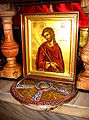
The Matins services for Holy Monday through Thursday are referred to as "Bridegroom Prayer" because the troparion
of the day and the exapostilarion
(the hymn that concludes the Canon
) develop the theme of "Christ the Bridegroom" (Thursday has its own troparion, but uses the same exapostilarion). The icon
often displayed on these days depicts Jesus as the Man of Sorrows
, and is referred to as the Bridegroom because the crown of thorns
and the robe
of mockery are parallel to the crown and robe worn by a bridegroom on his wedding day (Thursday has its own icon showing either the Mystical Supper or the Washing of Feet, or both). The Passion of Christ is seen as the wedding
of the Saviour with his bride, the Church.
 The first three days of Holy Week (Monday, Tuesday and Wednesday), the services all follow the same pattern and are nearly identical to the order followed on weekdays during the Great Forty Days; however, the number of Kathisma
ta (sections from the Psalter) is reduced and the Old Testament readings are taken from different books. The Presanctified Liturgy is celebrated on each of the first three days, and there is a Gospel reading at each one (during the Forty Days there was no Gospel reading unless it was a feast day). There is also a Gospel reading at Matins
on each day and the Canon
chanted at Matins is much shorter, consisting of only three or four odes rather than the usual nine.
In addition to the Gospel readings at Matins and Vespers, there is a reading of all four Gospels which takes place during the Little Hours
(Third Hour, Sixth Hour and Ninth Hour) on these first three days. Each Gospel is read in its entirety and in order, beginning with , and continuing through (the rest of the Gospel of John will be read during the remainder of Holy Week). The Gospels are divided up into nine sections with one section being read by the priest at each of the Little Hours.
The Prayer of Saint Ephrem
is said for the last time at the end of the Presanctified Liturgy on Holy and Great Wednesday. From this moment on, there will be no more prostrations made in the church (aside from those made before the epitaphios
) until Vespers on the afternoon of Pentecost
.
In some churches, the Holy Mystery (Sacrament) of Unction is celebrated on Holy and Great Wednesday, in commemoration of the anointing
of Jesus' feet in preparation for his burial .
The remaining three days of Holy Week retain a smaller degree of Lenten character, but each has elements that are unique to it.
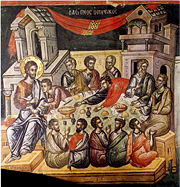 Holy and Great Thursday is a more festive day than the others of Holy Week in that it celebrates the institution of the Eucharist. The hangings
in the church and the vestment
s of the clergy are changed from dark Lenten hues to more festive colours (red, in the Russian tradition). Whereas the Divine Liturgy
is forbidden on other Lenten weekdays, the Divine Liturgy of St. Basil (combined with Vespers) is celebrated on this day. Many of the standard hymns of the Liturgy are replaced with the Troparion
of Great Thursday. In some churches, the Holy Table (altar) is covered with a simple white linen cloth, in commemoration of the Mystical Supper (Last Supper). During this Divine Liturgy, the reserved Mysteries are renewed (a new Lamb being consecrated, and the old Body and Blood of Christ being consumed by the deacon after the Liturgy). Also, when the supply of Chrism
runs low, it is at this Liturgy that the heads of the autocephalous churches will Sanctify new Chrism, the preparation of which would have been begun during the All-Night Vigil
on Palm Sunday.
After the Liturgy, a meal is served. The rule of fasting
is lessened somewhat, and the faithful are allowed to partake of wine in moderation during the meal and use oil in the cooking.
That night, the hangings and vestments in the church are changed to black, and Matins for Great and Holy Friday is celebrated.
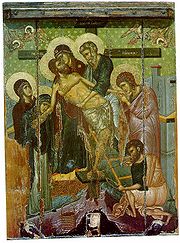 Holy and Great Friday is observed as a strict fast day
, on which the faithful who are physically able to should not eat anything at all. Some even fast from water, at least until after the Vespers service that evening.
The Matins service (usually celebrated Thursday night) is officially entitled, "The Office of the Holy and Redeeming Passion of our Lord Jesus Christ", and is commonly known as the "Matins of the Twelve Gospels", because interspersed throughout the service are twelve Gospel readings which recount the entire Passion of Christ
from the Last Supper
to the sealing of the tomb. Before the Sixth Gospel which first mentions the Crucifixion
, the priest carries a large cross into the center of the church, where it is set upright and all the faithful come forward to venerate it. The cross has attached to it a large icon
of the soma (the crucified body of Christ) At the beginning of each Gospel, the bell is rung according to the number of the Gospel (once for the first Gospel, two for the second, etc.). As each Gospel is read the faithful stand holding lighted candles, which are extinguished at the end of each reading. However, after the twelfth Gospel, the faithful do not extinguish their candles but leave them lit and carry the flame to their homes as a blessing. There, they will often use the flame to light the lampada in their icon corner
.
On the morning of Great Friday, the Royal Hours
are served. This is a solemn service of the Little Hours
and Typica
to which antiphon
s, and scripture readings have been added. Some of the fixed psalms which are standard to each of the Little Hours are replaced with psalms which are of particular significance to the Passion.
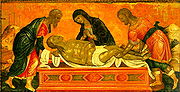 Vespers on Good Friday is usually celebrated in the afternoon, around the time of Jesus' death on the Cross. After the Little Entrance the Gospel reading is a concatenation
of the four Evangelists
' accounts of the Crucifixion and the Descent from the Cross
. At the point during the reading which mentions Joseph of Arimathea
and Nicodemus
, two clergymen approach the large cross in the center of the church, remove the soma, wrap it in a piece of white linen, and carry it into the sanctuary. Later, during the Troparion
, the clergy carry the epitaphios
(a cloth icon symbolizing the winding sheet in which Jesus was prepared for burial) into the center of the church, where it is venerated by all the faithful.
That night, the Matins of Lamentation is normally celebrated in the evening.
The Matins of Lamentation (usually celebrated on Friday evening) resembles the Orthodox funeral
service, in that its main component is the chanting of Psalm 118
(the longest Psalm in the Bible), each verse of which is interspersed with laudations (ainoi) of the dead Christ. The service takes place with the clergy and people gathered around the epitaphios in the center of the church. Everyone stands holding lighted candles during the psalm. Next are chanted the Evlogitaria of the Resurrection, hymns which are normally chanted only on Sundays. This is the first liturgical mention of the impending Resurrection of Jesus
. At the end of the Great Doxology
the epitaphios is carried in procession
around the outside of the church, and then is brought back in. As the clergy carrying the epitaphios enter back into the church, they raise the epitaphios at the door, so that all may pass under it as they enter in, symbolically entering into the death and resurrection of Jesus. The Gospel is not read at its normal place during Matins, but instead is read at the end of the service, in front of the epitaphios.
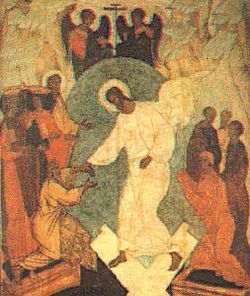 The next morning (Saturday), the Divine Liturgy of St. Basil is celebrated (combined with Vespers). At the beginning of the service, the hangings and vestments are still black. The service is much longer than usual, and includes 15 Old Testament readings recounting the history of salvation, and showing types
of the death and resurrection of Jesus. Many parts of the liturgy which are normally chanted in front of the Holy Doors are instead done in front of the epitaphios. Just before the Gospel reading, the hangings and vestments are changed to white, and the entire atmosphere of the service is transformed from sorrow to joy. In the Greek practice, the priest will strew the entire church with fresh bay leaves
, symbolizing Christ's victory over death. This service symbolizes the Descent of Christ into Hades
and the Harrowing of Hell
. Thus, according to Orthodox theology, Jesus' salvific work on the Cross has been accomplished, and the righteous departed in the Bosom of Abraham
have been released from their bondage; however, the Good News of the Resurrection has not yet been proclaimed to the living on earth (this will occur during the Paschal Vigil). For this reason, the faithful do not yet break their fast nor exchange the paschal kiss.
At the end of the Divine Liturgy, the priest will bless wine and bread which are distributed to the faithful. This is different from the Sacred Mysteries
(Holy Communion) which were received earlier in the service. This bread and wine are simply blessed
, not consecrated. They are a remnant of the ancient tradition of the church (still observed in some places) whereby the faithful did not leave the church after the service, but were each given a glass of wine
, and some bread
and dried fruit
to give them strength for the vigil ahead. They would listen to the reading of the Acts of the Apostles
, read in full, and await the beginning of the Paschal Vigil.
The last liturgical service in the Lenten Triodion is the Midnight Office
which forms the first part of the Paschal Vigil. During this service the Canon
of Great Saturday is repeated, at the end of which the priest and deacon take the epitaphios into the sanctuary through the Holy Doors and lay it on the Holy Table (altar), where it will remain until the feast of the Ascension. After the concluding prayers and a dismissal
, all of the lights and candles in the church are extinguished, and all wait in silence and darkness for the stroke of midnight, when the resurrection of Christ will be proclaimed.
Fasting
Fasting is primarily the act of willingly abstaining from some or all food, drink, or both, for a period of time. An absolute fast is normally defined as abstinence from all food and liquid for a defined period, usually a single day , or several days. Other fasts may be only partially restrictive,...
season in the church year in Eastern Christianity
Eastern Christianity
Eastern Christianity comprises the Christian traditions and churches that developed in the Balkans, Eastern Europe, Asia Minor, the Middle East, Northeastern Africa, India and parts of the Far East over several centuries of religious antiquity. The term is generally used in Western Christianity to...
, which prepares Christians for the greatest feast of the church year, Pascha
Easter
Easter is the central feast in the Christian liturgical year. According to the Canonical gospels, Jesus rose from the dead on the third day after his crucifixion. His resurrection is celebrated on Easter Day or Easter Sunday...
(Easter). In many ways Great Lent is similar to Lent
Lent
In the Christian tradition, Lent is the period of the liturgical year from Ash Wednesday to Easter. The traditional purpose of Lent is the preparation of the believer – through prayer, repentance, almsgiving and self-denial – for the annual commemoration during Holy Week of the Death and...
in Western Christianity
Western Christianity
Western Christianity is a term used to include the Latin Rite of the Catholic Church and groups historically derivative thereof, including the churches of the Anglican and Protestant traditions, which share common attributes that can be traced back to their medieval heritage...
. There are some differences in the timing of Lent (besides calculating the date of Easter) and how it is practiced, both liturgically in the public worship of the church and individually.
Duration
One difference between Eastern Christianity and Western Christianity is the calculation of the date of Easter (see ComputusComputus
Computus is the calculation of the date of Easter in the Christian calendar. The name has been used for this procedure since the early Middle Ages, as it was one of the most important computations of the age....
). Most years, the Eastern Pascha falls after the Western Easter, and it may be as much as five weeks later; occasionally, the two dates coincide. Like Western Lent
Lent
In the Christian tradition, Lent is the period of the liturgical year from Ash Wednesday to Easter. The traditional purpose of Lent is the preparation of the believer – through prayer, repentance, almsgiving and self-denial – for the annual commemoration during Holy Week of the Death and...
, Great Lent itself lasts for forty days, but unlike the West, Sundays are included in the count. Great Lent officially begins on Clean Monday
Clean Monday
Clean Monday , also known as Pure Monday, Ash Monday, Monday of Lent or Green Monday, is the first day of the Eastern Orthodox Christian and Eastern Catholic Great Lent...
, seven weeks before Pascha (Ash Wednesday
Ash Wednesday
Ash Wednesday, in the calendar of Western Christianity, is the first day of Lent and occurs 46 days before Easter. It is a moveable fast, falling on a different date each year because it is dependent on the date of Easter...
is not observed in Eastern Christianity) and runs for 40 contiguous days, concluding with the Presanctified Liturgy on Friday of the Sixth Week. The next day is called Lazarus Saturday
Lazarus Saturday
Lazarus Saturday, in the Orthodox Church and those Eastern Catholic Churches which follow the Byzantine Rite, is the day before Palm Sunday, and is liturgically linked to it...
, the day before Palm Sunday
Palm Sunday
Palm Sunday is a Christian moveable feast that falls on the Sunday before Easter. The feast commemorates Jesus' triumphal entry into Jerusalem, an event mentioned in all four Canonical Gospels. ....
. However, fasting continues throughout the following week, known as Passion Week or Holy Week
Holy Week
Holy Week in Christianity is the last week of Lent and the week before Easter...
, and does not end until after the Paschal Vigil early in the morning of Pascha (Easter Sunday).
Purpose
Passion (Christianity)
The Passion is the Christian theological term used for the events and suffering – physical, spiritual, and mental – of Jesus in the hours before and including his trial and execution by crucifixion...
and Resurrection of Jesus
Resurrection of Jesus
The Christian belief in the resurrection of Jesus states that Jesus returned to bodily life on the third day following his death by crucifixion. It is a key element of Christian faith and theology and part of the Nicene Creed: "On the third day he rose again in fulfillment of the Scriptures"...
. The totality of the Orthodox life centers around the Resurrection. Great Lent is intended to be a "workshop". Through spending more time than usual in prayer and meditation on the Holy Scripture and the Holy Traditions of the Church, the believer in Christ becomes through the grace of God more godlike.
Self-discipline
Observance of Great Lent is characterized by abstinenceAbstinence
Abstinence is a voluntary restraint from indulging in bodily activities that are widely experienced as giving pleasure. Most frequently, the term refers to sexual abstinence, or abstention from alcohol or food. The practice can arise from religious prohibitions or practical...
from certain foods, intensified private and public prayer, self-examination, confession
Confession
This article is for the religious practice of confessing one's sins.Confession is the acknowledgment of sin or wrongs...
, personal improvement, repentance
Repentance
Repentance is a change of thought to correct a wrong and gain forgiveness from a person who is wronged. In religious contexts it usually refers to confession to God, ceasing sin against God, and resolving to live according to religious law...
and restitution
Restitution
The law of restitution is the law of gains-based recovery. It is to be contrasted with the law of compensation, which is the law of loss-based recovery. Obligations to make restitution and obligations to pay compensation are each a type of legal response to events in the real world. When a court...
for sins committed, and almsgiving. The foods traditionally abstained from are meat and dairy products, wine and oil. (According to some traditions, only olive oil is abstained from; in others, all vegetable oils.) Since strict fasting is canonically forbidden on the Sabbath and the Lord's Day
Sunday
Sunday is the day of the week between Saturday and Monday. For most Christians, Sunday is observed as a day for worship of God and rest, due to the belief that it is Lord's Day, the day of Christ's resurrection....
, wine and oil are permitted on Saturdays and Sundays. If the Great Feast of the Annunciation
Annunciation
The Annunciation, also referred to as the Annunciation to the Blessed Virgin Mary or Annunciation of the Lord, is the Christian celebration of the announcement by the angel Gabriel to Virgin Mary, that she would conceive and become the mother of Jesus the Son of God. Gabriel told Mary to name her...
falls during Great Lent, then fish, wine and oil are permitted on that day.
Besides the additional liturgical celebrations described below, Orthodox Christians are expected to pay closer attention to and increase their private prayer. According to Orthodox theology
Theology
Theology is the systematic and rational study of religion and its influences and of the nature of religious truths, or the learned profession acquired by completing specialized training in religious studies, usually at a university or school of divinity or seminary.-Definition:Augustine of Hippo...
, when asceticism is increased, prayer must be increased also. The Church Fathers
Church Fathers
The Church Fathers, Early Church Fathers, Christian Fathers, or Fathers of the Church were early and influential theologians, eminent Christian teachers and great bishops. Their scholarly works were used as a precedent for centuries to come...
have referred to fasting without prayer as "the fast of the demons" since the demons do not eat according to their incorporeal nature, but neither do they pray.
Liturgical observances
Great Lent is unique in that, liturgically, the weeks do not run from Sunday to Saturday, but rather begin on Monday and end on Sunday, and most weeks are named for the lesson from the Gospel which will be read at the Divine Liturgy on its concluding Sunday. This is to illustrate that the entire season is anticipatory, leading up to the greatest Sunday of all: Pascha.During the Great Fast, a special service book is used, known as the Lenten Triodion
Triodion
The Triodion , also called the Lenten Triodion , is the liturgical book used by the Eastern Orthodox and Eastern Catholic Churches of Byzantine rite during Great Lent, the three preparatory weeks leading up to it, and during Holy Week.Many canons in the Triodion contain only three odes or...
, which contains the Lenten texts for the Daily Office (Canonical Hours) and Liturgies. The Triodion begins during the Pre-Lenten period to supplement or replace portions of the regular services. This replacement begins gradually, initially affecting only the Epistle
Epistle
An epistle is a writing directed or sent to a person or group of people, usually an elegant and formal didactic letter. The epistle genre of letter-writing was common in ancient Egypt as part of the scribal-school writing curriculum. The letters in the New Testament from Apostles to Christians...
and Gospel
Gospel
A gospel is an account, often written, that describes the life of Jesus of Nazareth. In a more general sense the term "gospel" may refer to the good news message of the New Testament. It is primarily used in reference to the four canonical gospels of Matthew, Mark, Luke, and John...
readings, and gradually increases until Holy Week when it entirely replaces all other liturgical material (during the Triduum even the Psalter
Psalter
A psalter is a volume containing the Book of Psalms, often with other devotional material bound in as well, such as a liturgical calendar and litany of the Saints. Until the later medieval emergence of the book of hours, psalters were the books most widely owned by wealthy lay persons and were...
is eliminated, and all texts are taken exclusively from the Triodion). The Triodion is used until the lights are extinguished before midnight at the Paschal Vigil, at which time it is replaced by the Pentecostarion
Pentecostarion
The Pentecostarion is the liturgical book used by the Eastern Orthodox and Eastern Catholic Churches which follow the Byzantine Rite during the Paschal Season which extends from Pascha to the Sunday following All Saints Sunday The Pentecostarion (Greek: Πεντηκοστάριον, Pentekostárion; Slavonic:...
, which begins by replacing the normal services entirely (during Bright Week
Bright Week
Bright Week or Renewal Week is the name used by the Eastern Orthodox Church and Eastern Catholic Churches of the Byzantine Rite for the period of seven days beginning on Pascha and continuing up to the following Sunday, which is known as Thomas Sunday...
) and gradually diminishes until the normal services resume following the Afterfeast
Afterfeast
An Afterfeast is a period of celebration attached to one of the Great Feasts celebrated by the Eastern Orthodox and Eastern Catholic Churches ....
of Pentecost
Pentecost
Pentecost is a prominent feast in the calendar of Ancient Israel celebrating the giving of the Law on Sinai, and also later in the Christian liturgical year commemorating the descent of the Holy Spirit upon the disciples of Christ after the Resurrection of Jesus...
.
Divine Liturgy
Divine Liturgy is the common term for the Eucharistic service of the Byzantine tradition of Christian liturgy. As such, it is used in the Eastern Orthodox and Eastern Catholic Churches. Armenian Christians, both of the Armenian Apostolic Church and of the Armenian Catholic Church, use the same term...
is not celebrated, because the joy of the Eucharist
Eucharist
The Eucharist , also called Holy Communion, the Sacrament of the Altar, the Blessed Sacrament, the Lord's Supper, and other names, is a Christian sacrament or ordinance...
(literally "Thanksgiving") is contrary to the attitude of repentance which predominates on these days. However, since it is considered especially important to receive the Holy Mysteries (Holy Communion) during this season, the Liturgy of the Presanctified Gifts
Liturgy of the Presanctified Gifts
The Liturgy of the Presanctified Gifts, informally Presanctified Liturgy, is an Eastern Christian liturgical service for the distribution of communion on the weekdays of Great Lent....
—also called the Liturgy of St. Gregory the Dialogist
Pope Gregory I
Pope Gregory I , better known in English as Gregory the Great, was pope from 3 September 590 until his death...
— may be celebrated on weekdays. Technically, this is not actually a Divine Liturgy, but rather a Vespers
Vespers
Vespers is the evening prayer service in the Western Catholic, Eastern Catholic, and Eastern Orthodox, Anglican, and Lutheran liturgies of the canonical hours...
service at which a portion of the Body
Body of Christ
In Christian theology, the term Body of Christ has two separate connotations: it may refer to Jesus's statement about the Eucharist at the Last Supper that "This is my body" in , or the explicit usage of the term by the Apostle Paul in to refer to the Christian Church.Although in general usage the...
and Blood of Christ
Blood of Christ
The Blood of Christ in Christian theology refers to the physical blood actually shed by Jesus Christ on the Cross, and the salvation which Christianity teaches was accomplished thereby; and the sacramental blood present in the Eucharist, which is considered by Catholic, Orthodox, Anglican, and...
, which was reserved
Reserved sacrament
During the Liturgy of the Eucharist, the second part of the Mass, the elements of bread and wine are considered, in some branches of Christian practice, to have been transubstantiated into the veritable Body and Blood of Jesus Christ...
the previous Sunday, are distributed to the faithful. Most parishes
Parish church
A parish church , in Christianity, is the church which acts as the religious centre of a parish, the basic administrative unit of episcopal churches....
and monasteries celebrate this Liturgy only on Wednesdays, Fridays and feast days, but it may be celebrated on any weekday of Great Lent. Because the Divine Liturgy is not celebrated on weekdays, it is replaced with the Typica, even on days when the Presanctified Liturgy is celebrated. On Saturday and Sunday the Divine Liturgy may be celebrated as usual. On Saturdays, the usual St. John Chrysostom is celebrated; on Sundays the more solemn and penitential Divine Liturgy of St. Basil the Great is used.
The services of the Canonical Hours
Canonical hours
Canonical hours are divisions of time which serve as increments between the prescribed prayers of the daily round. A Book of Hours contains such a set of prayers....
are much longer during Great Lent. In addition to doubling the number of Psalms
Psalms
The Book of Psalms , commonly referred to simply as Psalms, is a book of the Hebrew Bible and the Christian Bible...
read, the structure of the services is different on weekdays. In the evening, instead of the normal Compline
Compline
Compline is the final church service of the day in the Christian tradition of canonical hours. The English word Compline is derived from the Latin completorium, as Compline is the completion of the working day. The word was first used in this sense about the beginning of the 6th century by St...
(the final service before retiring at night), the much longer service of Great Compline is chanted. In the Greek practice, ordinary Compline is chanted on Friday night together with the Akathist
Akathist
The Akathist Hymn is a hymn of Eastern Orthodox and Eastern Catholic tradition dedicated to a saint, holy event, or one of the persons of the Holy Trinity...
to the Theotokos
Theotokos
Theotokos is the Greek title of Mary, the mother of Jesus used especially in the Eastern Orthodox, Oriental Orthodox, and Eastern Catholic Churches. Its literal English translations include God-bearer and the one who gives birth to God. Less literal translations include Mother of God...
(Mother of God). The Akathist is divided into four sections and one section is chanted on each of the first four Friday nights of Great Lent. Then the Akathist is chanted in its entirety at Matins in the Fifth Saturday. In the Slavic usage, Great Compline is chanted on Friday night—though some parts are read rather than sung as they are on other weeknights, and some Lenten material is replaced by non-Lenten hymns—and the Akathist is not chanted until Matins of the fifth Saturday.
An interesting difference between the Eastern and Western observances is that while in the West the chanting of Alleluia
Alleluia
The word "Alleluia" or "Hallelujah" , which at its most literal means "Praise Yah", is used in different ways in Christian liturgies....
ceases during Lent
Lent
In the Christian tradition, Lent is the period of the liturgical year from Ash Wednesday to Easter. The traditional purpose of Lent is the preparation of the believer – through prayer, repentance, almsgiving and self-denial – for the annual commemoration during Holy Week of the Death and...
, in the East its use is increased. This is because for the Orthodox, fasting should be joyous (cf. ), and the sense of unworthiness must always be tempered with hope in God's forgiveness. In fact, days which follow the Lenten pattern of services are referred to as "days with Alleluia". This theme of "Lenten joy" is also found in many of the hymns of the Triodion, such as the stichera
Sticheron
A sticheron is a particular kind of hymn used in the Divine Liturgy, acolouthia or other services of the Orthodox Church and those Eastern Catholic Churches which follow the Byzantine Rite....
which begin with the words: "The Lenten Spring has dawned!..." (Vespers
Vespers
Vespers is the evening prayer service in the Western Catholic, Eastern Catholic, and Eastern Orthodox, Anglican, and Lutheran liturgies of the canonical hours...
Aposticha
Aposticha
The Aposticha are a set of hymns accompanied by psalm verses that are chanted towards the end of Vespers and Matins in the Eastern Orthodox Church and those Eastern Catholic Churches that follow the Byzantine Rite....
, Wednesday of Cheesefare Week) and "Now is the season of repentance; let us begin it joyfully, O brethren..." (Matins
Matins
Matins is the early morning or night prayer service in the Roman Catholic, Anglican, Lutheran and Eastern Orthodox liturgies of the canonical hours. The term is also used in some Protestant denominations to describe morning services.The name "Matins" originally referred to the morning office also...
, Second Canon
Canon (hymnography)
A canon is a structured hymn used in a number of Eastern Orthodox services. It consists of nine odes, sometimes called canticles or songs depending on the translation, based on the Biblical canticles. Most of these are found in the Old Testament, but the final ode is taken from the Magnificat and...
, Ode 8, Monday of Cheesefare Week).
The making of prostration
Prostration
Prostration is the placement of the body in a reverentially or submissively prone position. Major world religions employ prostration either as a means of embodying reverence for a noble person, persons or doctrine, or as an act of submissiveness to a supreme being or beings...
s during the services increases as well. The one prayer
Prayer
Prayer is a form of religious practice that seeks to activate a volitional rapport to a deity through deliberate practice. Prayer may be either individual or communal and take place in public or in private. It may involve the use of words or song. When language is used, prayer may take the form of...
that typifies the Lenten services is the Prayer of Saint Ephrem
Prayer of Saint Ephrem
The Prayer of Righteous Ephrem , is a prayer attributed to Saint Ephrem the Syrian and used during the Great Lent by the Eastern Orthodox Church and those Eastern Catholic Churches that use the Byzantine rite...
, which is said at each service on weekdays, accompanied by full prostrations. One translation of it reads:
O Lord and master of my life! a spirit of idleness, despondency, ambition and idle-talking, give me not.
But rather, a spirit of chastity, humble-mindedness, patience and charity, bestow upon me Thy servant.
Yea, my king and Lord, grant me to see my own failings and refrain from judging others: For blessed art Thou unto ages of ages. Amen.
The public reading of Scripture is increased during Great Lent. The Psalter
Psalter
A psalter is a volume containing the Book of Psalms, often with other devotional material bound in as well, such as a liturgical calendar and litany of the Saints. Until the later medieval emergence of the book of hours, psalters were the books most widely owned by wealthy lay persons and were...
(Book of Psalms) is normally read through once a week during the course of the Daily Office; however, during Great Lent, the number of Psalms is increased so that the entire Psalter is read through twice during each of the Six Weeks (during Holy Week it is read through once). Readings from the Old Testament
Old Testament
The Old Testament, of which Christians hold different views, is a Christian term for the religious writings of ancient Israel held sacred and inspired by Christians which overlaps with the 24-book canon of the Masoretic Text of Judaism...
are also increased, with the Books of Genesis, Proverbs
Book of Proverbs
The Book of Proverbs , commonly referred to simply as Proverbs, is a book of the Hebrew Bible.The original Hebrew title of the book of Proverbs is "Míshlê Shlomoh" . When translated into Greek and Latin, the title took on different forms. In the Greek Septuagint the title became "paroimai paroimiae"...
and Isaiah
Book of Isaiah
The Book of Isaiah is the first of the Latter Prophets in the Hebrew Bible, preceding the books of Ezekiel, Jeremiah and the Book of the Twelve...
being read through almost in their entirety at the Sixth Hour and Vespers
Vespers
Vespers is the evening prayer service in the Western Catholic, Eastern Catholic, and Eastern Orthodox, Anglican, and Lutheran liturgies of the canonical hours...
(during Cheesefare Week, the readings at these services are taken from Joel
Book of Joel
The Book of Joel is part of the Hebrew Bible. Joel is part of a group of twelve prophetic books known as the Minor Prophets or simply as The Twelve; the distinction 'minor' indicates the short length of the text in relation to the larger prophetic texts known as the "Major Prophets".-Content:After...
and Zechariah
Book of Zechariah
The Book of Zechariah is the penultimate book of the twelve minor prophets in the Hebrew and Christian Bible, attributed to the prophet Zechariah.-Historical context:...
, while during Holy Week they are from Exodus, Ezekiel
Book of Ezekiel
The Book of Ezekiel is the third of the Latter Prophets in the Hebrew Bible, following the books of Isaiah and Jeremiah and preceding the Book of the Twelve....
and Job
Book of Job
The Book of Job , commonly referred to simply as Job, is one of the books of the Hebrew Bible. It relates the story of Job, his trials at the hands of Satan, his discussions with friends on the origins and nature of his suffering, his challenge to God, and finally a response from God. The book is a...
). Uniquely, on weekdays of Great Lent there is no public reading of the Epistle
Epistle
An epistle is a writing directed or sent to a person or group of people, usually an elegant and formal didactic letter. The epistle genre of letter-writing was common in ancient Egypt as part of the scribal-school writing curriculum. The letters in the New Testament from Apostles to Christians...
s or Gospel
Gospel
A gospel is an account, often written, that describes the life of Jesus of Nazareth. In a more general sense the term "gospel" may refer to the good news message of the New Testament. It is primarily used in reference to the four canonical gospels of Matthew, Mark, Luke, and John...
s. This is because the readings are particular to the Divine Liturgy, which is not celebrated on weekdays of Great Lent. There are, however, Epistles and Gospels appointed for each Saturday and Sunday.
Prayer for the dead
Prayer for the dead
Wherever there is a belief in the continued existence of man's personality through and after death, religion naturally concerns itself with the relations between the living and the dead...
, not only reminding the believer of his own mortality, and thus increasing the spirit of penitence, but also to remind him of his Christian obligation of charity in praying for the departed. A number of Saturdays during Great Lent are Saturdays of the Dead, with many of the hymns of the Daily Office and at the Divine Liturgy dedicated to remembrance of the departed. These Saturdays are:
- The Saturday of Meatfare Week
- The Second Saturday of Great Lent
- The Third Saturday of Great Lent
- The Fourth Saturday of Great Lent
In addition, the Litya, a brief prayer service for the departed, may be served on each weekday of Great Lent, provided there is no feast day or special observance on that day.
Feast days
Eastern Orthodox liturgical calendar
The Eastern Orthodox liturgical calendar describes and dictates the rhythm of the life of the Eastern Orthodox Church. Associated with each date are passages of Holy Scripture, Saints and events for commemoration, and many times special rules for fasting or feasting that correspond to the day of...
(Menaion
Menaion
The Menaion refers to the annual fixed cycle of services in the Eastern Orthodox and Greek-Catholic Churches. Commemorations in the Menaion are tied to the day of the calendar year.-Service books:...
) which occur during the season. When these feasts fall a weekday of Great Lent, the normal Lenten aspect of the services is lessened to celebrate the solemnity.
The most important of these fixed feasts is the Great Feast of the Annunciation
Annunciation
The Annunciation, also referred to as the Annunciation to the Blessed Virgin Mary or Annunciation of the Lord, is the Christian celebration of the announcement by the angel Gabriel to Virgin Mary, that she would conceive and become the mother of Jesus the Son of God. Gabriel told Mary to name her...
(March 25), which is considered to be so important that it is never moved, even if it should fall on the Sunday of Pascha itself (a rare and special occurrence which is known as Kyrio-Pascha). The fast is also lessened, and the faithful are allowed to eat fish (unless it is Good Friday or Holy Saturday). Whereas on other weekdays of Great Lent, no celebration of the Divine Liturgy is permitted, there is a Liturgy (usually the Liturgy of St. John Chrysostom
Divine Liturgy of St. John Chrysostom
The Divine Liturgy of Saint John Chrysostom is the most celebrated Divine Liturgy in the Byzantine Rite. It is named after the anaphora with the same name which is its core part and it is attributed to Saint John Chrysostom, Archbishop of Constantinople in the 5th century.It reflects the work of...
) celebrated on Annunciation—even if it falls on Good Friday
Good Friday
Good Friday , is a religious holiday observed primarily by Christians commemorating the crucifixion of Jesus Christ and his death at Calvary. The holiday is observed during Holy Week as part of the Paschal Triduum on the Friday preceding Easter Sunday, and may coincide with the Jewish observance of...
.
When the feast day of the patron saint
Patron saint
A patron saint is a saint who is regarded as the intercessor and advocate in heaven of a nation, place, craft, activity, class, clan, family, or person...
of the parish church
Parish church
A parish church , in Christianity, is the church which acts as the religious centre of a parish, the basic administrative unit of episcopal churches....
or monastery
Monastery
Monastery denotes the building, or complex of buildings, that houses a room reserved for prayer as well as the domestic quarters and workplace of monastics, whether monks or nuns, and whether living in community or alone .Monasteries may vary greatly in size – a small dwelling accommodating only...
falls on a weekday of Great Lent, there is no Liturgy (other than the Presanctified), but fish is allowed at the meal. In some churches the feast of a patron saint is moved to the nearest Saturday (excluding the Saturday of the Akathist), and in other churches, it is celebrated on the day of the feast itself.
When some other important feast occurs on a weekday, such as the First and Second Finding of the Head of John the Baptist (February 24), the Forty Martyrs of Sebaste
Forty Martyrs of Sebaste
The Forty Martyrs of Sebaste or the Holy Forty were a group of Roman soldiers in the Legio XII Fulminata whose martyrdom in 320 for the Christian faith is recounted in traditional martyrologies.They were killed near Sebaste, in Lesser Armenia, victims of the persecutions of Licinius,...
(March 9), etc., it is usually combined with the Lenten service, and wine and oil are allowed at the meal.
Regardless of the rank of the feast being celebrated, the Lenten hymns contained in the Triodion are never omitted, but are always chanted in their entirety, even on the feast of the Annunciation.
Menaion
The Menaion refers to the annual fixed cycle of services in the Eastern Orthodox and Greek-Catholic Churches. Commemorations in the Menaion are tied to the day of the calendar year.-Service books:...
. In order that their services not be completely forgotten, a portion of them (their canon at Matins, and their stichera from "Lord I Have Cried" at Vespers) is chanted at Compline
Compline
Compline is the final church service of the day in the Christian tradition of canonical hours. The English word Compline is derived from the Latin completorium, as Compline is the completion of the working day. The word was first used in this sense about the beginning of the 6th century by St...
.
Readings
In addition to the added readings from Scripture, spiritual books by the Church FathersChurch Fathers
The Church Fathers, Early Church Fathers, Christian Fathers, or Fathers of the Church were early and influential theologians, eminent Christian teachers and great bishops. Their scholarly works were used as a precedent for centuries to come...
are recommended during the Fast.
One book commonly read during Great Lent, particularly by monastics
Monasticism
Monasticism is a religious way of life characterized by the practice of renouncing worldly pursuits to fully devote one's self to spiritual work...
, is The Ladder of Divine Ascent
The Ladder of Divine Ascent
The Ladder of Divine Ascent, or Ladder of Paradise , is an important ascetical treatise for monasticism in Eastern Christianity written by John Climacus in ca...
, which was written in about the seventh century by St. John of the Ladder when he was the Hegumen
Hegumen
Hegumen, hegumenos, igumen, or ihumen is the title for the head of a monastery of the Eastern Orthodox Church or Eastern Catholic Churches, similar to the one of abbot. The head of a convent of nuns is called hegumenia or ihumenia . The term means "the one who is in charge", "the leader" in...
(Abbot) of St. Catherine's Monastery
Saint Catherine's Monastery, Mount Sinai
Saint Catherine's Monastery lies on the Sinai Peninsula, at the mouth of a gorge at the foot of Mount Sinai in the city of Saint Catherine in Egypt's South Sinai Governorate. The monastery is Orthodox and is a UNESCO World Heritage Site...
on Mount Sinai
Mount Sinai
Mount Sinai , also known as Mount Horeb, Mount Musa, Gabal Musa , Jabal Musa meaning "Moses' Mountain", is a mountain near Saint Catherine in the Sinai Peninsula of Egypt. A mountain called Mount Sinai is mentioned many times in the Book of Exodus in the Torah and the Bible as well as the Quran...
. The theme of The Ladder is not Great Lent itself, but rather it deals with the ascent of the soul from earth to heaven; that is, from enslavement to the passions to the building up of the virtue
Virtue
Virtue is moral excellence. A virtue is a positive trait or quality subjectively deemed to be morally excellent and thus is valued as a foundation of principle and good moral being....
s and its eventual theosis
Theosis
In Christian theology, divinization, deification, making divine or theosis is the transforming effect of divine grace. This concept of salvation is historical and fundamental for Christian understanding that is prominent in the Eastern Orthodox Church and also in the Catholic Church, and is a...
(union with God), which is the goal of Great Lent. The Ladder is usually read in the trapeza (refectory) during meals, but it may alternatively be read during the Little Hours
Little Hours
The Little Hours are the fixed daytime hours of prayer in the Divine Office of Christians, in both Western Christianity and the Eastern Orthodox Church. These Hours are called 'little' due to their shorter and simpler structure compared to the Night Hours...
on weekdays so that everyone can hear. Many of the laity
Laity
In religious organizations, the laity comprises all people who are not in the clergy. A person who is a member of a religious order who is not ordained legitimate clergy is considered as a member of the laity, even though they are members of a religious order .In the past in Christian cultures, the...
also read The Ladder privately during Great Lent.
Besides the Ladder, in some monasteries the Paradise of the Holy Fathers by Palladius
Palladius of Galatia
Palladius of Galatia was bishop of Helenopolis in Bithynia, and a devoted disciple of Saint John Chrysostom. He is best remembered for his work, the Lausiac History; he was also, in all probability, the author of the Dialogue on the Life of Chrysostom....
and the penitential sermons of St. Ephrem the Syrian
Ephrem the Syrian
Ephrem the Syrian was a Syriac and a prolific Syriac-language hymnographer and theologian of the 4th century. He is venerated by Christians throughout the world, and especially in the Syriac Orthodox Church, as a saint.Ephrem wrote a wide variety of hymns, poems, and sermons in verse, as well as...
are read during Matins
Matins
Matins is the early morning or night prayer service in the Roman Catholic, Anglican, Lutheran and Eastern Orthodox liturgies of the canonical hours. The term is also used in some Protestant denominations to describe morning services.The name "Matins" originally referred to the morning office also...
.
Outline
Liturgically, the period of the Triodion can be divided into three sections: (1) the Pre-Lenten period, (2) the Great Forty Days, and (3) Holy Week.Pre-Lenten period
Before the forty days of Great Lent commence, there is a three-week Pre-Lenten season, to prepare the faithful for the spiritual work they are to accomplish during the Great Fast. During this period many of the themes which will be developed in the liturgical texts of the forty days are introduced. Each week runs from Monday to Sunday and is named for the Gospel theme of the Sunday which concludes it.In the Slavic tradition, with the addition of Zacchaeus Sunday, some regard the pre-Lenten period as lasting four weeks, but there are no liturgical indications that the week following the fifth Sunday before Lent (whether preceded by Zacchaeus Sunday or otherwise) is in any way Lenten, because Zacchaeus Sunday falls outside the Triodion
Triodion
The Triodion , also called the Lenten Triodion , is the liturgical book used by the Eastern Orthodox and Eastern Catholic Churches of Byzantine rite during Great Lent, the three preparatory weeks leading up to it, and during Holy Week.Many canons in the Triodion contain only three odes or...
, the liturgical book
Liturgical book
A liturgical book is a book published by the authority of a church, that contains the text and directions for the liturgy of its official religious services.-Roman Catholic:...
which governs the pre-Lenten period and Lent itself.
Zacchaeus Sunday
Gospel
A gospel is an account, often written, that describes the life of Jesus of Nazareth. In a more general sense the term "gospel" may refer to the good news message of the New Testament. It is primarily used in reference to the four canonical gospels of Matthew, Mark, Luke, and John...
reading is always the account of Zacchaeus
Zacchaeus
Zacchaeus , according to chapter 19 of the gospel of Luke, was a superintendent of customs; a chief tax-gatherer at Jericho...
from , for which reason this Sunday is referred to as "Zacchaeus Sunday" (though the week before is not called "Zacchaeus week"). This reading actually falls at the end of the lectionary
Lectionary
A Lectionary is a book or listing that contains a collection of scripture readings appointed for Christian or Judaic worship on a given day or occasion.-History:...
cycle, being assigned to the 32nd Week after Pentecost. However, depending upon the date of the upcoming Pascha, the readings of the preceding weeks are either skipped (if Pascha will be early) or repeated (if it will be late) so that the readings for the 32nd Sunday after Pentecost always occur on the Sunday preceding the Week of the Publican and the Pharisee.
In the Byzantine ("Greek") liturgical traditions, the Gospel reading for Zacchaeus remains in the normal lectionary cycle and does not always fall on the fifth Sunday before Lent.
The Lenten significance of the Gospel account of Zacchaeus is that it introduces the themes of pious zeal (Zacchaeus' climbing up the sycamore tree; Jesus' words: "Zacchaeus, make haste"), restraint (Jesus' words: "come down"), making a place for Jesus in the heart ("I must abide at thy house"), overcoming gossip ("And when they saw it, they all murmured, saying, That he was gone to be guest with a man that is a sinner"), repentance and almsgiving ("And Zacchaeus stood, and said unto the Lord: Behold, Lord, the half of my goods I give to the poor; and if I have taken any thing from any man by false accusation, I restore him fourfold"), forgiveness and reconciliation ("And Jesus said unto him, This day is salvation come to this house, forsomuch as he also is a son of Abraham"), and the reason for the Passion and Resurrection ("For the Son of man is come to seek and to save that which was lost").
The Epistle
Epistle
An epistle is a writing directed or sent to a person or group of people, usually an elegant and formal didactic letter. The epistle genre of letter-writing was common in ancient Egypt as part of the scribal-school writing curriculum. The letters in the New Testament from Apostles to Christians...
reading for Zacchaeus Sunday is , which in and of itself has no Lenten theme, other than as an admonition to righteous behaviour.
Publican and Pharisee
The reading on the Sunday which concludes this week is the ParableParables of Jesus
The parables of Jesus can be found in all the Canonical gospels as well as in some of the non-canonical gospels but are located mainly within the three synoptic gospels. They represent a key part of the teachings of Jesus, forming approximately one third of his recorded teachings...
of the Publican and the Pharisee . The Sunday of the Publican and the Pharisee is the first day the Lenten Triodion is used (at Vespers
Vespers
Vespers is the evening prayer service in the Western Catholic, Eastern Catholic, and Eastern Orthodox, Anglican, and Lutheran liturgies of the canonical hours...
or All-Night Vigil
All-Night Vigil
The All-Night Vigil , Opus 37, is an a cappella choral composition by Sergei Rachmaninoff,written and premiered in 1915. It consists of settings of texts taken from the Russian Orthodox All-night vigil ceremony. It has been praised as Rachmaninoff's finest achievement and "the greatest musical...
on Saturday night), though it is only used for the Sunday services, with nothing pertaining to weekdays or Saturday. The theme of the hymns and readings on this Sunday is dedicated to the lessons to be learned from the parable: that righteous actions alone do not lead to salvation, that pride renders good deeds fruitless, that God can only be approached through a spirit of humility and repentance, and that God justifies
Justification (theology)
Rising out of the Protestant Reformation, Justification is the chief article of faith describing God's act of declaring or making a sinner righteous through Christ's atoning sacrifice....
the humble rather than the self-righteous. The week which follows the Sunday of the Publican and the Pharisee is a fast-free week, to remind the faithful not to be prideful in their fasting as the Pharisee was .
The Sunday of the Publican and the Pharisee is also the first day that structural changes (as opposed to simply substituting Lenten hymns for normal hymns from the octoechos
Octoechos (liturgy)
The Octoechos —literally, the book "of the Eight Tones"—contains an eight-week cycle, providing texts to be chanted for every day at Vespers, Matins, the Divine Liturgy, Compline and the Midnight Office...
or menaion
Menaion
The Menaion refers to the annual fixed cycle of services in the Eastern Orthodox and Greek-Catholic Churches. Commemorations in the Menaion are tied to the day of the calendar year.-Service books:...
) are made to the Sunday services.
Prodigal Son
The theme of this week is the Parable of the Prodigal Son . Again, the Triodion does not give propersProper (liturgy)
The Proper is a part of the Christian liturgy that varies according to the date, either representing an observance within the Liturgical Year, or of a particular saint or significant event...
for the weekdays. The Gospel Reading on Sunday lays out one of the most important themes of the Lenten season: the process of falling into of sin, realization of one's sinfulness, the road to repentance, and finally reconciliation, each of which is illustrated in the course of the parable.
Meatfare Week
The Saturday of this week is the first Saturday of the Dead observed during the Great Lenten season. The proper name in the typikonTypikon
The Typikon, or Typicon; plural Typika is a liturgical book which contains instructions about the order of the various Eastern Orthodox Christian church services and ceremonies, in the form of a perpetual calendar...
for the Sunday of this week is The Sunday of the Last Judgment
Last Judgment
The Last Judgment, Final Judgment, Day of Judgment, Judgment Day, or The Day of the Lord in Christian theology, is the final and eternal judgment by God of every nation. The concept is found in all the Canonical gospels, particularly the Gospel of Matthew. It will purportedly take place after the...
, indicating the theme of the Gospel of the day . The popular name of "Meatfare Sunday" comes from the fast that this is the last day on which the laity are permitted to eat meat until Pascha (Orthodox monks and nuns never eat meat).
Cheesefare Week
During Cheesefare Week the eating of dairy products is permitted on every day (even Wednesday and Friday, which are normally observed as fast days throughout the year), though meat may no longer be eaten any day of the week. On the weekdays of this week, the first Lenten structural elements are introduced to the cycle of services on weekdays (the chanting of "Alleluia", the Prayer of Saint Ephrem, making prostrations, etc.). Wednesday and Friday are the most Lenten, but some Lenten elements are also observed on Monday, Tuesday and Thursday. Cheesefare Saturday has no Lenten elements to it (as, in fact, is true of Saturdays throughout the Lenten period), but the hymns of the day celebrate the "Holy Ascetic Fathers". That is to say, all of the Holy Fathers (and Holy Mothers) who have shown forth in the monastic life.Cheesefare Week is concluded on Cheesefare Sunday. The proper name for this Sunday is The Sunday of Forgiveness, both because of the Gospel theme for the day and because it is the day on which everyone asks forgiveness of their neighbor. The popular name of "Cheesefare Sunday" derives from the fact that it is the last day to eat dairy products before Pascha. On this Sunday, Eastern Christians identify with Adam and Eve
Adam and Eve
Adam and Eve were, according to the Genesis creation narratives, the first human couple to inhabit Earth, created by YHWH, the God of the ancient Hebrews...
, and forgive each other in order to obtain forgiveness from God, typically in a Forgiveness Vespers service that Sunday evening. During Forgiveness Vespers (on Sunday evening) the hangings
Antependia
An antependium , more commonly known as a hanging, or, when speaking specifically of the hanging for the altar, an altar frontal , is a decorative piece of material that can adorn a Christian altar, lectern, pulpit, or table...
and vestments in the church are changed to somber Lenten colours to reflect a penitential mood. At the end of the service comes the "Ceremony of Mutual Forgiveness" during which all of the people one by one ask forgiveness of one another, that the Great Fast may begin in a spirit of peace. During the ceremony the choir chants the Irmoi
Irmos
The irmos is the initial troparion of each individual ode in a canon as chanted in the Eastern Orthodox Church and those Eastern Catholic Churches which use the Byzantine Rite...
from the Canon
Canon (hymnography)
A canon is a structured hymn used in a number of Eastern Orthodox services. It consists of nine odes, sometimes called canticles or songs depending on the translation, based on the Biblical canticles. Most of these are found in the Old Testament, but the final ode is taken from the Magnificat and...
of Pascha
Easter
Easter is the central feast in the Christian liturgical year. According to the Canonical gospels, Jesus rose from the dead on the third day after his crucifixion. His resurrection is celebrated on Easter Day or Easter Sunday...
.
The Great Forty Days
The forty days of Great Lent last from Clean Monday until the Friday of the Sixth Week. Each of the Sundays of Great Lent has its own special commemoration, though these are not necessarily repeated during the preceding week. An exception is the Week of the Cross (the Fourth Week), during which the theme of the preceding Sunday—the Veneration of the Cross—is repeated throughout the week. The themes introduced in the Pre-Lenten period continue to be developed throughout the forty days.Clean Week
Clean Monday
Clean Monday , also known as Pure Monday, Ash Monday, Monday of Lent or Green Monday, is the first day of the Eastern Orthodox Christian and Eastern Catholic Great Lent...
, the first day of Great Lent. The name "Clean Week" refers to the spiritual cleansing each of the faithful is encouraged to undergo through fasting, prayer, repentance, reception of the Holy Mysteries and begging forgiveness of his neighbor. It is also traditionally a time for spring cleaning
Spring cleaning
Spring cleaning is the period in spring time set aside for cleaning a house, normally applied in climates with a cold winter.The most common usage of spring cleaning refers to the yearly act of cleaning a house from top to bottom which would take place in the first warm days of the year typically...
so that one's outward surroundings matches his inward disposition.
Throughout this week fasting is most strict. Those who have the strength are encouraged to fast completely, eating only on Wednesday and Friday evenings, after the Presanctified Liturgy. Those who are unable to keep such a strict fast are encouraged to eat only a little, and then only xerophagy
Xerophagy
Xerophagy is the practice of eating dry food, especially food cooked without oil.. In Eastern Christianity, xerophagy is the form of fasting observed during Great Lent and certain other fasts, in which vegetables cooked with water and salt are eaten, together with such things as fruit, nuts, bread...
(uncooked food) once a day. Meals are served on Saturday and Sunday, but these are fasting meals at which meat and dairy products are forbidden.
At Great Compline during the first four days of the Fast (Monday through Thursday) the Great Canon of St. Andrew of Crete
Andrew of Crete
For the martyr of 766 of the same name, see Andrew of Crete .Saint Andrew of Crete For the martyr of 766 of the same name, see Andrew of Crete (martyr).Saint Andrew (Andreas) of Crete (also known as Andrew of Jerusalem) For the martyr of 766 of the same name, see Andrew of Crete (martyr).Saint...
is divided into four parts and one part is chanted each night (for further information about the Great Canon, see Fifth Week, below).
The First Saturday is called "St. Theodore Saturday" in honor of St. Theodore the Recruit, a fourth century martyr
Martyr
A martyr is somebody who suffers persecution and death for refusing to renounce, or accept, a belief or cause, usually religious.-Meaning:...
. At the end of the Presanctified Liturgy on Friday (since, liturgically, the day begins at sunset) a special canon to St. Theodore, composed by St. John of Damascus
John of Damascus
Saint John of Damascus was a Syrian monk and priest...
, is chanted. Then the priest blesses kolyva (boiled wheat with honey and raisins) which is distributed to the faithful in commemoration of the following miracle worked by St. Theodore on the First Saturday of Great Lent: Fifty years after the death of St Theodore, the emperor Julian the Apostate
Julian the Apostate
Julian "the Apostate" , commonly known as Julian, or also Julian the Philosopher, was Roman Emperor from 361 to 363 and a noted philosopher and Greek writer....
(361-363), as a part of his general policy of persecution of Christians
Persecution of Christians
Persecution of Christians as a consequence of professing their faith can be traced both historically and in the current era. Early Christians were persecuted for their faith, at the hands of both Jews from whose religion Christianity arose, and the Roman Empire which controlled much of the land...
, commanded the governor of Constantinople
Constantinople
Constantinople was the capital of the Roman, Eastern Roman, Byzantine, Latin, and Ottoman Empires. Throughout most of the Middle Ages, Constantinople was Europe's largest and wealthiest city.-Names:...
during the first week of Great Lent to sprinkle all the food provisions in the marketplaces with the blood offered to pagan idols, knowing that the people would be hungry after the strict fasting of the first week. St Theodore appeared in a dream to Archbishop Eudoxius
Eudoxius of Antioch
Eudoxius was the eighth bishop of Constantinople from January 27, 360 to 370, previously bishop of Germanicia and of Antioch, and was one of the most influential Arians.-Biography:...
, ordering him to inform all the Christians that no one should buy anything at the marketplaces, but rather to eat cooked wheat with honey (kolyva).
The First Sunday of Great Lent is the Feast of Orthodoxy
Feast of Orthodoxy
The Feast of Orthodoxy is celebrated on the first Sunday of Great Lent in the liturgical calendar of the Eastern Orthodox Church and Greek-Catholics...
, which commemorates the restoration of the veneration
Veneration
Veneration , or veneration of saints, is a special act of honoring a saint: an angel, or a dead person who has been identified by a church committee as singular in the traditions of the religion. It is practiced by the Eastern Orthodox Church, the Roman Catholic, and Eastern Catholic Churches...
of icon
Icon
An icon is a religious work of art, most commonly a painting, from Eastern Christianity and in certain Eastern Catholic churches...
s after the Iconoclast
Iconoclasm
Iconoclasm is the deliberate destruction of religious icons and other symbols or monuments, usually with religious or political motives. It is a frequent component of major political or religious changes...
controversy, which is considered to be the triumph of the Church over the last of the great heresies
Heresy
Heresy is a controversial or novel change to a system of beliefs, especially a religion, that conflicts with established dogma. It is distinct from apostasy, which is the formal denunciation of one's religion, principles or cause, and blasphemy, which is irreverence toward religion...
which troubled her (all later heresies being simply a rehashing of earlier ones). Before the Divine Liturgy
Divine Liturgy
Divine Liturgy is the common term for the Eucharistic service of the Byzantine tradition of Christian liturgy. As such, it is used in the Eastern Orthodox and Eastern Catholic Churches. Armenian Christians, both of the Armenian Apostolic Church and of the Armenian Catholic Church, use the same term...
on this day, a special service, known as the "Triumph of Orthodoxy" is held in cathedral
Cathedral
A cathedral is a Christian church that contains the seat of a bishop...
s and major monasteries, at which the synodicon (containing anathema
Anathema
Anathema originally meant something lifted up as an offering to the gods; it later evolved to mean:...
s against various heresies, and encomia of those who have held fast to the Christian faith) is proclaimed. The theme of the day is the victory of the True Faith over heresy. "This is the victory that overcomes the world, our faith" . Also, the icons of the saints bear witness that man, "created in the image and likeness of God" , may become holy and godlike
Theosis
In Christian theology, divinization, deification, making divine or theosis is the transforming effect of divine grace. This concept of salvation is historical and fundamental for Christian understanding that is prominent in the Eastern Orthodox Church and also in the Catholic Church, and is a...
through the purification of himself as God's living image.
The First Sunday of Great Lent originally commemorated the Prophet
Prophet
In religion, a prophet, from the Greek word προφήτης profitis meaning "foreteller", is an individual who is claimed to have been contacted by the supernatural or the divine, and serves as an intermediary with humanity, delivering this newfound knowledge from the supernatural entity to other people...
s such as Moses
Moses
Moses was, according to the Hebrew Bible and Qur'an, a religious leader, lawgiver and prophet, to whom the authorship of the Torah is traditionally attributed...
, Aaron
Aaron
In the Hebrew Bible and the Qur'an, Aaron : Ααρών ), who is often called "'Aaron the Priest"' and once Aaron the Levite , was the older brother of Moses, and a prophet of God. He represented the priestly functions of his tribe, becoming the first High Priest of the Israelites...
, and Samuel. The Liturgy's Prokeimenon
Prokeimenon
In the liturgical practice of the Orthodox Church, a Prokeimenon is a psalm or canticle refrain sung responsorially at certain specified points of the Divine Liturgy or the Divine Office, usually to introduce a scripture reading...
and alleluia
Alleluia
The word "Alleluia" or "Hallelujah" , which at its most literal means "Praise Yah", is used in different ways in Christian liturgies....
verses as well as the Epistle
Epistle
An epistle is a writing directed or sent to a person or group of people, usually an elegant and formal didactic letter. The epistle genre of letter-writing was common in ancient Egypt as part of the scribal-school writing curriculum. The letters in the New Testament from Apostles to Christians...
and Gospel
Gospel
A gospel is an account, often written, that describes the life of Jesus of Nazareth. In a more general sense the term "gospel" may refer to the good news message of the New Testament. It is primarily used in reference to the four canonical gospels of Matthew, Mark, Luke, and John...
readings appointed for the day continue to reflect this older usage.
Second Week
On the Second Sunday of Great Lent commemorates St. Gregory PalamasGregory Palamas
Gregory Palamas was a monk of Mount Athos in Greece and later the Archbishop of Thessaloniki known as a preeminent theologian of Hesychasm. The teachings embodied in his writings defending Hesychasm against the attack of Barlaam are sometimes referred to as Palamism, his followers as Palamites...
, the great defender of the Orthodox Church's doctrine
Doctrine
Doctrine is a codification of beliefs or a body of teachings or instructions, taught principles or positions, as the body of teachings in a branch of knowledge or belief system...
of Hesychasm
Hesychasm
Hesychasm is an eremitic tradition of prayer in the Eastern Orthodox Church, and some of the Eastern Catholic Churches, such as the Byzantine Rite, practised by the Hesychast Hesychasm is an eremitic tradition of prayer in the Eastern Orthodox Church, and some of the Eastern Catholic Churches,...
against its attack by Barlaam of Calabria
Barlaam of Calabria
Barlaam of Seminara , ca. 1290-1348, or Barlaam of Calabria was a southern Italian scholar and clergyman of the 14th century. Humanist, philologist, and theologian. He brought an accusation of heresy against Gregory Palamas for the latter's defence of Hesychasm...
.
Third Week
The Veneration of the Cross is celebrated on the third Sunday. The veneration comes on this day because it is the midpoint of the forty days. The services for this day are similar to those on the Great Feast of the Exaltation of the Cross (September 14). During the All-Night VigilAll-Night Vigil
The All-Night Vigil , Opus 37, is an a cappella choral composition by Sergei Rachmaninoff,written and premiered in 1915. It consists of settings of texts taken from the Russian Orthodox All-night vigil ceremony. It has been praised as Rachmaninoff's finest achievement and "the greatest musical...
the priest brings the cross out into the center of the church, where it is venerated by the clergy and faithful. It remains in the center of the church through Friday of the week following (the Fourth Week of Great Lent).
Fourth Week
This week is celebrated as a sort of afterfeastAfterfeast
An Afterfeast is a period of celebration attached to one of the Great Feasts celebrated by the Eastern Orthodox and Eastern Catholic Churches ....
of the Veneration of the Cross, during which some of the hymns from the previous Sunday are repeated each day. On Monday and Wednesday of the Fourth Week, a Veneration of the Cross takes place at the First Hour
Prime (liturgy)
Prime, or the First Hour, is a fixed time of prayer of the traditional Divine Office , said at the first hour of daylight , between the morning Hour of Lauds and the 9 a.m. Hour of Terce. It is part of the Christian liturgies of Eastern Christianity, but in the Latin Rite it was suppressed by the...
(repeating a portion of the service from the All-Night Vigil of the previous Sunday). On Friday of that week, the veneration takes place after the Ninth Hour, after which the cross is solemnly returned to the sanctuary by the priest and deacon.
The Sunday which ends the fourth week is dedicated to St. John Climacus, whose work, The Ladder of Divine Ascent has been read throughout the Great Lenten Fast.
Fifth Week
Andrew of Crete
For the martyr of 766 of the same name, see Andrew of Crete .Saint Andrew of Crete For the martyr of 766 of the same name, see Andrew of Crete (martyr).Saint Andrew (Andreas) of Crete (also known as Andrew of Jerusalem) For the martyr of 766 of the same name, see Andrew of Crete (martyr).Saint...
is chanted. This is the longest Canon of the church year, and during the course of its nine Ode
Ode
Ode is a type of lyrical verse. A classic ode is structured in three major parts: the strophe, the antistrophe, and the epode. Different forms such as the homostrophic ode and the irregular ode also exist...
s, most every person mentioned in the Bible is called to mind and tied to the theme of repentance. In anticipation of the Canon, Vespers on Wednesday afternoon is longer than normal, with special stichera added in honor of the Great Canon. The Great Canon itself is recited during Matins
Matins
Matins is the early morning or night prayer service in the Roman Catholic, Anglican, Lutheran and Eastern Orthodox liturgies of the canonical hours. The term is also used in some Protestant denominations to describe morning services.The name "Matins" originally referred to the morning office also...
for Thursday, which is usually celebrated by anticipation on Wednesday evening, so that more people can attend. As a part of the Matins of the Great Canon, the Life of St. Mary of Egypt by St. Sophronius, Patriarch of Jerusalem
Greek Orthodox Patriarch of Jerusalem
The Greek Orthodox Patriarch of Jerusalem is the head bishop of the Orthodox Church of Jerusalem, ranking fourth of nine Patriarchs in the Eastern Orthodox Church. Since 2005, the Orthodox Patriarch of Jerusalem has been Theophilos III...
(634 - 638) is read, for her example of repentance and overcoming temptation. On this day also is chanted the famous kontakion
Kontakion
Kontakion is a form of hymn performed in the Eastern Orthodox Church. The word derives from the Greek word kontax , meaning pole, specifically the pole around which a scroll is wound. The term describes the way in which the words on a scroll unfurl as it is read...
, "My soul, my soul, why sleepest thou..." by St. Romanos the Melodist. The next day (Thursday morning) a special Presanctified Liturgy is celebrated, and the fast is relaxed slightly (wine and oil are allowed) as consolation after the long service the night before.
Saturday of the Fifth Week is dedicated to the Theotokos
Theotokos
Theotokos is the Greek title of Mary, the mother of Jesus used especially in the Eastern Orthodox, Oriental Orthodox, and Eastern Catholic Churches. Its literal English translations include God-bearer and the one who gives birth to God. Less literal translations include Mother of God...
(Mother of God), and is known as the "Saturday of the Akathist" because the Akathist
Akathist
The Akathist Hymn is a hymn of Eastern Orthodox and Eastern Catholic tradition dedicated to a saint, holy event, or one of the persons of the Holy Trinity...
to the Theotokos is chanted during Matins on that day (again, usually anticipated on Friday evening).
The Fifth Sunday is dedicated to St. Mary of Egypt
Mary of Egypt
Mary of Egypt is revered as the patron saint of penitents, most particularly in the Eastern Orthodox, Oriental Orthodox, and Eastern Catholic churches, as well as in the Roman Catholic and Anglican churches.-Life:...
, whose Life was read earlier in the week during the Great Canon. At the end of the Divine Liturgy many churches celebrate a "Blessing of Dried Fruit
Dried fruit
Dried fruit is fruit where the majority of the original water content has been removed either naturally, through sun drying, or through the use of specialized dryers or dehydrators. Dried fruit has a long tradition of use dating back to the fourth millennium BC in Mesopotamia, and is prized...
", in commemoration of St. Mary's profound asceticism.
Sixth Week
During the Sixth Week the Lenten services are served as they were during the second and third weeks.Great Lent ends at Vespers on the evening of the Sixth Friday, and the Lenten cycle of Old Testament readings is brought to an end (Genesis ends with the account of the burial of Joseph, who is a type
Typology (theology)
Typology in Christian theology and Biblical exegesis is a doctrine or theory concerning the relationship between the Old and New Testaments...
of Christ). At that same service, the celebration of Lazarus Saturday
Lazarus Saturday
Lazarus Saturday, in the Orthodox Church and those Eastern Catholic Churches which follow the Byzantine Rite, is the day before Palm Sunday, and is liturgically linked to it...
begins. The resurrection
Resurrection
Resurrection refers to the literal coming back to life of the biologically dead. It is used both with respect to particular individuals or the belief in a General Resurrection of the dead at the end of the world. The General Resurrection is featured prominently in Jewish, Christian, and Muslim...
of Lazarus
Lazarus of Bethany
Lazarus of Bethany, also known as Saint Lazarus or Lazarus of the Four Days, is the subject of a prominent miracle attributed to Jesus in the Gospel of John, in which Jesus restores him to life four days after his death...
is understood as a foreshadowing of the Resurrection of Jesus
Resurrection of Jesus
The Christian belief in the resurrection of Jesus states that Jesus returned to bodily life on the third day following his death by crucifixion. It is a key element of Christian faith and theology and part of the Nicene Creed: "On the third day he rose again in fulfillment of the Scriptures"...
, and many of the Resurrection hymns normally chanted on Sunday (and which will be replaced the next day with hymns for Palm Sunday) are chanted at Matins on the morning of Lazarus Saturday.
Palm Sunday
Palm Sunday
Palm Sunday is a Christian moveable feast that falls on the Sunday before Easter. The feast commemorates Jesus' triumphal entry into Jerusalem, an event mentioned in all four Canonical Gospels. ....
differs from the previous Sundays in that it is one of the Great Feasts of the Orthodox Church
Great Feasts of the Orthodox Church
The feast of the Resurrection of Jesus, called Pascha , is the greatest of the feasts of the Eastern Orthodox Church. In addition, there are other days of great importance in the life of the Church - the Twelve Great Feasts ....
. None of the normal Lenten material is chanted on Palm Sunday, and fish is permitted in the trapeza. The blessing of palms (or pussywillow) takes place at Matins on Sunday morning, and everyone stands holding palms and lit candles during the important moments of the service. This is especially significant at the Great Entrance during the Divine Liturgy
Divine Liturgy
Divine Liturgy is the common term for the Eucharistic service of the Byzantine tradition of Christian liturgy. As such, it is used in the Eastern Orthodox and Eastern Catholic Churches. Armenian Christians, both of the Armenian Apostolic Church and of the Armenian Catholic Church, use the same term...
on Palm Sunday morning, since liturgically that entrance recreates the entry of Jesus into Jerusalem. The themes of Lazarus Saturday and Palm Sunday are tied together, and some of the same hymns (including one of the apolytikia
Apolytikion
The Apolytikion or Dismissal Hymn is a troparion said or sung at Orthodox Christian worship services. The apolytikion summarizes the feast being celebrated that day. It is chanted at Vespers, Matins and the Divine Liturgy; and it is read at each of the Little Hours...
) are chanted on both days. The Holy Week services begin on the night of Palm Sunday, and the liturgical colours
Liturgical colours
Liturgical colours are those specific colours which are used for vestments and hangings within the context of Christian liturgy. The symbolism of violet, white, green, red, gold, black, rose, and other colours may serve to underline moods appropriate to a season of the liturgical year or may...
are changed from the festive hues of Lazarus Saturday and Palm Sunday back to somber Lenten colours.
Holy Week
Although technically, Holy Week is separate from Great Lent, its services mirror those of Great Lent and are contained in the same book, the Lenten Triodion. Whereas, during Great Lent each week has its own theme, during Holy Week each day has its own theme, again based upon the Gospel readings for the day:- Holy and Great Monday—Joseph the all-comely as a typeTypology (theology)Typology in Christian theology and Biblical exegesis is a doctrine or theory concerning the relationship between the Old and New Testaments...
of Christ, and the account of The Fig TreeParable of the budding fig treeThe Parable of the Budding Fig Tree is a parable told by Jesus in the New Testament, found in Matthew , Mark , and Luke . This parable, about the Kingdom of God, involves a fig tree, as does the equally brief parable of the barren fig tree, with which it should not be confused.-Narrative:According...
- Holy and Great Tuesday—the Parable of the Ten VirginsParable of the Ten VirginsThe Parable of the Ten Virgins, also known as the parable of the Wise and Foolish Virgins, is one of the well known parables of Jesus. It appears in only one of the Canonical gospels of the New Testament...
- Holy and Great Wednesday—The anointing of JesusAnointing of JesusThe anointing of Jesus is an event reported by each of the Canonical gospels, in which a woman pours the entire contents of an alabastron of very expensive perfume over the head or feet of Jesus....
at Bethany - Holy and Great Thursday—The Mystical Supper
- Holy and Great Friday—The PassionPassion (Christianity)The Passion is the Christian theological term used for the events and suffering – physical, spiritual, and mental – of Jesus in the hours before and including his trial and execution by crucifixion...
- Holy and Great Saturday—The Burial of Jesus and the Harrowing of HellHarrowing of HellThe Harrowing of Hell is a doctrine in Christian theology referenced in the Apostles' Creed and the Athanasian Creed that states that Jesus Christ "descended into Hell"...
During Holy Week, the order of services is often brought forward by several hours: Matins being celebrated by anticipation the evening before, and Vespers in the morning. This "reversal" is not something mandated by the typicon but has developed out of practical necessity. Since some of the most important readings and liturgical actions take place at Matins, it is celebrated in the evening (rather than early in the morning before dawn, as is usual for Matins) so that more people can attend. Since during Holy Week Vespers is usually joined to either the Presanctified Liturgy or the Divine Liturgy, and since the faithful must observe a total fast from all food and drink before receiving Holy Communion, it is celebrated in the morning (Vespers on Good Friday is an exception to this, usually being celebrated in the afternoon).
The Matins services for Holy Monday through Thursday are referred to as "Bridegroom Prayer" because the troparion
Troparion
A troparion in Byzantine music and in the religious music of Eastern Orthodox Christianity is a short hymn of one stanza, or one of a series of stanzas. The word probably derives from a diminutive of the Greek tropos...
of the day and the exapostilarion
Exapostilarion
The Exapostilarion is a hymn or group of hymns chanted in the Eastern Orthodox and Greek-Catholic Churches at the conclusion of the Canon near the end of Matins...
(the hymn that concludes the Canon
Canon (hymnography)
A canon is a structured hymn used in a number of Eastern Orthodox services. It consists of nine odes, sometimes called canticles or songs depending on the translation, based on the Biblical canticles. Most of these are found in the Old Testament, but the final ode is taken from the Magnificat and...
) develop the theme of "Christ the Bridegroom" (Thursday has its own troparion, but uses the same exapostilarion). The icon
Icon
An icon is a religious work of art, most commonly a painting, from Eastern Christianity and in certain Eastern Catholic churches...
often displayed on these days depicts Jesus as the Man of Sorrows
Man of Sorrows
Among the passages in the Hebrew Bible that have been identified by Christians as prefigurations of the Messiah, the Man of Sorrows of Isaiah 53 is paramount - the various theological traditions are discussed at that article...
, and is referred to as the Bridegroom because the crown of thorns
Crown of Thorns
In Christianity, the Crown of Thorns, one of the instruments of the Passion, was woven of thorn branches and placed on Jesus Christ before his crucifixion...
and the robe
Robe
A robe is a loose-fitting outer garment. A robe is distinguished from a cape or cloak by the fact that it usually has sleeves. The English word robe derives from Middle English robe , borrowed from Old French robe , itself taken from the Frankish word *rouba , and is related to the word rob...
of mockery are parallel to the crown and robe worn by a bridegroom on his wedding day (Thursday has its own icon showing either the Mystical Supper or the Washing of Feet, or both). The Passion of Christ is seen as the wedding
Wedding
A wedding is the ceremony in which two people are united in marriage or a similar institution. Wedding traditions and customs vary greatly between cultures, ethnic groups, religions, countries, and social classes...
of the Saviour with his bride, the Church.
Holy Monday, Tuesday and Wednesday
Kathisma
A Kathisma , literally, "seat", is a division of the Psalter, used by Eastern Orthodox Christians and Eastern Catholics who follow the Byzantine Rite...
ta (sections from the Psalter) is reduced and the Old Testament readings are taken from different books. The Presanctified Liturgy is celebrated on each of the first three days, and there is a Gospel reading at each one (during the Forty Days there was no Gospel reading unless it was a feast day). There is also a Gospel reading at Matins
Matins
Matins is the early morning or night prayer service in the Roman Catholic, Anglican, Lutheran and Eastern Orthodox liturgies of the canonical hours. The term is also used in some Protestant denominations to describe morning services.The name "Matins" originally referred to the morning office also...
on each day and the Canon
Canon (hymnography)
A canon is a structured hymn used in a number of Eastern Orthodox services. It consists of nine odes, sometimes called canticles or songs depending on the translation, based on the Biblical canticles. Most of these are found in the Old Testament, but the final ode is taken from the Magnificat and...
chanted at Matins is much shorter, consisting of only three or four odes rather than the usual nine.
In addition to the Gospel readings at Matins and Vespers, there is a reading of all four Gospels which takes place during the Little Hours
Little Hours
The Little Hours are the fixed daytime hours of prayer in the Divine Office of Christians, in both Western Christianity and the Eastern Orthodox Church. These Hours are called 'little' due to their shorter and simpler structure compared to the Night Hours...
(Third Hour, Sixth Hour and Ninth Hour) on these first three days. Each Gospel is read in its entirety and in order, beginning with , and continuing through (the rest of the Gospel of John will be read during the remainder of Holy Week). The Gospels are divided up into nine sections with one section being read by the priest at each of the Little Hours.
The Prayer of Saint Ephrem
Prayer of Saint Ephrem
The Prayer of Righteous Ephrem , is a prayer attributed to Saint Ephrem the Syrian and used during the Great Lent by the Eastern Orthodox Church and those Eastern Catholic Churches that use the Byzantine rite...
is said for the last time at the end of the Presanctified Liturgy on Holy and Great Wednesday. From this moment on, there will be no more prostrations made in the church (aside from those made before the epitaphios
Epitaphios (liturgical)
The Epitaphios is an icon, today most often found as a large cloth, embroidered and often richly adorned, which is used during the services of Great Friday and Great Saturday in the Eastern Orthodox Churches and those Eastern Catholic Churches which follow...
) until Vespers on the afternoon of Pentecost
Pentecost
Pentecost is a prominent feast in the calendar of Ancient Israel celebrating the giving of the Law on Sinai, and also later in the Christian liturgical year commemorating the descent of the Holy Spirit upon the disciples of Christ after the Resurrection of Jesus...
.
In some churches, the Holy Mystery (Sacrament) of Unction is celebrated on Holy and Great Wednesday, in commemoration of the anointing
Anointing
To anoint is to pour or smear with perfumed oil, milk, water, melted butter or other substances, a process employed ritually by many religions. People and things are anointed to symbolize the introduction of a sacramental or divine influence, a holy emanation, spirit, power or God...
of Jesus' feet in preparation for his burial .
The remaining three days of Holy Week retain a smaller degree of Lenten character, but each has elements that are unique to it.
Holy Thursday
Antependia
An antependium , more commonly known as a hanging, or, when speaking specifically of the hanging for the altar, an altar frontal , is a decorative piece of material that can adorn a Christian altar, lectern, pulpit, or table...
in the church and the vestment
Vestment
Vestments are liturgical garments and articles associated primarily with the Christian religion, especially among Latin Rite and other Catholics, Eastern Orthodox, Anglicans, and Lutherans...
s of the clergy are changed from dark Lenten hues to more festive colours (red, in the Russian tradition). Whereas the Divine Liturgy
Divine Liturgy
Divine Liturgy is the common term for the Eucharistic service of the Byzantine tradition of Christian liturgy. As such, it is used in the Eastern Orthodox and Eastern Catholic Churches. Armenian Christians, both of the Armenian Apostolic Church and of the Armenian Catholic Church, use the same term...
is forbidden on other Lenten weekdays, the Divine Liturgy of St. Basil (combined with Vespers) is celebrated on this day. Many of the standard hymns of the Liturgy are replaced with the Troparion
Troparion
A troparion in Byzantine music and in the religious music of Eastern Orthodox Christianity is a short hymn of one stanza, or one of a series of stanzas. The word probably derives from a diminutive of the Greek tropos...
of Great Thursday. In some churches, the Holy Table (altar) is covered with a simple white linen cloth, in commemoration of the Mystical Supper (Last Supper). During this Divine Liturgy, the reserved Mysteries are renewed (a new Lamb being consecrated, and the old Body and Blood of Christ being consumed by the deacon after the Liturgy). Also, when the supply of Chrism
Chrism
Chrism , also called "Myrrh" , Holy anointing oil, or "Consecrated Oil", is a consecrated oil used in the Roman Catholic, Eastern Orthodox, Eastern Rite Catholic, Oriental Orthodox, in the Assyrian Church of the East, and in Old-Catholic churches, as well as Anglican churches in the administration...
runs low, it is at this Liturgy that the heads of the autocephalous churches will Sanctify new Chrism, the preparation of which would have been begun during the All-Night Vigil
All-Night Vigil
The All-Night Vigil , Opus 37, is an a cappella choral composition by Sergei Rachmaninoff,written and premiered in 1915. It consists of settings of texts taken from the Russian Orthodox All-night vigil ceremony. It has been praised as Rachmaninoff's finest achievement and "the greatest musical...
on Palm Sunday.
After the Liturgy, a meal is served. The rule of fasting
Fasting
Fasting is primarily the act of willingly abstaining from some or all food, drink, or both, for a period of time. An absolute fast is normally defined as abstinence from all food and liquid for a defined period, usually a single day , or several days. Other fasts may be only partially restrictive,...
is lessened somewhat, and the faithful are allowed to partake of wine in moderation during the meal and use oil in the cooking.
That night, the hangings and vestments in the church are changed to black, and Matins for Great and Holy Friday is celebrated.
Good Friday
Fast Day
Fast Day was a holiday observed in some parts of the United States between 1670 and 1991."A day of public fasting and prayer", it was traditionally observed in the New England states. It had its origin in days of prayer and repentance proclaimed in the early days of the American colonies by Royal...
, on which the faithful who are physically able to should not eat anything at all. Some even fast from water, at least until after the Vespers service that evening.
The Matins service (usually celebrated Thursday night) is officially entitled, "The Office of the Holy and Redeeming Passion of our Lord Jesus Christ", and is commonly known as the "Matins of the Twelve Gospels", because interspersed throughout the service are twelve Gospel readings which recount the entire Passion of Christ
Passion (Christianity)
The Passion is the Christian theological term used for the events and suffering – physical, spiritual, and mental – of Jesus in the hours before and including his trial and execution by crucifixion...
from the Last Supper
Last Supper
The Last Supper is the final meal that, according to Christian belief, Jesus shared with his Twelve Apostles in Jerusalem before his crucifixion. The Last Supper provides the scriptural basis for the Eucharist, also known as "communion" or "the Lord's Supper".The First Epistle to the Corinthians is...
to the sealing of the tomb. Before the Sixth Gospel which first mentions the Crucifixion
Crucifixion
Crucifixion is an ancient method of painful execution in which the condemned person is tied or nailed to a large wooden cross and left to hang until dead...
, the priest carries a large cross into the center of the church, where it is set upright and all the faithful come forward to venerate it. The cross has attached to it a large icon
Icon
An icon is a religious work of art, most commonly a painting, from Eastern Christianity and in certain Eastern Catholic churches...
of the soma (the crucified body of Christ) At the beginning of each Gospel, the bell is rung according to the number of the Gospel (once for the first Gospel, two for the second, etc.). As each Gospel is read the faithful stand holding lighted candles, which are extinguished at the end of each reading. However, after the twelfth Gospel, the faithful do not extinguish their candles but leave them lit and carry the flame to their homes as a blessing. There, they will often use the flame to light the lampada in their icon corner
Icon Corner
The Icon Corner is a small worship space prepared in the homes of Eastern Orthodox or Greek-Catholic Christians.The Book of Acts and the Epistles of the Apostle Paul record that in the early Church, Christians used to meet in the homes of the faithful. This tradition of the "House Church"...
.
On the morning of Great Friday, the Royal Hours
Royal Hours
The Royal Hours are a particularly solemn celebration of the Little Hours in the Eastern Orthodox and Eastern Catholic Churches. The Royal Hours are celebrated only three times a year: on the Eve of the Nativity, the Eve of Theophany, and Great Friday....
are served. This is a solemn service of the Little Hours
Little Hours
The Little Hours are the fixed daytime hours of prayer in the Divine Office of Christians, in both Western Christianity and the Eastern Orthodox Church. These Hours are called 'little' due to their shorter and simpler structure compared to the Night Hours...
and Typica
Typica
The term Typica may be used among Orthodox Christians with two distinct meanings: a description of the fact that within the Church there are a variety of liturgical practices, and a specific service that is read on days when the Divine Liturgy is not celebrated.-Variety of liturgical...
to which antiphon
Antiphon
An antiphon in Christian music and ritual, is a "responsory" by a choir or congregation, usually in Gregorian chant, to a psalm or other text in a religious service or musical work....
s, and scripture readings have been added. Some of the fixed psalms which are standard to each of the Little Hours are replaced with psalms which are of particular significance to the Passion.
Concatenation
In computer programming, string concatenation is the operation of joining two character strings end-to-end. For example, the strings "snow" and "ball" may be concatenated to give "snowball"...
of the four Evangelists
Four Evangelists
In Christian tradition the Four Evangelists are Matthew, Mark, Luke, and John, the authors attributed with the creation of the four Gospel accounts in the New Testament that bear the following titles:*Gospel according to Matthew*Gospel according to Mark...
' accounts of the Crucifixion and the Descent from the Cross
Descent from the Cross
The Descent from the Cross , or Deposition of Christ, is the scene, as depicted in art, from the Gospels' accounts of Joseph of Arimathea and Nicodemus taking Christ down from the cross after his crucifixion . In Byzantine art the topic became popular in the 9th century, and in the West from the...
. At the point during the reading which mentions Joseph of Arimathea
Joseph of Arimathea
Joseph of Arimathea was, according to the Gospels, the man who donated his own prepared tomb for the burial of Jesus after Jesus' Crucifixion. He is mentioned in all four Gospels.-Gospel references:...
and Nicodemus
Nicodemus
Saint Nicodemus was a Pharisee and a member of the Sanhedrin, who, according to the Gospel of John, showed favour to Jesus...
, two clergymen approach the large cross in the center of the church, remove the soma, wrap it in a piece of white linen, and carry it into the sanctuary. Later, during the Troparion
Troparion
A troparion in Byzantine music and in the religious music of Eastern Orthodox Christianity is a short hymn of one stanza, or one of a series of stanzas. The word probably derives from a diminutive of the Greek tropos...
, the clergy carry the epitaphios
Epitaphios (liturgical)
The Epitaphios is an icon, today most often found as a large cloth, embroidered and often richly adorned, which is used during the services of Great Friday and Great Saturday in the Eastern Orthodox Churches and those Eastern Catholic Churches which follow...
(a cloth icon symbolizing the winding sheet in which Jesus was prepared for burial) into the center of the church, where it is venerated by all the faithful.
That night, the Matins of Lamentation is normally celebrated in the evening.
Holy Saturday
Holy and Great Saturday (known also as the Great Sabbath, because on it Jesus "rested" from his labours on the Cross) combines elements of deep sorrow and exultant joy. This, like Good Friday is also a day of strict fasting, though a meal may be served after the Divine Liturgy at which wine (but not oil) may be used.The Matins of Lamentation (usually celebrated on Friday evening) resembles the Orthodox funeral
Funeral
A funeral is a ceremony for celebrating, sanctifying, or remembering the life of a person who has died. Funerary customs comprise the complex of beliefs and practices used by a culture to remember the dead, from interment itself, to various monuments, prayers, and rituals undertaken in their honor...
service, in that its main component is the chanting of Psalm 118
Psalm 119
Psalm 119 is the longest psalm as well as the longest chapter in the Bible. It is referred to in Hebrew by its opening words, "Ashrei temimei derech" . It is the prayer of one who delights in and lives by the Torah, the sacred law...
(the longest Psalm in the Bible), each verse of which is interspersed with laudations (ainoi) of the dead Christ. The service takes place with the clergy and people gathered around the epitaphios in the center of the church. Everyone stands holding lighted candles during the psalm. Next are chanted the Evlogitaria of the Resurrection, hymns which are normally chanted only on Sundays. This is the first liturgical mention of the impending Resurrection of Jesus
Resurrection of Jesus
The Christian belief in the resurrection of Jesus states that Jesus returned to bodily life on the third day following his death by crucifixion. It is a key element of Christian faith and theology and part of the Nicene Creed: "On the third day he rose again in fulfillment of the Scriptures"...
. At the end of the Great Doxology
Great Doxology
The Great Doxology is an ancient hymn of praise to the Trinity which is chanted or read daily in the Eastern Orthodox and Greek-Catholic Churches.At each of these hymns, the words “Vouchsafe, O Lord, to keep us this day without sin,” will be altered to correspond with the time of day:*At Matins:...
the epitaphios is carried in procession
Crucession
A Crucession, or Cross Procession , is a procession that takes place in the Eastern Orthodox and Eastern Catholic liturgical traditions. The name derives from the fact that the procession is headed by a cross....
around the outside of the church, and then is brought back in. As the clergy carrying the epitaphios enter back into the church, they raise the epitaphios at the door, so that all may pass under it as they enter in, symbolically entering into the death and resurrection of Jesus. The Gospel is not read at its normal place during Matins, but instead is read at the end of the service, in front of the epitaphios.
Typology (theology)
Typology in Christian theology and Biblical exegesis is a doctrine or theory concerning the relationship between the Old and New Testaments...
of the death and resurrection of Jesus. Many parts of the liturgy which are normally chanted in front of the Holy Doors are instead done in front of the epitaphios. Just before the Gospel reading, the hangings and vestments are changed to white, and the entire atmosphere of the service is transformed from sorrow to joy. In the Greek practice, the priest will strew the entire church with fresh bay leaves
Bay leaf
Bay leaf refers to the aromatic leaf of the bay laurel . Fresh or dried bay leaves are used in cooking for their distinctive flavor and fragrance. The leaves are often used to flavor soups, stews, braises and pâtés in Mediterranean cuisine...
, symbolizing Christ's victory over death. This service symbolizes the Descent of Christ into Hades
Hades in Christianity
According to various Christian faiths, Hades is "the place or state of departed spirits".-Hades in the Old Testament:In the Septuagint , the Greek term "ᾅδης" is used to translate the Hebrew term "שׁאול" in, for example,...
and the Harrowing of Hell
Harrowing of Hell
The Harrowing of Hell is a doctrine in Christian theology referenced in the Apostles' Creed and the Athanasian Creed that states that Jesus Christ "descended into Hell"...
. Thus, according to Orthodox theology, Jesus' salvific work on the Cross has been accomplished, and the righteous departed in the Bosom of Abraham
Bosom of Abraham
"Bosom of Abraham" refers to the place of comfort in sheol where the Jews said the righteous dead awaited Judgment Day.-Origin of the phrase:The word found in the Greek text for "bosom" is , meaning "lap" "bay"...
have been released from their bondage; however, the Good News of the Resurrection has not yet been proclaimed to the living on earth (this will occur during the Paschal Vigil). For this reason, the faithful do not yet break their fast nor exchange the paschal kiss.
At the end of the Divine Liturgy, the priest will bless wine and bread which are distributed to the faithful. This is different from the Sacred Mysteries
Sacred Mysteries
The term sacred mysteries generally denotes the area of supernatural phenomena associated with a divinity or a religious ideology.-Pre-Christian religious mysteries:...
(Holy Communion) which were received earlier in the service. This bread and wine are simply blessed
Blessing
A blessing, is the infusion of something with holiness, spiritual redemption, divine will, or one's hope or approval.- Etymology and Germanic paganism :...
, not consecrated. They are a remnant of the ancient tradition of the church (still observed in some places) whereby the faithful did not leave the church after the service, but were each given a glass of wine
Wine
Wine is an alcoholic beverage, made of fermented fruit juice, usually from grapes. The natural chemical balance of grapes lets them ferment without the addition of sugars, acids, enzymes, or other nutrients. Grape wine is produced by fermenting crushed grapes using various types of yeast. Yeast...
, and some bread
Bread
Bread is a staple food prepared by cooking a dough of flour and water and often additional ingredients. Doughs are usually baked, but in some cuisines breads are steamed , fried , or baked on an unoiled frying pan . It may be leavened or unleavened...
and dried fruit
Dried fruit
Dried fruit is fruit where the majority of the original water content has been removed either naturally, through sun drying, or through the use of specialized dryers or dehydrators. Dried fruit has a long tradition of use dating back to the fourth millennium BC in Mesopotamia, and is prized...
to give them strength for the vigil ahead. They would listen to the reading of the Acts of the Apostles
Acts of the Apostles
The Acts of the Apostles , usually referred to simply as Acts, is the fifth book of the New Testament; Acts outlines the history of the Apostolic Age...
, read in full, and await the beginning of the Paschal Vigil.
The last liturgical service in the Lenten Triodion is the Midnight Office
Midnight Office
The Midnight Office is one of the Canonical Hours that compose the cycle of daily worship in the Eastern Orthodox Church. The office originated as a purely monastic devotion inspired by Psalm 118:62, At midnight I arose to give thanks unto Thee for the judgments of Thy righteousness , and also by...
which forms the first part of the Paschal Vigil. During this service the Canon
Canon (hymnography)
A canon is a structured hymn used in a number of Eastern Orthodox services. It consists of nine odes, sometimes called canticles or songs depending on the translation, based on the Biblical canticles. Most of these are found in the Old Testament, but the final ode is taken from the Magnificat and...
of Great Saturday is repeated, at the end of which the priest and deacon take the epitaphios into the sanctuary through the Holy Doors and lay it on the Holy Table (altar), where it will remain until the feast of the Ascension. After the concluding prayers and a dismissal
Dismissal (liturgy)
The Dismissal is the final blessing said by a Christian priest or minister at the end of a religious service. In liturgical churches the dismissal will often take the form of ritualized words and gestures, such as raising the minister's hands over the congregation, or blessing with the sign of the...
, all of the lights and candles in the church are extinguished, and all wait in silence and darkness for the stroke of midnight, when the resurrection of Christ will be proclaimed.
See also
- LentLentIn the Christian tradition, Lent is the period of the liturgical year from Ash Wednesday to Easter. The traditional purpose of Lent is the preparation of the believer – through prayer, repentance, almsgiving and self-denial – for the annual commemoration during Holy Week of the Death and...
- MaslenitsaMaslenitsaMaslenitsa . Maslenitsa corresponds to the Western Christian Carnival, except that Orthodox Lent begins on a Monday instead of a Wednesday. The Orthodox date of Easter can differ greatly from the Western Christian date. In 2008, for example, Maslenitsa was celebrated from March 2 to March...
- EasterEasterEaster is the central feast in the Christian liturgical year. According to the Canonical gospels, Jesus rose from the dead on the third day after his crucifixion. His resurrection is celebrated on Easter Day or Easter Sunday...
- Coptic Lent
- Nativity FastNativity FastThe Nativity Fast is a period of abstinence and penance practiced by the Eastern Orthodox, Oriental Orthodox, and Eastern Catholic Churches, in preparation for the Nativity of Christ, . The fast is similar to the Western Advent, except that it runs for 40 days instead of four weeks. The fast is...
- Apostles' FastApostles' FastThe Apostles' Fast, also called the Fast of the Holy Apostles, the Fast of Peter and Paul, or sometimes St. Peter's Fast, is a fast observed by Eastern Orthodox, Oriental Orthodox and Eastern Catholic Christians...
- Dormition Fast
External links
- Resources for Great Lent
- Sundays of Great Lent
- The Great Lent & The Holy Paskha—Coptic articles and hymns at http://St-Takla.org
- Great Lent, Holy Week, and Pascha in the Greek Orthodox Church
- Great Lent: History, Significance, Meaning
- Great Lent and Holy Pascha
- A Homily on Fasting and Dispassion by St. Theodore the StuditeTheodore the StuditeTheodore the Studite was a Byzantine Greek monk and abbot of the Stoudios monastery in Constantinople. He played a major role in the revivals both of Byzantine monasticism and of classical literary genres in Byzantium...
, to be read at the beginning of Great Lent