History of Athens

Encyclopedia
Athens
Athens , is the capital and largest city of Greece. Athens dominates the Attica region and is one of the world's oldest cities, as its recorded history spans around 3,400 years. Classical Athens was a powerful city-state...
is one of the oldest named cities in the world, having been continuously inhabited for at least 7000 years. Situated in southern Europe
Europe
Europe is, by convention, one of the world's seven continents. Comprising the westernmost peninsula of Eurasia, Europe is generally 'divided' from Asia to its east by the watershed divides of the Ural and Caucasus Mountains, the Ural River, the Caspian and Black Seas, and the waterways connecting...
, Athens
Athens
Athens , is the capital and largest city of Greece. Athens dominates the Attica region and is one of the world's oldest cities, as its recorded history spans around 3,400 years. Classical Athens was a powerful city-state...
became the leading city of Ancient Greece
Ancient Greece
Ancient Greece is a civilization belonging to a period of Greek history that lasted from the Archaic period of the 8th to 6th centuries BC to the end of antiquity. Immediately following this period was the beginning of the Early Middle Ages and the Byzantine era. Included in Ancient Greece is the...
in the first millennium BCE and its cultural achievements during the 5th century BCE laid the foundations of western civilization
Western culture
Western culture, sometimes equated with Western civilization or European civilization, refers to cultures of European origin and is used very broadly to refer to a heritage of social norms, ethical values, traditional customs, religious beliefs, political systems, and specific artifacts and...
. During the early Middle Ages
Middle Ages
The Middle Ages is a periodization of European history from the 5th century to the 15th century. The Middle Ages follows the fall of the Western Roman Empire in 476 and precedes the Early Modern Era. It is the middle period of a three-period division of Western history: Classic, Medieval and Modern...
, they experienced a decline, then recovered under the later Byzantine Empire
Byzantine Empire
The Byzantine Empire was the Eastern Roman Empire during the periods of Late Antiquity and the Middle Ages, centred on the capital of Constantinople. Known simply as the Roman Empire or Romania to its inhabitants and neighbours, the Empire was the direct continuation of the Ancient Roman State...
and was relatively prosperous during the period of the Crusades
Crusades
The Crusades were a series of religious wars, blessed by the Pope and the Catholic Church with the main goal of restoring Christian access to the holy places in and near Jerusalem...
(12th and 13th centuries), benefiting from Italian
Italy
Italy , officially the Italian Republic languages]] under the European Charter for Regional or Minority Languages. In each of these, Italy's official name is as follows:;;;;;;;;), is a unitary parliamentary republic in South-Central Europe. To the north it borders France, Switzerland, Austria and...
trade. Following a period of sharp decline under the rule of the Ottoman Empire
Ottoman Empire
The Ottoman EmpireIt was usually referred to as the "Ottoman Empire", the "Turkish Empire", the "Ottoman Caliphate" or more commonly "Turkey" by its contemporaries...
, Athens re-emerged in the 19th century as the capital of the independent Greek
Greece
Greece , officially the Hellenic Republic , and historically Hellas or the Republic of Greece in English, is a country in southeastern Europe....
state.
Etymology
The name of AthensAthens
Athens , is the capital and largest city of Greece. Athens dominates the Attica region and is one of the world's oldest cities, as its recorded history spans around 3,400 years. Classical Athens was a powerful city-state...
(Attic
Attic Greek
Attic Greek is the prestige dialect of Ancient Greek that was spoken in Attica, which includes Athens. Of the ancient dialects, it is the most similar to later Greek, and is the standard form of the language studied in courses of "Ancient Greek". It is sometimes included in Ionic.- Origin and range...
: Athḗnai, Doric
Doric Greek
Doric or Dorian was a dialect of ancient Greek. Its variants were spoken in the southern and eastern Peloponnese, Crete, Rhodes, some islands in the southern Aegean Sea, some cities on the coasts of Asia Minor, Southern Italy, Sicily, Epirus and Macedon. Together with Northwest Greek, it forms the...
: Athânai, Homeric
Homeric Greek
Homeric Greek is the form of the Greek language that was used by Homer in the Iliad and Odyssey. It is an archaic version of Ionic Greek, with admixtures from certain other dialects, such as Aeolic Greek. It later served as the basis of Epic Greek, the language of epic poetry, typically in...
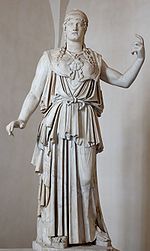
: Athḗnē) derives from goddess Athena
Athena
In Greek mythology, Athena, Athenê, or Athene , also referred to as Pallas Athena/Athene , is the goddess of wisdom, courage, inspiration, civilization, warfare, strength, strategy, the arts, crafts, justice, and skill. Minerva, Athena's Roman incarnation, embodies similar attributes. Athena is...
, its patron goddess. The word originates from an earlier, Pre-Greek
Pelasgians
The name Pelasgians was used by some ancient Greek writers to refer to populations that were either the ancestors of the Greeks or who preceded the Greeks in Greece, "a hold-all term for any ancient, primitive and presumably indigenous people in the Greek world." In general, "Pelasgian" has come...
language. The etiological myth explaining how Athens acquired this name through the legendary contest between Poseidon and Athena was described by Herodotus
Herodotus
Herodotus was an ancient Greek historian who was born in Halicarnassus, Caria and lived in the 5th century BC . He has been called the "Father of History", and was the first historian known to collect his materials systematically, test their accuracy to a certain extent and arrange them in a...
, Apollodorus
Bibliotheca (Pseudo-Apollodorus)
The Bibliotheca , in three books, provides a comprehensive summary of traditional Greek mythology and heroic legends, "the most valuable mythographical work that has come down from ancient times," Aubrey Diller observed, whose "stultifying purpose" was neatly expressed in the epigram noted by...
, Ovid
Ovid
Publius Ovidius Naso , known as Ovid in the English-speaking world, was a Roman poet who is best known as the author of the three major collections of erotic poetry: Heroides, Amores, and Ars Amatoria...
, Plutarch
Plutarch
Plutarch then named, on his becoming a Roman citizen, Lucius Mestrius Plutarchus , c. 46 – 120 AD, was a Greek historian, biographer, essayist, and Middle Platonist known primarily for his Parallel Lives and Moralia...
, Pausanias and more. It even became the theme of the sculpture on the West pediment of the Parthenon
Parthenon
The Parthenon is a temple on the Athenian Acropolis, Greece, dedicated to the Greek goddess Athena, whom the people of Athens considered their virgin patron. Its construction began in 447 BC when the Athenian Empire was at the height of its power. It was completed in 438 BC, although...
. Both Athena
Athena
In Greek mythology, Athena, Athenê, or Athene , also referred to as Pallas Athena/Athene , is the goddess of wisdom, courage, inspiration, civilization, warfare, strength, strategy, the arts, crafts, justice, and skill. Minerva, Athena's Roman incarnation, embodies similar attributes. Athena is...
and Poseidon
Poseidon
Poseidon was the god of the sea, and, as "Earth-Shaker," of the earthquakes in Greek mythology. The name of the sea-god Nethuns in Etruscan was adopted in Latin for Neptune in Roman mythology: both were sea gods analogous to Poseidon...
requested to be patrons of the city and to give their name to it, so they competed with one another for the honour, offering the city one gift each. Poseidon produced a spring
Spring (hydrosphere)
A spring—also known as a rising or resurgence—is a component of the hydrosphere. Specifically, it is any natural situation where water flows to the surface of the earth from underground...
by striking the ground with his trident, symbolizing naval power. Athena created the olive tree, symbolizing peace
Olive branch
The olive branch in Western culture, derived from the customs of Ancient Greece, symbolizes peace or victory and was worn by brides.-Ancient Greece and Rome:...
and prosperity
Prosperity
Prosperity is the state of flourishing, thriving, good fortune and/or successful social status. Prosperity often encompasses wealth but also includes others factors which are independent of wealth to varying degrees, such as happiness and health....
. The Athenians, under their ruler Cecrops
Cecrops I
Cecrops was a mythical king of Athens who is said to have reigned for fifty-six years. The name is not of Greek origin according to Strabo, or it might mean 'face with a tail': it is said that, born from the earth itself, he had his top half shaped like a man and the bottom half in serpent or...
, accepted the olive tree and named the city after Athena. The sacred olive-tree of goddess Athena seems to have survived for many centuries. It was located by the temple of Pandrosus
Pandrosus
Pandrosus was a figure in Greek mythology, and a daughter of Cecrops, sister to Herse and Aglauros....
, next to the Parthenon. During the Persian Wars, the olive tree was burnt together with the other sacred precinct, but according to Herodotus
Herodotus
Herodotus was an ancient Greek historian who was born in Halicarnassus, Caria and lived in the 5th century BC . He has been called the "Father of History", and was the first historian known to collect his materials systematically, test their accuracy to a certain extent and arrange them in a...
a shoot sprung from the stump. So the tree grew up again and survived until the time of Pausanias, i.e. to the 2nd century AD, as he reported in his "Description of Greece, Attica".
In Plato
Plato
Plato , was a Classical Greek philosopher, mathematician, student of Socrates, writer of philosophical dialogues, and founder of the Academy in Athens, the first institution of higher learning in the Western world. Along with his mentor, Socrates, and his student, Aristotle, Plato helped to lay the...
's dialogue Cratylus
Cratylus (dialogue)
Cratylus is the name of a dialogue by Plato. Most modern scholars agree that it was written mostly during Plato's so-called middle period...
, he gives the etymology
Etymology
Etymology is the study of the history of words, their origins, and how their form and meaning have changed over time.For languages with a long written history, etymologists make use of texts in these languages and texts about the languages to gather knowledge about how words were used during...
of the goddess Athena's name based on the view of the ancient Athenians:
|
| Plato, Cratylus, 407b |
Thus for Plato, Athena's name is to be derived from the Greek Ētheonóa (Ή-θεο-νόα) or Atheonóa (Ἀθεονόα) — from god's (theos) mind (nous
Nous
Nous , also called intellect or intelligence, is a philosophical term for the faculty of the human mind which is described in classical philosophy as necessary for understanding what is true or real, very close in meaning to intuition...
).
Athḗnai is a plural form, the Athḗnai, since it was originally a group of ten cities which Theseus
Theseus
For other uses, see Theseus Theseus was the mythical founder-king of Athens, son of Aethra, and fathered by Aegeus and Poseidon, both of whom Aethra had slept with in one night. Theseus was a founder-hero, like Perseus, Cadmus, or Heracles, all of whom battled and overcame foes that were...
unified into one city.
Geographical setting
The site on which Athens stands was first inhabited in the NeolithicNeolithic
The Neolithic Age, Era, or Period, or New Stone Age, was a period in the development of human technology, beginning about 9500 BC in some parts of the Middle East, and later in other parts of the world. It is traditionally considered as the last part of the Stone Age...
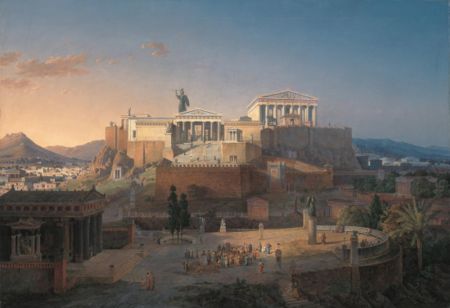
period, perhaps as a defensible settlement on top of the Acropolis
Acropolis of Athens
The Acropolis of Athens or Citadel of Athens is the best known acropolis in the world. Although there are many other acropoleis in Greece, the significance of the Acropolis of Athens is such that it is commonly known as The Acropolis without qualification...
('high city'), around the end of the fourth millennium BC or a little later. The Acropolis is a natural defensive position which commands the surrounding plains. The settlement was about 20 km (12 mi) inland from the Saronic Gulf
Saronic Gulf
The Saronic Gulf or Gulf of Aegina in Greece forms part of the Aegean Sea and defines the eastern side of the isthmus of Corinth. It is the eastern terminus of the Corinth Canal, which cuts across the isthmus.-Geography:The gulf includes the islands of; Aegina, Salamis, and Poros along with...
, in the centre of the Cephisian Plain
Cephissus (Athenian plain)
Cephissus , Kifissós) or Cephisus Kifisos), a river flowing through the Athenian plain.In his summary of Greek mythology Apollodorus declares that Erechtheus' wife Praxithea was daughter of Phrasimus by Diogenia daughter of Cephissus.This river is found in the western part of the...
, a fertile valley surrounded by rivers. To the east lies Mount Hymettus, to the north Mount Pentelicus.
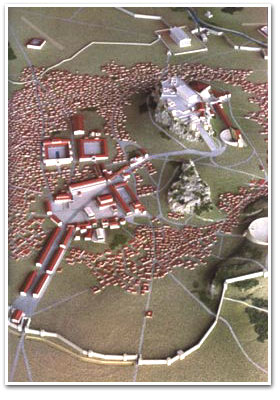
Ancient Athens, in the first millennium BC, occupied a very small area compared to the sprawling metropolis of modern Athens. The ancient walled city encompassed an area measuring about 2 km (1 mi) from east to west and slightly less than that from north to south, although at its peak the ancient city had suburbs extending well beyond these walls. The Acropolis was situated just south of the centre of this walled area. The Agora
Agora
The Agora was an open "place of assembly" in ancient Greek city-states. Early in Greek history , free-born male land-owners who were citizens would gather in the Agora for military duty or to hear statements of the ruling king or council. Later, the Agora also served as a marketplace where...
, the commercial and social centre of the city, lay about 400 m (1,312 ft) north of the Acropolis, in what is now the Monastiraki
Monastiraki
Monastiraki is a flea market neighborhood in the old town of Athens, Greece, and is one of the principal shopping districts in Athens. The area is home to clothing boutiques, souvenir shops, and specialty stores, and is a major tourist attraction in Athens and Attica for bargain shopping...
district. The hill of the Pnyx
Pnyx
The Pnyx is a hill in central Athens, the capital of Greece. It is located less than west of the Acropolis and 1.6 km south-west of the centre of modern Athens, Syntagma Square.-The site:...
, where the Athenian Assembly met, lay at the western end of the city. The Eridanus (Ηριδανός) river flowed through the city.
One of the most important religious sites in ancient Athens was the Temple of Athena, known today as the Parthenon
Parthenon
The Parthenon is a temple on the Athenian Acropolis, Greece, dedicated to the Greek goddess Athena, whom the people of Athens considered their virgin patron. Its construction began in 447 BC when the Athenian Empire was at the height of its power. It was completed in 438 BC, although...
, which stood on top of the Acropolis, where its evocative ruins still stand. Two other major religious sites, the Temple of Hephaestus
Temple of Hephaestus
The Temple of Hephaestus, also known as the Hephaisteion or earlier as the Theseion, is the best-preserved ancient Greek temple; it remains standing largely as built. It is a Doric peripteral temple, and is located at the north-west side of the Agora of Athens, on top of the Agoraios Kolonos hill....
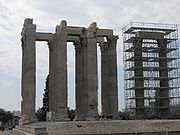
(which is still largely intact) and the Temple of Olympian Zeus or Olympeion (once the largest temple in mainland Greece but now in ruins) also lay within the city walls.
According to the Ancient Greek historian Thucydides
Thucydides
Thucydides was a Greek historian and author from Alimos. His History of the Peloponnesian War recounts the 5th century BC war between Sparta and Athens to the year 411 BC...
, the Athenian citizens at the beginning of the Peloponnesian War
Peloponnesian War
The Peloponnesian War, 431 to 404 BC, was an ancient Greek war fought by Athens and its empire against the Peloponnesian League led by Sparta. Historians have traditionally divided the war into three phases...
(5th century BC) numbered 40,000, making with their families a total of 140,000 people in all. The metics, i.e. those who did not have citizen rights and paid for the right to reside in Athens, numbered a further 70,000, whilst slaves
Slavery
Slavery is a system under which people are treated as property to be bought and sold, and are forced to work. Slaves can be held against their will from the time of their capture, purchase or birth, and deprived of the right to leave, to refuse to work, or to demand compensation...
were estimated at between 150,000 to 400,000. Hence, approximately a tenth of the population were adult male citizens, eligible to meet and vote in the Assembly and be elected to office. After the conquests of Alexander the Great in the 4th century BC, the city's population began to decrease as Greeks migrated to the Hellenistic empires in the East.
Origins and early history
Athens
Athens , is the capital and largest city of Greece. Athens dominates the Attica region and is one of the world's oldest cities, as its recorded history spans around 3,400 years. Classical Athens was a powerful city-state...
has been inhabited from Neolithic
Neolithic
The Neolithic Age, Era, or Period, or New Stone Age, was a period in the development of human technology, beginning about 9500 BC in some parts of the Middle East, and later in other parts of the world. It is traditionally considered as the last part of the Stone Age...
times, possibly from the end of the 4th millennium BC. By 1400 BC the settlement had become an important center of the Mycenaean
Mycenaean Greece
Mycenaean Greece was a cultural period of Bronze Age Greece taking its name from the archaeological site of Mycenae in northeastern Argolis, in the Peloponnese of southern Greece. Athens, Pylos, Thebes, and Tiryns are also important Mycenaean sites...
civilization and the Acropolis was the site of a major Mycenae
Mycenae
Mycenae is an archaeological site in Greece, located about 90 km south-west of Athens, in the north-eastern Peloponnese. Argos is 11 km to the south; Corinth, 48 km to the north...
an fortress whose remains can be recognised from sections of the characteristic Cyclopean walls. On the summit of the Acropolis, below the later Erechtheion, cuttings in the rock have been identified as the location of a Mycenaean palace. Between 1250 and 1200 BC a staircase was built down a cleft in the rock to reach a protected water supply, in a similar way to ones at Mycenae
Mycenae
Mycenae is an archaeological site in Greece, located about 90 km south-west of Athens, in the north-eastern Peloponnese. Argos is 11 km to the south; Corinth, 48 km to the north...
. Unlike other Mycenaean centers, such as Mycenae
Mycenae
Mycenae is an archaeological site in Greece, located about 90 km south-west of Athens, in the north-eastern Peloponnese. Argos is 11 km to the south; Corinth, 48 km to the north...
and Pylos
Pylos
Pylos , historically known under its Italian name Navarino, is a town and a former municipality in Messenia, Peloponnese, Greece. Since the 2011 local government reform it is part of the municipality Pylos-Nestoras, of which it is the seat and a municipal unit. It was the capital of the former...
, we do not know whether Athens suffered destruction in about 1200 BC, an event often attributed to a Dorian invasion, and the Athenians always maintained that they were "pure" Ionia
Ionia
Ionia is an ancient region of central coastal Anatolia in present-day Turkey, the region nearest İzmir, which was historically Smyrna. It consisted of the northernmost territories of the Ionian League of Greek settlements...
ns with no Dorian element. However, Athens, like many other Bronze Age settlements, went into economic decline for around 150 years following this.
Iron Age
Iron Age
The Iron Age is the archaeological period generally occurring after the Bronze Age, marked by the prevalent use of iron. The early period of the age is characterized by the widespread use of iron or steel. The adoption of such material coincided with other changes in society, including differing...
burials, in the Kerameikos and other locations, are often richly provided for and demonstrate that from 900 BC onwards Athens was one of the leading centres of trade and prosperity in the region; as were Lefkandi
Lefkandi
Lefkandi is a coastal village on the island of Euboea. Archaeological finds attest to a settlement on the promontory locally known as Xeropolis, while several associated cemeteries have been identified nearby. The settlement site is located on a promontory overlooking the Euripos, with small bays...
in Euboea
Euboea
Euboea is the second largest Greek island in area and population, after Crete. The narrow Euripus Strait separates it from Boeotia in mainland Greece. In general outline it is a long and narrow, seahorse-shaped island; it is about long, and varies in breadth from to...
and Knossos
Knossos
Knossos , also known as Labyrinth, or Knossos Palace, is the largest Bronze Age archaeological site on Crete and probably the ceremonial and political centre of the Minoan civilization and culture. The palace appears as a maze of workrooms, living spaces, and store rooms close to a central square...
in Crete. This position may well have resulted from its central location in the Greek world, its secure stronghold on the Acropolis and its access to the sea, which gave it a natural advantage over inland rivals such as Thebes and Sparta
Sparta
Sparta or Lacedaemon, was a prominent city-state in ancient Greece, situated on the banks of the River Eurotas in Laconia, in south-eastern Peloponnese. It emerged as a political entity around the 10th century BC, when the invading Dorians subjugated the local, non-Dorian population. From c...
.
According to legend, Athens was formerly ruled by kings (see Kings of Athens), a situation which may have continued up until the 9th century BC. From later accounts, it is believed that these kings stood at the head of a land-owning aristocracy
Aristocracy
Aristocracy , is a form of government in which a few elite citizens rule. The term derives from the Greek aristokratia, meaning "rule of the best". In origin in Ancient Greece, it was conceived of as rule by the best qualified citizens, and contrasted with monarchy...
known as the Eupatridae (the 'well-born'), whose instrument of government was a Council which met on the Hill of Ares
Ares
Ares is the Greek god of war. He is one of the Twelve Olympians, and the son of Zeus and Hera. In Greek literature, he often represents the physical or violent aspect of war, in contrast to the armored Athena, whose functions as a goddess of intelligence include military strategy and...
, called the Areopagus
Areopagus
The Areopagus or Areios Pagos is the "Rock of Ares", north-west of the Acropolis, which in classical times functioned as the high Court of Appeal for criminal and civil cases in Athens. Ares was supposed to have been tried here by the gods for the murder of Poseidon's son Alirrothios .The origin...
and appointed the chief city officials, the archon
Archon
Archon is a Greek word that means "ruler" or "lord", frequently used as the title of a specific public office. It is the masculine present participle of the verb stem ἀρχ-, meaning "to rule", derived from the same root as monarch, hierarchy, and anarchy.- Ancient Greece :In ancient Greece the...
s and the polemarch
Polemarch
A polemarch was a senior military title in various ancient Greek city states . The title is composed out of the polemos and archon and translates as "warleader" or "warlord", one of the nine archontes appointed annually in Athens...
(commander-in-chief).
Before the concept of the political state arose, four tribes based upon family relationships dominated the area. The members had certain rights, privileges, and obligations:
- Common religious rights.
- A common burial place.
- Mutual rights of succession to property of deceased members.
- Reciprocal obligations of help, defense and redress of injuries.
- The right to intermarry in the gensGensIn ancient Rome, a gens , plural gentes, referred to a family, consisting of all those individuals who shared the same nomen and claimed descent from a common ancestor. A branch of a gens was called a stirps . The gens was an important social structure at Rome and throughout Italy during the...
in the cases of orphan daughters and heiresses. - The possession of common property, an archon, and a treasurer.
- The limitation of descent to the male line.
- The obligation not to marry in the gensGensIn ancient Rome, a gens , plural gentes, referred to a family, consisting of all those individuals who shared the same nomen and claimed descent from a common ancestor. A branch of a gens was called a stirps . The gens was an important social structure at Rome and throughout Italy during the...
except in specified cases. - The right to adopt strangers into the gens.
- The right to elect and depose its chiefs.
During this period, Athens succeeded in bringing the other towns of Attica under its rule. This process of synoikismos – the bringing together into one home – created the largest and wealthiest state on the Greek mainland, but it also created a larger class of people excluded from political life by the nobility. By the 7th century BC social unrest had become widespread, and the Areopagus appointed Draco to draft a strict new code of law (hence the word 'draconian'). When this failed, they appointed Solon
Solon
Solon was an Athenian statesman, lawmaker, and poet. He is remembered particularly for his efforts to legislate against political, economic and moral decline in archaic Athens...
, with a mandate to create a new constitution (in 594 BC).
Reform and democracy
Ecclesia (ancient Athens)
The ecclesia or ekklesia was the principal assembly of the democracy of ancient Athens during its "Golden Age" . It was the popular assembly, opened to all male citizens over the age of 30 with 2 years of military service by Solon in 594 BC meaning that all classes of citizens in Athens were able...
(Assembly). But only the upper classes could hold political office. The Areopagus continued to exist but its powers were reduced.
The new system laid the foundations for what eventually became Athenian democracy
Athenian democracy
Athenian democracy developed in the Greek city-state of Athens, comprising the central city-state of Athens and the surrounding territory of Attica, around 508 BC. Athens is one of the first known democracies. Other Greek cities set up democracies, and even though most followed an Athenian model,...
, but in the short-term it failed to quell class conflict and after 20 years of unrest the popular party, led by Peisistratus
Peisistratos (Athens)
Peisistratos was a tyrant of Athens from 546 to 527/8 BC. His legacy lies primarily in his institution of the Panathenaic Festival and the consequent first attempt at producing a definitive version for Homeric epics. Peisistratos' championing of the lower class of Athens, the Hyperakrioi, can be...
, a cousin of Solon, seized power (in 541 BC). Peisistratus is usually called a tyrant
Tyrant
A tyrant was originally one who illegally seized and controlled a governmental power in a polis. Tyrants were a group of individuals who took over many Greek poleis during the uprising of the middle classes in the sixth and seventh centuries BC, ousting the aristocratic governments.Plato and...
, but the Greek word tyrannos does not mean a cruel and despotic ruler, merely one who took power by force. Peisistratus was in fact a very popular ruler, who made Athens wealthy, powerful, and a centre of culture, and instituted Athenian naval supremacy in the Aegean Sea
Aegean Sea
The Aegean Sea[p] is an elongated embayment of the Mediterranean Sea located between the southern Balkan and Anatolian peninsulas, i.e., between the mainlands of Greece and Turkey. In the north, it is connected to the Marmara Sea and Black Sea by the Dardanelles and Bosporus...
and beyond. He preserved the Solonian constitution, but made sure that he and his family held all the offices of state.
Peisistratus died in 527 BC and was succeeded by his sons Hippias
Hippias (son of Pisistratus)
Hippias of Athens was one of the sons of Peisistratus, and was tyrant of Athens in the 6th century BC.Hippias succeeded Peisistratus in 527 BC, and in 525 BC he introduced a new system of coinage in Athens. His brother Hipparchus, who may have ruled jointly with him, was murdered by Harmodius and...
and Hipparchus
Hipparchus (son of Pisistratus)
Hipparchus or Hipparch was a member of the ruling class of Athens. He was one of the sons of Peisistratos.Although he was said among Greeks to have been the tyrant of Athens along with his brother Hippias when Peisistratos died, about 528 BC...
. They proved to be much less adept rulers and in 514 BC, Hipparchus was assassinated in a private dispute over a young man (see Harmodius and Aristogeiton
Harmodius and Aristogeiton
Harmodius and Aristogeiton were two men from ancient Athens...
). This led Hippias to establish a real dictatorship, which proved very unpopular and he was overthrown in 510 BC. A radical politician with an aristocratic background named Cleisthenes
Cleisthenes
Cleisthenes was a noble Athenian of the Alcmaeonid family. He is credited with reforming the constitution of ancient Athens and setting it on a democratic footing in 508/7 BC...
then took charge, and it was he who established democracy in Athens.
The reforms of Cleisthenes replaced the traditional four "tribes" (phyle
Phyle
Phyle is an ancient Greek term for clan or tribe. They were usually ruled by a basileus...
) with ten new ones, named after legendary heroes and having no class basis; they were in fact electorates. Each 'tribe' was in turn divided into three 'trittyes' and each trittys
Trittys
Trittyes were population divisions in ancient Attica, established by the reforms of Cleisthenes in 508 BC. The name means "thirtieth," and there were in fact thirty trittyes in Attica. Each tribe, or phyle of Athens was composed of three trittyes, one from the coast, one from the city, and one...
had one or more deme
Deme
In Ancient Greece, a deme or demos was a subdivision of Attica, the region of Greece surrounding Athens. Demes as simple subdivisions of land in the countryside seem to have existed in the 6th century BC and earlier, but did not acquire particular significance until the reforms of Cleisthenes in...
s, which became the basis of local government. The tribes each elected fifty members to the Boule
Boule (Ancient Greece)
In cities of ancient Greece, the boule meaning to will ) was a council of citizens appointed to run daily affairs of the city...
, a council which governed Athens on a day-to-day basis. The Assembly was open to all citizens and was both a legislature and a supreme court, except in murder cases and religious matters, which became the only remaining functions of the Areopagus. Most offices were filled by lot, although the ten strategoi
Strategos
Strategos, plural strategoi, is used in Greek to mean "general". In the Hellenistic and Byzantine Empires the term was also used to describe a military governor...
(generals) were elected. This system remained remarkably stable and, with a few brief interruptions, it remained in place for 170 years, until Philip II of Macedon
Philip II of Macedon
Philip II of Macedon "friend" + ἵππος "horse" — transliterated ; 382 – 336 BC), was a king of Macedon from 359 BC until his assassination in 336 BC. He was the father of Alexander the Great and Philip III.-Biography:...
defeated Athens at the Battle of Chaeronea
Battle of Chaeronea (338 BC)
The Battle of Chaeronea was fought in 338 BC, near the city of Chaeronea in Boeotia, between the forces of Philip II of Macedon and an alliance of Greek city-states...
in 338 BC.
Early Athenian military history
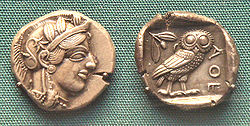
Sparta
Sparta or Lacedaemon, was a prominent city-state in ancient Greece, situated on the banks of the River Eurotas in Laconia, in south-eastern Peloponnese. It emerged as a political entity around the 10th century BC, when the invading Dorians subjugated the local, non-Dorian population. From c...
considered itself to be the leader of the Greeks, or hegemon
Hegemony
Hegemony is an indirect form of imperial dominance in which the hegemon rules sub-ordinate states by the implied means of power rather than direct military force. In Ancient Greece , hegemony denoted the politico–military dominance of a city-state over other city-states...
. In 499 BC Athens sent troops to aid the Ionia
Ionia
Ionia is an ancient region of central coastal Anatolia in present-day Turkey, the region nearest İzmir, which was historically Smyrna. It consisted of the northernmost territories of the Ionian League of Greek settlements...
n Greeks of Asia Minor
Asia Minor
Asia Minor is a geographical location at the westernmost protrusion of Asia, also called Anatolia, and corresponds to the western two thirds of the Asian part of Turkey...
, who were rebelling against the Persian Empire (the Ionian Revolt
Ionian Revolt
The Ionian Revolt, and associated revolts in Aeolis, Doris, Cyprus and Caria, were military rebellions by several regions of Asia Minor against Persian rule, lasting from 499 BC to 493 BC...
). This provoked two Persian invasions on Greece (see Persian Wars). In 490 BC the Athenians, led by the soldier-statesman Miltiades
Miltiades the Younger
Miltiades the Younger or Miltiades IV was the son of one Cimon, a renowned Olympic chariot-racer. Miltiades considered himself a member of the Aeacidae, and is known mostly for his role in the Battle of Marathon; as well as his rather tragic downfall afterwards. His son Cimon was a major Athenian...
, defeated the first invasion of the Persians under Darius I
Darius I of Persia
Darius I , also known as Darius the Great, was the third king of kings of the Achaemenid Empire...
at the Battle of Marathon
Battle of Marathon
The Battle of Marathon took place in 490 BC, during the first Persian invasion of Greece. It was fought between the citizens of Athens, aided by Plataea, and a Persian force commanded by Datis and Artaphernes. It was the culmination of the first attempt by Persia, under King Darius I, to subjugate...
. In 480 BC the Persians returned under Darius's son
Xerxes
Xerxes I of Persia
Xerxes I of Persia , Ḫšayāršā, ), also known as Xerxes the Great, was the fifth king of kings of the Achaemenid Empire.-Youth and rise to power:...
. When a small Greek force holding the pass of Thermopylae
Battle of Thermopylae
The Battle of Thermopylae was fought between an alliance of Greek city-states, led by King Leonidas of Sparta, and the Persian Empire of Xerxes I over the course of three days, during the second Persian invasion of Greece. It took place simultaneously with the naval battle at Artemisium, in August...
was defeated, the Athenians evacuated Athens, which was taken by the Persians. Subsequently the Athenians (led by Themistocles
Themistocles
Themistocles ; c. 524–459 BC, was an Athenian politician and a general. He was one of a new breed of politicians who rose to prominence in the early years of the Athenian democracy, along with his great rival Aristides...
), with their allies, engaged the much larger Persian navy at sea in the Battle of Salamis
Battle of Salamis
The Battle of Salamis was fought between an Alliance of Greek city-states and the Persian Empire in September 480 BCE, in the straits between the mainland and Salamis, an island in the Saronic Gulf near Athens...
. Xerxes built a throne on the coast in order to watch the Greek navy being defeated, but instead, the Persians were routed.
In 479 BC, the Athenians and Spartans, with their allies, defeated the Persian army at the Battle of Plataea
Battle of Plataea
The Battle of Plataea was the final land battle during the second Persian invasion of Greece. It took place in 479 BC near the city of Plataea in Boeotia, and was fought between an alliance of the Greek city-states, including Sparta, Athens, Corinth and Megara, and the Persian Empire of Xerxes...
. However, it was Athens that took the war to Asia Minor. These victories enabled it to bring most of the Aegean and many other parts of Greece together in the Delian League
Delian League
The Delian League, founded in circa 477 BC, was an association of Greek city-states, members numbering between 150 to 173, under the leadership of Athens, whose purpose was to continue fighting the Persian Empire after the Greek victory in the Battle of Plataea at the end of the Greco–Persian Wars...
, an Athenian-dominated alliance.
Artists and philosophers
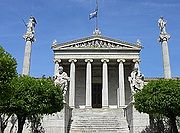
Greek philosophy
Ancient Greek philosophy arose in the 6th century BCE and continued through the Hellenistic period, at which point Ancient Greece was incorporated in the Roman Empire...
) and the arts (Greek theatre). In Athens at this time, the political satire
Political satire
Political satire is a significant part of satire that specializes in gaining entertainment from politics; it has also been used with subversive intent where political speech and dissent are forbidden by a regime, as a method of advancing political arguments where such arguments are expressly...
of the Comic poets at the theatres had a remarkable influence on public opinion
Public opinion
Public opinion is the aggregate of individual attitudes or beliefs held by the adult population. Public opinion can also be defined as the complex collection of opinions of many different people and the sum of all their views....
. Some of the most important figures of Western cultural and intellectual history lived in Athens during this period: the dramatists Aeschylus
Aeschylus
Aeschylus was the first of the three ancient Greek tragedians whose work has survived, the others being Sophocles and Euripides, and is often described as the father of tragedy. His name derives from the Greek word aiskhos , meaning "shame"...
, Aristophanes
Aristophanes
Aristophanes , son of Philippus, of the deme Cydathenaus, was a comic playwright of ancient Athens. Eleven of his forty plays survive virtually complete...
, Euripides
Euripides
Euripides was one of the three great tragedians of classical Athens, the other two being Aeschylus and Sophocles. Some ancient scholars attributed ninety-five plays to him but according to the Suda it was ninety-two at most...
and Sophocles
Sophocles
Sophocles is one of three ancient Greek tragedians whose plays have survived. His first plays were written later than those of Aeschylus, and earlier than or contemporary with those of Euripides...
,the physician Hippocrates
Hippocrates
Hippocrates of Cos or Hippokrates of Kos was an ancient Greek physician of the Age of Pericles , and is considered one of the most outstanding figures in the history of medicine...
, the philosophers Aristotle
Aristotle
Aristotle was a Greek philosopher and polymath, a student of Plato and teacher of Alexander the Great. His writings cover many subjects, including physics, metaphysics, poetry, theater, music, logic, rhetoric, linguistics, politics, government, ethics, biology, and zoology...
, Plato
Plato
Plato , was a Classical Greek philosopher, mathematician, student of Socrates, writer of philosophical dialogues, and founder of the Academy in Athens, the first institution of higher learning in the Western world. Along with his mentor, Socrates, and his student, Aristotle, Plato helped to lay the...
and Socrates
Socrates
Socrates was a classical Greek Athenian philosopher. Credited as one of the founders of Western philosophy, he is an enigmatic figure known chiefly through the accounts of later classical writers, especially the writings of his students Plato and Xenophon, and the plays of his contemporary ...
, the historians Herodotus
Herodotus
Herodotus was an ancient Greek historian who was born in Halicarnassus, Caria and lived in the 5th century BC . He has been called the "Father of History", and was the first historian known to collect his materials systematically, test their accuracy to a certain extent and arrange them in a...
, Thucydides
Thucydides
Thucydides was a Greek historian and author from Alimos. His History of the Peloponnesian War recounts the 5th century BC war between Sparta and Athens to the year 411 BC...
and Xenophon
Xenophon
Xenophon , son of Gryllus, of the deme Erchia of Athens, also known as Xenophon of Athens, was a Greek historian, soldier, mercenary, philosopher and a contemporary and admirer of Socrates...
, the poet Simonides
Simonides of Ceos
Simonides of Ceos was a Greek lyric poet, born at Ioulis on Kea. The scholars of Hellenistic Alexandria included him in the canonical list of nine lyric poets, along with Bacchylides and Pindar...
and the sculptor Phidias
Phidias
Phidias or the great Pheidias , was a Greek sculptor, painter and architect, who lived in the 5th century BC, and is commonly regarded as one of the greatest of all sculptors of Classical Greece: Phidias' Statue of Zeus at Olympia was one of the Seven Wonders of the Ancient World...
, The leading statesman of this period was Pericles
Pericles
Pericles was a prominent and influential statesman, orator, and general of Athens during the city's Golden Age—specifically, the time between the Persian and Peloponnesian wars...
, who used the tribute paid by the members of the Delian League to build the Parthenon
Parthenon
The Parthenon is a temple on the Athenian Acropolis, Greece, dedicated to the Greek goddess Athena, whom the people of Athens considered their virgin patron. Its construction began in 447 BC when the Athenian Empire was at the height of its power. It was completed in 438 BC, although...
and other great monuments of classical Athens. The city became, in Pericles's words, "the school of Hellas [Greece]."
Peloponnesian War
The resentment felt by other cities at the hegemony of Athens led to the Peloponnesian WarPeloponnesian War
The Peloponnesian War, 431 to 404 BC, was an ancient Greek war fought by Athens and its empire against the Peloponnesian League led by Sparta. Historians have traditionally divided the war into three phases...
, which began in 431 BC and pitted Athens and its increasingly rebellious overseas empire against a coalition of land-based states led by Sparta
Sparta
Sparta or Lacedaemon, was a prominent city-state in ancient Greece, situated on the banks of the River Eurotas in Laconia, in south-eastern Peloponnese. It emerged as a political entity around the 10th century BC, when the invading Dorians subjugated the local, non-Dorian population. From c...
. The conflict led to the end of Athenian command of the sea
Command of the sea
A naval force has command of the sea when it is so strong that its rivals cannot attack it directly. Also called sea control, this dominance may apply to its surrounding waters or may extend far into the oceans, meaning the country has a blue-water navy...
. The war between the two city-states ended in a victory for Sparta.
During the second year of the Peloponnesian War, the city-state
City-state
A city-state is an independent or autonomous entity whose territory consists of a city which is not administered as a part of another local government.-Historical city-states:...
of Athens was hit by a devastating epidemic, known as the Plague of Athens
Plague of Athens
The Plague of Athens was a devastating epidemic which hit the city-state of Athens in ancient Greece during the second year of the Peloponnesian War , when an Athenian victory still seemed within reach. It is believed to have entered Athens through Piraeus, the city's port and sole source of food...
, which killed, among others, Pericles
Pericles
Pericles was a prominent and influential statesman, orator, and general of Athens during the city's Golden Age—specifically, the time between the Persian and Peloponnesian wars...
and his two elder sons. Athens lost perhaps one third of the people sheltered within its walls.
Athenian coup of 411 BC
The democracy in Athens was briefly overthrown by a coup in 411 BC, due to its poor handling of the war, but it was quickly restored. The war ended in 404 BC with the complete defeat of Athens. Since the loss of the war was largely blamed on democratic politicians such as CleonCleon
Cleon was an Athenian statesman and a Strategos during the Peloponnesian War. He was the first prominent representative of the commercial class in Athenian politics, although he was an aristocrat himself...
and Cleophon, there was a brief reaction against democracy, aided by the Spartan army (the rule of the Thirty Tyrants
Thirty Tyrants
The Thirty Tyrants were a pro-Spartan oligarchy installed in Athens after its defeat in the Peloponnesian War in 404 BC. Contemporary Athenians referred to them simply as "the oligarchy" or "the Thirty" ; the expression "Thirty Tyrants" is due to later historians...
). In 403 BC, however, democracy was restored by Thrasybulus
Thrasybulus
Thrasybulus was an Athenian general and democratic leader. In 411 BC, in the wake of an oligarchic coup at Athens, the pro-democracy sailors at Samos elected him as a general, making him a primary leader of the successful democratic resistance to that coup...
and an amnesty declared.
Corinthian War and the Second Athenian League
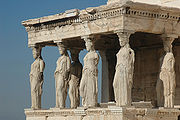
Thebes, Greece
Thebes is a city in Greece, situated to the north of the Cithaeron range, which divides Boeotia from Attica, and on the southern edge of the Boeotian plain. It played an important role in Greek myth, as the site of the stories of Cadmus, Oedipus, Dionysus and others...
and Corinth
Corinth
Corinth is a city and former municipality in Corinthia, Peloponnese, Greece. Since the 2011 local government reform it is part of the municipality Corinth, of which it is the seat and a municipal unit...
had become her allies; they fought with Athens
Athens
Athens , is the capital and largest city of Greece. Athens dominates the Attica region and is one of the world's oldest cities, as its recorded history spans around 3,400 years. Classical Athens was a powerful city-state...
and Argos
Argos
Argos is a city and a former municipality in Argolis, Peloponnese, Greece. Since the 2011 local government reform it is part of the municipality Argos-Mykines, of which it is a municipal unit. It is 11 kilometres from Nafplion, which was its historic harbour...
against Sparta
Sparta
Sparta or Lacedaemon, was a prominent city-state in ancient Greece, situated on the banks of the River Eurotas in Laconia, in south-eastern Peloponnese. It emerged as a political entity around the 10th century BC, when the invading Dorians subjugated the local, non-Dorian population. From c...
in the indecisive Corinthian War
Corinthian War
The Corinthian War was an ancient Greek conflict lasting from 395 BC until 387 BC, pitting Sparta against a coalition of four allied states; Thebes, Athens, Corinth, and Argos; which were initially backed by Persia. The immediate cause of the war was a local conflict in northwest Greece in which...
(395 – 387 BC). Opposition to Sparta enabled Athens to establish a Second Athenian League. Finally Thebes
Thebes, Greece
Thebes is a city in Greece, situated to the north of the Cithaeron range, which divides Boeotia from Attica, and on the southern edge of the Boeotian plain. It played an important role in Greek myth, as the site of the stories of Cadmus, Oedipus, Dionysus and others...
defeated Sparta in 371 BC in the Battle of Leuctra
Battle of Leuctra
The Battle of Leuctra was a battle fought on July 6, 371 BC, between the Boeotians led by Thebans and the Spartans along with their allies amidst the post-Corinthian War conflict. The battle took place in the neighbourhood of Leuctra, a village in Boeotia in the territory of Thespiae...
. But then the Greek cities (including Athens and Sparta) turned against Thebes
Thebes, Greece
Thebes is a city in Greece, situated to the north of the Cithaeron range, which divides Boeotia from Attica, and on the southern edge of the Boeotian plain. It played an important role in Greek myth, as the site of the stories of Cadmus, Oedipus, Dionysus and others...
, whose dominance was stopped at the Battle of Mantinea (362 BC)
Battle of Mantinea (362 BC)
The Battle of Mantinea was fought on July 4 362 BC between the Thebans, led by Epaminondas and supported by the Arcadians and the Boeotian league against the Spartans, led by King Agesilaus II and supported by the Eleans, Athenians, and Mantineans...
with the death of its military-genius leader Epaminondas
Epaminondas
Epaminondas , or Epameinondas, was a Theban general and statesman of the 4th century BC who transformed the Ancient Greek city-state of Thebes, leading it out of Spartan subjugation into a preeminent position in Greek politics...
.
Athens under Macedon
By the mid-4th century BC, however, the northern Greek kingdom of MacedonMacedon
Macedonia or Macedon was an ancient kingdom, centered in the northeastern part of the Greek peninsula, bordered by Epirus to the west, Paeonia to the north, the region of Thrace to the east and Thessaly to the south....
was becoming dominant in Athenian affairs, despite the warnings of the last great statesman of independent Athens, Demosthenes
Demosthenes
Demosthenes was a prominent Greek statesman and orator of ancient Athens. His orations constitute a significant expression of contemporary Athenian intellectual prowess and provide an insight into the politics and culture of ancient Greece during the 4th century BC. Demosthenes learned rhetoric by...
. In 338 BC the armies of Philip II
Philip II of Macedon
Philip II of Macedon "friend" + ἵππος "horse" — transliterated ; 382 – 336 BC), was a king of Macedon from 359 BC until his assassination in 336 BC. He was the father of Alexander the Great and Philip III.-Biography:...
defeated the other Greek cities at the Battle of Chaeronea
Battle of Chaeronea (338 BC)
The Battle of Chaeronea was fought in 338 BC, near the city of Chaeronea in Boeotia, between the forces of Philip II of Macedon and an alliance of Greek city-states...
, effectively ending Athenian independence. Subsequently, the conquests of his son Alexander the Great widened Greek horizons and made the traditional Greek city state obsolete. Athens remained a wealthy city with a brilliant cultural life, but ceased to be a fully independent power.
Hellenistic Athens
Roman Athens
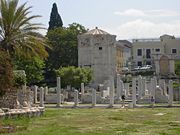
Lucius Cornelius Sulla
Lucius Cornelius Sulla Felix , known commonly as Sulla, was a Roman general and statesman. He had the rare distinction of holding the office of consul twice, as well as that of dictator...
, although many civic buildings and monuments were left intact. Under Rome, Athens was given the status of a free city because of its widely admired schools. The Roman emperor Hadrian, in the 2nd century AD, constructed a library, a gymnasium, an aqueduct which is still in use, several temples and sanctuaries, a bridge and financed the completion of the Temple of Olympian Zeus.
The city was sacked by the Heruli
Heruli
The Heruli were an East Germanic tribe who are famous for their naval exploits. Migrating from Northern Europe to the Black Sea in the third century They were part of the...
in AD 267, resulting in the burning of all the public buildings, the plundering of the lower city and the damaging of the Agora
Agora
The Agora was an open "place of assembly" in ancient Greek city-states. Early in Greek history , free-born male land-owners who were citizens would gather in the Agora for military duty or to hear statements of the ruling king or council. Later, the Agora also served as a marketplace where...
and Acropolis
Acropolis
Acropolis means "high city" in Greek, literally city on the extremity and is usually translated into English as Citadel . For purposes of defense, early people naturally chose elevated ground to build a new settlement, frequently a hill with precipitous sides...
. After this the city to the north of the Acropolis was hastily refortified on a smaller scale, with the Agora left outside the walls. Athens remained a centre of learning and philosophy during its 500 years of Roman rule, patronized by emperors such as Nero
Nero
Nero , was Roman Emperor from 54 to 68, and the last in the Julio-Claudian dynasty. Nero was adopted by his great-uncle Claudius to become his heir and successor, and succeeded to the throne in 54 following Claudius' death....
and Hadrian
Hadrian
Hadrian , was Roman Emperor from 117 to 138. He is best known for building Hadrian's Wall, which marked the northern limit of Roman Britain. In Rome, he re-built the Pantheon and constructed the Temple of Venus and Roma. In addition to being emperor, Hadrian was a humanist and was philhellene in...
. But the conversion of the Empire to Christianity
Christianity
Christianity is a monotheistic religion based on the life and teachings of Jesus as presented in canonical gospels and other New Testament writings...
ended the city's role as a centre of pagan learning; the Emperor Justinian
Justinian I
Justinian I ; , ; 483– 13 or 14 November 565), commonly known as Justinian the Great, was Byzantine Emperor from 527 to 565. During his reign, Justinian sought to revive the Empire's greatness and reconquer the lost western half of the classical Roman Empire.One of the most important figures of...
closed the schools of philosophy in AD 529. This is generally taken to mark the end of the ancient history of Athens.
Byzantine Athens
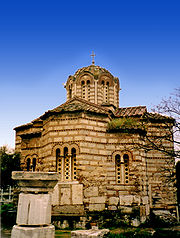
Byzantine Empire
The Byzantine Empire was the Eastern Roman Empire during the periods of Late Antiquity and the Middle Ages, centred on the capital of Constantinople. Known simply as the Roman Empire or Romania to its inhabitants and neighbours, the Empire was the direct continuation of the Ancient Roman State...
, Athens was a provincial town and experienced fluctuating fortunes. In the early years of Byzantine rule, many of its works of art were taken by the emperors to Constantinople
Constantinople
Constantinople was the capital of the Roman, Eastern Roman, Byzantine, Latin, and Ottoman Empires. Throughout most of the Middle Ages, Constantinople was Europe's largest and wealthiest city.-Names:...
. From about AD 600 the city shrank considerably, due to barbarian raids by the Avars
Eurasian Avars
The Eurasian Avars or Ancient Avars were a highly organized nomadic confederacy of mixed origins. They were ruled by a khagan, who was surrounded by a tight-knit entourage of nomad warriors, an organization characteristic of Turko-Mongol groups...
and Slavs, and it was reduced to a shadow of its former self. As the 7th century progressed, much of Greece was overrun by Slavic peoples
Slavic peoples
The Slavic people are an Indo-European panethnicity living in Eastern Europe, Southeast Europe, North Asia and Central Asia. The term Slavic represents a broad ethno-linguistic group of people, who speak languages belonging to the Slavic language family and share, to varying degrees, certain...
from the north, and Athens entered a period of uncertainty and insecurity. The one notable figure from this period is the Empress Irene of Athens, a native Athenian, who seized control of the Byzantine Empire in a palace coup.
By the middle of the 9th century, Greece had been fully reconquered by the Byzantine Empire
Byzantine Empire
The Byzantine Empire was the Eastern Roman Empire during the periods of Late Antiquity and the Middle Ages, centred on the capital of Constantinople. Known simply as the Roman Empire or Romania to its inhabitants and neighbours, the Empire was the direct continuation of the Ancient Roman State...
and the city began to recover. Just as other cities benefited from improved security and the restoration of effective central control during this period, so Athens expanded once more.
Invasion of the empire by the Turks after the battle of Manzikert in 1071, and the ensuing civil wars, largely passed the region by and Athens continued its provincial existence unharmed. When the Byzantine Empire
Byzantine Empire
The Byzantine Empire was the Eastern Roman Empire during the periods of Late Antiquity and the Middle Ages, centred on the capital of Constantinople. Known simply as the Roman Empire or Romania to its inhabitants and neighbours, the Empire was the direct continuation of the Ancient Roman State...
was rescued by the resolute leadership of the three Komnenos
Komnenos
Komnenós or Comnenus was the name of a ruling family of the Eastern Roman Empire , who halted the political decline of the Empire from c.1081 to c.1185.-Origins:...
emperors Alexios
Alexios I Komnenos
Alexios I Komnenos, Latinized as Alexius I Comnenus , was Byzantine emperor from 1081 to 1118, and although he was not the founder of the Komnenian dynasty, it was during his reign that the Komnenos family came to full power. The title 'Nobilissimus' was given to senior army commanders,...
, John
John II Komnenos
John II Komnenos was Byzantine Emperor from 1118 to 1143. Also known as Kaloïōannēs , he was the eldest son of Emperor Alexios I Komnenos and Irene Doukaina...
and Manuel
Manuel I Komnenos
Manuel I Komnenos was a Byzantine Emperor of the 12th century who reigned over a crucial turning point in the history of Byzantium and the Mediterranean....
, Attica and the rest of Greece prospered. Archaeological evidence tells us that the medieval town experienced a period of rapid and sustained growth, starting in the 11th century and continuing until the end of the 12th century. The agora or marketplace, which had been deserted since late antiquity, began to be built over, and soon the town became an important centre for the production of soaps and dyes. The growth of the town attracted the Venetians
Venice
Venice is a city in northern Italy which is renowned for the beauty of its setting, its architecture and its artworks. It is the capital of the Veneto region...
, and various other traders who frequented the ports of the Aegean, to Athens. This interest in trade appears to have further increased the economic prosperity of the town.
The 11th and 12th centuries were the Golden Age of Byzantine art
Byzantine art
Byzantine art is the term commonly used to describe the artistic products of the Byzantine Empire from about the 5th century until the Fall of Constantinople in 1453....
in Athens. Almost all of the most important Middle Byzantine churches in and around Athens were built during these two centuries, and this reflects the growth of the town in general. However, this medieval prosperity was not to last. In 1204, the Fourth Crusade
Fourth Crusade
The Fourth Crusade was originally intended to conquer Muslim-controlled Jerusalem by means of an invasion through Egypt. Instead, in April 1204, the Crusaders of Western Europe invaded and conquered the Christian city of Constantinople, capital of the Eastern Roman Empire...
conquered Athens and the city was not recovered from the Latins before it was taken by the Ottoman Turks
Ottoman Turks
The Ottoman Turks were the Turkish-speaking population of the Ottoman Empire who formed the base of the state's military and ruling classes. Reliable information about the early history of Ottoman Turks is scarce, but they take their Turkish name, Osmanlı , from the house of Osman I The Ottoman...
. It did not become Greek in government again until the 19th century.
Latin Athens
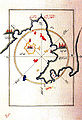
Burgundian period
Athens was initially the capital of the eponymous Duchy of AthensDuchy of Athens
The Duchy of Athens was one of the Crusader States set up in Greece after the conquest of the Byzantine Empire during the Fourth Crusade, encompassing the regions of Attica and Boeotia, and surviving until its conquest by the Ottoman Empire in the 15th century....
, a fief of the Latin Empire
Latin Empire
The Latin Empire or Latin Empire of Constantinople is the name given by historians to the feudal Crusader state founded by the leaders of the Fourth Crusade on lands captured from the Byzantine Empire. It was established after the capture of Constantinople in 1204 and lasted until 1261...
which replaced Byzantium. After Thebes
Thebes, Greece
Thebes is a city in Greece, situated to the north of the Cithaeron range, which divides Boeotia from Attica, and on the southern edge of the Boeotian plain. It played an important role in Greek myth, as the site of the stories of Cadmus, Oedipus, Dionysus and others...
became a possession of the Latin dukes, which were of the Burgundian
Burgundians
The Burgundians were an East Germanic tribe which may have emigrated from mainland Scandinavia to the island of Bornholm, whose old form in Old Norse still was Burgundarholmr , and from there to mainland Europe...
family called De la Roche, it replaced Athens as the capital and seat of government, although Athens remained the most influential ecclesiastical centre in the duchy and site of a prime fortress. Under the Burgundian dukes, a bell tower was added to the Parthenon. The Burgundians brought chivalry
Chivalry
Chivalry is a term related to the medieval institution of knighthood which has an aristocratic military origin of individual training and service to others. Chivalry was also the term used to refer to a group of mounted men-at-arms as well as to martial valour...
and tournaments
Tournament (medieval)
A tournament, or tourney is the name popularly given to chivalrous competitions or mock fights of the Middle Ages and Renaissance . It is one of various types of hastiludes....
to Athens; they also fortified the Acropolis. They were themselves influenced by Byzantine Greek culture.
Catalan period
In 1311, Athens was conquered by the Catalan CompanyCatalan Company
The Catalan Company of the East , officially the Magnas Societas Catalanorum, sometimes called the Grand Company and widely known as the Catalan Company, was a free company of mercenaries founded by Roger de Flor in the early 14th-century...
, a band of mercenaries called Almogavars
Almogavars
The almogavars were a class of soldiers from the Crown of Aragon, well-known during the Christian Reconquista of the Iberian Peninsula. They were much employed as mercenaries in Italy, Latin Greece and the Levant during the 13th and 14th centuries.-History:The Almogavars came mainly from the...
. It was held by the Catalans until 1388. After 1379, when Thebes was lost, Athens became the capital of the duchy again.
The history of Catalan Athens, called Cetines (rarely Athenes) by the conquerors, is obscure. Athens was a veguería
Vegueria
The vegueria was the feudal administrative territorial jurisdiction of the Principality of Catalonia during the Middle Ages and into the Modern Era until the Nueva Planta decrees of 1716...
with its own castellan, captain, and veguer. At some point during the Catalan period, the Acropolis was further fortified and the Athenian archdiocese received an extra two suffragan sees.
Florentine period
In 1388, the FlorentineFlorence
Florence is the capital city of the Italian region of Tuscany and of the province of Florence. It is the most populous city in Tuscany, with approximately 370,000 inhabitants, expanding to over 1.5 million in the metropolitan area....
Nerio I Acciajuoli took the city and made himself duke. The Florentines had to dispute the city with the Republic of Venice
Republic of Venice
The Republic of Venice or Venetian Republic was a state originating from the city of Venice in Northeastern Italy. It existed for over a millennium, from the late 7th century until 1797. It was formally known as the Most Serene Republic of Venice and is often referred to as La Serenissima, in...
, but they ultimately emerged victorious after seven years of Venetian rule (1395–1402). The descendants of Nerio I Acciajuoli ruled the city (as their capital) until the Turkish conquest of 1458. It was the last Latin state in Greece to fall.
Ottoman Athens
Finally, in 1458, Athens fell to the Ottoman EmpireOttoman Empire
The Ottoman EmpireIt was usually referred to as the "Ottoman Empire", the "Turkish Empire", the "Ottoman Caliphate" or more commonly "Turkey" by its contemporaries...
. As the Ottoman Sultan Mehmet II the Conqueror rode into the city, he was greatly struck by the beauty of its ancient monuments and issued a firman (imperial edict) forbidding their looting or destruction, on pain of death. The Parthenon
Parthenon
The Parthenon is a temple on the Athenian Acropolis, Greece, dedicated to the Greek goddess Athena, whom the people of Athens considered their virgin patron. Its construction began in 447 BC when the Athenian Empire was at the height of its power. It was completed in 438 BC, although...
was converted into Athens' main mosque
Mosque
A mosque is a place of worship for followers of Islam. The word is likely to have entered the English language through French , from Portuguese , from Spanish , and from Berber , ultimately originating in — . The Arabic word masjid literally means a place of prostration...
. The 375-year Ottoman rule of Athens (and of Greece in general) was the longest by any non-Hellenic power since the Romans.
Despite the initial efforts of the Ottoman authorities to turn Athens into a model provincial capital, the city's population severely declined and by the 17th century the city was little more than a village. Great damage to Athens was caused during this time, as the Ottoman power was declining. The Turks began a practice of storing gun powder and explosives in the Parthenon and Propylaea. In 1640, a lighting bolt struck the Propylaea, causing its destruction. In 1687, Athens was besieged by the Venetians during the Morean War
Morean War
The Morean War is the better known name for the Sixth Ottoman–Venetian War. The war was fought between 1684–1699, as part of the wider conflict known as the "Great Turkish War", between the Republic of Venice and the Ottoman Empire...
, and the temple of Athena Nike was dismantled by the Ottomans to fortify the Parthenon. A shot fired during the bombardment of the Acropolis caused a powder magazine in the Parthenon to explode, and the building was severely damaged, giving it the appearance we see today. The occupation of the Acropolis continued for six months and both the Venetians and the Ottomans participated in the looting of the Parthenon. One of its western pediments was removed, causing even more damage to the structure. The following year, Turkish forces set fire to the city. Ancient monuments were destroyed to provide material for a new wall which the Ottomans built around the city in 1778. Between 1801 and 1805 Lord Elgin
Thomas Bruce, 7th Earl of Elgin
Thomas Bruce, 7th Earl of Elgin and 11th Earl of Kincardine was a Scottish nobleman and diplomat, known for the removal of marble sculptures from the Parthenon in Athens. Elgin was the second son of Charles Bruce, 5th Earl of Elgin and his wife Martha Whyte...
, the British ambassador to the Ottoman Empire, arranged for the removal of many sculptures from the Parthenon (the Elgin marbles
Elgin Marbles
The Parthenon Marbles, forming a part of the collection known as the Elgin Marbles , are a collection of classical Greek marble sculptures , inscriptions and architectural members that originally were part of the Parthenon and other buildings on the Acropolis of Athens...
). Along with the Panathenaic frieze, one of the six caryatids of the Erechtheion was extracted and replaced with a plaster mold. All in all, fifty pieces of sculpture were carried away, including three fragments purchased by the French.
Nevertheless, Athens produced some notable intellectuals during this era, such as Demetrius Chalcondyles
Demetrius Chalcondyles
Demetrios Chalkokondyles, latinized as Demetrius Chalcocondyles and found variously as Demetricocondyles, Chalcocondylas or Chalcondyles , was a Greek humanist, scholar and Professor who taught the Greek language in Italy for over forty years; at Padua, Perugia, Milan and Florence...
(1424–1511), who became a celebrated Renaissance teacher of Greek and of Platonic philosophy in Italy. Chalcondyles published the first printed editions of Homer
Homer
In the Western classical tradition Homer , is the author of the Iliad and the Odyssey, and is revered as the greatest ancient Greek epic poet. These epics lie at the beginning of the Western canon of literature, and have had an enormous influence on the history of literature.When he lived is...
(in 1488), of Isocrates
Isocrates
Isocrates , an ancient Greek rhetorician, was one of the ten Attic orators. In his time, he was probably the most influential rhetorician in Greece and made many contributions to rhetoric and education through his teaching and written works....
(in 1493), and of the Suda
Suda
The Suda or Souda is a massive 10th century Byzantine encyclopedia of the ancient Mediterranean world, formerly attributed to an author called Suidas. It is an encyclopedic lexicon, written in Greek, with 30,000 entries, many drawing from ancient sources that have since been lost, and often...
lexicon (in 1499), and a Greek grammar (Erotemata). His cousin Laonicus Chalcondyles
Laonicus Chalcondyles
Laonikos Chalkokondyles, latinized as Laonicus Chalcondyles was a Byzantine Greek scholar from Athens.- Life :He was a Byzantine historian, son of George and cousin of Demetrios Chalcocondylas...
(c. 1423 – 1490) was also a native of Athens, a notable scholar and Byzantine historian and one of the most valuable of the later Greek historians. He was the author of the valuable work Historiarum Demonstrationes (Demonstrations of History) and was a great admirer of the ancient writer Herodotus
Herodotus
Herodotus was an ancient Greek historian who was born in Halicarnassus, Caria and lived in the 5th century BC . He has been called the "Father of History", and was the first historian known to collect his materials systematically, test their accuracy to a certain extent and arrange them in a...
, encouraging the interest of contemporary Italian humanists in that ancient historian. In the 17th century, Athenian-born Leonardos Philaras (c. 1595 – 1673), was a Greek scholar, politician, diplomat, advisor and the Duke of Parma's ambassador to the French court, spending much of his career trying to persuade western Europe
Western Europe
Western Europe is a loose term for the collection of countries in the western most region of the European continents, though this definition is context-dependent and carries cultural and political connotations. One definition describes Western Europe as a geographic entity—the region lying in the...
an intellectuals to support Greek indepencence
Greek War of Independence
The Greek War of Independence, also known as the Greek Revolution was a successful war of independence waged by the Greek revolutionaries between...
.
Independence from the Ottomans
In 1822, a Greek insurgency captured the city, but it fell to the Ottomans again in 1826. Again the ancient monuments suffered badly. Partially funded by Lord Byron, the Greeks continued to fight, but the Ottoman forces remained in possession until 1833, when they withdrew. Athens was chosen to be the capital of the newly established kingdom of Greece. At that time, the city was virtually uninhabited, being merely a cluster of buildings at the foot of the Acropolis, where the Plaka district is now.Modern Athens
In 1832, OttoOtto of Greece
Otto, Prince of Bavaria, then Othon, King of Greece was made the first modern King of Greece in 1832 under the Convention of London, whereby Greece became a new independent kingdom under the protection of the Great Powers .The second son of the philhellene King Ludwig I of Bavaria, Otto ascended...
, Prince of Bavaria
Bavaria
Bavaria, formally the Free State of Bavaria is a state of Germany, located in the southeast of Germany. With an area of , it is the largest state by area, forming almost 20% of the total land area of Germany...
, was proclaimed King of Greece. He adopted the Greek spelling of his name, King Othon, as well as Greek national dress, and made it one of his first tasks as king to conduct a detailed archaeological and topographical survey of Athens, his new capital. He assigned Gustav Eduard Schaubert and Stamatios Kleanthes to complete this task. At that time, Athens had a population of only 4,000 – 5,000 people, located in what today covers the district of Plaka
Plaka
Pláka is the old historical neighborhood of Athens, clustered around the northern and eastern slopes of the Acropolis, and incorporating labyrinthine streets and neoclassical architecture. Plaka is built on top of the residential areas of the ancient town of Athens...
in Athens.
Athens was chosen as the Greek capital for historical and sentimental reasons. There are few buildings dating from the period of the Byzantine Empire or the 18th century. Once the capital was established, a modern city plan was laid out and public buildings were erected. The finest legacy of this period are the buildings of the University of Athens (1837), the Old Royal Palace
Hellenic Parliament
The Hellenic Parliament , also the Parliament of the Hellenes, is the Parliament of Greece, located in the Parliament House , overlooking Syntagma Square in Athens, Greece....
(now the Greek Parliament Building) (1843), the National Gardens of Athens
National Gardens of Athens
The National Garden is a public park of in the center of the Greek capital, Athens. It is located directly behind the Greek Parliament building and continues to the South to the area where the Zappeion is located, across from the Panathenaiko or Kalimarmaro Olympic Stadium of the 1896 Olympic...
(1840), the National Library of Greece
National Library of Greece
The National Library of Greece is situated near the center of city of Athens. It was designed by the Danish architect Theophil Freiherr von Hansen, as part of his famous Trilogy of neo-classical buildings including the Academy of Athens and the original building of the Athens...
(1842), the Greek National Academy (1885), the Zappeion
Zappeion
The Zappeion is a building in the National Gardens of Athens in the heart of Athens, Greece. It is generally used for meetings and ceremonies, both official and private.-Constructing the Zappeion:...
Exhibition Hall (1878), the Old Parliament Building
Old Parliament House, Athens
The Old Parliament building at Stadiou Street in Athens, housed the Greek Parliament between 1875 and 1932. It now houses the country's National Historical Museum .-History:...
(1858), the New Royal Palace
New Royal Palace
The Presidential Mansion in Athens, Greece, is the official residence of the President of the Hellenic Republic. It previously served as the Royal Palace, until the abolition of the monarchy by referendum in 1974.- History :...
(now the Presidential Palace) (1897) and the Athens Town Hall (1874).
Population influx
Athens experienced its first period of explosive growth following the disastrous war with TurkeyTurkey
Turkey , known officially as the Republic of Turkey , is a Eurasian country located in Western Asia and in East Thrace in Southeastern Europe...
in 1921, when more than a million Greek refugees from Asia Minor
Asia Minor
Asia Minor is a geographical location at the westernmost protrusion of Asia, also called Anatolia, and corresponds to the western two thirds of the Asian part of Turkey...
were resettled in Greece. Suburbs such as Nea Ionia
Nea Ionia
Nea Ionia is a northern suburb of Athens, Greece, and a municipality of the Attica region. It has a surface train station . The suburb was named after Ionia, the region in Anatolia from which many Greeks migrated in the 1920s following the Population exchange between Greece and Turkey. It is...
and Nea Smyrni
Nea Smyrni
Nea Smyrni is a southern suburb of Athens, Greece. Nea Smyrni is located about 5 km SW of downtown Athens, about 5 km SW of Kifissias Avenue, W of Vouliagmenis Avenue, about 6 km E of Piraeus, and NE of Poseidonos Avenue....
began as refugee settlements on the Athens outskirts.
Athens under the Nazis
Athens was occupied by the Germans during World War IIWorld War II
World War II, or the Second World War , was a global conflict lasting from 1939 to 1945, involving most of the world's nations—including all of the great powers—eventually forming two opposing military alliances: the Allies and the Axis...
and experienced terrible privations during the later years of the war. In 1944 there was heavy fighting in the city between Communist
Communist Party of Greece
Founded in 1918, the Communist Party of Greece , better known by its acronym, ΚΚΕ , is the oldest party on the Greek political scene.- Foundation :...
forces and the royalists backed by the British.
Postwar Athens
After World War II the city began to grow again as people migrated from the villages and islands to find work. Greek entry into the European UnionEuropean Union
The European Union is an economic and political union of 27 independent member states which are located primarily in Europe. The EU traces its origins from the European Coal and Steel Community and the European Economic Community , formed by six countries in 1958...
in 1981 brought a flood of new investment to the city, but also increasing social and environmental problems. Athens had some of the worst traffic congestion and air pollution in the world at that time. This posed a new threat to the ancient monuments of Athens, as traffic vibration weakened foundations and air pollution corroded marble. The city's environmental and infrastructure problems were the main reason why Athens failed to secure the 1996 centenary Olympic Games
1996 Summer Olympics
The 1996 Summer Olympics of Atlanta, officially known as the Games of the XXVI Olympiad and unofficially known as the Centennial Olympics, was an international multi-sport event which was celebrated in 1996 in Atlanta, Georgia, United States....
.
Athens today
Following the failed attempt to secure the 1996 Summer Olympics1996 Summer Olympics
The 1996 Summer Olympics of Atlanta, officially known as the Games of the XXVI Olympiad and unofficially known as the Centennial Olympics, was an international multi-sport event which was celebrated in 1996 in Atlanta, Georgia, United States....
, both the city of Athens and the Greek government, aided by European Union funds, undertook major infrastructure projects such as the new Athens Airport and a new metro system. The city also tackled air pollution by restricting the use of cars in the centre of the city. As a result, Athens was awarded the 2004 Olympic Games
2004 Summer Olympics
The 2004 Summer Olympic Games, officially known as the Games of the XXVIII Olympiad, was a premier international multi-sport event held in Athens, Greece from August 13 to August 29, 2004 with the motto Welcome Home. 10,625 athletes competed, some 600 more than expected, accompanied by 5,501 team...
. Despite the scepticism of many observers, the games were a great success and brought renewed international prestige (and tourism revenue) to Athens.
Recent historical population

| Year | City population | Urban population | Metro population |
|---|---|---|---|
| 1833 | 4,000 | – | – |
| 1870 | 44,500 | – | – |
| 1896 | 123,000 | – | – |
| 1921 (Pre-Population exchange) | 473,000 | – | – |
| 1921 (Post-Population exchange Population exchange between Greece and Turkey The 1923 population exchange between Greece and Turkey was based upon religious identity, and involved the Greek Orthodox citizens of Turkey and the Muslim citizens of Greece... ) |
718,000 | – | – |
| 1971 | 867,023 | – | – |
| 1981 | 885,737 | – | – |
| 1991 | 772,072 | – | 3,444,358 |
| 2001 | 745,514 | 3,130,841 | 3,761,810 |
Notable Athenians
- AeschylusAeschylusAeschylus was the first of the three ancient Greek tragedians whose work has survived, the others being Sophocles and Euripides, and is often described as the father of tragedy. His name derives from the Greek word aiskhos , meaning "shame"...
- AlcibiadesAlcibiadesAlcibiades, son of Clinias, from the deme of Scambonidae , was a prominent Athenian statesman, orator, and general. He was the last famous member of his mother's aristocratic family, the Alcmaeonidae, which fell from prominence after the Peloponnesian War...
- AristophanesAristophanesAristophanes , son of Philippus, of the deme Cydathenaus, was a comic playwright of ancient Athens. Eleven of his forty plays survive virtually complete...
- AspasiaAspasiaAspasia was a Milesian woman who was famous for her involvement with the Athenian statesman Pericles. Very little is known about the details of her life. She spent most of her adult life in Athens, and she may have influenced Pericles and Athenian politics...
- Cimon
- CleisthenesCleisthenesCleisthenes was a noble Athenian of the Alcmaeonid family. He is credited with reforming the constitution of ancient Athens and setting it on a democratic footing in 508/7 BC...
- CleonCleonCleon was an Athenian statesman and a Strategos during the Peloponnesian War. He was the first prominent representative of the commercial class in Athenian politics, although he was an aristocrat himself...
- DemosthenesDemosthenesDemosthenes was a prominent Greek statesman and orator of ancient Athens. His orations constitute a significant expression of contemporary Athenian intellectual prowess and provide an insight into the politics and culture of ancient Greece during the 4th century BC. Demosthenes learned rhetoric by...
- EphialtesEphialtes of AthensEphialtes was an ancient Athenian politician and an early leader of the democratic movement there. In the late 460s BC, he oversaw reforms that diminished the power of the Areopagus, a traditional bastion of conservatism, and which are considered by many modern historians to mark the beginning of...
- EuripidesEuripidesEuripides was one of the three great tragedians of classical Athens, the other two being Aeschylus and Sophocles. Some ancient scholars attributed ninety-five plays to him but according to the Suda it was ninety-two at most...
- HerodotusHerodotusHerodotus was an ancient Greek historian who was born in Halicarnassus, Caria and lived in the 5th century BC . He has been called the "Father of History", and was the first historian known to collect his materials systematically, test their accuracy to a certain extent and arrange them in a...
- Empress Irene
- MiltiadesMiltiadesMiltiades or Miltiadis is a Greek name. Several historic persons have been called Miltiades .* Miltiades the Elder wealthy Athenian, and step-uncle of Miltiades the Younger...
- NiciasNiciasNicias or Nikias was an Athenian politician and general during the period of the Peloponnesian War. Nicias was a member of the Athenian aristocracy because he had inherited a large fortune from his father, which was invested into the silver mines around Attica's Mt. Laurium...
- Peisistratos
- PericlesPericlesPericles was a prominent and influential statesman, orator, and general of Athens during the city's Golden Age—specifically, the time between the Persian and Peloponnesian wars...
- Pheidias
- PlatoPlatoPlato , was a Classical Greek philosopher, mathematician, student of Socrates, writer of philosophical dialogues, and founder of the Academy in Athens, the first institution of higher learning in the Western world. Along with his mentor, Socrates, and his student, Aristotle, Plato helped to lay the...
- SimonidesSimonides of CeosSimonides of Ceos was a Greek lyric poet, born at Ioulis on Kea. The scholars of Hellenistic Alexandria included him in the canonical list of nine lyric poets, along with Bacchylides and Pindar...
- SocratesSocratesSocrates was a classical Greek Athenian philosopher. Credited as one of the founders of Western philosophy, he is an enigmatic figure known chiefly through the accounts of later classical writers, especially the writings of his students Plato and Xenophon, and the plays of his contemporary ...
- SolonSolonSolon was an Athenian statesman, lawmaker, and poet. He is remembered particularly for his efforts to legislate against political, economic and moral decline in archaic Athens...
- SophoclesSophoclesSophocles is one of three ancient Greek tragedians whose plays have survived. His first plays were written later than those of Aeschylus, and earlier than or contemporary with those of Euripides...
- ThemistoclesThemistoclesThemistocles ; c. 524–459 BC, was an Athenian politician and a general. He was one of a new breed of politicians who rose to prominence in the early years of the Athenian democracy, along with his great rival Aristides...
- TheseusTheseusFor other uses, see Theseus Theseus was the mythical founder-king of Athens, son of Aethra, and fathered by Aegeus and Poseidon, both of whom Aethra had slept with in one night. Theseus was a founder-hero, like Perseus, Cadmus, or Heracles, all of whom battled and overcame foes that were...
- ThrasybulusThrasybulusThrasybulus was an Athenian general and democratic leader. In 411 BC, in the wake of an oligarchic coup at Athens, the pro-democracy sailors at Samos elected him as a general, making him a primary leader of the successful democratic resistance to that coup...
- ThucydidesThucydidesThucydides was a Greek historian and author from Alimos. His History of the Peloponnesian War recounts the 5th century BC war between Sparta and Athens to the year 411 BC...
- XenophonXenophonXenophon , son of Gryllus, of the deme Erchia of Athens, also known as Xenophon of Athens, was a Greek historian, soldier, mercenary, philosopher and a contemporary and admirer of Socrates...
Ancient sites in Athens
- The AcropolisAcropolis, AthensAcropolis is a neighborhood of Athens, near the ancient monument of Acropolis, along the Dionysios Areopagitis, courier road. This neighborhood has a significant number of tourists all year round. It is the site of the Museum of Acropolis, opened in 2009....
, with the ParthenonParthenonThe Parthenon is a temple on the Athenian Acropolis, Greece, dedicated to the Greek goddess Athena, whom the people of Athens considered their virgin patron. Its construction began in 447 BC when the Athenian Empire was at the height of its power. It was completed in 438 BC, although... - AgoraAncient Agora of AthensThe Ancient Agora of Athens is the best-known example of an ancient Greek agora, located to the northwest of the Acropolis and is bounded on the south by the hill of the Areopagus and on the west by the hill known as the Colonus Agoraeus.-History:The agora in Athens had private housing, until it...
- Arch of HadrianArch of HadrianThe Arch of Hadrian is a monumental gateway resembling – in some respects - a Roman triumphal arch. It spanned an ancient road from the center of Athens, Greece, to the complex of structures on the eastern side of the city that included the Temple of Olympian Zeus...
- AreopagusAreopagusThe Areopagus or Areios Pagos is the "Rock of Ares", north-west of the Acropolis, which in classical times functioned as the high Court of Appeal for criminal and civil cases in Athens. Ares was supposed to have been tried here by the gods for the murder of Poseidon's son Alirrothios .The origin...
- Kerameikos
- Lysicrates monumentChoragic Monument of LysicratesThe Choragic Monument of Lysicrates near the Acropolis of Athens was erected by the choregos Lysicrates, a wealthy patron of musical performances in the Theater of Dionysus to commemorate the award of first prize in 335/334 BCE, to one of the performances he had sponsored...
- Philopappos monumentPhilopapposGaius Julius Antiochus Epiphanes Philopappos or Philopappus, was a Prince of the Kingdom of Commagene who lived in the Roman Empire during the 1st century and 2nd century. He was one of the most prominent Greeks who lived in the Roman Empire....
- PnyxPnyxThe Pnyx is a hill in central Athens, the capital of Greece. It is located less than west of the Acropolis and 1.6 km south-west of the centre of modern Athens, Syntagma Square.-The site:...
- Temple of HephaestusTemple of HephaestusThe Temple of Hephaestus, also known as the Hephaisteion or earlier as the Theseion, is the best-preserved ancient Greek temple; it remains standing largely as built. It is a Doric peripteral temple, and is located at the north-west side of the Agora of Athens, on top of the Agoraios Kolonos hill....
- Temple of Olympian Zeus
- Tower of the WindsTower of the WindsThe Tower of the Winds, also called horologion , is an octagonal Pentelic marble clocktower on the Roman agora in Athens. The structure features a combination of sundials, a water clock and a wind vane...
Further reading
- Traill, John S., The political organization of Attica: a study of the demes, trittyes, and phylai, and their representation in the Athenian Council, Princeton : American School of Classical Studies at AthensAmerican School of Classical Studies at AthensThe American School of Classical Studies at Athens is one of 17 foreign archaeological institutes in Athens, Greece.-General information:...
(ASCSA), 1975