
|
|
|
|
Mosque
|
| |
|
| |
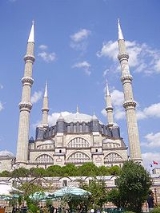
A mosque is a place of worship for followers of Islam. Muslims often refer to the mosque by its Arabic name, masjid, — (pl. masajid, — ). The word "mosque" in English refers to all types of buildings dedicated for Islamic worship, although there is a distinction in Arabic between the smaller, privately owned mosque and the larger, "collective" mosque (, masjid jami?), which has more community and social amenities.
The primary purpose of the mosque is to serve as a place where Muslims can come together for prayer and some other activities of their life (i.e, a centre for information, education, and dispute settlement).

Discussion
Ask a question about 'Mosque'
Start a new discussion about 'Mosque'
Answer questions from other users
|
Timeline
Encyclopedia
A mosque is a place of worship for followers of Islam. Muslims often refer to the mosque by its Arabic name, masjid, — (pl. masajid, — ). The word "mosque" in English refers to all types of buildings dedicated for Islamic worship, although there is a distinction in Arabic between the smaller, privately owned mosque and the larger, "collective" mosque (, masjid jami?), which has more community and social amenities.
The primary purpose of the mosque is to serve as a place where Muslims can come together for prayer and some other activities of their life (i.e, a centre for information, education, and dispute settlement). The Imam leads the prayer. Nevertheless, mosques are known around the world nowadays for their general importance to the Muslim community as well as their demonstration of Islamic architecture. They have developed significantly from the open-air spaces that were the Quba Mosque and Masjid al-Nabawi in the seventh century. Today, most mosques have elaborate domes, minarets, and prayer halls. Mosques originated on the Arabian Peninsula, but are now found in all inhabited continents. They are not only places for worship and prayer, but also places to learn about Islam and meet fellow believers.
Etymology The Arabic word masjid means place of worship and is a noun of place from the verb sajada|root]] "s-j-d," meaning "to bow" or "to kneel") in reference to the prostrations performed during Islamic prayers. Either the word masjid itself or at least the verb from which it is derived was borrowed from Aramaic. The word "m-s-g-d" is attested in Aramaic as early as the 5th century BCE, and the same word is later found in Nabataean inscriptions with the meaning "place of worship"; apparently, this Aramaic word originally meant "stele" or "sacred pillar".. The same root exists also in Hebrew,(?-?-?), meaning "to worship".
The modern-day English word "mosque", just like its equivalents in many other European languages, derives from the word masjid via Spanish mezquita. The pre-cursors of the word "mosque" appeared during the 15th, 16th, and 17th centuries and "Moseak", "muskey", "moschy", and "mos'keh" were just some of the variations that came into use until it was decided that "mosquee", imitating Middle French, Italian, and Old Spanish, would become the standard. In the early 18th century, the modern spelling became the most popular and standard spelling of the word.
Mosque in Islamic texts The word masjid is found throughout the Qur'an, most frequently with reference to the Kaaba sanctuary in Mecca. The Qur'an applies the term "masjid" to places of worship of different religions, including Judaism and Christianity; in the same general meaning of a place of worship, the word is used in the hadith (collections of Muslim traditions about the deeds and saying of the Islamic prophet Muhammad and his companions).
History Grand entryways and tall towers, or minarets, have long been and continue to be closely associated with mosques. However, the first three mosques were very simple open spaces on the Arabian Peninsula. Mosques evolved significantly over the next 1,000 years, acquiring their now-distinctive features and adapting to cultures around the world.
The First Mosques According to Islamic beliefs, the first mosque was the Kaaba, whose existing foundation was raised up by Ibrahim and his son Ismail, upon an order from God. The site of the Kaaba is also believed to be the place where a tent was erected by angels for Adam and Eve to use for worship. The oldest mosque built by Muslims is the Quba Mosque in Medina. When Muhammad lived in Mecca, he viewed Kaaba as his first and principal mosque and performed prayers there together with his followers.
Even during times when the pagan Arabs performed their rituals inside the Kaaba, Muhammad always held the Kaaba in very high esteem. The Meccan tribe of Quraish, which was responsible for guarding the Kaaba, attempted to exclude Muhammad's followers from the sanctuary, which became a subject of Muslim complaints recorded in the Qur'an. When Muhammad conquered Mecca in 630, he converted the Kaaba to a mosque, the Masjid al-Haram (Sacred Mosque). This mosque was significantly expanded and improved in the early centuries of Islam in order to accommodate the increasing number of Muslims who either lived in the area or made the annual Hajj, or pilgrimage, to Mecca, before it acquired its present shape in 1577 in the reign of the Ottoman sultan Selim II.
The first thing Muhammad did upon arriving with his followers near Medina (then named Yathrib) after the emigration from Mecca in 622 was build the Quba Mosque in a village outside Medina. Muslims believe he stayed at the Quba Masjid for three days before moving on to Medina.
Just days after beginning work on the Quba Mosque, Muhammad went on to establish another mosque in Medina, the Masjid al-Nabawi (Prophet's Mosque). The location of the mosque was declared after it hosted Muhammad's first Friday prayer. Following its establishment, the Prophet's Mosque continued some of the practices now considered common in today's mosques. For example, the call to prayer (adhan), was developed in the form still used in mosque today. The Masjid al-Nabawi was built with a large courtyard, a motif common among mosques built since then. Muhammad would stand up at one end of the arcade to preach. Later on, he would develop a three-step pulpit as a platform from which he would give sermons. The pulpit, now known as a minbar, is still a common feature of masjids.
Muhammad lived beside the mosque in Medina, which doubled as both a religious and political center for the early Muslim community. Negotiations were conducted, military actions planned, prisoners of war held, disputes settled, religious information disseminated, gifts received and distributed among his companions. His followers treated the wounded there and some people even lived in the mosque permanently in tents and huts.
Today, the Masjid al-Haram in Mecca, the Masjid al-Nabawi in Medina and Al Aqsa in Jerusalem are considered the three holiest sites in Islam.
Diffusion and evolution Mosques were built outside the Arabian Peninsula as Muslims moved to other parts of the world. Egypt became occupied by Muslim Arabs as early as 640, and since then so many mosques have appeared throughout the country that its capital city, Cairo, has acquired the nickname of city of a thousand minarets. Egyptian mosques vary in amenities, as some have Islamic schools (madrassas) while others have hospitals or tombs. Mosques in Sicily and Spain do not primarily reflect the architecture of Visigothic predecessors, but instead reflect the architecture introduced by the Muslim Moors. It is hypothesized, however, that there were some elements of pre-Islamic architecture which were Islamicized into Andalusi and Maghribi architecture, for example, the distinctive horseshoe arch.
The first Chinese mosque was established in the eighth century in Xi'an. The Great Mosque of Xi'an, whose current building dates from the eighteenth century, does not replicate many of the features often associated with traditional mosques. Instead, it follows traditional Chinese architecture. It is distinguished from other buildings by its green roof (Buddhist temples are often built with a yellow roof). Mosques in western China incorporate more traditional elements seen in mosques in other parts of the world. Western Chinese mosques were more likely to incorporate minarets and domes while eastern Chinese mosques were more likely to look like pagodas.
By the fifteenth century, Islam had become the dominant religion in Java and Sumatra, Indonesia's two most populous islands. As with Hinduism and Buddhism before it, the new religion and its accompanying foreign influences were absorbed and reinterpreted, with mosques given a unique Indonesian/Javanese interpretation. At the time, Javanese mosques took many design cues from Hindu, Buddhist, and even Chinese architectural influences. They lacked, for example, the ubiquitous Islamic dome which did not appear in Indonesia until the 19th century, but had tall timber, multi-level roofs not too dissimilar to the pagodas of Balinese Hindu temples still common today. A number of significant early mosques survive, particularly along the north coast of Java. These include the Mesjid Agung in Demak, built in 1474, and the Grand Mosque of Yogyakarta that feature multi-level roofs. Javanese styles in turn influenced the architectural styles of mosques among Indonesia's Austronesian neighbors: Malaysia, Brunei and the southern Philippines.
Mosques diffused into India during the reign of the Mughal empire in the sixteenth and seventeenth centuries. The Mughals brought their own form of architecture that included pointed, onion-shaped domes, as seen in Delhi's Jama Masjid.
Mosques first arrived in the Ottoman Empire (mostly present-day Turkey) during the eleventh century, when many local Turks converted to Islam. Several of the first mosques in the Ottoman Empire, such as the Hagia Sophia in present-day Istanbul, were originally churches or cathedrals in the Byzantine Empire. The Ottomans created their own design of mosques, which included large central domes, multiple minarets, and open façades. The Ottoman style of mosques usually included elaborate columns, aisles, and high ceilings in the interior, while incorporating traditional elements, such as the mihrab. Today, Turkey is still home to many mosques that display this Ottoman style of architecture.
Mosques gradually diffused to different parts of Europe, but the most rapid growth in the number of mosques has occurred within the past century as more Muslims have migrated to the continent. Major European cities, such as Rome, London, and Munich, are home to mosques that feature traditional domes and minarets. These large mosques in urban centers are supposed to serve as community and social centers for a large group of Muslims that occupy the region. However, one can still find smaller mosques in more suburban and rural regions throughout Europe where Muslims populate. There are 40,000 to 50,000 mosques in the United States and Islam is the fastest growing religion there. Mosques first appeared in the United States in the early twentieth century, the first of which was built in the late 1920s in Cedar Rapids, Iowa. However, as more immigrants continue to arrive in the country, especially from South Asia, the number of American mosques is increasing faster than ever before. Whereas only two percent of the country's mosques appeared in the United States before 1950, eighty-seven percent of American mosques were founded after 1970 and fifty percent of American mosques founded after 1980.
Conversion of places of worship
According to early Muslim historians, towns that surrendered without resistance and made treaties with the Muslims received permission to retain their churches and synagogues, One of the earliest examples of these kinds of conversions was in Damascus, Syria, where in 705 Umayyad caliph Abd al-Malik took the church of St. John from the Christians and had it rebuilt as a mosque, which is now known as Umayyad Mosque; overall, Abd al-Malik is said to have transformed 10 churches in Damascus into mosques. The process of turning churches into mosques was especially intensive in the villages. The Abbasid caliph al-Ma'mun turned many churches into mosques. Ottoman Turks converted into mosques nearly all churches, monasteries, and chapels in Constantinople, including the famous Hagia Sophia, immediately after capturing the city in 1453. In some instances mosques have been established on the places of Jewish or Christian sanctuaries associated with Biblical personalities who were also recognized by Islam. Muslim rulers in India built mosques seeing their actions as fulfillment of a religious duty.
On the other hand, mosques have also been converted for use by other religions, notably in southern Spain, following the conquest of the Moors in 1492. The most prominent of them is the Great Mosque of Cordoba. The Iberian Peninsula, Southeast Europe, and India (the Babri Masjid incident) are other regions in the world where such instances occurred once no longer under Muslim rule.
Religious functions
Prayers All adult Muslims are required to offer prayer, or Salat, compulsorily five times each day. (Those suffering from diseases, and women who have just given birth, may omit this obligation. (See Sharia)). Although some smaller mosques with smaller congregations will offer only a few prayers, most mosques offer all five required prayers daily: before sunrise (fajr), at midday (Zuhr), in the afternoon (Asr), after sunset (Maghrib), and in the evening (isha'a). It is obligatory for Muslims to offer prayer inside a mosque along with Friday Prayer, according to hadith; offering prayer in a congregation at a mosque is considered more virtuous than offering prayer alone. The mosque is the centre of the Islamic community, illustrating the idea of brotherhood and iman.
In addition to holding the five obligatory daily prayers, mosques hold jumuah prayers, or Friday prayers, which replace the midday prayer as the second required prayer on Fridays. While the ordinary daily prayers can be performed at any location that is clean, it is required that all adult men attend Friday prayers at the mosque.
A funeral prayer, or salat ul-janazah, is held for a deceased Muslim at the mosque, with all congregants present, including the imam, participating. Unlike the daily prayers, the funeral prayers are normally held outdoors in a courtyard or square close to the mosque. During eclipses, mosques will host special prayers called eclipse prayers.
There are two large holidays (Eids) in the Islamic calendar, Eid ul-Fitr and Eid ul-Adha during which there are special prayers held at mosques in the morning. These Eid prayers are supposed to be offered in large groups, and so larger mosques will normally host them for their congregants as well as the congregants of smaller local mosques. Some mosques will even rent convention centers or other large public buildings to hold the large number of Muslims who attend. Mosques, especially those in countries where Muslims are the majority, will also host Eid prayers outside in courtyards or town squares.
Ramadan events
Islam's holiest month, Ramadan, is observed through many events. As Muslims must fast during the day during Ramadan, mosques will host iftar dinners after sunset and the fourth required prayer of the day, maghrib. Food is provided, at least in part, by members of the community, thereby creating nightly potluck dinners. Because of the community contribution necessary to serve iftar dinners, mosques with smaller congregations may not be able to host the iftar dinners daily. Some mosques will also hold suhoor meals before dawn to congregants attending the first required prayer of the day, fajr. As with iftar dinners, congregants usually provide the food for suhoor, although able mosques may provide food instead. Mosques will often invite poorer members of the Muslim community to share in beginning and breaking the fasts, as providing charity during Ramadan is regarded in Islam as especially honorable.
Following the last obligatory daily prayer special, optional tarawih prayers are offered in larger mosques. During each night of prayers, which can last for up to two hours each night, usually one member of the community who has memorized the entire Qur’an will recite a segment of the book. Sometimes, several such people (not necessarily of the local community) take turns to do this. During the last ten days of Ramadan, larger mosques will host all-night programs to observe Laylat al-Qadr, the night Muslims believe the Islamic prophet Muhammad first received Qur'anic revelations. On that night, between sunset and sunrise, mosques employ speakers to educate congregants in attendance about Islam. Mosques or the community usually provide meals periodically throughout the night.
During the last ten days of Ramadan, larger mosques within the Muslim community will host i'tikaf, a practice in which at least one Muslim man from the community must participate. Muslims performing i'tikaf are required to stay within the mosque for ten consecutive days, often in worship or learning about Islam. As a result, the rest of the Muslim community is responsible for providing the participants with food, drinks, and whatever else they need during their stay.
Charity The third of the Five Pillars of Islam states that Muslims are required to give approximately one-fortieth of their wealth to charity as zakat. Since mosques form the center of Muslim communities, they are where Muslims go to both give zakat and, if necessary, collect it. Prior to the holiday of Eid ul-Fitr, mosques also collect a special zakat that is supposed to assist in helping poor Muslims attend the prayers and celebrations associated with the holiday.
Social functions
Center of Muslim community
Many Muslim rulers after the death of the Islamic prophet Muhammad, emulating him, established their domains by first building a mosque. In the same way Mecca and Medina are built around the Masjid Al-Haram and the Masjid Al-Nabawi, Karbala, in present-day Iraq, was built around the Imam Hussain Shrine. Isfahan, Iran is especially notable for its use of mosques to form the center of the city. In the eighth century, a mosque was established within the city which three centuries later was described by theologian and philosopher Naser Khosrow as "a magnificent Friday Mosque built in the city center." At the dawn of the seventeenth century, Shah Abbas I of the Safavid Dynasty led an effort to establish Isfahan as one of the largest and most beautiful cities in the world. As part of his plan, he ordered the building of Shah Mosque and Sheikh Lotf Allah Mosque which border Isfahan's Naghsh-i Jahan Square, which, as one of the largest city squares in the world, hosted sports and trade.
Mosques built more recently, especially in countries where Muslims are not the majority, tend to be away from the center of major cities. Nevertheless, even a mosque in a less densely populated area often influences Muslims to relocate their homes and businesses so they are close to the mosque. Thus, mosques form the focal points of Muslim communities, even if they do not form the center of the entire community as a whole. In the United States, the growth in the number of mosques and congregants in suburbs is much greater than that in densely urban areas.
Education
Another primary function of a mosque is to house educational facilities. Some mosques, especially those in countries where state-funded Islamic schools are not present, will have full-time schools that teach both Islamic and general knowledge. These full-time schools normally have students in elementary school and middle school, although there are also a few full-time schools available to high school students. Most mosques also have part-time schools, either on the weekends or in the evenings. Whereas full-time schools are meant for children who depend on the mosque to provide an Islamic education as well as a general education, weekend and nightly schools are meant to provide only Islamic education for students of all ages, young and old. Some mosques, however, will also provide general educational help to Muslim students as a way of bringing young Muslims closer to the mosque. The subjects at the Islamic evening and weekend classes vary. Qur'an reading and Arabic are commonly found at mosques that are located in countries where Arabic is not widely spoken. Classes for new Muslims about the basics of Islam are also common, especially in Europe and the United States, where it is the fastest-growing religion. Mosques will also go into more depth about Islam by providing congregants with classes on Islamic jurisprudence. Madrassas are also available for Muslims to study 'alim to become Islamic scholars or imams. However, as their primary purpose is not to serve as a place of worship or community center, madrassas are normally separate from neighborhood mosques.
Events and fundraising
Mosques host events and dinners either for raising money for mosque activities or simply to bring the community together and bazaars where community members can shop for Islamic merchandise are common among mosques. Mosques also host weddings, much like other places of worship.
One particularly interesting illustration of this community involvement is that of the mosque in Djenné, Mali where, during an annual festival, the community takes part in the re-applying of plaster to the exterior of the mud brick building (the largest of its kind in the world).
Contemporary political roles The late twentieth century saw an increase in the number of mosques used for political purposes. Today, civic participation is commonly promoted in mosques in the Western world. Because of the importance in the community, mosques are used for preaching peaceful co-existence with non-believers, even in times of adversity.
Advocacy
Countries with a minority Muslim population are more likely than Muslim-majority countries of the Greater Middle East to use mosques as a way to promote civic participation. American mosques host voter registration and civic participation drives that promote involving Muslims, who are often first- or second-generation immigrants, in the political process. As a result of these efforts as well as attempts at mosques to keep Muslims informed about the issues facing the Muslim community, regular mosque attendants are more likely to participate in protests, sign petitions, and otherwise be involved in politics.
Nevertheless, a link between political views and mosque attendance can still be seen in other parts of the world. Following the al-Askari Mosque bombing in February 2006, imams and other Islamic leaders used mosques and Friday prayers as vehicles to call for calm and peace in the midst of widespread violence.
Beginning in the late twentieth century and continuing into the early twenty-first century, a small number of mosques have also become the platforms of some extremist imams to advocate terrorism and extreme Islamic ideals. Finsbury Park Mosque in London is exemplary of a mosque that has been used in this manner.
Social conflict
As they are considered important to the Muslim community, mosques, like other places of worship, can be at the heart of social conflicts.
Babri Mosque was the subject of such a conflict up until the early 1990s when it was demolished. Before a mutual solution could be devised, the mosque was destroyed by approximately 200,000 Hindus on December 6, 1992 as the mosque was built by Babur allegedly on the site of a previous Hindu temple marking the birthplace of Ram. The controversy surrounded the mosque was directly linked to rioting in Bombay (present-day Mumbai) as well as bombings in 1993 that killed 257 people.
A February 2006 bombing that seriously damaged Iraq's al-Askari Mosque, exacerbated tensions that had already existed. Other mosque bombings in Iraq, both before and after the February 2006 bombing, have been part of the conflict between the country's groups of Muslims. However, mosque bombings have not been exclusive to Iraq; in June 2005, a suicide bomber killed at least 19 people at an Afghan mosque. In April 2006, two explosions occurred at India's Jama Masjid.
Following the September 11 attacks, several American mosques were targeted in attacks ranging from simple vandalism to arson. Furthermore, the Jewish Defense League was suspected of plotting to bomb the King Fahd Mosque in Culver City, California. Similar attacks occurred throughout the United Kingdom following the 7 July 2005 London bombings. Outside the Western world, in June 2001, the Hassan Bek Mosque was the target of attacks involving hundreds of Israelis angry at Arabs for a previous attack.
Saudi influence
Although the Saudi involvement in mosques around the world can be traced back to the 1960s, it was not until later in the twentieth century that the government of Saudi Arabia became a large influence in foreign mosques. Beginning in the 1980s, the Saudi Arabian government began to finance the construction of mosques in countries around the world. An estimated US$45 billion has been spent by the Saudi Arabian government financing mosques and Islamic schools in foreign countries. Ain al-Yaqeen, a Saudi newspaper, reported in 2002 that Saudi funds may have contributed to building as many as 1,500 mosques and 2,000 other Islamic centers Saudi citizens have also contributed significantly to mosques in the Islamic world, especially in countries where they see Muslims as poor and oppressed. Following the fall of the Soviet Union, in 1992, mosques in impoverished Afghanistan saw many contributions from Saudi citizens. The King Fahd Mosque in Culver City, California and the Islamic Cultural Center of Italy in Rome represent two of Saudi Arabia's largest investments in foreign mosques as former Saudi king Fahd bin Abdul Aziz al-Saud contributed US$ | |