
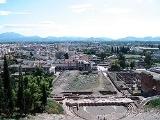
Argos is a city and a former municipality in
ArgolisArgolis is one of the regional units of Greece. It is part of the region of Peloponnese. It is situated in the eastern part of the Peloponnese peninsula.-Geography:...
, Peloponnese,
GreeceGreece , officially the Hellenic Republic , and historically Hellas or the Republic of Greece in English, is a country in southeastern Europe....
. Since the 2011 local government reform it is part of the municipality Argos-Mykines, of which it is a municipal unit. It is 11 kilometres from
NafplionNafplio is a seaport town in the Peloponnese in Greece that has expanded up the hillsides near the north end of the Argolic Gulf. The town was the first capital of modern Greece, from the start of the Greek Revolution in 1821 until 1834. Nafplio is now the capital of the peripheral unit of...
, which was its historic harbour. A settlement of great antiquity, Argos has been continuously inhabited for the past 7,000 years, making it one of the oldest cities in Greece and Europe. The city is a member of the
Most Ancient European Towns NetworkThe Most Ancient European Towns Network is a working group of the oldest cities in Europe. It was founded in 1994, with the idea coming from the town of Argos, Greece presented to the European Union...
.
At a strategic location on the fertile plain of Argolis, Argos was a major stronghold during the Mycenaean era. In
classical timesClassical antiquity is a broad term for a long period of cultural history centered on the Mediterranean Sea, comprising the interlocking civilizations of ancient Greece and ancient Rome, collectively known as the Greco-Roman world...
Argos was a powerful rival of
SpartaSparta or Lacedaemon, was a prominent city-state in ancient Greece, situated on the banks of the River Eurotas in Laconia, in south-eastern Peloponnese. It emerged as a political entity around the 10th century BC, when the invading Dorians subjugated the local, non-Dorian population. From c...
for dominance over the Peloponnese, but was eventually shunned by other Greek city-states after remaining neutral during the
Greco-Persian WarsThe Greco-Persian Wars were a series of conflicts between the Achaemenid Empire of Persia and city-states of the Hellenic world that started in 499 BC and lasted until 449 BC. The collision between the fractious political world of the Greeks and the enormous empire of the Persians began when Cyrus...
. Numerous ancient monuments can be found in the city today, the most famous of which is the renowned
Heraion of ArgosThe Heraion of Argos was the temple in the greatest sanctuary in the Argolid, dedicated to Hera, whose epithet "Argive Hera" , is familiar to readers of Homer. Hera herself claims to be the protector of Argos in Iliad IV, 50–52): "The three towns I love best are Argos, Sparta and Mycenae of...
, though agriculture (particularly citrus production) is the mainstay of the local economy.
Name
The region of Argos is known as the
ArgolisArgolis is one of the regional units of Greece. It is part of the region of Peloponnese. It is situated in the eastern part of the Peloponnese peninsula.-Geography:...
, Argolid, or Argeia. The inhabitants of Argos were known as (<
) or
Argīvī in
LatinLatin is an Italic language originally spoken in Latium and Ancient Rome. It, along with most European languages, is a descendant of the ancient Proto-Indo-European language. Although it is considered a dead language, a number of scholars and members of the Christian clergy speak it fluently, and...
, rendered
Argives in English.
The name might be of pre-Greek ("Pelasgian") derivation; the name of its
acropolisAcropolis means "high city" in Greek, literally city on the extremity and is usually translated into English as Citadel . For purposes of defense, early people naturally chose elevated ground to build a new settlement, frequently a hill with precipitous sides...
,
LarissaLarissa is the ancient and medieval acropolis of Argos, located in a high rocky hill, within the town's boundaries. It is named after the nymph Larissa....
, certainly is. Aitiology derives it from a mythological founder,
ArgosARGUS, all capitalized, may refer to:* ARGUS , a particle physics experiment that ran at DESY* ARGUS distribution, a function used in particle physics named after the above experiment...
son of
ZeusIn the ancient Greek religion, Zeus was the "Father of Gods and men" who ruled the Olympians of Mount Olympus as a father ruled the family. He was the god of sky and thunder in Greek mythology. His Roman counterpart is Jupiter and his Etruscan counterpart is Tinia.Zeus was the child of Cronus...
and
NiobeNiobe was a daughter of Tantalus and of either Dione, the most frequently cited, or of Eurythemista or Euryanassa, and she was the sister of Pelops and Broteas, all of whom figure in Greek mythology....
(see also
DanausIn Greek mythology Danaus, or Danaos , was the twin brother of Aegyptus and son of Achiroe and Belus, a mythical king of Egypt. The myth of Danaus is a foundation legend of Argos, one of the foremost Mycenaean cities of the Peloponnesus...
). If the name is Indo-European, it may be related to the adjective αργóς (
argós) 'shimmering' or 'quick') from
PIEThe Proto-Indo-European language is the reconstructed common ancestor of the Indo-European languages, spoken by the Proto-Indo-Europeans...
, hence also ἄργυρος (
árguros) 'silver' with a meaning "shining brightly" or similar.
Ancient
A
NeolithicThe Neolithic Age, Era, or Period, or New Stone Age, was a period in the development of human technology, beginning about 9500 BC in some parts of the Middle East, and later in other parts of the world. It is traditionally considered as the last part of the Stone Age...
settlement was located near the central sanctuary of Argois, removed 45 stadia (8 km; 5 miles) from Argos, closer to
MycenaeMycenae is an archaeological site in Greece, located about 90 km south-west of Athens, in the north-eastern Peloponnese. Argos is 11 km to the south; Corinth, 48 km to the north...
. The temple was dedicated to "Argivian
HeraHera was the wife and one of three sisters of Zeus in the Olympian pantheon of Greek mythology and religion. Her chief function was as the goddess of women and marriage. Her counterpart in the religion of ancient Rome was Juno. The cow and the peacock were sacred to her...
". The main festival of that temple was the Hekatombaia, one of the major festivals of Argos itself.
Walter BurkertWalter Burkert is a German scholar of Greek mythology and cult.An emeritus professor of classics at the University of Zurich, Switzerland, he also has taught in the United Kingdom and the United States...
(
Homo necansHomo Necans: the Anthropology of Ancient Greek Sacrificial Ritual and Myth is a book on ancient Greek religion and mythology by Walter Burkert, which won the Weaver Award for Scholarly Literature, awarded by the Ingersoll Foundation, in 1992...
, p. 185) connected the festival to the myth of the slaying of
Argus PanoptesIn Greek mythology, Argus Panoptes or Argos, guardian of the heifer-nymph Io and son of Arestor, was a primordial giant whose epithet "Panoptes", "all-seeing", led to his being described with multiple, often one hundred, eyes. The epithet Panoptes was applied to the Titan of the Sun, Helios, and...
by
HermesHermes is the great messenger of the gods in Greek mythology and a guide to the Underworld. Hermes was born on Mount Kyllini in Arcadia. An Olympian god, he is also the patron of boundaries and of the travelers who cross them, of shepherds and cowherds, of the cunning of thieves, of orators and...
("shimmering" or "quick"), and only secondarily associated with mythological Argus (or the toponym).
Argos was a major stronghold of
MycenaeanMycenaean Greece was a cultural period of Bronze Age Greece taking its name from the archaeological site of Mycenae in northeastern Argolis, in the Peloponnese of southern Greece. Athens, Pylos, Thebes, and Tiryns are also important Mycenaean sites...
times, and along with the neighbouring acropolis of
MycenaeMycenae is an archaeological site in Greece, located about 90 km south-west of Athens, in the north-eastern Peloponnese. Argos is 11 km to the south; Corinth, 48 km to the north...
and
TirynsTiryns is a Mycenaean archaeological site in the prefecture of Argolis in the Peloponnese, some kilometres north of Nauplion.-General information:...
became a very early settlement because of its commanding positions in the midst of the fertile plain of Argolis.
During
HomerIn the Western classical tradition Homer , is the author of the Iliad and the Odyssey, and is revered as the greatest ancient Greek epic poet. These epics lie at the beginning of the Western canon of literature, and have had an enormous influence on the history of literature.When he lived is...
ic times it belonged to a follower of
AgamemnonIn Greek mythology, Agamemnon was the son of King Atreus and Queen Aerope of Mycenae, the brother of Menelaus, the husband of Clytemnestra, and the father of Electra and Orestes. Mythical legends make him the king of Mycenae or Argos, thought to be different names for the same area...
and gave its name to the surrounding district; the
Argolid which the Romans knew as
Argeia.
Argos experienced its greatest period of expansion and power under the energetic
7th century BCThe 7th century BC started the first day of 700 BC and ended the last day of 601 BC.The Assyrian Empire continued to dominate the Near East during this century, exercising formidable power over neighbors like Babylon and Egypt. In the last two decades of the century, however, the empire began to...
ruler King
PheidonPheidon was a king of Argos, Greece in the 7th century BC. At that time, the monarch was purely a traditional figurehead with almost no genuine power. Pheidon seized the throne from the reigning aristocracy...
. Under Pheidon Argos regained sway over the cities of the Argolid and challenged
SpartaSparta or Lacedaemon, was a prominent city-state in ancient Greece, situated on the banks of the River Eurotas in Laconia, in south-eastern Peloponnese. It emerged as a political entity around the 10th century BC, when the invading Dorians subjugated the local, non-Dorian population. From c...
’s dominance of the Peloponnese. The importance of Argos was eclipsed by Sparta after the 6th century BC.
Because of its refusal to fight or send supplies in the Graeco-Persian Wars, Argos was shunned by most other city-states. Argos remained neutral or the ineffective ally of
AthensAthens , is the capital and largest city of Greece. Athens dominates the Attica region and is one of the world's oldest cities, as its recorded history spans around 3,400 years. Classical Athens was a powerful city-state...
during the 5th century BC struggles between Sparta and Athens.
Medieval
During the 12th century, a castle was built on Larissa Hill - the site of the ancient Acropolis - called
Kastro Larissa. Argos was captured by the Crusaders, and belonged to the lordship of
Argos and NaupliaDuring the late Middle Ages, the two cities of Argos and Nauplia formed a separate Lordship within the Frankish Principality of Achaea in southern Greece....
. In 1388 it was sold to the
Republic of VeniceThe Republic of Venice or Venetian Republic was a state originating from the city of Venice in Northeastern Italy. It existed for over a millennium, from the late 7th century until 1797. It was formally known as the Most Serene Republic of Venice and is often referred to as La Serenissima, in...
, but was taken by the despot of Mystra
Theodore I PalaiologosTheodore I Palaiologos was despot in the Morea from 1383 until his death on June 24, 1407. He was the youngest surviving son of the Byzantine Emperor John V Palaiologos and his wife Helena Kantakouzene. His maternal grandfather was former Emperor John VI Kantakouzenos...
before the Venetians could take control of the city ; he sold it anyway to them in 1394. In 1397 the city was plundered by the
Ottoman EmpireThe Ottoman EmpireIt was usually referred to as the "Ottoman Empire", the "Turkish Empire", the "Ottoman Caliphate" or more commonly "Turkey" by its contemporaries...
which carried off much of the population, selling them as slaves. The Venetians repopulated the town and region with Albanian settlers, granting them long-term agrarian tax exemptions. Together with the Greeks of Argos, they supplied
stratiotiThe Stratioti or Stradioti , were mercenary units from the Balkans recruited mainly by states of southern and central Europe from the 15th until the middle of the 18th century.-Name:The Greek term "στρατιώτης/-αι" and its various latinized forms, were in use since classical antiquity with...
troops to the armies of Venice. Some historians consider the French military term "argoulet" to derive from the Greek "argetes", or inhabitant of Argos, as a large number of French stratioti came from the plain of Argos.
Modern
At the beginning of the
Greek War of IndependenceThe Greek War of Independence, also known as the Greek Revolution was a successful war of independence waged by the Greek revolutionaries between...
in 1821, when many petty local republics were formed in different parts of the country, the "Consulate of Argos" was proclaimed on 26 May 1821, under the Senate of the
PeloponneseThe Peloponnese, Peloponnesos or Peloponnesus , is a large peninsula , located in a region of southern Greece, forming the part of the country south of the Gulf of Corinth...
. It had a single head of state, Stamatellos Antonopoulos, styled
ConsulConsul was the highest elected office of the Roman Republic and an appointive office under the Empire. The title was also used in other city states and also revived in modern states, notably in the First French Republic...
, between 28 March 1821 and 26 May 1821.
Later, Argos accepted the authority of the unified Provisional Government of the us
First National Assembly at EpidaurusThe First National Assembly of Epidaurus was the first meeting of the Greek National Assembly, a national representative political gathering of the Greek revolutionaries.The assembly opened in December 1821 at Piada...
, and eventually became part of the
Kingdom of GreeceThe Kingdom of Greece was a state established in 1832 in the Convention of London by the Great Powers...
.
The city of Argos is the seat of the province of the same name, one of the three subdivisions of the
ArgolisArgolis is one of the regional units of Greece. It is part of the region of Peloponnese. It is situated in the eastern part of the Peloponnese peninsula.-Geography:...
prefecture. According to the 2001 Greek census, the city has a population of 27,550. It is the largest city in the prefecture, one of the few prefectures in Greece where the largest city in population is larger than the prefectural capital.
Considerable remains of the city survive and are a popular tourist attraction. Agriculture, however, is the primary economic activity in the area, with citrus fruits the predominant crop. Olives are also popular here.
Argos has a railway station on the Kalamata - Tripoli - Corinth line of the Hellenic Railways Organisation, and a junior soccer team. The Archaeological Museum of Argos houses ancient artifacts recovered not only from the principal archaeological sites of the city, including the theater and
agoraThe Agora was an open "place of assembly" in ancient Greek city-states. Early in Greek history , free-born male land-owners who were citizens would gather in the Agora for military duty or to hear statements of the ruling king or council. Later, the Agora also served as a marketplace where...
but also from
LernaIn classical Greece, Lerna was a region of springs and a former lake near the east coast of the Peloponnesus, south of Argos. Its site near the village Mili at the Argolic Gulf is most famous as the lair of the Lernaean Hydra, the chthonic many-headed water snake, a creature of great antiquity...
.
http://www.culture.gr/2/21/211/21104m/e211dm03.html
In Greek mythology
The
mythological kingA mythological king is an archetype in mythology. A king is considered a "mythological king" if he is included and described in the culture's mythology. Unlike a fictional king, aspects of their lives may have been real and legendary, or that the culture believed to be real...
s of Argos are (in order):
InachusIn Greek mythology, Inachus was a king of Argos after whom a river was called Inachus River, the modern Panitsa that drains the western margin of the Argive plain...
,
PhoroneusIn Greek mythology, Phoroneus was a culture-hero of the Argolid, fire-bringer, primordial king of Argos and son of the river god Inachus and either Melia, the primordial ash-tree nymph or Argia, the embodiment of the Argolid itself: "Inachus, son of Oceanus, begat Phoroneus by his sister Argia,"...
, Argus,
TriopasIn Greek mythology, Triopas, Triophas or Triops was the name of several characters, whose relations are unclear. He belonged to the house of Phoroneus....
,
AgenorAgenor was the son and successor of Triopas, in the kingdom of Argos. He belonged to the house of Phoroneus, and was father of Crotopus. He was also said to have been the brother of king of Argos Iasus, Anthus and Pelasgus....
,
IasusIn Greek mythology, Iasus or Iasius was the name of several individuals:*Iasus, king of Argos. His genealogy is confused; according to different sources, he was:**Son of Phoroneus, brother of Agenor and Pelasgus...
,
CrotopusIn Greek mythology, Crotopus of Argos was the son of Agenor and father of Psamathe. He succeeded his uncle Iasus as King of Argos upon the latter's death....
,
PelasgusIn Greek mythology, Pelasgus was the eponymous ancestor of the Pelasgians, the mythical inhabitants of Greece who established the worship of the Dodonaean Zeus, Hephaestus, the Cabeiri, and other divinities. In the different parts of the country once occupied by Pelasgians, there existed...
(aka
GelanorIn Greek mythology, King Gelanor of Argos welcomed Danaus and his daughters. When an oracle told him to give Danaus his kingdom, he did so. He wanted to sell the Danaides into slavery following their murder of their husbands, but Danaus and the gods dissuaded him...
),
DanausIn Greek mythology Danaus, or Danaos , was the twin brother of Aegyptus and son of Achiroe and Belus, a mythical king of Egypt. The myth of Danaus is a foundation legend of Argos, one of the foremost Mycenaean cities of the Peloponnesus...
,
LynceusIn Greek mythology, Lynceus was a king of Argos, succeeding Danaus. He is named as a descendant of Belus through his father Aegyptus, who was the twin brother of Danaus. Danaus had fifty daughters, the Danaides, while Aegyptus had fifty sons including Lynceus, whose name when translated means "wolf"...
, Abas,
ProetusProetus was a mythical king of Argos and Tiryns. His father Abas, son of the last surviving and died Danaid Hypermnestra, had ruled over Argos and married Ocalea. However, Proetus quarreled continually with his twin brother Acrisius, inventing shields or bucklers in the process...
,
AcrisiusAcrisius was a mythical king of Argos, and a son of Abas and Aglaea , grandson of Lynceus, great-grandson of Danaus. His twin brother was Proetus, with whom he is said to have quarreled even in the womb of his mother...
,
PerseusPerseus ,Perseos and Perseas are not used in English. the legendary founder of Mycenae and of the Perseid dynasty of Danaans there, was the first of the mythic heroes of Greek mythology whose exploits in defeating various archaic monsters provided the founding myths of the Twelve Olympians...
,
MegapénthêsIn Greek mythology, Megapénthês is a name that refers to:* A son of Proetus. He exchanged kingdoms with his cousin Perseus, whom he killed much later. He was the father of Argeus and possibly Anaxagoras...
,
Argeus-Greek mythology:* Argeus * Argeus, a surname of Pan and Aristaeus* Argeus, one of the sons of Phineus and Danaë, the other being Argus* Argeus, son of Deiphontes and Hyrnetho* Argeus, one of the Niobids...
, and
AnaxagorasIn Greek mythology, Anaxagoras was a king of Argos and son of either Megapenthes or his son Argeus. The prince, Anaxagoras' son, suffered from a strange malady and the king offered a reward for anybody that could heal him. Melampus, a local seer, killed an ox and talked to the vultures that came...
.
An alternative version (supplied by Tatiānus) of the original 17 consecutive kings of Argōs includes
Apis-King of Argos:Apis was a king of Argos. He was a son of Phoroneus by the nymph Laodice, and brother of Niobe. During his reign he established a tyrannical government and called the Peloponnesus after his own name Apia: but he was killed in a conspiracy headed by Thelxion, king of Sparta, and Telchis...
, Argios, Kriasos, and
PhorbasIn Greek mythology, Phorbas or Phorbaceus may refer to:*Phorbas, a prince of the Thessalian Phlegyes who emigrated to Elis in the Peloponnesos. Phorbas was the son of Lapithes and Orsinome, and a brother of Periphas. He assisted Alector, king of Elis, in the war against Pelops, and shared the...
between Argus and Triopas, explaining the apparent unrelation of Triopas to Argus.
After the original 17 kings of Argos, there were three kings ruling Argos at the same time (see
AnaxagorasIn Greek mythology, Anaxagoras was a king of Argos and son of either Megapenthes or his son Argeus. The prince, Anaxagoras' son, suffered from a strange malady and the king offered a reward for anybody that could heal him. Melampus, a local seer, killed an ox and talked to the vultures that came...
), one descended from
BiasIn Greek mythology, Bias was a brother of Melampus who received one third of Argos . Bias married his cousin Pero and had one child, Talaus, with her. When Pero died he remarried Iphianassa, daughter of Proetus, after Melampus had cured her from madness. He received one third of Proetus's kingdom...
, one from
MelampusIn Greek mythology, Melampus, or Melampous , was a legendary soothsayer and healer, originally of Pylos, who ruled at Argos. He was the introducer of the worship of Dionysus, according to Herodotus, who asserted that his powers as a seer were derived from the Egyptians and that he could understand...
, and one from
AnaxagorasIn Greek mythology, Anaxagoras was a king of Argos and son of either Megapenthes or his son Argeus. The prince, Anaxagoras' son, suffered from a strange malady and the king offered a reward for anybody that could heal him. Melampus, a local seer, killed an ox and talked to the vultures that came...
. Melampus was succeeded by his son
MantiusIn Greek mythology, Mantius was the son of Melampus and Iphianassa and the father of Clitus, Polypheides and, in some versions, of Oicles....
, then
OiclesIn Greek mythology, Oecles was an Argive king, father of Amphiaraus, son of Mantius or Antiphates and grandson of Melampus....
, and
AmphiarausIn Greek mythology, Amphiaraus was the son of Oecles and Hypermnestra, and husband of Eriphyle. Amphiaraus was the King of Argos along with Adrastus— the brother of Amphiaraus' wife, Eriphyle— and Iphis. Amphiaraus was a seer, and greatly honored in his time...
, and his house of Melampus lasted down to the brothers
AlcmaeonIn Greek mythology, Alcmaeon, or Alkmáon , was the son of Amphiaraus and Eriphyle. As one of the Epigoni, he was a leader of the Argives who attacked Thebes, taking the city in retaliation for the deaths of their fathers, the Seven Against Thebes, who died while attempting the same thing.Pindar's...
and
AmphilochusAmphilochus or Amphílokhos may refer to:* In Greek mythology:** Amphilochus ** Amphilochus ** Husband of Alcinoe* Amphilochus , a genus of crustaceans...
.
AnaxagorasIn Greek mythology, Anaxagoras was a king of Argos and son of either Megapenthes or his son Argeus. The prince, Anaxagoras' son, suffered from a strange malady and the king offered a reward for anybody that could heal him. Melampus, a local seer, killed an ox and talked to the vultures that came...
was succeeded by his son
AlectorAlector refers to more than one person in classical myth and history:*Alector, the father of Leitus, himself one of the Argonauts. Homer calls him "Alectryon", and Diodorus "Electryon"....
, and then
IphisIphis is the name of seven characters in Greek mythology:1. Iphis, daughter of Ligdus and Telethusa.2. Iphis, a humble man, who killed himself for love of Anaxarete....
. Iphis left his kingdom to his nephew
SthenelusIn Greek mythology, Sthenelus was a name attributed to several different individuals.*Son of Perseus and Andromeda, and king of Mycenae.*Son of Capaneus and Evadne, he fought alongside Diomedes and the other Argives in the Trojan War and was one of the men who hid in the Trojan horse...
, the son of his brother
CapaneusIn Greek mythology, Capaneus was a son of Hipponous and either Astynome or Laodice , and husband of Evadne, with whom he fathered Sthenelus. Some call his wife Ianeira....
.
BiasIn Greek mythology, Bias was a brother of Melampus who received one third of Argos . Bias married his cousin Pero and had one child, Talaus, with her. When Pero died he remarried Iphianassa, daughter of Proetus, after Melampus had cured her from madness. He received one third of Proetus's kingdom...
was succeeded by his son
TalausIn Greek mythology, Talaus was the king of Argos and one of the Argonauts. He was the son of Bias and Pero. His wife was Lysimache, daughter of Abas . He was the father of Adrastus, Aristomachus, Astynome, Eriphyle, Mecisteus, Metidice, and Pronax.-Sources:**Barthall, Edward E...
, and then by his son
AdrastusAdrastus or Adrestus , traditionally translated as "nonparticipant" or "uncooperative", was a legendary king of Argos during the war of the Seven Against Thebes.-Mythological tradition:...
who, with Amphiaraus, commanded the disastrous
Seven Against ThebesThe Seven against Thebes is the third play in an Oedipus-themed trilogy produced by Aeschylus in 467 BC. The trilogy is sometimes referred to as the Oedipodea. It concerns the battle between an Argive army led by Polynices and the army of Thebes led by Eteocles and his supporters. The trilogy won...
.
AdrastusAdrastus or Adrestus , traditionally translated as "nonparticipant" or "uncooperative", was a legendary king of Argos during the war of the Seven Against Thebes.-Mythological tradition:...
bequethed the kingdom to his son,
AegialeusIn Greek mythology, Aegialeus is a name attributed several individuals.* Aegialeus was the elder son of Adrastus, a king of Argos, and either Amphithea or Demonassa. Aegialeus was identified as one of the Epigoni, who avenged their fathers' disastrous attack on the city of Thebes by retaking the...
, who was subsequently killed in the war of the
EpigoniIn Greek mythology, Epigoni are the sons of the Argive heroes who had fought and been killed in the first Theban war, the subject of the Greek Thebaid, in which Polynices and six allies attacked Thebes because Polynices' brother, Eteocles, refused to give up the throne as promised...
.
DiomedesDiomedes or Diomed is a hero in Greek mythology, known for his participation in the Trojan War.He was born to Tydeus and Deipyle and later became King of Argos, succeeding his maternal grandfather, Adrastus. In Homer's Iliad Diomedes is regarded alongside Ajax as one of the best warriors of all...
, grandson of Adrastus through his son-in-law Tydeus and daughter
DeipyleIn Greek mythology, Deipyle was the daughter of Adrastus and Amphithea, wife of Tydeus and mother of Diomedes. Her sister Argea married Polynices.-External links:*...
, replaced Aegialeus and was King of Argos during the Trojan war. This house lasted longer than those of
AnaxagorasIn Greek mythology, Anaxagoras was a king of Argos and son of either Megapenthes or his son Argeus. The prince, Anaxagoras' son, suffered from a strange malady and the king offered a reward for anybody that could heal him. Melampus, a local seer, killed an ox and talked to the vultures that came...
and
MelampusIn Greek mythology, Melampus, or Melampous , was a legendary soothsayer and healer, originally of Pylos, who ruled at Argos. He was the introducer of the worship of Dionysus, according to Herodotus, who asserted that his powers as a seer were derived from the Egyptians and that he could understand...
, and eventually the kingdom was reunited under its last member, Cyanippus, son of Aegialeus, soon after the exile of Diomedes.
Notable people
- Acrisius
Acrisius was a mythical king of Argos, and a son of Abas and Aglaea , grandson of Lynceus, great-grandson of Danaus. His twin brother was Proetus, with whom he is said to have quarreled even in the womb of his mother...
, mythological king
- Acusilaus
Acusilaus of Argos, son of Cabas or Scabras, was a Greek logographer and mythographer who lived in the latter half of the 6th century BC but whose work survives only in fragments and summaries of individual points....
(6th century BC), logographer and mythographer
- Ageladas
Ageladas or Hagelaidas, was a celebrated Argive sculptor, who flourished in the latter part of the 6th and the early part of the 5th century BC....
(6th-5th century BC), sculptor
- Pheidon
Pheidon was a king of Argos, Greece in the 7th century BC. At that time, the monarch was purely a traditional figurehead with almost no genuine power. Pheidon seized the throne from the reigning aristocracy...
(7th century BC), king of Argos
- Polykleitos
Polykleitos ; called the Elder, was a Greek sculptor in bronze of the fifth and the early 4th century BCE...
(5th-4th century BC), sculptor
- Polykleitos the Younger
Polykleitos the Younger was an ancient Greek sculptor of athletes. His greatest achievements, however, were as an architect. A renowned sculptor, Polykleitos the Younger was architect of the Theatre and Tholos at Epidaurus. Started around 360 BC, the Tholos exhibited elaborate detailing,...
(4th century BC), sculptor
- Telesilla
Telesilla was a Greek poet, native of Argos, and was named one of the nine lyric muses.-History:According to the traditional story, when Cleomenes, king of Sparta, invaded the land of the Argives in 510 BC, and defeated and killed the men of Argos in battle, Telesilla, dressed in men's clothes,...
(6th century BC), Greek poet
- Eleni Bakopanos
Eleni Bakopanos, PC is a Canadian politician.Bakopanos was a member of the Liberal Party of Canada in the Canadian House of Commons, representing the riding of Ahuntsic from 1997 to 2006, and Saint-Denis from 1993 to 1997 and is the first Greek-born woman to be elected to Parliament. Bakopanos has...
(1954-), Canadian politician
Twin towns — sister cities
Argos is
twinnedTwin towns and sister cities are two of many terms used to describe the cooperative agreements between towns, cities, and even counties in geographically and politically distinct areas to promote cultural and commercial ties.- Terminology :...
with:
AbbevilleAbbeville is a commune in the Somme department in Picardie in northern France.-Location:Abbeville is located on the Somme River, from its modern mouth in the English Channel, and northwest of Amiens...
,
FranceThe French Republic , The French Republic , The French Republic , (commonly known as France , is a unitary semi-presidential republic in Western Europe with several overseas territories and islands located on other continents and in the Indian, Pacific, and Atlantic oceans. Metropolitan France...
EpiskopiEpiskopi may refer to:*Episkopi Cantonment, a British military base in Cyprus*Episkopi, Heraklion, a town in the Heraklion prefecture, Greece*Episkopi, Lasithi, a town in the Lasithi prefecture, Greece...
,
CyprusCyprus , officially the Republic of Cyprus , is a Eurasian island country, member of the European Union, in the Eastern Mediterranean, east of Greece, south of Turkey, west of Syria and north of Egypt. It is the third largest island in the Mediterranean Sea.The earliest known human activity on the...
ArdeaArdea is an ancient town and comune in the province of Rome, 35 km south of Rome and about 4 km from today's Mediterranean coast....
,
ItalyItaly , officially the Italian Republic languages]] under the European Charter for Regional or Minority Languages. In each of these, Italy's official name is as follows:;;;;;;;;), is a unitary parliamentary republic in South-Central Europe. To the north it borders France, Switzerland, Austria and...
See also
- Kings of Argos
- Communities of Argolis
- Communities of Argos
-Communities:The two large communities of Argos and Kryovrysi cover about three-thirds of the entire municipality.* Argos* Dalamanara* Inachos* Tristrato** Ira* Kefalari**Magoula* Kryoneri* Elliniko* Krya Vryssi* Tourniki* Zogka* Kourtaki* Lalouka...
- Argos (dog)
In Homer's the Odyssey, Argos is Odysseus' faithful dog. After twenty years struggling to get home to Ithaca, Odysseus finally arrives at his homeland. In his absence, reckless suitors have taken over his house in hopes of marrying his wife Penelope...
Mythology: Dog of Odysseus
External links