

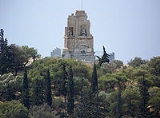
Philopappos

Encyclopedia
Gaius Julius Antiochus Epiphanes Philopappos or Philopappus, was a Prince of the Kingdom of Commagene
who lived in the Roman Empire
during the 1st century and 2nd century. He was one of the most prominent Greeks who lived in the Roman Empire
.
and an Egypt
ian Greek
woman called Claudia Capitolina
. His younger sister and only sibling was the poetess and friend to Roman Emperor
Hadrian
and Roman Empress Vibia Sabina
, Julia Balbilla
.
Philopappos’ parents were distantly related. The paternal grandmother of Claudia Capitolina was Greek Princess Aka II of Commagene
, who was a granddaughter or great, granddaughter of King Antiochus I Theos of Commagene
. While his father, was the first born son to King Antiochus IV of Commagene
and his wife Queen Julia Iotapa
of Commagene. Antiochus IV and Iotapa were direct descendants of Antiochus I Theos.
His maternal grandparents were Tiberius Claudius Balbilus
and an unnamed Greek woman. Balbilus was an astrologer and a learned scholar, who was later Prefect
of Egypt. Balbilus and his father, Egypt
ian Greek Grammarian and Astrologer called Thrasyllus of Mendes
or Tiberius Claudius Thrasyllus, were friends to the first Roman Emperor
s, which included Tiberius
, Claudius
and Vespasian
.
His paternal grandparents were Roman Client Monarchs, King Antiochus IV of Commagene
and Queen Julia Iotapa
. Antiochus IV and Iotapa were husband, wife and full blooded-siblings. He was of Armenia
n, Greek
and Medes
descent. Through his paternal grandparents, he was a direct descendant from the Greek Syria
n Kingdom the Seleucid Empire
and the Greek Egyptian
Kingdom the Ptolemaic dynasty
.
Philopappos was the first-born grandchild and grandson born to King Antiochus IV and Antiochus’ late wife, Iotapa. He was born in Samosata
the capital of the Kingdom of Commagene in the court of the palace of Antiochus IV. He lived there and was raised safely there until 72. Philopappos’ birth name was Gaius Julius Antiochus Epiphanes. His nickname and the name he is known now is Philopappos or Philopappus. Philopappos means Fond of Grandfather. He received this nickname because of his close relationship to Antiochus IV and possibly Tiberius Claudius Balbilus. Philopappos had a traditional Greek education of the Wealthy Class.
In 72 Lucius Caesennius Paetus
, the Roman Governor of Syria
had sent letters addressed to Vespasian accusing Antiochus IV; Philopappos’s father Epiphanes and his paternal uncle Callinicus
in planning to revolt against Rome
and allying themselves with the King of Parthia
.
Paetus accused in these letters that Antiochus IV, Epiphanes and Callinicus of disloyalty to the Emperor. It is not known whether if these accusations were true or false. After reading the letters, Vespasian felt that he could longer trust the family of Antiochus IV and couldn’t trust them to protect the strategic crossing at the Euphrates
River at Samosata. Vespasian gave orders to Antiochus IV to terminate his rule in Commagene.
Paetus invaded the Kingdom of Commagene, as head of the Legio VI Ferrata
. The client Kings Aristobulus of Chalcis
and Sohaemus of Emesa
also supplied troops to Paetus. They all arrived the night before the Battle. As Epiphanes and Callinicus prepared themselves that night for war, Antiochus IV was preparing to flee to Cilicia
.
The next morning that the war was supposed to occur Epiphanes with his family and Callinicus out of fear of the Romans fled to the King of Parthia, while Antiochus IV also out of fear of the Romans fled to Cilicia. There is a possibility that Epiphanes and Callinicus had a short-lived attempt to resist invasion, before they fled to Parthia
.
The family of Antiochus IV had let their own army and the citizens of Commagene down. Antiochus IV and his family never considered to cause a war with Rome
and they wanted to clear themselves of these accusations. Vespasian brought peacefully back to Rome, Epiphanes with his family and Callinicus in an honourable Roman Military Escort. Epiphanes with his family and Callinicus lived in Rome with Antiochus IV for the remainder of his life. Vespasian had given Antiochus IV and his family sufficient revenue to live on. Antiochus IV and his family had a glamorous life and were treated with great respect.
Philopappos and his family never returned to Commagene. Commagene was reinstated again as apart of the Roman Province of Syria
and there the citizens of Commagene still proved to be loyal subjects of the Roman Empire.
was born in Rome. After the deaths of both of his grandfathers, Epiphanes, his mother, himself with his sister moved and finally settled in Athens
Greece
. His father died in 92 of unknown causes. After the death of Epiphanes, Claudia Capitolina returned to her birth city of Alexandria
, Egypt
where she married for the second time to the Roman Politician Marcus Junius Rufus
. Capitolina spent her remaining years in her birth city and for a period of time Balbilla was with her mother and later returned to Philopappos in Athens.
Throughout his life, Philopappos always considered himself as having the status of a monarch. He spent the remainder of his life in Athens
and became a prominent and respected benefactor of the city. Philopappos assumed civic, political and religious duties in Athens
and Rome
. He belonged to the Roman elite and became friends with the Roman Emperor
Trajan
and Trajan’s heir and second paternal cousin Hadrian
. Through Trajan and Hadrian, Philopappos also met their families.
Philopappos had Roman
and Athenian citizenship. He served as an Archon
in Athens and had become friends to Greek philosophers. Through his friendship with the philosophers, he became an acquaintance to the Greek historian Plutarch
. Plutarch in his writings describes Philopappos as ‘very generous and magnificent in his rewards’ and describes his character as ‘good-humored and eager for instruction’.
Philopappos served as a Choregos (producer for a chorus) twice; as an Agonothetes
(magistrate of games) once and was a member of the Deme
Besa. Between 105-116, Philopappos was made a member of the Arval Brethren
. The Arval Brethren was an ancient group of priests that offered annual sacrifices to Lares and the gods to guarantee good harvests.
Through his friendship and influence from Trajan, Trajan promoted him as a member of the
Praetorian Guard
in Rome
. Trajan and Hadrian through his praetorian rank, promoted him to the Roman Senate
. He became a Roman Senator, although his father nor paternal grandfather was not of senatorial rank. Philopappos rose through the ranks and served as a suffect consul in 109.
There is a possibility that Philopappos married an unnamed woman. From this marriage he probably had children and possibly had further descendants, however there are no surviving records of this.
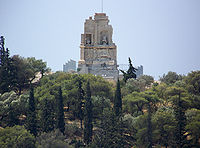 Philopappos died in 116. When he died, his death caused great sadness to his sister Julia Balbilla
, citizens of Athens and possibly to the imperial family. As a dedication to honor the memory of Philopappos, Balbilla with the citizens of Athens erected a tomb structure on Mouseion Hill, located southwest of the Acropolis of Athens
. His marble tomb monument is known as the “Philopappos Monument
”, and from it, the hill became known as “Philopappos Hill”.
Kingdom of Commagene
The Kingdom of Commagene was an ancient kingdom of the Hellenistic Age.Little is known of the region of Commagene prior to the beginning of the 2nd century BC. However, it seems that, from what little evidence remains, Commagene formed part of a larger state that also included Sophene...
who lived in the Roman Empire
Roman Empire
The Roman Empire was the post-Republican period of the ancient Roman civilization, characterised by an autocratic form of government and large territorial holdings in Europe and around the Mediterranean....
during the 1st century and 2nd century. He was one of the most prominent Greeks who lived in the Roman Empire
Roman Empire
The Roman Empire was the post-Republican period of the ancient Roman civilization, characterised by an autocratic form of government and large territorial holdings in Europe and around the Mediterranean....
.
Ancestry, family and early life
Philopappos was a man of aristocratic and well-connected origins. He was the first-born son of the Greek prince of Commagene, Gaius Julius Archelaus Antiochus EpiphanesGaius Julius Archelaus Antiochus Epiphanes
Gaius Julius Archelaus Antiochus Epiphanes, also known as Julius Archelaus Epiphanes; Epiphanes; Gaius Julius Antiochus Epiphanes or simply known as Gaius was an influential prince of the Kingdom of Commagene, who lived in the 1st century.Epiphanes was the first-born son and child to King...
and an Egypt
Egypt
Egypt , officially the Arab Republic of Egypt, Arabic: , is a country mainly in North Africa, with the Sinai Peninsula forming a land bridge in Southwest Asia. Egypt is thus a transcontinental country, and a major power in Africa, the Mediterranean Basin, the Middle East and the Muslim world...
ian Greek
Greeks
The Greeks, also known as the Hellenes , are a nation and ethnic group native to Greece, Cyprus and neighboring regions. They also form a significant diaspora, with Greek communities established around the world....
woman called Claudia Capitolina
Claudia Capitolina
Claudia Capitolina was an Egyptian Greek woman who lived in the Roman Empire, in the 1st century and possibly in the 2nd century. Capitolina came from a distinguished family of Equestrian rank. She was born and raised in Alexandria, Egypt. Capitolina was the daughter and only child of Tiberius...
. His younger sister and only sibling was the poetess and friend to Roman Emperor
Roman Emperor
The Roman emperor was the ruler of the Roman State during the imperial period . The Romans had no single term for the office although at any given time, a given title was associated with the emperor...
Hadrian
Hadrian
Hadrian , was Roman Emperor from 117 to 138. He is best known for building Hadrian's Wall, which marked the northern limit of Roman Britain. In Rome, he re-built the Pantheon and constructed the Temple of Venus and Roma. In addition to being emperor, Hadrian was a humanist and was philhellene in...
and Roman Empress Vibia Sabina
Vibia Sabina
Vibia Sabina was a Roman Empress, wife and second cousin, once removed, to Roman Emperor Hadrian. She was the daughter to Salonina Matidia , and suffect consul Lucius Vibius Sabinus...
, Julia Balbilla
Julia Balbilla
Julia Balbilla was a noble Roman woman and a poet who lived between the 1st century and 2nd century in the Roman Empire.-Family & Early Life:...
.
Philopappos’ parents were distantly related. The paternal grandmother of Claudia Capitolina was Greek Princess Aka II of Commagene
Aka II of Commagene
Aka II of Commagene, also known as Aka II was a Princess from the Kingdom of Commagene, who lived between the 1st century BC and 1st century. She was of Armenian and Greek descent.There are two possibilities on the origins of Aka II...
, who was a granddaughter or great, granddaughter of King Antiochus I Theos of Commagene
Antiochus I Theos of Commagene
Antiochus I Theos Dikaios Epiphanes Philorhomaios Philhellenos Antiochus I Theos Dikaios Epiphanes Philorhomaios Philhellenos Antiochus I Theos Dikaios Epiphanes Philorhomaios Philhellenos (Greek: о Αντίοχος Θεός Δίκαιος Επιφανής Φιλορωμαίος Φιλέλλην, meaning Antiochos, a just, eminent god, friend...
. While his father, was the first born son to King Antiochus IV of Commagene
Antiochus IV of Commagene
Gaius Julius Antiochus IV Epiphanes , the last king of Commagene, reigned between 38-72 as a client king to the Roman Empire.-Life:Antiochus was a prince and son of Antiochus III of Commagene and his mother was Queen Iotapa of Commagene. The parents of Antiochus IV were full-blooded siblings, who...
and his wife Queen Julia Iotapa
Iotapa
Iotapa or Iotape also known as Iotapi was the name of various queens and princesses who lived in between the 2nd century BC, 1st century BC, 1st century and 2nd century. The name Iotapa or Iotape originally derives from the name Jotapa or Jotape, which was a name of Persian origin...
of Commagene. Antiochus IV and Iotapa were direct descendants of Antiochus I Theos.
His maternal grandparents were Tiberius Claudius Balbilus
Tiberius Claudius Balbilus
Tiberius Claudius Balbillus or Balbilus, also known as ‘Balbillus the Wise‘, was an Egyptian Greek astrologer and a learned scholar. Balbillus was the son of astrologer Tiberius Claudius Thrasyllus, also known as Thrasyllus of Mendes and Princess Aka II of Commagene, who was either a granddaughter...
and an unnamed Greek woman. Balbilus was an astrologer and a learned scholar, who was later Prefect
Prefect
Prefect is a magisterial title of varying definition....
of Egypt. Balbilus and his father, Egypt
Egypt
Egypt , officially the Arab Republic of Egypt, Arabic: , is a country mainly in North Africa, with the Sinai Peninsula forming a land bridge in Southwest Asia. Egypt is thus a transcontinental country, and a major power in Africa, the Mediterranean Basin, the Middle East and the Muslim world...
ian Greek Grammarian and Astrologer called Thrasyllus of Mendes
Thrasyllus of Mendes
Thrasyllus of Mendes, whose full name was Tiberius Claudius Thrasyllus , was an Egyptian Greek grammarian and literary commentator from Mendes, Egypt...
or Tiberius Claudius Thrasyllus, were friends to the first Roman Emperor
Roman Emperor
The Roman emperor was the ruler of the Roman State during the imperial period . The Romans had no single term for the office although at any given time, a given title was associated with the emperor...
s, which included Tiberius
Tiberius
Tiberius , was Roman Emperor from 14 AD to 37 AD. Tiberius was by birth a Claudian, son of Tiberius Claudius Nero and Livia Drusilla. His mother divorced Nero and married Augustus in 39 BC, making him a step-son of Octavian...
, Claudius
Claudius
Claudius , was Roman Emperor from 41 to 54. A member of the Julio-Claudian dynasty, he was the son of Drusus and Antonia Minor. He was born at Lugdunum in Gaul and was the first Roman Emperor to be born outside Italy...
and Vespasian
Vespasian
Vespasian , was Roman Emperor from 69 AD to 79 AD. Vespasian was the founder of the Flavian dynasty, which ruled the Empire for a quarter century. Vespasian was descended from a family of equestrians, who rose into the senatorial rank under the Emperors of the Julio-Claudian dynasty...
.
His paternal grandparents were Roman Client Monarchs, King Antiochus IV of Commagene
Antiochus IV of Commagene
Gaius Julius Antiochus IV Epiphanes , the last king of Commagene, reigned between 38-72 as a client king to the Roman Empire.-Life:Antiochus was a prince and son of Antiochus III of Commagene and his mother was Queen Iotapa of Commagene. The parents of Antiochus IV were full-blooded siblings, who...
and Queen Julia Iotapa
Iotapa
Iotapa or Iotape also known as Iotapi was the name of various queens and princesses who lived in between the 2nd century BC, 1st century BC, 1st century and 2nd century. The name Iotapa or Iotape originally derives from the name Jotapa or Jotape, which was a name of Persian origin...
. Antiochus IV and Iotapa were husband, wife and full blooded-siblings. He was of Armenia
Armenia
Armenia , officially the Republic of Armenia , is a landlocked mountainous country in the Caucasus region of Eurasia...
n, Greek
Greeks
The Greeks, also known as the Hellenes , are a nation and ethnic group native to Greece, Cyprus and neighboring regions. They also form a significant diaspora, with Greek communities established around the world....
and Medes
Medes
The MedesThe Medes...
descent. Through his paternal grandparents, he was a direct descendant from the Greek Syria
Syria
Syria , officially the Syrian Arab Republic , is a country in Western Asia, bordering Lebanon and the Mediterranean Sea to the West, Turkey to the north, Iraq to the east, Jordan to the south, and Israel to the southwest....
n Kingdom the Seleucid Empire
Seleucid Empire
The Seleucid Empire was a Greek-Macedonian state that was created out of the eastern conquests of Alexander the Great. At the height of its power, it included central Anatolia, the Levant, Mesopotamia, Persia, today's Turkmenistan, Pamir and parts of Pakistan.The Seleucid Empire was a major centre...
and the Greek Egyptian
Ancient Egypt
Ancient Egypt was an ancient civilization of Northeastern Africa, concentrated along the lower reaches of the Nile River in what is now the modern country of Egypt. Egyptian civilization coalesced around 3150 BC with the political unification of Upper and Lower Egypt under the first pharaoh...
Kingdom the Ptolemaic dynasty
Ptolemaic dynasty
The Ptolemaic dynasty, was a Macedonian Greek royal family which ruled the Ptolemaic Empire in Egypt during the Hellenistic period. Their rule lasted for 275 years, from 305 BC to 30 BC...
.
Philopappos was the first-born grandchild and grandson born to King Antiochus IV and Antiochus’ late wife, Iotapa. He was born in Samosata
Samosata
Samosata was an ancient city on the right bank of the Euphrates whose ruins existed at the modern city of Samsat, Adıyaman Province, Turkey until the site was flooded by the newly-constructed Atatürk Dam....
the capital of the Kingdom of Commagene in the court of the palace of Antiochus IV. He lived there and was raised safely there until 72. Philopappos’ birth name was Gaius Julius Antiochus Epiphanes. His nickname and the name he is known now is Philopappos or Philopappus. Philopappos means Fond of Grandfather. He received this nickname because of his close relationship to Antiochus IV and possibly Tiberius Claudius Balbilus. Philopappos had a traditional Greek education of the Wealthy Class.
In 72 Lucius Caesennius Paetus
Lucius Caesennius Paetus
Lucius Junius Caesennius Paetus was a Roman aristocrat, member of the Caesennian gens and the Junian gens, who lived in the second half of the 1st century during the Roman Empire. He was Consul Ordinarius for the year 61, and enjoyed several high provincial commands in the East.He was the son of...
, the Roman Governor of Syria
History of Syria
The history of Syria:*Prehistory and Ancient Near East: see Pre-history of the Southern Levant, Fertile Crescent, Ebla, Mitanni*Antiquity: see Syro-Hittite states, Greater Syria, Roman Syria...
had sent letters addressed to Vespasian accusing Antiochus IV; Philopappos’s father Epiphanes and his paternal uncle Callinicus
Callinicus (Prince of Commagene)
Callinicus was a prince of the Kingdom of Commagene, who lived in the 1st century. Callinicus was the second-born son and child to King Antiochus IV of Commagene and Queen Iotapa of Commagene. His parents were full-blooded siblings. His parents were Roman Client Monarchs of Commagene that lived...
in planning to revolt against Rome
Rome
Rome is the capital of Italy and the country's largest and most populated city and comune, with over 2.7 million residents in . The city is located in the central-western portion of the Italian Peninsula, on the Tiber River within the Lazio region of Italy.Rome's history spans two and a half...
and allying themselves with the King of Parthia
Parthia
Parthia is a region of north-eastern Iran, best known for having been the political and cultural base of the Arsacid dynasty, rulers of the Parthian Empire....
.
Paetus accused in these letters that Antiochus IV, Epiphanes and Callinicus of disloyalty to the Emperor. It is not known whether if these accusations were true or false. After reading the letters, Vespasian felt that he could longer trust the family of Antiochus IV and couldn’t trust them to protect the strategic crossing at the Euphrates
Euphrates
The Euphrates is the longest and one of the most historically important rivers of Western Asia. Together with the Tigris, it is one of the two defining rivers of Mesopotamia...
River at Samosata. Vespasian gave orders to Antiochus IV to terminate his rule in Commagene.
Paetus invaded the Kingdom of Commagene, as head of the Legio VI Ferrata
Legio VI Ferrata
Legio sexta Ferrata , was a Roman Legion formed in 65 BC, and in existence up to at least 3rd century. A Legio VI fought in the Roman Republican civil wars of the 40s and 30s BC...
. The client Kings Aristobulus of Chalcis
Aristobulus of Chalcis
Aristobulus of Chalcis was a son of Herod of Chalcis and his first wife Mariamne, hence a great-grandson of Herod the Great.In 55 AD, he was appointed by Nero as King of Armenia Minor, and participated with his forces in the Roman-Parthian War of 58–63, where he received a small portion of Armenia...
and Sohaemus of Emesa
Sohaemus of Emesa
Gaius Julius Sohaemus, also known as Sohaemus of Emesa and Sohaemus of Sophene , was a prince and a Roman Client Priest King from Syria who lived in the 1st century....
also supplied troops to Paetus. They all arrived the night before the Battle. As Epiphanes and Callinicus prepared themselves that night for war, Antiochus IV was preparing to flee to Cilicia
Cilicia
In antiquity, Cilicia was the south coastal region of Asia Minor, south of the central Anatolian plateau. It existed as a political entity from Hittite times into the Byzantine empire...
.
The next morning that the war was supposed to occur Epiphanes with his family and Callinicus out of fear of the Romans fled to the King of Parthia, while Antiochus IV also out of fear of the Romans fled to Cilicia. There is a possibility that Epiphanes and Callinicus had a short-lived attempt to resist invasion, before they fled to Parthia
Parthia
Parthia is a region of north-eastern Iran, best known for having been the political and cultural base of the Arsacid dynasty, rulers of the Parthian Empire....
.
The family of Antiochus IV had let their own army and the citizens of Commagene down. Antiochus IV and his family never considered to cause a war with Rome
Rome
Rome is the capital of Italy and the country's largest and most populated city and comune, with over 2.7 million residents in . The city is located in the central-western portion of the Italian Peninsula, on the Tiber River within the Lazio region of Italy.Rome's history spans two and a half...
and they wanted to clear themselves of these accusations. Vespasian brought peacefully back to Rome, Epiphanes with his family and Callinicus in an honourable Roman Military Escort. Epiphanes with his family and Callinicus lived in Rome with Antiochus IV for the remainder of his life. Vespasian had given Antiochus IV and his family sufficient revenue to live on. Antiochus IV and his family had a glamorous life and were treated with great respect.
Philopappos and his family never returned to Commagene. Commagene was reinstated again as apart of the Roman Province of Syria
Syria
Syria , officially the Syrian Arab Republic , is a country in Western Asia, bordering Lebanon and the Mediterranean Sea to the West, Turkey to the north, Iraq to the east, Jordan to the south, and Israel to the southwest....
and there the citizens of Commagene still proved to be loyal subjects of the Roman Empire.
Life after Commagene
In 72, Philopappos’s sister Julia BalbillaJulia Balbilla
Julia Balbilla was a noble Roman woman and a poet who lived between the 1st century and 2nd century in the Roman Empire.-Family & Early Life:...
was born in Rome. After the deaths of both of his grandfathers, Epiphanes, his mother, himself with his sister moved and finally settled in Athens
Athens
Athens , is the capital and largest city of Greece. Athens dominates the Attica region and is one of the world's oldest cities, as its recorded history spans around 3,400 years. Classical Athens was a powerful city-state...
Greece
Greece
Greece , officially the Hellenic Republic , and historically Hellas or the Republic of Greece in English, is a country in southeastern Europe....
. His father died in 92 of unknown causes. After the death of Epiphanes, Claudia Capitolina returned to her birth city of Alexandria
Alexandria
Alexandria is the second-largest city of Egypt, with a population of 4.1 million, extending about along the coast of the Mediterranean Sea in the north central part of the country; it is also the largest city lying directly on the Mediterranean coast. It is Egypt's largest seaport, serving...
, Egypt
Egypt
Egypt , officially the Arab Republic of Egypt, Arabic: , is a country mainly in North Africa, with the Sinai Peninsula forming a land bridge in Southwest Asia. Egypt is thus a transcontinental country, and a major power in Africa, the Mediterranean Basin, the Middle East and the Muslim world...
where she married for the second time to the Roman Politician Marcus Junius Rufus
Marcus Junius Rufus
Marcus Junius Rufus was a Roman Politician of the Roman Empire, who lived in the 1st century. Rufus was a member of the ancient, noble and politician influential Junius ....
. Capitolina spent her remaining years in her birth city and for a period of time Balbilla was with her mother and later returned to Philopappos in Athens.
Throughout his life, Philopappos always considered himself as having the status of a monarch. He spent the remainder of his life in Athens
Athens
Athens , is the capital and largest city of Greece. Athens dominates the Attica region and is one of the world's oldest cities, as its recorded history spans around 3,400 years. Classical Athens was a powerful city-state...
and became a prominent and respected benefactor of the city. Philopappos assumed civic, political and religious duties in Athens
Athens
Athens , is the capital and largest city of Greece. Athens dominates the Attica region and is one of the world's oldest cities, as its recorded history spans around 3,400 years. Classical Athens was a powerful city-state...
and Rome
Rome
Rome is the capital of Italy and the country's largest and most populated city and comune, with over 2.7 million residents in . The city is located in the central-western portion of the Italian Peninsula, on the Tiber River within the Lazio region of Italy.Rome's history spans two and a half...
. He belonged to the Roman elite and became friends with the Roman Emperor
Roman Emperor
The Roman emperor was the ruler of the Roman State during the imperial period . The Romans had no single term for the office although at any given time, a given title was associated with the emperor...
Trajan
Trajan
Trajan , was Roman Emperor from 98 to 117 AD. Born into a non-patrician family in the province of Hispania Baetica, in Spain Trajan rose to prominence during the reign of emperor Domitian. Serving as a legatus legionis in Hispania Tarraconensis, in Spain, in 89 Trajan supported the emperor against...
and Trajan’s heir and second paternal cousin Hadrian
Hadrian
Hadrian , was Roman Emperor from 117 to 138. He is best known for building Hadrian's Wall, which marked the northern limit of Roman Britain. In Rome, he re-built the Pantheon and constructed the Temple of Venus and Roma. In addition to being emperor, Hadrian was a humanist and was philhellene in...
. Through Trajan and Hadrian, Philopappos also met their families.
Philopappos had Roman
Roman citizenship
Citizenship in ancient Rome was a privileged political and legal status afforded to certain free-born individuals with respect to laws, property, and governance....
and Athenian citizenship. He served as an Archon
Archon
Archon is a Greek word that means "ruler" or "lord", frequently used as the title of a specific public office. It is the masculine present participle of the verb stem ἀρχ-, meaning "to rule", derived from the same root as monarch, hierarchy, and anarchy.- Ancient Greece :In ancient Greece the...
in Athens and had become friends to Greek philosophers. Through his friendship with the philosophers, he became an acquaintance to the Greek historian Plutarch
Plutarch
Plutarch then named, on his becoming a Roman citizen, Lucius Mestrius Plutarchus , c. 46 – 120 AD, was a Greek historian, biographer, essayist, and Middle Platonist known primarily for his Parallel Lives and Moralia...
. Plutarch in his writings describes Philopappos as ‘very generous and magnificent in his rewards’ and describes his character as ‘good-humored and eager for instruction’.
Philopappos served as a Choregos (producer for a chorus) twice; as an Agonothetes
Agonothetes
In ancient Greece, an agonothetes was the president or superintendent of the sacred games. At first the person who instituted the games and defrayed the expenses was the Agonothetes; but in the great public games, such as the Olympic Games and Pythian Games, these presidents were the...
(magistrate of games) once and was a member of the Deme
Deme
In Ancient Greece, a deme or demos was a subdivision of Attica, the region of Greece surrounding Athens. Demes as simple subdivisions of land in the countryside seem to have existed in the 6th century BC and earlier, but did not acquire particular significance until the reforms of Cleisthenes in...
Besa. Between 105-116, Philopappos was made a member of the Arval Brethren
Arval Brethren
In ancient Roman religion, the Arval Brethren or Arval Brothers were a body of priests who offered annual sacrifices to the Lares and gods to guarantee good harvests...
. The Arval Brethren was an ancient group of priests that offered annual sacrifices to Lares and the gods to guarantee good harvests.
Through his friendship and influence from Trajan, Trajan promoted him as a member of the
Praetorian Guard
Praetorian Guard
The Praetorian Guard was a force of bodyguards used by Roman Emperors. The title was already used during the Roman Republic for the guards of Roman generals, at least since the rise to prominence of the Scipio family around 275 BC...
in Rome
Rome
Rome is the capital of Italy and the country's largest and most populated city and comune, with over 2.7 million residents in . The city is located in the central-western portion of the Italian Peninsula, on the Tiber River within the Lazio region of Italy.Rome's history spans two and a half...
. Trajan and Hadrian through his praetorian rank, promoted him to the Roman Senate
Roman Senate
The Senate of the Roman Republic was a political institution in the ancient Roman Republic, however, it was not an elected body, but one whose members were appointed by the consuls, and later by the censors. After a magistrate served his term in office, it usually was followed with automatic...
. He became a Roman Senator, although his father nor paternal grandfather was not of senatorial rank. Philopappos rose through the ranks and served as a suffect consul in 109.
There is a possibility that Philopappos married an unnamed woman. From this marriage he probably had children and possibly had further descendants, however there are no surviving records of this.
Philopappos Monument
Julia Balbilla
Julia Balbilla was a noble Roman woman and a poet who lived between the 1st century and 2nd century in the Roman Empire.-Family & Early Life:...
, citizens of Athens and possibly to the imperial family. As a dedication to honor the memory of Philopappos, Balbilla with the citizens of Athens erected a tomb structure on Mouseion Hill, located southwest of the Acropolis of Athens
Acropolis of Athens
The Acropolis of Athens or Citadel of Athens is the best known acropolis in the world. Although there are many other acropoleis in Greece, the significance of the Acropolis of Athens is such that it is commonly known as The Acropolis without qualification...
. His marble tomb monument is known as the “Philopappos Monument
Philopappos Monument
The Philopappos Monument is an ancient Greek mausoleum and monument dedicated to Gaius Julius Antiochus Epiphanes Philopappos or Philopappus, , a prince from the Kingdom of Commagene...
”, and from it, the hill became known as “Philopappos Hill”.
Sources
- Kleiner, D.E.E. “The Monument of Philopappos.” Archaeologica 30 (1983), Athenaeus Deipnosophistae VIII.350c
- JosephusJosephusTitus Flavius Josephus , also called Joseph ben Matityahu , was a 1st-century Romano-Jewish historian and hagiographer of priestly and royal ancestry who recorded Jewish history, with special emphasis on the 1st century AD and the First Jewish–Roman War, which resulted in the Destruction of...
Bellum Judaeum 238-243 - Pausanias (geographer)Pausanias (geographer)Pausanias was a Greek traveler and geographer of the 2nd century AD, who lived in the times of Hadrian, Antoninus Pius and Marcus Aurelius. He is famous for his Description of Greece , a lengthy work that describes ancient Greece from firsthand observations, and is a crucial link between classical...
I.25.8 - PlutarchPlutarchPlutarch then named, on his becoming a Roman citizen, Lucius Mestrius Plutarchus , c. 46 – 120 AD, was a Greek historian, biographer, essayist, and Middle Platonist known primarily for his Parallel Lives and Moralia...
Quaestiones Convivales 628a & Quomodo ab adulatore discernatur amicus 48e & 66c, IG II² 1759, 3112, 3450, 3451, & 4511; IG V.2.524; Inscriptions du Colosse de Memnon nos. 28-31, & OGIS 408