Hellenic Parliament

Encyclopedia
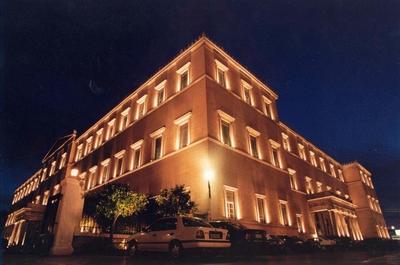
The Hellenic Parliament , also the Parliament of the Hellenes, is the Parliament
of Greece
, located in the Parliament House (Old Royal Palace), overlooking Syntagma Square
in Athens
, Greece
.
It is a unicameral
legislature
of 300 members, elected for a four-year term. During 1844-1863 and 1927-1935 the parliament was bicameral
with an upper house
, the Senate
and a lower house
, which retained the name Vouli. Several important Greek statesmen served as Speakers of the Hellenic Parliament. The List of Speakers of the Hellenic Parliament comprises all the Speakers from 1946 till today.
had been held, the first national parliament of the independent Greek state was established only in 1843, after the September 3rd Revolution, which forced King Otto
to grant a constitution
. In 1911, a revision of the constitution
resulted in stronger human rights
, the reinforcement of the Rule of Law and the modernization of institutions, among them the parliament. After seven years of military dictatorship
, on 8 December 1974, a referendum
was conducted to decide about the nature of the form of government. By a majority of 69.18%, the Greeks decided against a constitutional monarchy
and for a parliamentary republic
. As detailed in the following section, Members of Parliament are immune from criminal prosecution, arrest or detention while in office.
 The Greek Parliament has 300 members, elected for a four-year term by a system of 'reinforced' proportional representation in 56 constituencies, 48 of which are multi-seat and 8 single-seat. Seats are determined by constituency voting, and voters may select the candidate or candidates of their choice by marking their name on the party ballot. However, the party receiving the largest number of votes receives 40-seat premium, which is filled by candidates of that party not declared elected on the lower rungs (the constituencies). Eligible for deputies are Greek citizens aged 18 or over on the date of the election, who are eligible to vote. With the sole exception of university professors, citizens who are public servants are disqualified from submitting their candidacies, unless they irrevocably resign their office before promulgation.
Members of Parliament are immune from criminal prosecution, arrest or detention while in office. They are also immune from having to provide any information to any authority regarding their legislative functions and deliberations. They are not immune from civil suits. Alleged crimes committed in the member's official capacity (e.g. embezzlement of public monies) may be adjudicated only after Parliament impeaches the member. Government ministers who are not members of Parliament are subject to the same procedure. The impeachment trial is held by an ad hoc Special Court. Alleged crimes committed in the member's personal capacity (e.g. homicide) may be adjudicated only after Parliament votes to have the member's immunity suspended, at the request of a prosecuting attorney and only in relation to the particular alleged crime. In such cases, the case is adjudicated by a regular court. The Parliament's permission is not necessary if a member is "caught in the act" of committing a crime (e.g. murder).
, five Deputy Speakers, three Deans and six Secretaries. It is characterised by a tri-partisan composition, meaning that the fourth Deputy Speaker, a dean and a secretary belong to main opposition party, and the fifth Deputy Speaker and a secretary belong to the next largest (by seats) opposition party. A member of the Presidium, who must be a member of parliament, cannot be a member of the Cabinet
or an Under-Secretary. While the Speaker of the Parliament and the five Deputy Speakers are elected at the beginning of each term and for the entire duration of that term, the tenure of the Deans and of the Secretaries lasts for the duration of one regular session of the Parliament for which they were elected.
to promulgate and publish in the Government Gazette
. The countersignature of the appropriate government minister(s) is required. Delegation of legislative power is generally allowed, unless the Constitution provides for a situation where a Law (Nomos) is required. Laws can be found online in the National Gazette but the service works through subscription. Also, hard copies of the legislation can be obtained at the National Gazette office for a nominal fee. A private online service, the Nomos database, that again works through subscription, can be used for legislation research. There is no public database or website where one can obtain legislation. It is not published in the Parliament website either.
Recently the legislation is about to become available online through http://www.e-themis.gov.gr/
television station, "Vouli TV
", which broadcasts all plenary and committee
sessions. When no parliamentary business is conducted, the station broadcasts a selection of films, plays, classical music concerts, opera and ballet performances and historical documentaries.
During summer recess, Parliament operates "Teenager Parliament" (Vouli ton Efivon), a series of sessions during which a rotating quota of MPs attends speeches and debates held by high school junior students from Greece, Cyprus, and the Greek Diaspora
. The program carries the twin aims of alerting parliamentarians to the needs and perspectives of younger generations, and to educate teenagers in the practice of proper debating and participation in public life. Parliament also hosts official visits and tours for middle- and high-schools throughout the school year.
Parliament regularly organizes exhibitions and retrospectives on various aspects of public life, mainly dealing with aspects of political and parliamentary history.
Parliament administers the "Parliament Foundation", a research and publishing foundation established to produce printed and electronic media, mainly on archival material, historical and scientific matters pertaining to parliamentary functions and the past political and cultural life of Greece.

The original meeting place of the Hellenic Parliament was the house of Athenian magnate and politician Alexandros Kontostavlos, in central Athens, which was used for the first time after King Otto
was forced to grant a constitution in 1853. A devastating fire burned down the original building, and plans were made for the construction of what became the seat of the parliament between 1875 and 1932. The new building, now called the Old Parliament House
, was completed to designs by French
architect
François Boulanger. Pending the completion of the Parliament House between 1853 and 1871, the sessions of the parliament took place in a hastily-erected building near the Old Parliament House which became known as "the shack".
The current parliament, a neoclassical
three-floor structure designed by Friedrich von Gärtner
and completed in 1843, originally served as a palace
for the Greek monarchs, hence sometimes still referred to as the "Old Palace
" . After suffering fire damage in 1909, it entered a long period of renovation. The king and royal family moved to what was from 1897 until then the Crown Prince's Palace, from then on known as the "New Palace", one block to the east on Herodou Attikou Street
, while some royals continued to reside in the "Old Palace" until 1924, when a referendum
abolished the monarchy. The building was then used for many different purposes — functioning as a makeshift hospital
, a museum
, et al. — until November 1929, when government decided that the building would permanently house Parliament. After more extensive renovations, the Senate convened in the "Old Palace" (Παλαιά Ανάκτορα) on 2 August 1934, followed by the Fifth National Assembly on 1 July 1935. Although the monarchy was restored that same year, the building has housed Parliament ever since.
The Tomb of the Unknown Soldier (Μνημείο του Αγνώστου Στρατιώτη), guarded round the clock by the Evzones
of the Presidential Guard, is located in the formal forecourt of the building. Construction of the monument began in 1929 and it was inaugurated on March 25, 1932.
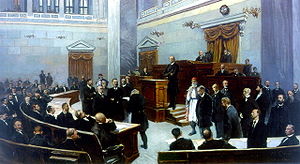
The main Chamber of Parliament, on the ground floor, is amphitheatrical in layout, and is panelled in purple and purple-veined white marble
, with inlaid gold
ornaments. Seating for the MPs is arranged in five circular sector
s. The Speaker's Chair, the lectern, the ministerial and state functionary benches, and the stenographers' vault are made of carved wood and are laid out facing the MP seats. A colonnade
d balcony surrounds the upper tier of the Chamber and is used as the visitors' gallery. Part of it served as the Royal Box in the past. A vitrail
roof provides natural light during daytime.
An almost identical, but smaller-scaled, Chamber was built in the second floor for use of the Senate. Since there has not been a Senate for several decades, this Chamber has no official function any more, and is used for party caucuses and other parliamentary or party functions on an ad hoc
basis.
The building has two main entrances, the west-facing formal entrance, which faces the Tomb of the Unknown Soldier and Syntagma Square
, and the east-facing business entrance, which faces the National Gardens. Improvements are ongoing, some of them significant (such as the addition of an 800-vehicle underground parking structure), to ensure that the building can continue to function effectively. Despite renovations, parliamentary functions have outpaced the capacity of the listed building, and some ancillary services have moved to nearby offices around Syntagma Square.
, the Hellenic Parliament was composed of five parliamentary groups. After repeated expulsions and resignations of individual MPs from the established parties due to the Greek debt crisis, the number has risen to nine (5 officially recognised and 4 unrecognised by the Hellenic Parliament
).
Officially recognised parties of the Hellenic Parliament:
Officially unrecognised parties of the Hellenic Parliament:
Independents
:
Parliament
A parliament is a legislature, especially in those countries whose system of government is based on the Westminster system modeled after that of the United Kingdom. The name is derived from the French , the action of parler : a parlement is a discussion. The term came to mean a meeting at which...
of Greece
Greece
Greece , officially the Hellenic Republic , and historically Hellas or the Republic of Greece in English, is a country in southeastern Europe....
, located in the Parliament House (Old Royal Palace), overlooking Syntagma Square
Syntagma Square
Syntagma Square , is located in central Athens, Greece. The Square is named after the Constitution that King Otto was forced to grant the people after a popular and military uprising, on September 3, 1843....
in Athens
Athens
Athens , is the capital and largest city of Greece. Athens dominates the Attica region and is one of the world's oldest cities, as its recorded history spans around 3,400 years. Classical Athens was a powerful city-state...
, Greece
Greece
Greece , officially the Hellenic Republic , and historically Hellas or the Republic of Greece in English, is a country in southeastern Europe....
.
It is a unicameral
Unicameralism
In government, unicameralism is the practice of having one legislative or parliamentary chamber. Thus, a unicameral parliament or unicameral legislature is a legislature which consists of one chamber or house...
legislature
Legislature
A legislature is a kind of deliberative assembly with the power to pass, amend, and repeal laws. The law created by a legislature is called legislation or statutory law. In addition to enacting laws, legislatures usually have exclusive authority to raise or lower taxes and adopt the budget and...
of 300 members, elected for a four-year term. During 1844-1863 and 1927-1935 the parliament was bicameral
Bicameralism
In the government, bicameralism is the practice of having two legislative or parliamentary chambers. Thus, a bicameral parliament or bicameral legislature is a legislature which consists of two chambers or houses....
with an upper house
Upper house
An upper house, often called a senate, is one of two chambers of a bicameral legislature, the other chamber being the lower house; a legislature composed of only one house is described as unicameral.- Possible specific characteristics :...
, the Senate
Greek Senate
The Greek Senate was the upper chamber of the parliament in Greece, extant several times in the country's history.-Local senates during the War of Independence:...
and a lower house
Lower house
A lower house is one of two chambers of a bicameral legislature, the other chamber being the upper house.Despite its official position "below" the upper house, in many legislatures worldwide the lower house has come to wield more power...
, which retained the name Vouli. Several important Greek statesmen served as Speakers of the Hellenic Parliament. The List of Speakers of the Hellenic Parliament comprises all the Speakers from 1946 till today.
History
Although during the Greek Revolution a number of National AssembliesGreek National Assembly
The Greek National Assemblies are representative bodies of the Greek people. During and in the direct aftermath of the Greek War of Independence , the name was used for the insurgents' proto-parliamentary assemblies...
had been held, the first national parliament of the independent Greek state was established only in 1843, after the September 3rd Revolution, which forced King Otto
Otto of Greece
Otto, Prince of Bavaria, then Othon, King of Greece was made the first modern King of Greece in 1832 under the Convention of London, whereby Greece became a new independent kingdom under the protection of the Great Powers .The second son of the philhellene King Ludwig I of Bavaria, Otto ascended...
to grant a constitution
Greek Constitution of 1844
The first constitution of the Kingdom of Greece was the Greek Constitution of 1844. On 3 September 1843, the military garrison of Athens, with the help of citizens, rebelled and demanded from King Otto the concession of a Constitution....
. In 1911, a revision of the constitution
Greek Constitution of 1911
The Greek Constitution of 1911 was a major step forward in the constitutional history of Greece. Following the rise to power of Eleftherios Venizelos after the Goudi revolt in 1909, Venizelos set about attempting to reform the state...
resulted in stronger human rights
Human rights
Human rights are "commonly understood as inalienable fundamental rights to which a person is inherently entitled simply because she or he is a human being." Human rights are thus conceived as universal and egalitarian . These rights may exist as natural rights or as legal rights, in both national...
, the reinforcement of the Rule of Law and the modernization of institutions, among them the parliament. After seven years of military dictatorship
Greek military junta of 1967-1974
The Greek military junta of 1967–1974, alternatively "The Regime of the Colonels" , or in Greece "The Junta", and "The Seven Years" are terms used to refer to a series of right-wing military governments that ruled Greece from 1967 to 1974...
, on 8 December 1974, a referendum
Greek plebiscite, 1974
The Greek plebiscite of December 8, 1974, resulted in the final abolition of the monarchy in Greece and the establishment of the current Third Hellenic Republic....
was conducted to decide about the nature of the form of government. By a majority of 69.18%, the Greeks decided against a constitutional monarchy
Constitutional monarchy
Constitutional monarchy is a form of government in which a monarch acts as head of state within the parameters of a constitution, whether it be a written, uncodified or blended constitution...
and for a parliamentary republic
Parliamentary republic
A parliamentary republic or parliamentary constitutional republic is a type of republic which operates under a parliamentary system of government - meaning a system with no clear-cut separation of powers between the executive and legislative branches. There are a number of variations of...
. As detailed in the following section, Members of Parliament are immune from criminal prosecution, arrest or detention while in office.
Election and tenure
Members of Parliament are immune from criminal prosecution, arrest or detention while in office. They are also immune from having to provide any information to any authority regarding their legislative functions and deliberations. They are not immune from civil suits. Alleged crimes committed in the member's official capacity (e.g. embezzlement of public monies) may be adjudicated only after Parliament impeaches the member. Government ministers who are not members of Parliament are subject to the same procedure. The impeachment trial is held by an ad hoc Special Court. Alleged crimes committed in the member's personal capacity (e.g. homicide) may be adjudicated only after Parliament votes to have the member's immunity suspended, at the request of a prosecuting attorney and only in relation to the particular alleged crime. In such cases, the case is adjudicated by a regular court. The Parliament's permission is not necessary if a member is "caught in the act" of committing a crime (e.g. murder).
Organization
The business of parliament is handled by the Presidium (Προεδρείο της Βουλής), which consists of the SpeakerSpeaker of the Hellenic Parliament
The Speaker, properly the President of the Hellenic Parliament . The president's term coincides with the term of the assembly, and he or she is chosen by a vote during the opening session, after each legislative election. Following is a list of Speakers of the Hellenic Parliament, from the Greek...
, five Deputy Speakers, three Deans and six Secretaries. It is characterised by a tri-partisan composition, meaning that the fourth Deputy Speaker, a dean and a secretary belong to main opposition party, and the fifth Deputy Speaker and a secretary belong to the next largest (by seats) opposition party. A member of the Presidium, who must be a member of parliament, cannot be a member of the Cabinet
Cabinet of Greece
The cabinet of Greece , officially called the Ministerial Council , constitutes the Government of Greece. It is the collective decision-making body of the Hellenic Republic, composed of the Prime Minister and the Ministers...
or an Under-Secretary. While the Speaker of the Parliament and the five Deputy Speakers are elected at the beginning of each term and for the entire duration of that term, the tenure of the Deans and of the Secretaries lasts for the duration of one regular session of the Parliament for which they were elected.
Legislative process
The Parliament votes for a Bill (Νομοσχέδιο, Nomoskhedio) to become Law (Νόμος, Nomos) in three voting sessions: firstly in principle, then per article (when amendments may be proposed and either approved or rejected) and then as a whole. A "simple" (50% plus one) majority is sufficient for any such vote to pass. Once the bill is passed, it is sent to the President of the RepublicPresident of Greece
The President of the Hellenic Republic , colloquially referred to in English as the President of Greece, is the head of state of Greece. The office of the President of the Republic was established after the Greek republic referendum, 1974 and formally by the Constitution of Greece in 1975. The...
to promulgate and publish in the Government Gazette
Efimerida tis Kyberniseos
The Government Gazette is the official journal of the Government of Greece which lists all laws passed in a set time period ratified by Cabinet and President. It was first issued in 1833.-External links: National Printing House...
. The countersignature of the appropriate government minister(s) is required. Delegation of legislative power is generally allowed, unless the Constitution provides for a situation where a Law (Nomos) is required. Laws can be found online in the National Gazette but the service works through subscription. Also, hard copies of the legislation can be obtained at the National Gazette office for a nominal fee. A private online service, the Nomos database, that again works through subscription, can be used for legislation research. There is no public database or website where one can obtain legislation. It is not published in the Parliament website either.
Recently the legislation is about to become available online through http://www.e-themis.gov.gr/
Constitutional revision
Parliament has the right to revise or amend the Constitution, except for the articles dealing with the "Form of the State" (i.e. the establishment of the presidential, parliamentary republic) and the articles safeguarding human rights and freedoms, which are unalterable. Revision of the Constitution is initiated by a motion by at least one sixth of MPs, and agreed by a supermajority of three fifths of MPs, expressed twice, in two separate votes at least one month apart. In this case, the business of revision is transferred to the next term of Parliament, i.e. after the following legislative elections. Parliament may then ratify the revision by a 50% plus one majority. If the initial motion for revision has only achieved a 50% plus one majority, then a three fifths supermajority of the new Parliament is required. A Parliament thus endowed by its predecessor with the powers of revising the Constitution is officially named a "Revisional Parliament" and is enumerated separately from "Ordinary" Parliamentary terms. In recent years, the 1974 Parliament was titled "5th Revisional", as it operated under, and amended, the 1952 constitution. The resulting constitution of 1975 was essentially an entirely new constitution, especially so since it incorporated the outcome of the 1974 plebiscite that established the presidential republic in the place of constitutional monarchy. Nevertheless it was officially deemed a revision of the 1952 one. The 1986 parliament was the "6th Revisional"; the 2001 one the "7th Revisional Parliament"; the 2004 Parliament was the "11th Ordinary Parliament" of the Third Hellenic Republic; the 2007 Parliament was the "8th Revisional Parliament"; the sitting 2009 Parliament is the "12th Ordinary". A minimum of five years must elapse after the successful conclusion of the revision process, before another may be initiated.Parallel activities
Parliament operates its own Free-to-airFree-to-air
Free-to-air describes television and radio services broadcast in clear form, allowing any person with the appropriate receiving equipment to receive the signal and view or listen to the content without requiring a subscription or one-off fee...
television station, "Vouli TV
Vouli Tileorasi
Vouli Tileorasi is a Greek network dedicated to airing non-stop coverage of government proceedings and public affairs programming. The name comes from Greek Βουλή Vouli, meaning ‘assembly’, ‘council’, or ‘parliament’; and Tileorasi, meaning television.The primary aim of the channel is to give...
", which broadcasts all plenary and committee
Parliamentary Committees (Greece)
The Parliament of Greece naturally assumes legislative responsibilities within the framework of the state, a key part of this parliamentary process is the establishment and running of Parliamentary committees on all manner of state decisions...
sessions. When no parliamentary business is conducted, the station broadcasts a selection of films, plays, classical music concerts, opera and ballet performances and historical documentaries.
During summer recess, Parliament operates "Teenager Parliament" (Vouli ton Efivon), a series of sessions during which a rotating quota of MPs attends speeches and debates held by high school junior students from Greece, Cyprus, and the Greek Diaspora
Greek diaspora
The Greek diaspora, also known as Hellenic Diaspora or Diaspora of Hellenism, is a term used to refer to the communities of Greek people living outside the traditional Greek homelands, but more commonly in southeast Europe and Asia Minor...
. The program carries the twin aims of alerting parliamentarians to the needs and perspectives of younger generations, and to educate teenagers in the practice of proper debating and participation in public life. Parliament also hosts official visits and tours for middle- and high-schools throughout the school year.
Parliament regularly organizes exhibitions and retrospectives on various aspects of public life, mainly dealing with aspects of political and parliamentary history.
Parliament administers the "Parliament Foundation", a research and publishing foundation established to produce printed and electronic media, mainly on archival material, historical and scientific matters pertaining to parliamentary functions and the past political and cultural life of Greece.
Seat
The original meeting place of the Hellenic Parliament was the house of Athenian magnate and politician Alexandros Kontostavlos, in central Athens, which was used for the first time after King Otto
Otto of Greece
Otto, Prince of Bavaria, then Othon, King of Greece was made the first modern King of Greece in 1832 under the Convention of London, whereby Greece became a new independent kingdom under the protection of the Great Powers .The second son of the philhellene King Ludwig I of Bavaria, Otto ascended...
was forced to grant a constitution in 1853. A devastating fire burned down the original building, and plans were made for the construction of what became the seat of the parliament between 1875 and 1932. The new building, now called the Old Parliament House
Old Parliament House, Athens
The Old Parliament building at Stadiou Street in Athens, housed the Greek Parliament between 1875 and 1932. It now houses the country's National Historical Museum .-History:...
, was completed to designs by French
French people
The French are a nation that share a common French culture and speak the French language as a mother tongue. Historically, the French population are descended from peoples of Celtic, Latin and Germanic origin, and are today a mixture of several ethnic groups...
architect
Architect
An architect is a person trained in the planning, design and oversight of the construction of buildings. To practice architecture means to offer or render services in connection with the design and construction of a building, or group of buildings and the space within the site surrounding the...
François Boulanger. Pending the completion of the Parliament House between 1853 and 1871, the sessions of the parliament took place in a hastily-erected building near the Old Parliament House which became known as "the shack".
The current parliament, a neoclassical
Neoclassical architecture
Neoclassical architecture was an architectural style produced by the neoclassical movement that began in the mid-18th century, manifested both in its details as a reaction against the Rococo style of naturalistic ornament, and in its architectural formulas as an outgrowth of some classicizing...
three-floor structure designed by Friedrich von Gärtner
Friedrich von Gärtner
Friedrich von Gärtner was a German architect.Gärtner and Leo von Klenze are the most well known architects of Bavaria during the reign of Ludwig I. His architecture was generally in the Romanesque style and much to the king's taste...
and completed in 1843, originally served as a palace
Palace
A palace is a grand residence, especially a royal residence or the home of a head of state or some other high-ranking dignitary, such as a bishop or archbishop. The word itself is derived from the Latin name Palātium, for Palatine Hill, one of the seven hills in Rome. In many parts of Europe, the...
for the Greek monarchs, hence sometimes still referred to as the "Old Palace
Old Royal Palace
The ""Old Royal Palace"" is the former royal palace in Athens, Greece. The palace lies at the Syntagma square and houses the Hellenic Parliament.The palace was designed by Friedrich von Gärtner for king Otto of Greece and was completed in 1843. As it originally served as palace for the Greek...
" . After suffering fire damage in 1909, it entered a long period of renovation. The king and royal family moved to what was from 1897 until then the Crown Prince's Palace, from then on known as the "New Palace", one block to the east on Herodou Attikou Street
Herodou Attikou Street
Herodou Attikou Street or Irodou Attikou Street is located east of downtown Athens and is adjacent to the National Garden of Athens...
, while some royals continued to reside in the "Old Palace" until 1924, when a referendum
Referendum
A referendum is a direct vote in which an entire electorate is asked to either accept or reject a particular proposal. This may result in the adoption of a new constitution, a constitutional amendment, a law, the recall of an elected official or simply a specific government policy. It is a form of...
abolished the monarchy. The building was then used for many different purposes — functioning as a makeshift hospital
Hospital
A hospital is a health care institution providing patient treatment by specialized staff and equipment. Hospitals often, but not always, provide for inpatient care or longer-term patient stays....
, a museum
Museum
A museum is an institution that cares for a collection of artifacts and other objects of scientific, artistic, cultural, or historical importance and makes them available for public viewing through exhibits that may be permanent or temporary. Most large museums are located in major cities...
, et al. — until November 1929, when government decided that the building would permanently house Parliament. After more extensive renovations, the Senate convened in the "Old Palace" (Παλαιά Ανάκτορα) on 2 August 1934, followed by the Fifth National Assembly on 1 July 1935. Although the monarchy was restored that same year, the building has housed Parliament ever since.
The Tomb of the Unknown Soldier (Μνημείο του Αγνώστου Στρατιώτη), guarded round the clock by the Evzones
Evzones
The Evzones, or Evzoni, is the name of several historical elite light infantry and mountain units of the Greek Army. Today, it refers to the members of the Proedriki Froura , an elite ceremonial unit that guards the Greek Tomb of the Unknown Soldier , the Hellenic Parliament and the Presidential...
of the Presidential Guard, is located in the formal forecourt of the building. Construction of the monument began in 1929 and it was inaugurated on March 25, 1932.
The main Chamber of Parliament, on the ground floor, is amphitheatrical in layout, and is panelled in purple and purple-veined white marble
Marble
Marble is a metamorphic rock composed of recrystallized carbonate minerals, most commonly calcite or dolomite.Geologists use the term "marble" to refer to metamorphosed limestone; however stonemasons use the term more broadly to encompass unmetamorphosed limestone.Marble is commonly used for...
, with inlaid gold
Gold
Gold is a chemical element with the symbol Au and an atomic number of 79. Gold is a dense, soft, shiny, malleable and ductile metal. Pure gold has a bright yellow color and luster traditionally considered attractive, which it maintains without oxidizing in air or water. Chemically, gold is a...
ornaments. Seating for the MPs is arranged in five circular sector
Circular sector
A circular sector or circle sector, is the portion of a disk enclosed by two radii and an arc, where the smaller area is known as the minor sector and the larger being the major sector. In the diagram, θ is the central angle in radians, r the radius of the circle, and L is the arc length of the...
s. The Speaker's Chair, the lectern, the ministerial and state functionary benches, and the stenographers' vault are made of carved wood and are laid out facing the MP seats. A colonnade
Colonnade
In classical architecture, a colonnade denotes a long sequence of columns joined by their entablature, often free-standing, or part of a building....
d balcony surrounds the upper tier of the Chamber and is used as the visitors' gallery. Part of it served as the Royal Box in the past. A vitrail
Stained glass
The term stained glass can refer to coloured glass as a material or to works produced from it. Throughout its thousand-year history, the term has been applied almost exclusively to the windows of churches and other significant buildings...
roof provides natural light during daytime.
An almost identical, but smaller-scaled, Chamber was built in the second floor for use of the Senate. Since there has not been a Senate for several decades, this Chamber has no official function any more, and is used for party caucuses and other parliamentary or party functions on an ad hoc
Ad hoc
Ad hoc is a Latin phrase meaning "for this". It generally signifies a solution designed for a specific problem or task, non-generalizable, and not intended to be able to be adapted to other purposes. Compare A priori....
basis.
The building has two main entrances, the west-facing formal entrance, which faces the Tomb of the Unknown Soldier and Syntagma Square
Syntagma Square
Syntagma Square , is located in central Athens, Greece. The Square is named after the Constitution that King Otto was forced to grant the people after a popular and military uprising, on September 3, 1843....
, and the east-facing business entrance, which faces the National Gardens. Improvements are ongoing, some of them significant (such as the addition of an 800-vehicle underground parking structure), to ensure that the building can continue to function effectively. Despite renovations, parliamentary functions have outpaced the capacity of the listed building, and some ancillary services have moved to nearby offices around Syntagma Square.
Current composition
Following the 4 October 2009 general electionsGreek legislative election, 2009
Parliamentary elections were held in Greece on 4 October 2009. An election was not required until September 2011.On 2 September Prime Minister Kostas Karamanlis announced he would request President Karolos Papoulias to dissolve Parliament and call an election...
, the Hellenic Parliament was composed of five parliamentary groups. After repeated expulsions and resignations of individual MPs from the established parties due to the Greek debt crisis, the number has risen to nine (5 officially recognised and 4 unrecognised by the Hellenic Parliament
Hellenic Parliament
The Hellenic Parliament , also the Parliament of the Hellenes, is the Parliament of Greece, located in the Parliament House , overlooking Syntagma Square in Athens, Greece....
).
Officially recognised parties of the Hellenic Parliament:
- Panhellenic Socialist MovementPanhellenic Socialist MovementThe Panhellenic Socialist Movement , known mostly by its acronym PASOK , is one of the two major political parties in Greece. Founded on 3 September 1974 by Andreas Papandreou, in 1981 PASOK became Greece's first social democratic party to win a majority in parliament.The party is a socialist party...
- Leader: George PapandreouGeorge PapandreouGeorgios A. Papandreou , commonly anglicised to George and shortened to Γιώργος in Greek, is a Greek politician who served as Prime Minister of Greece following his party's victory in the 2009 legislative election...
- MPs: 153
- New DemocracyNew Democracy (Greece)New Democracy is the main centre-right political party and one of the two major parties in Greece. It was founded in 1974 by Konstantinos Karamanlis and formed the first cabinet of the Third Hellenic Republic...
- Leader: Antonis SamarasAntonis SamarasAntonis Samaras is a Greek economist and politician who has been leader of New Democracy, Greece's major conservative party and main opposition party, since 2009. A Member of Parliament for Messenia, he was Minister of Finance in 1989, then Minister of Foreign Affairs from 1989 to 1990 and again...
- MPs: 83
- Communist Party of GreeceCommunist Party of GreeceFounded in 1918, the Communist Party of Greece , better known by its acronym, ΚΚΕ , is the oldest party on the Greek political scene.- Foundation :...
- Leader: Aleka PaparigaAleka PaparigaAlexandra "Aleka" Papariga is a communist Greek politician who has served the Communist Party of Greece as its General Secretary since 1991. She is the first woman to head a political party in Greece.- Early years :...
- MPs: 21
- Popular Orthodox RallyPopular Orthodox RallyThe Popular Orthodox Rally or The People's Orthodox Rally , often abbreviated to ΛΑ.Ο.Σ as a pun on the Greek word for people, is a Greek party. According to its political program LA.O.S...
- Leader: Georgios KaratzaferisGeorgios KaratzaferisGeorgios Karatzaferis is a Greek politician, a member of the Hellenic Parliament and the president of the Popular Orthodox Rally. Previously, Karatzaferis was a member of parliament of the liberal-conservative New Democracy party, from which he was expelled in 2000...
- MPs: 16
- Coalition of the Radical LeftCoalition of the Radical LeftThe Coalition of the Radical Left , commonly known by its Greek abbreviation ΣΥΡΙΖΑ , is a coalition of left political parties in Greece...
- Leader: Alexis TsiprasAlexis TsiprasAlexis Tsipras is a Greek left wing politician, member of the Hellenic parliament, president of the Synaspismos political party and head of SYRIZA parliamentary group.-Early life and career:Tsipras was born July 28, 1974, in Athens....
- MPs: 9
Officially unrecognised parties of the Hellenic Parliament:
- Democratic AllianceDemocratic Alliance (Greece)The Democratic Alliance is a centrist-liberal political party in Greece. It was founded on 21 November 2010 by Dora Bakoyannis, a few months after she was expelled from the centre-right party New Democracy for voting in support of an European Union-International Monetary Fund backed financial...
- Leader: Dora BakoyannisDora BakoyannisDora Bakoyannis , born Theodora Mitsotaki , is a Greek politician. From 2006 to 2009 she was Minister of Foreign Affairs of Greece, the highest position ever held by a woman in the Cabinet of Greece; she was also Chairperson-in-Office of the Organization for Security and Co-operation in Europe in...
- MPs: 4
- Democratic LeftDemocratic Left (Greece)Democratic Left is a Greek democratic socialist political party.It emerged, in June 2010, when the members of the moderate Renewal Wing platform left the Coalition of the Left of Movements and Ecology, or Synaspismos, at its 6th congress.-Principles:...
- Leader: Fotis Kouvelis
- MPs: 4
- Panhellenic Citizen Chariot
- Leader: Giannis Dimaras
- MPs: 1
- Free Citizens
- MPs: 1
Independents
Independent (politician)
In politics, an independent or non-party politician is an individual not affiliated to any political party. Independents may hold a centrist viewpoint between those of major political parties, a viewpoint more extreme than any major party, or they may have a viewpoint based on issues that they do...
:
- MPs: 8
See also
- Hellenic Youth ParliamentYouth Parliament (Greece)thumb|Parliament composition in 2010: Greece , Cyprus , Germany and other Greek communities .The Youth Parliament is a youth parliament organization established in 1994 and hosted in the Hellenic Parliament annually...
- Vouli TileorasiVouli TileorasiVouli Tileorasi is a Greek network dedicated to airing non-stop coverage of government proceedings and public affairs programming. The name comes from Greek Βουλή Vouli, meaning ‘assembly’, ‘council’, or ‘parliament’; and Tileorasi, meaning television.The primary aim of the channel is to give...
- Boule (Ancient Greece)Boule (Ancient Greece)In cities of ancient Greece, the boule meaning to will ) was a council of citizens appointed to run daily affairs of the city...