

Corinthian War

Encyclopedia
The Corinthian War was an ancient Greek
conflict lasting from 395 BC until 387 BC, pitting Sparta
against a coalition of four allied states; Thebes, Athens, Corinth
, and Argos
; which were initially backed by Persia. The immediate cause of the war was a local conflict in northwest Greece in which both Thebes and Sparta intervened. The deeper cause was hostility towards Sparta provoked by that city's "expansionism in Asia Minor
, central and northern Greece and even the west".
The war was fought on two fronts, on land near Corinth (hence the name) and Thebes and at sea in the Aegean
. On land, the Spartans achieved several early successes in major battles, but were unable to capitalize on their advantage, and the fighting soon became stalemated. At sea, the Spartan fleet was decisively defeated by a Persian fleet early in the war, an event that effectively ended Sparta's attempts to become a naval power. Taking advantage of this fact, Athens launched several naval campaigns in the later years of the war, recapturing a number of islands that had been part of the original Athenian Empire
during the 5th century BC.
Alarmed by these Athenian successes, the Persians stopped backing the allies and began supporting Sparta. This defection forced the allies to seek peace. The Peace of Antalcidas
, commonly known as the King's Peace, was signed in 387 BC, ending the war. This treaty declared that Persia would control all of Ionia
, and that all other Greek cities would be independent. Sparta was to be the guardian of the peace, with the power to enforce its clauses. The effects of the war, therefore, were to establish Persia's ability to interfere successfully in Greek politics and to affirm Sparta's hegemonic
position in the Greek political system.
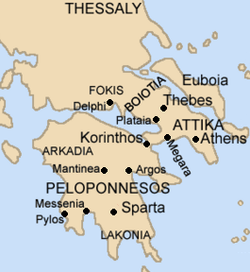 In the Peloponnesian War
, which had ended in 404 BC, Sparta had enjoyed the support of nearly every mainland Greek state and the Persian Empire, and in the months and years following that war, a number of the island states of the Aegean had come under its control. This solid base of support, however, was soon fragmented in the years following the war. Despite the collaborative nature of the victory, Sparta alone received the plunder taken from the defeated states and the tribute payments from the former Athenian Empire. Sparta's allies were further alienated when, in 402 BC, Sparta attacked and subdued Elis
, a member of the Peloponnesian League
that had angered the Spartans during the course of the Peloponnesian War. Corinth and Thebes refused to send troops to assist Sparta in its campaign against Elis.
Thebes, Corinth, and Athens also refused to participate in a Spartan expedition to Ionia
in 398 BC, with the Thebans going so far as to disrupt a sacrifice that the Spartan king Agesilaus
attempted to perform in their territory before his departure. Despite the absence of these states, Agesilaus campaigned effectively against the Persians in Lydia
, advancing as far inland as Sardis
. The satrap
Tissaphernes
was executed for his failure to contain Agesilaus, and his replacement, Tithraustes
, bribed the Spartans to move north, into the satrapy of Pharnabazus. Agesilaus did so, but simultaneously began preparing a sizable navy.
Unable to defeat Agesilaus's army, Pharnabazus decided to force Agesilaus to withdraw by stirring up trouble on the Greek mainland. He dispatched Timocrates of Rhodes
, an Asiatic Greek, to distribute money to the major cities of the mainland and incite them to act against Sparta. Timocrates visited Athens, Thebes, Corinth, and Argos, and succeeded in persuading powerful factions in each of those states to pursue an anti-Spartan policy. The Thebans, who had previously demonstrated their antipathy towards Sparta, undertook to bring about a war.
claims that, unwilling to challenge Sparta directly, the Thebans instead chose to precipitate a war by encouraging their allies, the Locrians
, to collect taxes from territory claimed by both Locris and Phocis
. In response, the Phocians invaded Locris, and ransacked Locrian territory. The Locrians appealed to Thebes for assistance, and the Thebans invaded Phocian territory; the Phocians, in turn, appealed to their ally, Sparta, and the Spartans, pleased to have a pretext to discipline the Thebans, ordered general mobilization. A Theban embassy was dispatched to Athens to request support; the Athenians voted to assist Thebes, and a perpetual alliance was concluded between Athens and the Boeotian confederacy.
The Spartan plan called for two armies, one under Lysander
and the other under Pausanias
, to rendezvous at and attack the Boeotian city of Haliartus. Lysander, arriving before Pausanias, successfully persuaded the city of Orchomenus to revolt from the Boeotian confederacy, and advanced to Haliartus with his troops and a force of Orchomenians. There, he was killed in the Battle of Haliartus
after bringing his force too near the walls of the city; the battle ended inconclusively, with the Spartans suffering early losses but then defeating a group of Thebans who pursued the Spartans onto rough terrain where they were at a disadvantage. Pausanias, arriving a day later, took back the bodies of the Spartan dead under a truce, and returned to Sparta. There, he was put on trial for his life for failing to arrive and support Lysander at the designated time. He fled to Tegea
before he could be convicted.
Alarmed by these developments, the Spartans prepared to send out an army against this new alliance, and sent a messenger to Agesilaus ordering him to return to Greece. The orders were a disappointment to Agesilaus, who had looked forward to further successful campaigning in Asia, but he set out for home with his troops, crossing the Hellespont and marching west through Thrace
.
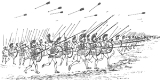
battles, the right flank of each army was victorious, with the Spartans defeating the Athenians while the Thebans, Argives, and Corinthians defeated the various Peloponnesians opposite them; the Spartans then attacked and killed a number of Argives, Corinthians, and Thebans as these troops returned from pursuing the defeated Peloponnesians. The coalition army lost 2,800 men, while the Spartans and their allies lost only 1,100.
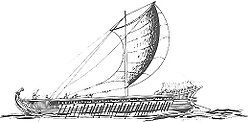
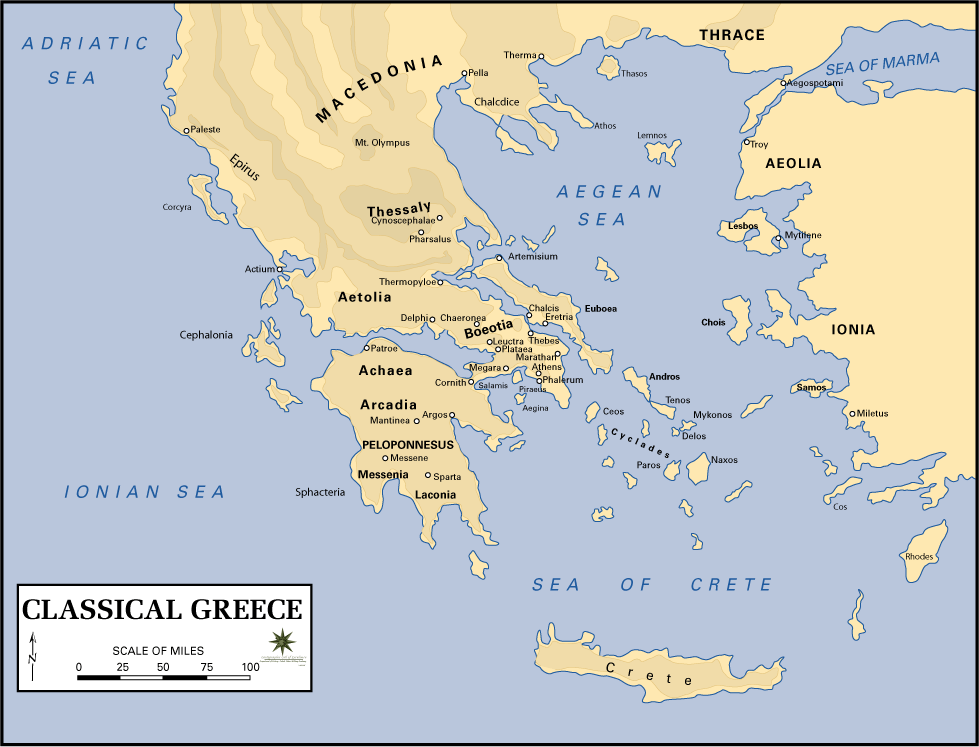 The next major action of the war took place at sea, where both the Persians and the Spartans had assembled large fleets during Agesilaus's campaign in Asia. By levying ships from the Aegean states under his control, Agesilaus had raised a force of 120 trireme
s, which he placed under the command of his brother-in-law Peisander
, who had never held a command of this nature before. The Persians, meanwhile, had already assembled a joint Phoenicia
n, Cilicia
n, and Cypriot
fleet, under the command of the experienced Athenian admiral Conon
, which had seized Rhodes
in 396 BC. These two fleets met off the point of Cnidus in 394 BC. The Spartans fought determinedly, particularly in the vicinity of Peisander's ship, but were eventually overwhelmed; large numbers of ships were sunk or captured, and the Spartan fleet was essentially wiped from the sea. Following this victory, Conon and Pharnabazus sailed along the coast of Ionia, expelling Spartan governors and garrisons from the cities, although they failed to reduce the Spartan bases at Abydos
and Sestos
.
during its march through that country, had arrived in Boeotia, where it was met by an army gathered from the various states of the anti-Spartan alliance. Agesilaus's force from Asia, composed largely of emancipated helots and mercenary veterans of the Ten Thousand
, was augmented by half a Spartan regiment from Orchomenus, and another half a regiment that had been transported across the Gulf of Corinth
. These armies met each other at Coronea, in Theban territory; as at Nemea, both right wings were victorious, with the Thebans breaking through while the rest of the allies were defeated. Seeing that the rest of their force had been defeated, the Thebans formed up to break back through to their camp. Agesilaus met their force head on, and in the struggle that followed a number of Thebans were killed before the remainder were able to force their way through and rejoin their allies. After this victory, Agesilaus sailed with his army across the Gulf of Corinth and returned to Sparta.
and seized the island of Cythera, where they left a garrison and an Athenian governor. They then sailed to Corinth, where they distributed money and urged the members of the council to show the Persian king that they were trustworthy. Pharnabazus then dispatched Conon with substantial funds and a large part of the fleet to Attica
, where he joined in the rebuilding of the long walls
from Athens to Piraeus
, a project that had been initiated by Thrasybulus
in 394 BC. With the assistance of the rowers of the fleet, and the workers paid for by the Persian money, the construction was soon completed. Athens quickly took advantage of its possession of walls and a fleet to seize the islands of Scyros, Imbros
, and Lemnos
, on which it established cleruchies
(citizen colonies).
At about this time, civil strife broke out in Corinth between the democratic
party and the oligarchic
party. The democrats, supported by the Argives, launched an attack on their opponents, and the oligarchs were driven from the city. These exiles went to the Spartans, based at this time at Sicyon
, for support, while the Athenians and Boeotians came up to support the democrats. In a night attack, the Spartans and exiles succeeded in seizing Lechaeum, Corinth's port on the Gulf of Corinth, and defeated the army that came out to challenge them the next day. The anti-Spartan allies then attempted to invest Lechaeum, but the Spartans launched an attack and drove them off.
, to the satrap Tiribazus
, hoping to turn the Persians against the allies by informing them of Conon's use of the Persian fleet to begin rebuilding the Athenian empire. The Athenians learned of this, and sent Conon and several others to present their case to the Persians; they also notified their allies, and Argos, Corinth, and Thebes dispatched embassies to Tiribazus. At the conference that resulted, the Spartans proposed a peace based on the independence of all states; this was rejected by the allies, as Athens wished to hold the gains it had made in the Aegean, Thebes wished to keep its control over the Boeotian league, and Argos already had designs on assimilating Corinth into its state. The conference thus failed, but Tiribazus, alarmed by Conon's actions, arrested him, and secretly provided the Spartans with money to equip a fleet. Although Conon quickly escaped, he died soon afterward. A second peace conference was held at Sparta in the same year, but the proposals made there were again rejected by the allies, both because of the implications of the autonomy principle and because the Athenians were outraged that the terms proposed would have involved abandoning the Ionian Greeks to Persia.
In the wake of the unsuccessful conference in Persia, Tiribazus returned to Susa
to report on events, and a new general, Struthas
, was sent out to take command. Struthas pursued an anti-Spartan policy, prompting the Spartans to order their commander in the region, Thibron, to attack him. Thibron successfully ravaged Persian territory for a time, but was killed along with a number of his men when Struthas ambushed one of his poorly organized raiding parties. Thibron was later replaced by Diphridas
, who raided more successfully, securing a number of small successes and even capturing Struthas's son-in-law, but never achieved any dramatic results.
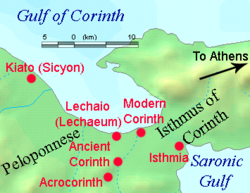 At Corinth, the democratic party continued to hold the city proper, while the exiles and their Spartan supporters held Lechaeum, from where they raided the Corinthian countryside. In 391 BC, Agesilaus campaigned in the area, successfully seizing several fortified points, along with a large amount of prisoners and booty. While Agesilaus was in camp preparing to sell off his spoils, the Athenian general Iphicrates
, with a force composed almost entirely of light troops and peltast
s (javelin throwers), won a decisive victory against the Spartan regiment that had been stationed at Lechaeum in the Battle of Lechaeum
. During the battle, Iphicrates took advantage of the Spartans' lack of peltasts to repeatedly harass the regiment with hit-and-run attacks, wearing the Spartans down until they broke and ran, at which point a number of them were slaughtered. Agesilaus returned home shortly after these events, but Iphicrates continued to campaign around Corinth, recapturing many of the strong points which the Spartans had previously taken, although he was unable to retake Lechaeum. He also campaigned against Phlius
and Arcadia
, decisively defeating the Phliasians and plundering the territory of the Arcadians when they refused to engage his troops.
After this victory, an Argive army came to Corinth, and, seizing the acropolis
, effected the merger of Argos and Corinth. The border stones between Argos and Corinth were torn down, and the citizen bodies of the two cities were merged.
, an ally of the anti-Spartan coalition. After initial difficulties in coming to grips with the Acarnanians, who kept to the mountains and avoided engaging him directly, Agesilaus was eventually able to draw them into a pitched battle, in which the Acarnanians were routed and lost a number of men. He then sailed home across the Gulf. The next year, the Acarnanians made peace with the Spartans to avoid further invasions.
In 388 BC, Agesipolis
led a Spartan army against Argos. Since no Argive army challenged him, he plundered the countryside for a time, and then, after receiving several unfavorable omens, returned home.
, to assist. After picking up more ships at Samos, Teleutias took command at Cnidus and commenced operations against Rhodes.
 Alarmed by this Spartan naval resurgence, the Athenians sent out a fleet of 40 triremes under Thrasybulus
. He, judging that he could accomplish more by campaigning where the Spartan fleet was not than by challenging it directly, sailed to the Hellespont. Once there, he won over several major states to the Athenian side and placed a duty on ships sailing past Byzantium
, restoring a source of revenue that the Athenians had relied on in the late Peloponnesian War. He then sailed to Lesbos
, where, with the support of the Mytilene
ans, he defeated the Spartan forces on the island and won over a number of cities. While still on Lesbos, however, Thrasybulus was killed by raiders from the city of Aspendus.
After this, the Spartans sent out a new commander, Anaxibius, to Abydos. For a time, he enjoyed a number of successes against Pharnabazus, and seized a number of Athenian merchant ships. Worried that Thrasybulus's accomplishments were being undermined, the Athenians sent Iphicrates to the region to confront Anaxibius. For a time, the two forces merely raided each other's territory, but eventually Iphicrates succeeded in guessing where Anaxibius would bring his troops on a return march from a campaign against Antandrus
, and ambushed the Spartan force. When Anaxibius and his men, who were strung out in the line of march, had entered the rough, mountainous terrain in which Iphicrates and his men were waiting, the Athenians emerged and ambushed them, killing Anaxibius and many others.
, off the coast of Attica. The Spartans soon drove off the Athenian fleet, but the Athenians continued their land assault. Under Antalcidas' command, the Spartan fleet sailed east to Rhodes but it was eventually blockaded at Abydos by the regional Athenian commanders. The Athenians on Aegina, meanwhile, soon found themselves under attack, and withdrew after several months.
Shortly thereafter, the Spartan fleet under Gorgopas
ambushed the Athenian fleet near Athens, capturing several ships. The Athenians responded with an ambush of their own; Chabrias
, on his way to Cyprus, landed his troops on Aegina and laid an ambush for the Aeginetans and their Spartan allies, killing a number of them including Gorgopas.
The Spartans then sent Teleutias to Aegina to command the fleet there. Noticing that the Athenians had relaxed their guard after Chabrias's victory, he launched a raid on Piraeus, seizing numerous merchant ships.
of Cyprus and Akoris
of Egypt
, both of whom were at war with Persia, had decided that their policy of weakening Sparta by supporting its enemies was no longer useful. After escaping from the blockade at Abydos, Antalcidas attacked and defeated a small Athenian force, then united his fleet with a supporting fleet sent from Syracuse
. With this force, which was soon further augmented with ships supplied by the satraps of the region, he sailed to the Hellespont, where he could cut off the trade routes that brought grain to Athens. The Athenians, mindful of their similar defeat in the Peloponnesian War less than two decades before, were ready to make peace.
In this climate, when Tiribazus called a peace conference in late 387 BC, the major parties of the war were ready to discuss terms. The basic outline of the treaty was laid out by a decree from the Persian king Artaxerxes
:
In a general peace conference at Sparta, the Spartans, with their authority enhanced by the threat of Persian intervention, secured the acquiescence of all the major states of Greece to these terms. The agreement eventually produced was commonly known as the King's Peace, reflecting the Persian influence the treaty showed. This treaty marked the first attempt at a Common Peace
in Greek history; under the treaty, all cities were to be independent, a clause that would be enforced by the Spartans as guardians of the peace. Under threat of Spartan intervention, Thebes disbanded its league, and Argos and Corinth ended their experiment in shared government; Corinth, deprived of its strong ally, was incorporated back into Sparta's Peloponnesian League
. After 8 years of fighting, the Corinthian war was at an end.
and Cyprus by 380 BC. Sparta, meanwhile, in its newly formalized position atop the Greek political system, took advantage of the autonomy clause of the peace to break up any coalition that it perceived as a threat. Disloyal allies were sharply punished—Mantinea, for instance, was broken up into five component villages. With Agesilaus at the head of the state, advocating for an aggressive policy, the Spartans campaigned from the Peloponnese to the distant Chalcidic peninsula
. Their dominance over mainland Greece would last another sixteen years before being shattered at Leuctra
.
The war also marked the beginning of Athens' resurgence as a power in the Greek world. With their walls and their fleet restored, the Athenians were in position to turn their eyes overseas. By the middle of the 4th century, they had assembled an organization of Aegean states commonly known as the Second Athenian Empire
, regaining at least parts of what they had lost with their defeat in 404 BC.
The freedom of the Ionian Greeks had been a rallying cry since the beginning of the 5th century, but after the Corinthian War, the mainland states made no further attempts to interfere with Persia's control of the region. After over a century of disruption and struggle, Persia at last ruled Ionia without disruption or intervention for over 50 years, until the time of Alexander the Great.
Ancient Greece
Ancient Greece is a civilization belonging to a period of Greek history that lasted from the Archaic period of the 8th to 6th centuries BC to the end of antiquity. Immediately following this period was the beginning of the Early Middle Ages and the Byzantine era. Included in Ancient Greece is the...
conflict lasting from 395 BC until 387 BC, pitting Sparta
Sparta
Sparta or Lacedaemon, was a prominent city-state in ancient Greece, situated on the banks of the River Eurotas in Laconia, in south-eastern Peloponnese. It emerged as a political entity around the 10th century BC, when the invading Dorians subjugated the local, non-Dorian population. From c...
against a coalition of four allied states; Thebes, Athens, Corinth
Corinth
Corinth is a city and former municipality in Corinthia, Peloponnese, Greece. Since the 2011 local government reform it is part of the municipality Corinth, of which it is the seat and a municipal unit...
, and Argos
Argos
Argos is a city and a former municipality in Argolis, Peloponnese, Greece. Since the 2011 local government reform it is part of the municipality Argos-Mykines, of which it is a municipal unit. It is 11 kilometres from Nafplion, which was its historic harbour...
; which were initially backed by Persia. The immediate cause of the war was a local conflict in northwest Greece in which both Thebes and Sparta intervened. The deeper cause was hostility towards Sparta provoked by that city's "expansionism in Asia Minor
Asia Minor
Asia Minor is a geographical location at the westernmost protrusion of Asia, also called Anatolia, and corresponds to the western two thirds of the Asian part of Turkey...
, central and northern Greece and even the west".
The war was fought on two fronts, on land near Corinth (hence the name) and Thebes and at sea in the Aegean
Aegean Sea
The Aegean Sea[p] is an elongated embayment of the Mediterranean Sea located between the southern Balkan and Anatolian peninsulas, i.e., between the mainlands of Greece and Turkey. In the north, it is connected to the Marmara Sea and Black Sea by the Dardanelles and Bosporus...
. On land, the Spartans achieved several early successes in major battles, but were unable to capitalize on their advantage, and the fighting soon became stalemated. At sea, the Spartan fleet was decisively defeated by a Persian fleet early in the war, an event that effectively ended Sparta's attempts to become a naval power. Taking advantage of this fact, Athens launched several naval campaigns in the later years of the war, recapturing a number of islands that had been part of the original Athenian Empire
Delian League
The Delian League, founded in circa 477 BC, was an association of Greek city-states, members numbering between 150 to 173, under the leadership of Athens, whose purpose was to continue fighting the Persian Empire after the Greek victory in the Battle of Plataea at the end of the Greco–Persian Wars...
during the 5th century BC.
Alarmed by these Athenian successes, the Persians stopped backing the allies and began supporting Sparta. This defection forced the allies to seek peace. The Peace of Antalcidas
Peace of Antalcidas
The Peace of Antalcidas , also known as the King's Peace, was a peace treaty guaranteed by the Persian King Artaxerxes II that ended the Corinthian War in ancient Greece. The treaty's alternate name comes from Antalcidas, the Spartan diplomat who traveled to Susa to negotiate the terms of the...
, commonly known as the King's Peace, was signed in 387 BC, ending the war. This treaty declared that Persia would control all of Ionia
Ionia
Ionia is an ancient region of central coastal Anatolia in present-day Turkey, the region nearest İzmir, which was historically Smyrna. It consisted of the northernmost territories of the Ionian League of Greek settlements...
, and that all other Greek cities would be independent. Sparta was to be the guardian of the peace, with the power to enforce its clauses. The effects of the war, therefore, were to establish Persia's ability to interfere successfully in Greek politics and to affirm Sparta's hegemonic
Hegemony
Hegemony is an indirect form of imperial dominance in which the hegemon rules sub-ordinate states by the implied means of power rather than direct military force. In Ancient Greece , hegemony denoted the politico–military dominance of a city-state over other city-states...
position in the Greek political system.
Events leading to the war
Peloponnesian War
The Peloponnesian War, 431 to 404 BC, was an ancient Greek war fought by Athens and its empire against the Peloponnesian League led by Sparta. Historians have traditionally divided the war into three phases...
, which had ended in 404 BC, Sparta had enjoyed the support of nearly every mainland Greek state and the Persian Empire, and in the months and years following that war, a number of the island states of the Aegean had come under its control. This solid base of support, however, was soon fragmented in the years following the war. Despite the collaborative nature of the victory, Sparta alone received the plunder taken from the defeated states and the tribute payments from the former Athenian Empire. Sparta's allies were further alienated when, in 402 BC, Sparta attacked and subdued Elis
Elis
Elis, or Eleia is an ancient district that corresponds with the modern Elis peripheral unit...
, a member of the Peloponnesian League
Peloponnesian League
The Peloponnesian League was an alliance in the Peloponnesus from the 6th to the 4th centuries BC.- Early history:By the end of the 6th century, Sparta had become the most powerful state in the Peloponnese, and was the political and military hegemon over Argos, the next most powerful state...
that had angered the Spartans during the course of the Peloponnesian War. Corinth and Thebes refused to send troops to assist Sparta in its campaign against Elis.
Thebes, Corinth, and Athens also refused to participate in a Spartan expedition to Ionia
Ionia
Ionia is an ancient region of central coastal Anatolia in present-day Turkey, the region nearest İzmir, which was historically Smyrna. It consisted of the northernmost territories of the Ionian League of Greek settlements...
in 398 BC, with the Thebans going so far as to disrupt a sacrifice that the Spartan king Agesilaus
Agesilaus II
Agesilaus II, or Agesilaos II was a king of Sparta, of the Eurypontid dynasty, ruling from approximately 400 BC to 360 BC, during most of which time he was, in Plutarch's words, "as good as thought commander and king of all Greece," and was for the whole of it greatly identified with his...
attempted to perform in their territory before his departure. Despite the absence of these states, Agesilaus campaigned effectively against the Persians in Lydia
Lydia
Lydia was an Iron Age kingdom of western Asia Minor located generally east of ancient Ionia in the modern Turkish provinces of Manisa and inland İzmir. Its population spoke an Anatolian language known as Lydian....
, advancing as far inland as Sardis
Sardis
Sardis or Sardes was an ancient city at the location of modern Sart in Turkey's Manisa Province...
. The satrap
Satrap
Satrap was the name given to the governors of the provinces of the ancient Median and Achaemenid Empires and in several of their successors, such as the Sassanid Empire and the Hellenistic empires....
Tissaphernes
Tissaphernes
Tissaphernes was a Persian soldier and statesman, grandson of Hydarnes.In 413 BC he was satrap of Lydia and Caria, and commander in chief of the Persian army in Asia Minor...
was executed for his failure to contain Agesilaus, and his replacement, Tithraustes
Tithraustes
Tithraustes was the Persian satrap of Sardis for several years in the early 4th century BC. Due to scanty historical records, little is known of the man or his activities...
, bribed the Spartans to move north, into the satrapy of Pharnabazus. Agesilaus did so, but simultaneously began preparing a sizable navy.
Unable to defeat Agesilaus's army, Pharnabazus decided to force Agesilaus to withdraw by stirring up trouble on the Greek mainland. He dispatched Timocrates of Rhodes
Timocrates of Rhodes
Timocrates of Rhodes was a Rhodian Greek sent by the Persian satrap Pharnabazus in 396 or 395 BC to distribute money to Greek city states and foment opposition to Sparta. He visited Athens, Thebes, Corinth, and Argos...
, an Asiatic Greek, to distribute money to the major cities of the mainland and incite them to act against Sparta. Timocrates visited Athens, Thebes, Corinth, and Argos, and succeeded in persuading powerful factions in each of those states to pursue an anti-Spartan policy. The Thebans, who had previously demonstrated their antipathy towards Sparta, undertook to bring about a war.
Initial fighting
XenophonXenophon
Xenophon , son of Gryllus, of the deme Erchia of Athens, also known as Xenophon of Athens, was a Greek historian, soldier, mercenary, philosopher and a contemporary and admirer of Socrates...
claims that, unwilling to challenge Sparta directly, the Thebans instead chose to precipitate a war by encouraging their allies, the Locrians
Locris
Locris was a region of ancient Greece, the homeland of the Locrians, made up of three distinct districts.-Locrian tribe:...
, to collect taxes from territory claimed by both Locris and Phocis
Phocis
Phocis is one of the regional units of Greece. It is part of the administrative region of Central Greece. It stretches from the western mountainsides of Parnassus on the east to the mountain range of Vardousia on the west, upon the Gulf of Corinth...
. In response, the Phocians invaded Locris, and ransacked Locrian territory. The Locrians appealed to Thebes for assistance, and the Thebans invaded Phocian territory; the Phocians, in turn, appealed to their ally, Sparta, and the Spartans, pleased to have a pretext to discipline the Thebans, ordered general mobilization. A Theban embassy was dispatched to Athens to request support; the Athenians voted to assist Thebes, and a perpetual alliance was concluded between Athens and the Boeotian confederacy.
The Spartan plan called for two armies, one under Lysander
Lysander
Lysander was a Spartan general who commanded the Spartan fleet in the Hellespont which defeated the Athenians at Aegospotami in 405 BC...
and the other under Pausanias
Pausanias of Sparta
Pausanias King of Sparta from 409 BC. He was in frequent conflict with the Ephors. Aristotle said that he tried to overthrow them. Army leader Lysander sent a letter to him, requesting help against Thebes, but it was intercepted...
, to rendezvous at and attack the Boeotian city of Haliartus. Lysander, arriving before Pausanias, successfully persuaded the city of Orchomenus to revolt from the Boeotian confederacy, and advanced to Haliartus with his troops and a force of Orchomenians. There, he was killed in the Battle of Haliartus
Battle of Haliartus
The Battle of Haliartus was fought in 395 BC between Sparta and Thebes. The Thebans defeated a Spartan force attempting to seize the town of Haliartus, killing the Spartan leader Lysander...
after bringing his force too near the walls of the city; the battle ended inconclusively, with the Spartans suffering early losses but then defeating a group of Thebans who pursued the Spartans onto rough terrain where they were at a disadvantage. Pausanias, arriving a day later, took back the bodies of the Spartan dead under a truce, and returned to Sparta. There, he was put on trial for his life for failing to arrive and support Lysander at the designated time. He fled to Tegea
Tegea
Tegea was a settlement in ancient Greece, and it is also a former municipality in Arcadia, Peloponnese, Greece. Since the 2011 local government reform it is part of the municipality Tripoli, of which it is a municipal unit. Its seat was the village Stadio....
before he could be convicted.
The alliance against Sparta expands
In the wake of these events, both the Spartans and their opponents prepared for more serious fighting to come. In late 395 BC, Corinth and Argos entered the war as co-belligerents with Athens and Thebes. A council was formed at Corinth to manage the affairs of this alliance. The allies then sent emissaries to a number of smaller states and received the support of many of them.Alarmed by these developments, the Spartans prepared to send out an army against this new alliance, and sent a messenger to Agesilaus ordering him to return to Greece. The orders were a disappointment to Agesilaus, who had looked forward to further successful campaigning in Asia, but he set out for home with his troops, crossing the Hellespont and marching west through Thrace
Thrace
Thrace is a historical and geographic area in southeast Europe. As a geographical concept, Thrace designates a region bounded by the Balkan Mountains on the north, Rhodope Mountains and the Aegean Sea on the south, and by the Black Sea and the Sea of Marmara on the east...
.
Nemea
After a brief engagement between Thebes and Phocis, in which Thebes was victorious, the allies gathered a large army at Corinth. A sizable force was sent out from Sparta to challenge this force. The forces met at the dry bed of the Nemea River, in Corinthian territory, where the Spartans won a decisive victory. As often happened in hopliteHoplite
A hoplite was a citizen-soldier of the Ancient Greek city-states. Hoplites were primarily armed as spearmen and fought in a phalanx formation. The word "hoplite" derives from "hoplon" , the type of the shield used by the soldiers, although, as a word, "hopla" could also denote weapons held or even...
battles, the right flank of each army was victorious, with the Spartans defeating the Athenians while the Thebans, Argives, and Corinthians defeated the various Peloponnesians opposite them; the Spartans then attacked and killed a number of Argives, Corinthians, and Thebans as these troops returned from pursuing the defeated Peloponnesians. The coalition army lost 2,800 men, while the Spartans and their allies lost only 1,100.
Cnidus
Trireme
A trireme was a type of galley, a Hellenistic-era warship that was used by the ancient maritime civilizations of the Mediterranean, especially the Phoenicians, ancient Greeks and Romans.The trireme derives its name from its three rows of oars on each side, manned with one man per oar...
s, which he placed under the command of his brother-in-law Peisander
Peisander (general)
Peisander was a Spartan general during the Corinthian War. In 395 BC, he was placed in command of the Spartan fleet in the Aegean by his half-brother, the king Agesilaus II. Peisander was a relatively inexperienced general, and in the first action his fleet saw, at the Battle of Cnidus, the...
, who had never held a command of this nature before. The Persians, meanwhile, had already assembled a joint Phoenicia
Phoenicia
Phoenicia , was an ancient civilization in Canaan which covered most of the western, coastal part of the Fertile Crescent. Several major Phoenician cities were built on the coastline of the Mediterranean. It was an enterprising maritime trading culture that spread across the Mediterranean from 1550...
n, Cilicia
Cilicia
In antiquity, Cilicia was the south coastal region of Asia Minor, south of the central Anatolian plateau. It existed as a political entity from Hittite times into the Byzantine empire...
n, and Cypriot
Cyprus
Cyprus , officially the Republic of Cyprus , is a Eurasian island country, member of the European Union, in the Eastern Mediterranean, east of Greece, south of Turkey, west of Syria and north of Egypt. It is the third largest island in the Mediterranean Sea.The earliest known human activity on the...
fleet, under the command of the experienced Athenian admiral Conon
Conon
Conon was an Athenian general at the end of the Peloponnesian War, who presided over the crucial Athenian naval defeat at Battle of Aegospotami; later he contributed significantly to the restoration of the political and military power.-Defeat at Aegospotami:Conon had been sent out following the...
, which had seized Rhodes
Rhodes
Rhodes is an island in Greece, located in the eastern Aegean Sea. It is the largest of the Dodecanese islands in terms of both land area and population, with a population of 117,007, and also the island group's historical capital. Administratively the island forms a separate municipality within...
in 396 BC. These two fleets met off the point of Cnidus in 394 BC. The Spartans fought determinedly, particularly in the vicinity of Peisander's ship, but were eventually overwhelmed; large numbers of ships were sunk or captured, and the Spartan fleet was essentially wiped from the sea. Following this victory, Conon and Pharnabazus sailed along the coast of Ionia, expelling Spartan governors and garrisons from the cities, although they failed to reduce the Spartan bases at Abydos
Abydos, Hellespont
For other uses, see Abydos Abydos , an ancient city of Mysia, in Asia Minor, situated at Nara Burnu or Nagara Point on the best harbor on the Asiatic shore of the Hellespont. Across Abydos lies Sestus on the European side marking the shortest point in the Dardanelles, scarcely a mile broad...
and Sestos
Sestos
200px|200px|thumb|The Ancient Map of Gallipoli PeninsulaSestos was an ancient Greek town of the Thracian Chersonese, the modern Gallipoli peninsula in European Turkey. Situated on the Hellespont opposite Abydos, it was the home of Hero in the legend of Hero and Leander, where according to legend...
.
Coronea
By this time, Agesilaus's army, after brushing off attacks from the ThessaliansThessaly
Thessaly is a traditional geographical region and an administrative region of Greece, comprising most of the ancient region of the same name. Before the Greek Dark Ages, Thessaly was known as Aeolia, and appears thus in Homer's Odyssey....
during its march through that country, had arrived in Boeotia, where it was met by an army gathered from the various states of the anti-Spartan alliance. Agesilaus's force from Asia, composed largely of emancipated helots and mercenary veterans of the Ten Thousand
Ten Thousand (Greek)
The Ten Thousand were a group of mercenary units, mainly Greek, drawn up by Cyrus the Younger to attempt to wrest the throne of the Persian Empire from his brother, Artaxerxes II...
, was augmented by half a Spartan regiment from Orchomenus, and another half a regiment that had been transported across the Gulf of Corinth
Gulf of Corinth
The Gulf of Corinth or the Corinthian Gulf is a deep inlet of the Ionian Sea separating the Peloponnese from western mainland Greece...
. These armies met each other at Coronea, in Theban territory; as at Nemea, both right wings were victorious, with the Thebans breaking through while the rest of the allies were defeated. Seeing that the rest of their force had been defeated, the Thebans formed up to break back through to their camp. Agesilaus met their force head on, and in the struggle that followed a number of Thebans were killed before the remainder were able to force their way through and rejoin their allies. After this victory, Agesilaus sailed with his army across the Gulf of Corinth and returned to Sparta.
Later events (393 BC to 388 BC)
The events of 394 BC left the Spartans with the upper hand on land, but weak at sea. The coalition states had been unable to defeat the Spartan phalanx in the field, but had kept their alliance strong and prevented the Spartans from moving at will through central Greece. The Spartans would continue to attempt, over the next several years, to knock either Corinth or Argos out of the war; the anti-Spartan allies, meanwhile, sought to preserve their united front against Sparta, while Athens and Thebes took advantage of Sparta's preoccupation to enhance their own power in areas they had traditionally dominated.Persian assistance, rebuilding at Athens, civil strife at Corinth
In 393 BC, Conon and Pharnabazus sailed to mainland Greece, where they raided the coast of LaconiaLaconia
Laconia , also known as Lacedaemonia, is one of the regional units of Greece. It is part of the region of Peloponnese. It is situated in the southeastern part of the Peloponnese peninsula. Its administrative capital is Sparti...
and seized the island of Cythera, where they left a garrison and an Athenian governor. They then sailed to Corinth, where they distributed money and urged the members of the council to show the Persian king that they were trustworthy. Pharnabazus then dispatched Conon with substantial funds and a large part of the fleet to Attica
Attica
Attica is a historical region of Greece, containing Athens, the current capital of Greece. The historical region is centered on the Attic peninsula, which projects into the Aegean Sea...
, where he joined in the rebuilding of the long walls
Long Walls
The Long Walls , in Ancient Greece, were walls built from a city to its port, providing a secure connection to the sea even during times of siege. Although long walls were built at several locations in Greece—Corinth and Megara being two of the best known examples—the phrase "long...
from Athens to Piraeus
Piraeus
Piraeus is a city in the region of Attica, Greece. Piraeus is located within the Athens Urban Area, 12 km southwest from its city center , and lies along the east coast of the Saronic Gulf....
, a project that had been initiated by Thrasybulus
Thrasybulus
Thrasybulus was an Athenian general and democratic leader. In 411 BC, in the wake of an oligarchic coup at Athens, the pro-democracy sailors at Samos elected him as a general, making him a primary leader of the successful democratic resistance to that coup...
in 394 BC. With the assistance of the rowers of the fleet, and the workers paid for by the Persian money, the construction was soon completed. Athens quickly took advantage of its possession of walls and a fleet to seize the islands of Scyros, Imbros
Imbros
Imbros or Imroz, officially referred to as Gökçeada since July 29, 1970 , is an island in the Aegean Sea and the largest island of Turkey, part of Çanakkale Province. It is located at the entrance of Saros Bay and is also the westernmost point of Turkey...
, and Lemnos
Lemnos
Lemnos is an island of Greece in the northern part of the Aegean Sea. Administratively the island forms a separate municipality within the Lemnos peripheral unit, which is part of the North Aegean Periphery. The principal town of the island and seat of the municipality is Myrina...
, on which it established cleruchies
Cleruchy
A cleruchy in Hellenic Greece, was a specialized type of colony established by Athens. The term comes from the Greek word , klērouchos, literally "lot-holder"....
(citizen colonies).
At about this time, civil strife broke out in Corinth between the democratic
Democracy
Democracy is generally defined as a form of government in which all adult citizens have an equal say in the decisions that affect their lives. Ideally, this includes equal participation in the proposal, development and passage of legislation into law...
party and the oligarchic
Oligarchy
Oligarchy is a form of power structure in which power effectively rests with an elite class distinguished by royalty, wealth, family ties, commercial, and/or military legitimacy...
party. The democrats, supported by the Argives, launched an attack on their opponents, and the oligarchs were driven from the city. These exiles went to the Spartans, based at this time at Sicyon
Sicyon
Sikyon was an ancient Greek city situated in the northern Peloponnesus between Corinth and Achaea on the territory of the present-day prefecture of Corinthia...
, for support, while the Athenians and Boeotians came up to support the democrats. In a night attack, the Spartans and exiles succeeded in seizing Lechaeum, Corinth's port on the Gulf of Corinth, and defeated the army that came out to challenge them the next day. The anti-Spartan allies then attempted to invest Lechaeum, but the Spartans launched an attack and drove them off.
Peace conferences break down
In 392 BC, the Spartans dispatched an ambassador, AntalcidasAntalcidas
Antalcidas was a Spartan soldier and diplomat, the son of Leon.In 393 BC he was sent to Tiribazus, Persian satrap of Sardis, to undermine the friendly relations then existing between Athens and Persia, offering to recognize Persian claims to the whole of Asia Minor and supremacy over Greek cities...
, to the satrap Tiribazus
Tiribazus
Tiribazus or Teribazus, a Persian general and Persian satrap of Western Armenia and later Lydia in western Anatolia.He was highly regarded by the Persian King Artaxerxes II, and when he was present, so Xenophon tells us, no one else had the honour of helping the sovereign to mount his horse.At the...
, hoping to turn the Persians against the allies by informing them of Conon's use of the Persian fleet to begin rebuilding the Athenian empire. The Athenians learned of this, and sent Conon and several others to present their case to the Persians; they also notified their allies, and Argos, Corinth, and Thebes dispatched embassies to Tiribazus. At the conference that resulted, the Spartans proposed a peace based on the independence of all states; this was rejected by the allies, as Athens wished to hold the gains it had made in the Aegean, Thebes wished to keep its control over the Boeotian league, and Argos already had designs on assimilating Corinth into its state. The conference thus failed, but Tiribazus, alarmed by Conon's actions, arrested him, and secretly provided the Spartans with money to equip a fleet. Although Conon quickly escaped, he died soon afterward. A second peace conference was held at Sparta in the same year, but the proposals made there were again rejected by the allies, both because of the implications of the autonomy principle and because the Athenians were outraged that the terms proposed would have involved abandoning the Ionian Greeks to Persia.
In the wake of the unsuccessful conference in Persia, Tiribazus returned to Susa
Susa
Susa was an ancient city of the Elamite, Persian and Parthian empires of Iran. It is located in the lower Zagros Mountains about east of the Tigris River, between the Karkheh and Dez Rivers....
to report on events, and a new general, Struthas
Struthas
Struthas was a Persian satrap for a brief period during the Corinthian War. In 392 BC, he was dispatched by Artaxerxes II to take command of the satrapy of Sardis, replacing Tiribazus, and to pursue an anti-Spartan policy...
, was sent out to take command. Struthas pursued an anti-Spartan policy, prompting the Spartans to order their commander in the region, Thibron, to attack him. Thibron successfully ravaged Persian territory for a time, but was killed along with a number of his men when Struthas ambushed one of his poorly organized raiding parties. Thibron was later replaced by Diphridas
Diphridas
Diphridas was a Spartan general in the Corinthian War. In 391 BC, he was placed in command of Spartan forces in Asia Minor, whose previous commander, Thibron, had been killed in an ambush. Diphridas continued his predecessor's policy of launching plundering raids into the territory of Persian...
, who raided more successfully, securing a number of small successes and even capturing Struthas's son-in-law, but never achieved any dramatic results.
Lechaeum and the seizure of Corinth
Iphicrates
Iphicrates was an Athenian general, the son of a shoemaker, who flourished in the earlier half of the 4th century BC....
, with a force composed almost entirely of light troops and peltast
Peltast
A peltast was a type of light infantry in Ancient Thrace who often served as skirmishers.-Description:Peltasts carried a crescent-shaped wicker shield called pelte as their main protection, hence their name. According to Aristotle the pelte was rimless and covered in goat or sheep skin...
s (javelin throwers), won a decisive victory against the Spartan regiment that had been stationed at Lechaeum in the Battle of Lechaeum
Battle of Lechaeum
The Battle of Lechaeum was an Athenian victory in the Corinthian War. In the battle, the Athenian general Iphicrates took advantage of the fact that a Spartan hoplite regiment operating near Corinth was moving in the open without the protection of any missile throwing troops. He decided to ambush...
. During the battle, Iphicrates took advantage of the Spartans' lack of peltasts to repeatedly harass the regiment with hit-and-run attacks, wearing the Spartans down until they broke and ran, at which point a number of them were slaughtered. Agesilaus returned home shortly after these events, but Iphicrates continued to campaign around Corinth, recapturing many of the strong points which the Spartans had previously taken, although he was unable to retake Lechaeum. He also campaigned against Phlius
Phlius
Phlius was a Greek city in the northwestern Argolid, in the Peloponnese, said to be named after the Greek hero, Phlias. Although geographically close to Argos, the city became a Spartan ally and a member of the Peloponnesian League....
and Arcadia
Arcadia
Arcadia is one of the regional units of Greece. It is part of the administrative region of Peloponnese. It is situated in the central and eastern part of the Peloponnese peninsula. It takes its name from the mythological character Arcas. In Greek mythology, it was the home of the god Pan...
, decisively defeating the Phliasians and plundering the territory of the Arcadians when they refused to engage his troops.
After this victory, an Argive army came to Corinth, and, seizing the acropolis
Acropolis
Acropolis means "high city" in Greek, literally city on the extremity and is usually translated into English as Citadel . For purposes of defense, early people naturally chose elevated ground to build a new settlement, frequently a hill with precipitous sides...
, effected the merger of Argos and Corinth. The border stones between Argos and Corinth were torn down, and the citizen bodies of the two cities were merged.
Later land campaigns
After Iphicrates's victories near Corinth, no more major land campaigns were conducted in that region. Campaigning continued in the Peloponnese and the northwest. Agesilaus had campaigned successfully in Argive territory in 391 BC, and he launched two more major expeditions before the end of the war. In the first of these, in 389 BC, a Spartan expeditionary force crossed the Gulf of Corinth to attack AcarnaniaAcarnania
Acarnania is a region of west-central Greece that lies along the Ionian Sea, west of Aetolia, with the Achelous River for a boundary, and north of the gulf of Calydon, which is the entrance to the Gulf of Corinth. Today it forms the western part of the prefecture of Aetolia-Acarnania. The capital...
, an ally of the anti-Spartan coalition. After initial difficulties in coming to grips with the Acarnanians, who kept to the mountains and avoided engaging him directly, Agesilaus was eventually able to draw them into a pitched battle, in which the Acarnanians were routed and lost a number of men. He then sailed home across the Gulf. The next year, the Acarnanians made peace with the Spartans to avoid further invasions.
In 388 BC, Agesipolis
Agesipolis I
Agesipolis I was the twenty-first of the kings of the Agiad dynasty in ancient Sparta.Agesipolis succeeded his father Pausanias, while still a minor, in 394 BC, and reigned fourteen years. Upon the death of Pausanias, Agesipolis and his brother, Cleombrotus I, were both placed under the...
led a Spartan army against Argos. Since no Argive army challenged him, he plundered the countryside for a time, and then, after receiving several unfavorable omens, returned home.
Later campaigns in the Aegean
After their defeat at Cnidus, the Spartans began to rebuild a fleet, and, in fighting with Corinth, had regained control of the Gulf of Corinth by 392 BC. Following the failure of the peace conferences of 392 BC, the Spartans sent a small fleet, under the commander Ecdicus, to the Aegean with orders to assist oligarchs exiled from Rhodes. Ecdicus arrived at Rhodes to find the democrats fully in control, and in possession of more ships than him, and thus waited at Cnidus. The Spartans then dispatched their fleet from the Gulf of Corinth, under TeleutiasTeleutias
Teleutias was the brother of the Spartan king Agesilaus II, and a Spartan naval commander in the Corinthian War. He first saw action in the campaign to regain control of the Corinthian Gulf after the Spartan naval disaster at Cnidus in 394 BC, and was later active in the Spartan campaign against...
, to assist. After picking up more ships at Samos, Teleutias took command at Cnidus and commenced operations against Rhodes.
Thrasybulus
Thrasybulus was an Athenian general and democratic leader. In 411 BC, in the wake of an oligarchic coup at Athens, the pro-democracy sailors at Samos elected him as a general, making him a primary leader of the successful democratic resistance to that coup...
. He, judging that he could accomplish more by campaigning where the Spartan fleet was not than by challenging it directly, sailed to the Hellespont. Once there, he won over several major states to the Athenian side and placed a duty on ships sailing past Byzantium
Byzantium
Byzantium was an ancient Greek city, founded by Greek colonists from Megara in 667 BC and named after their king Byzas . The name Byzantium is a Latinization of the original name Byzantion...
, restoring a source of revenue that the Athenians had relied on in the late Peloponnesian War. He then sailed to Lesbos
Lesbos Island
Lesbos is a Greek island located in the northeastern Aegean Sea. It has an area of with 320 kilometres of coastline, making it the third largest Greek island. It is separated from Turkey by the narrow Mytilini Strait....
, where, with the support of the Mytilene
Mytilene
Mytilene is a town and a former municipality on the island of Lesbos, North Aegean, Greece. Since the 2011 local government reform it is part of the municipality Lesbos, of which it is a municipal unit. It is the capital of the island of Lesbos. Mytilene, whose name is pre-Greek, is built on the...
ans, he defeated the Spartan forces on the island and won over a number of cities. While still on Lesbos, however, Thrasybulus was killed by raiders from the city of Aspendus.
After this, the Spartans sent out a new commander, Anaxibius, to Abydos. For a time, he enjoyed a number of successes against Pharnabazus, and seized a number of Athenian merchant ships. Worried that Thrasybulus's accomplishments were being undermined, the Athenians sent Iphicrates to the region to confront Anaxibius. For a time, the two forces merely raided each other's territory, but eventually Iphicrates succeeded in guessing where Anaxibius would bring his troops on a return march from a campaign against Antandrus
Antandrus
Antandrus was a Greek city on the north side of the Gulf of Adramyttium in the Troad region of Anatolia. Its surrounding territory was known in Greek as , and included the towns of Asponeus on the coast and Astyra to the east...
, and ambushed the Spartan force. When Anaxibius and his men, who were strung out in the line of march, had entered the rough, mountainous terrain in which Iphicrates and his men were waiting, the Athenians emerged and ambushed them, killing Anaxibius and many others.
Aegina and Piraeus
In 389 BC, the Athenians attacked the island of AeginaAegina
Aegina is one of the Saronic Islands of Greece in the Saronic Gulf, from Athens. Tradition derives the name from Aegina, the mother of Aeacus, who was born in and ruled the island. During ancient times, Aegina was a rival to Athens, the great sea power of the era.-Municipality:The municipality...
, off the coast of Attica. The Spartans soon drove off the Athenian fleet, but the Athenians continued their land assault. Under Antalcidas' command, the Spartan fleet sailed east to Rhodes but it was eventually blockaded at Abydos by the regional Athenian commanders. The Athenians on Aegina, meanwhile, soon found themselves under attack, and withdrew after several months.
Shortly thereafter, the Spartan fleet under Gorgopas
Gorgopas (4th Century BC)
Gorgopas was a Spartan commander during the Corinthian War. In 388 BC Hierax was dispatched by Sparta to Aegina to take over the Spartan fleet. The Spartans under the command of Teleutias had earlier driven off the Athenian fleet blockading Aegina...
ambushed the Athenian fleet near Athens, capturing several ships. The Athenians responded with an ambush of their own; Chabrias
Chabrias
Chabrias was a celebrated Athenian general of the 4th century BC. In 388 BC he defeated the Spartans and Aeginetans under Gorgopas at Aegina and commanded the fleet sent to assist Evagoras, king of Cyprus, against the Persians. In 378, when Athens entered into an alliance with Thebes against...
, on his way to Cyprus, landed his troops on Aegina and laid an ambush for the Aeginetans and their Spartan allies, killing a number of them including Gorgopas.
The Spartans then sent Teleutias to Aegina to command the fleet there. Noticing that the Athenians had relaxed their guard after Chabrias's victory, he launched a raid on Piraeus, seizing numerous merchant ships.
Peace of Antalcidas (387 BC)
Antalcidas, meanwhile, had entered into negotiations with Tiribazus, and reached an agreement under which the Persians would enter into the war on the Spartan side if the allies refused to make peace. It appears that the Persians, unnerved by certain of Athens' actions, including supporting king EvagorasEvagoras
Evagoras was the king of Salamis in Cyprus. The son of Nicocles, a previous king of Salamis, he claimed descent from Teucer, the son of Telamon and half-brother of Ajax, and his family had long been rulers of Salamis, although during his childhood Salamis came under Phoenician control, which...
of Cyprus and Akoris
Hakor
Hakor, or Akoris, was the Pharaoh of Egypt from 393 BC to 380 BC. Hakor overthrew his predecessor Psammuthes and falsely proclaimed himself to be the grandson of Nepherites I, founder of the 29th Dynasty, on his monuments in order to legitimise his kingship...
of Egypt
Egypt
Egypt , officially the Arab Republic of Egypt, Arabic: , is a country mainly in North Africa, with the Sinai Peninsula forming a land bridge in Southwest Asia. Egypt is thus a transcontinental country, and a major power in Africa, the Mediterranean Basin, the Middle East and the Muslim world...
, both of whom were at war with Persia, had decided that their policy of weakening Sparta by supporting its enemies was no longer useful. After escaping from the blockade at Abydos, Antalcidas attacked and defeated a small Athenian force, then united his fleet with a supporting fleet sent from Syracuse
Syracuse, Italy
Syracuse is a historic city in Sicily, the capital of the province of Syracuse. The city is notable for its rich Greek history, culture, amphitheatres, architecture, and as the birthplace of the preeminent mathematician and engineer Archimedes. This 2,700-year-old city played a key role in...
. With this force, which was soon further augmented with ships supplied by the satraps of the region, he sailed to the Hellespont, where he could cut off the trade routes that brought grain to Athens. The Athenians, mindful of their similar defeat in the Peloponnesian War less than two decades before, were ready to make peace.
In this climate, when Tiribazus called a peace conference in late 387 BC, the major parties of the war were ready to discuss terms. The basic outline of the treaty was laid out by a decree from the Persian king Artaxerxes
Artaxerxes II of Persia
Artaxerxes II Mnemon was king of Persia from 404 BC until his death. He was a son of Darius II of Persia and Parysatis.-Reign:...
:
King Artaxerxes thinks it just that the cities in Asia should belong to him, as well as Clazomenae and Cyprus among the islands, and that the other Greek cities, both small and great, should be left independent, except Lemnos, Imbros, and Scyros; and these should belong, as of old, to the Athenians. But whichever of the two parties does not accept this peace, upon them I will make war, in company with those who desire this arrangement, both by land and by sea, with ships and with money.
In a general peace conference at Sparta, the Spartans, with their authority enhanced by the threat of Persian intervention, secured the acquiescence of all the major states of Greece to these terms. The agreement eventually produced was commonly known as the King's Peace, reflecting the Persian influence the treaty showed. This treaty marked the first attempt at a Common Peace
Common Peace
Common Peace was the term used in ancient Greece for a peace treaty that simultaneously declared peace between all the combatants in a war. The concept was invented with the Peace of Antalcidas in 387 BC...
in Greek history; under the treaty, all cities were to be independent, a clause that would be enforced by the Spartans as guardians of the peace. Under threat of Spartan intervention, Thebes disbanded its league, and Argos and Corinth ended their experiment in shared government; Corinth, deprived of its strong ally, was incorporated back into Sparta's Peloponnesian League
Peloponnesian League
The Peloponnesian League was an alliance in the Peloponnesus from the 6th to the 4th centuries BC.- Early history:By the end of the 6th century, Sparta had become the most powerful state in the Peloponnese, and was the political and military hegemon over Argos, the next most powerful state...
. After 8 years of fighting, the Corinthian war was at an end.
Aftermath
In the years following the signing of the peace, the two states responsible for its structure, Persia and Sparta, took full advantage of the gains they had made. Persia, freed of both Athenian and Spartan interference in its Asian provinces, consolidated its hold over the eastern Aegean and captured both EgyptAncient Egypt
Ancient Egypt was an ancient civilization of Northeastern Africa, concentrated along the lower reaches of the Nile River in what is now the modern country of Egypt. Egyptian civilization coalesced around 3150 BC with the political unification of Upper and Lower Egypt under the first pharaoh...
and Cyprus by 380 BC. Sparta, meanwhile, in its newly formalized position atop the Greek political system, took advantage of the autonomy clause of the peace to break up any coalition that it perceived as a threat. Disloyal allies were sharply punished—Mantinea, for instance, was broken up into five component villages. With Agesilaus at the head of the state, advocating for an aggressive policy, the Spartans campaigned from the Peloponnese to the distant Chalcidic peninsula
Chalcidice
Chalkidiki, also Halkidiki, Chalcidice or Chalkidike , is a peninsula in northern Greece, and one of the regional units of Greece. It is part of the region of Central Macedonia. The autonomous Mount Athos region is part of the peninsula, but not of the regional unit...
. Their dominance over mainland Greece would last another sixteen years before being shattered at Leuctra
Battle of Leuctra
The Battle of Leuctra was a battle fought on July 6, 371 BC, between the Boeotians led by Thebans and the Spartans along with their allies amidst the post-Corinthian War conflict. The battle took place in the neighbourhood of Leuctra, a village in Boeotia in the territory of Thespiae...
.
The war also marked the beginning of Athens' resurgence as a power in the Greek world. With their walls and their fleet restored, the Athenians were in position to turn their eyes overseas. By the middle of the 4th century, they had assembled an organization of Aegean states commonly known as the Second Athenian Empire
Second Athenian Empire
The Second Athenian Empire or Confederacy was a maritime confederation of Aegean city-states from 378 BC-355 BC and headed by Athens primarily for self-defense against the growth of Sparta and secondly, the Persian Empire.-Origins:...
, regaining at least parts of what they had lost with their defeat in 404 BC.
The freedom of the Ionian Greeks had been a rallying cry since the beginning of the 5th century, but after the Corinthian War, the mainland states made no further attempts to interfere with Persia's control of the region. After over a century of disruption and struggle, Persia at last ruled Ionia without disruption or intervention for over 50 years, until the time of Alexander the Great.