
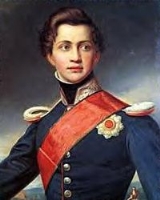
Otto, Prince of Bavaria, then
Othon, King of Greece was made the first modern
King of
GreeceThe Kingdom of Greece was a state established in 1832 in the Convention of London by the Great Powers...
in 1832 under the
Convention of LondonThe London Conference of 1832 was an international conference convened to establish a stable government in Greece. Negotiations between the three Great Powers resulted in the establishment of the Kingdom of Greece under a Bavarian Prince. The decisions were ratified in the Treaty of Constantinople...
, whereby
GreeceGreece , officially the Hellenic Republic , and historically Hellas or the Republic of Greece in English, is a country in southeastern Europe....
became a new independent kingdom under the protection of the Great Powers (the
United KingdomThe United Kingdom of Great Britain and Ireland was the formal name of the United Kingdom during the period when what is now the Republic of Ireland formed a part of it....
,
FranceThe July Monarchy , officially the Kingdom of France , was a period of liberal constitutional monarchy in France under King Louis-Philippe starting with the July Revolution of 1830 and ending with the Revolution of 1848...
and the
Russian EmpireThe Russian Empire was a state that existed from 1721 until the Russian Revolution of 1917. It was the successor to the Tsardom of Russia and the predecessor of the Soviet Union...
).
The second son of the philhellene King
Ludwig I of BavariaLudwig I was a German king of Bavaria from 1825 until the 1848 revolutions in the German states.-Crown prince:...
, Otto ascended the newly created throne of Greece while still a minor. His government was initially run by a three-man regency council made up of Bavarian court officials. Upon reaching his majority, Otto removed the regents when they proved unpopular with the people and he ruled as an absolute monarch. Eventually his subjects’ demands for a Constitution proved overwhelming and in the face of an armed but peaceful insurrection, Otto granted a Constitution in 1843.
Throughout his reign, Otto faced political challenges concerning Greece's financial weakness and the role of the government in the affairs of the Church. The politics of Greece of this era was based on affiliations with the three Great Powers, and Otto’s ability to maintain the support of the powers was key to his remaining in power. To remain strong, Otto had to play the interests of each of the Great Powers’ Greek adherents against the others, while not aggravating the Great Powers. When Greece was blockaded by the (British)
Royal NavyThe Royal Navy is the naval warfare service branch of the British Armed Forces. Founded in the 16th century, it is the oldest service branch and is known as the Senior Service...
in 1850 and again in 1853, to stop Greece from attacking the
Ottoman EmpireThe Ottoman EmpireIt was usually referred to as the "Ottoman Empire", the "Turkish Empire", the "Ottoman Caliphate" or more commonly "Turkey" by its contemporaries...
during the
Crimean WarThe Crimean War was a conflict fought between the Russian Empire and an alliance of the French Empire, the British Empire, the Ottoman Empire, and the Kingdom of Sardinia. The war was part of a long-running contest between the major European powers for influence over territories of the declining...
, Otto’s standing amongst Greeks suffered. As a result, there was an assassination attempt on the Queen and finally, in 1862, Otto was deposed while in the countryside. He died in exile in Bavaria in 1867.
Early life and reign
He was born Prince Otto Friedrich Ludwig of Bavaria at
Schloss MirabellThe Mirabell Palace is a historical building in Salzburg, Salzburgerland, Austria.-History:It was built in the Baroque style, with Italian and French models, by Archbishop Wolf Dietrich Raitenau in 1606...
in
Salzburg-Population development:In 1935, the population significantly increased when Salzburg absorbed adjacent municipalities. After World War II, numerous refugees found a new home in the city. New residential space was created for American soldiers of the postwar Occupation, and could be used for...
(when it belonged for a short time to the
Kingdom of BavariaThe Kingdom of Bavaria was a German state that existed from 1806 to 1918. The Bavarian Elector Maximilian IV Joseph of the House of Wittelsbach became the first King of Bavaria in 1806 as Maximilian I Joseph. The monarchy would remain held by the Wittelsbachs until the kingdom's dissolution in 1918...
), as second son of King Ludwig I of Bavaria and
Therese of Saxe-HildburghausenTherese Charlotte Luise of Saxony-Hildburghausen was a queen of Bavaria.She was a daughter of Frederick, Duke of Saxe-Altenburg, and Duchess Charlotte Georgine of Mecklenburg-Strelitz, eldest daughter of Charles II, Grand Duke of Mecklenburg-Strelitz.-Biography:In 1809, she was on the list of...
. Through his ancestor, the Bavarian Duke
John IIDuke John II of Bavaria-Munich , , since 1375 Duke of Bavaria-Munich. He was the third son of Stephen II and Elizabeth of Sicily.-Family:...
, Otto was a descendant of the Greek imperial dynasties of
KomnenosKomnenós or Comnenus was the name of a ruling family of the Eastern Roman Empire , who halted the political decline of the Empire from c.1081 to c.1185.-Origins:...
and
LaskarisThe Laskaris or Lascaris family was a Byzantine Greek noble family whose members formed the ruling dynasty of the Empire of Nicaea from 1204 to 1261 and remained among the senior nobility up to the dissolution of the Byzantine Empire, whereupon many emigrated to Italy and then to Smyrna...
.
When he was elected king, the Great Powers extracted a pledge from Otto’s father to restrain him from hostile actions against the
Ottoman EmpireThe Ottoman EmpireIt was usually referred to as the "Ottoman Empire", the "Turkish Empire", the "Ottoman Caliphate" or more commonly "Turkey" by its contemporaries...
, and insisted on his title being that of “King of Greece” instead of “King of the Greeks”, which would imply a claim over the millions of Greeks then still under Turkish rule. Not quite 18, the young prince arrived in Greece with 3,500 Bavarian troops and three Bavarian advisors aboard the British
frigateA frigate is any of several types of warship, the term having been used for ships of various sizes and roles over the last few centuries.In the 17th century, the term was used for any warship built for speed and maneuverability, the description often used being "frigate-built"...
HMS MadagascarHMS Madagascar was a 46-gun fifth-rate Seringapatam-class frigate, built at Bombay and launched on 15 November 1822.The Bavarian Prince Otto who had been selected as the King of Greece was delivered to his new capital Nafplion in 1833....
. He immediately endeared himself to his adopted country by adopting the Greek national costume and Hellenizing his name to "Othon." For this reason, some English sources call him "Otho." ("Othon" is also the French, Spanish and Portuguese version of the German name "Otto").
Otto's reign is usually divided into 3 periods:
- a. The years of Regency
Regency is the rule of a regent. It may also refer to:* Specific periods when a throne was vacant:** Regency in France, 1715–1723, a.k.a. Régence** British Regency, 1811–1820*The Hōjō Regency during the Kamakura shogunate in Japan.- Other:...
: 1832-1835
- b. The years of Absolute Monarchy
Absolute monarchy is a monarchical form of government in which the monarch exercises ultimate governing authority as head of state and head of government, his or her power not being limited by a constitution or by the law. An absolute monarch thus wields unrestricted political power over the...
: 1835-1843
- c. The years of Constitutional Monarchy
Constitutional monarchy is a form of government in which a monarch acts as head of state within the parameters of a constitution, whether it be a written, uncodified or blended constitution...
: 1843-1862
The Bavarian advisors were arrayed in a Regency Council headed by Count
Josef Ludwig von ArmanspergJosef Ludwig, Graf von Armansperg served as the Interior and Finance Minister and Foreign and Finance Minister under King Ludwig I of Bavaria in the government of Bavaria...
, who in Bavaria as minister of finance, had recently succeeded in restoring
BavariaBavaria, formally the Free State of Bavaria is a state of Germany, located in the southeast of Germany. With an area of , it is the largest state by area, forming almost 20% of the total land area of Germany...
n credit at the cost of his popularity. Von Armansperg was the President of the Privy Council and the 1st representative (or Prime Minister) of the new Greek government. The other members of the Regency Council were
Karl von AbelKarl von Abel was a Bavarian statesman.Born in Wetzlar, Abel was the son of a procurator at the superior Court of Justice...
and
Georg Ludwig von MaurerGeorg Ludwig Maurer, since 1831 Georg Ludwig von Maurer was a German statesman and legal historian.-Biography:Maurer was born at Erpolzheim, near Dürkheim as the son of a Protestant pastor....
with whom von Armansperg clashed often. After the King reached his majority in 1835, von Armansperg was made Arch-Secretary but was called Arch-Chancellor by the Greek press.
The UK and the Rothschild bank, who were underwriting the Greek loans, insisted on financial stringency from Armansperg. The Greeks were soon more heavily taxed than under
TurkishThe Ottoman EmpireIt was usually referred to as the "Ottoman Empire", the "Turkish Empire", the "Ottoman Caliphate" or more commonly "Turkey" by its contemporaries...
rule; as the people saw it, they had exchanged a hated
OttomanThe Ottoman EmpireIt was usually referred to as the "Ottoman Empire", the "Turkish Empire", the "Ottoman Caliphate" or more commonly "Turkey" by its contemporaries...
tyranny, which they understood, for government by a foreign
bureaucracyA bureaucracy is an organization of non-elected officials of a governmental or organization who implement the rules, laws, and functions of their institution, and are occasionally characterized by officialism and red tape.-Weberian bureaucracy:...
, the "Bavarocracy" (Βαυαροκρατία), which they despised. (Ottoman rule had been called in Greek Tourkokratia - Τουρκοκρατία, "Turkish rule").
In addition, the regency showed little respect for local customs. Also, as a
Roman CatholicThe Catholic Church, also known as the Roman Catholic Church, is the world's largest Christian church, with over a billion members. Led by the Pope, it defines its mission as spreading the gospel of Jesus Christ, administering the sacraments and exercising charity...
, Otto himself was viewed as a heretic by many pious Greeks, however, his heirs would have to be
OrthodoxThe Greek Orthodox Church is the body of several churches within the larger communion of Eastern Orthodox Christianity sharing a common cultural tradition whose liturgy is also traditionally conducted in Koine Greek, the original language of the New Testament...
according to the terms of the 1843 Constitution.
Popular heroes and leaders of the Greek Revolution, like the Generals
Theodoros KolokotronisTheodoros Kolokotronis was a Greek Field Marshal and one of the leaders of the Greek War of Independence against the Ottoman Empire....
and Yiannis Makriyiannis, who opposed the Bavarian-dominated regency, were charged with treason, put in jail and sentenced to death. However, they were pardoned later, under popular pressure, while the Greek judges, who resisted the Bavarian pressure and refused to sign the death penalties (like
Anastasios PolyzoidisAnastasios Polyzoidis was a Greek politician and judicial official.He was born in Melnik, Ottoman empire , where he graduated local Greek school. From 1818 he was studying law, history and social studies in Vienna, Göttingen and Berlin. At the outbreak of the Greek War of Independence, he...
and Georgios Tertsetis), were saluted as heroes.
King Otto’s early reign was notable for one more reason: He moved the capital of Greece from Nafplion to Athens. His first task as king was to make a detailed archaeological and topographical survey of Athens. He assigned Gustav Eduard Schaubert and
Stamatios Kleanthis to complete this task. At that time Athens had a population of roughly 4,000–5,000 people, located mainly in what today covers the district of Plaka in Athens.
Athens was chosen as the Greek capital for historical and sentimental reasons, not because it was a large city. A modern city plan was laid out and public buildings erected. The finest legacy of this period are the buildings of the University of Athens (1837), the
Athens Polytechnic UniversityThe National Technical University of Athens , sometimes simply known as Athens Polytechnic, is among the oldest and most prestigious higher education institutions of Greece....
(1837, under the name Royal School of Arts), the National Gardens of Athens (1840), the National Library of Greece (1842), the Old Royal Palace (now the Greek Parliament Building, 1843), the Old Parliament Building (1858). Schools and hospitals were established all over the (still small) Greek dominion; but the negative feelings of the people were rather neglecting this side of his reign.
In 1836-37, Otto visited Germany and married the beautiful and talented 17 year old,
Duchess Amalia (Amelie) of OldenburgAmalia of Oldenburg, Queen of Greece was the consort of King Otto of Greece . Born the daughter of Augustus, Grand Duke of Oldenburg and Princess Adelheid of Anhalt-Bernburg-Schaumburg-Hoym, she married King Otto on 22 December 1836, in Oldenburg...
(21 December 1818 - 20 May 1875). The wedding took place not in Greece, but in
OldenburgOldenburg is an independent city in Lower Saxony, Germany. It is situated in the western part of the state between the cities of Bremen and Groningen, Netherlands, at the Hunte river. It has a population of 160,279 which makes it the fourth biggest city in Lower Saxony after Hanover, Braunschweig...
, on 22 November 1836; the marriage did not produce an heir and the new queen made herself unpopular by interfering in the government. Besides, she remained Protestant. Otto was unfaithful to his wife, and had a liaison with Jane Digby, a notorious woman his father had previously taken as a lover.
Meanwhile, due to his overtly undermining the king, Armansperg was dismissed from his duties by King Otto immediately on his return. However, despite high hopes by the Greeks, the Bavarian
RundhartIgnaz Ritter von Rudhart was a Bavarian scholar and public servant who was dispatched to Greece to serve as President of the Privy Council during the reign of King Otto....
was appointed chief minister and the granting of a Constitution was again postponed. The attempts of Otto to conciliate Greek sentiment by efforts to enlarge the frontiers of his kingdom, for example, by the suggested acquisition of
CreteCrete is the largest and most populous of the Greek islands, the fifth largest island in the Mediterranean Sea, and one of the thirteen administrative regions of Greece. It forms a significant part of the economy and cultural heritage of Greece while retaining its own local cultural traits...
in 1841, failed in their objective and only succeeded in embroiling him with the Great Powers.
Parties, finances and the church
Throughout his reign, King Otto found himself confronted by a recurring series of issues: partisanship of the Greeks, financial uncertainty, and ecclesiastical issues.
Greek parties in the Othonian era were based on two factors: the political activities of the diplomatic representatives of the Great Powers:
RussiaRussia or , officially known as both Russia and the Russian Federation , is a country in northern Eurasia. It is a federal semi-presidential republic, comprising 83 federal subjects...
,
United KingdomThe United Kingdom of Great Britain and Northern IrelandIn the United Kingdom and Dependencies, other languages have been officially recognised as legitimate autochthonous languages under the European Charter for Regional or Minority Languages...
and
FranceThe French Republic , The French Republic , The French Republic , (commonly known as France , is a unitary semi-presidential republic in Western Europe with several overseas territories and islands located on other continents and in the Indian, Pacific, and Atlantic oceans. Metropolitan France...
and the affiliation of Greek political figures with these diplomats.
Financial uncertainty of the Othonian monarchy was the result of
- 1) Greece's poverty,
- 2) the concentration of land in the hands of a small number of wealthy “primates” like the Mavromichalis
Petros Mavromichalis , also known as Petrobey , was the leader of the Maniot people during the first half of the 19th century. His family had a long history of revolts against the Ottoman Empire, which ruled most of what is now Greece...
family of ManiThe Mani Peninsula , also long known as Maina or Maïna, is a geographical and cultural region in Greece. Mani is the central peninsula of the three which extend southwards from the Peloponnese in southern Greece. To the east is the Laconian Gulf, to the west the Messenian Gulf...
,
and
- 3) the promise of 60,000,000 francs in loans from the Great Powers, which kept these nations involved in Greek internal affairs and the Crown constantly seeking to please one or the other power to ensure the flow of funds.
The political machinations of the Great Powers were personified in their three legates in Athens: the French Theobald Piscatory, the Russian Gabriel Catacazy, and the English
Edmund LyonsAdmiral Edmund Lyons, 1st Baron Lyons, GCB, KCH was a British naval commander and diplomat who led a distinguished career in the Royal Navy, culminating with the Crimean War and his appointment as Commander of the Black Sea Fleet...
. They informed their home governments on the activities of the Greeks, while serving as advisers to their respective allied parties within Greece.
Otto pursued policies, such as balancing power among all the parties and sharing offices among the parties, ostensibly to reduce the power of the parties while trying to bring a pro-Othon party into being. The parties, however, became the entree into government power and financial stability.
The effect of his (and his advisors') policies was to make the Great Powers’ parties more powerful, not less. The Great Powers did not support curtailing Otto’s increasing absolutism, however, which resulted in a near permanent conflict between Otto’s absolute monarchy and the power bases of his Greek subjects.
Otto found himself confronted by a number of intractable ecclesiastical issues: 1)
monasticismMonasticism is a religious way of life characterized by the practice of renouncing worldly pursuits to fully devote one's self to spiritual work...
, 2)
AutocephalyAutocephaly , in hierarchical Christian churches and especially Eastern Orthodox and Oriental Orthodox churches, is the status of a hierarchical church whose head bishop does not report to any higher-ranking bishop...
, 3) the king as head of the Church and 4) toleration of other churches.
His regents, Armansperg and Rundhart, established a controversial policy of
suppressing the monasteriesSecularization is the transformation of a society from close identification with religious values and institutions toward non-religious values and secular institutions...
. This was very upsetting to the Church hierarchy. Russia was self-considered as stalwart defender of Orthodoxy but Orthodox believers were found in all three parties. Once he rid himself of his Bavarian advisers, Otto allowed the statutory dissolution of the monasteries to lapse.
By tradition dated back to the Byzantine era, the king was regarded by the Church as part of her head. On the issue of Church's
AutocephalyAutocephaly , in hierarchical Christian churches and especially Eastern Orthodox and Oriental Orthodox churches, is the status of a hierarchical church whose head bishop does not report to any higher-ranking bishop...
and his role as king within the Church, Otto was overwhelmed by the arcana of Orthodox Church doctrine and popular discontent with his Roman Catholicism (while the Queen was Protestant).
In 1833, the regents had unilaterally declared the Autocephaly of the
Church of GreeceThe Church of Greece , part of the wider Greek Orthodox Church, is one of the autocephalous churches which make up the communion of Orthodox Christianity...
.
This was a recognition of the
de facto political situation, as the
Patriarch of ConstantinopleThe Ecumenical Patriarch is the Archbishop of Constantinople – New Rome – ranking as primus inter pares in the Eastern Orthodox communion, which is seen by followers as the One, Holy, Catholic, and Apostolic Church....
was partially under the political control of the
Ottoman EmpireThe Ottoman EmpireIt was usually referred to as the "Ottoman Empire", the "Turkish Empire", the "Ottoman Caliphate" or more commonly "Turkey" by its contemporaries...
. However, faithful people - concerned that having a Catholic as the head of the Church of Greece would weaken the Orthodox Church - criticised the unilateral declaration of Autocephaly as
non-canonicalCanon law is the body of laws & regulations made or adopted by ecclesiastical authority, for the government of the Christian organization and its members. It is the internal ecclesiastical law governing the Catholic Church , the Eastern and Oriental Orthodox churches, and the Anglican Communion of...
. For the same reason, they likewise resisted the foreign, mostly Protestant, missionaries who established schools throughout Greece.
Tolerance of other religions was over-supported by some in the English Party and others educated in the West as a symbol of Greece’s progress as a
liberalLiberalism is the belief in the importance of liberty and equal rights. Liberals espouse a wide array of views depending on their understanding of these principles, but generally, liberals support ideas such as constitutionalism, liberal democracy, free and fair elections, human rights,...
European state. In the end, power over the Church and education was ceded to the Russian Party, while the King maintained a veto over the decision of the
SynodA synod historically is a council of a church, usually convened to decide an issue of doctrine, administration or application. In modern usage, the word often refers to the governing body of a particular church, whether its members are meeting or not...
of Bishops. This was to keep balance and avoid discrediting Greece in the eyes of Western Europe as a backward, religiously intolerant society.
Actually Greek society was very tolerant to other religions. But after 400 years of religious oppression by the Ottomans, Greeks were very suspicious of imposed "Liberal European progress". Such forced "progress" was viewed as one more attempt against their faith and against their own understanding of freedom, as the main motto of the Greek Revolution was
"for the holy faith of Christ and the freedom of the homeland"; home and faith were inseparable, given also that the Church was the main contributor to the survival of the Greek language and Greek consciousness during Turkish occupation.
Catholic communities were already established in Greece since the 13th century (Athens, Cyclades, Chios, Crete). Jewish communities also existed in the country, those arriving after the Expulsion of the Jews from Spain (1492) joining the earlier
RomaniotesThe Romaniotes or Romaniots are a Jewish population who have lived in the territory of today's Greece and neighboring areas with large Greek populations for more than 2,000 years. Their languages were Yevanic, a Greek dialect, and Greek. They derived their name from the old name for the people...
, Jews who had been living there since the times of Apostle Paul. Muslim families were still living in Greece during Otto's reign, since hostility was mainly against the Ottoman state and its depressive mechanisms and not against Muslim people.
September 3, 1843 Revolution and later reign
Although King Otto tried to function as an absolute monarch, as Thomas Gallant writes, he
“was neither ruthless enough to be feared, nor compassionate enough to be loved, nor competent enough to be respected.”
By 1843, public dissatisfaction with him had reached crisis proportions and there were demands for a Constitution. Initially Otto refused to grant a Constitution, but as soon as German troops were withdrawn from the kingdom, a popular revolt was launched.
On 3 September 1843, the infantry led by Colonel
Dimitris KallergisDimitrios Kallergis , was a Cretan-born Greek soldier and statesman.Hailing from the distinguished Cretan Kallergis family, he studied medicine at Paris and on the outbreak of the War of Greek Independence went to the Morea and joined the insurgents...
and the respected Revolutionary captain and former President of the Athens City Council General Yiannis Makriyiannis assembled in the Square in front of the Palace in Athens.
Eventually joined by much of the population of the small capital, the rebellion refused to disperse until the King agreed to grant a Constitution, which would require that there be Greeks in the Council, that he convene a permanent National Assembly and that Otto personally thank the leaders of the uprising.
Left with little recourse, now that his German troops were gone, King Otto gave in to the pressure and agreed to the demands of the crowd over the objections of his opinionated Queen. This square was renamed
Constitution SquareSyntagma Square , is located in central Athens, Greece. The Square is named after the Constitution that King Otto was forced to grant the people after a popular and military uprising, on September 3, 1843....
(Πλατεία Συντάγματος) to commemorate (until today) the events of September 1843 (and to feature many later tumultous events of Greek history). Now for the first time the king had Greeks in his Council and the French party, the English Party and the Russian Party (according to which of the Great Powers’ culture they most esteemed) vied for rank and power.
The King’s prestige, which was based in large part on his support by the combined Great Powers, but mostly the support of the British, suffered in the
Pacifico incidentThe Don Pacifico Affair concerned a Portuguese Jew, named David Pacifico , who was a trader and the Portuguese consul in Athens during the reign of King Otto. Pacifico was born in Gibraltar, a British possession. He was therefore a British subject...
of 1850, when British Foreign Secretary
PalmerstonHenry John Temple, 3rd Viscount Palmerston, KG, GCB, PC , known popularly as Lord Palmerston, was a British statesman who served twice as Prime Minister in the mid-19th century...
sent the British fleet to blockade the port of
PiraeusPiraeus is a city in the region of Attica, Greece. Piraeus is located within the Athens Urban Area, 12 km southwest from its city center , and lies along the east coast of the Saronic Gulf....
with warships, to exact reparation for injustice done to a British subject.
The
Great IdeaThe Megali Idea was an irredentist concept of Greek nationalism that expressed the goal of establishing a Greek state that would encompass all ethnic Greek-inhabited areas, since large Greek populations after the restoration of Greek independence in 1830 still lived under Ottoman rule.The term...
(Μεγάλη Ιδέα), the dream of uniting all Greek populations of the Ottoman Empire, thereby restoring the
Byzantine EmpireThe Byzantine Empire was the Eastern Roman Empire during the periods of Late Antiquity and the Middle Ages, centred on the capital of Constantinople. Known simply as the Roman Empire or Romania to its inhabitants and neighbours, the Empire was the direct continuation of the Ancient Roman State...
under Christian rule, led to his contemplating to enter the
Crimean WarThe Crimean War was a conflict fought between the Russian Empire and an alliance of the French Empire, the British Empire, the Ottoman Empire, and the Kingdom of Sardinia. The war was part of a long-running contest between the major European powers for influence over territories of the declining...
at the side of Russia against Turkey and its British and French allies in 1853; the enterprise was unsuccessful, and resulted in renewed intervention by the two Great Powers and a second blockade of
PiraeusPiraeus is a city in the region of Attica, Greece. Piraeus is located within the Athens Urban Area, 12 km southwest from its city center , and lies along the east coast of the Saronic Gulf....
port, forcing Greece to neutrality.
In 1861, a student named Aristeidis Dosios (son of politician Konstantinos Dosios) attempted to murder Queen Amalia, and was openly hailed as a hero. His attempt, however, also prompted spontaneous feelings of monarchism and sympathy towards the royal couple among the Greek population.
Succession
It is well known that Otto was a great admirer of the rural
SarakatsaniThe Sarakatsani are a group of Greek transhumant shepherds inhabiting chiefly Greece, with a smaller presence in neighbouring Bulgaria, southern Albania and the Republic of Macedonia. Historically centered around the Pindus mountains, they have been currently urbanised to a significant degree...
, a nomadic group of Greek mountain shepherds thought by some scholars to be descended from the Dorians. It is believed that at an early age he fathered an illegitimate child in the Sarakatsani clan named "Tangas". This child was named Manoli Tangas, was brought to Athens and remained there after Otto's 1862 departure, living as a merchant trader with children of his own. The descendants of Manoli still reside in Athens today.
However, since Otto had no legitimate issue, he chose his brother as Crown Prince of Greece. It is often suggested that following his death, Prince Adalbert became the
heir presumptiveAn heir presumptive or heiress presumptive is the person provisionally scheduled to inherit a throne, peerage, or other hereditary honour, but whose position can be displaced by the birth of an heir or heiress apparent or of a new heir presumptive with a better claim to the position in question...
to the throne of
GreeceGreece , officially the Hellenic Republic , and historically Hellas or the Republic of Greece in English, is a country in southeastern Europe....
. In fact, rights to the Greek succession were passed onto his other older brother
LuitpoldLuitpold, Prince Regent of Bavaria , was the de facto ruler of Bavaria from 1886 to 1912, due to the incapacity of his nephews, King Ludwig II and King Otto.-Early life:...
, who technically succeeded to the Greek throne in 1867.
Due to the renunciation of all the rights to the Greek succession by
King Ludwig IIILudwig III , was the last King of Bavaria, reigning from 1913 to 1918.-Early life:...
, at Luitpold's death the rights to the throne of Greece were inherited by his second son,
Prince LeopoldLeopold Maximilian Joseph Maria Arnulf, Prinz von Bayern was born in Munich, the son of Prince Regent Luitpold of Bavaria and his wife Archduchess Augusta of Austria...
.
Exile and death
While on a visit to the
PeloponneseThe Peloponnese, Peloponnesos or Peloponnesus , is a large peninsula , located in a region of southern Greece, forming the part of the country south of the Gulf of Corinth...
in 1862 a new coup was launched and this time a
Provisional GovernmentA provisional government is an emergency or interim government set up when a political void has been created by the collapse of a very large government. The early provisional governments were created to prepare for the return of royal rule...
was set up and summoned a National Convention. Ambassadors of the Great Powers urged King Otto not to resist, and the king and queen took refuge on a British warship and returned to
BavariaBavaria, formally the Free State of Bavaria is a state of Germany, located in the southeast of Germany. With an area of , it is the largest state by area, forming almost 20% of the total land area of Germany...
the same way they had come to Greece (aboard a British warship), taking with them the Greek royal regalia which he had brought from Bavaria in 1832. It has been suggested that had Otto and Amalia borne an heir, then the King would not have been overthrown, as succession was also a major unresolved question at the time. It is also true, however, that the Constitution of 1843 made provision for his succession by his two younger brothers and their descendants.
He died in the palace of the former bishops of
BambergBamberg is a city in Bavaria, Germany. It is located in Upper Franconia on the river Regnitz, close to its confluence with the river Main. Bamberg is one of the few cities in Germany that was not destroyed by World War II bombings because of a nearby Artillery Factory that prevented planes from...
, Germany, and was buried in the Theatiner Church in
MunichMunich The city's motto is "" . Before 2006, it was "Weltstadt mit Herz" . Its native name, , is derived from the Old High German Munichen, meaning "by the monks' place". The city's name derives from the monks of the Benedictine order who founded the city; hence the monk depicted on the city's coat...
. During his retirement, he would still wear the traditional uniform nowadays worn only by the
evzonesThe Evzones, or Evzoni, is the name of several historical elite light infantry and mountain units of the Greek Army. Today, it refers to the members of the Proedriki Froura , an elite ceremonial unit that guards the Greek Tomb of the Unknown Soldier , the Hellenic Parliament and the Presidential...
(Presidential Guards). During the
rebellionThe Cretan Revolt of 1866–1869 or Great Cretan Revolution was a three year uprising against Ottoman rule, the third and largest in a series of Cretan revolts between the end of the Greek War of Independence in 1830 and the establishment of the independent Cretan State in 1898.-Background:The...
in Crete against the Ottoman Empire in 1866, Otto donated most of his fortune to support the revolt by supplying it with weapons. He also made provisions for his donation to be kept secret until his death, to avoid causing political problems to the new King,
George IGeorge I was King of Greece from 1863 to 1913. Originally a Danish prince, George was only 17 years old when he was elected king by the Greek National Assembly, which had deposed the former king Otto. His nomination was both suggested and supported by the Great Powers...
.
It is generally accepted by historians that, although Otto failed, he deeply loved Greece as his own new homeland. His failure was mainly a result of the continuous intrigues and competition among the three Great Powers. Before his death, Otto asked to be buried in his own Greek traditional uniform.
Titles from birth to death
- 1 June 1815 – 6 February 1833: His Royal Highness Prince Otto Friedrich Ludwig of Bavaria
- 6 February 1833 – 23 October 1862: His Majesty Othon the First, by the Grace of God, King of Greece, Prince of Bavaria
- 23 October 1862 – 26 July 1867: His Majesty King Otto of Greece
Ancestors
External links