
All Topics  
Demosthenes

 
Demosthenes

   Email Print
   Bookmark   Link


Demosthenes


Demosthenes (384–322 BC, ) was a prominent Greek
Greeks

The Greeks , also known as Hellenes, are a nation and ethnic group native to Greece, Cyprus and neighbouring regions, who can also be found in Greek diaspora communities around the world....
 statesman
Statesman

A statesman or stateswoman or statesperson is usually a politician or other notable figure of state who has had a long and respected career in politics at the national and international level....
 and orator
Orator

An orator, or oratist, is a speaker.An orator may also be called an oratarian - literally, "he who orates".Etymology...
 of ancient Athens
History of Athens

The History of Athens is one of the longest of any city in Europe and in the world. Athens has been continuously inhabited for over 4,500 years, becoming the leading city of Ancient Greece in the first millennium BC; its cultural achievements during the 5th century BC laid the foundations of western culture....
. His oration
Oratory

Oratory is a type of public speaking.Oratory may also refer to:* Oratory , a power metal band* Oratory , a place of worship* a religious order such as...
s constitute a significant expression of contemporary Athenian intellectual prowess and provide an insight into the politics
Politics

Politics is the process by which groups of people make decisions. The term is generally applied to behaviour within civil governments, but politics has been observed in all human group interactions, including corporation, academia, and religion institutions....
 and culture of ancient Greece
Ancient Greece

The term Ancient Greece refers to the period of History of Greece lasting from the Greek Dark Ages ca. 1100 BC and the Dorian invasion, to 146 BC and the Roman Republic conquest of Greece after the Battle of Corinth ....
 during the 4th century BC. Demosthenes learned rhetoric
Rhetoric

Rhetoric is the art of using language as a means to persuade. Along with logic and dialectic, rhetoric is one of the three ancient arts of discourse....
 by studying the speeches of previous great orators. He delivered his first judicial speeches at the age of 20, in which he argued effectively to gain from his guardians what was left of his inheritance.


Discussion
Ask a question about 'Demosthenes'
Start a new discussion about 'Demosthenes'
Answer questions from other users
Full Discussion Forum


Quotations


A man is his own easiest dupe, for what he wishes to be true he generally believes to be true.

Every advantage in the past is judged in the light of the final issue.

Small opportunities are often the beginning of great enterprises.

The man who has received a benefit ought always to remember it, but he who has granted it ought to forget the fact at once.


Encyclopedia


Demosthenes (384–322 BC, ) was a prominent Greek
Greeks

The Greeks , also known as Hellenes, are a nation and ethnic group native to Greece, Cyprus and neighbouring regions, who can also be found in Greek diaspora communities around the world....
 statesman
Statesman

A statesman or stateswoman or statesperson is usually a politician or other notable figure of state who has had a long and respected career in politics at the national and international level....
 and orator
Orator

An orator, or oratist, is a speaker.An orator may also be called an oratarian - literally, "he who orates".Etymology...
 of ancient Athens
History of Athens

The History of Athens is one of the longest of any city in Europe and in the world. Athens has been continuously inhabited for over 4,500 years, becoming the leading city of Ancient Greece in the first millennium BC; its cultural achievements during the 5th century BC laid the foundations of western culture....
. His oration
Oratory

Oratory is a type of public speaking.Oratory may also refer to:* Oratory , a power metal band* Oratory , a place of worship* a religious order such as...
s constitute a significant expression of contemporary Athenian intellectual prowess and provide an insight into the politics
Politics

Politics is the process by which groups of people make decisions. The term is generally applied to behaviour within civil governments, but politics has been observed in all human group interactions, including corporation, academia, and religion institutions....
 and culture of ancient Greece
Ancient Greece

The term Ancient Greece refers to the period of History of Greece lasting from the Greek Dark Ages ca. 1100 BC and the Dorian invasion, to 146 BC and the Roman Republic conquest of Greece after the Battle of Corinth ....
 during the 4th century BC. Demosthenes learned rhetoric
Rhetoric

Rhetoric is the art of using language as a means to persuade. Along with logic and dialectic, rhetoric is one of the three ancient arts of discourse....
 by studying the speeches of previous great orators. He delivered his first judicial speeches at the age of 20, in which he argued effectively to gain from his guardians what was left of his inheritance. For a time, Demosthenes made his living as a professional speech-writer (logographer
Logographer (legal)

The title of logographer was applied to professional authors of judicial discourse in Ancient Greece. The modern term speechwriter is roughly equivalent....
) and a lawyer
Ancient Greek law

Ancient Greek law is a branch of comparative jurisprudence relating to the laws and legal institutions of Ancient Greece.Greek Iuris law has been partially compared with Roman law, and has been incidentally illustrated with the aid of the primitive institutions of the Germanic tribes....
, writing speeches for use in private legal suits
Lawsuit

In law, a lawsuit is a civil action brought before a court in which the party commencing the action, called the plaintiff, seeks a legal remedy or equitable remedy....
.

Demosthenes grew interested in politics during his time as a logographer, and in 354 BC he gave his first public political speeches. He went on to devote his most productive years to opposing Macedon
Macedon

Macedon or Macedonia was the name of a monarchy centred in the northernmost part of ancient Greece. The homeland of the ancient Macedonians, it was bordered by the kingdom of Epirus to the west and the region of Thrace to the east....
's expansion. He idealized his city and strove throughout his life to restore Athens' supremacy and motivate his compatriots against Philip II of Macedon
Philip II of Macedon

Philip II of Macedon,...
. He sought to preserve his city's freedom and to establish an alliance against Macedon, in an unsuccessful attempt to impede Philip's plans to expand his influence southwards by conquering all the Greek states. After Philip's death, Demosthenes played a leading part in his city's uprising against the new King of Macedon, Alexander the Great
Alexander the Great

Alexander the Great , also known as Alexander III of Macedon was an ancient Greeks King of Macedon . He was one of the most successful military commanders of all time and is presumed undefeated in battle....
. However, his efforts failed and the revolt was met with a harsh Macedonian reaction. To prevent a similar revolt against his own rule, Alexander's successor in this region, Antipater
Antipater

Antipater was a Macedonian general and a supporter of kings Philip II of Macedon and Alexander the Great. In 320 BC, he became regent of all of Alexander's empire....
, sent his men to track Demosthenes down. Demosthenes took his own life, in order to avoid being arrested by Archias
Archias

Archias may refer to:...
, Antipater's confidant.

The Alexandrian Canon compiled by Aristophanes of Byzantium
Aristophanes of Byzantium

Aristophanes of Byzantium was a Greece scholar, critic and grammarian, particularly renowned for his work in Homeric scholarship, but also for work on other classical authors such as Pindar and Hesiod....
 and Aristarchus of Samothrace
Aristarchus of Samothrace

Aristarchus or Aristarch of Samothrace was a grammarian noted as the most influential of all scholars of Homeric poetry. He was the librarian of the Library of Alexandria Alexandria and seems to have succeeded his teacher Aristophanes of Byzantium Byzantium in that role....
 recognized Demosthenes as one of the ten greatest Attic orators
Attic orators

The ten Attic orators were considered the greatest orators and logographer s of the classical antiquity . They are included in the "Alexandrian Canon" compiled by Aristophanes of Byzantium and Aristarchus of Samothrace....
 and logographers. According to Longinus
Longinus (literature)

Longinus is the conventional name of the author of the treatise, On the Sublime , a work which focuses on the effect of good writing....
, Demosthenes "perfected to the utmost the tone of lofty speech, living passions, copiousness, readiness, speed". Cicero
Cicero

Marcus Tullius Cicero was a Ancient Rome philosopher, statesman, lawyer, political theorist, and Constitution of the Roman Republic. Cicero is widely considered one of Rome's greatest rhetoric and prose stylists....
 acclaimed him as "the perfect orator" who lacked nothing, and Quintilian
Quintilian

Marcus Fabius Quintilianus was a Roman Empire rhetorician from Hispania, widely referred to in Middle ages schools of rhetoric and in Renaissance writing....
 extolled him as lex orandi ("the standard of oratory") and that inter omnes unus excellat ("he stands alone among all the orators").

Early years (384–355 BC)


Family, education and personal life


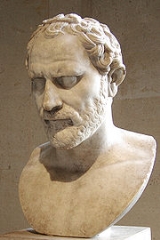
Demosthenes Bust  R280 Bc
Demosthenes was born in 384 BC, during the last year of the 98th Olympiad
Olympiad

An Olympiad is a period of four years, associated with the Ancient Olympic Games of Classical Greece. In the Hellenistic period, beginning with Ephorus, Olympiads were used as Epoch ....
 or the first year of the 99th Olympiad. His father—also named Demosthenes—who belonged to the local tribe
Tribe

A tribe, viewed historically or developmentally, consists of a social group existing before the development of, or outside of, states.Many anthropologists use the term to refer to societies organized largely on the basis of kinship, especially corporate descent groups ....
, Pandionis, and lived in the deme
Deme

In Ancient Greece, a deme was a subdivision of Attica, the region of Greece surrounding Classical Athens. Demes as simple subdivisions of land in the countryside seem to have existed in the 6th century BC and earlier, but did not acquire particular significance until the reforms of Cleisthenes in 508 BC....
 of Paeania in the Athenian countryside, was a wealthy sword-maker. Aeschines
Aeschines

Aeschines , Ancient Greece statesman and one of the ten Attic orators....
, Demosthenes' greatest political rival, maintained that his mother Kleoboule was a Scythia
Scythia

The Scythians or Scyths were an Eastern Iranian languages of Equestrianism nomadic pastoralists who dominated the Pontic steppe throughout Classical Antiquity....
n by blood—an allegation disputed by some modern scholars. Demosthenes was orphaned at the age of seven. Although his father provided well for him, his legal guardians, Aphobus, Demophon and Therippides, mishandled his inheritance.

As soon as Demosthenes came of age in 366 BC, he demanded they render an account of their management. According to Demosthenes, the account revealed the misappropriation of his property. Although his father left an estate of nearly fourteen talents, (very roughly 3,000 pounds in gold or 400,000 current United States dollar
United States dollar

The United States dollar is the unit of currency of the United States and was defined by the Coinage Act of 1792 to be between 371 and 416 grains of silver ....
s) Demosthenes asserted his guardians had left nothing "except the house, and fourteen slaves and thirty silver minae" (30 minae = ½ talent). At the age of 20, Demosthenes sued his trustees in order to recover his patrimony and delivered five orations — three Against Aphobus during 363 BC and 362 BC and two Against Ontenor during 362 and 361 BC. The courts fixed Demosthenes' damages at ten talents. When all the trials came to an end, he only succeeded in retrieving a portion of his inheritance.

Between his coming of age in 366 BC and the trials that took place in 364 BC, Demosthenes and his guardians negotiated acrimoniously but were unable to reach an agreement, for neither side was willing to make concessions. At the same time, Demosthenes prepared himself for the trials and improved his oratory skill. As an adolescent, his curiosity had been noticed by the orator Callistratus
Callistratus of Aphidnae

Callistratus of Aphidnae was an Athens orator and general in the 4th century BCE.For many years, as prostates, he supported Spartan interests at Athens, recognizing that Thebes, Greece posed a greater threat to Athens....
, who was then at the height of his reputation, having just won a case of considerable importance. According to Friedrich Nietzsche
Friedrich Nietzsche

Friedrich Wilhelm Nietzsche was a 19th century philosophy Germans philosophy and classical philology. He wrote critical texts on religion, morality, contemporary culture, philosophy, and science, using a distinctive German language style and displaying a fondness for metaphor and aphorism....
, a German philologist
Philology

Philology, derived from the Greek language considers both morphology and Meaning in linguistic expression, combining linguistics and literary studies....
 and philosopher
Philosophy

Philosophy is the study of general problems concerning matters such as existence, knowledge, truth, beauty, justice, validity, mind, and language....
, and Constantine Paparregopoulus
Constantine Paparregopoulus

Constantine Paparrigopoulos is considered the founder of modern Greek historiography. He analysed Greek history from ancient to the present as a continuous history in his multi-volume History of the Greek Nation, and is also known for his original research in Byzantine Empire history as well as in other fields of Greek studies....
, a major Greek historian
Historian

A historian is an individual who studies and writes about history, and is regarded as an authority on it. Historians are concerned with the continuous, systematic narrative and research of past events as relating to the human race; as well as the study of all events in time....
, Demosthenes was a student of Isocrates
Isocrates

File:Isocrates pushkin.jpgIsocrates , an ancient Greek rhetorician, was one of the ten Attic orators. In his time, he was probably the most influential rhetorician in Greece and made many contributions to rhetoric and education through his teaching and written works....
; according to Cicero, Quintillian and the Roman biographer Hermippus, he was a student of Plato
Plato

Plato , was a Classical Greece Greeks philosopher, mathematician, writer of philosophical dialogues, and founder of the Platonic Academy in Ancient Athens, the first institution of higher learning in the western world....
. Lucian
Lucian

Lucian of Samosata was an Assyrian people rhetorician, and satire who wrote in the Greek language. He is noted for his witty and scoffing nature....
, a Roman-Syrian rhetorician and satirist
Satire

Satire is often strictly defined as a literary genre; although, in practice, it is also found in the graphic arts and performing arts. In satire, human or individual vices, follies, abuses, or shortcomings are held up to censure by means of ridicule, derision, burlesque, irony, or other methods, ideally with the intent to bring about improv...
, lists the philosophers Aristotle
Aristotle

Aristotle was a Greeks philosopher, a student of Plato and teacher of Alexander the Great. He wrote on many subjects, including physics, metaphysics, Poetics , theater, music, logic, rhetoric, politics, government, ethics, biology and zoology....
, Theophrastus
Theophrastus

Theophrastus , a Greek native of Eressos in Lesbos Island, was the successor of Aristotle in the Peripatetic school. His interests were wide-ranging, extending from biology and physics to ethics and metaphysics....
 and Xenocrates
Xenocrates

Xenocrates of Chalcedon was a Ancient Greece philosopher, mathematician, and leader of the Platonic Academy from 339 to 314 BC. His teachings followed those of Plato's, which he attempted to define more closely, often with mathematical elements....
 among his teachers. These claims are nowadays disputed. According to Plutarch, Demosthenes employed Isaeus
Isaeus

Isaeus , fl. early 4th century BC. One of the ten Attic Orators according to the Alexandrian canon. He was a student of Isocrates in Athens, and later taught Demosthenes while working as a metic speechwriter for others....
 as his master in Rhetoric, even though Isocrates was then teaching this subject, either because he could not pay Isocrates the prescribed fee or because Demosthenes believed Isaeus' style better suited a vigorous and astute orator such as himself . Curtius
Ernst Curtius

You may be looking for Ernst Robert Curtius .Ernst Curtius was a Germany archaeologist and historian.He was born in L?beck; his brother was the noted philology Georg Curtius....
, a German archaeologist and historian, likened the relation between Isaeus and Demosthenes to "an intellectual armed alliance".

It has also been said that Demosthenes paid Isaeus 10,000 drachmae (somewhat over 1.5 talents) on the condition that Isaeus should withdraw from a school of Rhetoric which he had opened, and should devote himself wholly to Demosthenes, his new pupil. Another version credits Isaeus with having taught Demosthenes without charge. According to Sir Richard C. Jebb, a British classical
Classics

Classics is the branch of the Humanities comprising the languages, literature, philosophy, history, art, and other culture of the ancient Mediterranean World; especially Ancient Greece and Ancient Rome during Classical Antiquity ....
 scholar, "the intercourse between Isaeus and Demosthenes as teacher and learner can scarcely have been either very intimate or of very long duration". Konstantinos Tsatsos
Konstantinos Tsatsos

Konstantinos Tsatsos was a revered Greece, professor of law, scholar and politician. He served as President of Greece from 1975 to 1980....
, a Greek professor and academician
Academician

The title Academician denotes a Full Member of an art, literary, or scientific academy.In many countries it is a honorary title."Academician" may also be a functional title and denote a full member of the National National Academy in those countries where the Academy has a strong influence on national scientific life, particularly...
, believes that Isaeus helped Demosthenes edit his initial judicial orations against his guardians. Demosthenes is also said to have admired the historian Thucydides. In the Illiterate Book-Fancier, Lucian mentions eight beautiful copies of Thucydides made by Demosthenes, all in Demosthenes' own handwriting. These references hint at his respect for a historian he must have assiduously studied.

According to Pseudo-Plutarch
Pseudo-Plutarch

Pseudo-Plutarch is the conventional name given to the unknown authors of a number of pseudepigrapha attributed to Plutarch.Some of these works were included in some editions of Plutarch's Moralia....
, Demosthenes was married once. The only information about his wife, whose name is unknown, is that she was the daughter of Heliodorus, a prominent citizen. Demosthenes also had a daughter, "the only one who ever called him father", according to Aeschines' in a trenchant remark. His daughter died young and unmarried a few days before Philip's death.

Accusations concerning personal life
In his speeches, Aeschines often uses the pederastic
Pederasty in ancient Greece

Greek pederasty, as idealised by the Ancient Greece from Archaic period in Greece onward, was a relationship and bond between an adolescent boy and an adult man outside of his immediate family....
 relations of Demosthenes to attack him. The essence of these attacks was not that Demosthenes had relations with boys, but that he had been an inadequate pederast
Erastes

In ancient Greece, the 'erastes' was an adult male involved in a Pederasty in ancient Greece with an adolescent boy called the eromenos....
, one whose attentions did not benefit the boys, as would have been expected, but harmed them instead. In the case of Aristion, a youth from Plataea
Plataea

Plataea or Plataeae was an ancient city, located in Greece in southeastern Boeotia, south of Thebes . It was the location of the Battle of Plataea in 479 BC, in which an alliance of Greek city-states defeated the Persian Empire and ended the Persian Wars....
 who lived for a long time in Demosthenes' house, Aeschines mocked him for lack of sexual restraint and possibly effeminate behavior: "Allegations about what [Aristion] was undergoing there, or doing what, vary, and it would be most unseemly for me to talk about it." Another relationship which Aeschines brings up is that with Cnosion. His allegation, in this case, was also of a sexual nature. This time, however, he blamed Demosthenes for involving his wife by putting her in bed with the youth so as to get children by him. Athenaeus
Athenaeus

Athenaeus , of Naucratis in Egypt, Greeks rhetorician and grammarian, flourished about the end of the 2nd and beginning of the 3rd century A.D. The Suda only tells us that he lived in the times of Marcus ; but the contempt with which he speaks of Commodus shows that he survived that emperor....
, however, presents matters in a different light, claiming that his wife bedded the boy in a fit of jealousy.* C.A. Cox, Household Interests, 202

Aeschines often asserted that Demosthenes made money out of young rich men. He claimed that he deluded Aristarchus, the son of Moschus, with the pretence that he could make him a great orator. Apparently, while still under Demosthenes' tutelage, Aristarchus killed and mutilated a certain Nicodemus of Aphidna, gouging out his eyes and tongue. Aeschines accused Demosthenes of complicity in the murder, pointing out that Nicodemus had once pressed a lawsuit accusing Demosthenes of desertion. He also accused Demosthenes of having been such a bad erastes
Erastes

In ancient Greece, the 'erastes' was an adult male involved in a Pederasty in ancient Greece with an adolescent boy called the eromenos....
 to Aristarchus so as not even to deserve the name. His crime, according to Aeschines, was to have betrayed his eromenos
Eromenos

In the Pederasty in ancient Greece of Athens, the eromenos was an adolescence boy who was in a love relationship with an adult man, known as the erastes ....
 by pillaging his estate, allegedly pretending to be in love with the youth so as to get his hands on the boy's inheritance. This he is said to have squandered, having taken three talents
Talent (weight)

The talent is an ancient unit of mass. It corresponded generally to the mass of water in the volume of an Amphora , i.e. one foot cubed. Depending on the length of the respective legal foot, this corresponds roughly to the mass of 27 kg or about 60 English pound s....
 upon Aristarchus' fleeing into exile so as to avoid a trial. Thus, in payment for the trust that Aristarchus and his family put in him, "You entered a happy home [...] you ruined it." Nevertheless, the story of Demosthenes' relations with Aristarchus is still regarded as more than doubtful, and no other pupil of Demosthenes is known by name.

Career as logographer

"If you feel bound to act in the spirit of that dignity, whenever you come into court to give judgement on public causes, you must bethink yourselves that with his staff and his badge every one of you receives in trust the ancient pride of Athens."
Demosthenes (On the Crown, 210) - The orator's defense of the honor of the courts was in contrast to the improper actions of which Aeschines accused him.
To make his living, Demosthenes became a professional litigant and logographer, writing speeches for use in private legal suits. He was so successful that he soon acquired wealthy and powerful clients. The Athenian logographer could remain anonymous, allowing him to serve personal interests, even if it prejudiced the client. Aeschines accused Demosthenes of unethically disclosing his clients' arguments to their opponents. He queried of Demosthenes: "And the born traitor—how shall we recognize him? Will he not imitate you, Demosthenes, in his treatment of those whom chance throws in his way and who have trusted him? Will he not take pay for writing speeches for them to deliver in the courts, and then reveal the contents of these speeches to their opponents?"

As an example, Aeschines accused Demosthenes of writing a speech for Phormion, a wealthy banker, and then communicating it to Apollodorus, who was bringing a capital charge
Capital punishment

Capital punishment, the death penalty or execution, is the killing of a person by procedural law for Punishment#Retribution and Punishment#Incapacitation....
 against Phormion. Plutarch supported this accusation, stating that Demosthenes "was thought to have acted dishonorably".

Early politics (354 BC–350 BC)


Speech training

Demosthpracticing
Even before he turned 21-years-old in 363 BC, Demosthenes had already demonstrated an interest in politics. In 363, 359, and 357 BC, he assumed the office of the trierarch
Trierarch

Trierarch was the title of officers who commanded a trireme in the classical Greek world. In Athens and a few other states this officer was also required to pay for the outfitting and maintenance of the ship....
, being responsible for the outfitting and maintenance of a trireme
Trireme

File:Romtrireme.jpgThe trireme is a class of warships used by the ancient civilizations of the Mediterranean, especially the Phoenicians, ancient Greece and ancient Rome....
. In 348 BC, he became a choregos
Choregos (ancient Greece)

In the theatre of ancient Greece, chor?gos was an honorary title for a wealthy Classical Athens citizen who assumed the public duty of financing and paying the expenses of the preparation of the Greek chorus and other aspects of dramatic production that were not covered by the Polis....
, paying the expenses of a theatrical production.

Although Demosthenes said he never pleaded a single private case, it remains unclear when and if Demosthenes abandoned the profitable but not so prestigious profession of logography. According to Plutarch, when Demosthenes first addressed himself to the people, he was derided for his strange and uncouth style, "which was cumbered with long sentences and tortured with formal arguments to a most harsh and disagreeable excess".

Some citizens however discerned his talent. When he first left the ecclesia
Ecclesia (ancient Athens)

The ecclesia or ekklesia was the principal assembly of the Athenian democracy of ancient Athens during its Age of Pericles . It was the popular assembly, opened to all male citizens over the age of 18 by Solon in 594 BC meaning that all classes of citizens in Athens were able to participate, even the thetes....
 (the Athenian Assembly) disheartened, an old man named Eunomus encouraged him, saying his diction was very much like that of Pericles
Pericles

Pericles was a prominent and influential statesman, orator, and general of History of Athens during the city's Age of Pericles?specifically, the time between the Greco-Persian Wars and Peloponnesian War wars....
. Another time, after the ecclesia had refused to hear him and he was going home dejected, an actor named Satyrus followed him and entered into a friendly conversation with him.

As a boy Demosthenes had a speech impediment — an inarticulate and stammering pronunciation. Aeschines taunted him and referred to him in his speeches by the nickname "Batalus", apparently invented by Demosthenes' pedagogues or by the little boys with whom he was playing. According to Plutarch, he had a weakness in his voice of "a perplexed and indistinct utterance and a shortness of breath, which, by breaking and disjointing his sentences much obscured the sense and meaning of what he spoke." Demosthenes soon undertook a disciplined program to overcome these shortcomings and improve his locution. He worked on his diction, his voice and his gestures. His zeal and perseverance have passed into proverb. It is however unknown whether these vignettes are factual accounts of events in Demosthenes' life or merely anecdotes used to illustrate his perseverance and determination.

Increased political activity

See also: On the Navy
On the Navy

On the Navy is the first political oration of the prominent Athenian statesman and orator Demosthenes. It was delivered in 354 BC and constitutes one of the initial political interventions of Demosthenes....
, For the Megalopolitans
For the Megalopolitans

For the Megalopolitans is one of the first political orations of the prominent Athenian statesman and orator Demosthenes. It was delivered in 352 BC and constitutes one of the initial political interventions of Demosthenes....
, and On the Liberty of the Rhodians
Between 354 and 350 BC, Demosthenes continued practicing law privately while he was becoming increasingly interested in public affairs. He mostly remained a judicial orator, but started participating in the politics of the Athenian democracy
Athenian democracy

Athenian democracy developed in the Ancient Greece city-state of Classical Athens, comprising the central city-state of Athens and the surrounding territory of Attica, around 500 BC....
. In 355 BC he wrote Against Androtion and, in 354 BC, Against Leptines — two fierce attacks on individuals who attempted to repeal certain tax exemptions. In Against Timocrates and Against Aristocrates he advocated eliminating corruption. Demosthenes denounced measures regarded as dishonest or unworthy of Athenian traditions. All these speeches offer early glimpses of his general principles on foreign policy, such as the importance of the navy, of alliances and of national honor.
"While the vessel is safe, whether it be a large or a small one, then is the time for sailor and helmsman and everyone in his turn to show his zeal and to take care that it is not capsized by anyone's malice or inadvertence; but when the sea has overwhelmed it, zeal is useless."
Demosthenes (Third Philippic, 69) - The orator warned his countrymen of the disasters Athens would suffer, if they continued to remain idle and indifferent to the challenges of their times.


In 354 BC, Demosthenes delivered his first political oration, On the Navy, in which he espoused moderation and proposed the reform of "symmories"(boards) as a source of funding for the Athenian fleet. In 352 BC, he delivered For the Megalopolitans and, in 351 BC, On the Liberty of the Rhodians. In both speeches he opposed Eubulus
Eubulus (statesman)

Eubulus, or Euboulos was a statesman of ancient Athens, probably the most important of the period 355-342 and notable for his focus on Athenian finances....
, the most powerful Athenian statesman of the period 355 to 342 BC, who was against any intervention in the internal affairs of the other Greek cities.

Although none of his early orations were successful, Demosthenes established himself as an important political personality and broke with Eubulus' faction, a prominent member of which was Aeschines. He laid the foundations for his future political successes and for becoming the leader of his own party. His arguments revealed his desire to articulate Athens' needs and interests.

In 351 BC, Demosthenes felt strong enough to express his view concerning the most important foreign policy issue facing Athens at that time: the stance his city should take towards Philip II of Macedon. According to Jacqueline de Romilly
Jacqueline de Romilly

Jacqueline Worms de Romilly is a France philology of Jewish ancestry ...
, a French philologist and member of the Académie française
Académie française

L'Acad?mie fran?aise, or the French Academy, is the pre-eminent France learned body on matters pertaining to the French language. The Acad?mie was officially established in 1635 by Cardinal Richelieu, the chief minister to Louis XIII of France....
, the threat of Philip would give Demosthenes' stances a focus and a raison d'être. Henceforth, Demosthenes' career is virtually the history of Athenian foreign policy.

Confrontation with Philip II


First Philippic and the Olynthiacs (351–349 BC)

For more details on this topic, see First Philippic
First Philippic

The First Philippic was delivered by the Athenian statesman and orator Demosthenes between 351 BC-350 BC. It constitutes the first speech of the prominent politician against Philip II of Macedon....
 and Olynthiacs
Olynthiacs

The Olynthiacs were three political speeches, all delivered by the Athenian statesman and orator Demosthenes. In 349 BC Philip II of Macedon attacked Olynthus, which at the time was an ally of Athens....
Philip Ii of Macedon Cdm
Most of Demosthenes' major orations were directed against the growing power of King Philip II of Macedon. Since 357 BC, when Philip seized Amphipolis
Amphipolis

Amphipolis was an Ancient Greece Greece Polis in the region once inhabited by the Edoni people in the present-day Peripheries of Greece of Central Macedonia....
 and Pydna
Pydna

Pydna , also Pidna was a Greek city in ancient Macedon, the most important in Pieria. Modern Pydna is a rural municipality and coastal town in the northeastern part of the Prefecture of Pieria....
, Athens had been formally at war with the Macedonians
Ancient Macedonians

The Macedonians were an ancient tribe which inhabited the alluvial plain around the rivers Haliacmon and lower Vardar, north of Mount Olympus in Greece....
. In 352 BC, Demosthenes characterized Philip as the very worst enemy of his city; his speech presaged the fierce attacks that Demosthenes would launch against the Macedonian king over the ensuing years. A year later he criticized those dismissing Philip as a person of no account and warned that he was as dangerous as the King of Persia.

In 352 BC, Athenian troops successfully opposed Philip at Thermopylae
Thermopylae

Thermopylae is a location in Greece where a narrow coastal passage existed in classical antiquity. It derives its name from several natural hot water springs....
, but the Macedonian victory over the Phocians at the Battle of Crocus Field
Battle of Crocus Field

The Battle of Crocus Field was a battle between Philip II of Macedon and Onomarchus of Phocis in 352 BC. Philip had been defeated by Onomarchus the year before, but this time was victorious....
 shook Demosthenes. The theme of the First Philippic (351–350 BC) was preparedness and the reform of the theoric fund
Theoric Fund

The theorika was created or reinstated in Athens around 350 BCE, after the Social_War_, by the Athenian statesman Eubulus_, an administrator to the theorikon treasury sometime after 354/3 until Cephisophon of Aphidna replaced him in 343/2, and Diophantus....
, a mainstay of Eubulus' policy. In his rousing call for resistance, Demosthenes asked his countrymen to take the necessary action and asserted that "for a free people there can be no greater compulsion than shame for their position".
"We need money, for sure, Athenians, and without money nothing can be done that ought to be done."
Demosthenes (First Olynthiac, 20) - The orator took great pains to convince his countrymen that the reform of the theoric fund was necessary to finance the city's military preparations.


From this moment until 341 BC, all of Demosthenes' speeches referred to the same issue, the struggle against Philip. In 349 BC, Philip attacked Olynthus
Olynthus

Olynthus was an ancient city of Chalcidice, built mostly on two flat-topped hills 30–40m in height, in a fertile plain at the head of the Gulf of Torone, near the neck of the peninsula of Pallene, about 2.5 kilometers from the sea, and about 60 stadia from Potidaea....
, an ally of Athens. In the three Olynthiacs, Demosthenes criticized his compatriots for being idle and urged Athens to help Olynthus. He also insulted Philip by calling him a "barbarian". Despite Demosthenes' warnings, the Athenians engaged in a useless war in Euboea
Euboea

For the Greek mythology figure, see Euboea Euboea is the second largest of the Greece Aegean Islands and the second largest List of islands of Greece overall in area and population, after Crete....
 and offered no military support to Olynthus.

Case of Meidias (348 BC)

In 348 BC a peculiar event occurred: Meidias
Meidias

Meidias , an Athens of considerable wealth and influence, was a violent and bitter enemy of Demosthenes, the orator. He displayed his first act of hostility in 361 BC when he broke violently into the house of Demosthenes with his brother Thrasylochus in order to take possession of it....
, a wealthy Athenian, publicly slapped Demosthenes, who was at the time a choregos at the Greater Dionysia
Dionysia

The Dionysia was a large religious festival in ancient Athens in honor of the god Dionysus, the central event of which was the performance of tragedy and, since 487 BC, Greek comedy....
, a large religious festival in honour of the god Dionysus
Dionysus

In classical mythology, Dionysus or Dionysos , is the God of wine, the inspirer of ritual madness and ecstasy, and a major figure of Greek mythology, and one of the twelve Olympians, among whom Greek mythology treated Dionysus as a late arrival....
. Meidias was a friend of Eubulus and supporter of the unsuccessful excursion in Euboea. He also was an old enemy of Demosthenes; in 361 BC he had broken violently into his house, with his brother Thrasylochus, to take possession of it.
"Just think. The instant this court rises, each of you will walk home, one quicker, another more leisurely, not anxious, not glancing behind him, not fearing whether he is going to run up against a friend or an enemy, a big man or a little one, a strong man or a weak one, or anything of that sort. And why? Because in his heart he knows, and is confident, and has learned to trust the State, that no one shall seize or insult or strike him."
Demosthenes (Against Meidias, 221) - The orator asked the Athenians to defend their legal system, by making an example of the defendant for the instruction of others.


Demosthenes decided to prosecute his wealthy opponent and wrote the judicial oration Against Meidias. This speech gives valuable information about Athenian law at the time and especially about the Greek concept of hybris
Hubris

Hubris or hybris , mythology is a term used in modern English to indicate overweening pride, superciliousness, or arrogance, often resulting in fatal retribution....
 (aggravated assault), which was regarded as a crime not only against the city but against society as a whole. He stated that a democratic state perishes if the rule of law
Rule of law

The rule of law is a legal concept which includes a number of interrelated principles. First, protecting the rule of law ensures that no one is above the law....
 is undermined by wealthy and unscrupulous men, and that the citizens acquire power and authority in all state affairs due "to the strength of the laws". According to philologist Henri Weil
Henri Weil

Henri Weil was a Germany-born France Jewish philologist.He was educated at the universities of Bonn, Berlin, and Leipzig. He went to France, and continued his studies at Paris, graduating as "docteur ?s lettres" in 1845, and becoming "agr?g?" in 1848....
, Demosthenes dropped the charges for political reasons and never delivered Against Meidias, although Aeschines maintained that Demosthenes was bribed.

Peace of Philocrates (347–345 BC)

In 348 BC, Philip conquered Olynthus and razed it to the ground; then conquered the entire Chalcidice
Chalcidice

Chalkidiki, also Halkidiki or Chalcidice, less often Khalkidiki and rarely Chalkidice , is one of the prefectures of Greece....
 and all the states of the Chalcidic federation that Olynthus had once led. After these Macedonian victories, Athens sued for peace with Macedon. Demosthenes was among those who favored compromise. In 347 BC, an Athenian delegation, comprising Demosthenes, Aeschines and Philocrates, was officially sent to Pella
Pella

Pella was the Capital of the Ancient Greece Monarchy of Macedon. A common folk etymology is traditionally given for the name Pella, ascribing it to a form akin to the Doric Greek Apella, originally meaning a ceremonial location where decisions were made....
 to negotiate a peace treaty. In his first encounter with Philip, Demosthenes is said to have collapsed from fright.

The ecclesia officially accepted the harsh terms Phillip imposed. However, when an Athenian delegation arrived at Pella to put Phillip under oath, which was required to conclude the treaty, he was campaigning abroad. He expected that he would hold safely any Athenian possessions which he might seize before the ratification. Being very anxious about the delay, Demosthenes insisted that the embassy should travel to the place where they would find Philip and swear him in without delay. Despite his suggestions, the Athenian envoys, including himself and Aeschines, remained in Pella, until Philip successfully concluded his campaign in Thrace
Thrace

Thrace is a historical and geographic area in southeast Europe. Today the name Thrace designates a region spread over southern Bulgaria , northeastern Greece , and European Turkey ....
.

Finally, peace was sworn at Pherae
Pherae

Pherae was an ancient Greek town in southeastern Thessaly. In mythology, it was the home of King Admetus, whose wife, Alcestis, Heracles went into Hades to rescue....
, but Demosthenes accused the other envoys of venality. Just after the conclusion of the Peace of Philocrates, Philip passed Thermopylae, and subdued Phocis
Phocis

Phocis is an ancient district and a modern Prefectures of Greece of Greece, located in Central Greece, stretching from the western mountainsides of Mount Parnassus on the east to the mountain range of Vardousia on the west, upon the Gulf of Corinth....
; Athens made no move to support the Phocians. Supported by Thebes
Thebes, Greece

Thebes is a city in Greece, situated to the north of the Cithaeron range, which divides Boeotia from Attica, Greece, and on the southern edge of the Boeotian plain....
 and Thessaly
Thessaly

Thessaly is one of the 13 Peripheries of Greece of Greece, and is further sub-divided into 4 Prefectures of Greece. The capital of the periphery and traditional Regions of Greece is Larissa....
, Macedon took control of Phocis' votes in the Amphictyonic League
Amphictyonic League

In the Archaic period in Greece, an amphictyony or Amphictyonic League was an association of ancient Greek tribes formed in the dim past, before the rise of the Greek polis....
, a Greek religious organization formed to support the greater temples of Apollo
Apollo

In Greek mythology and Roman mythology, Apollo , is one of the most important and many-sided of the Twelve Olympians. The ideal of the kouros , Apollo has been variously recognized as a god of light and the sun; truth and prophecy; archery; medicine and healing; music, poetry, and the arts; and more....
 and Demeter
Demeter

File:Demeter in horse chariot w daughter kore 83d40m wikiC Tempio Y di Selinunte sec VIa.JPGDemeter , in Greek mythology, is the Goddess of cereal and fertility, the pure....
. Despite some reluctance on the part of the Athenian leaders, Athens finally accepted Philip's entry into the Council of the League. Demosthenes was among those who recommended this stance in his oration On the Peace
On the Peace

On the Peace is one of the most famous political orations of the prominent Athenian statesman and orator Demosthenes. It was delivered in 346 BC and constitutes a political intervention of Demosthenes in favor of the Peace of Philocrates....
.

Second and Third Philippics (344–341 BC)

Gallipoli Peninsula From Space
:For more details on this topic, see Second Philippic
Second Philippic

The Second Philippic is an oration that was delivered by the Athenian statesman and orator Demosthenes between 344 BC-343 BC. The speech constitutes the second of the four philippics the orator is said to have delivered....
, On the Chersonese
On the Chersonese

On the Chersonese is a political oration delivered by the Athenian statesman and orator Demosthenes in 341 BC. A short time later Demosthenes delivered one of his most famous speeches, the Third Philippic....
, Third Philippic
Third Philippic

The Third Philippic was delivered by the prominent Athenian statesman and orator, Demosthenes, in 341 BC. It constitutes the third of the four philippics....
In 344 BC Demosthenes travelled to the Peloponnese
Peloponnese

The Peloponnese or Peloponnesus is a large peninsula and Regions of Greece in southern Greece, forming the part of the country south of the Gulf of Corinth....
, in order to detach as many cities as possible from Macedon's influence, but his efforts were generally unsuccessful. Most of the Peloponnesians saw Philip as the guarantor of their freedom and sent a joint embassy to Athens to express their grievances against Demosthenes' activities. In response, Demosthenes delivered the Second Philippic, a vehement attack against Philip. In 343 BC Demosthenes delivered On the False Embassy
On the False Embassy

On the False Embassy is the name of two famous judicial orations, both delivered in 343 BC by the prominent Athenian statesmen and fierce opponents, Demosthenes and Aeschines....
 against Aeschines, who was facing a charge of high treason. Nonetheless, Aeschines was acquitted by the narrow margin of thirty votes by a jury
Jury

A jury is a sworn body of people convened to render a rationalism, impartiality verdict officially submitted to them by a court, or to set a sentence or judgment....
 which may have numbered as many as 1,501.

In 343 BC, Macedonian forces were conducting campaigns in Epirus
Epirus (region)

Epirus is a region in south-eastern Europe, currently divided between the Peripheries of Greece Epirus in Greece and the prefectures of Gjirokast?r, Vlor?, Kor??, and Berat in southern Albania....
 and, in 342 BC, Philip campaigned in Thrace
Thrace

Thrace is a historical and geographic area in southeast Europe. Today the name Thrace designates a region spread over southern Bulgaria , northeastern Greece , and European Turkey ....
. He also negotiated with the Athenians an amendment to the Peace of Philocrates. When the Macedonian army approached Chersonese
Thracian Chersonese

The Thracian Chersonese was the ancient name of the Gallipoli peninsula, in the part of historic Thrace that is now part of modern Turkey.The peninsula runs in a south-westerly direction into the Aegean Sea, between the Hellespont and the bay of Melas ....
 (now known as the Gallipoli Peninsula), an Athenian general named Diopeithes
Diopeithes

Diopeithes was an Athens general, probably father of the poet Menander, who was sent out to the Thracian Chersonese about 343 BC, at the head of a body of Athenian settlers or ????o??o?....
 ravaged the maritime district of Thrace, thereby inciting Philip's rage. Because of this turbulence, the Athenian Assembly convened. Demosthenes delivered On the Chersonese and convinced the Athenians not to recall Diopeithes. Also in 342 BC, he delivered the Third Philippic, which is considered to be the best of his political orations. Using all the power of his eloquence, he demanded resolute action against Philip and called for a burst of energy from the Athenian people. He told them that it would be "better to die a thousand times than pay court to Philip". Demosthenes now dominated Athenian politics and was able to considerably weaken the pro-Macedonian faction of Aeschines.

Battle of Chaeronea (338 BC)

Chaeronea Map
In 341 BC Demosthenes was sent to Byzantium
Byzantium

Byzantium was an Ancient Greece city, which was founded by Greeks colonists from Megara in 667 BC and named after their king Byzas or Byzantas ....
, where he sought to renew its alliance with Athens. Thanks to Demosthenes' diplomatic manoeuvres Abydos
Abydos, Hellespont

Abydos , an ancient city of Mysia, in Asia Minor, situated at Nara Burnu or Nagara Point on the best harbor on the Asiatic shore of the Hellespont....
 also entered into an alliance with Athens. These developments worried Philip and increased his anger at Demosthenes. The Athenian Assembly, however, laid aside Philip's grievances against Demosthenes' conduct and denounced the peace treaty — so doing, in effect, amounted to an official declaration of war. In 339 BC Philip made his last and most effective bid to conquer southern Greece
Greece

Greece , officially the Hellenic Republic , is a country in southeastern Europe, situated on the southern end of the Balkans. It has borders with Albania, Bulgaria and the former Yugoslav Republic of Macedonia to the north, and Turkey to the east....
, assisted by Aeschines' stance in the Amphictyonic Council. During a meeting of the Council, Philip accused the Amfissian
Amfissa

File:AMPHISSA 1918.jpgAmfissa is a municipality and the capital town of the prefecture of Phocis, in Greece. It is also known as Salona , which was the Middle Ages name of the town....
 Locrians
Locris

Locris was a region of ancient Greece, the homeland of the Locrians, made up of two districts. Opuntian Locris or Eastern Locris was on the mainland coast stretching from Thermopylae to Larymna, opposite Euboea, while Ozolian Locris or Western Locris was on the northern coast of the Corinthian Gulf between Naupactus and Crisa, going inland...
 of intruding on consecrated ground. The presiding officer of the Council, a Thessalian named Cottyphus, proposed the convocation of an Amphictyonic Congress to inflict a harsh punishment upon the Locrians. Aeschines agreed with this proposition and maintained that the Athenians should participate in the Congress. Demosthenes however reversed Aeschines' initiatives and Athens finally abstained. After the failure of a first military excursion against the Locrians, the summer session of the Amphictyonic Council gave command of the league's forces to Philip and asked him to lead a second excursion. Philip decided to act at once; in the winter of 339–338 BC, he passed through Thermopylae, entered Amfissa and defeated the Locrians. After this significant victory, Philip swiftly entered Phocis in 338 BC. He then turned south-east down the Cephissus
Cephissus (Athenian plain)

Cephissus or Cephisus , a river flowing through the Athenian plain.In his summary of Greek mythology Apollodorus declares that Erechtheus' wife Praxithea was daughter of Phrasimus by Diogenia daughter of Cephissus....
 valley, seized Elateia
Elateia

Elateia was an ancient Greece city of Phocis, and the most important place in the country after Delphi. It is also a Communities and Municipalities of Greece in the southeastern part of the modern prefecture of Phthiotis with a population of 4,000 inhabitants and a land area of 154.361 km?....
, and restored the fortifications of the city.

At the same time, Athens orchestrated the creation of an alliance with Euboea, Megara
Megara

Megara is an ancient city in Attica, Greece. It lies in the northern section of the Isthmus of Corinth opposite the island of Salamis Island, which belonged to Megara in archaic times, before being taken by Athens....
, Achaea
Achaea

Achaea is an ancient province and a present prefectures of Greece of Greece, on the northern coast of the Peloponnese, stretching from the mountain ranges of Erymanthus and Cyllene on the south to a narrow strip of fertile land on the north, bordering the Gulf of Corinth, into which the mountain Panachaicus projects....
, Corinth
Corinth

Corinth, or Korinth Corinth is now the capital of the Prefectures of Greece of Corinthia. The city is surrounded by the coastal townlets of Lechaio, Isthmia, Kechries, and the inland townlets of Examilia and the archaeological site....
, Acarnania
Acarnania

Acarnania is a region of west-central Greece that lies along the Ionian Sea, west of Aetolia, with the Achelous for a boundary, and north of the gulf of Calydon, which is the entrance to the Gulf of Corinth....
 and other states in the Peloponnese. However the most desirable ally for Athens was Thebes. To secure their allegiance, Demosthenes was sent, by Athens, to the Boeotian city; Philip also sent a deputation, but Demosthenes succeeded in securing Thebes' allegiance. Demosthenes' oration before the Theban people is not extant and, therefore, the arguments he used to convince the Thebans remain unknown. In any case, the alliance came at a price: Thebes' control of Boeotia was recognized, Thebes was to command solely on land and jointly at sea, and Athens was to pay two thirds of the campaign's cost.

While the Athenians and the Thebans were preparing themselves for war, Philip made a final attempt to appease his enemies, proposing in vain a new peace treaty. After a few trivial encounters between the two sides, which resulted in minor Athenian victories, Philip drew the phalanx
Phalanx formation

The phalanx is a rectangular mass military tactical formation, usually composed entirely of heavy infantry armed with spears, pike , or similar weapons....
 of the Athenian and Theban confederates into a plain near Chaeronea
Chaeronea

Chaeronea is a municipality in the Boeotia Prefecture, Greece. Population 2,218 . It is located in the Kifis?s River valley and NW of Thebes. It is the last city of historical Boiotia before the border with Phokis....
, where he defeated them. Demosthenes fought as a mere hoplite
Hoplite

The word hoplite derives from hoplon , meaning an item of armour or equipment, thus 'hoplite' may approximate to 'armoured man'. Hoplites were the citizen-soldiers of the Ancient Greece City-states....
. Such was Philip's hatred for Demosthenes that, according to Diodorus Siculus
Diodorus Siculus

Diodorus Siculus , was a Roman Greece historian who flourished in the 1st century BC. According to Diodorus' own work, he was born at Agira in Sicily ....
, the King after his victory sneered at the misfortunes of the Athenian statesman. However, the Athenian orator and statesman Demades
Demades

Demades was an Athens orator and demagogue.He was born into a poor family and was employed at one time as a common sailor, but he rose partly by his eloquence and partly by his unscrupulous character to a prominent position at Athens....
 is said to have remarked: "O King, when Fortune has cast you in the role of Agamemnon
Agamemnon

In Greek mythology, Agamemnon / is the son of King Atreus of Mycenae and Queen Aerope, the brother of Menelaus and the husband of Clytemnestra; different mythological versions make him the king either of Mycenae or of Argos....
, are you not ashamed to act the part of Thersites
Thersites

In Greek mythology, Thersites , son of Agrius, was a rank-and-file soldier of the Greek army during the Trojan War.Homer described him in detail in the Iliad, Book II, even though he plays only a minor role in the story....
? [an obscene soldier of the Greek army during the Trojan War
Trojan War

In Greek mythology, the Trojan War was waged against the city of Troy by the Achaeans after Paris of Troy stole Helen from her husband Menelaus, the king of Sparta....
]" Stung by these words, Philip immediately altered his demeanour.

Last political initiatives and death


Confrontation with Alexander

Battleofissus333bc Mosaic Detail1
After Chaeronea, Philip inflicted a harsh punishment upon Thebes, but made peace with Athens on very lenient terms. Demosthenes encouraged the fortification of Athens and was chosen by the ecclesia to deliver the Funeral Oration
Demosthenes' Funeral Oration

Demosthenes Funeral Oration was delivered between August and September of 338 BC, just after the Battle of Chaeronea . It constitutes along with the Erotic Essay the two epideictic orations of the prominent Demosthenes, which are still existent....
. In 337 BC, Philip created the League of Corinth
League of Corinth

The League of Corinth, also sometimes referred to as Hellenic League was a federation of Greek states created by Philip II of Macedon during the winter of 338 BC/337 BC to facilitate his use of military forces in his war against Persia....
, a confederation of Greek states under his leadership, and returned to Pella. In 336 BC, Philip was assassinated at the wedding of his daughter, Cleopatra of Macedonia, to King Alexander of Epirus
Alexander I of Epirus

Alexander I of Epirotes , also known as Alexander Molossians , was a king of Epirus of the Aeacides of Epirus. He was the son of Neoptolemus I of Epirus and brother of Olympias, the mother of Alexander the Great....
. After Philip's death, the army proclaimed Alexander, then aged twenty, as the new King of Macedon. Greek cities like Athens and Thebes saw in this change of leadership an opportunity to regain their full independence. Demosthenes celebrated Philip's assassination and played a leading part in his city's uprising. According to Aeschines, "it was but the seventh day after the death of his daughter, and though the ceremonies of mourning were not yet completed, he put a garland on his head and white raiment on his body, and there he stood making thank-offerings, violating all decency." Demosthenes also sent envoys to Attalus
Attalus (general)

Attalus , important courtier of Macedon king Philip II of Macedonia.In 339 BC, Attalus' niece Cleopatra Eurydice of Macedon married king Philip II of Macedonia....
, whom he considered to be an internal opponent of Alexander. Nonetheless, Alexander moved swiftly to Thebes, which submitted shortly after his appearance at its gates. When the Athenians learned that Alexander had moved quickly to Boeotia, they panicked and begged the new King of Macedon for mercy. Alexander admonished them but imposed no punishment.

In 335 BC Alexander felt free to engage the Thracians
Thracians

The ancient Thracians were a group of Indo-European peoples who spoke the Thracian language - a scarcely attested branch of the Indo-European language family....
 and the Illyrians
Illyrians

Illyrians has come to refer to a broad, ill-defined "Indo-European languages" group of peoples who inhabited the western Balkans and even possibly Messapia in Southern Italy ....
. While he was campaigning in the north, the Thebans and the Athenians rebelled once again, believing rumors that Alexander was dead. Darius III of Persia
Darius III of Persia

Darius III was the last king of the Achaemenid Empire of Persia from 336 BC to 330 BC. It was under his rule that the Persian Empire was conquered during the Wars of Alexander the Great....
 financed the Greek cities that rose up against Macedon, and Demosthenes is said to have received about 300 talents on behalf of Athens and to have faced accusations of embezzlement. Alexander reacted immediately and razed Thebes to the ground. He did not attack Athens, but demanded the exile of all anti-Macedonian politicians, Demosthenes first of all. According to Plutarch
Plutarch

Lucius Mestrius Plutarchus , c. AD 46 ? 120 ? commonly known in English as Plutarch ? was a Ancient Rome historian , biographer, essayist, and Middle Platonism....
, a special Athenian embassy led by Phocion
Phocion

Phocion was an Athens statesman and strategos, and the subject of one of Plutarch's Parallel Lives.Phocion was a successful politician of Athens....
, an opponent of the anti-Macedonian faction, was able to persuade Alexander to relent.

Delivery of On the Crown

"You stand revealed in your life and conduct, in your public performances and also in your public abstinences. A project approved by the people is going forward. Aeschines is speechless. A regrettable incident is reported. Aeschines is in evidence. He reminds one of an old sprain or fracture: the moment you are out of health it begins to be active."
Demosthenes (On the Crown, 198) - In On the Crown Demosthenes fiercely assaulted and finally neutralized Aeschines, his formidable political opponent.
Despite the unsuccessful ventures against Philip and Alexander, the Athenians still respected Demosthenes. In 336 BC, the orator Ctesiphon proposed that Athens honor Demosthenes for his services to the city by presenting him, according to custom, with a golden crown. This proposal became a political issue and, in 330 BC, Aeschines prosecuted Ctesiphon on charges of legal irregularities. In his most brilliant speech, On the Crown, Demosthenes effectively defended Ctesiphon and vehemently attacked those who would have preferred peace with Macedon. He was unrepentant about his past actions and policies and insisted that, when in power, the constant aim of his policies was the honor and the ascendancy of his country; and on every occasion and in all business he preserved his loyalty to Athens. He finally defeated Aeschines, although his enemy's legal objections to the crowning were probably valid.

Case of Harpalus

In 324 BC Harpalus, to whom Alexander had entrusted huge treasures, absconded and sought refuge in Athens. Demosthenes, at first, advised that he be chased out of the city. Finally, Harpalus was imprisoned despite the dissent of Hypereides
Hypereides

Hypereides was a logographer in Ancient Greece. He was one of the ten Attic orators included in the Alexandrian Canon compiled by Aristophanes of Byzantium and Aristarchus of Samothrace in the third century Before Christ....
, an anti-Macedonian statesman and former ally of Demosthenes. The ecclesia, after a proposal of Demosthenes, decided to take control of Harpalus' money, which was entrusted to a committee presided over by Demosthenes. When the committee counted the treasure, they found they only had half the money Harpalus had declared he had. Nevertheless, they decided not to disclose the deficit. When Harpalus escaped, the Areopagus
Areopagus

The Areopagus or Areios Pagos is the 'Hill of Ares', north-west of the Acropolis, Athens, which in classical times functioned as the high Court of Appeal for criminal and civil cases in Athens....
 conducted an inquiry and charged Demosthenes with mishandling twenty talents. During Demosthenes' trial, Hypereides argued that he did not disclose the huge deficit, because he was bribed by Harpalus. Demosthenes was fined and imprisoned, but he soon escaped. It remains unclear whether the accusations against him were just or not. In any case, the Athenians soon repealed the sentence.
"For a house, I take it, or a ship or anything of that sort must have its chief strength in its substructure; and so too in affairs of state the principles and the foundations must be truth and justice."
Demosthenes (Second Olynthiac, 10) - The orator faced serious accusations more than once, but he never admitted to any improper actions and insisted that it is impossible "to gain permanent power by injustice, perjury, and falsehood".
After Alexander's death in 323 BC, Demosthenes again urged the Athenians to seek independence from Macedonia in what became known as the Lamian War
Lamian War

The ?Lamian War?, also referred to as the ?Hellenic War? and the ?War against Antipater? , was fought by the Athenians and their Aetolian, Locrian, and Phocian allies against the Macedonians in Thessaly during the winter of ....
. However, Antipater, Alexander's successor, quelled all opposition and demanded that the Athenians turn over Demosthenes and Hypereides, among others. Following his request, the ecclesia adopted a decree condemning the most prominent anti-Macedonian agitators to death. Demosthenes escaped to a sanctuary on the island of Calauria
Poros

Poros is a small Greece island-pair in the southern part of the Saronic Gulf, at a distance about 58 km south from Piraeus and separated from the Peloponnese by a 200-metre wide sea channel....
 (modern-day Poros
Poros

Poros is a small Greece island-pair in the southern part of the Saronic Gulf, at a distance about 58 km south from Piraeus and separated from the Peloponnese by a 200-metre wide sea channel....
), where he was later discovered by Archias, a confidant of Antipater. He committed suicide before his capture by taking poison out of a reed, pretending he wanted to write a letter to his family. When Demosthenes felt that the poison was working on his body, he said to Archias: "Now, as soon as you please you may commence the part of Creon
Creon

Creon is a figure in Greek mythology best known as the ruler of Thebes,_Greece in the legend of Oedipus. He was the father of Menoeceus and Megara by his wife, Eurydice of Thebes....
 in the tragedy, and cast out this body of mine unburied. But, O gracious Neptune, I, for my part, while I am yet alive, arise up and depart out of this sacred place; though Antipater and the Macedonians have not left so much as the temple unpolluted." After saying these words, he passed by the altar, fell down and died. Years after Demosthenes' suicide, the Athenians erected a statue to honor him and decreed that the state should provide meals to his descendants in the Prytaneum.

Assessments


Political career

Demosthenes
Plutarch lauds Demosthenes for not being of a fickle disposition. Rebutting historian Theopompus
Theopompus

Theopompus, a Greece historian and rhetorician, was born on Chios about 380 BC.In early youth he seems to have spent some time at Athens, along with his father, who had been exiled on account of his Laconian sympathies....
, the biographer insists that for "the same party and post in politics which he held from the beginning, to these he kept constant to the end; and was so far from leaving them while he lived, that he chose rather to forsake his life than his purpose". On the other hand, Polybius
Polybius

Polybius was a Greek historian of the Hellenistic Period noted for his book called The Histories covering in detail the period of 220–146 BC....
, a Greek historian of the Mediterranean world
Mediterranean Basin

The Mediterranean Basin refers to the lands around and surrounded by the Mediterranean Sea. In biogeography, the Mediterranean Basin refers to the lands around the Mediterranean Sea that have a Mediterranean climate, with mild, rainy winters and hot, dry summers, which supports characteristic Mediterranean forests, woodlands, and scrub...
, was highly critical of Demosthenes' policies. Polybius accused him of having launched unjustified verbal attacks on great men of other cities, branding them unjustly as traitors to the Greeks. The historian maintains that Demosthenes measured everything by the interests of his own city, imagining that all the Greeks ought to have their eyes fixed upon Athens. According to Polybius, the only thing the Athenians eventually got by their opposition to Philip was the defeat at Chaeronea. "And had it not been for the king's magnanimity and regard for his own reputation, their misfortunes would have gone even further, thanks to the policy of Demosthenes".
"The man who deems himself born only to his parents will wait for his natural and destined end; the son of his country is willing to die rather than see her enslaved, and will look upon those outrages and indignities, which a commonwealth in subjection is compelled to endure, as more dreadful than death itself."
Demosthenes (On the Crown, 205) - During his long political career Demosthenes urged his countrymen to defend their city and to preserve their freedom and their democracy.
Paparregopoulus extols Demosthenes' patriotism, but criticizes him as being short-sighted. According to this critique, Demosthenes should have understood that the ancient Greek states could only survive unified under the leadership of Macedon. Therefore, Demosthenes is accused of misjudging events, opponents and opportunities and of being unable to foresee Philip's inevitable triumph. He is criticized for having overrated Athens' capacity to revive and challenge Macedon. His city had lost most of its Aegean allies, whereas Philip had consolidated his hold over Macedonia
Macedonia (region)

Macedonia is a geographical and Historical regions of the Balkan Peninsula in southeastern Europe whose area was re-defined in the early 20th century....
 and was master of enormous mineral wealth. Chris Carey, a professor of Greek in UCL
University College London

University College London is a university institution and constituent college of the University of London based primarily in London, England, United Kingdom....
, concludes that Demosthenes was a better orator and political operator than strategist. Nevertheless, the same scholar underscores that "pragmatists" like Aeschines or Phocion had no inspiring vision to rival that of Demosthenes. The orator asked the Athenians to choose that which is just and honorable, before their own safety and preservation. The people preferred Demosthenes' activism and even the bitter defeat at Chaeronea was regarded as a price worth paying in the attempt to retain freedom and influence. According to Professor of Greek Arthur Wallace Pickard-Cambridge, success may be a poor criterion for judging the actions of people like Demosthenes, who were motivated by the ideal of political liberty. Athens was asked by Philip to sacrifice its freedom and its democracy, while Demosthenes longed for the city's brilliance. He endeavored to revive its imperilled values and, thus, he became an "educator of the people" (in the words of Werner Jaeger
Werner Jaeger

Werner Wilhelm Jaeger was a classics of the 20th century.Jaeger was born in Lobberich, Rhenish Prussia. He attended school at Lobberich and at the Gymnasium Thomaeum in Kempen before studying at the University of Marburg....
).

The fact that Demosthenes fought at the battle of Chaeronea as a hoplite
Hoplite

The word hoplite derives from hoplon , meaning an item of armour or equipment, thus 'hoplite' may approximate to 'armoured man'. Hoplites were the citizen-soldiers of the Ancient Greece City-states....
 indicates that he lacked any military skills. According to historian Thomas Babington Macaulay, in his time the division between political and military offices was beginning to be strongly marked. Almost no politician, with the exception of Phocion
Phocion

Phocion was an Athens statesman and strategos, and the subject of one of Plutarch's Parallel Lives.Phocion was a successful politician of Athens....
, was at the same time an apt orator and a competent general
General

A General officer is an Officer of high military rank. The term or equivalent is used by nearly every country in the world. General can be used as a generic term for all grades of general officer, or it can specifically refer to a single rank that is just called general....
. Demosthenes dealt in policies and ideas, and war was not his business. This contrast between Demosthenes' intellectual prowess and his deficiencies in terms of vigor, stamina, military skill and strategic vision is illustrated by the inscription his countrymen engraved on the base of his statue:

Oratorical skill


According to Dionysius of Halicarnassus
Dionysius of Halicarnassus

Dionysius of Halicarnassus was a Greeks historian and teacher of rhetoric, who flourished during the reign of Caesar Augustus....
, a Greek historian and teacher of rhetoric, Demosthenes represented the final stage in the development of Attic prose. Dionysius asserts that Demosthenes brought together the best features of the basic types of style; he used the middle or normal type style ordinarily and applied the archaic type and the type of plain elegance where they were fitting. In each one of the three types he was better than its special masters. He is, therefore, regarded as a consummate orator, adept in the techniques of oratory, which are brought together in his work. In his initial judicial orations, the influence of both Lysias
Lysias

Lysias was an Attic orators....
 and Isaeus is obvious, but his marked, original style is already revealed.

According to the classical scholar Harry Thurston Peck, Demosthenes "affects no learning; he aims at no elegance; he seeks no glaring ornaments; he rarely touches the heart with a soft or melting appeal, and when he does, it is only with an effect in which a third-rate speaker would have surpassed him. He had no wit, no humour, no vivacity, in our acceptance of these terms. The secret of his power is simple, for it lies essentially in the fact that his political principles were interwoven with his very spirit." In this judgement, Peck agrees with Jaeger, who said that the imminent political decision imbued the Demosthenes' speech with a fascinating artistic power. Demosthenes was apt at combining abruptness with the extended period, brevity with breadth. Hence, his style harmonizes with his fervent commitment. His language is simple and natural, never far-fetched or artificial. According to Jebb, Demosthenes was a true artist who could make his art obey him. For his part, Aeschines stigmatized his intensity, attributing to his rival strings of absurd and incoherent images. Dionysius stated that Demosthenes' only shortcoming is the lack of humor, although Quintilian regards this deficiency as a virtue. The main criticism of Demosthenes' art, however, seems to have rested chiefly on his known reluctance to speak extempore; he often declined to comment on subjects he had not studied beforehand. However, he gave the most elaborate preparation to all his speeches and, therefore, his arguments were the products of careful study. He was also famous for his caustic wit.

According to Cicero, Demosthenes regarded "delivery" (gestures, voice etc.) as more important than style. Although he lacked Aeschines' charming voice and Demades's skill at improvisation, he made efficient use of his body to accentuate his words. Thus he managed to project his ideas and arguments much more forcefully. Nonetheless, his delivery was not accepted by everybody in antiquity: Demetrius Phalereus
Demetrius Phalereus

Demetrius Phalereus , also known as Demetrius of Phaleron was an Athens orator originally from Phalerum, a student of Theophrastus and one of the first Peripatetics....
 and the comedians ridiculed Demosthenes' "theatricality", whilst Aeschines regarded Leodamas of Acharnae
Acharnae

Acharnae was the largest deme of ancient Attica; it was located in the northwest part of the Attic plain, south of Mt. Parnes in the general vicinity of the modern suburbs of Acharnes and Ano Liosia, about 10 km due north of Athens....
 as superior to him.

Rhetorical legacy

Aeschinesdemosthenes
Demosthenes' fame continued down the ages. The scholars at the Library of Alexandria
Library of Alexandria

The Royal Library of Alexandria or Ancient Library of Alexandria in Alexandria, Egypt, was once the largest Great libraries of the ancient world....
 carefully edited the manuscripts of his speeches, and Roman
Ancient Rome

Ancient Rome was a civilization that grew out of a small agricultural community founded on the Italian Peninsula as early as the 10th century BC....
 schoolboys studied his art as part of their own oratorical training. Juvenal acclaimed him as "largus et exundans ingenii fons" (a large and overflowing fountain of genius), and he inspired Cicero's speeches against Mark Antony
Mark Antony

Marcus Antonius , known in English as Marc Antony, was a Roman Republic politician and General. He was an important supporter and the best friend of Julius Caesar as a military commander and administrator, being Caesar's second cousin, once removed, by his mother Julia Antonia....
, also called the Philippic
Philippic

A philippic is a fiery, damning speech, or tirade, delivered to condemn a particular political actor. The term originates with Demosthenes, who delivered several attacks on Philip II of Macedon in the 4th century BC....
s. Plutarch drew attention in his Life of Demosthenes to the strong similarities between the personalities and careers of Demosthenes and Marcus Tullius Cicero:

During the Middle Ages
Middle Ages

File:Karl 1 mit papst gelasius gregor1 sacramentar v karl d kahlen.jpgThe Middle Ages of European history are a period in history which lasted for roughly a millennium, commonly dated from the fall of the Roman Empire in the 5th century to the beginning of the Early Modern Period in the 16th century, marked by the division of Western Christi...
 and Renaissance
Renaissance

The Renaissance was a cultural movement that spanned roughly the 14th to the 17th century, beginning in Italy in the late Middle Ages and later spreading to the rest of Europe....
, Demosthenes had a reputation for eloquence. He was read more than any other ancient orator; only Cicero offered any real competition. French author and lawyer Guillaume du Vair
Guillaume du Vair

Guillaume du Vair was a France author and lawyer.He was born in Paris. After taking holy orders, he exercised only legal functions for most of his career....
 praises his speeches for their artful arrangement and elegant style; John Jewel
John Jewel

John Jewel , was an English bishop of Salisbury....
, Bishop of Salisbury
Bishop of Salisbury

The Bishop of Salisbury is the Ordinary of the Church of England Diocese of Salisbury in the Province of Canterbury.The diocese covers much of the Counties of Wiltshire and Dorset....
, and Jacques Amyot
Jacques Amyot

Jacques Amyot , French Renaissance writer and translator, was born of poor parents, at Melun.He found his way to the university of Paris, where he supported himself by serving some of the richer students....
, a French Renaissance writer and translator, regard Demosthenes as a great or even the "supreme" orator.

In modern history
Modern history

Modern history describes the history of the Modern period, the era after the Middle Ages....
, orators such as Henry Clay
Henry Clay

Henry Clay, Sr. was a nineteenth-century United States statesman and orator who represented Kentucky in both the United States House of Representatives and United States Senate....
 would mimic
Imitation

Imitation is an advanced behavior whereby an individual observes and replicates another's. The word can be applied in many contexts, ranging from animal training to international politics....
 Demosthenes' technique. His ideas and principles survived, influencing prominent politicians and movements of our times. Hence, he constituted a source of inspiration for the authors of the Federalist Papers
Federalist Papers

The Federalist Papers are a series of List of Federalist Papers advocating the History of the United States Constitution#Ratification of the United States United States Constitution....
 (series of 85 articles arguing for the ratification of the United States Constitution
United States Constitution

The Constitution of the United States of America is the supreme law of the United States. It is the foundation and source of the legal authority underlying the existence of the United States of America; the Federal Government of the United States; and all the State & local governments and Territorial Administrative bodies contained therein....
) and for the major orators of the French Revolution
French Revolution

The French Revolution was a period of political and social upheaval and radical change in the history of France, during which the French governmental structure, previously an absolute monarchy with feudalism for the aristocracy and Roman Catholic Church clergy, underwent radical change to forms based on Age of Enlightenment principles of cit...
. French Prime Minister Georges Clemenceau
Georges Clemenceau

Georges Benjamin Clemenceau was a French statesman, physician, and journalist. He served as the List of Prime Ministers of France from 1906-1909 and 1917-1920....
 was among those who idealized Demosthenes and wrote a book about him. For his part, Friedrich Nietzsche often composed his sentences according to the paradigms of Demosthenes, whose style he admired. During World War II
World War II

World War II, or the Second World War , was a global military conflict which involved a Participants in World War II, including all of the great powers, organised into two opposing military alliances: the Allies of World War II and the Axis powers....
, the fighters of the French Resistance
French Resistance

File:Croix de Lorraine2.svgThe French Resistance is the collective name used for the French resistance movements which fought against the Nazi Germany German occupation of France in World War II and the collaborationist Vichy Regime during World War II....
 identified themselves with Demosthenes, and Adolf Hitler
Adolf Hitler

Adolf Hitler was an Austrian-born Germany politician and the leader of the National Socialist German Workers Party , popularly known as the Nazi Party....
 with Philip.

The Demosthenian Literary Society
Demosthenian Literary Society

The Demosthenian Literary Society is a debating society at University of Georgia in Athens, Georgia,Georgia . It was founded in 1803 by the first graduating class of the University's Franklin College....
 at the The University of Georgia
University of Georgia

The University of Georgia is a public university research university located in Athens, Georgia, Georgia , the oldest and largest of the state's institutions of higher learning....
 is named after Demosthenes, as a tribute to his oratorical ability and the manner in which he improved his speaking ability.

Works

It seems that Demosthenes published many or all of his orations. After his death, texts of his speeches survived in Athens and the Library of Alexandria
Library of Alexandria

The Royal Library of Alexandria or Ancient Library of Alexandria in Alexandria, Egypt, was once the largest Great libraries of the ancient world....
. In Alexandria these texts were incorporated into the body of classical Greek literature that was preserved, catalogued and studied by scholars of the Hellenistic
Hellenistic civilization

File:Diadochen1.pngHellenistic civilization represents the zenith of Ancient Greece influence in the Classical Antiquity from 323 BC to about 146 BC ....
 period. From then until the 4th century AD, copies of his orations multiplied and they were in a relatively good position to survive the tense period from the 6th until the 9th century AD. In the end, sixty-one of Demosthenes' orations survived till the present day. Friedrich Blass
Friedrich Blass

Friedrich Blass was a Germany classical scholar from Osnabr?ck.After studying at university of G?ttingen and university of Bonn from 1860 to 1863, he lectured at several gymnasium and at the University of K?nigsberg....
, a German classical scholar, believes that nine more speeches were recorded by the orator, but they are not extant. Modern editions of these speeches are based on four manuscript
Manuscript

A manuscript is any document that is written by hand, as opposed to being printed or reproduced in some other way. The term may also be used for information that is hand-recorded in other ways than writing, for example inscriptions that are chiselled upon a hard material or scratched as with a knife point in plaster or with a stylus on a wa...
s of the 10th and 11th centuries AD. The authorship of at least nine of the sixty-one orations is disputed.

Fifty-six prologue
Prologue

Prologue , or prolog, is a preferred piece of writing. The Greek prologos included the modern meaning of prologue, but was of wider significance, embracing any kind of preface, like the Latin praefatio....
s and six letters are also extant. The prologues were openings of Demosthenes's speeches. They were collected for the Library of Alexandria by Callimachus
Callimachus

Callimachus was a native of the Greek colony of Cyrene, Libya, Libya. He was a noted poet, critic and scholar of the Library of Alexandria and enjoyed the patronage of ancient Egyptian Greeks Pharaohs Ptolemy II Philadelphus and Ptolemy III Euergetes....
, who believed that Demosthenes composed them. Modern scholars are divided: some of them reject them, while others, such as Blass, believe they are genuine. The letters are written under Demosthenes's name, but their authorship has been fiercely debated.

Citations


Primary sources (Greeks and Romans)


Secondary sources


Further reading


See also

  • Mary Renault
    Mary Renault

    Mary Renault born Mary Challans, was an England writer best known for her historical novels set in Ancient Greece. In addition to vivid fictional portrayals of Theseus, Socrates, Plato and Alexander the Great, she wrote a non-fiction biography of Alexander....
  • Philippics


External links